
Last Updated May 5, 2026
Nüwa is one of the most profound figures in Chinese myth because she stands at the intersection of creation, repair, social order, gendered sacred power, and the making of a human world. In different strands of the tradition, she appears not only as a primordial being associated with human origins, but also as the great restorer who repairs cosmic rupture when the supports of heaven fail, the earth cracks, floodwaters rage, fires burn without restraint, and predatory violence threatens life itself. This doubleness is central to her significance. Nüwa is not simply a figure of beginnings in the narrow sense. She is also a figure of maintenance, rescue, world-renewal, and restorative order.
Read within the larger plurality of Chinese cosmogony, Nüwa expands the meaning of creation. Creation is not only the first emergence of the world from chaos. It is also the repair of a world that has broken. It is the reestablishment of supports, the restraint of flood, the restoration of livable conditions, and the ordering of human relations after cosmic instability. Nüwa’s myth therefore belongs to one of the deepest patterns in Chinese mythic thought: a world fit for life is not merely brought into being; it must be continually stabilized, mended, and made habitable.
Series context: This article is part of the Chinese Myth, Folklore & Legend knowledge series. For the broader category structure, return to the Mythology category.
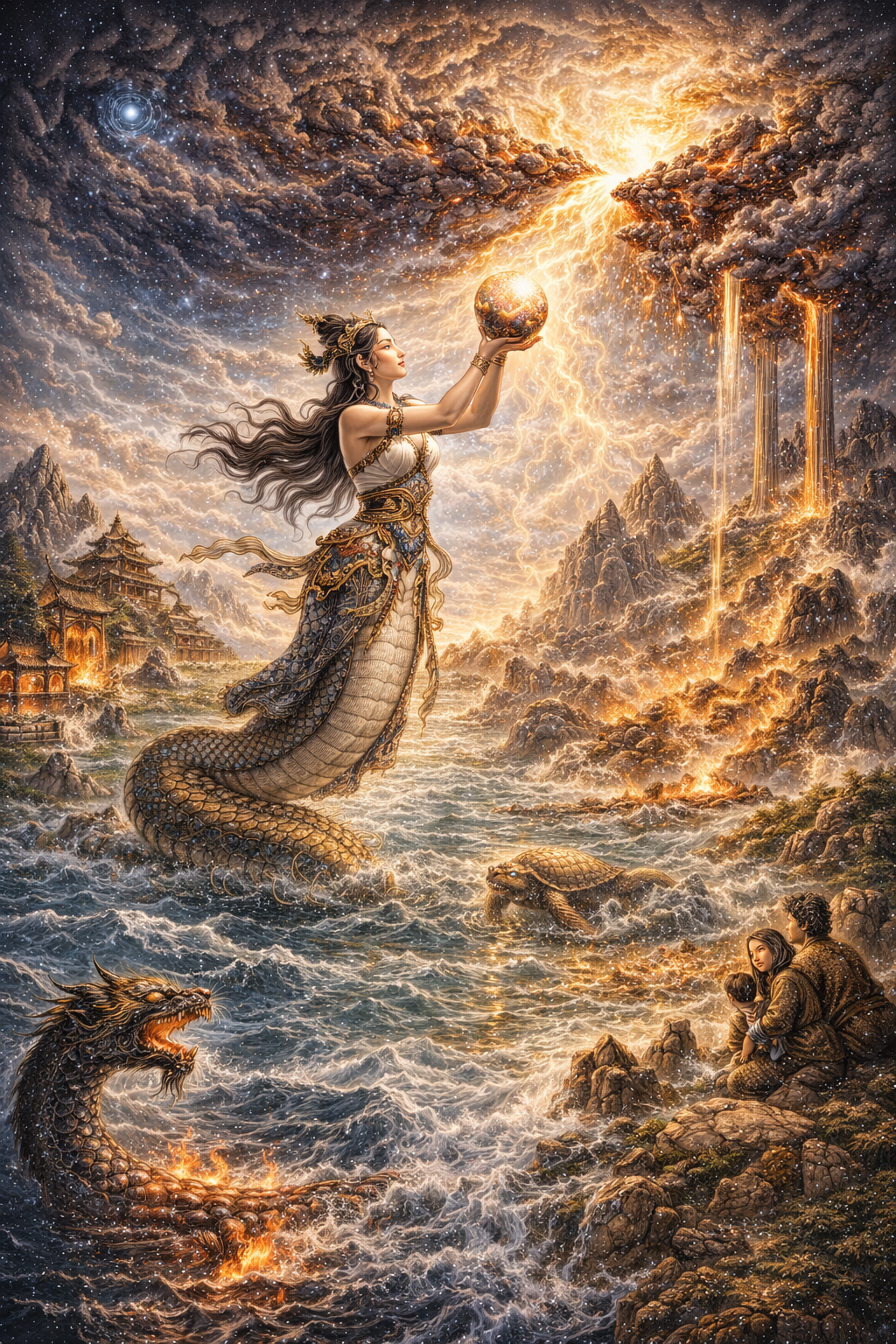
The reparative dimension of Nüwa’s myth is one of the defining features of Chinese cosmogony. In the Huainanzi, she appears in the famous account in which the four limits collapse, heaven no longer covers completely, earth no longer bears fully, fire burns without restraint, waters spread catastrophically, fierce beasts prey upon the people, and she restores order by melting five-colored stones to mend the sky, cutting off the legs of the great turtle to re-establish the supports of the world, killing the black dragon, and using reeds’ ashes to halt the flood. In later descriptions, she is also associated with human origins, marriage order, and the human social world. Taken together, these motifs make Nüwa one of the richest figures in Chinese mythology: creator, civilizer, and healer of the cosmos.
Nüwa’s myth is also important because it gives female sacred agency a world-making scale. She is not merely a helper, consort, decorative goddess, or marginal spirit. She is a figure who confronts the collapse of cosmic order and acts decisively to restore the conditions of life. In this sense, Nüwa belongs among the great world-repairing figures of global mythology. Her power is not conquest for its own sake. It is mending. It is the intelligence of restoration.
Who Is Nüwa?
Nüwa is one of the great primordial figures of Chinese myth. In later summaries of the tradition, she is remembered as a creator or culture-making figure associated with humanity, social order, marriage norms, and world-repair. That combination is revealing. Nüwa is not only linked to the beginning of life, but to the ordering of human relations and the repair of cosmic disorder.
This already distinguishes her from more narrowly cosmogonic figures. Nüwa belongs simultaneously to the story of the cosmos and to the story of society. She is a boundary-crossing figure whose significance reaches from the structure of heaven and earth into the norms that make communal human life possible. She is mythically ancient, but her concerns are practical: human survival, social continuity, bodily life, and the repair of broken relations.
Nüwa is also difficult to reduce to one function. She is sometimes associated with making human beings; sometimes with establishing or regulating marriage; sometimes with repairing the heavens after catastrophe; sometimes with Fuxi as part of a primordial pair; sometimes with a serpent-bodied or dragon-like form that joins human intelligence with archaic natural power. These strands do not cancel one another. They show how her figure gathers multiple dimensions of world-making.
Primary Source
女媧有體,孰製匠之?Nüwa has a body; who fashioned and made it?Chu ci, “Tianwen” 天問.
The question from “Tianwen” preserves Nüwa as a figure of mythic wonder and inquiry. Even her body becomes a problem of origin: who shaped the one who shapes and repairs the world?
This early questioning mode is important. Nüwa is not presented only as a stable mythological character with a fixed biography. She appears as a problem of mythic thought: a being whose body, agency, and origins invite speculation. The question “who fashioned her?” reveals how deep the problem of origins becomes once one asks not only who made the world, but who made the maker or repairer.
Nüwa Within Chinese Cosmogony
Nüwa should be read within the larger plurality of Chinese cosmogony. Chinese mythology does not preserve one universally binding creation epic. Instead, it preserves several overlapping traditions of origin, differentiation, rupture, flood, repair, and civilizational beginning. Within that larger field, Nüwa represents one of the most important answers to a central question: what happens when the world is not stable enough for life?
In this respect, Nüwa complements rather than replaces figures such as Pangu. Pangu dramatizes separation and the establishment of vertical order. Nüwa dramatizes restoration after catastrophic breakdown. Together they show that Chinese world-origin myth is not confined to a single inaugural moment. It includes differentiation, maintenance, repair, and social ordering as equally fundamental dimensions of a habitable cosmos.
This gives Nüwa a distinctive place in the cosmogonic sequence. She is not only a figure who helps explain where human beings come from. She helps explain how the world remains livable after collapse. Her myth assumes that order is vulnerable. The sky can break. The supports can fail. Flood and fire can exceed proper bounds. Predatory violence can threaten human life. Creation is therefore not enough unless the world can also be mended.
Nüwa’s myth also makes visible a reparative model of sacred power. Where some myths imagine world-making as conquest, command, or violent domination, Nüwa’s most famous act is technical, material, and restorative. She smelts stones. She cuts supports. She stops water. She destroys a destructive dragon. She acts like artisan, engineer, ritual restorer, and cosmic healer at once.
Nüwa and Human Origins
One major strand of the Nüwa tradition associates her with the creation or formation of human beings. In a later but influential account attributed to the Fengsu tongyi, she fashions people from yellow earth. When the labor becomes too great, she draws a cord through mud and raises it up, producing more people. The story is important because it links human origins to the material earth, to divine craft, and to the uneven social imagination of later tradition.
Primary Source
俗說天地開闢,未有人民,女媧摶黃土作人。劇務,力不暇供,乃引繩於泥中,舉以為人。Common tradition says that when heaven and earth had opened, there were not yet human people. Nüwa kneaded yellow earth to make humans. The work was urgent and her strength could not supply enough, so she drew a cord through the mud and lifted it up to make people.Tradition attributed to Fengsu tongyi 風俗通義.
This human-creation tradition presents Nüwa as artisan of humanity, but it should also be read critically because later versions use the clay-and-cord contrast to naturalize social hierarchy.
The social implications of this story matter. Later versions often distinguish between people carefully molded from yellow earth and those produced by the cord dragged through mud, using the contrast to explain social status. That element should not be repeated uncritically as harmless folklore. It reveals how origin stories can both dignify human life and encode hierarchy. Nüwa’s act creates people, but the later tradition around the act can also be used to explain inequality as if it were primordial.
This is why Nüwa’s human-origin myth must be read with care. On one level, it gives a powerful image of human beings as earth-formed, crafted, and intentionally brought into the world. On another level, it shows how myth can become a vehicle for social explanation, including explanations that naturalize rank. A serious reading should preserve the beauty of the image while also recognizing the politics of its later interpretation.
Even so, the association of a primordial female figure with human formation remains significant. It places female creative agency at the threshold where the cosmos becomes populated by human beings. Nüwa is not simply mother in a sentimental sense; she is maker, artisan, and civilizational founder. She shapes the human world from the materials of the earth.
Nüwa and the Repair of the Sky
The most famous classical account of Nüwa appears in the Huainanzi. In the “Lanming xun,” the text describes a cosmic catastrophe: the four limits collapse, the provinces crack, heaven fails to cover fully, earth fails to support completely, fires burn uncontrollably, waters overflow, fierce birds and beasts prey upon the people, and the human world becomes unlivable. Nüwa responds by melting five-colored stones to patch the sky, cutting off the legs of a giant turtle to support the four limits, killing the black dragon, and using the ashes of reeds to stop the flood.
This passage is indispensable because it gives one of the clearest classical formulations of Nüwa as a restorer of cosmic order. The meaning of the story is deeper than the image of divine repair alone. It implies that the cosmos is not permanently guaranteed. Its structure can fail. Supports can break. Elements can exceed proper measure. The world becomes deadly when the conditions of order collapse. Nüwa’s work is therefore civilizational as much as cosmic. She does not merely mend the heavens in abstraction. She restores a world in which human life can continue.
Primary Source
往古之時,四極廢,九州裂,天不兼覆,地不周載,火爁炎而不滅,水浩洋而不息,猛獸食顓民,鷙鳥攫老弱。於是女媧煉五色石以補蒼天,斷鼇足以立四極,殺黑龍以濟冀州,積蘆灰以止淫水。In ancient times, the four limits collapsed and the nine provinces split. Heaven could not fully cover; earth could not fully bear. Fire blazed without ceasing; waters surged without rest. Fierce beasts devoured the simple people, and birds of prey seized the old and weak. Then Nüwa smelted five-colored stones to mend the blue heaven, cut the turtle’s legs to set up the four limits, killed the black dragon to rescue Jizhou, and piled reed ashes to stop the overflowing waters.Huainanzi, “Lanming xun” 覽冥訓.
The passage is one of the central classical witnesses to Nüwa’s reparative power. It presents cosmic repair as ecological, social, and human rescue: heaven, earth, water, fire, animals, and vulnerable people all belong to the crisis.
The detail about the old and weak is especially important. The catastrophe is not abstract. It affects the vulnerable first. Predatory birds seize the old and weak; fierce beasts devour ordinary people. Nüwa’s repair is therefore not only cosmic engineering. It is protection of those most exposed to disorder. Her myth insists that a world is not truly repaired unless life within it can be sheltered.
The five-colored stones also matter symbolically. Repair is not a simple patch. It is a restoration of cosmic harmony through differentiated materials. The many-colored medium suggests that order is composite, patterned, and beautiful. The world is repaired through plurality, not through a single undifferentiated substance.
Creation, Repair, and the Meaning of World Order
Nüwa’s myth shows that creation in Chinese mythology cannot be reduced to first beginning alone. A world fit for life is not simply produced once and then left untouched. It may require rescue, rebalancing, and re-establishment of supports. In this sense, Nüwa changes the meaning of creation itself. To create is also to preserve. To preserve is also to mend.
This insight is one of the deepest themes in Chinese cosmogony. Order is relational and vulnerable. Flood, fire, broken pillars, predatory violence, and cosmic instability all dramatize what happens when right relations fail. Nüwa’s response is reparative order. She restores proportion where excess reigns. She turns an unlivable world back into a habitable one.
The sequence of her repair is also significant. She repairs heaven, stabilizes the supports, defeats destructive force, and stops the flood. This is not one isolated act but a system of interventions. The problem is structural, elemental, political, ecological, and human at once. The repair must therefore be equally comprehensive.
Nüwa’s myth offers a model of power that differs from domination. Her power is measured by her ability to restore conditions, not by her ability to rule for its own sake. She does not simply conquer the world. She makes life possible again. Her myth therefore offers a vision of authority grounded in care, technical skill, courage, and responsiveness to crisis.
Nüwa, Fuxi, and the Formation of Human Society
Nüwa’s mythic life also overlaps with that of Fuxi. In later traditional summaries, the two are often paired as primordial or early civilizational figures. They may appear as siblings, spouses, culture-making partners, or serpent-bodied figures whose intertwined forms symbolize primordial pairing and the generation of human society. This connection is significant because it situates Nüwa not only in cosmology but in the ordering of humanity.
The Nüwa-Fuxi pairing is especially important for the mythic imagination of marriage, kinship, and social continuity. If Nüwa is associated with the formation of human beings, her connection with Fuxi helps place human reproduction and social structure within a sacred frame. The mythic question is not only how human beings came to exist, but how human relations became ordered enough to endure.
This social dimension matters enormously. Chinese mythology often ties world-order to human order. A stable cosmos and a stable society are not wholly separate matters. By linking Nüwa to both creation and marriage norms, the tradition suggests that the human world depends on the same kind of structuring intelligence that the cosmos itself requires. She is not merely a mother of people in a biological sense. She is part of the symbolic foundation of civilization.
At the same time, the Nüwa-Fuxi tradition should be handled with interpretive care. Later images of the pair often reflect social, ritual, and gender assumptions from the periods that transmitted them. Their importance lies not in providing a simple historical origin of marriage, but in showing how mythic imagination linked sexuality, kinship, cosmic order, and social regulation.
The Serpent Body and Symbolic Form
Nüwa is frequently described or depicted as having a human head and a serpent or serpentine body. This bodily symbolism is not incidental. Hybrid forms in Chinese mythology often signify beings who move across boundaries that ordinary life keeps apart. Nüwa’s body expresses precisely such liminality: human and more-than-human, civilizing and primordial, earthly and cosmic.
The serpent form also reinforces themes of vitality, continuity, and elemental force. Nüwa does not stand outside nature as a purely transcendent artisan. She is mythically continuous with the living energies and archaic powers of the world she repairs and helps order. Her body makes visible the fact that cosmic intelligence in Chinese myth is often embodied, not abstract.
The serpent body also allows Nüwa to belong to multiple domains at once. Her human head suggests intelligence, speech, craft, and social relation. Her serpentine body suggests earth, water, fertility, transformation, and primordial life. Together they make her an image of mediation. She can repair the sky because she is not confined to one realm. She belongs to the boundary where human, animal, cosmic, and divine forms meet.
This hybrid form should not be treated as monstrous in a simple sense. In mythic terms, hybridity often signals intensified power. Nüwa is not less sacred because she is not wholly human. Her composite body is precisely what makes her capable of acting across the broken relations of the cosmos.
Female Agency and World-Saving Power
Nüwa’s importance is especially clear when read through the lens of female agency. She is one of the strongest examples in Chinese mythology of a female figure whose power is not confined to fertility, beauty, domesticity, or symbolic support. She acts on the largest possible scale. She repairs heaven, stabilizes earth, restrains flood, defeats destructive forces, and protects vulnerable human life.
This matters because later textual traditions often foreground male rulers, sages, culture heroes, and political founders. Nüwa preserves a deeper memory of female sacred power at the foundation of the world. Her agency is technical, cosmological, ecological, and protective. She is not merely associated with life; she intervenes when life is threatened.
The difference between creation and repair is also gendered in a meaningful way. Nüwa’s power is not only generative but restorative. She does not simply produce beings; she responds to breakdown. She enters a world of fire, water, violence, and collapse and makes it livable again. This gives her myth particular resonance for traditions concerned with care, maintenance, healing, and the undervalued labor of sustaining worlds.
Nüwa’s myth also invites a broader reflection on whose labor is remembered as world-making. Myths of origin often celebrate founding acts, conquest, or separation. Nüwa’s story insists that mending is equally foundational. Without repair, creation fails. Without care, order collapses. Without protection of the vulnerable, the world cannot be called habitable.
Nüwa and the Problem of Sources
Nüwa is a major case study in the problem of sources. She appears across multiple textual layers and functions differently within them. In the Chu ci, she is alluded to in a questioning and mythically resonant mode. In the Huainanzi, she appears in the fully developed sky-repair narrative. In the Lunheng, the story is discussed in a more skeptical and rationalizing register, which shows that Nüwa’s myth was already being interpreted, debated, and scrutinized in early intellectual history. In later traditional materials, she appears in relation to human creation, marriage, Fuxi, and the Three Sovereigns.
This layered survival is methodologically important. Nüwa is not a single frozen character whose meaning remains unchanged across all texts. She is a figure whose mythic life expands through literary, philosophical, skeptical, religious, and later folkloric transmission. That is precisely why she matters so much to Chinese myth studies. She reveals how myth survives by being reused, contested, and recontextualized.
Wang Chong’s discussion in the Lunheng is especially revealing because it shows that Nüwa’s sky-repair story was not simply repeated without reflection. It became an object of argument. Could heaven really be patched? What would it mean for the sky to break? How should inherited myth be interpreted? Such questions show that Chinese mythic tradition includes reflection on myth, not only myth itself.
This should shape modern interpretation. To read Nüwa well is not to collapse all her source layers into a single seamless story. It is to ask what each layer does. The Chu ci preserves wonder and question. The Huainanzi gives philosophical-cosmological structure to repair. The Lunheng preserves skeptical scrutiny. Later traditions extend her into human origins and social order. Together, these layers form Nüwa’s mythic archive.
Nüwa in Later Religious and Literary Life
Nüwa did not remain confined to early cosmological texts. Later literary, religious, and popular traditions continued to remember and reinterpret her. Her inclusion among primordial rulers or culture-making figures in later materials shows how she could be elevated into broader civilizational memory. Her presence in later visual, devotional, and narrative settings further indicates that she remained mythically legible beyond early classical discourse.
This afterlife matters because it helps explain her durability. A myth survives more powerfully when it can move from cosmology into culture, from textual allusion into social symbolism, and from philosophical reflection into broader religious imagination. Nüwa endured because she spoke to multiple questions at once: where humans come from, how relations should be ordered, what happens when the world breaks, and what kind of power is needed to restore life.
Her later image also becomes more visually legible through the serpent-bodied form, the pairing with Fuxi, and the iconic act of mending the sky. These motifs make her adaptable across media. She can be represented in painting, temple imagery, popular mythology, educational retellings, animation, and modern fantasy while still carrying the core symbolic logic of repair.
Yet modern retellings can also simplify her. If Nüwa is reduced only to “the goddess who patched the sky,” the depth of her myth is narrowed. She is not only a sky-mender. She is a figure through whom Chinese tradition thinks about human origins, social order, female agency, catastrophic instability, and the sacred labor of making the world livable again.
Modern Afterlives of Nüwa
Nüwa remains one of the most compelling figures in modern presentations of Chinese mythology because her imagery is immediate and powerful: a serpent-bodied goddess, a broken sky, five-colored stones, flood, fire, a threatened people, and the restoration of cosmic order. These elements translate easily into visual art, children’s literature, animation, educational resources, mythology collections, games, and comparative mythology.
Her modern afterlife also reflects contemporary concerns. Nüwa’s myth can speak to ecological crisis because it imagines the world as fragile and repairable. It can speak to gender because it places a female figure at the center of cosmic rescue. It can speak to social ethics because the catastrophe affects vulnerable people, not only abstract cosmic structures. It can speak to systems thinking because the crisis is multi-layered: heaven, earth, water, fire, animals, and humans all fall out of balance together.
Modern interpretation should not force Nüwa into contemporary categories too quickly. She is not simply an environmental symbol, a feminist icon, or a systems metaphor. But her myth remains powerful because it can support such readings without losing its ancient texture. She belongs to a world in which cosmos, ecology, society, and sacred agency are already interwoven.
For readers today, Nüwa offers one of mythology’s most important lessons: repair is not secondary work. Repair is world-making. A civilization that remembers only founders, conquerors, and separators misses the deeper labor required to sustain life. Nüwa restores that missing dimension.
Why Nüwa Still Matters
Nüwa still matters because she offers one of the deepest mythic reflections on fragility and care in the Chinese tradition. She is a creator who does not merely initiate life, but protects the conditions of life when they are threatened. She embodies the insight that order is vulnerable and that the human world depends on acts of restoration as much as on acts of beginning.
She also matters because she expands the meaning of power. Nüwa’s power is not conquest. It is mending. Not domination, but rebalancing. Not distance from the world, but intimate intervention within it. In an archive where chaos, flood, broken supports, and predatory violence repeatedly threaten habitation, Nüwa becomes one of the supreme figures of restorative order.
Nüwa also matters because she foregrounds a form of world-saving agency that is often undervalued: repair, care, stabilization, and protection of the vulnerable. Her myth does not imagine the world as self-sufficient once created. It imagines a cosmos that can fail and a sacred figure who responds. In this respect, Nüwa remains a powerful counterimage to myths that equate power only with domination or conquest.
Finally, Nüwa matters because she helps define Chinese cosmogony as a plural tradition. Alongside Pangu’s separation of heaven and earth, the Huainanzi’s philosophical ordering of myth, the Chu ci’s questions to heaven, and later human-origin traditions, Nüwa shows that creation is not one thing. It is beginning, differentiation, repair, social ordering, and the ongoing work of making life possible.
Related Reading
- Chinese Myth, Folklore & Legend
- What Is Chinese Myth, Folklore & Legend?
- The Problem of Sources in Chinese Mythology
- Chaos, Cosmos, and the Origins of the World in Chinese Myth
- Pangu and the Separation of Heaven and Earth
- The Huainanzi and the Philosophical Ordering of Myth
- Mythic Allusion and Cosmology in the Chu Ci
- Chinese Thought
Primary Sources
- Chinese Text Project (n.d.) Chu ci: Tianwen 楚辭:天問. Available at: https://ctext.org/chu-ci/tian-wen/zh
- Chinese Text Project (n.d.) Huainanzi: Lanming xun 淮南子:覽冥訓. Available at: https://ctext.org/huainanzi/lan-ming-xun/zh
- Chinese Text Project (n.d.) Lunheng: Tan Tian 論衡:談天. Available at: https://ctext.org/lunheng/tan-tian
- Chinese Text Project (n.d.) Fengsu tongyi: San Huang 風俗通義:三皇. Available at: https://ctext.org/fengsutongyi/huang-ba/san-huang/ens
- Chinese Text Project (n.d.) Liezi: Tang Wen 列子:湯問. Available at: https://ctext.org/liezi/tang-wen
- Wikisource (n.d.) Huainanzi: Lanming xun 淮南子:覽冥訓. Available at: https://zh.wikisource.org/wiki/%E6%B7%AE%E5%8D%97%E5%AD%90/%E8%A6%BD%E5%86%A5%E8%A8%93
Further Reading
- Birrell, A. (1993) Chinese Mythology: An Introduction. Baltimore: Johns Hopkins University Press. Available at: https://archive.org/details/chinesemythology0000birr
- Yang, L. and An, D. (2005) Handbook of Chinese Mythology. Santa Barbara: ABC-CLIO. Available at: https://archive.org/details/handbookofchines0000yang
- Major, J.S., Queen, S.A., Meyer, A.S. and Roth, H.D. (2010) The Huainanzi: A Guide to the Theory and Practice of Government in Early Han China. New York: Columbia University Press. Available at: https://cup.columbia.edu/book/the-huainanzi/9780231142045
- Chinese Text Project (n.d.) Huainanzi: Lanming xun. Available at: https://ctext.org/huainanzi/lan-ming-xun/zh
- Chinese Text Project (n.d.) Chu ci: Tianwen. Available at: https://ctext.org/chu-ci/tian-wen/zh
- Chinese Text Project (n.d.) Lunheng: Tan Tian. Available at: https://ctext.org/lunheng/tan-tian
- Chinese Text Project (n.d.) Fengsu tongyi: San Huang. Available at: https://ctext.org/fengsutongyi/huang-ba/san-huang/ens
- Encyclopaedia Britannica (n.d.) “Nu Gua.” Available at: https://www.britannica.com/topic/Nu-Gua
- Encyclopaedia Britannica (n.d.) “Chinese mythology.” Available at: https://www.britannica.com/topic/Chinese-mythology
References
- Birrell, A. (1993) Chinese Mythology: An Introduction. Baltimore: Johns Hopkins University Press. Available at: https://archive.org/details/chinesemythology0000birr
- Chinese Text Project (n.d.) Chu ci: Tianwen. Available at: https://ctext.org/chu-ci/tian-wen/zh
- Chinese Text Project (n.d.) Fengsu tongyi: San Huang. Available at: https://ctext.org/fengsutongyi/huang-ba/san-huang/ens
- Chinese Text Project (n.d.) Huainanzi: Lanming xun. Available at: https://ctext.org/huainanzi/lan-ming-xun/zh
- Chinese Text Project (n.d.) Liezi: Tang Wen. Available at: https://ctext.org/liezi/tang-wen
- Chinese Text Project (n.d.) Lunheng: Tan Tian. Available at: https://ctext.org/lunheng/tan-tian
- Encyclopaedia Britannica (n.d.) “Chinese mythology.” Available at: https://www.britannica.com/topic/Chinese-mythology
- Encyclopaedia Britannica (n.d.) “Nu Gua.” Available at: https://www.britannica.com/topic/Nu-Gua
- Major, J.S., Queen, S.A., Meyer, A.S. and Roth, H.D. (2010) The Huainanzi: A Guide to the Theory and Practice of Government in Early Han China. New York: Columbia University Press. Available at: https://cup.columbia.edu/book/the-huainanzi/9780231142045
- Wikisource (n.d.) Huainanzi: Lanming xun. Available at: https://zh.wikisource.org/wiki/%E6%B7%AE%E5%8D%97%E5%AD%90/%E8%A6%BD%E5%86%A5%E8%A8%93
- Yang, L. and An, D. (2005) Handbook of Chinese Mythology. Santa Barbara: ABC-CLIO. Available at: https://archive.org/details/handbookofchines0000yang