
Last Updated May 5, 2026
Chinese myth, folklore, and legend designate a vast and historically layered field of narrative, symbolic, ritual, literary, and religious tradition in which cosmogony, sacred geography, dynastic memory, divine and semi-divine agency, supernatural encounter, moral order, and cultural reinvention converge. The field extends from early classical textual witnesses to living ritual, from sacred mountains to temple festivals, from flood-control narratives to fox-spirit tales, from legendary sage-kings to vernacular opera, from local cults to modern cinema, television, animation, games, and digital storytelling. It cannot be reduced to a single mythological canon, a single authoritative scripture, or a single orderly genealogy of gods. Instead, it survives in dispersed, overlapping, and continually reworked forms across texts, rites, performances, images, festivals, landscapes, and local traditions.
To ask what Chinese myth, folklore, and legend are is therefore to ask a deeper civilizational question: how have order, origins, power, ancestry, catastrophe, transformation, death, landscape, and the relationship between heaven, earth, spirits, and human community been imagined across long stretches of Chinese cultural history? The answer is necessarily plural. Chinese mythic culture is not a closed archive of ancient stories frozen in an earlier age. It is an evolving symbolic world, extending across millennia, in which archaic motifs, religious adaptation, literary elaboration, regional practice, ethnic plurality, popular transmission, and modern reinvention all play constitutive roles.
Series context: This article is part of the Chinese Myth, Folklore & Legend knowledge series. For the broader field of mythic traditions, return to the Mythology library.
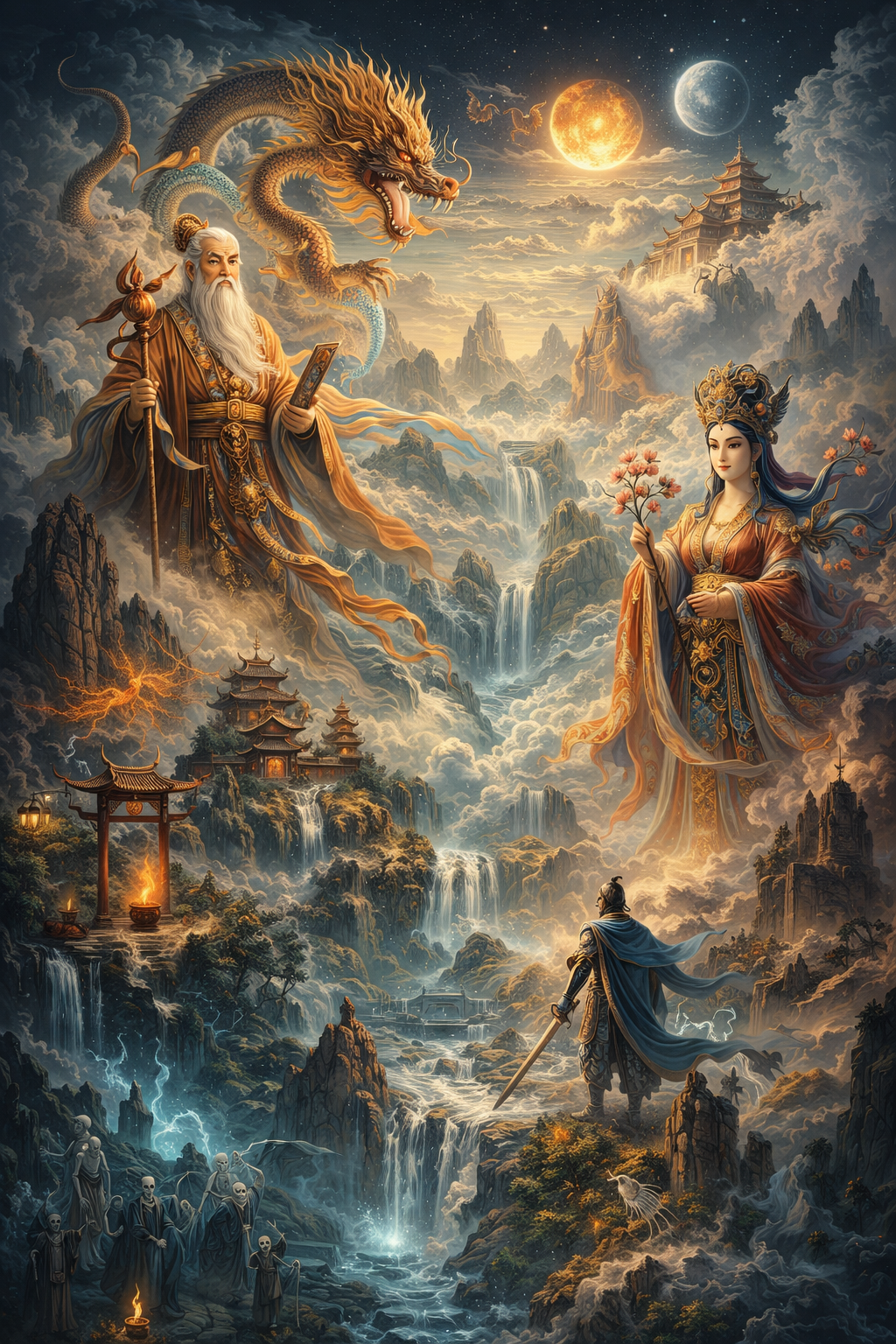
Unlike traditions that preserve myth primarily through a single epic cycle or tightly bounded corpus, Chinese mythic materials are scattered across many genres, institutions, regions, and periods. Early evidence appears in works such as the Shanhaijing, the Chu ci, the Huainanzi, transmitted classical literature, dynastic histories, ritual materials, local cult traditions, and later collections of anomaly and supernatural narrative. Chinese folklore and legend extend this archive further still into the worlds of ghost lore, dragon traditions, sea-goddess devotion, calendrical festivals, temple performance, oral storytelling, opera, pilgrimage, regional religious practice, and local memory. The subject is therefore best understood not as a single mythology in the narrow sense, but as an interconnected field in which myth, folklore, legend, ritual, religion, and literature interact continuously.
This breadth is not a defect of the archive but one of its defining strengths. Chinese mythic tradition was never exclusively literary, nor was it ever confined to a single institution. It was cosmological, ritual, political, local, artistic, ecological, and performative all at once. Mythic materials became durable not simply because they were recorded in texts, but because they were incorporated into seasonal life, sacred landscapes, visual culture, moral instruction, temple networks, theatrical transmission, family memory, craft traditions, and popular devotion. Chinese myth, folklore, and legend thus illuminate not only ancient imagination, but the long historical durability of symbolic forms within Chinese civilization.
Defining the Field
Chinese myth, folklore, and legend together form a broad field of inquiry concerned with how communities imagine origins, sacred power, moral order, environmental danger, extraordinary beings, ancestors, cosmic pattern, political legitimacy, ritual obligation, and the visible and invisible dimensions of the world. In the Chinese case, these materials are not limited to “mythology” in the narrow sense of tales about gods. They include narratives of cosmic differentiation, flood and repair, culture heroes, sacred rulers, mountain paradises, underworld judges, immortals, dragons, ghosts, fox spirits, miracle tales, deity cults, festival stories, local protectors, pilgrimage legends, and ritual narratives embedded in seasonal and communal life.
The field is particularly important because it occupies a meeting point between literature, religion, philosophy, politics, art, ecology, and everyday practice. Mythic narratives were not merely stories told for entertainment, nor were they only remnants of a supposedly primitive worldview displaced by later intellectual traditions. They remained entangled with ritual life, state symbolism, cosmological speculation, morality, local identity, visual representation, family memory, popular drama, and the embodied practices of festivals and temple communities. The study of Chinese myth, folklore, and legend therefore reveals how narrative and symbol helped mediate enduring questions of order, legitimacy, mortality, nature, fate, transformation, and the uncertain boundary between the human and the more-than-human world.
Any adequate definition must also recognize the temporal scale of the archive. The tradition spans early textual witnesses, medieval supernatural literature, late-imperial vernacular storytelling, temple and festival culture, regional oral traditions, ethnic and non-Han narrative worlds, and modern afterlives in literature, cinema, television, animation, games, and digital media. What unites this diverse material is not a single doctrine, but an enduring repertoire of symbols, figures, motifs, ritual settings, narrative structures, and spatial imaginations through which Chinese societies repeatedly imagined the visible and invisible worlds.
A Note on Sources, Translation, and Method
The study of Chinese myth requires special care because its sources do not behave like a single scripture, epic, or closed mythological handbook. Many important materials survive as fragments, allusions, ritual traces, poetic questions, geographical catalogues, anomaly tales, later commentaries, local traditions, and vernacular retellings. A figure may appear briefly in an early text and then receive far fuller development in religious practice, drama, fiction, visual art, or regional devotion. A mountain may be described as geography, but function as a sacred map. A deity may be a literary figure in one source, a ritual presence in another, and a local protector in a temple community.
For that reason, translation and interpretation matter. The bilingual source blocks in this article do not claim to provide exhaustive philological translations. They offer compact English renderings designed to preserve the interpretive force of selected passages: cosmological questioning, sacred geography, world-repair, and the archive-like texture of early Chinese mythic imagination. Classical Chinese passages are included where they clarify how early sources framed myth not as a detachable story alone, but as a way of thinking through world-order, landscape, rupture, repair, and divine-human relation.
Primary Source
遂古之初,誰傳道之?上下未形,何由考之?At the beginning of ancient time, who handed down the way? Before above and below had taken form, how could it be examined?Chu ci, “Tianwen” 天問.
The opening questions of “Tianwen” show why Chinese mythic material often survives as inquiry rather than system: the poem does not simply narrate origins; it interrogates the possibility of knowing them.
This questioning mode is crucial. Chinese mythic traditions frequently preserve origins through uncertainty, allusion, and layered recollection rather than through a single linear creation story. The archive asks where heaven and earth came from, how the realms were divided, how floods were contained, how rulers became legitimate, how mountains and waters became charged with sacred power, and how human beings might live within a cosmos that is ordered but never fully transparent.
Myth, Folklore, and Legend: Distinctions and Overlap
Myth refers here to narratives and symbolic structures concerned with creation, destruction, ordering, sacred origins, divine or semi-divine beings, cosmic patterns, and the fundamental relation between heaven, earth, spirits, ancestors, rulers, and the human sphere. In the Chinese context, myth includes stories of primordial disorder, world separation, flood control, celestial movements, sacred mountains, paradisal realms, extraordinary founders, culture heroes, and beings whose existence signals more than human power.
Folklore refers to the wider body of socially transmitted beliefs, tales, customs, seasonal practices, ritual observances, and communal symbolic forms that circulate through everyday life. Chinese folklore includes ghost traditions, fox-spirit narratives, dragon customs, temple lore, household protections, miracle stories, popular deity devotion, local legends, festival practices, calendrical beliefs, oral storytelling, and regional performance traditions. Folklore is often carried not only by texts but by ritual repetition, intergenerational storytelling, artistic practice, local memory, and communal enactment.
Legend occupies a middle ground between sacred myth and historical memory. Legends are commonly attached to named rulers, cities, temples, saints, mountains, dynastic transitions, local sites, women of extraordinary virtue or danger, divine interventions, and historical crises. They often claim some relation to the historical world, but they do so through symbolic amplification and narrative reshaping rather than modern documentary standards. In Chinese tradition, legendary rulers, founders, sages, women immortals, popular heroes, and local protectors frequently inhabit precisely this intermediate terrain, where remembered antiquity, moral idealization, political imagination, and mythic pattern converge.
These distinctions are useful for analysis but cannot be treated as rigid boundaries. A single story may function as myth in one context, legend in another, and folklore in a third. A dragon may be at once a cosmological power, a political emblem, an object of ritual invocation, and a figure of local celebration. A female deity may belong simultaneously to sacred geography, liturgical devotion, oral legend, maritime protection, and theatrical performance. A fox spirit may be a dangerous seducer, a sign of social anxiety, a figure of female agency, a literary device, or a being through whom marginal spaces speak. The Chinese archive continually dissolves neat modern classifications, and any serious interpretation must be comfortable with that fluidity.
Why Chinese Myth Does Not Take the Form of a Single Canon
One of the most important starting points for the study of Chinese myth is that it does not survive as a single, internally unified, canonical mythology. There is no one text that preserves the totality of Chinese divine genealogy, cosmology, sacred history, heroic legend, and underworld geography in the way modern readers sometimes expect from mythology as a category. Instead, early mythic materials survive in dispersed form, embedded within poetic works, philosophical treatises, geographical compilations, ritual texts, historical writing, religious literature, local cults, and later vernacular adaptation.
This does not indicate an absence of myth. On the contrary, it indicates a different mode of cultural preservation. Mythic materials in China were often reframed by traditions whose immediate concerns were not simply mythological preservation as such. Philosophers adapted mythic motifs to cosmological argument. Court historians incorporated legendary antiquity into narratives of rulership and order. Religious traditions reinterpreted sacred figures through liturgy, iconography, scripture, ritual, and doctrinal synthesis. Popular religion localized divine presences in temples, mountains, rivers, coastlines, households, guilds, and pilgrimage circuits. Storytellers and dramatists recast inherited symbols for performance, entertainment, and moral instruction.
The result is not a deficiency but a multilayered archive in which myth survives through transformation. Chinese mythology is therefore often reconstructed comparatively and historically rather than encountered as a fully packaged system. This requires patience, philological sensitivity, and a willingness to read across genres, regions, ritual practices, and centuries. The absence of a single canon is part of what allows the tradition to remain so generative: myth can move from mountain catalogue to philosophical text, from temple rite to opera stage, from local cult to national icon, and from classical allusion to modern visual media.
Textual Survival, Fragmentation, and Reconstruction
Because the archive is dispersed, the problem of sources becomes foundational. Early Chinese myth is preserved in fragmentary and layered form, often through texts that mix cosmological speculation, geography, political reflection, poetry, ritual reference, ethnographic imagination, and marvel literature. The field therefore demands methodological caution. One must attend not only to what a text says, but to what kind of text it is, when it was compiled, how it was transmitted, what earlier materials it may preserve, and how later traditions may have reframed the material.
The Shanhaijing is central because it preserves a world dense with sacred mountains, strange beings, extraordinary landscapes, divine traces, ritual associations, mineral and medicinal substances, monstrous bodies, borderlands, and civilizational edges. It does not present a single continuous narrative. Rather, it offers a map-like symbolic archive in which geography and myth are inseparable. The work is indispensable precisely because it preserves a mythic imagination embedded in spatial description.
The Chu ci preserves another dimension of the early archive: celestial movement, visionary travel, divine encounter, erotic-sacred longing, exile, political anguish, cosmological allusion, and the richly symbolic language of poetic imagination. Here mythic materials are not systematized as doctrine but activated as a powerful expressive repertoire. The Huainanzi, by contrast, is especially important because it shows how mythic motifs could be incorporated into a larger philosophical and cosmological synthesis. Rather than preserving myth as isolated tale, it reorganizes inherited symbolic materials within a broader theory of order, rulership, resonance, and cosmic process.
Later texts and traditions preserve still further layers. Anomaly literature, miracle collections, supernatural tales, local gazetteers, vernacular fiction, religious compilations, temple inscriptions, visual art, dramatic traditions, and oral performance all contribute to the survival of the mythic archive. This means that Chinese mythology must be studied not as a single body of evidence, but as an accretional field in which symbolic motifs endure through repeated acts of reinterpretation.
Cosmology, World-Ordering, and Sacred Geography
Chinese mythic thought is profoundly cosmological. It is concerned not merely with marvelous beings, but with the structuring of reality itself: the relation between primordial disorder and patterned order, the separation of realms, the balancing of forces, the movement of heaven, the stability of earth, the role of waters, the dangers of fire, the location of sacred mountains, and the moral resonance of the natural world. Myth in this sense is one of the narrative languages through which a civilization thinks about how the world becomes inhabitable.
This cosmological orientation helps explain the prominence of themes such as chaos and world-ordering, flood and repair, heaven and mandate, sacred mountains, paradisal realms, dragons associated with water and rain, and culture heroes who bring agriculture, medicine, social order, ritual propriety, writing, music, or political stability. Chinese mythic narratives frequently tie environmental and cosmic order to ethical and political order. The world is not simply there; it must be regulated, harmonized, repaired, or rightly aligned.
Primary Source
於是女媧煉五色石以補蒼天,斷鼇足以立四極。Then Nüwa smelted five-colored stones to mend the blue heaven, and cut the turtle’s legs to set up the four limits.Huainanzi, “Lanming xun” 覽冥訓.
The Nüwa world-repair narrative presents myth as cosmic restoration: broken heaven, unstable earth, flood, fire, and predatory violence are answered through repair, stabilization, and the reestablishment of livable order.
Sacred geography is one of the most distinctive features of the Chinese archive. Mountains, rivers, seas, grottoes, islands, celestial territories, western paradises, underworld courts, borderlands, and liminal edges all participate in mythic thought. Geography in this tradition is never merely topographical. It is symbolic, ritualized, medicinal, political, and morally charged. Certain landscapes become places where divine presence, extraordinary beings, immortality, revelation, danger, civilizational boundary, or ancestral memory are concentrated.
Primary Source
海內崑崙之墟,在西北,帝之下都。Within the realm, the ruins of Kunlun lie in the northwest: the lower capital of the Thearch.Shanhaijing, “Hainei xi jing” 海內西經.
Kunlun is not merely a mountain. In early mythic geography, it appears as a charged sacred center linking landscape, divine residence, cosmic hierarchy, and the spatial imagination of the world.
This gives Chinese mythology a particularly spatial texture. The world of myth is not only a sequence of events but a field of charged locations. Sacred mountains and distant regions are not backdrops for myth; they are active structures of meaning. A mountain can be a divine residence, a source of strange plants and animals, a boundary of the known world, a place of immortality, or a symbolic axis between heaven and earth. Rivers and seas are likewise not passive scenery; they are channels of danger, fertility, transport, purification, and sacred passage.
Ritual, Religion, and Popular Practice
Chinese myth cannot be separated from ritual and religion. Ancestor reverence, sacrificial traditions, temple practice, Daoist symbolism, Buddhist adaptation, spirit mediumship, seasonal observance, healing rites, household protection, and local deity cults all shape the way mythic materials were preserved and interpreted. Myth, in this context, is not merely narrative ornament or literary residue. It is embedded in lived worlds of reverence, petition, offering, protection, healing, commemoration, and sacred obligation.
This is especially important because Chinese religion is not reducible to a single ecclesiastical form. The field often described as Chinese popular religion includes local gods, tutelary deities, mother goddesses, sea cults, spirit officials, underworld courts, exorcistic practices, sacred calendars, temple festivals, pilgrimage networks, household altars, and regional ritual specialists. Many of the figures central to folklore and legend remain socially real within such contexts—not necessarily as abstract theological propositions, but as participants in ritual life, moral order, and communal identity.
Daoism played a particularly important role in preserving and transforming the mythic archive. Immortals, paradisal mountains, celestial bureaucracies, talismanic cosmology, sacred bodies of practice, inner alchemy, thunder rites, protective deities, and divine pantheons all contributed to the religious elaboration of older mythic material. Buddhism, too, shaped the field by contributing underworld imagery, karmic moral logics, miracle narratives, hagiographic structures, ritual technologies, bodhisattva devotion, and the translation of transregional motifs into locally meaningful forms. Much of what later readers encounter as “Chinese myth” is inseparable from these religious mediations.
The same is true of ritual calendars. New Year observances, dragon-associated rites, lantern festivals, temple fairs, ghost festivals, maritime processions, agricultural rites, and solar-term traditions preserve narrative memory through recurrent practice. Mythic consciousness is sustained not only by reading but by doing. The calendar, the temple, the performance space, the household threshold, and the pilgrimage route all become media through which mythic memory survives.
Legendary History and the Political Imagination
A defining feature of Chinese mythic tradition is its deep entanglement with the memory of rulership, civilization, and moral order. Legendary rulers, sage-kings, dynastic founders, culture heroes, loyal ministers, dangerous beauties, rebel figures, and divinized officials often inhabit a zone where mythic symbolism and political thought overlap. Figures associated with flood control, agriculture, law, medicine, music, writing, invention, ritual, or ethical governance are not merely colorful heroes of antiquity. They become carriers of reflection on legitimacy, social order, and the conditions under which human life becomes governable and civilized.
This is why the distinction between myth and history can be especially complex in Chinese materials. Legendary antiquity is not usually presented as pure fantasy severed from collective memory. Rather, it is often treated as a morally charged deep past through which later societies think about rightful rule, the harmonization of heaven and earth, the taming of chaos, the discipline of desire, the dangers of tyranny, and the obligations of sovereign authority. The stories of sage-kings and founder figures therefore belong simultaneously to mythic narrative, political theology, ethical reflection, and civilizational memory.
Such materials matter not because they provide straightforward historical data, but because they reveal the symbolic grammar of governance. They show how power is imagined when it is placed under cosmological and moral judgment. Heaven, mandate, omen, flood, drought, monstrous disorder, and ancestral precedent become ways of evaluating rule. In this respect, Chinese legend is one of the places where narrative, ethics, and statecraft meet.
Folklore, Performance, and Living Tradition
If myth illuminates origins and cosmic structures, folklore shows how symbolic worlds continue to inhabit social life. Chinese folklore includes ghost tales, stories of revenants and unsettled dead, fox spirits associated with seduction or ambiguity, serpent maidens, star-crossed lovers, local miracle traditions, pilgrimage legends, sea-goddess narratives, ritual dramas, protective charms, household tales, and countless regional stories tied to mountains, temples, families, rivers, crafts, and historical sites.
These traditions endure not only through books, but through performance and recurrence. Opera, storytelling, shadow puppetry, festival enactment, ritual theater, decorative art, temple imagery, popular prints, procession, pilgrimage, balladry, and regional dramatic forms all serve as media of transmission. In many cases, performance has preserved myths and legends more effectively than elite textual commentary alone. Communities remember stories because they re-enact them, sing them, dramatize them, display them, and place them within annual cycles of expectation and participation.
This performative dimension is one reason Chinese folklore is central not only to literary history but also to anthropology, religious studies, performance studies, art history, heritage studies, and the study of intangible cultural practice. Folklore is not just what a society once believed. It is what communities continue to carry, reshape, contest, and inhabit. The living force of folklore is especially visible in traditions that remain tied to local temples, regional operas, seasonal festivals, and family transmission rather than only to printed texts.
Plurality, Regions, and Cultural Layers
No serious account of Chinese myth, folklore, and legend can reduce the field to a single homogeneous narrative. The archive includes major Han traditions, but it also includes coastal cult systems, frontier traditions, vernacular religious worlds, local deity networks, and narrative systems associated with Tibetan, Qiang, Miao, Yao, Mongol, Manchu, Uyghur, Zhuang, Hakka, Minnan, and other regional or ethnic communities. Some mythic materials circulate across the entire civilization; others remain strongly local. Some are textualized early; others survive primarily through ritual and performance. Some become absorbed into nationally recognizable iconography; others remain attached to particular places, dialects, lineages, and social worlds.
This plurality is analytically essential. “Chinese mythology” is not best understood as a monolith but as a layered narrative ecology. Daoist, Buddhist, popular, local, courtly, vernacular, ethnic, regional, and diasporic traditions intersect and overlap, sometimes reinforcing one another and sometimes producing competing symbolic emphases. A mountain goddess, a sea protectress, a fox spirit, a legendary ruler, a martial hero, or a local underworld official may occupy very different roles depending on the textual, ritual, and regional setting in which they appear.
Foregrounding plurality also helps prevent the flattening of Chinese myth into a simple list of gods, monsters, and famous stories. The field includes imperial centers, but also village temples; literary elites, but also performers; classical sources, but also oral communities; dominant Han frameworks, but also the mythic memories of borderlands, minorities, migrants, women, ritual specialists, and local devotional worlds. The result is a field that is both coherent and internally diverse. Coherence arises from long civilizational continuities of symbol, cosmology, and transmission. Diversity arises from regional practice, religious layering, ethnic plurality, political change, migration, and the flexibility of narrative forms.
Gender, Spirits, and Social Power
Gender is one of the most revealing dimensions of Chinese myth, folklore, and legend. Female figures appear as creators, repairers, goddesses, immortals, ghosts, fox spirits, serpent women, lovers, mothers, dangerous beauties, betrayed wives, martyrs, protectors, healers, and local deities. Nüwa repairs the broken cosmos. Chang’e becomes associated with the moon and separation. The Weaver Girl gives celestial romance a calendrical life. Mazu becomes a maritime protector whose cult links local devotion, coastal danger, migration, and transregional pilgrimage. Fox spirits and ghost women frequently expose anxieties about sexuality, class mobility, examination culture, household order, and male vulnerability.
These stories should not be reduced to stereotypes of the seductive woman, the pure maiden, or the dangerous female spirit. They often encode deeper tensions around power, vulnerability, social constraint, desire, widowhood, marriage, migration, kinship, marginality, and the moral limits of patriarchal order. Female spirits may frighten, rescue, seduce, instruct, avenge, heal, or protect. Their ambiguity is precisely what makes them important. Through them, folklore gives narrative form to voices and pressures that formal political and philosophical texts often marginalize.
Gendered mythic figures also show how living religion can elevate local women into divine protectors, ritual patrons, and communal ancestors. Sea-goddess traditions, mother-goddess cults, fertility rites, and local female deities complicate any simple assumption that Chinese mythic culture is only a patriarchal extension of state order. The field contains hierarchy and constraint, but it also contains symbolic spaces where women, spirits, and marginal beings become carriers of power, memory, and protection.
Modern Reinvention and Comparative Afterlives
Chinese myth, folklore, and legend remain active in modern cultural production. Classical figures such as Nüwa, Fuxi, the Queen Mother of the West, Chang’e, Hou Yi, Nezha, Sun Wukong, Mazu, the White Snake, Erlang Shen, Zhong Kui, dragons, fox spirits, ghosts, and underworld judges continue to move through literature, animation, film, television, comics, video games, museum exhibitions, tourism, festival revival, and digital fandom. Their modern afterlives are not simply decorative. They often become ways of negotiating identity, memory, gender, ecological anxiety, national narrative, regional pride, diaspora belonging, and global mythic comparison.
Modern reinvention can deepen or flatten the tradition. Some adaptations recover older complexity, regional voices, and religious textures. Others turn myth into spectacle, fantasy branding, or simplified heroic archetype. The challenge for serious interpretation is to track how inherited symbols change when they move into new media environments. A mythic figure in a classical text, a temple festival, a Qing tale collection, a shadow-puppet performance, a twentieth-century film, and a contemporary game may share a name while functioning very differently.
Comparative study can be valuable when handled carefully. Chinese mythic materials can be placed alongside Greek, Mesopotamian, Indian, Japanese, Korean, Indigenous, African, or Abrahamic traditions in relation to flood, creation, underworlds, divine messengers, world mountains, dragons, culture heroes, tricksters, sacred law, and cosmic repair. Yet comparison should not erase difference. Chinese mythic tradition has its own distinctive modes: distributed textual survival, sacred geography, ritual continuity, bureaucratic imagination of the spirit world, landscape cosmology, and the persistent interweaving of myth, history, and popular practice.
Why the Field Matters
Chinese myth, folklore, and legend matter because they preserve long-duration reflections on order, danger, legitimacy, transformation, mortality, environment, kinship, social hierarchy, marginal voices, sacred landscape, and the unseen dimensions of the world. They reveal how narrative helps societies imagine the cosmos, domesticate fear, interpret disaster, moralize power, encode memory, and situate everyday life within a larger symbolic horizon.
They also matter because they remain active. Mythic and folkloric materials continue to animate visual culture, festival practice, performance traditions, education, tourism, literary reinvention, cinema, television, gaming, digital storytelling, diaspora memory, and local ritual life. Their afterlives are not superficial residues. They remain among the most powerful means by which inherited symbols move into new historical conditions.
To study Chinese myth, folklore, and legend, then, is not only to examine ancient stories. It is to explore a durable and adaptive civilizational archive in which cosmology, ritual, politics, artistry, ecology, gender, regional memory, and collective imagination continually interact. The field offers insight not merely into what people once imagined, but into how symbolic worlds persist, change, and continue to organize meaning across time.
Related Reading
- Chinese Myth, Folklore & Legend
- Mythology
- Chinese Thought
- East Asian Traditions
- Chinese Literature and Classical Memory
Primary Sources
- Chinese Text Project (n.d.) Shanhaijing 山海經 / Classic of Mountains and Seas. Available at: https://ctext.org/shan-hai-jing
- Chinese Text Project (n.d.) Chu ci 楚辭 / Songs of Chu. Available at: https://ctext.org/chu-ci
- Chinese Text Project (n.d.) Chu ci: Tianwen 楚辭:天問. Available at: https://ctext.org/chu-ci/tian-wen/zh
- Chinese Text Project (n.d.) Huainanzi 淮南子. Available at: https://ctext.org/huainanzi
- Chinese Text Project (n.d.) Huainanzi: Lanming xun 淮南子:覽冥訓. Available at: https://ctext.org/huainanzi/lan-ming-xun/zh
- Chinese Text Project (n.d.) Soushen Ji 搜神記 / In Search of the Supernatural. Available at: https://ctext.org/wiki.pl?if=en&res=839038
- Chinese Text Project (n.d.) Shijing 詩經 / Book of Odes. Available at: https://ctext.org/book-of-poetry
Further Reading
- Birrell, A. (1993) Chinese Mythology: An Introduction. Baltimore: Johns Hopkins University Press. Available at: https://archive.org/details/chinesemythology0000birr
- Major, J.S., Queen, S.A., Meyer, A.S. and Roth, H.D. (2010) The Huainanzi: A Guide to the Theory and Practice of Government in Early Han China. New York: Columbia University Press. Available at: https://cup.columbia.edu/book/the-huainanzi/9780231142045
- Strassberg, R.E. (2002) A Chinese Bestiary: Strange Creatures from the Guideways Through Mountains and Seas. Berkeley: University of California Press. Available at: https://www.ucpress.edu/book/9780520298514/a-chinese-bestiary
- Yang, L. and An, D. (2005) Handbook of Chinese Mythology. Santa Barbara: ABC-CLIO. Available at: https://archive.org/details/handbookofchines0000yang
- Metropolitan Museum of Art (2004) “Nature in Chinese Culture.” Available at: https://www.metmuseum.org/essays/nature-in-chinese-culture
- Metropolitan Museum of Art (2011) “Daoism and Daoist Art.” Available at: https://www.metmuseum.org/essays/daoism-and-daoist-art
- UNESCO Intangible Cultural Heritage (n.d.) “China.” Available at: https://ich.unesco.org/en/state/china-CN?info=elements-on-the-lists
References
- Chinese Text Project (n.d.) Shanhaijing. Available at: https://ctext.org/shan-hai-jing
- Chinese Text Project (n.d.) Shanhaijing: Hainei xi jing. Available at: https://ctext.org/shan-hai-jing/hai-nei-xi-jing/zh
- Chinese Text Project (n.d.) Chu ci. Available at: https://ctext.org/chu-ci
- Chinese Text Project (n.d.) Chu ci: Tianwen. Available at: https://ctext.org/chu-ci/tian-wen/zh
- Chinese Text Project (n.d.) Huainanzi. Available at: https://ctext.org/huainanzi
- Chinese Text Project (n.d.) Huainanzi: Lanming xun. Available at: https://ctext.org/huainanzi/lan-ming-xun/zh
- Chinese Text Project (n.d.) Soushen Ji. Available at: https://ctext.org/wiki.pl?if=en&res=839038
- Chinese Text Project (n.d.) Shijing. Available at: https://ctext.org/book-of-poetry
- Metropolitan Museum of Art (2004) “Nature in Chinese Culture.” Available at: https://www.metmuseum.org/essays/nature-in-chinese-culture
- Metropolitan Museum of Art (2011) “Daoism and Daoist Art.” Available at: https://www.metmuseum.org/essays/daoism-and-daoist-art
- UNESCO Intangible Cultural Heritage (n.d.) “China.” Available at: https://ich.unesco.org/en/state/china-CN?info=elements-on-the-lists
- UNESCO Intangible Cultural Heritage (2009) “Mazu belief and customs.” Available at: https://ich.unesco.org/en/RL/mazu-belief-and-customs-00269
- UNESCO Intangible Cultural Heritage (2011) “Chinese shadow puppetry.” Available at: https://ich.unesco.org/en/RL/chinese-shadow-puppetry-00421
- UNESCO Intangible Cultural Heritage (2016) “The Twenty-Four Solar Terms, knowledge in China of time and practices developed through observation of the sun’s annual motion.” Available at: https://ich.unesco.org/en/RL/the-twenty-four-solar-terms-knowledge-in-china-of-time-and-practices-developed-through-observation-of-the-sun-s-annual-motion-00647