
Last Updated May 7, 2026
The 2030 Agenda for Sustainable Development matters not only because it sets out 17 goals, but because it articulates a distinct logic of development governance: universal, integrated, indivisible, implementation-oriented, and dependent on long-run coordination across social, economic, environmental, and institutional domains. Adopted by all United Nations Member States in 2015, the Agenda presents itself as a plan of action for people, planet, prosperity, peace, and partnership, while identifying the eradication of poverty in all its forms and dimensions as the greatest global challenge and an indispensable requirement for sustainable development.
Its significance therefore lies not only in the subject matter of the Sustainable Development Goals, but in the way they reorganize development as a shared, interconnected, measurable, and politically reviewable global project. The SDGs are not merely a colorful list of aspirations. They are a governance architecture for coordinating priorities, indicators, institutions, financing, partnerships, and review processes under a common 2030 horizon.
Main Library
Publications
Article Map
Sustainable Development
Related Topic
International Organizations
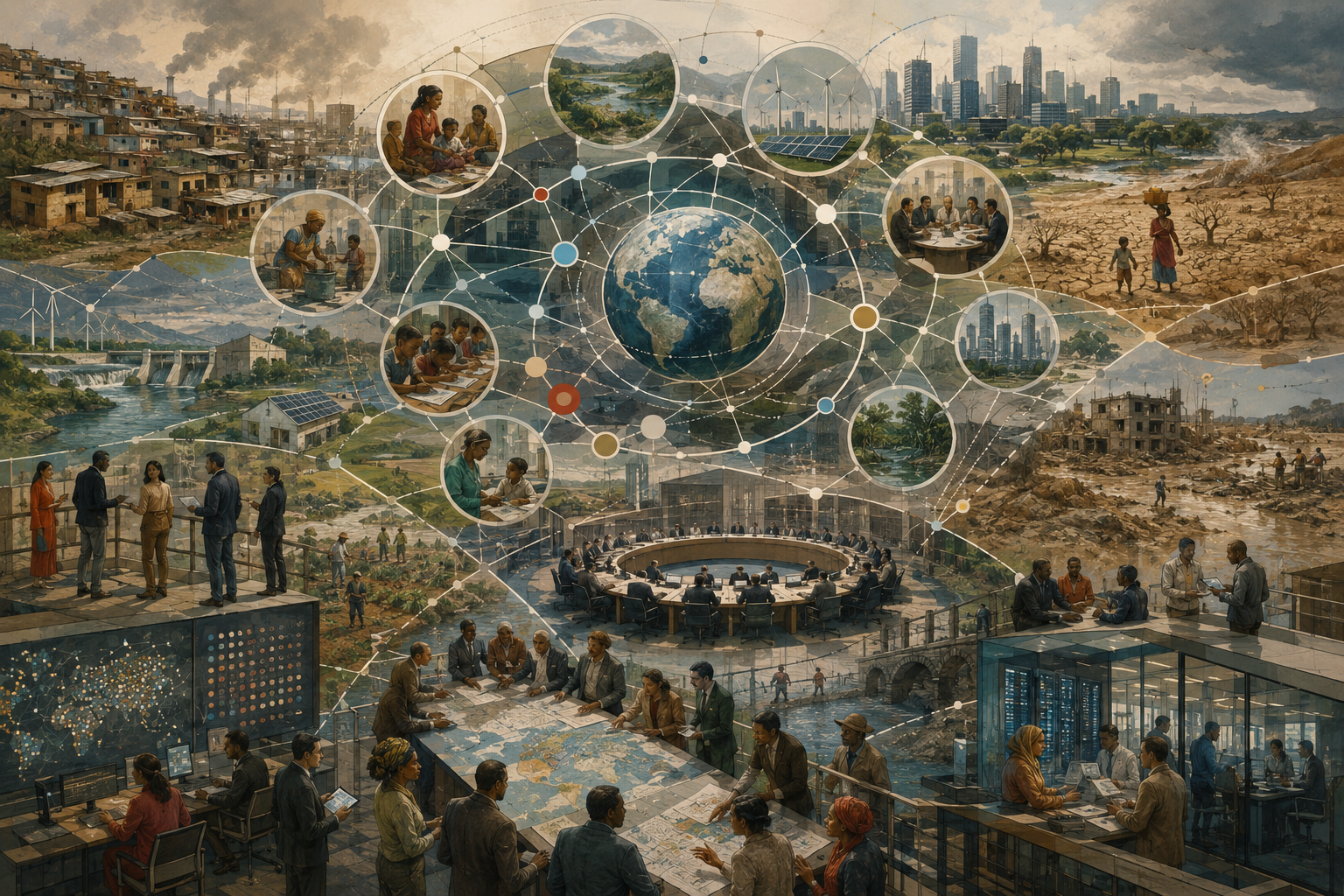
The 2030 Agenda emerged at a moment when development could no longer be understood through narrow growth metrics, sectoral policy silos, or a simple distinction between “developed” and “developing” countries. Climate change, inequality, biodiversity loss, debt stress, fragile institutions, uneven access to infrastructure, and repeated public-health disruption had made it increasingly clear that development challenges were structurally interconnected. The Agenda responded by offering a framework in which poverty, health, education, energy, work, cities, inequality, climate, ecosystems, governance, and international cooperation were treated as part of a single architecture rather than as separate policy compartments.
That architecture is often flattened into a checklist. But the SDGs were never meant to function only as a list of worthy objectives. They represent a theory of development governance. They imply that progress must be universal rather than geographically confined, integrated rather than compartmentalized, and monitored through a common indicator framework capable of supporting follow-up, review, and coordination. Their logic is therefore institutional as well as moral.
What Is the 2030 Agenda?
The 2030 Agenda for Sustainable Development is the United Nations’ comprehensive framework for global sustainable development governance, adopted in 2015 by all Member States. Its most visible expression is the set of 17 Sustainable Development Goals and their targets, but its deeper significance lies in the wider political architecture of the Agenda text itself. The document presents a common plan of action for people, planet, prosperity, peace, and partnership, and frames poverty eradication as the indispensable foundation of sustainable development.
The Agenda therefore operates at more than one level. At one level, it is a normative declaration about what should matter in development: ending poverty and hunger, improving health and education, reducing inequality, achieving gender equality, expanding access to water and energy, building decent work and infrastructure, creating sustainable cities, protecting ecosystems, and strengthening institutions and cooperation. At another level, it is an institutional framework designed to align states, international organizations, statistical systems, civil society, public institutions, and other actors around shared priorities and a common time horizon.
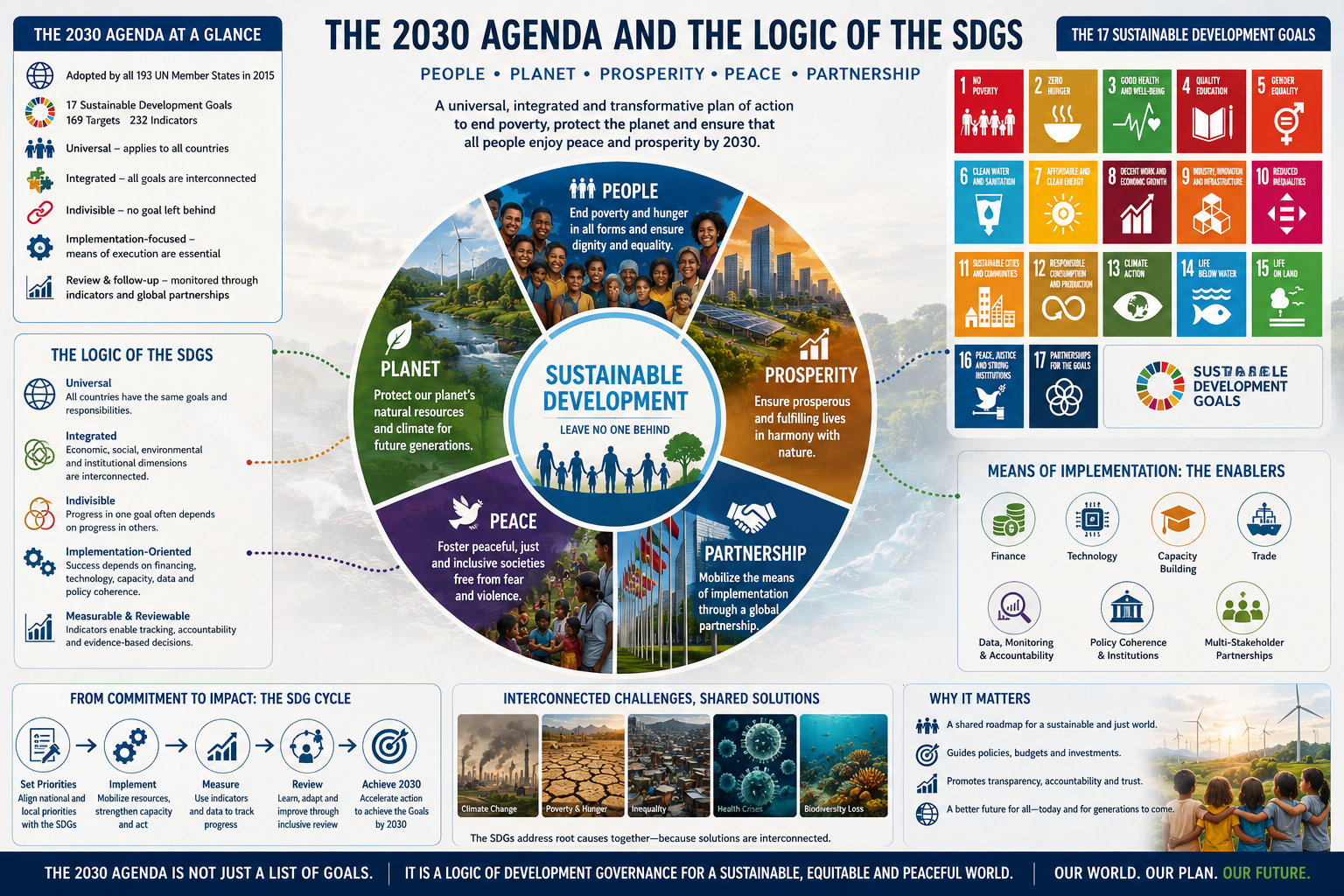
In this sense, the 2030 Agenda is not merely a declaration of values. It is an effort to create an internationally legible grammar of development. It organizes what counts as progress, what must be measured, and what should be subject to follow-up and review. Its importance lies not only in the goals it names, but in the attempt to construct a common structure for reasoning about development in a fragmented world.
The Agenda’s structure also reflects the intellectual evolution of sustainable development itself. It inherits the Brundtland tradition’s concern with present need and future responsibility. It carries forward the human development tradition’s concern with health, education, and dignity. It incorporates the institutional lesson that development cannot be governed through aspiration alone. It requires targets, means of implementation, data systems, review processes, and public accountability. This makes it central to the evolution of sustainable development beyond the earlier normative horizon established by The Brundtland Definition and Its Legacy.
The Agenda is also explicitly political. It does not create a world government, and it does not impose binding enforcement in the way a treaty might. Instead, it creates a framework of shared commitment, periodic review, statistical visibility, national adaptation, multilateral coordination, and public comparison. Its governance logic is therefore softer than law but stronger than mere rhetoric. It seeks to make development politically reviewable, even where implementation remains voluntary and uneven.
A Historical Turn in Development Governance
The 2030 Agenda should be understood as a historical turning point in development governance. Earlier development frameworks often treated economic growth as the dominant marker of progress and addressed social or environmental issues through separate policy channels. Even where multidimensional approaches had begun to emerge, governance often remained fragmented: poverty in one silo, public health in another, infrastructure somewhere else, and ecology treated as an adjacent concern rather than a constitutive condition of development itself.
The post-2015 framework was shaped by the recognition that this fragmentation had become untenable. Development could no longer be treated as a linear ascent of national income. Climate instability, biodiversity loss, inequality, fragile institutions, unsustainable consumption, debt vulnerability, and transboundary risk were forcing a more integrated understanding of social order. The SDGs arose from that recognition. They re-described development as a field of interacting systems rather than a ladder of economic advancement.
This historical move matters because it changed the scale and scope of the development question. The issue was no longer simply how poorer countries could “catch up.” It became how all countries would confront social, ecological, and institutional pressures that were increasingly planetary in reach yet deeply uneven in distribution. The 2030 Agenda therefore marks a transition from development as a category applied mainly to the Global South toward sustainable development as a universal governance challenge.
That does not mean the old inequalities disappeared. On the contrary, the Agenda’s universality exposed the need to think more carefully about unequal capacity, unequal vulnerability, unequal responsibility, and unequal voice. A wealthy country with high emissions and unsustainable consumption faces a different sustainable development challenge from a low-income country confronting extreme poverty, debt stress, and climate exposure. Both are inside the Agenda, but not in the same position. This is the complexity the SDG framework attempts to hold.
In that respect, the 2030 Agenda also builds on the transition explored in From Economic Growth to Human Development, where development ceased to be judged by output alone and became more explicitly centered on capability, welfare, and human possibility. The SDGs carry that multidimensional logic into a global policy architecture.
The Internal Logic of the SDGs
The SDGs have an internal logic that is often obscured when they are presented as a list of worthy objectives. That logic can be described through several principles. First, the goals are universal: they apply to all countries rather than only to poorer ones. Second, they are integrated: progress in one domain is assumed to affect progress in others. Third, they are indivisible: the framework rejects the idea that social, economic, environmental, and institutional goals can be treated as fully separable. Fourth, they are implementation-oriented: they are tied to targets, financing questions, data infrastructures, and review processes. Fifth, they are partnership-dependent: they presuppose action across multiple actors and scales.
This logic matters because it distinguishes the SDGs from narrower development agendas. The Agenda assumes that development is not simply about increasing income or expanding aid, but about governing interdependence. It tries to align poverty reduction, social inclusion, ecological stewardship, public goods, and institutional capacity within a single framework. That is a much more demanding project than sectoral target-setting, because it asks institutions organized around separation to think and act systemically.
The result is a framework that is ambitious precisely because it is organizational as well as ethical. The SDGs do not merely specify outcomes. They imply a style of governance in which development must be coordinated across ministries, sectors, scales, statistical systems, finance mechanisms, review platforms, and public institutions. Their underlying claim is that development can no longer be governed successfully through fragmentation.
The internal logic of the SDGs also explains why the Agenda can feel unwieldy. Its breadth is not accidental. The goals span poverty, food, health, education, gender, water, energy, work, infrastructure, inequality, cities, consumption, climate, oceans, terrestrial ecosystems, peace, institutions, and partnerships because sustainable development itself is multidimensional. The difficulty is that a framework broad enough to represent the problem may also become difficult to prioritize, finance, and administer.
This makes the Agenda conceptually adjacent to the systems-oriented concerns raised elsewhere in the series, including Sustainable Development as a Systems Problem, Resilience Thinking and Sustainable Development, and Scenario Planning for Sustainable Futures.
Universality and the End of the Old Development Divide
One of the most important conceptual innovations of the 2030 Agenda is universality. Earlier development discourse often rested on a distinction between countries that were “developed” and those that were “developing,” with development framed largely as the task of poorer societies catching up through growth, aid, and modernization. The SDGs complicate that picture by applying to all countries. This means that inequality, unsustainable consumption, ecological overshoot, institutional mistrust, public-health vulnerability, and social exclusion are treated as shared developmental concerns, even if they appear differently across contexts.
Universality changes the politics of development because it implies that richer countries are not external observers or benevolent helpers standing outside the development problem. They are participants within it. Their developmental failures may be expressed less through extreme income deprivation than through high emissions, resource-intensive lifestyles, social fragmentation, exclusion, financialization, or institutional erosion. The Agenda therefore reframes development as a common horizon of responsibility rather than a one-directional geography of assistance.
Yet universality does not erase asymmetry. Countries differ sharply in historical responsibility, fiscal capacity, institutional depth, vulnerability to shocks, technological capability, debt burdens, and unmet developmental need. The Agenda must therefore hold together two truths that do not collapse neatly into one another: that sustainable development is universal in relevance, and that its burdens and constraints are highly unequal.
This tension is not a flaw of the framework; it is one of the realities the framework must continually negotiate. Universality must be interpreted alongside partnership, differentiated capacity, financing justice, and the continuing salience of poverty eradication as the Agenda’s core moral imperative. Otherwise, universality can become a flattening language that treats very different historical and material positions as equivalent.
At its strongest, universality asks every society to submit itself to development judgment. It does not allow wealthy societies to define themselves as complete, nor does it allow poorer societies to be reduced to objects of assistance. It creates a common framework, but one that must still be read through unequal histories, unequal vulnerabilities, and unequal responsibilities.
Integration, Interdependence, and Indivisibility
Perhaps the deepest logic of the SDGs is integration. The Agenda assumes that poverty, health, education, gender equality, infrastructure, work, cities, climate, ecosystems, peace, and institutions are interconnected. This is why the goals are repeatedly described as integrated and indivisible. The claim is not that all goals can be pursued without tension, but that none can be adequately understood in isolation.
This principle reflects a systems view of development. Health outcomes depend on nutrition, sanitation, education, infrastructure, income, and institutional capacity. Climate vulnerability depends on housing, energy systems, income distribution, geography, and governance. Economic inclusion depends on transport, legal systems, education, finance, digital access, and labor conditions. The Agenda’s architecture tries to make these relations visible by placing them inside one framework, even where institutional structures remain siloed.
Indivisibility therefore does not abolish trade-offs; it makes them harder to hide. Industrial expansion may improve employment while increasing emissions and ecological pressure. Agricultural intensification may reduce hunger while straining water systems and biodiversity. Urban growth may widen opportunity while increasing infrastructure load and land-system stress. The SDG framework forces these interactions into view by refusing the comforting fiction that development gains in one sector can be understood apart from the pressures they create elsewhere.
In that sense, the Agenda’s logic is not one of easy harmony but one of structured interdependence. It recognizes that sustainable development requires governance capable of seeing across domains, time horizons, and institutional boundaries. This broader systems logic connects closely to related articles on Boundary Transgression and Development Fragility and Development Under Deep Uncertainty.
Integration also has a moral dimension. If the goals are indivisible, then progress cannot be claimed by improving one visible indicator while sacrificing marginalized communities, future generations, or ecological systems elsewhere. A development strategy that improves energy access but destroys local ecosystems, or a climate strategy that reduces emissions while deepening social exclusion, has not solved the integration problem. It has displaced it.
Implementation, Means of Execution, and Partnership
The 2030 Agenda is not only a vision statement. It is also an implementation framework. This is why it pairs broad goals with targets, means of implementation, and the language of partnership. The Agenda assumes that sustainable development will not emerge spontaneously from agreement on values. It requires financing, technology, capacity-building, policy coherence, institutional coordination, and sustained political commitment.
This emphasis matters because it prevents the SDGs from functioning solely as moral rhetoric. Development requires resources and institutions. Poverty reduction requires productive employment, social protection, and public investment. Climate and energy transition require infrastructure, fiscal capacity, and policy continuity. Better health and education require functioning delivery systems. Stronger institutions require administrative competence, legal credibility, and political legitimacy. The implementation logic of the Agenda reflects a sober recognition that values do not govern systems unless they are translated into durable organizational forms.
Partnership is equally central. Goal 17 formalizes the idea that development and sustainability depend on international cooperation in finance, trade, technology, data, and capacity-building. This reflects both practical necessity and political reality. Many lower-income countries face implementation constraints that cannot be solved through domestic policy alone, and many sustainability problems are transboundary by nature. Partnership is therefore not ornamental language; it is part of the Agenda’s basic governance logic, even if actual cooperation often falls short of the framework’s ambition.
The means-of-implementation question also exposes global inequality. Some countries enter the SDG period with robust tax systems, deep capital markets, administrative capacity, and technological infrastructure. Others confront debt stress, fiscal fragility, climate vulnerability, weak statistical systems, and dependence on external finance. Treating implementation as a purely national responsibility would therefore misread the Agenda’s own logic. Partnership matters because capacity is unevenly distributed, while many risks are shared or externally produced.
At the same time, partnership must be accountable. Development cooperation can reproduce hierarchy if it becomes donor-driven, conditional, extractive, or detached from local priorities. The strongest reading of Goal 17 is not simply that international cooperation is necessary, but that cooperation must support legitimate public capacity, locally meaningful development pathways, transparent finance, and the agency of communities most affected by development choices.
Indicators, Monitoring, and Review
One of the most distinctive features of the 2030 Agenda is its commitment to follow-up and review through an official global indicator framework. The indicator system maintained by the United Nations Statistics Division and supported by the Inter-agency and Expert Group on SDG Indicators turns the Agenda into a monitored architecture rather than a purely rhetorical one. This matters because what is counted acquires institutional visibility, political traction, and comparative force.
The indicator framework also reveals the Agenda’s commitment to operationalization. The goals are not supposed to remain abstract aspirations; they are tied to targets, metadata, custodianship, disaggregation principles, and ongoing refinement. The official global indicator framework was adopted by the UN General Assembly in 2017 and then refined through subsequent reviews, including the 2025 comprehensive review process. This demonstrates that the Agenda’s measurement logic is not static but iterative, shaped by both methodological learning and governance need.
Yet measurement is never neutral. Indicators clarify some dimensions of development while obscuring others. They support accountability, but they can also encourage targetism, technocratic simplification, or the substitution of statistical visibility for substantive transformation. The politics of review therefore runs through the entire Agenda. Monitoring is necessary because without it the goals remain rhetorical. But once goals are measured, questions immediately arise about what is being counted, what is omitted, and whether statistical order is being mistaken for developmental success.
This tension is unavoidable. It is also one of the most revealing features of the SDG architecture. The Agenda seeks to make sustainable development governable through data without allowing data alone to define the meaning of development. Whether that balance can be sustained remains one of the central institutional questions of the entire project.
The measurement architecture is especially important for marginalized and vulnerable populations. The Agenda’s commitment to leaving no one behind depends on disaggregated data: income, sex, age, race, ethnicity, migratory status, disability, geographic location, and other relevant characteristics where appropriate. Without disaggregation, aggregate progress can conceal the people, places, and communities being left behind.
Progress, Stagnation, and the 2030 Horizon
The 2030 Agenda is now close enough to its target year that the gap between aspiration and delivery has become impossible to ignore. Official SDG reporting shows that the world has made real progress in some areas, but that progress remains far too slow and uneven to achieve the full Agenda on time. This does not invalidate the SDGs. It clarifies the scale of the implementation problem.
The 2025 SDG Report is especially important because it treats the Agenda not simply as a moral promise, but as a monitored project whose progress can be assessed. With only a few years remaining before 2030, the report underscores a stark reality: the framework has improved lives and created a shared language of accountability, but the world remains off track across many targets. Conflict, climate disruption, debt stress, inequality, weak investment, and institutional fragility continue to slow progress.
This gap between ambition and delivery should be interpreted carefully. It would be too simple to say that the SDGs have failed because all goals will not be fully achieved by 2030. It would also be too complacent to treat partial progress as sufficient. The more serious interpretation is that the SDGs have revealed the depth of the coordination problem. They have made visible what sustainable development requires: long-run financing, institutional capacity, public accountability, data infrastructure, ecological restraint, and political coalitions strong enough to sustain action across crises.
The 2030 horizon therefore operates as both deadline and diagnostic. It disciplines attention, but it also reveals the limits of voluntary governance under conditions of global inequality and fragmented authority. The closer 2030 approaches, the more important it becomes to ask what should be preserved, revised, strengthened, or reimagined in any post-2030 development architecture.
The Strengths of the 2030 Agenda
The chief strength of the 2030 Agenda lies in its integrative ambition. It refuses the reduction of development to output growth, aid flows, or environmental management in isolation. Instead, it provides a common language in which social welfare, ecological integrity, institutional capacity, and global cooperation can be treated as parts of a shared project. That is a major conceptual achievement in a world accustomed to governing interdependent problems through fragmented institutions.
A second strength is universality. By applying to all countries, the Agenda avoids treating sustainable development as a problem located only in poorer regions. It recognizes that wealthier societies also face developmental failures, whether in the form of unsustainable material throughput, inequality, ecological overshoot, social exclusion, or institutional distrust. This broadens the legitimacy of the framework and makes it more appropriate to a deeply interconnected global order.
A third strength lies in its review architecture. The combination of goals, targets, indicators, reporting, and follow-up creates a structure of visibility that can support public reasoning, international comparison, and policy learning. Even where implementation is partial, the Agenda has helped normalize the idea that development must be multidimensional, measurable, and open to scrutiny across a common global vocabulary.
A fourth strength is its ability to connect local and global questions. A local sanitation project, a national education policy, an urban climate adaptation plan, an international finance mechanism, and a statistical capacity-building initiative can all be interpreted within the same SDG framework. This does not make the framework perfect, but it gives institutions and publics a shared map for locating different kinds of development work inside a larger structure.
Finally, the Agenda’s strength lies in its moral breadth. It is not content to ask whether economies grow. It asks whether poverty is reduced, whether people are healthy and educated, whether women and girls have equal rights, whether cities are livable, whether ecosystems are protected, whether institutions are peaceful and accountable, and whether cooperation can support shared survival. That breadth is difficult to govern, but it reflects the real complexity of sustainable development.
Tensions, Critiques, and Structural Limits
The 2030 Agenda also faces major tensions. One is breadth. Seventeen goals and a large target-and-indicator apparatus can make the framework difficult to prioritize, finance, and coordinate. Integration is conceptually powerful, but institutionally it can become overwhelming. Governments still tend to operate through ministries, budgets, electoral cycles, and sectoral jurisdictions that do not map neatly onto the Agenda’s systemic logic.
A second tension concerns coherence. The SDGs bring together objectives that are normatively compelling but not always easy to reconcile in practice. Economic growth, industrialization, infrastructure expansion, ecological protection, and reduced inequality may reinforce one another in some contexts and conflict in others. The Agenda’s language of integration does not remove these tensions. It relocates them inside a shared frame, where they become more visible but not necessarily more easily resolved.
A third limit concerns politics and compliance. The Agenda depends heavily on voluntary commitment, review, partnership, and peer pressure rather than hard enforcement. This broadens buy-in, but it also leaves the framework vulnerable to symbolic adoption, selective implementation, and weak delivery. Official SDG reporting continues to show substantial gaps between ambition and progress. That does not make the Agenda meaningless, but it does remind us that a governance architecture is only as effective as the institutional and political capacities that animate it.
Finally, there is a deeper structural critique. The Agenda attempts to govern interdependence at a planetary scale without a corresponding planetary government, and it attempts to align long-run goals with short-run political systems that often reward immediate gains over delayed benefits. In this respect, the SDGs can be read as both a remarkable innovation and a diagnostic document: they reveal how much coordination is needed for sustainable development precisely by revealing how difficult such coordination remains.
The Agenda also risks being absorbed into managerial language if justice and power disappear from view. Indicators, reports, and dashboards can support accountability, but they can also make development appear more technocratic than it is. Sustainable development involves land, labor, debt, trade, extraction, sovereignty, climate responsibility, public finance, and historical inequality. A serious reading of the SDGs must therefore keep the political stakes visible behind the statistical architecture.
The Post-2030 Question
As 2030 approaches, the Agenda increasingly raises a question about what comes next. The SDGs created a powerful global vocabulary, but the world they were designed to govern has become more turbulent: climate disruption has intensified, geopolitical tensions have sharpened, debt burdens have constrained public investment, technological systems have become more consequential, and institutional trust has weakened in many societies. A post-2030 framework will need to learn from both the successes and limits of the SDG architecture.
One likely lesson is that future frameworks will need stronger attention to implementation capacity. Goals and indicators matter, but they are not enough. Sustainable development requires fiscal space, state capacity, local institutions, public accountability, scientific infrastructure, and long-term investment. A future framework that preserves ambition while ignoring capacity would reproduce one of the central weaknesses of the current system.
A second lesson is that integration must become more operational. It is not enough to say that goals are indivisible. Institutions need tools for managing trade-offs, sequencing investments, modeling cross-sector effects, and protecting vulnerable communities when policies collide. This is where scenario planning, systems modeling, policy coherence, and resilience thinking become essential.
A third lesson is that equity must remain central. Future development governance cannot treat all countries, communities, or institutions as equally positioned. Climate responsibility, debt, historical extraction, technological access, and institutional capacity all shape what implementation means in practice. A post-2030 framework that fails to address unequal capacity and unequal vulnerability would weaken the justice claims at the heart of sustainable development.
The post-2030 question therefore is not whether the SDGs were perfect. They were not. The question is what kind of global development architecture can preserve their integrated vision while becoming more effective, accountable, just, and institutionally realistic. The Agenda’s historical importance may ultimately lie in having made that question unavoidable.
Mathematical Lens
The 2030 Agenda can be expressed as a problem of coordinating progress across multiple interdependent goal domains under shared review and implementation constraints. Let \(A\) denote agenda effectiveness, \(g_i\) the progress in goal domain \(i\), and \(b_{ij}\) the interaction term linking goals \(i\) and \(j\). A simple conceptual form is:
A = \sum_{i=1}^{17} g_i + \sum_{i \neq j} b_{ij} g_i g_j
\]
Interpretation: Agenda effectiveness depends not only on progress within each SDG domain, but also on whether goal interactions reinforce or undermine one another.
The interaction term captures the article’s core point: the Agenda’s logic depends not only on progress in each goal separately, but on how goals reinforce or undermine one another through integration and indivisibility.
We can also express implementation risk as:
R_a = \alpha F + \beta C + \gamma M
\]
Interpretation: Implementation risk rises when financing is weak, coordination fails, or measurement and monitoring systems are fragile.
Here, \(F\) is financing and means-of-implementation weakness, \(C\) is coordination failure, and \(M\) is measurement or monitoring fragility. Higher \(R_a\) means the Agenda is more likely to remain aspirational rather than operational.
Finally, review-system capacity can be represented as:
V = \lambda D + \mu I + \nu P
\]
Interpretation: Review-system capacity depends on data quality, institutional review capacity, and policy responsiveness to evidence.
In this formulation, \(D\) is data quality, \(I\) is institutional review capacity, and \(P\) is policy responsiveness to findings. This helps show why the SDGs are not just a moral framework, but a monitored governance architecture.
| Term | Meaning | Interpretive role |
|---|---|---|
| \(A\) | Agenda effectiveness | Represents the degree to which the SDG framework produces coordinated sustainable development progress. |
| \(g_i\) | Goal-domain progress | Represents progress within a specific SDG domain. |
| \(b_{ij}\) | Goal interaction term | Represents whether two goal areas reinforce, weaken, or complicate one another. |
| \(R_a\) | Agenda implementation risk | Represents the danger that the Agenda remains aspirational because delivery systems are weak. |
| \(F\) | Financing weakness | Represents insufficient means of implementation, fiscal space, investment, or development finance. |
| \(C\) | Coordination failure | Represents fragmentation across ministries, sectors, territories, and institutions. |
| \(M\) | Monitoring fragility | Represents weak indicator coverage, poor data quality, or limited review capacity. |
| \(V\) | Review-system capacity | Represents the ability to convert evidence into policy learning and institutional response. |
The equations are conceptual rather than predictive. Their value is to show why the SDGs cannot be interpreted as independent boxes. Their logic is relational: progress, implementation, data, finance, and institutions all interact across the Agenda’s larger governance architecture.
Advanced Python Workflow: SDG Governance Risk Scoring
This Python workflow translates the article’s core argument into a structured SDG-governance model. Rather than treating the SDGs as a checklist, it scores territories across universality exposure, integration complexity, implementation strength, monitoring capacity, and partnership readiness. That makes it possible to compare not only where ambition is high, but where the Agenda is most likely to face fragmentation between normative design and institutional delivery.
from __future__ import annotations

import pandas as pd
import numpy as np

INPUT_FILE = "agenda_2030_sdg_logic_panel.csv"
OUTPUT_FILE = "agenda_2030_sdg_logic_scores.csv"


def load_data(path: str) -> pd.DataFrame:
    """
    Load a territory-level SDG governance dataset.

    All *_index columns should be normalized to [0, 1].
    Higher values should mean more of the named property.

    Examples:
      - integration_complexity_index: higher = more cross-goal complexity
      - implementation_capacity_index: higher = stronger implementation capacity
      - policy_fragmentation_index: higher = more fragmentation
      - review_responsiveness_index: higher = stronger response to review findings
    """
    df = pd.read_csv(path)

    required_columns = [
        "territory_name",
        "country_or_region",
        "territory_type",
        "universality_exposure_index",
        "integration_complexity_index",
        "implementation_capacity_index",
        "means_of_implementation_index",
        "partnership_readiness_index",
        "monitoring_capacity_index",
        "indicator_coverage_index",
        "review_responsiveness_index",
        "policy_fragmentation_index",
        "sdg_alignment_index",
    ]

    missing = [col for col in required_columns if col not in df.columns]

    if missing:
        raise ValueError(f"Missing required columns: {missing}")

    return df


def validate_indices(df: pd.DataFrame) -> pd.DataFrame:
    """Validate that all *_index fields are complete and normalized to [0, 1]."""
    index_columns = [col for col in df.columns if col.endswith("_index")]

    for col in index_columns:
        if df[col].isna().any():
            raise ValueError(f"Column '{col}' contains missing values.")

        if ((df[col] < 0) | (df[col] > 1)).any():
            raise ValueError(f"Column '{col}' contains values outside [0, 1].")

    return df


def compute_scores(df: pd.DataFrame) -> pd.DataFrame:
    """
    Compute SDG pressure, capacity, and governance-risk scores.

    Agenda pressure rises with exposure, integration complexity,
    weak capacity, weak means of implementation, weak partnership,
    weak monitoring, weak indicator coverage, and policy fragmentation.

    Agenda capacity rises with implementation capacity, means of implementation,
    partnership readiness, monitoring capacity, indicator coverage,
    review responsiveness, and alignment.
    """
    df = df.copy()

    df["agenda_pressure_score"] = (
        0.14 * df["universality_exposure_index"] +
        0.16 * df["integration_complexity_index"] +
        0.14 * (1 - df["implementation_capacity_index"]) +
        0.14 * (1 - df["means_of_implementation_index"]) +
        0.12 * (1 - df["partnership_readiness_index"]) +
        0.10 * (1 - df["monitoring_capacity_index"]) +
        0.08 * (1 - df["indicator_coverage_index"]) +
        0.12 * df["policy_fragmentation_index"]
    ).clip(lower=0, upper=1)

    df["agenda_capacity_score"] = (
        0.24 * df["implementation_capacity_index"] +
        0.20 * df["means_of_implementation_index"] +
        0.16 * df["partnership_readiness_index"] +
        0.14 * df["monitoring_capacity_index"] +
        0.10 * df["indicator_coverage_index"] +
        0.10 * df["review_responsiveness_index"] +
        0.06 * df["sdg_alignment_index"]
    ).clip(lower=0, upper=1)

    df["sdg_governance_risk_score"] = (
        0.50 * df["agenda_pressure_score"] +
        0.30 * (1 - df["agenda_capacity_score"]) +
        0.20 * df["policy_fragmentation_index"]
    ).clip(lower=0, upper=1)

    df["risk_band"] = np.select(
        [
            df["sdg_governance_risk_score"] >= 0.80,
            df["sdg_governance_risk_score"] >= 0.60,
            df["sdg_governance_risk_score"] >= 0.40,
        ],
        [
            "Extreme SDG governance risk",
            "High SDG governance risk",
            "Moderate SDG governance risk",
        ],
        default="Lower SDG governance risk",
    )

    return df


def build_summary(df: pd.DataFrame) -> pd.DataFrame:
    """Return a ranked summary table for review or reporting."""
    columns = [
        "territory_name",
        "country_or_region",
        "territory_type",
        "agenda_pressure_score",
        "agenda_capacity_score",
        "sdg_governance_risk_score",
        "risk_band",
    ]

    summary = df[columns].copy()

    summary = summary.sort_values(
        by=[
            "sdg_governance_risk_score",
            "agenda_pressure_score",
            "agenda_capacity_score",
        ],
        ascending=[False, False, True],
    ).reset_index(drop=True)

    return summary


def main() -> None:
    df = load_data(INPUT_FILE)
    df = validate_indices(df)
    scored = compute_scores(df)
    summary = build_summary(scored)

    summary.to_csv(OUTPUT_FILE, index=False)

    print("The 2030 Agenda and SDG logic scoring complete.")
    print(summary.to_string(index=False))


if __name__ == "__main__":
    main()
This workflow is intentionally interpretable. It does not claim that SDG governance can be reduced to a final objective score. Instead, it makes the governance problem visible: a territory may formally align with the SDGs while lacking implementation capacity, means of implementation, indicator coverage, review responsiveness, or policy coherence. The value of the model is not prediction alone, but structured diagnostic reasoning.
Advanced R Workflow: SDG Integration, Monitoring Capacity, and Governance Risk
This R workflow is designed for the part of the article that emphasizes integration, indicator architecture, and review capacity. It compares settings across universality pressure, implementation strength, monitoring depth, partnership readiness, and policy fragmentation, then builds grouped summaries that help show where the Agenda is most likely to be operationalized effectively versus where it is most likely to remain rhetorically adopted but institutionally thin.
library(readr)
library(dplyr)

input_file <- "agenda_2030_sdg_logic_country_panel.csv"
region_output_file <- "cross_region_sdg_logic_summary.csv"
territory_output_file <- "cross_territory_sdg_logic_summary.csv"

sdg_df <- read_csv(input_file, show_col_types = FALSE)

required_cols <- c(
  "territory_name",
  "country_or_region",
  "territory_type",
  "universality_exposure_index",
  "integration_complexity_index",
  "implementation_capacity_index",
  "means_of_implementation_index",
  "partnership_readiness_index",
  "monitoring_capacity_index",
  "indicator_coverage_index",
  "review_responsiveness_index",
  "policy_fragmentation_index",
  "sdg_alignment_index"
)

missing_cols <- setdiff(required_cols, names(sdg_df))

if (length(missing_cols) > 0) {
  stop(paste("Missing required columns:", paste(missing_cols, collapse = ", ")))
}

index_cols <- names(sdg_df)[grepl("_index$", names(sdg_df))]

invalid_index_cols <- index_cols[
  vapply(
    sdg_df[index_cols],
    function(x) any(is.na(x) | x < 0 | x > 1),
    logical(1)
  )
]

if (length(invalid_index_cols) > 0) {
  stop(
    paste(
      "Index columns must be complete and normalized to [0, 1]:",
      paste(invalid_index_cols, collapse = ", ")
    )
  )
}

sdg_df <- sdg_df %>%
  mutate(
    sdg_logic_proxy = (
      universality_exposure_index +
      integration_complexity_index +
      (1 - implementation_capacity_index) +
      (1 - means_of_implementation_index) +
      (1 - partnership_readiness_index) +
      (1 - monitoring_capacity_index) +
      (1 - indicator_coverage_index) +
      (1 - review_responsiveness_index) +
      policy_fragmentation_index +
      (1 - sdg_alignment_index)
    ) / 10,
    implementation_readiness = (
      implementation_capacity_index +
      means_of_implementation_index +
      partnership_readiness_index +
      monitoring_capacity_index +
      review_responsiveness_index +
      sdg_alignment_index
    ) / 6,
    risk_band = case_when(
      sdg_logic_proxy >= 0.75 ~ "Extreme SDG governance risk",
      sdg_logic_proxy >= 0.55 ~ "High SDG governance risk",
      sdg_logic_proxy >= 0.35 ~ "Moderate SDG governance risk",
      TRUE ~ "Lower SDG governance risk"
    )
  )

region_summary <- sdg_df %>%
  group_by(country_or_region) %>%
  summarise(
    avg_sdg_logic_proxy = mean(sdg_logic_proxy, na.rm = TRUE),
    avg_implementation_readiness = mean(implementation_readiness, na.rm = TRUE),
    avg_integration_complexity = mean(integration_complexity_index, na.rm = TRUE),
    avg_monitoring_capacity = mean(monitoring_capacity_index, na.rm = TRUE),
    avg_indicator_coverage = mean(indicator_coverage_index, na.rm = TRUE),
    avg_policy_fragmentation = mean(policy_fragmentation_index, na.rm = TRUE),
    observations = n(),
    .groups = "drop"
  ) %>%
  mutate(
    regional_risk_band = case_when(
      avg_sdg_logic_proxy >= 0.75 ~ "Extreme SDG governance risk",
      avg_sdg_logic_proxy >= 0.55 ~ "High SDG governance risk",
      avg_sdg_logic_proxy >= 0.35 ~ "Moderate SDG governance risk",
      TRUE ~ "Lower SDG governance risk"
    )
  ) %>%
  arrange(desc(avg_sdg_logic_proxy))

territory_summary <- sdg_df %>%
  group_by(territory_type) %>%
  summarise(
    avg_sdg_logic_proxy = mean(sdg_logic_proxy, na.rm = TRUE),
    avg_implementation_readiness = mean(implementation_readiness, na.rm = TRUE),
    avg_integration_complexity = mean(integration_complexity_index, na.rm = TRUE),
    avg_monitoring_capacity = mean(monitoring_capacity_index, na.rm = TRUE),
    avg_indicator_coverage = mean(indicator_coverage_index, na.rm = TRUE),
    avg_policy_fragmentation = mean(policy_fragmentation_index, na.rm = TRUE),
    observations = n(),
    .groups = "drop"
  ) %>%
  arrange(desc(avg_sdg_logic_proxy))

write_csv(region_summary, region_output_file)
write_csv(territory_summary, territory_output_file)

cat("Cross-region SDG logic summary exported to:", region_output_file, "\n")
print(region_summary)

cat("\nCross-territory SDG logic summary exported to:", territory_output_file, "\n")
print(territory_summary)
This workflow helps distinguish formal SDG adoption from operational capacity. A territory may use the SDG language while still facing weak monitoring, fragmented policy, limited means of implementation, or poor responsiveness to review findings. The workflow keeps those distinctions visible so that the Agenda is treated as a governance problem rather than a branding exercise.
GitHub Repository
Complete Code Repository
The full code distribution for this article, including SDG-governance scoring workflows, integration diagnostics, SQL materials, optional monitoring support tooling, supporting documentation, and repository structure, is available on GitHub.
Related Articles
- What Is Sustainable Development? Meaning, Systems, and Long-Run Viability
- The Brundtland Definition and Its Legacy
- From Economic Growth to Human Development
- The Four Dimensions of Sustainable Development
- Sustainable Development as a Systems Problem
- SDG Indicators: Strengths, Gaps, and Political Uses
- Resilience Thinking and Sustainable Development
- Scenario Planning for Sustainable Futures
- Boundary Transgression and Development Fragility
- Development Under Deep Uncertainty
Further Reading
- United Nations (2015) Transforming our world: the 2030 Agenda for Sustainable Development. New York: United Nations. Available at: https://sdgs.un.org/2030agenda
- United Nations (n.d.) The 17 Goals. New York: United Nations. Available at: https://sdgs.un.org/goals
- United Nations Statistics Division (2025) The Sustainable Development Goals Report 2025. New York: United Nations. Available at: https://unstats.un.org/sdgs/report/2025/
- United Nations Statistics Division (n.d.) Global indicator framework for the Sustainable Development Goals and targets of the 2030 Agenda for Sustainable Development. New York: United Nations. Available at: https://unstats.un.org/sdgs/indicators/indicators-list/
- United Nations Statistics Division (2025) 2025 comprehensive review of the global indicator framework. New York: United Nations. Available at: https://unstats.un.org/sdgs/iaeg-sdgs/2025-comprehensive-review
- United Nations Development Programme (2025) Human Development Report 2025: A Matter of Choice: People and Possibilities in the Age of AI. New York: UNDP. Available at: https://hdr.undp.org/content/human-development-report-2025
- Sachs, J.D. (2015) The Age of Sustainable Development. New York: Columbia University Press. Available at: https://cup.columbia.edu/book/the-age-of-sustainable-development/9780231173155
References
- United Nations (2015) Transforming our world: the 2030 Agenda for Sustainable Development. New York: United Nations. Available at: https://sdgs.un.org/2030agenda
- United Nations (n.d.) The 17 Goals. New York: United Nations. Available at: https://sdgs.un.org/goals
- United Nations Department of Economic and Social Affairs (n.d.) Indicators. New York: United Nations. Available at: https://sdgs.un.org/topics/indicators
- United Nations Statistics Division (n.d.) SDG Indicators. New York: United Nations. Available at: https://unstats.un.org/sdgs
- United Nations Statistics Division (n.d.) Global indicator framework for the Sustainable Development Goals and targets of the 2030 Agenda for Sustainable Development. New York: United Nations. Available at: https://unstats.un.org/sdgs/indicators/indicators-list/
- United Nations Statistics Division (n.d.) Inter-agency and Expert Group on SDG Indicators (IAEG-SDGs). New York: United Nations. Available at: https://unstats.un.org/sdgs/iaeg-sdgs/
- United Nations Statistics Division (2025) The Sustainable Development Goals Report 2025. New York: United Nations. Available at: https://unstats.un.org/sdgs/report/2025/
- United Nations Statistics Division (2025) 2025 comprehensive review of the global indicator framework. New York: United Nations. Available at: https://unstats.un.org/sdgs/iaeg-sdgs/2025-comprehensive-review
- United Nations Statistics Division (2025) Global indicator framework for the Sustainable Development Goals and targets of the 2030 Agenda for Sustainable Development after the 2025 review. New York: United Nations. Available at: https://unstats.un.org/sdgs/indicators/Global-Indicator-Framework-after-2025-review-English.pdf
- United Nations Development Programme (2025) Human Development Report 2025: A Matter of Choice: People and Possibilities in the Age of AI. New York: UNDP. Available at: https://hdr.undp.org/content/human-development-report-2025
- Sachs, J.D. (2015) The Age of Sustainable Development. New York: Columbia University Press. Available at: https://cup.columbia.edu/book/the-age-of-sustainable-development/9780231173155