
Last Updated May 14, 2026
Remote sensing systems in environmental monitoring are infrastructures of synoptic environmental observation through which large, dynamic, and only partially accessible environments become measurable by detecting reflected, emitted, or backscattered energy from a distance and translating those measurements into interpretable evidence about condition, pattern, and change. They use sensors mounted on satellites, aircraft, drones, towers, and other stand-off platforms to observe land, water, atmosphere, vegetation, cryosphere, coasts, hazards, and built environments without requiring direct physical presence at every point of interest. In this sense, remote sensing is not merely image acquisition from above. It is a structured epistemic system that converts electromagnetic signals into environmental claims at scales that field observation alone cannot sustain.
Environmental monitoring presents a distinctive observational challenge because many ecological, hydrological, atmospheric, and land-surface processes are too extensive, too dangerous, too remote, too fast-moving, or too temporally uneven to be understood adequately through site-based monitoring alone. Wildfire spread, drought stress, land-cover change, flood extent, sea-surface dynamics, canopy condition, urban heat patterns, snow and ice behavior, coastal change, and atmospheric systems all require forms of observation that preserve coherence across large areas while returning frequently enough to reveal trajectory rather than mere snapshot. Remote sensing addresses this challenge by extending monitoring from points and transects to surfaces, gradients, mosaics, plumes, fields, corridors, and changing spatial patterns.
The deeper significance of remote sensing lies in the fact that it changes the geometry of environmental knowledge. Instead of observing only at manually visited locations, fixed stations, or sampled plots, remote sensing observes across continuous fields and repeated scenes. But this widened view also introduces a deeper inferential burden. Remote sensing frequently measures proxies rather than environmental realities directly. It is often stronger at mapping pattern than explaining mechanism, stronger at observing surface expression than subsurface process, and stronger at scale than at causal specificity. Exceptional remote sensing therefore depends not only on advanced sensors, but on disciplined interpretation of what the signal actually means, where inference is strong, and where apparent visibility may conceal unresolved uncertainty.
Main Library
Publications
Article Map
Environmental Monitoring
Related Topic
Data Systems
Related Topic
Artificial Intelligence
Related Topic
Risk & Resilience
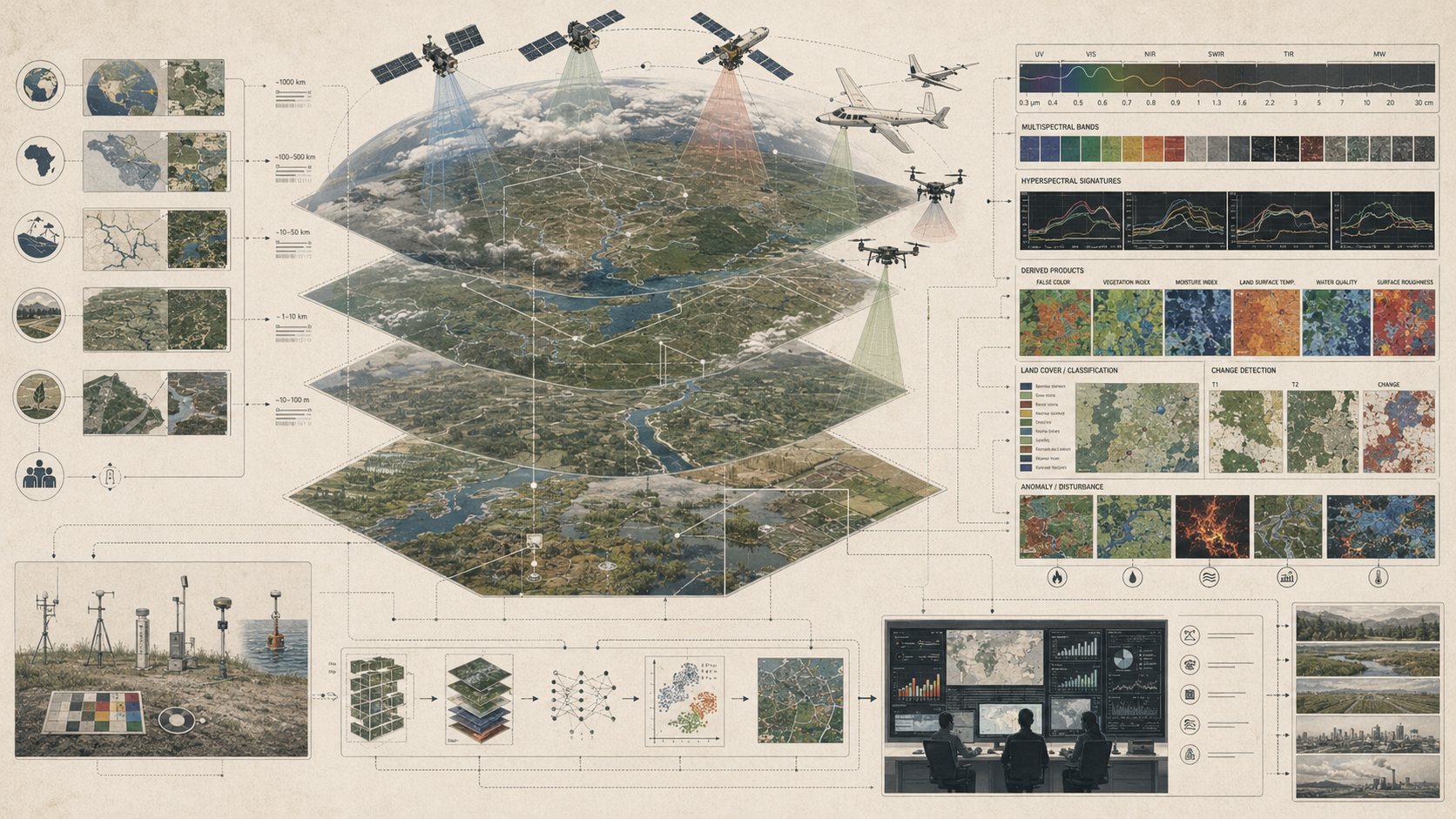
Remote sensing is where environmental monitoring becomes synoptic evidence infrastructure. It makes it possible to observe extensive landscapes, coastlines, watersheds, atmospheric systems, ecological mosaics, agricultural regions, fire scars, floodplains, urban surfaces, and cryospheric environments as connected spatial fields. Yet remote sensing is never pure transparency. It is an engineered and interpretive chain: platform selection, sensor physics, spectral response, calibration, atmospheric correction, geolocation, classification, retrieval, validation, time-series construction, uncertainty characterization, and decision-support translation all shape what the final product can responsibly mean.
Engineering Problem
The engineering problem is how to design remote sensing systems that convert electromagnetic measurements into reliable environmental evidence while preserving sensor context, scale, calibration, geolocation, atmospheric correction, retrieval logic, classification uncertainty, field validation, temporal continuity, and decision relevance. Remote sensing systems do not deliver environmental truth directly. They deliver measured signals whose meaning depends on the physics of sensing, the structure of the platform, the processing pipeline, the target environment, and the interpretive model applied to the signal.
This problem is difficult because remote sensing must resolve several tensions at once. A system may need broad coverage, but broad coverage often trades against spatial detail, latency, or processing complexity. A high-resolution drone survey may capture local texture but lack regional continuity. A satellite archive may reveal landscape trajectories over decades but require careful handling of clouds, seasonality, sensor transitions, and algorithm versions. A radar product may observe through clouds and darkness but require careful interpretation of surface roughness, moisture, geometry, and scattering physics. An optical product may be highly intuitive visually while still requiring atmospheric correction, phenological context, and validation before ecological claims can be made.
Weak remote-sensing systems treat maps, images, indices, and classifications as self-explanatory environmental facts. Strong systems treat them as evidence chains. They ask what was measured, how the signal was corrected, what product was derived, what assumptions connect that product to environmental condition, how uncertainty was characterized, what validation evidence exists, and whether the product is appropriate for the decision, policy, warning, or scientific claim attached to it.
| Engineering Tension | Why It Matters | Required Evidence |
|---|---|---|
| Coverage versus resolution | Wide-area monitoring often trades against local spatial detail and processing burden. | Coverage map, spatial resolution, pixel size, valid-use statement |
| Revisit versus persistence | Repeated scenes support change detection, while continuous monitoring is needed for fast-moving hazards. | Revisit interval, acquisition schedule, latency class, temporal gap record |
| Signal versus state | Sensors detect energy interactions; environmental condition is inferred through retrieval, classification, or index logic. | Retrieval method, classification method, spectral basis, validation report |
| Visual clarity versus inferential depth | Images can appear obvious while environmental meaning remains uncertain. | Product guide, uncertainty layer, caveat statement, field-validation record |
| Synoptic pattern versus local mechanism | Remote sensing can reveal broad pattern without fully explaining process or cause. | In situ integration, local context, model interpretation, process evidence |
| Time-series power versus product continuity | Change detection depends on consistency across sensors, seasons, processing versions, and archives. | Harmonization plan, product version history, seasonal control, continuity record |
| Operational speed versus science-grade refinement | Near-real-time products support response but may be less validated than refined products. | Processing level, latency, quality flags, review status, operational caveats |
The practical question is therefore: can the remote-sensing system preserve enough information about signal, scale, processing, uncertainty, validation, and intended use that derived products become trustworthy environmental evidence rather than visually persuasive representations?
Reference Architecture
A practical remote-sensing architecture can be understood as a layered environmental evidence system. The exact implementation may involve satellites, aircraft, drones, tower-mounted instruments, ground-control points, calibration workflows, atmospheric correction, radar preprocessing, lidar point clouds, spectral indices, machine-learning classification, time-series analysis, geospatial services, product catalogs, APIs, dashboards, and decision-support tools. The underlying responsibilities remain consistent: acquire, calibrate, geolocate, correct, derive, validate, harmonize, interpret, deliver, and learn.
| Layer | Engineering Role | Primary Risk | Evidence Artifact |
|---|---|---|---|
| Observation objective layer | Defines the environmental question, target variable, decision use, spatial scale, temporal scale, and user roles. | Sensor and product selection misaligned with the environmental process. | Observation objective manifest, decision-use statement |
| Platform layer | Provides the observational vantage point through satellite, aircraft, drone, tower, or other stand-off platform. | Coverage, revisit, altitude, tasking, or operational constraints hidden downstream. | Platform inventory, mission profile, flight plan, orbit/revisit record |
| Sensor layer | Measures reflected, emitted, or backscattered energy across optical, thermal, microwave, radar, lidar, or hyperspectral modes. | Spectral or measurement limitations overinterpreted as environmental limits. | Sensor specification, spectral bands, calibration record, measurement geometry |
| Preprocessing layer | Applies radiometric calibration, atmospheric correction, geometric correction, orthorectification, cloud masking, speckle filtering, or point-cloud processing. | Correction assumptions and quality masks lost before interpretation. | Preprocessing manifest, quality mask, processing level, correction method |
| Derivation layer | Generates indices, classifications, retrievals, anomaly fields, change maps, or other derived environmental products. | Derived product mistaken for direct observation. | Algorithm card, product registry, feature definitions, training data record |
| Validation layer | Compares products with field observations, reference datasets, independent labels, or expert review. | Products used outside validated domains. | Accuracy assessment, confusion matrix, validation dataset, field protocol |
| Time-series and harmonization layer | Aligns repeated observations across time, sensors, seasons, product versions, and environmental conditions. | False change caused by seasonality, sensor transition, cloud gaps, or algorithm drift. | Time-series manifest, harmonization record, seasonal window, version history |
| Decision-support layer | Delivers products through dashboards, reports, APIs, geospatial services, alerts, and analytical workflows. | User-facing clarity without uncertainty, scale, or valid-use guidance. | Dashboard specification, product guide, public caveats, decision matrix |
| Governance layer | Defines stewardship, product review, public communication, data access, versioning, and accountability. | Remote-sensing products influence decisions without transparent limits. | Governance policy, change log, review cadence, evidence package |
This architecture makes clear that remote sensing is not one act of observation. It is a chain of measurement, correction, inference, validation, and interpretation. Every layer affects whether the final environmental claim is justified.
Implementation Pattern
A rigorous implementation begins by defining the environmental monitoring question before selecting the platform or product. The correct design depends on whether the system is monitoring land-cover change, vegetation stress, flood extent, wildfire progression, surface heat, coastal erosion, snow persistence, water quality, urban expansion, habitat fragmentation, atmospheric composition, or another phenomenon. Each use case implies different spatial resolution, temporal cadence, spectral sensitivity, uncertainty tolerance, and validation needs.
| Artifact | Purpose | Typical Format |
|---|---|---|
| Remote-sensing objective manifest | Defines target process, variable, spatial scale, temporal scale, product type, and decision use. | YAML, Markdown, research design note |
| Platform and sensor inventory | Lists platform, altitude/orbit, sensor type, bands, resolution, revisit, coverage, and operational constraints. | CSV, SQL table, metadata catalog |
| Product registry | Defines derived products, units, processing levels, methods, versions, update cadence, uncertainty, and access endpoints. | CSV, JSON, STAC-style catalog, SQL table |
| Preprocessing manifest | Records calibration, correction, masking, geolocation, filtering, compositing, and quality-control operations. | YAML, workflow log, notebook, processing metadata |
| Inference / retrieval card | Documents how spectral, thermal, radar, lidar, or other signals are converted into environmental products. | Model card, algorithm card, Markdown |
| Validation protocol | Defines reference data, field sampling, accuracy assessment, validation regime, and performance metrics. | Markdown, CSV, field protocol, validation notebook |
| Time-series and change-detection manifest | Documents temporal window, baseline, seasonal controls, change criteria, and product continuity assumptions. | YAML, CSV, notebook, workflow metadata |
| Uncertainty and proxy policy | Defines how proxy products, retrieved variables, classifications, and inferred conditions are labeled and communicated. | YAML, product guide, public caveat policy |
| Decision-support matrix | Maps product outputs to planning, response, assessment, reporting, or accountability uses. | CSV, design document, dashboard specification |
| Product governance log | Tracks product changes, algorithm updates, validation status, public caveats, and review decisions. | CSV, release notes, governance register |
The implementation goal is to make the remote-sensing evidence chain inspectable. Users should be able to move from environmental claim back to product, from product back to algorithm, from algorithm back to signal, and from signal back to platform, sensor, calibration, and validation context.
Research-Grade Framing: Remote Sensing as Environmental Knowledge Infrastructure
A research-grade understanding of remote sensing begins by treating it as environmental knowledge infrastructure rather than as a convenient imaging technique. Remote sensing systems determine which environmental properties become visible at scale, how frequently they can be revisited, which spectral or structural signatures can be discriminated, and what kinds of spatial and temporal patterns can be converted into environmental indicators, classifications, anomalies, or trajectories.
This gives remote sensing extraordinary reach, but also makes it epistemically selective. Remote sensing is exceptionally strong at producing repeatable, wide-area, synoptic views. It is often weaker at revealing the full causal structure behind what is observed. A vegetation index may suggest stress while leaving drought, heat, pests, salinity, disease, land management, or ecological degradation unresolved. A thermal pattern may show surface heat without explaining the full energy, hydrological, infrastructural, or social processes underneath. A land-cover map may reveal fragmentation or conversion while saying less about the political economy, land tenure, restoration practice, or social displacement that produced that pattern.
Remote sensing therefore does not remove the need for interpretation; it intensifies it. It measures energy interactions, not environmental meaning directly. Meaning emerges through calibration, preprocessing, retrieval, classification, validation, contextual inference, and domain expertise. The great strength of remote sensing is that this inferential chain can be repeated consistently across large areas and long periods. Its great risk is that the visual persuasiveness of the final product can make the inferential distance between signal and environmental reality seem smaller than it actually is.
| Limited Pattern | Stronger Pattern | Why the Shift Matters |
|---|---|---|
| Acquire images | Construct calibrated, corrected, validated, and versioned environmental products | Prevents imagery from being overread as direct environmental truth. |
| Map visible pattern | Connect pattern to scale, process, uncertainty, and field validation | Turns visual observation into defensible environmental evidence. |
| Use one product in isolation | Integrate multiple sensors, platforms, time periods, and ground observations | Reduces sensor-specific bias and improves interpretation. |
| Compare two dates | Analyze time series, trajectories, seasonality, disturbance, and recovery | Moves from static change detection to environmental history. |
| Publish maps without caveats | Expose methods, confidence, uncertainty, scale limits, and valid-use boundaries | Strengthens scientific credibility and public accountability. |
| Assume scale creates certainty | Distinguish broad visibility from local explanation and causal diagnosis | Protects against large-scale overconfidence. |
The central research question is not simply “What can be sensed remotely?” but “What kinds of environmental claims can be responsibly constructed from remote measurements, and under what conditions?”
Formal Model: Signal, Scale, Inference, and Environmental Claim
A useful formal model separates measured signal, platform geometry, preprocessing, product derivation, validation, uncertainty, and environmental claim. Let \(S_r\) represent remote-sensing signal, \(G\) observation geometry, \(C\) calibration and correction state, \(A\) algorithm or retrieval method, \(V\) validation strength, \(U\) uncertainty, \(T\) temporal consistency, and \(E\) the environmental claim. The claim is not contained directly in the signal; it is produced through a chain of transformation and interpretation.
P_{\mathrm{env}} = f(S_r, G, C, A)
\]
Interpretation: A derived environmental product \(P_{\mathrm{env}}\) is produced from remote-sensing signal, observation geometry, correction state, and algorithmic transformation. The product is not the raw signal itself.
Q_{\mathrm{inference}} = g(C, V, U, D, R)
\]
Interpretation: Inference quality depends on correction quality \(C\), validation \(V\), uncertainty characterization \(U\), domain suitability \(D\), and representational fit \(R\).
C_{\mathrm{coverage}} = \frac{A_{\mathrm{valid}}}{A_{\mathrm{target}}}
\]
Interpretation: Valid coverage measures the share of the target area observed under usable conditions after clouds, shadows, quality masks, tasking gaps, or invalid retrievals are removed.
R_{\mathrm{revisit}} = \frac{1}{\Delta t_{\mathrm{repeat}}}
\]
Interpretation: Revisit rate increases as repeat interval decreases. It matters most when the environmental process changes faster than the observation system returns.
P_{\mathrm{proxy}} = \frac{N_{\mathrm{proxy\ products\ labeled}}}{N_{\mathrm{derived\ products}}}
\]
Interpretation: Proxy transparency measures how many indices, classifications, retrievals, and inferred products are clearly labeled as derived rather than direct environmental measurements.
Q_{\mathrm{remote\ evidence}} = w_1C_{\mathrm{coverage}} + w_2Q_{\mathrm{inference}} + w_3T_{\mathrm{continuity}} + w_4P_{\mathrm{proxy}} + w_5V_{\mathrm{field}}
\]
Interpretation: Remote-sensing evidence quality depends on valid coverage, inference quality, temporal continuity, proxy transparency, and field validation. A visually complete map is not necessarily a strong environmental claim.
This formal structure keeps the evidence chain visible. It distinguishes signal from product, product from claim, and synoptic visibility from causal explanation. Remote sensing is most powerful when each transformation is documented and each environmental claim is scaled to the evidence that supports it.
What Are Remote Sensing Systems in Environmental Monitoring?
Remote sensing systems in environmental monitoring are integrated arrangements of platforms, sensors, processing pipelines, classification methods, retrieval algorithms, validation protocols, metadata systems, and interpretive frameworks used to observe environmental conditions from a distance. These systems detect electromagnetic energy reflected, emitted, or backscattered from Earth, atmosphere, vegetation, water, ice, soil, infrastructure, or surface features and transform those measurements into products such as land-cover maps, vegetation indices, thermal anomalies, moisture estimates, flood extents, aerosol fields, canopy-structure metrics, shoreline-change products, or long-term environmental records.
NASA Earthdata’s Earth-observation basics frame remote sensing as acquiring information from a distance using remote instruments on space-based platforms and aircraft that detect reflected or emitted energy. That definition is important because it emphasizes both the distance of observation and the physical basis of measurement. Remote sensing is not only a visual practice. It is a measurement practice grounded in interactions between energy, atmosphere, surface, sensor, geometry, and processing method.
Such systems may include satellite instruments in polar, sun-synchronous, low-Earth, or geostationary orbit; aircraft and drone-based imaging and sensing platforms; multispectral, hyperspectral, thermal, microwave, radar, lidar, and other sensor systems; processing chains for calibration, geolocation, atmospheric correction, radiometric normalization, speckle filtering, and derivation; time-series products for change detection and environmental monitoring; and integrated systems linking remotely sensed data to field validation, models, environmental data platforms, dashboards, and decision support.
| Function | Monitoring Role | Example Evidence |
|---|---|---|
| Land-cover and land-use monitoring | Tracks conversion, fragmentation, urban growth, agriculture, forest change, and disturbance. | Land-cover classes, change maps, impervious surface, forest loss, crop extent |
| Vegetation and ecosystem monitoring | Tracks greenness, productivity proxies, canopy condition, phenology, disturbance, and recovery. | NDVI/EVI, canopy height, vegetation stress, burn severity, habitat condition |
| Water and flood monitoring | Tracks surface water, flood extent, turbidity proxies, wetlands, shoreline position, and hydrological change. | Water masks, SAR flood products, reservoir extent, wetland condition, coastal change |
| Thermal and heat monitoring | Tracks land-surface temperature, urban heat, fire anomalies, evapotranspiration proxies, and heat stress. | Thermal anomaly, LST product, fire hotspot, urban heat field |
| Atmospheric and aerosol monitoring | Tracks smoke, dust, aerosols, clouds, water vapor, atmospheric composition, and pollution proxies. | Aerosol optical depth, smoke plume, cloud fields, atmospheric trace-gas retrievals |
| Cryosphere monitoring | Tracks snow, ice, glaciers, sea ice, ice-sheet surface change, melt, and albedo-related processes. | Snow cover, ice extent, glacier retreat, melt indicators, ice elevation |
| Hazard monitoring | Supports wildfire, flood, drought, landslide, coastal storm, volcanic, and extreme-heat monitoring. | Burn scar, flood extent, drought anomaly, landslide scar, coastal erosion, heat-risk field |
The defining feature of remote sensing is non-contact observation at scale. It constructs environmental evidence by measuring energy interactions and translating those measurements into variables, indicators, classes, or trajectories. Remote sensing therefore operates not by direct environmental encounter, but by disciplined inference from signal to state.
Why Remote Sensing Matters
Remote sensing matters because many environmental processes unfold across extents and timescales that exceed the reach of field sampling alone. Land-cover change, canopy disturbance, surface moisture patterns, flood extent, wildfire progression, coastal erosion, snow persistence, heat distribution, atmospheric dynamics, and habitat fragmentation often require broad-area repeated observation if they are to be understood as systems rather than as disconnected local episodes. Stand-off observation makes that possible by preserving synoptic coverage where field networks would otherwise remain sparse or fragmented.
It also matters because environmental change is often spatially relational. A site may only make sense in relation to its surrounding landscape, watershed, plume, storm field, urban fabric, habitat mosaic, fire perimeter, agricultural region, or coastal system. Remote sensing expands not merely the area observed, but the kinds of questions that can be asked. It reveals adjacency, continuity, fragmentation, gradient, extent, and spatial dependency in ways that point-based monitoring cannot easily reconstruct from below.
Most importantly, remote sensing matters because it supports continuity across time. When environmental observation moves from isolated scenes to repeated archives, systems can be understood as trajectories rather than snapshots. Conditions become comparable across years, seasons, disturbances, and recovery periods. Monitoring becomes stronger when it can ask not only what is visible now, but whether that visibility signals persistence, deterioration, oscillation, recovery, or structural transformation. Remote sensing is one of the main infrastructures through which that temporal depth becomes possible at scale.
| Need | Remote-Sensing Contribution | Risk Without Remote Sensing |
|---|---|---|
| Synoptic coverage | Shows environmental systems as connected fields rather than isolated points. | Large-scale processes remain fragmented across sparse observations. |
| Repeated observation | Supports change detection, trajectory analysis, recurrence, and recovery monitoring. | Environmental change is interpreted as isolated snapshots. |
| Remote or hazardous access | Observes inaccessible, dangerous, or extensive environments without direct presence. | High-risk or remote regions remain under-observed. |
| Spatial context | Reveals adjacency, gradients, fragmentation, extent, and landscape structure. | Local conditions are interpreted without system context. |
| Hazard awareness | Provides broad-area views of floods, fires, smoke, drought, heat, ice, and coastal disturbance. | Warning and response systems lack spatially coherent evidence. |
| Public evidence | Makes environmental transformation visible across scales and time. | Environmental change remains anecdotal, localized, or difficult to verify. |
Remote sensing matters because it extends environmental monitoring from sampled sites to spatial systems. It allows environmental change to be seen not only as condition, but as pattern, extent, sequence, and trajectory.
Platforms, Sensors, and Observation Modes
Remote sensing systems vary according to the platforms that carry them and the kinds of signals they observe. Satellite platforms offer broad spatial continuity and, depending on orbit, either repeated global observation or persistent regional viewing. Aircraft and drones provide finer spatial detail, flexible tasking, and targeted observation over selected sites. Tower, ground-based, and fixed stand-off systems can complement broader systems by observing atmosphere, vegetation structure, or surface conditions from stable local vantage points.
Observation modes are equally important because they determine what environmental dimensions can be sensed. Optical systems are widely used for land, water, vegetation, and cloud observation under suitable illumination and atmospheric conditions. Thermal systems detect emitted energy associated with surface temperature patterns. Microwave and radar systems are valuable where cloud penetration, roughness sensitivity, moisture response, or all-weather continuity matter. Lidar supports structural observation such as canopy height, topography, and vertical form. Hyperspectral systems can discriminate finer material, vegetation, mineral, water-quality, or biochemical signatures, but often with greater data and interpretation complexity.
| Platform / Mode | Strength | Constraint | Typical Environmental Use |
|---|---|---|---|
| Satellite observation | Broad-area, repeated, regional-to-global monitoring. | Resolution, revisit, cloud, orbital geometry, and product latency constraints. | Land change, vegetation, weather, climate, oceans, ice, hazards, global records |
| Aircraft surveys | Flexible regional campaigns with high spatial or spectral detail. | Higher operational cost and episodic coverage. | Coastal mapping, lidar surveys, hyperspectral campaigns, disaster assessment |
| Drone-based sensing | Very high spatial detail and flexible local tasking. | Limited area, battery, weather, regulation, and scaling constraints. | Restoration plots, erosion, agriculture, habitat mapping, inspection, local validation |
| Optical / multispectral | Strong for land, vegetation, water, snow, and visible-to-near-infrared surface properties. | Clouds, smoke, illumination, atmosphere, shadow, and surface reflectance effects. | Land cover, vegetation indices, water masks, snow, burn scars |
| Hyperspectral | Fine spectral discrimination of materials, vegetation condition, water properties, and minerals. | Large data volume, complex interpretation, atmospheric sensitivity. | Vegetation chemistry, water quality, mineral mapping, species or material discrimination |
| Thermal infrared | Measures emitted energy associated with surface temperature and heat patterns. | Atmospheric effects, emissivity assumptions, resolution tradeoffs. | Urban heat, fire, evapotranspiration, drought stress, thermal pollution |
| Microwave / radar | All-weather and day-night observation for many applications. | Interpretation depends on roughness, moisture, geometry, wavelength, and scattering. | Floods, soil moisture, deformation, ice, wetlands, vegetation structure, ocean surface |
| Lidar | Provides height, structure, terrain, canopy, and vertical-profile information. | Sampling density, cost, canopy penetration limits, and campaign availability. | Topography, canopy height, biomass proxies, flood modeling, habitat structure |
Platform and sensor choice therefore shape not only image appearance, but the ontology of observation itself. They determine what counts as measurable, what remains latent, and what kinds of integration are necessary to move from signal to environmental interpretation.
Key Analytical Distinctions
Remote sensing is not the same as photography. Many remote-sensing systems measure beyond the visible spectrum and are designed to detect environmental properties rather than to create intuitive human-view images.
Coverage is not the same as understanding. Broad-area observation can reveal pattern and change without fully resolving mechanism, cause, vulnerability, or consequence.
Spectral signal is not the same as environmental reality. Sensors record energy interactions; environmental meaning is inferred from those signals through models, indices, retrievals, classifications, and validation.
Spatial resolution is not the same as analytical sufficiency. Finer resolution may help separate features while still leaving ambiguity about process, state, classification, or causality.
Temporal revisit is not the same as continuous awareness. Repeated scenes can still miss short-lived events, be interrupted by cloud or geometry, or arrive too late for some decisions.
Pattern is not the same as process. A remotely visible pattern may suggest ecological, hydrological, thermal, or atmospheric dynamics without revealing the entire process chain that produced it.
Remote sensing is not the same as in situ monitoring. They are complementary modes of evidence with different strengths in scale, mechanism, validation, and temporal depth.
| Distinction | Why It Matters | Design Implication |
|---|---|---|
| Signal versus state | Measured energy is not automatically the environmental variable of interest. | Document spectral basis, retrieval logic, classification method, and validation. |
| Image versus product | A visually interpretable image may not be a decision-ready environmental product. | Define product level, uncertainty, quality masks, and intended use. |
| Pattern versus process | Spatial pattern may indicate process but rarely explains it fully. | Integrate field data, models, social context, and process knowledge. |
| Resolution versus validity | High detail does not guarantee correct classification or interpretation. | Match resolution to process scale and validate by class, region, and season. |
| Revisit versus continuity | Frequent images do not automatically form a consistent time series. | Control for seasonality, sensor transition, atmospheric effects, and product version. |
| Remote observation versus local knowledge | Remote sensing may miss ground-level experience, exposure, or social meaning. | Use in situ validation and community-relevant interpretation where decisions affect people. |
These distinctions prevent remote sensing from becoming visually authoritative but analytically thin. They preserve the difference between seeing a pattern and understanding what that pattern can responsibly prove.
System Architecture: From Electromagnetic Signal to Environmental Intelligence
Remote sensing systems operate as layered observational architectures. Each layer transforms evidence: sensors detect reflected, emitted, or backscattered energy; preprocessing makes the signal more physically and geometrically usable; derivation turns signal into indices, classifications, variables, or anomalies; time-series analysis reveals persistence and change; interpretation connects products to environmental meaning; decision-support systems translate outputs into monitoring, planning, reporting, or response.
| Layer | Transformation | Failure Risk |
|---|---|---|
| Observation design | Defines environmental question, platform, sensing mode, resolution, revisit, and validation needs. | Observation system poorly matched to process scale or decision use. |
| Acquisition | Sensors detect reflected, emitted, or backscattered energy from environment or atmosphere. | Clouds, shadows, viewing angle, acquisition gaps, saturation, or atmospheric distortion. |
| Preprocessing | Measurements are calibrated, corrected, geolocated, masked, filtered, and prepared for analysis. | Correction assumptions, quality masks, or preprocessing versions lost downstream. |
| Derivation | Indices, classifications, retrievals, anomalies, or thematic products are generated. | Users mistake derived products for direct observations. |
| Validation | Products are compared with field data, reference labels, or independent evidence. | Products are used outside validated regimes. |
| Time-series construction | Repeated products are aligned to detect trend, disturbance, recovery, or trajectory. | False change caused by seasonality, sensor shift, cloud gaps, or algorithm changes. |
| Interpretation | Products are translated into environmental condition, risk, process hypothesis, or management question. | Claims exceed the strength of the product or validation evidence. |
| Decision support | Outputs are delivered through dashboards, APIs, reports, maps, models, alerts, or policy workflows. | Products influence decisions without caveats, uncertainty, or context. |
This architecture matters because remote sensing does not yield environmental truth directly from the instrument. It yields an evidentiary chain. Each step—from calibration to atmospheric correction to classification to trend analysis—shapes the meaning of the final product. A rigorous monitoring system therefore understands not only the map, image, or index, but the inferential chain that made it possible.
Scale, Coverage, Revisit, and Synoptic Visibility
One of the defining strengths of remote sensing is synoptic visibility: the ability to observe large areas coherently as connected fields rather than as isolated sample points. Landscapes, coastlines, floodplains, storm systems, agricultural regions, ice sheets, urban surfaces, forest mosaics, wetlands, and river corridors can be seen as patterned wholes. This makes remote sensing especially powerful where environmental processes depend on adjacency, connectivity, fragmentation, extent, gradients, and large-scale spatial relation.
Revisit is equally important because synoptic visibility without repetition remains only a broad snapshot. Repeated observation reveals rhythm, lag, acceleration, disturbance sequence, seasonal cycle, recovery, and trend. Different platforms produce different temporal geometries. Some offer persistent watching over one region. Others construct environmental continuity through periodic return. Monitoring becomes stronger when revisit frequency is matched to the tempo of the environmental process of concern.
But scale is not free. Broader coverage often trades against detail, latency, or analytical complexity. Finer spatial resolution may improve local mapping but increase cost, storage needs, processing burden, and interpretation difficulty. High revisit may reduce spatial resolution or depend on constellations. Drone imagery may offer exquisite detail over small areas but cannot easily replace regional archives. Remote sensing expands what can be seen, but every expansion in extent creates new questions about what forms of detail, ambiguity, or causal specificity are being compressed.
| Design Dimension | What It Enables | What It Can Hide | Review Question |
|---|---|---|---|
| Spatial resolution | Feature separation, local mapping, object detection, fine-scale classification. | Process uncertainty, mixed interpretation, class ambiguity, overconfidence in detail. | Does pixel or object size match the environmental process? |
| Temporal revisit | Change detection, disturbance timing, phenology, event monitoring. | Gaps between passes, cloud interruption, false temporal continuity. | Can the system observe the process before it changes or disappears? |
| Coverage extent | Regional, national, continental, or global pattern recognition. | Local context, mechanism, exposure, field detail. | Is broad coverage being mistaken for local explanation? |
| Spectral resolution | Discrimination of materials, vegetation condition, water properties, and atmospheric signatures. | Noise, atmospheric complexity, interpretive overfitting, data-volume burden. | Does the spectral evidence support the environmental claim? |
| Latency | Operational response, warning, near-real-time awareness. | Reduced validation, preliminary quality, missing refinement. | Is the product preliminary, operational, or science-grade? |
Large-scale visibility is one of remote sensing’s greatest strengths and one of its most important interpretive responsibilities. A system can see more without necessarily explaining more. Good design makes that distinction visible.
Spectral Measurement, Proxy Logic, and Environmental Inference
Remote sensing is fundamentally spectral and physical. It measures variations in reflected, emitted, or backscattered energy across wavelengths and uses those variations to infer environmental conditions. This is what gives remote sensing its extraordinary range, but it also means that many remote-sensing products are proxy products. They stand in relation to environmental processes rather than directly reproducing them.
A vegetation index does not directly measure biodiversity, resilience, ecological integrity, or food security. Thermal patterns do not directly explain why a surface is hot. Radar backscatter does not directly disclose hydrological mechanism or substrate condition without contextual interpretation. Moisture products, canopy metrics, land-cover classes, aerosol products, and atmospheric retrievals all involve a chain of assumptions linking signal to state. Those assumptions may be strong in one region, season, land-cover class, atmospheric condition, or biome and weaker in another.
This is why proxy logic must be treated as central rather than peripheral. A rigorous remote-sensing system asks not only whether a variable can be derived, but what environmental claim that variable can support honestly, under what conditions the proxy remains valid, and where the inferential gap widens. Exceptional remote sensing depends on knowing exactly when spectral evidence is a strong stand-in for environmental process and when it is only a partial clue.
| Measured Signal / Product | Possible Environmental Interpretation | Interpretive Caution |
|---|---|---|
| Visible and near-infrared reflectance | Vegetation greenness, land cover, water boundaries, snow, surface properties. | Affected by atmosphere, illumination, shadow, phenology, and surface mixture. |
| Vegetation index | Vegetation condition, productivity proxy, stress signal, recovery trend. | Can saturate, vary by biome, and require seasonal and land-cover context. |
| Thermal infrared emission | Surface heat, fire anomaly, evapotranspiration proxy, drought or urban heat signal. | Requires emissivity, atmosphere, time-of-day, and surface-context interpretation. |
| Radar backscatter | Flood extent, soil moisture proxy, roughness, structure, vegetation, ice, deformation. | Depends on wavelength, polarization, geometry, moisture, roughness, and scattering regime. |
| Lidar point cloud | Canopy height, terrain, structure, elevation, biomass proxy. | Sampling density, canopy penetration, terrain complexity, and classification matter. |
| Hyperspectral signature | Material, vegetation chemistry, water constituents, mineral or biochemical properties. | High sensitivity to atmosphere, calibration, noise, and local validation. |
Proxy interpretation is not a secondary concern. It is the core discipline of remote-sensing evidence. The strongest systems do not hide proxy logic; they document it, validate it, and communicate it clearly to users.
Time Series, Change Detection, and Environmental Trajectories
Remote sensing becomes especially powerful when it moves from isolated scenes to time series. Repeated observation makes it possible to detect abrupt shifts, gradual deterioration, recurring disturbance, recovery, fragmentation, seasonal movement, and long-term environmental trajectory. Change detection is therefore not simply the comparison of two dates. It is the interpretation of patterned transformation through time.
This matters because many environmental changes are cumulative rather than singular. Forests may degrade through repeated disturbance rather than one-time conversion. Wetlands may contract hydrologically before disappearing cartographically. Agricultural landscapes may intensify or dry within stable class categories. Urban surfaces may expand through edge growth and infill rather than sudden transformation. Coastlines may shift episodically after storms yet trend persistently over decades. Fire, flood, drought, and recovery all have sequences that cannot be fully understood from one scene.
| Temporal Pattern | What It May Indicate | Required Interpretation |
|---|---|---|
| Abrupt change | Fire, flood, clearing, storm damage, landslide, rapid development. | Confirm with event timing, cloud masks, field evidence, and local context. |
| Gradual trend | Degradation, warming, drying, recovery, urban expansion, vegetation shift. | Control for seasonality, sensor changes, and product-version differences. |
| Seasonal cycle shift | Phenology change, water availability, crop timing, climate stress. | Compare against historical seasonal baselines and ecological expectations. |
| Disturbance and recovery | Fire recovery, flood recession, restoration, regrowth, infrastructure repair. | Track sequence, recovery rate, and persistent residual effects. |
| Fragmentation increase | Habitat breakup, road expansion, land conversion, edge effects. | Use landscape metrics and ecological interpretation, not class area alone. |
| Anomaly persistence | Drought, heat stress, water-quality issue, vegetation decline. | Distinguish short event, seasonal anomaly, and structural change. |
Trajectory analysis is one of the deepest contributions of remote sensing to environmental monitoring. It allows systems to be observed not only as patterns distributed across space, but as histories unfolding through sequence, persistence, interruption, disturbance, and return.
Resolution, Uncertainty, and the Limits of Representation
Remote sensing always operates under constraints of representation. Spatial resolution affects what can be separated in the scene. Temporal resolution shapes which dynamics can be captured before they disappear or blend into seasonal background. Spectral resolution affects what kinds of material, structural, biological, or thermal differences can be discriminated. Atmospheric interference, shadow, cloud, smoke, viewing angle, mixed pixels, surface complexity, sensor noise, and algorithm assumptions all influence the reliability of interpretation.
Uncertainty also enters through retrieval and classification. The same observed signal may support multiple plausible environmental readings depending on calibration, context, and reference data. Mixed or transitional surfaces can complicate categorical assignment. Large-area products can appear authoritative while concealing substantial local ambiguity. Remote sensing is therefore not a frictionless window onto environmental reality. It is a system of measurement under uncertainty whose outputs must always be read with awareness of what the sensor, product, and validation evidence could actually resolve.
| Limit | Effect | Mitigation |
|---|---|---|
| Mixed pixels | One pixel may contain vegetation, bare soil, water, infrastructure, and shadow. | Use appropriate resolution, subpixel methods, object-based analysis, or local validation. |
| Cloud, smoke, and atmosphere | Optical products can be obscured or distorted. | Use cloud masks, atmospheric correction, radar alternatives, compositing, and quality flags. |
| Viewing geometry | Angle effects can alter reflectance, shadow, backscatter, and apparent surface condition. | Use geometry metadata, correction methods, and acquisition consistency checks. |
| Classification ambiguity | Different classes may share spectral or structural properties. | Use training data, confusion matrices, independent validation, and uncertainty maps. |
| Seasonal and phenological effects | Seasonal variation can be mistaken for land-cover or condition change. | Use comparable seasonal windows, phenology models, and time-series baselines. |
| Scale mismatch | Product scale may not match ecological, hydrological, or decision scale. | Match product to process scale and document valid-use boundaries. |
Strong monitoring systems do not hide these limitations. They expose them through validation protocols, uncertainty characterization, documentation, and transparent discussion of what the product can and cannot support. Remote sensing becomes more trustworthy, not less, when its limits are treated as part of the evidence rather than as an inconvenience to be buried beneath the final map.
Remote Sensing and In Situ Integration
Remote sensing is most powerful when integrated with in situ observation rather than treated as its replacement. Field data help calibrate, validate, and interpret remotely sensed products. Remote sensing, in turn, extends field understanding across larger extents and repeated observations. Together they create a stronger evidentiary chain than either mode typically can provide alone.
This integration matters because many environmental variables are only partially observable by remote methods and only partially scalable by field methods. A field network may have strong process knowledge but weak spatial continuity. A satellite product may have strong coverage but weaker local explanatory power. A drone survey may produce fine detail but limited temporal continuity. A radar product may identify water extent but need ground evidence to interpret local impact. Combined, these modes bridge the gap between mechanism and scale, between local certainty and large-area coherence.
| Evidence Mode | Primary Strength | Primary Limitation | Integration Role |
|---|---|---|---|
| Satellite remote sensing | Regional-to-global coverage, repeated observation, broad archives. | Proxy interpretation, cloud/geometry limits, local mechanism uncertainty. | Provides scale, continuity, and landscape or atmospheric context. |
| Aircraft / drone sensing | High spatial detail and flexible targeted observation. | Limited extent, episodic coverage, operational constraints. | Supports high-resolution mapping, validation, and local inspection. |
| In situ monitoring | Direct local measurement and process specificity. | Sparse coverage, sampling gaps, scaling difficulty. | Calibrates and validates remote products and explains local mechanisms. |
| Environmental models | Process integration, forecasting, simulation, and gap-filling. | Assumption dependence and structural uncertainty. | Connects remote products and field data into dynamic explanation. |
| Administrative and social data | Exposure, infrastructure, land-use, population, governance, and response context. | Reporting gaps and boundary effects. | Connects environmental signals to human systems and accountability. |
Exceptional monitoring does not ask whether remote sensing can replace field observation. It asks how remote and in situ evidence can be aligned so that each compensates for the other’s inferential limits while strengthening the overall environmental claim.
Governance, Monitoring Programs, and Evidentiary Accountability
Remote sensing systems are governance infrastructures because they shape what kinds of environmental change can be documented, compared, reported, and contested. They support land monitoring, weather surveillance, climate records, flood mapping, environmental assessment, ecosystem observation, hazard response, resource management, and policy reporting. Their products often become shared evidence spaces within which environmental claims are evaluated publicly and institutionally.
This makes evidentiary accountability central. A remote-sensing product is only as credible as the chain that produced it: sensor design, calibration, preprocessing, retrieval, classification, validation, uncertainty characterization, and interpretation. Visual persuasiveness or widespread institutional use does not eliminate the need for methodological clarity. Remote sensing can powerfully support governance, but only if the institutions using it understand where the product is measuring directly, where it is inferring, and where uncertainty remains structurally important.
| Governance Responsibility | Question | Evidence |
|---|---|---|
| Product stewardship | Who maintains the product, method, documentation, and update history? | Product owner, release notes, metadata catalog, archive policy |
| Method transparency | Can users understand how signal becomes product? | Algorithm card, product guide, processing manifest, code where available |
| Validation governance | Is the product validated in the regions and conditions where it is used? | Validation protocol, accuracy assessment, confusion matrix, field data |
| Uncertainty communication | Are confidence, caveats, limits, and valid-use boundaries visible? | Uncertainty layer, quality flags, caveat statement, user guide |
| Version and continuity control | Can users distinguish real environmental change from product change? | Version history, product reprocessing record, sensor transition note |
| Public accountability | Can affected publics, agencies, or researchers inspect the evidence behind claims? | Public evidence package, metadata links, plain-language explanation, review path |
Remote sensing changes more than visibility. It changes the politics of environmental evidence. Repeated observation at scale can make environmental transformation harder to dismiss as anecdotal or isolated. But when products are overinterpreted, remote sensing can also substitute large-scale overconfidence for local ignorance. Accountability requires not only seeing more, but explaining carefully what has actually been seen.
Failure Modes, Proxy Overconfidence, and Product Fragility
Remote sensing systems can fail in ways that are less visible than sensor failure but highly consequential for environmental interpretation. A product may continue updating while training data become stale, validation weakens, an algorithm changes, atmospheric correction shifts, seasonal bias enters the time series, or users forget that a product is inferred rather than directly measured. A dashboard may show a polished map while hiding cloud gaps, mixed pixels, classification uncertainty, spatial misalignment, or invalid-use conditions.
One major failure mode is proxy overconfidence: the assumption that a derived index, classification, or retrieval represents the environmental process directly. Remote sensing often reveals symptoms, expressions, patterns, and proxies. Those can be powerful evidence, but they are not always complete explanations. Another failure mode is scale overconfidence: the assumption that because a product covers a large area, it is also locally authoritative. Synoptic visibility can reveal environmental structure, but it can also obscure local mechanism, lived exposure, and ground truth.
| Failure Mode | Consequence | Prevention |
|---|---|---|
| Proxy overconfidence | Derived products are treated as direct environmental facts. | Label evidence status and explain proxy logic. |
| Visual overconfidence | Clean maps imply more certainty than the product supports. | Show uncertainty, quality flags, validation status, and caveats. |
| Scale mismatch | Product is used for decisions below its valid spatial or temporal scale. | Document valid-use boundaries and match product to decision scale. |
| Classification drift | Class meanings change due to training data, algorithm, or land-surface differences. | Maintain versioning, class definitions, training records, and accuracy assessments. |
| False change | Seasonality, sensor change, processing update, or cloud gaps are mistaken for environmental change. | Use harmonized time series, comparable windows, and product-history review. |
| Weak validation | Products are used in regions, seasons, or land-cover types where accuracy is unknown. | Validate by domain, geography, class, season, and environmental regime. |
| Public simplification | Public-facing products hide uncertainty or valid-use boundaries. | Provide plain-language caveats, evidence drill-down, and method links. |
Strong systems do not weaken remote-sensing authority by acknowledging these failure modes. They strengthen it. Trustworthy remote-sensing evidence depends on making the chain from signal to claim visible enough to be reviewed.
Future Directions
The future of remote sensing in environmental monitoring lies in tighter integration across platform types, richer time-series analytics, broader use of multisensor fusion, stronger validation workflows, and more disciplined translation of signal archives into decision-relevant environmental intelligence. The trajectory is toward observation systems that are more continuous, more multimodal, more interoperable, and more capable of linking spatial pattern to temporal change.
Artificial intelligence will expand remote sensing through image classification, object detection, anomaly detection, cloud masking, super-resolution, data fusion, change detection, segmentation, feature extraction, and automated interpretation. But AI will also increase the need for stronger governance. A model can classify faster than a human, but it can also hide training bias, domain drift, weak validation, false confidence, and unsupported causal claims. AI-enabled remote sensing will be only as trustworthy as its metadata, validation, uncertainty handling, domain review, and public caveats.
The deeper challenge is not simply collecting more scenes, bands, or derived products. It is building remote-sensing systems that remain interpretable, uncertainty-aware, and tightly connected to field validation and environmental process knowledge. Future systems will need stronger treatment of proxy limits, sharper articulation of what different observation modes can support, better integration between broad-area observation and local environmental judgment, and public-facing evidence systems that do not confuse visual persuasion with scientific certainty.
Remote sensing dramatically expands environmental visibility, but it does so through selective measurement and inference rather than direct transparency. Where it is well designed and carefully interpreted, it makes environmental change more measurable, more discussable, and more governable at scales that would otherwise remain poorly seen. Where it is weakly interpreted, it can replace local blindness with large-scale overconfidence. In that sense, remote sensing systems in environmental monitoring are not merely tools for seeing from afar. They are infrastructures for deciding what counts as environmental evidence at scale, how much of that evidence is proxy, and how far environmental judgment can responsibly travel from signal to claim.
Deployment Readiness Gate
Before a remote-sensing product or workflow is used for environmental reporting, public communication, hazard response, planning, regulatory review, ecological assessment, sustainability strategy, or accountability, it should pass a deployment readiness gate. This gate should test whether the product is scientifically meaningful, technically reproducible, uncertainty-aware, validated, and appropriate for its decision use.
| Readiness Area | Required Question | Pass Evidence |
|---|---|---|
| Observation readiness | Does the platform, sensor, resolution, and revisit match the environmental question? | Objective manifest, platform inventory, sensor specification, product-use statement |
| Preprocessing readiness | Are calibration, correction, geolocation, masking, and filtering steps documented? | Preprocessing manifest, correction record, quality mask, processing version |
| Inference readiness | Is the transformation from signal to product documented? | Retrieval card, classification method, index definition, algorithm record |
| Validation readiness | Is product performance known for the relevant geography, season, class, and condition? | Validation protocol, reference data, accuracy assessment, confusion matrix |
| Uncertainty readiness | Are uncertainty, confidence, quality flags, and caveats visible to users? | Uncertainty layer, confidence score, caveat text, product guide |
| Time-series readiness | Can changes be interpreted across seasons, sensors, product versions, and years? | Harmonization record, seasonal control, product version history, baseline definition |
| Decision readiness | Is the product appropriate for the specific decision, warning, report, or claim? | Decision-support matrix, user-role map, action logic, public caveats |
| Governance readiness | Are stewardship, product changes, review, and public accountability defined? | Governance log, release notes, review schedule, evidence package |
This readiness gate prevents remote-sensing products from being used merely because they are available, visually compelling, or spatially extensive. The stronger standard is whether the product can support the specific environmental claim or decision being made.
Data and Configuration Artifacts
A reproducible remote-sensing workflow should include explicit artifacts for objective definition, platform and sensor metadata, product definitions, preprocessing, inference logic, validation, uncertainty, time-series continuity, decision use, and governance. These artifacts make remote-sensing evidence reusable and reviewable.
| Artifact | Purpose | Suggested Path |
|---|---|---|
| Remote-sensing objective manifest | Defines target environmental process, product purpose, decision use, spatial scale, and temporal scale. | config/remote_sensing_objective.yml |
| Platform and sensor inventory | Lists platforms, sensors, bands, resolution, revisit, coverage, and operating constraints. | data/platform_sensor_inventory.csv |
| Remote-sensing product registry | Defines products, variables, units, processing levels, methods, temporal cadence, and access paths. | data/remote_sensing_product_registry.csv |
| Preprocessing manifest | Documents calibration, correction, masking, filtering, compositing, and geolocation steps. | config/preprocessing_manifest.yml |
| Inference and proxy card | Documents how signal becomes index, retrieval, classification, or environmental indicator. | model_cards/inference_proxy_card.md |
| Validation records | Tracks reference data, field validation, accuracy, uncertainty, and domain limitations. | data/validation_records.csv |
| Time-series and change-detection manifest | Defines baseline, temporal window, seasonal controls, change criteria, and product continuity rules. | config/time_series_change_manifest.yml |
| Uncertainty and proxy policy | Defines how index, classification, retrieval, inferred, and modeled products are labeled. | config/uncertainty_proxy_policy.yml |
| Product governance log | Tracks product updates, validation status, method changes, caveats, and public release decisions. | data/product_governance_log.csv |
These artifacts make remote sensing transparent as a chain of evidence, not merely as an archive of images, scenes, maps, or derived products.
Mathematical Lens: Resolution, Revisit, Coverage, Inference, and Validation
Several simple metrics can help evaluate remote-sensing product readiness. These metrics are not substitutes for domain science, field validation, or expert interpretation, but they make the evidence chain more inspectable.
R_{\mathrm{spatial}} = \frac{1}{A_{\mathrm{pixel}}}
\]
Interpretation: Spatial resolving power increases as pixel area decreases, but finer pixels do not automatically create stronger environmental interpretation.
R_{\mathrm{revisit}} = \frac{1}{\Delta t_{\mathrm{repeat}}}
\]
Interpretation: Revisit rate increases as repeat interval decreases. It must be matched to the speed of the monitored process.
C_{\mathrm{valid}} = \frac{A_{\mathrm{usable}}}{A_{\mathrm{target}}}
\]
Interpretation: Valid coverage measures the share of the target area usable after clouds, shadows, quality masks, missing data, or invalid retrievals are removed.
Q_{\mathrm{inference}} = w_1C_{\mathrm{correction}} + w_2V_{\mathrm{validation}} + w_3U_{\mathrm{characterized}} + w_4D_{\mathrm{domain}}
\]
Interpretation: Inference quality combines correction quality, validation strength, uncertainty characterization, and suitability for the environmental domain.
A_{\mathrm{classification}} = \frac{N_{\mathrm{correct\ reference\ labels}}}{N_{\mathrm{reference\ labels}}}
\]
Interpretation: Classification accuracy compares product labels with reference labels, but should be disaggregated by class, region, and condition when decisions depend on it.
Q_{\mathrm{remote\ evidence}} = w_1C_{\mathrm{valid}} + w_2Q_{\mathrm{inference}} + w_3T_{\mathrm{continuity}} + w_4P_{\mathrm{proxy}} + w_5V_{\mathrm{field}}
\]
Interpretation: Remote-sensing evidence quality depends on valid coverage, inference quality, temporal continuity, proxy transparency, and field validation.
These measures evaluate remote-sensing products as evidence systems rather than as images alone. They ask whether the product is usable, valid, transparent, continuous, and appropriately connected to field or decision evidence.
Python Workflow: Remote-Sensing Product Readiness and Evidence Review
A Python workflow can demonstrate how remote-sensing products might be evaluated for valid coverage, inference quality, proxy transparency, field validation, time-series continuity, and decision fit. The purpose is not to create a universal score, but to make product-readiness dimensions visible.
from dataclasses import dataclass
from typing import List
import pandas as pd

@dataclass
class RemoteSensingProduct:
    product_id: str
    domain: str
    sensing_mode: str
    valid_coverage: float
    correction_quality: float
    validation_score: float
    uncertainty_characterized: float
    domain_suitability: float
    time_series_continuity: float
    proxy_transparency: float
    field_validation: float
    decision_fit: float
    high_stakes_use: bool

def inference_quality(product: RemoteSensingProduct) -> float:
    return (
        0.25 * product.correction_quality +
        0.30 * product.validation_score +
        0.25 * product.uncertainty_characterized +
        0.20 * product.domain_suitability
    )

def remote_evidence_quality(product: RemoteSensingProduct) -> float:
    iq = inference_quality(product)
    return (
        0.20 * product.valid_coverage +
        0.22 * iq +
        0.18 * product.time_series_continuity +
        0.15 * product.proxy_transparency +
        0.15 * product.field_validation +
        0.10 * product.decision_fit
    )

def classify_review_priority(product: RemoteSensingProduct, evidence_score: float) -> str:
    iq = inference_quality(product)

    if product.high_stakes_use and product.uncertainty_characterized < 0.80:
        return "high_stakes_uncertainty_review"
    if product.valid_coverage < 0.70:
        return "valid_coverage_review"
    if product.proxy_transparency < 0.75:
        return "proxy_transparency_review"
    if iq < 0.75:
        return "inference_quality_review"
    if product.field_validation < 0.70:
        return "field_validation_review"
    if product.time_series_continuity < 0.70:
        return "time_series_continuity_review"
    if product.decision_fit < 0.70:
        return "decision_fit_review"
    if evidence_score < 0.75:
        return "remote_sensing_product_quality_review"
    return "routine_monitoring"

products: List[RemoteSensingProduct] = [
    RemoteSensingProduct(
        "landsat-land-cover-change",
        "land",
        "optical_thermal",
        0.82,
        0.86,
        0.80,
        0.76,
        0.82,
        0.88,
        0.82,
        0.74,
        0.84,
        True,
    ),
    RemoteSensingProduct(
        "sentinel-sar-flood-extent",
        "flood",
        "sar",
        0.84,
        0.82,
        0.76,
        0.74,
        0.80,
        0.72,
        0.82,
        0.68,
        0.88,
        True,
    ),
    RemoteSensingProduct(
        "vegetation-stress-index",
        "biosphere",
        "optical_ir_index",
        0.70,
        0.80,
        0.70,
        0.66,
        0.74,
        0.78,
        0.62,
        0.64,
        0.78,
        False,
    ),
    RemoteSensingProduct(
        "urban-heat-thermal-field",
        "urban_heat",
        "thermal_ir",
        0.78,
        0.84,
        0.78,
        0.76,
        0.80,
        0.70,
        0.80,
        0.72,
        0.86,
        True,
    ),
]

records = []
for product in products:
    iq = inference_quality(product)
    eq = remote_evidence_quality(product)
    records.append({
        "product_id": product.product_id,
        "domain": product.domain,
        "sensing_mode": product.sensing_mode,
        "inference_quality": round(iq, 3),
        "remote_evidence_quality": round(eq, 3),
        "valid_coverage": product.valid_coverage,
        "time_series_continuity": product.time_series_continuity,
        "proxy_transparency": product.proxy_transparency,
        "field_validation": product.field_validation,
        "decision_fit": product.decision_fit,
        "review_priority": classify_review_priority(product, eq),
    })

df = pd.DataFrame(records)
print(df.sort_values(["review_priority", "remote_evidence_quality"]))
This workflow treats remote-sensing products as governed evidence objects. A product is not decision-ready merely because it exists, covers a large area, or looks visually compelling. It must be usable, corrected, validated, uncertainty-aware, proxy-transparent, temporally coherent, and fit for the environmental claim or decision it supports.
R Workflow: Remote-Sensing Product and Time-Series Reporting
An R workflow can support product governance by summarizing readiness across domains, sensing modes, validation status, and review priorities. This is useful for remote-sensing audits, product comparison, monitoring-program review, and decision-support reporting.
library(dplyr)
library(readr)

remote_products <- tribble(
  ~product_id, ~domain, ~sensing_mode, ~valid_coverage, ~correction_quality, ~validation_score, ~uncertainty_characterized, ~domain_suitability, ~time_series_continuity, ~proxy_transparency, ~field_validation, ~decision_fit, ~high_stakes_use,
  "landsat-land-cover-change", "land", "optical_thermal", 0.82, 0.86, 0.80, 0.76, 0.82, 0.88, 0.82, 0.74, 0.84, TRUE,
  "sentinel-sar-flood-extent", "flood", "sar", 0.84, 0.82, 0.76, 0.74, 0.80, 0.72, 0.82, 0.68, 0.88, TRUE,
  "vegetation-stress-index", "biosphere", "optical_ir_index", 0.70, 0.80, 0.70, 0.66, 0.74, 0.78, 0.62, 0.64, 0.78, FALSE,
  "urban-heat-thermal-field", "urban_heat", "thermal_ir", 0.78, 0.84, 0.78, 0.76, 0.80, 0.70, 0.80, 0.72, 0.86, TRUE
)

remote_summary <- remote_products %>%
  mutate(
    inference_quality = round(
      0.25 * correction_quality +
      0.30 * validation_score +
      0.25 * uncertainty_characterized +
      0.20 * domain_suitability,
      3
    ),
    remote_evidence_quality = round(
      0.20 * valid_coverage +
      0.22 * inference_quality +
      0.18 * time_series_continuity +
      0.15 * proxy_transparency +
      0.15 * field_validation +
      0.10 * decision_fit,
      3
    ),
    review_priority = case_when(
      high_stakes_use & uncertainty_characterized < 0.80 ~ "high_stakes_uncertainty_review",
      valid_coverage < 0.70 ~ "valid_coverage_review",
      proxy_transparency < 0.75 ~ "proxy_transparency_review",
      inference_quality < 0.75 ~ "inference_quality_review",
      field_validation < 0.70 ~ "field_validation_review",
      time_series_continuity < 0.70 ~ "time_series_continuity_review",
      decision_fit < 0.70 ~ "decision_fit_review",
      remote_evidence_quality < 0.75 ~ "remote_sensing_product_quality_review", TRUE ~ "routine_monitoring" ) ) %>%
  arrange(review_priority, remote_evidence_quality)

print(remote_summary)

write_csv(
  remote_summary,
  "outputs/remote_sensing_product_readiness_summary.csv"
)
The R workflow emphasizes that remote-sensing product review should account for sensing mode, domain, coverage, inference quality, time-series continuity, proxy transparency, field validation, and decision fit. These dimensions help prevent remote-sensing products from being judged by visual clarity or coverage alone.
Systems Code: Product Pipelines, Metadata, APIs, and Field Validation
Remote sensing systems depend on full-stack infrastructure. The stack includes product catalogs, cloud object storage, geospatial processing pipelines, raster and vector workflows, tile services, APIs, field-validation datasets, model registries, machine-learning pipelines, dashboards, quality masks, metadata records, and public evidence layers. A serious companion repository should therefore include both analytical workflows and systems-code scaffolding.
| Language / Tool | Role in Companion Repository | Example Use |
|---|---|---|
| Python | Remote-sensing product scoring, raster workflows, validation, metadata audits | Product readiness and evidence-quality scoring |
| R | Product reporting, time-series summaries, accuracy assessment tables | Product-readiness and validation reporting |
| SQL | Platform inventory, product registry, validation records, change logs, governance records | Auditable remote-sensing database schema |
| Go | Lightweight product API and service-health endpoint | Serve product status, coverage, validation, and readiness metadata |
| Rust | Safe validation CLI for product metadata, quality masks, and manifest completeness | Validate product registry and preprocessing manifests |
| TypeScript | Remote-sensing dashboard and product-card type definitions | Map-layer metadata, uncertainty panels, product cards, filter controls |
| C / C++ | Embedded or edge evidence-producer stubs for field validation systems | Local reference observations linked to remote products |
| MicroPython | Low-power validation node | Field sensor stream paired with remote-sensing product validation |
| TinyML | On-device inference that can complement remote-sensing products | Local anomaly detection with confidence and evidence metadata |
| PYNQ / HDL | Streaming raster or signal preprocessing placeholders | Quality-mask operations, threshold filters, tile preclassification |
This breadth is appropriate because remote sensing is not only an imaging problem. It is an evidence infrastructure problem spanning signal acquisition, product generation, validation, data platforms, analytical workflows, and decision support.
GitHub Repository
A companion repository for this article should translate the remote-sensing framework into reproducible technical scaffolding. The repository should include observation objective manifests, platform and sensor inventories, product registries, preprocessing manifests, inference and proxy cards, validation records, time-series change-detection manifests, uncertainty policies, Python and R workflows, SQL schemas, API service examples, and systems-code scaffolding for field validation and product readiness.
Testing and Validation
Testing remote-sensing products requires more than confirming that scenes, rasters, maps, or API outputs exist. It requires validating calibration, correction, geolocation, masking, inference logic, classification performance, uncertainty characterization, product continuity, time-series comparability, field-validation strength, and user-facing communication. A remote-sensing product can be visually complete and still be weak as environmental evidence.
| Test Type | Purpose | Example Test |
|---|---|---|
| Metadata validation | Ensure products include platform, sensor, sensing mode, product level, variable, unit, grid, timestamp, and version metadata. | Validate product records against a remote-sensing product schema. |
| Preprocessing review | Ensure calibration, correction, geolocation, masking, and filtering steps are documented. | Check preprocessing manifest and quality-mask availability. |
| Inference validation | Ensure indices, retrievals, and classifications are supported by method documentation. | Review algorithm card, variable definition, feature inputs, and caveats. |
| Coverage and quality test | Ensure usable observations cover the target domain under valid conditions. | Compute valid area after cloud, shadow, quality, and retrieval masks. |
| Classification accuracy test | Ensure categorical products are validated against reference data. | Produce confusion matrix, class accuracy, and class-specific caveats. |
| Time-series continuity test | Ensure change detection is not distorted by seasonality, sensor transition, or algorithm changes. | Review comparable seasonal windows, product versions, and baseline definitions. |
| Proxy transparency test | Ensure indices, classifications, retrievals, and inferred products are labeled appropriately. | Audit public-facing products for evidence-status labels and caveats. |
| Decision-use test | Ensure users do not overinterpret remote products for unsupported decisions. | Scenario-based review with scientists, planners, responders, and public communicators. |
Validation should test the remote-sensing product as a chain of evidence. The decisive question is not only whether an environmental pattern can be mapped, but whether the resulting product can support the claim or action attached to it.
Operational Signals and Remote-Sensing Product Observability
Remote-sensing systems themselves must be monitored. A system that observes the environment but cannot observe its own product gaps, processing failures, correction changes, quality-mask coverage, validation status, algorithm drift, product latency, or public-service outages is operationally fragile. Product observability should track both technical health and evidence health.
| Signal | Why It Matters | Failure Indicator |
|---|---|---|
| Acquisition status | Determines whether expected observations were captured. | Missed scene, flight gap, tasking failure, orbit gap, acquisition failure |
| Processing latency | Determines whether products are timely enough for operations or warning. | Product delivery exceeds latency threshold. |
| Valid coverage | Determines how much target area is usable after masks and quality filtering. | Cloud, shadow, invalid retrieval, missing data, or coverage gap. |
| Correction status | Determines whether preprocessing assumptions are current and documented. | Unreviewed atmospheric correction, calibration update, or geolocation issue. |
| Algorithm version | Determines whether product values changed because of processing updates. | Unannounced classification or retrieval update. |
| Validation coverage | Determines whether product performance is known across regimes. | Unvalidated class, biome, season, region, or environmental condition. |
| Time-series continuity | Determines whether change detection remains comparable over time. | Sensor transition, seasonal mismatch, product-version break, baseline drift. |
| Service availability | Determines whether users can access products, APIs, catalogs, and dashboards. | API outage, stale tiles, catalog failure, broken product endpoint. |
Operational observability protects remote-sensing products from silent degradation. It helps ensure that the appearance of environmental monitoring does not outlast the quality of the evidence chain beneath it.
Engineer and Researcher Checklist
- Define the environmental question before selecting a platform, sensor, index, or product.
- Match spatial resolution, revisit, spectral mode, latency, and coverage to the process being monitored.
- Document platform, sensor, bands, processing level, unit, spatial grid, temporal cadence, and product version.
- Distinguish raw signal, corrected product, index, retrieval, classification, model output, and environmental claim.
- Preserve preprocessing records for calibration, correction, masking, filtering, and geolocation.
- Use validation records and accuracy assessments before using products for high-stakes decisions.
- Assess valid coverage after clouds, shadows, quality masks, and invalid retrievals are removed.
- Control for seasonality, sensor transitions, and product versions in time-series analysis.
- Use proxy-transparency labels for indices, classifications, inferred products, and model-derived outputs.
- Integrate field data, local knowledge, and process models where remote evidence alone is insufficient.
- Maintain product governance logs for method changes, public releases, validation status, and caveats.
- Publish public evidence packages when products support policy, warnings, or public accountability.
Where This Fits in the Series
This article connects Environmental Monitoring Systems to satellite observation, Earth-system monitoring, land-use change detection, ecosystem monitoring, biodiversity monitoring, environmental sensor networks, data platforms, dashboards, AI-enabled environmental intelligence, and risk and resilience. It sits between site-based monitoring and planetary observation: the scale where environmental monitoring expands from field evidence to spatial pattern and temporal trajectory.
Within the broader series, this article provides the remote-observation framework that supports land-use monitoring, ecosystem observation, biodiversity monitoring, hazard monitoring, satellite observation, data platforms, environmental analytics, and future environmental intelligence. Its role is to show that remote sensing is not merely a source of images. It is a disciplined evidence infrastructure for moving from energy measurement to environmental interpretation across scale, time, and uncertainty.
Related articles
- Satellite Observation and Earth System Monitoring
- Environmental Sensor Networks
- Land Use Monitoring and Environmental Change Detection
- Ecosystem Monitoring and Ecological Observation
- Biodiversity Monitoring Systems
- Environmental Data Platforms and Decision Support Systems
- Environmental Analytics and Monitoring Dashboards
- Monitoring Environmental Risk and Resilience
- Environmental Monitoring Systems
Further reading
- NASA Earthdata (2026) Earth Observation Data Basics. Available at: https://www.earthdata.nasa.gov/learn/earth-observation-data-basics
- NASA Earthdata (2026) Applied Remote Sensing Training Program (ARSET). Available at: https://www.earthdata.nasa.gov/data/projects/arset
- NASA Earthdata (2026) Fundamentals of Remote Sensing. Available at: https://www.earthdata.nasa.gov/learn/trainings/fundamentals-remote-sensing
- NASA Earth Observatory (1999) Remote Sensing. Available at: https://science.nasa.gov/earth/earth-observatory/remote-sensing/
- U.S. Geological Survey (2026) Remote Sensing. Available at: https://www.usgs.gov/programs/ecosystems-land-change-science-program/science/science-topics/remote-sensing
- U.S. Geological Survey (2026) Integrated Land Change Monitoring. Available at: https://www.usgs.gov/centers/eros/science/integrated-land-change-monitoring
- U.S. Geological Survey (2026) Land Change Monitoring, Assessment, and Projection. Available at: https://www.usgs.gov/special-topics/lcmap/science
- National Oceanic and Atmospheric Administration (2026) Geostationary Operational Environmental Satellites. Available at: https://www.ospo.noaa.gov/operations/goes/
- European Space Agency (2026) ESA Climate Change Initiative. Available at: https://climate.esa.int/
- European Space Agency (2026) ESA Climate Change Initiative Open Data Portal. Available at: https://climate.esa.int/en/data/
- Woodcock, C.E. et al. (2020) ‘Transitioning from change detection to monitoring with remote sensing: a paradigm shift’, Remote Sensing of Environment. Available at: https://pubs.usgs.gov/publication/70249358
References
- European Space Agency (2026) ESA Climate Change Initiative. Available at: https://climate.esa.int/ (Accessed: 14 May 2026).
- European Space Agency (2026) ESA Climate Change Initiative Open Data Portal. Available at: https://climate.esa.int/en/data/ (Accessed: 14 May 2026).
- NASA Earthdata (2026) Applied Remote Sensing Training Program (ARSET). Available at: https://www.earthdata.nasa.gov/data/projects/arset (Accessed: 14 May 2026).
- NASA Earthdata (2026) Earth Observation Data Basics. Available at: https://www.earthdata.nasa.gov/learn/earth-observation-data-basics (Accessed: 14 May 2026).
- NASA Earthdata (2026) Fundamentals of Remote Sensing. Available at: https://www.earthdata.nasa.gov/learn/trainings/fundamentals-remote-sensing (Accessed: 14 May 2026).
- NASA Earth Observatory (1999) Remote Sensing. Available at: https://science.nasa.gov/earth/earth-observatory/remote-sensing/ (Accessed: 14 May 2026).
- National Oceanic and Atmospheric Administration (2026) Geostationary Operational Environmental Satellites. Available at: https://www.ospo.noaa.gov/operations/goes/ (Accessed: 14 May 2026).
- U.S. Geological Survey (2026) Integrated Land Change Monitoring. Available at: https://www.usgs.gov/centers/eros/science/integrated-land-change-monitoring (Accessed: 14 May 2026).
- U.S. Geological Survey (2026) Land Change Monitoring, Assessment, and Projection. Available at: https://www.usgs.gov/special-topics/lcmap/science (Accessed: 14 May 2026).
- U.S. Geological Survey (2026) Remote Sensing. Available at: https://www.usgs.gov/programs/ecosystems-land-change-science-program/science/science-topics/remote-sensing (Accessed: 14 May 2026).
- Woodcock, C.E. et al. (2020) ‘Transitioning from change detection to monitoring with remote sensing: a paradigm shift’, Remote Sensing of Environment. Available at: https://pubs.usgs.gov/publication/70249358 (Accessed: 14 May 2026).