
Last Updated May 14, 2026
Biodiversity monitoring systems are socio-ecological knowledge infrastructures through which living change becomes measurable, comparable, and governable across time, space, and scale. They combine field surveys, automated sensors, camera traps, acoustic recorders, environmental DNA, remote sensing, statistical models, data standards, and indicator frameworks in order to transform biological complexity into evidence for conservation, restoration, policy, and ecological accountability. In this sense, biodiversity monitoring is not simply the counting of species or the accumulation of sightings. It is the disciplined construction of ecological visibility: a way of making change in genes, populations, communities, habitats, ecosystem condition, and ecological function legible enough to support action in systems where decline may otherwise remain partial, delayed, or politically deniable.
Biodiversity presents one of the hardest monitoring problems in environmental science because life is heterogeneous, mobile, seasonal, behaviorally variable, taxonomically uneven, and imperfectly detectable. Species are missed even when present. Population decline can occur without immediate local disappearance. Habitat extent may remain stable while ecological quality deteriorates. Some organisms are best monitored through direct observation, others through sound, image, trace DNA, or habitat proxies, and still others remain weakly observed despite major ecological importance. Effective biodiversity monitoring therefore depends not only on what is measured, but on how detectability, comparability, scale, uncertainty, data standards, and ecological meaning are handled.
The deeper significance of biodiversity monitoring lies in the fact that it mediates between living reality and institutional claim. Biodiversity policy increasingly depends on indicators, targets, national reports, conservation finance, protected-area assessments, restoration verification, and measurable progress. But those policy-facing outputs are only as strong as the observational systems beneath them. Where monitoring is robust, ecological change becomes harder to ignore and easier to govern. Where monitoring is weak, uncertainty often protects loss rather than life. Biodiversity monitoring is therefore not merely a technical practice. It is part of the infrastructure of conservation truth.
Main Library
Publications
Article Map
Environmental Monitoring
Related Topic
Biology
Related Topic
Risk & Resilience
Related Topic
Data Systems
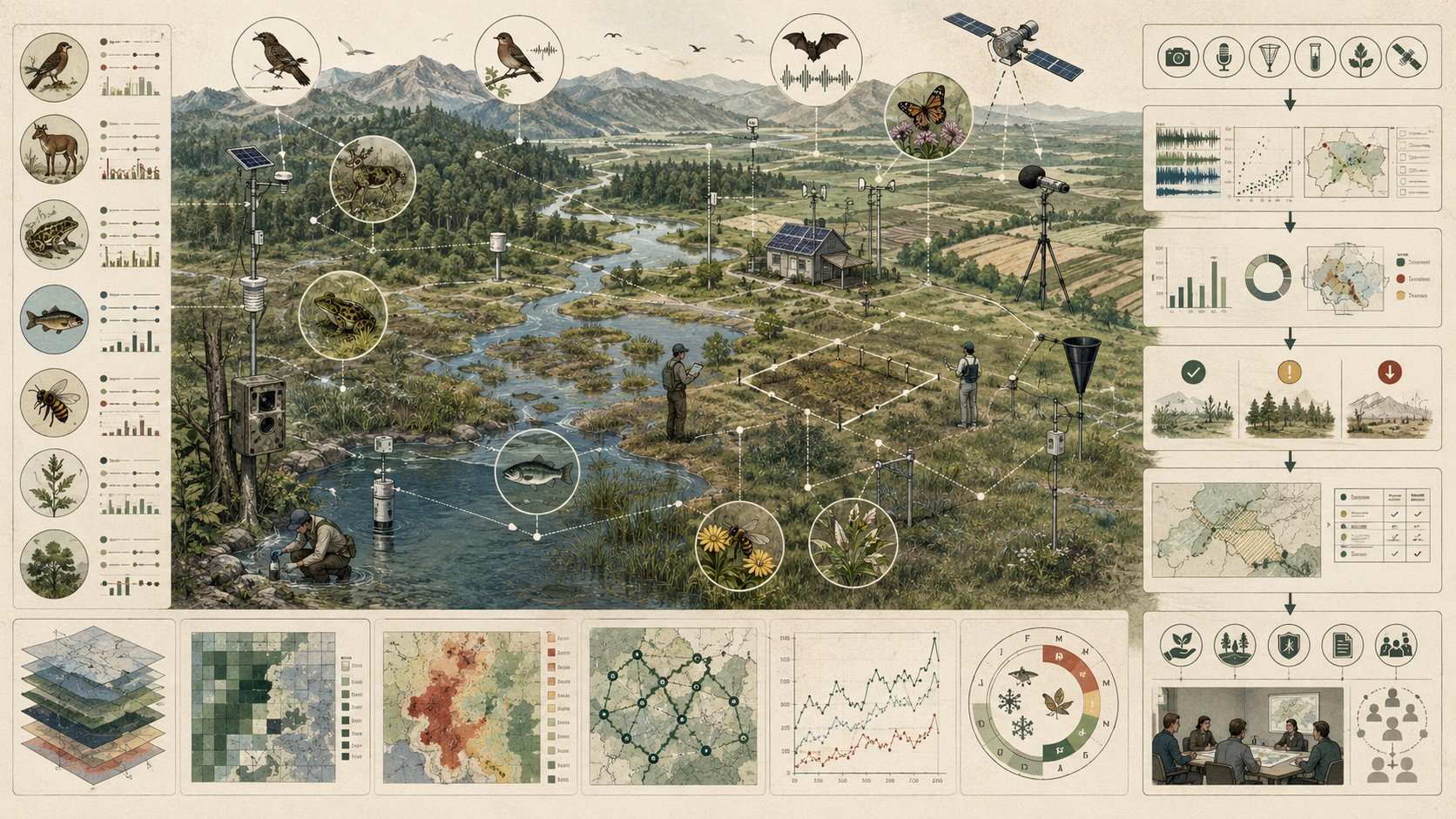
Biodiversity monitoring is where ecological observation becomes conservation evidence. It asks not only which species have been recorded, but how living systems are changing, how reliable the records are, which taxa and places remain under-observed, what uncertainty surrounds inferred trends, and whether conservation claims are supported by repeatable evidence. A species list, camera-trap image, acoustic recording, DNA trace, or habitat raster rarely answers those questions alone. The central task is to assemble partial observations into defensible biodiversity intelligence without pretending that indicators are biodiversity itself.
Engineering Problem
The engineering problem is how to design biodiversity monitoring systems that can transform incomplete, biased, multi-method observations into defensible evidence about species occurrence, abundance, distribution, community composition, habitat condition, ecosystem function, invasive spread, ecological integrity, and conservation progress. Biodiversity monitoring is not a simple data-collection problem because most biodiversity observations are filtered through imperfect detection, uneven sampling effort, taxonomic uncertainty, habitat access, seasonal timing, sensor placement, method change, observer expertise, and institutional capacity.
This problem is difficult because biodiversity is not one variable. It includes genetic diversity, populations, species, traits, communities, habitats, ecosystems, functions, and relationships. Each changes at different rates and is observed through different methods. A camera trap may record medium and large mammals while missing invertebrates, plants, microbes, and cryptic taxa. An acoustic recorder may capture vocal species while missing silent or non-vocal biodiversity. An eDNA sample may detect traces without establishing abundance, viability, or ecological role. A satellite-derived habitat product may reveal structure or fragmentation without directly observing organismal response. A species occurrence database may contain valuable records but still reflect uneven effort, accessibility, and reporting bias.
Weak biodiversity monitoring treats records as if they were transparent evidence of life. Strong biodiversity monitoring treats records as evidence produced under known conditions. It asks how observations were made, how often, by whom or what device, under what protocol, with what effort, for which taxa, at what spatial and temporal scale, and with what uncertainty. It separates detection from presence, presence from abundance, abundance from viability, species richness from ecological condition, and indicators from the living systems they represent.
| Engineering Tension | Why It Matters | Required Evidence |
|---|---|---|
| Observation versus detectability | A species not recorded may still be present; detection depends on effort, method, season, behavior, and habitat. | Survey effort, detection model, repeat visits, method metadata, absence caveat |
| Occurrence versus abundance | Presence records do not necessarily reveal population size, trend, viability, or decline. | Abundance method, count protocol, effort normalization, trend model |
| Species richness versus ecological condition | Richness can remain stable while specialists disappear, communities homogenize, or function declines. | Community composition, trait metrics, integrity indicators, habitat condition |
| Habitat visibility versus biological response | Remote sensing can show habitat structure but may miss population, genetic, or interaction change. | Field validation, species response data, habitat-quality indicators |
| Standardization versus local meaning | Global indicators support reporting but can flatten local ecological knowledge and context. | Indicator crosswalk, local interpretation note, Indigenous/local knowledge governance |
| Automation versus accountability | AI-assisted image, acoustic, or eDNA classification can scale observation while creating new uncertainty. | Model card, validation set, confidence score, false-positive/negative review |
| Monitoring visibility versus conservation response | Seeing decline does not guarantee institutions have authority, funding, legitimacy, or capacity to respond. | Decision-use statement, response pathway, governance owner, public evidence package |
The practical question is therefore: can the monitoring system support the biodiversity claim being made, or does it merely accumulate records without enough information about detection, effort, uncertainty, representativeness, and ecological meaning?
Reference Architecture
A practical biodiversity monitoring architecture can be understood as a biodiversity evidence system. The exact implementation may include field transects, plots, camera traps, acoustic recorders, eDNA samples, remote-sensing layers, taxonomic reference libraries, occurrence databases, data standards, detection models, EBV-style variables, indicator pipelines, dashboards, reporting systems, community-based observation, and governance logs. The responsibilities remain consistent: observe, document effort, validate identity, handle detectability, harmonize methods, infer state and trend, communicate uncertainty, and connect evidence to conservation action.
| Layer | Engineering Role | Primary Risk | Evidence Artifact |
|---|---|---|---|
| Monitoring objective layer | Defines taxa, ecosystem context, geography, temporal horizon, decision use, reporting framework, and evidence standard. | Monitoring design follows available methods rather than conservation question. | Monitoring objective manifest, decision-use statement, taxonomic scope |
| Sampling and effort layer | Defines survey design, site selection, repeat visits, observation effort, method duration, and sampling frame. | Records cannot be interpreted because effort and detectability are unknown. | Sampling plan, effort log, observation-event registry |
| Observation layer | Collects field, image, audio, molecular, remote-sensing, and community observations. | Taxonomic, spatial, method, and accessibility biases shape the evidence without being visible. | Occurrence records, sensor registry, eDNA sample log, image/audio metadata |
| Taxonomic and validation layer | Checks species identification, classifier confidence, reference taxonomy, data quality, and uncertain records. | Misidentifications, taxonomic changes, or model errors become hidden in indicators. | Validation report, taxonomic backbone, confidence score, expert-review log |
| Detectability and inference layer | Accounts for non-detection, survey effort, method bias, occupancy, abundance, and trend uncertainty. | Absence, decline, or stability is inferred too strongly from incomplete records. | Detection model, occupancy model, effort-normalized trend output |
| Indicator and EBV layer | Translates observations into standardized variables and policy-facing indicators. | Indicators become administratively useful but ecologically shallow. | Indicator registry, EBV crosswalk, variable definition, proxy-limit statement |
| Data infrastructure layer | Stores, standardizes, publishes, and reuses biodiversity data through interoperable vocabularies and platforms. | Records become fragmented, non-comparable, or hard to audit. | Darwin Core-style fields, dataset metadata, GBIF-ready archive, API documentation |
| Governance and accountability layer | Connects monitoring evidence to conservation, restoration, protected-area management, national reporting, and public accountability. | Biodiversity claims exceed evidence quality or omit uncertainty and representativeness limits. | Governance log, public evidence package, revision history, response pathway |
This architecture makes clear that biodiversity monitoring is not only a biological activity. It is an evidence infrastructure spanning field ecology, sensing systems, taxonomy, statistics, data standards, institutional capacity, and public accountability.
Implementation Pattern
A rigorous biodiversity-monitoring implementation begins with the ecological and governance question. The correct design depends on whether the system is intended to detect population decline, estimate occupancy, monitor protected-area integrity, track invasive species, assess restoration, report on national biodiversity targets, evaluate habitat change, support conservation finance, or document community-based ecological observations. Each purpose implies different taxa, sampling frequency, field protocols, detection assumptions, data standards, statistical models, uncertainty thresholds, and public reporting requirements.
| Artifact | Purpose | Suggested Format |
|---|---|---|
| Monitoring objective manifest | Defines target taxa, geography, monitoring purpose, reporting framework, temporal horizon, and evidence standard. | YAML, Markdown, architecture decision record |
| Taxonomic and ecological scope | Documents taxa, functional groups, habitats, ecosystem context, and exclusions. | CSV, controlled vocabulary, data dictionary |
| Sampling and effort registry | Tracks sites, survey events, effort, duration, method, observer, device, environmental conditions, and repeat visits. | CSV, SQL table, Darwin Core Event-style table |
| Occurrence and detection records | Stores species records, detections, non-detections, confidence, method, evidence type, and validation status. | CSV, SQL table, Darwin Core-style archive |
| Method registry | Documents field survey, camera, acoustic, eDNA, remote-sensing, and community observation methods. | YAML, CSV, protocol manual |
| Indicator and EBV crosswalk | Maps raw observations and intermediate variables to EBVs, CBD indicators, and management indicators. | CSV, YAML, documentation table |
| Detectability and bias model card | Documents detection assumptions, effort normalization, model limitations, false positives, and false negatives. | Markdown model card |
| Representativeness audit | Assesses taxonomic, geographic, habitat, method, capacity, and accessibility gaps. | CSV, map, governance memo |
| Public evidence package | Explains methods, indicators, uncertainty, data quality, valid-use limits, and governance ownership. | Markdown, HTML, PDF, dashboard note |
| Governance and revision log | Records method changes, indicator updates, taxonomic revisions, disputed claims, public caveats, and reporting decisions. | CSV, SQL table, changelog |
The implementation goal is to make biodiversity claims reconstructable. Users should be able to move from a statement such as “species declining,” “habitat improving,” “invasive spreading,” “target on track,” or “restoration succeeding” back to the observations, effort, detection assumptions, validation, indicators, uncertainty, and governance decisions that produced it.
Research-Grade Framing: Biodiversity Monitoring as Living Knowledge Infrastructure
A research-grade account of biodiversity monitoring begins by treating it as living knowledge infrastructure rather than as a bundle of field techniques. Monitoring systems determine which taxa, habitats, communities, functions, and ecological processes become visible, how often they are observed, what uncertainty is tolerated, which biases are corrected or ignored, and how raw observations are transformed into indicators, trends, risk categories, management actions, or policy reports. In that sense, biodiversity monitoring organizes the conditions under which living change becomes knowable.
This role is especially demanding because biodiversity resists total observation. Biodiversity includes genes, populations, species, traits, interactions, communities, habitats, and ecosystem functions. These dimensions are distributed unevenly across space, change at different rates, and require different methods. A system designed around habitat extent will not necessarily capture abundance decline. A system centered on charismatic vertebrates may miss invertebrate collapse, plant community turnover, fungal diversity, microbial change, or functional homogenization. A monitoring framework that emphasizes species richness may obscure degradation in ecological integrity, trophic structure, or community composition.
Biodiversity monitoring is therefore necessarily selective, and its selectivity has consequences. What is counted, standardized, and reported acquires institutional weight. What is weakly monitored or methodologically excluded can become peripheral to governance even if ecologically central. Monitoring systems thus do not merely describe biodiversity; they help define which forms of biodiversity loss are legible enough to matter in policy, management, finance, and public debate.
| Limited Pattern | Stronger Pattern | Why the Shift Matters |
|---|---|---|
| Collect species records | Build an effort-aware, method-aware biodiversity evidence system | Prevents observations from being mistaken for unbiased biodiversity reality. |
| Report species richness | Track occurrence, abundance, composition, traits, condition, function, and integrity where relevant | Prevents simple counts from concealing ecological deterioration. |
| Use automated classification | Document model performance, uncertainty, validation, false positives, and false negatives | Prevents scaled automation from becoming unreviewable ecological authority. |
| Produce indicators | Preserve the link between indicators, EBVs, observations, effort, and ecological meaning | Prevents policy dashboards from becoming detached from field reality. |
| Map habitat | Connect habitat extent and structure to biological response and condition | Prevents habitat proxies from replacing biodiversity evidence. |
| Invite participation | Govern community and Indigenous knowledge with consent, reciprocity, data rights, and interpretive respect | Prevents local knowledge from being mined without epistemic or political accountability. |
The central research question is not “How many biodiversity records exist?” but “What kind of living change does this monitoring system make visible, what remains hidden or uncertain, and what claims can responsibly be made from the evidence?”
Formal Model: Detectability, Occupancy, Trend, Indicator Readiness, and Evidence Quality
A useful formal model separates detection probability, occupancy, abundance trend, taxonomic coverage, spatial representativeness, method comparability, indicator readiness, uncertainty communication, and governance readiness. Let \(p_d\) represent detection probability, \(\psi\) occupancy, \(T_a\) abundance trend evidence, \(C_t\) taxonomic coverage, \(R_s\) spatial representativeness, \(M_c\) method comparability, \(I_r\) indicator readiness, \(U_c\) uncertainty communication, and \(G_r\) governance readiness. Biodiversity evidence quality depends on these dimensions together, not on record volume alone.
p_d = P(\mathrm{detection}\mid \mathrm{presence},\ \mathrm{method},\ \mathrm{effort},\ \mathrm{season})
\]
Interpretation: Detection probability expresses that a species may be present but not detected, depending on method, effort, season, behavior, habitat, and observation conditions.
\psi = P(\mathrm{site\ occupied})
\]
Interpretation: Occupancy represents the probability that a site is used or occupied by a species, distinct from whether the species happened to be detected during a survey.
R_{\mathrm{effort}} = \frac{N_{\mathrm{standardized\ survey\ events}}}{N_{\mathrm{target\ survey\ events}}}
\]
Interpretation: Effort completeness measures whether the monitoring program has enough standardized survey events to support comparison through time and across sites.
C_{\mathrm{taxonomic}} = \frac{N_{\mathrm{taxa\ monitored}}}{N_{\mathrm{taxa\ in\ scope}}}
\]
Interpretation: Taxonomic coverage measures how much of the monitoring scope is actually represented by the observation system.
B_{\mathrm{bias}} = 1 – \frac{G_{\mathrm{underrepresented}}}{G_{\mathrm{target}}}
\]
Interpretation: Bias-adjusted representativeness can be approximated as the share of target taxonomic, habitat, geographic, and method groups that are meaningfully represented.
Q_{\mathrm{biodiversity\ evidence}} = w_1p_d + w_2T_a + w_3C_t + w_4R_s + w_5M_c + w_6I_r + w_7U_c + w_8G_r
\]
Interpretation: Biodiversity evidence quality depends on detection modeling, abundance or trend evidence, taxonomic coverage, representativeness, method comparability, indicator readiness, uncertainty communication, and governance readiness.
This formal structure protects against a common error in biodiversity monitoring: equating more records with better evidence. A monitoring system can have many records and still be weak if it lacks effort data, detectability handling, taxonomic breadth, spatial representativeness, validation, or governance context.
What Are Biodiversity Monitoring Systems?
Biodiversity monitoring systems are coordinated systems for observing, sampling, recording, validating, integrating, and interpreting biological variation and change. They are designed to track dimensions of biodiversity such as species occurrence, occupancy, abundance, distribution, population trend, community composition, habitat structure, ecosystem integrity, ecological function, invasive spread, and conservation response. These systems may be local, regional, national, or global, but they share the same central purpose: to convert living complexity into evidence that can support ecological understanding and decision-making.
Such systems may include field transects, plots, repeated surveys, species inventories, camera traps, acoustic monitoring networks, eDNA and other molecular detection methods, satellite and airborne remote sensing, community-based observation, Indigenous and local knowledge systems where governed appropriately, taxonomic databases, statistical models, and indicator frameworks that translate observations into trend and status assessments. GEO BON’s Essential Biodiversity Variables are especially useful because they position monitoring as a bridge between raw biodiversity data and policy-relevant indicators.
The defining feature of biodiversity monitoring is that it rarely observes biodiversity directly in total. Instead, it samples selected ecological signals and uses those signals to infer broader patterns of condition and change. A camera trap may indicate occupancy or activity. An acoustic sensor may reveal temporal presence of vocal taxa. A habitat map may capture extent or fragmentation. An eDNA sample may detect taxa otherwise difficult to observe. A citizen-science record may extend spatial coverage while introducing effort and validation questions. Monitoring systems are therefore inferential architectures rather than simple counting systems.
| Monitoring Form | Primary Question | Typical Evidence | Main Risk |
|---|---|---|---|
| Occurrence monitoring | Which taxa have been detected at which places and times? | Occurrence records, specimens, observations, images, audio, DNA detections | Detection is mistaken for full presence/absence knowledge. |
| Occupancy monitoring | Which sites are likely occupied after accounting for imperfect detection? | Repeated surveys, detection/non-detection records, occupancy models | Non-detections are treated as absences without effort or detection correction. |
| Abundance monitoring | How many individuals or relative detections occur through time? | Counts, density estimates, capture-recapture, acoustic/image rates, standardized effort | Record volume is mistaken for population size. |
| Community monitoring | How are assemblages, composition, turnover, and functional traits changing? | Community matrices, traits, guilds, beta diversity, turnover metrics | Richness hides compositional loss or homogenization. |
| Habitat-linked monitoring | How do habitat extent, structure, and fragmentation relate to biodiversity? | Remote sensing, habitat maps, fragmentation metrics, field validation | Habitat proxies are treated as direct biological evidence. |
| Indicator and reporting monitoring | How can observations support policy targets, EBVs, and conservation indicators? | Indicator pipelines, EBV crosswalks, national reports, dashboards | Indicators compress complexity without preserving uncertainty. |
Biodiversity monitoring systems are therefore more than observation networks. They are infrastructures for producing defensible evidence about living change.
Why Biodiversity Monitoring Matters
Biodiversity monitoring matters because ecological change is often difficult to perceive without systematic observation. Species can decline before vanishing from a landscape. Community composition can shift while gross habitat appearance remains stable. Habitat fragmentation can undermine viability long before total area loss becomes obvious. Freshwater, forest, marine, grassland, soil, and urban ecosystems all exhibit different rhythms and modes of degradation. Without monitoring, these changes can remain anecdotal, spatially patchy, methodologically uncertain, or institutionally contestable.
Monitoring also matters because contemporary conservation increasingly operates through targets, indicators, accountability frameworks, protected-area commitments, restoration claims, and national biodiversity strategies. The Kunming–Montreal Global Biodiversity Framework and its monitoring framework place biodiversity commitments within a measurable reporting structure. That means biodiversity policy is expected to be evidentiary rather than merely aspirational. Monitoring therefore underpins not only ecological research, but the verification of whether political promises correspond to ecological outcomes.
It matters, finally, because ecological loss is often cumulative and path dependent. Early invasive establishment, fragmentation, declining reproductive success, community homogenization, genetic erosion, or repeated disturbance may be more important than static snapshots of present condition. Monitoring creates temporal depth. It allows managers and institutions to ask not only what biodiversity looks like now, but whether it is stable, recovering, degrading, shifting, or approaching thresholds beyond which restoration becomes harder, slower, or more expensive.
| Need | Monitoring Contribution | Risk Without Monitoring |
|---|---|---|
| Conservation planning | Identifies species, habitats, populations, trends, and priority areas requiring action. | Planning relies on outdated distributions or charismatic visibility. |
| Protected-area management | Tests whether protected places are maintaining biodiversity condition and integrity. | Legal protection is mistaken for ecological effectiveness. |
| Restoration accountability | Tracks whether interventions produce ecological recovery, not only activity completion. | Restoration claims remain project-based rather than evidence-based. |
| Invasive-species control | Detects early establishment, spread, and ecological impact. | Response begins after invasive populations are entrenched. |
| National and global reporting | Supports indicators, EBVs, and progress assessment under biodiversity frameworks. | Policy commitments become difficult to verify or compare. |
| Environmental justice and inclusion | Can reveal under-monitored places, local ecological change, and unequal capacity to document loss. | Ecological decline in marginalized landscapes remains less visible. |
Biodiversity monitoring matters because living systems can decline quietly. Without repeated, representative, uncertainty-aware observation, loss can remain deniable until the ecological consequences are severe.
Biodiversity Monitoring as Ecological Knowledge Infrastructure
A strong understanding of biodiversity monitoring requires treating it as ecological knowledge infrastructure rather than as a bundle of techniques. Monitoring systems determine which taxa, habitats, communities, and ecological processes become visible, how often they are observed, what forms of uncertainty are tolerated, which biases are corrected or ignored, and how raw observations are transformed into indicators, trends, or management-relevant categories. In that sense, biodiversity monitoring organizes the conditions under which ecological change becomes knowable.
This is especially difficult because biodiversity is not one variable. It includes genes, populations, species, traits, communities, habitats, and ecosystem functions, each of which changes at different rates and is observed with different methods. A system designed around habitat extent will not necessarily capture abundance decline. A system centered on charismatic vertebrates may miss invertebrate collapse or microbial change. A monitoring framework that emphasizes species richness may obscure degradation in ecological integrity, community composition, or functional structure.
This also means biodiversity monitoring is inseparable from the politics of representation. What is counted, standardized, and reported acquires institutional weight. What is weakly monitored or methodologically excluded can become peripheral to governance even if ecologically central. Monitoring systems thus do not merely describe biodiversity; they help define which forms of biodiversity loss are legible enough to matter in policy and management.
| Monitoring Choice | What Becomes More Visible | What May Remain Less Visible |
|---|---|---|
| Species occurrence records | Where taxa have been recorded and when. | Detection effort, abundance, non-detections, population viability. |
| Camera trap networks | Medium and large-bodied mobile fauna, activity patterns, occupancy. | Plants, invertebrates, microbes, cryptic small taxa, many ecological interactions. |
| Acoustic monitoring | Vocal taxa, seasonal activity, temporal patterns, soundscape change. | Silent taxa, quiet species, non-vocal life stages, ambiguous call attribution. |
| eDNA sampling | Taxa with genetic traces in water, soil, air, or sediments. | Abundance, viability, exact location, persistence of DNA traces. |
| Remote sensing | Habitat extent, structure, fragmentation, productivity, ecosystem context. | Organism-level presence, demographic change, genetic diversity, biotic interactions. |
| Policy indicators | Comparable reporting, target tracking, dashboard communication. | Local ecological meaning, uncertainty, taxonomic bias, method limitations. |
Biodiversity monitoring is powerful because it turns living change into public evidence. It is risky when the evidence chain is forgotten and records, indicators, or proxies are mistaken for biodiversity itself.
Dimensions of Biodiversity and What Must Be Observed
Biodiversity monitoring systems observe many different aspects of life and ecological condition, but several dimensions recur across scientific and policy frameworks. GEO BON’s Essential Biodiversity Variables are especially useful because they identify intermediate biological measurements that can support derived indicators and reporting across scales. These include dimensions related to genetic composition, species populations, species traits, community composition, ecosystem structure, and ecosystem function.
Common biodiversity monitoring targets include species occurrence and occupancy, species abundance and population trend, distribution shifts and range change, community composition and turnover, habitat extent and fragmentation, ecosystem integrity and ecological condition, invasive species presence and spread, and pressure, response, and management-linked ecological indicators. No single target captures biodiversity as a whole. Habitat extent can remain stable while abundance declines. Species richness can remain superficially high while specialists disappear and communities homogenize. Population trend can reveal decline without explaining habitat mechanism. Ecosystem-condition indicators may reflect broad change while masking taxonomic losers and winners.
| Dimension | What It Captures | Possible Evidence | Analytical Risk |
|---|---|---|---|
| Genetic diversity | Variation within and among populations. | Genomic samples, eDNA, population genetics, genetic indicators. | Species presence is mistaken for population resilience. |
| Species occurrence | Where taxa are detected. | Observations, specimens, images, sounds, DNA records. | Detection is mistaken for true distribution. |
| Population abundance | How population size or relative activity changes through time. | Counts, density estimates, capture-recapture, standardized detections. | Observation volume is mistaken for abundance. |
| Community composition | Which taxa co-occur and how assemblages change. | Community matrices, turnover, traits, guilds, functional groups. | Species richness hides replacement, homogenization, or specialist loss. |
| Habitat and ecosystem structure | Spatial and physical context sustaining biodiversity. | Remote sensing, patch metrics, vegetation structure, fragmentation. | Habitat structure is treated as biological response. |
| Ecosystem function | Processes linked to biodiversity and ecological performance. | Productivity, pollination, decomposition, nutrient cycling, trophic signals. | Functional proxies overstate ecological integrity. |
| Pressure and response | Stressors, management interventions, and conservation outcomes. | Threat layers, invasive records, restoration actions, protected-area management indicators. | Response effort is mistaken for ecological recovery. |
This is why biodiversity monitoring is almost always multi-variable and multi-method at serious levels of practice. Different dimensions illuminate different forms of ecological change, and robust monitoring must hold them together without collapsing them into a false single metric.
Key Analytical Distinctions
Observation is not the same as detectability. A species not recorded is not necessarily absent. Monitoring systems must account for imperfect detection, especially for rare, cryptic, seasonal, nocturnal, subterranean, aquatic, or acoustically subtle taxa.
Occurrence is not the same as abundance. A record shows that a taxon was detected under particular conditions. It does not automatically show population size, density, viability, or trend.
Species richness is not the same as ecological condition. A site can retain many species while losing specialists, trophic structure, native integrity, or functional resilience. Richness alone may not capture fragmentation, homogenization, invasions, or declining ecosystem function.
Remote sensing is not the same as biological observation. Earth observation can track habitat extent, structure, productivity, and fragmentation, but many biological variables still depend on field, acoustic, image-based, molecular, or community-based methods.
Indicators are not the same as raw biodiversity data. Indicators are standardized, policy-facing summaries derived from underlying observation systems. They are essential for governance, but they compress ecological complexity.
Monitoring is not the same as assessment. Monitoring supplies the observational basis; assessment interprets that evidence in relation to ecological status, trend, targets, thresholds, uncertainty, and decision frameworks.
| Distinction | Why It Matters | Design Implication |
|---|---|---|
| Detection versus presence | Non-detection can result from method or effort rather than true absence. | Use repeat surveys, detection models, effort metadata, and absence caveats. |
| Occurrence versus population trend | Presence records do not automatically reveal decline. | Track abundance, effort-normalized detections, and temporal trend. |
| Richness versus composition | Richness can remain stable during community turnover or homogenization. | Track composition, specialists, functional groups, and community change. |
| Habitat proxy versus species response | Habitat extent or structure does not guarantee viable populations. | Link remote sensing with field or automated biological observation. |
| Indicator versus ecological reality | Indicators simplify complex systems for reporting. | Document proxy limits, source data, uncertainty, and valid-use boundaries. |
| Participation versus governance | Community data are not automatically equitable or legitimate if knowledge ownership is ignored. | Define consent, attribution, data rights, validation, and interpretation roles. |
These distinctions prevent biodiversity monitoring from being reduced to a record count, dashboard, or species list. The monitoring system is an evidentiary architecture, not merely an observation archive.
System Architecture: From Observation to Biodiversity Intelligence
Biodiversity monitoring systems operate as layered architectures that transform scattered ecological observations into interpretable biodiversity intelligence. Surveys, traps, recorders, genetic samples, remote-sensing systems, and community observations collect biological and ecological signals. Records are time-stamped, georeferenced, taxonomically identified, and linked to metadata on effort, method, observer, device, environmental conditions, and context. Records are validated for quality, taxonomic consistency, sensor reliability, classifier confidence, and methodological comparability. Observations from multiple sites, times, taxa, and methods are harmonized into analyzable datasets. Statistical models and indicator frameworks infer trend, status, condition, risk, or progress. Managers, governments, researchers, and communities then use results for conservation planning, reporting, restoration, and governance.
| Stage | Transformation | Failure Risk |
|---|---|---|
| Living system | Biodiversity changes through population dynamics, movement, reproduction, mortality, disturbance, and ecological interaction. | The selected method observes only a narrow biological slice. |
| Observation | Field, automated, molecular, remote, or community methods detect biological signals. | Observation bias, imperfect detection, taxonomic gaps, and uneven effort. |
| Metadata and effort | Records are linked to method, effort, time, site, observer, device, and environmental conditions. | Records cannot support inference because effort is unknown. |
| Validation | Taxonomic identity, classifier confidence, sensor quality, and data completeness are checked. | Misidentification and model error enter indicators unnoticed. |
| Integration | Records from different sites, methods, taxa, and years are harmonized. | Method differences are mistaken for ecological change. |
| Inference | Models infer occurrence, occupancy, abundance, trend, community change, or risk. | Non-detection, sampling bias, or missing taxa are over-interpreted. |
| Indicator production | Monitoring outputs become EBVs, headline indicators, national statistics, or conservation dashboards. | Indicators become detached from source data and uncertainty. |
| Governance use | Evidence supports conservation, restoration, finance, protected-area management, and public reporting. | Claims exceed evidence strength or omit caveats. |
This layered structure matters because biodiversity intelligence does not emerge directly from raw records. A camera image, acoustic signature, DNA trace, habitat raster, or citizen-science observation becomes decision-relevant only when inserted into a broader monitoring logic that includes effort, validation, detectability, standardization, inference, and governance.
Field Surveys, Automated Observation, eDNA, and Remote Sensing
Modern biodiversity monitoring is methodologically plural because different taxa, habitats, and questions require different observational modes. Traditional field surveys, plots, and transects remain indispensable for many species and ecological questions because they allow direct identification, contextual observation, standardized repeat measurement, and long-term continuity. They often provide the backbone of protected-area monitoring and ecological time series.
Automated observation has expanded monitoring capacity dramatically. Camera traps make it possible to monitor mobile or elusive fauna with less continuous human presence. Acoustic recorders allow repeated, minimally intrusive monitoring of birds, amphibians, insects, mammals, and other vocal taxa across long temporal windows. These methods increase scale and continuity, but they also create new burdens of classification, algorithmic interpretation, storage, sampling design, and effort standardization.
Environmental DNA and related molecular methods are increasingly important because they can detect taxa that are difficult to observe visually or acoustically, especially in aquatic, soil, and cryptic contexts. They expand the observational repertoire of biodiversity monitoring, but also raise questions about persistence of genetic traces, taxonomic resolution, contamination, reference libraries, and the distinction between detection and ecological interpretation.
Remote sensing contributes habitat and ecosystem-scale visibility. It is especially powerful for monitoring vegetation structure, land-cover change, fragmentation, ecosystem extent, productivity, and some proxies of ecological function over large spatial scales. But habitat visibility is not identical to organism visibility. This is why the most robust biodiversity monitoring systems combine field, automated, molecular, and remote methods rather than assuming any one mode can stand in for biodiversity as a whole.
| Method Family | Strength | Limitation | Best Use |
|---|---|---|---|
| Field surveys | Direct ecological context, protocol control, expert identification, long-term comparability. | Labor-intensive, spatially limited, observer-dependent, access-biased. | Species inventories, abundance, community composition, validation. |
| Camera traps | Repeated detection of mobile and elusive fauna. | Taxonomic and body-size bias, image classification burden, placement effects. | Occupancy, activity, medium/large vertebrate monitoring. |
| Acoustic monitoring | High-frequency and low-disturbance monitoring of vocal taxa and soundscapes. | Vocal taxa bias, acoustic confusion, model uncertainty, soundscape noise. | Birds, amphibians, insects, bats, soundscape change. |
| eDNA and molecular methods | Detection of cryptic, aquatic, rare, or difficult-to-observe taxa. | Trace persistence, contamination, reference-library limits, abundance ambiguity. | Early detection, aquatic biodiversity, cryptic taxa, invasive surveillance. |
| Remote sensing | Broad habitat, structure, fragmentation, and ecosystem context. | Indirect for organism-level biodiversity and biological interactions. | Habitat change, structure, ecosystem extent, landscape context. |
| Community-based observation | Local coverage, place-based knowledge, legitimacy, long-duration ecological memory. | Requires careful governance, consent, attribution, and validation design. | Local ecological change, stewardship, participatory monitoring. |
Method integration is not an optional enhancement. It is the heart of biodiversity monitoring because no single method observes life as a whole.
Detectability, Bias, and the Problem of Ecological Inference
One of the hardest and most fundamental problems in biodiversity monitoring is detectability. Species are not observed with equal probability. Detection depends on abundance, behavior, season, habitat structure, observer skill, survey timing, sensor placement, taxonomic difficulty, weather, vocalization, body size, DNA shedding, and effort. This means biodiversity data are rarely transparent reflections of ecological reality; they are filtered through the conditions of observation.
This has major consequences for inference. A non-detection is not equivalent to absence. A decline in recorded observations may reflect true population decline, altered detectability, shifting effort, changes in method, or changes in reporting behavior. A camera trap network may be rich for medium and large vertebrates while poorly representing smaller taxa. An acoustic network may privilege vocal species. A remote-sensing layer may capture habitat transformation without revealing species response. Strong monitoring systems therefore do not treat bias as an unfortunate side issue. They build designs and models around it.
Bias also enters through geography and institutions. Accessible sites, protected areas, charismatic taxa, better-funded regions, and well-connected research networks often receive denser monitoring than remote, politically marginal, taxonomically difficult, or low-capacity systems. Monitoring can therefore be data-rich while remaining spatially, taxonomically, or methodologically skewed. An exceptional biodiversity monitoring system is not one that eliminates these biases completely. It is one that acknowledges them explicitly, designs around them where possible, and communicates the limits of inference honestly.
| Bias or Inference Problem | Consequence | Mitigation |
|---|---|---|
| Imperfect detection | Species are missed even when present. | Repeat surveys, occupancy models, detection probability, effort metadata. |
| Observer and taxonomic bias | Visible, charismatic, or easier-to-identify taxa dominate records. | Taxonomic training, expert validation, method diversity, taxonomic gap audit. |
| Method bias | Camera, acoustic, eDNA, field, and remote methods observe different biodiversity slices. | Method registry, cross-method calibration, indicator-specific caveats. |
| Spatial access bias | Accessible sites and protected areas are overrepresented. | Stratified design, under-sampled area targeting, representativeness audit. |
| Temporal bias | Seasonal, daily, or event-driven variation is mistaken for trend. | Consistent sampling windows, phenology notes, long-term time series. |
| Data-publication bias | Records reflect who publishes data, not only where biodiversity occurs. | Dataset provenance, capacity review, data-mobilization support. |
Ecological knowledge becomes more trustworthy not when it claims completeness, but when it is rigorous about uncertainty in the presence of incomplete visibility.
Indicators, EBVs, and the Politics of Standardization
Indicators are the governance-facing outputs of biodiversity monitoring. They translate raw ecological observations into standardized measures that can support reporting, comparison, target tracking, and public communication. The CBD monitoring framework organizes progress assessment around headline, binary, component, and complementary indicators, while GEO BON’s Essential Biodiversity Variables provide a structured middle layer between raw observations and derived policy indicators.
This translation is necessary, but it is never neutral. Indicators simplify. They compress ecological complexity into manageable forms suited to policy and reporting. That compression is useful, even indispensable, but it also means indicators privilege some forms of ecological visibility over others. What gets standardized becomes easier to govern. What remains poorly standardized may become harder to compare, report, or fund, even if ecologically important.
This is why the politics of standardization matter. EBVs are powerful because they offer a common conceptual grammar across data sources and scales. But even a strong indicator architecture cannot fully dissolve the tension between ecological heterogeneity and reporting comparability. Biodiversity monitoring systems are strongest when they preserve a clear connection between standardized indicators and the ecological realities from which they are derived. Otherwise, indicator systems risk becoming administratively elegant while ecologically shallow.
| Evidence Layer | Role | Risk | Evidence Requirement |
|---|---|---|---|
| Raw observations | Species, sample, sensor, image, audio, DNA, or habitat records. | Records are interpreted without effort, method, or validation context. | Occurrence fields, event metadata, method, effort, confidence, provenance. |
| Intermediate variables | Standardized biological measurements such as EBV-style variables. | Variables are abstracted from method limitations. | Variable definition, source data, spatial/temporal scale, uncertainty. |
| Indicators | Policy-facing metrics for targets, reports, and dashboards. | Indicator elegance hides data gaps or taxonomic bias. | Indicator registry, valid-use limits, caveats, update method. |
| Assessment | Interpretation of status, trend, risk, or progress. | Assessment exceeds evidence quality. | Evidence-strength statement, confidence, review, public explanation. |
| Governance action | Conservation, restoration, regulation, finance, or reporting response. | Action is disconnected from monitoring uncertainty or capacity. | Decision pathway, accountability owner, review schedule. |
Indicators are indispensable for biodiversity governance. But they should remain connected to the records, effort, taxonomic judgments, uncertainty, and ecological interpretation that make them meaningful.
Data Standards, Occurrence Records, and Interoperability
Biodiversity monitoring depends on data infrastructure because observations become more useful when they can be shared, discovered, validated, integrated, and reused across institutions, regions, and time periods. Occurrence datasets, observation-event records, taxonomic identifiers, sampling metadata, data-quality rules, and shared vocabularies are not peripheral technical details. They determine whether biodiversity evidence can be compared across methods and used responsibly in research, reporting, and policy.
GBIF provides a major global infrastructure for open biodiversity data, especially species occurrence records, while Darwin Core provides a widely used standard vocabulary for sharing information about taxa, occurrences, specimens, samples, observations, and related biodiversity information. These infrastructures matter because biodiversity data are otherwise fragmented across museums, agencies, researchers, community projects, NGOs, environmental consultants, and monitoring programs. Standardization does not eliminate ecological uncertainty, but it makes data lineage and reuse more possible.
Interoperability also has limits. A standardized occurrence record may show that an organism was observed at a place and time, but it may not contain enough effort, non-detection, abundance, or protocol information to support trend inference. A monitoring dataset designed for occupancy, abundance, or ecological assessment needs richer event and effort metadata than a simple occurrence list. Strong biodiversity data systems therefore preserve both standardized sharing fields and monitoring-specific context.
| Requirement | Why It Matters | Evidence Artifact |
|---|---|---|
| Taxonomic identity | Ensures records can be interpreted consistently despite synonymy, revision, and uncertainty. | Taxon ID, scientific name, taxonomic authority, identification confidence. |
| Occurrence metadata | Links a taxon to place, time, basis of record, and evidence. | Darwin Core-style occurrence fields, evidence type, georeference. |
| Event and effort metadata | Allows non-detection, detectability, and trend inference. | Survey event, protocol, effort, duration, method, repeat visits. |
| Validation status | Protects indicators from misidentification and model error. | Expert review, classifier confidence, data-quality flag. |
| Method comparability | Allows field, camera, acoustic, molecular, and remote data to be interpreted together. | Method registry, calibration note, crosswalk, caveat statement. |
| Dataset provenance | Supports reuse, attribution, data rights, and governance accountability. | Dataset metadata, license, contributor, version, citation. |
Data standards turn biodiversity records into reusable evidence. But monitoring inference still depends on effort, method, detectability, validation, and ecological interpretation.
Community-Based Monitoring, Inclusion, and Situated Ecological Knowledge
Biodiversity monitoring is not only a technical or state-centered enterprise. Community-based monitoring, Indigenous observation systems, citizen-science networks, and other situated forms of ecological knowledge are increasingly recognized as essential to both monitoring coverage and legitimacy. Local and Indigenous monitoring systems may observe ecological change on temporal and spatial scales that formal scientific programs miss. They often bring long-duration place-based knowledge about seasonality, species behavior, habitat relationships, disturbance memory, and environmental anomalies.
This matters because biodiversity monitoring is also a question of who observes, who interprets, whose categories matter, and who benefits from the resulting evidence. A monitoring system that expands records while extracting knowledge without consent, attribution, reciprocity, or interpretive respect can reproduce epistemic inequality even while improving technical coverage. Inclusion is not achieved merely by attaching participation to preexisting reporting systems. It requires serious governance around data rights, knowledge ownership, consent, benefit-sharing, validation, and interpretation.
Biodiversity monitoring becomes stronger when it expands both empirical coverage and epistemic plurality. Scientific standards and local ecological knowledge need not be treated as enemies. The deeper question is whether monitoring systems can combine comparability with respect for situated knowledge, and whether public biodiversity evidence can support accountability without erasing the people and communities who observe ecological change directly.
| Issue | Why It Matters | Governance Requirement |
|---|---|---|
| Consent | Community and Indigenous knowledge should not be extracted without agreement. | Free, prior, and informed consent where applicable; documented participation terms. |
| Knowledge ownership | Local observations may contain culturally, ecologically, or politically sensitive information. | Data-rights agreement, sensitivity classification, access rules. |
| Interpretive authority | External systems can misread local categories and ecological meaning. | Co-interpretation, local review, category crosswalk, contextual notes. |
| Validation | Community observations require credibility pathways without dismissing situated knowledge. | Transparent validation rules, expert/community review, uncertainty handling. |
| Benefit-sharing | Monitoring should support local stewardship rather than only external reporting. | Reciprocal outputs, accessible dashboards, local capacity support. |
| Risk management | Publishing sensitive species or site data can create harm. | Location generalization, protected access, sensitivity review. |
Inclusive biodiversity monitoring is not only about adding observers. It is about building evidence systems that respect knowledge, rights, context, and accountability.
Governance, Capacity, and Ecological Accountability
Biodiversity monitoring has a governance dimension because what is monitored shapes what can be protected, restored, financed, reported, regulated, or contested. Monitoring systems support national biodiversity strategies, protected-area management, global framework implementation, environmental assessment, conservation prioritization, restoration review, and biodiversity finance. The CBD monitoring framework and IPBES monitoring assessment both reflect the growing expectation that biodiversity commitments be linked to measurable evidence rather than rhetorical intent.
Monitoring capacity, however, is profoundly uneven. Some countries, taxa, ecosystems, and institutions benefit from dense records, advanced data infrastructures, durable funding, and strong taxonomic expertise. Others face sparse coverage, limited survey capacity, fragmented databases, taxonomic workforce gaps, and low sensor or computational infrastructure. Weak monitoring is therefore not merely a scientific inconvenience. It is a governance vulnerability. Where biodiversity change is poorly observed, ecological decline can be underestimated, delayed in recognition, or excluded from serious policy response.
Monitoring also structures accountability. A conservation target without robust monitoring may function more as aspiration than obligation. A biodiversity-finance claim without evidence may remain difficult to verify. A restoration intervention without baseline and follow-up monitoring cannot easily demonstrate ecological effect. In this sense, biodiversity monitoring systems are infrastructures of ecological accountability: they make claims about living systems testable against observed change.
| Governance Responsibility | Question | Evidence |
|---|---|---|
| Monitoring governance | Who defines monitoring objectives, taxa, methods, indicators, and reporting uses? | Monitoring objective manifest, indicator registry, decision-use statement. |
| Taxonomic governance | How are identification uncertainty, taxonomy changes, and expert review handled? | Taxonomic backbone, validation log, revision record. |
| Data governance | Who can publish, access, reuse, correct, and interpret biodiversity records? | Data license, access policy, provenance, contributor attribution. |
| Indicator governance | Are indicators linked to source data, EBVs, uncertainty, and valid-use limits? | Indicator registry, EBV crosswalk, caveat statement, update method. |
| Capacity governance | Which taxa, places, communities, and institutions lack monitoring capacity? | Representativeness audit, capacity audit, funding and training plan. |
| Public accountability | Can affected publics, researchers, managers, and communities understand and contest biodiversity claims? | Public evidence package, accessible methods, uncertainty note, review owner. |
| Revision governance | How are errors, new data, taxonomic revisions, model updates, and disputed assessments handled? | Changelog, correction log, reassessment trigger, review schedule. |
Governance is how biodiversity monitoring remains trustworthy after records enter indicators, reports, dashboards, conservation finance, restoration claims, and public narratives.
Future Directions
The future of biodiversity monitoring lies in deeper integration across field surveys, automated sensors, molecular methods, remote sensing, statistical harmonization, biodiversity data standards, and policy-linked indicator systems. IPBES’s methodological assessment, the CBD monitoring framework, GEO BON’s work on EBVs and biodiversity observation networks, GBIF’s global data infrastructure, and Darwin Core-style standards all point toward more interoperable, scalable, and policy-relevant biodiversity observation infrastructures.
The deeper challenge is not simply to collect more biodiversity data. It is to build monitoring systems that are detectability-aware, taxonomically broader, geographically less biased, ecologically interpretable, institutionally durable, and publicly accountable. Future systems will need better treatment of imperfect detection, stronger links between local reality and global indicators, wider coverage of under-monitored taxa and ecosystems, more responsible integration of community and Indigenous observation systems, and stronger governance for automated classification, sensitive species data, and data reuse.
Biodiversity is rarely directly visible as a whole. Its decline is often distributed, gradual, taxon-specific, and easily masked by incomplete sampling or coarse proxies. Where monitoring systems are strong, ecological change becomes more measurable, more discussable, and more governable. Where they are weak, uncertainty often shelters degradation rather than life. In that sense, biodiversity monitoring systems are not merely tools of observation. They are infrastructures of ecological accountability, selective visibility, and conservation truth.
Deployment Readiness Gate
Before a biodiversity monitoring system is used for conservation claims, national reporting, protected-area evaluation, restoration verification, invasive-species response, biodiversity finance, ecological risk assessment, or public communication, it should pass a deployment readiness gate. This gate should test whether the monitoring system is ecologically meaningful, detectability-aware, interoperable, representative, uncertainty-aware, and fit for the governance claim attached to it.
| Readiness Area | Required Question | Pass Evidence |
|---|---|---|
| Purpose readiness | Does the system match the taxa, ecosystem context, geography, temporal horizon, decision use, and reporting framework? | Monitoring objective manifest, decision-use statement, taxonomic scope. |
| Sampling readiness | Are sites, survey events, effort, timing, methods, and repeat observations documented? | Sampling plan, observation-event registry, effort log. |
| Detectability readiness | Can the system distinguish non-detection from absence and records from true abundance? | Detection model, occupancy design, effort-normalized trend method. |
| Taxonomic readiness | Are identifications, taxonomy, reference libraries, classifier confidence, and review procedures documented? | Taxonomic backbone, validation report, confidence fields, expert-review log. |
| Method readiness | Are field, camera, acoustic, eDNA, remote-sensing, and community methods described and comparable? | Method registry, protocol manual, method-specific caveats. |
| Indicator readiness | Are indicators linked to observations, EBVs, source data, uncertainty, and valid-use limits? | Indicator registry, EBV crosswalk, public caveat statement. |
| Interoperability readiness | Can data be discovered, shared, validated, and reused using recognized standards? | Darwin Core-style fields, dataset metadata, GBIF-ready archive, API documentation. |
| Representativeness readiness | Does monitoring cover relevant taxa, habitats, geographies, seasons, methods, and under-monitored places? | Taxonomic/geographic/method audit, gap analysis, capacity plan. |
| Governance readiness | Are public caveats, data rights, sensitive species rules, community knowledge governance, revisions, and response pathways defined? | Governance log, public evidence package, access policy, revision history. |
This readiness gate prevents biodiversity monitoring from being treated as complete merely because records exist. The stronger standard is whether the monitoring system can support a defensible claim about living change.
Data and Configuration Artifacts
A reproducible biodiversity-monitoring workflow should include explicit artifacts for objectives, taxonomic scope, sampling events, occurrence records, method registry, indicator crosswalks, detectability assumptions, representativeness audits, public evidence, and governance. These artifacts make biodiversity claims auditable rather than hidden inside maps, dashboards, and indicators.
| Artifact | Purpose | Suggested Path |
|---|---|---|
| Monitoring objective manifest | Defines taxa, geography, ecosystem context, temporal window, decision use, and evidence standard. | config/monitoring_objective.yml |
| Taxonomic scope registry | Documents focal taxa, functional groups, habitats, exclusions, and reference taxonomy. | data/taxonomic_scope_registry.csv |
| Sampling and effort registry | Stores site, event, method, duration, observer, device, season, repeat visit, and effort fields. | data/sampling_effort_registry.csv |
| Occurrence and detection records | Stores taxa, detections, non-detections, confidence, validation, evidence type, and method. | data/biodiversity_detection_records.csv |
| Method registry | Documents field, camera, acoustic, eDNA, remote-sensing, and community methods. | data/monitoring_method_registry.csv |
| Indicator and EBV crosswalk | Maps observations and variables to EBVs, CBD indicators, and local management indicators. | data/indicator_ebv_crosswalk.csv |
| Detectability model card | Documents assumptions, detection probability, survey design, false positives, false negatives, and limitations. | model_cards/detectability_model_card.md |
| Representativeness audit | Assesses taxonomic, geographic, habitat, seasonal, method, and capacity gaps. | data/representativeness_audit.csv |
| Public evidence package | Explains methods, indicators, data quality, uncertainty, caveats, and valid-use limits. | docs/public_evidence_package.md |
| Governance log | Tracks method changes, taxonomic revisions, disputed claims, sensitive species decisions, and reporting updates. | data/biodiversity_monitoring_governance_log.csv |
These artifacts turn biodiversity monitoring into a reproducible conservation evidence system rather than a loose collection of records and indicators.
Mathematical Lens: Detection, Occupancy, Trend, Indicator Readiness, and Accountability
Several simple metrics can help evaluate biodiversity-monitoring readiness. These metrics are not substitutes for ecological expertise, taxonomic knowledge, field validation, community knowledge, or governance judgment, but they make biodiversity evidence quality more inspectable.
p_d = P(\mathrm{detection}\mid \mathrm{presence},\ \mathrm{method},\ \mathrm{effort},\ \mathrm{season})
\]
Interpretation: Detection probability expresses that a species may be present but not detected, depending on method, effort, season, behavior, habitat, and observation conditions.
\psi = P(\mathrm{site\ occupied})
\]
Interpretation: Occupancy estimates the probability that a site is occupied or used, separate from whether a detection occurred during a particular observation event.
R_{\mathrm{effort}} = \frac{N_{\mathrm{standardized\ survey\ events}}}{N_{\mathrm{target\ survey\ events}}}
\]
Interpretation: Effort completeness measures whether the monitoring program has enough standardized survey events to support comparison across sites and through time.
C_{\mathrm{taxonomic}} = \frac{N_{\mathrm{taxa\ monitored}}}{N_{\mathrm{taxa\ in\ scope}}}
\]
Interpretation: Taxonomic coverage measures how much of the stated monitoring scope is actually represented by the observation system.
T_{\mathrm{trend}} = \frac{A_{t+k} – A_t}{A_t}
\]
Interpretation: A simple abundance trend compares a later abundance or activity estimate with an earlier one, but should be interpreted only after effort and detectability are considered.
Q_{\mathrm{biodiversity\ evidence}} = w_1p_d + w_2T_a + w_3C_t + w_4R_s + w_5M_c + w_6I_r + w_7U_c + w_8G_r
\]
Interpretation: Biodiversity evidence quality depends on detection modeling, abundance or trend evidence, taxonomic coverage, representativeness, method comparability, indicator readiness, uncertainty communication, and governance readiness.
These measures evaluate biodiversity monitoring as an evidence system rather than a record archive. They ask whether the monitoring system can support the claim being made from the records it contains.
Python Workflow: Biodiversity Monitoring Readiness and Evidence Quality
A Python workflow can demonstrate how biodiversity monitoring systems might be evaluated for detectability handling, trend evidence, taxonomic coverage, spatial representativeness, method comparability, indicator readiness, uncertainty communication, and governance readiness. The purpose is not to create a universal biodiversity score, but to make evidence-quality dimensions visible.
from dataclasses import dataclass
from typing import List
import pandas as pd

@dataclass
class BiodiversityMonitoringProgram:
    program_id: str
    monitoring_purpose: str
    geography: str
    detection_handling: float
    trend_evidence: float
    taxa_monitored: int
    taxa_in_scope: int
    spatial_representativeness: float
    method_comparability: float
    indicator_readiness: float
    uncertainty_communication: float
    governance_readiness: float
    high_stakes_use: bool

def taxonomic_coverage(program: BiodiversityMonitoringProgram) -> float:
    if program.taxa_in_scope <= 0:
        return 0.0
    return max(0.0, min(1.0, program.taxa_monitored / program.taxa_in_scope))

def biodiversity_evidence_quality(program: BiodiversityMonitoringProgram) -> float:
    return (
        0.15 * program.detection_handling +
        0.14 * program.trend_evidence +
        0.13 * taxonomic_coverage(program) +
        0.13 * program.spatial_representativeness +
        0.12 * program.method_comparability +
        0.12 * program.indicator_readiness +
        0.10 * program.uncertainty_communication +
        0.11 * program.governance_readiness
    )

def classify_review_priority(program: BiodiversityMonitoringProgram, score: float) -> str:
    coverage = taxonomic_coverage(program)

    if program.high_stakes_use and program.detection_handling < 0.75:
        return "high_stakes_detectability_review"
    if program.trend_evidence < 0.70:
        return "trend_evidence_review"
    if coverage < 0.70:
        return "taxonomic_coverage_review"
    if program.spatial_representativeness < 0.70:
        return "spatial_representativeness_review"
    if program.method_comparability < 0.70:
        return "method_comparability_review"
    if program.indicator_readiness < 0.75:
        return "indicator_readiness_review"
    if program.uncertainty_communication < 0.75:
        return "uncertainty_communication_review"
    if program.governance_readiness < 0.75:
        return "governance_readiness_review"
    if score < 0.75:
        return "biodiversity_evidence_quality_review"
    return "routine_monitoring"

programs: List[BiodiversityMonitoringProgram] = [
    BiodiversityMonitoringProgram(
        "protected-area-biodiversity-network",
        "protected_area_effectiveness",
        "regional_protected_area_network",
        0.82,
        0.78,
        220,
        300,
        0.76,
        0.74,
        0.82,
        0.78,
        0.84,
        True,
    ),
    BiodiversityMonitoringProgram(
        "camera-acoustic-wildlife-network",
        "occupancy_and_activity",
        "forest_landscape",
        0.78,
        0.70,
        65,
        140,
        0.72,
        0.76,
        0.74,
        0.72,
        0.78,
        True,
    ),
    BiodiversityMonitoringProgram(
        "edna-freshwater-surveillance",
        "early_detection_and_aquatic_biodiversity",
        "watershed_network",
        0.74,
        0.68,
        110,
        180,
        0.70,
        0.68,
        0.76,
        0.74,
        0.80,
        True,
    ),
    BiodiversityMonitoringProgram(
        "community-biodiversity-observation",
        "local_ecological_change",
        "community_landscapes",
        0.66,
        0.62,
        90,
        250,
        0.58,
        0.62,
        0.68,
        0.70,
        0.64,
        False,
    ),
]

records = []
for program in programs:
    score = biodiversity_evidence_quality(program)
    records.append({
        "program_id": program.program_id,
        "monitoring_purpose": program.monitoring_purpose,
        "geography": program.geography,
        "detection_handling": program.detection_handling,
        "trend_evidence": program.trend_evidence,
        "taxonomic_coverage": round(taxonomic_coverage(program), 3),
        "spatial_representativeness": program.spatial_representativeness,
        "method_comparability": program.method_comparability,
        "indicator_readiness": program.indicator_readiness,
        "uncertainty_communication": program.uncertainty_communication,
        "governance_readiness": program.governance_readiness,
        "biodiversity_evidence_quality": round(score, 3),
        "review_priority": classify_review_priority(program, score),
    })

df = pd.DataFrame(records)
print(df.sort_values(["review_priority", "biodiversity_evidence_quality"]))
This workflow treats biodiversity monitoring programs as evidence systems. A program is not ready merely because it has records. It must preserve enough information about detection, trend, taxonomic scope, representativeness, methods, indicators, uncertainty, and governance to support the intended biodiversity claim.
R Workflow: Biodiversity Indicators, Detectability, and Reporting Readiness
An R workflow can support biodiversity-monitoring governance by summarizing evidence quality across programs, methods, taxa, indicators, uncertainty, and review priorities. This is useful for biodiversity reporting, protected-area audits, restoration review, indicator preparation, and public evidence packages.
library(dplyr)
library(readr)

biodiversity_programs <- tribble(
  ~program_id, ~monitoring_purpose, ~geography, ~detection_handling, ~trend_evidence, ~taxa_monitored, ~taxa_in_scope, ~spatial_representativeness, ~method_comparability, ~indicator_readiness, ~uncertainty_communication, ~governance_readiness, ~high_stakes_use,
  "protected-area-biodiversity-network", "protected_area_effectiveness", "regional_protected_area_network", 0.82, 0.78, 220, 300, 0.76, 0.74, 0.82, 0.78, 0.84, TRUE,
  "camera-acoustic-wildlife-network", "occupancy_and_activity", "forest_landscape", 0.78, 0.70, 65, 140, 0.72, 0.76, 0.74, 0.72, 0.78, TRUE,
  "edna-freshwater-surveillance", "early_detection_and_aquatic_biodiversity", "watershed_network", 0.74, 0.68, 110, 180, 0.70, 0.68, 0.76, 0.74, 0.80, TRUE,
  "community-biodiversity-observation", "local_ecological_change", "community_landscapes", 0.66, 0.62, 90, 250, 0.58, 0.62, 0.68, 0.70, 0.64, FALSE
)

biodiversity_summary <- biodiversity_programs %>%
  mutate(
    taxonomic_coverage = pmax(0, pmin(1, taxa_monitored / taxa_in_scope)),
    biodiversity_evidence_quality = round(
      0.15 * detection_handling +
      0.14 * trend_evidence +
      0.13 * taxonomic_coverage +
      0.13 * spatial_representativeness +
      0.12 * method_comparability +
      0.12 * indicator_readiness +
      0.10 * uncertainty_communication +
      0.11 * governance_readiness,
      3
    ),
    review_priority = case_when(
      high_stakes_use & detection_handling < 0.75 ~ "high_stakes_detectability_review",
      trend_evidence < 0.70 ~ "trend_evidence_review",
      taxonomic_coverage < 0.70 ~ "taxonomic_coverage_review",
      spatial_representativeness < 0.70 ~ "spatial_representativeness_review",
      method_comparability < 0.70 ~ "method_comparability_review",
      indicator_readiness < 0.75 ~ "indicator_readiness_review",
      uncertainty_communication < 0.75 ~ "uncertainty_communication_review",
      governance_readiness < 0.75 ~ "governance_readiness_review",
      biodiversity_evidence_quality < 0.75 ~ "biodiversity_evidence_quality_review", TRUE ~ "routine_monitoring" ) ) %>%
  arrange(review_priority, biodiversity_evidence_quality)

print(biodiversity_summary)

write_csv(
  biodiversity_summary,
  "outputs/biodiversity_monitoring_readiness_summary.csv"
)
The R workflow emphasizes that biodiversity-monitoring review should account for multiple evidence dimensions rather than treating record availability as sufficient. These dimensions help prevent monitoring programs from being judged by data volume alone.
Systems Code: Occurrence Records, Observation Events, Indicators, and Governance Logs
Biodiversity monitoring depends on full-stack ecological and analytical systems code. The stack includes occurrence records, observation-event metadata, taxonomic registries, method registries, sensor outputs, eDNA sample logs, acoustic and image classification outputs, EBV/indicator crosswalks, detection-model metadata, interoperability schemas, QA/QC reports, dashboards, public evidence packages, and governance logs. A serious companion repository should therefore include both analytical workflows and systems-code scaffolding.
| Language / Tool | Role in Companion Repository | Example Use |
|---|---|---|
| Python | Biodiversity evidence-quality scoring, detectability readiness, method comparison, and indicator triage | Program-level evidence-quality scoring and review prioritization |
| R | Biodiversity indicator summaries, effort-normalized reporting, and governance-ready tables | Monitoring readiness and indicator reporting outputs |
| SQL | Occurrence records, observation events, taxonomic scope, indicators, audits, and governance logs | Auditable biodiversity-monitoring database schema |
| JSON Schema | Validation of occurrence, detection, event, and indicator records | Required fields for biodiversity monitoring records |
| TypeScript | Dashboard and platform data models | Occurrence cards, indicator panels, uncertainty displays, review flags |
| Go | Lightweight monitoring-program status endpoint | Expose dataset, indicator, validation, and governance readiness |
| Rust | Safe validation CLI for biodiversity detection records | Validate required taxon, event, method, effort, confidence, and governance fields |
| C / C++ | Low-level detection and event-record examples | Demonstrate efficient observation-event and detection-record processing concepts |
| Shell scripts | Reproducible validation, export, and local workflow automation | One-command scaffold validation and output generation |
This breadth is appropriate because biodiversity monitoring is not only ecological observation. It is evidence infrastructure spanning taxonomy, field methods, sensor systems, molecular data, data standards, statistical inference, reporting, and governance.
GitHub Repository
A companion repository for this article should translate the biodiversity-monitoring framework into reproducible technical scaffolding. The repository should include monitoring objective manifests, taxonomic scope registries, sampling and effort records, occurrence and detection records, method registries, indicator/EBV crosswalks, detectability model cards, representativeness audits, validation workflows, SQL schemas, dashboard data types, and governance logs.
Testing and Validation
Testing biodiversity monitoring systems requires more than confirming that records exist. It requires validating taxonomic identity, observation effort, method consistency, sensor reliability, classifier performance, detection assumptions, occurrence metadata, non-detection handling, indicator derivation, representativeness, data standards, uncertainty communication, sensitive species governance, and public evidence use. A monitoring program can appear sophisticated while producing weak biodiversity evidence if any part of the chain is undocumented or untested.
| Test Type | Purpose | Example Test |
|---|---|---|
| Taxonomic validation test | Ensure species identifications, taxonomy, and classifier outputs are credible. | Review taxonomic backbone, confidence scores, expert validation, and uncertain IDs. |
| Effort metadata test | Ensure records can be interpreted in relation to method and survey effort. | Validate site, event, method, duration, observer/device, repeat visit, and effort fields. |
| Detectability test | Ensure non-detections are not treated as absences without modeling or caveats. | Check repeat surveys, detection probability, occupancy design, and absence caveats. |
| Method comparability test | Ensure field, camera, acoustic, eDNA, remote, and community records are not combined without caveats. | Review method registry, calibration, crosswalks, and method-specific bias statements. |
| Indicator traceability test | Ensure indicators can be traced back to source data and intermediate variables. | Validate EBV crosswalk, indicator registry, source fields, and uncertainty notes. |
| Representativeness test | Assess taxonomic, spatial, seasonal, habitat, method, and institutional coverage gaps. | Run coverage audits and compare monitored groups to stated scope. |
| Interoperability test | Ensure records can be discovered, shared, and reused using recognized standards. | Validate Darwin Core-style terms, dataset metadata, licenses, and provenance fields. |
| Sensitive species test | Prevent publication from increasing risk to threatened or exploited taxa. | Review location generalization, embargo, access control, and risk classification. |
| Community knowledge governance test | Ensure local and Indigenous observations are governed ethically. | Review consent, attribution, data rights, knowledge ownership, and co-interpretation records. |
| Public evidence test | Ensure public biodiversity claims match evidence quality and uncertainty. | Compare claims against validation, representativeness, indicators, and caveats. |
Validation should test the monitoring system as a biodiversity evidence chain. The decisive question is not only whether observations exist, but whether they can support the conservation claim being made.
Operational Signals and Biodiversity-Monitoring Observability
Biodiversity monitoring systems must observe themselves. A system that monitors life but cannot report survey effort, detection gaps, taxonomic uncertainty, sensor uptime, classifier performance, reference-library coverage, dataset completeness, indicator version, representativeness gaps, sensitive-data status, and governance decisions is operationally fragile. Monitoring-system observability should track both technical workflow health and ecological evidence health.
| Signal | Why It Matters | Failure Indicator |
|---|---|---|
| Survey effort completeness | Determines whether comparisons across sites and time are meaningful. | Missing effort, uneven survey duration, inconsistent repeat visits. |
| Detection probability status | Determines whether non-detections can be interpreted responsibly. | No repeat surveys, no method caveat, no detection model. |
| Taxonomic coverage | Determines whether focal biodiversity is represented. | Charismatic or easy taxa dominate while key groups remain missing. |
| Taxonomic validation backlog | Determines whether uncertain IDs are entering indicators prematurely. | Large unreviewed image, audio, or DNA classification backlog. |
| Sensor and device health | Determines whether automated observations are complete and reliable. | Camera failure, acoustic recorder outage, corrupted files, missing samples. |
| Reference library coverage | Determines whether molecular or automated methods can classify taxa reliably. | Taxa absent from reference library or low classifier confidence. |
| Indicator version status | Determines whether reports are comparable through time. | Unversioned indicator update or changed method without revision note. |
| Representativeness audit status | Determines whether monitoring visibility is uneven across taxa, places, and methods. | Under-monitored habitats, geographies, seasons, or taxonomic groups. |
| Sensitive species governance | Determines whether data publication could create ecological harm. | No access rule, no location generalization, no sensitivity review. |
| Public evidence readiness | Determines whether biodiversity claims can be understood and contested. | No methods note, no uncertainty statement, no source-data traceability. |
Operational observability protects biodiversity monitoring from silent evidence degradation. It helps ensure that the appearance of biodiversity reporting does not outlast the quality and accountability of the monitoring system beneath it.
Engineer and Researcher Checklist
- Define taxa, geography, ecosystem context, monitoring purpose, temporal horizon, reporting framework, and evidence standard before choosing methods.
- Document survey events, effort, method, observer/device, season, environmental conditions, and repeat visits.
- Separate detection, non-detection, presence, absence, occupancy, abundance, and trend in the data model.
- Use taxonomic validation, reference taxonomy, classifier confidence, and expert review for uncertain records.
- Track method-specific bias for field surveys, camera traps, acoustic recorders, eDNA, remote sensing, and community observations.
- Use effort-normalized indicators and detectability-aware models where absence, occupancy, or trend claims are being made.
- Maintain an indicator and EBV crosswalk that links policy-facing metrics to source observations and uncertainty.
- Audit taxonomic, geographic, habitat, seasonal, method, institutional, and capacity gaps.
- Use recognized biodiversity data standards and preserve occurrence, event, effort, provenance, and license metadata.
- Define governance for sensitive species, community observations, Indigenous and local knowledge, data rights, and public release.
- Provide public evidence packages that explain methods, indicators, uncertainty, caveats, and valid-use limits.
- Ensure biodiversity claims are matched to evidence quality, not merely to the availability of records or the elegance of an indicator dashboard.
Where This Fits in the Series
This article connects Environmental Monitoring Systems to ecosystem monitoring, land-use monitoring, remote sensing, satellite observation, environmental data platforms, risk and resilience, restoration ecology, conservation planning, and biology. It sits at the biodiversity-observation layer of the series: the point where repeated observations of living systems become evidence about occurrence, abundance, occupancy, composition, habitat context, ecological condition, conservation response, and accountability.
Within the broader series, this article provides the biodiversity framework that supports ecosystem monitoring and ecological observation, land use monitoring and environmental change detection, remote sensing systems in environmental monitoring, satellite observation and Earth system monitoring, environmental data platforms and decision support systems, and monitoring environmental risk and resilience. Its role is to show that biodiversity intelligence does not emerge from records alone. It emerges from the relationship among observation, effort, detectability, validation, taxonomy, indicators, uncertainty, and governance.
Related articles
- Environmental Monitoring Systems
- Ecosystem Monitoring and Ecological Observation
- Land Use Monitoring and Environmental Change Detection
- Remote Sensing Systems in Environmental Monitoring
- Satellite Observation and Earth System Monitoring
- Environmental Data Platforms and Decision Support Systems
- Monitoring Environmental Risk and Resilience
Further reading
- Convention on Biological Diversity (2026) Kunming–Montreal Global Biodiversity Framework. Available at: https://www.cbd.int/gbf
- Convention on Biological Diversity (2026) Monitoring Framework for the Kunming–Montreal Global Biodiversity Framework. Available at: https://www.cbd.int/gbf/monitoring/
- Convention on Biological Diversity (2026) Identification, Monitoring, Indicators and Assessments. Available at: https://www.cbd.int/indicators
- GBF Indicators (2026) Indicators for the Kunming–Montreal Global Biodiversity Framework. Available at: https://www.gbf-indicators.org/
- Intergovernmental Science-Policy Platform on Biodiversity and Ecosystem Services (2026) Monitoring Assessment. Available at: https://www.ipbes.net/monitoring-assessment
- Intergovernmental Science-Policy Platform on Biodiversity and Ecosystem Services (2023) Scoping report for a methodological assessment on monitoring biodiversity and nature’s contributions to people. Available at: https://files.ipbes.net/ipbes-web-prod-public-files/2023-09/scoping_report_for_the_monitoring_assessment.pdf
- GEO BON (2026) What Are Essential Biodiversity Variables? Available at: https://geobon.org/ebvs/what-are-ebvs/
- GEO BON (2026) What Is a Biodiversity Observation Network? Available at: https://geobon.org/what-is-a-bon/
- Group on Earth Observations (2026) GEO Biodiversity Observation Network. Available at: https://earthobservations.org/groups/geo-biodiversity-observation-network
- Global Biodiversity Information Facility (2026) What is GBIF? Available at: https://www.gbif.org/what-is-gbif
- Global Biodiversity Information Facility (2026) Data quality requirements: Occurrence datasets. Available at: https://www.gbif.org/data-quality-requirements-occurrences
- Darwin Core Maintenance Group (2026) Darwin Core. Available at: https://dwc.tdwg.org/
- Biodiversity Information Standards (TDWG) (2026) Darwin Core Standard. Available at: https://www.tdwg.org/standards/dwc/
- International Union for Conservation of Nature (2024) A framework for monitoring biodiversity in protected areas and other effective area-based conservation measures. Available at: https://portals.iucn.org/library/sites/library/files/documents/PATRS-007-En.pdf
- International Union for Conservation of Nature (2021) Guidelines for planning and monitoring corporate biodiversity performance. Available at: https://portals.iucn.org/library/sites/library/files/documents/2021-009-En.pdf
References
- Biodiversity Information Standards (TDWG) (2026) Darwin Core Standard. Available at: https://www.tdwg.org/standards/dwc/ (Accessed: 14 May 2026).
- Convention on Biological Diversity (2026) Identification, Monitoring, Indicators and Assessments. Available at: https://www.cbd.int/indicators (Accessed: 14 May 2026).
- Convention on Biological Diversity (2026) Kunming–Montreal Global Biodiversity Framework. Available at: https://www.cbd.int/gbf (Accessed: 14 May 2026).
- Convention on Biological Diversity (2026) Monitoring Framework for the Kunming–Montreal Global Biodiversity Framework. Available at: https://www.cbd.int/gbf/monitoring/ (Accessed: 14 May 2026).
- Darwin Core Maintenance Group (2026) Darwin Core. Available at: https://dwc.tdwg.org/ (Accessed: 14 May 2026).
- GBF Indicators (2026) Indicators for the Kunming–Montreal Global Biodiversity Framework. Available at: https://www.gbf-indicators.org/ (Accessed: 14 May 2026).
- GEO BON (2026) What Are Essential Biodiversity Variables? Available at: https://geobon.org/ebvs/what-are-ebvs/ (Accessed: 14 May 2026).
- GEO BON (2026) What Is a Biodiversity Observation Network? Available at: https://geobon.org/what-is-a-bon/ (Accessed: 14 May 2026).
- Global Biodiversity Information Facility (2026) Data quality requirements: Occurrence datasets. Available at: https://www.gbif.org/data-quality-requirements-occurrences (Accessed: 14 May 2026).
- Global Biodiversity Information Facility (2026) What is GBIF? Available at: https://www.gbif.org/what-is-gbif (Accessed: 14 May 2026).
- Group on Earth Observations (2026) GEO Biodiversity Observation Network. Available at: https://earthobservations.org/groups/geo-biodiversity-observation-network (Accessed: 14 May 2026).
- Intergovernmental Science-Policy Platform on Biodiversity and Ecosystem Services (2023) Scoping report for a methodological assessment on monitoring biodiversity and nature’s contributions to people. Available at: https://files.ipbes.net/ipbes-web-prod-public-files/2023-09/scoping_report_for_the_monitoring_assessment.pdf (Accessed: 14 May 2026).
- Intergovernmental Science-Policy Platform on Biodiversity and Ecosystem Services (2026) Monitoring Assessment. Available at: https://www.ipbes.net/monitoring-assessment (Accessed: 14 May 2026).
- International Union for Conservation of Nature (2021) Guidelines for planning and monitoring corporate biodiversity performance. Available at: https://portals.iucn.org/library/sites/library/files/documents/2021-009-En.pdf (Accessed: 14 May 2026).
- International Union for Conservation of Nature (2024) A framework for monitoring biodiversity in protected areas and other effective area-based conservation measures. Available at: https://portals.iucn.org/library/sites/library/files/documents/PATRS-007-En.pdf (Accessed: 14 May 2026).