
Last Updated May 14, 2026
IoT architectures for environmental monitoring are infrastructures of distributed environmental intelligence through which sensing, computation, communication, storage, interpretation, and response are coordinated across devices, gateways, platforms, analytics systems, and institutions. They connect environmental instruments to data pathways, edge logic, cloud services, metadata systems, analytics, alerting workflows, and decision processes so that changing environmental conditions can be observed continuously, interpreted across scales, and acted upon within the time horizon that the phenomenon requires. In this sense, an IoT architecture is not merely a diagram of devices connected to the internet. It is a design for how environmental reality becomes operationally visible: where observation begins, where interpretation occurs, what data move across the system, what standards make them comparable, and how evidence becomes actionable without losing credibility.
Environmental monitoring creates a distinctive architectural problem because the systems being observed are heterogeneous, distributed, dynamic, and only partially observable at any one point in space and time. A river sensor, air-quality node, soil probe, camera trap, smart water asset, coastal buoy, weather station, industrial monitor, and habitat sensor may all belong to the same broad monitoring ecosystem while operating under different power budgets, communications constraints, sampling intervals, calibration requirements, latency tolerances, and decision horizons. Some observations support near-real-time alerts. Others support long-term trend analysis and archival science. Some systems must conserve energy above all else. Others must prioritize low latency, redundancy, security, or local autonomy. IoT architecture is the organizing logic that makes these different demands coherent enough to function together.
The deeper significance of IoT architecture lies in the fact that it distributes environmental judgment across the stack. A signal may be sensed at the edge, filtered in a gateway, transmitted across unreliable networks, standardized in a platform, stored with metadata, classified in analytics services, visualized in dashboards, and interpreted by operators, scientists, regulators, or communities. What happens at each layer changes what becomes visible enough to govern. A strong architecture can make environmental systems more observable, interoperable, and responsive. A weak architecture can create brittle devices, fragmented data silos, semantically inconsistent records, alert fatigue, opaque automation, and the illusion of intelligence without evidentiary coherence. IoT architecture therefore does not merely support monitoring. It helps determine what monitoring can mean.
Main Library
Publications
Article Map
Environmental Monitoring
Related Topic
Data Systems
Related Topic
Embedded & Edge
Related Topic
Infrastructure Systems
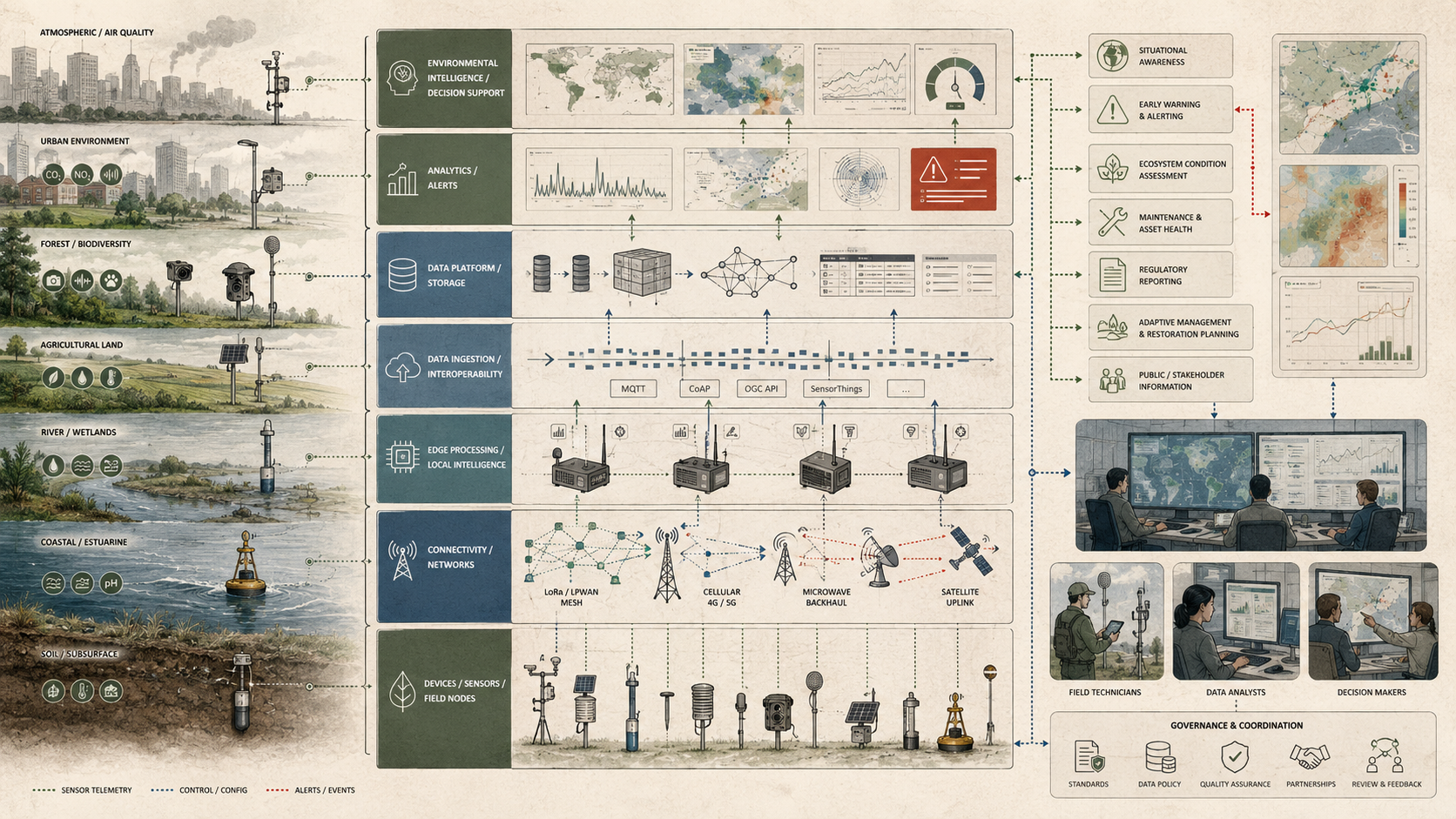
Environmental IoT is where monitoring becomes distributed evidence infrastructure. It makes it possible to observe rivers, air sheds, soils, infrastructure assets, farms, forests, coasts, cities, treatment systems, and ecological sites through networks of connected devices that operate across space and time. Yet connected sensing is never enough by itself. Environmental intelligence depends on the full chain: device identity, calibration, timestamping, edge filtering, gateway buffering, network transport, data models, quality control, metadata, analytics, alert logic, visualization, governance, and response. The central question is not simply whether devices are connected, but whether the architecture preserves enough meaning, context, and reliability for distributed observations to become trustworthy evidence.
Engineering Problem
The engineering problem is how to design environmental IoT architectures that can coordinate heterogeneous field devices, constrained networks, edge systems, cloud platforms, data models, analytics services, alerting workflows, and human decision processes without losing evidence quality. Environmental IoT is not merely a problem of connecting sensors. It is a problem of preserving meaning, reliability, and accountability across a distributed technical system that operates under field constraints.
This is difficult because environmental IoT systems are often deployed in places where power, connectivity, maintenance access, calibration support, and physical protection are limited. Devices may face moisture, corrosion, fouling, heat, cold, biofilm, wildlife, vandalism, flooding, vibration, sediment, dust, salt, or communication interference. Sensor readings may drift. Gateways may lose synchronization. Networks may drop packets. Cloud platforms may ingest data without enough metadata. Dashboards may show values without calibration context. Alerts may fire without distinguishing environmental anomaly from device failure. The architecture must therefore manage both environmental reality and system reality.
Weak IoT architectures treat connectivity as the goal. Strong architectures treat connectivity as one component of an evidence chain. They ask whether devices are identifiable, calibrated, synchronized, power-aware, secure, and observable; whether gateways can buffer, filter, translate, and recover; whether protocols match field conditions; whether platforms preserve units, timestamps, provenance, quality flags, and semantics; whether analytics distinguish signal from noise; and whether alerts connect to institutional response. Environmental intelligence emerges only when the stack remains coherent from device to decision.
| Engineering Tension | Why It Matters | Required Evidence |
|---|---|---|
| Connectivity versus coherence | Devices may transmit successfully while data remain semantically inconsistent or poorly documented. | Data model, metadata schema, unit registry, device identity, observed-property definition |
| Low power versus high fidelity | Energy constraints affect sampling rate, transmission frequency, local processing, and data completeness. | Power budget, duty cycle, sampling policy, battery health record |
| Edge filtering versus evidence preservation | Local processing can reduce latency and bandwidth but may discard context needed for later review. | Edge-rule registry, raw/processed retention policy, transformation log |
| Low latency versus validation depth | Near-real-time alerts may arrive before full quality control or contextual interpretation is possible. | Latency class, preliminary flag, QC status, alert confidence |
| Scalability versus maintainability | More devices can increase monitoring reach while multiplying maintenance, calibration, and governance burden. | Asset registry, maintenance schedule, calibration log, observability dashboard |
| Automation versus accountability | Automated alerts and models can accelerate response while obscuring assumptions and failure modes. | Model card, alert-rule registry, escalation policy, audit trail |
| Resilience versus opacity | Autonomous devices and gateways improve robustness but can make distributed decisions harder to reconstruct. | Device logs, gateway logs, event trace, edge-to-cloud lineage |
The practical question is therefore: can the architecture make environmental systems more observable and responsive while preserving the evidentiary chain that makes the resulting intelligence trustworthy?
Reference Architecture
A practical environmental IoT architecture can be understood as a layered evidence system. The exact implementation may use microcontrollers, embedded Linux gateways, cellular modems, LoRaWAN, MQTT brokers, REST APIs, SensorThings-style data models, time-series databases, object storage, stream processors, alert engines, dashboards, and governance logs. The responsibilities remain consistent: sense, timestamp, identify, validate, buffer, transport, standardize, store, analyze, alert, decide, and learn.
| Layer | Engineering Role | Primary Risk | Evidence Artifact |
|---|---|---|---|
| Observation objective layer | Defines monitored variables, environmental processes, decision uses, latency needs, and valid-use boundaries. | Architecture optimized for connectivity rather than monitoring purpose. | IoT objective manifest, user-role matrix, decision-use statement |
| Device and sensor layer | Measures environmental variables and device-state information at the field edge. | Sensor drift, fouling, power failure, timestamp error, identity ambiguity. | Device registry, calibration log, firmware version, health telemetry |
| Embedded control layer | Controls sampling, local storage, power state, quality checks, and local device behavior. | Unlogged local decisions alter evidence before it reaches the platform. | Firmware manifest, duty-cycle policy, local QC rule, device log |
| Gateway and edge layer | Aggregates devices, buffers records, translates protocols, applies local logic, and manages intermittent connectivity. | Filtering, aggregation, or synchronization changes are not traceable. | Gateway configuration, edge-rule registry, buffer status, edge event log |
| Network and transport layer | Moves records across cellular, LPWAN, radio, satellite, wired, mesh, or hybrid networks. | Packet loss, latency, reordered data, failed retransmission, hidden gaps. | Transport log, message acknowledgement, latency report, retry policy |
| Platform and ingestion layer | Receives records, validates schema, preserves metadata, stores time series, and exposes APIs. | Records arrive without enough context to be reused or audited. | Schema validation, ingestion log, metadata catalog, API documentation |
| Semantic and interoperability layer | Aligns observed properties, units, locations, device identities, calibration status, and quality flags. | Technically connected systems produce incompatible environmental meaning. | Observed-property registry, unit registry, SensorThings-style model, semantic crosswalk |
| Analytics and alert layer | Transforms streams into thresholds, anomalies, trends, forecasts, classifications, and alerts. | Alert fatigue, false positives, hidden assumptions, poor prioritization. | Alert-rule registry, model card, anomaly log, review record |
| Decision and governance layer | Connects outputs to operations, science, regulation, public communication, and accountability. | System produces signals that institutions cannot interpret, trust, or act upon. | Escalation policy, governance log, public evidence package, corrective-action record |
This architecture makes clear that IoT intelligence is assembled. A measurement becomes environmental evidence only when identity, time, place, unit, method, quality, context, transport, and interpretation remain connected across the stack.
Implementation Pattern
A rigorous implementation begins by defining the monitoring purpose before selecting devices, networks, platforms, or dashboards. The correct architecture depends on whether the system is monitoring flood thresholds, water-quality anomalies, air pollution, soil moisture, weather conditions, habitat change, ecological activity, infrastructure risk, or treatment-system performance. Each use case implies different latency, sampling, redundancy, calibration, validation, and governance requirements.
| Artifact | Purpose | Suggested Format |
|---|---|---|
| IoT architecture objective manifest | Defines monitored domains, variables, decision uses, latency classes, power constraints, and governance context. | YAML, Markdown, architecture decision record |
| Device and sensor registry | Lists devices, sensors, observed properties, calibration status, firmware, location, owner, and deployment context. | CSV, SQL table, asset-management record |
| Gateway and edge registry | Documents gateways, connected devices, local rules, buffering policy, protocol translation, and failover behavior. | CSV, YAML, architecture diagram, edge configuration |
| Connectivity manifest | Defines transport mode, protocol, message format, acknowledgment, retry, latency, and security assumptions. | YAML, network design record, protocol specification |
| Environmental data model | Defines device identity, location, datastream, observed property, unit, result time, phenomenon time, quality flag, and provenance. | JSON Schema, SQL schema, SensorThings-style model, ontology mapping |
| Quality-control policy | Defines range checks, spike checks, flatline checks, drift checks, missing-data rules, and suspect-data handling. | YAML, QARTOD-style rules, validation code |
| Alert-rule registry | Documents thresholds, anomaly logic, severity, suppressions, escalation paths, owners, and review cadence. | CSV, YAML, alerting platform configuration |
| Security and access policy | Defines authentication, authorization, key rotation, device provisioning, firmware update, and public/private data rules. | Security policy, provisioning document, access matrix |
| Observability and maintenance plan | Tracks device health, battery, calibration, connectivity, uptime, latency, packet loss, and service availability. | Dashboard, runbook, maintenance schedule, log schema |
| Governance and evidence log | Records architecture changes, device replacements, calibration decisions, alert reviews, and public caveats. | CSV, SQL table, governance register, release notes |
The implementation goal is to make the architecture inspectable. Users should be able to move from an alert back to the rule, from the rule back to the datastream, from the datastream back to device identity and calibration, and from the device back to deployment context and observed environmental process.
Research-Grade Framing: IoT Architecture as Environmental Intelligence Infrastructure
A research-grade understanding of IoT architecture begins by treating it as environmental intelligence infrastructure rather than as a connectivity framework. Architecture determines where environmental data become meaningful enough to count as evidence. Some structure is imposed at the device. Some at the gateway. Some in the transport layer through message schemas and acknowledgments. Some in the platform through metadata, APIs, and data models. Some in analytics through thresholds, models, anomaly detection, and dashboards. Environmental judgment is therefore distributed across the stack, not centralized in one layer.
This means IoT systems are not neutral pipelines. They encode assumptions about what variables matter, what counts as an event, what raw information must be preserved, what level of latency is acceptable, what quality-control rules matter, which uncertainties can be tolerated, and which anomalies deserve escalation. An architecture optimized for regulatory reporting will emphasize traceability, metadata discipline, calibration records, versioning, and auditability. An architecture optimized for hazard response may emphasize low latency, local autonomy, redundancy, and prioritized transport. An architecture optimized for science may emphasize interoperable data models, discoverability, validation, and long-term reuse. Architecture is therefore an implicit theory of the monitoring system’s purpose.
Seen this way, architecture shapes observability itself. It determines whether environmental signals remain local or become networked, whether ambiguity is preserved or filtered away early, whether devices speak in compatible terms, whether data can be joined across time and place, and whether alerts can be traced back to their evidentiary source. The architecture does not merely carry environmental evidence. It helps constitute what that evidence is allowed to become.
| Limited Pattern | Stronger Pattern | Why the Shift Matters |
|---|---|---|
| Connect sensors to a network | Design a full evidence chain from device to decision | Prevents telemetry from being mistaken for environmental intelligence. |
| Store time-series values | Preserve values with device identity, units, calibration, quality, location, and provenance | Makes observations interpretable beyond their original deployment. |
| Push all data to the cloud | Distribute computation across device, gateway, platform, and human review | Balances latency, bandwidth, energy, resilience, and auditability. |
| Use dashboards as final outputs | Connect dashboards to alert logic, metadata, uncertainty, and action pathways | Moves from visualization to decision support. |
| Scale by adding devices | Scale by improving maintainability, semantics, governance, and observability | Prevents device growth from producing system fragility. |
| Automate alerts | Make alert rules reviewable, prioritized, and connected to institutional response | Reduces alert fatigue and improves accountability. |
The central research question is not “How many environmental devices can be connected?” but “How can distributed sensing become reliable, interoperable, auditable, and actionable environmental intelligence?”
Formal Model: Device Reliability, Connectivity, Semantics, Latency, and Decision Quality
A useful formal model separates device reliability, connectivity, edge preservation, semantic completeness, quality-control strength, latency, and decision fit. Let \(D_r\) represent device reliability, \(C_n\) network connectivity, \(E_p\) edge preservation, \(S_m\) semantic completeness, \(Q_c\) quality-control readiness, \(L\) latency, and \(F_d\) decision fit. IoT evidence quality depends on the full architecture, not one layer alone.
A_{\mathrm{device}} = \frac{T_{\mathrm{valid\ operation}}}{T_{\mathrm{deployment}}}
\]
Interpretation: Device availability measures how much of the deployment period the device operated in a valid state.
C_{\mathrm{delivery}} = \frac{N_{\mathrm{delivered\ records}}}{N_{\mathrm{expected\ records}}}
\]
Interpretation: Delivery completeness measures whether the architecture successfully transports expected environmental records from the field to the platform.
L_{\mathrm{end\ to\ end}} = t_{\mathrm{decision\ available}} – t_{\mathrm{phenomenon}}
\]
Interpretation: End-to-end latency measures the time between environmental occurrence and availability of decision-ready evidence.
S_{\mathrm{semantic}} = \frac{N_{\mathrm{records\ with\ required\ semantics}}}{N_{\mathrm{records}}}
\]
Interpretation: Semantic completeness measures whether records carry the device identity, observed property, unit, location, timestamp, calibration, and quality context needed for interpretation.
R_{\mathrm{edge}} = \frac{N_{\mathrm{edge\ transformations\ logged}}}{N_{\mathrm{edge\ transformations}}}
\]
Interpretation: Edge traceability measures whether local filtering, aggregation, compression, thresholds, and rules are logged well enough for later audit.
Q_{\mathrm{iot\ evidence}} = w_1A_{\mathrm{device}} + w_2C_{\mathrm{delivery}} + w_3S_{\mathrm{semantic}} + w_4Q_{\mathrm{qc}} + w_5R_{\mathrm{edge}} + w_6F_{\mathrm{decision}} – w_7L_{\mathrm{penalty}}
\]
Interpretation: IoT evidence quality can be approximated as a weighted function of device availability, delivery completeness, semantic completeness, quality-control readiness, edge traceability, decision fit, and latency penalty.
This formal structure protects against simplistic interpretations of environmental IoT. A system with many connected devices may still have poor evidence quality if records are late, semantically weak, poorly quality-controlled, or difficult to trace from device to decision.
What Are IoT Architectures for Environmental Monitoring?
IoT architectures for environmental monitoring are structured system designs that define how connected environmental devices sense, communicate, process, store, expose, and operationalize data across a monitoring network. They encompass the device layer, embedded-control layer, gateway or edge layer, communications layer, platform layer, analytics layer, application layer, and governance layer. Their purpose is not simply to connect sensors to networks, but to make environmental data persistent, interpretable, interoperable, auditable, and usable across distributed observational systems.
Such architectures may include distributed sensor nodes measuring air, water, soil, weather, ecological, or infrastructure-linked variables; embedded control and logging systems at the field edge; gateways that aggregate, buffer, and coordinate local data and device behavior; communications systems using cellular, radio, LPWAN, satellite, wired, or hybrid transport; cloud or server platforms for storage, metadata, APIs, interoperability, and analytics; and dashboards, alerting tools, models, and decision workflows that turn data into action.
The defining feature of IoT architecture is end-to-end environmental coherence. A sensor alone does not constitute an IoT system. Nor does telemetry alone. Architecture begins when sensing, transport, metadata, processing, storage, semantics, analytics, and application logic are designed as one evidentiary chain. It determines not only how data move, but how environmental signals become structured enough to support comparison, reuse, explanation, and decision.
| Function | Architectural Role | Environmental Evidence Contribution |
|---|---|---|
| Sensing | Captures field signals through distributed devices and environmental instruments. | Creates local observations of environmental condition or device state. |
| Embedded control | Manages sampling, power, local storage, timing, and sensor interaction. | Determines the reliability and cadence of field observations. |
| Edge coordination | Aggregates, buffers, filters, translates, and prioritizes local data. | Improves resilience and responsiveness under field constraints. |
| Transport | Moves records through constrained or variable networks. | Determines timeliness, completeness, and recoverability of evidence. |
| Platform services | Ingests, validates, stores, catalogs, exposes, and manages data. | Gives distributed observations persistence and interoperability. |
| Semantic modeling | Defines device identity, observed property, unit, location, timestamp, and quality context. | Makes observations comparable and reusable across systems. |
| Analytics and alerts | Converts streams into trends, anomalies, classifications, forecasts, and alerts. | Transforms observations into operational or scientific intelligence. |
| Governance | Defines stewardship, access, review, accountability, and corrective learning. | Keeps the evidence chain inspectable from device to decision. |
An environmental IoT architecture is therefore not simply a technology stack. It is a structured way of making distributed environmental evidence trustworthy enough to matter.
Why IoT Architecture Matters
IoT architecture matters because environmental monitoring increasingly depends on distributed, persistent, interoperable observation rather than isolated measurement sites. Monitoring systems may include hundreds or thousands of devices deployed across watersheds, cities, coasts, agricultural landscapes, treatment systems, ecological reserves, transport corridors, industrial sites, or atmospheric networks. Without architectural coherence, these devices risk becoming disconnected islands of measurement rather than parts of a shared environmental intelligence system.
It also matters because environmental monitoring is never just a sensing problem. It is equally a problem of time synchronization, power management, metadata continuity, device-state awareness, bandwidth limits, edge logic, storage durability, calibration history, semantic consistency, cybersecurity, operational maintenance, and institutional response. An architecture determines whether a device can survive intermittent connectivity, whether a threshold event is detected locally or only later in the cloud, whether measurements from different vendors can be integrated meaningfully, and whether environmental evidence remains interpretable beyond its original deployment.
Most importantly, IoT architecture matters because it structures accountability. A claim about pollution, habitat change, flood risk, infrastructure failure, sensor anomaly, or environmental threshold crossing is only as credible as the chain that produced it. If devices are weakly integrated, timestamps inconsistent, metadata thin, calibration history missing, and processing logic opaque, then environmental intelligence may appear abundant while evidentiary reliability remains fragile. Architecture is therefore not merely an implementation concern. It is part of the truth structure of environmental monitoring.
| Need | IoT Architecture Contribution | Risk Without Strong Architecture |
|---|---|---|
| Continuous observation | Supports persistent monitoring across distributed devices and time horizons. | Environmental change is observed only episodically or inconsistently. |
| Distributed coverage | Extends measurement across sites, assets, gradients, and networks. | Monitoring remains sparse, fragmented, and difficult to compare. |
| Operational responsiveness | Enables edge rules, alerts, low-latency transport, and escalation workflows. | Events are detected too late or without action pathways. |
| Interoperability | Aligns device identity, observed properties, units, metadata, and APIs. | Data arrive successfully but cannot be meaningfully joined or reused. |
| Resilience | Supports buffering, recovery, redundancy, health monitoring, and graceful degradation. | Single-layer failures create data loss or misleading outputs. |
| Accountability | Preserves traceability from device to alert, report, model, or decision. | Environmental claims cannot be reconstructed or trusted. |
IoT architecture matters because distributed sensing does not automatically produce distributed intelligence. The architecture is what makes connected measurement coherent enough to become evidence.
Core Layers of Environmental IoT Architecture
Although implementations vary, most environmental IoT architectures include recurring layers: device, embedded control, edge or gateway, network, platform, semantic model, analytics, application, and governance. These layers should not be imagined as neat separable boxes. Their value emerges from coordination and continuity. A sophisticated device without coherent metadata can underperform analytically. A powerful cloud platform without stable field semantics can accumulate data that are hard to interpret. A rich analytics layer without governance pathways can generate alerts without action.
| Layer | Primary Role | Key Design Question |
|---|---|---|
| Device layer | Sensors, instruments, embedded controllers, power systems, enclosures, and local storage. | Can the device produce valid observations under field conditions? |
| Embedded-control layer | Sampling, timestamping, duty cycling, calibration state, local QC, firmware, and device-state monitoring. | Are local decisions traceable and aligned with monitoring purpose? |
| Edge / gateway layer | Aggregation, buffering, protocol translation, local rules, failover, synchronization, and local autonomy. | What should be processed locally, preserved raw, or escalated upstream? |
| Network layer | Cellular, LPWAN, radio, satellite, mesh, wired, or hybrid communications. | Does transport match latency, reliability, cost, power, and geography? |
| Platform layer | Message brokers, ingestion pipelines, databases, object storage, catalogs, APIs, and device management. | Does the platform preserve context, quality, and lineage? |
| Semantic layer | Observed-property definitions, units, locations, datastreams, device identity, metadata, and interoperability models. | Can observations from different devices and sites be compared meaningfully? |
| Analytics layer | Thresholds, anomaly detection, forecasting, classification, dashboards, and decision-support models. | Do analytics preserve uncertainty and support real decisions? |
| Application layer | Operational, scientific, regulatory, community, and public-facing uses. | Are outputs interpretable by the people or institutions expected to act? |
| Governance layer | Stewardship, access, review, security, auditability, maintenance, and public accountability. | Can the evidence chain be trusted and corrected over time? |
IoT architecture becomes environmentally meaningful when these layers behave as one evidentiary system rather than as a stack of disconnected technologies.
Key Analytical Distinctions
IoT is not the same as telemetry. Remote transmission alone does not create an architecture capable of preserving meaning, supporting analytics, or enabling interoperable reuse.
Connectivity is not the same as coherence. Devices may exchange packets successfully while still failing to share consistent semantics, metadata, identity, units, calibration context, or processing history.
Device interoperability is not the same as semantic interoperability. Two sensors can be technically connected while still disagreeing about what a variable means, how it was calibrated, or what context is required to interpret it.
Edge intelligence is not the same as platform intelligence. Both can be useful, but they serve different temporal, computational, bandwidth, and evidentiary roles.
Data volume is not the same as evidentiary value. An architecture can move large quantities of data while still failing in interpretability, auditability, or operational relevance.
Automation is not the same as institutional maturity. A system may automate collection and alerting while remaining fragile in maintenance, governance, security, or response capacity.
Scalability is not the same as extensibility. A pilot may expand numerically without becoming easier to integrate, govern, secure, or reuse across new contexts.
| Distinction | Why It Matters | Design Implication |
|---|---|---|
| Telemetry versus architecture | Moving values does not preserve meaning. | Design identity, metadata, quality, calibration, and lineage into the stack. |
| Connectivity versus observability | A connected system may still be blind to its own failures. | Track device health, gateway status, packet loss, latency, and platform ingestion. |
| Data stream versus evidence stream | Values become evidence only when context and quality are preserved. | Attach units, observed properties, location, timestamp, QC status, and provenance. |
| Edge autonomy versus edge opacity | Local rules improve responsiveness but can hide transformations. | Log edge filtering, thresholds, aggregation, and exception handling. |
| Alerting versus decision support | Alerts can overwhelm users without prioritization and action logic. | Design severity, suppression, escalation, owner, and review rules. |
| Scalable deployment versus sustainable stewardship | More devices increase maintenance, calibration, and governance obligations. | Maintain asset registries, maintenance cycles, calibration plans, and lifecycle review. |
These distinctions prevent environmental IoT from becoming a collection of connected devices that produce more data than usable intelligence.
From Device to Decision: The Full Environmental IoT Stack
IoT architectures in environmental monitoring function as multi-layered systems linking field observation to institutional use. The device captures a signal. Embedded firmware determines sampling, timestamping, and local behavior. Gateways coordinate buffering, filtering, and transport. Networks determine whether observations arrive in time and in order. Platforms validate, store, and expose records. Semantic models preserve comparability. Analytics assign pattern and salience. Decision workflows convert outputs into action, reporting, or accountability.
| Stack Stage | Evidence Transformation | Failure Risk |
|---|---|---|
| Physical environment | Environmental condition exists as water level, temperature, concentration, soil moisture, wind, vibration, image, sound, or biological activity. | System observes only a partial proxy for the process of interest. |
| Sensor interface | Physical condition becomes electrical, optical, chemical, acoustic, or digital signal. | Sensor drift, fouling, bias, noise, or calibration failure. |
| Embedded controller | Signal is sampled, timestamped, filtered, logged, and prepared for transmission. | Timestamp error, firmware bug, power interruption, undocumented filtering. |
| Gateway / edge node | Local observations are aggregated, buffered, transformed, prioritized, or locally evaluated. | Untraceable aggregation, data loss, rule drift, synchronization failure. |
| Transport layer | Records move across networks with latency, packet loss, retries, acknowledgments, and security controls. | Missing, delayed, duplicated, reordered, or insecure records. |
| Platform ingestion | Records are validated, stored, indexed, and exposed through APIs or services. | Schema drift, missing metadata, ingestion failure, weak data governance. |
| Analytics and alerts | Streams become thresholds, anomalies, trends, forecasts, classifications, and dashboards. | False alarms, hidden assumptions, alert fatigue, weak uncertainty handling. |
| Decision and review | Operators, regulators, researchers, communities, or automated systems act on outputs. | Output lacks action pathway, accountability, or evidentiary traceability. |
This stacked view matters because environmental knowledge is not produced in one moment. It is assembled across layers. Architecture is the design of that assembly process and of the trust relationships between its layers.
Field Devices, Gateways, and Edge Coordination
The field edge is where environmental signals first become system objects. Devices measure local conditions, but gateways and edge nodes often determine whether those measurements can function coherently as part of a wider IoT system. They may manage timestamp synchronization, local buffering, sensor health reporting, protocol translation, adaptive duty cycling, threshold evaluation, and routing priorities among heterogeneous devices.
This edge layer is especially important in environmental settings because deployments often operate under strict constraints of power, access, bandwidth, maintenance, and serviceability. A gateway can serve as a resilience point by preserving data through transport outages, staging transmissions, coordinating local decisions, distinguishing environmental anomalies from device anomalies, and insulating central systems from unstable field conditions. In many architectures, the edge is where the monitoring network first becomes more than a loose collection of instruments.
At the same time, the edge is where opacity can quietly begin. The more coordination, filtering, compression, anomaly detection, or interpretation is pushed into local devices and gateways, the more important it becomes to preserve traceability about what happened there. Otherwise the architecture gains responsiveness at the cost of transparency.
| Responsibility | Environmental Role | Evidence Requirement |
|---|---|---|
| Sampling control | Defines how often and under what conditions environmental measurements are collected. | Sampling policy, duty cycle, firmware version, timestamp source |
| Power management | Determines deployment duration and sampling reliability. | Battery record, solar status, sleep schedule, power-failure log |
| Local buffering | Preserves records during network outage or intermittent connectivity. | Buffer capacity, store-and-forward policy, retry log |
| Protocol translation | Allows heterogeneous field devices to communicate with platform services. | Protocol map, gateway configuration, message schema |
| Local quality checks | Identifies impossible values, sensor faults, flatlines, spikes, or missing data before transport. | QC rules, quality flags, suspect-data policy |
| Edge alerting | Supports low-latency response when platform access is delayed or unavailable. | Threshold rule, severity level, local action log, escalation policy |
| Health telemetry | Distinguishes environmental anomaly from device, power, or connectivity failure. | Device-state stream, diagnostics, calibration status, error codes |
Edge coordination should improve responsiveness without severing evidence from its origin. Good architecture makes local decisions visible enough to reconstruct later.
Connectivity, Protocols, and the Transport of Environmental Signals
Environmental IoT architectures are inseparable from transport because environmental systems are geographically uneven in their connectivity. Some devices operate in dense urban networks with stable backhaul. Others sit in estuaries, farm fields, uplands, forests, wetlands, offshore regions, treatment plants, buried infrastructure, or mobile platforms where connectivity is intermittent, expensive, or fragile. Architecture must therefore be designed for the real geography of data transport rather than ideal network conditions.
Protocols matter because they govern not only efficiency, but system behavior. Lightweight publish-subscribe messaging, store-and-forward strategies, batch uploads, REST APIs, event streams, geospatial sensor APIs, and hybrid transport patterns imply different tradeoffs among timeliness, power use, robustness, recoverability, security, and interoperability. A protocol choice is therefore not merely a software detail. It shapes the temporal character and evidentiary reliability of the monitoring system.
Data transport determines whether environmental signals arrive quickly enough, completely enough, securely enough, and coherently enough to support the monitoring objective. A system can fail not because sensing is weak, but because transport assumptions are mismatched to field reality. In environmental IoT, the network path is part of the evidence path.
| Pattern | Strength | Constraint | Typical Use |
|---|---|---|---|
| Cellular | Broad availability, moderate bandwidth, direct cloud connectivity. | Coverage gaps, cost, power use, carrier dependence. | Urban air sensors, water stations, utility assets, mobile monitoring |
| LPWAN | Low power, long range, suitable for small messages. | Limited bandwidth, duty-cycle constraints, gateway dependence. | Soil moisture, water level, weather nodes, distributed low-rate sensing |
| Radio / mesh | Local resilience and site-specific flexibility. | Complexity, interference, topology management. | Watersheds, farms, field research sites, remote ecological networks |
| Satellite communications | Connectivity in remote or offshore locations. | Cost, latency, power, message-size constraints. | Buoys, polar stations, remote hydrology, disaster contexts |
| Wired / industrial networks | Reliability, power availability, integration with control systems. | Limited mobility and deployment flexibility. | Treatment plants, industrial monitoring, smart infrastructure |
| Hybrid transport | Combines local buffering, multiple links, and fallback routes. | More complex governance, testing, and observability. | High-stakes environmental monitoring and resilience-critical systems |
The transport layer should be designed as an evidence layer. Packet loss, duplication, delay, and retransmission are not only network concerns. They affect environmental interpretation.
Platforms, Semantics, and Interoperable Environmental Data Models
Cloud and platform layers give environmental IoT systems their longer memory, broader coherence, and cross-site comparability. They store measurements, expose APIs, preserve metadata, support archival analysis, and make it possible to harmonize observations across many devices, time periods, projects, and institutions. Without this platform layer, distributed sensing often remains fragmented into bespoke deployments whose value is difficult to extend beyond their original operational context.
But ingestion is not enough. The real challenge is semantic coherence. Environmental data must carry units, timestamps, calibration context, device identity, measurement provenance, processing history, location, observed-property definition, and quality-control status in ways that survive movement across systems. Standards such as the OGC SensorThings API are especially relevant because they provide a geospatially enabled model for connecting IoT devices, observations, datastreams, sensors, observed properties, and metadata. This kind of structure matters because environmental data become more trustworthy when users can understand not only the value, but the object, property, location, method, and context behind it.
Environmental data models are therefore not merely database conveniences. They are the structures through which the architecture preserves comparability and interpretability across devices and time. Semantic failure can be more damaging than transport failure because it produces data that arrive successfully but no longer mean exactly what users think they mean.
| Requirement | Why It Matters | Example Field |
|---|---|---|
| Device identity | Links observations to a known physical instrument and deployment history. | device_id, sensor_id, thing_id |
| Observed property | Defines what environmental variable or device state is being measured. | observed_property, variable_name |
| Units | Prevents incompatible measurements from being compared incorrectly. | unit, unit_uri |
| Location | Places observations in geographic, asset, or site context. | latitude, longitude, site_id, asset_id |
| Time | Distinguishes phenomenon time, result time, ingestion time, and decision availability. | phenomenon_time, result_time, ingested_at |
| Calibration | Allows users to assess whether readings remain valid. | calibration_date, calibration_status |
| Quality | Indicates whether values passed range, spike, persistence, or domain checks. | quality_flag, qc_level, suspect_reason |
| Provenance | Tracks transformations from raw signal to processed observation or alert. | processing_level, edge_rule_id, workflow_id |
The strongest IoT platforms preserve the relationship among device, datastream, observed property, observation, location, unit, time, quality, and provenance. Without that relationship, connected data can become disconnected meaning.
Analytics, Alerts, and the Distribution of Environmental Judgment
IoT architectures become operationally consequential when data streams are translated into trends, anomalies, classifications, forecasts, and alerts that support environmental judgment. Analytics may include simple threshold logic, moving-window comparisons, statistical anomaly detection, machine-learning classifiers, hydrological triggers, water-quality rules, air-quality exposure summaries, digital twins, or decision dashboards. Their purpose is to turn connected measurements into usable environmental intelligence.
But analytics are not neutral consequences of architecture. They embody assumptions about normality, urgency, significance, uncertainty, and tolerable risk. A system can be highly connected yet analytically weak if it overwhelms users with noise, erases ambiguity too early, fails to distinguish device anomalies from environmental anomalies, or lacks the context needed to reinterpret an event later. An alerting layer that produces constant signals without operational prioritization may reduce, not increase, practical intelligence.
Exceptional IoT architectures therefore distribute environmental judgment carefully. They decide what should be evaluated at the device, what belongs in the gateway, what requires platform context, and what belongs to human interpretation. They are designed not for maximal signal production but for actionable, auditable, and context-sensitive intelligence.
| Analytics Location | Strength | Risk | Appropriate Use |
|---|---|---|---|
| Device | Lowest latency and lowest bandwidth use. | Limited context, limited compute, difficult audit if poorly logged. | Basic range checks, sensor diagnostics, emergency threshold flag |
| Gateway / edge | Local context, buffering, aggregation, offline resilience. | Hidden transformations and rule drift if not versioned. | Local anomaly detection, compression, event prioritization, failover rules |
| Platform | Cross-device context, historical comparison, metadata-rich processing. | Higher latency and dependence on connectivity. | Time-series analytics, multi-site comparison, quality-control review |
| Model service | Advanced forecasting, classification, data fusion, and scenario reasoning. | Model opacity, drift, and unsupported inference. | Forecasts, anomaly models, exposure estimates, digital twins |
| Human decision layer | Contextual judgment, institutional accountability, ethical review. | Delayed response or inconsistent interpretation if support is weak. | Escalation, public communication, regulatory action, maintenance dispatch |
Analytics should be treated as part of the architecture’s governance design. Every alert should have a source, method, severity, owner, action path, and review process.
Resilience, Failure, and Graceful Degradation Across the Stack
Environmental IoT systems fail across multiple layers, not only at the sensor. Devices drift. Batteries degrade. Gateways lose synchronization. Networks drop packets. Cloud services mishandle ingestion. Metadata become inconsistent. APIs change. Models degrade. Dashboards create alert fatigue. Institutional workflows fail to absorb what the system produces. Architecture is therefore also an architecture of failure.
Resilience requires that the stack degrade gracefully. Devices should preserve local records during network interruptions. Gateways should buffer and synchronize intelligently. Platforms should track lineage and status. Analytics should distinguish environmental anomaly from device anomaly where possible. Operators should be able to inspect what failed, where, and why, rather than discovering only that the final dashboard is incomplete or misleading.
Security matters for similar reasons. Connected environmental systems increasingly sit close to public health, infrastructure operations, utility systems, regulatory evidence, and emergency response. A mature architecture therefore treats resilience, recoverability, and security as structural properties. In environmental IoT, the robustness of the architecture is part of the robustness of the evidence.
| Failure Condition | Graceful Degradation Pattern | Evidence to Preserve |
|---|---|---|
| Sensor drift | Flag readings as suspect, compare with neighboring devices, schedule calibration review. | Calibration history, drift indicators, quality flags, comparison results |
| Battery decline | Reduce sampling frequency, prioritize essential measurements, issue maintenance alert. | Battery state, duty-cycle change, maintenance ticket |
| Network outage | Buffer locally, retry transport, mark records by delayed arrival status. | Outage window, buffer count, retry log, ingestion time |
| Gateway failure | Fail over to local device storage or alternate route where possible. | Gateway status, failover event, device backlog |
| Platform ingestion failure | Reject invalid messages, quarantine suspect records, preserve error reason. | Schema error, rejected record, validation log |
| Alert overload | Suppress duplicates, group related alerts, escalate only actionable events. | Suppression rule, grouped events, severity decision |
| Model degradation | Fallback to rules, flag model output, trigger retraining or review. | Model version, performance signal, fallback rule, review record |
Resilience is not only the ability to keep operating. It is the ability to keep operating in ways that remain interpretable after partial failure.
Standards, Scalability, and Evidentiary Accountability
IoT architectures for environmental monitoring have a governance dimension because they define what kinds of environmental evidence can be shared, compared, audited, and acted upon across institutions. Standards matter not only for technical efficiency but for accountability. WMO’s WIGOS provides a framework, guidance, and tools for fit-for-purpose observational data across weather, water, climate, and related environmental systems. NOAA IOOS QARTOD shows how real-time quality control becomes a structured community process rather than an afterthought. OGC SensorThings API demonstrates how sensor observations, datastreams, devices, and metadata can be organized in interoperable ways.
Scalability is equally important. Pilot systems often succeed under bespoke integration, close attention, and limited heterogeneity. Mature architectures must sustain many sites, longer durations, changing devices, evolving users, and more demanding reuse requirements. This demands more than numerical expansion. It requires versioning, metadata discipline, API stability, semantic continuity, maintainable governance roles, lifecycle planning, security practice, and architectural legibility.
Ultimately, IoT architecture shapes evidentiary accountability. A threshold alert, compliance report, habitat trend, flood-warning signal, or pollution anomaly is only as credible as the chain that produced it. Architecture determines whether that chain remains inspectable from device to decision. Where it does, environmental intelligence can scale without surrendering trust. Where it does not, connectedness may expand faster than reliability.
| Governance Responsibility | Question | Evidence |
|---|---|---|
| Device stewardship | Who owns, maintains, calibrates, replaces, and validates each device? | Device owner, maintenance schedule, calibration record, firmware history |
| Data-model governance | Are observed properties, units, locations, and quality flags defined consistently? | Observed-property registry, unit registry, schema version, semantic crosswalk |
| Quality-control governance | Are range, spike, flatline, drift, and missing-data rules documented? | QC policy, QARTOD-style rules, validation report, suspect-data log |
| Edge-rule governance | Are local filters, thresholds, compression, and aggregation rules versioned? | Edge-rule registry, gateway log, transformation record |
| Security governance | Are devices provisioned, authenticated, updated, and retired safely? | Access policy, key rotation, firmware update record, device lifecycle log |
| Alert governance | Are alerts actionable, prioritized, owned, and reviewed? | Alert-rule registry, escalation policy, alert-review log |
| Public accountability | Can affected publics or external reviewers understand evidence behind claims? | Public evidence package, method notes, caveats, source links |
Governance is not separate from architecture. It is the set of rules that keeps a connected environmental system from becoming an opaque stream of unreviewable signals.
Failure Modes, Alert Fatigue, and Architecture Drift
Environmental IoT systems can fail in ways that remain hidden because parts of the system continue operating. A device may keep transmitting while drifting out of calibration. A gateway may keep sending aggregated values while silently suppressing anomalies. A platform may continue ingesting data while metadata become stale. A dashboard may continue updating while alert rules no longer match operational reality. This is architecture drift: the gradual divergence between what the system is assumed to do and what it actually does.
Alert fatigue is another major failure mode. Environmental IoT systems can generate large numbers of events, warnings, thresholds, and anomaly signals. If alerts are not prioritized, suppressed, grouped, assigned, and reviewed, users may stop trusting them. A system designed to increase awareness can then reduce attention by overwhelming human operators with low-value signals.
| Failure Mode | Consequence | Prevention |
|---|---|---|
| Device drift | Values appear normal but no longer represent environmental condition accurately. | Calibration schedule, drift detection, cross-device comparison, maintenance alerts |
| Timestamp inconsistency | Events cannot be aligned across devices or systems. | Clock synchronization, phenomenon time/result time distinction, time-source monitoring |
| Metadata loss | Data remain available but become difficult to interpret or reuse. | Schema validation, required metadata, ingestion rejection/quarantine rules |
| Semantic mismatch | Different devices appear comparable while measuring different concepts or units. | Observed-property registry, unit validation, semantic crosswalk |
| Edge opacity | Local rules alter data without traceable transformation records. | Edge-rule versioning, gateway logs, raw/processed data-retention policy |
| Alert fatigue | Users ignore or distrust alerts because too many are non-actionable. | Severity levels, suppression logic, action owners, alert-review cadence |
| Architecture drift | System assumptions diverge from deployed reality over time. | Architecture reviews, asset audits, configuration drift checks, governance logs |
| Security weakness | Compromised devices or data streams undermine environmental evidence. | Device authentication, encrypted transport, access control, update policy |
Strong IoT architectures assume failure will occur and design systems so that failure is observable, recoverable, and reviewable. The goal is not perfection. The goal is trustworthy degradation and disciplined correction.
Future Directions
The future of IoT architectures for environmental monitoring lies in tighter coordination among low-power field devices, edge-aware gateways, resilient transport, semantically coherent platforms, quality-control frameworks, AI-enabled analytics, and accountable decision workflows. The most important advances are likely to come not simply from more connected devices, but from architectures that are more interoperable, more auditable, more observable, and more explicit about how intelligence is distributed across the stack.
Artificial intelligence will likely expand environmental IoT through edge anomaly detection, adaptive sampling, sensor-fault detection, predictive maintenance, event classification, stream summarization, data fusion, and decision-support automation. But AI will also increase the need for stronger architecture. If models run at the edge, their versions, input assumptions, confidence levels, and fallback behavior must be logged. If AI summarizes sensor streams, uncertainty and provenance must remain visible. If automated systems issue alerts, action pathways and human review must be preserved.
The deeper challenge is not simply to connect everything. It is to build architectures that remain interpretable, scalable, secure, and trustworthy under real deployment conditions. Future systems will need stronger support for device-state awareness, metadata continuity, edge-to-cloud traceability, model transparency, graceful degradation, and institutional learning when one part of the stack weakens while others continue operating.
Environmental systems are too complex for any single layer to monopolize intelligence. The device cannot do everything. The gateway cannot do everything. The cloud cannot do everything. The dashboard cannot do everything. The architecture must decide how sensing, computation, transport, storage, semantics, analytics, and judgment are distributed. Where that distribution is well designed, environmental monitoring becomes more continuous, more interoperable, and more actionable without losing evidentiary integrity. Where it is poorly designed, the result is connectivity without coherence and automation without trust. In that sense, IoT architectures for environmental monitoring are not merely technical blueprints. They are infrastructures for deciding how environmental evidence is made, moved, interpreted, and believed.
Deployment Readiness Gate
Before an environmental IoT architecture is used for public communication, operational response, regulatory reporting, infrastructure monitoring, ecological assessment, environmental justice analysis, sustainability strategy, or accountability, it should pass a deployment readiness gate. This gate should test whether the system is technically functional, semantically coherent, secure, maintainable, quality-controlled, and decision-ready.
| Readiness Area | Required Question | Pass Evidence |
|---|---|---|
| Purpose readiness | Does the architecture match the environmental question, decision use, latency need, and evidence standard? | IoT objective manifest, decision-use statement, user-role matrix |
| Device readiness | Are devices identified, calibrated, located, powered, protected, and health-monitored? | Device registry, calibration log, deployment record, health telemetry |
| Edge readiness | Are gateway functions, local rules, buffering, and failover behavior documented? | Gateway registry, edge-rule registry, buffer policy, local event log |
| Transport readiness | Does connectivity support required latency, completeness, recoverability, and security? | Connectivity manifest, latency test, packet-loss report, encryption/authentication policy |
| Platform readiness | Can the platform ingest, validate, store, expose, and govern records with required metadata? | Schema validation, ingestion log, metadata catalog, API documentation |
| Semantic readiness | Are observed properties, units, locations, device identities, timestamps, and quality flags consistent? | Data model, unit registry, observed-property registry, semantic crosswalk |
| Quality-control readiness | Are range, spike, flatline, drift, missing-data, and suspect-data rules documented? | QC policy, validation workflow, quality flags, suspect-data report |
| Analytics readiness | Are thresholds, models, alerts, severity levels, and action owners reviewable? | Alert-rule registry, model card, escalation policy, alert-review log |
| Governance readiness | Are stewardship, maintenance, security, access, review, public caveats, and corrective learning defined? | Governance policy, maintenance schedule, access matrix, public evidence package |
This readiness gate prevents IoT systems from being deployed merely because devices can transmit data. The stronger standard is whether the architecture can support trustworthy environmental evidence under real field conditions.
Data and Configuration Artifacts
A reproducible environmental IoT workflow should include explicit artifacts for architecture objectives, devices, gateways, connectivity, data models, quality control, alert rules, security, observability, maintenance, and governance. These artifacts make the architecture auditable and reusable across deployments.
| Artifact | Purpose | Suggested Path |
|---|---|---|
| IoT architecture objective manifest | Defines monitoring purpose, domains, decision uses, latency classes, power constraints, and governance context. | config/iot_architecture_objective.yml |
| Device and sensor registry | Lists field devices, sensors, observed properties, units, calibration status, firmware, location, and owners. | data/device_sensor_registry.csv |
| Gateway and edge registry | Documents gateways, connected devices, edge rules, buffering, local logic, and protocol translation. | data/gateway_edge_registry.csv |
| Connectivity manifest | Defines transport modes, protocols, acknowledgments, retries, latency class, security, and fallback behavior. | config/connectivity_manifest.yml |
| Environmental observation schema | Defines device identity, observed property, unit, location, timestamps, quality flag, and provenance. | schemas/environmental_observation.schema.json |
| Quality-control rules | Defines range, spike, flatline, drift, missing-data, and suspect-data logic. | config/quality_control_rules.yml |
| Alert-rule registry | Documents thresholds, anomaly rules, severity, owner, suppressions, and escalation policy. | data/alert_rule_registry.csv |
| Architecture readiness scores | Stores device availability, delivery completeness, semantic completeness, edge traceability, QC readiness, and decision fit. | data/iot_architecture_readiness_scores.csv |
| Governance and maintenance log | Tracks calibration, firmware updates, device replacements, alert reviews, security events, and public caveats. | data/iot_governance_log.csv |
These artifacts make environmental IoT architecture visible as a governed evidence system rather than a hidden implementation layer behind dashboards.
Mathematical Lens: Reliability, Latency, Connectivity, Semantics, and Decision Readiness
Several simple metrics can help evaluate environmental IoT architecture readiness. These metrics are not substitutes for engineering review, domain expertise, security assessment, or institutional judgment, but they make the evidence chain more inspectable.
A_{\mathrm{device}} = \frac{T_{\mathrm{valid\ operation}}}{T_{\mathrm{deployment}}}
\]
Interpretation: Device availability measures how much of the deployment period the device produced valid observations.
C_{\mathrm{delivery}} = \frac{N_{\mathrm{delivered\ records}}}{N_{\mathrm{expected\ records}}}
\]
Interpretation: Delivery completeness measures whether expected records reach the platform.
S_{\mathrm{semantic}} = \frac{N_{\mathrm{records\ with\ required\ semantics}}}{N_{\mathrm{records}}}
\]
Interpretation: Semantic completeness measures whether records include the device, property, unit, location, time, calibration, quality, and provenance needed for interpretation.
R_{\mathrm{edge}} = \frac{N_{\mathrm{logged\ edge\ transformations}}}{N_{\mathrm{edge\ transformations}}}
\]
Interpretation: Edge traceability measures whether local filtering, aggregation, thresholding, or transformation is logged.
L_{\mathrm{end\ to\ end}} = t_{\mathrm{decision\ available}} – t_{\mathrm{phenomenon}}
\]
Interpretation: End-to-end latency measures how long it takes environmental reality to become decision-ready information.
Q_{\mathrm{iot\ evidence}} = w_1A_{\mathrm{device}} + w_2C_{\mathrm{delivery}} + w_3S_{\mathrm{semantic}} + w_4Q_{\mathrm{qc}} + w_5R_{\mathrm{edge}} + w_6F_{\mathrm{decision}} – w_7L_{\mathrm{penalty}}
\]
Interpretation: Environmental IoT evidence quality can be estimated as a function of device availability, delivery completeness, semantic completeness, quality-control readiness, edge traceability, decision fit, and latency penalty.
These measures evaluate IoT architecture as an evidence system rather than as a connectivity system. They ask whether connected observations remain available, complete, meaningful, quality-controlled, traceable, timely, and usable for decisions.
Python Workflow: IoT Architecture Readiness and Evidence Quality
A Python workflow can demonstrate how environmental IoT architecture components might be evaluated for device availability, record delivery, semantic completeness, edge traceability, quality-control readiness, latency, and decision fit. The purpose is not to create a universal score, but to make architecture-readiness dimensions visible.
from dataclasses import dataclass
from typing import List
import pandas as pd

@dataclass
class IoTArchitectureComponent:
    component_id: str
    domain: str
    component_type: str
    device_availability: float
    delivery_completeness: float
    semantic_completeness: float
    qc_readiness: float
    edge_traceability: float
    decision_fit: float
    end_to_end_latency_minutes: float
    target_latency_minutes: float
    high_stakes_use: bool

def latency_penalty(component: IoTArchitectureComponent) -> float:
    if component.target_latency_minutes <= 0:
        return 1.0
    ratio = component.end_to_end_latency_minutes / component.target_latency_minutes
    return min(max(ratio - 1.0, 0.0), 1.0)

def iot_evidence_quality(component: IoTArchitectureComponent) -> float:
    penalty = latency_penalty(component)
    return (
        0.18 * component.device_availability +
        0.18 * component.delivery_completeness +
        0.18 * component.semantic_completeness +
        0.16 * component.qc_readiness +
        0.14 * component.edge_traceability +
        0.16 * component.decision_fit -
        0.10 * penalty
    )

def classify_review_priority(component: IoTArchitectureComponent, score: float) -> str:
    if component.high_stakes_use and component.qc_readiness < 0.80:
        return "high_stakes_qc_review"
    if component.device_availability < 0.75:
        return "device_reliability_review"
    if component.delivery_completeness < 0.80:
        return "connectivity_delivery_review"
    if component.semantic_completeness < 0.80:
        return "semantic_completeness_review"
    if component.edge_traceability < 0.75:
        return "edge_traceability_review"
    if component.end_to_end_latency_minutes > component.target_latency_minutes:
        return "latency_review"
    if component.decision_fit < 0.75:
        return "decision_fit_review"
    if score < 0.75:
        return "architecture_quality_review"
    return "routine_monitoring"

components: List[IoTArchitectureComponent] = [
    IoTArchitectureComponent(
        "river-level-node-network",
        "water",
        "sensor_network",
        0.92,
        0.88,
        0.86,
        0.84,
        0.78,
        0.90,
        8.0,
        10.0,
        True,
    ),
    IoTArchitectureComponent(
        "coastal-buoy-gateway",
        "coastal",
        "gateway",
        0.82,
        0.76,
        0.82,
        0.80,
        0.72,
        0.84,
        25.0,
        15.0,
        True,
    ),
    IoTArchitectureComponent(
        "soil-moisture-lpwan-cluster",
        "soil",
        "low_power_sensor_cluster",
        0.78,
        0.84,
        0.74,
        0.72,
        0.80,
        0.76,
        90.0,
        120.0,
        False,
    ),
    IoTArchitectureComponent(
        "urban-air-quality-platform",
        "air_quality",
        "platform_service",
        0.88,
        0.90,
        0.92,
        0.86,
        0.82,
        0.88,
        12.0,
        15.0,
        True,
    ),
]

records = []
for component in components:
    score = iot_evidence_quality(component)
    records.append({
        "component_id": component.component_id,
        "domain": component.domain,
        "component_type": component.component_type,
        "iot_evidence_quality": round(score, 3),
        "device_availability": component.device_availability,
        "delivery_completeness": component.delivery_completeness,
        "semantic_completeness": component.semantic_completeness,
        "qc_readiness": component.qc_readiness,
        "edge_traceability": component.edge_traceability,
        "decision_fit": component.decision_fit,
        "latency_penalty": round(latency_penalty(component), 3),
        "review_priority": classify_review_priority(component, score),
    })

df = pd.DataFrame(records)
print(df.sort_values(["review_priority", "iot_evidence_quality"]))
This workflow treats IoT architecture components as evidence-chain components. A component is not ready merely because it connects. It must produce valid records, deliver them reliably, preserve semantics, support quality control, trace edge behavior, meet latency requirements, and fit the decision context.
R Workflow: Device, Gateway, Platform, and Alert Reporting
An R workflow can support architecture governance by summarizing readiness across component types, domains, and review priorities. This is useful for device-network audits, gateway review, platform readiness, alert governance, and environmental evidence-quality reporting.
library(dplyr)
library(readr)

iot_components <- tribble(
  ~component_id, ~domain, ~component_type, ~device_availability, ~delivery_completeness, ~semantic_completeness, ~qc_readiness, ~edge_traceability, ~decision_fit, ~end_to_end_latency_minutes, ~target_latency_minutes, ~high_stakes_use,
  "river-level-node-network", "water", "sensor_network", 0.92, 0.88, 0.86, 0.84, 0.78, 0.90, 8, 10, TRUE,
  "coastal-buoy-gateway", "coastal", "gateway", 0.82, 0.76, 0.82, 0.80, 0.72, 0.84, 25, 15, TRUE,
  "soil-moisture-lpwan-cluster", "soil", "low_power_sensor_cluster", 0.78, 0.84, 0.74, 0.72, 0.80, 0.76, 90, 120, FALSE,
  "urban-air-quality-platform", "air_quality", "platform_service", 0.88, 0.90, 0.92, 0.86, 0.82, 0.88, 12, 15, TRUE
)

iot_summary <- iot_components %>%
  mutate(
    latency_penalty = pmin(pmax((end_to_end_latency_minutes / target_latency_minutes) - 1, 0), 1),
    iot_evidence_quality = round(
      0.18 * device_availability +
      0.18 * delivery_completeness +
      0.18 * semantic_completeness +
      0.16 * qc_readiness +
      0.14 * edge_traceability +
      0.16 * decision_fit -
      0.10 * latency_penalty,
      3
    ),
    review_priority = case_when(
      high_stakes_use & qc_readiness < 0.80 ~ "high_stakes_qc_review",
      device_availability < 0.75 ~ "device_reliability_review",
      delivery_completeness < 0.80 ~ "connectivity_delivery_review",
      semantic_completeness < 0.80 ~ "semantic_completeness_review",
      edge_traceability < 0.75 ~ "edge_traceability_review", end_to_end_latency_minutes > target_latency_minutes ~ "latency_review",
      decision_fit < 0.75 ~ "decision_fit_review",
      iot_evidence_quality < 0.75 ~ "architecture_quality_review", TRUE ~ "routine_monitoring" ) ) %>%
  arrange(review_priority, iot_evidence_quality)

print(iot_summary)

write_csv(
  iot_summary,
  "outputs/iot_architecture_readiness_summary.csv"
)
The R workflow emphasizes that IoT architecture review should account for device availability, record delivery, semantic completeness, quality-control readiness, edge traceability, latency, and decision fit. These dimensions help prevent IoT systems from being judged by device count or connectivity alone.
Systems Code: Devices, Gateways, APIs, Edge Rules, and Platform Services
Environmental IoT architecture depends on full-stack systems code. The stack includes embedded firmware, gateway services, message schemas, protocol adapters, ingestion APIs, time-series databases, data-quality services, device registries, edge-rule registries, alert engines, dashboards, observability tools, and governance records. A serious companion repository should therefore include both analytical workflows and systems-code scaffolding.
| Language / Tool | Role in Companion Repository | Example Use |
|---|---|---|
| Python | Architecture readiness scoring, QC workflows, ingestion validation, evidence-quality review | IoT evidence-quality scoring and component triage |
| R | Device, gateway, platform, and alert-readiness reporting | Architecture review tables and governance summaries |
| SQL | Device registry, gateway registry, observation records, alert rules, governance logs | Auditable IoT architecture database schema |
| C | Embedded-device firmware scaffold and environmental observation record construction | Microcontroller sensor record formatting |
| C++ | Gateway event buffering and edge-rule simulation | Local event queue and outage buffering |
| MicroPython | Low-power environmental field node example | Water-level, soil, or air-quality telemetry scaffold |
| Go | Lightweight platform health endpoint or ingestion API service | Device registry and platform readiness API |
| Rust | Safe schema and observation-message validation CLI | Validate observation records and edge-rule manifests |
| TypeScript | Dashboard and platform data models | Device cards, alert panels, gateway health, observation types |
| TinyML | Edge inference placeholder for anomaly detection and local classification | On-device event confidence and model-version records |
| PYNQ / HDL | Streaming threshold, signal filtering, or quality-flag placeholders | Hardware-assisted edge filtering and record validation |
This breadth is appropriate because environmental IoT is not only a device problem. It is an evidence infrastructure problem spanning hardware, firmware, networks, platforms, semantics, analytics, security, and governance.
GitHub Repository
A companion repository for this article should translate the IoT architecture framework into reproducible technical scaffolding. The repository should include IoT objective manifests, device and sensor registries, gateway registries, connectivity manifests, environmental observation schemas, quality-control rules, alert-rule registries, architecture-readiness scoring workflows, SQL schemas, embedded and edge code examples, platform API examples, and governance logs.
Testing and Validation
Testing environmental IoT architecture requires more than confirming that devices transmit messages or dashboards update. It requires validating device identity, calibration, firmware, time synchronization, message schemas, transport completeness, gateway buffering, edge-rule traceability, semantic consistency, quality-control rules, security controls, analytics behavior, alert actionability, and governance review.
| Test Type | Purpose | Example Test |
|---|---|---|
| Device identity test | Ensure each observation can be traced to a known device, sensor, firmware version, and deployment location. | Validate device_id, sensor_id, firmware, and deployment metadata. |
| Calibration test | Ensure devices are within calibration requirements before data are used for decisions. | Flag records from devices past calibration date. |
| Timestamp test | Ensure phenomenon time, result time, and ingestion time are valid and distinguishable. | Detect clock drift, future timestamps, missing time-zone context, and delayed ingestion. |
| Transport test | Ensure expected records arrive with acceptable latency, loss, duplication, and ordering. | Compare delivered records to expected records by device and time window. |
| Gateway-buffer test | Ensure local buffering preserves records during network outage. | Simulate outage and confirm delayed records are delivered with correct timestamps. |
| Schema validation test | Ensure records contain required device, property, unit, time, quality, and provenance fields. | Validate observation JSON against environmental observation schema. |
| Semantic test | Ensure observed properties and units are compatible across devices and vendors. | Check observed-property registry and unit conversions. |
| QC test | Ensure range, spike, flatline, drift, missing-data, and suspect-data rules behave as intended. | Run controlled synthetic observations through QC pipeline. |
| Alert test | Ensure alerts are actionable, prioritized, owned, and suppress duplicate noise. | Replay historical events and compare expected alert severity. |
| Security test | Ensure devices and gateways authenticate securely and reject unauthorized messages. | Test device provisioning, key rotation, and invalid-message rejection. |
Validation should test the architecture as a chain of evidence. The decisive question is not only whether a device can connect, but whether the connected system can support the environmental claim or action attached to it.
Operational Signals and IoT Architecture Observability
Environmental IoT systems must observe themselves. A system that monitors the environment but cannot monitor its own devices, gateways, networks, platforms, schemas, alerts, and security state is operationally fragile. Architecture observability should track both technical health and evidence health.
| Signal | Why It Matters | Failure Indicator |
|---|---|---|
| Device uptime | Determines whether field instruments are operating. | Device silent, repeated reboot, missing heartbeat. |
| Battery or power state | Determines whether sampling can continue reliably. | Battery decline, solar charge failure, power-cycle pattern. |
| Calibration status | Determines whether readings remain valid. | Calibration expired, drift suspected, maintenance overdue. |
| Connectivity status | Determines whether records can reach the platform. | Packet loss, repeated retries, link outage, delayed delivery. |
| Gateway buffer depth | Determines whether local data are accumulating during transport issues. | Buffer near capacity, old unsent records, failed flush. |
| Schema validation rate | Determines whether incoming records remain structurally valid. | Rejected records, missing required fields, schema drift. |
| Semantic completeness | Determines whether observations remain interpretable. | Missing unit, location, observed property, calibration, or quality flag. |
| QC failure rate | Determines whether data quality is degrading. | Spike, flatline, range, drift, or missing-data surge. |
| Alert burden | Determines whether alerting is actionable or overwhelming. | High non-actionable alert count, repeated duplicate alerts. |
| Security events | Determines whether device, gateway, or platform trust is intact. | Unauthorized device, invalid token, unexpected firmware, suspicious traffic. |
Operational observability protects environmental IoT systems from silent degradation. It helps ensure that the appearance of connected monitoring does not outlast the quality of the evidence chain beneath it.
Engineer and Researcher Checklist
- Define the environmental question before selecting devices, networks, protocols, platforms, or dashboards.
- Maintain a device and sensor registry with identity, location, observed property, calibration, firmware, owner, and deployment context.
- Distinguish phenomenon time, result time, ingestion time, and decision-available time.
- Preserve units, observed-property definitions, quality flags, calibration status, and provenance with every record.
- Design edge logic with traceability, including local rules, aggregation, filtering, compression, and alert thresholds.
- Match transport to field geography, latency requirements, power budgets, reliability needs, and security constraints.
- Use interoperable environmental data models where observations must be shared, reused, or integrated across systems.
- Design quality-control rules for range, spike, flatline, drift, missingness, and suspect-data handling.
- Monitor device health, gateway status, connectivity, buffer depth, ingestion success, QC failure, and alert burden.
- Make alerts actionable by assigning severity, owner, escalation path, suppression logic, and review cadence.
- Plan for graceful degradation, including local buffering, retries, fallback rules, and post-outage reconstruction.
- Maintain governance records for calibration, firmware changes, device replacement, schema changes, alert-rule updates, and public caveats.
Where This Fits in the Series
This article connects Environmental Monitoring Systems to embedded field devices, edge computing, environmental sensor networks, smart water systems, data platforms, dashboards, artificial intelligence, intelligent infrastructure, and risk and resilience. It sits at the distributed sensing layer of the series: the scale where environmental monitoring expands from isolated instruments to coordinated device networks, platforms, and decision workflows.
Within the broader series, this article provides the architecture framework that supports edge computing in environmental monitoring, embedded monitoring devices for field observation, environmental sensor networks, smart water systems, environmental data platforms, monitoring environmental risk and resilience, and future environmental monitoring systems. Its role is to show that environmental IoT is not simply about connecting devices. It is about preserving evidence across the full chain from field signal to accountable decision.
Related articles
- Edge Computing in Environmental Monitoring
- Embedded Monitoring Devices for Field Observation
- Environmental Sensor Networks
- Environmental Data Platforms and Decision Support Systems
- Environmental Analytics and Monitoring Dashboards
- Smart Water Systems and Environmental Sensing
- Monitoring Environmental Risk and Resilience
- Remote Sensing Systems in Environmental Monitoring
- Environmental Monitoring Systems
Further reading
- World Meteorological Organization (2026) WMO Integrated Global Observing System (WIGOS). Available at: https://wmo.int/activities/wmo-integrated-global-observing-system-wigos
- World Meteorological Organization (2026) WMO Integrated Global Observing System. Available at: https://wmo.int/activities/wmo-integrated-global-observing-system-wigos/wmo-integrated-global-observing-system
- National Oceanic and Atmospheric Administration, Integrated Ocean Observing System (2026) QARTOD. Available at: https://ioos.noaa.gov/project/qartod/
- National Oceanic and Atmospheric Administration, Integrated Ocean Observing System (2026) Access IOOS Data. Available at: https://ioos.noaa.gov/data/access-ioos-data/
- National Oceanic and Atmospheric Administration, Integrated Ocean Observing System (2026) Open Data Sharing. Available at: https://ioos.noaa.gov/data/data-standards/open-data-sharing/
- National Oceanic and Atmospheric Administration, Integrated Ocean Observing System (2022) QARTOD Project Plan Update 2022–2026. Available at: https://cdn.ioos.noaa.gov/media/2022/05/QARTOD-Project-Plan-Update-2022-2026_Final.pdf
- Open Geospatial Consortium (2026) OGC SensorThings API Standard. Available at: https://www.ogc.org/standards/sensorthings/
- Open Geospatial Consortium (2026) OGC SensorThings API Overview. Available at: https://ogcapi.ogc.org/sensorthings/overview.html
- U.S. Environmental Protection Agency (2026) Water Sensors Toolbox. Available at: https://www.epa.gov/water-research/water-sensors-toolbox
- U.S. Environmental Protection Agency (2024) Intelligent Water Systems. Available at: https://www.epa.gov/system/files/documents/2024-04/cwsrf-intelligent-water-systems.pdf
- U.S. Geological Survey (2026) Artificial Intelligence in the USGS Ecosystems Mission Area. Available at: https://www.usgs.gov/mission-areas/ecosystems/science/artificial-intelligence-usgs-ecosystems-mission-area
References
- National Oceanic and Atmospheric Administration, Integrated Ocean Observing System (2022) QARTOD Project Plan Update 2022–2026. Available at: https://cdn.ioos.noaa.gov/media/2022/05/QARTOD-Project-Plan-Update-2022-2026_Final.pdf (Accessed: 14 May 2026).
- National Oceanic and Atmospheric Administration, Integrated Ocean Observing System (2026) Access IOOS Data. Available at: https://ioos.noaa.gov/data/access-ioos-data/ (Accessed: 14 May 2026).
- National Oceanic and Atmospheric Administration, Integrated Ocean Observing System (2026) Open Data Sharing. Available at: https://ioos.noaa.gov/data/data-standards/open-data-sharing/ (Accessed: 14 May 2026).
- National Oceanic and Atmospheric Administration, Integrated Ocean Observing System (2026) QARTOD. Available at: https://ioos.noaa.gov/project/qartod/ (Accessed: 14 May 2026).
- Open Geospatial Consortium (2026) OGC SensorThings API Standard. Available at: https://www.ogc.org/standards/sensorthings/ (Accessed: 14 May 2026).
- Open Geospatial Consortium (2026) OGC SensorThings API Overview. Available at: https://ogcapi.ogc.org/sensorthings/overview.html (Accessed: 14 May 2026).
- U.S. Environmental Protection Agency (2024) Intelligent Water Systems. Available at: https://www.epa.gov/system/files/documents/2024-04/cwsrf-intelligent-water-systems.pdf (Accessed: 14 May 2026).
- U.S. Environmental Protection Agency (2026) Water Sensors Toolbox. Available at: https://www.epa.gov/water-research/water-sensors-toolbox (Accessed: 14 May 2026).
- U.S. Geological Survey (2026) Artificial Intelligence in the USGS Ecosystems Mission Area. Available at: https://www.usgs.gov/mission-areas/ecosystems/science/artificial-intelligence-usgs-ecosystems-mission-area (Accessed: 14 May 2026).
- World Meteorological Organization (2026) WMO Integrated Global Observing System (WIGOS). Available at: https://wmo.int/activities/wmo-integrated-global-observing-system-wigos (Accessed: 14 May 2026).
- World Meteorological Organization (2026) WMO Integrated Global Observing System. Available at: https://wmo.int/activities/wmo-integrated-global-observing-system-wigos/wmo-integrated-global-observing-system (Accessed: 14 May 2026).