
Last Updated May 12, 2026
Embedded systems architecture examines how computation is organized within dedicated devices that must sense, process, control, communicate, and recover under real-world constraints. Unlike general-purpose computing architectures, embedded architectures are shaped by timing, energy efficiency, memory limits, physical integration, reliability, fault behavior, security, and predictable interaction with external hardware and environments.
Modern embedded systems are pervasive but often invisible. They regulate appliances, instruments, industrial controllers, medical-adjacent devices, vehicles, utility systems, environmental monitors, robotics platforms, communication hardware, energy systems, and intelligent infrastructure. In each case, the system is not intended to function as an open-ended computing environment. It is designed to perform bounded tasks continuously, often under strict limits of memory, power, cost, thermal tolerance, physical space, response time, and long-term maintainability.
Architecture matters in embedded systems because failure is rarely abstract. A missed control deadline, malformed interrupt interaction, corrupted sensor reading, unstable power transition, weak boot path, or poorly designed update flow can produce material consequences in the physical world. Embedded architecture is therefore not only about selecting a processor or arranging software modules. It is the disciplined design of hardware resources, firmware, memory, timing, interfaces, fault behavior, security boundaries, and lifecycle structure so that a device remains dependable in the conditions for which it was built.
At its core, embedded systems architecture concerns the relationship between computational logic and physical function. It asks how sensing, actuation, storage, communication, control, and software behavior should be arranged within a constrained device. It also asks what must execute deterministically, what can be deferred, what must remain local, what can be communicated outward, and how the device should behave under noise, interruption, degraded connectivity, unstable power, or partial failure.
In that sense, embedded architecture forms the technical substrate of cyber-physical systems. Timing, latency, state, power, memory, and coordination are not merely performance questions. They are system properties with operational consequences.
Main Library
Publications
Article Map
Embedded & Edge Systems
Related Topic
Data Systems & Analytics
Related Topic
Intelligent Infrastructure
Related Topic
Environmental Monitoring
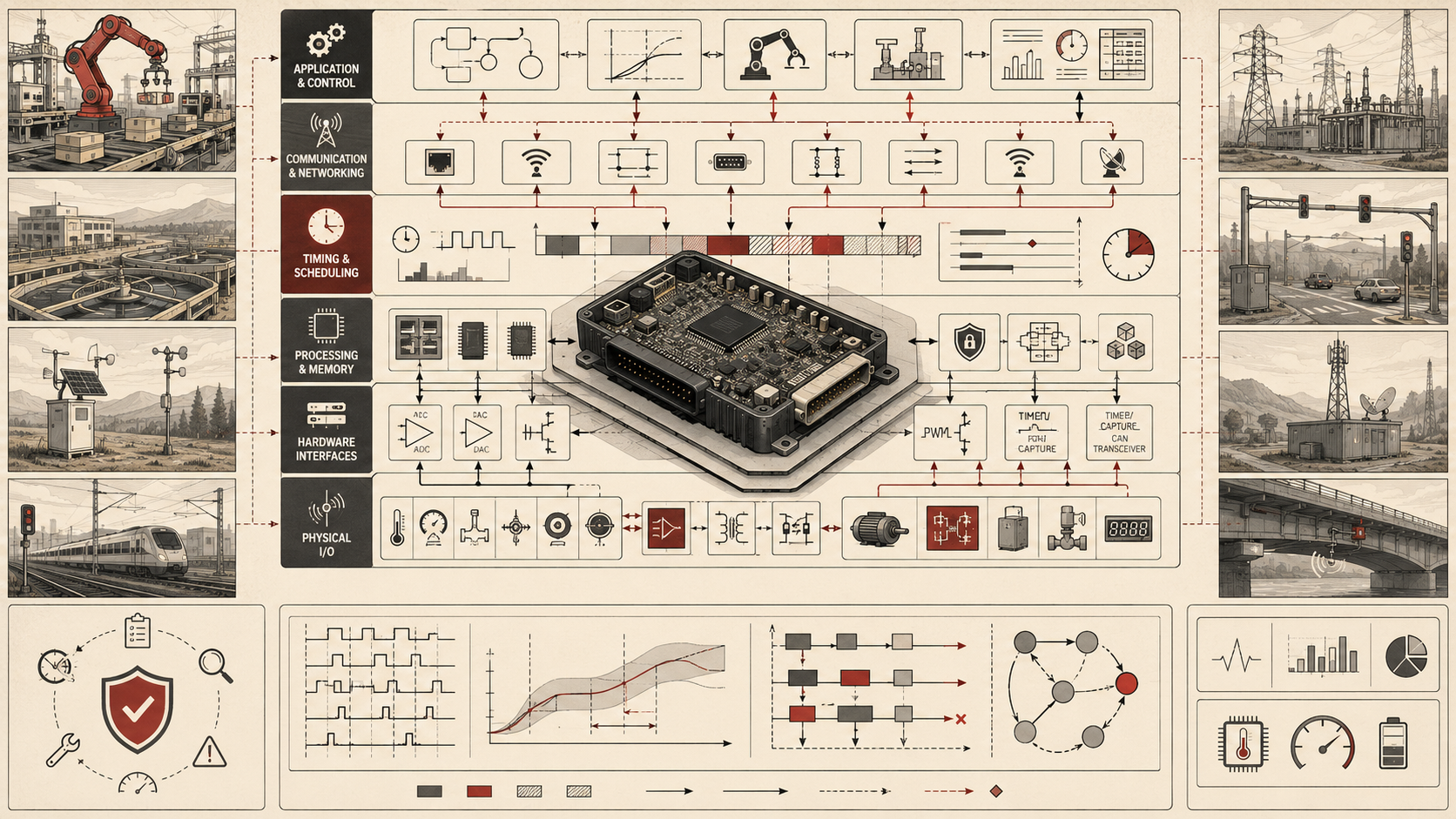
The engineering question is therefore not simply how to build a device that works once. It is how to design a device whose timing, memory, power behavior, peripheral interactions, update paths, security assumptions, and diagnostic evidence remain intelligible across its operating life.
Engineering Problem
The engineering problem is how to organize computation inside a dedicated device so that software, hardware, timing, power, memory, communication, and physical interaction remain coordinated under constraint. Embedded systems are not defined simply by being small. They are defined by being embedded within larger machines, infrastructures, environments, or operational processes where computation must serve a bounded purpose.
A weak embedded architecture can fail in several ways. A processor may be fast enough, but the memory budget may be too small for buffers, logs, updates, and future firmware growth. A sensor may be accurate, but its sampling path may be destabilized by interrupt latency or bus contention. A device may sleep efficiently in theory, but required wake sources may prevent the intended low-power state. A communication interface may work in isolation, but fail when logging, sensing, and control workloads occur at the same time. A firmware image may boot successfully, but lack update rollback, reset-cause evidence, or field diagnostics.
A rigorous architecture should be able to answer several questions. What work must happen locally? What timing deadlines must be met? Which events require interrupt response? Which data can be buffered, dropped, compressed, or deferred? Which memory is volatile, persistent, retained, or update-reserved? Which power states are safe? Which failures must be detected, tolerated, or escalated? Which interfaces are mission-critical? How will the device be updated, diagnosed, and recovered after deployment?
The central challenge is not maximizing capability. It is creating a proportionate architecture in which every resource—compute, memory, timing, power, I/O, security, diagnostics, and lifecycle support—is matched to the device’s real operating role.
Reference Architecture
A practical embedded systems architecture can be understood as a layered but tightly coupled control stack. The exact implementation may be bare-metal firmware, a superloop, an event-driven design, an RTOS-based system, embedded Linux, a heterogeneous MCU/SoC platform, or a hybrid architecture. The architectural responsibilities remain consistent.
| Layer | Engineering Role | Architectural Concern | Evidence Artifact |
|---|---|---|---|
| Requirements layer | Defines the device mission, physical environment, timing needs, power budget, safety expectations, and lifecycle constraints | Purpose fit, deployment assumptions, failure tolerance, operational boundaries | Requirements matrix, operating profile, hazard and constraint notes |
| Silicon platform layer | Provides MCU, SoC, DSP, FPGA, accelerator, or hybrid compute resources | Compute headroom, memory capacity, peripheral fit, timing support, power states | Silicon-fit matrix, platform manifest, memory and I/O scorecard |
| Boot and startup layer | Brings the system from reset to controlled execution | Reset cause, clock setup, memory initialization, secure boot, update handoff | Boot sequence, reset log, startup test, update manifest |
| Board support layer | Maps silicon capabilities to a board, package, pinout, power tree, and external devices | Pin multiplexing, regulators, clocks, external sensors, buses, debug access | BSP notes, schematic map, pin allocation, board manifest |
| Firmware and driver layer | Initializes and controls peripherals, interrupts, buses, timers, memory, and device state | Register access, driver contracts, ISR safety, lifecycle transitions | Driver manifest, register access policy, state machine, API contract |
| Scheduling layer | Defines how work is ordered, preempted, delayed, or deferred | Superloop timing, event queues, RTOS priorities, deadlines, blocking | Task manifest, timing budget, scheduling model, trace logs |
| Data path layer | Moves sensor readings, control state, telemetry, logs, and communication payloads | Buffer sizing, DMA, queue pressure, stale data, packet loss, backpressure | Dataflow diagram, buffer budget, queue high-water marks, telemetry schema |
| Power layer | Coordinates clocks, regulators, sleep states, wake sources, retention, and energy use | Battery life, wake latency, clock domains, device suspend/resume, thermal margin | Power-state table, current trace, wake-source map, energy model |
| Security and update layer | Protects boot, firmware integrity, debug access, identity, credentials, and update paths | Secure boot, signed updates, rollback, debug lockdown, key storage | Threat model, update policy, provisioning record, key-management notes |
| Diagnostics and lifecycle layer | Records and exposes evidence for field reliability, maintenance, recovery, and improvement | Reset causes, fault logs, firmware version, watchdog events, update results | Fault log, telemetry report, recovery runbook, fleet dashboard |
This architecture separates embedded design into reviewable responsibilities without pretending the layers are independent. In real devices, timing, memory, power, firmware, security, and physical behavior remain deeply coupled. The same clock-tree decision that affects power may affect timer accuracy. The same memory budget that affects buffers may affect firmware update safety. The same bus choice that simplifies board design may create timing contention under load.
Implementation Pattern
A rigorous implementation begins with a constraint inventory before code and board design become locked. The design should identify what the device must sense, compute, store, control, communicate, protect, and report across its expected operating conditions.
| Artifact | Purpose | Typical Format |
|---|---|---|
| Device operating profile | Defines duty cycle, physical environment, operating modes, wake events, and deployment assumptions | Markdown, YAML, design table |
| Timing requirements table | Defines sampling periods, control deadlines, interrupt-response needs, communication timing, and jitter tolerance | CSV, timing matrix, RTOS task manifest |
| Memory budget | Defines code, stack, heap, buffers, logs, persistent state, update slots, and retained memory | Linker map, spreadsheet, Python report |
| Peripheral and pin manifest | Lists required ADC, DAC, PWM, GPIO, timers, serial buses, radios, storage, and debug interfaces | YAML, CSV, board manifest, pin map |
| Power-state model | Defines active, idle, sleep, deep sleep, wake, retention, brownout, and recovery behavior | Power table, current trace, wake-source matrix |
| Firmware architecture map | Defines boot, startup, BSP, HAL, drivers, middleware, application logic, and diagnostics | Architecture diagram, README, module map |
| Fault model | Defines expected failures and required behavior under fault, degradation, or recovery | FMEA-style table, runbook, test matrix |
| Security and update policy | Defines secure boot, signed update, rollback, provisioning, debug control, and key storage | Threat model, update manifest, lifecycle policy |
| Observability schema | Defines which runtime and field evidence the device must preserve and report | SQL schema, JSON Schema, telemetry contract |
| Verification plan | Tests timing, memory, interrupts, power, communication, updates, and fault behavior under realistic load | HIL plan, simulation workflow, regression checklist |
The implementation goal is to make embedded constraints explicit. Engineers should be able to identify why the architecture is proportionate, what margins remain, which assumptions are risky, and what evidence proves the device can operate outside ideal laboratory conditions.
Research-Grade Framing: Embedded Architecture as Constraint Governance
Embedded systems architecture can be framed as constraint governance. The architecture governs how scarce resources are allocated, how physical events are translated into computational state, how timing is protected, how energy is conserved, how failures are contained, and how evidence is preserved for maintenance and accountability.
This framing matters because embedded systems are often treated too narrowly. A device is described as “using a microcontroller,” “running an RTOS,” “reading sensors,” or “sending telemetry,” but those phrases do not reveal whether the system is architecturally sound. A device can use a capable MCU and still fail because its memory budget ignores update slots. It can run an RTOS and still miss deadlines because priority assignment is weak. It can support wireless communication and still drain its battery because wake behavior is poorly designed. It can log errors and still be impossible to diagnose because reset-cause evidence is lost.
| Architectural Dimension | Question | Required Evidence |
|---|---|---|
| Purpose fit | Does the architecture match the device’s bounded mission? | Requirements matrix, operating profile, device-class rationale |
| Timing fit | Can deadlines, sampling intervals, interrupt response, and jitter tolerance be met? | Timing budget, response-time analysis, trace data, HIL test |
| Memory fit | Can code, stacks, buffers, logs, persistent state, and updates fit safely? | Memory budget, linker map, stack watermark report |
| Power fit | Can active, idle, sleep, wake, and communication energy meet the deployment model? | Power-state model, current trace, duty-cycle analysis |
| I/O fit | Do sensors, actuators, buses, radios, debug interfaces, and pins fit together? | Peripheral manifest, pin map, bus allocation, schematic review |
| Fault fit | Does the device behave predictably under partial failure, reset, degraded connectivity, or brownout? | Fault model, watchdog policy, reset-cause telemetry, recovery tests |
| Security fit | Does the architecture protect boot, firmware, identity, keys, updates, and debug access? | Threat model, secure-boot chain, update policy, debug policy |
| Lifecycle fit | Can the device be provisioned, updated, diagnosed, recovered, and maintained over time? | Lifecycle runbook, update manifest, telemetry schema, fleet report |
In this view, architecture is not a static diagram. It is the governing structure that determines how the device handles pressure, uncertainty, failure, and change.
Formal Model: Workload, Timing, Memory, Power, and Reliability Fit
A useful formal model treats embedded architecture as a multi-constraint system. Let \(W\) represent workload, \(T\) timing requirements, \(M\) memory requirements, \(P\) power budget, \(I\) interface requirements, \(F\) fault behavior, \(S\) security requirements, and \(L\) lifecycle requirements. Architecture is suitable only when each domain has adequate margin and when cross-domain interactions remain controlled.
A_{\mathrm{fit}} = f(W, T, M, P, I, F, S, L)
\]
Interpretation: Embedded architecture fit depends on workload, timing, memory, power, interfaces, fault behavior, security, and lifecycle needs. No single metric, such as CPU speed, determines suitability.
U_{\mathrm{cpu}} = \sum_{i=1}^{n} \frac{C_i}{T_i}
\]
Interpretation: CPU utilization estimates how much processing time periodic or bounded work consumes. It must leave margin for interrupts, communication bursts, diagnostics, fault handling, and future firmware growth.
M_{\mathrm{margin}} = M_{\mathrm{available}} – (M_{\mathrm{code}} + M_{\mathrm{stack}} + M_{\mathrm{heap}} + M_{\mathrm{buffers}} + M_{\mathrm{logs}} + M_{\mathrm{persistent}} + M_{\mathrm{update}})
\]
Interpretation: Memory margin must include not only the current application, but also stacks, buffers, logs, persistent state, and firmware-update needs. First-release fit is not enough.
L_{\mathrm{event}} = L_{\mathrm{interrupt}} + L_{\mathrm{deferred}} + L_{\mathrm{driver}} + L_{\mathrm{bus}} + L_{\mathrm{application}}
\]
Interpretation: Event-response latency is a system property. It includes interrupt latency, deferred work, driver behavior, bus delay, and application processing.
E_{\mathrm{cycle}} = E_{\mathrm{sense}} + E_{\mathrm{compute}} + E_{\mathrm{communicate}} + E_{\mathrm{sleep}} + E_{\mathrm{wake}} + E_{\mathrm{diagnostics}}
\]
Interpretation: Energy per cycle includes sensing, compute, communication, sleep, wake overhead, and diagnostics. Low-power architecture depends on the whole duty cycle, not only idle current.
These equations turn embedded design into a reviewable engineering process. Their purpose is to expose hidden assumptions before hardware, firmware, and deployment decisions become expensive to change.
What Is Embedded Systems Architecture?
Embedded systems architecture is the structural design of a dedicated computing system integrated into a larger device, machine, infrastructure, or environment. It defines how processing, memory, peripherals, sensors, actuators, software layers, power management, communication interfaces, diagnostics, and security controls are arranged so that the device can perform its intended function efficiently and predictably.
In general-purpose computing, architecture often emphasizes flexibility, abstraction, user-facing functionality, and broad software compatibility. In embedded systems, architecture is usually driven by narrower but more demanding requirements. A device may need to wake from a low-power state in microseconds, sample a sensor on a fixed interval, respond immediately to an interrupt, preserve critical state under unstable power conditions, or continue operating for years with minimal intervention. Architecture must therefore be designed around purpose, constraints, and deployment conditions from the beginning.
Embedded architecture is best understood as layered but tightly coupled. The processing core provides compute capacity. The memory model determines what can be stored, when, and with what persistence. Peripherals connect the processor to the external world through timers, analog interfaces, serial buses, radios, watchdogs, and actuator control. Firmware initializes the system and manages low-level behavior, while device software implements state machines, scheduling, filtering, control, diagnostics, and communications. In more complex systems, an RTOS provides task scheduling, synchronization, and bounded concurrency.
The architecture is successful when these layers work as a coherent system rather than as isolated features. A device is not well architected simply because it has a capable processor, many peripherals, or a modern RTOS. It is well architected when its resource model, timing model, power model, fault model, and lifecycle model fit the device’s purpose.
Why Architecture Matters
The architecture of an embedded system shapes much more than performance. It determines whether the system is intelligible to engineers, testable under stress, maintainable over time, resilient under fault, secure in deployment, and diagnosable after field failures. Poor architectural decisions often do not appear immediately during laboratory prototypes. They reveal themselves later as race conditions, power instability, timing overruns, brittle update flows, unpredictable memory behavior, security gaps, and opaque device failures in the field.
Architecture matters especially because many embedded decisions are expensive to reverse once hardware is fixed and devices are deployed. A poor interrupt model, undersized memory budget, weak boot strategy, overly complex abstraction layer, unsuitable bus architecture, or missing diagnostic channel can constrain every later stage of development. A strong architecture, by contrast, creates a system whose control flow is legible, whose timing assumptions are bounded, and whose interfaces remain stable enough to support debugging, verification, and iterative refinement.
Embedded systems are therefore not primarily exercises in maximizing compute capacity. They are exercises in disciplined constraint management. The goal is to design a device whose resources are properly matched to purpose, whose timing properties are understood, whose power states are usable, and whose interaction with the physical world remains dependable.
This is why architecture should be treated as a first-order engineering artifact. It is not merely the result of implementation choices. It is the structure that determines whether later implementation choices remain safe, comprehensible, and maintainable.
Architectural Decomposition: From Boot to Application Logic
A mature embedded architecture can often be understood as a sequence of layers that bring the device from power-on state to stable operational behavior. This layered view is useful not because all embedded systems use identical stacks, but because it clarifies where responsibilities reside and where failures propagate.
Bootloader and startup logic occupy the earliest stage. This layer handles reset behavior, memory initialization, hardware bring-up, clock configuration, integrity checks, and sometimes secure boot or firmware update logic. In connected systems, the boot path is also part of the device’s trust model, because it determines what code is allowed to execute and how updates are authenticated.
Board support packages and hardware abstraction layers connect generic software to the particulars of a board or silicon platform. These layers expose clocks, GPIO, interrupt controllers, timers, memory regions, communication controllers, and startup routines in forms usable by higher-level code. Good abstraction can improve portability and maintainability. Poor abstraction can obscure hardware behavior, hide timing assumptions, and introduce costly overhead.
Device drivers provide concrete control over peripherals and connected devices. Drivers manage ADCs, DACs, timers, displays, serial buses, radios, sensor interfaces, storage components, and actuator paths. In architecture terms, drivers are where abstract intent meets timing-sensitive hardware behavior.
Middleware appears in more capable systems and may include protocol stacks, file systems, wireless stacks, buffering services, serialization libraries, inference runtimes, or device-management functions. Middleware can accelerate development, but it also expands footprint, memory pressure, timing complexity, and update surface.
Application logic sits above these layers and implements the device’s domain purpose: control loops, state machines, measurement routines, local analytics, fault handling, and communication policy. In a well-architected system, application logic depends on clear service boundaries rather than directly entangling itself with low-level hardware details.
This decomposition matters because embedded failures often travel across layers. A power instability may appear as a communication issue. A driver timing flaw may appear as sensor unreliability. A bootloader decision may shape the long-term security and maintainability of the entire device. Architecture provides the framework through which these interactions can be made tractable.
Core Architectural Components
Most embedded systems architectures combine several recurring components:
- Processing unit: microcontroller, microprocessor, DSP, FPGA-assisted design, or system-on-chip chosen for required compute, timing, memory, and power characteristics.
- Memory subsystem: flash, ROM, SRAM, EEPROM, cache, retained memory, and optional external memory for code, buffers, persistent configuration, telemetry, and runtime state.
- Peripheral subsystem: timers, GPIO, PWM, ADC, DAC, watchdogs, DMA controllers, communication interfaces, cryptographic engines, and hardware accelerators.
- Sensor and actuator interfaces: the physical paths through which the system receives signals and affects the environment.
- Firmware and device software: initialization logic, interrupt service routines, drivers, schedulers, control routines, diagnostics, and communications code.
- Scheduling model: superloop, event-driven execution, interrupt-oriented coordination, cooperative scheduling, or RTOS-based multitasking.
- Communication layer: buses and links such as UART, SPI, I²C, CAN, Ethernet, BLE, LoRa, Wi-Fi, cellular, or industrial fieldbuses depending on range, throughput, determinism, and power constraints.
- Power subsystem: regulators, clocks, sleep states, wake logic, battery management, retention domains, and brownout protection.
- Security and lifecycle subsystem: secure boot, firmware updates, debug control, key storage, provisioning, rollback, recovery, and diagnostic evidence.
What makes these components architectural is not merely their presence but their relationship. A battery-powered environmental sensor node may prioritize ultra-low-power duty cycling and sparse communication. A motor controller may prioritize timing precision, interrupt latency, and fault isolation. A connected medical-adjacent monitor may prioritize memory protection, diagnostics, secure updates, and high-integrity state handling. Architecture begins not with a feature list but with the conditions under which the system must remain dependable.
Hardware–Software Co-Design
Embedded architecture is fundamentally a problem of hardware–software co-design. The processor cannot be selected independently of the firmware model. Communication interfaces cannot be chosen independently of timing and bandwidth requirements. Memory layout cannot be defined independently of code size, buffering needs, update strategy, and fault recovery. Power states cannot be designed independently of software scheduling, wake sources, and retained state.
In embedded systems, software behavior is inseparable from hardware structure. Interrupt latency depends on processor and controller design. Timing precision depends on clocks, timers, and scheduling decisions. Sampling quality depends on analog front ends, conversion accuracy, filtering, and calibration. Energy efficiency depends not only on hardware selection but on how software orchestrates wake cycles, sleep states, DMA use, peripheral activation, and communication duty cycles.
Hardware–software co-design also matters because embedded systems mediate between physical reality and computational representation. Sensors produce noisy signals. Actuators exhibit delay, tolerance, and nonlinearity. Electrical conditions vary. Power can sag. Environmental conditions drift. Embedded software must therefore do more than execute logic; it must stabilize a computational interpretation of an imperfect physical world.
A strong architecture identifies what should be solved in hardware, what should be handled in firmware, what should be scheduled in software, what can be deferred to a gateway or cloud service, and what must remain observable in the field. That partitioning is the heart of embedded systems design.
Memory Architecture, Memory-Mapped I/O, and Allocation Strategy
Memory architecture is one of the central design problems in embedded systems because memory is usually scarce, expensive, and operationally consequential. Architects must determine how code resides in flash or ROM, how runtime state is organized in SRAM, how persistent configuration is stored, how communication buffers are sized, how stack depth is bounded under worst-case conditions, and how firmware updates will fit over time.
Many embedded systems rely heavily on memory-mapped I/O, in which peripheral control and status registers appear at fixed memory addresses. This architecture simplifies access paths and allows firmware to manipulate timers, buses, ADCs, GPIO, and interrupt controllers using ordinary load/store semantics. But it also means software must be acutely aware of register behavior, atomicity, timing, side effects, and ordering.
Allocation strategy is especially important. In smaller or higher-assurance systems, engineers often prefer static allocation for critical buffers, task stacks, and shared structures because it improves predictability and reduces risks associated with fragmentation and heap exhaustion. Dynamic allocation can be useful in more flexible systems, but it introduces uncertainty that may be unacceptable in timing-sensitive or safety-critical environments. The architectural question is not whether dynamic memory is “good” or “bad,” but whether its failure modes and timing implications are tolerable in the target system.
Memory design also determines what kinds of software structure are feasible. Heavy middleware, large protocol stacks, rich diagnostics, on-device analytics, secure update mechanisms, cryptographic libraries, and retained logs all consume space. Architecture therefore requires explicit budget discipline. Every abstraction has a footprint. Every buffer has a cost. Every convenience has implications for energy, timing, and maintainability.
Timing, Interrupts, Jitter, and Determinism
Timing is one of the defining characteristics of embedded architecture. In cyber-physical systems, it is often not enough for the system to be functionally correct. It must be correct within time bounds that matter for control, sensing, synchronization, communication, or safety. Timing and latency are system-level concerns rather than secondary performance metrics.
Interrupts provide immediate response to external or internal events, but they also introduce architectural complexity. An interrupt service routine that runs too long can block lower-priority work, increase latency elsewhere, and destabilize the timing model. Poorly managed shared state between ISR and foreground code can create race conditions that are difficult to reproduce. Strong architecture therefore keeps ISRs short, bounded, and focused on urgent work such as capturing timestamps, moving data to safe buffers, acknowledging hardware state, or triggering deferred processing.
Jitter matters because many embedded systems do not merely require fast response; they require consistent response. Variability in sampling intervals, task execution, communication timing, or control-loop updates can degrade signal interpretation and destabilize physical behavior. Jitter is influenced by interrupt nesting, scheduler design, bus contention, DMA behavior, cache effects where present, and competing peripheral activity.
Worst-case execution time matters because average-case performance is often irrelevant in real-time contexts. A system that usually completes a task in time but occasionally overruns may still be architecturally unsound. This is why embedded architecture often emphasizes bounded execution, explicit priorities, watchdogs, task segregation, and carefully reasoned timing paths.
RTOS environments can make such coordination more tractable, but they do not eliminate the need for architecture. Many small systems remain well served by superloops or event-driven state machines. What matters is that concurrency and timing are designed deliberately rather than treated as incidental implementation detail.
Peripheral Interfaces and Communication Buses
Embedded systems rarely operate in isolation. Their architecture must define how the processor communicates with sensors, memory devices, radios, displays, actuators, storage, gateways, and external infrastructure. Peripheral design is therefore central, not peripheral in the colloquial sense.
Interfaces such as GPIO, UART, SPI, and I²C dominate smaller and board-level systems, while CAN, Ethernet, USB, BLE, Wi-Fi, LoRa, cellular, and industrial fieldbuses appear in more complex or networked environments. These choices are not merely electrical or protocol matters. They affect interrupt structure, buffering, latency, addressability, fault tolerance, energy use, security exposure, and software complexity.
A device that samples sensors, communicates wirelessly, logs telemetry, and controls an actuator is not simply “using multiple interfaces.” It is coordinating multiple timing domains, state transitions, power states, and fault modes. Architecture determines whether those interactions remain legible, debuggable, and robust.
Communication architecture should also define failure behavior. What happens when a bus stalls? What happens when a radio retry budget is exceeded? What happens when telemetry cannot be sent? Does the device buffer, summarize, drop, back off, enter degraded mode, or reset a peripheral? These policies are architectural decisions because they determine how the device behaves under real deployment conditions.
Common Architectural Patterns
Superloop architectures remain common in simpler devices because they are compact, understandable, and often sufficient. They work best when timing demands are modest and the system’s activities can be serialized without unacceptable delay.
Interrupt-driven architectures improve responsiveness but can become fragile when too much logic is pushed into ISR context or when priority relationships are poorly designed. They require discipline around shared state, atomicity, ISR duration, and deferred processing.
Event-driven architectures organize behavior around state transitions, queues, callbacks, and deferred handlers. They can provide an elegant middle ground for asynchronous systems without the full complexity of multitasking.
RTOS-based architectures introduce explicit tasks, priorities, timing services, synchronization primitives, and scheduler behavior. They are powerful when multiple concurrent functions must coexist with bounded latency, but they also demand greater discipline in stack sizing, priority assignment, inter-task communication, blocking analysis, and deadlock avoidance.
Layered architectures improve portability and maintainability by separating BSPs, drivers, middleware, and application logic. Yet in deeply constrained systems, too much layering can obscure hardware behavior and consume scarce memory.
Hybrid edge architectures distribute responsibility across MCU nodes, gateway SoCs, edge analytics services, and cloud systems. They are increasingly important in environmental monitoring, industrial IoT, intelligent infrastructure, and robotics.
Architecture is therefore not a matter of choosing the most sophisticated pattern. It is a matter of selecting the minimal structure that preserves clarity, determinism, power fitness, security, and maintainability under the system’s actual constraints.
Power, Clocking, and Energy-Aware Architecture
Power architecture is central to embedded systems because many devices must operate from batteries, harvested energy, constrained thermal envelopes, or remote power sources. A device that is computationally correct but power-unstable is not architecturally sound.
Energy behavior depends on more than processor selection. It includes clock trees, regulators, peripheral enablement, sensor duty cycles, radio transmission, memory retention, wake latency, sleep leakage, brownout behavior, and software scheduling. A low-power MCU can waste energy if firmware wakes too often, polls unnecessarily, holds buses active, or prevents deep sleep. A more capable SoC can be appropriate when its higher active power is offset by shorter active intervals, better local processing, or reduced communication.
Clocking also has timing consequences. Oscillators, PLLs, prescalers, RTCs, low-power timers, and clock domains shape both energy use and temporal precision. A timer that remains active in deep sleep may enable efficient duty cycling. A wake source that requires a high-power domain may undermine battery life. A peripheral that loses state during sleep may require reinitialization that affects response time.
Energy-aware architecture therefore requires a full duty-cycle model. The design must account for active work, sleep residency, wake overhead, communication bursts, retained state, diagnostics, and failure recovery. Power is not a separate optimization stage. It is part of the architecture from the start.
Boot, Security, Updates, and Lifecycle Trust
As embedded devices become more connected and more operationally important, boot and update architecture have become central to system design. The boot path determines what code executes. The update path determines how the device changes after deployment. Debug policy determines who can inspect or modify the device. Key storage determines whether identity and communication remain trustworthy.
In smaller embedded systems, security may focus on secure boot, signed firmware images, debug-port control, flash protection, and key storage. In richer edge systems, the security model may include multiple boot stages, trusted firmware, isolated execution domains, secure elements, cryptographic accelerators, protected storage, and authenticated update mechanisms. These are not merely security features. They shape the lifecycle architecture of the device.
Update design is especially important. A device must be able to receive new firmware without becoming unrecoverable after power loss, communication interruption, version mismatch, or failed validation. This often requires update slots, rollback support, image manifests, compatibility checks, and diagnostic evidence. A device that can be updated but not recovered is fragile. A device that can fail securely but cannot report why it failed is difficult to maintain.
Security should also be proportionate to field reality. A classroom prototype may tolerate unsigned firmware and open debug access. A deployed infrastructure sensor, industrial controller, medical-adjacent device, or public environmental monitor may not. Embedded architecture should make that transition possible rather than forcing security to be bolted on after hardware and firmware decisions have already narrowed the design.
Diagnostics, Telemetry, and Field Observability
Embedded devices must be designed not only to operate, but to explain their operation after failure. Field failures are often difficult to reproduce because they depend on environmental conditions, power state, timing pressure, sensor noise, communication patterns, or rare execution paths. Without diagnostic evidence, teams may be left guessing.
Useful embedded observability signals include firmware version, hardware revision, reset cause, boot count, watchdog resets, brownout events, stack watermarks, queue high-water marks, bus timeouts, sensor faults, communication retries, update outcomes, sleep residency, wake sources, and error counters. In constrained devices, these signals must be chosen carefully, but they should not be absent.
Diagnostics are not only for debugging. They are part of the reliability architecture. A watchdog reset without a reset-cause record is weak evidence. A firmware update without a result log is incomplete lifecycle management. A field device with no record of power events, communication failures, or driver faults is difficult to improve.
A mature embedded architecture therefore includes observability from the beginning. It defines what evidence will be preserved locally, what will be transmitted, what will be summarized, what will trigger maintenance, and what will support safe recovery or rollback.
Architecture Assurance Case
A technical architecture should produce an assurance case: a structured argument that the device can meet its mission under realistic constraints. This is not the same as claiming the device is perfect or failure-proof. It is a disciplined way to connect requirements, architecture decisions, tests, telemetry, and residual risks.
| Claim | Evidence Needed | Residual Risk to Track |
|---|---|---|
| The device can meet its timing requirements. | Timing budget, ISR trace, scheduler trace, HIL timing test, worst-case load scenario | Rare burst load, interrupt storms, bus contention, firmware growth |
| The device has adequate memory for lifecycle operation. | Linker map, stack watermark, queue high-water marks, update partition plan, log-size estimate | Feature creep, middleware expansion, diagnostic growth, larger update images |
| The device can meet its power model. | Current trace, duty-cycle model, wake-source validation, sleep residency report | Field communication retries, sensor drift, cold temperature behavior, battery aging |
| The device can recover from expected faults. | Fault-injection tests, watchdog policy, reset-cause log, recovery runbook | Compound failures, corrupted persistent state, intermittent peripherals |
| The device can be maintained securely. | Secure-boot evidence, signed-update flow, rollback test, debug-lock policy, provisioning record | Key rotation, supply-chain changes, expired certificates, lost recovery access |
| The device can be diagnosed after deployment. | Telemetry schema, fleet report, local fault log, update outcome record | Storage limits, intermittent connectivity, privacy/security limits on telemetry |
This assurance case turns architecture into a living technical record. It helps teams avoid treating a successful prototype as sufficient evidence, while also identifying where additional testing, telemetry, or design margin is required.
Design Trade-Offs
Embedded systems architecture is defined by trade-offs that cannot all be optimized at once. Greater abstraction may improve maintainability but increase memory use. Richer diagnostics may improve field reliability but consume storage, bandwidth, and execution time. Aggressive power savings may extend battery life but complicate latency and communication. Stronger modularity may support portability but introduce overhead that smaller devices cannot afford.
Typical trade-offs include:
- performance versus energy efficiency
- determinism versus flexibility
- modularity versus footprint
- local processing versus communication overhead
- static allocation versus runtime flexibility
- low-power sleep depth versus wake latency
- secure update complexity versus field maintainability
- diagnostic richness versus memory and bandwidth limits
- cost minimization versus robustness and future extensibility
These are not merely engineering inconveniences. They are the substance of architectural judgment. Good embedded architecture is not maximalist. It is proportionate, explicit about constraints, and honest about what the device must do reliably.
Mathematical Lens: Utilization, Latency, Memory Margin, and Energy
A mathematical lens helps connect embedded architecture to measurable constraints. These equations are not substitutes for hardware testing, but they make design assumptions explicit enough to review.
U_{\mathrm{cpu}} = \sum_{i=1}^{n} \frac{C_i}{T_i}
\]
Interpretation: CPU utilization estimates how much processor capacity is consumed by periodic or bounded work. A viable architecture should leave margin for interrupts, communication bursts, diagnostics, and future firmware growth.
L_{\mathrm{response}} = L_{\mathrm{interrupt}} + L_{\mathrm{queue}} + L_{\mathrm{driver}} + L_{\mathrm{bus}} + L_{\mathrm{application}}
\]
Interpretation: End-to-end response latency includes interrupt handling, queueing, driver behavior, bus delay, and application processing. Timing must be evaluated across the whole path.
M_{\mathrm{margin}} = M_{\mathrm{available}} – M_{\mathrm{required}}
\]
Interpretation: Memory margin should include code, stacks, heap, buffers, persistent configuration, logs, retained state, and update slots. Small memory margins increase lifecycle risk.
Q_{\mathrm{risk}} = \frac{\lambda_{\mathrm{arrival}}}{\mu_{\mathrm{service}}}
\]
Interpretation: Queue risk increases as arrival rate approaches service rate. Buffers can absorb bursts, but they cannot make an overloaded architecture sustainable.
E_{\mathrm{day}} = N_{\mathrm{cycles}}(E_{\mathrm{sense}} + E_{\mathrm{compute}} + E_{\mathrm{comm}} + E_{\mathrm{wake}}) + E_{\mathrm{sleep}} + E_{\mathrm{retention}}
\]
Interpretation: Daily energy depends on sensing, computation, communication, wake overhead, sleep, and retained state. A power-fit architecture must match the real duty cycle.
R_{\mathrm{architecture}} = w_T R_T + w_M R_M + w_P R_P + w_I R_I + w_F R_F + w_S R_S + w_L R_L
\]
Interpretation: An architecture risk score can weight timing, memory, power, interface, fault, security, and lifecycle risks. The weights should reflect the device’s actual mission.
The value of this lens is practical. It helps teams identify whether a prototype succeeds because the architecture is sound, or because the test conditions have not yet exposed the real constraint.
Python Workflow: Architecture Constraint and Timing Simulation
The companion Python workflow models embedded architecture as a set of constraints: tasks, timing deadlines, memory budgets, power states, buffers, queues, interrupts, communication events, and fault scenarios. It can estimate CPU utilization, response latency, queue pressure, memory margin, energy per duty cycle, and architecture risk.
The workflow is designed to answer practical engineering questions. Does the current workload fit the CPU and timing budget? Which task has the smallest slack margin? Which queue is likely to overflow during communication bursts? How much memory remains after buffers, logs, persistent state, and update slots? Which power state dominates energy use? How does increased sensor sampling affect compute and communication load? Which failure modes lack diagnostic evidence?
Useful outputs include architecture constraint scorecards, timing summaries, queue-pressure reports, memory-margin reports, power-state estimates, fault-evidence coverage, and plots of latency or energy risk. In a production setting, this workflow can support early architecture review before hardware and firmware decisions become difficult to reverse.
The purpose is not to replace datasheets, bench measurements, or hardware-in-the-loop testing. It is to make architectural assumptions explicit enough that engineers can test them systematically.
R Workflow: Fleet Telemetry and Architecture Risk Reporting
The companion R workflow treats embedded architecture as an operational evidence problem. It summarizes runtime and fleet telemetry such as reset causes, watchdog resets, brownout events, stack watermarks, queue high-water marks, bus timeouts, communication retries, update outcomes, firmware versions, board revisions, sleep residency, and diagnostic coverage.
This matters because architectural weaknesses often appear only after deployment. One firmware version may increase queue pressure. One board revision may show more brownout resets. One device class may fail to enter the intended sleep state. One communication path may create more retries than the energy model assumed. One driver may produce field faults that were not visible in laboratory testing.
Useful R outputs include risk rankings by device, reset-cause distributions, firmware-version comparisons, power-state summaries, update success rates, diagnostic coverage reports, and fleet maintenance priority tables. These reports can support rollback decisions, firmware redesign, board revision review, and long-term platform governance.
A mature embedded system is not only designed, built, and flashed. It is observed, maintained, and improved across its operational life.
Systems Code: Architecture Manifests, Validation, Telemetry, PYNQ, HDL, and Bash
The companion systems stack demonstrates how embedded architecture concerns appear across implementation layers.
The C example focuses on architecture capability contracts: CPU budget, memory budget, timing requirements, queue sizes, and power-state support. The C++ example models device-state and event-path behavior across sensing, control, communication, and diagnostics. The Rust example validates architecture manifests and ensures that required fields—timing, memory, peripherals, power states, diagnostics, security, and lifecycle support—are present before deployment. The Go example sketches a telemetry aggregator for reset causes, queue pressure, watchdog resets, power-state residency, and update outcomes.
MicroPython provides a prototype for board-level sensing, event loops, and power-aware behavior on constrained boards. TinyML support can model whether local anomaly screening is feasible under memory, compute, and energy limits, but it should not replace explicit architecture review. PYNQ support can demonstrate hardware/software co-design, event counters, timing capture, DMA-assisted data movement, or accelerator integration. HDL examples can model timer blocks, event counters, watchdog progress indicators, queue-depth counters, or peripheral status registers.
The Bash scripts tie the workflow together by validating manifests, running Python and R workflows, generating outputs, and checking repository structure. The goal is not to create a complete embedded framework. The goal is to provide an engineering scaffold that mirrors real embedded architecture problems: timing, memory, I/O, power, fault behavior, security, lifecycle, and field evidence.
Technical Verification Gates
Embedded systems architecture should pass explicit verification gates before a design is treated as deployment-ready. These gates help distinguish a working prototype from a robust architecture.
| Gate | Verification Question | Evidence Required |
|---|---|---|
| Purpose-fit gate | Does the architecture match the device’s bounded mission and deployment environment? | Requirements matrix, operating profile, device-class rationale |
| Compute gate | Does the processor or compute platform meet workload needs with realistic headroom? | Utilization estimate, benchmark, timing trace, workload model |
| Memory gate | Can code, stacks, buffers, logs, retained state, and update slots fit safely? | Memory budget, linker map, stack watermark report, update partition plan |
| Timing gate | Can deadlines, interrupt response, jitter limits, and communication timing be met? | Timing budget, ISR trace, latency measurements, HIL test |
| I/O gate | Are required sensors, actuators, buses, pins, radios, storage, and debug paths available and conflict-free? | Peripheral manifest, pin map, bus allocation, schematic review |
| Power gate | Do active, idle, sleep, wake, communication, and retained states meet the energy model? | Current trace, duty-cycle analysis, wake-source table, power-state test |
| Fault gate | Does the device behave predictably under brownout, bus faults, sensor failure, communication loss, watchdog reset, or update interruption? | Fault-injection test, recovery runbook, reset-cause log, diagnostic report |
| Security gate | Are boot, update, debug, key storage, identity, and communication trust handled appropriately? | Threat model, secure-boot chain, update policy, debug-control record |
| Lifecycle gate | Can the device be provisioned, updated, diagnosed, recovered, and maintained in the field? | Update manifest, telemetry schema, fleet report, maintenance runbook |
These gates reinforce the central principle: embedded architecture is not validated by a successful nominal run. It is validated when the system’s constraints, failure modes, and lifecycle assumptions are tested with evidence.
Common Failure Modes
Embedded architecture failures often appear as isolated bugs even when their causes are structural. A sensor may appear unreliable because the sampling path is poorly timed. A radio may appear defective because the power model is wrong. An application may appear unstable because stack or buffer sizing is insufficient. A firmware update may appear to fail randomly because the boot and rollback path was underdesigned.
Common failure modes include undersized memory budgets, overly optimistic CPU headroom, unbounded interrupt work, missing watchdog evidence, weak power-state design, excessive dynamic allocation, poorly managed shared state, bus contention, insufficient queue capacity, missing update rollback, insecure debug access, and field devices that cannot report why they failed.
Other failures include false simplicity, where a superloop remains understandable only under nominal load; false modularity, where abstraction layers hide critical timing and power assumptions; false low power, where sleep modes are not usable with required wake sources; and false observability, where logs exist but omit the evidence needed for root-cause analysis.
A particularly important failure mode is lifecycle blindness. A device may satisfy the first functional demonstration but fail the demands of deployment: updates, diagnostics, security, recovery, board revisions, firmware growth, and long-term maintenance. Strong embedded architecture evaluates the whole operating life, not only the first working prototype.
Architecture in Real-World Systems
In industrial automation, embedded architecture often prioritizes deterministic control, fault isolation, watchdog behavior, EMI tolerance, and stable field communication. In environmental monitoring, the dominant concerns may be ultra-low-power duty cycling, calibration integrity, intermittent connectivity, long unattended lifecycles, and reliable diagnostics. In medical-adjacent devices, architecture may emphasize traceability, bounded behavior, failsafe states, diagnostics, and secure maintenance. In vehicles and mobility platforms, distributed control units must coordinate sensing, communication, timing, and increasingly complex software interactions across multiple subsystems.
These examples show that embedded architecture is not a narrow hardware topic. It is a systems discipline concerned with how computation is embedded in material processes and infrastructures. That makes it directly relevant to larger questions of resilience, observability, control, sustainability, and intelligent infrastructure.
It also explains the progression of this series. Once architecture is understood, it becomes easier to analyze the specific roles of microcontrollers, system-on-chip design, real-time operating systems, firmware, sensing interfaces, low-power design, environmental sensor networks, edge computing architectures, and cyber-physical systems. The foundational article establishes the vocabulary for that whole sequence.
Engineer Checklist
| Question | Why It Matters |
|---|---|
| Is the device’s bounded mission clearly defined? | Prevents architecture from becoming a feature list rather than a purpose-fit system. |
| Are timing requirements explicit and testable? | Protects sensing, control, communication, and physical interaction from hidden latency failures. |
| Does the memory budget include buffers, stacks, logs, retained state, and updates? | Prevents first-release success from becoming lifecycle failure. |
| Are interrupts, deferred work, and shared state designed deliberately? | Reduces race conditions, jitter, and unpredictable foreground/background interactions. |
| Are power states compatible with wake requirements and retained-state needs? | Protects battery life, field reliability, and low-power behavior. |
| Are communication paths designed for fault, delay, retries, and buffering? | Prevents interface success in isolation from becoming system failure under real load. |
| Are boot, update, debug, and key-storage assumptions explicit? | Protects lifecycle trust and field maintainability. |
| Can the device report meaningful diagnostic evidence after failure? | Supports root-cause analysis, recovery, rollback, maintenance, and long-term improvement. |
GitHub Repository
This article is supported by a companion workflow that treats embedded systems architecture as a structured constraint-governance problem: timing requirements, memory budgets, power-state models, peripheral manifests, fault scenarios, diagnostic schemas, Python simulations, R fleet reports, SQL evidence structures, systems-code examples, tests, manifests, and runbooks.
Complete Code Repository
The companion repository includes Python, R, SQL, C, C++, Rust, Go, MicroPython, TinyML, PYNQ, HDL, Bash, YAML/JSON configuration, notebooks, tests, docs, data, outputs, and article-specific engineering workflows for embedded architecture analysis.
View the Full GitHub Repository
Where This Fits in the Series
This article establishes the foundational architectural logic of the Embedded and Edge Systems series. It explains how dedicated devices are structured before the series moves into processor design, system-on-chip integration, RTOS models, firmware, sensing interfaces, power management, edge analytics, and distributed cyber-physical infrastructure.
It prepares the way for deeper articles on microcontrollers and SoCs, real-time operating systems, firmware and hardware abstraction, data acquisition, low-power embedded design, environmental sensor networks, cyber-physical integration, and edge computing architectures. Those later topics are easier to evaluate once the architectural foundation is clear: embedded systems are constrained, physical, time-sensitive, power-aware, and lifecycle-bound computing systems.
Related articles
- Microcontrollers and System-on-Chip Design
- Real-Time Operating Systems in Embedded Computing
- Firmware, Hardware Abstraction, and Device Control
- Data Acquisition and Embedded Sensor Interfaces
- Low-Power Embedded System Design
- Environmental Sensor Networks
- Edge Computing Architectures
- Cyber-Physical Systems and Hardware Integration
Further reading
- Arm (n.d.) M-Profile Architectures. Available at: https://www.arm.com/architecture/cpu/m-profile.
- Burns, A. and Wellings, A.J. (2009) Real-Time Systems and Programming Languages. 4th edn. Harlow: Addison-Wesley.
- FreeRTOS (n.d.) RTOS Fundamentals. Available at: https://www.freertos.org/Documentation/01-FreeRTOS-quick-start/01-Beginners-guide/01-RTOS-fundamentals.
- Hennessy, J.L. and Patterson, D.A. (2019) Computer Architecture: A Quantitative Approach. 6th edn. Cambridge, MA: Morgan Kaufmann.
- Lee, E.A. and Seshia, S.A. (2017) Introduction to Embedded Systems: A Cyber-Physical Systems Approach. 2nd edn. Cambridge, MA: MIT Press.
- Rajkumar, R., Lee, I., Sha, L. and Stankovic, J. (2010) ‘Cyber-physical systems: the next computing revolution’, in Proceedings of the 47th Design Automation Conference. New York: ACM, pp. 731–736.
- Wolf, W. (2012) Computers as Components: Principles of Embedded Computing System Design. 3rd edn. Burlington, MA: Morgan Kaufmann.
- Zephyr Project (n.d.) Introduction. Available at: https://docs.zephyrproject.org/latest/introduction/index.html.
References
- Arm (n.d.) Arm Architecture. Available at: https://www.arm.com/architecture.
- Arm (n.d.) Fundamentals of System-on-Chip Design on Arm Cortex-M. Available at: https://armkeil.blob.core.windows.net/developer/Files/pdf/ebook/arm-fundamentals-soc.pdf.
- Arm (n.d.) M-Profile Architectures. Available at: https://www.arm.com/architecture/cpu/m-profile.
- FreeRTOS (n.d.) Documentation Overview. Available at: https://www.freertos.org/Documentation/00-Overview.
- FreeRTOS (n.d.) RTOS Fundamentals. Available at: https://www.freertos.org/Documentation/01-FreeRTOS-quick-start/01-Beginners-guide/01-RTOS-fundamentals.
- Hennessy, J.L. and Patterson, D.A. (2019) Computer Architecture: A Quantitative Approach. 6th edn. Cambridge, MA: Morgan Kaufmann.
- Lee, E.A. and Seshia, S.A. (2017) Introduction to Embedded Systems: A Cyber-Physical Systems Approach. 2nd edn. Cambridge, MA: MIT Press.
- NIST (2017) Framework for Cyber-Physical Systems: Volume 1, Overview. Available at: https://nvlpubs.nist.gov/nistpubs/SpecialPublications/NIST.SP.1500-201.pdf.
- NIST (2017) Framework for Cyber-Physical Systems: Volume 3, Timing Annex. Available at: https://www.nist.gov/publications/framework-cyber-physical-systems-volume-3-timing-annex.
- Rajkumar, R., Lee, I., Sha, L. and Stankovic, J. (2010) ‘Cyber-physical systems: the next computing revolution’, in Proceedings of the 47th Design Automation Conference. New York: ACM, pp. 731–736.
- Wolf, W. (2012) Computers as Components: Principles of Embedded Computing System Design. 3rd edn. Burlington, MA: Morgan Kaufmann.
- Zephyr Project (n.d.) Introduction. Available at: https://docs.zephyrproject.org/latest/introduction/index.html.
- Zephyr Project (n.d.) Zephyr Project Documentation. Available at: https://docs.zephyrproject.org/latest/index.html.