
Last Updated May 20, 2026
Semantic memory refers to the long-term memory system that stores general knowledge about the world, including concepts, facts, meanings, categories, schemas, and relationships among ideas. Unlike episodic memory, which concerns personally experienced events situated in time and place, semantic memory preserves structured knowledge that can be accessed independently of a specific autobiographical episode. In cognitive psychology, semantic memory is one of the major systems through which the mind understands language, categorizes experience, reasons about abstractions, recognizes relations, and uses knowledge flexibly across contexts.
Semantic memory forms part of the foundation of human cognition. It allows individuals to know that Paris is the capital of France, that dogs are animals, that triangles have three sides, that copper conducts electricity, that democracy is a political concept, or that justice is an abstract moral and institutional idea. These forms of knowledge are not usually tied to a remembered episode of acquisition. They exist instead as part of a larger structured knowledge system.
In cognitive psychology, semantic memory is not treated as a mere storehouse of disconnected facts. It is understood as an organized, dynamic, and relational system that supports retrieval, inference, categorization, language comprehension, concept formation, decision making, and knowledge transfer. This makes semantic memory central not only to memory, but also to language processing, concept formation, mental models, analogical reasoning, and decision making.
Main Library
Publications
Article Map
Cognitive Psychology
Related Topic
Artificial Intelligence Systems
Related Topic
Data Systems & Analytics
Related Topic
Behavioral Economics
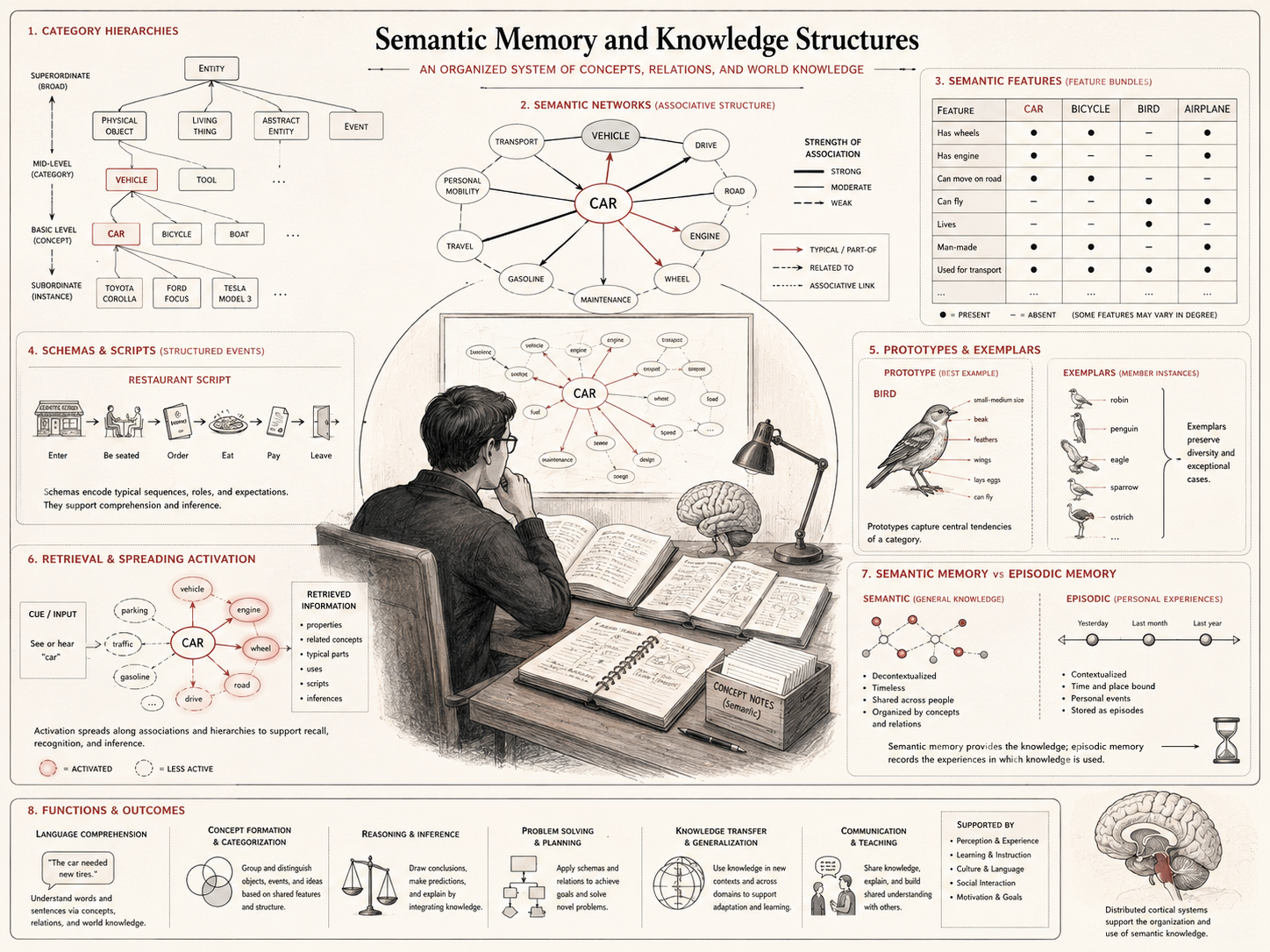
Semantic memory matters because human cognition depends on stable knowledge that can travel across situations. Without semantic memory, each encounter would remain isolated. Language would lose durable meaning, categories would fail to organize perception, and reasoning would be trapped in immediate experience. Semantic memory allows knowledge to become portable.
The nature of semantic memory
Semantic memory stores knowledge that is independent of a specific personal episode. It includes word meanings, conceptual categories, factual knowledge, abstract ideas, social meanings, object properties, causal relations, scripts, schemas, and structured relations among concepts. Knowing that a robin is a bird, that copper conducts electricity, that hammers are tools, or that democracy refers to a form of political organization are all examples of semantic memory.
This knowledge differs from direct recall of personally experienced events. A person may know that Paris is the capital of France without remembering when or where that fact was learned. They may know what a hospital is, what a contract is, or what a triangle is without retrieving a specific learning episode. Semantic memory is therefore not primarily autobiographical. It is conceptual.
Semantic memory matters because it gives cognition stability beyond immediate perception and beyond personal narrative. It provides the conceptual structure required for understanding language, drawing inferences, recognizing category membership, interpreting unfamiliar situations, and reasoning about things that are not currently present.
This does not mean semantic memory is static. Knowledge changes over time. Concepts are refined, associations strengthen or weaken, categories reorganize, and meanings shift with language, culture, expertise, education, and experience. Semantic memory is stable enough to support recognition and meaning, but plastic enough to support learning and conceptual change.
Semantic memory is therefore best understood as a structured knowledge system: durable, relational, dynamic, and continuously shaped by use.
Semantic memory and episodic memory
The distinction between semantic and episodic memory is one of the most influential organizing distinctions in memory research. Episodic memory concerns personally experienced events situated in a particular time and place. Semantic memory concerns general knowledge that can usually be retrieved without mentally returning to the event in which it was learned.
For example, remembering a particular school lesson about geometry is episodic. Knowing that triangles have three sides is semantic. Remembering the dinner where one first tasted a regional dish is episodic. Knowing what that regional cuisine generally refers to is semantic.
The distinction is useful, but not absolute in everyday cognition. Semantic and episodic memory interact. Episodic experiences can become semantic knowledge when repeated, abstracted, or detached from their original context. Semantic knowledge can also shape episodic encoding by making new information easier to organize and remember. A person with rich semantic knowledge about ecology, law, medicine, engineering, or history can often encode new related events more efficiently because prior knowledge provides structure.
This interaction matters for learning. Education is not only the accumulation of facts, but the transformation of particular exposures into durable conceptual structures. The learner may first encounter a fact in a specific classroom, article, experiment, or conversation. Over time, the fact becomes part of a wider semantic system that can be used without recalling the original episode.
Semantic memory and episodic memory therefore differ in function, but they cooperate in cognition. Episodic memory preserves personal encounter; semantic memory abstracts general knowledge from experience and makes it available for future reasoning.
The structure of semantic memory
Semantic memory has often been described as a network of interconnected concepts and relations. In network accounts, concepts are represented as nodes or structured units, and relations are represented as links, features, associations, or weighted connections. Retrieval occurs when cues activate related knowledge.
Classic work by Collins and Quillian modeled semantic memory as a hierarchical network in which concepts were organized by category relations and properties could be stored at appropriate levels of abstraction. This approach helped make semantic memory experimentally tractable because it connected structure to measurable retrieval time.
For example, if a concept such as “canary” is connected to “bird,” and “bird” is connected to “animal,” a proposition such as “a canary is an animal” may require traversal across a longer relational path than “a canary is a bird.” Such models helped explain why semantic verification can take longer when a proposition is more inferentially distant.
Later research complicated the early hierarchical picture. Semantic memory is not only a strict taxonomy. Knowledge can be organized by taxonomic relations, thematic relations, functional relations, perceptual features, emotional associations, language co-occurrence, embodied experience, scripts, schemas, and abstract conceptual structure.
This means semantic memory is better understood as a multi-relational system rather than a single tree. A concept such as “doctor” can be connected to “profession” taxonomically, to “hospital” thematically, to “stethoscope” associatively, to “care” functionally, and to “authority” socially. Which relation becomes active depends on task, context, cue, and goal.
The broader insight remains: semantic memory is structured. It supports efficient retrieval because knowledge is organized relationally rather than stored as an undifferentiated list of facts.
Categories, prototypes, exemplars, and features
Semantic memory is deeply involved in categorization. Categories allow the mind to treat different instances as meaningfully related: dogs as animals, hammers as tools, apples as fruit, contracts as legal instruments, democracies as political systems, or triangles as geometric figures.
Category knowledge can be represented in several ways. Prototype accounts emphasize central tendencies: a robin may feel like a more typical bird than an ostrich because it better matches the usual features associated with birds. Exemplar accounts emphasize stored examples: category judgments may depend on comparisons to remembered instances. Feature-based accounts emphasize properties: wings, feathers, flight, beaks, and egg-laying may all contribute to bird knowledge, though not every bird shares every feature.
These approaches help explain why category membership and category typicality are not the same thing. An ostrich is a bird, but it may be judged less typical than a robin. A tomato is botanically a fruit, but many people categorize it differently in culinary contexts. A concept can be technically included in a category while being psychologically peripheral to it.
Semantic memory also supports flexible categorization. A person can categorize a hammer as a tool, a weapon, a household object, a construction object, a lever, or a symbol depending on context. This flexibility reveals that concepts are not fixed labels attached to objects. They are organized knowledge structures whose relevant features shift with task and interpretation.
In research terms, category judgments provide a window into semantic structure. Response time, accuracy, typicality ratings, feature-generation tasks, and semantic relatedness judgments can all reveal how concepts are organized and retrieved.
Formalizing semantic memory: networks, similarity, and retrieval
Semantic memory can be described formally as a graph or relational system. Let semantic memory be represented as:
S = (V, E, W)
\]
Interpretation: \(V\) is a set of conceptual nodes, \(E\) is a set of semantic relations, and \(W\) contains weights representing relation strength, similarity, association, or salience.
Retrieval from semantic memory can be modeled as activation spreading from an initial cue node \(v_i\) to related nodes. If \(a_t\) is the activation vector at time \(t\), then a simple spreading-activation update can be written as:
a_{t+1} = \gamma W a_t
\]
Interpretation: Activation spreads through weighted semantic relations, with \(\gamma\) representing decay or propagation strength.
Similarity-based retrieval can also be represented formally. If concept \(x\) and concept \(y\) are encoded in a semantic feature space, then similarity may be written as:
\operatorname{sim}(x,y) = \exp(-\lambda d(x,y))
\]
Interpretation: Semantic similarity decreases as distance \(d(x,y)\) increases. The parameter \(\lambda\) controls how quickly similarity falls with distance.
Fact verification can be described through retrieval cost. If a proposition \(p\) requires traversing \(k\) semantic relations, then:
RT(p) \propto k
\]
Interpretation: Verification time tends to increase as the semantic path or inferential distance required to evaluate a proposition increases.
A probabilistic semantic-verification model can include distance, truth status, typicality, association, and false semantic association:
Pr(y_i=1)=\frac{1}{1+e^{-(\beta_0-\beta_1D_i+\beta_2T_i+\beta_3C_i+\beta_4A_i-\beta_5F_i)}}
\]
Interpretation: Verification accuracy can increase with truth status \(T_i\), category typicality \(C_i\), and association \(A_i\), while decreasing with semantic distance \(D_i\) and false association \(F_i\).
These formal models are simplified, but useful. They show that semantic memory can be studied as a structured retrieval system rather than a vague collection of meanings.
Semantic memory and language
Semantic memory plays a central role in language processing because understanding words and sentences depends on access to stored meanings and conceptual relations. To comprehend language, individuals must retrieve lexical meanings, integrate them with context, and connect them to broader conceptual knowledge.
This makes semantic memory indispensable for language processing. Without semantic memory, words would not carry stable meaning, and sentences could not be interpreted beyond their immediate sound or visual form. Meaning construction would collapse into surface recognition without conceptual understanding.
Semantic memory helps language comprehension by supporting:
- word meaning retrieval;
- category inference;
- metaphor and analogy;
- disambiguation of multiple meanings;
- thematic and causal interpretation;
- context-sensitive meaning adjustment;
- integration of new statements with prior knowledge.
For example, the word “bank” may refer to a financial institution or the edge of a river. Semantic memory provides the possible meanings, but context selects the relevant one. The sentence does not merely activate a dictionary entry; it guides retrieval within a structured semantic field.
Semantic memory also supports abstract language. Concepts such as justice, probability, causality, democracy, authority, sustainability, risk, and responsibility cannot be reduced to simple perceptual images. They depend on networks of relations, examples, institutions, values, and learned usage. Semantic memory therefore supports both concrete word meaning and highly abstract conceptual thought.
Language and semantic memory are mutually reinforcing. Language gives semantic memory a symbolic system for organizing and communicating knowledge, while semantic memory gives language its conceptual depth.
Semantic memory and mental models
Semantic memory provides the building blocks for mental models. Semantic memory stores concepts, relations, properties, categories, facts, and schemas. Mental models organize those elements into more complex representations of situations, systems, and possible outcomes.
A person may know semantically that birds have wings, that flight requires lift, that migration is seasonal, and that ecosystems involve food webs. But to reason about a particular ecological situation, those elements must be organized into a larger internal model. Semantic memory supplies the conceptual materials; mental models arrange them into a working representation of a specific system or scenario.
This relationship matters because general knowledge becomes cognitively powerful when it can be integrated into structured reasoning. Facts alone do not guarantee understanding. A learner may memorize terms without knowing how they relate. A professional may know many facts but fail to build the correct model of a situation. A decision maker may retrieve familiar categories but apply them to the wrong problem structure.
Mental models depend on semantic memory, but they also reshape semantic memory. When people repeatedly use concepts together in reasoning, new associations can form. When a model is revised, relations among concepts may change. Learning a scientific theory, legal doctrine, programming framework, or historical interpretation often reorganizes semantic memory by altering how concepts connect.
Semantic memory is therefore not only a source of stored knowledge. It is the substrate from which situation understanding is built.
Semantic memory and learning
Learning often involves the expansion, refinement, and reorganization of semantic memory. As individuals acquire new information, they integrate it into existing conceptual structures, adjust category boundaries, and strengthen or weaken relations among ideas.
This process is essential for building coherent knowledge systems. New information is most useful when it is not retained in isolation, but linked meaningfully to what is already known. A fact that remains disconnected is difficult to retrieve and apply. A fact embedded in a rich semantic network becomes easier to use in reasoning, explanation, and transfer.
These dynamics connect directly to cognitive learning. Learning is not simply exposure. It is the transformation of information into organized, retrievable, and transferable knowledge.
Semantic learning often involves:
- adding new concepts;
- refining category boundaries;
- strengthening associations;
- weakening misconceptions;
- linking examples to abstractions;
- building schemas;
- integrating language with experience;
- reorganizing prior knowledge when new evidence conflicts with old assumptions.
Education depends heavily on semantic memory. Vocabulary, scientific concepts, historical categories, mathematical relations, legal principles, ethical frameworks, and technical systems all require semantic organization. The goal is not merely to store more information, but to build knowledge structures that support interpretation and transfer.
Semantic memory also explains why prior knowledge can both help and hinder learning. Strong prior knowledge can support rapid comprehension when it is accurate and relevant. But rigid or mistaken semantic structures can produce misconceptions, overgeneralization, or resistance to conceptual change.
Semantic memory and decision making
Semantic memory influences decision making by supplying the concepts, categories, and factual structures through which options are interpreted. Individuals do not evaluate alternatives in a vacuum. They rely on prior knowledge to determine what features matter, what categories apply, and what past knowledge is relevant to current judgment.
This influence becomes especially important in complex environments where direct calculation is difficult and prior knowledge must do much of the interpretive work. A medical decision depends on disease categories and causal knowledge. A legal decision depends on doctrines and precedents. A financial decision depends on concepts such as risk, interest, debt, inflation, and opportunity cost. A civic decision depends on semantic knowledge about institutions, policies, rights, and responsibilities.
Semantic memory can support judgment by making relevant knowledge accessible. It can also distort judgment when stored categories are too rigid, too simplistic, culturally biased, outdated, or poorly matched to the case at hand. In that sense, semantic memory is relevant not only to knowledge storage but also to cognitive bias.
For example, if a person’s semantic category for “leader” is shaped by narrow stereotypes, that knowledge structure may affect evaluation of candidates. If an institution categorizes communities through outdated or deficit-based concepts, its decisions may reproduce structural harm. If a policymaker interprets a system through an inappropriate analogy or category, their solution may address the wrong problem.
Decision making therefore depends not only on available information, but on the semantic structures used to interpret information. Better decisions often require better categories, more accurate concepts, and more reflective knowledge organization.
Semantic cognition and the brain
Neuroscientific research suggests that semantic memory is distributed rather than localized in a single isolated brain region. Conceptual knowledge involves interactions among perceptual, motor, linguistic, association, and transmodal systems. Different theories debate how modality-specific features and more abstract integrative structures contribute to meaning.
One influential line of research emphasizes that semantic knowledge involves both distributed feature information and integrative systems that support coherent concepts across modalities. A concept such as “dog” includes perceptual features, sounds, actions, emotional associations, linguistic labels, and category relations. The mind must integrate those different sources into a stable concept that can be recognized across contexts.
Neuropsychological evidence has also been important. Some patients show semantic impairments that affect naming, comprehension, category knowledge, and conceptual access across modalities. Such patterns suggest that semantic memory is not simply verbal memory or visual memory. It is a broader knowledge system that supports meaning across input and output formats.
This distributed view also helps explain why semantic memory is resilient but vulnerable. Because knowledge is distributed, partial cues can often support retrieval. But damage to key integrative systems can produce broad semantic deficits. Semantic cognition therefore depends on both specialized feature systems and broader integration across conceptual networks.
The central lesson from cognitive neuroscience is that meaning is not stored in a single mental dictionary. It emerges from structured interaction among systems that encode, integrate, retrieve, and apply knowledge.
Semantic memory in artificial intelligence
Semantic memory has strong parallels in artificial intelligence, where knowledge is often represented in structured systems such as knowledge graphs, ontologies, semantic networks, vector embeddings, and hybrid retrieval systems. These systems organize information into entities, relations, attributes, and learned representations so that machines can retrieve, classify, compare, and reason over stored knowledge.
The comparison is not exact. Human semantic memory is shaped by embodiment, development, affect, culture, language, social interaction, and lived experience. Artificial systems may represent semantic relations statistically, symbolically, graphically, or through embedding geometry, but they do not possess human semantic memory in the same experiential and developmental sense.
Still, the parallel is useful because both human and artificial systems confront the problem of organizing knowledge in ways that support flexible retrieval and inference. A search engine, recommendation system, knowledge graph, or language model depends on how information is represented and related. Poor representations produce poor retrieval and misleading inference.
AI also raises new questions for semantic-memory research. Large-scale models can approximate semantic similarity, generate associations, and retrieve facts, but they may confuse association with truth. A phrase can be statistically related to another phrase without the relation being factually correct. This mirrors a human cognitive risk: semantic relatedness can feel meaningful even when the proposition is false.
Semantic memory therefore provides a bridge between cognitive psychology and knowledge engineering. It helps frame a central question for both human and artificial systems: how should knowledge be represented so that retrieval is useful, inference is reliable, and meaning remains accountable to evidence?
Semantic memory in contemporary research
Modern research on semantic memory integrates cognitive psychology, neuroscience, computational modeling, psycholinguistics, artificial intelligence, and philosophy of memory. Contemporary reviews emphasize that semantic memory is not well captured by a single simple model. Instead, it has been studied through semantic networks, feature-based systems, distributed representations, embodied and grounded approaches, hub-and-spoke accounts, and large-scale computational models.
Research methods include semantic verification, category judgment, lexical decision, priming, feature generation, semantic fluency, naming, neuropsychological assessment, neuroimaging, corpus modeling, embedding analysis, and computational simulation. Each method reveals a different part of the system.
One major contemporary challenge is integrating representational accounts with process accounts. It is not enough to say how concepts are stored. Researchers also need to explain how semantic knowledge is retrieved, selected, controlled, and used in tasks. A model may represent similarity well but still fail to explain human response time, error patterns, context effects, or task demands.
Another challenge is cultural and social variation. Semantic memory is shaped by language, education, profession, community, media, institutions, and lived experience. What concepts are central, which associations are strong, and how categories are organized can differ across groups. A research-grade account of semantic memory should therefore avoid treating one knowledge structure as universal by default.
Semantic memory remains a central problem because it connects knowledge storage to meaning. It asks how the mind organizes what it knows so that knowledge can be retrieved, interpreted, applied, and revised.
R code for semantic-memory data
The following R workflow illustrates analyses relevant to semantic-memory research, including fact verification, semantic-distance effects, category judgments, false semantic association, confidence, and retrieval-time modeling.
# Install packages if needed:
# pak::pak(c("tidyverse", "lme4", "lmerTest", "emmeans", "broom.mixed"))

library(tidyverse)
library(lme4)
library(lmerTest)
library(emmeans)
library(broom.mixed)

# Expected columns:
# participant, condition, cue_concept, target_concept,
# category, relation_type, semantic_distance,
# category_typicality, feature_overlap, associative_strength,
# concept_familiarity, concreteness, schema_consistency,
# fact_true, false_association, verification_accuracy,
# category_strength, confidence, response_time_ms

dat <- read_csv("semantic_memory_trials.csv") %>%
  mutate(
    participant = factor(participant),
    condition = factor(condition),
    cue_concept = factor(cue_concept),
    target_concept = factor(target_concept),
    category = factor(category),
    relation_type = factor(relation_type),
    fact_true = as.integer(fact_true),
    false_association = as.integer(false_association),
    verification_accuracy = as.integer(verification_accuracy),
    log_response_time = log(response_time_ms)
  )

# -----------------------------
# 1. Descriptive profile
# -----------------------------

condition_summary <- dat %>%
  group_by(condition) %>%
  summarise(
    n_trials = n(),
    participants = n_distinct(participant),
    mean_semantic_distance = mean(semantic_distance, na.rm = TRUE),
    mean_category_typicality = mean(category_typicality, na.rm = TRUE),
    mean_feature_overlap = mean(feature_overlap, na.rm = TRUE),
    mean_associative_strength = mean(associative_strength, na.rm = TRUE),
    mean_concept_familiarity = mean(concept_familiarity, na.rm = TRUE),
    mean_schema_consistency = mean(schema_consistency, na.rm = TRUE),
    false_association_rate = mean(false_association, na.rm = TRUE),
    true_fact_rate = mean(fact_true, na.rm = TRUE),
    accuracy_rate = mean(verification_accuracy, na.rm = TRUE),
    mean_category_strength = mean(category_strength, na.rm = TRUE),
    mean_confidence = mean(confidence, na.rm = TRUE),
    mean_response_time_ms = mean(response_time_ms, na.rm = TRUE),
    .groups = "drop"
  )

print(condition_summary)

# -----------------------------
# 2. Semantic-verification accuracy model
# -----------------------------

accuracy_model <- glmer(
  verification_accuracy ~
    condition +
    relation_type +
    semantic_distance +
    fact_true +
    category_typicality +
    feature_overlap +
    associative_strength +
    concept_familiarity +
    schema_consistency +
    false_association +
    (1 | participant) +
    (1 | target_concept),
  data = dat,
  family = binomial(),
  control = glmerControl(optimizer = "bobyqa")
)

summary(accuracy_model)
emmeans(accuracy_model, ~ condition, type = "response")
emmeans(accuracy_model, ~ relation_type, type = "response")

# -----------------------------
# 3. Retrieval-latency model
# -----------------------------

rt_model <- lmer(
  log_response_time ~
    condition +
    relation_type +
    semantic_distance +
    fact_true +
    category_typicality +
    associative_strength +
    concept_familiarity +
    false_association +
    verification_accuracy +
    (1 | participant) +
    (1 | target_concept),
  data = dat,
  REML = FALSE
)

summary(rt_model)
emmeans(rt_model, ~ condition)

# -----------------------------
# 4. Category-strength model
# -----------------------------

category_model <- lmer(
  category_strength ~
    condition +
    semantic_distance +
    category_typicality +
    feature_overlap +
    associative_strength +
    schema_consistency +
    false_association +
    (1 | participant) +
    (1 | target_concept),
  data = dat,
  REML = FALSE
)

summary(category_model)
emmeans(category_model, ~ condition)

# -----------------------------
# 5. Confidence model
# -----------------------------

confidence_model <- lmer(
  confidence ~
    verification_accuracy +
    category_strength +
    concept_familiarity +
    false_association +
    semantic_distance +
    condition +
    (1 | participant) +
    (1 | target_concept),
  data = dat,
  REML = FALSE
)

summary(confidence_model)

# -----------------------------
# 6. Visualization
# -----------------------------

ggplot(dat, aes(x = semantic_distance, y = response_time_ms, color = relation_type)) +
  geom_point(alpha = 0.25) +
  geom_smooth(method = "lm", se = FALSE) +
  labs(
    title = "Semantic distance and retrieval latency",
    x = "Semantic distance",
    y = "Response time (ms)"
  ) +
  theme_minimal()
This workflow can be adapted for semantic-verification tasks, category-judgment studies, lexical-decision experiments, semantic-priming studies, neuropsychological assessment, embedding-validation studies, or human-AI comparisons of semantic retrieval. Researchers should model participant and item effects whenever possible because concepts vary strongly in familiarity, concreteness, typicality, and cultural exposure.
Python code for semantic-memory data
The Python examples below parallel the R workflow and are useful for semantic-verification tasks, category-judgment studies, retrieval-time experiments, false semantic association, semantic-distance modeling, and semantic-network analysis.
import numpy as np
import pandas as pd
import statsmodels.formula.api as smf
import statsmodels.api as sm
import matplotlib.pyplot as plt
import networkx as nx

# Expected columns:
# participant, condition, cue_concept, target_concept,
# category, relation_type, semantic_distance,
# category_typicality, feature_overlap, associative_strength,
# concept_familiarity, concreteness, schema_consistency,
# fact_true, false_association, verification_accuracy,
# category_strength, confidence, response_time_ms

df = pd.read_csv("semantic_memory_trials.csv")

categorical_cols = [
    "participant",
    "condition",
    "cue_concept",
    "target_concept",
    "category",
    "relation_type"
]

for col in categorical_cols:
    df[col] = df[col].astype("category")

df["fact_true"] = df["fact_true"].astype(int)
df["false_association"] = df["false_association"].astype(int)
df["verification_accuracy"] = df["verification_accuracy"].astype(int)
df["log_response_time"] = np.log(df["response_time_ms"])

# -----------------------------
# 1. Descriptive profile
# -----------------------------

condition_summary = (
    df.groupby("condition")
    .agg(
        n_trials=("verification_accuracy", "size"),
        participants=("participant", "nunique"),
        mean_semantic_distance=("semantic_distance", "mean"),
        mean_category_typicality=("category_typicality", "mean"),
        mean_feature_overlap=("feature_overlap", "mean"),
        mean_associative_strength=("associative_strength", "mean"),
        mean_concept_familiarity=("concept_familiarity", "mean"),
        mean_schema_consistency=("schema_consistency", "mean"),
        false_association_rate=("false_association", "mean"),
        true_fact_rate=("fact_true", "mean"),
        accuracy_rate=("verification_accuracy", "mean"),
        mean_category_strength=("category_strength", "mean"),
        mean_confidence=("confidence", "mean"),
        mean_response_time_ms=("response_time_ms", "mean"),
    )
    .reset_index()
)

print(condition_summary)

# -----------------------------
# 2. Semantic-verification accuracy model
# -----------------------------

accuracy_model = smf.glm(
    "verification_accuracy ~ condition + relation_type + semantic_distance "
    "+ fact_true + category_typicality + feature_overlap + associative_strength "
    "+ concept_familiarity + schema_consistency + false_association",
    data=df,
    family=sm.families.Binomial(),
)

accuracy_result = accuracy_model.fit(
    cov_type="cluster",
    cov_kwds={"groups": df["participant"]},
)

print(accuracy_result.summary())

# -----------------------------
# 3. Retrieval-latency model
# -----------------------------

rt_model = smf.ols(
    "log_response_time ~ condition + relation_type + semantic_distance "
    "+ fact_true + category_typicality + associative_strength "
    "+ concept_familiarity + false_association + verification_accuracy",
    data=df,
)

rt_result = rt_model.fit(
    cov_type="cluster",
    cov_kwds={"groups": df["participant"]},
)

print(rt_result.summary())

# -----------------------------
# 4. Category-strength model
# -----------------------------

category_model = smf.ols(
    "category_strength ~ condition + semantic_distance + category_typicality "
    "+ feature_overlap + associative_strength + schema_consistency "
    "+ false_association",
    data=df,
)

category_result = category_model.fit(
    cov_type="cluster",
    cov_kwds={"groups": df["participant"]},
)

print(category_result.summary())

# -----------------------------
# 5. Small semantic-network example
# -----------------------------

edges = [
    ("animal", "bird", 0.80),
    ("bird", "robin", 0.92),
    ("bird", "ostrich", 0.55),
    ("animal", "dog", 0.85),
    ("animal", "shark", 0.72),
    ("tool", "hammer", 0.90),
    ("tool", "wrench", 0.86),
    ("kitchen", "spoon", 0.82),
    ("doctor", "nurse", 0.86),
    ("doctor", "scalpel", 0.70),
    ("justice", "law", 0.84),
    ("democracy", "law", 0.62),
]

G = nx.Graph()
G.add_weighted_edges_from(edges)

node_metrics = pd.DataFrame({
    "concept": list(G.nodes),
    "degree": [G.degree(n) for n in G.nodes],
    "degree_centrality": [nx.degree_centrality(G)[n] for n in G.nodes],
})

print(node_metrics.sort_values("degree_centrality", ascending=False).head())

# -----------------------------
# 6. Visualization
# -----------------------------

fig, ax = plt.subplots(figsize=(8, 5))

for relation, group in df.groupby("relation_type"):
    ax.scatter(
        group["semantic_distance"],
        group["response_time_ms"],
        alpha=0.35,
        label=str(relation),
    )

ax.set_xlabel("Semantic distance")
ax.set_ylabel("Response time (ms)")
ax.set_title("Semantic distance and retrieval latency")
ax.legend(title="Relation type")
plt.tight_layout()
plt.show()
The Python workflow is intentionally transparent and extensible. It can be expanded with graph-based semantic networks, distributional embeddings, feature-vector models, lexical-decision experiments, semantic-fluency analysis, priming curves, category-typicality models, neuropsychological profiles, or human-AI comparisons of semantic retrieval and verification.
GitHub Repository
The companion repository provides reusable code and research scaffolding for studying semantic memory in cognitive psychology, including workflows for semantic-verification modeling, semantic-distance effects, category-strength analysis, false semantic association, retrieval-latency modeling, spreading-activation simulation, semantic-network metrics, and computational knowledge-structure analysis.
Complete Code Repository
Access the full companion repository for this article, including reproducible analysis materials and multi-language code workflows for semantic-memory research.
Applications of semantic-memory research
Semantic-memory research matters across education, language comprehension, clinical assessment, knowledge engineering, search systems, interface design, artificial intelligence, public communication, and human-computer interaction. It helps explain how people store and retrieve conceptual knowledge, how category structure shapes understanding, and why the organization of knowledge affects reasoning efficiency.
In education, semantic-memory research helps explain why meaningful connections support learning better than isolated memorization. In language research, it helps explain word meaning, semantic priming, ambiguity resolution, and comprehension. In clinical contexts, semantic-memory assessment can help characterize cognitive impairment, naming difficulty, category-specific deficits, and neurodegenerative change.
In artificial intelligence and knowledge engineering, semantic-memory research provides conceptual tools for evaluating knowledge graphs, ontologies, embeddings, retrieval systems, and semantic search. It reminds designers that association is not the same as truth, and that useful retrieval depends on how knowledge is structured.
In public communication, semantic memory matters because categories shape how people interpret social, scientific, and political issues. The words available to describe a problem influence what the problem appears to be. Better public understanding often requires better semantic structures, not merely more information.
These applications matter because semantic memory is one of the main systems through which the mind turns experience into stable, meaningful, and transferable knowledge.
Conclusion
Semantic memory is the long-term memory system that stores general knowledge about the world, including concepts, facts, meanings, categories, schemas, and relations among ideas. It allows individuals to understand language, recognize categories, retrieve conceptual knowledge, draw inferences, and reason beyond immediate experience.
Cognitive psychology shows that semantic memory is not a passive repository of facts, but a structured and dynamic knowledge system organized through conceptual relations and refined through learning, language, experience, and use. Understanding semantic memory therefore helps explain how knowledge is stored, how meaning is retrieved, and how abstract cognition becomes possible.
The central lesson is that knowledge is not only something the mind possesses. It is something the mind organizes. Semantic memory is the architecture that makes meaning available for thought.
Related articles
- Cognitive Psychology
- Memory in Cognitive Psychology
- Language Processing in Cognitive Psychology
- Concept Formation in Cognitive Psychology
- Mental Models in Cognitive Psychology
- Cognitive Learning Processes
- Analogical Reasoning and Knowledge Transfer
- Decision Making in Cognitive Psychology
- Cognitive Systems in Artificial Intelligence
Further reading
- American Psychological Association (n.d.) Semantic memory. APA Dictionary of Psychology. Available at: https://dictionary.apa.org/semantic-memory.
- Collins, A.M. and Quillian, M.R. (1969) ‘Retrieval time from semantic memory’, Journal of Verbal Learning and Verbal Behavior, 8(2), pp. 240–247. Available at: https://www.sciencedirect.com/science/article/pii/S0022537169800691.
- Kumar, A.A. (2021) ‘Semantic memory: A review of methods, models, and current challenges’, Psychonomic Bulletin & Review, 28, pp. 40–80. Available at: https://pubmed.ncbi.nlm.nih.gov/32885404/.
- Michaelian, K. and Sutton, J. (2017) ‘Memory’, Stanford Encyclopedia of Philosophy. Available at: https://plato.stanford.edu/entries/memory/.
- Patterson, K., Nestor, P.J. and Rogers, T.T. (2007) ‘Where do you know what you know? The representation of semantic knowledge in the human brain’, Nature Reviews Neuroscience, 8(12), pp. 976–987. Available at: https://pubmed.ncbi.nlm.nih.gov/18026167/.
- Tulving, E. (1972) ‘Episodic and semantic memory’, in Tulving, E. and Donaldson, W. (eds.) Organization of Memory. New York: Academic Press, pp. 381–403.
References
- American Psychological Association (n.d.) Semantic memory. APA Dictionary of Psychology. Available at: https://dictionary.apa.org/semantic-memory.
- Collins, A.M. and Quillian, M.R. (1969) ‘Retrieval time from semantic memory’, Journal of Verbal Learning and Verbal Behavior, 8(2), pp. 240–247. Available at: https://www.sciencedirect.com/science/article/pii/S0022537169800691.
- Kumar, A.A. (2021) ‘Semantic memory: A review of methods, models, and current challenges’, Psychonomic Bulletin & Review, 28, pp. 40–80. Available at: https://pubmed.ncbi.nlm.nih.gov/32885404/.
- Michaelian, K. and Sutton, J. (2017) ‘Memory’, Stanford Encyclopedia of Philosophy. Available at: https://plato.stanford.edu/entries/memory/.
- Patterson, K., Nestor, P.J. and Rogers, T.T. (2007) ‘Where do you know what you know? The representation of semantic knowledge in the human brain’, Nature Reviews Neuroscience, 8(12), pp. 976–987. Available at: https://pubmed.ncbi.nlm.nih.gov/18026167/.
- Rogers, T.T. and McClelland, J.L. (2004) Semantic Cognition: A Parallel Distributed Processing Approach. Cambridge, MA: MIT Press.
- Tulving, E. (1972) ‘Episodic and semantic memory’, in Tulving, E. and Donaldson, W. (eds.) Organization of Memory. New York: Academic Press, pp. 381–403.