
Last Updated May 20, 2026
Metacognition refers to the mind’s capacity to monitor, evaluate, and regulate its own cognitive processes. Often described as “thinking about thinking,” metacognition allows individuals to assess what they know, recognize what they do not know, judge whether their strategies are working, detect uncertainty, revise plans, and adjust learning, reasoning, or decision making accordingly. In cognitive psychology, metacognition is not an optional extra layered on top of thought. It is one of the ways cognition becomes self-corrective, strategic, and adaptive.
Basic cognition allows individuals to perceive, remember, reason, solve problems, and make decisions. Metacognition helps determine whether those processes are being used effectively. It asks a different kind of question: not only What do I know?, but How well do I know it?; not only What strategy am I using?, but Is this strategy working?; not only What answer seems right?, but How justified is my confidence?
Metacognition operates across multiple domains of cognition. It interacts with memory, working memory, learning, problem solving, decision making, cognitive bias, and expertise development. This makes metacognition central to education, professional judgment, self-regulated learning, human-AI decision support, and the broader psychology of reflective thought.
Main Library
Publications
Article Map
Cognitive Psychology
Related Topic
Behavioral Economics
Related Topic
Artificial Intelligence Systems
Related Topic
Data Systems & Analytics
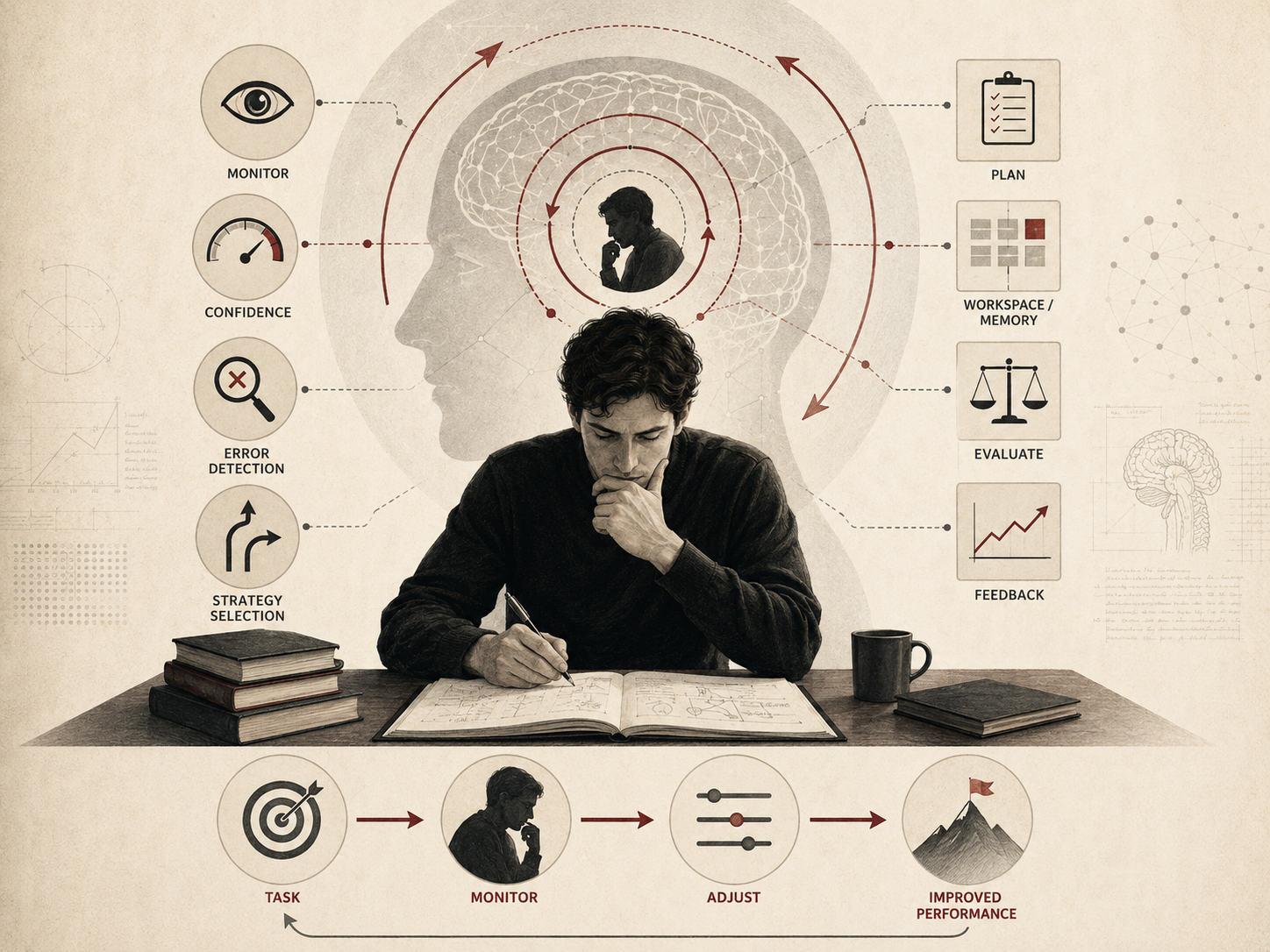
This distinction helps explain why two people with similar knowledge can perform very differently. One may persist with an ineffective strategy, fail to notice misunderstanding, or overestimate confidence. The other may monitor progress, detect confusion early, and change approach before error compounds. In this way, metacognition often helps determine whether cognitive resources are merely present or actually used well.
The structure of metacognition
Metacognition is commonly divided into two broad components: metacognitive knowledge and metacognitive regulation. These categories are useful because they separate what a person understands about cognition from what a person does to guide cognition while working.
- Metacognitive knowledge refers to awareness of one’s cognitive processes, strengths, limits, strategies, task demands, and learning conditions.
- Metacognitive regulation refers to the ability to plan, monitor, evaluate, and adjust cognition in response to difficulty, uncertainty, feedback, or changing goals.
Metacognitive knowledge includes knowing what one understands, where confusion remains, which strategies are useful for different kinds of tasks, and how one tends to perform under different conditions. A learner may know that rereading feels fluent but does not always produce durable recall. A researcher may know that a familiar explanation can become a source of confirmation bias. A decision maker may know that high confidence under time pressure is not the same as good evidence.
Metacognitive regulation includes planning, monitoring, checking, revising, and evaluating one’s cognitive activity as it unfolds. It is the practical side of metacognition: deciding to slow down, test understanding, seek feedback, change strategy, review weak material, or delay judgment until better evidence is available.
Flavell’s classic treatment helped establish metacognition as a major area of cognitive-developmental inquiry. Later work by Nelson and Narens gave the field an influential monitoring-control architecture: cognition can be monitored by a higher-level system, and the results of that monitoring can be used to control or regulate ongoing cognitive activity. This remains one of the clearest ways of understanding why metacognition is not only awareness, but adaptive self-regulation.
Metacognition therefore has both reflective and operational dimensions. It allows the mind to inspect itself, but also to intervene in itself.
Monitoring, control, and regulation
The monitoring-control distinction is central to metacognition. Monitoring refers to the assessment of one’s own cognitive state. Control refers to the regulatory action taken in response to that assessment.
Monitoring may include judgments such as:
- How confident am I?
- Do I understand this?
- How difficult is this task?
- Am I making progress?
- Is this strategy working?
- Is my answer based on evidence or familiarity?
- Should I keep going, pause, seek help, or change approach?
Control may include actions such as:
- reallocating attention;
- reviewing weak material;
- switching strategies;
- slowing down under uncertainty;
- checking an answer;
- seeking feedback;
- using external aids;
- abandoning a poor problem representation;
- withholding judgment until evidence improves.
The two processes are linked. Monitoring without control can produce awareness without improvement. Control without monitoring can produce effort without direction. Effective metacognition requires both: a reasonably accurate sense of what is happening cognitively and a capacity to adjust behavior based on that assessment.
This matters because many cognitive failures are not failures of knowledge alone. They are failures of regulation. A person may have enough knowledge to solve a problem but not notice that their current approach is failing. A learner may spend hours studying but not realize that the strategy is shallow. A decision maker may be highly confident but poorly calibrated. A team may collect more data while failing to question the frame that makes the data misleading.
Metacognition gives cognition a feedback loop. It makes thinking more adjustable.
Confidence, calibration, and uncertainty
One of the most important topics in metacognition is calibration: the relationship between subjective confidence and objective performance. A person is well calibrated when confidence tracks accuracy. A person is poorly calibrated when confidence and performance diverge.
Poor calibration can take several forms:
- Overconfidence, where confidence exceeds actual accuracy.
- Underconfidence, where confidence is lower than actual performance.
- Misplaced certainty, where confidence remains high despite weak evidence.
- Unproductive uncertainty, where uncertainty remains high even when evidence is strong enough to act.
- Familiarity illusion, where material feels known because it is familiar, even when recall or transfer would fail.
Calibration is important because confidence influences control. When people are overconfident, they may stop studying too early, fail to check assumptions, ignore contrary evidence, or make premature decisions. When people are underconfident, they may over-study, hesitate unnecessarily, defer to others too quickly, or fail to act despite adequate knowledge.
Uncertainty is not always a weakness. In many cases, uncertainty is a sign of good monitoring. A person who detects uncertainty can slow down, seek evidence, review material, ask for help, or switch strategy. The problem is not uncertainty itself. The problem is being uncertain without knowing why, or being certain when uncertainty is warranted.
Metacognitive maturity therefore does not mean always being confident. It means learning how to interpret confidence and uncertainty as information about the state of one’s own cognition.
Metacognition and learning
Metacognition plays a central role in learning because effective learners do more than absorb information. They monitor understanding, notice when recall is weak, evaluate whether a study strategy is working, and adjust their approach over time.
When studying difficult material, learners often need to ask themselves questions such as:
- Do I actually understand this concept?
- Can I explain it without looking?
- Can I apply it to a new case?
- Am I confusing recognition with mastery?
- Which parts remain unstable?
- What strategy would help me learn this better?
- What feedback have I received, and how should it change my next step?
These reflective processes matter because learning is not only about exposure. It is also about calibration. Learners must estimate what has been grasped, what remains fragile, and what kind of effort is still needed. A student who rereads a chapter may feel fluent because the material looks familiar, but that familiarity may not survive a closed-book explanation or transfer task. A better metacognitive strategy would test recall, compare answers with feedback, and focus effort where retrieval fails.
Metacognition also supports self-regulated learning. A self-regulated learner plans, monitors, evaluates, and revises. They choose strategies based on task demands rather than habit alone. They can distinguish easy exposure from durable learning. They can use feedback without treating it as a personal threat.
This connection is developed further in cognitive learning, where knowledge acquisition, retrieval, transfer, and integration are examined in greater depth.
Formalizing metacognition: monitoring, control, and updating
Metacognition can be expressed formally as a relation between first-order cognition and higher-order evaluation. Let \(C_t\) represent a cognitive state at time \(t\), such as an estimate, memory trace, comprehension state, or reasoning path. A metacognitive monitoring function can be written as:
M_t = g(C_t)
\]
Interpretation: A monitoring process \(g\) produces a metacognitive judgment \(M_t\) about the current cognitive state \(C_t\), such as confidence, uncertainty, perceived comprehension, or difficulty.
Control can then be represented as a policy that uses the monitoring state to alter ongoing processing:
C_{t+1} = f(C_t, M_t, S_t)
\]
Interpretation: The next cognitive state depends on the current state \(C_t\), the monitoring judgment \(M_t\), and a strategy or regulatory action \(S_t\), such as reviewing, slowing down, switching methods, or reallocating attention.
Calibration can be described by the gap between judged performance and actual performance:
\epsilon = |J – P|
\]
Interpretation: Calibration error \(\epsilon\) is the absolute difference between a judgment \(J\), such as confidence or predicted performance, and actual performance \(P\).
Signed calibration distinguishes overconfidence from underconfidence:
\delta = J – P
\]
Interpretation: Positive values of \(\delta\) indicate overconfidence, while negative values indicate underconfidence.
A simple model of strategy shifting can use uncertainty, difficulty, confidence, and feedback:
Pr(S_t = 1)=\frac{1}{1+e^{-(\beta_0+\beta_1U_t+\beta_2D_t-\beta_3J_t+\beta_4F_t)}}
\]
Interpretation: The probability of a strategy shift increases with uncertainty \(U_t\), task difficulty \(D_t\), and feedback \(F_t\), and may decrease when confidence \(J_t\) remains high.
These formalizations are useful because they make metacognition measurable. They allow researchers to study not only whether people succeed, but whether they understand the quality of their own performance and regulate cognition accordingly.
Metacognition and problem solving
Metacognition is deeply involved in problem solving because effective problem solvers do not merely execute strategies. They also monitor whether those strategies are working. They notice when they are stuck, recognize when an approach is unproductive, and shift methods when necessary.
This self-monitoring function is especially important in complex problems where success depends on intermediate correction rather than a single immediate insight. People who regulate their reasoning more effectively are often better able to detect dead ends, revise assumptions, and explore alternatives.
Metacognition helps problem solvers ask:
- Is my representation of the problem accurate?
- Am I solving the actual problem or a simplified substitute?
- What evidence tells me this strategy is working?
- Am I repeating a familiar method because it is useful or because it is comfortable?
- Have I reached an impasse?
- Should I decompose the problem, use an analogy, seek feedback, or reframe the task?
These questions connect metacognition closely to mental models. A major part of problem solving involves checking whether one’s representation of the problem is adequate in the first place. A person can work intensely inside the wrong model. Metacognition is one of the systems that can reveal when the model itself needs revision.
Good problem solving therefore requires flexible persistence. Persistence matters when the approach is sound. Flexibility matters when the approach is wrong. Metacognition helps decide which is which.
Metacognition and decision making
Metacognitive processes also influence decision making by allowing individuals to reflect on the quality of their own judgments. Under conditions of uncertainty, it is not enough to make an estimate or choose an option. One must often also judge how reliable that estimate is, how much uncertainty remains, and whether more evidence is needed before acting.
This is where metacognition becomes especially important. It can help identify overconfidence, weak justification, rushed reasoning, or misplaced certainty. It can also help determine whether deliberation should continue or whether a decision is good enough to make now.
Metacognition supports decision making by helping people ask:
- How strong is the evidence?
- How uncertain am I?
- What assumptions am I relying on?
- Do I know enough to decide?
- Am I being influenced by familiarity, status, urgency, fear, or institutional pressure?
- Would I change my mind if new evidence appeared?
- Am I confident because the case is strong or because the story is coherent?
These processes connect directly to cognitive biases, since better metacognitive monitoring can sometimes reduce the impact of systematic judgment error, even if it cannot eliminate it entirely. A person may still be vulnerable to confirmation bias, anchoring, availability, or motivated reasoning, but metacognition can create points of interruption: moments where the person asks whether the judgment is as justified as it feels.
In institutional settings, metacognition also supports decision accountability. Decision makers need not only conclusions, but calibrated awareness of uncertainty, evidence quality, and possible error.
Metacognition and cognitive control
Metacognition is closely related to cognitive control. Cognitive control helps regulate attention, manage working memory, inhibit irrelevant information, resolve conflict, and maintain task goals. Metacognition helps decide when and how such control should be deployed.
For example, when faced with a demanding task, individuals may need to allocate attention selectively, suppress distraction, slow down reasoning, review a premise, or revise a working strategy. These are control operations, but they are often triggered or guided by metacognitive judgments about difficulty, uncertainty, progress, or error.
This relationship highlights why metacognition is not merely reflective. It is operational. It influences how limited cognitive resources are managed under demanding conditions.
When metacognition is weak, cognitive control may be misallocated. A person may focus on easy parts while avoiding difficult ones, spend too much time on material already known, or ignore signals that a task requires more careful processing. When metacognition is stronger, control becomes more adaptive: attention and effort are directed where they are most needed.
Metacognition therefore helps turn effort into intelligent effort. It does not simply increase cognitive work; it guides where that work should go.
Metacognition and expertise
Metacognition is one of the distinguishing features of expertise. Experts often possess not only more knowledge, but also better awareness of how to use that knowledge, when to question it, and when to revise their approach. They monitor their own performance more effectively, evaluate the fit between strategy and task, and make more nuanced adjustments in response to feedback.
This does not mean experts are free of error. In some contexts, expertise can increase risk when familiar patterns produce premature closure. Experts can become overconfident, ignore anomalies, or apply a known solution to a structurally different problem. Metacognition is therefore necessary even for expertise. It helps experts decide when automatic recognition is reliable and when reflective analysis is needed.
Expert metacognition often includes:
- knowing when a case is routine and when it is not;
- detecting anomalies that do not fit the expected pattern;
- knowing which strategies fit which problems;
- recognizing limits of one’s own knowledge;
- seeking feedback without treating it as threat;
- distinguishing confidence from evidence;
- revising assumptions when the task structure changes.
This relationship is explored further in skill acquisition and expertise development, where high-level performance is treated as the product of structured refinement rather than simple repetition alone.
Expertise without metacognition can become rigidity. Expertise with metacognition becomes adaptive judgment.
Metacognition, institutions, and accountability
Metacognition is often discussed as an individual capacity, but it is also shaped by environments. People monitor and regulate cognition more effectively when institutions provide useful feedback, psychological safety, time for reflection, transparent standards, and opportunities to revise. They do so less effectively when environments punish uncertainty, reward overconfidence, overload attention, or treat error as shame rather than information.
This matters in schools, workplaces, science, medicine, law, public administration, and technology design. A learner may struggle not because they lack metacognitive capacity, but because the learning environment gives poor feedback. A worker may fail to question assumptions because the organization rewards speed and certainty. A team may make poor decisions because dissent is discouraged. A system may produce overconfidence because metrics make performance look cleaner than it is.
Institutional metacognition means building systems that can ask reflective questions about their own knowledge, evidence, assumptions, and performance. Such systems make uncertainty visible, preserve dissent, encourage review, and treat feedback as part of learning.
This is especially important for marginalized groups and unequal institutions. People who are not heard, believed, or given access to feedback may be blamed for outcomes that reflect institutional design. A serious account of metacognition should therefore avoid reducing self-regulation to individual willpower alone. Monitoring and control are cognitive processes, but they are supported or undermined by social conditions.
Metacognition becomes ethically important when it helps individuals and institutions ask not only “Are we right?” but “How would we know if we were wrong?”
Metacognition and artificial intelligence systems
Metacognition is increasingly relevant to artificial intelligence because AI systems often generate outputs that users must evaluate under uncertainty. Human users need to judge whether an output is accurate, whether evidence is sufficient, whether provenance is clear, and whether confidence is warranted.
AI systems can support metacognition when they expose uncertainty, show sources, invite verification, distinguish evidence from speculation, and help users compare alternatives. They can undermine metacognition when they produce fluent but unsupported answers, hide uncertainty, encourage overreliance, or make weak evidence look authoritative.
Human-AI interaction therefore requires calibrated metacognition. Users must ask:
- Do I understand why this output was produced?
- What evidence supports it?
- What uncertainty remains?
- Am I deferring to fluency instead of evaluating substance?
- What would I need to verify before acting?
- Does this system make my judgment better calibrated or merely faster?
Metacognition also helps frame AI governance. A responsible system should not only produce answers. It should support users in monitoring the quality, uncertainty, limits, and consequences of those answers. In this sense, metacognition is not only a human skill but a design principle for decision-support systems.
For cognitive psychology, AI creates a new applied domain for metacognition research: how humans monitor their own thinking when assisted by systems that can sound confident, persuasive, and incomplete at the same time.
Metacognition in contemporary research
Contemporary research on metacognition spans cognitive psychology, educational psychology, philosophy of mind, neuroscience, decision science, human factors, artificial intelligence, and learning sciences. Flavell’s original framing remains foundational, while the Nelson–Narens model continues to shape work on metamemory, monitoring, and control.
Current work studies metacognitive training in education, confidence judgments in perceptual and memory tasks, judgments of learning, feeling-of-knowing judgments, self-monitoring in reasoning, uncertainty monitoring, restudy choice, study-time allocation, and the relationship between confidence, accuracy, and response time.
Educational research continues to emphasize that metacognitive strategies can support student learning when students are taught how to plan, monitor, evaluate, and adjust their learning. This matters because many learners do not spontaneously use effective monitoring strategies. They may rely on familiarity, rereading, or passive exposure rather than retrieval, explanation, feedback, and targeted review.
Philosophically, metacognition touches questions of self-awareness, introspection, mental agency, and higher-order cognition. It asks how minds become aware of their own states, how reliable that awareness is, and how reflective awareness can guide action.
Across these fields, metacognition remains important because it links cognition to self-correction. It is not only about knowing. It is about knowing how well one knows, and knowing what to do when one does not know enough.
R code for metacognition data
The following R workflow illustrates analyses relevant to metacognition research, including calibration, confidence judgments, monitoring accuracy, strategy adjustment, review choice, feedback use, response time, and metacognitive regulation across tasks.
# Install packages if needed:
# pak::pak(c("tidyverse", "lme4", "lmerTest", "emmeans", "broom.mixed"))

library(tidyverse)
library(lme4)
library(lmerTest)
library(emmeans)
library(broom.mixed)

# Expected columns:
# participant, condition, task_id, domain,
# task_difficulty, evidence_quality, confidence_rating,
# uncertainty_rating, actual_accuracy, judgment_of_learning,
# feeling_of_knowing, strategy_shift, review_choice,
# feedback_used, study_time_seconds, response_time_ms,
# metacognitive_regulation_score

dat <- read_csv("metacognition_trials.csv") %>%
  mutate(
    participant = factor(participant),
    condition = factor(condition),
    task_id = factor(task_id),
    domain = factor(domain),
    actual_accuracy = as.integer(actual_accuracy),
    strategy_shift = as.integer(strategy_shift),
    review_choice = as.integer(review_choice),
    feedback_used = as.integer(feedback_used),
    calibration_error = abs(confidence_rating - actual_accuracy),
    signed_calibration = confidence_rating - actual_accuracy,
    log_response_time = log(response_time_ms)
  )

# -----------------------------
# 1. Descriptive profile
# -----------------------------

condition_summary <- dat %>%
  group_by(condition) %>%
  summarise(
    n_trials = n(),
    participants = n_distinct(participant),
    mean_difficulty = mean(task_difficulty, na.rm = TRUE),
    mean_evidence_quality = mean(evidence_quality, na.rm = TRUE),
    mean_confidence = mean(confidence_rating, na.rm = TRUE),
    mean_uncertainty = mean(uncertainty_rating, na.rm = TRUE),
    accuracy_rate = mean(actual_accuracy, na.rm = TRUE),
    mean_calibration_error = mean(calibration_error, na.rm = TRUE),
    mean_signed_calibration = mean(signed_calibration, na.rm = TRUE),
    strategy_shift_rate = mean(strategy_shift, na.rm = TRUE),
    review_choice_rate = mean(review_choice, na.rm = TRUE),
    feedback_use_rate = mean(feedback_used, na.rm = TRUE),
    mean_study_time_seconds = mean(study_time_seconds, na.rm = TRUE),
    mean_response_time_ms = mean(response_time_ms, na.rm = TRUE),
    mean_regulation_score = mean(metacognitive_regulation_score, na.rm = TRUE),
    .groups = "drop"
  )

print(condition_summary)

# -----------------------------
# 2. Calibration-error model
# -----------------------------

calibration_model <- lmer(
  calibration_error ~
    condition +
    domain +
    task_difficulty +
    evidence_quality +
    uncertainty_rating +
    judgment_of_learning +
    feedback_used +
    (1 | participant) +
    (1 | task_id),
  data = dat,
  REML = FALSE
)

summary(calibration_model)
emmeans(calibration_model, ~ condition)

# -----------------------------
# 3. Signed-calibration model
# -----------------------------

signed_model <- lmer(
  signed_calibration ~
    condition +
    domain +
    task_difficulty +
    evidence_quality +
    actual_accuracy +
    uncertainty_rating +
    (1 | participant) +
    (1 | task_id),
  data = dat,
  REML = FALSE
)

summary(signed_model)

# -----------------------------
# 4. Strategy-shift model
# -----------------------------

shift_model <- glmer(
  strategy_shift ~
    condition +
    domain +
    confidence_rating +
    uncertainty_rating +
    actual_accuracy +
    task_difficulty +
    evidence_quality +
    feedback_used +
    (1 | participant) +
    (1 | task_id),
  data = dat,
  family = binomial(),
  control = glmerControl(optimizer = "bobyqa")
)

summary(shift_model)
emmeans(shift_model, ~ condition, type = "response")

# -----------------------------
# 5. Review-choice model
# -----------------------------

review_model <- glmer(
  review_choice ~
    condition +
    domain +
    calibration_error +
    uncertainty_rating +
    task_difficulty +
    confidence_rating +
    feedback_used +
    (1 | participant) +
    (1 | task_id),
  data = dat,
  family = binomial(),
  control = glmerControl(optimizer = "bobyqa")
)

summary(review_model)
emmeans(review_model, ~ condition, type = "response")

# -----------------------------
# 6. Regulation-quality model
# -----------------------------

regulation_model <- lmer(
  metacognitive_regulation_score ~
    condition +
    domain +
    calibration_error +
    strategy_shift +
    review_choice +
    feedback_used +
    task_difficulty +
    evidence_quality +
    (1 | participant) +
    (1 | task_id),
  data = dat,
  REML = FALSE
)

summary(regulation_model)

# -----------------------------
# 7. Response-time model
# -----------------------------

rt_model <- lmer(
  log_response_time ~
    condition +
    domain +
    task_difficulty +
    confidence_rating +
    uncertainty_rating +
    strategy_shift +
    actual_accuracy +
    (1 | participant) +
    (1 | task_id),
  data = dat,
  REML = FALSE
)

summary(rt_model)

# -----------------------------
# 8. Visualization
# -----------------------------

ggplot(dat, aes(x = confidence_rating, y = actual_accuracy, color = condition)) +
  geom_point(alpha = 0.25, position = position_jitter(width = 0.01, height = 0.03)) +
  geom_abline(slope = 1, intercept = 0, linetype = "dashed") +
  labs(
    title = "Metacognitive calibration",
    x = "Confidence rating",
    y = "Actual accuracy"
  ) +
  theme_minimal()
This workflow can be adapted for confidence-accuracy studies, judgment-of-learning experiments, feeling-of-knowing studies, strategy-shift experiments, self-regulated learning research, study-time allocation analysis, decision-support studies, and human-AI calibration research. Researchers should model participant and task effects whenever possible because monitoring and control vary strongly across people, items, domains, and feedback conditions.
Python code for metacognition data
The Python examples below parallel the R workflow and are useful for calibration studies, confidence judgments, monitoring-control experiments, strategy-shift analysis, review choice, feedback-use modeling, and response-time analysis.
import numpy as np
import pandas as pd
import statsmodels.formula.api as smf
import statsmodels.api as sm
import matplotlib.pyplot as plt

# Expected columns:
# participant, condition, task_id, domain,
# task_difficulty, evidence_quality, confidence_rating,
# uncertainty_rating, actual_accuracy, judgment_of_learning,
# feeling_of_knowing, strategy_shift, review_choice,
# feedback_used, study_time_seconds, response_time_ms,
# metacognitive_regulation_score

df = pd.read_csv("metacognition_trials.csv")

categorical_cols = ["participant", "condition", "task_id", "domain"]
for col in categorical_cols:
    df[col] = df[col].astype("category")

binary_cols = ["actual_accuracy", "strategy_shift", "review_choice", "feedback_used"]
for col in binary_cols:
    df[col] = df[col].astype(int)

df["calibration_error"] = np.abs(df["confidence_rating"] - df["actual_accuracy"])
df["signed_calibration"] = df["confidence_rating"] - df["actual_accuracy"]
df["log_response_time"] = np.log(df["response_time_ms"])

# -----------------------------
# 1. Descriptive profile
# -----------------------------

condition_summary = (
    df.groupby("condition")
    .agg(
        n_trials=("actual_accuracy", "size"),
        participants=("participant", "nunique"),
        mean_difficulty=("task_difficulty", "mean"),
        mean_evidence_quality=("evidence_quality", "mean"),
        mean_confidence=("confidence_rating", "mean"),
        mean_uncertainty=("uncertainty_rating", "mean"),
        accuracy_rate=("actual_accuracy", "mean"),
        mean_calibration_error=("calibration_error", "mean"),
        mean_signed_calibration=("signed_calibration", "mean"),
        strategy_shift_rate=("strategy_shift", "mean"),
        review_choice_rate=("review_choice", "mean"),
        feedback_use_rate=("feedback_used", "mean"),
        mean_study_time_seconds=("study_time_seconds", "mean"),
        mean_response_time_ms=("response_time_ms", "mean"),
        mean_regulation_score=("metacognitive_regulation_score", "mean"),
    )
    .reset_index()
)

print(condition_summary)

# -----------------------------
# 2. Calibration-error model
# -----------------------------

calibration_model = smf.ols(
    "calibration_error ~ condition + domain + task_difficulty "
    "+ evidence_quality + uncertainty_rating + judgment_of_learning "
    "+ feedback_used",
    data=df,
)

calibration_result = calibration_model.fit(
    cov_type="cluster",
    cov_kwds={"groups": df["participant"]},
)

print(calibration_result.summary())

# -----------------------------
# 3. Signed-calibration model
# -----------------------------

signed_model = smf.ols(
    "signed_calibration ~ condition + domain + task_difficulty "
    "+ evidence_quality + actual_accuracy + uncertainty_rating",
    data=df,
)

signed_result = signed_model.fit(
    cov_type="cluster",
    cov_kwds={"groups": df["participant"]},
)

print(signed_result.summary())

# -----------------------------
# 4. Strategy-shift model
# -----------------------------

shift_model = smf.glm(
    "strategy_shift ~ condition + domain + confidence_rating "
    "+ uncertainty_rating + actual_accuracy + task_difficulty "
    "+ evidence_quality + feedback_used",
    data=df,
    family=sm.families.Binomial(),
)

shift_result = shift_model.fit(
    cov_type="cluster",
    cov_kwds={"groups": df["participant"]},
)

print(shift_result.summary())

# -----------------------------
# 5. Review-choice model
# -----------------------------

review_model = smf.glm(
    "review_choice ~ condition + domain + calibration_error "
    "+ uncertainty_rating + task_difficulty + confidence_rating "
    "+ feedback_used",
    data=df,
    family=sm.families.Binomial(),
)

review_result = review_model.fit(
    cov_type="cluster",
    cov_kwds={"groups": df["participant"]},
)

print(review_result.summary())

# -----------------------------
# 6. Regulation-quality model
# -----------------------------

regulation_model = smf.ols(
    "metacognitive_regulation_score ~ condition + domain "
    "+ calibration_error + strategy_shift + review_choice + feedback_used "
    "+ task_difficulty + evidence_quality",
    data=df,
)

regulation_result = regulation_model.fit(
    cov_type="cluster",
    cov_kwds={"groups": df["participant"]},
)

print(regulation_result.summary())

# -----------------------------
# 7. Response-time model
# -----------------------------

rt_model = smf.ols(
    "log_response_time ~ condition + domain + task_difficulty "
    "+ confidence_rating + uncertainty_rating + strategy_shift "
    "+ actual_accuracy",
    data=df,
)

rt_result = rt_model.fit(
    cov_type="cluster",
    cov_kwds={"groups": df["participant"]},
)

print(rt_result.summary())

# -----------------------------
# 8. Visualization
# -----------------------------

fig, ax = plt.subplots(figsize=(8, 5))

for condition, group in df.groupby("condition"):
    jitter = np.random.normal(0, 0.015, size=len(group))
    ax.scatter(
        group["confidence_rating"],
        group["actual_accuracy"] + jitter,
        alpha=0.35,
        label=str(condition),
    )

ax.plot([0, 1], [0, 1], linestyle="--")
ax.set_xlabel("Confidence rating")
ax.set_ylabel("Actual accuracy")
ax.set_title("Metacognitive calibration")
ax.legend(title="Condition")
plt.tight_layout()
plt.show()
The Python workflow is intentionally transparent and extensible. It can be expanded with hierarchical Bayesian calibration models, signal-detection measures of metacognitive sensitivity, drift-diffusion models, study-time allocation models, adaptive tutoring data, confidence-response curves, human-AI reliance studies, and dashboards for monitoring overconfidence or underconfidence across tasks.
GitHub Repository
The companion repository provides reusable code and research scaffolding for studying metacognition in cognitive psychology, including workflows for calibration, confidence, uncertainty, strategy shifting, review choice, feedback use, study-time allocation, response-time modeling, metacognitive regulation, and monitoring-control simulation.
Complete Code Repository
Access the full companion repository for this article, including reproducible analysis materials and multi-language code workflows for metacognition research.
Applications of metacognition research
Metacognition research matters across education, professional training, decision support, knowledge work, clinical practice, human factors, leadership, artificial intelligence, and institutional governance. It helps explain why some people study effectively while others misjudge what they know, why some problem solvers revise strategy at the right moment while others persist too long, and why confidence and competence do not always move together.
In education, metacognition supports self-regulated learning. Students benefit when they learn to plan, monitor, test understanding, use feedback, and adjust study strategies. In professional training, metacognition helps learners recognize when competence is developing and when more supervision, practice, or review is needed.
In decision support, metacognition helps people distinguish evidence from confidence. This is especially important in high-stakes settings such as medicine, law, engineering, finance, public policy, and organizational leadership, where misplaced certainty can produce serious consequences.
In human-AI systems, metacognition is essential for calibrated reliance. Users need to monitor not only their own thinking but also the quality, evidence, uncertainty, and limitations of AI-generated outputs. Good AI tools should support rather than weaken this reflective process.
These applications matter because better thinking is not only a matter of having more information. It is also a matter of monitoring, evaluating, and regulating how cognition is being used.
Conclusion
Metacognition is the mind’s capacity to monitor, evaluate, and regulate its own cognitive processes. It allows people to assess what they know, detect uncertainty, revise strategy, seek feedback, and use cognitive resources more effectively.
Cognitive psychology shows that metacognition is central to learning, problem solving, decision making, cognitive control, and expertise because it turns cognition into something more self-aware and self-corrective. Understanding metacognition therefore helps explain not only how people think, but how they learn to think better.
The central lesson is that cognition becomes more adaptive when it can monitor itself. Knowledge matters, but so does knowing the condition of one’s knowledge. Strategy matters, but so does recognizing when a strategy is failing. Confidence matters, but only when it is calibrated to evidence. Metacognition is the reflective architecture that makes those adjustments possible.
Related articles
- Cognitive Psychology
- Cognitive Learning Processes
- Memory in Cognitive Psychology
- Working Memory in Cognitive Psychology
- Problem Solving in Cognitive Psychology
- Decision Making in Cognitive Psychology
- Cognitive Biases in Decision Making
- Mental Models in Cognitive Psychology
- Skill Acquisition and Expertise Development
Further reading
- American Psychological Association (n.d.) Metacognition. APA Dictionary of Psychology. Available at: https://dictionary.apa.org/metacognition.
- Flavell, J.H. (1979) ‘Metacognition and cognitive monitoring: A new area of cognitive-developmental inquiry’, American Psychologist, 34(10), pp. 906–911. Record available at: https://eric.ed.gov/?id=EJ217109.
- Nelson, T.O. and Narens, L. (1990) ‘Metamemory: A theoretical framework and new findings’, in Bower, G.H. (ed.) The Psychology of Learning and Motivation, Vol. 26. San Diego, CA: Academic Press, pp. 125–173. Available at: https://sites.socsci.uci.edu/~lnarens/1990/Nelson%26Narens_Book_Chapter_1990.pdf.
- Stanton, J.D., Sebesta, A.J. and Dunlosky, J. (2021) ‘Fostering metacognition to support student learning and performance’, CBE—Life Sciences Education, 20(2), fe3. Available at: https://pmc.ncbi.nlm.nih.gov/articles/PMC8734377/.
- Proust, J. (2013) The Philosophy of Metacognition: Mental Agency and Self-Awareness. Oxford: Oxford University Press.
- TEAL Center (n.d.) Metacognitive Processes. LINCS, U.S. Department of Education. Available at: https://lincs.ed.gov/federal-initiatives/teal/guide/metacognitive.
References
- American Psychological Association (n.d.) Metacognition. APA Dictionary of Psychology. Available at: https://dictionary.apa.org/metacognition.
- Flavell, J.H. (1979) ‘Metacognition and cognitive monitoring: A new area of cognitive-developmental inquiry’, American Psychologist, 34(10), pp. 906–911. Record available at: https://eric.ed.gov/?id=EJ217109.
- Nelson, T.O. and Narens, L. (1990) ‘Metamemory: A theoretical framework and new findings’, in Bower, G.H. (ed.) The Psychology of Learning and Motivation, Vol. 26. San Diego, CA: Academic Press, pp. 125–173. Available at: https://sites.socsci.uci.edu/~lnarens/1990/Nelson%26Narens_Book_Chapter_1990.pdf.
- Proust, J. (2013) The Philosophy of Metacognition: Mental Agency and Self-Awareness. Oxford: Oxford University Press.
- Stanton, J.D., Sebesta, A.J. and Dunlosky, J. (2021) ‘Fostering metacognition to support student learning and performance’, CBE—Life Sciences Education, 20(2), fe3. Available at: https://pmc.ncbi.nlm.nih.gov/articles/PMC8734377/.
- TEAL Center (n.d.) Metacognitive Processes. LINCS, U.S. Department of Education. Available at: https://lincs.ed.gov/federal-initiatives/teal/guide/metacognitive.