
Last Updated May 25, 2026
Nudge theory examines how small, strategically designed changes in decision environments can influence behavior without formally removing options, prohibiting alternatives, or imposing direct mandates. In behavioral economics, a nudge is not simply any attempt to persuade. It is a particular kind of intervention that operates through choice architecture: defaults, reminders, framing, sequencing, salience, social information, simplified pathways, feedback, and other environmental cues that alter how decisions are encountered. The theory emerged from the recognition that human behavior is shaped not only by incentives and information, but also by inertia, limited attention, bounded rationality, loss aversion, present bias, administrative burden, social norms, and the structure of the environment itself.
Traditional policy models often assume that once people are given accurate information and well-calibrated incentives, they will act in accordance with their long-term interests. Behavioral economics challenged that assumption by showing that people frequently procrastinate, remain with defaults, misread risk, neglect important information, respond strongly to framing, and avoid actions that impose immediate hassle even when those actions produce future benefits. Nudge theory emerged as a practical policy response to that insight. Rather than relying solely on regulation, taxation, subsidy, prohibition, or information disclosure, it asks how public and institutional environments can be designed so that beneficial actions become easier, more visible, more timely, and more behaviorally natural.
Main Library
Publications
Article Map
Behavioral Economics
Related Topic
Decision Science
Related Topic
Institutions & Governance
Related Topic
Data Systems & Analytics
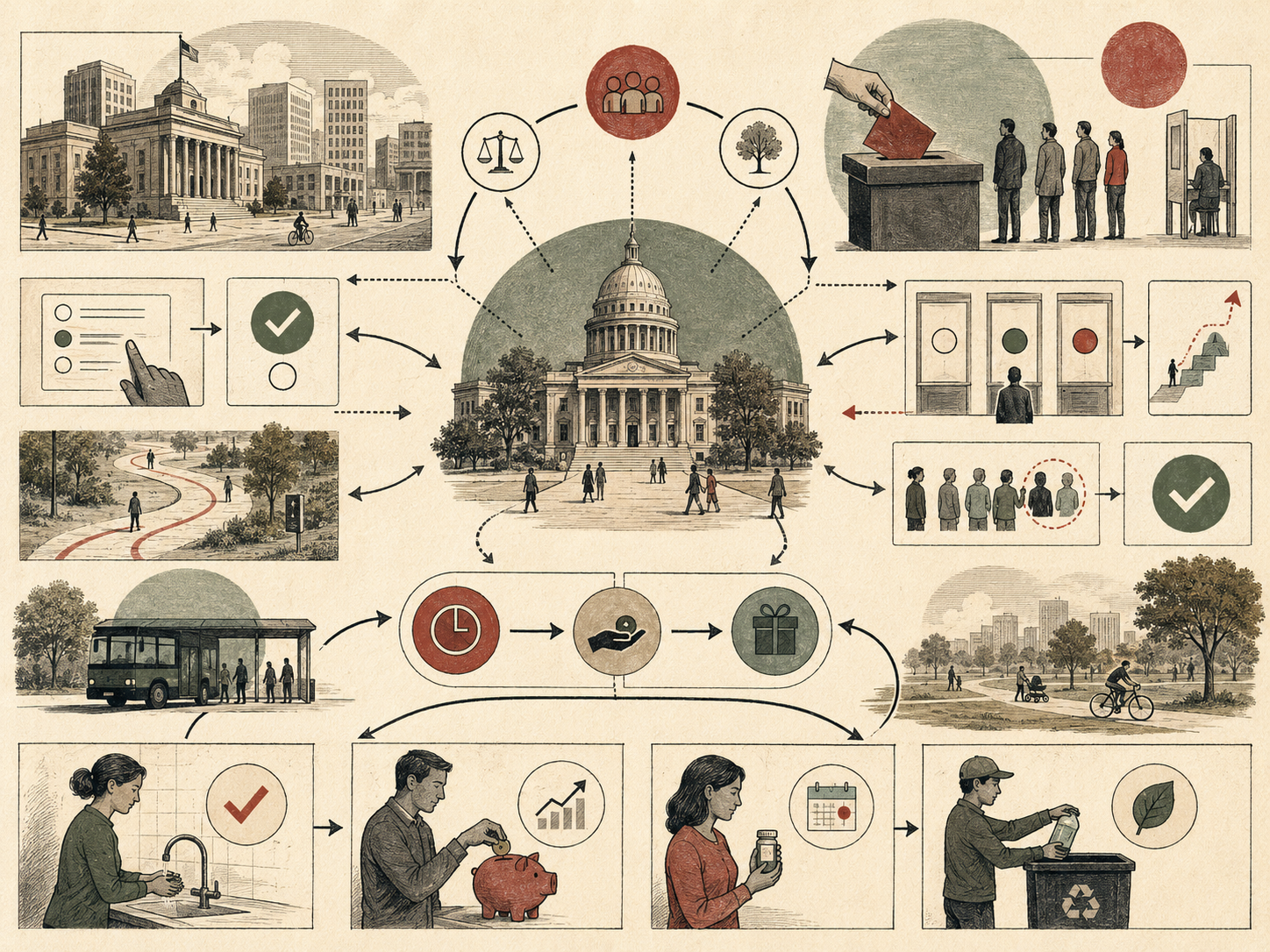
Properly understood, nudge theory is not a complete philosophy of governance. It is a targeted approach to policy design that addresses predictable cognitive, administrative, and behavioral frictions while preserving formal freedom of choice. Its importance lies both in what it can accomplish and in the debates it has generated about autonomy, paternalism, manipulation, public justification, institutional trust, regulatory legitimacy, and the legitimate boundaries of behavioral influence.
The strongest version of nudge theory is not a substitute for public investment, social protection, regulation, redistribution, enforcement, infrastructure, or democratic accountability. It is a way of improving the design of decision environments within broader governance systems. A reminder can help someone renew a benefit, but it cannot make an inadequate benefit sufficient. A default can increase enrollment, but it cannot solve wage insecurity. A green-energy default can support cleaner consumption, but it cannot replace decarbonized infrastructure. Nudges matter because implementation matters; they become dangerous when they are used to avoid the harder work of structural policy.
Origins of Nudge Theory
Nudge theory gained broad public visibility through Richard H. Thaler and Cass R. Sunstein’s Nudge, first published in 2008 and later updated in a refreshed 2021 edition. The book drew together several strands of behavioral research: bounded rationality, heuristics and biases, default effects, status quo bias, framing, self-control problems, loss aversion, mental accounting, social influence, and the broader claim that human beings do not behave like frictionless optimizers.
The practical force of the theory lies in a simple observation: even when people are well intentioned, they often fail to act on their own long-run preferences because decisions occur under conditions of inattention, inertia, complexity, short-run pressure, emotional framing, social influence, and competing demands. People may intend to save more, fill out a form, attend a health appointment, reduce energy use, renew a public benefit, compare financial products, or choose a safer option, yet fail to do so because the immediate environment makes action hard, delayed, confusing, or easy to postpone.
Nudge theory redirected policy attention away from the belief that more information alone would necessarily improve outcomes. Information matters, but information must be salient, timely, usable, trusted, and connected to a feasible action. A long disclosure that few people read is not the same as meaningful understanding. A benefit that technically exists but is buried under administrative burden is not the same as real access. A rational incentive that is weakly visible at the moment of decision may have less behavioral force than a well-timed prompt or a preselected default.
This makes nudge theory closely related to Choice Architecture and Decision Environments, which provides the broader conceptual framework within which nudges operate, and to core behavioral themes such as Bounded Rationality in Economic Decision-Making, Heuristics and Biases in Economic Decision-Making, Loss Aversion and Risk Perception, and Framing Effects in Consumer Choice.
The historical importance of nudge theory is that it brought behavioral economics into public policy in an operationally usable form. It did not merely describe cognitive bias. It asked how institutions might redesign practical decision environments in response. That shift helped open the door to behavioral insights teams, policy trials, simplified administrative design, tax-compliance experiments, benefit-enrollment redesign, public-health reminders, energy-conservation feedback, and the broader field of behaviorally informed governance.
Yet the origins of nudge theory also contain its central tension. If institutions can improve outcomes by shaping decision environments, they can also manipulate behavior by shaping those environments invisibly. The same insight that makes nudges useful makes them ethically serious. From the beginning, nudge theory has therefore been both a practical policy method and a debate about power.
Choice Architecture and the Structure of Decision Environments
Choice architecture refers to the structure in which options are presented, compared, and acted upon. Every menu, form, webpage, disclosure, public notice, application portal, benefits process, institutional rule, digital interface, checkout screen, search result, or administrative pathway creates some architecture of choice. The question is never whether choice architecture exists; it always does. The question is how it is designed and whether that design makes decisions clearer, more difficult, more manipulative, or more supportive of user welfare.
Common nudges include default settings, reminders, simplified information presentation, social-norm feedback, prompts, warnings, implementation-intention cues, sequencing changes, framing adjustments, and friction reduction. These mechanisms do not necessarily alter the formal set of available options. Instead, they alter how those options are encountered cognitively and behaviorally. A default makes inaction consequential. A reminder makes a future obligation salient now. A social comparison makes private behavior visible in relation to a perceived norm. A simplified form reduces the cost of acting. A well-designed prompt connects intention to action at the moment when action is possible.
This is why nudge theory is often misunderstood when treated as a synonym for paternalistic steering in general. More precisely, a nudge is a targeted intervention within a broader environment of choice architecture. It works by recognizing that the environment already shapes behavior and by asking whether that environment can be intentionally designed to improve outcomes while leaving formal choice intact.
The architecture of choice matters because people make decisions under bounded rationality. They simplify, defer, use heuristics, respond to cues, avoid effort, trust institutional defaults, infer popularity from social signals, and overweight immediate costs relative to future benefits. A well-designed architecture can reduce unnecessary burden and help people act on considered goals. A poorly designed architecture can magnify confusion, exclusion, and error. A manipulative architecture can exploit the same cognitive tendencies for institutional gain.
Choice architecture therefore gives nudge theory both its power and its limits. Nudges are powerful because small design changes can affect behavior at scale. They are limited because design changes cannot solve every problem and because the same mechanisms can serve very different ethical purposes. A default retirement contribution and a hard-to-cancel subscription both exploit inertia, but they are not morally equivalent. A renewal reminder and a deceptive urgency cue both use salience, but they serve different interests. The architecture must be evaluated by purpose, transparency, welfare, reversibility, and distributional effect.
For economists, choice architecture also complicates revealed preference. A person who accepts a default may prefer it, trust it, ignore the choice, or avoid the cost of switching. A person who fails to claim a benefit may not reject the benefit; they may be blocked by complexity, stigma, time scarcity, language barriers, or distrust. Observed behavior must therefore be interpreted in relation to the environment that produced it.
Nudges, Incentives, and Regulation
Nudges differ from both traditional regulation and price-based incentives. A regulation changes the legal structure of permissible behavior. A tax, subsidy, fee, rebate, or financial incentive changes the material cost-benefit structure of action. A nudge, by contrast, changes the context in which the decision is made while preserving the formal menu of options and without imposing a large material incentive.
This distinction matters because nudges are often rhetorically attractive precisely because they seem less coercive than mandates and less expensive than subsidies. But that attractiveness can become misleading. Some public problems require enforceable standards, fiscal capacity, infrastructure, redistribution, or direct regulation. Pollution, unsafe products, labor exploitation, discrimination, fraud, predatory finance, data extraction, and structural poverty cannot be solved by reminders and defaults alone. Nudges are most useful when behavior is being distorted by predictable cognitive frictions, weak salience, procrastination, confusion, administrative complexity, or mismatch between intention and action.
In economic terms, nudges often operate by changing nonprice costs. A simplified form reduces cognitive and administrative cost. A reminder reduces forgetting cost. A default reduces active-choice cost. A social-norm message changes perceived social payoff. A timely prompt reduces the gap between intention and execution. These effects are real even though they do not appear as conventional prices. A complete public-economics analysis should therefore treat attention, friction, comprehension, hassle, and timing as part of the effective policy environment.
Nudges also differ from disclosure. Disclosure assumes that information can be provided and that users will process it. A nudge assumes that information processing is itself limited and context-dependent. A simple disclosure may be a nudge if it makes an important risk salient at the moment of choice. But a dense disclosure that no one reads may satisfy formal legal requirements while failing behaviorally. Nudge theory therefore places attention on usable information, not merely available information.
The relationship between nudges and regulation should be complementary rather than substitutive. Regulation can establish rights, duties, protections, and accountability. Incentives can change material payoffs. Nudges can improve the way people encounter those rules and incentives. A strong public policy may use all three: a legal entitlement, a financial benefit, and a simplified automatic enrollment process. A weak policy may use nudges as a cosmetic substitute for material support. The difference is politically and ethically important.
Nudge theory is therefore best understood as one instrument within behaviorally informed governance. It should be used where the problem is partly architectural: inattention, inertia, complexity, delay, administrative burden, or weak salience. It should not be used to make inadequate policy appear sophisticated or to shift responsibility from institutions onto individuals.
Nudge Theory as Behavioral Public Economics
Nudge theory belongs within behavioral public economics because it concerns how public institutions can improve welfare under realistic assumptions about human decision-making. Public economics traditionally studies externalities, public goods, redistribution, taxation, market failures, information asymmetry, social insurance, and welfare. Behavioral public economics adds that policies operate through decision-makers whose attention, foresight, trust, comprehension, and administrative capacity are limited.
This changes how policy effectiveness should be evaluated. A program cannot be judged only by formal eligibility or statutory generosity. It must also be evaluated by whether people can find it, understand it, apply for it, renew it, and use it without disproportionate burden. A tax incentive cannot be evaluated only by its theoretical value. It must be evaluated by salience, timing, liquidity, and administrative accessibility. A regulatory disclosure cannot be evaluated only by the fact that information exists. It must be evaluated by comprehension and actionability.
From this perspective, nudges are not merely psychological tricks. They are institutional design choices that change the effective cost of action. A reminder lowers forgetting cost. A pre-filled form lowers compliance cost. An automatic enrollment default lowers initiation cost. A social-norm report changes perceived cooperation. A simplified comparison table lowers cognitive cost. These are economic variables because they affect behavior, welfare, distribution, and policy performance.
Behavioral public economics also forces a distinction between behavior and welfare. A nudge may increase take-up, but take-up is not automatically welfare. A default may increase enrollment, but the default could be poorly chosen. A reminder may increase compliance, but the obligation may be unjust or overly burdensome. A digital prompt may increase consent, but consent may not be informed. The welfare question is whether the intervention improves people’s ability to act on their own considered interests or legitimate public purposes without hidden coercion, manipulation, or unfair burden.
Economist-facing analysis should therefore ask several questions. What is the behavioral friction? What is the policy objective? What is the counterfactual environment? What outcome is being measured? Is the outcome welfare-enhancing? Who benefits? Who bears the burden? Is opt-out meaningful? Are distributional effects estimated? Are there spillovers or unintended consequences? These questions turn nudge theory from a policy slogan into a serious object of empirical and ethical evaluation.
In its strongest form, nudge theory helps public economics become more realistic. It recognizes that the path from policy to outcome runs through forms, interfaces, reminders, defaults, deadlines, trust, social expectations, and administrative systems. Those features are not minor details. They are often where policy succeeds or fails.
Applications in Public Policy
Nudges have been used across a wide range of policy settings, including retirement savings, tax compliance, energy conservation, health behavior, vaccination reminders, benefit enrollment, public-service participation, court appearances, consumer disclosure, organ-donation debates, and environmental behavior. Governments in many countries have established behavioral-insights teams or integrated behavioral methods into policy experimentation, often using field trials and randomized evaluations to test whether changes in wording, defaults, reminders, or comparison feedback alter outcomes in practice.
Retirement savings is one of the canonical domains. Automatic enrollment and default contribution rates can substantially alter participation because many employees who intend to save may postpone active enrollment. A default changes the behavioral baseline: saving becomes the path of least resistance while opting out remains available. In a well-designed system, this can help people overcome inertia and act in line with long-term financial goals.
Tax compliance provides another major application. Reminder letters, simplified notices, social-norm messages, pre-populated forms, and easier payment pathways can increase timely filing or payment among people who intend to comply but face confusion or delay. These interventions do not replace enforcement against deliberate evasion. They help distinguish between strategic noncompliance and administrative friction.
Public health offers examples such as appointment reminders, vaccination prompts, default scheduling, simplified instructions, and planning prompts that help people translate intention into action. In these settings, nudges are often useful because the benefits of action may be delayed while the costs of acting are immediate. A prompt that arrives at the right moment can reduce the friction between intention and behavior.
Benefit enrollment and public administration are especially important because many people fail to receive benefits for which they are eligible. Nudges such as simplified forms, automatic enrollment, reminders, plain-language notices, and pre-filled applications can improve access. But these interventions also reveal the limits of nudge theory: if a program is underfunded, eligibility is too restrictive, documentation requirements are punitive, or benefits are inadequate, nudges can only do so much.
These applications matter not merely because some interventions are low-cost. They matter because they reframe governance as partly a matter of designing decision systems that fit how people actually behave. A simplified tax reminder, an automatically prefilled form, or a default savings contribution can sometimes improve outcomes more effectively than marginal increases in informational detail alone. But the policy lesson is not that small interventions are always enough. The lesson is that implementation design is part of policy design.
This is also why nudge theory connects closely to Behavioral Regulation and Institutional Design. Once choice environments are understood as part of public policy, nudges become one specific instrument within a larger project of behaviorally informed governance.
Administrative Burden, Take-Up, and Access
Administrative burden is one of the most important domains where nudge theory becomes practically relevant. Many policy failures occur not because people reject public programs or legal obligations, but because the pathways to access or compliance are difficult. Learning costs, compliance costs, and psychological costs all affect whether people act. A person may fail to renew a benefit because the notice is confusing. A household may fail to claim a rebate because the application is complicated. A small business may miss a requirement because guidance is fragmented. A patient may miss an appointment because scheduling and reminders are poorly designed.
Nudges can reduce administrative burden by simplifying information, prompting timely action, pre-filling forms, clarifying deadlines, reducing unnecessary steps, and making the next action obvious. These interventions can improve take-up and compliance without changing the underlying benefit level or legal rule. In this sense, nudge theory can help reveal where policy implementation is failing at the level of administrative design.
But administrative burden is not always accidental. Sometimes burdens are politically or institutionally useful because they reduce program participation, discourage claims, preserve discretion, or shift costs from institutions to individuals. In such cases, a nudge may help at the margin, but the deeper issue is institutional design and political choice. A simplified reminder cannot fully correct a system built to exclude.
Take-up analysis should therefore distinguish between behavioral friction and structural exclusion. If people fail to enroll because they forgot a deadline, a reminder may be appropriate. If they fail because the required documentation is inaccessible, the issue is more than a reminder. If they fail because they distrust the institution based on prior experience, the issue is legitimacy. If they fail because the benefit is inadequate or the action is unaffordable, the issue is material policy design.
For economists, administrative burden should be modeled as a cost. It affects take-up, welfare, distribution, and policy effectiveness. A program with a smaller nominal benefit but lower burden may outperform a larger benefit that is difficult to claim. A rule with clear guidance and easy compliance may produce better outcomes than a harsher rule surrounded by confusion. Nudge theory is most useful when it helps identify and reduce unnecessary burden while preserving accountability and fairness.
Distribution is central here. Burden falls unevenly. People with more time, education, digital access, documentation, language fluency, transportation, legal support, and institutional familiarity can navigate complex systems more easily. People already under stress face higher effective costs. A nudge that reduces burden can therefore have equity benefits, but only if it reaches the people most burdened by the system.
Ethical Debates and Libertarian Paternalism
Nudge theory has generated substantial ethical debate, especially around the concept of libertarian paternalism. The central claim is that some forms of paternalism can be compatible with freedom of choice if they preserve opt-out and are justified by welfare-enhancing aims. A default retirement plan, for example, may guide people toward saving while allowing them to decline. A reminder may prompt action without forcing it. A simplified form may support access without mandating participation.
Critics worry that nudges may bypass deliberation, obscure power, or permit institutions to manipulate decision environments without adequate transparency. These objections become sharper in commercial and digital settings, where firms may use the same behavioral logic to maximize retention, consent, transaction volume, attention, or data extraction rather than to support user welfare. A default can help people save, but it can also increase unwanted data sharing. A reminder can support health, but it can also produce compulsive engagement. Friction reduction can improve access, but friction asymmetry can trap users in subscriptions or platforms.
Supporters respond that there is no behaviorally neutral way to present choices. Options must be ordered. Defaults must be set or avoided. Information must be sequenced. Forms must be designed. Digital interfaces must allocate attention. If choice architecture is unavoidable, the ethical question is not whether environments influence behavior, but whether their influence is transparent, accountable, proportionate, evidence-based, and publicly defensible.
This tension is one reason nudge theory sits at the intersection of behavioral economics, political philosophy, administrative ethics, consumer protection, platform governance, and democratic legitimacy. The debate is not merely about whether nudges work. It is about who designs the architecture, for whose benefit, with what evidence, under what constraints, and with what forms of public accountability.
Ethical nudging should meet several standards. First, the purpose should be legitimate and publicly defensible. Second, the intervention should preserve meaningful choice, not merely formal opt-out buried behind friction. Third, the mechanism should be transparent enough to be accountable. Fourth, distributional effects should be examined. Fifth, the nudge should improve welfare, not merely institutional metrics. Sixth, the intervention should be proportionate to the problem and not used to conceal inadequate structural policy.
Libertarian paternalism remains controversial because the terms “libertarian” and “paternalism” pull in opposite directions. The concept can be useful when it draws attention to the unavoidable design of choice environments. It becomes weak when it assumes that preserving formal choice is always enough. A real defense of nudging must address power, information asymmetry, institutional incentives, and the lived experience of the people being nudged.
Nudges in Sustainability Policy
Nudges are increasingly used in sustainability and environmental policy. Common examples include energy-efficiency labeling, default renewable-energy enrollment, social-comparison reports for household electricity use, simplified recycling guidance, waste-reduction prompts, lower-carbon menu defaults, water-conservation reminders, and feedback on household resource use. These interventions are attractive because many environmental problems involve long time horizons, diffuse benefits, collective-action dilemmas, and routine decisions where small changes in salience or default structure can influence behavior.
Sustainability nudges work through several behavioral mechanisms. They make environmental consequences more salient. They reduce effort required to choose a lower-impact option. They signal that sustainable behavior is normal. They help people compare their behavior with relevant peers. They reduce the gap between environmental intention and everyday action. They may also counter present bias by making future or collective benefits more visible in the current moment.
Yet the same caution applies here as elsewhere. Behavioral sustainability policy can complement broader environmental governance, but it cannot replace regulation, infrastructure investment, public transit, clean-energy systems, industrial standards, building codes, or accurate pricing of externalities. A recycling prompt cannot solve packaging systems. A green label cannot make unaffordable alternatives accessible. A household energy report cannot decarbonize the grid. A default renewable plan can support cleaner consumption, but it must be evaluated for cost, transparency, distribution, and actual emissions impact.
Nudge-based environmental interventions are most defensible when they help close the gap between stated environmental commitments and everyday behavior under conditions of present bias, limited attention, and uncertainty. They are least defensible when they shift responsibility onto individuals while leaving structural incentives, industrial emissions, infrastructure constraints, or corporate practices unchanged.
For that reason, this topic connects directly to Present Bias and the Psychology of Immediate Reward, Time Discounting and Long-Term Decision-Making, Behavioral Insights in Environmental Policy, and Behavioral Economics and Sustainable Consumption. Sustainability policy is often most effective when nudges support, rather than substitute for, stronger policy architecture.
The welfare evaluation of environmental nudges should include environmental benefit, household welfare, fiscal cost, administrative burden, distributional effects, rebound effects, and the risk of moral licensing. A nudge that increases adoption of a lower-impact behavior may be useful, but it should be understood within a larger system of ecological governance.
Nudge Theory in Digital and Institutional Systems
As more decisions move through digital platforms, applications, algorithmic systems, and administrative portals, nudge theory has become increasingly relevant to technology governance and institutional design. Defaults, reminders, button prominence, notification timing, recommendation systems, consent flows, rankings, progress bars, badges, preselected options, and friction asymmetries all function as behavioral interventions. In welfare-enhancing contexts, they may help users save, learn, comply, protect privacy, reduce error, or access benefits. In extractive contexts, they may lock users in, capture attention, increase data sharing, or steer users toward outcomes preferred by the institution.
This is why nudge theory must now be read alongside Behavioral Economics and Digital Platforms and Behavioral Design in Technology Systems. The same behavioral mechanisms that can improve public policy can also be used commercially or manipulatively. That dual use is central to the contemporary relevance of the theory.
Digital nudges are especially powerful because they can be personalized, tested, and optimized continuously. A public agency may test reminders to improve appointment attendance. A platform may test button colors to increase consent. A financial app may test prompts to increase trading. A subscription service may test cancellation friction to reduce churn. The method is similar; the institutional objective differs. This makes governance and ethical evaluation essential.
Digital choice environments also make formal consent less reliable as a measure of user welfare. Users may accept privacy settings because refusal is confusing. They may continue subscriptions because cancellation is difficult. They may click recommended content because it is ranked prominently. They may share data because prompts are designed to normalize disclosure. A behaviorally informed regulator should ask whether the architecture supports real comprehension, meaningful refusal, and easy exit.
In public institutions, digital nudges can improve access if they reduce burden, clarify next steps, and support users with limited time or information. But digital systems can also exclude people with limited internet access, disability, low literacy, language barriers, or distrust of online administration. A nudge embedded in a digital portal is only as inclusive as the portal itself.
The future of nudge theory will therefore depend heavily on digital governance. Behavioral design is no longer limited to printed letters or policy forms. It is embedded in interfaces that can shape attention and choice at population scale. The central question is whether those systems will be governed by welfare, accessibility, transparency, and public accountability, or by private optimization alone.
Distribution, Equity, and Unequal Behavioral Burden
Nudge theory is often evaluated by average treatment effects: Did the reminder increase attendance? Did the default raise enrollment? Did the social-norm message reduce energy use? These are useful questions, but incomplete. A serious treatment must also ask who benefited, who was burdened, who was excluded, and whether the nudge improved or worsened inequality.
Decision environments are not experienced equally. A simplified form may be especially helpful for users with limited time, but only if it is available in the right language and format. A default may protect people from inertia, but it may also impose costs on those for whom the default is poorly suited. A digital reminder may help people with reliable phones and email while missing those with unstable access. A social-norm message may motivate some communities while feeling intrusive or irrelevant to others.
Behavioral burdens often compound existing inequalities. Low-income households may face greater time scarcity, higher stress, less access to expert advice, and more complex interactions with public systems. People with disabilities may face inaccessible forms and interfaces. Language-minority communities may face comprehension barriers. People with prior negative institutional experiences may distrust public prompts. Small firms may lack compliance departments. A nudge that works for the median participant may fail the people most burdened by the system.
Equity analysis therefore requires heterogeneous treatment effects. Analysts should estimate effects by income, language, digital access, age, disability, trust, cognitive load, prior experience, housing status, firm size, or other relevant characteristics. They should also examine whether a nudge changes the composition of participants. A policy that increases total enrollment but primarily benefits already advantaged users may have different justice implications from one that reduces exclusion among marginalized groups.
Nudges can support equity when they reduce unnecessary burden and make legitimate programs easier to access. Automatic enrollment, simplified renewal, pre-filled forms, and timely reminders can help people who would otherwise be excluded by administrative friction. But nudges can also obscure inequity if policymakers use small design changes to avoid addressing inadequate benefits, inaccessible services, or unequal infrastructure.
The distributional question is not secondary. It is central to whether a nudge is welfare-enhancing. A behaviorally effective intervention can still be ethically weak if it shifts costs onto vulnerable groups, exploits low-literacy users, or allows institutions to claim reform while leaving structural exclusion intact.
Empirical and Policy-Evaluation Lens
A professional economist-facing treatment of nudge theory should move beyond general claims that nudges work. It should ask what can be identified, estimated, compared, and evaluated. Nudges can be studied through randomized controlled trials, field experiments, A/B tests, administrative-data analysis, natural experiments, regression discontinuity, difference-in-differences designs, audit studies, and structural models of choice under bounded rationality.
The core empirical challenge is separating the effect of the nudge from selection effects, institutional context, and concurrent changes. People who respond to reminders may already be more motivated. Users who accept a default may differ from active choosers. Program participants may be more informed or less burdened than nonparticipants. If nudges are rolled out selectively to certain users, firms, agencies, or jurisdictions, simple comparisons may be misleading.
Randomized field experiments are often well suited to nudge evaluation because many nudges involve variations in letters, reminders, default settings, timing, framing, or interface layout. But experimental evidence must still be interpreted carefully. A statistically significant increase in uptake does not automatically mean welfare improved. The intervention may increase behavior without improving comprehension, autonomy, or long-term outcomes. It may help one subgroup while excluding another. It may be effective in one context and fail elsewhere.
Good nudge evaluation should therefore include several layers. First, estimate behavioral effects: adoption, take-up, compliance, attendance, contribution, cancellation, consent, switching, energy use, or other relevant outcomes. Second, estimate welfare effects where possible: private benefit, social benefit, cost savings, environmental benefit, reduced burden, reduced error, or improved access. Third, examine distribution: who benefits and who does not. Fourth, evaluate persistence: does the effect last or decay? Fifth, assess legitimacy and ethics: is the intervention transparent, reversible, and publicly defensible?
Economists should also compare nudges with alternatives. A reminder may be cheap, but a larger benefit, reduced documentation requirement, direct regulation, or infrastructure investment may be more effective. Cost-effectiveness analysis should not become an excuse for small interventions when larger policy is required. A low-cost nudge that produces a small effect may be valuable in some settings, but it should not crowd out structural policy when structural policy is needed.
In practice, a serious empirical workflow should ask: What is the friction? What is the treatment? What is the counterfactual? What outcome is being measured? Is the outcome behavior or welfare? Are there subgroup effects? Are there spillovers? Are there administrative or psychological costs? Are the results robust? This is how nudge theory becomes an evidence-based policy method rather than a fashionable design vocabulary.
An Analytical Framework for Nudges
A simple formalization of nudging begins by distinguishing the intrinsic value of an option from the way the environment modifies its perceived attractiveness. Let the perceived utility of choosing option \(j\) be:
U_j = v_j + \alpha D_j + \beta S_j + \gamma R_j + \eta N_j – \delta C_j
\]
Interpretation: Perceived utility depends on baseline option value, default status, salience, reminder intensity, social-norm support, and cognitive or effort cost.
Here, \(v_j\) is the baseline value of the option, \(D_j\) captures default status, \(S_j\) is salience, \(R_j\) is reminder or prompt intensity, \(N_j\) is social-norm support, and \(C_j\) is cognitive or effort cost. Parameters \(\alpha, \beta, \gamma, \eta, \delta > 0\) measure user sensitivity to these features.
This equation helps show why a nudge can alter choice without changing the formal option set. A default increases the effective utility of one option by lowering action cost and signaling recommendation. A reminder raises the visibility of a delayed obligation. A social-norm message raises the perceived legitimacy or normality of an action. These architectural changes shift behavior even when material payoffs remain constant.
Observed choice can then be represented using a softmax selection rule:
P(j) = \frac{e^{U_j}}{\sum_{m=1}^{n} e^{U_m}}
\]
Interpretation: The probability of selecting an option rises as its architecture-adjusted utility rises relative to alternatives.
Present bias clarifies why nudges may be effective in domains involving delay. Suppose an action has immediate cost \(C_0\) and a stream of future benefits \(B_t\). A present-biased decision-maker evaluates it as:
U = -C_0 + \beta \sum_{t=1}^{T}\delta^t B_t
\qquad \text{with } 0 < \beta \leq 1
\]
Interpretation: When present bias is strong, delayed benefits are underweighted relative to immediate hassle, effort, or attention cost.
When \(\beta < 1\), delayed benefits are underweighted relative to immediate hassle or effort. A reminder, default, or simplification can then matter by lowering the present cost of acting or by increasing the salience of future benefit in the current moment.
Administrative burden can be introduced directly. Let \(A\) represent administrative cost, including learning cost, compliance cost, and psychological cost. Adoption occurs when:
U_A = B + \alpha D + \gamma R + \eta N – C – A \geq 0
\]
Interpretation: A nudge can increase adoption by raising salience, default support, reminders, or social-norm support, but high administrative burden may still suppress action.
For policy evaluation, the average treatment effect of a nudge \(T\) can be expressed as:
\tau = E[Y_i(1) – Y_i(0)]
\]
Interpretation: The treatment effect compares behavior or welfare under the nudge with the counterfactual environment without the nudge.
But welfare analysis should not stop at behavior. Let total welfare from nudge regime \(n\) be:
W(n) = B_U(n) + B_S(n) – C_F(n) – C_A(n) – C_E(n)
\]
Interpretation: Welfare depends on user benefit, social benefit, friction cost, administrative cost, and evaluation or implementation cost.
This framework prevents a common error: assuming that behavior change is sufficient evidence of policy success. A nudge should be evaluated by whether it improves welfare, access, comprehension, autonomy, and distributional fairness, not merely by whether it increases uptake.
R Workflow: Defaults, Reminders, Social Norms, and Welfare
The following R workflow simulates a behaviorally informed policy setting in which uptake depends on defaults, reminders, norm messaging, friction, present bias, and administrative burden. It adds welfare accounting and distributional analysis so the workflow is useful for economists, policy analysts, and public-administration researchers rather than serving only as a behavioral demonstration.
# Nudge Theory and Behavioral Public Policy
# R workflow: defaults, reminders, social norms, uptake, and welfare
# Synthetic data only. Economist-facing research scaffold.

set.seed(707)

n_agents <- 9000

agents <- data.frame(
  agent_id = seq_len(n_agents),
  default_sensitivity = pmin(pmax(rnorm(n_agents, 0.55, 0.18), 0), 1),
  reminder_sensitivity = pmin(pmax(rnorm(n_agents, 0.50, 0.17), 0), 1),
  norm_sensitivity = pmin(pmax(rnorm(n_agents, 0.48, 0.19), 0), 1),
  friction_sensitivity = pmin(pmax(rnorm(n_agents, 0.60, 0.16), 0), 1),
  present_bias = pmin(pmax(rbeta(n_agents, 2, 5), 0.05), 0.99),
  administrative_burden_sensitivity = pmin(pmax(rnorm(n_agents, 0.58, 0.17), 0), 1),
  trust = pmin(pmax(rnorm(n_agents, 0.55, 0.20), 0), 1)
)

policy_grid <- expand.grid(
  default_on = c(0, 1),
  reminder_strength = c(0.20, 0.50, 0.80),
  norm_signal = c(0.15, 0.45, 0.75),
  friction = c(0.05, 0.15, 0.30),
  administrative_burden = c(0.05, 0.15, 0.30)
)

simulate_uptake <- function(
  df,
  default_on,
  reminder_strength,
  norm_signal,
  friction,
  administrative_burden
) {
  utility <- with(df,
    0.8 * default_sensitivity * default_on +
      0.7 * reminder_sensitivity * reminder_strength +
      0.8 * norm_sensitivity * norm_signal +
      0.4 * trust -
      1.1 * friction_sensitivity * friction -
      0.5 * present_bias * friction -
      0.9 * administrative_burden_sensitivity * administrative_burden
  )

  uptake_prob <- plogis(utility)
  adopted <- rbinom(nrow(df), 1, uptake_prob)

  user_benefit <- 0.50 * adopted
  social_benefit <- 0.40 * adopted
  friction_cost <- friction * df$friction_sensitivity
  admin_cost <- administrative_burden * df$administrative_burden_sensitivity
  implementation_cost <- 0.04 + 0.03 * reminder_strength + 0.02 * norm_signal

  total_welfare <- utility +
    user_benefit +
    social_benefit -
    friction_cost -
    admin_cost -
    implementation_cost

  data.frame(
    uptake_prob = uptake_prob,
    adopted = adopted,
    user_benefit = user_benefit,
    social_benefit = social_benefit,
    friction_cost = friction_cost,
    admin_cost = admin_cost,
    implementation_cost = implementation_cost,
    total_welfare = total_welfare
  )
}

results_list <- vector("list", nrow(policy_grid))

for (i in seq_len(nrow(policy_grid))) {
  g <- policy_grid[i, ]

  sim <- simulate_uptake(
    agents,
    default_on = g$default_on,
    reminder_strength = g$reminder_strength,
    norm_signal = g$norm_signal,
    friction = g$friction,
    administrative_burden = g$administrative_burden
  )

  results_list[[i]] <- data.frame(
    default_on = g$default_on,
    reminder_strength = g$reminder_strength,
    norm_signal = g$norm_signal,
    friction = g$friction,
    administrative_burden = g$administrative_burden,
    mean_uptake_prob = mean(sim$uptake_prob),
    realized_uptake_rate = mean(sim$adopted),
    mean_user_benefit = mean(sim$user_benefit),
    mean_social_benefit = mean(sim$social_benefit),
    mean_total_welfare = mean(sim$total_welfare)
  )
}

results <- do.call(rbind, results_list)
results <- results[order(-results$mean_total_welfare), ]

print(head(results, 15))

if (requireNamespace("dplyr", quietly = TRUE)) {
  library(dplyr)

  default_lift <- results %>%
    group_by(reminder_strength, norm_signal, friction, administrative_burden) %>%
    summarize(
      uptake_without_default = realized_uptake_rate[default_on == 0],
      uptake_with_default = realized_uptake_rate[default_on == 1],
      default_effect = uptake_with_default - uptake_without_default,
      welfare_without_default = mean_total_welfare[default_on == 0],
      welfare_with_default = mean_total_welfare[default_on == 1],
      welfare_effect = welfare_with_default - welfare_without_default,
      .groups = "drop"
    ) %>%
    arrange(desc(welfare_effect))

  print(default_lift)
}

agents$present_bias_quartile <- cut(
  agents$present_bias,
  breaks = quantile(agents$present_bias, probs = seq(0, 1, 0.25)),
  include.lowest = TRUE,
  labels = paste0("Q", 1:4)
)

distribution_rows <- list()

for (q in levels(agents$present_bias_quartile)) {
  subset <- agents[agents$present_bias_quartile == q, ]

  sim <- simulate_uptake(
    subset,
    default_on = 1,
    reminder_strength = 0.80,
    norm_signal = 0.75,
    friction = 0.05,
    administrative_burden = 0.05
  )

  distribution_rows[[length(distribution_rows) + 1]] <- data.frame(
    present_bias_quartile = q,
    uptake_rate = mean(sim$adopted),
    mean_total_welfare = mean(sim$total_welfare),
    mean_admin_cost = mean(sim$admin_cost),
    mean_friction_cost = mean(sim$friction_cost)
  )
}

distribution <- do.call(rbind, distribution_rows)
print(distribution)

dir.create("outputs/tables", recursive = TRUE, showWarnings = FALSE)
write.csv(results, "outputs/tables/r_nudge_policy_grid.csv", row.names = FALSE)
write.csv(distribution, "outputs/tables/r_nudge_distributional_summary.csv", row.names = FALSE)
This simulation highlights a familiar lesson from behavioral public policy: small architectural changes can materially shift aggregate behavior when they reduce friction and increase salience at the moment of choice. But it also adds a more important economist-facing point: uptake and welfare are not identical. A nudge should be judged by how it affects user benefit, social benefit, administrative burden, implementation cost, and distributional incidence, not simply by whether it moves behavior.
Python Workflow: Comparing Nudge Regimes Under Behavioral Assumptions
The Python workflow below compares three stylized regimes: information only, reminder-plus-norm, and default-plus-reminder. It estimates uptake and a welfare score under heterogeneous behavioral sensitivities. It also creates a synthetic experimental dataset that can be used for treatment-effect estimation, heterogeneous effects, and robustness analysis.
# Nudge Theory and Behavioral Public Policy
# Python workflow: nudge regimes, uptake, welfare, and treatment effects
# Synthetic data only. Economist-facing research scaffold.

from __future__ import annotations

from pathlib import Path

import numpy as np
import pandas as pd

rng = np.random.default_rng(707)

n = 12000

agents = pd.DataFrame({
    "agent_id": np.arange(1, n + 1),
    "default_sensitivity": np.clip(rng.normal(0.55, 0.18, n), 0, 1),
    "reminder_sensitivity": np.clip(rng.normal(0.50, 0.17, n), 0, 1),
    "norm_sensitivity": np.clip(rng.normal(0.48, 0.19, n), 0, 1),
    "friction_sensitivity": np.clip(rng.normal(0.60, 0.16, n), 0, 1),
    "present_bias": np.clip(rng.beta(2, 5, n), 0.05, 0.99),
    "administrative_burden_sensitivity": np.clip(rng.normal(0.58, 0.17, n), 0, 1),
    "trust": np.clip(rng.normal(0.55, 0.20, n), 0, 1)
})

def evaluate_regime(
    df: pd.DataFrame,
    default_on: int,
    reminder_strength: float,
    norm_signal: float,
    friction: float,
    administrative_burden: float
) -> dict[str, float]:
    """
    Evaluate a nudge regime under heterogeneous behavioral sensitivities.

    default_on:
        Whether the target option is preselected.

    reminder_strength:
        Strength of reminders or prompts.

    norm_signal:
        Strength of social comparison or norm messaging.

    friction:
        Hassle or complexity cost attached to action.

    administrative_burden:
        Learning, compliance, or psychological burden.
    """
    utility = (
        0.8 * df["default_sensitivity"].values * default_on
        + 0.7 * df["reminder_sensitivity"].values * reminder_strength
        + 0.8 * df["norm_sensitivity"].values * norm_signal
        + 0.4 * df["trust"].values
        - 1.1 * df["friction_sensitivity"].values * friction
        - 0.5 * df["present_bias"].values * friction
        - 0.9 * df["administrative_burden_sensitivity"].values * administrative_burden
    )

    uptake_prob = 1 / (1 + np.exp(-utility))
    adopt = rng.binomial(1, uptake_prob)

    user_benefit = 0.50 * adopt
    social_benefit = 0.40 * adopt
    friction_cost = friction * df["friction_sensitivity"].values
    admin_cost = administrative_burden * df["administrative_burden_sensitivity"].values
    implementation_cost = 0.04 + 0.03 * reminder_strength + 0.02 * norm_signal

    total_welfare = (
        utility
        + user_benefit
        + social_benefit
        - friction_cost
        - admin_cost
        - implementation_cost
    )

    return {
        "adoption_rate": float(adopt.mean()),
        "mean_uptake_prob": float(uptake_prob.mean()),
        "mean_user_benefit": float(user_benefit.mean()),
        "mean_social_benefit": float(social_benefit.mean()),
        "mean_friction_cost": float(friction_cost.mean()),
        "mean_admin_cost": float(admin_cost.mean()),
        "mean_total_welfare": float(total_welfare.mean())
    }

regimes = {
    "information_only": {
        "default_on": 0,
        "reminder_strength": 0.10,
        "norm_signal": 0.10,
        "friction": 0.22,
        "administrative_burden": 0.25
    },
    "reminder_plus_norm": {
        "default_on": 0,
        "reminder_strength": 0.70,
        "norm_signal": 0.70,
        "friction": 0.12,
        "administrative_burden": 0.15
    },
    "default_plus_reminder": {
        "default_on": 1,
        "reminder_strength": 0.70,
        "norm_signal": 0.60,
        "friction": 0.10,
        "administrative_burden": 0.10
    }
}

rows = []

for name, params in regimes.items():
    out = evaluate_regime(agents, **params)
    out["regime"] = name
    rows.append(out)

results = pd.DataFrame(rows)[[
    "regime",
    "adoption_rate",
    "mean_uptake_prob",
    "mean_user_benefit",
    "mean_social_benefit",
    "mean_friction_cost",
    "mean_admin_cost",
    "mean_total_welfare"
]]

print(results.sort_values("mean_total_welfare", ascending=False))

agents["present_bias_group"] = pd.qcut(
    agents["present_bias"],
    4,
    labels=["low", "medium", "high", "very_high"]
)

dist_rows = []

for name, params in regimes.items():
    for group in agents["present_bias_group"].unique():
        subset = agents.loc[agents["present_bias_group"] == group].copy()
        out = evaluate_regime(subset, **params)
        out["regime"] = name
        out["present_bias_group"] = str(group)
        dist_rows.append(out)

distribution = pd.DataFrame(dist_rows)
print(distribution.sort_values(["regime", "present_bias_group"]))

# Synthetic experimental dataset for treatment-effect estimation.
experimental = agents.copy()
experimental["treatment"] = rng.choice(
    ["information_only", "reminder_plus_norm", "default_plus_reminder"],
    size=len(experimental),
    p=[0.34, 0.33, 0.33]
)

def assign_outcome(row):
    params = regimes[row["treatment"]]
    tmp = pd.DataFrame([row])
    outcome = evaluate_regime(tmp, **params)
    return pd.Series(outcome)

outcome_df = experimental.apply(assign_outcome, axis=1)
experimental = pd.concat([experimental, outcome_df], axis=1)

experimental["reminder_norm_treat"] = (
    experimental["treatment"] == "reminder_plus_norm"
).astype(int)

experimental["default_reminder_treat"] = (
    experimental["treatment"] == "default_plus_reminder"
).astype(int)

try:
    import statsmodels.api as sm

    X = experimental[[
        "reminder_norm_treat",
        "default_reminder_treat",
        "default_sensitivity",
        "reminder_sensitivity",
        "norm_sensitivity",
        "friction_sensitivity",
        "present_bias",
        "administrative_burden_sensitivity",
        "trust"
    ]]
    X = sm.add_constant(X)

    for outcome in ["adoption_rate", "mean_total_welfare", "mean_social_benefit"]:
        model = sm.OLS(experimental[outcome], X).fit(cov_type="HC1")
        print(f"\nOutcome: {outcome}")
        print(model.summary().tables[1])

except ImportError:
    print("statsmodels not installed; skipping regression table.")

output_dir = Path("outputs/tables")
output_dir.mkdir(parents=True, exist_ok=True)

results.to_csv(output_dir / "nudge_regime_summary.csv", index=False)
distribution.to_csv(output_dir / "nudge_distributional_summary.csv", index=False)
experimental.to_csv(output_dir / "synthetic_nudge_policy_experiment.csv", index=False)
For analysts, the important distinction is not only whether a nudge changes behavior, but whether it improves welfare under conditions that can be publicly justified. Behavioral success alone is not sufficient. A strong evaluation asks whether the intervention improves user benefit, social benefit, access, comprehension, autonomy, and distributional fairness, while controlling administrative and implementation costs.
Stata Replication Note: Nudge Policy Evaluation
For an economist-facing repository, the companion code should support Stata as well as R and Python. The article-level GitHub folder should include a Stata workflow that imports the synthetic experiment dataset, estimates treatment effects, reports robust standard errors, and exports regression tables. A compact Stata pattern for this article would look like this:
clear all
set more off

* Nudge Theory and Behavioral Public Policy
* Stata policy-evaluation scaffold using synthetic data.

global ROOT "`c(pwd)'"
global TABLES "$ROOT/outputs/tables"
global REG "$ROOT/outputs/regression_tables"

capture mkdir "$REG"

import delimited "$TABLES/synthetic_nudge_policy_experiment.csv", clear varnames(1)

label variable reminder_norm_treat "Reminder plus social norm treatment"
label variable default_reminder_treat "Default plus reminder treatment"
label variable adoption_rate "Simulated adoption outcome"
label variable mean_total_welfare "Simulated total welfare"
label variable mean_social_benefit "Simulated social benefit"

local controls default_sensitivity reminder_sensitivity norm_sensitivity friction_sensitivity present_bias administrative_burden_sensitivity trust
local outcomes adoption_rate mean_total_welfare mean_social_benefit mean_user_benefit mean_admin_cost mean_friction_cost

tempname handle
postfile `handle' str40 outcome str40 term double estimate double std_error double p_value double n using "$REG/stata_nudge_policy_estimates.dta", replace

foreach y of local outcomes {
    regress `y' reminder_norm_treat default_reminder_treat `controls', vce(robust)

    foreach x in reminder_norm_treat default_reminder_treat {
        local b = _b[`x']
        local se = _se[`x']
        local p = 2 * ttail(e(df_r), abs(_b[`x'] / _se[`x']))
        local n = e(N)
        post `handle' ("`y'") ("`x'") (`b') (`se') (`p') (`n')
    }
}

postclose `handle'

use "$REG/stata_nudge_policy_estimates.dta", clear
export delimited using "$REG/stata_nudge_policy_estimates.csv", replace

display "Stata nudge policy-evaluation workflow complete."
The purpose of including Stata is to make the repository useful to economists, policy analysts, and graduate-level applied researchers who commonly work across Stata, R, and Python. The full repository scaffold should also include identification notes, robustness plans, replication instructions, synthetic panel data, treatment-effect estimation, and sensitivity tests for assumptions about user benefit, social benefit, administrative burden, friction cost, implementation cost, default strength, reminder timing, and norm signaling.
GitHub Repository
The companion repository provides reproducible scaffolding for the computational side of this article, including synthetic nudge-policy datasets, default-effect simulations, reminder and social-norm models, administrative-burden diagnostics, treatment-effect estimation, welfare analysis, distributional summaries, robustness checks, Stata/R/Python workflows, SQL metadata structures, and scientific-computing examples for behavioral public policy research.
Complete Code Repository
This article is supported by an article-level folder in the Behavioral Economics computational repository, with synthetic panel and experiment-style datasets, causal-inference workflows, welfare analysis, econometric identification notes, policy-evaluation scripts, robustness and sensitivity checks, Stata/R/Python workflows, SQL metadata structures, and scientific-computing examples for studying defaults, reminders, salience, social-norm feedback, administrative burden, present bias, public-policy uptake, and behaviorally informed governance.
Interpretive Limits and Cautions
Nudge theory is powerful, but it can be misused or overstated. Not every behavior change is evidence of improved welfare. Not every default is ethical. Not every reminder is helpful. Not every simplified choice is neutral. Not every increase in take-up means the policy is adequate. The interpretation of a nudge depends on the institutional context, the underlying policy, the population affected, and the welfare consequences of the behavior being encouraged.
There is also a risk of reducing structural problems to design problems. A better form cannot substitute for a fair benefit level. A reminder cannot substitute for affordable healthcare. A green default cannot substitute for clean infrastructure. A savings default cannot solve low wages or precarious work. A disclosure cannot substitute for substantive consumer protection where meaningful comprehension is unrealistic. Nudges are important because they affect implementation, but they should not be used to avoid deeper institutional reform.
Another caution concerns paternalism. If institutions use nudges to steer people toward outcomes that designers prefer, the justification must be explicit and contestable. Some interventions may be justified because they help people act on their own long-term goals. Others may be questionable because they impose designer values, obscure costs, or benefit the institution more than the user. The boundary between guidance and manipulation depends on transparency, reversibility, evidence, proportionality, and accountability.
Behavioral evidence also has limits. Effects can be context-dependent, short-lived, heterogeneous, or sensitive to implementation details. A reminder that works for one population may fail another. A default that improves welfare in one domain may be harmful in another. A social-norm message may produce backfire effects if poorly designed. A digital nudge may reduce effort for some users while excluding others. Professional evaluation should therefore include robustness checks, subgroup analysis, replication, qualitative evidence, and clear documentation of assumptions.
The strongest use of nudge theory is not to make people easier to manage. It is to make decision environments more understandable, accessible, fair, and aligned with legitimate welfare. That requires treating nudges as part of institutional design, not merely as a toolkit for behavioral influence.
Conclusion
Nudge theory remains influential because it offers a realistic account of how policy can operate in environments shaped by inertia, limited attention, bounded rationality, present bias, administrative burden, social influence, and choice architecture. Its enduring contribution is not the claim that subtle steering can solve every policy problem. It is the recognition that the presentation and structure of options matter, and that governance cannot ignore the behavioral conditions under which people make decisions.
Its limitations are equally important. Nudges are not substitutes for regulation, redistribution, infrastructure, enforcement, or institutional reform where those are required. Nor are they ethically self-justifying. The value of nudge theory depends on whether interventions are transparent, evidence-based, autonomy-preserving, distributionally fair, and directed toward legitimate welfare-enhancing aims. Behavioral success alone is not enough.
The mature interpretation of nudge theory is therefore neither technocratic enthusiasm nor blanket rejection. It is institutional realism. People choose within designed environments. Those environments already shape behavior. The task is to decide whether they will be designed carelessly, manipulatively, or responsibly. A serious public policy framework should use nudges where they reduce unnecessary burden, improve access, support deliberation, and help people act on legitimate goals, while refusing to use them as substitutes for justice, material support, and accountable governance.
In that sense, nudge theory is best understood as a specific tool within a larger project of behaviorally informed governance. It helps policymakers see the distance between formal policy and lived decision-making. It also reminds institutions that the details of forms, defaults, reminders, interfaces, and administrative pathways are not minor details. They are part of how power, access, and welfare are organized in everyday life.
Related Articles
- Behavioral Economics
- Choice Architecture and Decision Environments
- Behavioral Regulation and Institutional Design
- Bounded Rationality in Economic Decision-Making
- Heuristics and Biases in Economic Decision-Making
- Loss Aversion and Risk Perception
- Framing Effects and Consumer Choice
- Behavioral Economics and Digital Platforms
- Behavioral Design in Technology Systems
- Behavioral Economics and Sustainable Consumption
- Behavioral Insights in Environmental Policy
- The Future of Behavioral Economics in Governance and Policy
Further Reading
- Benartzi, S. et al. (2017) ‘Should governments invest more in nudging?’, Psychological Science, 28(8), pp. 1041–1055. Available at: https://journals.sagepub.com/doi/10.1177/0956797617702501.
- Dworkin, G. (2020) ‘Paternalism’, in Zalta, E.N. (ed.) The Stanford Encyclopedia of Philosophy. Available at: https://plato.stanford.edu/entries/paternalism/.
- Hallsworth, M. (2023) A Manifesto for Applying Behavioral Science. Cambridge, MA: MIT Press. Available at: https://mitpress.mit.edu/9780262546195/a-manifesto-for-applying-behavioral-science/.
- Kahneman, D. (2011) Thinking, Fast and Slow. New York: Farrar, Straus and Giroux. Available at: https://us.macmillan.com/books/9780374533557/thinkingfastandslow.
- OECD (2017) Behavioural Insights and Public Policy: Lessons from Around the World. Paris: OECD Publishing. Available at: https://www.oecd.org/en/publications/behavioural-insights-and-public-policy_9789264270480-en.html.
- OECD (2022) Good Practice Principles for Ethical Behavioural Science in Public Policy. Paris: OECD. Available at: https://www.oecd.org/en/publications/good-practice-principles-for-ethical-behavioural-science-in-public-policy_e19a9be9-en.html.
- Sunstein, C.R. (2014) Why Nudge? The Politics of Libertarian Paternalism. New Haven, CT: Yale University Press. Available at: https://yalebooks.yale.edu/book/9780300206920/why-nudge/.
- Thaler, R.H. (2015) Misbehaving: The Making of Behavioral Economics. New York: W.W. Norton. Available at: https://wwnorton.com/books/9780393354775.
- Thaler, R.H. and Sunstein, C.R. (2021) Nudge: The Final Edition. New Haven, CT: Yale University Press. Available at: https://yalebooks.yale.edu/book/9780300262285/nudge/.
- The Nobel Prize (2017) ‘The Prize in Economic Sciences 2017’. Available at: https://www.nobelprize.org/prizes/economic-sciences/2017/summary/.
- World Bank (2015) World Development Report 2015: Mind, Society, and Behavior. Washington, DC: World Bank. Available at: https://www.worldbank.org/en/publication/wdr2015.
References
- Benartzi, S. et al. (2017) ‘Should governments invest more in nudging?’, Psychological Science, 28(8), pp. 1041–1055. Available at: https://journals.sagepub.com/doi/10.1177/0956797617702501.
- Dworkin, G. (2020) ‘Paternalism’, in Zalta, E.N. (ed.) The Stanford Encyclopedia of Philosophy. Available at: https://plato.stanford.edu/entries/paternalism/.
- Hallsworth, M. (2023) A Manifesto for Applying Behavioral Science. Cambridge, MA: MIT Press. Available at: https://mitpress.mit.edu/9780262546195/a-manifesto-for-applying-behavioral-science/.
- Kahneman, D. (2011) Thinking, Fast and Slow. New York: Farrar, Straus and Giroux. Available at: https://us.macmillan.com/books/9780374533557/thinkingfastandslow.
- OECD (2017) Behavioural Insights and Public Policy: Lessons from Around the World. Paris: OECD Publishing. Available at: https://www.oecd.org/en/publications/behavioural-insights-and-public-policy_9789264270480-en.html.
- OECD (2022) Good Practice Principles for Ethical Behavioural Science in Public Policy. Paris: OECD. Available at: https://www.oecd.org/en/publications/good-practice-principles-for-ethical-behavioural-science-in-public-policy_e19a9be9-en.html.
- Sunstein, C.R. (2014) Why Nudge? The Politics of Libertarian Paternalism. New Haven, CT: Yale University Press. Available at: https://yalebooks.yale.edu/book/9780300206920/why-nudge/.
- Thaler, R.H. (2015) Misbehaving: The Making of Behavioral Economics. New York: W.W. Norton. Available at: https://wwnorton.com/books/9780393354775.
- Thaler, R.H. and Sunstein, C.R. (2021) Nudge: The Final Edition. New Haven, CT: Yale University Press. Available at: https://yalebooks.yale.edu/book/9780300262285/nudge/.
- The Nobel Prize (2017) ‘The Prize in Economic Sciences 2017’. Available at: https://www.nobelprize.org/prizes/economic-sciences/2017/summary/.
- World Bank (2015) World Development Report 2015: Mind, Society, and Behavior. Washington, DC: World Bank. Available at: https://www.worldbank.org/en/publication/wdr2015.