
Last Updated May 25, 2026
Behavioral insights in environmental policy examine how policymakers can design environmental governance around realistic models of human judgment, attention, motivation, trust, social coordination, administrative burden, and time preference. Environmental policy has long relied on taxes, subsidies, standards, public investment, disclosure rules, and regulatory mandates, and those instruments remain indispensable. But many environmentally significant outcomes also depend on whether households, firms, public agencies, and communities notice information, understand trade-offs, trust institutions, respond to social expectations, and act under conditions of limited time, bounded attention, infrastructure constraint, and present-oriented incentives.
Environmental governance is therefore not only a problem of efficient pricing or formal regulation. It is also a problem of implementation under real human conditions. A carbon price may be economically coherent while remaining politically fragile or behaviorally obscure. A rebate may exist while eligible households fail to claim it. A retrofit program may be cost-effective while enrollment remains low because paperwork is difficult, contractors are scarce, or future benefits are discounted. A recycling rule may be reasonable while compliance remains weak because the sorting system is confusing. A public warning may be accurate while action fails because trust is low or the relevant choice is not available at the moment of decision.
Main Library
Publications
Article Map
Behavioral Economics
Related Topic
Sustainable Development
Related Topic
Risk & Resilience
Related Topic
Institutions & Governance
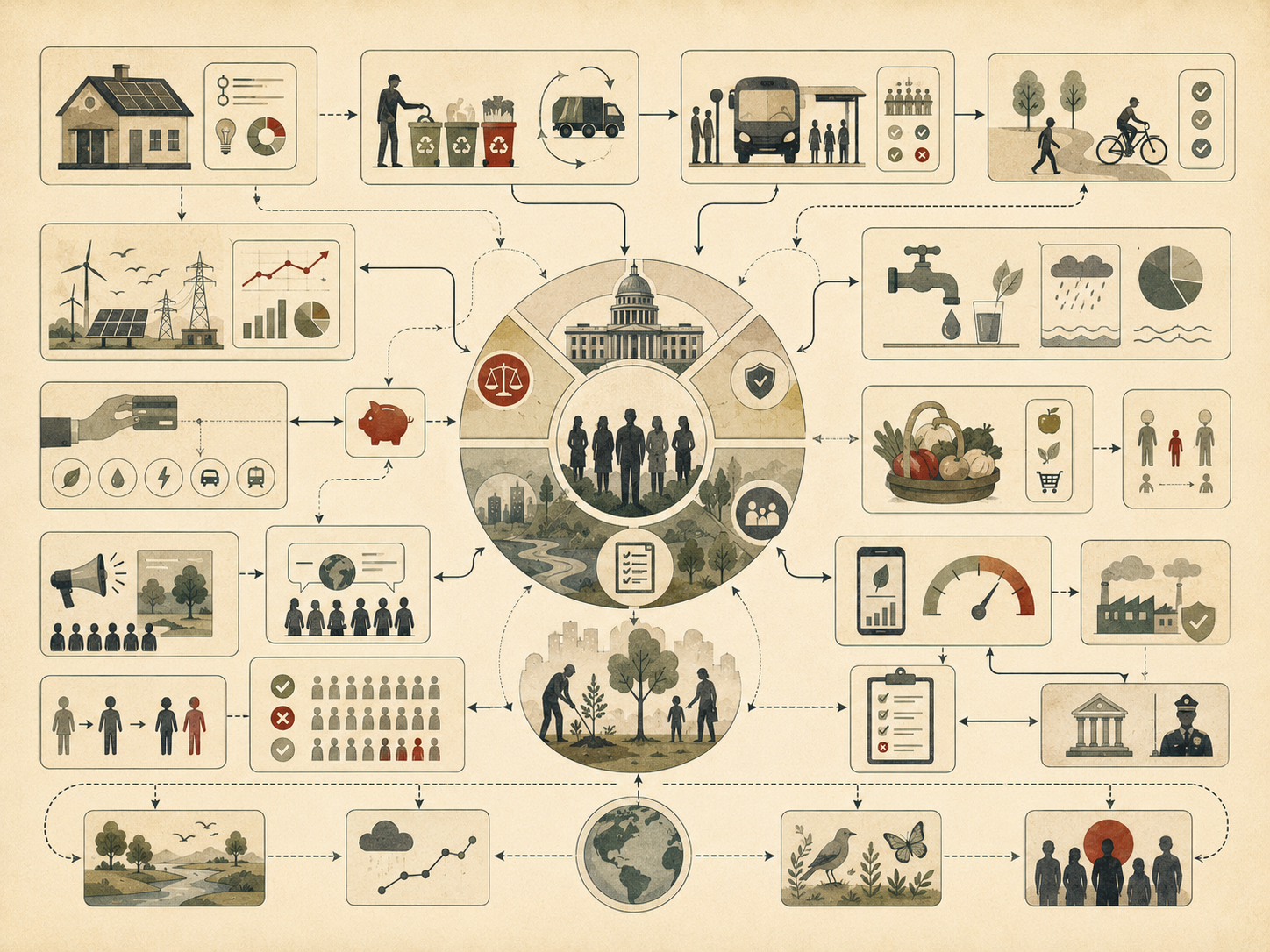
Climate change, biodiversity loss, pollution, energy waste, food-system emissions, water scarcity, resource depletion, and land-use change all involve collective-action problems that depend on millions of decentralized decisions. Households decide how much energy to use, how to travel, what to buy, whether to retrofit homes, how to dispose of waste, and whether to participate in local environmental programs. Firms decide whether to invest in efficiency, redesign supply chains, disclose risk, reduce emissions, or respond strategically to regulation. Public institutions decide how clearly policies are communicated, how defaults are structured, how benefits are delivered, how burdens are distributed, and how legible compliance becomes.
Behavioral insights therefore expand environmental policy not by replacing economic and legal instruments, but by improving how those instruments are designed, tested, communicated, and implemented. They help explain why awareness often fails to translate into action, why seemingly minor policy-design choices can materially affect uptake, and why legitimacy, fairness, trust, and social expectation are often central to environmental compliance and cooperation. The field’s most important contribution is not the claim that better messaging can solve ecological crisis. It is the more serious claim that environmental policy must be built for real people, real institutions, and real decision environments rather than idealized actors operating with perfect information, frictionless choice, and infinite attention.
The Behavioral Gap in Environmental Decision-Making
Many people express strong concern about environmental harm while failing to adopt behaviors fully consistent with those concerns. This is often described as the attitude-behavior gap, but the phrase should be interpreted carefully. The problem is not simply hypocrisy or inconsistency between values and actions. It is often a mismatch between reflective commitments and the environments in which those commitments must be enacted.
Environmentally preferable choices may involve higher upfront costs, delayed benefits, inconvenience, uncertainty about effectiveness, low salience at the moment of choice, confusing information, social ambiguity, or diffuse collective benefits that are difficult to perceive at the individual level. A person may support climate action and still postpone an energy retrofit because contractors are hard to compare, rebates are difficult to claim, future savings are uncertain, and the household budget is already strained. A consumer may care about waste and still choose convenience packaging when alternatives are not visible, affordable, or practical. A commuter may support lower emissions but lack reliable transit, safe cycling infrastructure, or flexible work arrangements.
Behavioral economics helps explain why this matters. People do not respond only to incentives in the abstract. They respond to the timing of costs and benefits, the design of information, the ease of acting, the behavior of others, and the degree to which institutions are trusted and understood. Attention is scarce. Future benefits are discounted. Losses loom larger than equivalent gains. Defaults carry implied recommendations. Social norms influence whether behavior feels normal, admirable, futile, or unfairly burdensome.
For environmental policy, this means better information is often necessary but insufficient. Information must be legible, timely, credible, and action-relevant. Incentives must be designed so that people can understand and use them. Administrative friction must be treated as a policy variable rather than a technical inconvenience. The real challenge is not merely persuading people that environmental protection matters, but designing systems in which environmentally beneficial action becomes cognitively, materially, socially, and institutionally feasible.
Environmental behavior is therefore shaped by what might be called implementation realism. Policies do not operate on values alone. They operate through forms, bills, labels, reminders, prices, contractors, digital portals, infrastructure, social expectations, deadlines, neighborhood norms, procurement rules, building codes, public trust, and material constraint. Behavioral insights matter because they locate environmental decision-making in this full policy environment.
Environmental Policy as Behavioral Public Economics
Environmental policy has a strong foundation in public economics. Pollution is often analyzed as a negative externality. Carbon pricing, emissions standards, cap-and-trade systems, subsidies, public investment, and regulation are central tools for aligning private incentives with social costs. That framework remains essential. Behavioral economics does not eliminate the need for prices, standards, and enforcement. It asks why formally efficient instruments sometimes underperform once they encounter real households, firms, markets, and administrative systems.
Consider a subsidy for heat pumps, insulation, solar installation, electric vehicles, or energy-efficient appliances. A conventional model might predict uptake based on price, expected savings, income, and technology characteristics. A behavioral model adds additional variables: salience of the subsidy, uncertainty about installers, distrust of program claims, hassle costs, attention costs, liquidity constraints, present bias, perceived loss of convenience, landlord-tenant split incentives, social visibility, and whether the application process is simple or burdensome. These factors can materially change program performance.
This is especially important for environmental policy because many interventions require active uptake. Households must apply, compare, schedule, install, switch, maintain, or change routines. Firms must evaluate capital investments, interpret compliance obligations, reorganize operations, and manage uncertainty. Public agencies must communicate clearly, process applications, verify eligibility, coordinate with vendors, and sustain legitimacy. Policy effectiveness depends on the full chain from formal instrument to actual behavior.
Behavioral public economics therefore treats environmental policy as a system of incentives plus decision architecture. The question is not only whether an intervention changes relative prices, but whether it changes the perceived opportunity set in a way that real actors can respond to. This does not weaken economic analysis. It strengthens it by incorporating the frictions, biases, constraints, and social mechanisms that determine whether policy instruments actually work.
A professional environmental-policy analysis should therefore distinguish at least four levels of policy performance: statutory design, administrative delivery, behavioral uptake, and welfare outcome. A subsidy may be enacted but poorly delivered. It may be delivered but weakly understood. It may be understood but too hard to claim. It may be claimed by higher-income households while failing to reach those with the greatest energy burden. Behavioral insights are most useful when they help diagnose where along that chain policy failure occurs.
Attention, Salience, and Environmental Information
Environmental information is often abundant but weakly actionable. Labels, warnings, disclosures, public-service announcements, consumption reports, climate-risk statements, efficiency ratings, recycling instructions, and emissions data may all exist, but their behavioral effect depends on whether they are noticed, understood, trusted, and connected to a feasible action.
Salience matters because people cannot process all available information. Energy efficiency may be economically valuable, but it can be overshadowed by purchase price, style, brand familiarity, installation complexity, or immediate convenience. Carbon information may be accurate but invisible at the moment when a travel, food, or purchasing decision is made. Recycling instructions may be technically correct but too complex to apply under routine time pressure. Environmental consequences are often delayed, probabilistic, spatially distant, or collectively distributed, making them less psychologically vivid than immediate cost or convenience.
Behaviorally informed environmental communication therefore emphasizes timing, clarity, comparability, and actionability. A label is stronger when it appears at the moment of choice. A disclosure is stronger when it translates technical information into a meaningful comparison. A reminder is stronger when it arrives before a deadline or routine decision point. A dashboard is stronger when it helps users identify what to do next rather than merely displaying data.
Yet salience must be used carefully. Making environmental harm visible can support action, but excessive warnings can produce fatigue, helplessness, or defensive avoidance. Fear-based messaging may motivate short-term attention while weakening long-term trust if it is not paired with feasible pathways. Information design must therefore balance urgency with agency. People need to understand the seriousness of environmental harm, but they also need credible routes for meaningful action.
For economists, the salience problem is analytically important because it changes the perceived price and benefit structure. A household may underrespond to future energy savings not because the savings are absent, but because they are not salient. A firm may underinvest in resilience not because risks are nonexistent, but because they are weakly visible in quarterly performance systems. A policy may fail not because its incentive is too small, but because the incentive is difficult to notice, understand, or claim.
Energy Conservation and Social Norm Feedback
One of the most studied applications of behavioral environmental policy involves social-norm feedback in energy consumption. Households often reduce electricity use when they receive reports comparing their own energy consumption to that of neighbors or peers. These interventions work not primarily by changing prices, but by changing the social meaning and visibility of consumption.
Hunt Allcott’s work on home energy reports showed that comparative social information can produce measurable reductions in electricity demand. The significance of this finding extends beyond the specific intervention. It demonstrates that environmental behavior is often conditional on what people believe others are doing, and that social information can alter perceived normality, fairness, and personal responsibility.
Social-norm feedback works through several behavioral channels. It makes private consumption visible in a comparative frame. It reduces uncertainty about what counts as high or low use. It signals that conservation is normal rather than exceptional. It can activate reciprocity by suggesting that others are contributing. It can also create reputational or identity-based motivation even when no formal sanction exists.
But social-norm interventions also have limits. Effects are often modest, context-dependent, and sensitive to design. Norm feedback can backfire if low-consuming households increase consumption after learning they are below average, unless the feedback includes injunctive cues that signal approval for conservation. Norms may also operate differently across income groups, regions, housing types, and political contexts. In some communities, peer comparison may feel motivating. In others, it may feel intrusive, irrelevant, or unfair.
Social-norm feedback is therefore best understood as a complement to structural environmental policy. It can improve conservation at the margin, especially when paired with clear action steps, pricing signals, appliance programs, building efficiency, and trustworthy institutions. It cannot substitute for decarbonized infrastructure, building standards, grid reform, or industrial regulation. Its value lies in helping policy work through everyday routines where social expectations and visible comparison shape behavior.
Defaults and Sustainable Choice
Default options are another powerful tool in environmental policy. A default is the outcome that occurs automatically if no active alternative is selected. Because many people stick with defaults due to inertia, implied recommendation, effort avoidance, uncertainty, or trust in institutional design, default settings can strongly influence participation in environmentally relevant programs.
Examples include default enrollment in renewable electricity plans, green-energy defaults in deregulated markets, paperless service settings, automatic enrollment in energy-saving programs, default procurement settings for lower-impact goods, and default participation in building-efficiency initiatives. These policies preserve formal freedom of choice while altering the behavioral baseline from which action occurs.
Behavioral economics helps explain why defaults are effective. They reduce decision effort, signal legitimacy, and exploit the fact that many individuals interpret the default as institutionally endorsed. In environmental contexts, they may be especially useful because many beneficial choices are low in immediate salience, high in minor hassle cost, and easy to postpone. A green default can turn passive delay into environmental participation rather than environmental inaction.
Defaults belong in close conversation with Choice Architecture and Decision Environments and Nudge Theory and Behavioral Public Policy. Yet environmental defaults raise ethical and distributional questions. Is the default transparent? Is opting out easy? Are costs fairly distributed? Does the default impose higher bills on households already experiencing energy insecurity? Are people informed enough to understand the choice? Are vulnerable users protected from institutional overreach?
A legitimate environmental default should be welfare-enhancing, transparent, reversible, and publicly defensible. It should support sustainable action without hiding material costs or shifting burdens onto those least able to absorb them. Defaults are powerful precisely because they change behavior without requiring active persuasion. That power makes them useful, but it also makes ethical design and public accountability essential.
Prices, Subsidies, and Behavioral Constraints
Environmental economists have long emphasized prices. Carbon pricing, congestion charges, fuel taxes, pollution fees, rebates, subsidies, and deposit-refund systems can change behavior by altering relative costs. Behavioral economics does not reject that logic. It clarifies why price signals may be undernoticed, misinterpreted, politically resisted, or unevenly effective across populations.
A price signal is more behaviorally effective when it is salient, timely, credible, and connected to feasible alternatives. A carbon price that appears indirectly through complex energy bills may be less behaviorally visible than a clear rebate, comparison label, or point-of-decision price difference. A subsidy may be financially meaningful but underused if claiming it requires paperwork, contractor coordination, upfront liquidity, or technical knowledge. A congestion charge may be efficient but politically vulnerable if people perceive it as unfair, unavoidable, or disconnected from improved transit alternatives.
Behavioral constraints are especially important for low-income households. A rebate that arrives after purchase may be less useful to households lacking upfront cash. A policy that assumes flexible schedules may fail for workers with rigid employment. A retrofit incentive may be inaccessible to renters or households facing landlord-tenant split incentives. A transportation policy may impose costs without providing credible alternatives. These are not merely behavioral problems; they are distributional and institutional design problems.
Economist-facing environmental policy should therefore estimate not only average price responsiveness, but heterogeneous policy response. Who notices the incentive? Who can act on it? Who faces liquidity constraints? Who bears compliance costs? Who receives benefits? Who is excluded by administrative burden? Behavioral insights deepen public economics by linking elasticities to implementation conditions, not by replacing price analysis with psychology.
Policy packages are often stronger than isolated instruments. A carbon price paired with rebates, infrastructure investment, clear communication, green defaults, and targeted support may produce different behavioral and political outcomes than a price signal alone. A subsidy paired with automatic eligibility and contractor support may outperform a larger subsidy that is difficult to claim. Environmental economics becomes more realistic when it treats uptake as a function of both incentives and decision architecture.
Behavioral Interventions and Climate Policy
Behavioral insights increasingly appear in climate policy because decarbonization depends not only on large infrastructure and industrial change, but also on recurring decisions about energy use, mobility, purchasing, retrofit uptake, technology adoption, maintenance, diet, land use, investment, and household routines. Many of these choices involve long-term benefits but short-term inconvenience, uncertainty, or cost. They are therefore vulnerable to present bias, limited attention, status quo preference, and loss aversion.
Behaviorally informed climate policy may include simplified efficiency labels, timely reminders, salient social messaging, public commitment mechanisms, streamlined retrofit enrollment, trusted messenger strategies, improved default design in green-energy markets, and better framing of long-term savings. These interventions can improve uptake, but their real value often lies in helping existing policy instruments work better.
A carbon price may provide an economic signal, but behavioral design may determine whether that signal is noticed, understood, politically accepted, and acted upon. Building codes may define performance standards, but compliance may depend on contractor knowledge, inspection practices, administrative clarity, and market norms. Subsidies may reduce cost, but uptake may depend on application design, financing, trust, and local supply chains. Public investment may expand alternatives, but behavior changes only when those alternatives are reliable, convenient, affordable, and socially legitimate.
Climate policy is also unusually vulnerable to intertemporal and collective-action problems. The costs of action may be immediate and visible, while benefits are delayed, probabilistic, and shared across populations. This makes climate governance a central case for behavioral public economics. People are often willing to support action when they believe burdens are fairly distributed, when institutions are trustworthy, when others are also contributing, and when the policy path is legible. They are more likely to resist when action appears symbolic, unequal, opaque, or disconnected from material feasibility.
Environmental policy is strongest when behavioral design and traditional regulation are integrated. Climate governance fails when it assumes that the existence of a rational incentive automatically generates a rational response. Behavioral economics helps close the gap between formal policy logic and actual implementation.
Institutional Applications and Evidence-Based Environmental Governance
Governments and international institutions increasingly apply behavioral science to environmental governance. Experimental policy testing, field trials, randomized interventions, administrative simplification, message testing, digital-service redesign, and implementation evaluation have become more common in domains such as energy conservation, recycling, transport behavior, climate adaptation, public participation, water conservation, and sustainability programs.
This institutional turn matters because it shifts environmental policy toward real-world implementation rather than abstract prescription alone. Behavioral approaches allow policymakers to examine what actually happens when households confront labels, defaults, comparison reports, deadlines, subsidy applications, contractor lists, tax credits, permit rules, or public commitments. Small design choices that might seem secondary from a purely theoretical perspective can have outsized effects on uptake, compliance, and legitimacy.
Evidence-based environmental governance should not mean merely running isolated nudges. It should mean building learning capacity into institutions. Public agencies should be able to test application forms, compare communication strategies, identify bottlenecks, estimate treatment effects, monitor distributional outcomes, and revise programs based on evidence. This is not a replacement for democratic decision-making. It is a way to make implementation more accountable and empirically grounded.
At the same time, evidence-based behavioral governance requires caution. Effects are often context-dependent, and a policy that works in one domain or population may not generalize. A norm message that reduces energy use in one setting may be ineffective elsewhere. A green default that works in one market may raise fairness concerns in another. A simplified application may increase uptake but still fail to reach the most excluded households. Behavioral environmental policy becomes more credible when it remains empirical, modest about transferability, and explicit about ethical constraints.
Institutional learning also requires transparency about failure. Environmental programs should not bury null results, uneven effects, or unintended consequences. A professional policy-evaluation culture treats those findings as evidence, not embarrassment. Behavioral insight is strongest when it improves public institutions’ ability to learn from implementation rather than merely producing attractive intervention stories.
Administrative Burden, Access, and Environmental Program Uptake
Environmental policy often fails not because people oppose it, but because accessing it is too difficult. Administrative burden includes the learning costs, compliance costs, and psychological costs involved in using a public program or meeting a policy requirement. These burdens are central to environmental policy because many programs require households, firms, or local governments to discover eligibility, complete forms, compare technical options, coordinate vendors, document compliance, or wait for reimbursement.
Learning costs arise when people do not know a program exists, cannot interpret eligibility criteria, or struggle to compare options. Compliance costs arise when people must gather documents, schedule inspections, fill out forms, navigate portals, obtain contractor estimates, or meet deadlines. Psychological costs arise when processes are confusing, stigmatizing, stressful, or mistrusted. In environmental policy, these burdens can determine whether rebates, retrofit programs, conservation programs, and resilience investments reach their intended users.
Administrative burden is not evenly distributed. Higher-income households, large firms, and well-resourced municipalities are often better able to navigate complex programs. Lower-income households, renters, small businesses, rural communities, elderly residents, people with disabilities, language-minority communities, and under-resourced local governments may face higher effective burdens. A formally universal environmental program can therefore produce unequal uptake if its administrative design favors those with more time, knowledge, liquidity, and institutional familiarity.
Behavioral insights help identify these barriers, but the solution is institutional, not merely psychological. Automatic eligibility, pre-filled forms, trusted local intermediaries, simple application design, upfront financing, multilingual support, contractor quality assurance, clear timelines, and human assistance can all increase program accessibility. These are not cosmetic improvements. They can determine whether environmental public investment produces broad social benefit or primarily subsidizes those already positioned to act.
For economists, administrative burden should be modeled as an adoption cost. It affects take-up, distribution, welfare, and cost-effectiveness. A program with a lower nominal subsidy but much lower burden may outperform a larger subsidy that is difficult to use. Environmental policy evaluation should therefore include administrative burden as a measurable determinant of uptake and equity.
Behavioral Economics and Collective Environmental Action
Environmental challenges are rarely reducible to isolated personal choices. They are collective-action problems in which the aggregated behavior of many actors determines outcomes. This creates a central motivational difficulty: individuals may perceive their own contribution as too small to matter, especially when environmental benefits are diffuse, delayed, and shared by others.
Behavioral economics helps explain why cooperation in such settings depends on norms, reciprocity, trust, fairness, and perceived participation. People are often more willing to act when they believe others are also contributing, when burdens appear fairly distributed, and when institutional goals feel legitimate rather than selectively imposed. This is particularly important in climate policy, where resentment, perceived hypocrisy, or elite exemption can undermine public support even for substantively important measures.
Collective environmental action depends on the visibility of shared effort. When individuals see that neighbors are conserving energy, firms are complying with regulation, public agencies are investing seriously, and higher-income actors are bearing appropriate burdens, cooperation becomes more plausible. When people believe that others are free-riding, powerful actors are exempt, or policy is symbolic rather than substantive, cooperation weakens.
Environmental governance therefore depends not only on designing efficient instruments, but on sustaining cooperative expectations. Policy that signals shared obligation and visible participation can help stabilize collective action. Policy that appears uneven, opaque, or symbolically punitive may weaken it. Behavioral economics makes these social conditions analytically visible.
Collective-action framing also helps avoid overindividualization. Environmental policy should not imply that ecological crisis can be solved through household virtue alone. Individual behavior matters, but it is shaped by infrastructure, markets, regulation, institutional design, and political economy. Behavioral insights should help align individual action with collective systems, not shift responsibility away from institutions and powerful actors.
Fairness, Trust, and the Political Economy of Environmental Cooperation
Fairness and trust are central to environmental policy because many environmental measures impose visible costs before producing visible benefits. Carbon pricing, congestion charges, building standards, land-use restrictions, water-use rules, fuel regulations, and industrial transition policies can all generate resistance when people perceive burdens as unfairly distributed or institutions as untrustworthy.
Behavioral economics shows that people are not motivated only by private payoff. They also respond to reciprocity, procedural fairness, social meaning, and institutional legitimacy. A policy that is efficient in aggregate may fail politically if people believe it protects elites, burdens workers, ignores rural communities, raises household costs without alternatives, or allows powerful polluters to avoid responsibility. Conversely, a demanding policy may gain support when it is transparent, fair, compensatory, and visibly shared.
Trust affects how environmental information is interpreted. The same message may be accepted or rejected depending on who delivers it. The same policy may be seen as necessary transition or unfair coercion depending on institutional history. Communities that have experienced neglect, pollution, displacement, or unequal enforcement may reasonably distrust new environmental promises. Behavioral policy must therefore take historical and institutional context seriously.
Fairness also matters for distributional welfare. Environmental policies can produce regressive effects if costs fall heavily on lower-income households or workers in transition-exposed sectors. Behavioral insights should be integrated with compensatory design: rebates, targeted subsidies, transition support, public investment, job pathways, and community participation. A policy that ignores distribution may fail not because people misunderstand it, but because they understand its unequal burden too well.
The political economy of environmental cooperation requires legitimacy. Behavioral tools can support legitimacy by improving clarity, reducing burden, making participation visible, and aligning policy design with social expectations. They can undermine legitimacy if used to obscure costs, manipulate consent, or substitute messaging for justice. The ethical test is whether behavioral design makes environmental governance more accountable, fair, and effective, not merely easier to sell.
Behavioral Economics and Sustainable Development
Behavioral insights are relevant to sustainable development because many sustainability challenges unfold across long time horizons and complex systems. Decisions about resource use, land use, energy transition, water management, resilient infrastructure, public health, agricultural practices, and disaster preparedness often involve delayed benefits, uncertain feedback, and difficult trade-offs between present convenience and future stability.
Under such conditions, present bias and limited attention are not minor irritants. They are major obstacles to developmental rationality. A society may endorse sustainability in principle while repeatedly underinvesting in long-term resilience because immediate costs are concentrated and long-run benefits are uncertain, invisible, or politically diffuse. Firms may underinvest in climate adaptation because benefits are difficult to attribute. Governments may postpone infrastructure maintenance because the payoff is avoiding future loss rather than producing immediate visible gain.
Behavioral economics offers tools for understanding these failures, but also for designing more workable interventions that help align near-term action with long-term collective interest. This may involve commitment mechanisms, institutionalized long-term planning, resilience metrics, default investment rules, transparent risk disclosure, participatory budgeting, and public communication that connects future benefits to present security and dignity.
For sustainable development, behavioral policy must be integrated with structural policy. A reminder to conserve water is less meaningful where infrastructure leaks are severe. A green consumption label is less meaningful where low-impact alternatives are unaffordable. A climate adaptation message is less meaningful where communities lack resources to act. Behavioral insights are most legitimate when they strengthen material capabilities rather than asking individuals to compensate for institutional failure.
For that reason, behavioral environmental policy should be seen as part of a larger project of institutional design under ecological constraint. It complements technological innovation, legal frameworks, fiscal policy, public investment, and social protection by helping ensure that environmental governance is designed for real people rather than idealized actors.
Empirical and Policy-Evaluation Lens
A professional economist-facing treatment of behavioral environmental policy should move beyond general claims that nudges work. It should ask what can be identified, estimated, compared, and evaluated. Environmental behavioral interventions can be studied using randomized controlled trials, field experiments, natural experiments, difference-in-differences designs, regression discontinuity, panel data, administrative records, utility consumption data, program take-up data, survey experiments, and structural models of technology adoption.
The core empirical challenge is separating behavioral design effects from selection effects. Households that opt into a green program may already be more environmentally motivated. Firms that respond to disclosure may already have better governance. Municipalities that adopt sustainability programs may differ systematically from those that do not. A naive comparison between participants and nonparticipants can therefore overstate causal effects.
Randomized field experiments can estimate average treatment effects of defaults, messages, reminders, comparison reports, application simplification, or rebate framing. Panel methods can compare behavior before and after policy rollout. Difference-in-differences designs can compare treated and untreated groups when policy changes occur at different times. Regression discontinuity can exploit eligibility thresholds. Audit studies can examine whether administrative or market systems respond differently to standardized applicants. Welfare analysis can compare private benefits, environmental externalities, administrative costs, distributional effects, and fiscal costs.
Good policy evaluation should also distinguish behavioral outcomes from welfare outcomes. Uptake is important, but uptake is not welfare by itself. A green default may increase renewable enrollment, but welfare depends on cost, transparency, emissions impact, distributional effects, and user understanding. A norm message may reduce electricity demand, but welfare depends on persistence, comfort, equity, and total environmental benefit. A retrofit subsidy may increase adoption, but welfare depends on energy savings, household burden, fiscal cost, emissions reduction, and who receives the subsidy.
Heterogeneity is especially important. Environmental interventions may affect households differently by income, housing tenure, energy burden, region, digital access, language, political trust, environmental concern, present bias, and baseline consumption. A policy that performs well on average may fail the households it most needs to reach. Behavioral environmental policy should therefore include distributional analysis as part of evaluation, not as an afterthought.
An Analytical Framework for Environmental Policy Under Behavioral Constraints
A simple way to formalize environmentally relevant choice is to model the uptake of a pro-environmental action \(a\) as depending on more than monetary cost and benefit. Let the net perceived utility of adopting action \(a\) be:
U(a) = B_p + \alpha B_e + \beta N + \gamma D – C – \phi – \lambda L
\]
Interpretation: Adoption depends on private benefit, perceived environmental benefit, social norms, default status, direct cost, friction, and perceived loss relative to the status quo.
Here, \(B_p\) is the private benefit, \(B_e\) is the perceived environmental benefit, \(N\) is normative or social benefit, \(D\) captures whether the action is supported by a default, \(C\) is direct private cost, \(\phi\) is friction or hassle cost, and \(L\) is perceived loss relative to the status quo. Parameters \(\alpha, \beta, \gamma, \lambda > 0\) represent behavioral sensitivity.
This framework shows why environmentally beneficial actions may be underadopted even when they are efficient in a long-run or social sense. If friction is high, if environmental benefit is weakly salient, or if the action is coded as a loss of convenience, adoption may remain low despite broad verbal support.
Intertemporal considerations deepen the problem. Suppose adoption has an immediate cost \(C_0\) and a stream of future benefits \(B_t\). Under present bias, individuals evaluate the action according to:
U(a) = -C_0 + \beta \sum_{t=1}^{T}\delta^t B_t
\qquad \text{with } 0 < \beta \leq 1
\]
Interpretation: When present bias is strong, immediate costs weigh heavily while future environmental or financial benefits are behaviorally discounted.
When \(\beta < 1\), future environmental or financial gains are underweighted relative to the present burden. This helps explain slow diffusion of energy-efficient technologies, delayed retrofit decisions, underinvestment in lower-emission options, and insufficient preparation for climate-related risk.
Defaults can be represented as a shift in the decision threshold. Let adoption occur when:
U(a) + \gamma D \geq 0
\]
Interpretation: A green default increases adoption probability by changing the behavioral baseline, even when the underlying material attributes of the option remain unchanged.
Norm feedback can be incorporated similarly. Let \(m\) denote perceived participation by relevant peers. Then:
U(a) = B_p + \alpha B_e + \beta m – C – \phi
\]
Interpretation: As perceived peer participation rises, adoption becomes more attractive through social proof, reciprocity, and reduced uncertainty about what counts as normal behavior.
For policy evaluation, the treatment effect of a behavioral intervention \(T\) on adoption can be expressed as:
\tau = E[Y_i(1) – Y_i(0)]
\]
Interpretation: The average treatment effect compares adoption under the behavioral intervention with adoption under the counterfactual condition without the intervention.
But environmental policy evaluation should also include welfare. Let total welfare from policy \(p\) be:
W(p) = B_H(p) + B_E(p) – C_P(p) – C_A(p) – C_F(p)
\]
Interpretation: Policy welfare depends on household or firm benefits, environmental benefits, private costs, administrative costs, and fiscal costs.
This makes clear that a behavioral intervention is not justified merely because it increases uptake. It must be evaluated in relation to environmental benefit, user welfare, fiscal cost, administrative burden, distributional effects, and legitimacy. The strongest behavioral environmental policies are not simply behaviorally effective. They are welfare-improving, equitable, transparent, and institutionally defensible.
R Workflow: Environmental Uptake, Treatment Effects, and Welfare
The following R workflow simulates adoption of a pro-environmental program across households that vary in environmental concern, present bias, norm sensitivity, friction sensitivity, income, energy burden, and loss aversion. It includes a policy grid, treatment-effect comparison, and welfare accounting. The data are synthetic and intended for economist-facing research scaffolding, teaching, and methods demonstration.
# Behavioral Insights in Environmental Policy
# R workflow: uptake, treatment effects, and welfare
# Synthetic data only. Economist-facing research scaffold.

set.seed(404)

n_households <- 8000

households <- data.frame(
  household_id = seq_len(n_households),
  income = exp(rnorm(n_households, log(55000), 0.55)),
  energy_burden = pmin(pmax(rnorm(n_households, 0.08, 0.04), 0.01), 0.30),
  env_concern = pmin(pmax(rnorm(n_households, 0.60, 0.18), 0), 1),
  present_bias = pmin(pmax(rbeta(n_households, 2, 5), 0.05), 0.99),
  norm_sensitivity = pmin(pmax(rnorm(n_households, 0.50, 0.20), 0), 1),
  friction_sensitivity = pmin(pmax(rnorm(n_households, 0.58, 0.17), 0), 1),
  loss_aversion = pmin(pmax(rnorm(n_households, 2.00, 0.40), 1), 4),
  trust = pmin(pmax(rnorm(n_households, 0.55, 0.20), 0), 1)
)

policy_grid <- expand.grid(
  default_green = c(0, 1),
  norm_signal = c(0.20, 0.50, 0.80),
  subsidy = c(0.00, 0.06, 0.12),
  friction = c(0.05, 0.15, 0.30)
)

simulate_uptake <- function(df, default_green, norm_signal, subsidy, friction) {
  upfront_cost <- pmax(0.18 - subsidy, 0)

  utility <- with(df,
    0.9 * env_concern +
      0.8 * norm_sensitivity * norm_signal +
      0.7 * default_green +
      0.5 * trust -
      1.2 * upfront_cost -
      1.0 * friction * friction_sensitivity -
      0.6 * present_bias * upfront_cost -
      0.4 * loss_aversion * friction -
      0.5 * energy_burden
  )

  uptake_prob <- plogis(utility)
  adopted <- rbinom(nrow(df), 1, uptake_prob)

  private_benefit <- adopted * (0.25 + 0.15 * df$energy_burden)
  environmental_benefit <- adopted * 0.90
  fiscal_cost <- adopted * subsidy
  admin_cost <- 0.05 + 0.10 * friction

  total_welfare <- utility + private_benefit + environmental_benefit - fiscal_cost - admin_cost

  data.frame(
    uptake_prob = uptake_prob,
    adopted = adopted,
    private_benefit = private_benefit,
    environmental_benefit = environmental_benefit,
    fiscal_cost = fiscal_cost,
    admin_cost = admin_cost,
    total_welfare = total_welfare
  )
}

results_list <- vector("list", nrow(policy_grid))

for (i in seq_len(nrow(policy_grid))) {
  g <- policy_grid[i, ]

  sim <- simulate_uptake(
    households,
    default_green = g$default_green,
    norm_signal = g$norm_signal,
    subsidy = g$subsidy,
    friction = g$friction
  )

  results_list[[i]] <- data.frame(
    default_green = g$default_green,
    norm_signal = g$norm_signal,
    subsidy = g$subsidy,
    friction = g$friction,
    mean_uptake_prob = mean(sim$uptake_prob),
    realized_uptake_rate = mean(sim$adopted),
    mean_private_benefit = mean(sim$private_benefit),
    mean_environmental_benefit = mean(sim$environmental_benefit),
    mean_fiscal_cost = mean(sim$fiscal_cost),
    mean_total_welfare = mean(sim$total_welfare)
  )
}

results <- do.call(rbind, results_list)
results <- results[order(-results$mean_total_welfare), ]

print(head(results, 15))

if (requireNamespace("dplyr", quietly = TRUE)) {
  library(dplyr)

  default_effects <- results %>%
    group_by(norm_signal, subsidy, friction) %>%
    summarize(
      uptake_without_default = realized_uptake_rate[default_green == 0],
      uptake_with_default = realized_uptake_rate[default_green == 1],
      default_lift = uptake_with_default - uptake_without_default,
      welfare_without_default = mean_total_welfare[default_green == 0],
      welfare_with_default = mean_total_welfare[default_green == 1],
      welfare_lift = welfare_with_default - welfare_without_default,
      .groups = "drop"
    ) %>%
    arrange(desc(welfare_lift))

  print(default_effects)
}

households$income_quintile <- cut(
  households$income,
  breaks = quantile(households$income, probs = seq(0, 1, 0.2)),
  include.lowest = TRUE,
  labels = paste0("Q", 1:5)
)

distribution_rows <- list()

for (q in levels(households$income_quintile)) {
  subset <- households[households$income_quintile == q, ]

  sim <- simulate_uptake(
    subset,
    default_green = 1,
    norm_signal = 0.80,
    subsidy = 0.12,
    friction = 0.05
  )

  distribution_rows[[length(distribution_rows) + 1]] <- data.frame(
    income_quintile = q,
    adoption_rate = mean(sim$adopted),
    mean_total_welfare = mean(sim$total_welfare),
    mean_fiscal_cost = mean(sim$fiscal_cost)
  )
}

distribution <- do.call(rbind, distribution_rows)
print(distribution)

dir.create("outputs/tables", recursive = TRUE, showWarnings = FALSE)
write.csv(results, "outputs/tables/r_environmental_policy_grid.csv", row.names = FALSE)
write.csv(distribution, "outputs/tables/r_distributional_environmental_policy_summary.csv", row.names = FALSE)
This simulation illustrates a recurring policy lesson: behavioral interventions are often most effective when they reduce friction, increase perceived participation, and complement rather than replace material incentives. It also shows why welfare and distribution matter. A policy that raises adoption may still perform poorly if it imposes excessive fiscal cost, administrative burden, or unequal access. Economist-facing behavioral environmental policy should therefore compare adoption, welfare, and distribution together.
Python Workflow: Comparing Environmental Policy Regimes Under Behavioral Assumptions
The Python workflow below compares three stylized environmental-policy regimes: price signal only, norm-plus-default, and integrated policy design. It estimates adoption, private welfare, environmental benefit, fiscal cost, and total welfare under heterogeneous behavioral parameters. It also includes a regression-style policy-evaluation layer for treatment-effect estimation.
# Behavioral Insights in Environmental Policy
# Python workflow: environmental policy regimes, welfare, and treatment effects
# Synthetic data only. Economist-facing research scaffold.

from __future__ import annotations

from pathlib import Path

import numpy as np
import pandas as pd

rng = np.random.default_rng(404)

n = 12000

agents = pd.DataFrame({
    "agent_id": np.arange(1, n + 1),
    "income": rng.lognormal(np.log(55000), 0.55, n),
    "energy_burden": np.clip(rng.normal(0.08, 0.04, n), 0.01, 0.30),
    "env_concern": np.clip(rng.normal(0.60, 0.18, n), 0, 1),
    "present_bias": np.clip(rng.beta(2, 5, n), 0.05, 0.99),
    "norm_sensitivity": np.clip(rng.normal(0.50, 0.20, n), 0, 1),
    "friction_sensitivity": np.clip(rng.normal(0.58, 0.17, n), 0, 1),
    "loss_aversion": np.clip(rng.normal(2.00, 0.40, n), 1, 4),
    "trust": np.clip(rng.normal(0.55, 0.20, n), 0, 1)
})

def evaluate_policy(
    df: pd.DataFrame,
    price_subsidy: float,
    default_green: int,
    norm_signal: float,
    friction: float
) -> dict[str, float]:
    """
    Evaluate an environmental policy regime.

    price_subsidy:
        Reduces effective upfront private cost.

    default_green:
        Indicates whether the environmentally preferable option is preselected.

    norm_signal:
        Strength of visible peer participation or social expectation.

    friction:
        Administrative or logistical hassle associated with uptake.
    """
    upfront_cost = max(0.18 - price_subsidy, 0.0)

    utility = (
        0.9 * df["env_concern"].values
        + 0.8 * df["norm_sensitivity"].values * norm_signal
        + 0.7 * default_green
        + 0.5 * df["trust"].values
        - 1.2 * upfront_cost
        - 1.0 * friction * df["friction_sensitivity"].values
        - 0.6 * df["present_bias"].values * upfront_cost
        - 0.4 * df["loss_aversion"].values * friction
        - 0.5 * df["energy_burden"].values
    )

    uptake_prob = 1 / (1 + np.exp(-utility))
    adopt = rng.binomial(1, uptake_prob)

    private_benefit = adopt * (0.25 + 0.15 * df["energy_burden"].values)
    environmental_benefit = 0.9 * adopt
    fiscal_cost = price_subsidy * adopt
    admin_cost = 0.05 + 0.10 * friction

    total_welfare = utility + private_benefit + environmental_benefit - fiscal_cost - admin_cost

    return {
        "adoption_rate": float(adopt.mean()),
        "mean_uptake_prob": float(uptake_prob.mean()),
        "mean_private_benefit": float(private_benefit.mean()),
        "mean_environmental_benefit": float(environmental_benefit.mean()),
        "mean_fiscal_cost": float(fiscal_cost.mean()),
        "mean_total_welfare": float(total_welfare.mean())
    }

regimes = {
    "price_signal_only": {
        "price_subsidy": 0.08,
        "default_green": 0,
        "norm_signal": 0.10,
        "friction": 0.20
    },
    "norm_plus_default": {
        "price_subsidy": 0.00,
        "default_green": 1,
        "norm_signal": 0.70,
        "friction": 0.08
    },
    "integrated_policy_design": {
        "price_subsidy": 0.06,
        "default_green": 1,
        "norm_signal": 0.70,
        "friction": 0.08
    }
}

rows = []

for name, params in regimes.items():
    out = evaluate_policy(agents, **params)
    out["regime"] = name
    rows.append(out)

results = pd.DataFrame(rows)[[
    "regime",
    "adoption_rate",
    "mean_uptake_prob",
    "mean_private_benefit",
    "mean_environmental_benefit",
    "mean_fiscal_cost",
    "mean_total_welfare"
]]

print(results.sort_values("mean_total_welfare", ascending=False))

agents["income_quintile"] = pd.qcut(
    agents["income"],
    5,
    labels=["Q1", "Q2", "Q3", "Q4", "Q5"]
)

dist_rows = []

for name, params in regimes.items():
    for group in agents["income_quintile"].unique():
        subset = agents.loc[agents["income_quintile"] == group].copy()
        out = evaluate_policy(subset, **params)
        out["regime"] = name
        out["income_quintile"] = str(group)
        dist_rows.append(out)

distribution = pd.DataFrame(dist_rows)
print(distribution.sort_values(["regime", "income_quintile"]))

# Build synthetic experimental dataset for treatment-effect estimation.
experimental = agents.copy()
experimental["treatment"] = rng.choice(
    ["control", "default_norm", "integrated"],
    size=len(experimental),
    p=[0.34, 0.33, 0.33]
)

def assign_outcome(row):
    if row["treatment"] == "control":
        params = regimes["price_signal_only"]
    elif row["treatment"] == "default_norm":
        params = regimes["norm_plus_default"]
    else:
        params = regimes["integrated_policy_design"]

    tmp = pd.DataFrame([row])
    outcome = evaluate_policy(tmp, **params)
    return pd.Series(outcome)

outcome_df = experimental.apply(assign_outcome, axis=1)
experimental = pd.concat([experimental, outcome_df], axis=1)

experimental["default_norm_treat"] = (experimental["treatment"] == "default_norm").astype(int)
experimental["integrated_treat"] = (experimental["treatment"] == "integrated").astype(int)

try:
    import statsmodels.api as sm

    X = experimental[[
        "default_norm_treat",
        "integrated_treat",
        "income",
        "energy_burden",
        "env_concern",
        "present_bias",
        "trust"
    ]]
    X = sm.add_constant(X)

    for outcome in ["adoption_rate", "mean_total_welfare", "mean_environmental_benefit"]:
        model = sm.OLS(experimental[outcome], X).fit(cov_type="HC1")
        print(f"\nOutcome: {outcome}")
        print(model.summary().tables[1])

except ImportError:
    print("statsmodels not installed; skipping regression table.")

output_dir = Path("outputs/tables")
output_dir.mkdir(parents=True, exist_ok=True)

results.to_csv(output_dir / "environmental_policy_regime_summary.csv", index=False)
distribution.to_csv(output_dir / "environmental_policy_distributional_summary.csv", index=False)
experimental.to_csv(output_dir / "synthetic_environmental_policy_experiment.csv", index=False)
For analysts, the point of this comparison is not simply to ask whether one behavioral intervention works. It is to examine how environmental policy performs under realistic behavioral conditions, whether integrated designs outperform isolated instruments, and whether policy benefits are distributed equitably. This type of workflow can be extended to retrofit subsidies, transport mode shift, household energy reports, water conservation, climate adaptation uptake, green procurement, or default renewable electricity programs.
Stata Replication Note: Policy Evaluation and Robustness
For an economist-facing repository, the companion code should support Stata as well as R and Python. The article-level GitHub folder should include a Stata workflow that imports the synthetic experiment dataset, estimates treatment effects, reports robust standard errors, and exports regression tables. A compact Stata pattern for this article would look like this:
clear all
set more off

* Behavioral Insights in Environmental Policy
* Stata policy-evaluation scaffold using synthetic data.

global ROOT "`c(pwd)'"
global TABLES "$ROOT/outputs/tables"
global REG "$ROOT/outputs/regression_tables"

capture mkdir "$REG"

import delimited "$TABLES/synthetic_environmental_policy_experiment.csv", clear varnames(1)

label variable default_norm_treat "Default plus social norm treatment"
label variable integrated_treat "Integrated policy design treatment"
label variable adoption_rate "Simulated adoption outcome"
label variable mean_total_welfare "Simulated total welfare"
label variable mean_environmental_benefit "Simulated environmental benefit"

local controls income energy_burden env_concern present_bias trust
local outcomes adoption_rate mean_total_welfare mean_environmental_benefit

tempname handle
postfile `handle' str35 outcome str35 term double estimate double std_error double p_value double n using "$REG/stata_environmental_policy_estimates.dta", replace

foreach y of local outcomes {
    regress `y' default_norm_treat integrated_treat `controls', vce(robust)

    foreach x in default_norm_treat integrated_treat {
        local b = _b[`x']
        local se = _se[`x']
        local p = 2 * ttail(e(df_r), abs(_b[`x'] / _se[`x']))
        local n = e(N)
        post `handle' ("`y'") ("`x'") (`b') (`se') (`p') (`n')
    }
}

postclose `handle'

use "$REG/stata_environmental_policy_estimates.dta", clear
export delimited using "$REG/stata_environmental_policy_estimates.csv", replace

display "Stata environmental policy-evaluation workflow complete."
The purpose of including Stata is not to privilege one tool, but to make the repository useful to economists, policy analysts, and graduate-level applied researchers who commonly work across Stata, R, and Python. The full repository scaffold should also include identification notes, robustness plans, replication instructions, synthetic panel data, and sensitivity tests for assumptions about environmental benefit, administrative cost, present bias, and fiscal cost.
GitHub Repository
The companion repository provides reproducible scaffolding for the computational side of this article, including synthetic household and policy-experiment datasets, environmental uptake simulations, treatment-effect estimation, welfare analysis, distributional summaries, robustness checks, Stata/R/Python workflows, SQL metadata structures, and scientific-computing examples for behavioral environmental policy research.
This article is supported by an article-level folder in the Behavioral Economics computational repository, with synthetic panel and experiment-style datasets, causal-inference workflows, welfare analysis, econometric identification notes, policy-evaluation scripts, robustness and sensitivity checks, Stata/R/Python workflows, SQL metadata structures, and scientific-computing examples for studying environmental defaults, social-norm feedback, administrative friction, present bias, environmental uptake, and sustainable policy design.
Interpretive Limits and Ethical Cautions
Behavioral insights are powerful, but they can be misused or overstated. Environmental policy should not be reduced to messaging, nudges, or consumer choice. Climate change, biodiversity loss, pollution, water insecurity, and resource depletion are structural problems involving industrial systems, infrastructure, law, investment, political economy, and unequal power. Behavioral tools can improve implementation, but they cannot substitute for decarbonization, regulation, public investment, standards, enforcement, and institutional accountability.
There is also a danger of blaming individuals for choices that are materially constrained. A household cannot choose reliable transit where none exists. A renter cannot always choose building efficiency. A low-income family may not be able to pay upfront for a future-saving technology. A community exposed to pollution may not lack awareness; it may lack political power. Behavioral environmental policy must therefore avoid moralizing individual behavior while ignoring structural conditions.
Ethically, behavioral interventions should be transparent, proportionate, reversible where appropriate, and publicly defensible. Defaults should not hide costs. Norm messages should not shame unfairly burdened groups. Salience should not become fear manipulation. Simplification should not obscure material trade-offs. Behavioral design should support agency and cooperation, not manipulate consent or deflect attention from institutional responsibility.
Behavioral evidence also has limits. Effects can be context-dependent, short-lived, or sensitive to implementation details. A successful trial in one setting may not replicate elsewhere. Some interventions may affect uptake without improving welfare. Others may help average users while excluding vulnerable groups. Professional policy evaluation should therefore include replication, robustness checks, distributional analysis, and clear documentation of assumptions.
The strongest use of behavioral economics in environmental policy is not to make people comply quietly with inadequate systems. It is to design environmental governance that is more usable, legitimate, equitable, evidence-based, and aligned with the realities of human decision-making.
Conclusion
Behavioral insights in environmental policy reveal that environmental governance depends not only on prices, technologies, legal standards, and public investment, but on how policies are encountered by real people under conditions of attention scarcity, social influence, present bias, administrative friction, material constraint, and institutional trust. The field matters because many environmentally significant choices occur in routine settings where design details can materially affect uptake, cooperation, legitimacy, and welfare.
Its value, however, does not lie in treating behavioral tools as substitutes for structural environmental reform. Environmental policy is strongest when behavioral design complements pricing, regulation, infrastructure, public investment, and social protection. Used well, behavioral insights help institutions close the gap between formal policy ambition and actual human response. Used poorly, they risk trivializing ecological crises into matters of messaging alone or shifting responsibility away from institutions and powerful actors.
The deeper contribution of behavioral economics is therefore not simply better nudges, but better environmental governance under real conditions of human decision-making. A mature behavioral environmental policy asks how incentives are perceived, how defaults are structured, how programs are accessed, how social norms are formed, how trust is maintained, how burdens are distributed, and how welfare is measured. It treats adoption as important, but not sufficient. It treats behavior as real, but not isolated from infrastructure and power.
Environmental policy must govern in a world where people have limited attention, limited time, unequal resources, social motivations, institutional memories, and legitimate concerns about fairness. Behavioral insights help make that world visible. The task is to use them not as a shortcut around politics and justice, but as tools for building environmental institutions that are more effective, more equitable, and more capable of sustaining collective action under ecological constraint.
Related Articles
- Behavioral Economics
- Behavioral Economics and Sustainable Consumption
- Choice Architecture and Decision Environments
- Nudge Theory and Behavioral Public Policy
- Present Bias and the Psychology of Immediate Reward
- Fairness and Reciprocity in Economic Behavior
- Trust and Cooperation in Economic Systems
- Behavioral Regulation and Institutional Design
- The Future of Behavioral Economics in Governance and Policy
- Sustainable Development
Further Reading
- Allcott, H. (2011) ‘Social norms and energy conservation’, Journal of Public Economics, 95(9–10), pp. 1082–1095. Available at: https://econpapers.repec.org/RePEc:eee:pubeco:v:95:y:2011:i:9-10:p:1082-1095.
- Allcott, H. and Rogers, T. (2014) ‘The short-run and long-run effects of behavioral interventions: Experimental evidence from energy conservation’, American Economic Review, 104(10), pp. 3003–3037. Available at: https://www.aeaweb.org/articles?id=10.1257/aer.104.10.3003.
- Intergovernmental Panel on Climate Change (2023) AR6 Synthesis Report: Climate Change 2023. Geneva: IPCC. Available at: https://www.ipcc.ch/report/ar6/syr/.
- Kahneman, D. (2011) Thinking, Fast and Slow. New York: Farrar, Straus and Giroux. Available at: https://us.macmillan.com/books/9780374533557/thinkingfastandslow.
- OECD (2025) Mind Shift, Green Lift: Six Behavioural Science Trends for Environmental Policy. Paris: OECD. Available at: https://www.oecd.org/en/publications/mind-shift-green-lift_162c5a27-en.html.
- Sunstein, C.R. and Reisch, L.A. (2014) ‘Automatically green: Behavioral economics and environmental protection’, Harvard Environmental Law Review, 38(1), pp. 127–158. Available at: https://journals.law.harvard.edu/elr/2014/04/08/automatically-green-behavioral-economics-and-environmental-protection/.
- Thaler, R.H. and Sunstein, C.R. (2008) Nudge: Improving Decisions About Health, Wealth, and Happiness. New Haven, CT: Yale University Press. Available at: https://yalebooks.yale.edu/book/9780300122237/nudge/.
- United Nations Environment Programme (2017) ‘Nudge to Action: Behavioural Science for Sustainability’. Nairobi: UNEP. Available at: https://www.unep.org/news-and-stories/story/nudge-action-behavioural-science-sustainability.
- United Nations Environment Programme (2019) ‘Five Ways Behavioural Science Can Transform Climate Change Action’. Nairobi: UNEP. Available at: https://www.unep.org/news-and-stories/story/five-ways-behavioural-science-can-transform-climate-change-action.
References
- Allcott, H. (2011) ‘Social norms and energy conservation’, Journal of Public Economics, 95(9–10), pp. 1082–1095. Available at: https://econpapers.repec.org/RePEc:eee:pubeco:v:95:y:2011:i:9-10:p:1082-1095.
- Allcott, H. and Rogers, T. (2014) ‘The short-run and long-run effects of behavioral interventions: Experimental evidence from energy conservation’, American Economic Review, 104(10), pp. 3003–3037. Available at: https://www.aeaweb.org/articles?id=10.1257/aer.104.10.3003.
- Intergovernmental Panel on Climate Change (2023) AR6 Synthesis Report: Climate Change 2023. Geneva: IPCC. Available at: https://www.ipcc.ch/report/ar6/syr/.
- Kahneman, D. (2011) Thinking, Fast and Slow. New York: Farrar, Straus and Giroux. Available at: https://us.macmillan.com/books/9780374533557/thinkingfastandslow.
- OECD (2025) Mind Shift, Green Lift: Six Behavioural Science Trends for Environmental Policy. Paris: OECD. Available at: https://www.oecd.org/en/publications/mind-shift-green-lift_162c5a27-en.html.
- Sunstein, C.R. and Reisch, L.A. (2014) ‘Automatically green: Behavioral economics and environmental protection’, Harvard Environmental Law Review, 38(1), pp. 127–158. Available at: https://journals.law.harvard.edu/elr/2014/04/08/automatically-green-behavioral-economics-and-environmental-protection/.
- Thaler, R.H. and Sunstein, C.R. (2008) Nudge: Improving Decisions About Health, Wealth, and Happiness. New Haven, CT: Yale University Press. Available at: https://yalebooks.yale.edu/book/9780300122237/nudge/.
- United Nations Environment Programme (2017) ‘Nudge to Action: Behavioural Science for Sustainability’. Nairobi: UNEP. Available at: https://www.unep.org/news-and-stories/story/nudge-action-behavioural-science-sustainability.
- United Nations Environment Programme (2019) ‘Five Ways Behavioural Science Can Transform Climate Change Action’. Nairobi: UNEP. Available at: https://www.unep.org/news-and-stories/story/five-ways-behavioural-science-can-transform-climate-change-action.