
Last Updated August 6, 2026
Thermodynamics is the study of energy, its transformations, and the limits that govern those transformations. It explains why heat flows from warmer regions to cooler ones, why no heat engine can convert all thermal input into useful work, why batteries and fuel cells warm during operation, why compression raises temperature, why refrigeration requires energy, and why every real conversion process produces losses that cannot be fully reversed.
These principles operate beneath nearly every energy technology. Thermal power plants, internal-combustion engines, industrial furnaces, heat pumps, electrolyzers, data centers, district-energy networks, batteries, hydrogen systems, buildings, and thermal storage all depend on thermodynamic relationships. Even technologies that do not begin with combustion must manage heat, entropy generation, material limits, and the difference between total energy and useful energy.
Thermodynamics therefore provides more than a set of equations. It provides a disciplined way to define systems, trace transfers, test energy balances, distinguish reversible ideals from real processes, and identify where useful energy is degraded. It also reveals why energy policy cannot be evaluated through fuel quantities or electrical output alone. Temperature, timing, system boundaries, environmental sinks, infrastructure design, and the quality of energy all shape what a system can actually accomplish.
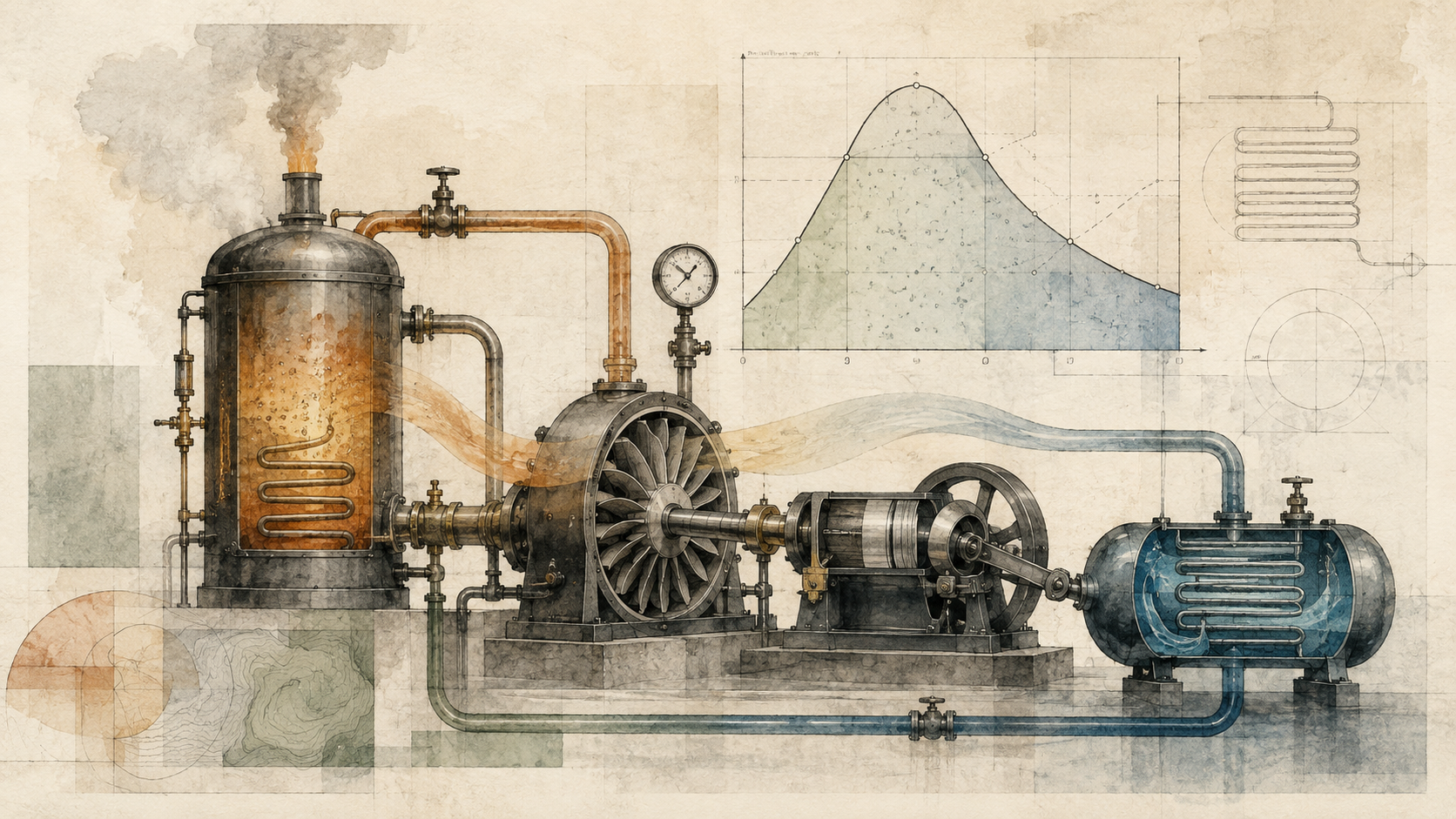
Energy is conserved, but useful energy is not. A joule of electricity can drive a motor, power electronics, produce light, or generate heat. A joule of low-temperature heat near ambient conditions has far fewer possible uses. Thermodynamics explains this difference without violating conservation: total energy remains, while its capacity to produce organized change declines as entropy is generated.
The distinction is central to energy-system design. A technology may conserve energy while wasting much of its useful potential. A plant may report high equipment efficiency while ignoring upstream fuel processing or downstream heat rejection. A heat pump can deliver more heat than the electrical energy it consumes because it moves thermal energy rather than creating it. A thermal storage system can preserve energy while losing temperature and therefore losing usefulness.
This article develops the thermodynamic foundation needed to analyze such claims. It introduces systems and boundaries, equilibrium, temperature, heat, work, internal energy, enthalpy, entropy, heat engines, refrigeration, exergy, phase change, combustion, storage, and the role of irreversibility. It also connects these concepts to infrastructure planning, decarbonization, public value, and computational modeling.
Why Thermodynamics Matters
Thermodynamics matters because every energy system is a conversion system. Resources become fuels, fuels become heat, heat becomes mechanical work, mechanical work becomes electricity, electricity becomes motion, light, computation, cooling, or heat, and each stage changes the usefulness of the energy that passes through it. The physical quantity of energy may be conserved while the system’s capacity to deliver desired services declines.
This distinction appears throughout infrastructure:
- Power plants convert thermal, nuclear, chemical, hydraulic, solar, or mechanical inputs into electricity while rejecting heat.
- Buildings exchange heat through walls, windows, ventilation, appliances, people, sunlight, and heating or cooling equipment.
- Industry requires heat at particular temperatures, pressures, and rates rather than generic energy.
- Transportation converts chemical or electrical energy into motion while overcoming drag, rolling resistance, and internal losses.
- Storage preserves energy across time but may lose charge, temperature, pressure, or chemical potential.
- Digital infrastructure converts nearly all electrical input into heat that must be removed to maintain reliable operation.
- Hydrogen and synthetic fuels pass through multiple conversion stages, each with efficiency and exergy consequences.
A thermodynamic view asks more precise questions than a simple energy tally. What form of energy enters? At what temperature, pressure, chemical composition, or electrical potential? What useful service leaves? Which losses are unavoidable under physical law, and which arise from poor design, friction, mixing, finite temperature differences, leakage, control error, or degraded equipment? Where is heat rejected, and who or what absorbs it?
Thermodynamics also prevents category errors in policy. A proposal to replace combustion heat with electricity must consider the temperature required, the performance of the electric technology, grid conditions, and the upstream generation mix. A claim that waste heat is “free energy” must consider temperature, distance, timing, contamination, and the work required to collect and move it. A comparison between a boiler and a heat pump must distinguish first-law efficiency from coefficient of performance and must state the source and sink temperatures.
The field is built around four laws:
| Law | Core idea | Energy-system implication |
|---|---|---|
| Zeroth law | Thermal equilibrium makes temperature a meaningful property. | Temperature can be measured and used to predict the direction of heat transfer. |
| First law | Energy is conserved. | Inputs, outputs, and storage changes must balance across a defined boundary. |
| Second law | Real processes generate entropy and have a preferred direction. | No conversion can recover all useful work; heat engines and refrigeration face fundamental limits. |
| Third law | The entropy of a perfect crystal approaches a reference value as temperature approaches absolute zero. | Absolute zero cannot be reached by a finite sequence of ordinary processes, and low-temperature behavior requires quantum-aware treatment. |
The laws are not separate rules for isolated textbook problems. Together they define what energy systems can do, what they cannot do, and how closely a design approaches the physical limit.
Systems, Surroundings, and Boundaries
Thermodynamic analysis begins by defining a system: the matter or region selected for study. Everything outside it is the surroundings. The real or conceptual surface separating them is the boundary. Energy and matter may cross that boundary depending on the kind of system being analyzed.
Three system types are commonly distinguished:
| System type | Matter crossing boundary? | Energy crossing boundary? | Illustrative example |
|---|---|---|---|
| Isolated | No | No | An idealized perfectly insulated, sealed system with no external work interaction. |
| Closed | No | Yes | A sealed piston-cylinder that can exchange heat and boundary work. |
| Open | Yes | Yes | A turbine, compressor, boiler, heat exchanger, building, or power plant control volume. |
The boundary determines what appears as internal storage and what appears as transfer. Fuel inside a storage tank is part of the system if the tank is included, but it is an inflow if the boundary is drawn around the burner. Electricity generated onsite is an internal conversion if the boundary includes the generator, but it is an imported energy flow if the boundary begins at the building meter.
Boundary choice is therefore analytically and politically consequential. A narrow boundary can make a process appear efficient by excluding upstream extraction, fuel processing, transmission losses, cooling-water use, or waste disposal. A broad boundary can reveal lifecycle consequences but may introduce additional uncertainty and data requirements. Neither boundary is automatically correct; the appropriate choice depends on the question, but it must be declared.
A useful boundary statement should specify:
- the physical equipment, facility, region, or supply chain included;
- the time interval of analysis;
- which matter flows cross the boundary;
- which heat, work, electrical, radiative, and chemical transfers are counted;
- the reference environment for temperature, pressure, and composition;
- whether construction, maintenance, and decommissioning are included;
- which outputs are considered useful services.
A thermodynamic result without a boundary is incomplete. Efficiency, loss, exergy destruction, and emissions intensity all depend on what the analyst has chosen to include.
State, Properties, and Equilibrium
A thermodynamic state describes the condition of a system through properties such as temperature, pressure, volume, density, composition, internal energy, enthalpy, and entropy. A property has a value determined by the state, not by the path used to reach it. Heat and work are different: they describe energy transferred during a process and are not stored properties of a state.
Properties may be:
- Extensive, scaling with system size, such as mass, volume, internal energy, entropy, and total enthalpy.
- Intensive, independent of system size, such as temperature, pressure, density, and specific volume.
- Specific, expressed per unit mass, such as specific internal energy, specific enthalpy, and specific entropy.
A system is in thermodynamic equilibrium when it has no unbalanced tendency to change internally. This requires thermal equilibrium, mechanical equilibrium, phase equilibrium, and chemical equilibrium. Real infrastructure often operates away from equilibrium because gradients are required to produce flows. Heat transfer requires a temperature difference. Fluid flow requires a pressure difference. Electrical current requires a potential difference. Chemical reactions require a driving force.
The closer a process approaches equilibrium at every intermediate step, the closer it approaches reversibility. But approaching reversibility generally requires smaller gradients and slower transfer, which can demand larger equipment, longer process times, and higher capital cost. Engineering therefore balances efficiency against power density, size, cost, controllability, safety, and operational requirements.
A process is a change from one state to another. Common idealized processes include:
| Process | Quantity held constant | Typical use |
|---|---|---|
| Isothermal | Temperature | Slow compression or expansion with sufficient heat exchange. |
| Isobaric | Pressure | Heating or cooling in many open vessels and flow processes. |
| Isochoric | Volume | Heating a rigid sealed container. |
| Adiabatic | No heat transfer | Rapid compression, insulated turbines, compressors, and nozzles. |
| Isentropic | Entropy in an ideal reversible adiabatic process | Reference model for turbine and compressor performance. |
| Steady state | Properties within the control volume do not change with time | Continuous operation of turbines, heat exchangers, pumps, and pipelines. |
These idealizations simplify analysis. Real processes may approximate one or more of them over a limited operating range, but the approximation should be tested rather than assumed.
The Zeroth Law and Temperature
The zeroth law states that if system A is in thermal equilibrium with system C, and system B is also in thermal equilibrium with system C, then A and B are in thermal equilibrium with each other. This transitive relationship makes temperature a measurable property. A thermometer functions as system C: when it reaches thermal equilibrium with the system being measured, its calibrated response indicates temperature.
Temperature is not the amount of heat in a body. It is a property related to thermal state and, at the microscopic level, to the distribution of energy among available modes. A small hot object may contain less total internal energy than a large cooler object. Heat capacity, mass, phase, and composition determine how much energy is required to change temperature.
Thermodynamic temperature is measured on an absolute scale. The kelvin is the SI unit. Temperature differences expressed in kelvins and degrees Celsius have the same numerical size, but ratios and formulas involving absolute temperature require kelvins.
For an ideal gas, temperature, pressure, volume, and amount of substance are related by:
PV = nRT
\]
Interpretation: For an ideal gas, pressure \(P\), volume \(V\), amount \(n\), gas constant \(R\), and absolute temperature \(T\) define the equilibrium state. Real gases deviate from this relation at high pressure, low temperature, and near phase transitions.
Temperature differences drive heat transfer. Conduction moves energy through molecular interactions, convection combines conduction with fluid motion, and radiation transfers energy through electromagnetic fields. Heat-transfer rate depends not only on temperature difference but also on geometry, material properties, surface conditions, flow, and radiation characteristics.
This is why the same amount of insulation can perform differently across climates, why industrial heat recovery depends on temperature matching, and why low-temperature waste heat may be abundant but difficult to use. Thermodynamics identifies the direction and potential of transfer; heat-transfer science determines the rate and equipment required.
Heat, Work, and Internal Energy
Internal energy is the microscopic energy stored within a system through molecular motion, intermolecular forces, chemical bonds, electronic states, nuclear states, and other internal degrees of freedom. It excludes the kinetic energy of the system’s bulk motion and its gravitational potential energy as a whole unless those terms are explicitly included in total energy.
Heat is energy transferred across a boundary because of a temperature difference. A system does not “contain heat” as a stored substance. It contains internal energy. Heat is a process quantity describing transfer.
Work is energy transferred by an organized interaction other than heat. Mechanical boundary work, shaft work, electrical work, surface-tension work, and magnetic work are examples. In a piston-cylinder, expansion can move a boundary against pressure. In a turbine, fluid energy produces shaft work. In a motor, electrical work becomes mechanical output and heat.
A common sign convention for closed systems treats heat entering the system as positive and work done by the system on the surroundings as positive. With that convention:
\Delta U = Q – W
\]
Interpretation: The change in internal energy \(\Delta U\) equals heat added to the system \(Q\) minus work performed by the system \(W\). Some disciplines use different signs, so every analysis should state its convention.
For quasi-equilibrium boundary work at pressure \(P\):
W_b = \int_{V_1}^{V_2} P\,dV
\]
Interpretation: Expansion work depends on the path through pressure-volume space. Two processes connecting the same initial and final states can transfer different amounts of work.
This path dependence distinguishes heat and work from state properties. Internal energy change depends only on the endpoints. Heat and work depend on how the process occurs.
Energy-system communication often blurs these terms. “Heat content” may be used informally for chemical energy in fuels. “Waste heat” may refer to internal energy rejected at a temperature too low for practical recovery. “Electrical heat” may describe resistive conversion of electrical work into internal energy. Precise analysis should identify the actual transfer mechanism and state variables rather than relying on shorthand.
The First Law for Closed Systems
The first law applies energy conservation to thermodynamic processes. For a closed system that may change internal, kinetic, and potential energy:
Q – W
=
\Delta U + \Delta KE + \Delta PE
\]
Interpretation: Net heat added minus work delivered changes the system’s stored internal, kinetic, and potential energy.
In many stationary devices, changes in bulk kinetic and potential energy are negligible compared with internal energy. In vehicles, turbines, nozzles, hydropower, and compressed-gas systems, those terms may be important.
The first law is necessary but not sufficient for evaluating a process. It can identify an impossible energy imbalance, but it cannot by itself determine whether a proposed process can occur. A device that claims to convert ambient heat entirely into work might satisfy a simple energy balance, yet violate the second law. Conservation says how much energy exists; the second law constrains direction and quality.
For cyclic operation, the system returns to its initial state after each cycle, so the net change in stored energy is zero:
\oint \delta Q = \oint \delta W
\]
Interpretation: Over a complete cycle, net heat transfer equals net work output when kinetic and potential changes also return to their starting values.
This relation underlies heat engines, refrigeration cycles, heat pumps, and many industrial processes. The cycle does not create energy. It repeatedly converts and transfers energy while returning the working fluid to its starting condition.
A first-law audit should check:
- whether all energy streams are expressed in consistent units;
- whether storage changes are included during startup, shutdown, and transient operation;
- whether mass flows carry enthalpy, kinetic, potential, and chemical energy;
- whether parasitic loads and auxiliary equipment are counted;
- whether measured heat losses include radiation, convection, leakage, and unmetered flows;
- whether reported efficiency uses gross or net output.
Many apparent energy discrepancies are boundary, timing, or measurement problems rather than violations of conservation.
Enthalpy and Open-System Energy Balances
Most energy infrastructure is better represented as an open system or control volume because matter flows through it. Turbines, compressors, pumps, heat exchangers, boilers, condensers, pipelines, reactors, cooling towers, and buildings all exchange mass with their surroundings.
Flowing matter must be pushed into and out of a control volume. The combination of internal energy and flow work is represented by enthalpy:
h = u + Pv
\]
Interpretation: Specific enthalpy \(h\) combines specific internal energy \(u\) with pressure-volume flow work \(Pv\). It is especially useful for steady-flow devices.
For a steady-flow control volume with one inlet and one outlet:
\dot{Q} – \dot{W}
=
\dot{m}
\left[
(h_2-h_1)
+
\frac{V_2^2-V_1^2}{2}
+
g(z_2-z_1)
\right]
\]
Interpretation: Heat-transfer rate minus work-output rate equals the mass flow rate multiplied by changes in enthalpy, kinetic energy, and potential energy.
Different devices emphasize different terms:
| Device | Dominant thermodynamic function | Common approximation |
|---|---|---|
| Turbine | Converts fluid enthalpy into shaft work. | Approximately adiabatic; kinetic and potential changes may be small. |
| Compressor | Uses shaft work to raise fluid pressure and enthalpy. | Approximately adiabatic; compare actual work with isentropic reference. |
| Pump | Raises liquid pressure using mechanical work. | Liquid often treated as incompressible. |
| Heat exchanger | Transfers energy between fluid streams. | External heat loss and shaft work often negligible. |
| Nozzle | Converts enthalpy into kinetic energy. | Adiabatic with negligible shaft work. |
| Throttle valve | Reduces pressure through an irreversible restriction. | Enthalpy approximately constant. |
Enthalpy should not be interpreted as a separate substance carried by a fluid. It is a property constructed to simplify energy accounting for flowing matter. Its usefulness depends on consistent reference states and reliable property data.
Specific Heat, Latent Heat, and Phase Change
When a substance changes temperature without changing phase, the required heat can often be approximated by:
Q = mc\Delta T
\]
Interpretation: Heat transfer \(Q\) depends on mass \(m\), specific heat capacity \(c\), and temperature change \(\Delta T\). The approximation assumes \(c\) is sufficiently constant over the temperature range.
Specific heat measures how much energy is required to change the temperature of a unit mass. Materials with high heat capacity can store significant thermal energy with modest temperature change. Water’s relatively high heat capacity makes it useful in district heating, cooling loops, hydronic systems, and thermal storage.
During phase change, a substance can absorb or release substantial energy with little or no temperature change. The idealized relation is:
Q = mL
\]
Interpretation: Latent heat \(L\) is the energy per unit mass associated with a phase transition such as melting or vaporization.
Phase change is central to boilers, condensers, steam cycles, refrigeration, liquefied-gas storage, heat pipes, and phase-change thermal storage. A condenser removes latent heat from vapor. A boiler adds latent heat to produce vapor. Ice storage shifts cooling demand by freezing water during low-demand periods and melting it during higher-demand periods.
Real phase-change systems require attention to superheating, subcooling, pressure dependence, mixtures, nucleation, hysteresis, thermal conductivity, cycling stability, containment, and heat-exchanger design. The latent-heat equation provides an energy quantity but not the transfer rate or operational feasibility.
Thermal storage capacity can combine sensible and latent terms:
Q_{ ext{stored}}
=
m c_s (T_m-T_i)
+
mL
+
m c_l (T_f-T_m)
\]
Interpretation: A material may store sensible heat before melting, latent heat during melting, and additional sensible heat after melting.
The value of stored heat depends on more than total energy. Temperature determines which end uses can use it and how much work could theoretically be recovered.
Ideal Gases and Real Fluids
The ideal-gas model assumes molecules occupy negligible volume and interact only through elastic collisions. It is useful for many gases at moderate pressure and sufficiently high temperature. For an ideal gas, internal energy and enthalpy depend primarily on temperature, simplifying many calculations.
Real fluids deviate from ideal behavior because molecules have finite size and intermolecular forces. Deviations become important near saturation, at high pressure, at low temperature, and in supercritical conditions. Steam power cycles, refrigeration systems, carbon-dioxide transport, hydrogen storage, liquefied natural gas, and geothermal systems therefore require accurate property tables or equations of state.
A compressibility factor can express deviation from the ideal-gas equation:
PV = ZnRT
\]
Interpretation: The compressibility factor \(Z\) equals one for ideal-gas behavior. Real-fluid data or an equation of state determines \(Z\) under specific conditions.
Phase diagrams show regions in which solid, liquid, and vapor phases are stable. The critical point marks the end of the liquid-vapor coexistence curve. Above the critical point, the distinction between liquid and gas disappears, though density and transport properties can still change strongly.
Property uncertainty matters in energy-system modeling. A simplified constant specific heat may be acceptable for preliminary analysis but misleading across wide temperature ranges. Treating steam as an ideal gas near condensation can produce major errors. Modeling hydrogen, carbon dioxide, or refrigerants under pressure requires fluid-specific data and appropriate safety margins.
The analyst should match model complexity to the decision. Conceptual screening may use idealized properties. Equipment sizing, safety analysis, and financial commitments require validated property sources, calibrated models, and engineering review.
The Second Law of Thermodynamics
The first law says energy is conserved. The second law says that real processes have direction and that not all energy can be converted into work. Heat flows spontaneously from higher temperature to lower temperature, not the reverse. Friction converts organized motion into internal energy. Mixing occurs spontaneously but does not unmix without external work. Electrical resistance produces heat. Chemical reactions proceed toward equilibrium under appropriate conditions.
Several equivalent statements express the second law:
- No cyclic heat engine can convert all heat drawn from a single reservoir into work.
- Heat cannot flow spontaneously from a colder body to a hotter body.
- The total entropy of an isolated system does not decrease.
- Real processes destroy exergy through irreversibility.
The second law does not say that local order cannot increase. Refrigerators create a colder interior, living systems build organized structures, and industries manufacture complex products. These local decreases in entropy require energy transfers and are accompanied by greater entropy generation elsewhere.
A simple entropy balance for an isolated system is:
\Delta S_{ ext{isolated}} \ge 0
\]
Interpretation: Entropy remains constant only for an ideal reversible process. It increases for every real irreversible process.
The second law explains why efficiency improvement has limits. Better materials, controls, heat exchangers, and operating practices can reduce avoidable losses, but they cannot eliminate the need to reject heat in a cyclic heat engine or remove all entropy generation from a finite-rate process.
This distinction matters for transition planning. Technological learning can move systems closer to physical limits, but policy scenarios should not assume indefinite efficiency gains. The remaining gap between current practice and the thermodynamic limit may be small, inaccessible, costly, or constrained by other requirements.
Entropy and Entropy Generation
Entropy is a thermodynamic state property that measures how energy is distributed among microscopic possibilities and, operationally, how much energy has become unavailable for conversion into work under specified conditions. Entropy is not simply “disorder,” although that metaphor can sometimes be suggestive. In engineering analysis, entropy is a measurable property with units of joules per kelvin.
For a reversible heat transfer:
dS = \frac{\delta Q_{\text{rev}}}{T}
\]
Interpretation: An infinitesimal reversible heat transfer \(\delta Q_{\text{rev}}\) at absolute temperature \(T\) changes entropy by \(dS\).
For a finite process between states 1 and 2:
\Delta S
=
\int_1^2 \frac{\delta Q}{T_b}
+
S_{ ext{gen}}
\]
Interpretation: Entropy change equals entropy transferred with heat across boundary temperature \(T_b\) plus entropy generated internally. For real processes, \(S_{\text{gen}}\ge 0\).
Sources of entropy generation include:
- heat transfer across a finite temperature difference;
- fluid friction and pressure drop;
- electrical resistance;
- mixing of streams with different temperature, pressure, or composition;
- unrestrained expansion;
- chemical reaction away from equilibrium;
- inelastic deformation and mechanical friction;
- mass transfer across finite concentration differences.
Entropy analysis helps locate avoidable degradation. A heat exchanger may satisfy the first law while generating excessive entropy because the temperature difference is too large. A compressor may deliver the required pressure but consume more work than an ideal isentropic compressor. A throttling valve may reduce pressure cheaply but destroy exergy that an expander could partly recover.
Entropy generation cannot be negative in a real process, but it can be shifted between components. A design that reduces one loss may increase another or require more material and capital. System-level optimization therefore matters more than maximizing the performance of an isolated component.
Reversibility and Irreversibility
A reversible process is an idealized process that can be reversed while leaving no net change in the system or surroundings. It proceeds through states infinitesimally close to equilibrium and produces no entropy. Reversibility provides a benchmark for the best possible performance under specified boundary conditions.
Real processes are irreversible because they require finite driving forces and occur over finite time. A perfectly reversible heat exchanger would require an infinitesimal temperature difference and therefore an impractically large area or infinite time. A reversible turbine would have no friction, leakage, shock, turbulence, or heat loss. A reversible battery would have no resistance, concentration gradient, side reaction, or hysteresis.
Engineering performance is often measured relative to a reversible reference. Turbine isentropic efficiency compares actual work output with ideal isentropic work. Compressor isentropic efficiency compares ideal work input with actual work input. Heat-exchanger effectiveness compares actual heat transfer with the maximum possible transfer for the inlet conditions.
Irreversibility is not always evidence of poor design. Throttling valves are intentionally simple and reliable. Friction is necessary for traction and braking. Finite temperature differences are needed for compact heat exchangers. Mixing may be the desired process. The goal is not to eliminate all irreversibility but to understand where it occurs, how much useful potential it destroys, and whether a better system configuration is justified.
A practical irreversibility review asks:
- Which gradients drive the process?
- Which gradients are larger than necessary?
- Where are pressure, temperature, voltage, and concentration differences dissipated?
- Can staged conversion, regeneration, or heat integration reduce losses?
- Would recovery equipment create more lifecycle cost or impact than it avoids?
- Does the design preserve flexibility under changing operating conditions?
Reversibility is a physical ideal, not a policy objective by itself. Public decisions must also consider affordability, reliability, material use, safety, land, labor, environmental burden, and distributional consequences.
Heat Engines and Thermal Efficiency
A heat engine operates cyclically between a high-temperature source and a lower-temperature sink. It absorbs heat from the source, converts part of that energy into work, and rejects the remainder to the sink. Steam turbines, gas turbines, internal-combustion engines, and some solar-thermal systems are heat engines.
For a cyclic heat engine:
W_{\text{net}} = Q_H – Q_C
\]
Interpretation: Net work equals heat absorbed from the hot reservoir \(Q_H\) minus heat rejected to the cold reservoir \(Q_C\).
Thermal efficiency is:
\eta_{\text{th}}
=
\frac{W_{\text{net}}}{Q_H}
=
1-\frac{Q_C}{Q_H}
\]
Interpretation: A heat engine cannot produce net work without rejecting some heat. Thermal efficiency is always below one for a real engine operating between finite temperatures.
Actual efficiency depends on source temperature, sink temperature, cycle design, pressure ratio, turbine and compressor performance, heat-exchanger effectiveness, combustion quality, cooling conditions, part-load operation, startup losses, auxiliary loads, and maintenance.
Gross plant efficiency excludes some internal electricity use. Net efficiency subtracts pumps, fans, cooling systems, controls, fuel handling, pollution controls, and other auxiliary loads. Seasonal or annual efficiency may differ from rated efficiency because of ambient conditions, cycling, outages, and part-load behavior.
Combined heat and power can achieve high total fuel utilization by using rejected heat for buildings or industrial processes. But total utilization should not be confused with electrical efficiency, and the value of recovered heat depends on temperature, timing, distance, and a durable heat demand.
A heat engine is therefore not evaluated by one number. A complete assessment includes net output, heat rate, part-load performance, cooling demand, water use, emissions, flexibility, reliability, fuel supply, and the usefulness of rejected heat.
The Carnot Limit
The Carnot cycle is an ideal reversible cycle operating between a hot reservoir at absolute temperature \(T_H\) and a cold reservoir at \(T_C\). Its efficiency is the maximum possible for any heat engine operating between those temperatures:
\eta_{\text{Carnot}}
=
1-\frac{T_C}{T_H}
\]
Interpretation: Higher source temperature and lower sink temperature increase the theoretical maximum efficiency. Temperatures must be expressed in kelvins.
The Carnot limit does not predict actual plant efficiency. It defines an upper bound. Real cycles have irreversibilities, material constraints, finite heat-transfer rates, pressure losses, incomplete combustion, mechanical losses, and auxiliary loads.
The equation also explains several infrastructure realities:
- High-temperature heat has greater work potential than low-temperature heat.
- Hotter combustion or reactor temperatures can improve efficiency but may increase material stress, corrosion, emissions, and cost.
- Warmer cooling water or ambient air can reduce power-plant output and efficiency.
- Heat rejection cannot be eliminated from a cyclic thermal plant.
- Low-temperature waste heat may be useful for heating even when it has little electricity-generation potential.
Suppose a reversible engine operates between 900 K and 300 K:
\eta_{\text{Carnot}}
=
1-\frac{300}{900}
=
0.667
\]
Interpretation: The theoretical maximum is 66.7 percent. A real engine must operate below this value.
Carnot comparisons should use the effective temperatures at which heat is added and rejected, not merely peak flame temperature and ambient air temperature. Oversimplified temperature choices can exaggerate the apparent performance gap.
Refrigerators and Heat Pumps
Refrigerators and heat pumps move heat from a colder region to a warmer region by consuming work. The same cycle can be described from two perspectives. A refrigerator is valued for heat removed from the cold space. A heat pump is valued for heat delivered to the warm space.
The coefficient of performance for refrigeration is:
COP_R = \frac{Q_C}{W_{\text{in}}}
\]
Interpretation: Refrigeration performance is the useful cooling removed from the cold region divided by work input.
For a heat pump:
COP_{HP} = \frac{Q_H}{W_{\text{in}}} = COP_R + 1
\]
Interpretation: Heat delivered equals heat extracted from the source plus the work supplied to the compressor.
A coefficient of performance greater than one does not violate energy conservation. The device moves environmental or recovered heat and adds compressor work. If a heat pump delivers three units of heat for one unit of electricity, approximately two units were transferred from the source and one unit came from electrical work.
The reversible limits are:
COP_{R,\text{Carnot}}
=
\frac{T_C}{T_H-T_C}
\qquad
COP_{HP,\text{Carnot}}
=
\frac{T_H}{T_H-T_C}
\]
Interpretation: Performance declines as the required temperature lift \(T_H-T_C\) increases.
This temperature-lift relationship is central to building electrification. Low-temperature heating systems, good envelopes, larger heat emitters, and moderate supply temperatures can improve heat-pump performance. Poor insulation, high-temperature radiators, cold outdoor conditions, or undersized equipment can reduce performance and increase peak electrical demand.
Seasonal performance depends on climate, defrost cycles, controls, backup resistance heat, cycling, installation quality, refrigerant charge, duct or hydronic distribution, and user settings. Rated laboratory performance should not be treated as guaranteed field performance.
Exergy and Energy Quality
Energy accounting measures quantity. Exergy measures the maximum useful work that could be obtained as a system comes into equilibrium with a defined reference environment. Exergy is destroyed by irreversibility even though energy is conserved.
For heat \(Q\) available at constant temperature \(T\) in an environment at \(T_0\), the maximum work potential is:
B_Q
=
Q\left(1-\frac{T_0}{T}\right)
\]
Interpretation: Heat near the environmental temperature has little work potential. High-temperature heat has greater exergy.
The Gouy-Stodola relation connects exergy destruction to entropy generation:
X_{\text{destroyed}} = T_0 S_{\text{gen}}
\]
Interpretation: Irreversibility destroys useful work potential in proportion to entropy generation and the environmental reference temperature.
Electricity and mechanical work are high-exergy forms because they can, in principle, be converted almost entirely into other forms. Low-temperature heat has lower exergy. Burning high-quality fuel or using electricity to provide very low-temperature heat may therefore be thermodynamically mismatched, even when first-law efficiency appears high.
Exergy analysis can reveal opportunities hidden by energy efficiency:
| Process | Energy perspective | Exergy perspective |
|---|---|---|
| Electric resistance heating | Nearly all electrical input becomes heat. | High-quality electrical exergy is degraded to low-temperature heat. |
| Boiler | Can achieve high fuel-to-heat efficiency. | Combustion and heat transfer may destroy substantial exergy. |
| Heat pump | Can deliver several units of heat per unit of electricity. | Uses work to move low-exergy environmental heat to a useful temperature. |
| Throttling valve | Energy is approximately conserved through constant enthalpy. | Pressure exergy is destroyed through irreversibility. |
| Waste-heat recovery | Large heat quantity may appear available. | Recoverable work or useful heating depends strongly on temperature. |
Exergy results depend on the chosen reference environment and on chemical composition. They should be used transparently, not as a universal ranking that overrides cost, justice, reliability, or ecological constraints.
Thermodynamics of Power Generation
Thermal electricity generation typically follows a chain: a resource provides heat, a working fluid carries energy, expansion produces mechanical work, a generator produces electricity, and a cooling system rejects remaining heat. Coal, natural gas, nuclear fission, biomass, geothermal heat, and concentrating solar power differ in source and operating conditions but share thermodynamic constraints when they use a heat-engine cycle.
Major cycle families include:
- Rankine cycles, using liquid-vapor phase change, commonly with water and steam.
- Brayton cycles, using gas compression, heat addition, and turbine expansion.
- Combined cycles, using hot gas-turbine exhaust to produce steam for an additional cycle.
- Organic Rankine cycles, using fluids suited to lower-temperature heat sources.
- Stirling and other external-combustion cycles, using external heat exchange with a contained working gas.
Cycle improvements include higher source temperature, lower condenser temperature, regeneration, reheating, intercooling, combined cycles, improved turbomachinery, reduced pressure loss, and better controls. Each improvement has limits and trade-offs.
Cooling systems are part of the thermodynamic plant, not an accessory. Once-through cooling, wet cooling towers, dry cooling, hybrid systems, and water bodies provide different sink conditions. Hot weather, drought, warm rivers, water scarcity, and environmental discharge limits can constrain output. Climate change can therefore affect both demand and supply through thermodynamic pathways.
Heat rate is often used to report fuel input per unit of electrical output. Lower heat rate indicates higher efficiency. But comparisons require consistent fuel heating values, gross or net output, operating condition, and time period.
Thermal generation also produces spatial consequences. Rejected heat enters air or water. Cooling infrastructure consumes land, water, electricity, and materials. Pollution controls create auxiliary loads. Fuel supply and waste management extend the boundary beyond the power block. Thermodynamic analysis becomes most useful when connected to these broader system relationships.
Renewables and Electrochemical Systems
Not every electricity technology is a heat engine. Photovoltaic cells convert part of incident solar radiation directly into electrical energy through semiconductor processes. Wind turbines and hydropower convert kinetic and gravitational energy into mechanical and then electrical energy. Batteries and fuel cells use electrochemical reactions. These systems are not limited by the Carnot efficiency that applies to cyclic heat engines.
They are still governed by thermodynamics. Photovoltaic efficiency is constrained by semiconductor band structure, spectral mismatch, recombination, temperature, reflection, and electrical resistance. Wind and hydropower face fluid-mechanical limits and equipment losses. Batteries generate heat through resistance, reaction overpotential, entropy change, and side reactions. Fuel cells convert chemical free energy into electrical work but cannot convert the total reaction enthalpy into electricity.
For an electrochemical reaction, the maximum non-expansion work is related to Gibbs free energy:
\Delta G = \Delta H – T\Delta S
\]
Interpretation: Reaction enthalpy \(\Delta H\) includes the total energy change, while Gibbs free energy \(\Delta G\) represents the maximum useful non-expansion work at constant temperature and pressure.
The reversible cell voltage is related to Gibbs free energy by:
\Delta G = -nFE
\]
Interpretation: For a reaction transferring \(n\) moles of electrons, Faraday constant \(F\), and reversible voltage \(E\), chemical free energy determines the theoretical electrical work.
Actual voltage falls below the reversible voltage during discharge because of activation losses, ohmic resistance, mass-transfer limits, and concentration gradients. During charging, additional voltage is required. Thermal management affects performance, safety, aging, and usable capacity.
Hydrogen systems illustrate multistage thermodynamics. Electricity produces hydrogen through electrolysis; hydrogen may be compressed, liquefied, stored, transported, and reconverted in a fuel cell, turbine, engine, or industrial process. Each stage has energy and exergy losses. Hydrogen can still be valuable where direct electrification is difficult, but the full chain should be evaluated rather than treating hydrogen as a primary energy source.
Thermal Storage and Sector Coupling
Thermal storage separates the timing of energy input from the timing of heating or cooling demand. It can use hot water, chilled water, ice, molten salts, rocks, concrete, underground formations, phase-change materials, or thermochemical reactions.
Key performance dimensions include:
- stored energy capacity;
- charge and discharge power;
- operating temperature range;
- heat loss over time;
- round-trip efficiency;
- temperature degradation during storage;
- heat-exchanger performance;
- cycling life and material stability;
- compatibility with the end-use temperature requirement.
A storage tank may retain most of its energy while its temperature declines. First-law efficiency can remain high even as exergy declines. Stratification, insulation, tank geometry, mixing, and control strategy therefore matter.
Thermal storage can support electricity systems by shifting electric heating or cooling away from peak periods. Heat pumps can charge thermal stores when renewable generation is abundant. District-energy networks can integrate industrial waste heat, geothermal resources, solar thermal, data-center heat, and seasonal storage.
Sector coupling can improve system flexibility but can also shift constraints. Electrified heat increases grid load. Large thermal stores require space and materials. District heating requires durable demand density and long-lived networks. Waste-heat use can create dependency on an industrial facility that may close or change operations.
The thermodynamic question is whether source temperature, storage temperature, and demand temperature are well matched. The institutional question is who owns the infrastructure, who carries investment risk, how reliability is maintained, and whether benefits reach households and communities equitably.
Buildings, Industry, and Useful Heat
Buildings and industry use energy services, not abstract energy. Buildings need comfortable temperatures, humidity control, ventilation, hot water, light, and equipment operation. Industry may need steam, drying, melting, separation, reaction heat, refrigeration, compressed air, or mechanical drive at tightly specified conditions.
A building heat balance can be represented as:
\dot{Q}_{\text{HVAC}}
+
\dot{Q}_{\text{solar}}
+
\dot{Q}_{\text{internal}}
–
\dot{Q}_{\text{envelope}}
–
\dot{Q}_{\text{ventilation}}
=
\frac{dU_{\text{building}}}{dt}
\]
Interpretation: Heating or cooling equipment, solar gain, internal loads, envelope transfer, ventilation, and thermal storage in the building determine indoor temperature over time.
Improving the envelope reduces the thermal load before equipment is sized. Lower loads can permit smaller heat pumps, lower supply temperatures, reduced peak demand, and better comfort during outages. Thermodynamics therefore connects efficiency, resilience, affordability, and electrification.
Industrial decarbonization requires temperature-specific analysis. Low-temperature heat may be supplied by heat pumps, solar thermal, recovered heat, or district systems. Medium-temperature processes may use electric boilers, mechanical vapor recompression, thermal storage, or redesigned processes. Very high-temperature and chemically reducing processes may require electric furnaces, plasma, hydrogen, biomass, carbon management, or new materials and chemistry.
Pinch analysis and process integration identify opportunities to match hot streams needing cooling with cold streams needing heating. The goal is not simply to recover the largest heat flow, but to match temperature levels and timing while minimizing additional pressure drop, contamination risk, and operational complexity.
Compressed air and steam systems often hide large losses through leaks, poor controls, excessive pressure, failed traps, and uninsulated distribution. These are thermodynamic and maintenance problems. Measurement, asset management, and workforce capacity are therefore part of energy efficiency.
Environmental Limits and Public Value
Thermodynamic systems require sources and sinks. Heat engines need a heat source and a lower-temperature environment for rejection. Refrigeration systems remove heat from one place and release more heat elsewhere. Data centers transfer electrical input into heat that must be discharged. Industrial processes release thermal, chemical, and material residuals.
The environment is not an infinite sink. Thermal discharges can alter aquatic ecosystems. Cooling towers consume water and can create visible plumes, drift, and local effects. Urban waste heat can contribute to heat exposure. Air-conditioning reduces indoor risk while increasing outdoor heat rejection and electrical demand. Dry cooling reduces water use but may reduce plant performance during hot conditions.
Thermodynamic design therefore intersects with public value:
- Reliability: Can the system maintain service under high temperatures, drought, fuel disruption, and equipment failure?
- Affordability: Do efficiency gains reduce total bills, or are capital costs and rate structures shifted onto vulnerable customers?
- Health: Does the system reduce indoor heat, pollution, and outage exposure?
- Justice: Who receives useful energy, and who absorbs rejected heat, extraction, pollution, land use, and infrastructure burden?
- Ecological limits: Are water, thermal discharge, emissions, and material flows within durable environmental constraints?
- Governance: Are performance claims independently measurable, understandable, and contestable?
A technically efficient system can still be socially harmful. A district-energy project may improve fuel utilization but displace residents. A high-efficiency industrial plant may preserve hazardous pollution. A heat-pump program may lower average emissions while excluding renters or households with poor electrical service.
Thermodynamics does not resolve these questions, but it clarifies the physical relationships that governance must address. It shows where heat and material flows go, which claims are physically plausible, and where a decision transfers burden rather than eliminating it.
Worked Examples
Example 1: Heating Water
A 200-liter water tank contains approximately 200 kilograms of water. How much energy is required to raise its temperature from 15°C to 55°C, ignoring losses? Using \(c=4.186\ \mathrm{kJ\,kg^{-1}\,K^{-1}}\):
Q
=
mc\Delta T
=
(200)(4.186)(40)
=
33{,}488\ \mathrm{kJ}
\]
Interpretation: The tank requires about 33.5 MJ, equivalent to approximately 9.30 kWh of thermal energy. Real input must be higher because of tank, piping, and conversion losses.
Example 2: Heat Engine
A heat engine receives 1,000 MJ from a hot source and rejects 620 MJ to the sink.
W_{\text{net}}=1000-620=380\ \mathrm{MJ}
\]
\[
\eta_{\text{th}}=\frac{380}{1000}=0.38
\]
Interpretation: The engine produces 380 MJ of work with a thermal efficiency of 38 percent.
If the engine operates between effective reservoir temperatures of 800 K and 300 K, its Carnot limit is 62.5 percent. The difference does not mean all of the remaining gap is cheaply recoverable; it includes unavoidable practical constraints and design trade-offs.
Example 3: Heat Pump
A heat pump consumes 4 kWh of electricity and delivers 12 kWh of heat.
COP_{HP}=\frac{12}{4}=3
\]
Interpretation: The device transfers approximately 8 kWh from the source environment and adds 4 kWh of electrical work, delivering 12 kWh to the building.
Example 4: Exergy of Low-Temperature Heat
Suppose 100 MJ of heat is available at 373 K in an environment at 298 K.
B_Q
=
100\left(1-\frac{298}{373}\right)
=
20.1\ \mathrm{MJ}
\]
Interpretation: Although the heat quantity is 100 MJ, its maximum theoretical work potential is only about 20 MJ relative to the stated environment.
Example 5: Mixing and Energy Conservation
Equal masses of the same liquid at 80°C and 20°C are mixed in an insulated container with constant specific heat. The final temperature is 50°C. Energy is conserved, but entropy increases because heat flowed across a finite temperature difference and the initial temperature separation cannot be restored without external work.
These examples show why thermodynamic analysis should report both quantity and quality. Energy conservation closes the balance. Entropy and exergy explain the lost opportunity for useful conversion.
Common Misconceptions
| Misconception | Why it is misleading | More precise interpretation |
|---|---|---|
| Energy is lost. | Total energy is conserved. | Energy is transferred, dispersed, or converted into a less useful form. |
| Heat is stored in an object. | Heat is a transfer caused by temperature difference. | The object stores internal energy. |
| A 100-percent efficient heater violates thermodynamics. | Electrical resistance heating can convert nearly all electrical input into local heat. | The deeper issue is exergy degradation and upstream generation, not first-law conversion at the heater. |
| A heat pump with COP above one creates energy. | It moves environmental heat and adds compressor work. | Delivered heat equals extracted heat plus work input. |
| The Carnot efficiency is the expected plant efficiency. | Carnot is a reversible upper bound. | Actual performance is lower and depends on cycle and equipment conditions. |
| Waste heat is free electricity. | Low-temperature heat may have little work potential and can be costly to collect. | Evaluate temperature, flow, timing, distance, and recovery equipment. |
| Entropy means disorder. | The metaphor is incomplete and often misleading. | Entropy is a thermodynamic state property linked to energy dispersal and irreversibility. |
| Adiabatic means constant temperature. | Adiabatic means no heat transfer. | Temperature may change substantially during adiabatic compression or expansion. |
A strong technical explanation replaces slogans with boundaries, state variables, transfer mechanisms, and performance definitions.
Mathematics, Computation, and Modeling
Thermodynamic models range from simple algebraic balances to dynamic multiphysics simulations. The appropriate level depends on the question, data, and consequence of error.
Common modeling tasks include:
- property evaluation from equations of state or tabulated data;
- steady-state mass and energy balances;
- cycle analysis for turbines, compressors, boilers, and condensers;
- transient thermal storage and building models;
- heat-exchanger sizing and effectiveness analysis;
- entropy generation and exergy destruction mapping;
- combustion and chemical-equilibrium calculations;
- uncertainty and sensitivity analysis;
- optimization across efficiency, cost, emissions, and reliability.
A dynamic lumped thermal model can be written as:
C_{\text{th}}\frac{dT}{dt}
=
\dot{Q}_{\text{in}}
–
UA(T-T_{\text{amb}})
–
\dot{Q}_{\text{load}}
\]
Interpretation: Thermal capacitance \(C_{\text{th}}\) stores energy, input heat raises temperature, conductance \(UA\) causes loss to ambient, and the load removes useful heat.
Numerical integration is needed when inputs, losses, or properties vary over time. Small time steps may improve resolution but increase computation. Stiff systems, phase change, control logic, and coupled electrical-thermal behavior may require specialized solvers.
Model validation should compare predicted temperatures, flows, energy balances, and equipment performance with measurements. A model that closes the energy balance can still be wrong if compensating errors reproduce the total. Validation should test component behavior, transient response, and independent operating conditions.
Uncertainty should be propagated rather than hidden. Ambient temperature, heat-transfer coefficients, property data, sensor calibration, occupancy, equipment degradation, and control behavior can materially change results.
Python Workflow: Heat Engine and Thermal Storage Analysis
The following compact Python workflow compares a heat engine with its Carnot limit and simulates a simple thermal store. It is intentionally transparent and uses synthetic educational parameters rather than operational facility data.
from __future__ import annotations

from dataclasses import dataclass


@dataclass(frozen=True)
class HeatEngine:
    heat_input_mj: float
    heat_rejected_mj: float
    source_temperature_k: float
    sink_temperature_k: float

    @property
    def work_output_mj(self) -> float:
        return self.heat_input_mj - self.heat_rejected_mj

    @property
    def thermal_efficiency(self) -> float:
        return self.work_output_mj / self.heat_input_mj

    @property
    def carnot_efficiency(self) -> float:
        return 1.0 - self.sink_temperature_k / self.source_temperature_k

    @property
    def second_law_efficiency(self) -> float:
        return self.thermal_efficiency / self.carnot_efficiency


def step_thermal_store(
    temperature_c: float,
    ambient_c: float,
    input_kw: float,
    useful_load_kw: float,
    thermal_capacity_kwh_per_k: float,
    loss_kw_per_k: float,
    timestep_hours: float,
) -> float:
    loss_kw = loss_kw_per_k * (temperature_c - ambient_c)
    net_energy_kwh = (
        input_kw - useful_load_kw - loss_kw
    ) * timestep_hours
    return temperature_c + net_energy_kwh / thermal_capacity_kwh_per_k


def main() -> None:
    engine = HeatEngine(
        heat_input_mj=1000.0,
        heat_rejected_mj=620.0,
        source_temperature_k=800.0,
        sink_temperature_k=300.0,
    )

    print(f"Work output: {engine.work_output_mj:.1f} MJ")
    print(f"Thermal efficiency: {engine.thermal_efficiency:.3f}")
    print(f"Carnot efficiency: {engine.carnot_efficiency:.3f}")
    print(f"Second-law efficiency: {engine.second_law_efficiency:.3f}")

    temperature = 80.0
    for hour in range(1, 13):
        temperature = step_thermal_store(
            temperature_c=temperature,
            ambient_c=20.0,
            input_kw=0.0,
            useful_load_kw=4.0,
            thermal_capacity_kwh_per_k=2.5,
            loss_kw_per_k=0.06,
            timestep_hours=1.0,
        )
        print(f"Hour {hour:02d}: {temperature:.2f} °C")


if __name__ == "__main__":
    main()
A production workflow should add unit validation, temperature-dependent properties, operational constraints, uncertainty analysis, input provenance, and tests for conservation and limiting behavior.
R Workflow: Temperature-Lift and Efficiency Scenarios
This R example compares the reversible heat-pump coefficient of performance across source temperatures. Real equipment performs below the reversible limit, but the pattern illustrates why temperature lift matters.
source_c <- seq(-15, 20, by = 5)
supply_c <- 45

source_k <- source_c + 273.15
supply_k <- supply_c + 273.15

cop_carnot <- supply_k / (supply_k - source_k)
assumed_fraction_of_carnot <- 0.45
cop_estimated <- cop_carnot * assumed_fraction_of_carnot

results <- data.frame(
  source_temperature_c = source_c,
  supply_temperature_c = supply_c,
  temperature_lift_k = supply_c - source_c,
  carnot_cop = round(cop_carnot, 2),
  illustrative_real_cop = round(cop_estimated, 2)
)

print(results)

plot(
  results$source_temperature_c,
  results$illustrative_real_cop,
  type = "b",
  xlab = "Source temperature (°C)",
  ylab = "Illustrative COP",
  main = "Heat-pump performance and temperature lift"
)
The assumed fraction of Carnot performance is illustrative, not a universal equipment value. Field analysis should use manufacturer maps, measured seasonal data, defrost behavior, part-load effects, and system-level electricity consumption.
GitHub Repository
Complete Code Repository
The full Energy Systems repository contains article examples, expanded thermodynamic workflows, reproducible data structures, validation materials, and computational scaffolding for system boundaries, energy balances, entropy generation, exergy, heat-engine performance, heat pumps, thermal storage, scenario analysis, and uncertainty.
A Practical Thermodynamic Analysis Method
A rigorous thermodynamic assessment can follow a repeatable sequence:
- Define the decision. State whether the analysis concerns equipment performance, system planning, decarbonization, reliability, cost, or public policy.
- Draw the boundary. Identify included equipment, upstream and downstream stages, time horizon, and reference environment.
- Identify states and flows. Record mass, temperature, pressure, composition, phase, electrical input, heat transfer, and work.
- Apply conservation. Close mass and first-law energy balances before calculating efficiency.
- Apply the second law. Identify entropy generation, reversible limits, and major irreversibilities.
- Evaluate useful output. Define the service actually valued: electricity, shaft work, heating, cooling, pressure, mobility, or process change.
- Match quality to need. Compare source temperature or exergy with end-use requirements.
- Test operating conditions. Include part load, startup, ambient extremes, degradation, control behavior, and outages.
- Quantify uncertainty. Vary property data, sensor error, efficiencies, temperatures, and load assumptions.
- Connect to governance. Report environmental sinks, distributional effects, ownership, accountability, and implementation constraints.
The method prevents efficiency from becoming a context-free number. It connects component physics to the system that finances, operates, regulates, and depends on the technology.
A useful final report should include:
- a boundary diagram;
- mass and energy balance tables;
- state-point data with units and sources;
- first-law and second-law performance;
- comparison with physical and operational benchmarks;
- uncertainty and sensitivity results;
- assumptions, exclusions, and data limitations;
- public and environmental implications.
Limits, Uncertainty, and Responsible Interpretation
Thermodynamic equations are exact only within their assumptions. Real systems may be transient, spatially distributed, multiphase, chemically reacting, poorly instrumented, or controlled by nonlinear logic. Measurements may be asynchronous. Property data may be extrapolated. Boundaries may omit important auxiliaries or upstream stages.
Common uncertainties include:
- temperature and pressure sensor accuracy;
- mass-flow measurement;
- fuel composition and heating value;
- steam quality and phase state;
- heat-transfer coefficients and fouling;
- ambient and cooling conditions;
- equipment degradation and leakage;
- part-load and cycling behavior;
- reference-state choices for enthalpy, entropy, and exergy;
- allocation of shared equipment and useful outputs.
An uncertainty interval is more honest than a precise but unsupported efficiency. Conservation residuals should be reported rather than silently forced to zero. Calibration should not be confused with validation. A model tuned to one operating period may fail under different weather, loads, or equipment conditions.
Responsible interpretation also requires distinguishing physical potential from deployable potential. A thermodynamic calculation may show that heat recovery is possible, but the project may be uneconomic, unreliable, spatially mismatched, or institutionally infeasible. Conversely, a modest thermodynamic gain may create large public value if it reduces peak demand, outage risk, pollution exposure, or household energy burden.
The purpose of thermodynamic analysis is not to make decisions appear objective. It is to make physical assumptions, limits, and trade-offs visible enough to support better decisions.
Why Thermodynamics Changes Energy Analysis
Thermodynamics changes energy analysis by separating conservation from usefulness. Energy is conserved, but every real transformation generates entropy and destroys some capacity to perform work. This is why heat must flow down a temperature gradient, why engines reject heat, why refrigeration requires work, why pressure drops matter, why thermal storage can lose quality without losing much quantity, and why low-temperature heat cannot be treated as equivalent to electricity.
The field also makes system boundaries unavoidable. Efficiency depends on what enters, what leaves, what is stored, and which outputs are valued. A narrow equipment boundary can conceal upstream and downstream burdens. A broad boundary can reveal infrastructure relationships but requires more data and explicit assumptions.
For energy transition, thermodynamics provides both constraint and opportunity. It limits heat-engine performance, but it also shows why direct electrification, heat pumps, low-temperature networks, efficient envelopes, process integration, and thermal storage can reduce primary energy demand. It reveals where high-quality energy is being used for low-quality tasks and where waste streams can be matched to useful demand.
Thermodynamics does not determine what society should build. It cannot decide whose needs take priority, how costs should be distributed, or which environmental risks are acceptable. It does, however, expose impossible claims, hidden losses, physical dependencies, and the environmental sinks that every energy system requires. That clarity is essential for designing systems that are reliable, affordable, resilient, and accountable.
Related Articles
- What Are Energy Systems?
- Energy, Power, and Work
- Primary, Secondary, and Final Energy
- Energy Flows and Sankey Diagrams
- Energy Return on Investment
- Energy Systems Thinking
- Energy Efficiency
- Industrial Decarbonization
Further Reading
- Çengel, Yunus A., Michael A. Boles, and Mehmet Kanoğlu. Thermodynamics: An Engineering Approach.
- Moran, Michael J., Howard N. Shapiro, Daisie D. Boettner, and Margaret B. Bailey. Fundamentals of Engineering Thermodynamics.
- Callen, Herbert B. Thermodynamics and an Introduction to Thermostatistics.
- Bejan, Adrian. Advanced Engineering Thermodynamics.
- Kotas, T. J. The Exergy Method of Thermal Plant Analysis.
- OpenStax. University Physics, Volume 2, chapters on temperature, heat, and thermodynamics.
References
- Bureau International des Poids et Mesures. The International System of Units (SI Brochure). Available at: BIPM.
- National Institute of Standards and Technology. NIST Chemistry WebBook. Available at: NIST.
- OpenStax. University Physics Volume 2. Available at: OpenStax.
- U.S. Department of Energy. Combined Heat and Power Basics. Available at: U.S. Department of Energy.
- International Energy Agency. The Future of Heat Pumps. Available at: IEA.
- Intergovernmental Panel on Climate Change. Climate Change 2022: Mitigation of Climate Change, Working Group III contribution to the Sixth Assessment Report. Available at: IPCC.
- International Organization for Standardization. ISO 50001, Energy Management Systems — Requirements with Guidance for Use.
- ASHRAE. ASHRAE Handbook—Fundamentals.