
Last Updated May 20, 2026
Attention is the cognitive process through which the mind selects, stabilizes, prioritizes, and redirects information under conditions of constant competition. At any given moment, far more is available to perception, memory, thought, emotion, and action than can be fully processed at once. Sensory input, internal reflection, bodily signals, stored knowledge, goals, emotions, alerts, tasks, and environmental demands all compete for limited cognitive resources. Attention is the set of processes that makes this competition manageable. It shapes what comes into focus, what remains in the background, what is maintained long enough to matter, and what falls away.
Within cognitive psychology, attention holds a central place because perception, memory, working memory, learning, problem solving, and decision making all depend on some form of selective control. Without attention, cognition would be flooded by competing signals. With it, the mind can organize experience, prioritize what matters, suppress interference, and maintain coherence across time.
Attention is therefore not one narrow function among many. It is one of the conditions that makes structured cognition possible. It acts as a bottleneck, but it also acts as a coordinator. It limits what can be processed at once, yet it also makes meaningful perception, memory, and action possible by giving finite resources a direction.
Main Library
Publications
Article Map
Cognitive Psychology
Related Topic
Behavioral Economics
Related Topic
Artificial Intelligence Systems
Related Topic
Data Systems & Analytics
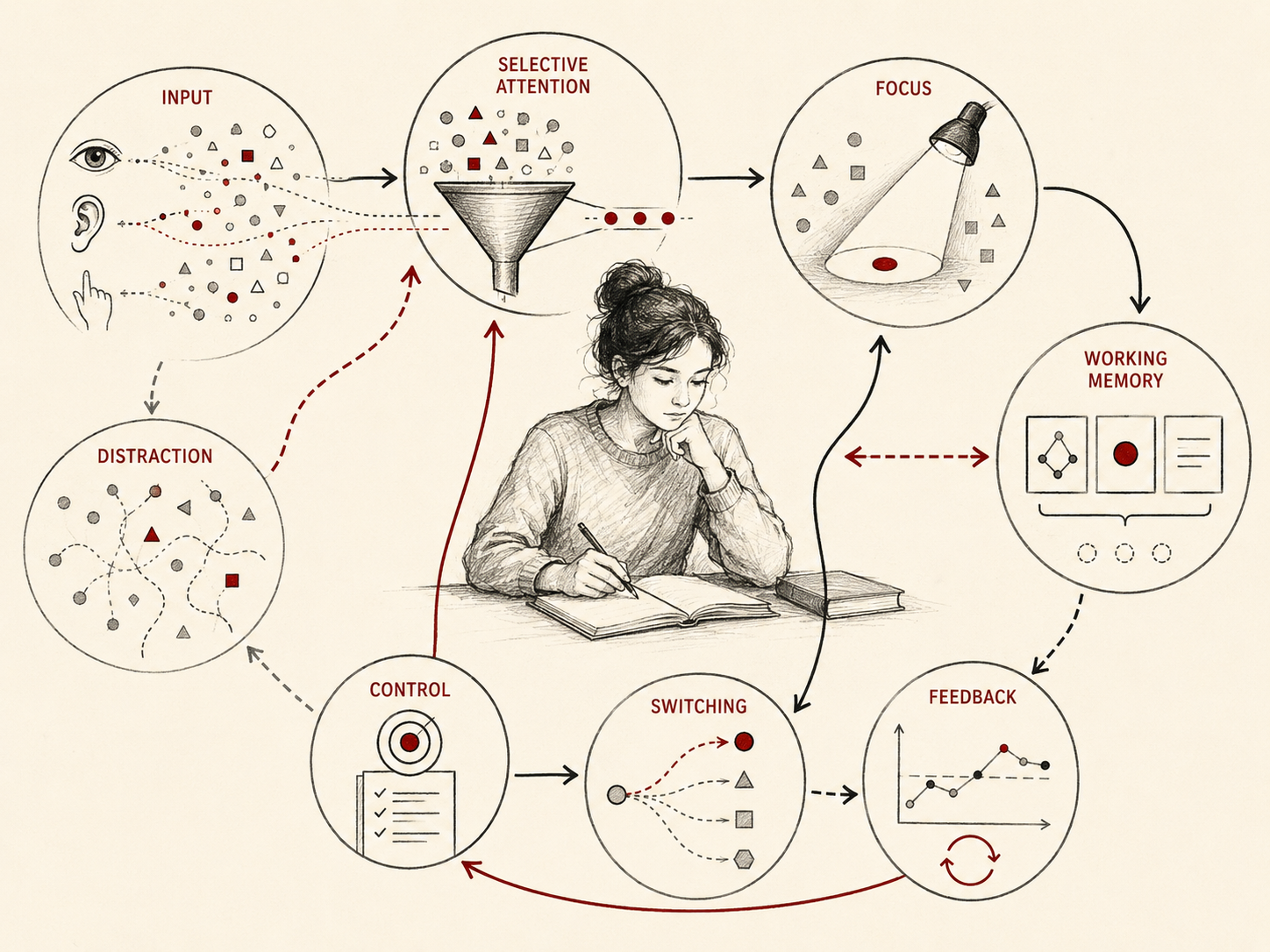
Research on attention now spans experimental psychology, cognitive neuroscience, computational modeling, human factors, education, philosophy of mind, machine learning, and the design of digital environments. Early theories treated attention as a filter imposed by severe capacity limits. Later work complicated that picture by emphasizing attenuation, resource allocation, competition, executive control, vigilance, network organization, and distributed neural systems. More recent approaches increasingly treat attention not as a single faculty, but as a family of interacting processes involving selection, orienting, alerting, control, prioritization, uncertainty regulation, and the management of limited cognitive resources.
What is attention?
Psychologists often define attention as the selective directedness of mental life, but that phrase becomes more meaningful when understood as part of a broader control system. At any moment, the mind faces multiple streams of input: sights, sounds, memories, intentions, bodily states, emotional reactions, goals, language, social cues, and potential actions. These cannot all be processed equally or simultaneously. Attention governs that uneven distribution. It determines what is amplified, what is suppressed, what is sustained, and what is reoriented when circumstances change.
Attention is not simply “concentrating harder.” It includes several distinct but related operations:
- selecting relevant information from a noisy environment;
- amplifying weak but important signals;
- maintaining focus across time;
- shifting attention when goals or context change;
- dividing limited resources across concurrent demands when possible;
- inhibiting distraction, interference, and prepotent responses;
- holding task goals in place so perception and action remain organized;
- prioritizing information according to salience, relevance, value, risk, and uncertainty;
- regulating vigilance during prolonged monitoring.
This is why attention matters across cognition as a whole. It shapes memory because what is not attended is less likely to be encoded. It shapes decision making because people cannot weigh what they do not notice. It shapes perception because the experienced world is filtered through selective sensitivity. It also constrains working memory, since only a limited amount of information can be actively maintained and manipulated at once.
In this sense, attention is not simply another chapter in the study of cognition. It is one of the deeper organizing processes through which cognition becomes selective, ordered, and responsive to the world.
Historical foundations of attention research
The study of attention has roots that reach well beyond modern psychology. Philosophers and early psychologists recognized that consciousness is structured by limitation and selection. William James’s classic account of attention as the mind taking possession of one out of several possible objects or trains of thought remains influential because it captures a central fact of mental life: the world presents more than the mind can hold at once.
In the twentieth century, attention became a central experimental problem as psychology adopted information-processing frameworks. Work in communications, listening tasks, aviation, radar monitoring, military performance, and industrial safety made clear that human cognition operates under real constraints. Under conditions of overload, some information must be selected, some delayed, and some ignored altogether.
From this point forward, several major questions shaped the field. Does selection occur early, before meaning is extracted? Can unattended information still be processed semantically? Is attention best understood as a filter, a limited pool of resources, a competitive priority system, a set of neural networks, or a control process that continuously regulates uncertainty and action?
Those questions helped define modern cognitive psychology and continue to structure research on awareness, cognitive control, mental effort, vigilance, human error, multitasking, and the design of environments that either support or exploit human limitation.
Early selection, attenuation, and late selection
Some of the most influential theories of attention emerged from studies of dichotic listening, in which different auditory streams are presented simultaneously to each ear. These studies made attention experimentally visible because participants could shadow one stream while ignoring another, allowing researchers to ask what happens to unattended information.
Broadbent’s filter model proposed that incoming information is first registered for simple physical properties such as loudness, location, or pitch, after which a filter selects one stream for deeper processing. The logic was direct: because processing capacity is limited, the system must choose early.
Treisman’s attenuation model preserved this general architecture but softened its rigidity. On this account, unattended information is not fully blocked. It is attenuated, or reduced in strength. This helps explain why certain words, personally meaningful stimuli, or highly expected material can still break through even when they are not the primary focus of attention.
Late selection theories moved further still, proposing that unattended information may undergo more processing than early-selection models allow. On this view, semantic analysis may occur before final selection is resolved.
These models remain important because they formalized enduring problems in the study of attention: where selection occurs, how complete selection is, how much processing unattended input receives, and how capacity limits shape conscious experience and behavior.
Contemporary research no longer treats these theories as mutually exclusive in a simple way. Selection may occur at different stages depending on task demands, perceptual load, expectancy, stimulus strength, goal relevance, and the form of competition. The enduring lesson is that attention is selective, but selection is not governed by one fixed gate.
Capacity, resource, and load theories
Not all theories approached attention primarily as a filter. Capacity theories instead treated it as a limited pool of mental effort or processing resources that can be allocated across tasks. Daniel Kahneman’s work was especially influential in shaping this perspective. Rather than asking only where attention selects, resource theories ask how much processing capacity is available, how that capacity is distributed, and what happens when demands exceed it.
This perspective helps explain why multitasking is often costly, why fatigue and stress degrade performance, and why practice can reduce the attentional demands of familiar activities. Some tasks become less effortful over time because parts of their processing become more automatic. Others continue to require active control because they involve conflict, novelty, uncertainty, or unstable goals.
Multiple-resource theory further refines this view by suggesting that different tasks interfere more when they draw on overlapping resources. Two tasks may be easier to combine when they rely on different modalities or response systems, and harder to combine when they compete for the same perceptual, cognitive, or motor channel.
Load theory later refined the relationship between attention and distraction by distinguishing between perceptual load and cognitive-control load. Under some conditions, high perceptual demands reduce distraction because available resources are fully engaged by the task. Under other conditions, heavy control demands weaken the ability to suppress irrelevant input. This helps explain why distraction does not follow a single law across all settings, but instead varies with task structure and the state of the person performing it.
These theories are especially important in modern environments where distraction is often designed, engineered, and monetized. Attention is not merely an individual discipline problem. It is a resource shaped by interfaces, institutions, work systems, media environments, notification systems, and social demands.
Major forms of attention
Selective attention
Selective attention allows the mind to prioritize one stimulus, object, location, feature, or task while limiting interference from competing input. It is what makes it possible to follow one conversation in a noisy room, locate a target in visual clutter, or focus on a line of reasoning while irrelevant material remains in the background.
Divided attention
Divided attention refers to the distribution of resources across multiple demands. In practice, this distribution is often less efficient than people assume. Human multitasking is usually partial, sequential, or dependent on whether the tasks draw on overlapping systems. Apparent multitasking often involves rapid switching rather than true parallel control.
Sustained attention
Sustained attention concerns the maintenance of focus across time. It is essential for reading, studying, monitoring, analysis, driving, medical observation, security screening, and any task in which alertness must be preserved despite monotony or fatigue.
Alternating attention
Alternating attention involves shifting between tasks, rules, or mental sets. Such shifts are rarely cost-free. They often involve reconfiguration, interference, and measurable delays. This is why task switching can impair productivity even when each task is simple on its own.
Executive attention
Executive attention refers to the regulation of conflict, distraction, inhibition, and goal maintenance. It is especially important wherever cognition must remain stable in the presence of competing responses, intrusive cues, changing demands, or emotionally salient information.
Overt and covert attention
Overt attention involves visible orienting, such as turning the eyes or head. Covert attention refers to shifts in processing priority that occur without overt movement. The distinction matters because attention can move before the body does, and sometimes without the body moving at all.
Internal attention
Internal attention refers to the prioritization of mental representations rather than external stimuli. A person may attend to a memory, mental image, mathematical relation, inner speech, imagined future, or decision option. This form of attention connects selection to working memory, reasoning, and self-regulation.
Formalizing attention: core mathematical ideas
Although attention is often described qualitatively, many of its central dynamics can be expressed in formal terms. Resource allocation, competition, signal enhancement, and vigilance across time all lend themselves to mathematical representation.
A simple way to represent attentional allocation begins with finite capacity \(C\) distributed across \(n\) tasks or stimuli:
\sum_{i=1}^{n}a_i\leq C,\qquad a_i\geq0
\]
Interpretation: Attention assigned across tasks or stimuli \(a_i\) must remain within total available capacity \(C\).
Performance on a given task can then be modeled as a saturating function of allocation:
P_i=\frac{\alpha_i a_i}{\beta_i+a_i}
\]
Interpretation: Performance \(P_i\) improves with attention allocation \(a_i\), but additional allocation eventually produces diminishing returns.
Competition among stimuli can also be represented through weighted priority. Let the raw priority of item \(i\) depend on bottom-up salience \(S_i\), top-down goal relevance \(G_i\), learned value \(V_i\), and expected uncertainty reduction \(U_i\):
w_i=\exp(\lambda_1S_i+\lambda_2G_i+\lambda_3V_i+\lambda_4U_i)
\]
Interpretation: Each item receives attentional weight from salience, goal relevance, learned value, and expected information value.
The probability that item \(i\) is selected can then be expressed as:
Pr(i)=\frac{w_i}{\sum_{j=1}^{n}w_j}
\]
Interpretation: A softmax-style rule converts competing attention weights into selection probabilities.
In vigilance tasks, attentional readiness across time can be expressed as a decaying state:
A(t)=A_0e^{-kt}+\epsilon_t
\]
Interpretation: Attentional readiness \(A(t)\) may decline over time at rate \(k\), with short-term fluctuation \(\epsilon_t\).
In cueing paradigms, valid-cue benefits and invalid-cue costs are often represented as:
\Delta_{\text{benefit}}=RT_{\text{neutral}}-RT_{\text{valid}},\qquad
\Delta_{\text{cost}}=RT_{\text{invalid}}-RT_{\text{neutral}}
\]
Interpretation: Valid cues reduce response time relative to neutral cues, while invalid cues increase response time because attention must be reoriented.
These formal models are simplified, but they are useful because they make attention measurable. They allow researchers to distinguish capacity, salience, goal relevance, vigilance, cueing, response bias, and decision time rather than treating attention as one undifferentiated “focus” variable.
Signal detection, sensitivity, and criterion
Many attention tasks, especially those involving vigilance, monitoring, visual search, safety alerts, and target detection, are well analyzed using signal detection theory. This framework is valuable because it distinguishes perceptual sensitivity from response bias. Missing a signal and withholding a response are not always the same kind of failure.
If the hit rate is \(H\) and the false-alarm rate is \(F\), sensitivity \(d’\) is given by:
d’=z(H)-z(F)
\]
Interpretation: Sensitivity \(d’\) estimates how well the participant separates signal from noise.
Response criterion is given by:
c=-\frac{1}{2}\left[z(H)+z(F)\right]
\]
Interpretation: Criterion \(c\) estimates whether the participant is responding conservatively or liberally.
A larger \(d’\) indicates better separation between signal and noise. A positive \(c\) reflects more conservative responding, while a negative \(c\) reflects a more liberal response tendency. Attention manipulations can influence one, the other, or both. A cue may genuinely improve sensitivity, but a change in target prevalence may shift criterion more than perception itself.
This matters because declining performance over time may reflect weaker discrimination, a change in willingness to respond, or some combination of the two. A researcher who records only percent correct may miss the difference between a participant who no longer sees the signal and a participant who sees it but becomes reluctant to respond.
Signal detection is therefore useful not only for laboratory attention tasks, but also for radiology, security screening, warning systems, quality control, driving alerts, medical monitoring, and AI-assisted detection systems where false alarms and missed targets have different consequences.
Reaction time, sequential sampling, and drift-diffusion models
Reaction time is one of the most widely used measures in attention research because it provides a sensitive behavioral readout of prioritization, conflict, interference, expectation, and preparation. But average response time by itself is often too blunt an instrument. Reaction-time distributions are usually skewed, different portions of the distribution can respond differently to experimental manipulations, and speed-accuracy tradeoffs can hide important underlying changes.
Sequential sampling models provide a more refined framework. In the drift-diffusion model, evidence accumulates over time until a decision threshold is reached:
dx_t=v\,dt+s\,dW_t
\]
Interpretation: The decision variable \(x_t\) changes according to drift rate \(v\), noise scale \(s\), and stochastic fluctuation \(dW_t\).
A response occurs once evidence reaches a decision boundary, and nondecision time captures encoding and motor execution. Attention can influence this process in several ways. It can improve drift rate by increasing the quality of evidence, alter threshold by changing caution, affect starting bias through expectation, or change nondecision time by modifying encoding or preparation.
That is why superficially similar reaction-time effects can arise from different underlying processes. A valid cue may speed response by improving perceptual encoding. A warning may speed response by lowering decision threshold. A difficult distractor may slow response by reducing drift rate. A task switch may add nondecision time because the system must reconfigure the task set.
For research-grade analysis, reaction time should therefore be analyzed alongside accuracy, signal detection, cueing effects, confidence, and trial-level predictors rather than treated as an isolated measure.
Sustained attention and vigilance decrement
One of the most robust findings in the literature is the vigilance decrement: performance often worsens over time during prolonged monitoring, particularly when targets are rare and task environments are repetitive. This decline has been explained in several ways, including resource depletion, underload and mind wandering, declining arousal, shifting expectations, and opportunity-cost accounts in which prolonged monitoring becomes increasingly difficult to sustain.
At the level of statistical modeling, hit probability over time block \(t\) can be represented as:
\text{logit}\{Pr(\text{hit}_{it}=1)\}=\beta_0+\beta_1t+\beta_2\text{condition}_i+\beta_3(t\times\text{condition}_i)+u_{0i}+u_{1i}t
\]
Interpretation: A negative time coefficient \(\beta_1\) indicates declining detection as time-on-task increases, while random effects capture individual differences.
The hazard of lapse can also be modeled continuously:
h(t)=h_0\exp(\gamma t)
\]
Interpretation: If \(\gamma>0\), the risk of attentional lapse increases over time.
Vigilance matters because many critical systems depend on rare-event detection. Air traffic control, driving, medical monitoring, industrial safety, cybersecurity, quality assurance, and AI-assisted review all require humans to sustain attention under conditions where nothing may happen for long periods. Such systems can fail not because people lack responsibility, but because the task structure is hostile to human attention.
Good design should therefore avoid assuming unlimited vigilance. It should support appropriate alerting, task rotation, rest, redundancy, automation transparency, uncertainty display, and escalation pathways while avoiding alarm fatigue.
Inattentional blindness and the limits of awareness
One of the most striking discoveries in attention research is that people can fail to notice highly visible events when their attention is occupied elsewhere. This phenomenon, known as inattentional blindness, demonstrates that awareness depends not simply on what is present in the environment, but on what the system is prepared to process.
The best-known demonstration is the “invisible gorilla” paradigm, in which participants focused on a counting task often fail to notice a conspicuous unexpected event. The importance of such findings lies in what they reveal about conscious experience more broadly: perception is not a complete copy of the external world. It is structured by selective engagement, task demands, and expectation.
This has consequences well beyond the laboratory. Inattentional blindness matters in radiology, driving, security screening, cockpit monitoring, eyewitness observation, interface design, and any setting in which a missed signal can have serious consequences.
It also carries an important ethical and institutional lesson. Failure to notice is not always negligence. It can be a predictable consequence of task design. Systems that rely on people to notice unexpected events while their attention is heavily loaded should be treated as fragile systems, not as proof that individuals are simply careless.
Attentional networks and cognitive neuroscience
Contemporary neuroscience increasingly describes attention as the product of distributed systems rather than a single localized mechanism. Michael Posner’s influential framework distinguishes three broad functions:
- Alerting — readiness, vigilance, and state regulation.
- Orienting — shifting processing toward relevant locations, objects, features, or modalities.
- Executive control — regulating conflict, interference, inhibition, and goal maintenance.
Subsequent work has expanded this picture to include dorsal and ventral attention systems, frontoparietal control networks, salience-related systems, thalamic modulation, and subcortical contributions to alerting and orienting. At the neural level, attention has been associated with gain modulation, altered receptive-field properties, synchronization, reduced interneuronal correlation, and improved population coding for behaviorally relevant signals.
One influential way of representing attentional gain is through normalization models, in which neuronal response \(R_i\) is expressed as:
R_i=\frac{G_iE_i}{\sigma+\sum_jE_j}
\]
Interpretation: Neural response depends on excitatory drive \(E_i\), attentional gain \(G_i\), and normalization across competing inputs.
This helps explain how relevant signals can be enhanced without assuming unlimited amplification. Attention increases priority, but signals still compete within finite neural and cognitive systems.
Neuroscience also reinforces the idea that attention is not one thing. Alertness, spatial orienting, feature selection, conflict control, response inhibition, and sustained vigilance rely on overlapping but distinct systems. A person may struggle with one form of attention while another remains relatively preserved.
Attention, working memory, and learning
Attention is deeply intertwined with memory and learning. Information that never receives sufficient attention is unlikely to be encoded in a durable form. At the same time, working memory itself depends on attentional prioritization, especially when several representations compete for maintenance.
A simple gated update formulation expresses this relationship:
m_t=g_t\odot x_t+(1-g_t)\odot m_{t-1}
\]
Interpretation: Working-memory state \(m_t\) depends on incoming information \(x_t\), prior state \(m_{t-1}\), and an attentional gate \(g_t\).
In cognitive terms, attention determines what gets in, what remains stable, and what is displaced. This helps explain why divided attention at encoding often produces shallow memory traces, while sustained and organized focus tends to support stronger comprehension, richer encoding, and better later retrieval.
Attention also shapes learning by determining what learners treat as relevant. A student may look at a diagram but fail to attend to the causal relation it is meant to show. A novice may attend to surface features while an expert attends to structure. A worker may attend to what is visually salient rather than what is operationally important. Learning environments must therefore guide attention, not merely present information.
Good instructional design uses signaling, segmentation, worked examples, spatial alignment, retrieval practice, and reduction of extraneous load to help learners allocate attention to meaningful structure. In that sense, attention is one of the mechanisms through which information becomes learnable.
Attention and decision making
Decision making depends not only on reasoning but on prior selection. People cannot evaluate what never receives sufficient attention. This is one reason attention has become central to work in judgment, behavioral economics, consumer choice, risk perception, and neuroeconomics.
An attention-weighted representation of utility can be written as:
U_i^*=\sum_{k=1}^{K}\omega_{ik}a_{ik}x_{ik}
\]
Interpretation: The evaluated utility \(U_i^*\) of option \(i\) depends on attribute values \(x_{ik}\), importance weights \(\omega_{ik}\), and attentional weights \(a_{ik}\).
Because attention changes across time and context, evaluation itself becomes dynamic. Salient, emotionally vivid, repeatedly fixated, recently mentioned, or interface-highlighted attributes can acquire disproportionate influence over judgment and choice.
This is why attention is not merely downstream of valuation. It helps constitute the very information that valuation operates on. Defaults, rankings, warnings, labels, colors, pop-ups, social proof, scarcity cues, and recommendation systems all influence decisions partly by directing attention.
For high-stakes decisions, this matters ethically. A system that makes certain options salient and others obscure does not merely present choices. It structures the attention through which choice becomes possible.
Attention, interfaces, and human-computer interaction
Digital interfaces are attention-management systems. They determine what becomes visible, what interrupts, what appears urgent, what is hidden, what competes for the user’s focus, and what must be remembered across screens. For this reason, attention research is central to human-computer interaction.
Interface design can support attention by:
- using visual hierarchy to prioritize critical information;
- separating urgent signals from routine signals;
- reducing unnecessary clutter;
- grouping related elements perceptually;
- minimizing task switching;
- preserving context across steps;
- limiting nonessential notifications;
- making system status visible;
- supporting resumption after interruption;
- designing alerts that are noticeable without producing alarm fatigue.
Bad interface design imposes attentional tax. It forces users to hunt for information, recover from interruptions, remember hidden state, distinguish weak signals from clutter, or respond to too many alerts. In such cases, error may be a predictable consequence of design rather than a personal failure.
Attention-sensitive design asks not only whether information is present, but whether it is available under realistic conditions: time pressure, fatigue, interruption, stress, small screens, accessibility needs, divided attention, and competing goals.
Attention and artificial intelligence systems
The term “attention” now also appears prominently in machine learning, especially in transformer architectures. Computational attention mechanisms allow models to weight relationships among tokens, features, patches, or representations. This technical use is not identical to biological attention, but the comparison is useful when handled carefully.
Biological attention involves embodied action, limited resources, motivation, perception, memory, awareness, fatigue, task goals, and neural control. Machine-learning attention is a computational mechanism for weighting information in a model. The two should not be collapsed into one another. But both concern the prioritization of information within systems that cannot treat all inputs equally at all times.
Attention research can help AI systems in several ways:
- modeling how humans allocate attention during AI-assisted tasks;
- measuring whether AI alerts improve detection or create overreliance;
- analyzing alarm fatigue in automated monitoring;
- designing explanations that guide attention to evidence rather than persuasion;
- studying how interface salience changes trust and verification;
- separating genuine decision support from attention capture;
- building systems that preserve user control rather than exploiting attentional limits.
AI systems can support attention by summarizing, triaging, highlighting anomalies, preserving context, and reducing information overload. But they can also fragment attention, produce false salience, create automation complacency, or hide uncertainty behind fluent output.
Responsible human-AI design should therefore measure attention as an outcome. It should ask whether the system improves detection, comprehension, verification, vigilance, and decision quality — or whether it merely redirects attention in ways that benefit the system rather than the person.
Attention, accessibility, and institutional design
Attention is limited, and those limits are not evenly distributed across environments. Fatigue, disability, stress, poverty, trauma, language barriers, neurodivergence, sensory overload, sleep deprivation, caregiving burden, and administrative complexity can all change the attentional resources people have available for a task.
Institutions can overload attention through:
- fragmented forms and portals;
- unclear instructions;
- excessive notifications;
- dense legal or medical text;
- poor signage;
- unnecessary interruptions;
- confusing eligibility rules;
- hidden deadlines;
- interfaces that require constant switching;
- alert systems that produce alarm fatigue;
- procedures that punish missed information without making it perceptually or cognitively accessible.
This makes attention a justice issue as well as a cognitive one. Systems often assume an idealized user who is rested, literate in the relevant institutional language, uninterrupted, technologically fluent, emotionally regulated, and cognitively available. Many people must navigate the same systems under far more difficult conditions.
A humane institution does not merely provide information. It structures attention responsibly. It makes important signals visible, reduces unnecessary distraction, supports resumption after interruption, provides reminders, avoids manipulative salience, and recognizes that missed information is often a design problem before it is a moral failing.
Experimental paradigms and measurement
Attention research uses a wide range of paradigms, each illuminating different aspects of selection and control:
- Dichotic listening and shadowing tasks — early selection and channel competition.
- Posner cueing paradigms — spatial orienting and reorienting.
- Visual search tasks — feature integration, distractor load, and guided attention.
- Stroop, flanker, and Simon tasks — interference and executive control.
- Continuous performance tasks — sustained attention and vigilance.
- Attentional blink paradigms — temporal limits in serial selection.
- Dual-task paradigms — divided attention and capacity limits.
- Eye-tracking — overt orienting, dwell time, fixation, and attentional allocation.
- EEG and MEG — temporal dynamics such as N2pc, P3, and alpha suppression.
- fMRI — large-scale network organization and task-related functional coupling.
- Computational modeling — drift rate, threshold, lapse probability, and priority weighting.
Methodologically, it is usually important to examine both accuracy and latency rather than relying on one alone. It is also useful to move beyond simple condition averages and model trial-level variation, participant heterogeneity, stimulus heterogeneity, target prevalence, confidence, and the shape of reaction-time distributions. These choices often make the difference between a descriptive result and a more explanatory one.
R code for attention research
The following R workflow illustrates analyses relevant to attention experiments, including signal detection, cueing effects, mixed-effects accuracy models, reaction-time models, vigilance decrement, lapse modeling, and condition summaries.
# Install packages if needed:
# pak::pak(c("tidyverse", "lme4", "lmerTest", "emmeans", "broom.mixed"))

library(tidyverse)
library(lme4)
library(lmerTest)
library(emmeans)
library(broom.mixed)

# Expected columns:
# participant, condition, domain, trial, block, stimulus_id,
# cue_validity, task_type, target_present, response_yes, correct, rt,
# salience, goal_relevance, distractor_load, perceptual_load,
# executive_load, task_switch, conflict, vigilance_state,
# lapse_probability, confidence, interface_salience,
# notification_load, divided_attention_cost

dat <- read_csv("attention_trials.csv") %>%
  mutate(
    participant = factor(participant),
    condition = factor(condition),
    domain = factor(domain),
    stimulus_id = factor(stimulus_id),
    cue_validity = factor(cue_validity, levels = c("invalid", "neutral", "valid", "none")),
    task_type = factor(task_type),
    target_present = as.integer(target_present),
    response_yes = as.integer(response_yes),
    correct = as.integer(correct),
    task_switch = as.integer(task_switch),
    block_z = as.numeric(scale(block)),
    log_rt = log(rt)
  ) %>%
  filter(rt >= 150, rt <= 60000)

# -----------------------------
# 1. Signal-detection metrics
# -----------------------------

sdt <- dat %>%
  group_by(participant, condition) %>%
  summarise(
    hits = sum(target_present == 1 & response_yes == 1, na.rm = TRUE),
    misses = sum(target_present == 1 & response_yes == 0, na.rm = TRUE),
    false_alarms = sum(target_present == 0 & response_yes == 1, na.rm = TRUE),
    correct_rejections = sum(target_present == 0 & response_yes == 0, na.rm = TRUE),
    .groups = "drop"
  ) %>%
  mutate(
    hit_rate = (hits + 0.5) / (hits + misses + 1),
    false_alarm_rate = (false_alarms + 0.5) / (false_alarms + correct_rejections + 1),
    dprime = qnorm(hit_rate) - qnorm(false_alarm_rate),
    criterion = -0.5 * (qnorm(hit_rate) + qnorm(false_alarm_rate))
  )

print(sdt)

# -----------------------------
# 2. Condition summary
# -----------------------------

condition_summary <- dat %>%
  group_by(condition) %>%
  summarise(
    n_trials = n(),
    participants = n_distinct(participant),
    correct_rate = mean(correct, na.rm = TRUE),
    yes_rate = mean(response_yes, na.rm = TRUE),
    mean_rt = mean(rt, na.rm = TRUE),
    mean_confidence = mean(confidence, na.rm = TRUE),
    mean_lapse_probability = mean(lapse_probability, na.rm = TRUE),
    mean_vigilance_state = mean(vigilance_state, na.rm = TRUE),
    mean_distractor_load = mean(distractor_load, na.rm = TRUE),
    mean_executive_load = mean(executive_load, na.rm = TRUE),
    mean_divided_attention_cost = mean(divided_attention_cost, na.rm = TRUE),
    .groups = "drop"
  )

print(condition_summary)

# -----------------------------
# 3. Accuracy model
# -----------------------------

accuracy_model <- glmer(
  correct ~
    condition +
    cue_validity +
    task_type +
    block_z +
    salience +
    goal_relevance +
    distractor_load +
    perceptual_load +
    executive_load +
    task_switch +
    conflict +
    vigilance_state +
    interface_salience +
    notification_load +
    (1 + block_z | participant) +
    (1 | stimulus_id),
  data = dat,
  family = binomial(),
  control = glmerControl(optimizer = "bobyqa")
)

summary(accuracy_model)
emmeans(accuracy_model, ~ condition, type = "response")

# -----------------------------
# 4. Target-present response model
# -----------------------------

response_model <- glmer(
  response_yes ~
    condition +
    cue_validity +
    target_present +
    salience +
    goal_relevance +
    distractor_load +
    perceptual_load +
    executive_load +
    conflict +
    vigilance_state +
    lapse_probability +
    confidence +
    interface_salience +
    (1 | participant) +
    (1 | stimulus_id),
  data = dat,
  family = binomial(),
  control = glmerControl(optimizer = "bobyqa")
)

summary(response_model)

# -----------------------------
# 5. Response-time model
# -----------------------------

rt_dat <- dat %>% filter(correct == 1)

rt_model <- lmer(
  log_rt ~
    condition +
    cue_validity +
    task_type +
    block_z +
    salience +
    goal_relevance +
    distractor_load +
    perceptual_load +
    executive_load +
    task_switch +
    conflict +
    vigilance_state +
    confidence +
    interface_salience +
    notification_load +
    (1 + block_z | participant) +
    (1 | stimulus_id),
  data = rt_dat,
  REML = FALSE
)

summary(rt_model)
emmeans(rt_model, ~ cue_validity)

# -----------------------------
# 6. Vigilance decrement
# -----------------------------

vigilance_model <- glmer(
  correct ~
    block_z * condition +
    vigilance_state +
    lapse_probability +
    distractor_load +
    executive_load +
    (1 + block_z | participant),
  data = dat,
  family = binomial(),
  control = glmerControl(optimizer = "bobyqa")
)

summary(vigilance_model)

# -----------------------------
# 7. Lapse model
# -----------------------------

lapse_model <- lmer(
  lapse_probability ~
    condition +
    block_z +
    vigilance_state +
    distractor_load +
    executive_load +
    notification_load +
    divided_attention_cost +
    (1 + block_z | participant),
  data = dat,
  REML = FALSE
)

summary(lapse_model)

# -----------------------------
# 8. Posner-style cueing effects
# -----------------------------

cue_effects <- rt_dat %>%
  filter(cue_validity %in% c("valid", "neutral", "invalid")) %>%
  group_by(participant, condition, cue_validity) %>%
  summarise(mean_rt = mean(rt, na.rm = TRUE), .groups = "drop") %>%
  pivot_wider(names_from = cue_validity, values_from = mean_rt) %>%
  mutate(
    orienting_benefit = neutral - valid,
    reorienting_cost = invalid - neutral,
    total_validity_effect = invalid - valid
  )

print(cue_effects)

# -----------------------------
# 9. Vigilance plot
# -----------------------------

dat %>%
  group_by(condition, block) %>%
  summarise(
    correct_rate = mean(correct),
    lapse = mean(lapse_probability),
    .groups = "drop"
  ) %>%
  ggplot(aes(x = block, y = correct_rate, color = condition)) +
  geom_point(alpha = 0.75) +
  geom_line(alpha = 0.75) +
  labs(
    title = "Sustained attention across time-on-task",
    x = "Block",
    y = "Correct rate"
  ) +
  theme_minimal()
This workflow can be adapted for cueing, visual search, continuous performance, Stroop, flanker, Simon, dual-task, attentional blink, HCI notification, safety-monitoring, medical-monitoring, and human-AI attention-support experiments. Researchers should model participant and stimulus effects whenever possible because attentional performance varies across people, tasks, stimuli, contexts, and time-on-task.
Python code for attention research
The Python examples below parallel the R workflow and are useful for signal detection, cueing effects, vigilance decrement, response-time modeling, lapse estimation, and drift-diffusion style simulation.
import numpy as np
import pandas as pd
from scipy.stats import norm
import statsmodels.formula.api as smf
import statsmodels.api as sm
import matplotlib.pyplot as plt

# Expected columns:
# participant, condition, domain, trial, block, stimulus_id,
# cue_validity, task_type, target_present, response_yes, correct, rt,
# salience, goal_relevance, distractor_load, perceptual_load,
# executive_load, task_switch, conflict, vigilance_state,
# lapse_probability, confidence, interface_salience,
# notification_load, divided_attention_cost

df = pd.read_csv("attention_trials.csv")

categorical_cols = [
    "participant", "condition", "domain", "stimulus_id",
    "cue_validity", "task_type"
]

for col in categorical_cols:
    df[col] = df[col].astype("category")

df["target_present"] = df["target_present"].astype(int)
df["response_yes"] = df["response_yes"].astype(int)
df["correct"] = df["correct"].astype(int)
df["task_switch"] = df["task_switch"].astype(int)
df["block_z"] = (df["block"] - df["block"].mean()) / df["block"].std()
df["log_rt"] = np.log(df["rt"])

# -----------------------------
# 1. Signal-detection metrics
# -----------------------------

def hautus_rate(k, n):
    return (k + 0.5) / (n + 1)

rows = []

for (participant, condition), g in df.groupby(["participant", "condition"], observed=True):
    hits = ((g["target_present"] == 1) & (g["response_yes"] == 1)).sum()
    misses = ((g["target_present"] == 1) & (g["response_yes"] == 0)).sum()
    false_alarms = ((g["target_present"] == 0) & (g["response_yes"] == 1)).sum()
    correct_rejections = ((g["target_present"] == 0) & (g["response_yes"] == 0)).sum()

    hit_rate = hautus_rate(hits, hits + misses)
    false_alarm_rate = hautus_rate(false_alarms, false_alarms + correct_rejections)

    rows.append({
        "participant": participant,
        "condition": condition,
        "hits": hits,
        "misses": misses,
        "false_alarms": false_alarms,
        "correct_rejections": correct_rejections,
        "hit_rate": hit_rate,
        "false_alarm_rate": false_alarm_rate,
        "dprime": norm.ppf(hit_rate) - norm.ppf(false_alarm_rate),
        "criterion": -0.5 * (norm.ppf(hit_rate) + norm.ppf(false_alarm_rate)),
    })

sdt = pd.DataFrame(rows)
print(sdt.groupby("condition", observed=True)[["dprime", "criterion"]].agg(["mean", "std"]))

# -----------------------------
# 2. Condition summary
# -----------------------------

condition_summary = (
    df.groupby("condition", observed=True)
    .agg(
        n_trials=("correct", "size"),
        participants=("participant", "nunique"),
        correct_rate=("correct", "mean"),
        yes_rate=("response_yes", "mean"),
        mean_rt=("rt", "mean"),
        mean_confidence=("confidence", "mean"),
        mean_lapse_probability=("lapse_probability", "mean"),
        mean_vigilance_state=("vigilance_state", "mean"),
        mean_distractor_load=("distractor_load", "mean"),
        mean_executive_load=("executive_load", "mean"),
        mean_divided_attention_cost=("divided_attention_cost", "mean"),
    )
    .reset_index()
)

print(condition_summary)

# -----------------------------
# 3. Accuracy model
# -----------------------------

accuracy_model = smf.glm(
    "correct ~ condition + cue_validity + task_type + block_z "
    "+ salience + goal_relevance + distractor_load + perceptual_load "
    "+ executive_load + task_switch + conflict + vigilance_state "
    "+ interface_salience + notification_load",
    data=df,
    family=sm.families.Binomial(),
)

accuracy_result = accuracy_model.fit(
    cov_type="cluster",
    cov_kwds={"groups": df["participant"]},
)

print(accuracy_result.summary())

# -----------------------------
# 4. Target-present response model
# -----------------------------

response_model = smf.glm(
    "response_yes ~ condition + cue_validity + target_present "
    "+ salience + goal_relevance + distractor_load + perceptual_load "
    "+ executive_load + conflict + vigilance_state + lapse_probability "
    "+ confidence + interface_salience",
    data=df,
    family=sm.families.Binomial(),
)

response_result = response_model.fit(
    cov_type="cluster",
    cov_kwds={"groups": df["participant"]},
)

print(response_result.summary())

# -----------------------------
# 5. Response-time model
# -----------------------------

rt_df = df[(df["rt"] >= 150) & (df["correct"] == 1)].copy()

rt_model = smf.ols(
    "log_rt ~ condition + cue_validity + task_type + block_z "
    "+ salience + goal_relevance + distractor_load + perceptual_load "
    "+ executive_load + task_switch + conflict + vigilance_state "
    "+ confidence + interface_salience + notification_load",
    data=rt_df,
)

rt_result = rt_model.fit(
    cov_type="cluster",
    cov_kwds={"groups": rt_df["participant"]},
)

print(rt_result.summary())

# -----------------------------
# 6. Vigilance decrement
# -----------------------------

vigilance_model = smf.glm(
    "correct ~ block_z * condition + vigilance_state "
    "+ lapse_probability + distractor_load + executive_load",
    data=df,
    family=sm.families.Binomial(),
)

vigilance_result = vigilance_model.fit(
    cov_type="cluster",
    cov_kwds={"groups": df["participant"]},
)

print(vigilance_result.summary())

# -----------------------------
# 7. Posner-style cueing effects
# -----------------------------

cue_df = rt_df[rt_df["cue_validity"].isin(["valid", "neutral", "invalid"])].copy()

cue_means = (
    cue_df.groupby(["participant", "condition", "cue_validity"], observed=True)["rt"]
    .mean()
    .unstack("cue_validity")
    .reset_index()
)

cue_means["orienting_benefit"] = cue_means["neutral"] - cue_means["valid"]
cue_means["reorienting_cost"] = cue_means["invalid"] - cue_means["neutral"]
cue_means["total_validity_effect"] = cue_means["invalid"] - cue_means["valid"]

print(
    cue_means.groupby("condition", observed=True)[
        ["orienting_benefit", "reorienting_cost", "total_validity_effect"]
    ].agg(["mean", "std"])
)

# -----------------------------
# 8. Drift-diffusion style simulation
# -----------------------------

def simulate_ddm(
    n_trials=5000,
    drift=0.20,
    threshold=1.0,
    noise=1.0,
    dt=0.01,
    ndt=0.30,
    bias=0.5,
):
    rts = []
    choices = []

    for _ in range(n_trials):
        x = threshold * (2 * bias - 1)
        t = 0.0

        while abs(x) < threshold and t < 10:
            x += drift * dt + noise * np.sqrt(dt) * np.random.normal()
            t += dt

        rts.append(t + ndt)
        choices.append(1 if x >= threshold else 0)

    return pd.DataFrame({"rt_seconds": rts, "choice": choices})

sim_valid = simulate_ddm(drift=0.28, threshold=1.0, ndt=0.28)
sim_invalid = simulate_ddm(drift=0.18, threshold=1.0, ndt=0.31)

sim_valid["cue_validity"] = "valid"
sim_invalid["cue_validity"] = "invalid"

sim = pd.concat([sim_valid, sim_invalid], ignore_index=True)

print(sim.groupby("cue_validity")["rt_seconds"].describe())

fig, ax = plt.subplots(figsize=(8, 5))

for label, group in sim.groupby("cue_validity"):
    ax.hist(group["rt_seconds"], bins=50, density=True, alpha=0.35, label=label)

ax.set_xlabel("Reaction time (s)")
ax.set_ylabel("Density")
ax.set_title("Simulated drift-diffusion reaction-time distributions")
ax.legend()
plt.tight_layout()
plt.show()

# -----------------------------
# 9. Export summaries
# -----------------------------

condition_summary.to_csv("attention_condition_summary.csv", index=False)
sdt.to_csv("attention_signal_detection_summary.csv", index=False)
cue_means.to_csv("attention_cueing_effects.csv", index=False)
The Python workflow is intentionally transparent and extensible. It can be expanded with Bayesian hierarchical models, diffusion-model estimation packages, eye-tracking features, EEG/ERP measures, target-prevalence manipulations, visual-search slope estimation, notification-load experiments, fatigue models, interface-salience testing, and human-AI attention-support evaluation.
GitHub Repository
The companion repository provides reusable code and research scaffolding for studying attention in cognitive psychology, including workflows for cueing, vigilance, signal detection, response time, attentional load, executive control, divided attention, distractor interference, lapse probability, confidence, interface salience, notification load, and human-AI attention support.
Complete Code Repository
Access the full companion repository for this article, including reproducible analysis materials and multi-language code workflows for attention research.
Applications of attention research
Attention research has practical importance across a wide range of domains. In education, it informs instructional design, cognitive load management, visual signaling, classroom design, reading environments, and the structuring of tasks that support comprehension rather than fragmentation. In transportation and aviation, it helps explain the risks of distraction, alarm overload, monotony, inattentional blindness, and attentional tunneling.
In medicine, attention matters for radiological search, patient monitoring, surgery, diagnosis, medication safety, shift work, and handoff communication. In human-computer interaction, it guides decisions about interface salience, notification systems, interruption management, visual hierarchy, and the costs of competing signals.
In organizations, attention research helps explain why meetings, dashboards, alerts, emails, chat systems, and multitasking cultures can degrade performance. In law and public safety, it helps clarify the limits of eyewitness observation, the effects of stress, and the risk of missed signals under focused task demands.
More broadly, attention has become a defining issue in modern environments saturated with information. The struggle for attention now shapes media systems, digital platforms, institutional design, advertising, learning environments, and daily cognitive life. For that reason, the study of attention reaches beyond psychology into the broader question of how environments are built to align with or exploit the limits of human cognition.
Debates, limitations, and open questions
Despite decades of research, attention remains theoretically unsettled. No single model fully explains all forms of attentional selection across modalities, timescales, developmental stages, neural systems, social contexts, and levels of analysis.
Filter theories, attenuation accounts, capacity models, load theory, biased competition, feature-integration approaches, predictive frameworks, network-based models, and computational attention mechanisms each illuminate part of the picture without exhausting it.
Several important questions remain open:
- how attention relates to consciousness;
- how value, emotion, and motivation reshape attentional priority;
- whether vigilance failure reflects depletion, underload, strategic disengagement, fatigue, or some combination;
- how attention interacts with working-memory precision and uncertainty;
- how well laboratory findings generalize to real-world environments;
- how computational uses of “attention” in machine learning do and do not map onto biological attention;
- how attention develops across the lifespan;
- how attentional control differs across individuals and clinical populations;
- how digital environments reshape attentional habits over time;
- how to design institutions that respect rather than exploit attentional limits.
There are also methodological concerns. Some paradigms show modest reliability, many effects vary across context, and behavioral data alone often underdetermine mechanism. For these reasons, current work increasingly benefits from richer modeling, larger samples, multimodal measurement, preregistered designs, longitudinal studies, and tasks that move closer to the structure of real attentional demands.
Attention research is strongest when it avoids reducing attention to a single metaphor. Attention is not only a spotlight, filter, resource, network, gate, or computational weight. It is a family of selection and control processes that must be studied across behavior, brain, environment, body, and task structure.
Conclusion
Attention is one of the central organizing processes of cognition because it governs how limited minds achieve selective perception, stable thought, meaningful learning, and adaptive action in the face of competing demands. From early filter models to distributed network accounts, research on attention has shown that cognition depends fundamentally on prioritization.
Its significance lies in more than the ordinary idea of focus. Attention regulates evidence quality, shapes awareness, constrains memory, guides decision making, and determines which parts of the world become mentally available at all. It is one of the clearest examples of how limited cognition nevertheless produces structured experience and coherent behavior.
Attention also has social, ethical, and institutional importance. Environments can protect attention, support attention, fragment attention, manipulate attention, or punish people for predictable attentional failure. A serious account of attention must therefore include not only the laboratory mind, but also the designed world in which attention is spent.
For that reason, attention remains indispensable to any serious account of how the mind works: not as a peripheral topic, but as one of the central processes through which cognition becomes organized, selective, and capable of acting intelligently in a complex world.
Related articles
- Cognitive Psychology
- Perception in Cognitive Psychology
- Memory in Cognitive Psychology
- Working Memory in Cognitive Psychology
- Cognitive Load and Information Processing
- Decision Making in Cognitive Psychology
- Cognitive Biases and Decision Making
- Cognition and Human-Computer Interaction
- Visual Cognition
- Behavioral Economics
Further reading
- American Psychological Association (n.d.) Attention. APA Dictionary of Psychology. Available at: https://dictionary.apa.org/attention.
- Broadbent, D.E. (1958) Perception and Communication. London: Pergamon Press.
- Bundesen, C. (1990) ‘A theory of visual attention’, Psychological Review, 97(4), pp. 523–547.
- Carrasco, M. (2011) ‘Visual attention: The past 25 years’, Vision Research, 51(13), pp. 1484–1525. Available at: https://pmc.ncbi.nlm.nih.gov/articles/PMC3390154/.
- Corbetta, M. and Shulman, G.L. (2002) ‘Control of goal-directed and stimulus-driven attention in the brain’, Nature Reviews Neuroscience, 3(3), pp. 201–215.
- Desimone, R. and Duncan, J. (1995) ‘Neural mechanisms of selective visual attention’, Annual Review of Neuroscience, 18, pp. 193–222.
- Driver, J. and Egeth, H. (eds.) (1998) Attention and Performance XVII. Oxford: Oxford University Press. Available at: https://global.oup.com/academic/product/attention-and-performance-xvii-9780198524204.
- Kahneman, D. (1973) Attention and Effort. Englewood Cliffs, NJ: Prentice-Hall.
- Lavie, N. (2010) ‘Attention, distraction, and cognitive control under load’, Current Directions in Psychological Science, 19(3), pp. 143–148. Available at: https://journals.sagepub.com/doi/abs/10.1177/0963721410370295.
- Lindsay, G.W. (2020) ‘Attention in psychology, neuroscience, and machine learning’, Frontiers in Computational Neuroscience, 14, 29. Available at: https://www.frontiersin.org/journals/computational-neuroscience/articles/10.3389/fncom.2020.00029/full.
- Macmillan, N.A. and Creelman, C.D. (2005) Detection Theory: A User’s Guide. 2nd edn. Mahwah, NJ: Lawrence Erlbaum Associates.
- Parasuraman, R. (ed.) (1998) The Attentive Brain. Cambridge, MA: MIT Press. Available at: https://mitpress.mit.edu/9780262043259/the-attentive-brain/.
- Petersen, S.E. and Posner, M.I. (2012) ‘The attention system of the human brain: 20 years after’, Annual Review of Neuroscience, 35, pp. 73–89. Available at: https://pmc.ncbi.nlm.nih.gov/articles/PMC3413263/.
- Posner, M.I. (2012) ‘Attention in cognitive neuroscience: An overview’, Annual Review of Psychology, 63, pp. 1–23. Available at: https://www.annualreviews.org/doi/10.1146/annurev-psych-120710-100511.
- Posner, M.I. and Petersen, S.E. (1990) ‘The attention system of the human brain’, Annual Review of Neuroscience, 13, pp. 25–42. Available at: https://www.annualreviews.org/doi/10.1146/annurev.ne.13.030190.002421.
- Ratcliff, R. and McKoon, G. (2008) ‘The diffusion decision model: Theory and data for two-choice decision tasks’, Neural Computation, 20(4), pp. 873–922.
- Simons, D.J. and Chabris, C.F. (1999) ‘Gorillas in our midst: Sustained inattentional blindness for dynamic events’, Perception, 28(9), pp. 1059–1074. PubMed record available at: https://pubmed.ncbi.nlm.nih.gov/10694957/.
- Smithies, D. (2019) ‘Attention’, Stanford Encyclopedia of Philosophy. Available at: https://plato.stanford.edu/entries/attention/.
- Treisman, A.M. (1964) ‘Selective attention in man’, British Medical Bulletin, 20, pp. 12–16.
- Treisman, A. and Gelade, G. (1980) ‘A feature-integration theory of attention’, Cognitive Psychology, 12(1), pp. 97–136.
- Wickens, C.D. (2008) ‘Multiple resources and mental workload’, Human Factors, 50(3), pp. 449–455.
References
- American Psychological Association (n.d.) Attention. APA Dictionary of Psychology. Available at: https://dictionary.apa.org/attention.
- Broadbent, D.E. (1958) Perception and Communication. London: Pergamon Press.
- Bundesen, C. (1990) ‘A theory of visual attention’, Psychological Review, 97(4), pp. 523–547.
- Carrasco, M. (2011) ‘Visual attention: The past 25 years’, Vision Research, 51(13), pp. 1484–1525. Available at: https://pmc.ncbi.nlm.nih.gov/articles/PMC3390154/.
- Corbetta, M. and Shulman, G.L. (2002) ‘Control of goal-directed and stimulus-driven attention in the brain’, Nature Reviews Neuroscience, 3(3), pp. 201–215.
- Desimone, R. and Duncan, J. (1995) ‘Neural mechanisms of selective visual attention’, Annual Review of Neuroscience, 18, pp. 193–222.
- Kahneman, D. (1973) Attention and Effort. Englewood Cliffs, NJ: Prentice-Hall.
- Lavie, N. (2004) ‘A load theory of attention and cognitive control’, Journal of Experimental Psychology: General, 133(3), pp. 339–354. PubMed record available at: https://pubmed.ncbi.nlm.nih.gov/15355143/.
- Lavie, N. (2010) ‘Attention, distraction, and cognitive control under load’, Current Directions in Psychological Science, 19(3), pp. 143–148. Available at: https://journals.sagepub.com/doi/abs/10.1177/0963721410370295.
- Lindsay, G.W. (2020) ‘Attention in psychology, neuroscience, and machine learning’, Frontiers in Computational Neuroscience, 14, 29. Available at: https://www.frontiersin.org/journals/computational-neuroscience/articles/10.3389/fncom.2020.00029/full.
- Macmillan, N.A. and Creelman, C.D. (2005) Detection Theory: A User’s Guide. 2nd edn. Mahwah, NJ: Lawrence Erlbaum Associates.
- Petersen, S.E. and Posner, M.I. (2012) ‘The attention system of the human brain: 20 years after’, Annual Review of Neuroscience, 35, pp. 73–89. Available at: https://pmc.ncbi.nlm.nih.gov/articles/PMC3413263/.
- Posner, M.I. (2012) ‘Attention in cognitive neuroscience: An overview’, Annual Review of Psychology, 63, pp. 1–23. Available at: https://www.annualreviews.org/doi/10.1146/annurev-psych-120710-100511.
- Posner, M.I. and Petersen, S.E. (1990) ‘The attention system of the human brain’, Annual Review of Neuroscience, 13, pp. 25–42. Available at: https://www.annualreviews.org/doi/10.1146/annurev.ne.13.030190.002421.
- Ratcliff, R. and McKoon, G. (2008) ‘The diffusion decision model: Theory and data for two-choice decision tasks’, Neural Computation, 20(4), pp. 873–922.
- Simons, D.J. and Chabris, C.F. (1999) ‘Gorillas in our midst: Sustained inattentional blindness for dynamic events’, Perception, 28(9), pp. 1059–1074. PubMed record available at: https://pubmed.ncbi.nlm.nih.gov/10694957/.
- Smithies, D. (2019) ‘Attention’, Stanford Encyclopedia of Philosophy. Available at: https://plato.stanford.edu/entries/attention/.
- Treisman, A.M. (1964) ‘Selective attention in man’, British Medical Bulletin, 20, pp. 12–16.
- Treisman, A. and Gelade, G. (1980) ‘A feature-integration theory of attention’, Cognitive Psychology, 12(1), pp. 97–136.
- Wickens, C.D. (2008) ‘Multiple resources and mental workload’, Human Factors, 50(3), pp. 449–455.