
Last Updated June 11, 2026
The monomyth is powerful because it gives story a recognizable shape: departure, ordeal, transformation, and return. But not every story is a quest. Not every protagonist leaves home. Not every conflict requires conquest. Not every transformation ends in return, victory, integration, or restored order.
Alternative Story Structures Beyond the Monomyth examines narrative forms that do not fit the heroic quest model: cyclical stories, braided narratives, episodic forms, relational plots, care narratives, fragmented structures, mosaic forms, archive stories, polyphonic novels, ensemble narratives, nonheroic journeys, kishōtenketsu, network stories, branching narratives, interactive systems, lyric essays, testimony, and open-ended forms. It treats the monomyth as one useful structure among many, not as the master key to all storytelling.
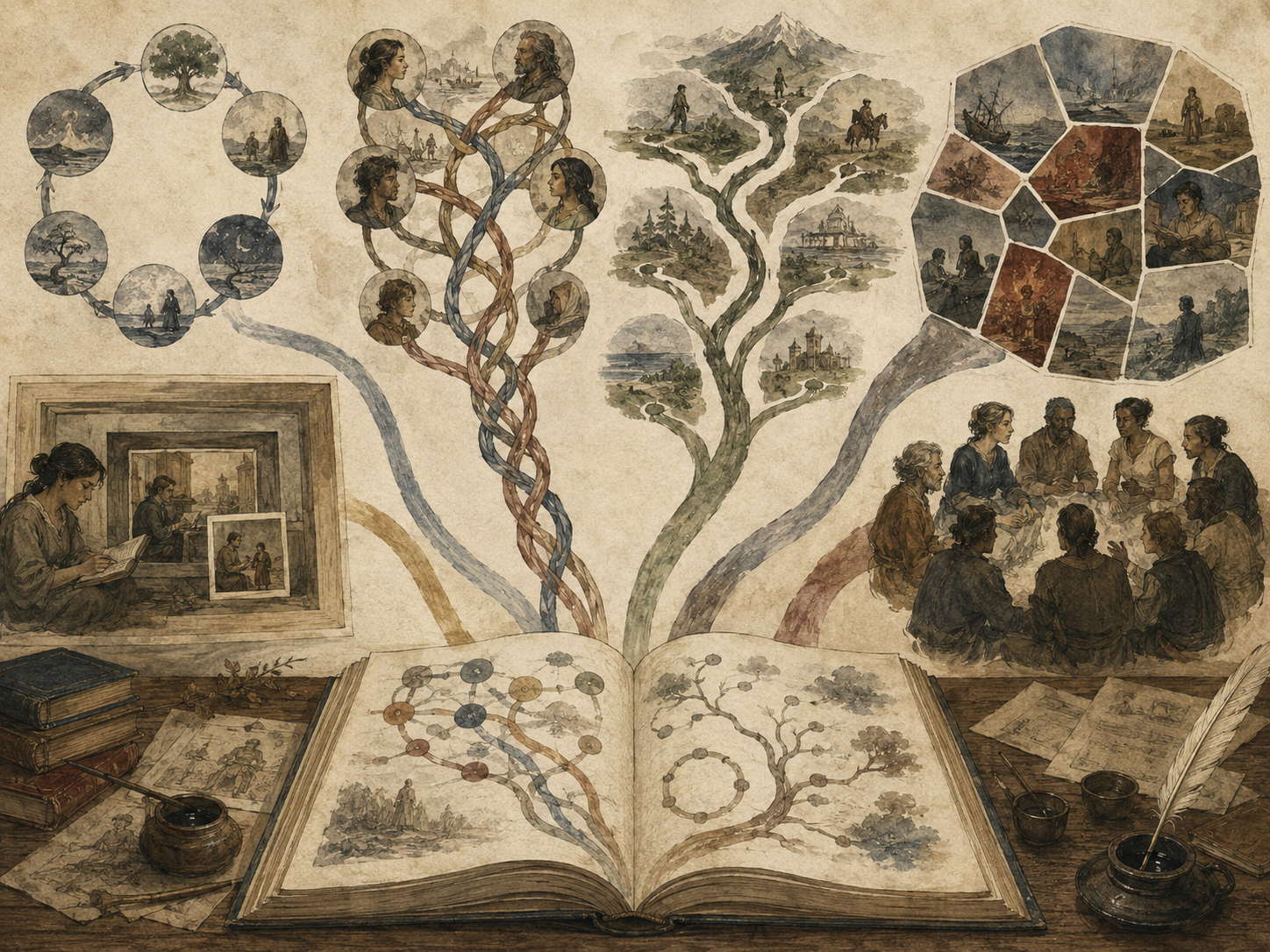
This article argues for structural pluralism. The question is not whether a story can be squeezed into a heroic pattern. The question is what form the story actually needs. Some stories move by repetition. Some move by accumulation. Some move by witness. Some move by relation. Some move by return without conquest. Some move by refusal. Some move by branching choice. Some move by a pattern that is visible only after the reader learns how to listen.
Why Alternative Story Structures Matter
Alternative story structures matter because form shapes meaning. A story organized as a quest says something different from a story organized as a cycle, archive, testimony, network, braid, diary, ritual, or ensemble. Structure is not just a container for content. It is part of the argument the story makes about time, agency, causality, memory, power, and change.
The monomyth privileges a certain kind of motion: departure, testing, transformation, and return. That motion is useful for many stories. But it is not enough for stories of caregiving, exile, collective memory, ecological relation, institutional change, trauma, ritual repetition, migration, disability, grief, bureaucracy, platform culture, or unresolved witness.
Alternative structures make other kinds of action visible. Staying can be action. Remembering can be action. Caring can be action. Refusing can be action. Repeating can be action. Listening can be action. Surviving can be action. A story may move without conquest.
| Structural assumption | Alternative possibility | Why it matters |
|---|---|---|
| Story moves through quest. | Story may move through relation, repetition, memory, or accumulation. | Agency becomes broader than adventure. |
| Conflict drives everything. | Contrast, revelation, rhythm, care, or juxtaposition may drive form. | Not every meaningful story is built around combat. |
| Resolution completes the arc. | Open endings, cycles, or fragments may be more truthful. | Closure can be ethically false. |
| The protagonist transforms. | A community, system, archive, or reader may transform instead. | Story need not center a single heroic self. |
| Return restores order. | Return may be impossible, undesirable, or politically suspect. | Exile, displacement, and rupture require other forms. |
| Structure is universal. | Structure is situated, cultural, formal, and rhetorical. | Models must remain accountable to context. |
Alternative structures matter because stories do not all move toward the same kind of becoming.
What the Monomyth Clarifies and Limits
The monomyth clarifies stories of adventure, initiation, ordeal, threshold-crossing, symbolic transformation, and return. It can help readers see why myths, films, games, novels, and memoirs often use departure, helpers, trials, crisis, revelation, and return. It is especially effective when a story is about an individual entering danger, gaining knowledge, and returning changed.
But the monomyth limits interpretation when it becomes a default. It can make readers search for the call, mentor, ordeal, abyss, boon, and return even when the story is doing something else. It may treat nonheroic forms as incomplete. It may read relational plots as weak quest plots, fragmented stories as failed linear stories, and cyclical stories as underdeveloped arcs.
The monomyth is strongest as one lens among several. It becomes weakest when it becomes the only lens.
| Monomyth strength | Useful for | Limit |
|---|---|---|
| Threshold movement | Stories of departure, ordeal, and initiation. | Can overvalue leaving over staying. |
| Symbolic patterning | Mythic, fantasy, adventure, and transformation narratives. | Can flatten local symbolic systems. |
| Character transformation | Stories where a protagonist is changed by crisis. | Can ignore collective or systemic transformation. |
| Quest orientation | Stories of seeking, testing, and return. | Can make every narrative look like a quest. |
| Teaching clarity | Introductory story structure education. | Can become a simplified template. |
| Comparative reading | Pattern comparison across works. | Can confuse recurrence with universality. |
The monomyth becomes more useful when its limits are made explicit.
From One Arc to Many Forms
A story does not need one rising line. It may be a circle, spiral, web, braid, map, chain, archive, constellation, chamber, diary, procedure, witness record, chorus, cycle, ledger, puzzle, or field of fragments. Each structure changes how the audience experiences time and meaning.
An arc emphasizes progression. A cycle emphasizes return. A braid emphasizes relation among threads. A mosaic emphasizes assembly. A network emphasizes connection. An archive emphasizes evidence. A diary emphasizes temporality and intimacy. A chorus emphasizes collective voice. A procedural narrative emphasizes rules and repetition. A branching story emphasizes choice and consequence.
Structural pluralism asks the analyst to identify the story’s actual organizing logic instead of assuming an arc in advance.
| Structure | Primary motion | Best suited for |
|---|---|---|
| Arc | Progression through change. | Transformation, quest, conflict, decision, growth. |
| Cycle | Return with variation. | Ritual, seasons, grief, recurrence, ecological time. |
| Spiral | Return at a changed level. | Memory, healing, learning, generational stories. |
| Braid | Alternating threads that build resonance. | Memoir, essay, multi-timeline fiction, research narrative. |
| Mosaic | Meaning assembled from fragments. | Trauma, archive, cultural memory, documentary form. |
| Network | Connection among nodes. | Interactive fiction, ensemble casts, systems stories. |
| Chorus | Multiple voices create a shared field. | Community stories, institutional stories, testimony. |
| Map | Exploration through place or relation. | Games, travel, place-based narrative, worldbuilding. |
The first question of story analysis should not be “Where is the hero’s journey?” It should be “What shape is this story asking for?”
Cyclical and Seasonal Structures
Cyclical structures organize meaning through recurrence. A cycle may be seasonal, ritual, generational, ecological, liturgical, agricultural, emotional, political, or familial. In a cycle, repetition is not a failure to progress. Repetition is the structure of meaning.
Cyclical stories often appear in myths of death and renewal, family sagas, ecological narratives, religious calendars, community rituals, grief narratives, and stories about institutions that repeat harmful patterns. The point is not always to escape the cycle. Sometimes the point is to understand recurrence, honor rhythm, interrupt repetition, or return differently.
A cyclical structure may feel slower than a quest because its meaning accumulates through pattern. It asks the audience to notice variation across return.
| Cyclical feature | Narrative function | Analytical question |
|---|---|---|
| Return | Revisits a place, event, season, or wound. | What changes between returns? |
| Ritual repetition | Creates continuity and communal meaning. | What does repetition preserve? |
| Seasonal rhythm | Links human action to ecological time. | How does environment structure the story? |
| Generational recurrence | Shows inherited patterns. | What is repeated, repaired, or refused? |
| Political cycle | Shows institutional recurrence. | Who benefits from repeated crisis? |
| Spiral return | Returns with altered consciousness. | Is the character trapped or transformed? |
Cyclical stories remind readers that meaning can come from recurrence, not only from linear ascent.
Episodic and Picaresque Structures
Episodic structures organize story as a sequence of encounters, episodes, cases, travels, jobs, adventures, memories, or social scenes. Instead of one central quest, the story advances through accumulation. Each episode reveals another layer of a person, world, institution, culture, or moral field.
The picaresque form, historically associated with wandering protagonists and satirical social observation, often resists heroic development. The protagonist may survive, improvise, witness, deceive, work, travel, or expose hypocrisy without becoming a heroic figure. The story’s energy comes from movement through social worlds.
Episodic form is common in oral storytelling, television, travel writing, comics, memoir, satire, children’s literature, procedural drama, and serial fiction. It works when the story’s meaning depends on recurrence, variation, and exposure rather than one final confrontation.
| Episodic feature | Function | Risk if judged by monomyth |
|---|---|---|
| Loose sequence | Creates accumulation rather than tight arc. | May be mistaken for weak plotting. |
| Repeated encounters | Reveals variations on a theme. | May be seen as repetitive without purpose. |
| Social range | Moves through classes, institutions, places, or types. | May be reduced to adventure beats. |
| Survival logic | Focuses on improvisation and adaptation. | May seem morally ambiguous or undeveloped. |
| Satirical observation | Exposes hypocrisy across episodes. | May be misread as lack of transformation. |
| Serial openness | Allows continuation rather than final closure. | May be treated as incomplete. |
Episodic structures show that story can move by encounter, variation, and accumulation rather than one heroic ordeal.
Relational and Care-Based Structures
Relational structures organize story around bonds rather than quests. The movement may involve attachment, obligation, conflict, caregiving, dependency, repair, inheritance, kinship, friendship, community, mentorship, reciprocity, or betrayal. The story changes as relationships change.
Care-based structures make maintenance visible. Feeding, tending, teaching, nursing, listening, grieving, raising, sheltering, translating, remembering, and organizing may become the center of narrative movement. These actions often disappear when story is defined as conflict, conquest, or individual transformation.
Care narratives can be intimate, political, ecological, institutional, or spiritual. They can expose the labor that keeps worlds alive. They can also show the costs of care, including exhaustion, invisibility, exploitation, unequal obligation, and moral injury.
| Relational structure | Movement pattern | What it reveals |
|---|---|---|
| Care arc | Need, response, labor, strain, repair, limit. | How life is maintained. |
| Kinship web | Obligations and memory move across relations. | How identity is relational. |
| Friendship structure | Trust, difference, conflict, loyalty, change. | How selves form through others. |
| Community maintenance | Shared labor sustains a collective world. | How ordinary action becomes political. |
| Ethic of repair | Harm, recognition, apology, restitution, renewed relation. | How responsibility becomes narrative motion. |
| Dependency narrative | Need and vulnerability shape agency. | How autonomy is never absolute. |
Relational stories challenge the idea that the most important action is always the action of a solitary protagonist.
Braided, Polyphonic, and Ensemble Structures
Braided structures alternate between threads: past and present, personal memory and public history, field notes and reflection, two families, three timelines, several places, or multiple research strands. Meaning emerges through pattern, contrast, and resonance across threads.
Polyphonic structures use multiple voices. No single narrator owns the whole meaning. The story may be a chorus of testimony, letters, interviews, documents, perspectives, or interior monologues. Ensemble structures distribute agency across a group instead of concentrating it in one protagonist.
These forms are especially useful for stories about community, institutions, migration, social crisis, family systems, political events, ecological change, and public memory. They resist the heroic center.
| Form | Primary logic | Best question |
|---|---|---|
| Braided narrative | Threads alternate and illuminate one another. | What resonance emerges between strands? |
| Polyphonic narrative | Multiple voices create meaning without full synthesis. | Whose voice complicates the story? |
| Ensemble narrative | Agency is distributed across characters. | How does the group change? |
| Documentary chorus | Documents and testimonies build a shared record. | What evidence accumulates? |
| Multi-timeline structure | Different temporal layers interact. | How does the past reorganize the present? |
| Systems narrative | Characters reveal a larger structure. | What network or institution is being mapped? |
Braided and polyphonic stories teach readers to listen across difference instead of following one heroic line.
Fragmented, Mosaic, and Archive Forms
Fragmented structures organize meaning through breaks, gaps, fragments, memories, documents, images, lists, scenes, records, shards, testimony, or recurring motifs. These forms are often appropriate for trauma, memory, historical loss, exile, censorship, institutional harm, family secrets, or archival absence.
A mosaic structure asks the reader to assemble meaning from pieces. An archive form foregrounds evidence: letters, reports, photographs, transcripts, court records, diaries, maps, bureaucratic documents, marginal notes, or found objects. The structure may make absence visible: what is missing, destroyed, withheld, misfiled, or impossible to know.
Fragmentation should not automatically be treated as failed coherence. Sometimes broken form is the truthful form.
| Fragmented feature | Function | Ethical caution |
|---|---|---|
| Gaps | Represent absence, loss, censorship, or trauma. | Do not fill gaps too quickly. |
| Documents | Ground story in evidence and institutional record. | Documents may also distort or erase. |
| Shards | Let meaning accumulate through pieces. | Do not demand linear explanation. |
| Repetition | Shows memory returning under pressure. | Do not read recurrence as redundancy only. |
| Contradiction | Preserves contested accounts. | Do not force premature synthesis. |
| Archive absence | Makes erasure visible. | Do not mistake missing evidence for missing history. |
Fragmented and archive structures are often the most responsible forms for stories where wholeness would be false.
Kishōtenketsu and Non-Conflict Structures
Kishōtenketsu is often described as a four-part structure associated with East Asian narrative traditions: introduction, development, turn, and conclusion. In simplified English-language writing discussions, it is sometimes presented as a structure that does not depend on conflict in the same way Western plot models often do.
This does not mean kishōtenketsu has no tension. It means narrative movement may be generated through contrast, juxtaposition, turn, surprise, relation, or reinterpretation rather than through escalating conflict. The “turn” can reframe what came before without requiring a battle, conquest, or crisis.
Kishōtenketsu is useful for thinking beyond conflict-centered plot. But it should not be treated as a generic “Asian structure” detached from language, genre, culture, and history. Responsible use requires source awareness and caution.
| Part | Common English rendering | Structural function |
|---|---|---|
| Ki | Introduction | Establishes situation, image, subject, or premise. |
| Shō | Development | Extends or deepens the initial material. |
| Ten | Turn | Introduces contrast, surprise, reframe, or new relation. |
| Ketsu | Conclusion | Connects or resolves the relation among parts. |
Kishōtenketsu reminds writers that narrative movement can come from juxtaposition and turn, not only from conflict and conquest.
Lyric, Essayistic, and Associative Forms
Lyric and essayistic structures move by association. They may follow an image, question, mood, memory, refrain, metaphor, argument, or pattern of attention rather than a plot sequence. The story may unfold like thought.
These forms are especially important in memoir, creative nonfiction, criticism, philosophical writing, experimental fiction, poetry, and hybrid essays. The movement may be recursive, meditative, exploratory, or fragmentary. The narrator may not “change” in a conventional arc. Instead, the field of attention changes.
Associative form is not formless. It has rhythm, return, image pattern, tonal development, conceptual progression, and emotional architecture. Its structure may be subtle, but it is still designed.
| Associative device | Function | Reader effect |
|---|---|---|
| Refrain | Returns to a phrase, image, or question. | Creates resonance and deepening. |
| Image cluster | Links ideas through recurring visual or sensory motifs. | Builds pattern without linear plot. |
| Essay turn | Shifts thought rather than action. | Creates intellectual movement. |
| Fragment sequence | Arranges pieces by resonance. | Invites assembly and reflection. |
| Parallel scenes | Places moments beside one another. | Creates meaning through comparison. |
| Question-driven form | Follows inquiry rather than conflict. | Makes thinking itself narrative. |
Lyric and essayistic structures show that attention can be a form of action.
Branching, Network, and Interactive Structures
Interactive stories challenge linear structure because the reader, player, or participant may shape sequence, exploration, decision, perspective, or outcome. Branching narrative creates paths. Network narrative creates nodes and connections. Map-based narrative lets movement through space become story structure. Procedural narrative uses rules, systems, and states to generate experience.
These structures are common in games, digital fiction, interactive documentaries, learning simulations, role-playing systems, immersive theater, and platform-native storytelling. They do not always produce one canonical arc. They may produce a space of possible arcs.
Interactive structure raises new design questions. What choices matter? What remains fixed? How does the system remember action? Is the story branching meaningfully or only cosmetically? Does agency belong to the participant, the system, the designer, or the world model?
| Interactive structure | Primary logic | Design question |
|---|---|---|
| Branching tree | Choice creates diverging paths. | Which choices change meaning? |
| Network narrative | Nodes connect in multiple sequences. | What governs movement among nodes? |
| Map-based structure | Exploration organizes story. | How does place reveal narrative? |
| State-based narrative | Story changes according to variables. | What does the system remember? |
| Procedural narrative | Rules generate events or patterns. | How does emergence remain meaningful? |
| Multiplayer narrative | Participants co-produce story. | How are conflict, consent, and agency governed? |
Interactive structures make narrative less like a road and more like a field of possible movement.
Collective, Institutional, and Ecological Narratives
Some stories do not belong to a single protagonist. A community, institution, ecosystem, city, movement, supply chain, court case, hospital, school, neighborhood, or archive may be the real narrative unit. In these stories, agency is distributed.
Collective narratives often use ensemble form, documentary structure, oral history, institutional records, network maps, timelines, case files, public testimony, or multiple perspectives. The story’s movement may be systemic: a policy changes, a pattern is exposed, a community remembers, an ecosystem shifts, a bureaucracy fails, a movement forms.
Ecological narratives are especially resistant to monomythic structure. They may unfold across seasons, species, feedback loops, slow violence, interdependence, and planetary time. The protagonist may be a watershed, forest, town, coastline, or shared habitat.
| Narrative unit | Structure | What changes |
|---|---|---|
| Community | Chorus, oral history, ensemble, ritual. | Shared memory and collective identity. |
| Institution | Records, procedures, cases, reports, testimony. | Rules, accountability, legitimacy, failure. |
| Movement | Distributed action across participants. | Coalition, strategy, public meaning. |
| Ecosystem | Cycle, feedback, slow change, interdependence. | Balance, collapse, resilience, adaptation. |
| City | Map, network, district, infrastructure, migration. | Spatial relation and public life. |
| Archive | Documents, absences, voices, records. | Evidence and memory. |
Collective, institutional, and ecological stories remind us that narrative agency may be distributed across systems rather than housed in one hero.
Digital and AI-Mediated Structure
Digital and AI-mediated storytelling can either expand or narrow structural imagination. Tools can help writers explore braided plots, branching designs, alternative arcs, character networks, episodic sequences, or archive-based structures. But tools can also default to familiar templates: three-act structure, hero’s journey, rising conflict, climax, and neat resolution.
AI systems often reward legibility. They may simplify unusual structures into conventional arcs. They may label fragments as incomplete, cyclical stories as repetitive, care narratives as low-conflict, or polyphonic structures as unfocused. A tool trained on dominant narrative patterns may treat alternative structures as errors.
Responsible AI-assisted story design should ask what structure the story needs before generating plot beats. It should be able to compare multiple structures, flag uncertainty, preserve cultural context, and avoid forcing every story into a heroic arc.
| AI use | Helpful function | Governance risk |
|---|---|---|
| Structure comparison | Compares arc, cycle, braid, mosaic, and network possibilities. | May rank conventional structure too highly. |
| Plot generation | Drafts alternative outlines quickly. | May default to conflict escalation and neat closure. |
| Fragment ordering | Tests arrangements of scenes or documents. | May erase meaningful gaps. |
| Interactive branching | Maps choices and consequences. | May create cosmetic agency without real effect. |
| Voice clustering | Organizes polyphonic or testimonial material. | May flatten voice difference. |
| Governance audit | Flags template forcing and missing alternatives. | May perform critique superficially. |
AI should not make every story more conventional. It should help identify when convention is the wrong structure.
Ethics of Alternative Structure
Alternative structure has ethical stakes. Some stories require nonlinearity because trauma has damaged continuity. Some require chorus because no single speaker owns the truth. Some require archive form because evidence matters. Some require open endings because closure would be dishonest. Some require cyclical form because the story belongs to ritual, season, or ecological time. Some require relational form because the self is not the center.
Forcing these stories into monomythic shape can distort their meaning. It may individualize systemic harm, erase collective agency, romanticize suffering, demand resolution, or turn testimony into entertainment. Structure can either respect the story’s conditions or violate them.
Ethical structure asks: What form is truthful to the experience, culture, evidence, medium, and audience? What does this structure allow the story to protect? What does it refuse to simplify?
| Ethical issue | Structural response | Why it matters |
|---|---|---|
| Trauma and memory | Fragment, repetition, silence, or mosaic. | Protects against false coherence. |
| Collective testimony | Chorus, archive, oral history, polyphony. | Prevents one voice from owning the whole truth. |
| Care labor | Relational or maintenance structure. | Makes invisible work visible. |
| Cultural specificity | Local, ritual, cyclical, or place-based form. | Protects meaning from extraction. |
| Interactive agency | Branching, state, or network structure. | Matches form to participant choice. |
| Unresolved injustice | Open ending or continuing archive. | Refuses false closure. |
The ethics of structure begins when the writer stops asking how to make the story fit a model and starts asking what model would do justice to the story.
Examples of Alternative Structure Analysis
The examples below show how different stories may require different structural lenses.
Caregiving memoir
Weak: The story is judged as low-conflict because no heroic quest occurs.
Stronger: The analysis identifies care labor, dependency, repetition, exhaustion, repair, and relational agency as the structure.
Why it works: It makes maintenance visible as narrative movement.
Trauma testimony
Weak: The story is forced into a clean arc of injury, recovery, and closure.
Stronger: The analysis respects fragmentation, silence, repetition, and unresolved witness.
Why it works: It avoids false coherence.
Interactive game
Weak: The game is summarized as a single hero’s journey.
Stronger: The analysis maps branching paths, player agency, state changes, and network structure.
Why it works: It matches analysis to medium.
Ecological story
Weak: The story searches for a single protagonist and climax.
Stronger: The analysis tracks cycles, feedback, species relation, slow change, and interdependence.
Why it works: It respects ecological time.
Archive novel
Weak: The documents are treated as background information.
Stronger: The analysis treats records, gaps, contradictions, and absences as the structure.
Why it works: It understands evidence as narrative form.
Kishōtenketsu-inspired story
Weak: The story is criticized for insufficient conflict escalation.
Stronger: The analysis looks for introduction, development, turn, and relational resolution.
Why it works: It recognizes movement through juxtaposition.
Alternative structure analysis begins by asking what kind of movement the story actually uses.
Mathematics, Computation, and Modeling
Alternative story structures should not be reduced to rigid metrics. Still, modeling can help make structural assumptions visible. A computational workflow can compare how strongly a story aligns with arc, cycle, braid, mosaic, network, care, testimony, archive, or interactive structures.
A structural plurality score can estimate whether a story needs more than one framework:
P_s = \frac{A_c + C_y + B_r + M_o + N_w + R_l + F_g}{7}
\]
Interpretation: Structural plurality \(P_s\) averages arc signal \(A_c\), cycle signal \(C_y\), braid signal \(B_r\), mosaic signal \(M_o\), network signal \(N_w\), relational signal \(R_l\), and fragment signal \(F_g\).
A monomyth-overfit risk score can estimate whether heroic structure is being imposed too strongly:
M_r = H_fw_h + C_sw_c + R_pw_r + I_pw_i + T_fw_t + (1 – E_v)w_e
\]
Interpretation: Monomyth-overfit risk \(M_r\) rises with hero forcing \(H_f\), conflict substitution \(C_s\), return pressure \(R_p\), individualization pressure \(I_p\), template forcing \(T_f\), and weak evidence visibility \(E_v\).
An alternative-structure readiness score can estimate whether analysis is suitable for reuse:
R_a = \frac{S_c + M_l + A_l + C_x + U_n + R_o}{6}
\]
Interpretation: Alternative-structure readiness \(R_a\) averages source context \(S_c\), method limits \(M_l\), alternative lens visibility \(A_l\), cultural context \(C_x\), uncertainty notes \(U_n\), and review owner clarity \(R_o\).
A medium-fit score can estimate whether the structure matches the medium:
F_m = \frac{T_m + A_g + P_c + S_q + I_o + E_x}{6}
\]
Interpretation: Medium fit \(F_m\) averages temporal match \(T_m\), agency design \(A_g\), pacing compatibility \(P_c\), sequence logic \(S_q\), interaction affordance \(I_o\), and experiential coherence \(E_x\).
| Modeling task | Interpretive question | Example output |
|---|---|---|
| Structure plurality audit | Does the story require multiple structural lenses? | Structural plurality score. |
| Monomyth-overfit audit | Is the heroic model being imposed too strongly? | Overfit risk and template-forcing flags. |
| Alternative-structure audit | Which non-monomythic forms are present? | Cycle, braid, mosaic, network, care, archive, or fragment signals. |
| Medium-fit audit | Does the structure match the medium? | Medium-fit score. |
| AI governance audit | Does the tool default to conventional plot? | Automation governance note. |
| Publication review audit | Is the analysis responsible enough for reuse? | Canvas card and governance queue. |
Computation can support structural pluralism when it compares possibilities instead of declaring one universal form.
Python Workflow: Alternative Structure Canvas Audit
The Python workflow below follows the advanced Catalyst Canvas standard: typed records, config-driven scoring, validation, governance notes, Canvas-card exports, CSV outputs, JSON outputs, markdown governance queues, and review priorities. The companion repository version includes the shared `python/catalyst_canvas/` layer plus article-specific data for structural plurality, monomyth-overfit risk, alternative-structure readiness, medium fit, and AI-mediated structure governance.
# run_alternative_structure_canvas_audit.py
from __future__ import annotations

from dataclasses import dataclass
from pathlib import Path
import csv
import json
from hashlib import sha256
from statistics import mean
from typing import Any


ARTICLE_ROOT = Path(__file__).resolve().parents[1]
OUTPUTS = ARTICLE_ROOT / "outputs"


@dataclass(frozen=True)
class AlternativeStructureRecord:
    item: str
    claim_context: str
    arc_signal: float
    cycle_signal: float
    braid_signal: float
    mosaic_signal: float
    network_signal: float
    relational_signal: float
    fragment_signal: float
    hero_forcing: float
    conflict_substitution: float
    return_pressure: float
    individualization_pressure: float
    template_forcing: float
    evidence_visibility: float
    source_context: float
    method_limits: float
    alternative_lens: float
    cultural_context: float
    uncertainty_notes: float
    review_owner_clarity: float
    temporal_match: float
    agency_design: float
    pacing_compatibility: float
    sequence_logic: float
    interaction_affordance: float
    experiential_coherence: float
    public_consequence: float
    owner: str = "editorial"
    status: str = "active"
    notes: str = ""


@dataclass(frozen=True)
class AlternativeStructureConfig:
    article_title: str = "Alternative Story Structures Beyond the Monomyth"
    article_slug: str = "alternative-story-structures-beyond-the-monomyth"
    medium_threshold: float = 0.45
    high_threshold: float = 0.62
    allowed_statuses: tuple[str, ...] = ("active", "archive", "review", "revise")


def validate_score(value: float, field_name: str) -> None:
    if value < 0 or value > 1:
        raise ValueError(f"{field_name} must be between 0 and 1.")


def validate_record(record: AlternativeStructureRecord, config: AlternativeStructureConfig) -> None:
    if not record.item.strip():
        raise ValueError("item is required.")
    if not record.claim_context.strip():
        raise ValueError("claim_context is required.")
    if record.status not in config.allowed_statuses:
        raise ValueError(f"Invalid status: {record.status}")

    for field_name, value in record.__dict__.items():
        if isinstance(value, float):
            validate_score(value, field_name)


def structural_plurality(record: AlternativeStructureRecord) -> float:
    return mean([
        record.arc_signal,
        record.cycle_signal,
        record.braid_signal,
        record.mosaic_signal,
        record.network_signal,
        record.relational_signal,
        record.fragment_signal,
    ])


def monomyth_overfit_risk(record: AlternativeStructureRecord) -> float:
    return min(
        1.0,
        record.hero_forcing * 0.20
        + record.conflict_substitution * 0.18
        + record.return_pressure * 0.16
        + record.individualization_pressure * 0.18
        + record.template_forcing * 0.18
        + (1 - record.evidence_visibility) * 0.10,
    )


def alternative_readiness(record: AlternativeStructureRecord) -> float:
    return mean([
        record.source_context,
        record.method_limits,
        record.alternative_lens,
        record.cultural_context,
        record.uncertainty_notes,
        record.review_owner_clarity,
    ])


def medium_fit(record: AlternativeStructureRecord) -> float:
    return mean([
        record.temporal_match,
        record.agency_design,
        record.pacing_compatibility,
        record.sequence_logic,
        record.interaction_affordance,
        record.experiential_coherence,
    ])


def governance_priority_score(record: AlternativeStructureRecord, config: AlternativeStructureConfig) -> float:
    score = (
        monomyth_overfit_risk(record) * 0.36
        + (1 - alternative_readiness(record)) * 0.24
        + structural_plurality(record) * 0.18
        + record.public_consequence * 0.22
    )

    if record.status == "revise":
        score = max(score, config.high_threshold)
    elif record.status == "review":
        score = max(score, config.medium_threshold)

    return min(1.0, max(0.0, score))


def review_priority(record: AlternativeStructureRecord, config: AlternativeStructureConfig) -> str:
    score = governance_priority_score(record, config)
    if score >= config.high_threshold:
        return "high"
    if score >= config.medium_threshold:
        return "medium"
    return "standard"


def card_id(record: AlternativeStructureRecord, config: AlternativeStructureConfig) -> str:
    raw = f"{config.article_slug}|{record.item}|{record.claim_context}"
    return sha256(raw.encode("utf-8")).hexdigest()[:16]


def governance_note(record: AlternativeStructureRecord, config: AlternativeStructureConfig) -> str:
    priority = review_priority(record, config)
    risk = monomyth_overfit_risk(record)
    plurality = structural_plurality(record)

    notes = []

    if priority == "high":
        notes.append("High-priority alternative-structure governance review required.")
    elif priority == "medium":
        notes.append("Medium-priority review recommended before reuse.")
    else:
        notes.append("Standard editorial review sufficient.")

    if risk >= 0.55:
        notes.append("Monomyth-overfit risk is elevated; review hero forcing, conflict substitution, return pressure, individualization pressure, template forcing, and evidence visibility.")
    if plurality >= 0.65:
        notes.append("Structural plurality is strong; compare arc, cycle, braid, mosaic, network, relational, and fragmented forms before selecting a framework.")
    if alternative_readiness(record) < 0.65:
        notes.append("Alternative-structure readiness is limited; strengthen source context, method limits, alternative lenses, cultural context, uncertainty notes, and review ownership.")
    if record.notes:
        notes.append(record.notes)

    return " ".join(notes)


def canvas_card(record: AlternativeStructureRecord, config: AlternativeStructureConfig) -> dict[str, Any]:
    return {
        "schema_version": "1.0.0",
        "card_id": card_id(record, config),
        "card_type": "alternative_story_structure_beyond_monomyth",
        "article_title": config.article_title,
        "article_slug": config.article_slug,
        "item": record.item,
        "claim_context": record.claim_context,
        "scores": {
            "structural_plurality": round(structural_plurality(record), 4),
            "monomyth_overfit_risk": round(monomyth_overfit_risk(record), 4),
            "alternative_readiness": round(alternative_readiness(record), 4),
            "medium_fit": round(medium_fit(record), 4),
            "governance_priority_score": round(governance_priority_score(record, config), 4),
        },
        "review": {
            "priority": review_priority(record, config),
            "owner": record.owner,
            "status": record.status,
            "governance_note": governance_note(record, config),
        },
    }


def write_csv(path: Path, rows: list[dict[str, Any]]) -> None:
    path.parent.mkdir(parents=True, exist_ok=True)
    fieldnames = list(rows[0].keys())
    with path.open("w", encoding="utf-8", newline="") as handle:
        writer = csv.DictWriter(handle, fieldnames=fieldnames)
        writer.writeheader()
        writer.writerows(rows)


def write_json(path: Path, payload: Any) -> None:
    path.parent.mkdir(parents=True, exist_ok=True)
    path.write_text(json.dumps(payload, indent=2), encoding="utf-8")


def write_markdown_queue(path: Path, rows: list[dict[str, Any]]) -> None:
    path.parent.mkdir(parents=True, exist_ok=True)
    lines = [
        "# Alternative Story Structure Governance Queue",
        "",
        "| Item | Context | Plurality | Monomyth risk | Readiness | Medium fit | Priority | Owner |",
        "|---|---|---:|---:|---:|---:|---|---|",
    ]

    for row in rows:
        lines.append(
            f"| {row['item']} | {row['claim_context']} | "
            f"{row['structural_plurality']} | {row['monomyth_overfit_risk']} | "
            f"{row['alternative_readiness']} | {row['medium_fit']} | "
            f"{row['review_priority']} | {row['owner']} |"
        )

    path.write_text("\n".join(lines) + "\n", encoding="utf-8")


def main() -> None:
    config = AlternativeStructureConfig()

    records = [
        AlternativeStructureRecord(
            "Caregiving memoir",
            "relational care structure and monomyth-overfit audit",
            0.32, 0.50, 0.62, 0.54, 0.42, 0.92, 0.58,
            0.78, 0.70, 0.62, 0.74, 0.80, 0.82,
            0.84, 0.86, 0.90, 0.82, 0.84, 0.86,
            0.76, 0.64, 0.74, 0.72, 0.38, 0.80,
            0.84,
            "ethics review", "review",
            "Use relational and care-based structure before heroic quest."
        ),
        AlternativeStructureRecord(
            "Archive novel",
            "mosaic evidence gap and fragmented structure audit",
            0.44, 0.52, 0.76, 0.92, 0.62, 0.58, 0.86,
            0.64, 0.56, 0.58, 0.62, 0.68, 0.88,
            0.88, 0.84, 0.92, 0.86, 0.90, 0.84,
            0.82, 0.54, 0.70, 0.86, 0.36, 0.84,
            0.90,
            "governance", "review",
            "Preserve gaps and documentary logic; do not force clean resolution."
        ),
        AlternativeStructureRecord(
            "Interactive fiction",
            "branching network and player agency audit",
            0.58, 0.40, 0.48, 0.42, 0.94, 0.52, 0.46,
            0.62, 0.50, 0.54, 0.48, 0.58, 0.86,
            0.82, 0.80, 0.88, 0.78, 0.84, 0.86,
            0.72, 0.94, 0.74, 0.82, 0.96, 0.88,
            0.92,
            "governance", "revise",
            "Escalate medium-fit and agency-design review for branching structure."
        ),
    ]

    rows = []
    cards = []

    for record in records:
        validate_record(record, config)
        cards.append(canvas_card(record, config))
        rows.append({
            "item": record.item,
            "claim_context": record.claim_context,
            "structural_plurality": round(structural_plurality(record), 4),
            "monomyth_overfit_risk": round(monomyth_overfit_risk(record), 4),
            "alternative_readiness": round(alternative_readiness(record), 4),
            "medium_fit": round(medium_fit(record), 4),
            "governance_priority_score": round(governance_priority_score(record, config), 4),
            "review_priority": review_priority(record, config),
            "owner": record.owner,
            "status": record.status,
            "governance_note": governance_note(record, config),
        })

    priority_order = {"high": 3, "medium": 2, "standard": 1}
    rows = sorted(
        rows,
        key=lambda row: (
            priority_order.get(str(row["review_priority"]), 0),
            float(row["governance_priority_score"]),
        ),
        reverse=True,
    )

    queue = [row for row in rows if row["review_priority"] != "standard"]
    queue_cards = [card for card in cards if card["review"]["priority"] != "standard"]

    write_csv(OUTPUTS / "tables" / "alternative_structure_audit.csv", rows)
    write_csv(OUTPUTS / "tables" / "alternative_structure_governance_queue.csv", queue)
    write_json(OUTPUTS / "json" / "alternative_structure_canvas_cards.json", cards)
    write_json(OUTPUTS / "json" / "alternative_structure_governance_queue.json", queue_cards)
    write_markdown_queue(OUTPUTS / "markdown" / "alternative_structure_governance_queue.md", queue)

    print("Alternative structure Canvas audit complete.")


if __name__ == "__main__":
    main()
This workflow treats structure as plural, contextual, and accountable rather than universal by default.
R Workflow: Alternative Structure Diagnostics
The R workflow below provides a portable base R diagnostic for auditing alternative structures. It calculates structural plurality, monomyth-overfit risk, alternative-structure readiness, medium fit, governance priority, and review status.
# alternative_structure_diagnostics.R
# Base R workflow for Alternative Story Structures Beyond the Monomyth.

args <- commandArgs(trailingOnly = FALSE)
file_arg <- grep("^--file=", args, value = TRUE)

if (length(file_arg) > 0) {
  script_path <- normalizePath(sub("^--file=", "", file_arg[1]), mustWork = TRUE)
  article_root <- normalizePath(file.path(dirname(script_path), ".."), mustWork = TRUE)
} else {
  article_root <- getwd()
}

setwd(article_root)

tables_dir <- file.path(article_root, "outputs", "tables")
figures_dir <- file.path(article_root, "outputs", "figures")
dir.create(tables_dir, recursive = TRUE, showWarnings = FALSE)
dir.create(figures_dir, recursive = TRUE, showWarnings = FALSE)

records <- data.frame(
  item = c(
    "Caregiving memoir",
    "Archive novel",
    "Interactive fiction"
  ),
  claim_context = c(
    "relational care structure and monomyth-overfit audit",
    "mosaic evidence gap and fragmented structure audit",
    "branching network and player agency audit"
  ),
  arc_signal = c(0.32, 0.44, 0.58),
  cycle_signal = c(0.50, 0.52, 0.40),
  braid_signal = c(0.62, 0.76, 0.48),
  mosaic_signal = c(0.54, 0.92, 0.42),
  network_signal = c(0.42, 0.62, 0.94),
  relational_signal = c(0.92, 0.58, 0.52),
  fragment_signal = c(0.58, 0.86, 0.46),
  hero_forcing = c(0.78, 0.64, 0.62),
  conflict_substitution = c(0.70, 0.56, 0.50),
  return_pressure = c(0.62, 0.58, 0.54),
  individualization_pressure = c(0.74, 0.62, 0.48),
  template_forcing = c(0.80, 0.68, 0.58),
  evidence_visibility = c(0.82, 0.88, 0.86),
  source_context = c(0.84, 0.88, 0.82),
  method_limits = c(0.86, 0.84, 0.80),
  alternative_lens = c(0.90, 0.92, 0.88),
  cultural_context = c(0.82, 0.86, 0.78),
  uncertainty_notes = c(0.84, 0.90, 0.84),
  review_owner_clarity = c(0.86, 0.84, 0.86),
  temporal_match = c(0.76, 0.82, 0.72),
  agency_design = c(0.64, 0.54, 0.94),
  pacing_compatibility = c(0.74, 0.70, 0.74),
  sequence_logic = c(0.72, 0.86, 0.82),
  interaction_affordance = c(0.38, 0.36, 0.96),
  experiential_coherence = c(0.80, 0.84, 0.88),
  public_consequence = c(0.84, 0.90, 0.92),
  owner = c("ethics review", "governance", "governance"),
  status = c("review", "review", "revise"),
  stringsAsFactors = FALSE
)

records$structural_plurality <- rowMeans(records[, c(
  "arc_signal",
  "cycle_signal",
  "braid_signal",
  "mosaic_signal",
  "network_signal",
  "relational_signal",
  "fragment_signal"
)])

records$monomyth_overfit_risk <- pmin(
  1,
  records$hero_forcing * 0.20 +
    records$conflict_substitution * 0.18 +
    records$return_pressure * 0.16 +
    records$individualization_pressure * 0.18 +
    records$template_forcing * 0.18 +
    (1 - records$evidence_visibility) * 0.10
)

records$alternative_readiness <- rowMeans(records[, c(
  "source_context",
  "method_limits",
  "alternative_lens",
  "cultural_context",
  "uncertainty_notes",
  "review_owner_clarity"
)])

records$medium_fit <- rowMeans(records[, c(
  "temporal_match",
  "agency_design",
  "pacing_compatibility",
  "sequence_logic",
  "interaction_affordance",
  "experiential_coherence"
)])

records$governance_priority_score <- pmin(
  1,
  records$monomyth_overfit_risk * 0.36 +
    (1 - records$alternative_readiness) * 0.24 +
    records$structural_plurality * 0.18 +
    records$public_consequence * 0.22
)

records$review_priority <- ifelse(
  records$status == "revise" | records$governance_priority_score >= 0.62,
  "high",
  ifelse(
    records$status == "review" | records$governance_priority_score >= 0.45,
    "medium",
    "standard"
  )
)

records <- records[order(records$governance_priority_score, decreasing = TRUE), ]

write.csv(records, file.path(tables_dir, "alternative_structure_diagnostics.csv"), row.names = FALSE)
write.csv(records[records$review_priority != "standard", ], file.path(tables_dir, "alternative_structure_governance_queue.csv"), row.names = FALSE)

png(file.path(figures_dir, "structural_plurality_scores.png"), width = 1200, height = 700)
barplot(
  records$structural_plurality,
  names.arg = records$item,
  las = 2,
  ylab = "Structural plurality",
  main = "Alternative Story Structure Plurality"
)
grid()
dev.off()

png(file.path(figures_dir, "monomyth_overfit_risk_scores.png"), width = 1200, height = 700)
barplot(
  records$monomyth_overfit_risk,
  names.arg = records$item,
  las = 2,
  ylab = "Monomyth-overfit risk",
  main = "Monomyth Overfit Risk"
)
grid()
dev.off()

print(records[, c(
  "item",
  "claim_context",
  "structural_plurality",
  "monomyth_overfit_risk",
  "alternative_readiness",
  "medium_fit",
  "review_priority"
)])
This workflow supports structured comparison while preserving the interpretive limits of narrative modeling.
GitHub Repository
The companion repository for this article supports alternative structure analysis as a Catalyst Canvas-ready module. It includes advanced additive `python/catalyst_canvas/` governance infrastructure, article-specific alternative-structure data, config-driven scoring, validation, governance notes, Canvas card generation, CSV/JSON/markdown exporters, CLI workflows, smoke tests, unit tests, R diagnostics, SQL structures, documentation, and reusable structural-pluralism templates.
Complete Code Repository
Companion repository for the article, including advanced Catalyst Canvas-ready code for alternative story structures, monomyth-overfit risk, structural plurality, medium-fit analysis, interactive narrative structure, archive and mosaic form, JSON exports, Canvas cards, governance queues, and reproducible research workflows.
articles/alternative-story-structures-beyond-the-monomyth/
├── canvas/
│   ├── canvas_manifest.json
│   ├── input_schema.json
│   ├── output_schema.json
│   ├── catalyst_canvas_config.json
│   ├── catalyst_canvas_manifest.json
│   ├── catalyst_canvas_cards.json
│   └── catalyst_canvas_governance_queue.json
├── html/
├── css/
├── php/
├── java/
├── python/
│   ├── catalyst_canvas/
│   │   ├── __init__.py
│   │   ├── __main__.py
│   │   ├── cli.py
│   │   ├── models.py
│   │   ├── scoring.py
│   │   ├── validation.py
│   │   ├── governance.py
│   │   └── exporters.py
│   ├── alternative_structure_canvas/
│   │   ├── __init__.py
│   │   ├── models.py
│   │   ├── scoring.py
│   │   ├── validation.py
│   │   ├── governance.py
│   │   └── exporters.py
│   ├── tests/
│   │   ├── test_catalyst_canvas.py
│   │   └── test_alternative_structure_canvas.py
│   ├── run_catalyst_canvas_audit.py
│   └── run_alternative_structure_canvas_audit.py
├── r/
│   ├── alternative_structure_diagnostics.R
│   └── run_all_alternative_structure_workflows.R
├── sql/
│   ├── canvas_schema.sql
│   └── canvas_queries.sql
├── docs/
│   ├── article_notes.md
│   ├── modeling_principles.md
│   ├── alternative_structure_notes.md
│   ├── monomyth_limits.md
│   ├── cyclical_and_seasonal_structures.md
│   ├── episodic_and_picaresque_structures.md
│   ├── relational_and_care_based_structures.md
│   ├── braided_polyphonic_ensemble_structures.md
│   ├── fragmented_mosaic_archive_forms.md
│   ├── kishotenketsu_and_non_conflict_structures.md
│   ├── branching_network_interactive_structures.md
│   ├── digital_and_ai_mediated_structure.md
│   ├── ethical_risk.md
│   ├── responsible_use.md
│   ├── governance_notes.md
│   └── catalyst_canvas_upgrade_notes.md
├── data/
│   ├── alternative_structure_claims.csv
│   ├── structure_taxonomy_notes.csv
│   ├── monomyth_overfit_notes.csv
│   ├── medium_fit_notes.csv
│   ├── digital_structure_governance_notes.csv
│   └── catalyst_canvas_assessment.csv
├── outputs/
│   ├── figures/
│   ├── json/
│   ├── markdown/
│   └── tables/
├── notebooks/
├── shared/
│   ├── schemas/
│   ├── narrative-templates/
│   ├── story-archetypes/
│   ├── character-models/
│   ├── plot-structures/
│   ├── rhetorical-frameworks/
│   ├── cultural-memory/
│   ├── alternative-structures/
│   └── governance/
├── tests/
└── README.md
Related Articles
- Gender, Critique, and the Limits of Universal Story Models
- The Monomyth: What Campbell Actually Argued
- Maureen Murdock and the Heroine’s Journey
- Tragedy, Cyclical Story, and Non-Heroic Narrative
- Postcolonial Storytelling and the Politics of Narrative Form
- Games, Interactivity, and Branching Narrative
A Practical Method for Identifying Alternative Story Structures
Alternative structure analysis should begin with observation, not template selection.
1. Describe the story’s movement
Ask whether the story moves by quest, cycle, relation, accumulation, fragmentation, archive, voice, place, choice, or system.
2. Identify the narrative unit
Determine whether the main unit is a protagonist, community, institution, ecosystem, archive, relationship, voice, or network.
3. Map time
Ask whether time is linear, cyclical, braided, fragmented, recursive, seasonal, interactive, or simultaneous.
4. Map agency
Ask who or what acts: a person, group, system, place, document, reader, player, algorithm, or institution.
5. Look for repetition and variation
Identify repeated scenes, motifs, rituals, episodes, returns, or documents.
6. Study gaps and absences
Ask whether missing information is accidental, ethical, formal, archival, or traumatic.
7. Compare possible structures
Test arc, cycle, braid, mosaic, archive, network, relational, lyric, and interactive models.
8. Check medium fit
Ask whether the form matches the medium: novel, memoir, game, essay, film, archive, oral history, or digital platform.
9. Audit monomyth overfit
Identify any forced hero, quest, conflict, return, boon, or resolution pattern.
10. State the limits of the chosen model
Explain why the selected structure clarifies the story and what it does not explain.
The method keeps structure interpretive rather than prescriptive.
Common Pitfalls
Several pitfalls appear when alternative structures are handled too loosely or when the monomyth remains the hidden default.
- Calling everything non-linear: Fragment, braid, cycle, mosaic, and network structures work differently.
- Treating alternative form as lack of structure: Unfamiliar structure is not the same as formlessness.
- Overcorrecting against the monomyth: The heroic quest remains useful for some stories.
- Romanticizing fragmentation: Broken form should serve meaning, not decorate confusion.
- Ignoring medium: A game, memoir, archive, essay, and oral history require different structural questions.
- Forcing cultural forms into generic categories: Structures like kishōtenketsu require context and care.
- Confusing low conflict with low stakes: Care, memory, and relation can carry enormous stakes.
- Demanding closure: Some stories are more truthful when open, cyclical, or unresolved.
- Making AI enforce convention: Automated tools can flatten alternative forms into standard arcs.
- Neglecting ethics: Structure can either protect or violate testimony, culture, trauma, and memory.
The central pitfall is assuming that a story lacks structure because it does not follow the structure we expected.
Why Structural Pluralism Matters
Structural pluralism matters because stories are not all trying to solve the same narrative problem. Some stories ask how a person changes. Others ask how a community remembers, how care sustains life, how trauma disrupts time, how archives preserve and erase, how systems create harm, how rituals repeat meaning, how ecosystems move, how players choose, or how fragments speak across silence.
The monomyth remains valuable when it is used proportionally. It helps explain stories of departure, ordeal, transformation, and return. But it cannot explain every form of narrative agency. When the heroic quest becomes the default, many stories appear deficient simply because they are organized around other kinds of movement.
Alternative story structures broaden what counts as narrative. They make room for cycles, braids, mosaics, choruses, networks, archives, diaries, episodes, relationships, systems, and open forms. They help writers choose structures that fit the ethical and formal demands of the material.
The best question is not “How does this story fit the monomyth?” The better question is “What structure allows this story to tell the truth it needs to tell?”
Further Reading
- Chatman, S. (1978) Story and Discourse: Narrative Structure in Fiction and Film. Ithaca: Cornell University Press.
- Freytag, G. (1894) Freytag’s Technique of the Drama: An Exposition of Dramatic Composition and Art. Translated by E.J. MacEwan. Chicago: Scott, Foresman.
- Genette, G. (1980) Narrative Discourse: An Essay in Method. Translated by J.E. Lewin. Ithaca: Cornell University Press.
- Labov, W. and Waletzky, J. (1967) ‘Narrative Analysis: Oral Versions of Personal Experience’, in Helm, J. (ed.) Essays on the Verbal and Visual Arts. Seattle: University of Washington Press.
- Le Guin, U.K. (1986) ‘The Carrier Bag Theory of Fiction’, in Dancing at the Edge of the World. New York: Grove Press.
- Ryan, M.-L. (2001) Narrative as Virtual Reality: Immersion and Interactivity in Literature and Electronic Media. Baltimore: Johns Hopkins University Press.
- Tatar, M. (2021) The Heroine with 1001 Faces. New York: Liveright.
- Turner, V. (1969) The Ritual Process: Structure and Anti-Structure. Chicago: Aldine.
References
- Chatman, S. (1978) Story and Discourse: Narrative Structure in Fiction and Film. Ithaca: Cornell University Press. Available at: https://www.cornellpress.cornell.edu/book/9780801491863/story-and-discourse/
- Clerc, J., Lourdeaux, D., Sallak, M., Barbier, J. and Ravaine, M. (2025) ‘Modeling Interactive Narrative Systems: A Formal Approach’. Available at: https://arxiv.org/abs/2508.05653
- Genette, G. (1980) Narrative Discourse: An Essay in Method. Translated by J.E. Lewin. Ithaca: Cornell University Press.
- Labov, W. and Waletzky, J. (1967) ‘Narrative Analysis: Oral Versions of Personal Experience’, in Helm, J. (ed.) Essays on the Verbal and Visual Arts. Seattle: University of Washington Press.
- Le Guin, U.K. (1986) ‘The Carrier Bag Theory of Fiction’, in Dancing at the Edge of the World. New York: Grove Press. Available at: https://www.ursulakleguin.com/the-carrier-bag-theory-of-fiction
- Li, B., Cardier, B., Wang, T. and Metze, F. (2017) ‘Annotating High-Level Structures of Short Stories and Personal Anecdotes’. Available at: https://arxiv.org/abs/1710.06917
- Oh, G. (2025) ‘Kishōtenketsu and its potential applications to prose writing’, TEXT. Available at: https://textjournal.scholasticahq.com/article/146391-kishotenketsu-and-its-potential-applications-to-prose-writing
- Ryan, M.-L. (2001) Narrative as Virtual Reality: Immersion and Interactivity in Literature and Electronic Media. Baltimore: Johns Hopkins University Press.
- Ryan, M.-L. (2015) Narrative as Virtual Reality 2: Revisiting Immersion and Interactivity in Literature and Electronic Media. Baltimore: Johns Hopkins University Press. Available at: https://www.press.jhu.edu/books/title/11170/narrative-virtual-reality-2
- Tatar, M. (2021) The Heroine with 1001 Faces. New York: Liveright.