
Last Updated June 10, 2026
Not all storytelling appears as extended plot. Some traditions carry meaning through compact, repeated, musical, ceremonial, or highly formal speech. A proverb may compress generations of social judgment into one line. A song may preserve memory through melody, rhythm, repetition, and voice. A chant may carry words through measured cadence, communal participation, or ritual force. Ritual speech may authorize transitions, obligations, blessings, laments, prayers, vows, invocations, names, or sacred relations.
Proverb, Song, Chant, and Ritual Speech examines short, musical, rhythmic, and ceremonial forms of oral storytelling. It explains why these forms should not be treated as minor ornaments around “real” narrative. They often carry cultural memory, moral instruction, sacred authority, historical experience, political critique, ecological knowledge, identity, and communal continuity in concentrated form. The article also shows why performance context, language, sound, repetition, access, and authority matter when interpreting them.
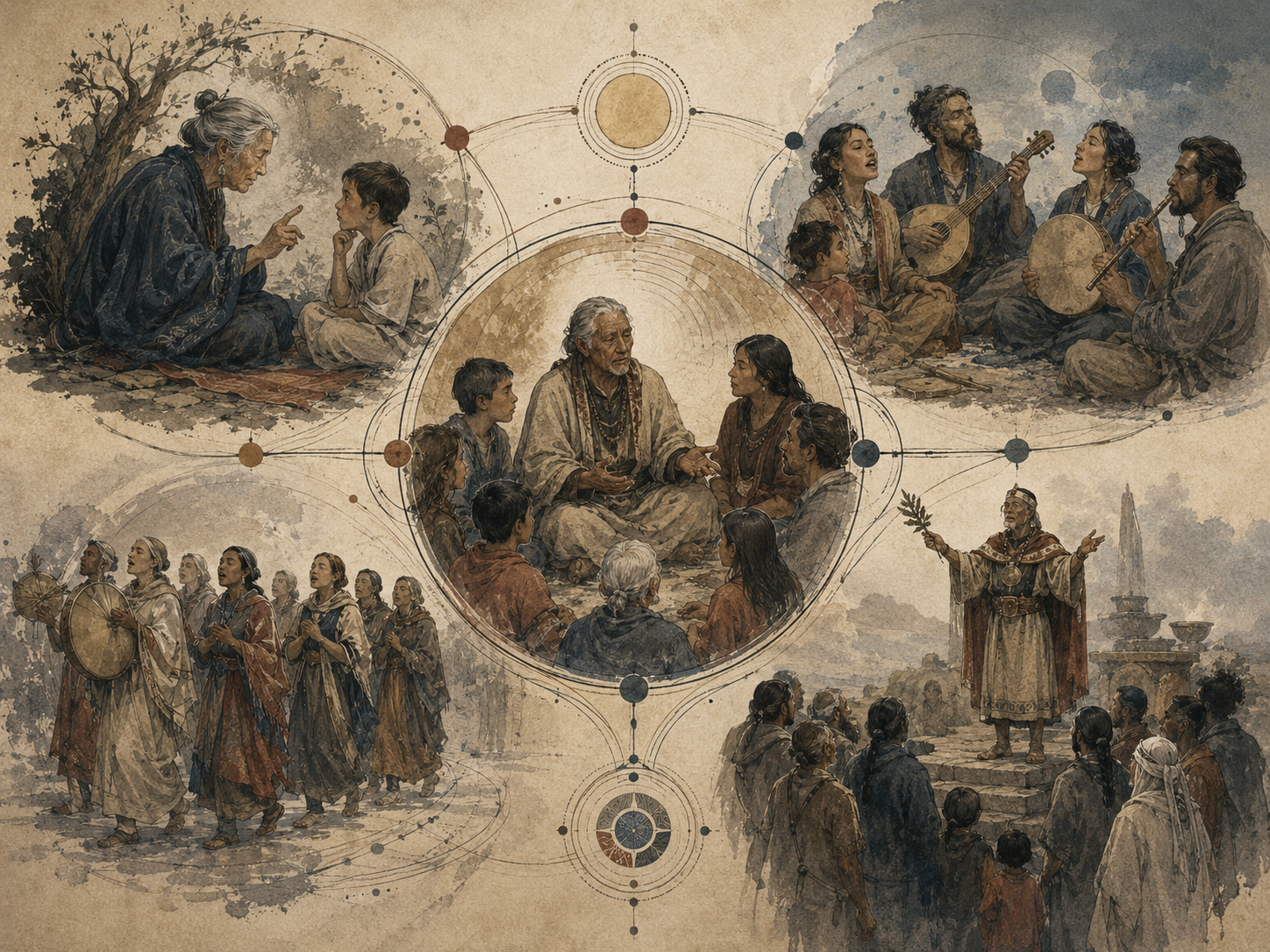
This article treats proverbs, songs, chants, and ritual speech as central forms of oral storytelling and cultural transmission. It examines compression, rhythm, melody, repetition, authority, occasion, performance, language, memory, ceremony, access, translation, documentation, and ethical interpretation. It also includes computational workflows for auditing oral-form context, sound and repetition, ritual authority, access protocol, translation risk, archive risk, and Catalyst Canvas-ready governance outputs.
Why Short, Musical, and Ritual Forms Matter
Proverbs, songs, chants, and ritual speech matter because storytelling is not limited to long narrative sequences. A culture may preserve memory in a brief proverb, a repeated refrain, a ceremonial invocation, a praise name, a work song, a lament, a chant, a blessing, a curse, a prayer, a vow, a naming formula, or a ritual exchange. These forms may be short, but they can carry dense social meaning.
A proverb condenses judgment. It may be used to settle a dispute, warn the young, mock foolishness, praise restraint, authorize patience, or criticize power indirectly. A song can bind memory to melody, body, place, and collective participation. A chant can turn speech into rhythm and force, supporting memory, concentration, ritual sequence, or communal action. Ritual speech can make something happen socially: a marriage is recognized, a transition is marked, a blessing is given, a name is spoken, a lament is performed, or an obligation is renewed.
These forms also challenge text-centered analysis. Their meaning may depend on tone, rhythm, repetition, timing, melody, audience response, sacred context, social role, and performance protocol. A written line may not capture what the proverb did in the room, what the song did in the gathering, what the chant did in ceremony, or what ritual speech authorized.
| Form | Primary feature | Storytelling function |
|---|---|---|
| Proverb | Compression, metaphor, social judgment, memorable phrasing. | Condenses collective wisdom, warning, critique, or moral reasoning. |
| Song | Melody, rhythm, voice, refrain, emotional and communal force. | Carries memory, identity, labor, mourning, celebration, protest, or belonging. |
| Chant | Measured rhythm, recitation, repetition, cadence, collective voicing. | Sustains ritual, memory, coordination, invocation, or intensified speech. |
| Ritual speech | Authorized language performed in formal social or sacred context. | Marks transition, obligation, blessing, naming, lament, prayer, oath, or renewal. |
Short, musical, and ritual forms matter because they show how storytelling can work through concentration, sound, cadence, authority, and performance rather than plot alone.
Proverb as Compressed Social Knowledge
A proverb is a small verbal form with large social reach. It may appear as a short sentence, metaphor, comparison, warning, joke, analogy, paradox, or inherited saying. Its power lies in compression. A proverb can carry practical advice, moral judgment, social criticism, historical memory, ecological observation, intergenerational teaching, or communal common sense in a form that is easy to remember and repeat.
Proverbs are not neutral decorations. They are used. A speaker may introduce a proverb to end an argument, redirect a conversation, correct behavior, signal experience, soften criticism, sharpen criticism, speak indirectly to power, or align with tradition. The meaning of the proverb depends on the moment of use.
The same proverb can also do different work in different contexts. It may be wise in one setting and manipulative in another. It may protect patience or excuse injustice. It may warn against recklessness or discourage necessary action. It may preserve inherited knowledge or reinforce hierarchy. The analyst should therefore ask not only what the proverb says, but who uses it, when, why, and to what effect.
| Proverb feature | How it works | Analytic question |
|---|---|---|
| Compression | Condenses social knowledge into memorable form. | What larger judgment is compressed into the saying? |
| Metaphor | Uses image or comparison to guide interpretation. | What image carries the meaning? |
| Indirectness | Allows criticism, warning, or advice without direct accusation. | What cannot be said plainly? |
| Authority | Draws on tradition, elders, collective experience, or repeated use. | Whose authority does the proverb invoke? |
| Situational use | Meaning changes depending on context. | What is happening when the proverb is spoken? |
| Ambivalence | May support wisdom, caution, hierarchy, resistance, or evasion. | What social consequence does the proverb create? |
A proverb is not merely a quote. It is a portable act of social reasoning.
Song as Memory, Performance, and Belonging
Song carries story through melody, rhythm, repetition, voice, breath, and shared participation. A song may preserve historical memory, family memory, labor rhythm, grief, praise, protest, migration, courtship, ritual, worship, seasonal transition, or communal identity. It may tell a story directly, or it may carry narrative fragments through refrain, image, name, place, and emotion.
Song is powerful because melody can stabilize memory. Words that might be forgotten in prose can be remembered through tune, rhythm, rhyme, and repetition. A refrain can allow participation even when not everyone knows the full song. A melody can carry feeling across generations. A song can make memory bodily: sung, breathed, repeated, danced, clapped, marched, mourned, or celebrated.
Songs also organize belonging. A group may know itself through shared songs. A family may remember a person through a song. A movement may gather around protest songs. A ritual may depend on specific songs. A diaspora may use songs to sustain language and place memory. A work community may coordinate labor through song. A song can carry identity without needing to explain identity in abstract terms.
| Song function | How it works | Documentation concern |
|---|---|---|
| Memory | Melody, rhythm, and refrain support recall. | Words alone may miss musical memory. |
| Belonging | Shared singing creates group recognition. | Who may sing, lead, hear, or teach the song? |
| Emotion | Voice and melody carry grief, joy, anger, longing, or reverence. | Transcript may flatten emotional force. |
| Labor | Rhythm coordinates work, movement, timing, or endurance. | Performance setting matters. |
| Protest | Refrain and repetition sustain collective action. | Political context shapes meaning. |
| Ritual | Song marks ceremony, transition, worship, healing, or remembrance. | Access and protocol may be restricted. |
Song shows how story can become memorable not only by being told, but by being sung together.
Chant as Rhythm, Recitation, and Force
Chant occupies a space between speech and song. It may use repeated rhythm, measured cadence, call and response, tonal pattern, formula, repetition, breath, and group voicing. Chant can support memory, ritual focus, coordination, invocation, protest, meditation, mourning, discipline, celebration, or communal intensity.
A chant may be less melodic than song, but it is not ordinary speech. Its force often comes from repetition and cadence. A chant can make words feel collective, formal, urgent, sacred, or embodied. In ritual settings, chant may organize sequence, invoke presence, mark transition, sustain attention, or connect participants to inherited forms. In public life, chant may coordinate protest, solidarity, or collective demand.
Chant can also protect language. A formula repeated through chant may preserve old words, sacred names, ceremonial phrases, or inherited rhythms. But this also means chant can be difficult to translate. The meaning may live in sound, cadence, repetition, breath, and timing as much as in dictionary definitions.
| Chant feature | How it works | Analytic question |
|---|---|---|
| Cadence | Gives speech a measured rhythm. | How does rhythm shape meaning? |
| Repetition | Intensifies words and supports memory. | What changes through repeated saying? |
| Collective voice | Allows group participation and coordination. | Who speaks together, and why? |
| Invocation | Calls on presence, authority, ancestors, spirits, names, or values. | What is being called forth? |
| Ritual sequence | Marks stages of ceremony or transition. | Where does the chant occur in the event? |
| Public force | Turns repeated speech into solidarity or demand. | What action does the chant support? |
Chant demonstrates that repetition is not redundancy. Repetition can be memory, force, participation, and transformation.
Ritual Speech as Authorized Action
Ritual speech is language performed under special conditions of authority. It may include prayers, blessings, vows, curses, invocations, laments, praise names, naming formulas, oaths, ceremonial greetings, initiation speech, healing words, funerary speech, wedding formulas, legal-religious declarations, seasonal recitations, or sacred narrative fragments. Its meaning often depends on who speaks, when, where, to whom, and by what authority.
Ritual speech is not simply expressive. It may be performative: it does something. A blessing blesses. A vow binds. A name recognizes. A lament mourns publicly. An invocation calls. A prayer addresses. A ceremonial greeting opens relation. A curse condemns. A formal apology may repair. A ritual formula may authorize transition from one social state to another.
Because ritual speech can be powerful, it often involves protocol. Some words may be restricted. Some can be spoken only by certain people. Some require a place, season, object, audience, or ritual state. Some must not be recorded or translated. Some can be paraphrased but not reproduced. Some are public; others are private or sacred.
| Ritual speech type | What it does | Interpretive caution |
|---|---|---|
| Blessing | Confers favor, protection, recognition, or good will. | Do not detach from authority and occasion. |
| Vow | Binds speaker to promise, relation, role, or obligation. | Who has authority to witness or enforce it? |
| Invocation | Calls on deity, ancestor, spirit, value, memory, or presence. | May involve sacred or restricted language. |
| Lament | Performs grief, memory, praise, accusation, or communal mourning. | Emotional and social context matter. |
| Naming formula | Recognizes identity, lineage, place, status, or belonging. | Names may carry restricted or relational meaning. |
| Ceremonial greeting | Opens relation, acknowledges status, and sets the speech frame. | Translation may miss politeness, rank, or obligation. |
Ritual speech shows storytelling at the boundary of language and action: words spoken in the right context can change social reality.
Form, Function, and Context
Proverbs, songs, chants, and ritual speech should be analyzed by form, function, and context together. Form asks how the speech is shaped: short saying, melody, refrain, rhythm, invocation, formula, call and response, or ceremonial sequence. Function asks what the speech does: instructs, remembers, blesses, mocks, protests, mourns, authorizes, binds, heals, or invokes. Context asks where, when, why, by whom, and before whom it is performed.
The same words can change function across contexts. A song may be devotional in one setting, political in another, nostalgic in another, and commercialized in another. A proverb may be wise counsel or a tool of social pressure. A chant may be sacred recitation or public protest. A ritual phrase may be powerful in ceremony but empty when copied without authority.
This is why analysis should avoid isolating form from use. A proverb printed in a collection is not the same as a proverb spoken during dispute. A song in an archive is not the same as a song sung in procession. A chant transcribed on a page is not the same as a chant repeated by bodies in rhythm. Ritual speech quoted outside its frame may lose or violate its function.
| Analytic layer | Question | Example |
|---|---|---|
| Form | How is the oral expression shaped? | Proverb, song, chant, blessing, oath, lament. |
| Function | What does it do socially, emotionally, ritually, or politically? | Warn, remember, invoke, bind, protest, mourn, bless. |
| Context | Where, when, why, by whom, and for whom is it performed? | Family gathering, ceremony, worksite, protest, funeral, festival. |
| Authority | Who has the right to speak, lead, teach, record, or interpret? | Elder, singer, ritual specialist, community member, public performer. |
| Transmission | How is the form learned and corrected? | Apprenticeship, repetition, listening, school, family, ritual office. |
| Access | Who may hear, repeat, translate, record, or publish it? | Public, community-only, restricted, seasonal, ceremonial, private. |
A compact oral form should be interpreted through the event in which it acts.
Language, Sound, and Translation
Language and sound are central to proverbs, songs, chants, and ritual speech. Their meaning often depends on rhythm, rhyme, tone, melody, repetition, alliteration, parallelism, wordplay, call and response, breath, silence, pitch, and culturally specific terms. Translation may preserve the basic idea while losing the force of the form.
A proverb may depend on metaphor that does not travel easily. A song may lose melody and emotional weight when translated. A chant may lose cadence. A ritual formula may lose sacred or social authority if rendered as ordinary prose. A praise name may carry lineage, history, and status that cannot be reduced to a literal equivalent.
Translation also raises ethical questions. Some material should not be translated publicly. Some should be paraphrased rather than reproduced. Some requires community review. Some requires notes explaining what cannot be fully carried across languages. In some cases, the original-language form must be preserved alongside any translation.
| Language feature | Meaning risk | Responsible practice |
|---|---|---|
| Metaphor | Literal translation may sound strange or lose cultural reference. | Explain image, context, and use. |
| Rhyme and rhythm | Musical memory may disappear. | Preserve sound notes where possible. |
| Refrain | Participation structure may be lost. | Document audience response and repetition. |
| Sacred terms | Translation may flatten restricted or theological meaning. | Use cultural review and access controls. |
| Names | Lineage, place, status, or relational meaning may disappear. | Include naming notes when permitted. |
| Silence | Omitted or unspoken material may be misread as absence. | Document protocol without exposing restricted content. |
Translation should not pretend that all meaning has been transferred. It should make the limits of transfer visible.
Repetition, Participation, and Memory
Repetition is one of the strongest memory supports in oral tradition. A proverb becomes memorable through repeated use. A song becomes memorable through refrain, melody, and repeated singing. A chant becomes powerful through rhythmic recurrence. Ritual speech gains force through prescribed repetition, formula, and occasion.
Participation also strengthens memory. A group may respond to a leader, sing a refrain, repeat a phrase, clap a rhythm, answer a call, complete a proverb, or join a chant. This distributes memory across the group. The story or speech form is not held only by one speaker. It is held in the relationship between speaker, listeners, rhythm, and expected response.
Repetition can also change meaning. A phrase said once may be ordinary; repeated in chant, song, or ritual, it can become collective, sacred, urgent, mournful, comic, or politically charged. Repetition does not simply duplicate words. It builds force.
| Memory device | How it works | Storytelling effect |
|---|---|---|
| Refrain | Repeats a line or phrase at intervals. | Creates recognition and participation. |
| Parallelism | Repeats structure with variation. | Builds rhythm, emphasis, and comparison. |
| Call and response | Divides speech between leader and group. | Distributes performance across community. |
| Formula | Uses inherited wording in repeated contexts. | Signals tradition, authority, and continuity. |
| Rhythmic cadence | Organizes speech through pulse or beat. | Supports memory and embodiment. |
| Completion cue | Invites listeners to finish a line, proverb, or response. | Shows shared knowledge. |
Repetition and participation show that oral memory is often communal, embodied, and active.
Authority, Access, and Protocol
Proverbs, songs, chants, and ritual speech are not equally open to everyone. Some are public and widely repeated. Some belong to families, lineages, professional performers, ritual specialists, elders, initiates, language communities, religious groups, occupational groups, or specific places. Some can be heard but not repeated. Some can be repeated but not recorded. Some can be recorded but not published. Some should not be translated.
Authority may be based on age, training, family, initiation, gender, office, religious role, community recognition, performance skill, or lived experience. A person may know the words but lack authority to lead the song or speak the ritual formula. A collector may have a transcript but not permission to publish. A platform may host a recording but not hold cultural authority over reuse.
Access protocol is therefore part of meaning. The question is not only “What does this form say?” but “Who may speak it, who may hear it, who may teach it, who may archive it, who may adapt it, and who may refuse access?”
| Access layer | Question | Why it matters |
|---|---|---|
| Hearing | Who may hear the proverb, song, chant, or ritual speech? | Some forms are audience-restricted. |
| Performance | Who may speak, sing, lead, or respond? | Authority may depend on role or training. |
| Teaching | Who may transmit the form to others? | Transmission can require apprenticeship or permission. |
| Recording | May the performance be documented? | Recording changes circulation and permanence. |
| Publication | May the form be printed, uploaded, quoted, or translated? | Public access may violate protocol. |
| Adaptation | May the form be remixed, sampled, dramatized, or used in media? | Creative reuse may become extraction. |
Authority and access are not external restrictions on interpretation. They are part of the form’s social reality.
Documentation and Archive Risk
Documentation can preserve proverbs, songs, chants, and ritual speech, especially when language shift, displacement, aging knowledge holders, conflict, migration, or disrupted transmission place traditions at risk. Audio recordings, video recordings, transcripts, translations, notation, field notes, and community archives can support learning and memory.
But documentation can also harm. A proverb collected without context may become a decorative quotation. A song recorded without permission may circulate beyond its intended audience. A chant transcribed without cadence may lose force. A ritual formula published without protocol may expose restricted speech. A translation may flatten sound, status, sacred relation, or social use. A database may impose categories that do not match community understanding.
Archive risk is especially high when oral forms are short. Their brevity can make them seem easy to extract. A proverb may be removed from its situation. A refrain may be sampled. A chant may be used as atmosphere. A ritual phrase may become a slogan. Compact forms travel easily, which makes governance more important.
| Documentation form | Potential value | Risk |
|---|---|---|
| Transcript | Preserves words and supports analysis. | May lose sound, rhythm, gesture, and event context. |
| Audio recording | Preserves voice, melody, cadence, and timing. | May circulate beyond consent. |
| Video recording | Preserves gesture, setting, participation, and ritual action. | May expose restricted or private context. |
| Translation | Expands access across languages. | May flatten metaphor, music, sacred terms, or social role. |
| Notation | Preserves melodic or rhythmic pattern. | May privilege formal representation over living performance. |
| Archive metadata | Supports search, cataloging, and preservation. | May misclassify authority, access, or community meaning. |
Documentation should preserve context, permission, sound, use, and authority, not only words.
Digital Circulation and Platform Risk
Digital platforms make proverbs, songs, chants, and ritual speech easier to circulate. A proverb can become a quote graphic. A song can become a clip. A chant can become a meme, protest sound, or remix. A ritual phrase can be quoted without context. Digital circulation can support visibility, revitalization, teaching, and community connection, but it can also create context collapse.
Context collapse happens when speech meant for one audience enters another audience without the surrounding knowledge needed to interpret it responsibly. A ceremonial chant may be heard as sound texture. A protest chant may be detached from its political situation. A proverb may be translated into generic inspiration. A ritual phrase may be used as branding. A song may be sampled without permission or benefit sharing.
Platform systems also reshape oral forms. Short, repeatable, rhythmic forms are especially easy to clip, share, remix, and algorithmically amplify. The features that make them memorable also make them vulnerable to extraction.
| Platform issue | Risk | Responsible response |
|---|---|---|
| Quote extraction | Proverbs become decorative content without context. | Include source, use context, and cultural notes. |
| Audio sampling | Songs or chants are reused without consent. | Review permissions, rights, and benefit sharing. |
| Clip circulation | Ritual speech is detached from ceremony. | Use access controls and contextual framing. |
| Search indexing | Restricted words become easily discoverable. | Limit indexing and public metadata when needed. |
| Algorithmic amplification | Attention rewards spectacle over context. | Use community-led framing and governance. |
| Data reuse | Audio and transcripts may enter datasets or AI systems. | Document data-use restrictions explicitly. |
Digital circulation should extend community control and context, not turn compact oral forms into free-floating content.
The Ethics of Interpretation
The ethics of interpreting proverbs, songs, chants, and ritual speech begins with humility. These forms are often dense, context-dependent, and easy to misread. A proverb may sound universal but belong to a specific social situation. A song may appear simple but carry layered historical grief. A chant may sound repetitive but organize collective force. Ritual speech may appear formulaic but perform real social or sacred action.
Ethical interpretation requires attention to source, language, performer, audience, occasion, authority, access, and use. It also requires caution around quotation. Some forms can be quoted freely; others should be paraphrased; others should not be reproduced at all. Public accessibility does not automatically equal ethical availability.
Interpretation should also avoid romanticizing oral forms as pure wisdom. Proverbs can reinforce hierarchy. Songs can be used for exclusion or propaganda. Chants can mobilize solidarity or intimidation. Ritual speech can heal, bind, bless, exclude, or control. Ethical analysis asks what the form does and who is affected.
| Ethical concern | Risk | Responsible practice |
|---|---|---|
| Context loss | A compact form is treated as self-explanatory. | Document occasion, speaker, audience, and use. |
| Overquotation | Restricted or sacred language is reproduced without permission. | Use access review and paraphrase where appropriate. |
| Romanticization | All inherited sayings or songs are treated as wisdom. | Analyze power, exclusion, and social consequence. |
| Translation overconfidence | Translated meaning is treated as complete. | Include language and sound notes. |
| Commercial reuse | Song, chant, or ritual phrase becomes branding, sample, or content. | Review consent, rights, and benefit sharing. |
| Authority confusion | Anyone who knows the words is treated as authorized. | Identify performance and teaching authority. |
The ethical question is not only what a proverb, song, chant, or ritual speech means, but what happens when it is repeated, translated, archived, taught, or reused.
Examples of Proverb, Song, Chant, and Ritual Speech Analysis
The examples below show how compact and ritual oral forms can be analyzed without reducing them to decorative quotations.
Proverb in conflict mediation
Weak: The proverb is quoted as general wisdom.
Stronger: The analysis asks who used it, what conflict it addressed, and how indirect speech shaped the outcome.
Why it works: The proverb is treated as social action.
Work song
Weak: The song is interpreted only by lyrics.
Stronger: The analysis includes rhythm, labor coordination, call and response, fatigue, and shared timing.
Why it works: Song is understood as embodied performance.
Ceremonial chant
Weak: The chant is transcribed without access notes.
Stronger: The analysis records cadence, occasion, authority, restrictions, and what should not be publicly reproduced.
Why it works: Ritual force and protocol are preserved.
Funerary lament
Weak: The lament is summarized as sadness.
Stronger: The analysis asks how voice, naming, memory, grief, accusation, praise, and communal mourning work together.
Why it works: Lament is treated as public memory and emotional action.
Protest chant
Weak: The chant is treated as a slogan.
Stronger: The analysis considers rhythm, repetition, group voicing, political situation, and collective force.
Why it works: Chant is read as coordinated public action.
Naming formula
Weak: The name is translated literally.
Stronger: The analysis asks what lineage, place, status, relationship, and permission are carried by the naming speech.
Why it works: Ritual speech is treated as recognition, not label alone.
Compact oral forms should be analyzed as situated performances with sound, force, memory, and authority.
Mathematics, Computation, and Modeling
Proverbs, songs, chants, and ritual speech should not be reduced to formulas, but modeling can help make documentation and governance questions explicit. A computational workflow can audit whether compact oral forms have enough context, sound documentation, authority notes, translation notes, access controls, and archive-risk review.
An oral-form context score can estimate whether the form has been documented as a performance event:
O_c = \frac{F_i + S_p + A_d + O_n + P_l + U_c}{6}
\]
Interpretation: Oral-form context \(O_c\) averages form identification \(F_i\), speaker or performer role \(S_p\), audience documentation \(A_d\), occasion notes \(O_n\), place linkage \(P_l\), and use context \(U_c\).
A sound-and-repetition score can estimate whether rhythm, melody, cadence, and repetition are preserved:
S_r = \frac{R_h + M_l + C_d + R_f + P_a + E_b}{6}
\]
Interpretation: Sound and repetition \(S_r\) averages rhythm \(R_h\), melody \(M_l\), cadence \(C_d\), refrain or formula \(R_f\), participation \(P_a\), and embodiment \(E_b\).
A ritual-authority score can estimate whether access, protocol, and authority are clear:
A_r = \frac{R_l + P_r + C_s + A_c + G_o + B_s}{6}
\]
Interpretation: Ritual authority \(A_r\) averages role legitimacy \(R_l\), protocol review \(P_r\), consent status \(C_s\), access control \(A_c\), governance oversight \(G_o\), and benefit sharing \(B_s\).
An archive-risk score can estimate whether documentation may flatten, expose, or extract compact oral forms:
R_a = Q_ew_q + C_rw_c + S_lw_s + T_lw_t + E_xw_e + (1 – G_c)w_g
\]
Interpretation: Archive risk \(R_a\) rises with quote extraction \(Q_e\), context removal \(C_r\), sound loss \(S_l\), translation loss \(T_l\), extraction risk \(E_x\), and weak governance control \(G_c\).
| Modeling task | Oral-form question | Example output |
|---|---|---|
| Form audit | Is the item a proverb, song, chant, ritual speech, or hybrid form? | Oral-form classification table. |
| Context audit | Who performed it, for whom, when, where, and why? | Oral-form context score. |
| Sound audit | Are rhythm, melody, cadence, repetition, and participation documented? | Sound and repetition profile. |
| Authority audit | Who may speak, sing, teach, record, translate, or publish it? | Ritual-authority score. |
| Translation audit | What meaning is lost when sound, metaphor, or sacred terms are translated? | Translation-risk note. |
| Governance queue | Which items need source, cultural, language, access, or ethics review? | Compact oral forms governance queue. |
Computation can support responsible documentation when it makes context, sound, authority, and risk visible. It should not replace community interpretation, language knowledge, performer authority, or human judgment.
Python Workflow: Oral Form and Ritual Speech Audit
The Python workflow below evaluates compact oral forms by form identification, speaker role, audience documentation, occasion notes, place linkage, use context, rhythm, melody, cadence, refrain or formula, participation, embodiment, role legitimacy, protocol review, consent status, access control, governance oversight, benefit sharing, quote extraction risk, context removal, sound loss, translation loss, extraction risk, and governance control. The companion repository version extends this into a Catalyst Canvas-ready module with schemas, package-style Python, tests, JSON exports, Canvas cards, markdown governance queues, and reusable oral-form templates.
# compact_oral_forms_audit.py
# Dependency-light workflow for auditing proverbs, songs, chants, and ritual speech.

from __future__ import annotations

from dataclasses import dataclass
from pathlib import Path
import csv
import json
from statistics import mean

ARTICLE_ROOT = Path(__file__).resolve().parents[1]
OUTPUTS = ARTICLE_ROOT / "outputs"
TABLES = OUTPUTS / "tables"
JSON_DIR = OUTPUTS / "json"
MARKDOWN = OUTPUTS / "markdown"


@dataclass
class CompactOralFormItem:
    item: str
    oral_form: str
    form_identification: float
    speaker_role: float
    audience_documentation: float
    occasion_notes: float
    place_linkage: float
    use_context: float
    rhythm: float
    melody: float
    cadence: float
    refrain_or_formula: float
    participation: float
    embodiment: float
    role_legitimacy: float
    protocol_review: float
    consent_status: float
    access_control: float
    governance_oversight: float
    benefit_sharing: float
    quote_extraction_risk: float
    context_removal: float
    sound_loss: float
    translation_loss: float
    extraction_risk: float
    governance_control: float
    community_sensitivity: float
    public_consequence: float
    owner: str
    status: str

    def oral_form_context(self) -> float:
        return mean([
            self.form_identification,
            self.speaker_role,
            self.audience_documentation,
            self.occasion_notes,
            self.place_linkage,
            self.use_context,
        ])

    def sound_and_repetition(self) -> float:
        return mean([
            self.rhythm,
            self.melody,
            self.cadence,
            self.refrain_or_formula,
            self.participation,
            self.embodiment,
        ])

    def ritual_authority(self) -> float:
        return mean([
            self.role_legitimacy,
            self.protocol_review,
            self.consent_status,
            self.access_control,
            self.governance_oversight,
            self.benefit_sharing,
        ])

    def archive_risk(self) -> float:
        return min(
            1.0,
            self.quote_extraction_risk * 0.18
            + self.context_removal * 0.18
            + self.sound_loss * 0.16
            + self.translation_loss * 0.16
            + self.extraction_risk * 0.18
            + (1 - self.governance_control) * 0.14,
        )

    def governance_priority_score(self) -> float:
        return min(
            1.0,
            self.archive_risk() * 0.35
            + self.community_sensitivity * 0.25
            + self.public_consequence * 0.20
            + (1 - self.ritual_authority()) * 0.20,
        )

    def review_priority(self) -> str:
        risk = self.archive_risk()
        priority = self.governance_priority_score()
        authority = self.ritual_authority()

        if self.status == "revise" or risk >= 0.55 or priority >= 0.62 or authority < 0.55:
            return "high"
        if self.status == "review" or risk >= 0.40 or priority >= 0.48 or authority < 0.68:
            return "medium"
        return "standard"


def write_csv(path: Path, rows: list[dict[str, object]]) -> None:
    path.parent.mkdir(parents=True, exist_ok=True)
    if not rows:
        raise ValueError(f"No rows to write: {path}")
    with path.open("w", encoding="utf-8", newline="") as handle:
        writer = csv.DictWriter(handle, fieldnames=list(rows[0].keys()))
        writer.writeheader()
        writer.writerows(rows)


def write_json(path: Path, payload: object) -> None:
    path.parent.mkdir(parents=True, exist_ok=True)
    path.write_text(json.dumps(payload, indent=2), encoding="utf-8")


def write_markdown_queue(path: Path, rows: list[dict[str, object]]) -> None:
    path.parent.mkdir(parents=True, exist_ok=True)
    lines = [
        "# Compact Oral Forms Governance Queue",
        "",
        "| Item | Form | Context | Sound and repetition | Ritual authority | Archive risk | Priority | Owner |",
        "|---|---|---:|---:|---:|---:|---|---|",
    ]

    for row in rows:
        lines.append(
            f"| {row['item']} | {row['oral_form']} | "
            f"{row['oral_form_context']} | {row['sound_and_repetition']} | "
            f"{row['ritual_authority']} | {row['archive_risk']} | "
            f"{row['review_priority']} | {row['owner']} |"
        )

    path.write_text("\n".join(lines) + "\n", encoding="utf-8")


def main() -> None:
    items = [
        CompactOralFormItem(
            "Proverb in conflict mediation",
            "proverb",
            0.92, 0.78, 0.72, 0.82, 0.58, 0.88,
            0.54, 0.10, 0.48, 0.76, 0.46, 0.40,
            0.70, 0.62, 0.68, 0.70, 0.66, 0.58,
            0.46, 0.38, 0.44, 0.56, 0.40, 0.72,
            0.68, 0.58,
            "editorial", "active"
        ),
        CompactOralFormItem(
            "Work song",
            "song",
            0.88, 0.82, 0.76, 0.78, 0.70, 0.82,
            0.86, 0.90, 0.80, 0.84, 0.82, 0.76,
            0.72, 0.66, 0.70, 0.68, 0.64, 0.62,
            0.36, 0.34, 0.46, 0.48, 0.42, 0.76,
            0.72, 0.62,
            "performance review", "active"
        ),
        CompactOralFormItem(
            "Ceremonial chant",
            "chant",
            0.86, 0.84, 0.64, 0.92, 0.80, 0.86,
            0.88, 0.62, 0.92, 0.88, 0.78, 0.84,
            0.86, 0.92, 0.58, 0.46, 0.82, 0.54,
            0.58, 0.72, 0.70, 0.66, 0.64, 0.44,
            0.96, 0.84,
            "cultural review", "review"
        ),
        CompactOralFormItem(
            "Funerary lament",
            "ritual speech",
            0.90, 0.88, 0.82, 0.94, 0.76, 0.88,
            0.70, 0.76, 0.78, 0.72, 0.68, 0.86,
            0.82, 0.80, 0.74, 0.70, 0.76, 0.66,
            0.42, 0.48, 0.58, 0.56, 0.46, 0.70,
            0.88, 0.80,
            "archive review", "active"
        ),
        CompactOralFormItem(
            "Ritual phrase used in marketing",
            "ritual speech adaptation",
            0.44, 0.28, 0.24, 0.30, 0.22, 0.34,
            0.32, 0.20, 0.28, 0.36, 0.18, 0.20,
            0.24, 0.20, 0.18, 0.16, 0.18, 0.12,
            0.92, 0.88, 0.74, 0.76, 0.94, 0.16,
            0.94, 0.88,
            "governance", "revise"
        ),
    ]

    rows = []

    for item in items:
        rows.append({
            "item": item.item,
            "oral_form": item.oral_form,
            "oral_form_context": round(item.oral_form_context(), 3),
            "sound_and_repetition": round(item.sound_and_repetition(), 3),
            "ritual_authority": round(item.ritual_authority(), 3),
            "archive_risk": round(item.archive_risk(), 3),
            "governance_priority_score": round(item.governance_priority_score(), 3),
            "review_priority": item.review_priority(),
            "owner": item.owner,
            "status": item.status,
        })

    priority_order = {"high": 3, "medium": 2, "standard": 1}
    rows = sorted(
        rows,
        key=lambda row: (
            priority_order.get(str(row["review_priority"]), 0),
            float(row["archive_risk"])
        ),
        reverse=True,
    )

    governance_queue = [
        row for row in rows
        if row["review_priority"] != "standard"
    ]

    write_csv(TABLES / "compact_oral_forms_audit.csv", rows)
    write_csv(TABLES / "compact_oral_forms_governance_queue.csv", governance_queue)

    write_json(JSON_DIR / "compact_oral_forms_canvas_cards.json", rows)
    write_json(JSON_DIR / "compact_oral_forms_governance_queue.json", governance_queue)

    write_markdown_queue(MARKDOWN / "compact_oral_forms_governance_queue.md", governance_queue)

    print("Compact oral forms audit complete.")


if __name__ == "__main__":
    main()
This workflow helps distinguish compact oral forms from weak quotation, context loss, sound loss, translation distortion, ritual exposure, and extractive reuse.
R Workflow: Proverb, Song, Chant, and Ritual Speech Diagnostics
The R workflow below creates a synthetic compact oral-forms dataset, calculates oral-form context, sound and repetition, ritual authority, archive risk, governance priority, and review priority, then exports summary tables and base R plots. It is intentionally portable and uses only base R.
# compact_oral_forms_diagnostics.R
# Base R workflow for proverb, song, chant, and ritual speech analysis.

args <- commandArgs(trailingOnly = FALSE)
file_arg <- grep("^--file=", args, value = TRUE)

if (length(file_arg) > 0) {
  script_path <- normalizePath(sub("^--file=", "", file_arg[1]), mustWork = TRUE)
  article_root <- normalizePath(file.path(dirname(script_path), ".."), mustWork = TRUE)
} else {
  article_root <- getwd()
}

setwd(article_root)

tables_dir <- file.path(article_root, "outputs", "tables")
figures_dir <- file.path(article_root, "outputs", "figures")
dir.create(tables_dir, recursive = TRUE, showWarnings = FALSE)
dir.create(figures_dir, recursive = TRUE, showWarnings = FALSE)

items <- data.frame(
  item = c(
    "Proverb in conflict mediation",
    "Work song",
    "Ceremonial chant",
    "Funerary lament",
    "Ritual phrase used in marketing"
  ),
  oral_form = c(
    "proverb",
    "song",
    "chant",
    "ritual speech",
    "ritual speech adaptation"
  ),
  form_identification = c(0.92, 0.88, 0.86, 0.90, 0.44),
  speaker_role = c(0.78, 0.82, 0.84, 0.88, 0.28),
  audience_documentation = c(0.72, 0.76, 0.64, 0.82, 0.24),
  occasion_notes = c(0.82, 0.78, 0.92, 0.94, 0.30),
  place_linkage = c(0.58, 0.70, 0.80, 0.76, 0.22),
  use_context = c(0.88, 0.82, 0.86, 0.88, 0.34),
  rhythm = c(0.54, 0.86, 0.88, 0.70, 0.32),
  melody = c(0.10, 0.90, 0.62, 0.76, 0.20),
  cadence = c(0.48, 0.80, 0.92, 0.78, 0.28),
  refrain_or_formula = c(0.76, 0.84, 0.88, 0.72, 0.36),
  participation = c(0.46, 0.82, 0.78, 0.68, 0.18),
  embodiment = c(0.40, 0.76, 0.84, 0.86, 0.20),
  role_legitimacy = c(0.70, 0.72, 0.86, 0.82, 0.24),
  protocol_review = c(0.62, 0.66, 0.92, 0.80, 0.20),
  consent_status = c(0.68, 0.70, 0.58, 0.74, 0.18),
  access_control = c(0.70, 0.68, 0.46, 0.70, 0.16),
  governance_oversight = c(0.66, 0.64, 0.82, 0.76, 0.18),
  benefit_sharing = c(0.58, 0.62, 0.54, 0.66, 0.12),
  quote_extraction_risk = c(0.46, 0.36, 0.58, 0.42, 0.92),
  context_removal = c(0.38, 0.34, 0.72, 0.48, 0.88),
  sound_loss = c(0.44, 0.46, 0.70, 0.58, 0.74),
  translation_loss = c(0.56, 0.48, 0.66, 0.56, 0.76),
  extraction_risk = c(0.40, 0.42, 0.64, 0.46, 0.94),
  governance_control = c(0.72, 0.76, 0.44, 0.70, 0.16),
  community_sensitivity = c(0.68, 0.72, 0.96, 0.88, 0.94),
  public_consequence = c(0.58, 0.62, 0.84, 0.80, 0.88),
  owner = c("editorial", "performance review", "cultural review", "archive review", "governance"),
  status = c("active", "active", "review", "active", "revise"),
  stringsAsFactors = FALSE
)

items$oral_form_context <- rowMeans(items[, c(
  "form_identification",
  "speaker_role",
  "audience_documentation",
  "occasion_notes",
  "place_linkage",
  "use_context"
)])

items$sound_and_repetition <- rowMeans(items[, c(
  "rhythm",
  "melody",
  "cadence",
  "refrain_or_formula",
  "participation",
  "embodiment"
)])

items$ritual_authority <- rowMeans(items[, c(
  "role_legitimacy",
  "protocol_review",
  "consent_status",
  "access_control",
  "governance_oversight",
  "benefit_sharing"
)])

items$archive_risk <- pmin(
  1,
  items$quote_extraction_risk * 0.18 +
    items$context_removal * 0.18 +
    items$sound_loss * 0.16 +
    items$translation_loss * 0.16 +
    items$extraction_risk * 0.18 +
    (1 - items$governance_control) * 0.14
)

items$governance_priority_score <- pmin(
  1,
  items$archive_risk * 0.35 +
    items$community_sensitivity * 0.25 +
    items$public_consequence * 0.20 +
    (1 - items$ritual_authority) * 0.20
)

items$review_priority <- ifelse(
  items$status == "revise" | items$archive_risk >= 0.55 | items$governance_priority_score >= 0.62 | items$ritual_authority < 0.55,
  "high",
  ifelse(
    items$status == "review" | items$archive_risk >= 0.40 | items$governance_priority_score >= 0.48 | items$ritual_authority < 0.68,
    "medium",
    "standard"
  )
)

items <- items[order(items$archive_risk, decreasing = TRUE), ]

write.csv(
  items,
  file.path(tables_dir, "compact_oral_forms_diagnostics.csv"),
  row.names = FALSE
)

governance_queue <- items[items$review_priority != "standard", ]

write.csv(
  governance_queue,
  file.path(tables_dir, "compact_oral_forms_governance_queue.csv"),
  row.names = FALSE
)

png(file.path(figures_dir, "oral_form_context_scores.png"), width = 1200, height = 700)
barplot(
  items$oral_form_context,
  names.arg = items$item,
  las = 2,
  ylab = "Oral-form context",
  main = "Compact Oral Form Context Scores"
)
grid()
dev.off()

png(file.path(figures_dir, "ritual_authority_scores.png"), width = 1200, height = 700)
barplot(
  items$ritual_authority,
  names.arg = items$item,
  las = 2,
  ylab = "Ritual authority",
  main = "Ritual Authority and Access Scores"
)
grid()
dev.off()

print(items[, c(
  "item",
  "oral_form",
  "oral_form_context",
  "sound_and_repetition",
  "ritual_authority",
  "archive_risk",
  "governance_priority_score",
  "review_priority"
)])
This workflow turns compact oral forms into a reviewable analysis object while preserving the central point: proverbs, songs, chants, and ritual speech require context, sound, authority, access, and ethical interpretation.
GitHub Repository
The companion repository for this article supports proverb, song, chant, and ritual speech as a Catalyst Canvas-ready analysis module. It includes oral-form context scoring, sound-and-repetition diagnostics, ritual-authority review, translation-risk notes, archive-risk checks, platform-circulation review, JSON schemas, package-style Python, R workflows, SQL structures, Canvas cards, markdown governance queues, synthetic datasets, documentation, and reusable compact oral-form templates.
Complete Code Repository
Companion repository for the article, including Catalyst Canvas-ready code for proverbs, songs, chants, ritual speech, oral-form context, sound and repetition, authority review, archive risk, governance queues, JSON exports, Canvas cards, and reproducible research workflows.
articles/proverb-song-chant-and-ritual-speech/
├── canvas/
│   ├── canvas_manifest.json
│   ├── input_schema.json
│   ├── output_schema.json
│   ├── canvas_cards.json
│   └── governance_queue.json
├── html/
├── css/
├── php/
├── java/
├── python/
│   ├── compact_oral_forms_canvas/
│   │   ├── __init__.py
│   │   ├── __main__.py
│   │   ├── cli.py
│   │   ├── models.py
│   │   ├── scoring.py
│   │   ├── validation.py
│   │   ├── governance.py
│   │   └── exporters.py
│   ├── tests/
│   │   └── test_compact_oral_forms_canvas.py
│   └── run_compact_oral_forms_canvas_audit.py
├── r/
│   ├── compact_oral_forms_diagnostics.R
│   └── run_all_compact_oral_forms_workflows.R
├── sql/
│   ├── canvas_schema.sql
│   └── canvas_queries.sql
├── docs/
│   ├── article_notes.md
│   ├── modeling_principles.md
│   ├── proverb.md
│   ├── song.md
│   ├── chant.md
│   ├── ritual_speech.md
│   ├── translation_and_sound.md
│   ├── archive_risk.md
│   └── governance_notes.md
├── data/
│   ├── compact_oral_forms_items.csv
│   ├── oral_form_contexts.csv
│   ├── sound_repetition_features.csv
│   ├── ritual_authority_notes.csv
│   ├── archive_risks.csv
│   └── compact_oral_forms_governance_notes.csv
├── outputs/
│   ├── figures/
│   ├── json/
│   ├── markdown/
│   └── tables/
├── notebooks/
├── shared/
│   ├── schemas/
│   ├── narrative-templates/
│   ├── story-archetypes/
│   ├── character-models/
│   ├── plot-structures/
│   ├── rhetorical-frameworks/
│   ├── cultural-memory/
│   ├── compact-oral-forms/
│   └── governance/
├── tests/
└── README.md
Related Articles
- Oral Tradition, Performance, and Collective Memory
- Storytelling as Intangible Cultural Heritage
- Performance, Memory, and Variation in Oral Storytelling
- Myths, Legends, Folktales, and Epics
- Myth, Ritual, and the Symbolic Work of Story
- Rhetoric, Persuasion, and the Public Life of Story
A Practical Method for Analyzing Compact and Ritual Oral Forms
1. Identify the oral form
Clarify whether the item is a proverb, song, chant, ritual speech, hybrid form, or adaptation.
2. Document the speech event
Record speaker or performer role, audience, occasion, place, purpose, and interaction.
3. Analyze sound and repetition
Note rhythm, melody, cadence, refrain, formula, call and response, participation, and embodiment.
4. Identify social function
Ask whether the form instructs, warns, blesses, mourns, protests, invokes, binds, remembers, or authorizes.
5. Review language and translation
Document original-language features, metaphor, rhyme, tone, sacred terms, names, and translation limits.
6. Establish authority
Ask who may speak, sing, lead, teach, record, translate, publish, or adapt the form.
7. Set access levels
Determine whether the material is public, community-only, restricted, seasonal, ceremonial, private, or not to be archived.
8. Audit archive risk
Look for quote extraction, context removal, sound loss, translation loss, restricted material, and platform risk.
9. Review reuse and adaptation
Ask whether the form is being quoted, sampled, remixed, commercialized, taught, or used as data.
10. Add governance notes
Document review owner, access protocol, source context, sound documentation, translation constraints, and revision recommendations.
This method protects the meaning of compact oral forms by preserving context, sound, authority, and responsibility.
Common Pitfalls
Several pitfalls appear when compact oral forms are treated as simple quotations.
- Treating proverbs as universal wisdom: Proverbs are situated acts of social reasoning and may also reinforce hierarchy or evasion.
- Reading songs only as lyrics: Melody, rhythm, voice, setting, participation, and embodiment often carry central meaning.
- Dismissing chant as repetition: Repetition can create memory, force, ritual sequence, and collective action.
- Quoting ritual speech without authority: Some speech should not be reproduced, translated, or circulated without protocol.
- Ignoring sound: Transcripts can flatten rhythm, cadence, tone, silence, and musical memory.
- Ignoring use context: The same proverb, song, chant, or ritual phrase can do different work in different situations.
- Flattening translation: Literal meaning may not preserve metaphor, sound, sacred terms, names, or social force.
- Confusing access with availability: Material found online is not automatically ethically available for reuse.
- Extracting short forms for content: Compact forms are easy to quote, sample, or remix, which increases governance risk.
- Separating speech from action: Ritual speech may bless, bind, name, mourn, invoke, or authorize; it is not only description.
The central pitfall is treating compact oral forms as content fragments rather than living speech acts.
Why These Forms Still Matter
Proverbs, songs, chants, and ritual speech still matter because many cultures preserve meaning through compact, repeated, musical, and ceremonial forms. Not every story needs a long plot to carry memory. A proverb can hold social judgment. A song can hold belonging. A chant can hold collective force. Ritual speech can hold authority, transition, obligation, grief, blessing, and sacred relation.
These forms also remind us that storytelling is not only narrative content. It is sound, timing, repetition, participation, social use, and authorized performance. A line may matter because of who speaks it. A refrain may matter because people join it. A chant may matter because repetition changes the atmosphere. A ritual phrase may matter because the right words in the right setting can change social reality.
To interpret these forms responsibly, we must ask more than what the words mean. We must ask how they sound, who carries them, when they are spoken, what they do, who may hear them, what cannot be translated, and what obligations follow when they are recorded, quoted, taught, archived, or reused.
Further Reading
- Bauman, R. (1986) Story, Performance, and Event: Contextual Studies of Oral Narrative. Cambridge: Cambridge University Press. Available at: https://www.cambridge.org/core/books/story-performance-and-event/800376D4B7FC687529F1A48E97FEEDDB
- Britannica (n.d.) Oral Literature: Oral Genres. Available at: https://www.britannica.com/art/oral-literature/Oral-genres
- Finnegan, R. (1992) Oral Traditions and the Verbal Arts: A Guide to Research Practices. London: Routledge. Available at: https://www.routledge.com/Oral-Traditions-and-the-Verbal-Arts-A-Guide-to-Research-Practices/Finnegan/p/book/9780415048415
- Foley, J.M. (2002) How to Read an Oral Poem. Urbana: University of Illinois Press.
- Lord, A.B. (2019) The Singer of Tales. 3rd edn. Edited by D.F. Elmer. Cambridge, MA: Harvard University Press. Available at: https://www.hup.harvard.edu/books/9780674975736
- Ong, W.J. (2012) Orality and Literacy: The Technologizing of the Word. 30th anniversary edn. London: Routledge. Available at: https://www.routledge.com/Orality-and-Literacy-30th-Anniversary-Edition/Ong/p/book/9780415538381
- UNESCO (n.d.) Oral Traditions and Expressions Including Language as a Vehicle of the Intangible Cultural Heritage. Available at: https://ich.unesco.org/en/oral-traditions-and-expressions-00053
- Vansina, J. (1985) Oral Tradition as History. Madison: University of Wisconsin Press.
References
- Bauman, R. (1986) Story, Performance, and Event: Contextual Studies of Oral Narrative. Cambridge: Cambridge University Press. Available at: https://www.cambridge.org/core/books/story-performance-and-event/800376D4B7FC687529F1A48E97FEEDDB
- Britannica (n.d.) Oral Literature: Oral Genres. Available at: https://www.britannica.com/art/oral-literature/Oral-genres
- Finnegan, R. (1992) Oral Traditions and the Verbal Arts: A Guide to Research Practices. London: Routledge. Available at: https://www.routledge.com/Oral-Traditions-and-the-Verbal-Arts-A-Guide-to-Research-Practices/Finnegan/p/book/9780415048415
- Foley, J.M. (2002) How to Read an Oral Poem. Urbana: University of Illinois Press.
- Lord, A.B. (2019) The Singer of Tales. 3rd edn. Edited by D.F. Elmer. Cambridge, MA: Harvard University Press. Available at: https://www.hup.harvard.edu/books/9780674975736
- Ong, W.J. (2012) Orality and Literacy: The Technologizing of the Word. 30th anniversary edn. London: Routledge. Available at: https://www.routledge.com/Orality-and-Literacy-30th-Anniversary-Edition/Ong/p/book/9780415538381
- UNESCO (n.d.) Oral Traditions and Expressions Including Language as a Vehicle of the Intangible Cultural Heritage. Available at: https://ich.unesco.org/en/oral-traditions-and-expressions-00053
- Vansina, J. (1985) Oral Tradition as History. Madison: University of Wisconsin Press.