
Last Updated June 10, 2026
Oral storytelling is never only the delivery of a fixed text. A story changes as it is remembered, voiced, timed, embodied, heard, corrected, repeated, adapted, and passed on. The same tale may feel comic in one performance, solemn in another, ceremonial in another, intimate in another, and politically charged in another. The difference is not accidental. Performance, memory, and variation are part of how oral storytelling lives.
Performance, Memory, and Variation in Oral Storytelling examines oral storytelling as a dynamic practice rather than a static artifact. It explains how tellers use memory, formula, gesture, voice, repetition, audience response, occasion, place, and improvisation to keep stories recognizable while allowing them to change. It also shows why variation is not automatically error. In living oral traditions, variation can be a sign of continuity, adaptation, authority, skill, and communal responsiveness.
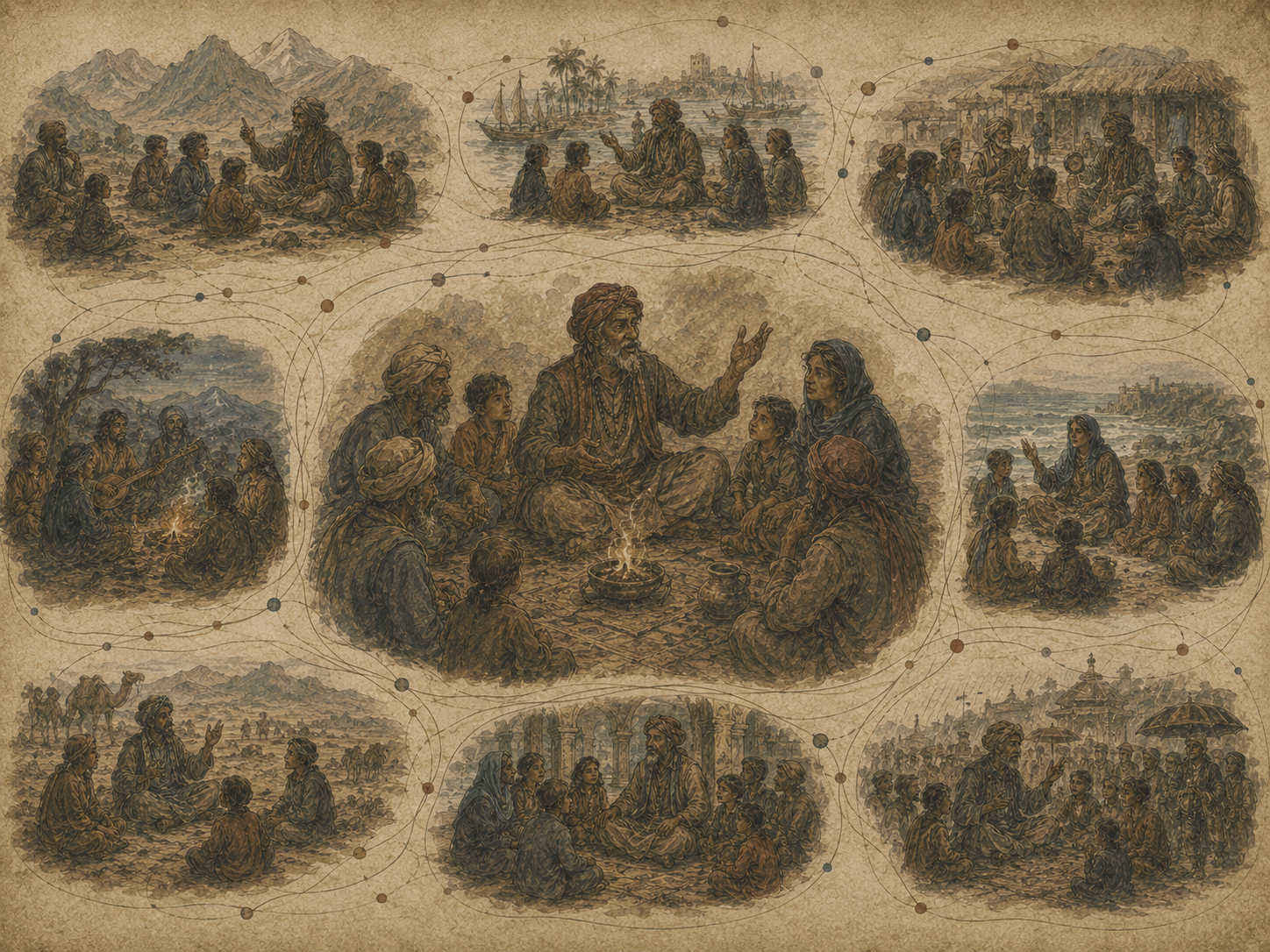
This article treats oral storytelling as a living system of performance, memory, and variation. It examines how stories are remembered, stabilized, changed, improvised, corrected, adapted, and transmitted across tellers and generations. It also includes computational workflows for auditing performance context, memory support, variation patterns, audience participation, formula use, transmission integrity, archive risk, and Catalyst Canvas-ready governance outputs.
Why Performance, Memory, and Variation Matter
Performance, memory, and variation matter because oral storytelling does not live as a single fixed object. It lives through repeated acts of telling. Each performance occurs in a specific situation: a teller, an audience, an occasion, a place, a language, a social purpose, and a field of expectations. The story is remembered and recognized, but it is also remade in the act of telling.
This is why oral stories can remain stable across generations without becoming identical word-for-word recitations. Stability often comes from pattern, formula, sequence, character role, repeated image, rhythm, moral orientation, ritual frame, or community recognition. Change comes from teller skill, audience response, local context, new events, translation, humor, memory, emphasis, and adaptation.
Variation is therefore central to oral storytelling. It may signal creativity, local relevance, performer authority, audience responsiveness, or cultural change. It may also signal memory loss, context collapse, translation distortion, unauthorized adaptation, or archive error. Responsible analysis asks what kind of variation is occurring and what it means.
| Dimension | What it does in oral storytelling | Why it matters |
|---|---|---|
| Performance | Turns a story into a social event through voice, timing, gesture, audience, and occasion. | Meaning is produced in the act of telling. |
| Memory | Preserves patterns, formulas, episodes, images, values, and social knowledge. | Stories remain recognizable across tellings. |
| Variation | Changes wording, emphasis, order, length, humor, setting, or interpretation. | Stories adapt to people, place, time, and purpose. |
| Audience | Responds, corrects, laughs, anticipates, challenges, or authorizes. | The telling is shaped by listeners. |
| Occasion | Frames why the story is told now. | The same story may do different work in different contexts. |
| Transmission | Moves story practice across generations and communities. | Continuity depends on learning, correction, and repetition. |
Oral storytelling is best understood not as unstable text, but as living performance supported by memory and renewed through variation.
Oral Storytelling Is an Event
An oral story is not only what is said. It is also what happens when it is said. A teller speaks before listeners. The audience reacts. The occasion matters. The place matters. The teller may pause, repeat, chant, joke, gesture, lower the voice, invite response, change tempo, or hold back a detail. The performance creates an event.
This event quality is why a transcript can be useful but incomplete. A transcript may capture words, sequence, and some verbal features, but it may miss tone, silence, facial expression, rhythm, audience laughter, interruption, correction, gesture, objects, movement, ritual setting, or emotional atmosphere. These are not decorative extras. They may be part of the story’s meaning.
A story told during a funeral, festival, classroom, courtship, dispute, initiation, family gathering, political rally, healing ceremony, or online performance does different work. The story may teach, console, warn, entertain, accuse, remember, authorize, bless, resist, or reconcile. The performance event frames the function.
| Event feature | Storytelling role | Documentation question |
|---|---|---|
| Teller | Embodies authority, style, memory, skill, and social position. | Who is telling, and by what authority? |
| Audience | Shapes pacing, humor, correction, suspense, and permission. | Who is present, and how do they respond? |
| Occasion | Gives the story immediate purpose. | Why is this story being told now? |
| Place | Links story to setting, land, home, road, shrine, or gathering space. | Does location change meaning? |
| Interaction | Includes call and response, laughter, challenge, silence, correction, or recognition. | How does the audience participate? |
| Embodiment | Uses gesture, posture, movement, facial expression, and voice. | What meaning appears beyond words? |
To analyze oral storytelling responsibly, the performance event must be treated as part of the story, not as background noise around the story.
Performance as Composition
In oral storytelling, performance can be a form of composition. A teller may not recite a memorized script word for word. Instead, the teller may compose in performance by drawing on remembered patterns, episodes, formulas, images, characters, rhythms, gestures, and audience expectations. The story is both inherited and made present.
This does not mean the teller invents everything freely. Oral performance often works within constraints. The community may recognize what belongs to the tradition. Some episodes may be expected. Some phrases may be formulaic. Some endings may be required. Some stories may require permission. Some details may not be changed. Skilled performance involves knowing what can vary and what must remain.
Performance-as-composition also helps explain why oral stories can be long, complex, and stable without requiring verbatim memorization. Pattern supports memory. Formula supports rhythm. Repetition supports audience recognition. Episode structure supports sequencing. Gesture and melody may cue recall. Audience response may guide pacing and emphasis.
| Compositional resource | How it supports performance | Example use |
|---|---|---|
| Formula | Provides repeated language or rhythmic pattern. | Opening phrases, epithets, transitions, blessings, or warnings. |
| Episode | Organizes story into memorable units. | Departure, test, encounter, pursuit, recognition, return. |
| Type-scene | Provides a recognizable situation with flexible details. | Feast, battle, journey, challenge, trick, lament, welcome. |
| Gesture | Anchors memory and meaning through embodied action. | Pointing, miming, pacing, posture, or ritual movement. |
| Audience cue | Guides timing, repetition, and emphasis. | Laughter, silence, response, correction, anticipation. |
| Local detail | Adapts the story to place and audience. | Names, landmarks, current events, family references, local humor. |
Performance is not merely delivery after composition. In oral storytelling, performance can be where composition happens.
Memory as Practice
Memory in oral storytelling is not simply mental storage. It is a practice shaped by repetition, listening, performance, correction, training, and social recognition. A teller remembers by having heard stories many times, by practicing them, by knowing their sequence, by internalizing formulas, by recognizing audience expectations, and by understanding what the story is meant to do.
Oral memory is often distributed. It is held not only in one person’s mind but in community recognition, repeated occasions, shared phrases, audience responses, places, ritual frames, songs, gestures, objects, and teaching relationships. Listeners may correct or prompt the teller. Elders may judge whether a version is appropriate. Children may learn through repeated exposure before they become tellers themselves.
Memory also changes. A teller may shorten a story for one occasion, expand it for another, add humor for a familiar audience, emphasize warning for children, use a local place name, omit restricted material, or respond to recent events. The story remains remembered, but memory is active and situational.
| Memory support | How it works | Analytic question |
|---|---|---|
| Repetition | Builds familiarity and recall through repeated telling. | What phrases, episodes, or patterns recur? |
| Formula | Stabilizes language, rhythm, and transition. | Which phrases function as memory anchors? |
| Sequence | Orders events into memorable movement. | What order must be preserved? |
| Audience recognition | Confirms, prompts, corrects, or anticipates the story. | How do listeners help preserve memory? |
| Embodied cue | Gesture, song, movement, or object helps recall. | What nonverbal cues support memory? |
| Social correction | Community members evaluate appropriateness and continuity. | Who has authority to correct the telling? |
Oral memory is not passive recall. It is a social and performative practice of keeping stories available for meaningful use.
Variation Is Not Just Error
Variation is often misunderstood as corruption: a story changes because someone forgot the “real” version. Sometimes variation does reflect memory loss, misunderstanding, translation distortion, or careless adaptation. But in oral storytelling, variation can also be a normal and necessary feature of living tradition.
A teller may vary a story to fit the audience. A story for children may be shorter, clearer, or funnier. A story for elders may include more genealogical detail. A ceremonial telling may follow stricter protocol. A public performance may omit restricted material. A diaspora version may introduce migration memory. A digital version may compress the story for new media. A local teller may adapt place names or references.
Variation can preserve continuity by allowing the story to remain relevant. If a story never adapts, it may become rigid and distant. If it varies without recognition, it may lose connection to the tradition. The key question is not whether variation occurs, but whether variation remains accountable to memory, context, community, and purpose.
| Variation type | How it appears | Possible meaning |
|---|---|---|
| Wording variation | The same episode is told with different phrases. | Normal performance flexibility. |
| Length variation | A tale is shortened, expanded, or episodically selected. | Adaptation to occasion, time, audience, or ritual frame. |
| Emphasis variation | Humor, warning, grief, morality, or politics receives more attention. | Contextual interpretation. |
| Character variation | Names, relations, traits, or roles shift. | Local adaptation or variant tradition. |
| Place variation | The story attaches to a different site or landscape. | Localization and place memory. |
| Protocol variation | Some material is included, omitted, restricted, or coded. | Access control and cultural responsibility. |
Variation is not the enemy of oral tradition. Unaccountable variation is the problem. Living variation can be one way a tradition survives.
Formula, Repetition, and Recognition
Formula and repetition are central to many oral storytelling traditions. A formula may be a repeated phrase, opening, closing, epithet, invocation, transition, greeting, curse, blessing, question, response, or rhythm. Repetition may occur across words, episodes, gestures, sounds, scenes, or narrative structures.
Repetition helps tellers remember and audiences recognize. It gives listeners pleasure through anticipation. It creates rhythm and participation. It can mark sacred or formal speech. It can support long-form performance. It can also structure escalation: three tests, three warnings, three attempts, three brothers, three nights, three questions.
Formula and repetition should not be dismissed as primitive or redundant. In oral storytelling, they are technologies of memory, performance, and social recognition. They help stories travel without requiring fixed scripts. They also help communities know when a story belongs to a tradition.
| Pattern | Performance function | Memory function |
|---|---|---|
| Opening formula | Signals that a story world is beginning. | Cues teller and audience into the performance frame. |
| Closing formula | Marks completion, return, blessing, or release. | Creates recognizable closure. |
| Repeated episode | Builds suspense, humor, or escalation. | Organizes sequence into memorable units. |
| Call and response | Invites audience participation. | Distributes memory across group response. |
| Epithet or repeated descriptor | Stabilizes character identity or action. | Anchors recognition during long performance. |
| Rhythmic pattern | Shapes pace, expectation, and emotional force. | Supports recall through sound and repetition. |
Formula and repetition are not filler. They are structural supports for memory, performance, audience participation, and continuity.
Audience and Occasion
Oral storytelling is shaped by audience and occasion. The teller is not speaking into emptiness. Listeners bring expectations, memories, social roles, humor, attention, fatigue, belief, skepticism, and authority. They may laugh, respond, correct, interrupt, request a favorite episode, reject an inappropriate version, or recognize a phrase before it is completed.
The occasion also matters. A story told for instruction may emphasize moral consequence. A story told for entertainment may heighten humor and suspense. A story told in ritual may follow stricter form. A story told during mourning may slow down and preserve names. A story told during political struggle may become testimony or resistance. A story told to children may simplify danger or amplify repetition.
Because of this, oral storytelling analysis should record not only the story content but also the event conditions. Who was present? What was the occasion? Was the story requested? Was it expected? Was it public or private? Was the teller performing, teaching, remembering, warning, healing, entertaining, or testifying?
| Audience or occasion factor | Effect on storytelling | Example question |
|---|---|---|
| Children present | May change length, imagery, repetition, fear, or moral clarity. | How is the story adapted for younger listeners? |
| Elders present | May increase accuracy pressure, protocol, or genealogy. | Who can correct or authorize the telling? |
| Ritual occasion | May require formal language, sequence, restriction, or timing. | What parts are bound to ceremony? |
| Public festival | May emphasize performance, translation, framing, or display. | How does public presentation change the telling? |
| Family gathering | May invite memory, humor, argument, or correction. | How does shared history shape the story? |
| Digital audience | May collapse context and widen circulation. | Who hears the story beyond the intended audience? |
Audience and occasion are not external to oral storytelling. They are part of how the story becomes meaningful in the moment.
Voice, Gesture, and Embodiment
Oral storytelling is embodied. Voice, breath, pause, posture, hand movement, facial expression, eye contact, silence, rhythm, song, and movement can all carry meaning. A transcript can show what words were spoken, but it may not show how fear was built through a pause, how humor worked through timing, how grief was held in silence, or how authority appeared through posture and repetition.
Embodiment also helps memory. A teller may remember through bodily rhythm, gesture, movement through space, use of objects, or song. Listeners may remember not only what was said, but how it sounded and felt. The body can become part of the archive of the story.
Embodiment can also mark boundaries. A ritual gesture may signal that a story has entered ceremonial space. A lowered voice may indicate sensitivity. A repeated movement may cue audience participation. A particular posture may signal respect, mourning, mockery, or authority.
| Embodied element | Storytelling function | Documentation risk |
|---|---|---|
| Voice | Carries tone, character, authority, emotion, and rhythm. | Transcript may flatten vocal meaning. |
| Pause | Creates suspense, grief, emphasis, humor, or transition. | Pause may disappear in edited text. |
| Gesture | Marks action, place, relationship, scale, or ritual meaning. | Audio-only recording may miss it. |
| Facial expression | Signals irony, warning, sorrow, mockery, or intimacy. | Verbal text may misread intention. |
| Movement | Frames space, character, journey, danger, or ceremonial action. | Static documentation may miss spatial meaning. |
| Song or chant | Links story to melody, rhythm, memory, and ritual form. | Translation may preserve words while losing form. |
Embodiment reminds us that oral storytelling is heard, seen, felt, and shared, not merely decoded as text.
Transmission and Apprenticeship
Oral storytelling is transmitted through learning systems. Some are formal; others are informal. Children may listen for years before telling. Apprentices may learn from elders or master performers. Family members may absorb stories through repeated gatherings. Ritual specialists may learn restricted narratives under controlled conditions. Public performers may develop skill through practice, correction, and audience response.
Transmission includes more than memorizing content. It includes learning when to tell, how to tell, who may hear, which details matter, what can vary, what cannot be changed, what must be omitted in public, how to handle humor, how to respond to correction, how to preserve names, and how to respect authority.
Apprenticeship also builds ethical knowledge. A learner may be taught not only the story, but the responsibility attached to the story. This is especially important for sacred narratives, ritual speech, family memory, trauma testimony, ecological knowledge, or stories tied to community authority.
| Transmission mode | How learning happens | What must be preserved |
|---|---|---|
| Listening over time | Learners absorb stories through repeated exposure. | Occasion, rhythm, formula, and audience response. |
| Apprenticeship | Learners practice under guidance of skilled tellers. | Technique, protocol, and correction. |
| Family repetition | Stories recur in household or kinship contexts. | Names, relationships, humor, and memory. |
| Ritual training | Restricted forms are taught through role, office, or initiation. | Access rules and ceremonial authority. |
| Community performance | Tellers learn through public practice and recognition. | Audience response and social accountability. |
| Digital learning | Recordings and platforms support remote learning. | Context, consent, source, and limits. |
Transmission is where oral storytelling becomes heritage rather than isolated content.
Stability and Change
Every living oral tradition balances stability and change. Too much rigidity may freeze a story into a museum form. Too much uncontrolled change may detach it from memory, community, or authority. The art of oral storytelling often lies in knowing how to vary without breaking continuity.
Stability can come from formula, plot skeleton, role pattern, names, places, ritual frames, repeated lines, community correction, or sacred restriction. Change can come from audience, occasion, local politics, migration, language shift, new media, performer personality, humor, or recent events. A skilled teller knows how to work with both.
This balance is especially important when stories are recorded, translated, taught, adapted, or archived. A recorded version may be mistaken for the definitive version. A published version may overshadow living variants. A digital adaptation may circulate faster than community correction. Analysts should therefore avoid treating one documented telling as the entire tradition.
| Stable element | Variable element | Interpretive question |
|---|---|---|
| Core sequence | Episode length, pacing, or order emphasis. | What movement must remain recognizable? |
| Formula | Delivery, tone, repetition, or translation. | What phrase or pattern anchors the tradition? |
| Character role | Name, traits, humor, or local identity. | What role must the figure perform? |
| Place memory | Specific landscape references or route details. | What place relation is preserved or changed? |
| Ritual frame | Public explanation or restricted detail. | What can be shared in this context? |
| Moral orientation | Emphasis, tone, audience lesson, or ambiguity. | What value or warning remains active? |
Oral storytelling remains alive by preserving enough to be recognized and changing enough to be meaningful.
Performance Memory and Archive Risk
Archives can help preserve oral storytelling, but they can also distort it. A recording, transcript, or database entry may make a story available to future generations, researchers, schools, and community members. It can help support language revitalization, cultural memory, and endangered traditions. But archive creation changes the status of the story.
A performance that was once tied to a specific audience may become replayable anywhere. A story told with permission in one context may be accessed by people outside that context. A variant may become fixed as authoritative because it was the one recorded. A transcript may omit voice and gesture. A digital archive may make sensitive material searchable. Metadata may impose outside categories.
Archive risk is especially high when performance context is missing. Without notes on teller, audience, occasion, language, place, permission, variation, and access limits, future users may misunderstand the story or reuse it irresponsibly.
| Archive issue | Risk | Responsible response |
|---|---|---|
| Single-version fixation | One recording becomes treated as the correct version. | Document variants and performance context. |
| Performance flattening | Transcript loses voice, gesture, rhythm, and audience response. | Use audio, video, field notes, and context metadata where appropriate. |
| Access mismatch | Restricted or context-specific material becomes public. | Use consent layers and access controls. |
| Metadata reduction | Living practice becomes a few database fields. | Include community-defined categories and notes. |
| Translation distortion | Original language nuance disappears. | Preserve original language, translation notes, and glossaries. |
| Institutional control | Archive holder gains power over community material. | Use community governance and benefit sharing. |
The goal is not to avoid documentation, but to make documentation serve living memory rather than replace it.
Digital Recording and Platform Circulation
Digital recording has transformed oral storytelling. Phones, cameras, podcasts, video platforms, archives, social media, and messaging apps make it easier to capture and circulate performances. This can support preservation, teaching, diaspora connection, language learning, and public recognition.
But digital circulation changes audience and control. A story intended for a small gathering may become global. A humorous local performance may be misread by outsiders. A sacred story may be clipped out of context. A storyteller’s voice may be reused without permission. A platform may monetize attention while the community receives little benefit. A recording may become training data or remix material.
Digital storytelling also changes variation. A viral version may overpower local variants. A short clip may become the known version. Comments and remixes may create new meanings. Algorithmic visibility may reward spectacle over context. Platform circulation can accelerate adaptation while weakening community correction.
| Digital condition | Effect on oral storytelling | Governance need |
|---|---|---|
| Easy recording | More performances can be preserved. | Clear consent before recording. |
| Global circulation | Stories reach new audiences quickly. | Context notes, access limits, and reuse rules. |
| Searchability | Stories become discoverable by outsiders. | Indexing controls for sensitive material. |
| Remix culture | Stories can be edited, sampled, joked about, or transformed. | Adaptation permissions and cultural warnings. |
| Platform metrics | Attention may shape what versions become visible. | Community-led framing and alternative archives. |
| Data reuse | Audio, transcript, or metadata may enter datasets. | Explicit restrictions on data and AI use. |
Digital tools can support oral storytelling when they extend consent, context, and community control. They can harm it when they detach performance from those conditions.
The Ethics of Documenting Variation
Documenting variation is valuable, but it requires care. A variant is not automatically a mistake, and it is not automatically free material for comparison. It may reflect performer skill, local identity, family memory, ritual restriction, language shift, humor, trauma, censorship, migration, or audience adaptation.
Ethical documentation asks how variants were produced and who has authority to interpret them. Did the teller intentionally change the story for children? Was a sacred detail omitted because outsiders were present? Did translation alter the form? Did a collector edit the tale? Did a published version remove local language? Did a digital clip create a misleading fragment?
Documentation should avoid ranking variants too quickly. Older does not always mean more authentic. Longer does not always mean better. Written does not always mean more authoritative. Public does not always mean unrestricted. A variant should be understood in relation to teller, audience, occasion, place, language, source, and community recognition.
| Ethical issue | Risk | Responsible practice |
|---|---|---|
| Variant hierarchy | One version is treated as authentic and others as corrupt. | Document criteria and avoid premature ranking. |
| Restricted omission | Omitted details are mistaken for memory failure. | Ask whether access protocols shaped the telling. |
| Translation flattening | Variation caused by language is misread as content change. | Include language and translation notes. |
| Collector influence | Questions, editing, or publication shape the story. | Document collection context. |
| Public exposure | Variant comparison reveals sensitive material. | Use access controls and community review. |
| Commercial reuse | Variants become raw material for adaptation without consent. | Document ownership, permission, and benefit sharing. |
To document variation ethically is to document context, authority, and responsibility alongside difference.
Examples of Performance, Memory, and Variation
The examples below show how performance, memory, and variation can be analyzed without treating oral storytelling as a defective version of writing.
Repeated family story
Weak: The analyst treats differences between tellings as mistakes.
Stronger: The analyst asks how audience, humor, grief, family role, and occasion shape each version.
Why it works: Variation is interpreted as social memory in motion.
Festival folktale performance
Weak: The performance is transcribed without audience notes.
Stronger: The analysis records laughter, call and response, pacing, gesture, and public framing.
Why it works: Performance is treated as part of the story.
Ritual story omission
Weak: The teller is assumed to have forgotten a section.
Stronger: The analysis asks whether outsiders, season, gender, initiation, or ceremonial restriction shaped the omission.
Why it works: Silence can be protocol, not failure.
Epic singer variant
Weak: Different wording is treated as unstable memory.
Stronger: The analysis tracks formula, episode sequence, type-scenes, audience, and performance length.
Why it works: Oral composition is understood through pattern and skill.
Digital clip of a legend
Weak: The clip is analyzed as the full story.
Stronger: The analysis asks what was cut, who posted it, who the original audience was, and how comments changed meaning.
Why it works: Platform circulation becomes part of the interpretation.
Translated folktale variant
Weak: Translation differences are treated as equivalent story differences.
Stronger: The analysis distinguishes wording variation, cultural substitution, idiom loss, and translator choice.
Why it works: Language is treated as part of memory and performance.
Oral storytelling analysis is strongest when it treats variation as evidence to be interpreted, not noise to be erased.
Mathematics, Computation, and Modeling
Performance, memory, and variation cannot be reduced to formulas, but modeling can help make interpretive questions explicit. A computational workflow can audit whether a performance record includes enough context, whether memory supports are visible, whether variation has been documented responsibly, and whether archive or platform risks require review.
A performance-context score can estimate how well a telling is documented as an event:
P_c = \frac{T_r + A_d + O_c + P_l + E_b + I_n}{6}
\]
Interpretation: Performance context \(P_c\) averages teller role \(T_r\), audience documentation \(A_d\), occasion context \(O_c\), place linkage \(P_l\), embodiment \(E_b\), and interaction notes \(I_n\).
A memory-support score can estimate whether the analysis captures how oral memory is sustained:
M_s = \frac{R_p + F_u + S_q + A_r + C_c + T_p}{6}
\]
Interpretation: Memory support \(M_s\) averages repetition \(R_p\), formula use \(F_u\), sequence clarity \(S_q\), audience recognition \(A_r\), community correction \(C_c\), and transmission pathway \(T_p\).
A variation-accountability score can estimate whether variation has been interpreted responsibly:
V_a = \frac{V_t + C_x + L_n + S_r + A_p + G_o}{6}
\]
Interpretation: Variation accountability \(V_a\) averages variation tracking \(V_t\), context explanation \(C_x\), language notes \(L_n\), source review \(S_r\), access protocol \(A_p\), and governance oversight \(G_o\).
An archive-risk score can estimate whether documentation may flatten, expose, or extract oral storytelling:
R_a = F_rw_f + C_rw_c + P_ow_p + T_lw_t + E_xw_e + (1 – G_c)w_g
\]
Interpretation: Archive risk \(R_a\) rises with fixation risk \(F_r\), context removal \(C_r\), performance omission \(P_o\), translation loss \(T_l\), extraction risk \(E_x\), and weak governance control \(G_c\).
| Modeling task | Storytelling question | Example output |
|---|---|---|
| Performance-context audit | Was the storytelling event documented beyond transcript? | Performance context score. |
| Memory-support audit | What formulas, repetitions, sequences, and audience cues support recall? | Memory support profile. |
| Variation mapping | What changes across tellings, and why? | Variant comparison table. |
| Transmission audit | How is the story learned, corrected, and passed on? | Transmission pathway report. |
| Archive-risk audit | Could documentation flatten, expose, or overfix the story? | Archive risk score. |
| Governance queue | Which items need community, cultural, source, or ethics review? | Oral storytelling governance queue. |
Computation can support oral storytelling analysis when it makes context and risk visible. It should never replace performer authority, community interpretation, language knowledge, or human judgment.
Python Workflow: Oral Storytelling Variation Audit
The Python workflow below evaluates oral storytelling items by teller role, audience documentation, occasion context, place linkage, embodiment, interaction notes, repetition, formula use, sequence clarity, audience recognition, community correction, transmission pathway, variation tracking, context explanation, language notes, source review, access protocol, governance oversight, fixation risk, context removal, performance omission, translation loss, extraction risk, and governance control. The companion repository version extends this into a Catalyst Canvas-ready module with schemas, package-style Python, tests, JSON exports, Canvas cards, markdown governance queues, and reusable variation templates.
# oral_storytelling_variation_audit.py
# Dependency-light workflow for auditing performance, memory, and variation in oral storytelling.

from __future__ import annotations

from dataclasses import dataclass
from pathlib import Path
import csv
import json
from statistics import mean

ARTICLE_ROOT = Path(__file__).resolve().parents[1]
OUTPUTS = ARTICLE_ROOT / "outputs"
TABLES = OUTPUTS / "tables"
JSON_DIR = OUTPUTS / "json"
MARKDOWN = OUTPUTS / "markdown"


@dataclass
class OralStorytellingVariationItem:
    item: str
    storytelling_context: str
    teller_role: float
    audience_documentation: float
    occasion_context: float
    place_linkage: float
    embodiment: float
    interaction_notes: float
    repetition: float
    formula_use: float
    sequence_clarity: float
    audience_recognition: float
    community_correction: float
    transmission_pathway: float
    variation_tracking: float
    context_explanation: float
    language_notes: float
    source_review: float
    access_protocol: float
    governance_oversight: float
    fixation_risk: float
    context_removal: float
    performance_omission: float
    translation_loss: float
    extraction_risk: float
    governance_control: float
    community_sensitivity: float
    public_consequence: float
    owner: str
    status: str

    def performance_context(self) -> float:
        return mean([
            self.teller_role,
            self.audience_documentation,
            self.occasion_context,
            self.place_linkage,
            self.embodiment,
            self.interaction_notes,
        ])

    def memory_support(self) -> float:
        return mean([
            self.repetition,
            self.formula_use,
            self.sequence_clarity,
            self.audience_recognition,
            self.community_correction,
            self.transmission_pathway,
        ])

    def variation_accountability(self) -> float:
        return mean([
            self.variation_tracking,
            self.context_explanation,
            self.language_notes,
            self.source_review,
            self.access_protocol,
            self.governance_oversight,
        ])

    def archive_risk(self) -> float:
        return min(
            1.0,
            self.fixation_risk * 0.18
            + self.context_removal * 0.18
            + self.performance_omission * 0.18
            + self.translation_loss * 0.14
            + self.extraction_risk * 0.18
            + (1 - self.governance_control) * 0.14,
        )

    def governance_priority_score(self) -> float:
        return min(
            1.0,
            self.archive_risk() * 0.35
            + self.community_sensitivity * 0.25
            + self.public_consequence * 0.20
            + (1 - self.variation_accountability()) * 0.20,
        )

    def review_priority(self) -> str:
        risk = self.archive_risk()
        priority = self.governance_priority_score()
        accountability = self.variation_accountability()

        if self.status == "revise" or risk >= 0.55 or priority >= 0.62 or accountability < 0.55:
            return "high"
        if self.status == "review" or risk >= 0.40 or priority >= 0.48 or accountability < 0.68:
            return "medium"
        return "standard"


def write_csv(path: Path, rows: list[dict[str, object]]) -> None:
    path.parent.mkdir(parents=True, exist_ok=True)
    if not rows:
        raise ValueError(f"No rows to write: {path}")
    with path.open("w", encoding="utf-8", newline="") as handle:
        writer = csv.DictWriter(handle, fieldnames=list(rows[0].keys()))
        writer.writeheader()
        writer.writerows(rows)


def write_json(path: Path, payload: object) -> None:
    path.parent.mkdir(parents=True, exist_ok=True)
    path.write_text(json.dumps(payload, indent=2), encoding="utf-8")


def write_markdown_queue(path: Path, rows: list[dict[str, object]]) -> None:
    path.parent.mkdir(parents=True, exist_ok=True)
    lines = [
        "# Oral Storytelling Variation Governance Queue",
        "",
        "| Item | Context | Performance context | Memory support | Variation accountability | Archive risk | Priority | Owner |",
        "|---|---|---:|---:|---:|---:|---|---|",
    ]

    for row in rows:
        lines.append(
            f"| {row['item']} | {row['storytelling_context']} | "
            f"{row['performance_context']} | {row['memory_support']} | "
            f"{row['variation_accountability']} | {row['archive_risk']} | "
            f"{row['review_priority']} | {row['owner']} |"
        )

    path.write_text("\n".join(lines) + "\n", encoding="utf-8")


def main() -> None:
    items = [
        OralStorytellingVariationItem(
            "Repeated family story",
            "family memory gathering",
            0.72, 0.78, 0.80, 0.66, 0.62, 0.76,
            0.84, 0.62, 0.76, 0.82, 0.74, 0.78,
            0.72, 0.76, 0.58, 0.64, 0.68, 0.70,
            0.28, 0.30, 0.34, 0.36, 0.28, 0.78,
            0.68, 0.52,
            "editorial", "active"
        ),
        OralStorytellingVariationItem(
            "Festival folktale performance",
            "public festival performance",
            0.84, 0.82, 0.78, 0.70, 0.88, 0.86,
            0.82, 0.78, 0.80, 0.84, 0.68, 0.74,
            0.76, 0.74, 0.62, 0.66, 0.70, 0.72,
            0.34, 0.38, 0.28, 0.34, 0.36, 0.76,
            0.72, 0.66,
            "performance review", "active"
        ),
        OralStorytellingVariationItem(
            "Ritual story omission",
            "restricted ritual context",
            0.88, 0.70, 0.94, 0.78, 0.86, 0.64,
            0.76, 0.82, 0.74, 0.68, 0.90, 0.72,
            0.58, 0.66, 0.70, 0.74, 0.82, 0.86,
            0.46, 0.64, 0.72, 0.58, 0.62, 0.48,
            0.96, 0.82,
            "cultural review", "review"
        ),
        OralStorytellingVariationItem(
            "Digital clip of local legend",
            "platform circulation",
            0.40, 0.32, 0.28, 0.34, 0.26, 0.30,
            0.42, 0.28, 0.36, 0.26, 0.22, 0.24,
            0.34, 0.26, 0.30, 0.24, 0.22, 0.20,
            0.86, 0.88, 0.82, 0.64, 0.84, 0.18,
            0.86, 0.78,
            "platform review", "revise"
        ),
        OralStorytellingVariationItem(
            "Translated folktale variant",
            "translated collected folktale",
            0.66, 0.60, 0.58, 0.52, 0.44, 0.50,
            0.70, 0.62, 0.72, 0.54, 0.50, 0.48,
            0.68, 0.58, 0.38, 0.42, 0.56, 0.60,
            0.58, 0.54, 0.62, 0.82, 0.50, 0.60,
            0.78, 0.64,
            "archive review", "review"
        ),
    ]

    rows = []

    for item in items:
        rows.append({
            "item": item.item,
            "storytelling_context": item.storytelling_context,
            "performance_context": round(item.performance_context(), 3),
            "memory_support": round(item.memory_support(), 3),
            "variation_accountability": round(item.variation_accountability(), 3),
            "archive_risk": round(item.archive_risk(), 3),
            "governance_priority_score": round(item.governance_priority_score(), 3),
            "review_priority": item.review_priority(),
            "owner": item.owner,
            "status": item.status,
        })

    priority_order = {"high": 3, "medium": 2, "standard": 1}
    rows = sorted(
        rows,
        key=lambda row: (
            priority_order.get(str(row["review_priority"]), 0),
            float(row["archive_risk"])
        ),
        reverse=True,
    )

    governance_queue = [
        row for row in rows
        if row["review_priority"] != "standard"
    ]

    write_csv(TABLES / "oral_storytelling_variation_audit.csv", rows)
    write_csv(TABLES / "oral_storytelling_variation_governance_queue.csv", governance_queue)

    write_json(JSON_DIR / "oral_storytelling_variation_canvas_cards.json", rows)
    write_json(JSON_DIR / "oral_storytelling_variation_governance_queue.json", governance_queue)

    write_markdown_queue(MARKDOWN / "oral_storytelling_variation_governance_queue.md", governance_queue)

    print("Oral storytelling variation audit complete.")


if __name__ == "__main__":
    main()
This workflow helps distinguish meaningful variation from weak documentation, context loss, translation distortion, platform circulation, and archive risk.
R Workflow: Performance and Memory Diagnostics
The R workflow below creates a synthetic oral storytelling variation dataset, calculates performance context, memory support, variation accountability, archive risk, governance priority, and review priority, then exports summary tables and base R plots. It is intentionally portable and uses only base R.
# oral_storytelling_variation_diagnostics.R
# Base R workflow for performance, memory, and variation in oral storytelling.

args <- commandArgs(trailingOnly = FALSE)
file_arg <- grep("^--file=", args, value = TRUE)

if (length(file_arg) > 0) {
  script_path <- normalizePath(sub("^--file=", "", file_arg[1]), mustWork = TRUE)
  article_root <- normalizePath(file.path(dirname(script_path), ".."), mustWork = TRUE)
} else {
  article_root <- getwd()
}

setwd(article_root)

tables_dir <- file.path(article_root, "outputs", "tables")
figures_dir <- file.path(article_root, "outputs", "figures")
dir.create(tables_dir, recursive = TRUE, showWarnings = FALSE)
dir.create(figures_dir, recursive = TRUE, showWarnings = FALSE)

items <- data.frame(
  item = c(
    "Repeated family story",
    "Festival folktale performance",
    "Ritual story omission",
    "Digital clip of local legend",
    "Translated folktale variant"
  ),
  storytelling_context = c(
    "family memory gathering",
    "public festival performance",
    "restricted ritual context",
    "platform circulation",
    "translated collected folktale"
  ),
  teller_role = c(0.72, 0.84, 0.88, 0.40, 0.66),
  audience_documentation = c(0.78, 0.82, 0.70, 0.32, 0.60),
  occasion_context = c(0.80, 0.78, 0.94, 0.28, 0.58),
  place_linkage = c(0.66, 0.70, 0.78, 0.34, 0.52),
  embodiment = c(0.62, 0.88, 0.86, 0.26, 0.44),
  interaction_notes = c(0.76, 0.86, 0.64, 0.30, 0.50),
  repetition = c(0.84, 0.82, 0.76, 0.42, 0.70),
  formula_use = c(0.62, 0.78, 0.82, 0.28, 0.62),
  sequence_clarity = c(0.76, 0.80, 0.74, 0.36, 0.72),
  audience_recognition = c(0.82, 0.84, 0.68, 0.26, 0.54),
  community_correction = c(0.74, 0.68, 0.90, 0.22, 0.50),
  transmission_pathway = c(0.78, 0.74, 0.72, 0.24, 0.48),
  variation_tracking = c(0.72, 0.76, 0.58, 0.34, 0.68),
  context_explanation = c(0.76, 0.74, 0.66, 0.26, 0.58),
  language_notes = c(0.58, 0.62, 0.70, 0.30, 0.38),
  source_review = c(0.64, 0.66, 0.74, 0.24, 0.42),
  access_protocol = c(0.68, 0.70, 0.82, 0.22, 0.56),
  governance_oversight = c(0.70, 0.72, 0.86, 0.20, 0.60),
  fixation_risk = c(0.28, 0.34, 0.46, 0.86, 0.58),
  context_removal = c(0.30, 0.38, 0.64, 0.88, 0.54),
  performance_omission = c(0.34, 0.28, 0.72, 0.82, 0.62),
  translation_loss = c(0.36, 0.34, 0.58, 0.64, 0.82),
  extraction_risk = c(0.28, 0.36, 0.62, 0.84, 0.50),
  governance_control = c(0.78, 0.76, 0.48, 0.18, 0.60),
  community_sensitivity = c(0.68, 0.72, 0.96, 0.86, 0.78),
  public_consequence = c(0.52, 0.66, 0.82, 0.78, 0.64),
  owner = c("editorial", "performance review", "cultural review", "platform review", "archive review"),
  status = c("active", "active", "review", "revise", "review"),
  stringsAsFactors = FALSE
)

items$performance_context <- rowMeans(items[, c(
  "teller_role",
  "audience_documentation",
  "occasion_context",
  "place_linkage",
  "embodiment",
  "interaction_notes"
)])

items$memory_support <- rowMeans(items[, c(
  "repetition",
  "formula_use",
  "sequence_clarity",
  "audience_recognition",
  "community_correction",
  "transmission_pathway"
)])

items$variation_accountability <- rowMeans(items[, c(
  "variation_tracking",
  "context_explanation",
  "language_notes",
  "source_review",
  "access_protocol",
  "governance_oversight"
)])

items$archive_risk <- pmin(
  1,
  items$fixation_risk * 0.18 +
    items$context_removal * 0.18 +
    items$performance_omission * 0.18 +
    items$translation_loss * 0.14 +
    items$extraction_risk * 0.18 +
    (1 - items$governance_control) * 0.14
)

items$governance_priority_score <- pmin(
  1,
  items$archive_risk * 0.35 +
    items$community_sensitivity * 0.25 +
    items$public_consequence * 0.20 +
    (1 - items$variation_accountability) * 0.20
)

items$review_priority <- ifelse(
  items$status == "revise" | items$archive_risk >= 0.55 | items$governance_priority_score >= 0.62 | items$variation_accountability < 0.55,
  "high",
  ifelse(
    items$status == "review" | items$archive_risk >= 0.40 | items$governance_priority_score >= 0.48 | items$variation_accountability < 0.68,
    "medium",
    "standard"
  )
)

items <- items[order(items$archive_risk, decreasing = TRUE), ]

write.csv(
  items,
  file.path(tables_dir, "oral_storytelling_variation_diagnostics.csv"),
  row.names = FALSE
)

governance_queue <- items[items$review_priority != "standard", ]

write.csv(
  governance_queue,
  file.path(tables_dir, "oral_storytelling_variation_governance_queue.csv"),
  row.names = FALSE
)

png(file.path(figures_dir, "performance_context_scores.png"), width = 1200, height = 700)
barplot(
  items$performance_context,
  names.arg = items$item,
  las = 2,
  ylab = "Performance context",
  main = "Oral Storytelling Performance Context Scores"
)
grid()
dev.off()

png(file.path(figures_dir, "variation_accountability_scores.png"), width = 1200, height = 700)
barplot(
  items$variation_accountability,
  names.arg = items$item,
  las = 2,
  ylab = "Variation accountability",
  main = "Oral Storytelling Variation Accountability Scores"
)
grid()
dev.off()

print(items[, c(
  "item",
  "storytelling_context",
  "performance_context",
  "memory_support",
  "variation_accountability",
  "archive_risk",
  "governance_priority_score",
  "review_priority"
)])
This workflow turns performance, memory, and variation into a reviewable analysis object while preserving the central point: oral storytelling is a living performance system, not a faulty transcript.
GitHub Repository
The companion repository for this article supports performance, memory, and variation in oral storytelling as a Catalyst Canvas-ready analysis module. It includes performance-context scoring, memory-support diagnostics, variation-accountability review, transmission-pathway mapping, formula and repetition tracking, archive-risk checks, platform-circulation review, JSON schemas, package-style Python, R workflows, SQL structures, Canvas cards, markdown governance queues, synthetic datasets, documentation, and reusable oral storytelling variation templates.
Complete Code Repository
Companion repository for the article, including Catalyst Canvas-ready code for oral storytelling performance context, memory support, variation tracking, transmission pathways, archive risk, governance queues, JSON exports, Canvas cards, and reproducible research workflows.
articles/performance-memory-and-variation-in-oral-storytelling/
├── canvas/
│   ├── canvas_manifest.json
│   ├── input_schema.json
│   ├── output_schema.json
│   ├── canvas_cards.json
│   └── governance_queue.json
├── html/
├── css/
├── php/
├── java/
├── python/
│   ├── oral_storytelling_variation_canvas/
│   │   ├── __init__.py
│   │   ├── __main__.py
│   │   ├── cli.py
│   │   ├── models.py
│   │   ├── scoring.py
│   │   ├── validation.py
│   │   ├── governance.py
│   │   └── exporters.py
│   ├── tests/
│   │   └── test_oral_storytelling_variation_canvas.py
│   └── run_oral_storytelling_variation_canvas_audit.py
├── r/
│   ├── oral_storytelling_variation_diagnostics.R
│   └── run_all_oral_storytelling_variation_workflows.R
├── sql/
│   ├── canvas_schema.sql
│   └── canvas_queries.sql
├── docs/
│   ├── article_notes.md
│   ├── modeling_principles.md
│   ├── performance_context.md
│   ├── memory_support.md
│   ├── variation_tracking.md
│   ├── transmission_pathways.md
│   ├── archive_risk.md
│   └── governance_notes.md
├── data/
│   ├── oral_storytelling_variation_items.csv
│   ├── performance_contexts.csv
│   ├── memory_supports.csv
│   ├── variation_patterns.csv
│   ├── archive_risks.csv
│   └── oral_storytelling_governance_notes.csv
├── outputs/
│   ├── figures/
│   ├── json/
│   ├── markdown/
│   └── tables/
├── notebooks/
├── shared/
│   ├── schemas/
│   ├── narrative-templates/
│   ├── story-archetypes/
│   ├── character-models/
│   ├── plot-structures/
│   ├── rhetorical-frameworks/
│   ├── cultural-memory/
│   ├── oral-storytelling-variation/
│   └── governance/
├── tests/
└── README.md
Related Articles
- Oral Tradition, Performance, and Collective Memory
- Storytelling as Intangible Cultural Heritage
- Proverb, Song, Chant, and Ritual Speech
- Myths, Legends, Folktales, and Epics
- Folktale Structure and Vladimir Propp’s Morphology
- Narratology and the Grammar of Story
A Practical Method for Analyzing Oral Storytelling Variation
1. Identify the storytelling context
Clarify whether the item is a family story, folktale, legend, ritual story, epic performance, public festival telling, digital clip, or translated variant.
2. Document the performance event
Record teller role, audience, occasion, place, interaction, gesture, voice, and performance frame.
3. Map the memory supports
Identify repetition, formula, sequence, audience recognition, community correction, and transmission pathways.
4. Track variation carefully
Note changes in wording, length, sequence, emphasis, character, place, tone, language, audience, or access protocol.
5. Ask what the variation does
Determine whether variation reflects adaptation, humor, ritual restriction, audience fit, memory loss, translation, censorship, platform editing, or unauthorized change.
6. Preserve language and translation notes
Document original-language features, idioms, rhythm, untranslatable terms, and translator decisions.
7. Compare variants without ranking too quickly
Avoid treating older, written, longer, or archived versions as automatically more authentic.
8. Review access and consent
Ask whether the performance was public, private, restricted, ceremonial, family-only, community-only, or platform-mediated.
9. Audit archive and platform risk
Look for fixation risk, context removal, performance omission, translation loss, extraction risk, and weak governance control.
10. Add governance notes
Document review owner, source context, access level, variation type, community sensitivity, and revision recommendations.
This method treats variation as meaningful evidence while protecting performance context, memory, authority, and community responsibility.
Common Pitfalls
Several pitfalls appear when oral storytelling is analyzed through a text-only lens.
- Treating variation as failure: Variation may reflect skill, context, adaptation, or protocol rather than bad memory.
- Overvaluing transcripts: A transcript can preserve words while losing voice, gesture, audience, timing, and occasion.
- Fixing one version as definitive: One recorded performance should not be mistaken for the entire tradition.
- Ignoring audience participation: Listeners may prompt, correct, authorize, laugh, respond, or shape the performance.
- Missing ritual restriction: Omission may reflect access protocol, not forgetfulness.
- Flattening formula and repetition: Repeated phrases and scenes are memory technologies, not unnecessary filler.
- Ignoring translation: Differences across versions may reflect language mediation rather than story change alone.
- Separating story from place: Local references and landscapes may be essential to memory and authority.
- Using digital clips as full evidence: A clip may omit context, setup, audience response, and consent conditions.
- Extracting variants for content: Oral storytelling materials require source, consent, access, and governance review.
The central pitfall is treating oral storytelling as incomplete writing rather than as a complete performance practice with its own forms of memory and variation.
Why Variation Keeps Oral Storytelling Alive
Variation keeps oral storytelling alive because a living story must be remembered and renewed. If a story never changes, it may become detached from new audiences, new places, new problems, and new generations. If it changes without accountability, it may lose its connection to the tradition. Oral storytelling survives between these extremes.
Performance makes the story present. Memory keeps it recognizable. Variation makes it responsive. Audience gives it social life. Transmission carries it forward. Community recognition provides continuity and correction. Documentation can support this process, but only when it preserves context, consent, and authority.
To study oral storytelling well is to listen for more than plot. It is to ask how a story is performed, remembered, varied, received, corrected, transmitted, recorded, and governed. The living story is not only in the words. It is in the event, the memory, the variation, and the responsibility of those who carry it.
Further Reading
- Bauman, R. (1986) Story, Performance, and Event: Contextual Studies of Oral Narrative. Cambridge: Cambridge University Press. Available at: https://www.cambridge.org/core/books/story-performance-and-event/800376D4B7FC687529F1A48E97FEEDDB
- Finnegan, R. (1992) Oral Traditions and the Verbal Arts: A Guide to Research Practices. London: Routledge. Available at: https://www.routledge.com/Oral-Traditions-and-the-Verbal-Arts-A-Guide-to-Research-Practices/Finnegan/p/book/9780415048415
- Foley, J.M. (1995) The Singer of Tales in Performance. Bloomington: Indiana University Press.
- Lord, A.B. (2019) The Singer of Tales. 3rd edn. Edited by D.F. Elmer. Cambridge, MA: Harvard University Press. Available at: https://www.hup.harvard.edu/books/9780674975736
- Ong, W.J. (2012) Orality and Literacy: The Technologizing of the Word. 30th anniversary edn. London: Routledge. Available at: https://www.routledge.com/Orality-and-Literacy-30th-Anniversary-Edition/Ong/p/book/9780415538381
- Portelli, A. (1991) The Death of Luigi Trastulli and Other Stories: Form and Meaning in Oral History. Albany: State University of New York Press.
- UNESCO (n.d.) Oral Traditions and Expressions Including Language as a Vehicle of the Intangible Cultural Heritage. Available at: https://ich.unesco.org/en/oral-traditions-and-expressions-00053
- Vansina, J. (1985) Oral Tradition as History. Madison: University of Wisconsin Press.
References
- Bauman, R. (1986) Story, Performance, and Event: Contextual Studies of Oral Narrative. Cambridge: Cambridge University Press. Available at: https://www.cambridge.org/core/books/story-performance-and-event/800376D4B7FC687529F1A48E97FEEDDB
- Finnegan, R. (1992) Oral Traditions and the Verbal Arts: A Guide to Research Practices. London: Routledge. Available at: https://www.routledge.com/Oral-Traditions-and-the-Verbal-Arts-A-Guide-to-Research-Practices/Finnegan/p/book/9780415048415
- Foley, J.M. (1995) The Singer of Tales in Performance. Bloomington: Indiana University Press.
- Lord, A.B. (2019) The Singer of Tales. 3rd edn. Edited by D.F. Elmer. Cambridge, MA: Harvard University Press. Available at: https://www.hup.harvard.edu/books/9780674975736
- Ong, W.J. (2012) Orality and Literacy: The Technologizing of the Word. 30th anniversary edn. London: Routledge. Available at: https://www.routledge.com/Orality-and-Literacy-30th-Anniversary-Edition/Ong/p/book/9780415538381
- Portelli, A. (1991) The Death of Luigi Trastulli and Other Stories: Form and Meaning in Oral History. Albany: State University of New York Press.
- UNESCO (n.d.) Oral Traditions and Expressions Including Language as a Vehicle of the Intangible Cultural Heritage. Available at: https://ich.unesco.org/en/oral-traditions-and-expressions-00053
- Vansina, J. (1985) Oral Tradition as History. Madison: University of Wisconsin Press.