
Last Updated June 3, 2026
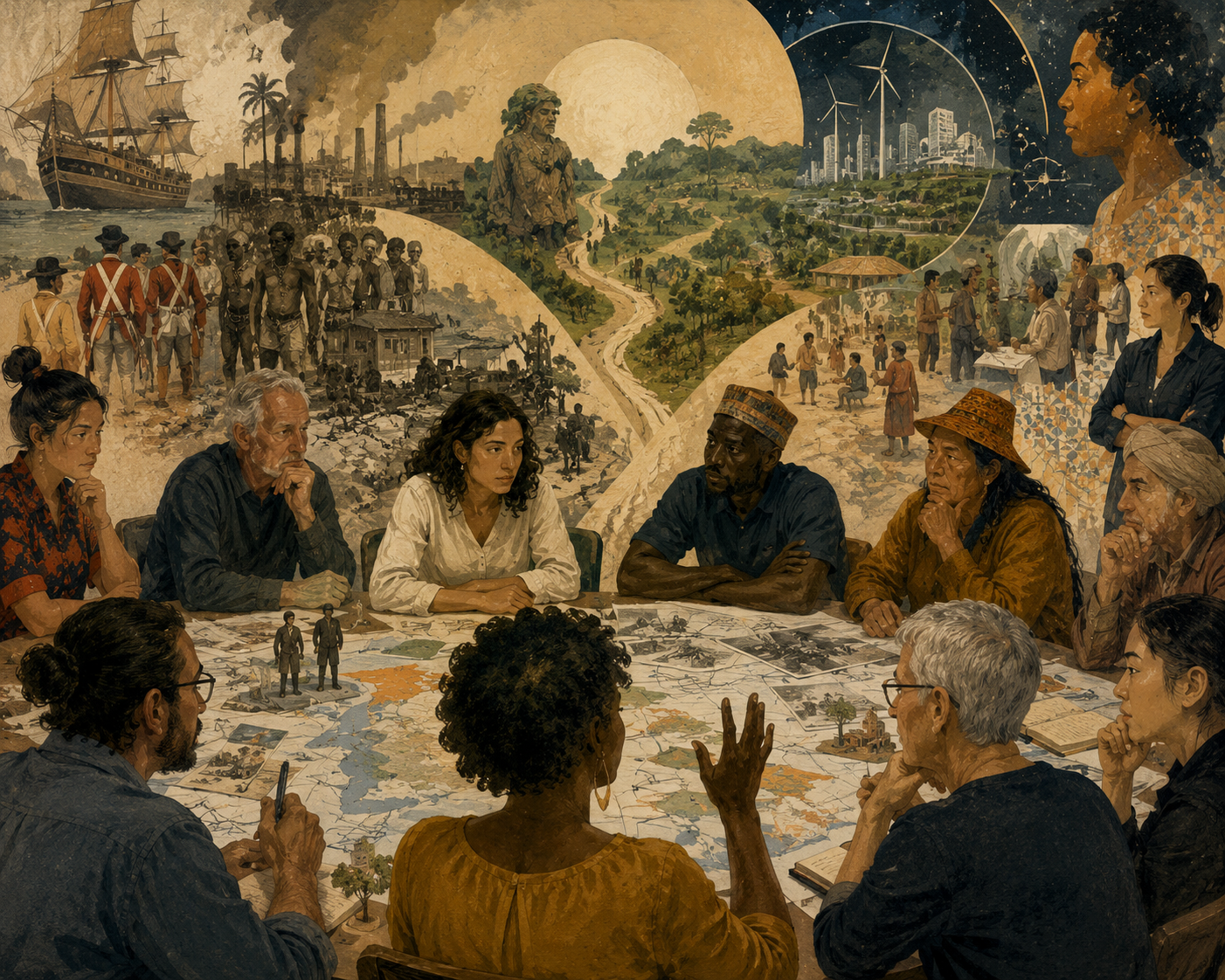
Colonial futures and contested imagination examine how power shapes what societies are allowed to imagine, who is treated as a subject of the future, whose histories are erased, whose lands and bodies are planned around, and whose possibilities are dismissed as unrealistic, backward, dangerous, or impossible. Futures thinking is often presented as a forward-looking discipline: scenarios, forecasts, horizon scans, strategic foresight, transition pathways, innovation roadmaps, risk models, and long-term governance. Yet every future-facing practice also carries memory. It is shaped by colonial histories, imperial hierarchies, racial capitalism, extraction, land dispossession, epistemic domination, border regimes, forced labor, environmental sacrifice, and the unequal authority to define progress.
Colonial futures are not simply futures imagined by colonial empires in the past. They are futures in which old patterns of domination are reproduced through new language: development, modernization, security, innovation, resilience, investment, infrastructure, sustainability, climate adaptation, artificial intelligence, strategic minerals, conservation, or humanitarian intervention. A future may look technologically advanced while still depending on extracted land, displaced communities, racialized labor, data appropriation, cultural erasure, military control, or external decision-making imposed on people who are expected to live with the consequences.
Contested imagination is the struggle over who gets to define what the future means. It asks why some futures are treated as rational, investable, scalable, and inevitable while others are dismissed as utopian, radical, primitive, local, emotional, or unrealistic. It asks why the dreams of powerful institutions become strategy, while the survival visions of colonized, Indigenous, Black, migrant, working-class, disabled, rural, and climate-exposed communities are often treated as testimony rather than theory.
This article examines colonial futures and contested imagination through coloniality, development, extraction, epistemic injustice, Indigenous sovereignty, racialized futurity, climate transition, conservation, data colonialism, AI, infrastructure, migration, security, land, memory, reparative futures, plural temporalities, scenario planning, mathematical models of power-weighted future-making, and reproducible computational workflows for evaluating whose futures are centered, whose are excluded, and whose are made to bear the cost of progress.
Main Library
Publications
Article Map
Futures Thinking
Related Topic
Global Governance
Related Topic
Institutions & Governance
Related Topic
Risk & Resilience
What Colonial Futures Mean
Colonial futures are futures shaped by the continuation, reactivation, or modernization of colonial power. They emerge when the future is imagined through hierarchies inherited from empire: some peoples are cast as advanced and others as behind; some lands are treated as empty, underused, or available; some knowledge systems are treated as universal while others are reduced to culture, folklore, or local color; some communities are asked to sacrifice for progress while others collect the benefits.
A colonial future does not need to announce itself as colonial. It may be framed as development, security, climate transition, humanitarian intervention, innovation, digital transformation, market expansion, conservation, or resilience. The colonial pattern appears in the structure of authority: who decides, who benefits, who is consulted only after the decision, who is displaced, whose knowledge is ignored, whose land is reorganized, and whose future is treated as negotiable.
Colonial futures are futures in which domination is made to look like progress.
| Colonial Future Pattern | How It Appears | Ethical and Political Problem |
|---|---|---|
| Extractive progress | Land, minerals, labor, water, forests, or data are taken to supply external futures. | Benefits accumulate elsewhere while harms remain local. |
| Development hierarchy | Some societies are framed as behind and needing outside modernization. | Plural pathways are erased by a single model of progress. |
| Epistemic domination | External expertise overrides local, Indigenous, worker, or community knowledge. | People living the consequences are denied authority over interpretation. |
| Green dispossession | Climate, conservation, or biodiversity projects displace communities or restrict livelihoods. | Environmental protection repeats colonial land control. |
| Security paternalism | External actors claim to protect regions through military, border, or surveillance systems. | Protection becomes control and dependency. |
| Digital colonialism | Platforms, AI systems, cloud infrastructure, and data extraction concentrate power elsewhere. | Digital futures are built from unequal data relations and proprietary control. |
| Temporal erasure | Colonized histories are treated as past, while dominant institutions claim the future. | Historical injustice disappears from future planning. |
Colonial futures analysis therefore asks whether the future being proposed is genuinely transformative or whether it renews old power through updated technical, environmental, financial, or institutional language.
What Contested Imagination Means
Contested imagination refers to the political struggle over what can be imagined, funded, planned, believed, and made real. Futures are not only projected through models. They are fought over through language, institutions, investment, education, media, law, land use, infrastructure, technology, religion, culture, memory, and public participation.
Powerful institutions often define the future through plausibility. They decide which scenarios are “realistic,” which transitions are “practical,” which reforms are “too radical,” which losses are “unavoidable,” and which communities must “adapt.” But plausibility is not neutral. What counts as plausible is shaped by existing power. A future that preserves elite advantage may be treated as realistic because institutions already know how to finance it. A future centered on restitution, sovereignty, demilitarization, redistribution, ecological repair, or community authority may be dismissed as unrealistic because it challenges those same institutions.
Contested imagination is the refusal to let the powerful monopolize reality.
| Imaginative Conflict | Dominant Framing | Contested Reframing |
|---|---|---|
| Development | Modernization requires integration into dominant economic systems. | Communities can define development through sovereignty, care, land, culture, and ecological continuity. |
| Climate transition | Clean technology requires rapid extraction and infrastructure expansion. | Transition must include repair, consent, sufficiency, land rights, and just distribution. |
| Security | Instability requires surveillance, militarization, and border hardening. | Security must be grounded in dignity, rights, repair, livelihood, and decolonial peace. |
| Innovation | The future belongs to scalable technology and private platforms. | Innovation includes public goods, community knowledge, repair, maintenance, and democratic control. |
| Conservation | Nature must be protected from local people. | Ecological stewardship must protect Indigenous and community rights. |
| Migration | Movement from formerly colonized regions is a crisis for wealthy states. | Mobility is tied to empire, extraction, climate responsibility, labor demand, and unequal borders. |
Contested imagination does not mean replacing one imposed future with another. It means opening space for plural futures, especially those rooted in communities whose worlds have long been treated as raw material for other people’s progress.
Coloniality and the Future
Colonialism refers to historical systems of conquest, occupation, extraction, settlement, racial hierarchy, forced labor, cultural domination, and imperial rule. Coloniality refers to the enduring structures of power that persist after formal colonial rule changes form. Coloniality lives in borders, debt, trade, language, knowledge systems, racial categories, land ownership, resource extraction, security alliances, development institutions, global finance, technology, migration regimes, and environmental governance.
Futures thinking must reckon with coloniality because the future is often built on inherited structures. A development bank may finance infrastructure through assumptions shaped by earlier modernization theory. A climate model may identify an optimal pathway while ignoring historical emissions, land dispossession, and unequal adaptation capacity. A technology firm may describe global AI inclusion while extracting data and labor from low-income regions without meaningful governance rights. A conservation project may protect biodiversity while restricting Indigenous access to ancestral lands.
Coloniality turns history into infrastructure. It survives not only in memory, but in the systems through which futures are planned.
| Coloniality Layer | Future-Making Effect | What Ethical Futures Work Must Ask |
|---|---|---|
| Land | Determines who controls territory, housing, agriculture, minerals, forests, and sacred sites. | Whose land is treated as available for future projects? |
| Knowledge | Determines whose evidence counts and whose expertise is recognized. | Whose knowledge is treated as theory, and whose as anecdote? |
| Finance | Shapes debt, investment, extraction, austerity, and development options. | Who pays for futures designed elsewhere? |
| Law | Defines property, sovereignty, borders, rights, contracts, and liability. | Does law repair colonial harm or preserve it? |
| Race | Structures vulnerability, policing, mobility, labor, exposure, and belonging. | Who is treated as a risk to the future rather than a maker of it? |
| Technology | Concentrates data, platforms, infrastructure, automation, and predictive authority. | Who controls the systems that classify future possibility? |
| Ecology | Embeds environmental harm in landscapes, watersheds, bodies, and livelihoods. | Which futures require ecological sacrifice zones? |
A decolonial approach to futures thinking does not merely add marginalized voices to existing models. It questions the models, categories, institutions, property relations, and time horizons that made those voices marginal in the first place.
Development, Modernization, and Progress Narratives
Development futures often promise growth, infrastructure, education, industrialization, technology, investment, modernization, and improved living standards. These aims can matter deeply. Communities need health systems, schools, water, energy, housing, mobility, digital access, safe work, and public capacity. The problem is not development itself. The problem is development imposed through hierarchy, dependency, extraction, debt, cultural erasure, and external control.
Modernization narratives often imagine history as a single road. Some societies are said to be advanced, others developing, others backward. This framing makes dominant institutions appear to own the future while others are expected to catch up. It can erase alternative political economies, communal land systems, Indigenous governance, nonmarket care systems, subsistence practices, spiritual ecologies, local infrastructures, and forms of social wealth that do not fit growth-centered metrics.
Progress becomes colonial when it requires others to abandon their worlds in order to be recognized as modern.
| Progress Narrative | What It Promises | What It May Hide |
|---|---|---|
| Growth-led development | Rising income, investment, productivity, and infrastructure. | Debt, extraction, inequality, ecological harm, and dependency. |
| Technological leapfrogging | Rapid adoption of digital, energy, health, or financial systems. | Platform dependence, data extraction, weak accountability, vendor lock-in. |
| Climate modernization | Clean energy, resilient infrastructure, and green investment. | Mineral extraction, land grabs, unequal transition burdens. |
| Humanitarian development | Service delivery, emergency relief, stabilization, capacity building. | Paternalism, dependency, external agenda-setting, weak local authority. |
| Security development | Stability, counterterrorism, border management, institutional reform. | Militarization, surveillance, repression, and securitized aid. |
| Market inclusion | Financial access, entrepreneurship, digital participation. | Debt exposure, informality, privatized risk, extraction of behavioral data. |
Ethical development futures should be judged not only by growth and efficiency, but by sovereignty, dignity, ecological integrity, public capacity, cultural continuity, labor rights, reparative justice, and the ability of communities to define their own futures.
Extraction, Land, and Resource Futures
Many future pathways depend on material resources: lithium, cobalt, nickel, copper, rare earth elements, water, timber, land, oil, gas, agricultural commodities, solar sites, wind corridors, transmission lines, ports, data centers, fiber routes, and logistics corridors. The material basis of the future is often hidden behind clean images of innovation, sustainability, and transition. Yet every energy transition, digital infrastructure system, AI platform, battery supply chain, and urban expansion has a geography.
Colonial futures appear when the land and labor of some communities are treated as inputs for the futures of others. Extraction may be justified as national development, global decarbonization, strategic competition, green growth, or energy security. But if affected communities lack consent, ownership, compensation, environmental protection, and political authority, the future remains extractive even when the technology is clean.
A future powered by sacrifice zones is not just because it is low-carbon.
| Extractive Future | Future-Oriented Justification | Critical Question |
|---|---|---|
| Critical minerals mining | Batteries, electric vehicles, grids, defense systems, digital infrastructure. | Who controls the land, labor, profit, environmental risk, and consent process? |
| Large-scale renewable infrastructure | Decarbonization, energy security, climate mitigation. | Does clean energy reproduce land dispossession or create shared public benefit? |
| Water-intensive data centers | AI, cloud computing, digital economy growth. | Whose water systems are stressed for digital futures? |
| Carbon offsets | Net-zero pathways and climate finance. | Do offsets protect ecosystems or shift responsibility away from emitters? |
| Industrial agriculture expansion | Food security, export earnings, modernization. | Who loses land, biodiversity, seed sovereignty, and livelihood autonomy? |
| Strategic corridors | Trade, logistics, energy transport, defense readiness. | Which communities are displaced or policed to secure movement for capital? |
Resource futures must be evaluated through land rights, Indigenous sovereignty, labor dignity, ecological restoration, community benefit, long-term stewardship, and the right to refuse. Consent cannot be reduced to consultation after the project has already been defined.
Epistemic Injustice and Knowledge Power
Colonial power has always involved control over knowledge. It classifies people, names places, maps territory, defines development, writes law, archives history, measures value, and decides which knowledge counts as rational. Futures thinking can reproduce this pattern when formal models, expert reports, external consultants, donor frameworks, and technical dashboards override the knowledge of people living with the consequences.
Epistemic injustice occurs when communities are wronged as knowers. Their testimony is dismissed. Their categories are ignored. Their memory is treated as subjective. Their warnings are called anecdotal. Their spiritual, ecological, cultural, or place-based knowledge is treated as less rigorous than remote analysis. Their future visions are described as emotional or impractical even when they understand the system more deeply than outside experts.
Knowledge power shapes future power.
| Knowledge Hierarchy | Colonial Pattern | Decolonial Futures Practice |
|---|---|---|
| Expert over community | External consultants define futures for affected populations. | Community co-design, local authority, participatory analysis. |
| Quantitative over lived | Only measurable variables are treated as real. | Combine models with testimony, memory, qualitative evidence, and lived experience. |
| Universal over situated | One framework is applied across different histories and ecologies. | Use context-sensitive, historically grounded, place-based analysis. |
| Institutional archive over oral history | Official records define what happened and what matters. | Recognize oral history, cultural memory, and suppressed archives. |
| Technical neutrality over moral conflict | Political decisions are presented as technical necessities. | Make values, tradeoffs, and power relations explicit. |
| Scenario authority over public imagination | Only professionally produced futures are seen as credible. | Treat community futures, artistic futures, and survival visions as serious knowledge. |
Decolonial futures thinking broadens rigor. It does not reject evidence. It rejects the idea that evidence only becomes legitimate when powerful institutions produce it.
Indigenous Sovereignty and Plural Temporalities
Indigenous futures cannot be reduced to inclusion in someone else’s planning process. They are tied to sovereignty, land, treaty rights, language, kinship, ecological relation, cultural continuity, sacred responsibility, and self-determination. Many Indigenous communities hold temporal frameworks that differ from short-term electoral, market, or project-finance timelines. Futures may be understood through ancestral responsibility, obligations to land, responsibilities to coming generations, and continuity between memory and possibility.
Colonial futures often treat Indigenous land as empty, underused, remote, strategic, or available for extraction, conservation, defense, infrastructure, tourism, carbon storage, or renewable energy. Decolonial futures require a different starting point: Indigenous peoples are not stakeholders in land futures. They are nations, peoples, communities, rights holders, knowledge holders, and future-makers.
Indigenous futures require sovereignty, not symbolic consultation.
| Future-Making Issue | Colonial Approach | Sovereignty-Centered Approach |
|---|---|---|
| Land use | Projects seek access through permits, compensation, or consultation. | Land governance begins with sovereignty, treaty obligations, consent, and refusal rights. |
| Environmental planning | Conservation or climate goals are imposed from outside. | Indigenous stewardship and ecological knowledge shape governance authority. |
| Energy transition | Renewable or mineral projects are justified by global climate goals. | Transition respects land, culture, consent, benefit sharing, and community control. |
| Data and research | Researchers collect knowledge for external use. | Data sovereignty and community governance guide research. |
| Language and culture | Culture is treated as heritage or identity. | Language and culture are living infrastructures of future continuity. |
| Time horizon | Planning follows grants, elections, markets, or project timelines. | Planning honors ancestral memory and obligations to coming generations. |
Plural temporalities matter because colonial modernity often demands a single clock: growth, speed, extraction, scale, innovation, and competitive urgency. Decolonial futures make room for slower, relational, cyclical, ancestral, ecological, and place-based time.
Racialized Futurity and Social Order
Race shapes who is imagined as belonging to the future. Racialized futurity appears when certain populations are cast as threats, burdens, surplus labor, security problems, demographic danger, cultural decline, or obstacles to progress. It also appears when dominant groups imagine their own continuity as universal while presenting others’ presence as disruption.
Futures language can intensify racial hierarchy. Demographic panic may frame migration or fertility change as replacement. Security foresight may classify racialized communities as risk clusters. Urban redevelopment may describe gentrification as revitalization while displacing long-standing residents. AI systems may encode racialized policing, credit, hiring, welfare, health, or border categories. Climate adaptation may protect high-value districts while exposing poorer racialized neighborhoods to heat, flooding, and abandonment.
Racialized futures are made through policy, infrastructure, policing, data, housing, labor, and narrative.
| Racialized Future Pattern | How It Works | Counter-Future |
|---|---|---|
| Demographic threat narratives | Migration, fertility, or diversity are framed as loss or invasion. | Belonging, rights, plural democracy, and shared public futures. |
| Predictive risk classification | Data systems reproduce racialized categories through policing, welfare, credit, or borders. | Auditable systems, rights protections, contestability, and anti-discrimination. |
| Urban displacement | Redevelopment treats racialized communities as obstacles to investment. | Tenant protection, community land control, repair, and anti-displacement policy. |
| Labor stratification | Racialized and migrant workers perform essential work without power. | Labor rights, status protection, collective bargaining, and care infrastructure. |
| Climate vulnerability | Historical inequality creates unequal exposure to heat, pollution, flood, and disaster. | Justice-centered adaptation and reparative infrastructure investment. |
| Security suspicion | Communities are governed through surveillance, policing, and counter-radicalization frames. | Human security, public trust, rights, and community-led safety. |
A just futures practice must ask not only what future is being planned, but which bodies are expected to absorb its risk and which communities are imagined as the rightful inhabitants of tomorrow.
Climate Transition and Sacrifice Zones
Climate transition is necessary. Fossil fuel dependence is ecologically destructive and socially dangerous. Yet transition can become colonial if it reproduces extractive land relations, unequal labor systems, debt dependency, green enclosure, mineral sacrifice zones, forced relocation, or technological pathways defined by wealthy states and firms.
A low-carbon future can still be unjust. Electric vehicles can depend on harmful mineral extraction. Renewable energy projects can displace Indigenous communities. Carbon markets can allow emitters to continue polluting while enclosing forests elsewhere. Adaptation finance can impose donor priorities. Geoengineering debates can give powerful states authority over planetary systems without meaningful consent from vulnerable regions.
Climate justice asks not only whether the future is decarbonized, but how decarbonization is governed.
| Climate Transition Risk | Colonial Future Pattern | Justice-Centered Alternative |
|---|---|---|
| Mineral extraction | Communities near mines absorb pollution, labor risk, and land disruption. | Consent, benefit sharing, recycling, demand reduction, labor rights, restoration. |
| Renewable land use | Large projects occupy land without meaningful local authority. | Community ownership, land rights, participatory siting, distributed systems. |
| Carbon offsets | Polluters buy claims to land-based carbon elsewhere. | Direct emissions cuts, community-led restoration, rights-based conservation. |
| Adaptation inequality | Wealthy areas are protected while poor regions are displaced or abandoned. | Loss and damage finance, relocation justice, infrastructure equity. |
| Green industrial competition | States secure supply chains through resource control and strategic rivalry. | Cooperative transition, fair trade, public interest standards. |
| Geoengineering governance | Powerful actors consider planetary intervention without global legitimacy. | Precaution, democratic governance, international law, affected-region consent. |
Climate futures must confront the fact that the same global order that created ecological crisis cannot be trusted to solve it through extraction without accountability. A just transition requires repair, not only replacement.
Conservation, Biodiversity, and Green Colonialism
Conservation futures can become colonial when they separate nature from people in ways that erase Indigenous and local stewardship. Fortress conservation, exclusionary protected areas, militarized anti-poaching regimes, and externally managed biodiversity projects may protect landscapes while displacing or criminalizing communities that have lived with those ecosystems for generations.
This does not mean biodiversity protection is unimportant. Ecological loss is severe and accelerating. But conservation that ignores land rights, history, livelihood, cultural relation, and community governance can reproduce colonial land control under environmental language. Green colonialism occurs when ecological protection becomes a justification for dispossession.
Biodiversity futures must protect living systems without erasing the people who have sustained them.
| Conservation Future | Risk of Green Colonialism | Rights-Based Practice |
|---|---|---|
| Protected areas | Communities are removed or restricted without consent. | Indigenous and community conserved areas, co-governance, land rights. |
| Carbon forests | Forests become offset assets controlled by external markets. | Community-led restoration, direct emissions reductions, benefit sharing. |
| Biodiversity finance | Nature is financialized through markets that local communities cannot control. | Public finance, safeguards, community authority, ecological accountability. |
| Anti-poaching enforcement | Militarized conservation criminalizes local people. | Livelihood support, rights-based enforcement, community stewardship. |
| Rewilding | Land is imagined as empty or better without human presence. | Historical and cultural landscape analysis, consent, local governance. |
| Ecotourism | Nature becomes a spectacle for outsiders while locals receive limited control. | Community ownership, fair revenue, cultural protection, ecological limits. |
Decolonial conservation recognizes that ecosystems are not only scientific objects or market assets. They are places of relation, memory, livelihood, sacred meaning, governance, and future responsibility.
Data Colonialism, AI, and Digital Futures
Digital futures create new forms of colonial extraction. Data colonialism describes the appropriation of human life, behavior, language, image, labor, movement, attention, and social relation as data for external systems of prediction, profit, control, and automation. AI intensifies these concerns because models often depend on massive datasets, global annotation labor, energy-intensive infrastructure, cloud concentration, proprietary platforms, and institutional authority to classify people and futures.
Digital colonialism is not only about who owns data. It is about who defines categories, who controls infrastructure, who benefits from automation, who is made legible to systems, who can contest classification, whose languages are included, whose labor is hidden, and whose societies become testing grounds for technologies designed elsewhere.
AI futures can reproduce colonial power when intelligence is centralized and extraction is distributed.
| Digital Future Pattern | Colonial Logic | Decolonial Digital Practice |
|---|---|---|
| Data extraction | People’s lives become raw material for models and platforms. | Data sovereignty, consent, purpose limits, community governance. |
| Platform dependency | Public services and markets rely on foreign or private infrastructure. | Public digital infrastructure, interoperability, local capacity, open standards. |
| AI language dominance | Major languages and dominant knowledge systems receive better model support. | Language justice, community-controlled datasets, cultural context. |
| Hidden labor | Low-paid workers label data, moderate content, and support automation systems. | Labor rights, transparency, wage standards, occupational protections. |
| Predictive governance | People are classified for risk, eligibility, policing, credit, or migration. | Auditability, appeal rights, anti-discrimination, human accountability. |
| Infrastructure extraction | Data centers use land, water, energy, and mineral-intensive hardware. | Environmental accountability, public oversight, resource limits. |
Decolonial AI futures require more than bias mitigation. They require different governance over data, infrastructure, labor, language, public authority, ownership, and the right of communities to shape or refuse digital systems.
Infrastructure, Megaprojects, and Spatial Control
Infrastructure futures shape territory. Railways, highways, ports, dams, pipelines, power lines, broadband corridors, data centers, industrial zones, desalination systems, housing districts, military bases, and climate defenses reorganize land, labor, markets, mobility, and public life. They can expand rights and public capacity. They can also displace communities, deepen debt, privatize essential systems, and create spatial control.
Colonial and imperial systems have long used infrastructure to extract resources, move troops, integrate colonies into global markets, and consolidate authority. Contemporary megaprojects can repeat this pattern when designed around external finance, export corridors, resource extraction, strategic competition, or elite real estate while local communities absorb displacement, policing, debt, and ecological disruption.
Infrastructure is not only built in space. It produces political space.
| Infrastructure Future | Potential Public Value | Colonial Risk |
|---|---|---|
| Transport corridors | Mobility, trade, access, regional connection. | Extraction routes, land seizure, militarized logistics, uneven development. |
| Dams and water systems | Energy, irrigation, flood control, water supply. | Displacement, ecological harm, downstream injustice, cultural loss. |
| Energy grids | Decarbonization, reliability, public welfare. | Land conflicts, privatized gain, unequal reliability, rural sacrifice. |
| Smart cities | Efficiency, service coordination, digital access. | Surveillance, exclusion, real estate speculation, vendor control. |
| Ports and logistics hubs | Trade, employment, supply-chain capacity. | Pollution, labor exploitation, displacement, external control. |
| Climate defenses | Flood protection, coastal adaptation, resilience. | Protecting high-value districts while exposing poorer communities. |
Just infrastructure futures require public purpose, democratic planning, land rights, maintenance, accessibility, ecological accountability, labor standards, and community benefit. Infrastructure should not be a monument to other people’s futures built on local dispossession.
Migration, Borders, and the Colonial Afterlife
Migration futures cannot be separated from colonial history. Many contemporary migration routes follow patterns shaped by empire, labor recruitment, trade, war, language, education, resource extraction, border-making, climate vulnerability, and unequal development. Former imperial centers often frame migration from formerly colonized regions as crisis while benefiting from centuries of extraction, labor demand, geopolitical influence, and environmental externalization.
Border regimes frequently reproduce colonial hierarchies. Passports, visas, detention systems, externalized border enforcement, offshore processing, labor sponsorship, and asylum restrictions determine who may move safely and who must risk death, exploitation, or illegality. Mobility is stratified: tourists, investors, professionals, and citizens of wealthy states move with relative ease; workers, refugees, displaced people, and racialized migrants face suspicion and control.
The freedom to move is unequally distributed by history.
| Migration Future Issue | Colonial Afterlife | Justice-Oriented Response |
|---|---|---|
| Asylum restriction | People fleeing conflict, persecution, or instability face deterrence from states shaped by imperial histories. | Due process, protection, safe routes, burden sharing. |
| Labor migration | Global labor demand depends on workers denied full rights or citizenship pathways. | Labor rights, status protection, family unity, fair recruitment. |
| Climate mobility | Those least responsible for emissions face rising displacement and weak protection. | Climate finance, relocation justice, legal mobility pathways. |
| Border externalization | Wealthy states move border control into poorer regions. | Human rights accountability, transparency, legal review. |
| Diaspora surveillance | Migrant communities are monitored or pressured by states and security systems. | Civil rights protection, anti-harassment systems, community trust. |
| Mobility privilege | Wealth, citizenship, race, and class determine freedom of movement. | More equitable mobility governance and recognition of historical responsibility. |
Migration futures should not treat movement as an abnormal disruption of settled national order. Mobility is part of the world colonialism helped create. The ethical task is to govern movement with dignity, rights, realism, and historical memory.
Security Futures and Imperial Protection
Security futures often claim to protect people from instability, terrorism, migration pressure, cyber threats, climate risk, supply-chain disruption, and geopolitical conflict. But security language can also reproduce imperial relations when powerful states define other regions as unstable, dangerous, underdeveloped, strategically valuable, or in need of management. Protection can become control.
Colonial security futures appear when military bases, surveillance partnerships, counterterrorism programs, border enforcement, resource security, maritime control, cyber operations, and stabilization missions are justified as necessary for order while weakening local sovereignty, democratic accountability, or civilian protection. They also appear when climate stress or migration is framed mainly as a threat to wealthy states rather than as harm experienced by vulnerable people.
Security futures become colonial when they protect the powerful from the consequences of the systems they helped build.
| Security Future | Protective Claim | Colonial Risk |
|---|---|---|
| Counterterrorism foresight | Prevents violence and instability. | Expands surveillance, militarization, and racialized suspicion. |
| Climate security | Plans for instability and displacement. | Frames climate-affected people as threats instead of rights-bearing communities. |
| Resource security | Protects supply chains and strategic materials. | Justifies intervention, extraction, and support for coercive partners. |
| Border security | Manages irregular migration and trafficking. | Creates dangerous routes, detention, externalization, and rights violations. |
| Cyber security capacity building | Improves resilience and digital protection. | Imports surveillance systems and external dependencies. |
| Stabilization missions | Supports fragile states and civilian protection. | External actors define legitimacy and reform priorities. |
Human security offers a corrective. It asks whether security protects lives, rights, livelihoods, dignity, self-determination, and public capacity. A decolonial security future must begin with the safety and authority of affected people, not only the strategic concerns of powerful states.
Reparative Futures and Structural Repair
Reparative futures are futures organized around repair rather than denial. They begin from the recognition that historical injustice is not over simply because time has passed. Land dispossession, slavery, colonial extraction, racial segregation, environmental racism, cultural erasure, debt dependency, forced assimilation, and unequal law continue to shape present and future possibilities.
Repair is not only apology. It may include land return, treaty enforcement, debt cancellation, restitution, climate finance, loss and damage support, public investment, cultural restoration, language revitalization, institutional reform, archive recovery, ecological restoration, labor justice, and new governance structures. Repair also requires changing the systems that reproduce harm.
A reparative future does not ask injured communities to adapt to injustice forever. It changes the conditions that made adaptation necessary.
| Reparative Future Practice | What It Addresses | Future-Making Value |
|---|---|---|
| Land return and land governance reform | Dispossession, extraction, cultural erasure, ecological harm. | Restores authority, relation, stewardship, and sovereignty. |
| Climate finance and loss and damage | Unequal responsibility for climate harm. | Links adaptation and survival to historical responsibility. |
| Debt justice | Financial dependency, austerity, and constrained public capacity. | Creates fiscal room for self-directed futures. |
| Cultural and language revitalization | Assimilation, epistemic violence, identity suppression. | Restores living continuity between memory and future. |
| Environmental restoration | Pollution, extraction, habitat loss, sacrifice zones. | Repairs the ecological basis of future life. |
| Institutional redesign | Exclusion from law, planning, finance, and governance. | Builds authority, participation, and accountability into future-making. |
Reparative futures are not nostalgic. They are forward-looking because they recognize that no future can be just if it is built on unresolved harm while demanding that harmed communities move on.
Core Dimensions of Colonial Futures Analysis
Colonial futures and contested imagination can be evaluated across several interacting dimensions. These dimensions help identify whether a future-facing project reproduces domination or creates conditions for plural, reparative, and self-determined futures. They should shape the framing, evidence, scenario design, stakeholder process, risk analysis, implementation, and accountability structure of futures work from the beginning.
1. Historical Memory
Historical memory examines whether futures work acknowledges conquest, slavery, extraction, dispossession, forced assimilation, racial hierarchy, colonial law, and environmental harm as living structures rather than closed history.
2. Sovereignty and Consent
Sovereignty and consent assess whether affected communities, Indigenous peoples, and rights holders have authority to define, accept, modify, or refuse future-making projects.
3. Land and Resource Control
Land and resource control evaluates who owns, governs, profits from, and bears the harm of land, minerals, water, forests, energy systems, infrastructure corridors, and ecological restoration projects.
4. Epistemic Justice
Epistemic justice asks whose knowledge counts, whose evidence is recognized, whose language is preserved, and whether local, Indigenous, worker, migrant, and community knowledge shape the future-making process.
5. Distributional Repair
Distributional repair evaluates whether benefits, burdens, risks, compensation, ownership, and public investment address historical and present inequalities rather than reproducing them.
6. Imaginative Pluralism
Imaginative pluralism assesses whether multiple futures are taken seriously, especially futures rooted in communities whose visions have historically been dismissed, suppressed, or treated as unrealistic.
7. Anti-Extractive Governance
Anti-extractive governance asks whether future-making reduces dependency, dispossession, data extraction, labor exploitation, environmental sacrifice, and external control.
8. Reparative Accountability
Reparative accountability examines whether institutions are answerable for harms, capable of repair, open to contestation, and willing to redistribute authority, not merely consult affected groups.
| Dimension | Core Question | Failure if Ignored |
|---|---|---|
| Historical memory | Does the future-making process recognize colonial history as structurally present? | Futures work reproduces harm while claiming neutrality. |
| Sovereignty and consent | Can affected peoples define or refuse the future being proposed? | Consultation becomes a cover for imposed decisions. |
| Land and resource control | Who controls the material basis of the future? | Clean or modern futures depend on sacrifice zones. |
| Epistemic justice | Whose knowledge shapes the scenarios and models? | External expertise erases lived, local, and Indigenous knowledge. |
| Distributional repair | Does the pathway repair unequal harm or redistribute it? | Benefits and burdens follow colonial lines. |
| Imaginative pluralism | Are alternative futures treated as serious? | Dominant institutions monopolize plausibility. |
| Anti-extractive governance | Does the future reduce extraction and dependency? | New systems repeat old extraction with updated technology. |
| Reparative accountability | Can harmed communities demand repair and institutional change? | Ethical language replaces structural responsibility. |
Colonial futures analysis is strongest when it treats history, land, knowledge, sovereignty, distribution, imagination, and repair as inseparable parts of future-making.
Scenario Planning for Contested Futures
Scenario planning can either reproduce colonial imagination or challenge it. A conventional scenario process may ask how a government, firm, or institution should prepare for future uncertainty. A decolonial scenario process asks a deeper question: who gets to define the uncertainty, whose vulnerability counts, whose future is being secured, and whether the scenario framework itself reproduces colonial assumptions.
Contested futures require scenario design that includes historical memory, structural power, community visions, refusal, repair, sovereignty, ecological limits, and alternative measures of flourishing. It should include not only likely or institutionally comfortable futures, but also futures that dominant systems would prefer not to imagine: land return, debt cancellation, demilitarization, public ownership, Indigenous-led governance, labor power, ecological restoration, community-controlled technology, and forms of prosperity not organized around extraction.
Scenario planning becomes decolonial when it changes who has authority over the question, not only who comments on the answer.
| Scenario Design Element | Colonial Risk | Decolonial Practice |
|---|---|---|
| Problem framing | External institutions define what the future problem is. | Affected communities co-define the problem and desired outcomes. |
| Driver selection | Markets, technology, and security dominate the analysis. | Include land, memory, culture, care, repair, sovereignty, and ecological relation. |
| Stakeholder mapping | Communities are listed but not empowered. | Distinguish stakeholders from rights holders and sovereign peoples. |
| Scenario narratives | Dominant futures are treated as plausible; reparative futures as unrealistic. | Include serious scenarios of structural repair and redistributed authority. |
| Evidence base | Official data and expert modeling crowd out lived experience. | Integrate oral history, community research, Indigenous knowledge, and local memory. |
| Evaluation criteria | Success is measured by growth, efficiency, stability, or investment. | Measure dignity, repair, sovereignty, ecological health, care, and rights. |
| Implementation | Plans are delivered to communities after decisions are made. | Communities govern implementation, monitoring, revision, and accountability. |
Decolonial scenario planning does not require certainty about a perfect future. It requires refusing the assumption that the future must be governed by the same structures that created present injustice.
Colonial and Contested Future Scenarios
Colonial futures and contested imagination can unfold across multiple pathways. These scenarios are not predictions. They are structured contexts for testing how power, memory, land, knowledge, technology, climate transition, and repair might shape future-making.
| Scenario | Description | Colonial Risk | Reparative Opportunity |
|---|---|---|---|
| Green Extraction Continuity | Clean energy, batteries, grids, and digital systems expand rapidly through mineral extraction and land-intensive infrastructure. | Low-carbon transition reproduces sacrifice zones and resource colonialism. | Consent, recycling, sufficiency, public ownership, labor rights, and community benefit reshape transition. |
| Technocratic Development Revival | Development institutions promote modernization through infrastructure, finance, technology, and market integration. | Local futures are subordinated to external metrics of progress. | Self-determined development centers sovereignty, care, public capacity, and ecological limits. |
| Data Colonial Futures | AI and digital platforms expand through data extraction, cloud dependency, predictive governance, and hidden labor. | Digital futures concentrate authority while extracting value from global populations. | Data sovereignty, public digital infrastructure, labor rights, and algorithmic contestability grow. |
| Climate Security Fortress | Wealthy states respond to climate stress through hardened borders, resource control, and security planning. | Climate victims are framed as threats rather than rights-bearing communities. | Human security, climate finance, mobility justice, and adaptation repair become central. |
| Conservation Without People | Biodiversity and carbon projects expand through protected areas, offsets, and external ecological governance. | Green colonialism displaces or criminalizes local and Indigenous communities. | Community-led stewardship and rights-based conservation reshape ecological futures. |
| Reparative Plural Futures | Land, finance, climate policy, technology, and institutions are redesigned around repair and self-determination. | Faces resistance from actors invested in existing ownership and authority. | Creates futures based on sovereignty, restitution, ecological restoration, and public legitimacy. |
| Suppressed Imagination | Dominant institutions dismiss reparative and decolonial futures as impractical or destabilizing. | Plausibility becomes a tool for preserving power. | Art, scholarship, community planning, movements, and public institutions expand the imaginable. |
| Contested Democratic Future-Making | Communities, youth, workers, Indigenous peoples, migrants, and civil society contest dominant scenarios and build alternatives. | Conflict over authority intensifies. | Futures thinking becomes more plural, accountable, and grounded in lived reality. |
Scenario analysis shows that the question is not whether the future will be planned. The question is whether future-making will reproduce domination or become a practice of repair.
Strategic Questions
Colonial futures analysis should guide strategic questions for governments, public agencies, universities, foundations, technology firms, climate institutions, infrastructure planners, international organizations, conservation bodies, social movements, Indigenous governments, and communities. These questions reveal whether a future-facing project is genuinely transformative or simply renewing old hierarchies through new language.
| Strategic Question | What It Reveals | Why It Matters |
|---|---|---|
| Who defined the future problem? | Agenda-setting authority and framing power. | The first act of domination is often defining the question for others. |
| Whose land, labor, data, or ecology makes this future possible? | The material basis of future-making. | Progress may depend on hidden extraction. |
| Can affected communities refuse the project? | Whether consent is real or procedural. | Consultation without refusal is not consent. |
| Which histories are being treated as irrelevant? | Erasure of colonial memory and structural harm. | Unacknowledged history reappears as future injustice. |
| Whose knowledge shaped the model? | Epistemic justice or knowledge hierarchy. | Futures built from narrow knowledge produce avoidable harm. |
| Who captures the benefits and who bears the risks? | Distribution of value, exposure, and protection. | Aggregate progress can hide sacrifice zones. |
| Which futures are dismissed as unrealistic? | The politics of plausibility. | Imagination is constrained by power unless contested. |
| What would repair require? | Structural obligations beyond mitigation or compensation. | Reparative futures require changing conditions, not only reducing harm. |
The purpose of these questions is to move futures work from imposed vision toward accountable future-making.
Limitations and Failure Modes
Colonial futures analysis can fail if it becomes symbolic, abstract, or performative. Institutions may adopt decolonial language without redistributing authority. They may invite marginalized communities to speak while preserving control over budgets, land, models, timelines, and implementation. They may turn “local knowledge” into an extractive input. They may use “co-design” language for projects that remain externally defined. They may convert repair into branding.
Another failure mode is treating decolonial futures as only cultural or symbolic. Coloniality is material. It concerns land, money, law, labor, borders, infrastructure, extraction, policing, data, ecology, and institutions. A futures process that celebrates diversity while leaving ownership and decision rights intact is not decolonial in any serious sense.
| Failure Mode | Problem | Corrective Practice |
|---|---|---|
| Decolonial language without power shift | Institutions adopt vocabulary while preserving authority. | Redistribute decision rights, budgets, ownership, and governance. |
| Extractive participation | Communities provide stories and knowledge without control or benefit. | Use consent, compensation, co-authorship, and community governance. |
| Consultation theater | Input is gathered after decisions are already made. | Move participation to problem framing, scenario design, implementation, and review. |
| Symbolic repair | Acknowledgment substitutes for material change. | Connect memory to land, finance, law, infrastructure, and public investment. |
| Romanticization | Marginalized communities are idealized rather than treated as politically complex. | Respect pluralism, internal debate, sovereignty, and real governance capacity. |
| Anti-technical overcorrection | Technical tools are rejected entirely because of colonial misuse. | Use tools under democratic, community, and rights-based governance. |
| False universality | One decolonial framework is imposed across different histories. | Use place-based, historically specific, locally accountable methods. |
| Plausibility policing | Reparative futures are dismissed as unrealistic. | Interrogate who benefits from current definitions of realism. |
Colonial futures analysis should be judged by whether it changes the structure of future-making, not by whether it uses the right vocabulary.
Mathematical Lens: Power-Weighted Futures and Distributional Erasure
A simple future-making influence score can represent how power affects whose visions shape a scenario:
F = \sum_{i=1}^{n} p_i v_i
\]
Interpretation: \(F\) is the resulting future frame, \(p_i\) is the power weight of actor \(i\), and \(v_i\) is that actor’s vision of the future. If power weights are unequal, the scenario may appear collective while primarily reflecting dominant actors.
A distributional extraction score can be represented as:
X_i = L_i + R_i + D_i – B_i
\]
Interpretation: \(X_i\) is extraction burden for community \(i\), \(L_i\) is land disruption, \(R_i\) is resource loss, \(D_i\) is displacement or dispossession pressure, and \(B_i\) is local benefit. A future is extractive when local burdens exceed local authority and benefit.
A contestation-adjusted legitimacy score can be written as:
G = C + S + A + E – O
\]
Interpretation: \(G\) is governance legitimacy, \(C\) is consent, \(S\) is sovereignty or self-determination, \(A\) is accountability, \(E\) is epistemic justice, and \(O\) is imposed external control. Legitimacy rises when affected people govern the process, not merely participate in it.
A reparative futures score can be represented conceptually as:
R_f = M + K + P + H + T
\]
Interpretation: \(R_f\) is reparative future capacity, \(M\) is material restitution, \(K\) is knowledge justice, \(P\) is political authority, \(H\) is historical acknowledgment, and \(T\) is transformation of the systems that reproduce harm.
A plausibility bias indicator can be expressed as:
B_p = P_d – P_m
\]
Interpretation: \(B_p\) is plausibility bias, \(P_d\) is the plausibility assigned to dominant institutional futures, and \(P_m\) is the plausibility assigned to marginalized or reparative futures. A large gap suggests that “realism” may be reproducing power rather than measuring feasibility.
These equations are not final answers. They are diagnostic tools. Their purpose is to make power visible in future-making: whose vision is weighted, whose land is burdened, whose consent matters, whose repair counts, and whose imagination is treated as plausible.
Computational Modeling for Colonial Futures and Contested Imagination
Computational modeling can support colonial futures analysis by making assumptions explicit, comparing stakeholder influence, identifying extraction burdens, scoring consent and sovereignty gaps, tracking distributional benefits, and evaluating whether future pathways repair or reproduce colonial relations. It should not replace political judgment, historical analysis, or community authority. It should support accountability.
A responsible computational workflow for colonial futures may include:
- Future-making profiles: agenda-setting power, land exposure, consent quality, local benefit, external control, epistemic justice, reparative capacity, and ecological harm.
- Scenario records: green extraction continuity, technocratic development, data colonial futures, climate security fortress, conservation without people, reparative plural futures, suppressed imagination, and contested democratic future-making.
- Risk indicators: land dispossession, resource extraction, epistemic erasure, green colonialism, data extraction, security drift, debt dependency, and plausibility policing.
- Strategy options: land return, consent systems, community ownership, data sovereignty, debt justice, rights-based conservation, reparative finance, and participatory scenario governance.
- Outputs: coloniality risk scores, reparative capacity scores, extraction burden tables, influence-weighted scenario diagnostics, legitimacy scores, and reproducibility reports.
Computational tools should reveal colonial structure, not obscure it behind neutral scores.
Advanced R Workflow: Comparing Colonial Future-Making Profiles
The R workflow below compares stylized future-making profiles across agenda-setting power, consent quality, land exposure, external control, epistemic justice, local benefit, ecological harm, and reparative capacity.
# ------------------------------------------------------------
# R Workflow: Comparing Colonial Future-Making Profiles
# Purpose:
#   Compare stylized futures across agenda-setting power,
#   consent quality, land exposure, external control,
#   epistemic justice, local benefit, ecological harm,
#   and reparative capacity.
#
# Optional dependency:
#   install.packages(c("tidyverse"))
# ------------------------------------------------------------

library(tidyverse)

future_profiles <- tibble(
  future_type = c(
    "Green Extraction Continuity",
    "Technocratic Development Revival",
    "Data Colonial Futures",
    "Climate Security Fortress",
    "Conservation Without People",
    "Reparative Plural Futures",
    "Suppressed Imagination",
    "Contested Democratic Future-Making"
  ),
  agenda_setting_power = c(0.86, 0.82, 0.88, 0.84, 0.76, 0.34, 0.78, 0.42),
  consent_quality = c(0.34, 0.40, 0.28, 0.30, 0.32, 0.86, 0.26, 0.82),
  land_exposure = c(0.90, 0.74, 0.48, 0.56, 0.82, 0.38, 0.52, 0.44),
  external_control = c(0.82, 0.86, 0.92, 0.88, 0.78, 0.30, 0.80, 0.36),
  epistemic_justice = c(0.36, 0.42, 0.30, 0.34, 0.38, 0.88, 0.28, 0.84),
  local_benefit = c(0.38, 0.46, 0.34, 0.32, 0.36, 0.82, 0.30, 0.78),
  ecological_harm = c(0.78, 0.66, 0.54, 0.50, 0.46, 0.28, 0.44, 0.32),
  reparative_capacity = c(0.24, 0.32, 0.26, 0.28, 0.30, 0.92, 0.22, 0.84)
)

future_profiles <- future_profiles %>%
  mutate(
    coloniality_risk_score =
      0.15 * agenda_setting_power +
      0.14 * (1 - consent_quality) +
      0.14 * land_exposure +
      0.14 * external_control +
      0.12 * (1 - epistemic_justice) +
      0.11 * (1 - local_benefit) +
      0.11 * ecological_harm +
      0.09 * (1 - reparative_capacity),

    reparative_future_score =
      0.20 * consent_quality +
      0.18 * epistemic_justice +
      0.17 * local_benefit +
      0.17 * reparative_capacity +
      0.10 * (1 - external_control) +
      0.08 * (1 - land_exposure) +
      0.06 * (1 - ecological_harm) +
      0.04 * (1 - agenda_setting_power),

    profile_class = case_when(
      coloniality_risk_score >= 0.70 ~ "High coloniality risk",
      reparative_future_score >= 0.65 ~ "Stronger reparative future capacity",
      TRUE ~ "Mixed or contested future"
    )
  ) %>%
  arrange(desc(coloniality_risk_score))

print(future_profiles)

future_long <- future_profiles %>%
  select(
    future_type,
    agenda_setting_power,
    consent_quality,
    land_exposure,
    external_control,
    epistemic_justice,
    local_benefit,
    ecological_harm,
    reparative_capacity
  ) %>%
  pivot_longer(
    cols = -future_type,
    names_to = "dimension",
    values_to = "value"
  )

ggplot(future_long, aes(x = dimension, y = value, fill = future_type)) +
  geom_col(position = "dodge") +
  coord_flip() +
  labs(
    title = "Colonial Futures and Contested Imagination Dimensions",
    x = "Dimension",
    y = "Value",
    fill = "Future Type"
  ) +
  theme_minimal(base_size = 12)

ggplot(future_profiles, aes(x = reorder(future_type, coloniality_risk_score), y = coloniality_risk_score)) +
  geom_col() +
  coord_flip() +
  labs(
    title = "Coloniality Risk Score by Future Type",
    x = "Future Type",
    y = "Coloniality Risk Score"
  ) +
  theme_minimal(base_size = 12)

ggplot(future_profiles, aes(x = coloniality_risk_score, y = reparative_future_score, label = future_type)) +
  geom_point(size = 3) +
  geom_text(nudge_y = 0.02, size = 3) +
  labs(
    title = "Coloniality Risk vs Reparative Future Capacity",
    x = "Coloniality Risk",
    y = "Reparative Future Capacity"
  ) +
  theme_minimal(base_size = 12)

dir.create("outputs", showWarnings = FALSE)
write_csv(future_profiles, "outputs/colonial_futures_profiles.csv")
This workflow is intentionally stylized. Its purpose is to help analysts compare whether future pathways are shifting authority, benefit, knowledge, and repair—or simply renaming extraction as progress.
Advanced Python Workflow: Simulating Extraction, Voice, and Reparative Capacity
The Python workflow below simulates how extraction burden, community voice, external control, and reparative capacity can change over time under different future-making scenarios.
# ------------------------------------------------------------
# Python Workflow: Extraction, Voice, and Reparative Capacity
# Purpose:
#   Simulate stylized colonial futures and contested imagination
#   pathways across extraction burden, community voice,
#   external control, ecological harm, and reparative capacity.
#
# Optional dependencies:
#   pip install pandas numpy matplotlib
# ------------------------------------------------------------

from pathlib import Path

import numpy as np
import pandas as pd
import matplotlib.pyplot as plt

OUTPUT_DIR = Path("outputs")
OUTPUT_DIR.mkdir(exist_ok=True)

time_steps = np.arange(1, 41)

scenarios = [
    {
        "future": "Green Extraction Continuity",
        "extraction_burden": 0.84,
        "community_voice": 0.32,
        "external_control": 0.82,
        "ecological_harm": 0.76,
        "local_benefit": 0.38,
        "reparative_capacity": 0.24
    },
    {
        "future": "Data Colonial Futures",
        "extraction_burden": 0.70,
        "community_voice": 0.26,
        "external_control": 0.92,
        "ecological_harm": 0.54,
        "local_benefit": 0.34,
        "reparative_capacity": 0.26
    },
    {
        "future": "Climate Security Fortress",
        "extraction_burden": 0.66,
        "community_voice": 0.30,
        "external_control": 0.88,
        "ecological_harm": 0.50,
        "local_benefit": 0.32,
        "reparative_capacity": 0.28
    },
    {
        "future": "Reparative Plural Futures",
        "extraction_burden": 0.34,
        "community_voice": 0.88,
        "external_control": 0.30,
        "ecological_harm": 0.28,
        "local_benefit": 0.82,
        "reparative_capacity": 0.92
    },
    {
        "future": "Contested Democratic Future-Making",
        "extraction_burden": 0.44,
        "community_voice": 0.82,
        "external_control": 0.36,
        "ecological_harm": 0.32,
        "local_benefit": 0.78,
        "reparative_capacity": 0.84
    }
]

def simulate_future(profile):
    extraction = np.zeros(len(time_steps))
    voice = np.zeros(len(time_steps))
    external = np.zeros(len(time_steps))
    harm = np.zeros(len(time_steps))
    benefit = np.zeros(len(time_steps))
    repair = np.zeros(len(time_steps))
    legitimacy = np.zeros(len(time_steps))

    extraction[0] = profile["extraction_burden"]
    voice[0] = profile["community_voice"]
    external[0] = profile["external_control"]
    harm[0] = profile["ecological_harm"]
    benefit[0] = profile["local_benefit"]
    repair[0] = profile["reparative_capacity"]

    legitimacy[0] = (
        0.28 * voice[0]
        + 0.22 * benefit[0]
        + 0.22 * repair[0]
        - 0.16 * external[0]
        - 0.12 * extraction[0]
    )

    for t in range(1, len(time_steps)):
        extraction_push = 0.018 if (t + 1) % 7 == 0 else 0.0
        resistance_cycle = 0.020 if (t + 1) % 9 == 0 else 0.0
        repair_window = 0.018 if (t + 1) % 11 == 0 else 0.0

        extraction[t] = np.clip(
            extraction[t - 1]
            + extraction_push
            + 0.012 * external[t - 1]
            - 0.014 * voice[t - 1]
            - 0.012 * repair[t - 1],
            0,
            1.8
        )

        voice[t] = np.clip(
            voice[t - 1]
            + resistance_cycle
            + 0.014 * repair[t - 1]
            - 0.010 * external[t - 1]
            - 0.006 * extraction[t - 1],
            0,
            1.8
        )

        external[t] = np.clip(
            external[t - 1]
            + 0.010 * extraction[t]
            - 0.014 * voice[t]
            - 0.010 * repair[t - 1],
            0,
            1.8
        )

        harm[t] = np.clip(
            harm[t - 1]
            + 0.012 * extraction[t]
            + 0.006 * external[t]
            - 0.014 * repair[t - 1],
            0,
            1.8
        )

        benefit[t] = np.clip(
            benefit[t - 1]
            + 0.012 * voice[t]
            + 0.010 * repair[t - 1]
            - 0.006 * external[t]
            + repair_window,
            0,
            1.8
        )

        repair[t] = np.clip(
            repair[t - 1]
            + 0.014 * voice[t]
            + repair_window
            - 0.008 * external[t]
            - 0.006 * extraction[t],
            0,
            1.8
        )

        legitimacy[t] = np.clip(
            0.28 * voice[t]
            + 0.22 * benefit[t]
            + 0.22 * repair[t]
            - 0.16 * external[t]
            - 0.12 * extraction[t],
            -1,
            1.8
        )

    return extraction, voice, external, harm, benefit, repair, legitimacy

rows = []

for scenario in scenarios:
    extraction, voice, external, harm, benefit, repair, legitimacy = simulate_future(scenario)

    for t, e, v, x, h, b, r, l in zip(time_steps, extraction, voice, external, harm, benefit, repair, legitimacy):
        rows.append({
            "future": scenario["future"],
            "time": t,
            "extraction_burden": e,
            "community_voice": v,
            "external_control": x,
            "ecological_harm": h,
            "local_benefit": b,
            "reparative_capacity": r,
            "legitimacy": l
        })

df = pd.DataFrame(rows)

summary = (
    df.groupby("future")
    .agg(
        final_extraction_burden=("extraction_burden", "last"),
        final_community_voice=("community_voice", "last"),
        final_external_control=("external_control", "last"),
        final_ecological_harm=("ecological_harm", "last"),
        final_local_benefit=("local_benefit", "last"),
        final_reparative_capacity=("reparative_capacity", "last"),
        final_legitimacy=("legitimacy", "last")
    )
    .reset_index()
    .sort_values("final_legitimacy", ascending=False)
)

print(summary)

plt.figure(figsize=(10, 6))
for future_name in df["future"].unique():
    subset = df[df["future"] == future_name]
    plt.plot(subset["time"], subset["extraction_burden"], label=future_name)

plt.xlabel("Time Step")
plt.ylabel("Extraction Burden")
plt.title("Extraction Burden Across Colonial and Contested Futures")
plt.legend()
plt.tight_layout()
plt.savefig(OUTPUT_DIR / "extraction_burden_paths.png", dpi=150)
plt.close()

plt.figure(figsize=(10, 6))
for future_name in df["future"].unique():
    subset = df[df["future"] == future_name]
    plt.plot(subset["time"], subset["reparative_capacity"], label=future_name)

plt.xlabel("Time Step")
plt.ylabel("Reparative Capacity")
plt.title("Reparative Capacity Across Colonial and Contested Futures")
plt.legend()
plt.tight_layout()
plt.savefig(OUTPUT_DIR / "reparative_capacity_paths.png", dpi=150)
plt.close()

plt.figure(figsize=(10, 6))
for future_name in df["future"].unique():
    subset = df[df["future"] == future_name]
    plt.plot(subset["time"], subset["legitimacy"], label=future_name)

plt.xlabel("Time Step")
plt.ylabel("Legitimacy")
plt.title("Legitimacy Across Colonial and Contested Futures")
plt.legend()
plt.tight_layout()
plt.savefig(OUTPUT_DIR / "legitimacy_paths.png", dpi=150)
plt.close()

df.to_csv(OUTPUT_DIR / "colonial_futures_simulation_paths.csv", index=False)
summary.to_csv(OUTPUT_DIR / "colonial_futures_simulation_summary.csv", index=False)
This workflow shows why future-making legitimacy depends on more than performance. A pathway may deliver infrastructure, technology, or climate benefits while losing legitimacy if extraction burden rises, community voice remains low, and reparative capacity never grows.
GitHub Repository
The companion repository for this article contains computational examples for colonial futures, contested imagination, extractive progress, epistemic justice, land and resource futures, climate transition, green colonialism, data colonialism, reparative capacity, scenario comparison, legitimacy scoring, and reproducible decolonial foresight workflows.
Complete Code Repository
The companion code includes Python, R, Julia, SQL, Rust, Go, C++, Fortran, C, documentation, synthetic datasets, outputs, and notebook placeholders for applied colonial futures and contested imagination workflows.
Why This Matters
Colonial futures and contested imagination matter because the future is often presented as open while being structured by old forms of power. The language changes: innovation, resilience, transition, security, modernization, sustainability, digital transformation, strategic infrastructure, climate adaptation. But beneath that language, familiar questions remain: who controls land, labor, knowledge, finance, data, law, borders, and ecological risk?
Futures thinking becomes dangerous when it forgets history. A scenario can reproduce empire while speaking of development. A climate pathway can reproduce extraction while speaking of transition. A digital roadmap can reproduce data colonialism while speaking of inclusion. A conservation project can reproduce dispossession while speaking of biodiversity. A migration forecast can reproduce racial hierarchy while speaking of security. A security plan can reproduce imperial management while speaking of stability.
The future is not innocent simply because it has not happened yet.
To think ethically about the future is to ask who is allowed to imagine, who is forced to adapt, who is displaced for progress, who is classified as risk, who is treated as data, who owns the infrastructure, who benefits from transition, and who gets to say no. These are not abstract questions. They determine whether future-making becomes repair or repetition.
Contested imagination is essential because dominant institutions often treat their preferred futures as reality itself. They call some visions practical and others impossible. But every major transformation begins as a contest over possibility. Abolition, decolonization, land return, climate justice, labor rights, gender equality, Indigenous sovereignty, public health, disability justice, and democratic participation all require futures that were once dismissed by powerful actors.
Colonial futures analysis therefore expands the work of foresight. It insists that scenario planning, strategic design, technology governance, climate transition, and long-term policy must be historically grounded, materially honest, epistemically plural, and accountable to those whose worlds are at stake.
The central question is not whether we can imagine the future. It is whether we can imagine futures that do not require domination to appear realistic.
Related Articles
- Futures Thinking
- Ethics of Futures Thinking
- Future Generations and Long-Term Responsibility
- Hope, Dread, and the Politics of the Future
- Future Directions in Strategic Foresight
- Climate Futures and Environmental Change
- Planetary Boundaries and Future Pathways
- Migration, Demography, and Future Societies
- Global Governance Futures
- Security Futures and Hybrid Risk
- Democratic Futures and Public Participation
- Anticipatory Governance
Further Reading
- Césaire, A. (2000) Discourse on Colonialism. New York: Monthly Review Press.
- Fanon, F. (1963) The Wretched of the Earth. New York: Grove Press.
- Said, E.W. (1978) Orientalism. New York: Pantheon Books.
- Rodney, W. (1972) How Europe Underdeveloped Africa. London: Bogle-L’Ouverture Publications.
- Quijano, A. (2000) ‘Coloniality of power and Eurocentrism in Latin America’, International Sociology, 15(2), pp. 215–232.
- Mignolo, W.D. (2011) The Darker Side of Western Modernity: Global Futures, Decolonial Options. Durham: Duke University Press.
- Tuck, E. and Yang, K.W. (2012) ‘Decolonization is not a metaphor’, Decolonization: Indigeneity, Education & Society, 1(1), pp. 1–40.
- Whyte, K. (2018) ‘Indigenous science fiction for the Anthropocene: Ancestral dystopias and fantasies of climate change crises’, Environment and Planning E: Nature and Space, 1(1–2), pp. 224–242.
- Couldry, N. and Mejias, U.A. (2019) The Costs of Connection: How Data Is Colonizing Human Life and Appropriating It for Capitalism. Stanford: Stanford University Press.
- Liboiron, M. (2021) Pollution Is Colonialism. Durham: Duke University Press.
References
- Césaire, A. (2000) Discourse on Colonialism. New York: Monthly Review Press.
- Couldry, N. and Mejias, U.A. (2019) The Costs of Connection: How Data Is Colonizing Human Life and Appropriating It for Capitalism. Stanford: Stanford University Press.
- Fanon, F. (1963) The Wretched of the Earth. New York: Grove Press.
- Liboiron, M. (2021) Pollution Is Colonialism. Durham: Duke University Press.
- Mignolo, W.D. (2011) The Darker Side of Western Modernity: Global Futures, Decolonial Options. Durham: Duke University Press.
- Quijano, A. (2000) ‘Coloniality of power and Eurocentrism in Latin America’, International Sociology, 15(2), pp. 215–232.
- Rodney, W. (1972) How Europe Underdeveloped Africa. London: Bogle-L’Ouverture Publications.
- Said, E.W. (1978) Orientalism. New York: Pantheon Books.
- Simpson, L.B. (2017) As We Have Always Done: Indigenous Freedom through Radical Resistance. Minneapolis: University of Minnesota Press.
- Smith, L.T. (2012) Decolonizing Methodologies: Research and Indigenous Peoples. 2nd edn. London: Zed Books.
- Tuck, E. and Yang, K.W. (2012) ‘Decolonization is not a metaphor’, Decolonization: Indigeneity, Education & Society, 1(1), pp. 1–40.
- Whyte, K. (2018) ‘Indigenous science fiction for the Anthropocene: Ancestral dystopias and fantasies of climate change crises’, Environment and Planning E: Nature and Space, 1(1–2), pp. 224–242.