
Last Updated June 3, 2026
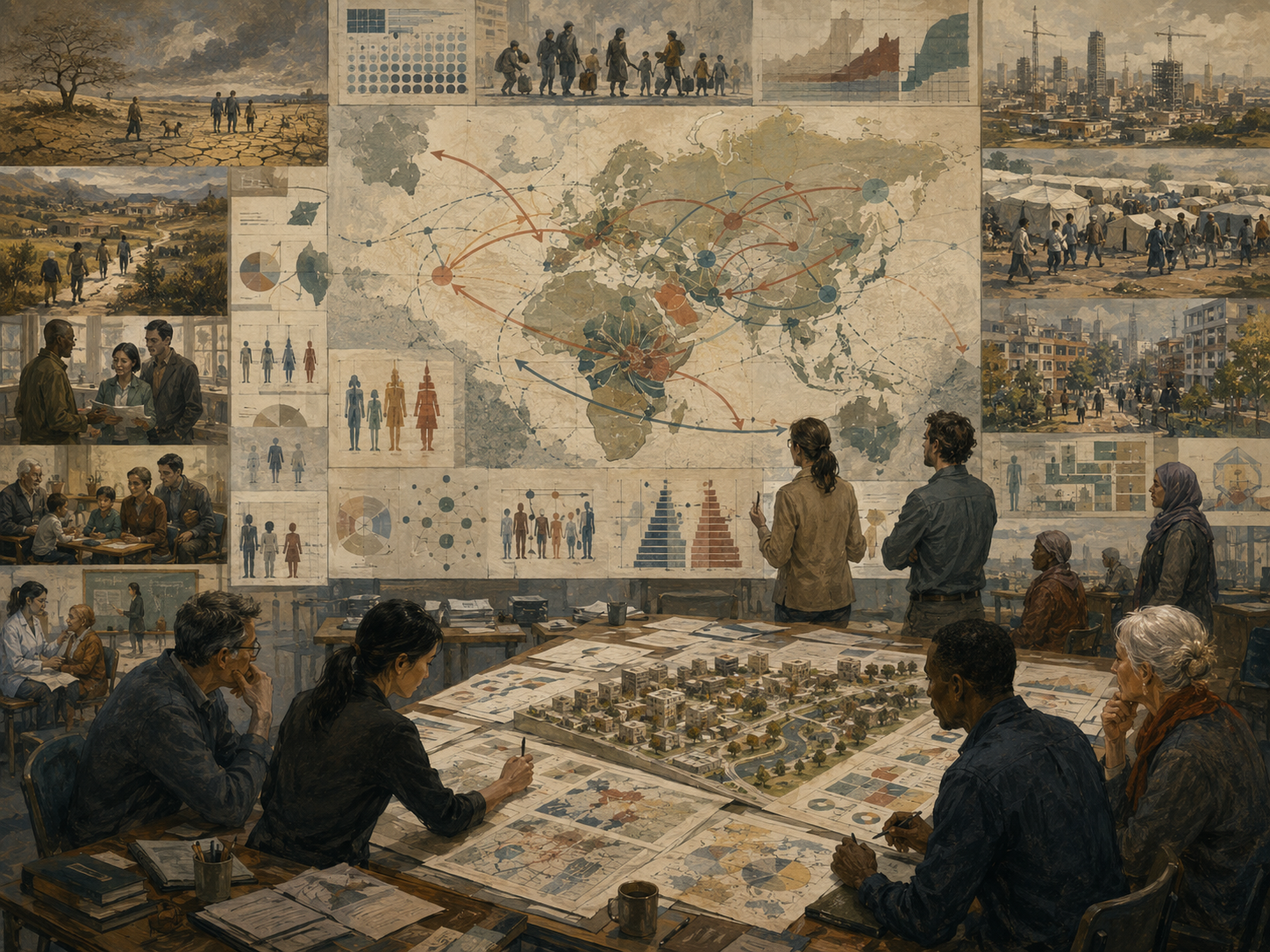
Migration, demography, and future societies examine how population change, mobility, aging, youth cohorts, urbanization, fertility, mortality, labor markets, climate displacement, care systems, borders, identity, social cohesion, and public institutions may reshape the human future. The future is not only technological, geopolitical, or ecological. It is also demographic. Societies are transformed by who is born, who ages, who moves, who stays, who is protected, who is excluded, who works, who cares, who belongs, and whose future is treated as worthy of planning.
Demographic change is often discussed through numbers: fertility rates, dependency ratios, median age, labor force participation, migration flows, urbanization rates, household size, life expectancy, and population projections. These measures matter, but they do not speak for themselves. Population change becomes politically meaningful through institutions, inequality, borders, labor systems, housing, gender relations, climate exposure, public health, education, care work, citizenship, and public narratives about belonging.
Demography is not destiny. It is a set of structural pressures and possibilities that societies govern well, govern poorly, or refuse to govern at all. Aging can produce crisis if care systems, pensions, housing, health systems, and labor markets are unprepared. Youthful populations can produce vitality if education, employment, participation, and public investment are strong. Migration can sustain families, economies, and cultural renewal when governed with rights and planning. It can become dangerous when forced into irregular routes, exploitation, dehumanization, and political scapegoating.
This article examines migration, demography, and future societies through population structure, fertility, aging, youth cohorts, care economies, migration systems, climate mobility, urbanization, labor markets, gender, public health, identity, social cohesion, citizenship, diaspora, remittances, border politics, demographic anxiety, scenario planning, mathematical population models, and reproducible computational workflows for comparing demographic and mobility futures.
Main Library
Publications
Article Map
Futures Thinking
Related Topic
Global Governance
Related Topic
Institutions & Governance
Related Topic
Risk & Resilience
What Migration, Demography, and Future Societies Mean
Migration, demography, and future societies are the study of how human populations change and how those changes reshape institutions, economies, cultures, cities, households, rights, political systems, and social life. Demography examines population structure: births, deaths, age composition, household formation, mortality, fertility, migration, urbanization, and life expectancy. Migration studies examine movement: voluntary, forced, seasonal, circular, internal, cross-border, labor-driven, climate-related, family-based, educational, humanitarian, and irregular.
Future societies emerge from the interaction between these processes and institutional choices. Population aging can create pressure on pensions, care work, housing, health systems, and intergenerational solidarity. Youthful populations can become a source of innovation, labor, civic energy, and cultural renewal—or frustration, unemployment, exclusion, and instability. Migration can sustain labor markets, families, remittance economies, demographic balance, and cultural exchange—or become a site of exploitation, border violence, scapegoating, and political fear.
Demographic futures are not only about how many people live somewhere. They are about the social arrangements that make population change humane, stable, productive, and just.
| Demographic Process | What It Measures | Why It Matters for Future Societies |
|---|---|---|
| Fertility | Patterns of births and family formation. | Shapes age structure, labor supply, education needs, gender systems, and future population size. |
| Mortality | Patterns of death, survival, and life expectancy. | Reflects health systems, inequality, public safety, environmental conditions, and longevity. |
| Migration | Movement across regions, borders, and social systems. | Shapes labor markets, cities, family life, remittances, identity, and political belonging. |
| Aging | Growth in older population shares and longer life spans. | Transforms pensions, care, health, housing, work, and intergenerational contracts. |
| Youth cohorts | Size and opportunity structure of younger populations. | Shapes education, employment, civic participation, innovation, and political stability. |
| Urbanization | Movement and concentration of people in towns and cities. | Shapes housing, transport, infrastructure, public health, climate exposure, and opportunity. |
| Household change | Family size, living arrangements, marriage, caregiving, and dependency. | Affects care systems, housing demand, gender roles, poverty, and social support. |
Demographic futures require both statistical literacy and ethical imagination. Numbers describe pressure. Institutions decide whether that pressure becomes abandonment, exclusion, opportunity, repair, or renewal.
Demography Is Not Destiny
The phrase “demography is destiny” is popular because population structure creates real constraints. A society with a rapidly aging population faces different pressures than a society with a rapidly growing youth cohort. A city receiving large numbers of migrants requires different housing, school, health, and labor policies than a city losing population. A country with low fertility and restrictive migration policy may face labor shortages and rising dependency burdens. A climate-exposed region may face mobility pressures that cannot be solved by border policy alone.
Yet the phrase is misleading if it implies inevitability. Demographic conditions do not determine outcomes by themselves. Institutions, public finance, labor policy, housing systems, education, gender equality, health systems, migration governance, civic inclusion, and economic structure all shape what demographic change becomes.
The same demographic pressure can produce very different futures depending on how it is governed.
| Demographic Pressure | Poorly Governed Outcome | Well-Governed Possibility |
|---|---|---|
| Aging population | Care crisis, pension stress, age conflict, health-system overload. | Healthy aging, care innovation, flexible work, intergenerational support, universal design. |
| Youthful population | Unemployment, frustration, political instability, informalization. | Education expansion, skilled employment, civic participation, entrepreneurship, cultural renewal. |
| Migration growth | Exploitation, informal work, housing pressure, xenophobic backlash. | Legal pathways, labor protection, integration, demographic renewal, transnational opportunity. |
| Urban growth | Slums, congestion, exclusion, heat exposure, infrastructure overload. | Affordable housing, transit, public health, green infrastructure, inclusive urban economies. |
| Low fertility | Labor shortages, school closures, regional decline, political anxiety. | Work-family support, gender equality, migration planning, productivity investment. |
| Climate displacement | Border deaths, humanitarian crisis, statelessness, social conflict. | Planned relocation, adaptation finance, legal protection, receiving-community support. |
Futures thinking is essential because demographic change is slow-moving until it suddenly becomes visible through institutional stress: empty schools, full hospitals, labor shortages, housing scarcity, border emergencies, care shortages, or political panic. Societies that plan early have more humane options than societies that wait until fear dominates policy.
Population Structure and Social Change
Population structure refers to the composition of a population by age, sex, household type, region, education, labor-force status, health, migration background, and other social characteristics. It matters because public systems are built around assumptions about who needs care, who works, who pays taxes, who studies, who retires, who moves, and who depends on whom.
Age structure is especially important. A population with many children requires schools, maternal health, vaccination, youth services, and future employment pathways. A population with many working-age adults requires jobs, housing, transport, training, and labor protections. A population with many older adults requires long-term care, accessible housing, chronic disease management, pensions, social connection, and age-friendly infrastructure.
Population structure becomes a social challenge when institutions are designed for yesterday’s age distribution.
| Population Structure | Institutional Pressure | Future Society Question |
|---|---|---|
| Child-heavy structure | Schools, nutrition, vaccination, child protection, maternal care. | Can the society invest in young people before disadvantage becomes permanent? |
| Youth-heavy structure | Education, jobs, housing, political participation, social mobility. | Can young people find dignified futures and meaningful voice? |
| Working-age concentration | Employment, productivity, migration, taxation, training. | Can economic systems convert labor force potential into shared prosperity? |
| Aging structure | Pensions, health care, long-term care, accessibility, social support. | Can longevity become a social achievement rather than a crisis? |
| Regional population decline | School closures, labor shortages, service access, housing vacancy. | Can shrinking places remain dignified and connected? |
| Urban concentration | Housing, transit, sanitation, public health, heat, inequality. | Can cities absorb growth without deepening exclusion? |
Population structure is not simply a technical variable. It shapes intergenerational politics, fiscal capacity, public investment, family life, and social expectations. Demographic foresight asks whether institutions are adjusting before stress becomes crisis.
Fertility, Family, and Reproductive Futures
Fertility futures are often framed through concern about population growth or decline, but fertility is never only a number. Fertility reflects gender relations, economic security, housing affordability, work-family policy, reproductive rights, education, health care, cultural expectations, labor markets, childcare, eldercare, climate anxiety, and the ability of people to imagine livable futures.
In some regions, high fertility remains connected to limited access to education, contraception, health care, economic opportunity, and women’s autonomy. In other regions, low fertility reflects delayed family formation, insecure work, expensive housing, unaffordable childcare, gender inequality in unpaid care, and pessimism about the future. Coercive fertility policy is a dangerous failure mode in both directions. Forced sterilization, reproductive control, pronatal coercion, abortion restrictions, population panic, and nationalist fertility rhetoric all treat bodies as instruments of state strategy.
A humane fertility future begins with reproductive freedom, material security, gender equality, and the right to form families without coercion.
| Fertility Driver | How It Shapes Family Decisions | Policy Implication |
|---|---|---|
| Economic security | Income, job stability, debt, and housing affect whether people feel able to raise children. | Stable work, living wages, housing policy, social protection. |
| Childcare access | Care costs and availability shape work-family decisions. | Affordable childcare, early education, caregiver support. |
| Gender equality | Unequal unpaid care can reduce fertility intentions and women’s autonomy. | Parental leave, care redistribution, workplace flexibility, anti-discrimination enforcement. |
| Reproductive health | Access to contraception, maternal care, abortion, fertility care, and safe birth matters. | Rights-based reproductive health systems. |
| Housing affordability | Overcrowding, rent burden, and delayed household formation affect family timing. | Affordable housing, family-friendly urban planning. |
| Future confidence | Climate anxiety, political instability, and insecurity shape long-term decisions. | Public investment, climate action, social trust, credible futures. |
Fertility futures should not be governed through panic. They should be governed through rights, care, security, health, and dignity. People are more likely to build futures when societies make futures feel possible.
Aging Societies and the Care Economy
Aging is one of the central demographic transformations of the twenty-first century. Longer life expectancy is a major human achievement, but aging societies require institutional adaptation. Health systems must manage chronic disease, dementia, disability, rehabilitation, prevention, and end-of-life care. Pension systems must remain adequate and sustainable. Housing must become accessible. Transport must support mobility. Workplaces must adapt to longer working lives. Social systems must prevent isolation. Families must not be left alone to carry impossible care burdens.
The care economy is often invisible because much of it is unpaid, feminized, underpaid, migrant, racialized, or treated as family obligation rather than public infrastructure. Aging futures make this invisibility impossible to sustain. Societies cannot function without care work. The question is whether care is recognized, funded, protected, and organized fairly.
Aging futures are care futures.
| Aging Pressure | Institutional Need | Failure Risk |
|---|---|---|
| Longer life expectancy | Healthy aging, prevention, social participation, accessible design. | Longer lives marked by isolation, disability, and unequal health. |
| Chronic disease | Primary care, long-term management, medication access, community support. | Hospital overload and family exhaustion. |
| Dementia and cognitive decline | Specialized care, caregiver support, safe housing, public awareness. | Unmet care needs and institutional neglect. |
| Pension pressure | Fair retirement systems, labor-market adaptation, fiscal planning. | Old-age poverty or intergenerational conflict. |
| Care labor shortage | Training, wages, migration pathways, worker protections. | Exploitation, burnout, care gaps, family strain. |
| Social isolation | Community design, digital access, public spaces, intergenerational programs. | Loneliness, mental health decline, reduced resilience. |
Aging societies should not frame older people as burdens. Older adults carry knowledge, family support, civic memory, economic activity, and community presence. The problem is not longevity. The problem is institutions that fail to plan for the full life course.
Youth Cohorts, Education, and Employment
Youthful societies face a different set of futures. Large youth cohorts can be a source of creativity, labor, entrepreneurship, democratic renewal, cultural production, and social transformation. But this potential depends on education, employment, health, housing, public safety, civic participation, and political inclusion. A youth cohort without opportunity can become a site of frustration, migration pressure, informalization, social unrest, or recruitment into criminal and armed networks.
The “demographic dividend” is not automatic. It occurs when a large working-age population is matched by education, health, job creation, gender equality, infrastructure, investment, and institutional stability. Without those conditions, demographic potential becomes demographic stress.
Youth futures are opportunity futures.
| Youth System | Future Society Role | Failure Risk |
|---|---|---|
| Education | Builds literacy, skills, civic capacity, scientific understanding, and opportunity. | Learning gaps, exclusion, unemployment, distrust. |
| Employment | Converts demographic potential into livelihoods and public revenue. | Informalization, underemployment, migration pressure, instability. |
| Health | Supports life-course resilience and human development. | Preventable disease, mental health crisis, reduced productivity. |
| Housing | Enables household formation, stability, and autonomy. | Delayed adulthood, overcrowding, homelessness, social frustration. |
| Civic participation | Gives young people voice in shaping institutions and futures. | Alienation, protest without channels, authoritarian backlash. |
| Digital access | Shapes education, work, identity, networks, and political life. | Platform exploitation, misinformation, surveillance, digital exclusion. |
Future societies must avoid treating young people as either labor reserves or threats. Youth are political, cultural, ethical, and institutional actors. A society that asks young people to inherit the future must give them power to shape it.
Migration Systems and Human Mobility
Migration is a normal feature of human history, but it is often governed as exception, crisis, or threat. People move for work, education, family, safety, climate stress, persecution, conflict, housing, opportunity, care obligations, and survival. Migration systems include origin communities, transit routes, destination societies, border regimes, labor recruiters, smugglers, employers, diaspora networks, remittance systems, humanitarian agencies, legal pathways, enforcement systems, and social narratives about belonging.
Migration futures will be shaped by demographic imbalance, labor demand, aging societies, youth unemployment, climate exposure, conflict, education, inequality, family networks, and policy choices. Restrictive systems do not eliminate mobility. They often make mobility more dangerous, irregular, expensive, and exploitable.
Migration is not simply movement from one place to another. It is a system of rights, labor, family, risk, identity, and power.
| Migration Type | Primary Driver | Governance Need |
|---|---|---|
| Labor migration | Work opportunities, wage differences, demographic demand. | Legal pathways, labor protections, recruitment regulation, portability of rights. |
| Family migration | Household reunification and transnational family life. | Humane visa systems, family unity, child protection. |
| Student migration | Education, skills, professional mobility. | Fair access, post-study pathways, anti-exploitation protections. |
| Forced displacement | War, persecution, violence, disaster, state collapse. | Protection, asylum, humanitarian access, durable solutions. |
| Climate mobility | Heat, drought, flood, sea-level rise, livelihood loss. | Adaptation, planned relocation, legal protection, regional cooperation. |
| Internal migration | Rural-urban movement, disaster relocation, labor markets. | Urban planning, housing, services, rights, transport. |
| Circular migration | Seasonal work, repeated movement, transnational livelihoods. | Worker protections, portability, fair recruitment, cross-border coordination. |
Migration governance should begin from reality: people move. The choice is not between movement and no movement. It is between planned, rights-based, lawful, humane mobility and dangerous, exploitative, irregular, politically manipulated mobility.
Climate Mobility and Displacement
Climate mobility is one of the defining demographic and governance challenges of the future. Climate change can reshape where people can safely live and work through heat, drought, flood, wildfire, sea-level rise, storms, water stress, crop failure, ecosystem loss, and repeated disaster. Some movement will be sudden and forced. Some will be gradual and planned. Some will be internal. Some will cross borders. Some people will be trapped in high-risk areas because they lack resources to move.
Climate mobility is often misrepresented as a simple story of mass migration from poorer countries to richer countries. In reality, much climate-related movement is likely to occur within countries or regions, and mobility depends on income, networks, policy, labor demand, conflict, infrastructure, land rights, and adaptation capacity. The most vulnerable people may be the least able to move safely.
The future question is not only how many people move because of climate change. It is who has the right, resources, and protection to move safely—or to remain safely where they are.
| Climate Mobility Pattern | Description | Policy Need |
|---|---|---|
| Sudden disaster displacement | Storms, floods, fires, or acute disasters force immediate movement. | Emergency shelter, evacuation, recovery finance, housing reconstruction. |
| Slow-onset livelihood migration | Drought, heat, soil decline, water stress, or crop loss gradually reduce viability. | Adaptation, livelihood support, rural investment, legal migration pathways. | Planned relocation | Communities move from areas that are becoming unsafe or uninhabitable. | Consent, land rights, compensation, cultural continuity, community-led planning. | Trapped populations | People cannot move because of poverty, disability, age, borders, or lack of networks. | Protection, adaptation investment, social support, emergency access. |
| Urban climate absorption | Cities receive people displaced or pressured by environmental stress. | Housing, services, jobs, transport, heat planning, social inclusion. |
| Cross-border climate mobility | Climate interacts with conflict, livelihoods, or habitability to shape international movement. | Regional agreements, protection pathways, labor mobility, humanitarian support. |
Climate mobility policy must avoid turning displaced people into security threats. The ethical priority is protection, adaptation, dignity, and choice. Movement can be a form of resilience when it is safe and planned. It becomes a crisis when institutions make it dangerous.
Urbanization, Housing, and Metropolitan Futures
Urbanization is one of the most important demographic transformations in modern history. Cities concentrate jobs, education, culture, innovation, health services, transport, institutions, and political power. They also concentrate inequality, housing stress, heat exposure, pollution, congestion, informal settlements, policing conflict, and infrastructure demand.
Migration and demographic change often become visible first in cities. Newcomers need housing, schools, transit, health services, language access, employment pathways, and civic inclusion. Young adults need affordable housing and work. Older adults need accessible neighborhoods and care. Families need childcare and safe public spaces. Climate-exposed populations need cooling, flood protection, green infrastructure, and disaster planning.
Urban futures are demographic futures because cities are where population change becomes lived reality.
| Urban Demographic Pressure | System Affected | Planning Need |
|---|---|---|
| Rapid population growth | Housing, water, sanitation, transport, schools, health systems. | Integrated land-use planning, infrastructure finance, inclusive services. |
| Migration arrival | Labor markets, language services, schools, legal aid, community relations. | Integration policy, anti-discrimination, labor protection, local participation. |
| Aging urban population | Transport, housing, health care, public space, social connection. | Accessible design, care networks, age-friendly neighborhoods. |
| Youth concentration | Education, jobs, public space, culture, civic life. | Employment pathways, youth services, participation, safety without repression. |
| Housing unaffordability | Household formation, fertility, poverty, displacement, homelessness. | Social housing, tenant protection, land policy, anti-displacement tools. |
| Climate exposure | Heat, flooding, air quality, emergency response, infrastructure. | Green infrastructure, cooling, drainage, resilient housing, evacuation planning. |
Future societies will be judged in part by whether cities become places of inclusion or sorting machines of inequality. Housing is especially decisive. Without housing justice, demographic change becomes crisis management.
Labor Markets, Care Work, and Economic Futures
Demographic change reshapes labor markets. Aging societies may face shortages in health care, long-term care, construction, education, agriculture, logistics, and service work. Youthful societies may need job creation at scale. Migration can connect labor demand and labor supply, but only if workers are protected from exploitation. Automation and AI may reshape demand for skills while leaving essential care, maintenance, and human service work undervalued.
The care economy deserves special attention. Care work includes childcare, eldercare, disability support, health assistance, domestic work, emotional labor, and family caregiving. It is often done by women, migrants, racialized workers, and low-paid workers. Demographic aging will increase demand for care, while low fertility, changing household forms, and migration can reduce the availability of unpaid family care.
Future labor policy must treat care as infrastructure, not as private sacrifice.
| Labor Future Issue | Demographic Driver | Governance Response |
|---|---|---|
| Care workforce demand | Aging populations and longer life expectancy. | Living wages, training, migration pathways, labor protections, public funding. |
| Youth employment | Large youth cohorts entering labor markets. | Education, apprenticeships, industrial policy, public investment, entrepreneurship support. |
| Migrant labor exploitation | Demand for low-wage labor under restrictive migration systems. | Recruitment regulation, labor enforcement, status protections, portability of rights. |
| Automation displacement | Technological change and productivity pressure. | Training, transition support, social protection, job quality standards. |
| Regional labor mismatch | Population decline in some regions and growth in others. | Mobility support, regional development, housing, remote services. |
| Informal work | Weak labor markets, migration status, urbanization, inequality. | Formalization pathways, worker rights, social insurance, enforcement. |
The future of work cannot be separated from migration and demography. Societies that restrict migration while relying on migrant labor produce hypocrisy and exploitation. Societies that depend on care while underpaying care workers produce fragility. Societies that educate young people without creating dignified work produce frustration and loss of trust.
Gender, Power, and Demographic Change
Demographic futures are deeply shaped by gender. Fertility, migration, care, labor, health, education, aging, and household structure are all gendered. Women’s education, reproductive autonomy, labor-force participation, safety, health care, childcare access, property rights, political voice, and freedom from violence shape population futures. At the same time, demographic anxiety often produces efforts to control women’s bodies, restrict reproductive rights, or define national futures through gendered obligation.
Care systems are also gendered. Families often rely on unpaid care by women, while formal care sectors often underpay women and migrant workers. Migration can empower women through income, autonomy, and transnational networks, but it can also expose them to domestic work exploitation, trafficking, family separation, legal dependence, or abuse.
There is no serious demographic futures analysis without gender justice.
| Gendered Demographic Issue | How It Shapes the Future | Rights-Based Response |
|---|---|---|
| Reproductive autonomy | Shapes fertility, health, family life, and bodily freedom. | Universal reproductive health, contraception, maternal care, abortion access where legal, informed choice. |
| Unpaid care | Determines who absorbs aging, childcare, disability, and household work. | Care leave, public childcare, eldercare support, social recognition, redistribution. |
| Women’s labor participation | Shapes household income, fertility decisions, public revenue, and autonomy. | Equal pay, childcare, anti-discrimination, safe workplaces. |
| Gender-based violence | Constrains mobility, education, work, health, and safety. | Protection systems, legal enforcement, survivor support, prevention. |
| Migrant domestic work | Supports care economies while often hiding exploitation. | Labor rights, status protections, recruitment regulation, inspection. |
| Gendered aging | Women often live longer with lower lifetime earnings and higher care burdens. | Pension equity, health care, social housing, caregiver credits. |
Demographic policy becomes dangerous when it treats women as instruments for solving fertility, labor, or nationalist anxieties. A just demographic future must protect autonomy, care, equality, and bodily dignity.
Public Health, Longevity, and Life-Course Futures
Public health shapes demographic futures through survival, fertility, aging, disability, life expectancy, childhood development, maternal health, infectious disease, chronic disease, mental health, nutrition, environmental exposure, and health equity. A population’s future depends not only on how long people live, but on the quality, dignity, and inequality of those lives.
Longevity is a major achievement, but unequal longevity reveals social failure. Life expectancy and healthy life expectancy are shaped by income, race, caste, gender, geography, housing, work, pollution, violence, health access, nutrition, education, and environmental risk. Climate change may intensify health burdens through heat, air pollution, vector-borne disease, disasters, food insecurity, water stress, and displacement.
Future societies should measure not only population size, but the life-course conditions under which people are born, grow, work, care, age, and die.
| Public Health Dimension | Demographic Importance | Future Governance Need |
|---|---|---|
| Maternal and infant health | Shapes survival, fertility, family wellbeing, and inequality. | Universal care, nutrition, safe birth, reproductive health. |
| Child development | Shapes education, productivity, health, and long-term opportunity. | Early childhood support, vaccination, nutrition, safe housing. |
| Healthy aging | Determines whether longevity brings capacity or severe dependency. | Prevention, primary care, accessible environments, social connection. |
| Mental health | Affects youth futures, migration stress, aging, work, and social cohesion. | Community care, prevention, trauma-informed systems, stigma reduction. |
| Environmental health | Links pollution, heat, water, housing, and workplace exposure to demographic outcomes. | Clean air, safe water, climate adaptation, occupational protection. |
| Health equity | Reveals unequal survival and unequal futures. | Universal access, anti-discrimination, targeted public health investment. |
Demographic futures should not be reduced to population counts. A smaller society with high wellbeing, equality, care, and ecological stability may be more resilient than a larger society marked by poor health, exclusion, and abandoned populations.
Diaspora, Remittances, and Transnational Life
Migration does not end when people cross a border. Many migrants live transnational lives, maintaining family, financial, cultural, political, emotional, and religious ties across places. Diaspora communities support relatives, invest in origin communities, build businesses, transfer skills, sustain languages, organize politically, and reshape identity across borders. Remittances can support households, education, health care, housing, debt repayment, and local economies.
Transnational life also carries risks. Families may be separated for years. Migrant workers may sacrifice their own wellbeing to support others. Diasporas may face surveillance, political pressure, discrimination, or identity conflict. Remittance dependence can mask weak development systems or shift public responsibilities onto migrant labor. Brain drain concerns can arise where skilled workers leave under conditions of unequal global opportunity.
Diaspora futures reveal that belonging, obligation, and development are not confined within national borders.
| Transnational System | Positive Function | Risk or Tension |
|---|---|---|
| Remittances | Support households, education, health, housing, and local economies. | Dependence, transfer costs, family separation, public-service substitution. |
| Diaspora networks | Build trade, knowledge, advocacy, culture, and political connection. | Surveillance, polarization, instrumentalization by states. |
| Skill circulation | Transfers expertise, entrepreneurship, and professional networks. | Brain drain if origin systems lose essential workers. |
| Transnational families | Maintain care, identity, and support across borders. | Emotional strain, legal separation, unequal care burdens. |
| Cultural exchange | Expands identity, creativity, language, religion, and social knowledge. | Discrimination, assimilation pressure, identity policing. |
| Political participation | Connects diaspora voice to origin and destination societies. | External manipulation, divided loyalties rhetoric, repression. |
Future societies will increasingly be shaped by people whose lives are not contained by one national frame. Governance must catch up with transnational realities: portable rights, fair remittance systems, dual belonging, labor mobility, diaspora protection, and recognition of families stretched across borders.
Borders, Citizenship, and Belonging
Borders are not only lines on maps. They are institutions that determine movement, protection, exclusion, status, rights, risk, and belonging. Citizenship defines who has recognized membership, political voice, legal protection, and claims on public systems. In migration futures, border and citizenship regimes will be tested by labor demand, climate mobility, displacement, dual nationality, digital identity, statelessness, transnational families, and demographic anxiety.
Restrictive border systems often claim to preserve order, but they can produce disorder by making movement irregular, empowering smugglers, increasing deaths, and creating exploitable populations without full rights. At the same time, destination societies need legitimate systems for planning, admission, integration, labor regulation, asylum, and public trust. The challenge is not open border slogans versus closed border fear. The challenge is building lawful, humane, accountable mobility systems that reflect reality.
Belonging is a governance question. Societies decide who is seen as neighbor, worker, citizen, stranger, threat, or future member.
| Border and Belonging Issue | Future Tension | Governance Need |
|---|---|---|
| Asylum | Protection obligations meet political backlash and administrative overload. | Due process, reception capacity, legal aid, humane timelines. |
| Labor pathways | Economies need workers while politics resists migration. | Transparent admissions, labor rights, employer accountability. |
| Statelessness | People lack recognized nationality and full protection. | Birth registration, nationality reform, anti-discrimination protections. |
| Integration | Newcomers need housing, language, schools, jobs, rights, and participation. | Local investment, anti-discrimination enforcement, civic inclusion. |
| Digital identity | Digital systems can expand access or deepen exclusion and surveillance. | Privacy, due process, portability, accessibility, oversight. |
| Naturalization | Long-term residents may remain politically excluded. | Clear pathways to citizenship and democratic participation. |
Future societies will be judged by how they treat people at the edge of membership: refugees, migrants, stateless people, temporary workers, undocumented residents, border communities, and children born into uncertain status. Belonging is not only sentiment. It is law, infrastructure, access, and dignity.
Demographic Anxiety and Political Narratives
Demographic change often produces political anxiety. Aging populations can generate fear about decline. Low fertility can become tied to nationalism, gender politics, and cultural panic. Migration can be framed as invasion, replacement, burden, or threat. Youthful populations can be portrayed as instability rather than potential. Urban demographic change can produce backlash. These narratives matter because they shape policy, elections, violence, and public imagination.
Demographic anxiety is rarely only about numbers. It is about identity, power, status, memory, inequality, economic insecurity, media systems, political entrepreneurs, and historical wounds. When institutions fail to provide security, housing, work, care, and dignity, demographic narratives can redirect frustration toward migrants, minorities, young people, older people, or women.
Demographic fear becomes politically dangerous when people are taught to interpret social change as demographic threat.
| Demographic Narrative | Political Risk | Better Framing |
|---|---|---|
| “Aging is national decline” | Frames older people as burdens and fuels intergenerational resentment. | Longevity as achievement requiring care, design, and solidarity. |
| “Migrants are replacing us” | Dehumanizes newcomers and legitimizes exclusion or violence. | Migration as governed mobility, labor, family, refuge, and shared society. |
| “Low fertility is betrayal” | Turns reproductive decisions into nationalist obligation. | Family formation depends on freedom, security, care, and equality. |
| “Youth are dangerous” | Justifies repression instead of investment. | Youth as civic, economic, cultural, and democratic capacity. |
| “Urban diversity destroys cohesion” | Frames pluralism as threat and fuels segregation. | Cohesion depends on housing, rights, public space, and institutional fairness. |
| “Climate migrants are security threats” | Militarizes displacement and abandons vulnerable people. | Climate mobility as adaptation, protection, justice, and planning. |
Futures thinking must challenge demographic fatalism and demographic fear. Population change requires planning, not panic. People are not variables to be managed at a distance. They are the future society itself.
Core Dimensions of Demographic Futures
Migration, demography, and future societies can be evaluated across several interacting dimensions. These dimensions should not be treated separately. Aging affects care, labor, housing, health, and migration. Climate mobility affects cities, borders, public finance, labor markets, and rights. Fertility is shaped by gender equality, housing, work, care, reproductive health, and confidence in the future. Youth opportunity depends on education, jobs, public health, participation, and social trust.
1. Age Structure
Age structure measures the distribution of children, youth, working-age adults, and older adults. It shapes education systems, labor markets, pensions, health care, care work, taxation, and intergenerational politics.
2. Fertility and Family Formation
Fertility and family formation examine births, reproductive autonomy, household formation, childcare, housing, work-family policy, gender equality, and future confidence.
3. Migration and Mobility
Migration and mobility assess labor migration, forced displacement, student movement, family reunification, circular migration, internal migration, climate mobility, and legal pathways.
4. Care Capacity
Care capacity evaluates childcare, eldercare, disability support, health care, unpaid care, migrant care work, long-term care finance, and the social recognition of caregiving.
5. Urban Absorption Capacity
Urban absorption capacity measures whether cities can provide housing, transport, schools, health systems, sanitation, public space, employment, and climate resilience as populations change.
6. Labor-Market Adaptation
Labor-market adaptation examines job creation, skill systems, automation, migrant labor protections, informal work, youth employment, aging workforces, and regional labor mismatch.
7. Belonging and Citizenship
Belonging and citizenship evaluate legal status, asylum, naturalization, integration, anti-discrimination, civic participation, statelessness, and public narratives about membership.
8. Adaptive Demographic Governance
Adaptive demographic governance assesses whether institutions can monitor population change, revise assumptions, fund long-term systems, protect rights, and plan before demographic pressure becomes crisis.
| Dimension | Core Question | Failure if Ignored |
|---|---|---|
| Age structure | How is the population distributed across the life course? | Schools, labor systems, pensions, and care systems become misaligned. |
| Fertility and family | Can people form families freely and securely? | Coercive policy, family insecurity, reproductive injustice. |
| Migration and mobility | Are movement systems lawful, humane, and realistic? | Irregular migration, exploitation, border harm, political panic. |
| Care capacity | Can society care for children, older adults, disabled people, and families? | Care crisis, gender inequality, worker exploitation, family burnout. |
| Urban absorption | Can cities house and serve changing populations? | Informal settlements, displacement, congestion, heat exposure. |
| Labor adaptation | Can economies align work, skills, migration, and dignity? | Shortages, unemployment, exploitation, informalization. |
| Belonging and citizenship | Who is included, protected, and represented? | Exclusion, statelessness, xenophobia, social fragmentation. |
| Adaptive governance | Can institutions plan before demographic stress becomes crisis? | Reactive policy dominated by fear and scarcity. |
Demographic futures are strongest when population change is governed through rights, care, housing, work, health, mobility, belonging, and long-term public investment together.
Scenario Planning for Migration and Demography
Scenario planning helps societies examine demographic futures without assuming a single path. Population projections are useful, but they cannot fully account for wars, pandemics, climate shocks, migration policy changes, economic crises, housing markets, reproductive behavior, technology, care systems, or political backlash. Scenario planning allows institutions to test how different combinations of aging, fertility, migration, climate mobility, urbanization, and labor-market change might affect public systems.
Good demographic scenarios should include age structure, fertility, mortality, migration, climate exposure, housing, care capacity, labor markets, public health, social cohesion, and institutional legitimacy. They should also identify who benefits, who is harmed, who is excluded, and which assumptions are morally dangerous.
Demographic scenario planning is valuable when it expands humane choices before crisis narrows them.
| Foresight Tool | Demographic Use | Example Application |
|---|---|---|
| Cohort projection | Tracks age groups through time. | Estimating school, workforce, pension, and care pressures. |
| Migration scenario planning | Explores different mobility pathways. | Comparing restrictive, rights-based, labor-based, and climate-planned migration systems. |
| Urban absorption modeling | Tests housing, infrastructure, and service capacity. | Planning for city growth under migration and climate pressure. |
| Care stress testing | Evaluates care demand and workforce supply. | Comparing aging scenarios with different care-policy investments. |
| Climate mobility mapping | Identifies exposure, trapped populations, and relocation needs. | Planning adaptation, evacuation, and receiving-community support. |
| Distributional analysis | Tracks who bears costs and who receives protection. | Evaluating migration, fertility, housing, and care policies by class, gender, region, and status. |
| Participatory foresight | Includes migrants, youth, older adults, caregivers, and affected communities. | Designing demographic futures with those who live them. |
Demographic foresight should not be confined to statistical offices. It belongs in housing policy, labor planning, climate adaptation, public health, education, migration systems, care policy, and democratic participation.
Migration and Demography Future Scenarios
Migration and demographic futures can unfold across multiple pathways. These scenarios are not predictions. They are structured contexts for testing institutional assumptions, policy readiness, social cohesion, rights protection, and long-term public capacity.
| Scenario | Description | Systemic Risk | Strategic Opportunity |
|---|---|---|---|
| Aging Without Care Reform | Older population shares rise while care systems, pensions, housing, and health systems remain underprepared. | Care crisis, family burnout, old-age poverty, fiscal stress. | Forces recognition of care as public infrastructure. |
| Youth Potential Without Opportunity | Large youth cohorts face weak education, unemployment, housing barriers, and limited political voice. | Frustration, migration pressure, instability, lost human potential. | Public investment can convert demographic potential into shared prosperity. |
| Rights-Based Migration Renewal | Legal pathways, labor protections, integration, asylum capacity, and local support improve mobility governance. | Requires political courage and institutional capacity. | Supports aging societies, protects migrants, strengthens labor systems. |
| Restrictive Border Spiral | States respond to mobility pressure through deterrence, externalization, irregularity, and exclusion. | Deaths, exploitation, trafficking, polarization, informal labor. | Failure may reveal the need for lawful and humane alternatives. |
| Climate Mobility Shock | Repeated climate disasters and slow-onset stress increase internal displacement, urban absorption pressure, and cross-border movement. | Humanitarian crisis, housing stress, political backlash, trapped populations. | Planned relocation, adaptation finance, and regional mobility systems reduce harm. |
| Care Migration Dependency | Aging societies rely heavily on migrant care workers without adequate rights or wage protections. | Exploitation, family separation, unequal care chains, legitimacy loss. | Care policy can link migration rights, wages, training, and public funding. |
| Inclusive Urban Demographic Renewal | Cities invest in housing, transit, schools, health, public space, and integration as populations change. | Requires sustained finance and anti-displacement protections. | Creates resilient, plural, productive metropolitan futures. |
| Demographic Fear Politics | Political actors frame fertility, migration, aging, youth, or diversity as existential threat. | Xenophobia, reproductive coercion, authoritarianism, social fragmentation. | Public narratives can be rebuilt around dignity, care, belonging, and shared futures. |
Scenario analysis reveals that demographic futures are not only about population. They are about care, rights, work, housing, public health, identity, ecological risk, and institutional imagination.
Strategic Questions
Migration and demographic futures analysis should guide strategic questions for governments, cities, public agencies, universities, employers, care systems, civil society, humanitarian organizations, labor unions, housing planners, and communities. These questions reveal whether institutions are planning for real population change or reacting after stress becomes visible.
| Strategic Question | What It Reveals | Why It Matters |
|---|---|---|
| What age structure are public systems designed for? | Mismatch between demographic reality and institutional design. | Schools, pensions, care, health, housing, and labor systems depend on age structure. |
| Who is doing care work, and under what conditions? | Gender, migration, labor, and public finance assumptions. | Care systems fail when unpaid or underpaid labor is treated as infinite. |
| Are migration pathways aligned with labor, rights, and family realities? | Gap between policy rhetoric and social need. | Restrictive systems can create exploitation and irregularity. |
| Which communities are most exposed to climate mobility pressure? | Adaptation, displacement, housing, and legal protection needs. | Early planning reduces forced movement and humanitarian harm. |
| Can cities absorb population change without displacement? | Housing, transit, services, land policy, and urban inequality. | Urban demographic change becomes crisis when housing fails. |
| Are young people included in future planning? | Political voice, education, work, and legitimacy. | Youth exclusion undermines democratic and economic futures. |
| Are demographic narratives becoming dehumanizing? | Risk of xenophobia, ageism, reproductive coercion, or fear politics. | Policy becomes dangerous when people are framed as threats. |
| What systems must change before demographic pressure peaks? | Time-sensitive windows for reform. | Demographic change is slow enough to plan for but costly to ignore. |
The purpose of these questions is to move demographic policy from panic to preparation, and from population management to human dignity.
Limitations and Failure Modes
Migration and demographic futures analysis has serious ethical risks. It can become technocratic, treating people as abstract population units. It can become nationalist, treating births, migration, and family life as instruments of state power. It can become xenophobic, framing migrants as demographic threats. It can become coercive, targeting women’s bodies through fertility policy. It can become ageist, treating older people as burdens. It can become youth-punitive, treating young populations as instability rather than possibility.
Demographic analysis can also hide inequality. National averages may conceal regional decline, racialized mortality, gendered care burdens, migrant exploitation, rural abandonment, informal settlements, or climate exposure. A society may appear demographically stable while some communities face profound insecurity.
| Failure Mode | Problem | Corrective Practice |
|---|---|---|
| Population determinism | Treats demographic trends as inevitable outcomes. | Analyze institutions, policy choices, rights, and distribution. |
| Technocratic abstraction | Reduces people to ratios, flows, or burdens. | Include lived experience, ethics, participation, and human dignity. |
| Xenophobic framing | Presents migrants as threats to identity, security, or welfare. | Use rights-based, evidence-informed, humanizing migration governance. |
| Reproductive coercion | Treats fertility as a national instrument rather than personal autonomy. | Protect reproductive freedom, health, gender equality, and family security. |
| Ageism | Frames older people as fiscal burdens. | Build care systems, universal design, participation, and intergenerational solidarity. |
| Youth securitization | Treats young people as instability risks. | Invest in education, employment, housing, participation, and voice. |
| Climate mobility panic | Militarizes displacement and border control. | Plan adaptation, safe mobility, protection, and receiving-community support. |
| Average blindness | Uses national averages that hide unequal harm. | Disaggregate by region, class, gender, race, legal status, age, and exposure. |
A responsible demographic futures framework must be analytically serious and ethically grounded. It must examine population change without treating people as problems to be managed from above.
Mathematical Lens: Population Change, Dependency, and Mobility
A simple population balance equation can represent how population changes over time:
P_{t+1} = P_t + B_t – D_t + I_t – E_t
\]
Interpretation: \(P_t\) is population at time \(t\), \(B_t\) is births, \(D_t\) is deaths, \(I_t\) is immigration, and \(E_t\) is emigration. Population change is shaped by fertility, mortality, and mobility together.
The net migration component can be written as:
M_t = I_t – E_t
\]
Interpretation: \(M_t\) is net migration. Positive net migration can offset population decline or labor shortages, but the social impact depends on housing, rights, labor protections, public services, and integration.
A dependency ratio can be represented as:
DR_t = \frac{P_{0-14,t} + P_{65+,t}}{P_{15-64,t}}
\]
Interpretation: \(DR_t\) is the dependency ratio. It compares children and older adults to the working-age population. It is a pressure indicator, not a moral measure of worth. Children and older adults are people, not burdens.
A care stress index can be expressed conceptually as:
C_t = \frac{O_t + D_t + Y_t}{W_t + F_t}
\]
Interpretation: \(C_t\) is care stress, \(O_t\) is older-adult care demand, \(D_t\) is disability-related care demand, \(Y_t\) is child care demand, \(W_t\) is paid care workforce capacity, and \(F_t\) is family and community care capacity. A society can reduce care stress by investing in care systems, not by blaming those who need care.
A climate mobility pressure index can be represented as:
K_t = H_t + L_t + W_t – A_t – S_t
\]
Interpretation: \(K_t\) is climate mobility pressure, \(H_t\) is hazard exposure, \(L_t\) is livelihood loss, \(W_t\) is water or food stress, \(A_t\) is adaptation capacity, and \(S_t\) is social protection. Mobility pressure rises when hazards and livelihood stress exceed adaptation and support.
These equations are not complete demographic models. They are conceptual tools that clarify the relationships among fertility, mortality, migration, age structure, care, climate exposure, and institutional capacity.
Computational Modeling for Migration and Demographic Futures
Computational modeling can support demographic foresight by comparing age structures, fertility assumptions, migration pathways, care demand, urban absorption capacity, labor-force change, and climate mobility pressure. It should not be used to create false certainty. Population projections depend on assumptions that may change through policy, culture, conflict, technology, health, housing, climate, and political events. The value of modeling is not perfect prediction. It is disciplined comparison.
A professional demographic futures workflow may include:
- Demographic profiles: fertility, mortality, aging rate, youth share, working-age share, net migration, care demand, housing pressure, urban absorption capacity, and social cohesion.
- Scenario records: aging without care reform, youth opportunity expansion, restrictive border spiral, rights-based migration renewal, climate mobility shock, care migration dependency, inclusive urban renewal, and demographic fear politics.
- Risk indicators: care workforce gaps, housing burden, youth unemployment, irregular migration pressure, climate displacement exposure, public health stress, xenophobic mobilization, and statelessness risk.
- Strategy options: care investment, legal migration pathways, youth employment systems, affordable housing, climate adaptation, integration policy, reproductive health, and public narrative repair.
- Outputs: demographic pressure scores, care stress indices, mobility pressure rankings, scenario comparisons, strategy value scores, and reproducibility reports.
Demographic modeling should support public responsibility, not population control. Its purpose is to help societies prepare humane systems for changing human realities.
Advanced R Workflow: Comparing Demographic Futures
The R workflow below compares stylized demographic futures across aging pressure, youth opportunity, migration pressure, care capacity, housing pressure, labor adaptation, climate mobility, and social cohesion.
# ------------------------------------------------------------
# R Workflow: Comparing Demographic Futures
# Purpose:
#   Compare stylized migration and demographic futures across
#   age structure, migration, care, housing, labor, climate
#   mobility, and social cohesion.
#
# Optional dependency:
#   install.packages(c("tidyverse"))
# ------------------------------------------------------------

library(tidyverse)

demographic_futures <- tibble(
  future_type = c(
    "Aging Without Care Reform",
    "Youth Potential Without Opportunity",
    "Rights-Based Migration Renewal",
    "Restrictive Border Spiral",
    "Climate Mobility Shock",
    "Care Migration Dependency",
    "Inclusive Urban Demographic Renewal",
    "Demographic Fear Politics"
  ),
  aging_pressure = c(0.92, 0.34, 0.58, 0.54, 0.48, 0.86, 0.50, 0.62),
  youth_opportunity_gap = c(0.42, 0.92, 0.46, 0.66, 0.58, 0.50, 0.32, 0.70),
  migration_pressure = c(0.44, 0.62, 0.54, 0.88, 0.86, 0.72, 0.50, 0.80),
  care_capacity = c(0.28, 0.46, 0.66, 0.42, 0.44, 0.38, 0.78, 0.34),
  housing_pressure = c(0.62, 0.72, 0.60, 0.76, 0.82, 0.68, 0.42, 0.74),
  labor_adaptation = c(0.42, 0.38, 0.74, 0.44, 0.46, 0.52, 0.78, 0.36),
  climate_mobility_exposure = c(0.38, 0.48, 0.42, 0.56, 0.94, 0.50, 0.46, 0.62),
  social_cohesion = c(0.48, 0.42, 0.72, 0.30, 0.38, 0.44, 0.82, 0.22)
)

demographic_futures <- demographic_futures %>%
  mutate(
    demographic_stress_score =
      0.15 * aging_pressure +
      0.14 * youth_opportunity_gap +
      0.13 * migration_pressure +
      0.15 * (1 - care_capacity) +
      0.13 * housing_pressure +
      0.11 * (1 - labor_adaptation) +
      0.12 * climate_mobility_exposure +
      0.07 * (1 - social_cohesion),

    adaptive_capacity_score =
      0.20 * care_capacity +
      0.18 * labor_adaptation +
      0.18 * social_cohesion +
      0.14 * (1 - housing_pressure) +
      0.12 * (1 - youth_opportunity_gap) +
      0.10 * (1 - migration_pressure) +
      0.08 * (1 - climate_mobility_exposure),

    profile_class = case_when(
      demographic_stress_score >= 0.70 ~ "High demographic stress",
      adaptive_capacity_score >= 0.65 ~ "Stronger demographic adaptation",
      TRUE ~ "Mixed or transitional demographic future"
    )
  ) %>%
  arrange(desc(demographic_stress_score))

print(demographic_futures)

demographic_long <- demographic_futures %>%
  select(
    future_type,
    aging_pressure,
    youth_opportunity_gap,
    migration_pressure,
    care_capacity,
    housing_pressure,
    labor_adaptation,
    climate_mobility_exposure,
    social_cohesion
  ) %>%
  pivot_longer(
    cols = -future_type,
    names_to = "dimension",
    values_to = "value"
  )

ggplot(demographic_long, aes(x = dimension, y = value, fill = future_type)) +
  geom_col(position = "dodge") +
  coord_flip() +
  labs(
    title = "Migration and Demographic Futures Dimensions",
    x = "Dimension",
    y = "Value",
    fill = "Future Type"
  ) +
  theme_minimal(base_size = 12)

ggplot(demographic_futures, aes(x = reorder(future_type, demographic_stress_score), y = demographic_stress_score)) +
  geom_col() +
  coord_flip() +
  labs(
    title = "Demographic Stress Score by Future",
    x = "Future Type",
    y = "Demographic Stress Score"
  ) +
  theme_minimal(base_size = 12)

ggplot(demographic_futures, aes(x = demographic_stress_score, y = adaptive_capacity_score, label = future_type)) +
  geom_point(size = 3) +
  geom_text(nudge_y = 0.02, size = 3) +
  labs(
    title = "Demographic Stress vs Adaptive Capacity",
    x = "Demographic Stress",
    y = "Adaptive Capacity"
  ) +
  theme_minimal(base_size = 12)

dir.create("outputs", showWarnings = FALSE)
write_csv(demographic_futures, "outputs/migration_demography_future_profiles.csv")
This workflow illustrates why demographic futures should be evaluated through pressure and capacity together. Aging, migration, housing, and climate mobility become more manageable when care systems, labor policy, urban planning, and social cohesion are strong.
Advanced Python Workflow: Simulating Population, Migration, and Care Stress
The Python workflow below simulates stylized population, migration, care stress, and adaptive capacity pathways across different demographic futures.
# ------------------------------------------------------------
# Python Workflow: Population, Migration, and Care Stress
# Purpose:
#   Simulate stylized demographic futures under aging,
#   youth opportunity, migration, housing, climate mobility,
#   care capacity, labor adaptation, and social cohesion stress.
#
# Optional dependencies:
#   pip install pandas numpy matplotlib
# ------------------------------------------------------------

from pathlib import Path

import numpy as np
import pandas as pd
import matplotlib.pyplot as plt

OUTPUT_DIR = Path("outputs")
OUTPUT_DIR.mkdir(exist_ok=True)

time_steps = np.arange(1, 41)

futures = [
    {
        "future": "Aging Without Care Reform",
        "population": 10_000_000,
        "birth_rate": 0.009,
        "death_rate": 0.011,
        "net_migration_rate": 0.002,
        "aging_pressure": 0.92,
        "youth_gap": 0.42,
        "care_capacity": 0.28,
        "housing_pressure": 0.62,
        "labor_adaptation": 0.42,
        "climate_mobility": 0.38,
        "social_cohesion": 0.48
    },
    {
        "future": "Rights-Based Migration Renewal",
        "population": 10_000_000,
        "birth_rate": 0.010,
        "death_rate": 0.009,
        "net_migration_rate": 0.006,
        "aging_pressure": 0.58,
        "youth_gap": 0.46,
        "care_capacity": 0.66,
        "housing_pressure": 0.60,
        "labor_adaptation": 0.74,
        "climate_mobility": 0.42,
        "social_cohesion": 0.72
    },
    {
        "future": "Climate Mobility Shock",
        "population": 10_000_000,
        "birth_rate": 0.014,
        "death_rate": 0.010,
        "net_migration_rate": 0.008,
        "aging_pressure": 0.48,
        "youth_gap": 0.58,
        "care_capacity": 0.44,
        "housing_pressure": 0.82,
        "labor_adaptation": 0.46,
        "climate_mobility": 0.94,
        "social_cohesion": 0.38
    },
    {
        "future": "Inclusive Urban Demographic Renewal",
        "population": 10_000_000,
        "birth_rate": 0.011,
        "death_rate": 0.009,
        "net_migration_rate": 0.005,
        "aging_pressure": 0.50,
        "youth_gap": 0.32,
        "care_capacity": 0.78,
        "housing_pressure": 0.42,
        "labor_adaptation": 0.78,
        "climate_mobility": 0.46,
        "social_cohesion": 0.82
    },
    {
        "future": "Demographic Fear Politics",
        "population": 10_000_000,
        "birth_rate": 0.010,
        "death_rate": 0.010,
        "net_migration_rate": -0.001,
        "aging_pressure": 0.62,
        "youth_gap": 0.70,
        "care_capacity": 0.34,
        "housing_pressure": 0.74,
        "labor_adaptation": 0.36,
        "climate_mobility": 0.62,
        "social_cohesion": 0.22
    }
]

def simulate_demographic_future(profile):
    population = np.zeros(len(time_steps))
    demographic_stress = np.zeros(len(time_steps))
    care_stress = np.zeros(len(time_steps))
    mobility_pressure = np.zeros(len(time_steps))
    adaptive_capacity = np.zeros(len(time_steps))

    population[0] = profile["population"]

    demographic_stress[0] = (
        0.16 * profile["aging_pressure"]
        + 0.14 * profile["youth_gap"]
        + 0.14 * profile["housing_pressure"]
        + 0.14 * profile["climate_mobility"]
        + 0.12 * (1 - profile["care_capacity"])
        + 0.12 * (1 - profile["labor_adaptation"])
        + 0.10 * (1 - profile["social_cohesion"])
        + 0.08 * abs(profile["net_migration_rate"]) * 100
    )

    care_stress[0] = (
        0.36 * profile["aging_pressure"]
        + 0.18 * profile["youth_gap"]
        + 0.16 * (1 - profile["care_capacity"])
        + 0.12 * (1 - profile["labor_adaptation"])
        + 0.10 * profile["housing_pressure"]
        + 0.08 * (1 - profile["social_cohesion"])
    )

    mobility_pressure[0] = (
        0.34 * profile["climate_mobility"]
        + 0.18 * profile["housing_pressure"]
        + 0.16 * profile["youth_gap"]
        + 0.14 * (1 - profile["labor_adaptation"])
        + 0.10 * (1 - profile["social_cohesion"])
        + 0.08 * profile["aging_pressure"]
    )

    adaptive_capacity[0] = (
        0.24 * profile["care_capacity"]
        + 0.22 * profile["labor_adaptation"]
        + 0.20 * profile["social_cohesion"]
        + 0.14 * (1 - profile["housing_pressure"])
        + 0.10 * (1 - profile["climate_mobility"])
        + 0.10 * (1 - profile["youth_gap"])
    )

    for t in range(1, len(time_steps)):
        climate_shock = 0.004 if (t + 1) % 10 == 0 else 0.0
        housing_shock = 0.003 if (t + 1) % 8 == 0 else 0.0
        care_shock = 0.003 if (t + 1) % 12 == 0 else 0.0

        births = population[t - 1] * profile["birth_rate"]
        deaths = population[t - 1] * profile["death_rate"]
        net_migration = population[t - 1] * (
            profile["net_migration_rate"]
            + climate_shock * profile["climate_mobility"]
            - housing_shock * profile["housing_pressure"]
        )

        population[t] = max(0, population[t - 1] + births - deaths + net_migration)

        care_stress[t] = np.clip(
            care_stress[t - 1]
            + 0.04 * profile["aging_pressure"]
            + care_shock
            + 0.03 * profile["housing_pressure"]
            - 0.05 * profile["care_capacity"]
            - 0.03 * profile["labor_adaptation"],
            0,
            1.8
        )

        mobility_pressure[t] = np.clip(
            mobility_pressure[t - 1]
            + 0.04 * profile["climate_mobility"]
            + 0.03 * profile["housing_pressure"]
            + climate_shock
            - 0.03 * profile["labor_adaptation"]
            - 0.03 * profile["social_cohesion"],
            0,
            1.8
        )

        demographic_stress[t] = np.clip(
            demographic_stress[t - 1]
            + 0.03 * care_stress[t]
            + 0.03 * mobility_pressure[t]
            + 0.02 * profile["youth_gap"]
            + 0.02 * profile["aging_pressure"]
            - 0.04 * adaptive_capacity[t - 1],
            0,
            1.8
        )

        adaptive_capacity[t] = np.clip(
            adaptive_capacity[t - 1]
            + 0.03 * profile["care_capacity"]
            + 0.03 * profile["labor_adaptation"]
            + 0.02 * profile["social_cohesion"]
            - 0.03 * demographic_stress[t]
            - 0.02 * care_stress[t],
            0,
            1.8
        )

    return population, demographic_stress, care_stress, mobility_pressure, adaptive_capacity

rows = []

for profile in futures:
    population, stress, care, mobility, adaptive = simulate_demographic_future(profile)

    for t, p, s, c, m, a in zip(time_steps, population, stress, care, mobility, adaptive):
        rows.append({
            "future": profile["future"],
            "time": t,
            "population": p,
            "demographic_stress": s,
            "care_stress": c,
            "mobility_pressure": m,
            "adaptive_capacity": a
        })

df = pd.DataFrame(rows)

summary = (
    df.groupby("future")
    .agg(
        final_population=("population", "last"),
        final_demographic_stress=("demographic_stress", "last"),
        mean_care_stress=("care_stress", "mean"),
        mean_mobility_pressure=("mobility_pressure", "mean"),
        final_adaptive_capacity=("adaptive_capacity", "last")
    )
    .reset_index()
    .sort_values("final_adaptive_capacity", ascending=False)
)

print(summary)

plt.figure(figsize=(10, 6))
for future_name in df["future"].unique():
    subset = df[df["future"] == future_name]
    plt.plot(subset["time"], subset["demographic_stress"], label=future_name)

plt.xlabel("Time Step")
plt.ylabel("Demographic Stress")
plt.title("Demographic Stress Across Future Scenarios")
plt.legend()
plt.tight_layout()
plt.savefig(OUTPUT_DIR / "demographic_stress_paths.png", dpi=150)
plt.close()

plt.figure(figsize=(10, 6))
for future_name in df["future"].unique():
    subset = df[df["future"] == future_name]
    plt.plot(subset["time"], subset["adaptive_capacity"], label=future_name)

plt.xlabel("Time Step")
plt.ylabel("Adaptive Capacity")
plt.title("Adaptive Capacity Across Demographic Futures")
plt.legend()
plt.tight_layout()
plt.savefig(OUTPUT_DIR / "demographic_adaptive_capacity_paths.png", dpi=150)
plt.close()

df.to_csv(OUTPUT_DIR / "migration_demography_future_paths.csv", index=False)
summary.to_csv(OUTPUT_DIR / "migration_demography_future_summary.csv", index=False)
This workflow shows why demographic futures cannot be evaluated by population size alone. Care stress, housing pressure, climate mobility, labor adaptation, social cohesion, and adaptive capacity shape whether population change becomes crisis or renewal.
GitHub Repository
The companion repository for this article contains computational examples for migration, demography, population structure, aging, youth cohorts, care stress, fertility assumptions, climate mobility, housing pressure, labor adaptation, urban absorption capacity, social cohesion, demographic scenario comparison, and reproducible demographic foresight workflows.
Complete Code Repository
The companion code includes Python, R, Julia, SQL, Rust, Go, C++, Fortran, C, documentation, synthetic datasets, outputs, and notebook placeholders for applied migration, demography, and future societies workflows.
Why This Matters
Migration, demography, and future societies matter because population change is one of the deepest forces shaping the coming century. It will affect labor markets, cities, schools, pensions, care systems, public health, housing, climate adaptation, political narratives, borders, family life, economic development, and social belonging. Yet demographic change is often discussed in ways that are either too technical or too fearful. Both approaches fail.
A purely technical approach reduces people to ratios and flows. A fear-driven approach turns migrants, young people, older adults, women, or minorities into symbols of threat. A serious futures approach must do something better. It must ask how changing populations can live with dignity, care, opportunity, rights, and belonging.
The future demographic question is not only how many people there will be. It is what kind of society they will be allowed to build.
Aging societies can become more caring, accessible, and intergenerational—or more unequal and exhausted. Youthful societies can become dynamic and participatory—or frustrated and excluded. Migration can become a lawful, humane, and productive part of social renewal—or a site of exploitation and political cruelty. Climate mobility can be planned as adaptation—or forced into humanitarian disaster. Cities can absorb change through housing and public services—or amplify displacement and inequality.
The ethical stakes are high because demographic policy touches the most intimate parts of life: birth, death, family, aging, movement, work, care, home, identity, and belonging. Bad demographic politics can become coercive quickly. It can police fertility, militarize borders, devalue older people, scapegoat migrants, abandon youth, or treat care workers as disposable.
Future societies need demographic literacy, but they also need moral clarity. Population change should be governed through public investment, rights, housing, care, health, labor dignity, gender equality, climate adaptation, integration, and democratic participation. The goal is not to control people as demographic instruments. The goal is to build institutions capable of caring for human futures as they actually unfold.
Demography is not destiny. But demographic denial is dangerous. The societies that prepare early, humanely, and fairly will have more room to choose their futures.
Related Articles
- Futures Thinking
- Security Futures and Hybrid Risk
- Ethics of Futures Thinking
- Global Governance Futures
- Climate Futures and Environmental Change
- Urban Futures
- Food, Water, and Land-Use Futures
- Health Futures and Public Systems
- Futures Thinking and Risk Analysis
- Social Vulnerability and Resilience
- Resilience Thinking
- Global Governance
Further Reading
- Castles, S., de Haas, H. and Miller, M.J. (2019) The Age of Migration: International Population Movements in the Modern World. 6th edn. London: Red Globe Press.
- de Haas, H. (2023) How Migration Really Works: A Factful Guide to the Most Divisive Issue in Politics. New York: Basic Books.
- International Organization for Migration (IOM) (2024) World Migration Report 2024. Available at: https://worldmigrationreport.iom.int/.
- United Nations Department of Economic and Social Affairs (UN DESA) (no date) World Population Prospects. Available at: https://population.un.org/wpp/.
- United Nations High Commissioner for Refugees (UNHCR) (no date) Global Trends. Available at: https://www.unhcr.org/global-trends.
- International Labour Organization (ILO) (no date) Labour Migration. Available at: https://www.ilo.org/topics/labour-migration.
- World Health Organization (WHO) (no date) Ageing and Health. Available at: https://www.who.int/news-room/fact-sheets/detail/ageing-and-health.
- United Nations Population Fund (UNFPA) (no date) Population Issues. Available at: https://www.unfpa.org/data.
- World Bank (no date) Migration and Remittances. Available at: https://www.worldbank.org/en/topic/migrationremittancesdiasporaissues.
- Internal Displacement Monitoring Centre (IDMC) (no date) Global Internal Displacement Database. Available at: https://www.internal-displacement.org/database/.
References
- Castles, S., de Haas, H. and Miller, M.J. (2019) The Age of Migration: International Population Movements in the Modern World. 6th edn. London: Red Globe Press.
- de Haas, H. (2023) How Migration Really Works: A Factful Guide to the Most Divisive Issue in Politics. New York: Basic Books.
- International Labour Organization (ILO) (no date) Labour Migration. Available at: https://www.ilo.org/topics/labour-migration.
- International Organization for Migration (IOM) (2024) World Migration Report 2024. Available at: https://worldmigrationreport.iom.int/.
- Internal Displacement Monitoring Centre (IDMC) (no date) Global Internal Displacement Database. Available at: https://www.internal-displacement.org/database/.
- Massey, D.S. et al. (1993) ‘Theories of international migration: A review and appraisal’, Population and Development Review, 19(3), pp. 431–466.
- United Nations Department of Economic and Social Affairs (UN DESA) (no date) World Population Prospects. Available at: https://population.un.org/wpp/.
- United Nations High Commissioner for Refugees (UNHCR) (no date) Global Trends. Available at: https://www.unhcr.org/global-trends.
- United Nations Population Fund (UNFPA) (no date) Population Data Portal. Available at: https://pdp.unfpa.org/.
- World Bank (no date) Migration and Remittances. Available at: https://www.worldbank.org/en/topic/migrationremittancesdiasporaissues.
- World Health Organization (WHO) (no date) Ageing and Health. Available at: https://www.who.int/news-room/fact-sheets/detail/ageing-and-health.
- Zelinsky, W. (1971) ‘The hypothesis of the mobility transition’, Geographical Review, 61(2), pp. 219–249.