
Last Updated June 2, 2026
Materials Science examines the relationship between structure, properties, processing, performance, degradation, sustainability, and technological use across the material foundations of modern life. Rather than treating materials as passive inputs into engineering systems, this pillar treats materials as active foundations of infrastructure, energy transition, electronics, manufacturing, medicine, transportation, construction, public health, environmental responsibility, and long-term technological capacity.
Every bridge, battery, solar cell, semiconductor, medical implant, aircraft component, water-treatment membrane, wind turbine, transmission line, building, vehicle, sensor, and digital device depends on material choices. Those choices are shaped by atomic bonding, crystal structure, defects, microstructure, thermal history, mechanical loading, chemical exposure, manufacturing process, cost, supply chains, repairability, toxicity, lifecycle impacts, and institutional standards. Materials Science therefore sits at the intersection of chemistry, physics, engineering, computation, industrial systems, environmental responsibility, and public infrastructure.
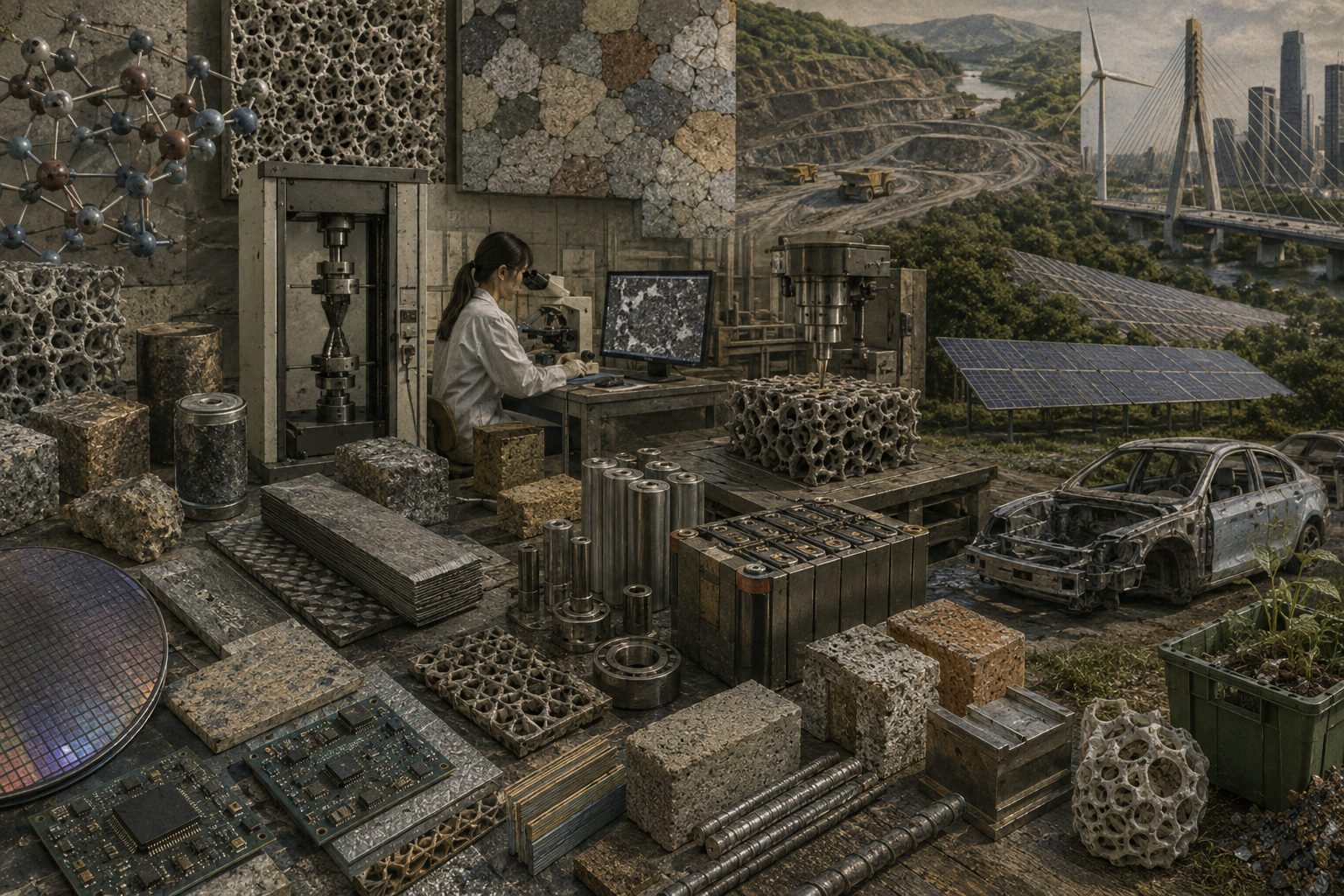
Materials Science matters because technological systems are material systems. A clean-energy transition depends on battery chemistries, photovoltaic materials, copper conductors, rare-earth magnets, power electronics, hydrogen membranes, catalysts, grid materials, thermal insulation, low-carbon steel, low-carbon cement, and durable infrastructure. Digital systems depend on semiconductor wafers, dielectrics, interconnects, packaging materials, thermal interfaces, optical materials, sensors, and rare elements. Public infrastructure depends on steel, concrete, asphalt, composites, ceramics, coatings, pipes, membranes, cables, and repair systems. Medicine depends on biomaterials, polymers, ceramics, metals, hydrogels, implant surfaces, sterile packaging, and biocompatible interfaces.
This pillar treats materials science as both a physical science and a public systems field. Materials are governed by atomic structure and thermodynamics, but they are also governed by extraction, manufacturing, labor, supply chains, regulation, standards, procurement, repair, waste, toxicity, and environmental justice. A material may be strong but unrecyclable, efficient but toxic, cheap but short-lived, high-performing but dependent on fragile supply chains, or low-carbon in operation but damaging in extraction. Serious materials analysis therefore requires linking laboratory properties to real-world performance, lifecycle consequences, and institutional responsibility.
Materials Science is also central to sustainability because every sustainability transition has a material basis. Decarbonization is not only a question of energy sources; it is a question of the materials that make energy systems possible. Climate adaptation is not only a question of planning; it is a question of heat-resilient surfaces, corrosion-resistant infrastructure, flood-tolerant materials, water-treatment systems, insulation, repairable buildings, and durable public assets. Circularity is not only a waste-management strategy; it requires material design, separability, traceability, standards, reuse systems, and markets for recovered materials.
Complete Code Repository
The companion repository for this knowledge series contains synthetic materials-property datasets, stress-strain analysis, diffusion models, lifecycle assessment workflows, corrosion and degradation examples, materials screening tools, structure-property models, SQL schemas, Python workflows, R reports, Julia simulations, C and C++ engineering kernels, Fortran numerical examples, Rust validation tools, Go reporting services, MATLAB/Octave teaching models, Modelica physical-system examples, notebooks, LaTeX technical notes, validation documentation, and engineering-use notes for materials science.
What Is Materials Science?
Materials Science is the study of how matter is structured, how that structure produces properties, how processing changes structure, how materials perform under real conditions, and how material choices shape technological systems. Its central concern is the relationship among structure, properties, processing, performance, degradation, and use.
In practical terms, Materials Science includes several interrelated components:
- atomic and molecular structure including bonding, electron configuration, crystal structure, amorphous structure, molecular chains, and nanoscale organization
- microstructure including grains, phases, interfaces, pores, inclusions, dislocations, precipitates, defects, fibers, domains, and surface features
- properties including strength, stiffness, toughness, ductility, hardness, conductivity, thermal stability, corrosion resistance, optical response, magnetic behavior, density, permeability, and biocompatibility
- processing including casting, forming, machining, sintering, heat treatment, polymerization, curing, deposition, coating, additive manufacturing, crystal growth, and semiconductor fabrication
- performance including how materials behave under load, heat, moisture, electricity, radiation, chemical exposure, fatigue, wear, biological contact, manufacturing tolerances, and long-term service conditions
- degradation including corrosion, oxidation, fatigue, creep, fracture, polymer aging, UV damage, embrittlement, fouling, delamination, radiation damage, and thermal cycling
- lifecycle systems including extraction, refining, manufacturing, transport, use, repair, reuse, recycling, disposal, embodied carbon, toxicity, and circularity
- computation and data including molecular dynamics, density functional theory, finite element modeling, materials informatics, databases, high-throughput screening, uncertainty analysis, and reproducible workflows
Materials Science is not reducible to chemistry, physics, engineering, or manufacturing alone. It is a bridge field. Chemistry explains bonding, reactions, polymers, corrosion, batteries, catalysts, and molecular design. Physics explains electronic structure, crystal behavior, heat, magnetism, optics, mechanics, and quantum effects. Engineering explains processing, design constraints, safety factors, reliability, manufacturability, and system performance. Environmental science explains lifecycle consequences, extraction burdens, waste, toxicity, and ecological limits.
Seen in this way, a material is not just a substance. It is a structured physical system embedded in a technological, economic, ecological, and institutional context.
Why Materials Science Matters
Materials Science matters because material capability sets the boundary conditions for technological possibility. Stronger materials make lighter structures possible. More conductive materials make better power systems possible. More stable materials make safer batteries possible. More biocompatible materials make medical implants possible. More durable materials make infrastructure more resilient. More recyclable materials make circular systems more plausible. More efficient catalysts make cleaner industrial processes possible. More precise semiconductors make modern computing possible.
Materials also determine failure. Bridges corrode. Batteries degrade. Polymers embrittle. Concrete cracks. Turbine blades creep. Semiconductors overheat. Coatings delaminate. Pipes fail. Implants wear. Solar cells lose efficiency. Wind turbine blades fatigue. These failures are not merely accidents; they often reveal the deeper relationship among material selection, design assumptions, environment, maintenance, cost pressure, standards, and institutional oversight.
The importance of Materials Science is especially visible in the energy transition. Batteries depend on electrode materials, electrolytes, separators, binders, current collectors, packaging, thermal management, and recycling pathways. Solar cells depend on semiconductor materials, glass, encapsulants, contacts, coatings, and stability under weathering. Wind turbines depend on composites, steel, rare-earth magnets, coatings, bearings, and blade repair. Transmission systems depend on conductors, insulators, transformers, thermal limits, and grid materials. Low-carbon construction depends on cement chemistry, supplementary cementitious materials, steel production, timber systems, insulation, durability, and lifecycle accounting.
Materials Science also matters for public responsibility. Many materials carry hidden burdens: mining impacts, toxic exposure, worker risk, waste persistence, carbon-intensive production, geopolitical dependency, and unequal distribution of environmental harm. A serious materials science pillar must therefore ask not only “What can this material do?” but also “What systems make this material possible, who bears its burdens, and how can it be designed, used, repaired, and recovered responsibly?”
System Architecture and Functional Layers
Materials Science can be analyzed as a layered system in which atomic structure, microstructure, processing, properties, performance, lifecycle, and governance interact over time.
Atomic and Molecular Layer
The atomic and molecular layer includes bonding, electron structure, molecular geometry, crystalline order, amorphous structure, and nanoscale organization. This layer helps explain why metals conduct electricity, ceramics resist heat, polymers deform viscoelastically, semiconductors respond to doping, and catalysts accelerate reactions.
Defect and Microstructure Layer
Real materials are never perfect. Vacancies, interstitials, dislocations, grain boundaries, precipitates, pores, cracks, inclusions, interfaces, and phase distributions shape properties. Microstructure is often the bridge between atomic structure and engineering performance. Two materials with the same composition can behave very differently because of processing history and microstructural state.
Processing Layer
Processing changes structure. Casting, rolling, forging, heat treatment, sintering, additive manufacturing, coating, crystal growth, polymer curing, thin-film deposition, and semiconductor fabrication all alter defects, phases, grain size, texture, porosity, residual stress, and surface condition. Processing is therefore not separate from material identity; it is part of what makes a material perform.
Property Layer
Properties describe measurable responses: stress, strain, modulus, strength, toughness, conductivity, thermal expansion, diffusion coefficient, permeability, optical response, magnetic behavior, density, corrosion rate, fatigue life, and biocompatibility. Properties are not abstract numbers; they are context-dependent measurements shaped by temperature, environment, loading rate, microstructure, scale, test method, and uncertainty.
Performance Layer
Performance describes how materials behave in real applications. A material selected for laboratory strength may fail under fatigue, corrosion, thermal cycling, impact, manufacturing defects, or maintenance neglect. Performance depends on use conditions, design margins, joining methods, surface treatment, inspection, repair, and failure modes.
Lifecycle Layer
The lifecycle layer includes extraction, refining, manufacturing, transport, installation, use, maintenance, repair, reuse, remanufacturing, recycling, disposal, and environmental release. A material’s lifecycle may include embodied carbon, water use, waste, toxicity, land disturbance, labor risk, and geopolitical dependency.
Computational and Data Layer
Materials Science increasingly depends on computation, databases, simulation, high-throughput screening, machine learning, and automated experimentation. Computational materials science can connect atomistic models, continuum models, experimental data, and lifecycle analysis, but its validity depends on data quality, assumptions, validation, and physical interpretation.
Governance and Standards Layer
Materials enter public life through standards, codes, procurement, certification, testing, safety regulation, environmental rules, and institutional trust. Materials governance shapes what is allowed, what is specified, what is tested, what is procured, what is repaired, what is recycled, and what harms are tolerated.
Structure, Properties, Processing, and Performance
The core framework of Materials Science is often summarized as structure-property-processing-performance. Structure refers to how matter is organized across scales. Properties describe how matter responds. Processing describes how materials are made or modified. Performance describes how materials behave in use.
This framework is powerful because it prevents simplistic material selection. A metal is not simply “strong.” A polymer is not simply “light.” A ceramic is not simply “brittle.” A composite is not simply “advanced.” Each material class contains many possible structures, processing routes, property combinations, and performance constraints.
For example, steel can be soft and formable or hard and wear-resistant depending on carbon content, alloying, heat treatment, grain size, and microstructure. Aluminum can be lightweight but susceptible to fatigue or corrosion depending on alloy and environment. Polymers can be flexible, tough, transparent, insulating, biodegradable, persistent, recyclable, or toxic depending on chemistry and additives. Ceramics can be brittle but extremely heat-resistant. Composites can be strong and light but difficult to inspect, repair, or recycle.
Processing creates many of these differences. Heat treatment can change phases and precipitates. Rolling can change texture and grain shape. Additive manufacturing can create complex geometries but also porosity, anisotropy, residual stress, and certification challenges. Thin-film deposition can create functional coatings or electronic layers. Polymer processing can change crystallinity, orientation, molecular weight effects, and performance.
The structure-property-processing-performance framework therefore connects laboratory science to engineering practice. It is the conceptual bridge from atomic structure to bridges, batteries, implants, turbines, semiconductors, pipes, packaging, and public infrastructure.
Sustainability, Lifecycle, and Circularity
Sustainable materials analysis asks how materials are sourced, produced, used, maintained, recovered, and governed across their full lifecycle. It requires looking beyond the point of use to the upstream and downstream systems that make material performance possible.
A material can reduce operational emissions while increasing extraction burdens. A lightweight composite can improve vehicle efficiency but complicate recycling. A battery can enable renewable integration while depending on mineral supply chains with social and ecological risks. A low-cost polymer can provide essential public-health benefits but create persistent waste. A durable infrastructure material can reduce replacement needs but carry high embodied carbon.
Lifecycle thinking helps clarify these trade-offs. It asks what functional unit is being evaluated, what system boundary is used, what energy and material inputs are included, what emissions and waste streams are counted, how long the material lasts, whether repair is possible, whether recovery is feasible, and how uncertainty is reported.
Circularity adds another layer. A circular materials system requires more than recycling slogans. It requires design for disassembly, material identification, separability, collection systems, repair infrastructure, remanufacturing, standards, markets for secondary materials, and avoidance of toxic additives that undermine recovery. Some materials can circulate effectively; others downcycle, degrade, disperse, contaminate streams, or remain economically difficult to recover.
Sustainable Materials Science therefore requires technical design and institutional design together. Materials can be engineered for durability, repairability, recyclability, lower toxicity, lower embodied carbon, and reduced criticality, but those properties only produce public value when supported by procurement, standards, infrastructure, regulation, and markets.
Computational Materials Science and Materials Informatics
Computational Materials Science uses mathematical models, numerical simulation, databases, and algorithms to understand and predict material behavior. It includes atomistic methods, electronic-structure calculations, thermodynamic modeling, molecular dynamics, phase-field models, finite element analysis, computational thermodynamics, data-driven property prediction, and materials informatics.
Materials informatics uses data to identify patterns, screen candidate materials, guide experiments, and accelerate discovery. It can support battery materials, catalysts, semiconductors, structural alloys, polymers, biomaterials, and sustainable material selection. But data-driven materials discovery must be handled carefully. Models depend on training data quality, measurement consistency, missing data, publication bias, uncertainty, and validation in real materials.
Computational tools are especially useful when they connect scales. Atomistic models can help explain diffusion, defects, or electronic behavior. Continuum models can help predict stress, heat transfer, fracture, and deformation. Lifecycle models can estimate embodied carbon, energy demand, and end-of-life impacts. Screening models can compare candidate materials across properties, cost, availability, and environmental factors.
The promise of computational materials science is not that it replaces experiment. It helps guide experiments, organize knowledge, test hypotheses, quantify uncertainty, and make the structure-property-performance relationship more visible. In a public-interest context, computation also supports transparency: assumptions, data, equations, and workflows can be shared, tested, challenged, and improved.
Mathematical Lens
Materials Science requires mathematics because stress, strain, diffusion, heat flow, reaction rates, density, fracture, conductivity, lifecycle burden, and failure probability must be measured rather than merely described.
\sigma = \frac{F}{A}
\]
\varepsilon = \frac{\Delta L}{L_0}
\]
\sigma = E\varepsilon
\]
J = -D\frac{dC}{dx}
\]
k = A e^{-\frac{E_a}{RT}}
\]
\sigma_y = \sigma_0 + k_y d^{-1/2}
\]
q = -k \nabla T
\]
\rho = \frac{m}{V}
\]
| Symbol | Meaning | Materials interpretation |
|---|---|---|
| \(\sigma\) | Stress | Force per unit area applied to a material. |
| \(\varepsilon\) | Strain | Relative deformation under load. |
| \(E\) | Elastic modulus | Stiffness in the elastic region. |
| \(J\) | Diffusion flux | Rate of material transport through space. |
| \(D\) | Diffusion coefficient | How quickly atoms, ions, or molecules move through a material. |
| \(E_a\) | Activation energy | Energy barrier for reaction, diffusion, or degradation. |
| \(d\) | Grain size | Microstructural scale that can influence strength. |
| \(\rho\) | Density | Mass per unit volume. |
The mathematical lesson is practical. Materials do not perform well because they are described as advanced, sustainable, strong, or innovative. They perform well when their structure, properties, processing, environment, and lifecycle constraints are understood quantitatively.
Core Domains of Materials Science
Materials Science spans multiple domains, each with distinctive structures, properties, processing methods, applications, and public consequences.
Metals and Alloys
Metals and alloys are central to infrastructure, transportation, energy, manufacturing, electronics, and public systems. Their value comes from strength, ductility, conductivity, toughness, formability, and recyclability. Steel, aluminum, copper, titanium, nickel alloys, magnesium, and superalloys each have distinct relationships among composition, processing, microstructure, corrosion, fatigue, and performance.
Ceramics and Glasses
Ceramics and glasses are often hard, heat-resistant, chemically stable, electrically insulating, or optically useful. They appear in refractories, electronics, sensors, armor, turbine components, glass fibers, biomedical implants, coatings, catalytic substrates, nuclear materials, and construction systems. Their brittleness, processing difficulty, and fracture behavior make design and testing critical.
Polymers and Soft Materials
Polymers include plastics, elastomers, fibers, membranes, adhesives, coatings, hydrogels, and biomedical materials. Their behavior depends on molecular weight, chain structure, crystallinity, crosslinking, additives, temperature, viscoelasticity, degradation, and processing. Polymers are essential but also central to questions of persistence, toxicity, microplastics, and circularity.
Composite Materials
Composites combine materials to achieve properties that individual components cannot provide alone. Fiber-reinforced composites, concrete, laminates, sandwich structures, bio-composites, and ceramic-matrix composites can deliver high strength-to-weight performance, tailored stiffness, durability, and thermal resistance. They also raise challenges around inspection, repair, failure modes, and recycling.
Semiconductors and Electronic Materials
Semiconductors, dielectrics, conductors, substrates, interconnects, packaging materials, and thermal interfaces make digital systems possible. Their performance depends on electronic structure, defects, doping, interfaces, fabrication precision, contamination control, thermal management, and reliability under miniaturization.
Energy Materials
Energy materials include battery electrodes, electrolytes, separators, photovoltaic materials, catalysts, fuel-cell membranes, hydrogen-storage materials, nuclear fuels, thermoelectrics, grid conductors, magnets, insulation, and thermal-storage media. Energy transition depends deeply on materials performance, availability, stability, safety, and recoverability.
Biomaterials
Biomaterials interact with living systems. They include metals, ceramics, polymers, hydrogels, composites, implants, tissue scaffolds, drug-delivery systems, dental materials, and medical-device surfaces. Their design must address biocompatibility, sterilization, mechanical performance, degradation, immune response, infection risk, ethics, and regulation.
Nanomaterials and Advanced Functional Materials
Nanomaterials exhibit properties shaped by nanoscale structure and surface effects. Graphene, nanotubes, nanoparticles, quantum dots, nanocomposites, metamaterials, smart materials, and responsive materials can create new capabilities, but they also require careful governance around toxicity, exposure, validation, and hype.
Construction and Infrastructure Materials
Concrete, steel, asphalt, timber, glass, insulation, pipes, coatings, sealants, membranes, and structural composites shape the durability, emissions, safety, and resilience of public infrastructure. Climate adaptation and decarbonization both require serious attention to infrastructure materials.
Sustainable and Circular Materials
Sustainable materials are designed or selected to reduce harm across their lifecycle. Circular materials systems require repairability, reuse, recyclability, separability, traceability, and institutional support. Sustainability is not a single property; it is a system-level judgment across function, duration, impact, and governance.
Materials Science Article Map
The roadmap below organizes the Materials Science knowledge series into conceptual domains. All articles are currently listed as planned and unlinked so the pillar can function as both a public index and a long-range technical architecture for the series.
Foundations of Materials Science
- What Is Materials Science? (Planned) — A foundational introduction to materials science as the study of structure, properties, processing, performance, degradation, and use.
- Structure, Properties, Processing, and Performance (Planned) — Explains the central framework connecting how materials are made, how they are structured, how they behave, and how they perform in real systems.
- Major Classes of Materials (Planned) — Introduces metals, ceramics, polymers, composites, semiconductors, biomaterials, nanomaterials, and smart materials.
- Atomic Structure and Bonding in Materials (Planned) — Covers ionic, covalent, metallic, and secondary bonding and how bonding shapes material behavior.
- Crystal Structure and Crystallography (Planned) — Introduces lattices, unit cells, Miller indices, crystallographic planes, crystal systems, and structural symmetry.
- Defects in Materials (Planned) — Explains vacancies, interstitials, dislocations, grain boundaries, impurities, pores, cracks, and how imperfections shape properties.
- Surfaces, Interfaces, and Grain Boundaries (Planned) — Examines the boundaries where materials interact, fail, bond, corrode, catalyze, and transform.
Thermodynamics, Phase Behavior, and Microstructure
- Materials Thermodynamics (Planned) — Explains free energy, entropy, enthalpy, stability, equilibrium, and the thermodynamic basis of material behavior.
- Phase Diagrams (Planned) — Introduces phase stability, composition, temperature, solidification, eutectics, solubility, and phase boundaries.
- Phase Transformations (Planned) — Covers nucleation, growth, precipitation, crystallization, martensitic transformations, and microstructural change.
- Microstructure and Material Performance (Planned) — Studies grains, phases, pores, inclusions, texture, interfaces, and how microstructure governs properties.
- Heat Treatment and Materials Processing (Planned) — Explains annealing, quenching, tempering, aging, sintering, curing, and thermal processing strategies.
- Solidification and Crystal Growth (Planned) — Examines dendrites, grain formation, segregation, casting defects, single crystals, and process control.
- Diffusion-Controlled Microstructural Change (Planned) — Connects diffusion, temperature, time, phase transformation, precipitation, oxidation, and degradation.
Mechanical Properties and Failure
- Stress, Strain, and Elasticity (Planned) — A foundation for mechanical loading, deformation, elastic modulus, stiffness, and elastic behavior.
- Plasticity and Yielding (Planned) — Explains permanent deformation, dislocations, yield strength, strain hardening, and plastic flow.
- Fracture Toughness and Crack Growth (Planned) — Covers crack initiation, fracture mechanics, brittle fracture, ductile fracture, and toughness.
- Fatigue and Cyclic Loading (Planned) — Examines repeated loading, fatigue life, stress concentration, crack propagation, and reliability.
- Creep and High-Temperature Deformation (Planned) — Studies time-dependent deformation under stress in turbines, reactors, engines, and high-temperature systems.
- Wear, Friction, and Tribology (Planned) — Covers surface interaction, lubrication, abrasion, adhesion, erosion, and material loss in moving systems.
- Hardness, Toughness, and Strength Trade-Offs (Planned) — Explains why improving one mechanical property can weaken another and how design balances trade-offs.
Transport, Electrical, Thermal, and Optical Properties
- Diffusion in Materials (Planned) — Covers atomic, ionic, and molecular transport through solids, liquids, polymers, membranes, and interfaces.
- Thermal Properties of Materials (Planned) — Introduces thermal conductivity, heat capacity, expansion, insulation, thermal shock, and thermal management.
- Electrical Properties of Materials (Planned) — Covers conductivity, resistivity, dielectrics, semiconductors, insulators, and electronic structure.
- Magnetic Materials (Planned) — Examines ferromagnetism, permanent magnets, soft magnetic materials, motors, generators, and critical mineral dependence.
- Optical Materials (Planned) — Studies transparency, absorption, reflection, photonic materials, lenses, coatings, displays, and optical devices.
- Ionic Transport and Electrochemical Materials (Planned) — Covers ion transport in batteries, fuel cells, membranes, corrosion systems, and sensors.
- Thermal Management Materials (Planned) — Examines heat spreaders, interface materials, insulation, phase-change materials, and cooling systems.
Metals, Ceramics, Polymers, and Composites
- Metals and Alloys (Planned) — Covers metallic bonding, alloy design, steel, aluminum, titanium, copper, nickel, microstructure, and performance.
- Steel and Structural Materials (Planned) — Examines steel, reinforcement, bridges, buildings, infrastructure, strength, toughness, corrosion, and decarbonization challenges.
- Ceramics (Planned) — Covers oxides, carbides, nitrides, refractories, brittleness, hardness, thermal stability, and high-temperature applications.
- Polymers (Planned) — Introduces plastics, elastomers, thermoplastics, thermosets, molecular chains, viscoelasticity, degradation, and recycling.
- Composite Materials (Planned) — Covers fiber-reinforced materials, matrix systems, laminates, strength-to-weight performance, damage, and repair.
- Advanced Structural Materials (Planned) — Examines high-entropy alloys, superalloys, lightweight alloys, engineered ceramics, and high-performance composites.
- Timber, Bio-Based, and Mineral Construction Materials (Planned) — Studies timber systems, bio-composites, stone, earth materials, and mineral-based construction.
Electronic, Semiconductor, and Digital Materials
- Semiconductor Materials (Planned) — Covers silicon, compound semiconductors, band gaps, doping, wafers, devices, and fabrication constraints.
- Microelectronics Materials (Planned) — Examines interconnects, dielectrics, packaging, substrates, thermal interfaces, and reliability in electronic systems.
- Photovoltaic Materials (Planned) — Covers silicon solar cells, thin films, perovskites, stability, efficiency, degradation, and lifecycle impacts.
- Thermoelectric Materials (Planned) — Studies materials that convert temperature differences into electricity and their potential for waste-heat recovery.
- Sensors and Functional Materials (Planned) — Covers piezoelectric, electrochemical, optical, magnetic, and responsive materials used in sensing systems.
- Power Electronics Materials (Planned) — Examines wide-bandgap semiconductors, packaging, thermal management, reliability, and grid/vehicle applications.
- Optoelectronic and Photonic Materials (Planned) — Studies LEDs, lasers, photodetectors, optical fibers, displays, and photonic integrated systems.
Materials for Energy Systems
- Battery Materials (Planned) — Covers cathodes, anodes, electrolytes, separators, degradation, safety, recycling, and supply chains.
- Hydrogen Materials (Planned) — Examines electrolyzer materials, fuel-cell membranes, catalysts, storage materials, embrittlement, and infrastructure compatibility.
- Catalyst Materials (Planned) — Covers catalytic surfaces, reaction pathways, energy conversion, industrial chemistry, emissions control, and green chemistry.
- Nuclear Materials (Planned) — Studies fuels, cladding, radiation damage, reactor materials, waste forms, and long-term containment.
- Grid and Transmission Materials (Planned) — Covers conductors, transformers, insulation, superconductors, thermal limits, and materials for electrical infrastructure.
- Low-Carbon Building Materials (Planned) — Examines cement, concrete, timber, insulation, steel, glass, embodied carbon, durability, and circular construction.
- Materials for Thermal Storage and Heat Pumps (Planned) — Studies phase-change materials, heat exchangers, refrigerants, insulation, and thermal-management systems.
Biomaterials, Soft Materials, and Nanomaterials
- Biomaterials (Planned) — Covers implants, tissue compatibility, biodegradation, medical devices, biointerfaces, and ethical design.
- Soft Materials (Planned) — Introduces gels, elastomers, colloids, foams, membranes, biological materials, and deformable systems.
- Nanomaterials (Planned) — Covers nanoscale structure, surface effects, nanoparticles, nanotubes, graphene, quantum dots, and risk governance.
- Smart Materials (Planned) — Examines materials that respond to heat, light, stress, electricity, chemistry, moisture, or biological signals.
- Bioinspired Materials (Planned) — Studies materials inspired by shells, bone, wood, spider silk, lotus leaves, gecko feet, and ecological design.
- Hydrogels and Tissue-Engineering Materials (Planned) — Explores soft, water-rich materials used in biomedical interfaces, scaffolds, and controlled release.
- Membranes and Separation Materials (Planned) — Covers filtration, desalination, gas separation, fuel cells, batteries, and environmental applications.
Degradation, Corrosion, and Material Lifecycles
- Corrosion (Planned) — Covers electrochemical degradation, rust, oxidation, passivation, protective coatings, and infrastructure risk.
- Polymer Degradation (Planned) — Examines UV damage, oxidation, hydrolysis, thermal aging, microplastics, additives, and long-term persistence.
- Materials Failure Analysis (Planned) — Covers forensic materials analysis, root-cause investigation, fracture surfaces, defects, fatigue, and design lessons.
- Durability and Reliability (Planned) — Studies service life, accelerated testing, uncertainty, environmental exposure, maintenance, and resilience.
- Repair, Reuse, and Remanufacturing (Planned) — Covers maintainability, modular design, repair systems, reuse markets, and remanufacturing.
- Coatings and Surface Protection (Planned) — Examines protective layers, corrosion barriers, functional coatings, surface treatments, and durability.
- Materials Aging Under Climate Stress (Planned) — Studies heat, moisture, salt, wildfire, flooding, UV exposure, freeze-thaw cycles, and climate-driven degradation.
Manufacturing, Processing, and Industrial Systems
- Materials Processing (Planned) — Covers casting, forming, machining, sintering, extrusion, polymer processing, coating, and heat treatment.
- Additive Manufacturing (Planned) — Examines 3D printing, powder-bed fusion, binder jetting, extrusion, design freedom, defects, and certification.
- Thin Films and Coatings (Planned) — Covers deposition, surface engineering, protective coatings, optical coatings, semiconductor films, and barrier layers.
- Materials Quality Control (Planned) — Studies inspection, testing, nondestructive evaluation, statistical process control, certification, and traceability.
- Industrial Materials Systems (Planned) — Examines materials in manufacturing, infrastructure, supply chains, industrial policy, and technological capacity.
- Nondestructive Testing and Materials Inspection (Planned) — Covers ultrasonic, radiographic, magnetic, optical, acoustic, and thermal inspection methods.
- Standards, Certification, and Materials Testing (Planned) — Explains test methods, certification, quality systems, safety margins, and standards institutions.
Computational Materials Science
- Computational Materials Science (Planned) — Introduces computational approaches to predicting structure, properties, stability, and performance.
- Materials Informatics (Planned) — Covers materials datasets, feature engineering, screening, property prediction, uncertainty, and responsible AI use.
- Molecular Dynamics (Planned) — Studies atomistic motion, temperature, defects, interfaces, diffusion, and nanoscale behavior.
- Density Functional Theory (Planned) — Introduces electronic-structure modeling, band structures, stability, and materials discovery.
- Finite Element Modeling for Materials (Planned) — Covers continuum simulation of stress, heat, deformation, fracture, and multiphysics materials problems.
- Digital Materials Labs (Planned) — Examines automated experimentation, lab data systems, simulation, materials databases, and reproducible workflows.
- Uncertainty and Validation in Materials Modeling (Planned) — Covers model assumptions, uncertainty propagation, experimental validation, and responsible interpretation.
Sustainable Materials and Circularity
- Sustainable Materials (Planned) — Examines low-impact materials, renewable feedstocks, embodied carbon, toxicity, durability, and design responsibility.
- Lifecycle Assessment for Materials (Planned) — Covers embodied energy, emissions, extraction, manufacturing, transport, use, end-of-life, and uncertainty.
- Circular Materials Systems (Planned) — Examines recycling, reuse, remanufacturing, design for disassembly, material passports, and circular economy limits.
- Critical Minerals and Materials Security (Planned) — Studies lithium, cobalt, nickel, copper, rare earths, supply chains, mining impacts, and geopolitical risk.
- Toxicity and Materials Governance (Planned) — Covers hazardous substances, chemical regulation, exposure, environmental justice, substitution, and public accountability.
- Material Passports and Traceability (Planned) — Examines product data, reuse markets, building materials, supply-chain transparency, and digital records.
- Design for Disassembly and Recovery (Planned) — Studies modular design, fasteners, adhesives, separability, product architecture, and end-of-life recovery.
Materials for Public Systems and Infrastructure
- Materials for Water Systems (Planned) — Covers pipes, membranes, filtration media, corrosion, contaminants, desalination, and water infrastructure resilience.
- Materials for Transportation (Planned) — Examines lightweighting, batteries, rail infrastructure, aerospace materials, road surfaces, and vehicle durability.
- Materials for Public Health (Planned) — Covers medical materials, sterilization, filtration, personal protective equipment, implants, packaging, and resilient health systems.
- Climate Adaptation Materials (Planned) — Studies heat-resilient surfaces, flood-resistant materials, corrosion control, wildfire-resistant materials, and adaptive infrastructure.
- Materials and Public Procurement (Planned) — Explains how governments can shape material systems through standards, procurement, lifecycle requirements, and public investment.
- Materials for Food and Agriculture Systems (Planned) — Covers packaging, irrigation, sensors, storage, soil-contact materials, cold chains, and agricultural infrastructure.
- Materials for Disaster Resilience (Planned) — Examines emergency shelters, resilient roads, flood barriers, fire-resistant systems, and rapid-repair materials.
Future of Materials Science
- Future Materials Platforms (Planned) — Covers integrated research platforms, computational screening, automated labs, open datasets, and institutional materials intelligence.
- AI and Materials Discovery (Planned) — Examines AI-assisted materials discovery, data quality, model uncertainty, laboratory validation, and scientific accountability.
- Materials for Decarbonization (Planned) — Studies batteries, grids, hydrogen, catalysts, cement, steel, insulation, and materials for climate transition.
- The Ethics of Materials Science (Planned) — Covers extraction, labor, toxicity, waste, environmental justice, dual-use technologies, public responsibility, and sustainable design.
- The Future of Materials Science (Planned) — A concluding article on material futures, planetary limits, technological capability, institutional responsibility, and the physical foundations of sustainable systems.
GitHub Code Repository
The Materials Science knowledge series is supported by a companion code repository designed for practical, reproducible, multi-language scientific and engineering workflows. This repository should bridge material-property screening, stress-strain analysis, diffusion, thermal transport, lifecycle assessment, corrosion, degradation, sustainable material selection, structure-property models, computational notebooks, and technical communication.
Recommended repository structure:
materials-science-code/
├── README.md
├── LICENSE
├── CITATION.cff
├── requirements-advanced.txt
├── pyproject.toml
├── Makefile
├── .github/
│   └── workflows/
│       └── smoke-tests.yml
├── articles/
│   ├── what-is-materials-science/
│   ├── structure-property-processing-performance/
│   ├── stress-strain-and-elasticity/
│   ├── diffusion-in-materials/
│   ├── phase-diagrams/
│   ├── materials-for-energy-systems/
│   ├── lifecycle-assessment-for-materials/
│   └── future-of-materials-science/
├── data/
│   ├── raw/
│   ├── processed/
│   └── synthetic/
│       ├── material_properties.csv
│       ├── stress_strain_samples.csv
│       ├── lifecycle_inventory.csv
│       └── corrosion_exposure.csv
├── sql/
│   ├── schema.sql
│   └── example_queries.sql
├── python/
│   ├── run_all.py
│   ├── material_screening.py
│   ├── stress_strain_model.py
│   ├── diffusion_model.py
│   ├── lifecycle_materials_model.py
│   ├── corrosion_risk_model.py
│   └── advanced_materials_dashboard.py
├── r/
│   ├── materials_property_summary.R
│   ├── degradation_trends.R
│   └── lifecycle_comparison.R
├── julia/
│   ├── diffusion_simulation.jl
│   └── structure_property_model.jl
├── c/
│   └── stress_strain.c
├── cpp/
│   └── material_selection.cpp
├── fortran/
│   └── diffusion_step.f90
├── rust/
│   └── materials_score.rs
├── go/
│   └── materials_table.go
├── matlab/
│   └── phase_diagram_demo.m
├── modelica/
│   └── ThermalConductionTeachingModel.mo
├── notebooks/
│   ├── materials_screening.ipynb
│   ├── stress_strain_analysis.ipynb
│   └── lifecycle_assessment_intro.ipynb
├── latex/
│   └── materials_equations.tex
├── docs/
│   ├── data_dictionary.md
│   ├── modeling_notes.md
│   ├── validation_plan.md
│   ├── responsible_use.md
│   ├── engineering_use_notes.md
│   ├── materials_property_notes.md
│   └── lifecycle_assessment_notes.md
└── outputs/
    ├── figures/
    └── tables/
The repository should support several practical workflows:
- SQL: materials, properties, lifecycle inventory, degradation exposure, property comparisons, and sustainability screening.
- Python: material screening, stress-strain analysis, diffusion modeling, lifecycle accounting, corrosion risk, and advanced dashboards.
- R: material family summaries, degradation trends, lifecycle comparison, and report-ready tables.
- Julia: diffusion simulation, structure-property models, and numerical materials examples.
- C: stress-strain kernels and simple engineering calculations.
- C++: material selection, sorting, scoring, and engineering simulation scaffolds.
- Fortran: numerical diffusion examples and scientific-computing continuity.
- Rust: safe validation of material scores, property values, and data-quality checks.
- Go: lightweight materials-property services and command-line reporting tools.
- MATLAB/Octave: phase-diagram and teaching models for engineering audiences.
- Modelica: dynamic physical-system examples for heat transfer and coupled material behavior.
- Notebooks: exploratory analysis for materials screening, stress-strain behavior, lifecycle assessment, and degradation.
SQL Workflow: Materials Property and Lifecycle Registry
SQL provides the durable structure for materials science analysis. It defines material families, properties, lifecycle inventory, degradation exposure, and screening metrics.
Suggested filename:
sql/schema.sql-- Materials Property and Lifecycle Registry
-- -----------------------------------------
-- This schema supports materials science examples:
-- material properties, lifecycle inventory, degradation exposure,
-- and sustainability screening.
CREATE TABLE IF NOT EXISTS materials (
material TEXT PRIMARY KEY,
family TEXT NOT NULL,
density_kg_m3 REAL NOT NULL,
yield_strength_mpa REAL,
elastic_modulus_gpa REAL,
thermal_conductivity_w_mk REAL,
electrical_resistivity_ohm_m REAL,
embodied_carbon_kg_co2e_per_kg REAL,
recyclability_score REAL
);
CREATE TABLE IF NOT EXISTS lifecycle_inventory (
material TEXT NOT NULL,
kg_material REAL NOT NULL,
embodied_carbon_kg_co2e_per_kg REAL NOT NULL,
recycled_content_fraction REAL,
service_life_years REAL,
end_of_life_recovery_fraction REAL
);
CREATE TABLE IF NOT EXISTS degradation_exposure (
material TEXT NOT NULL,
environment TEXT NOT NULL,
chloride_level TEXT,
temperature_c REAL,
relative_humidity_percent REAL,
exposure_days REAL,
mass_loss_g_m2 REAL
);
CREATE VIEW IF NOT EXISTS material_strength_to_weight AS
SELECT
material,
family,
yield_strength_mpa / density_kg_m3 AS strength_to_weight
FROM materials
WHERE yield_strength_mpa IS NOT NULL
ORDER BY strength_to_weight DESC;This schema supports the central purpose of the pillar: materials analysis requires linked data about properties, performance, degradation, lifecycle impacts, and design constraints.
Python Workflow: Materials Screening Model
Python is the primary workflow language for transparent materials screening, property comparison, lifecycle accounting, and reproducible technical examples.
Suggested filename:
python/material_screening.pyfrom __future__ import annotations
import csv
from dataclasses import dataclass
from pathlib import Path
from typing import Iterable
ROOT = Path(__file__).resolve().parents[1]
DATA = ROOT / "data" / "synthetic" / "material_properties.csv"
OUTPUT = ROOT / "outputs" / "tables" / "material_screening_scores.csv"
@dataclass
class Material:
material: str
family: str
density_kg_m3: float
yield_strength_mpa: float
elastic_modulus_gpa: float
thermal_conductivity_w_mk: float
embodied_carbon_kg_co2e_per_kg: float
recyclability_score: float
@property
def strength_to_weight(self) -> float:
return self.yield_strength_mpa / self.density_kg_m3
@property
def stiffness_to_weight(self) -> float:
return self.elastic_modulus_gpa / self.density_kg_m3
def read_materials(path: Path = DATA) -> list[Material]:
with path.open(newline="", encoding="utf-8") as handle:
rows = csv.DictReader(handle)
return [
Material(
material=row["material"],
family=row["family"],
density_kg_m3=float(row["density_kg_m3"]),
yield_strength_mpa=float(row["yield_strength_mpa"]),
elastic_modulus_gpa=float(row["elastic_modulus_gpa"]),
thermal_conductivity_w_mk=float(row["thermal_conductivity_w_mk"]),
embodied_carbon_kg_co2e_per_kg=float(row["embodied_carbon_kg_co2e_per_kg"]),
recyclability_score=float(row["recyclability_score"]),
)
for row in rows
]
def normalize(values: Iterable[float], value: float, inverse: bool = False) -> float:
values = list(values)
low, high = min(values), max(values)
if high == low:
score = 0.0
else:
score = (value - low) / (high - low)
score = max(0.0, min(1.0, score))
return 1.0 - score if inverse else score
def score_materials(materials: list[Material]) -> list[dict[str, str]]:
stw_values = [m.strength_to_weight for m in materials]
stiffness_values = [m.stiffness_to_weight for m in materials]
carbon_values = [m.embodied_carbon_kg_co2e_per_kg for m in materials]
scored: list[dict[str, str]] = []
for m in materials:
strength_score = normalize(stw_values, m.strength_to_weight)
stiffness_score = normalize(stiffness_values, m.stiffness_to_weight)
carbon_score = normalize(carbon_values, m.embodied_carbon_kg_co2e_per_kg, inverse=True)
recyclability_score = m.recyclability_score
total = (
0.40 * strength_score
+ 0.20 * stiffness_score
+ 0.25 * carbon_score
+ 0.15 * recyclability_score
)
scored.append(
{
"material": m.material,
"family": m.family,
"strength_to_weight": f"{m.strength_to_weight:.6f}",
"stiffness_to_weight": f"{m.stiffness_to_weight:.6f}",
"screening_score": f"{total:.3f}",
}
)
return sorted(scored, key=lambda row: float(row["screening_score"]), reverse=True)
def main() -> None:
materials = read_materials()
scores = score_materials(materials)
OUTPUT.parent.mkdir(parents=True, exist_ok=True)
with OUTPUT.open("w", newline="", encoding="utf-8") as handle:
writer = csv.DictWriter(handle, fieldnames=scores[0].keys())
writer.writeheader()
writer.writerows(scores)
print(f"Wrote {OUTPUT}")
print("Top candidate:", scores[0]["material"], scores[0]["screening_score"])
if __name__ == "__main__":
main()This workflow supports the pillar’s central argument: material selection is not a single-property decision. Strength, stiffness, density, embodied carbon, recyclability, durability, and application context must be evaluated together.
R Workflow: Materials Property and Degradation Report
R is useful for materials reporting, summary tables, degradation trends, lifecycle comparison, and publication-ready analysis.
Suggested filename:
r/materials_property_summary.R# Materials Property and Degradation Report
# -----------------------------------------
# Base R workflow for summarizing material families.
args <- commandArgs(trailingOnly = FALSE)
file_arg <- "--file="
script_path <- sub(file_arg, "", grep(file_arg, args, value = TRUE))
if (length(script_path) > 0) {
root <- normalizePath(file.path(dirname(script_path[1]), ".."), mustWork = FALSE)
} else {
root <- getwd()
}
input <- file.path(root, "data", "synthetic", "material_properties.csv")
output <- file.path(root, "outputs", "tables", "r_material_family_summary.csv")
dir.create(dirname(output), recursive = TRUE, showWarnings = FALSE)
materials <- read.csv(input)
summary <- aggregate(
cbind(
density_kg_m3,
yield_strength_mpa,
embodied_carbon_kg_co2e_per_kg
) ~ family,
data = materials,
FUN = mean
)
write.csv(summary, output, row.names = FALSE)
cat("Wrote", output, "\n")This workflow helps compare material families in a way that can support article figures, property tables, and public-facing explanation.
Julia Workflow: Diffusion Simulation
Julia is useful for numerical modeling, simulation, optimization, and scientific-computing workflows in materials science.
Suggested filename:
julia/diffusion_simulation.jl# Lightweight Julia diffusion simulation
function simulate_diffusion(nodes::Int=21, steps::Int=80, alpha::Float64=0.25)
if alpha > 0.5
error("alpha must be <= 0.5 for stability")
end
c = zeros(Float64, nodes)
c[1] = 1.0
for _ in 1:steps
new = copy(c)
for i in 2:(nodes - 1)
new[i] = c[i] + alpha * (c[i - 1] - 2c[i] + c[i + 1])
end
new[1] = 1.0
new[end] = new[end - 1]
c = new
end
return c
end
profile = simulate_diffusion()
mkpath(joinpath(@__DIR__, "..", "outputs", "tables"))
output = joinpath(@__DIR__, "..", "outputs", "tables", "julia_diffusion_profile.csv")
open(output, "w") do io
println(io, "node,concentration")
for (i, value) in enumerate(profile)
println(io, "$(i),$(round(value, digits=6))")
end
end
println("Wrote $output")Diffusion appears across corrosion, batteries, membranes, heat treatment, doping, phase transformations, and degradation. A simple diffusion model gives readers a bridge between equation and material behavior.
C Workflow: Stress-Strain Kernel
C is useful for lightweight engineering kernels, embedded systems, and transparent numerical calculations.
Suggested filename:
c/stress_strain.c#include <stdio.h>
int main(void) {
const double force_newtons = 50000.0;
const double area_m2 = 0.0025;
const double original_length_m = 1.0;
const double change_length_m = 0.0012;
double stress_pa = force_newtons / area_m2;
double strain = change_length_m / original_length_m;
double modulus_pa = stress_pa / strain;
printf("stress_pa,%.3f\n", stress_pa);
printf("strain,%.6f\n", strain);
printf("elastic_modulus_gpa,%.3f\n", modulus_pa / 1.0e9);
return 0;
}This small kernel makes the basic mechanics visible: stress, strain, and modulus are not abstractions; they are measurable relationships between force, geometry, and deformation.
C++ Workflow: Material Selection Model
C++ is useful for material selection, simulation frameworks, sorting, scoring, and engineering-oriented computational examples.
Suggested filename:
cpp/material_selection.cpp#include <algorithm>
#include <iostream>
#include <string>
#include <vector>
struct Material {
std::string name;
double density;
double yield_strength;
double embodied_carbon;
};
int main() {
std::vector<Material> materials = {
{"Structural Steel", 7850.0, 350.0, 1.9},
{"Recycled Aluminum Alloy", 2700.0, 240.0, 3.5},
{"Titanium Alloy Ti-6Al-4V", 4430.0, 880.0, 35.0}
};
std::sort(materials.begin(), materials.end(), [](const Material& a, const Material& b) {
return (a.yield_strength / a.density) > (b.yield_strength / b.density);
});
std::cout << "material,strength_to_weight\n";
for (const auto& m : materials) {
std::cout << m.name << "," << (m.yield_strength / m.density) << "\n";
}
return 0;
}This workflow reinforces a basic engineering principle: material selection is often about ratios, trade-offs, constraints, and application context, not absolute property values alone.
Fortran Workflow: One-Dimensional Diffusion Step
Fortran remains relevant for numerical modeling traditions in engineering, physics, materials simulation, climate science, and scientific computing.
Suggested filename:
fortran/diffusion_step.f90program diffusion_step
implicit none
integer, parameter :: n = 21, steps = 80
real(8), parameter :: alpha = 0.25d0
real(8) :: c(n), newc(n)
integer :: i, step
c = 0.0d0
c(1) = 1.0d0
do step = 1, steps
newc = c
do i = 2, n - 1
newc(i) = c(i) + alpha * (c(i-1) - 2.0d0*c(i) + c(i+1))
end do
newc(1) = 1.0d0
newc(n) = newc(n-1)
c = newc
end do
print *, "node,concentration"
do i = 1, n
print *, i, c(i)
end do
end program diffusion_stepThis workflow connects classical numerical methods to materials behavior. Diffusion problems appear in alloying, corrosion, oxidation, doping, membranes, batteries, and thermal processing.
Rust Workflow: Materials Score Validator
Rust is useful for safe command-line validation, property checks, data-quality tools, and reproducible materials-data workflows.
Suggested filename:
rust/materials_score.rs#[derive(Debug)]
struct Material {
name: &'static str,
density: f64,
yield_strength: f64,
}
fn main() {
let mut materials = vec![
Material { name: "Structural Steel", density: 7850.0, yield_strength: 350.0 },
Material { name: "Recycled Aluminum Alloy", density: 2700.0, yield_strength: 240.0 },
Material { name: "Titanium Alloy Ti-6Al-4V", density: 4430.0, yield_strength: 880.0 },
];
materials.sort_by(|a, b| {
let score_a = a.yield_strength / a.density;
let score_b = b.yield_strength / b.density;
score_b.partial_cmp(&score_a).unwrap()
});
println!("material,strength_to_weight");
for material in materials {
println!("{},{}", material.name, material.yield_strength / material.density);
}
}Validation matters because materials data can be misleading when units, test conditions, missing values, or property definitions are mishandled.
Go Workflow: Materials Property Service
Go is useful for lightweight data services, command-line tools, APIs, and operational reporting.
Suggested filename:
go/materials_table.gopackage main
import (
"fmt"
"sort"
)
type Material struct {
Name string
Family string
Density float64
YieldStrength float64
}
func main() {
materials := []Material{
{"Structural Steel", "metal", 7850, 350},
{"Recycled Aluminum Alloy", "metal", 2700, 240},
{"Bamboo Composite Panel", "bio-composite", 750, 90},
}
sort.Slice(materials, func(i, j int) bool {
return materials[i].YieldStrength/materials[i].Density >
materials[j].YieldStrength/materials[j].Density
})
fmt.Println("material,family,strength_to_weight")
for _, m := range materials {
fmt.Printf("%s,%s,%.6f\n", m.Name, m.Family, m.YieldStrength/m.Density)
}
}A materials-property service can be expanded into tools for design screening, procurement support, sustainability scoring, or public materials databases.
Modelica Workflow: Thermal Conduction Teaching Model
Modelica is useful for system-level modeling of dynamic physical systems, including heat transfer, thermal storage, coupled energy systems, and multiphysics behavior.
Suggested filename:
modelica/ThermalConductionTeachingModel.momodel ThermalConductionTeachingModel
parameter Real k = 45 "Thermal conductivity W/mK";
parameter Real area = 0.01 "Area m2";
parameter Real length = 0.1 "Length m";
parameter Real hot = 373.15 "Hot side K";
parameter Real cold = 293.15 "Cold side K";
Real q "Heat transfer rate W";
equation
q = k * area * (hot - cold) / length;
end ThermalConductionTeachingModel;Modelica helps frame materials as part of dynamic physical systems. Thermal conductivity, geometry, and temperature difference become part of system behavior rather than isolated property values.
Governance, Standards, and Institutional Capacity
Materials enter society through institutions. Standards, specifications, procurement rules, testing methods, safety codes, building codes, environmental regulations, labeling systems, certification processes, and industrial norms determine which materials are accepted, trusted, and deployed.
This matters because material failure can become public failure. A bridge collapse, battery fire, pipe corrosion crisis, building-material toxicity scandal, medical implant failure, or semiconductor supply-chain disruption is not only a technical problem. It is also a governance problem involving testing, oversight, procurement, maintenance, certification, transparency, and accountability.
Materials governance includes several practical questions:
- What properties must be tested before use?
- Which standards define acceptable performance?
- How are failures documented and learned from?
- How are supply chains traced?
- How are toxic substances regulated?
- How are recycled or recovered materials certified?
- How are environmental product declarations verified?
- How are public agencies supported in responsible procurement?
Strong materials governance does not slow innovation by default. It can make innovation more trustworthy by clarifying performance expectations, reducing hidden risk, improving comparability, and protecting public systems from weak materials, false claims, or poorly understood lifecycle burdens.
Ethics, Extraction, Toxicity, and Public Value
Materials Science has ethical stakes because materials are produced through social and ecological systems. Extraction can affect land, water, labor, Indigenous rights, biodiversity, and public health. Manufacturing can expose workers and communities to hazardous substances. Disposal can create persistent waste. High-performance technologies can depend on fragile or exploitative supply chains. Materials used for public goods can also be used in harmful or dual-use systems.
Ethical Materials Science requires asking who benefits from a material, who bears its burdens, who has decision-making power, and whether alternatives exist. It also requires honesty about trade-offs. A material may be essential for decarbonization while still requiring better mining governance. A polymer may be medically necessary while still creating waste challenges. A composite may reduce operational energy while complicating recycling. A low-carbon material may require new standards before it can be safely used at scale.
Public value in Materials Science comes from designing and governing materials in ways that support safety, durability, repairability, affordability, ecological responsibility, public health, and long-term resilience. This means moving beyond novelty as the main measure of progress. The best material is not always the newest or most technically impressive. It is the material that performs responsibly within a real system of use, maintenance, recovery, and public consequence.
Future Directions
The future of Materials Science will be shaped by several converging developments: decarbonization, energy storage, semiconductor demand, critical minerals, circular economy requirements, climate adaptation, infrastructure renewal, bio-based materials, materials informatics, automated laboratories, AI-assisted discovery, and stronger lifecycle accountability.
One major frontier is materials for decarbonization. Batteries, solar cells, wind turbines, hydrogen systems, power electronics, thermal storage, low-carbon cement, green steel, catalysts, insulation, and grid infrastructure all depend on materials breakthroughs and deployment capacity.
A second frontier is circularity and material recovery. Future materials systems will need better design for disassembly, material identification, recycling infrastructure, repair systems, and procurement standards. Circularity cannot be achieved by end-of-pipe recycling alone.
A third frontier is computational acceleration. Materials databases, high-throughput experiments, AI-assisted screening, molecular simulation, and digital labs can shorten discovery cycles, but only when grounded in validated data, physical understanding, and reproducible workflows.
A fourth frontier is climate resilience. Materials will be required to perform under hotter, wetter, saltier, more fire-prone, more flood-prone, and more variable conditions. Infrastructure materials, building materials, coatings, membranes, and repair systems will become increasingly central to adaptation.
The future of Materials Science is therefore not merely a future of stronger, lighter, or smarter materials. It is a future of responsible material systems: materials that support human wellbeing, technological capability, public infrastructure, ecological limits, and long-term stewardship.
Methodological Orientation
This pillar uses a structure-property-processing-performance framework, expanded through sustainability, computation, governance, and public systems analysis. It treats materials as physical systems and institutional systems at the same time.
The methodological stance is practical but critical. Mechanical equations are treated as tools for understanding real deformation and failure. Diffusion equations are treated as bridges to batteries, corrosion, membranes, heat treatment, and degradation. Lifecycle analysis is treated as boundary-dependent and uncertainty-sensitive. Materials informatics is treated as useful but not self-validating. Sustainability claims are treated as hypotheses requiring evidence, system boundaries, and institutional follow-through.
The computational layer of the series reinforces this orientation. SQL structures materials data. Python models screening, stress-strain behavior, diffusion, corrosion, and lifecycle impacts. R supports summary reporting and degradation trends. Julia supports numerical simulation. C, C++, Fortran, Rust, Go, MATLAB/Octave, and Modelica provide additional scientific and engineering perspectives.
The goal is not to create a narrow materials textbook. The goal is to build a knowledge architecture capable of connecting material science, engineering performance, sustainability, computational modeling, infrastructure responsibility, and technological systems.
How This Series Connects Across the Site
Materials Science connects naturally with several neighboring knowledge series.
- Chemistry — Materials depend on bonding, reactions, polymers, corrosion, catalysis, electrochemistry, and molecular structure.
- Physics — Materials depend on mechanics, thermodynamics, electronic structure, quantum behavior, magnetism, optics, heat transfer, and condensed matter physics.
- Energy Systems — Batteries, solar cells, wind turbines, transmission systems, hydrogen systems, nuclear systems, and low-carbon infrastructure all depend on materials.
- Intelligent Infrastructure Systems — Infrastructure sensing, durability, telemetry hardware, embedded devices, coatings, structures, and field assets all depend on material reliability.
- Environmental Monitoring Systems — Sensors, membranes, sampling devices, filters, optical materials, and field instrumentation depend on materials science.
- Data Systems and Analytics — Materials informatics, property databases, lifecycle data, uncertainty analysis, and reproducible workflows depend on data systems.
- Risk and Resilience — Material degradation, corrosion, fatigue, supply chains, climate exposure, and infrastructure failure are resilience questions.
- Economic Systems — Materials shape industrial policy, manufacturing capacity, supply chains, procurement, critical minerals, and circular economy systems.
Materials Science is therefore not an isolated natural-science category. It is a bridge between matter and systems: from atomic structure to public infrastructure, from laboratory characterization to industrial capacity, and from technological performance to planetary responsibility.
Related Reading
- Chemistry
- Physics
- Energy Systems
- Intelligent Infrastructure Systems
- Environmental Monitoring Systems
- Data Systems & Analytics
- Risk & Resilience
- Economic Systems
Further Reading
- National Institute of Standards and Technology. Materials Genome Initiative. Available at: https://www.nist.gov/mgi.
- Materials Project. Materials Project: An Open Materials Database. Available at: https://materialsproject.org/.
- ASM International. ASM Handbook. Available at: https://www.asminternational.org/asm-handbook.
- National Renewable Energy Laboratory. Materials Science. Available at: https://www.nrel.gov/materials-science/.
- U.S. Department of Energy. Critical Materials Assessment. Available at: https://www.energy.gov/cmm/critical-materials-assessment.
- U.S. Environmental Protection Agency. Sustainable Materials Management. Available at: https://www.epa.gov/smm.
- European Commission. Critical Raw Materials. Available at: https://single-market-economy.ec.europa.eu/sectors/raw-materials/areas-specific-interest/critical-raw-materials_en.
- Cambridge University Engineering Department. Materials Data Book. Available at: https://www-mdp.eng.cam.ac.uk/web/library/enginfo/cueddatabooks/materials.pdf.
References
- Ashby, M.F. (2011). Materials Selection in Mechanical Design. Oxford: Butterworth-Heinemann.
- Callister, W.D. and Rethwisch, D.G. (2020). Materials Science and Engineering: An Introduction. Hoboken: Wiley.
- National Institute of Standards and Technology. Materials Genome Initiative. Available at: https://www.nist.gov/mgi.
- Materials Project. Materials Project: An Open Materials Database. Available at: https://materialsproject.org/.
- ASM International. ASM Handbook. Available at: https://www.asminternational.org/asm-handbook.
- National Renewable Energy Laboratory. Materials Science. Available at: https://www.nrel.gov/materials-science/.
- U.S. Department of Energy. Critical Materials Assessment. Available at: https://www.energy.gov/cmm/critical-materials-assessment.
- U.S. Environmental Protection Agency. Sustainable Materials Management. Available at: https://www.epa.gov/smm.
- European Commission. Critical Raw Materials. Available at: https://single-market-economy.ec.europa.eu/sectors/raw-materials/areas-specific-interest/critical-raw-materials_en.
- International Organization for Standardization. ISO 14040: Environmental management — Life cycle assessment — Principles and framework. Available at: https://www.iso.org/standard/37456.html.
- International Organization for Standardization. ISO 14044: Environmental management — Life cycle assessment — Requirements and guidelines. Available at: https://www.iso.org/standard/38498.html.
- Cambridge University Engineering Department. Materials Data Book. Available at: https://www-mdp.eng.cam.ac.uk/web/library/enginfo/cueddatabooks/materials.pdf.