
Last Updated June 1, 2026
Reinforcing and balancing dynamics are two of the central engines of system behavior. Reinforcing dynamics amplify change. Balancing dynamics counteract change. Together, they explain why systems grow, decline, stabilize, resist reform, overshoot limits, oscillate around targets, compound advantage, reproduce disadvantage, and produce consequences that no single actor fully intended.
In systems thinking, the question is not only whether a feedback loop exists. The deeper question is what kind of dynamic the loop produces. A reinforcing loop can create learning, trust, recovery, ecological regeneration, and institutional momentum. It can also create collapse, contagion, runaway inequality, public distrust, debt spirals, and escalating conflict. A balancing loop can create stability, safety, adaptation, and control. It can also preserve stagnation, suppress dissent, normalize injustice, and protect systems that should change.
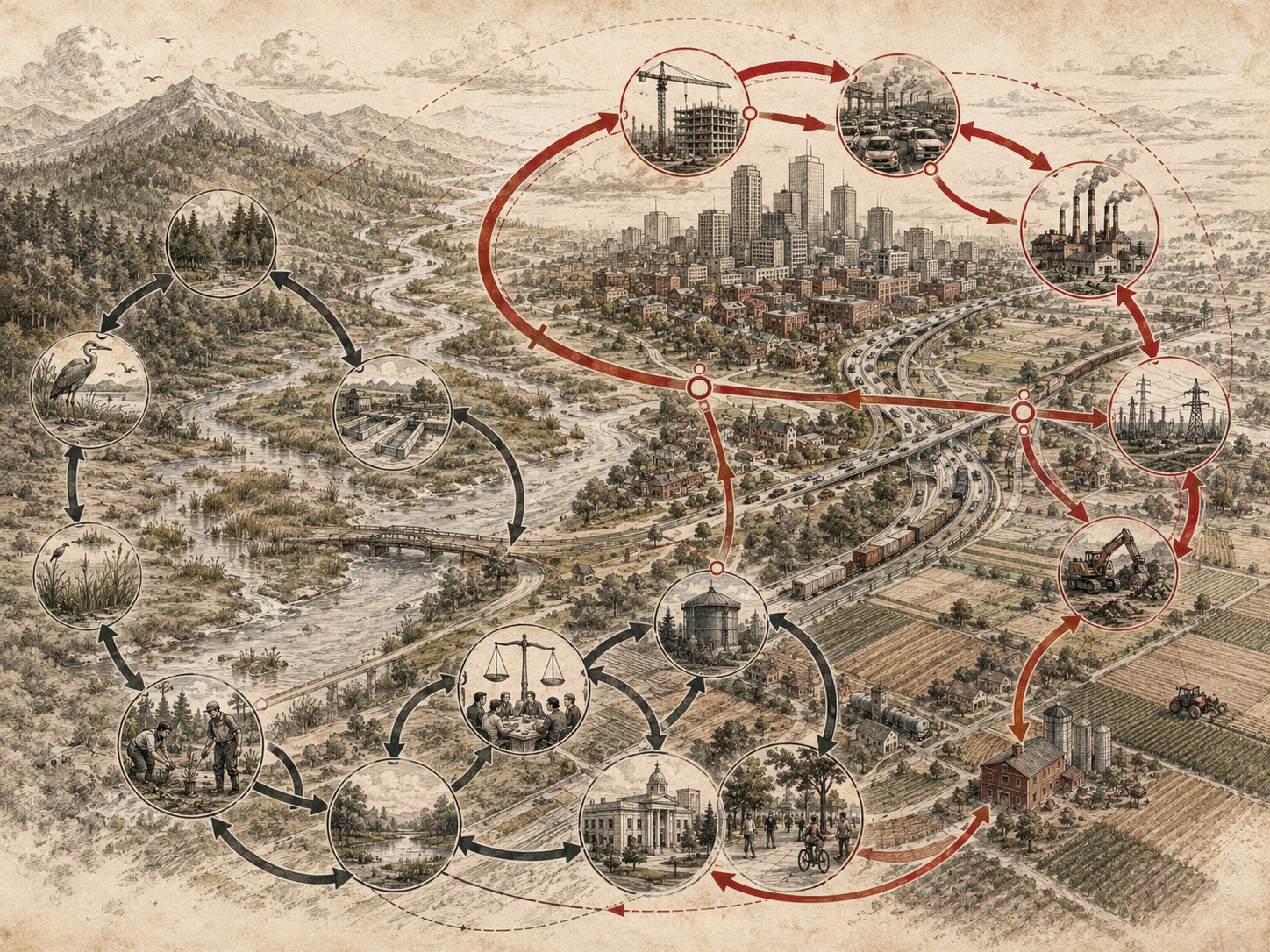
This article examines reinforcing and balancing dynamics as foundational patterns in systems thinking. It explains how reinforcing loops produce compounding growth or decline, how balancing loops regulate behavior around goals and constraints, and how the interaction between the two can produce resilience, instability, lock-in, overshoot, resistance, or transformation. The article also shows why these dynamics are ethically important: systems do not simply behave; they amplify some values, suppress others, distribute burdens, reward certain actions, and make particular futures easier or harder to reach.
Why Reinforcing and Balancing Dynamics Matter
Systems do not only contain parts and relationships. They generate behavior. Reinforcing and balancing dynamics describe two basic ways that systems behave through feedback. Reinforcing dynamics amplify change. Balancing dynamics counteract change. Most real systems contain both, often operating at different speeds, scales, and levels of visibility.
These dynamics matter because they explain why system behavior often differs from what people expect. A small advantage can become large through reinforcement. A small neglect can accumulate into crisis. A policy reform can be absorbed by balancing resistance. A system can appear stable until reinforcing decline overwhelms its buffers. A successful program can grow until it encounters a limit. A harmful pattern can persist because balancing loops keep returning the system to an unjust equilibrium.
Reinforcing and balancing dynamics help answer practical systems questions:
- Why does this pattern keep intensifying?
- Why does this problem return after each attempted fix?
- Why does early success create later strain?
- Why does the system resist change even when many people want improvement?
- Why does growth eventually slow, reverse, or collapse?
- Why do some groups accumulate advantage while others accumulate disadvantage?
- Why does a policy produce temporary relief without durable transformation?
The distinction is foundational because it connects feedback-loop diagrams to behavior over time. A diagram is useful only when it explains a pattern. Reinforcing and balancing dynamics give the analyst a way to interpret that pattern: is the system amplifying change, counteracting change, or doing both at once?
| Dynamic | Basic behavior | Common patterns | Core question |
|---|---|---|---|
| Reinforcing | Amplifies change in the same direction. | Growth, decline, escalation, compounding advantage, collapse, contagion. | What is being amplified, and what will eventually constrain it? |
| Balancing | Counteracts change and seeks a goal, limit, norm, or equilibrium. | Stabilization, regulation, correction, resistance, goal seeking, oscillation. | What goal or condition is the system trying to maintain? |
These dynamics are not abstract. They shape public trust, organizational capacity, infrastructure maintenance, ecological resilience, climate feedbacks, platform behavior, institutional legitimacy, economic inequality, learning, burnout, debt, cooperation, conflict, and governance. When systems thinking becomes practical, it often begins by identifying which reinforcing and balancing loops are producing the behavior that matters.
Reinforcing Dynamics: Amplification, Growth, and Decline
A reinforcing dynamic occurs when change feeds on itself. An increase leads to more increase. A decrease leads to more decrease. Reinforcing loops create momentum. Once operating, they can continue even after the original trigger fades because the loop itself becomes a source of future behavior.
Reinforcing dynamics are often associated with growth. A person practices a skill, improves, gains confidence, practices more, and improves further. A platform gains users, becomes more valuable, attracts more users, and becomes more valuable still. A public institution performs well, earns trust, receives cooperation, improves performance, and builds more trust. These are reinforcing loops that can produce beneficial compounding.
But reinforcing dynamics also produce deterioration. An organization loses experienced staff, remaining workers become overloaded, quality declines, morale falls, more staff leave, and overload deepens. A community loses investment, services decline, residents with options leave, tax capacity weakens, and disinvestment continues. An ecosystem loses biodiversity, resilience declines, disturbances become more damaging, and biodiversity declines further. A reinforcing loop can generate collapse as easily as growth.
x_{t+1} = x_t + r x_t
\]
Interpretation: A simple reinforcing dynamic adds a proportion \(r\) of the current state \(x_t\). The larger the current state becomes, the larger the next increase can be.
Reinforcing dynamics often appear in systems where current state affects future capacity. The more knowledge a person has, the easier it may be to learn related knowledge. The more trust an institution has, the easier it may be to secure cooperation. The more wealth a household has, the easier it may be to access education, housing, healthcare, capital, and political influence. The more damage an ecosystem has absorbed, the harder regeneration may become.
Reinforcing loops also create lock-in. Early patterns become harder to reverse because each cycle strengthens the conditions that produce the next cycle. This can happen in technologies, institutions, markets, land-use systems, organizational cultures, and social expectations. Once a standard, platform, norm, or infrastructure becomes dominant, alternatives may become less viable even if they are better in some respects.
For systems analysis, the important questions are:
- What is growing or declining?
- What feedback causes the growth or decline to continue?
- What resource, capacity, belief, incentive, or condition is being reinforced?
- What limits might eventually slow or reverse the process?
- Who benefits from the reinforcement?
- Who is harmed or excluded as the loop compounds?
Reinforcing dynamics explain why small beginnings can become large consequences. They also warn that harmful systems rarely remain static. If a destructive loop is left intact, the future may not merely repeat the present. It may amplify it.
Balancing Dynamics: Correction, Stability, and Constraint
A balancing dynamic counteracts change. It pushes the system toward a goal, limit, norm, target, or reference condition. Balancing loops are the feedback structures of correction and regulation. They can stabilize temperature, maintain inventory, control spending, regulate risk, restore equilibrium, or resist unwanted movement away from a desired state.
A thermostat is the familiar example. If temperature falls below a target, heat turns on. As temperature approaches the target, heating slows or stops. The loop reduces the gap between the actual condition and the desired condition. Similar structures appear in homeostasis, budgeting, traffic control, inventory management, hiring, regulation, resource allocation, and institutional oversight.
Balancing dynamics are often necessary. Without balancing feedback, systems can overshoot, collapse, deplete resources, ignore risk, or accelerate beyond capacity. A healthy organization needs balancing loops that detect workload strain and adjust priorities. A sustainable water system needs balancing loops that align use with replenishment. A democratic institution needs balancing loops that detect abuse, correct error, and remain accountable to the public.
x_{t+1} = x_t + k(G – x_t)
\]
Interpretation: A balancing dynamic adjusts the current state \(x_t\) toward a goal \(G\). The parameter \(k\) represents the strength or speed of correction.
Yet balancing dynamics are not automatically desirable. They stabilize whatever goal or reference condition the system is organized around. If that reference condition is unjust, harmful, or outdated, the balancing loop may preserve harm. A bureaucracy may return to delay after each reform. A workplace may normalize overwork after each wellness initiative. A political system may absorb protest without changing policy. A market may correct toward profit while ignoring ecological damage. A school discipline system may restore order by excluding students rather than addressing belonging, support, and learning conditions.
Balancing dynamics therefore require goal analysis. The analyst must ask what the system is trying to maintain, who set that goal, and whether the goal is legitimate. A system may say it is trying to maintain quality, but its balancing loop may actually maintain budget control. It may say it is trying to maintain safety, but its feedback may maintain institutional reputation. It may say it is trying to maintain fairness, but its rules may preserve unequal access.
Systems thinking asks:
- What variable is being regulated?
- What goal, threshold, or norm is guiding correction?
- Who defined the goal?
- How does the system detect deviation?
- How quickly and accurately does the system respond?
- Does the loop create healthy stability or harmful resistance?
- What happens when the goal itself needs to change?
Balancing dynamics are the system’s way of saying, “not too far from here.” The ethical question is whether “here” is where the system should remain.
Why Reinforcing and Balancing Do Not Mean Good and Bad
One of the most common misunderstandings in systems thinking is to treat reinforcing feedback as good and balancing feedback as bad, or to treat positive links as desirable and negative links as harmful. This is incorrect. In feedback analysis, positive and negative are causal terms, not moral terms. Reinforcing and balancing describe structure, not value.
A reinforcing loop can build public trust, learning, recovery, and ecological regeneration. It can also amplify inequality, misinformation, debt, conflict, burnout, and collapse. A balancing loop can stabilize health, safety, justice, accountability, and resource use. It can also preserve inequality, suppress dissent, protect bureaucratic inertia, or normalize low expectations.
The moral evaluation depends on what the loop does, whom it affects, what it reinforces or stabilizes, and what consequences it produces over time.
| Loop type | Potentially beneficial behavior | Potentially harmful behavior |
|---|---|---|
| Reinforcing | Learning, trust, capacity building, ecological regeneration, recovery, cooperation. | Collapse, contagion, escalation, inequality, distrust, debt spirals, burnout. |
| Balancing | Stability, safety, accountability, regulation, adaptation, resource stewardship. | Stagnation, repression, resistance to reform, normalization of harm, unjust equilibrium. |
This distinction matters because systems diagrams can create false confidence. A loop labeled reinforcing may look exciting because it suggests growth. But growth can destroy a system if it ignores limits. A loop labeled balancing may look conservative because it resists change. But correction may be essential for survival, safety, and resilience. Conversely, resistance may block necessary transformation.
A systems thinker should therefore avoid moral shortcuts. The correct questions are:
- What is the loop amplifying or stabilizing?
- Is that behavior desirable, harmful, or mixed?
- For whom is it beneficial?
- For whom is it costly?
- What time horizon is being used?
- What hidden costs or delayed effects are excluded?
- Does the loop build long-term capacity or consume it?
Reinforcing and balancing dynamics are not ethical categories. They are causal structures. Ethical analysis begins when the analyst asks what those structures do in the world.
How Reinforcing and Balancing Loops Interact
Real systems rarely contain only one loop. They contain multiple reinforcing and balancing loops operating simultaneously. System behavior emerges from their interaction. A system may grow because reinforcing loops dominate early, then slow because balancing loops become stronger. It may stabilize until a reinforcing deterioration loop overwhelms its buffers. It may oscillate when balancing correction is delayed. It may resist reform because balancing loops counteract attempted change.
Consider organizational growth. Early success can create a reinforcing loop: better performance attracts more clients, revenue, talent, and reputation, which improve performance further. But growth also increases coordination demands, workload, hiring complexity, cultural strain, and process burden. These balancing constraints eventually slow growth. If the organization invests in capacity, learning, documentation, and governance, growth may stabilize. If it ignores constraints, reinforcing overload may produce decline.
Consider public trust. Good institutional performance can reinforce trust. Trust can increase cooperation, improving performance further. But if demand grows faster than capacity, delays can increase. Delays can erode trust. Lower trust can reduce cooperation, increasing strain and weakening performance. The system may shift from a reinforcing trust loop to a reinforcing distrust loop.
Systems behavior often changes when loop dominance changes. A reinforcing loop may dominate during early growth. A balancing loop may dominate when limits are reached. A harmful reinforcing loop may dominate during decline. A reform may succeed only if it changes which loop is dominant.
\Delta x_t = R(x_t) – B(x_t)
\]
Interpretation: System change can be understood conceptually as the result of reinforcing pressures \(R(x_t)\) and balancing pressures \(B(x_t)\). The dominant pressure shapes the observed behavior.
Loop interaction explains why systems can behave differently at different times. A system may appear stable, then suddenly deteriorate. It may grow rapidly, then plateau. It may improve temporarily, then relapse. It may resist change until a threshold is crossed. These shifts often reflect changing loop dominance, delayed feedback, accumulated stocks, or constraints that become visible only after growth reaches a limit.
Systems thinking therefore asks:
- Which reinforcing loops are operating?
- Which balancing loops are operating?
- Which loops dominate now?
- Which loops may dominate later?
- What delays affect loop interaction?
- What stocks or accumulations strengthen one loop over another?
- What intervention could shift loop dominance toward healthier behavior?
A system’s behavior is rarely caused by one loop alone. It is produced by a changing field of feedback dynamics.
Limits to Growth
Limits to growth is one of the most important patterns produced by interaction between reinforcing and balancing dynamics. A reinforcing loop creates growth, but eventually a balancing loop begins to constrain that growth. The constraint may be physical, ecological, organizational, financial, social, political, cognitive, or institutional.
A program grows because success attracts attention, funding, and participation. Eventually, staff capacity, coordination, quality control, or infrastructure becomes strained. Growth slows or quality declines. A city grows through investment, population, and development. Eventually, housing costs, traffic, water limits, pollution, infrastructure strain, or ecological constraints become limiting factors. A platform grows through network effects. Eventually, moderation burden, trust erosion, user fatigue, regulatory pressure, or governance failures may constrain growth.
The systems lesson is that growth is not self-explanatory and not indefinitely sustainable. Reinforcing growth must eventually meet a limit unless the system expands capacity, redesigns relationships, changes goals, or transforms its resource base. Ignoring limits often produces overshoot: growth continues beyond the system’s capacity to sustain it.
x_{t+1} = x_t + r x_t\left(1 – \frac{x_t}{K}\right)
\]
Interpretation: A simple limited-growth model shows reinforcing growth slowing as the system approaches a carrying capacity or constraint \(K\).
Limits to growth is not only an ecological idea, although ecology makes the pattern visible. Organizations, institutions, technologies, and economies also face limits. They may be limited by trust, legitimacy, skill, maintenance, attention, governance capacity, coordination, energy, water, materials, biodiversity, social tolerance, or public accountability.
When a system approaches a limit, there are several possible responses:
- deny the limit and continue growth until overshoot occurs;
- shift burden elsewhere so growth appears sustainable inside a narrow boundary;
- increase capacity in the constraining part of the system;
- change the growth goal itself;
- redesign relationships so the system no longer depends on destructive expansion;
- develop balancing feedback that keeps activity within sustainable bounds.
The ethical question is not only whether a system can grow. It is what the system consumes in order to grow, who bears the constraint, and whether the growth strengthens or weakens the conditions that sustain life, trust, dignity, and resilience.
Success to the Successful
Success to the successful is a reinforcing dynamic in which early advantage attracts more resources, which produces more advantage. This pattern appears in education, wealth, technology platforms, research funding, organizational politics, infrastructure investment, neighborhood development, and institutional legitimacy.
The structure is simple. Actor A gains an early advantage. That advantage produces better performance, visibility, confidence, access, or credibility. The system rewards that performance with more resources. More resources improve future performance. The loop repeats. Meanwhile, actors without early advantage receive fewer resources, making it harder for them to compete or recover.
This dynamic helps explain cumulative inequality. A school with more resources can provide better programs, attract more support, and build stronger outcomes, which justify further investment. A researcher with early grants can produce more publications, which improve future grant prospects. A platform with more users attracts more developers, advertisers, and users. A wealthy household can access better housing, education, healthcare, networks, and capital, which increase future wealth.
A_{t+1} = A_t + rA_t + I_t
\]
Interpretation: Advantage \(A\) can grow through its own reinforcing returns \(rA_t\) and additional investment \(I_t\). When investment follows existing advantage, inequality can compound.
Success to the successful is not always unjust. Expertise can produce trust. Trust can produce opportunity. Opportunity can produce more expertise. In some settings, rewarding demonstrated capability is reasonable. The problem arises when initial advantage reflects unequal starting conditions, when resource allocation ignores need, when the loop locks out capable but under-resourced actors, or when the system mistakes accumulated advantage for inherent merit.
Systems thinking asks:
- What resources follow success?
- How is success measured?
- Did initial success reflect ability, luck, inherited advantage, or unequal access?
- Does the system provide balancing support for those without early advantage?
- Does the loop strengthen the whole system or concentrate capacity?
- What forms of talent, knowledge, care, or contribution are excluded by the success metric?
Success-to-the-successful dynamics are ethically important because they can make inequality appear natural. A system may claim that resources follow performance while ignoring how performance itself was shaped by earlier resource distribution. Systems thinking exposes the feedback structure behind apparent merit.
Erosion, Collapse, and Compounding Disadvantage
Reinforcing dynamics can also produce erosion and collapse. In these loops, decline weakens the capacity to prevent further decline. The system becomes less able to recover precisely because it is deteriorating.
Public trust offers a clear example. If an institution performs poorly, trust declines. Lower trust reduces cooperation, compliance, patience, and legitimacy. Reduced cooperation can make institutional performance harder, which further lowers trust. A decline in trust can become self-reinforcing.
Organizational capacity can erode in the same way. Understaffing increases workload. Higher workload increases stress and error. Stress and error increase turnover. Turnover reduces capacity. Reduced capacity increases workload. The system spirals downward. A simple solution like asking remaining workers to work harder may intensify the loop.
Infrastructure systems can also erode through feedback. Deferred maintenance increases failure. Failure consumes emergency funds. Emergency spending reduces preventive maintenance. Reduced preventive maintenance increases deferred maintenance. The system becomes more expensive and fragile over time.
C_{t+1} = C_t – dC_t
\]
Interpretation: A simple reinforcing decline process reduces capacity \(C\) by a proportion \(d\). As capacity falls, the system may become less able to prevent further loss.
Compounding disadvantage is especially important in social systems. A household facing low income, poor housing, limited healthcare, weak transportation, unsafe work, debt, and environmental exposure may experience multiple reinforcing disadvantages at once. Each disadvantage can intensify the others. Poor health can reduce income. Low income can limit housing options. Poor housing can worsen health. Transportation barriers can reduce employment access. Debt can increase stress. Stress can worsen health. The system of disadvantage is not a list of problems; it is a network of reinforcing loops.
Collapse dynamics often become visible late. A system can absorb stress for a long time, then deteriorate rapidly once capacity, trust, ecological resilience, or financial reserves fall below a threshold. The final event may appear sudden, but the reinforcing decline may have been operating for years.
Systems thinking asks:
- What capacity is eroding?
- What feedback causes erosion to accelerate?
- What buffers are being depleted?
- What early signals were ignored?
- What short-term fixes are worsening the decline?
- What would interrupt the reinforcing deterioration?
Reinforcing decline is one reason prevention is morally and practically important. Waiting until collapse is visible often means waiting until the system has lost the very capacity needed for repair.
Stabilization, Regulation, and Resistance to Change
Balancing dynamics stabilize systems by counteracting deviation. They keep conditions within bounds, maintain goals, enforce norms, and preserve reference states. This can be essential for safety and resilience. But stabilization can also become resistance to needed change.
Stabilizing loops are common in governance. A regulatory agency monitors risk and intervenes when risk rises. A budget office constrains spending. A court system enforces procedural rules. A safety system shuts down dangerous operations. A public-health system detects outbreak signals and responds. These balancing loops protect the system from extremes.
But institutions also contain balancing loops that protect existing power. A reform proposal may trigger procedural delay. Public criticism may trigger reputational defense. Worker complaints may trigger symbolic wellness programming rather than workload change. Community demands may trigger consultation without authority. Data showing harm may be reclassified, questioned, or buried. The system returns to its prior state.
Resistance to change often appears when balancing loops are organized around institutional self-protection. The system’s implicit goal may not be justice, learning, or repair. It may be stability, reputation, budget control, legal defensibility, authority preservation, or political survival.
\text{Correction} = k(\text{Reference State} – \text{Current State})
\]
Interpretation: A balancing loop corrects deviation from a reference state. The key systems question is whether the reference state is legitimate, equitable, and sustainable.
This is why balancing dynamics require careful interpretation. A system that resists change may be protecting something valuable: safety, rights, ecological limits, procedural fairness, or institutional continuity. But it may also be protecting injustice, inefficiency, exclusion, or authority. The same structure—resistance to deviation—can be either necessary or harmful depending on the goal.
Systems thinking asks:
- What reference state is being protected?
- Is that reference state explicit or hidden?
- Who benefits from maintaining it?
- Who is harmed by maintaining it?
- Does the system learn from feedback or neutralize it?
- Does correction address root causes or suppress symptoms?
- What would it take to change the goal itself?
Balancing dynamics are often where systems reveal their deepest commitments. The question is not only what the system says it values, but what it corrects back toward when disturbed.
Leverage Points in Reinforcing and Balancing Dynamics
A leverage point is a place in a system where a change can produce significant effects. Reinforcing and balancing dynamics help identify leverage because they show what drives behavior over time. A low-leverage intervention treats symptoms. A higher-leverage intervention changes the loop that produces the symptoms.
In a reinforcing deterioration loop, leverage may involve interrupting the cycle early. In an organizational burnout loop, this might mean reducing workload, increasing staffing, clarifying priorities, improving documentation, or changing incentives that reward overload. In a public trust loop, leverage may involve improving service reliability, transparency, responsiveness, and accountability before distrust becomes self-reinforcing.
In a balancing loop, leverage may involve changing the goal, improving feedback accuracy, reducing delay, increasing response capacity, or changing who has authority to define the reference condition. If a system stabilizes around harmful delay, merely asking people to work harder may not help. The loop’s goal, resources, information, and rules may need redesign.
| Dynamic problem | Low-leverage response | Higher-leverage response |
|---|---|---|
| Reinforcing decline | Emergency repair after each failure. | Interrupt the loop through capacity investment, prevention, and early feedback. |
| Reinforcing inequality | Reward already-successful actors more. | Redesign allocation rules, support under-resourced actors, and counter cumulative disadvantage. |
| Balancing resistance | Repeated reform announcements. | Change the goal, authority structure, measurement system, or accountability loop. |
| Delayed correction | React harder after damage appears. | Shorten feedback delays and improve early-warning indicators. |
| Limits to growth | Push growth harder. | Identify the real constraint and redesign around sustainable capacity. |
| Symptom relief dependency | Increase short-term fixes. | Strengthen the fundamental solution and reduce dependency on symptomatic relief. |
Leverage analysis should be ethically informed. A technically effective intervention may be unjust if it shifts burden to those with less power. A system may be stabilized by suppressing dissent rather than resolving harm. A reinforcing loop may be accelerated for profit while externalizing ecological and social costs. The best leverage points improve system behavior without hiding costs, silencing affected stakeholders, or consuming the resilience of vulnerable people and ecosystems.
Systems thinking therefore asks not only where the system can be changed, but whether the change strengthens the conditions for dignity, accountability, regeneration, and long-term resilience.
Ethics, Power, and Dynamic Feedback
Reinforcing and balancing dynamics have ethical consequences because they distribute opportunity, risk, recognition, correction, and burden. A system’s feedback structure determines what gets amplified, what gets constrained, what gets corrected, and what is allowed to continue.
Power shapes feedback. Some groups can send signals that systems respond to quickly. Others experience harm without effective feedback channels. Wealthy neighborhoods may receive faster infrastructure repair because complaints generate political response. Marginalized communities may face repeated exposure because their signals are discounted. Workers may report overload, but the organization may respond only when turnover threatens performance. Ecosystems may signal stress through biodiversity loss, soil degradation, water depletion, or climate instability, but economic systems may ignore those signals until damage becomes costly.
Reinforcing dynamics can produce cumulative advantage or cumulative harm. Balancing dynamics can protect rights or protect institutions from accountability. A feedback loop is therefore not only a causal structure. It is also a governance structure. It defines what the system learns from, what it ignores, and what it repeats.
Ethical feedback analysis asks:
- What does the system reinforce?
- What does it correct?
- What does it allow to accumulate?
- Whose feedback reaches decision-makers?
- Whose feedback is delayed, dismissed, or punished?
- Who benefits from current loop dominance?
- Who bears the cost of stabilization?
- Does the system build resilience or consume hidden reserves?
These questions matter because unjust systems often maintain themselves through feedback. A complaint system may absorb grievances without changing conditions. A performance metric may reward visible output while hiding exhaustion. A funding formula may direct resources toward those already advantaged. A platform may amplify profitable behavior while weakening public trust. A public policy may stabilize budgets by shifting unpaid labor onto families.
Systems thinking should make these dynamics visible. It should ask whether a system’s reinforcing loops are compounding justice or injustice, and whether its balancing loops are protecting life or protecting the status quo.
Examples Across Systems
Reinforcing and balancing dynamics appear across many systems. The examples below show how the same feedback concepts help explain behavior in public health, infrastructure, organizations, education, technology, climate, and economic systems.
Public health
Public health depends on trust, access, service quality, communication, and institutional legitimacy. A reinforcing trust loop can improve outcomes: reliable service builds trust, trust increases cooperation, cooperation improves health outcomes, and better outcomes reinforce trust. A reinforcing distrust loop can do the opposite: poor access erodes trust, distrust reduces cooperation, reduced cooperation worsens outcomes, and worse outcomes deepen distrust. Balancing loops are needed to detect outbreaks, correct misinformation, regulate risk, and allocate resources before harm escalates.
Infrastructure
Infrastructure systems depend on maintenance feedback. Preventive maintenance reduces failure risk, which reduces emergency repair costs and preserves capacity. But deferred maintenance can create reinforcing decline: backlog increases failures, failures consume emergency funds, emergency spending reduces preventive investment, and backlog grows. Balancing dynamics should stabilize infrastructure condition around safety and service goals, but political and budget cycles often delay correction.
Organizations
Organizations often contain reinforcing loops around culture and capacity. Trust improves communication, communication improves coordination, coordination improves performance, and performance strengthens trust. But fear can also reinforce silence. Silence hides problems. Hidden problems worsen outcomes. Worsening outcomes increase fear. Balancing loops can stabilize workload, quality, and priorities, but they can also protect existing authority and resist needed change.
Education
Learning can be reinforcing. Success increases confidence, confidence increases participation, participation improves learning, and learning increases success. But disengagement can also reinforce itself. Exclusion reduces belonging, reduced belonging weakens participation, weaker participation lowers achievement, and lower achievement increases exclusion. Balancing dynamics are needed to detect learning gaps and provide support, but punitive balancing loops may stabilize classroom order while deepening long-term harm.
Artificial intelligence systems
AI and platform systems often contain reinforcing data loops. Recommended content receives attention. Attention becomes data. Data shapes future recommendations. Future recommendations amplify similar content. This can reinforce relevance and learning, but it can also reinforce bias, polarization, misinformation, surveillance, or narrow behavioral patterns. Balancing loops require governance: auditing, contestability, human oversight, transparency, and correction when harm appears.
Climate and ecological systems
Climate systems include reinforcing physical feedbacks such as ice-albedo effects, permafrost thaw, forest loss, and carbon-cycle disruption. Ecological systems also contain balancing dynamics through predator-prey relationships, nutrient cycling, regeneration, and disturbance recovery. Human systems can weaken ecological balancing loops by degrading biodiversity, soils, forests, wetlands, and water systems. Once ecological buffers are depleted, reinforcing degradation may accelerate.
Economic systems
Economic systems contain reinforcing expectations. Optimism can increase investment, employment, income, demand, and further optimism. Pessimism can reduce investment, employment, income, demand, and deepen pessimism. Balancing loops include prices, interest rates, regulation, inventories, and public policy. But these balancing loops may be delayed, unequal, or politically constrained. Economic stability depends on how reinforcing expectations and balancing institutions interact.
Across these domains, system behavior is rarely produced by one cause alone. It emerges from feedback dynamics that amplify, constrain, delay, stabilize, and redirect change over time.
Mathematics, Computation, and Modeling
Reinforcing and balancing dynamics can be studied through causal-loop diagrams, behavior-over-time graphs, stock-flow models, recurrence equations, network models, simulations, and scenario analysis. Modeling helps make feedback assumptions explicit. It can show how small differences compound, how limits constrain growth, how delayed correction produces oscillation, and how interventions shift loop dominance.
A simple reinforcing dynamic can be represented as:
x_{t+1} = (1+r)x_t
\]
Interpretation: The system state \(x\) grows or declines by a proportional rate \(r\). Positive \(r\) produces growth, while negative \(r\) produces decline.
A simple balancing dynamic can be represented as:
x_{t+1} = x_t + k(G – x_t)
\]
Interpretation: The system adjusts toward a goal \(G\). The parameter \(k\) represents correction strength.
A limited-growth system can be represented as:
x_{t+1} = x_t + r x_t\left(1 – \frac{x_t}{K}\right)
\]
Interpretation: Reinforcing growth slows as the system approaches a limit or carrying capacity \(K\).
A delayed balancing loop can be represented as:
x_{t+1} = x_t + k(G – x_{t-d})
\]
Interpretation: The system corrects based on a delayed observation \(x_{t-d}\). Delay can produce oscillation, overshoot, and instability.
Modeling can support several tasks:
| Modeling task | Systems question | Example use |
|---|---|---|
| Reinforcing-loop simulation | How quickly does growth or decline compound? | Modeling trust, debt, skill, platform adoption, backlog, or ecological degradation. |
| Balancing-loop simulation | How does the system correct toward a goal? | Modeling inventory, workload, response delay, resource allocation, or regulation. |
| Loop dominance analysis | Which loop controls behavior under different conditions? | Testing growth followed by constraint, decline after capacity loss, or reform resistance. |
| Delay analysis | How does delayed feedback affect stability? | Studying oscillation in hiring, maintenance, inventory, water use, or policy response. |
| Scenario comparison | Which intervention changes the loop structure? | Comparing symptom relief, capacity investment, rule change, goal redesign, or feedback improvement. |
| Sensitivity analysis | Which parameters most affect system behavior? | Testing growth rates, correction strength, carrying capacity, delay length, and thresholds. |
Models are useful because reinforcing and balancing dynamics can be counterintuitive. A system may decline even while people work harder. Growth may weaken the conditions that support growth. A correction may destabilize the system if delayed. A reform may fail because balancing loops return the system to its old state. Modeling makes these patterns visible and testable.
But models should be interpreted with humility. A model depends on boundaries, variables, parameters, assumptions, evidence, and values. It may show the logic of a loop while excluding lived experience, power, history, ecology, or institutional constraint. The purpose of modeling is not to replace judgment. It is to discipline it.
Python Workflow: Reinforcing, Balancing, Loop-Dominance, and Delay Diagnostics
The Python workflow below turns reinforcing and balancing dynamics into a small reproducible model. It compares four scenarios: a runaway reinforcing loop, delayed balancing correction, capacity before limits, and accountable adaptive balance. The script uses only the Python standard library, writes CSV outputs relative to the article folder, and is designed as a clear starting point for companion repository work.
# reinforcing_balancing_dynamics_workflow.py
# Dependency-light workflow for reinforcing dynamics, balancing dynamics,
# loop dominance, limits to growth, delay, oscillation, and policy resistance.
# Writes outputs relative to the article root.

from __future__ import annotations

from dataclasses import dataclass
from pathlib import Path
import csv
from statistics import mean

ARTICLE_ROOT = Path(__file__).resolve().parents[1]
TABLES = ARTICLE_ROOT / "outputs" / "tables"


@dataclass
class DynamicScenario:
    name: str
    reinforcing_pressure: float
    balancing_capacity: float
    delay_pressure: float
    carrying_capacity: float
    capacity_investment: float
    feedback_accuracy: float
    accountability: float
    stress_exposure: float


def clamp(value: float, low: float = 0.0, high: float = 120.0) -> float:
    return max(low, min(high, value))


def run_scenario(scenario: DynamicScenario, periods: int = 48) -> list[dict[str, object]]:
    system_stock = 34.0 + scenario.reinforcing_pressure * 18.0
    capacity_stock = 36.0 + scenario.capacity_investment * 22.0
    harm_stock = scenario.stress_exposure * 44.0
    loop_memory = scenario.feedback_accuracy * 38.0
    history: list[float] = [system_stock]
    rows: list[dict[str, object]] = []

    for period in range(periods + 1):
        delay_index = max(0, len(history) - 1 - int(round(scenario.delay_pressure * 8)))
        delayed_state = history[delay_index]

        carrying_limit = 45.0 + scenario.carrying_capacity * 65.0
        limit_pressure = clamp(max(0.0, delayed_state - carrying_limit) * 0.60, 0.0, 100.0)

        reinforcing_effect = clamp(
            scenario.reinforcing_pressure * system_stock * 0.12
            + loop_memory * 0.06
            + scenario.stress_exposure * 5.0
        )

        balancing_effect = clamp(
            scenario.balancing_capacity * 18.0
            + scenario.feedback_accuracy * 14.0
            + capacity_stock * 0.13
            + scenario.accountability * 10.0
            - scenario.delay_pressure * 6.0
            - limit_pressure * 0.06
        )

        loop_dominance = reinforcing_effect - balancing_effect

        overshoot_risk = clamp(
            limit_pressure
            + scenario.delay_pressure * 18.0
            + max(0.0, loop_dominance) * 0.28
            - scenario.feedback_accuracy * 5.0
        )

        harm_stock = clamp(
            harm_stock
            + overshoot_risk * 0.16
            + max(0.0, loop_dominance) * 0.12
            - scenario.accountability * 1.8
            - balancing_effect * 0.05,
            0.0,
            100.0
        )

        capacity_stock = clamp(
            capacity_stock
            + scenario.capacity_investment * 3.0
            + scenario.accountability * 1.4
            + balancing_effect * 0.05
            - harm_stock * 0.05
            - limit_pressure * 0.04,
            0.0,
            100.0
        )

        loop_memory = clamp(
            loop_memory
            + scenario.feedback_accuracy * 1.8
            + scenario.accountability * 1.5
            - scenario.delay_pressure * 0.8
            - overshoot_risk * 0.03,
            0.0,
            100.0
        )

        system_stock = clamp(
            system_stock
            + reinforcing_effect * 0.16
            - balancing_effect * 0.12
            - limit_pressure * 0.10
            - harm_stock * 0.035,
            0.0,
            120.0
        )

        dynamic_health_score = clamp(
            capacity_stock * 0.24
            + loop_memory * 0.18
            + balancing_effect * 0.20
            + scenario.accountability * 16.0
            - overshoot_risk * 0.18
            - harm_stock * 0.16
            - abs(loop_dominance) * 0.08,
            0.0,
            100.0
        )

        rows.append({
            "period": period,
            "scenario": scenario.name,
            "system_stock": round(system_stock, 3),
            "capacity_stock": round(capacity_stock, 3),
            "harm_stock": round(harm_stock, 3),
            "loop_memory": round(loop_memory, 3),
            "delayed_state": round(delayed_state, 3),
            "reinforcing_effect": round(reinforcing_effect, 3),
            "balancing_effect": round(balancing_effect, 3),
            "loop_dominance": round(loop_dominance, 3),
            "limit_pressure": round(limit_pressure, 3),
            "overshoot_risk": round(overshoot_risk, 3),
            "dynamic_health_score": round(dynamic_health_score, 3),
        })

        history.append(system_stock)

    return rows


def write_csv(path: Path, rows: list[dict[str, object]]) -> None:
    path.parent.mkdir(parents=True, exist_ok=True)
    if not rows:
        raise ValueError(f"No rows to write: {path}")
    with path.open("w", newline="", encoding="utf-8") as handle:
        writer = csv.DictWriter(handle, fieldnames=list(rows[0].keys()))
        writer.writeheader()
        writer.writerows(rows)


def summarize(rows: list[dict[str, object]]) -> list[dict[str, object]]:
    output: list[dict[str, object]] = []
    for scenario_name in sorted({row["scenario"] for row in rows}):
        subset = [row for row in rows if row["scenario"] == scenario_name]
        final = subset[-1]
        avg_overshoot = mean(float(row["overshoot_risk"]) for row in subset)
        avg_harm = mean(float(row["harm_stock"]) for row in subset)
        avg_health = mean(float(row["dynamic_health_score"]) for row in subset)

        if float(final["dynamic_health_score"]) >= 65 and float(final["harm_stock"]) <= 35:
            diagnostic = "balanced dynamic feedback with adaptive capacity"
        elif avg_overshoot >= 55:
            diagnostic = "overshoot risk dominates loop behavior"
        elif avg_harm >= 55:
            diagnostic = "reinforcing harm and capacity depletion remain high"
        elif avg_health >= 55:
            diagnostic = "partial dynamic health with remaining delay or limit risk"
        else:
            diagnostic = "weak feedback governance; loop dominance remains unstable"

        output.append({
            "scenario": scenario_name,
            "final_dynamic_health_score": final["dynamic_health_score"],
            "final_system_stock": final["system_stock"],
            "final_capacity_stock": final["capacity_stock"],
            "final_harm_stock": final["harm_stock"],
            "final_loop_dominance": final["loop_dominance"],
            "final_overshoot_risk": final["overshoot_risk"],
            "average_overshoot_risk": round(avg_overshoot, 3),
            "average_harm_stock": round(avg_harm, 3),
            "average_dynamic_health_score": round(avg_health, 3),
            "diagnostic": diagnostic,
        })

    return output


def main() -> None:
    scenarios = [
        DynamicScenario("Runaway reinforcing loop", 0.82, 0.26, 0.60, 0.36, 0.22, 0.30, 0.24, 0.72),
        DynamicScenario("Delayed balancing correction", 0.62, 0.66, 0.78, 0.54, 0.46, 0.54, 0.44, 0.56),
        DynamicScenario("Capacity before limits", 0.56, 0.72, 0.44, 0.72, 0.76, 0.68, 0.62, 0.42),
        DynamicScenario("Accountable adaptive balance", 0.48, 0.84, 0.28, 0.84, 0.84, 0.82, 0.80, 0.30),
    ]

    rows: list[dict[str, object]] = []
    for scenario in scenarios:
        rows.extend(run_scenario(scenario))

    write_csv(TABLES / "reinforcing_balancing_dynamics_timeseries.csv", rows)
    write_csv(TABLES / "reinforcing_balancing_dynamics_summary.csv", summarize(rows))

    print("Reinforcing and balancing dynamics workflow complete.")
    print(TABLES / "reinforcing_balancing_dynamics_timeseries.csv")


if __name__ == "__main__":
    main()
The workflow is intentionally simple enough to inspect. It shows how reinforcing pressure can amplify harm when balancing capacity is weak, how delayed correction can create overshoot risk, and how capacity investment, feedback accuracy, and accountability improve dynamic health. The model is synthetic and illustrative; it supports disciplined inquiry rather than replacing domain expertise, stakeholder evidence, or ethical judgment.
R Workflow: Dynamic Feedback Summary and Visualization
The R workflow reads the Python-generated time-series output, creates scenario summaries, and exports base R plots for system stock, capacity stock, harm stock, loop dominance, overshoot risk, and dynamic health. It uses only base R so it remains portable across simple local environments.
# reinforcing_balancing_dynamics_diagnostics.R
# Base R workflow for dynamic feedback summary and visualization.

args <- commandArgs(trailingOnly = FALSE)
file_arg <- grep("^--file=", args, value = TRUE)

if (length(file_arg) > 0) {
  script_path <- normalizePath(sub("^--file=", "", file_arg[1]), mustWork = TRUE)
  article_root <- normalizePath(file.path(dirname(script_path), ".."), mustWork = TRUE)
} else {
  article_root <- getwd()
}

setwd(article_root)

tables_dir <- file.path(article_root, "outputs", "tables")
figures_dir <- file.path(article_root, "outputs", "figures")

if (!dir.exists(tables_dir)) {
  dir.create(tables_dir, recursive = TRUE)
}

if (!dir.exists(figures_dir)) {
  dir.create(figures_dir, recursive = TRUE)
}

timeseries_path <- file.path(tables_dir, "reinforcing_balancing_dynamics_timeseries.csv")

if (!file.exists(timeseries_path)) {
  stop(paste("Missing", timeseries_path, "Run the Python workflow first."))
}

data <- read.csv(timeseries_path, stringsAsFactors = FALSE)

last_by_scenario <- do.call(
  rbind,
  lapply(split(data, data$scenario), function(df) df[nrow(df), ])
)

avg_overshoot <- aggregate(overshoot_risk ~ scenario, data = data, FUN = mean)
avg_harm <- aggregate(harm_stock ~ scenario, data = data, FUN = mean)
avg_health <- aggregate(dynamic_health_score ~ scenario, data = data, FUN = mean)

names(avg_overshoot)[2] <- "average_overshoot_risk"
names(avg_harm)[2] <- "average_harm_stock"
names(avg_health)[2] <- "average_dynamic_health_score"

final_fields <- last_by_scenario[, c(
  "scenario",
  "dynamic_health_score",
  "system_stock",
  "capacity_stock",
  "harm_stock",
  "loop_dominance",
  "overshoot_risk"
)]

names(final_fields) <- c(
  "scenario",
  "final_dynamic_health_score",
  "final_system_stock",
  "final_capacity_stock",
  "final_harm_stock",
  "final_loop_dominance",
  "final_overshoot_risk"
)

summary_table <- Reduce(
  function(x, y) merge(x, y, by = "scenario"),
  list(avg_overshoot, avg_harm, avg_health, final_fields)
)

summary_table$diagnostic <- ifelse(
  summary_table$final_dynamic_health_score >= 65 &
    summary_table$final_harm_stock <= 35,
  "balanced dynamic feedback with adaptive capacity",
  ifelse(
    summary_table$average_overshoot_risk >= 55,
    "overshoot risk dominates loop behavior",
    ifelse(
      summary_table$average_harm_stock >= 55,
      "reinforcing harm and capacity depletion remain high",
      ifelse(
        summary_table$average_dynamic_health_score >= 55,
        "partial dynamic health with remaining delay or limit risk",
        "weak feedback governance; loop dominance remains unstable"
      )
    )
  )
)

write.csv(
  summary_table,
  file.path(tables_dir, "reinforcing_balancing_dynamics_r_summary.csv"),
  row.names = FALSE
)

plot_metric <- function(metric, label, file_name) {
  png(file.path(figures_dir, file_name), width = 1200, height = 700)
  scenarios <- unique(data$scenario)
  plot(
    NA,
    xlim = range(data$period),
    ylim = range(data[[metric]], na.rm = TRUE),
    xlab = "Period",
    ylab = label,
    main = paste(label, "by Scenario")
  )
  for (scenario_name in scenarios) {
    subset_data <- data[data$scenario == scenario_name, ]
    lines(subset_data$period, subset_data[[metric]], lwd = 2)
  }
  legend("topleft", legend = scenarios, lwd = 2, cex = 0.8, bty = "n")
  grid()
  dev.off()
}

plot_metric("system_stock", "System stock", "system_stock_trajectories.png")
plot_metric("capacity_stock", "Capacity stock", "capacity_stock_trajectories.png")
plot_metric("harm_stock", "Harm stock", "harm_stock_trajectories.png")
plot_metric("loop_dominance", "Loop dominance", "loop_dominance_trajectories.png")
plot_metric("overshoot_risk", "Overshoot risk", "overshoot_risk_trajectories.png")
plot_metric("dynamic_health_score", "Dynamic health score", "dynamic_health_score_trajectories.png")

print(summary_table)
This workflow supports the article’s central methodological claim: reinforcing and balancing dynamics should be interpreted through loop dominance, delay, limits, capacity, and behavior over time. The R outputs help readers see when a system is amplifying harm, stabilizing correction, or approaching overshoot.
GitHub Repository
The companion repository for this article should help readers model reinforcing and balancing dynamics using synthetic data, causal-loop examples, limited-growth models, delay simulations, loop-dominance scenarios, and multi-language systems-analysis scaffolds.
Complete Code Repository
Companion repository for the article, including reinforcing-loop simulations, balancing-loop models, limited-growth examples, delayed correction, loop-dominance analysis, scenario comparisons, synthetic datasets, documentation notes, and multi-language scaffolds for systems analysis.
articles/reinforcing-and-balancing-dynamics/
├── python/
│   ├── reinforcing_balancing_dynamics_workflow.py
│   ├── reinforcing_loop_simulation.py
│   ├── balancing_loop_simulation.py
│   ├── limited_growth_model.py
│   ├── delayed_balancing_dynamics.py
│   ├── loop_dominance_analysis.py
│   ├── scenario_comparison.py
│   ├── validation_checks.py
│   └── run_all_reinforcing_balancing_workflows.py
├── r/
│   ├── reinforcing_balancing_dynamics_diagnostics.R
│   ├── reinforcing_balancing_plots.R
│   ├── limited_growth_visualization.R
│   ├── delay_oscillation_plots.R
│   ├── loop_dominance_tables.R
│   ├── scenario_comparison.R
│   └── run_all_reinforcing_balancing_workflows.R
├── julia/
│   ├── nonlinear_reinforcing_dynamics.jl
│   └── balancing_control_examples.jl
├── sql/
│   ├── schema_feedback_variables.sql
│   ├── schema_reinforcing_loops.sql
│   ├── schema_balancing_loops.sql
│   ├── schema_scenarios.sql
│   ├── schema_indicators.sql
│   └── schema_model_runs.sql
├── rust/
│   └── dynamics_diagnostics_cli.rs
├── go/
│   └── loop_dynamics_pathway_utility.go
├── cpp/
│   ├── efficient_loop_dynamics.cpp
│   └── reinforcing_balancing_simulation.cpp
├── fortran/
│   └── recurrence_dynamics_model.f90
├── c/
│   └── low_level_feedback_dynamics.c
├── docs/
│   ├── modeling_principles.md
│   ├── article_notes.md
│   ├── assumptions_and_limitations.md
│   └── responsible_use.md
├── data/
│   ├── synthetic_feedback_variables.csv
│   ├── synthetic_reinforcing_loops.csv
│   ├── synthetic_balancing_loops.csv
│   ├── synthetic_scenarios.csv
│   └── synthetic_indicators.csv
├── outputs/
│   ├── figures/
│   └── tables/
└── notebooks/
    ├── python_reinforcing_balancing_walkthrough.ipynb
    └── r_loop_dynamics_visualization_placeholder.ipynb
This repository structure supports the article’s central argument: reinforcing and balancing dynamics generate much of what systems do over time. The data/ folder separates variables, reinforcing loops, balancing loops, scenarios, and indicators. The python/ and r/ folders support simulations, visualizations, limited-growth models, delayed balancing behavior, and loop-dominance analysis. The julia/ folder supports nonlinear and control-oriented examples. The sql/ folder defines schemas for loop variables, loop structures, scenarios, indicators, and model runs. The lower-level language folders provide scaffolds for efficient diagnostics, recurrence modeling, and simulation.
A Practical Method for Analyzing Reinforcing and Balancing Dynamics
Reinforcing and balancing dynamics can be analyzed through a practical sequence of questions. The goal is to move from observed behavior to feedback structure and then to responsible intervention.
1. Identify the behavior over time
Start with a variable that changes: trust, demand, cost, backlog, workload, risk, capacity, emissions, legitimacy, debt, biodiversity, quality, or stress. Ask whether it is growing, declining, stabilizing, oscillating, overshooting, or recovering.
2. Look for amplification
Ask whether an increase produces further increase or whether a decline produces further decline. If so, a reinforcing dynamic may be operating. Identify what is being compounded.
3. Look for correction
Ask whether the system is trying to reduce a gap, maintain a target, enforce a norm, preserve a limit, or return to a reference state. If so, a balancing dynamic may be operating.
4. Name the variables clearly
Use variables that can increase or decrease. “Public trust,” “maintenance backlog,” “institutional capacity,” and “response delay” are more useful than vague terms such as “problems” or “performance.”
5. Map causal links and polarity
Identify whether each relationship moves in the same direction or the opposite direction. This helps determine whether the loop is reinforcing or balancing.
6. Identify loop dominance
Ask which loop controls behavior now and which loop may become dominant later. Growth, decline, stability, and collapse often reflect changes in loop dominance.
7. Identify delays
Mark where time separates cause and effect. Delays can produce overshoot, oscillation, and premature judgment.
8. Identify limits and constraints
Ask what might eventually slow or reverse reinforcing growth. Limits may include capacity, trust, resources, legitimacy, energy, water, labor, attention, or ecological conditions.
9. Evaluate the goal of balancing loops
Ask what reference state the system is trying to maintain. Determine whether the goal is legitimate, equitable, sustainable, and transparent.
10. Choose intervention points
Decide whether the intervention should weaken a harmful reinforcing loop, strengthen a beneficial one, redesign a balancing goal, reduce delay, improve feedback quality, increase capacity, or change the system’s structure.
This method helps prevent superficial intervention. Instead of asking only how to fix an event, it asks how to change the dynamics that produce the event repeatedly.
Common Pitfalls
Reinforcing and balancing dynamics are powerful concepts, but they can be misused. Several pitfalls are common.
- Assuming reinforcing means desirable: Reinforcing dynamics can produce learning and trust, but they can also produce collapse, inequality, debt, burnout, and escalation. The moral value depends on what is being reinforced.
- Assuming balancing means resistance to avoid: Balancing dynamics can resist change, but they also provide safety, accountability, correction, and ecological restraint. The question is what the loop stabilizes.
- Ignoring the goal of a balancing loop: A balancing loop always works toward some reference condition. If that condition is hidden, the analysis may miss the system’s real purpose.
- Ignoring limits to reinforcing growth: No real system grows without constraint. Ignoring limits can produce overshoot, depletion, and collapse.
- Confusing loop labels with explanation: Labeling a loop as reinforcing or balancing is not enough. The analyst must explain the mechanism, evidence, delay, boundary, and behavior over time.
- Missing loop interaction: Systems usually contain multiple loops. Focusing on one loop can hide constraints, compensating feedback, or future loop dominance.
- Using loops without evidence: A causal-loop diagram should be supported by data, observation, stakeholder knowledge, domain expertise, historical evidence, or plausible mechanism.
- Ignoring power and distribution: A loop may look efficient while shifting burden to less powerful actors. Feedback analysis should ask who benefits, who pays, and whose signals are ignored.
The strongest use of reinforcing and balancing dynamics is specific, behavior-focused, evidence-aware, and ethically alert. It explains not only what the system does, but why the pattern persists.
Why Dynamic Feedback Matters
Reinforcing and balancing dynamics matter because systems are not static arrangements. They are living patterns of amplification and correction. They build momentum, resist change, stabilize behavior, compound inequality, generate resilience, produce collapse, and shape what becomes easier or harder over time.
Understanding these dynamics changes how problems are interpreted. A recurring failure may not be a series of isolated mistakes. It may be a reinforcing deterioration loop. A reform that repeatedly fails may not be poorly communicated. It may be resisted by balancing loops that protect the existing structure. Growth that appears successful may be approaching limits. Stability that appears healthy may be preserving an unjust equilibrium.
Systems thinking therefore asks what loops are operating, what they amplify, what they constrain, what goals they serve, what delays they contain, and whose lives are shaped by their behavior. This is not only a technical exercise. Feedback dynamics are part of governance, ethics, sustainability, and institutional responsibility.
To understand a system, one must understand what it reinforces and what it balances against. Those dynamics reveal what the system is becoming, what it is protecting, and what would have to change for a different future to become possible.
Related Articles
- Causality in Systems Thinking
- Systems Thinking and Levels of Analysis
- Feedback Loops and System Behavior
- Delays, Oscillation, and Misperception
- Behavior Over Time and Structural Explanation
- Feedback Loop Polarity and Causal Signs
- Dynamic Complexity and Policy Resistance
- Stocks, Flows, and Accumulation
Further Reading
- Meadows, Donella H. Thinking in Systems: A Primer. Chelsea Green Publishing.
- Sterman, John D. Business Dynamics: Systems Thinking and Modeling for a Complex World. Irwin/McGraw-Hill.
- Senge, Peter M. The Fifth Discipline: The Art and Practice of the Learning Organization. Doubleday/Currency.
- Forrester, Jay W. Industrial Dynamics. MIT Press.
- Richardson, George P. Feedback Thought in Social Science and Systems Theory. University of Pennsylvania Press.
- Ashby, W. Ross. An Introduction to Cybernetics. Chapman & Hall.
- Wiener, Norbert. Cybernetics: Or Control and Communication in the Animal and the Machine. MIT Press.
References
- Ashby, W.R. (1956) An Introduction to Cybernetics. London: Chapman & Hall. Available at: https://archive.org/details/introductiontocy00ashb
- Forrester, J.W. (1961) Industrial Dynamics. Cambridge, MA: MIT Press.
- Meadows, D.H. (2008) Thinking in Systems: A Primer. White River Junction, VT: Chelsea Green Publishing. Available at: https://www.chelseagreen.com/product/thinking-in-systems/
- MIT OpenCourseWare (2013) Introduction to System Dynamics. Massachusetts Institute of Technology. Available at: https://ocw.mit.edu/courses/15-871-introduction-to-system-dynamics-fall-2013/
- Richardson, G.P. (1991) Feedback Thought in Social Science and Systems Theory. Philadelphia: University of Pennsylvania Press.
- Senge, P.M. (1990) The Fifth Discipline: The Art and Practice of the Learning Organization. New York: Doubleday/Currency.
- Sterman, J.D. (2000) Business Dynamics: Systems Thinking and Modeling for a Complex World. Boston: Irwin/McGraw-Hill.
- Wiener, N. (1948) Cybernetics: Or Control and Communication in the Animal and the Machine. Cambridge, MA: MIT Press.