
Last Updated May 30, 2026
Mathematics has repeatedly reimagined itself. It has been understood as calculation, measurement, geometry, proof, algebra, analysis, logic, structure, language, model, computation, and formal system. Each reimagining changed not only what mathematics studied, but what mathematicians believed mathematics was. Is mathematics about numbers? Is it about space? Is it about truth? Is it about symbols? Is it about structures? Is it about patterns? Is it about computation? Is it about the disciplined construction of possible worlds?
The modern understanding of mathematics cannot be reduced to any single answer. Mathematics is not only arithmetic, geometry, algebra, or calculus. It is a way of organizing relations under explicit assumptions. It builds worlds from axioms, studies structures through maps and transformations, formalizes reasoning, models physical and social systems, and increasingly interacts with computation, proof assistants, data systems, and artificial intelligence. Mathematics is both ancient and constantly being remade.
This article examines foundations, structure, and the reimagining of mathematics from the crisis of Euclidean certainty through non-Euclidean geometry, set theory, formal logic, the foundations debates, structuralism, category-level abstraction, computation, proof assistants, and contemporary mathematical practice. It argues that mathematics is best understood not as a fixed body of eternal formulas, but as an evolving architecture of disciplined imagination: a way of creating, testing, transforming, and interpreting formal structures that illuminate both the world and the limits of reason.
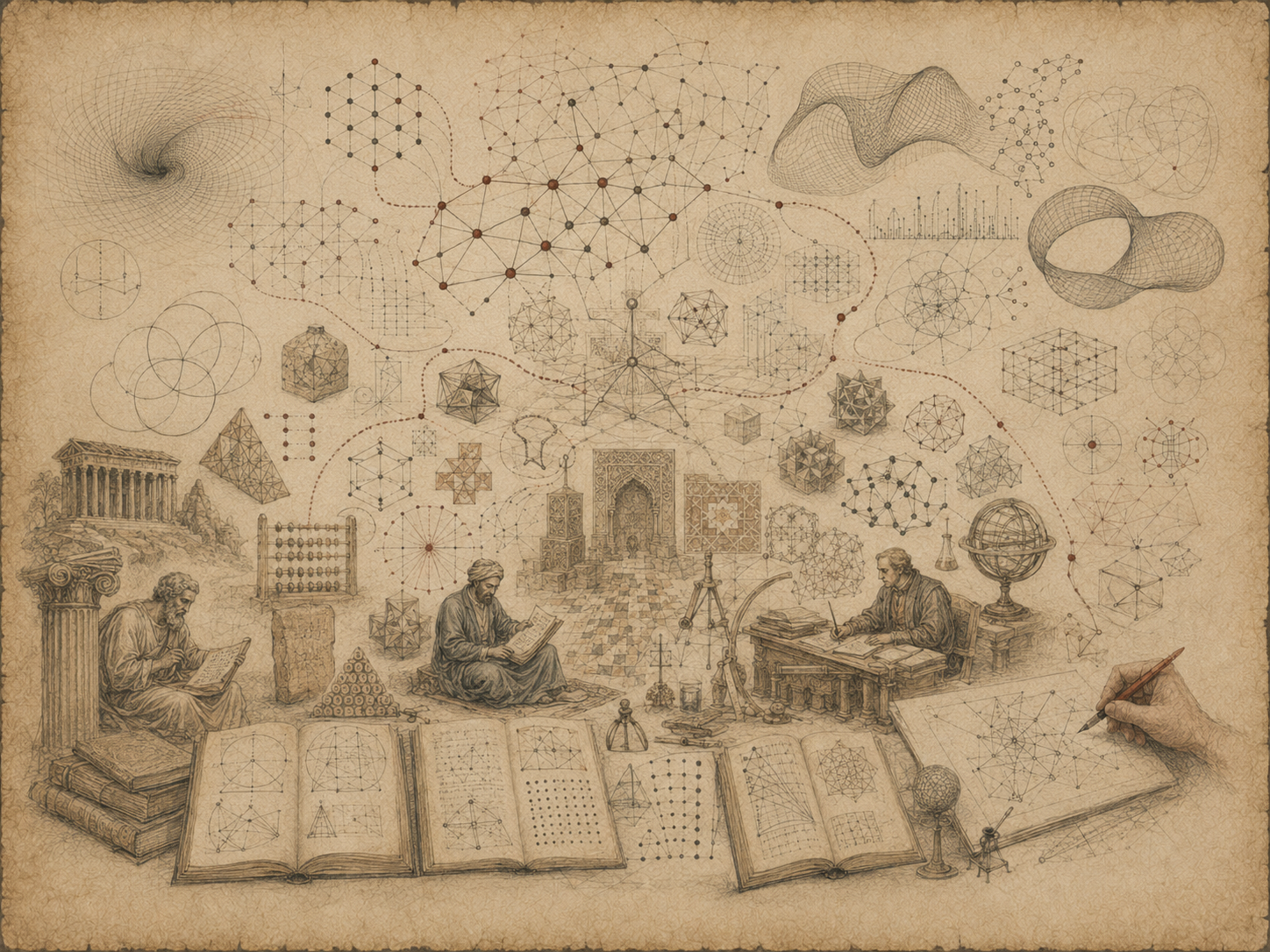
The Question of What Mathematics Is
Every major transformation in mathematics raises a deeper philosophical question: what is mathematics actually about? At first glance, the answer seems obvious. Mathematics is about numbers, shapes, formulas, equations, proofs, and calculations. But this answer becomes unstable as soon as mathematics moves beyond elementary examples.
A group may consist of rotations, permutations, matrices, integers under addition, or symmetries of an object. A topological space may describe a surface, a function space, a network, or an abstract collection of points with a notion of openness. A category may treat whole structures as objects and structure-preserving maps as the primary focus. A formal system may reason about strings of symbols without requiring an immediate physical interpretation. A computer proof may verify a theorem through a formal language unreadable to most humans without specialized training.
Mathematics is therefore not simply the study of one kind of object. It is the study of patterned relation under disciplined representation.
\text{mathematics}=\text{objects}+\text{relations}+\text{rules}+\text{transformations}+\text{interpretation}
\]
Interpretation: Mathematics studies objects through relations, rules, and transformations, but those objects may be numbers, shapes, functions, structures, programs, models, or formal symbols.
This is why foundations matter. Foundations ask what mathematics rests on. Are mathematical truths grounded in logic, set theory, construction, intuition, formal symbols, structures, categories, computation, or something else? But foundations alone are not enough. Modern mathematics is also structural: it studies how systems behave under operations, maps, invariants, equivalences, and transformations.
| View of Mathematics | Primary Object | Core Question |
|---|---|---|
| Arithmetic view | Numbers | How do quantities behave? |
| Geometric view | Space and shape | How are forms related? |
| Logical view | Statements and inference | What follows from what? |
| Set-theoretic view | Collections | How can mathematics be built from membership? |
| Structural view | Systems of relation | What laws define the structure? |
| Computational view | Procedures and formal artifacts | What can be computed, checked, or generated? |
The reimagining of mathematics begins when mathematics stops asking only “What is the answer?” and begins asking “What kind of world makes this question meaningful?”
The Classical Picture: Number, Space, and Proof
The classical picture of mathematics was shaped by arithmetic, geometry, and proof. Number made quantity abstract. Geometry made space intelligible. Proof made mathematical claims accountable. This picture reached one of its most influential forms in Greek deductive geometry, especially in the Euclidean tradition.
In the classical picture, mathematics appeared to describe necessary truths. A theorem about triangles or circles seemed not merely useful, but certain. The diagram helped intuition, while the proof showed why a statement must hold. The authority of mathematics rested on deductive demonstration from accepted starting points.
\text{definitions}+\text{axioms}+\text{deduction}\Rightarrow \text{theorem}
\]
Interpretation: Classical proof culture organizes mathematics as a sequence of claims derived from definitions, assumptions, and earlier results.
This classical picture remains powerful. Much of mathematical education still inherits it: define the object, state the theorem, prove the result. But the classical picture does not exhaust mathematics. It works well for many geometric and arithmetic contexts, yet modern mathematics eventually had to confront objects and structures that were not obvious from ordinary spatial intuition.
| Classical Element | Mathematical Role | Later Pressure Point |
|---|---|---|
| Number | Represents quantity and discrete relation | Negative, irrational, complex, infinite, and transfinite numbers expand the idea |
| Geometry | Represents space, shape, and construction | Non-Euclidean geometry challenges one-space intuition |
| Diagram | Makes spatial relation visible | Diagrams can mislead when cases become abstract |
| Proof | Establishes necessity under assumptions | Formal systems reveal limits and hidden assumptions |
| Axiom | Provides starting point | Axioms become structural assumptions, not only obvious truths |
The classical picture gave mathematics an ideal of certainty. Modern mathematics did not abandon that ideal, but it transformed it. Certainty became less about self-evident objects and more about explicit systems, formal assumptions, structural invariants, and carefully defined contexts.
The Foundational Crisis: When Certainty Became a Problem
The nineteenth and early twentieth centuries brought a series of shocks to mathematical certainty. Calculus had been extraordinarily successful, but its early foundations were unclear. Infinite series behaved in unexpected ways. Functions could be continuous but nowhere differentiable. Non-Euclidean geometry showed that alternative geometries were possible. Set theory opened the study of actual infinity, then produced paradoxes. Logic promised foundations, but formal systems revealed limits.
This was not a collapse of mathematics. It was a deepening. Mathematics had become powerful enough to expose the inadequacy of older assumptions. The crisis was not that mathematics failed, but that it had outgrown inherited pictures of what mathematical objects, proof, and certainty were supposed to be.
\text{success of method}\not\Rightarrow \text{clarity of foundation}
\]
Interpretation: Mathematics often advances through powerful methods before fully clarifying the foundations that justify them.
The foundational crisis forced mathematics to become self-conscious. What is a real number? What is a function? What is a set? What is a proof? What is an axiom? What counts as existence? Can every true statement be proved? Can a formal system guarantee its own consistency? Can mathematical reasoning be reduced to logic, symbols, construction, or computation?
| Foundational Pressure | Problem Raised | Mathematical Response |
|---|---|---|
| Calculus | What are infinitesimals, limits, and continuity? | Rigorous analysis and epsilon-delta definitions |
| Non-Euclidean geometry | Are Euclidean axioms necessary truths? | Axioms as structural assumptions |
| Set theory | Can any collection be treated as a set? | Axiomatic set theory |
| Paradoxes | Can unrestricted abstraction produce contradiction? | Restrictions on comprehension and formal foundations |
| Formal systems | Can mathematics prove its own consistency? | Metamathematics, incompleteness, proof theory |
Modern foundations emerged from this pressure. Mathematics became more abstract, more formal, more cautious, and more powerful at the same time.
Non-Euclidean Geometry and the Plurality of Mathematical Worlds
Non-Euclidean geometry changed mathematics by showing that Euclidean space was not the only coherent geometric possibility. For centuries, the parallel postulate had seemed less self-evident than Euclid’s other postulates. Many attempted to prove it from the rest. The discovery that consistent alternative geometries could be developed by modifying the parallel postulate transformed the meaning of axioms.
Axioms no longer appeared only as self-evident truths about the one real space. They became assumptions defining mathematical worlds. A geometry could be studied not because it matched ordinary intuition, but because it was internally coherent and mathematically fruitful.
\text{axiom system}_1 \Rightarrow \text{geometry}_1,\qquad
\text{axiom system}_2 \Rightarrow \text{geometry}_2
\]
Interpretation: Different axiom systems can define different mathematical worlds, each with its own theorems and internal logic.
This was one of the great reimaginings of mathematics. Mathematical truth became conditional: true within a system, derived from assumptions, judged by consistency, model, and structure. The question shifted from “Which geometry is self-evidently true?” to “What follows from these assumptions, and what structures do they define?”
| Geometric Shift | Older View | Reimagined View |
|---|---|---|
| Axioms | Self-evident truths about space | Explicit assumptions defining a system |
| Geometry | One necessary description of spatial reality | Multiple coherent mathematical structures |
| Proof | Demonstration of spatial necessity | Derivation within an axiom system |
| Intuition | Primary guide to truth | Useful but not final authority |
| Model | Representation of known space | Interpretation of formal assumptions |
Non-Euclidean geometry taught mathematics to imagine formal worlds beyond immediate intuition. That lesson became central to modern mathematics.
Set Theory and the Attempt to Rebuild Mathematics
Set theory offered a powerful foundational language. If mathematical objects could be understood as sets, then numbers, functions, relations, spaces, structures, and even more complex objects might be rebuilt from membership. The simple relation \(x\in A\) became a foundational tool.
Set theory made infinity into a mathematical object of systematic study. Cantor’s work showed that infinite sets could have different sizes. The natural numbers, real numbers, and other infinite collections could be compared through functions, bijections, and cardinalities. Infinity was no longer only a philosophical or theological idea; it became mathematically structured.
x\in A
\]
Interpretation: Set theory builds mathematical language around membership: an object belongs, or does not belong, to a collection.
But set theory also generated paradoxes when used too freely. Russell’s paradox showed that unrestricted set formation could lead to contradiction. If one considers the set of all sets that are not members of themselves, one asks whether that set is a member of itself. Either answer creates a contradiction. Such paradoxes forced mathematicians to axiomatize set theory carefully.
R=\{x\mid x\notin x\}
\]
Interpretation: Russell-style paradoxes show that unrestricted comprehension—forming a set from any condition—can produce contradiction.
| Set-Theoretic Concept | Mathematical Role | Foundational Issue |
|---|---|---|
| Membership | Basic relation between object and set | What objects and collections are allowed? |
| Function | Can be represented as a set of ordered pairs | Does representation capture mathematical meaning? |
| Infinity | Infinite collections become objects of study | How should infinite totalities be handled? |
| Comprehension | Forms sets by conditions | Unrestricted forms can create paradoxes |
| Axiomatization | Restricts set formation by explicit rules | Foundations depend on chosen axioms |
Set theory did not end foundational debate, but it gave modern mathematics a powerful common language. Much of contemporary mathematics can be expressed within set-theoretic foundations, even when mathematicians think structurally rather than set-theoretically in daily practice.
Logicism, Formalism, and Intuitionism
The foundations of mathematics were shaped by three major programs: logicism, formalism, and intuitionism. Each reimagined mathematics differently.
Logicism sought to reduce mathematics, especially arithmetic, to logic. If numbers and mathematical truths could be derived from purely logical principles, mathematics would be grounded in the laws of thought. Formalism treated mathematics as manipulation of symbols according to rules, emphasizing formal systems, consistency, and proof. Intuitionism rejected some classical assumptions, especially non-constructive existence proofs, and grounded mathematics in constructive mental activity.
\text{logicism}\neq \text{formalism}\neq \text{intuitionism}
\]
Interpretation: The major foundations programs disagreed about what mathematics is grounded in: logic, formal symbolic systems, or constructive mathematical activity.
These were not merely philosophical differences. They affected what counted as proof, existence, truth, and legitimate reasoning. Classical mathematics accepts proofs by contradiction that establish existence without constructing an example. Intuitionistic mathematics demands stronger constructive content. Formalism shifts attention toward systems, syntax, and consistency.
| Foundational Program | Basic Claim | Mathematical Emphasis |
|---|---|---|
| Logicism | Mathematics can be grounded in logic | Definitions, logical derivation, reduction of arithmetic |
| Formalism | Mathematics is formal manipulation within systems | Axioms, symbols, consistency, proof theory |
| Intuitionism | Mathematics is grounded in constructive mental activity | Construction, rejection of some non-constructive principles |
| Set-theoretic foundations | Mathematics can be developed within axiomatic set theory | Membership, collections, hierarchy, infinity |
| Structuralism | Mathematics studies positions in structures | Relations, invariants, isomorphism, abstraction |
The foundations debates matter because they show that mathematics is not philosophically simple. Even when mathematicians agree on many results, they may disagree about what those results mean, what objects they concern, and what kind of existence they establish.
Gödel and the Limits of Formal Foundations
Gödel’s incompleteness theorems transformed the foundations of mathematics. They showed that any sufficiently strong, consistent formal system capable of expressing arithmetic contains true statements that cannot be proved within that system. They also showed that such a system cannot, under the relevant assumptions, prove its own consistency using only its own resources.
This did not destroy mathematics. It clarified the limits of one dream: that mathematics could be completely captured by a single formal system that proves all truths and certifies its own consistency. Formal systems remain powerful, but they are not omnipotent.
\text{consistency}+\text{arithmetical strength}\Rightarrow \text{incompleteness}
\]
Interpretation: Gödel revealed that sufficiently expressive formal systems cannot be both consistent and complete in the strongest hoped-for sense.
Gödel forced a distinction between truth and provability. A statement may be true in the intended interpretation of arithmetic yet not derivable from a given formal system. This distinction reshaped mathematical logic, philosophy, computer science, and the understanding of formal proof.
| Concept | Meaning | Gödelian Pressure |
|---|---|---|
| Formal system | A language, axioms, and inference rules | Powerful but limited |
| Consistency | No contradiction can be derived | Cannot always be internally certified |
| Completeness | Every relevant truth is provable | Fails for sufficiently strong systems |
| Truth | Holds in an intended interpretation or model | Not identical to derivability |
| Provability | Derivable from axioms by formal rules | Depends on the chosen system |
The reimagining here is profound: mathematics can formalize reasoning, but formalization itself reveals boundaries. The foundations of mathematics are not a final basement floor beneath all thought. They are themselves mathematical terrain.
The Structural Turn in Modern Mathematics
Modern mathematics increasingly understands itself as the study of structure. Instead of asking only what numbers, shapes, or functions are individually, mathematics asks how objects relate, transform, compose, preserve, and correspond.
A group is not defined by what its elements physically are. It is defined by an operation satisfying laws. A vector space may consist of arrows, coordinate tuples, functions, signals, or data points. A topology studies continuity and nearness without requiring ordinary distance. A graph studies relational structure through nodes and edges. A formal system studies derivability through symbols and rules.
\text{structure}=(\text{objects},\text{relations},\text{operations},\text{laws})
\]
Interpretation: Structural mathematics studies objects by the relations, operations, and laws that organize them.
The structural turn allows mathematics to identify sameness beneath difference. Two systems may look unlike one another, but if they share the same structure, results may transfer. The concept of isomorphism captures this idea: two structures may be essentially the same from the perspective of their internal relations.
G\cong H
\]
Interpretation: An isomorphism states that two structures are the same in the relevant structural sense, even if their elements are represented differently.
| Structure | Objects | Key Relation or Operation |
|---|---|---|
| Group | Elements such as symmetries or transformations | Associative operation with identity and inverses |
| Vector space | Vectors, functions, signals, or data | Addition and scalar multiplication |
| Topological space | Points and open sets | Continuity, nearness, deformation |
| Graph | Vertices and edges | Adjacency, connectivity, paths |
| Formal system | Symbols, formulas, axioms, proofs | Inference and derivation |
The structural turn reimagines mathematics as a science of form. It studies not only particular mathematical objects, but the architectures that make many different objects behave alike.
Category-Level Abstraction and Mathematics as Transformation
Category theory pushed structural thinking even further. Rather than focusing primarily on objects and their internal elements, category theory emphasizes objects and morphisms: structure-preserving maps between objects. This makes transformation central.
In many areas of mathematics, the most important information is not only what an object is, but how it maps to other objects. Groups are studied through homomorphisms. Spaces are studied through continuous maps. Vector spaces are studied through linear transformations. Logical systems can be studied through translations. Data types can be studied through functions. Category theory provides a language for this emphasis on maps and composition.
A\xrightarrow{f}B\xrightarrow{g}C,\qquad g\circ f:A\to C
\]
Interpretation: Category-level thinking emphasizes transformations and their composition. The map is not secondary to the object; it is part of the structure.
This does not mean category theory replaces all other mathematics. It provides a high-level language for seeing patterns among structures. Its power lies in abstraction, but abstraction has costs. Without examples, category-level reasoning can become opaque. With examples, it reveals deep unity across algebra, topology, logic, computer science, and geometry.
| Category-Theoretic Idea | Plain Meaning | Why It Matters |
|---|---|---|
| Object | A structure being studied | May be a set, group, space, type, or system |
| Morphism | A structure-preserving map | Shows how structures relate |
| Composition | Chaining maps | Creates coherent transformation systems |
| Functor | A map between categories | Preserves relationships between structures |
| Natural transformation | A structured comparison between functors | Studies transformations between transformations |
Category-level abstraction reimagines mathematics as a study of relational architecture. It asks not only “What is this object?” but “How does it transform, and what is preserved across transformations?”
Models, Interpretation, and Mathematical Worlds
Modern mathematics often works through models. A model gives interpretation to a formal structure. The same equation, graph, probability distribution, or dynamical system can model different phenomena depending on how its symbols are interpreted. This is one reason mathematics is powerful across physics, economics, biology, computer science, engineering, climate science, and social systems.
But the power of modeling also creates risk. A model is not the world. A model selects, abstracts, simplifies, and formalizes. It can clarify structure, but it can also hide assumptions, exclude lived realities, and produce false authority when treated as complete.
\text{formal structure}+\text{interpretation}\Rightarrow \text{model}
\]
Interpretation: A model is not just mathematics. It is mathematics given meaning through interpretation, assumptions, and a target system.
The distinction between formal structure and interpretation is central to modern mathematical thinking. A graph may represent a social network, a road system, a supply chain, a neural architecture, or a dependency graph. The mathematics of nodes and edges may be the same, but the meaning of an edge changes completely across domains.
| Mathematical Form | Possible Interpretations | Key Risk |
|---|---|---|
| Graph | Friendship, roads, citations, dependencies, neural connections | Edges may not mean the same thing across domains |
| Differential equation | Motion, population, disease spread, chemical reaction | Model assumptions may omit critical variables |
| Probability distribution | Uncertainty, frequency, belief, risk, noise | Interpretation of probability may be unclear |
| Optimization problem | Efficiency, cost, welfare, loss, performance | The objective function may encode harmful priorities |
| Matrix | Linear transformation, dataset, adjacency, covariance | Rows, columns, and entries require interpretation |
Mathematics is reimagined through modeling when it becomes a bridge between formal worlds and lived worlds. But that bridge requires interpretation, responsibility, and humility.
Computation and the Reimagining of Mathematical Practice
Computation has changed what mathematics can do. Algorithms, simulations, symbolic computation, numerical methods, complexity theory, cryptography, data analysis, machine learning, and computer-assisted proof have all transformed mathematical practice. Mathematics is no longer only written, diagrammed, or proved by hand. It is executed.
Computation reimagines mathematics in at least four ways. First, it turns procedures into formal algorithms. Second, it allows large-scale experimentation. Third, it represents mathematical objects as data structures. Fourth, it makes proof and verification partly mechanizable.
\text{mathematical object}\longrightarrow \text{data structure}\longrightarrow \text{algorithmic transformation}
\]
Interpretation: Computational mathematics represents mathematical objects in forms that can be stored, transformed, tested, searched, and verified by machines.
Computer algebra systems manipulate symbolic expressions. Numerical solvers approximate solutions. Simulations explore dynamical systems. Proof assistants check formal derivations. Machine learning systems fit high-dimensional functions. Each expands mathematical practice, but each introduces new questions about reliability, interpretability, assumptions, and validation.
| Computational Form | Mathematical Power | Responsible Question |
|---|---|---|
| Algorithm | Executes a procedure | What is specified, and does the procedure satisfy it? |
| Simulation | Explores complex systems | What assumptions shape the model? |
| Computer algebra | Transforms symbolic expressions | Under what domain assumptions are transformations valid? |
| Numerical computation | Approximates solutions | How stable, accurate, and interpretable is the result? |
| Machine-checked proof | Verifies formal derivations | Does the formal statement capture the intended meaning? |
Computation does not replace mathematical thought. It changes the medium of mathematical thought. It makes mathematics executable, scalable, testable, and in some cases formally checkable. But interpretation remains human.
Proof Assistants and Machine-Checked Mathematics
Proof assistants represent one of the most significant contemporary reimaginings of mathematics. Systems such as Lean, Coq, Isabelle/HOL, HOL Light, and Agda allow mathematical definitions, theorems, and proofs to be encoded in formal languages and checked by computer.
This changes the status of proof. A traditional proof is written for human understanding and peer review. A formal proof is written in a language that a machine can check. The machine verifies that each step follows from the formal rules and available definitions. This can expose hidden assumptions, missing cases, and informal gaps.
\text{informal theorem}\rightarrow \text{formal statement}\rightarrow \text{checked proof}
\]
Interpretation: Proof assistants translate mathematical reasoning into formal artifacts that can be checked by a proof kernel.
Machine-checked mathematics does not eliminate creativity. It may actually require more precise creativity: choosing definitions, organizing libraries, decomposing proofs, finding formal paths, and connecting human intuition to machine-verifiable structure. The proof assistant does not decide what mathematics matters. It checks the formal consequences of what humans formulate.
| Layer | Human Role | Machine Role |
|---|---|---|
| Concept | Decide what idea matters | No independent mathematical intention |
| Definition | Formalize objects and assumptions | Check syntactic and type correctness |
| Theorem | State the claim precisely | Represent the proposition formally |
| Proof | Guide strategy and construction | Verify inference steps |
| Interpretation | Explain why the result matters | No social, scientific, or philosophical judgment |
The future of mathematics may involve a new partnership between human mathematical imagination and machine-checked formal discipline. But the central question remains old: what are we proving, under what assumptions, and why does it matter?
Mathematical Pluralism: One Mathematics or Many?
The reimagining of mathematics leads naturally to pluralism. There may be one mathematics in the sense that valid reasoning can be shared, checked, translated, and generalized across contexts. But there are many mathematical practices: classical proof, constructive proof, formal verification, computational experimentation, applied modeling, numerical approximation, statistical inference, category-level abstraction, and visual reasoning.
Mathematical pluralism does not mean anything goes. It means different mathematical contexts may require different standards, tools, and interpretations. A numerical simulation is not the same as a proof. A constructive proof is not the same as a non-constructive existence proof. A formal verification is not the same as a good model of the world. A beautiful abstraction is not automatically useful. A useful model is not automatically just.
\text{pluralism}\neq \text{relativism}
\]
Interpretation: Mathematical pluralism recognizes multiple legitimate practices while still requiring standards, assumptions, validation, and accountability.
| Mathematical Practice | Primary Standard | Common Misuse |
|---|---|---|
| Classical proof | Logical derivation under accepted assumptions | Treating proof as interpretation of real-world meaning |
| Constructive proof | Explicit construction or method | Assuming all classical results translate directly |
| Formal verification | Machine-checked derivation from formal specification | Confusing specification correctness with real-world adequacy |
| Simulation | Numerical exploration under model assumptions | Treating simulation output as proof |
| Applied modeling | Fit between formal structure and target system | Mistaking model elegance for truth |
Pluralism is a mature view of mathematics. It recognizes that mathematics has many modes while insisting that each mode must be honest about its assumptions, scope, and evidence.
How Foundations and Structure Change Mathematical Learning
Foundations and structure should change how mathematics is taught. Many students experience mathematics as a sequence of procedures detached from meaning. Others encounter proof as a rigid ritual. Others meet abstraction too early without examples, or too late after years of mechanical manipulation. A structural and historical approach can make mathematics more coherent.
Students should learn that mathematics develops by asking better questions about form. Why does this rule work? What structure makes this transformation valid? What assumptions are hidden? What changes when the domain changes? Is this an equation, an identity, a definition, a model, or an algorithm? What is preserved under transformation?
\text{learning mathematics}=\text{meaning}+\text{method}+\text{structure}+\text{justification}
\]
Interpretation: Mathematical learning deepens when procedures are connected to meaning, structure, and proof.
Foundational awareness also helps students understand why mathematics changes. Euclidean geometry is not “wrong” because non-Euclidean geometry exists. Classical proof is not “obsolete” because proof assistants exist. Algebraic notation is not “natural” simply because it is familiar. Each mathematical system works within assumptions, purposes, and representational choices.
| Teaching Focus | Traditional Risk | Structural Reframing |
|---|---|---|
| Procedures | Rules without meaning | Procedures as transformations under conditions |
| Proof | Formal ritual without intuition | Proof as accountable explanation |
| Notation | Symbols as decoration | Notation as cognitive infrastructure |
| Abstraction | Empty generality | Abstraction as preservation of structure |
| Applications | Formula plugging | Modeling as interpretation under assumptions |
Mathematics education becomes stronger when students see mathematics not as a wall of techniques, but as an evolving architecture of ideas.
A Mathematical Lens: Objects, Relations, Rules, Transformations
A useful lens for reimagining mathematics is the sequence: objects, relations, rules, transformations. Mathematical thinking begins by identifying objects. It then studies relations among them. It defines rules governing those relations. It examines transformations that preserve, reveal, or change structure.
\text{Objects}\rightarrow \text{Relations}\rightarrow \text{Rules}\rightarrow \text{Transformations}
\]
Interpretation: Modern mathematics often moves from objects to relations, from relations to rules, and from rules to structure-preserving transformations.
This lens works across many areas. In arithmetic, objects are numbers and operations relate them. In geometry, objects are points, lines, spaces, and transformations. In algebra, objects are elements inside structures governed by operations. In topology, objects are spaces and continuous maps. In logic, objects are statements and inference rules. In computation, objects are data structures and algorithms.
| Mathematical Area | Objects | Relations or Rules | Transformations |
|---|---|---|---|
| Arithmetic | Numbers | Operations and divisibility | Calculation and equivalence |
| Geometry | Points, lines, spaces | Incidence, distance, angle | Symmetry, projection, deformation |
| Algebra | Elements and structures | Operations and laws | Homomorphisms and isomorphisms |
| Topology | Spaces | Open sets and continuity | Continuous maps and deformation |
| Logic | Statements and formulas | Inference rules | Derivations and translations |
| Computation | Inputs, states, data structures | Algorithms and types | Execution, rewriting, verification |
This lens captures the deep continuity between ancient and modern mathematics. Mathematics has always studied relation. Modern mathematics has made that relational imagination explicit.
Computational Companion Examples
The companion repository for this article should extend the Mathematical Thinking codebase with examples focused on foundational systems, structural abstractions, model interpretation, formal systems, proof-style metadata, category-style transformation graphs, Haskell typed structures, SQL foundation schemas, and responsible abstraction audits. The examples below are compact article-level previews; the repository can expand them into richer professional workflows.
Python: Structural System Metadata
from dataclasses import dataclass
from collections import defaultdict

@dataclass(frozen=True)
class MathematicalStructure:
    name: str
    objects: str
    relations_or_operations: str
    preserved_by: str
    interpretation_note: str

structures = [
    MathematicalStructure(
        name="Group",
        objects="elements such as symmetries or transformations",
        relations_or_operations="one associative operation with identity and inverses",
        preserved_by="group homomorphism",
        interpretation_note="structure is defined by operation laws, not element appearance"
    ),
    MathematicalStructure(
        name="Vector space",
        objects="vectors, functions, signals, or data points",
        relations_or_operations="addition and scalar multiplication",
        preserved_by="linear map",
        interpretation_note="linear structure can appear in geometry, analysis, physics, and data"
    ),
    MathematicalStructure(
        name="Topological space",
        objects="points and open sets",
        relations_or_operations="openness, continuity, nearness",
        preserved_by="continuous map",
        interpretation_note="topology studies qualitative structure rather than exact measurement"
    ),
    MathematicalStructure(
        name="Formal system",
        objects="symbols, formulas, axioms, proofs",
        relations_or_operations="inference rules and derivability",
        preserved_by="formal translation or interpretation",
        interpretation_note="proof becomes an object of mathematical study"
    ),
]

by_preservation = defaultdict(list)
for item in structures:
    by_preservation[item.preserved_by].append(item.name)

for map_type, names in by_preservation.items():
    print(map_type, "=>", names)
R: Foundations and Structure Audit Table
foundation_views <- data.frame(
  view = c(
    "Set-theoretic",
    "Logical",
    "Formalistic",
    "Intuitionistic",
    "Structural",
    "Computational"
  ),
  primary_question = c(
    "Can mathematics be built from sets and membership?",
    "Can mathematics be grounded in logic?",
    "Can mathematics be secured through formal systems?",
    "What mathematics can be constructed?",
    "What structures and relations define mathematical objects?",
    "What can be computed, checked, simulated, or verified?"
  ),
  risk = c(
    "membership language may hide mathematical practice",
    "logic may not capture all mathematical meaning",
    "syntax may be mistaken for interpretation",
    "classical results may not transfer directly",
    "abstraction may detach from examples",
    "computation may be mistaken for proof or wisdom"
  )
)

print(foundation_views)
Haskell: Typed Structures and Foundation Views
{-# OPTIONS_GHC -Wall #-}

data FoundationView
  = SetTheoretic
  | Logical
  | Formalist
  | Intuitionist
  | Structural
  | Computational
  deriving (Eq, Show)

data Structure
  = Group
  | VectorSpace
  | TopologicalSpace
  | Graph
  | FormalSystem
  deriving (Eq, Show)

data PreservationMap
  = Homomorphism
  | LinearMap
  | ContinuousMap
  | GraphMorphism
  | FormalTranslation
  deriving (Eq, Show)

preserves :: Structure -> PreservationMap
preserves structure =
  case structure of
    Group -> Homomorphism
    VectorSpace -> LinearMap
    TopologicalSpace -> ContinuousMap
    Graph -> GraphMorphism
    FormalSystem -> FormalTranslation

main :: IO ()
main = do
  print SetTheoretic
  print Structural
  print (preserves Group)
  print (preserves TopologicalSpace)
SQL: Foundations and Structure Schema
CREATE TABLE foundation_view (
  view_id TEXT PRIMARY KEY,
  name TEXT NOT NULL,
  central_question TEXT NOT NULL,
  mathematical_strength TEXT NOT NULL,
  limitation_note TEXT NOT NULL
);

CREATE TABLE mathematical_structure (
  structure_id TEXT PRIMARY KEY,
  name TEXT NOT NULL,
  objects TEXT NOT NULL,
  relations_or_operations TEXT NOT NULL,
  preserved_by TEXT NOT NULL,
  interpretation_note TEXT NOT NULL
);

CREATE TABLE formal_system (
  system_id TEXT PRIMARY KEY,
  language TEXT NOT NULL,
  axioms TEXT NOT NULL,
  inference_rules TEXT NOT NULL,
  intended_use TEXT NOT NULL,
  limitation_note TEXT NOT NULL
);

CREATE TABLE abstraction_warning (
  warning_id TEXT PRIMARY KEY,
  topic TEXT NOT NULL,
  warning TEXT NOT NULL,
  mitigation TEXT NOT NULL
);
These examples treat foundations and structure as inspectable knowledge. Foundation views can be compared. Structures can be described by objects, operations, and preservation maps. Formal systems can be separated from interpretation. Warnings can document the risks of treating abstraction as neutral, complete, or socially detached.
GitHub Repository
The companion repository for this article is designed as a reproducible mathematical-thinking workspace focused on foundations, formal systems, structural abstraction, category-level transformation, model interpretation, proof-style metadata, typed structures, SQL foundation schemas, and responsible abstraction audits.
Complete Code Repository
Companion article folder with Python, R, Julia, SQL, Haskell, Rust, Go, C++, Fortran, and C examples for professional mathematical exploration of foundations, structures, formal systems, axioms, models, transformations, proof assistants, computation, structural abstraction, and responsible mathematical interpretation.
Foundations, Power, and Responsible Abstraction
Abstraction is one of mathematics’ greatest powers, but abstraction is not automatically innocent. To abstract is to select what matters and ignore what does not. In pure mathematics, that selection may be internal to a formal system. In applied mathematics, modeling, computation, data science, economics, governance, infrastructure, or artificial intelligence, abstraction can shape decisions that affect people, institutions, and environments.
Foundations and structure therefore have ethical consequences. A formal model may be logically coherent but socially inadequate. A metric may be mathematically precise but morally narrow. An optimization problem may be solved correctly while optimizing the wrong objective. A proof may establish a statement whose interpretation remains contested. A verified system may satisfy a specification that should never have been chosen.
\text{formal correctness}\neq \text{ethical adequacy}
\]
Interpretation: A mathematical result can be correct within a formal system while still requiring human judgment about meaning, use, and consequences.
| Abstraction Risk | Problem | Responsible Practice |
|---|---|---|
| Hidden assumptions | Formal clarity can conceal modeling choices | State assumptions, domains, and exclusions explicitly |
| Metric reduction | Complex values are reduced to measurable proxies | Audit what the metric omits |
| Optimization harm | A system optimizes the wrong objective | Interrogate objectives before solving |
| Formal overconfidence | Proof or verification is mistaken for full adequacy | Distinguish specification, proof, interpretation, and consequence |
| Access barriers | Abstraction excludes learners or marginalized communities | Teach examples, history, notation, and meaning alongside form |
Responsible abstraction does not weaken mathematics. It clarifies where mathematics is strongest and where interpretation, ethics, and institutional judgment remain necessary.
Why Reimagining Mathematics Matters
The reimagining of mathematics matters because mathematics now shapes modern technical life. It underlies physics, engineering, cryptography, finance, logistics, climate science, epidemiology, data systems, artificial intelligence, optimization, formal verification, and decision-making infrastructures. How mathematics understands itself affects how societies use mathematical authority.
If mathematics is understood only as calculation, then proof, structure, and interpretation disappear. If mathematics is understood only as formal proof, then modeling, computation, experimentation, and application may be undervalued. If mathematics is understood only as useful modeling, then the internal discipline of proof and abstraction may be weakened. If mathematics is understood only as computation, then formal meaning and human judgment may be displaced by output.
A mature view holds these dimensions together. Mathematics is calculation and proof, symbol and structure, model and abstraction, computation and interpretation. It creates formal worlds, but it also helps interpret real ones. It can produce certainty within assumptions, but it cannot remove the need to choose assumptions wisely.
Foundations ask what mathematics rests on. Structure asks what mathematics preserves. Reimagining asks what mathematics can become. Together, they show mathematics as one of humanity’s most profound intellectual practices: the disciplined creation of forms that make reason visible, portable, testable, transformable, and accountable.
Related Articles
- What Is Mathematical Thinking? Pattern, Proof, Architecture, and Reason
- The History of Mathematical Thinking from Antiquity to Modernity
- The Historical Development of Proof
- The Evolution of Algebraic Notation
- Abstraction and the Power of Generalization
- Mathematical Thinking and Category-Level Abstraction
- Mathematical Thinking and Proof Assistants
- Mathematical Thinking and AI-Assisted Discovery
- Historical Development and the Unity of Mathematical Ideas
- The Historical Understanding of Mathematics
Further Reading
- Avigad, J. (2024) The Mechanization of Mathematics. Cambridge: Cambridge University Press. Available at: https://www.cambridge.org/core/books/mechanization-of-mathematics/0D421D0044B551A17E8C01D0163FF061
- Corry, L. (2004) Modern Algebra and the Rise of Mathematical Structures. 2nd edn. Basel: Birkhäuser. Available at: https://link.springer.com/book/10.1007/978-3-0348-7917-0
- Dauben, J.W. (1990) Georg Cantor: His Mathematics and Philosophy of the Infinite. Princeton: Princeton University Press. Available at: https://press.princeton.edu/books/paperback/9780691024479/georg-cantor
- Ferreirós, J. (2007) Labyrinth of Thought: A History of Set Theory and Its Role in Modern Mathematics. 2nd edn. Basel: Birkhäuser. Available at: https://link.springer.com/book/10.1007/978-3-7643-8350-3
- Goldblatt, R. (2006) Topoi: The Categorial Analysis of Logic. Mineola, NY: Dover.
- Gray, J. (2007) Plato’s Ghost: The Modernist Transformation of Mathematics. Princeton: Princeton University Press. Available at: https://press.princeton.edu/books/paperback/9780691136103/platos-ghost
- Horsten, L. (2019) ‘Philosophy of Mathematics’, Stanford Encyclopedia of Philosophy. Available at: https://plato.stanford.edu/entries/philosophy-mathematics/
- Reck, E. (2019) ‘Structuralism in the Philosophy of Mathematics’, Stanford Encyclopedia of Philosophy. Available at: https://plato.stanford.edu/entries/structuralism-mathematics/
- Shapiro, S. (1997) Philosophy of Mathematics: Structure and Ontology. Oxford: Oxford University Press.
- Weir, A. (2022) ‘Formalism in the Philosophy of Mathematics’, Stanford Encyclopedia of Philosophy. Available at: https://plato.stanford.edu/entries/formalism-mathematics/
References
- Avigad, J. (2024) The Mechanization of Mathematics. Cambridge: Cambridge University Press. Available at: https://www.cambridge.org/core/books/mechanization-of-mathematics/0D421D0044B551A17E8C01D0163FF061
- Benacerraf, P. and Putnam, H. (eds.) (1983) Philosophy of Mathematics: Selected Readings. 2nd edn. Cambridge: Cambridge University Press.
- Corry, L. (2004) Modern Algebra and the Rise of Mathematical Structures. 2nd edn. Basel: Birkhäuser. Available at: https://link.springer.com/book/10.1007/978-3-0348-7917-0
- Dauben, J.W. (1990) Georg Cantor: His Mathematics and Philosophy of the Infinite. Princeton: Princeton University Press. Available at: https://press.princeton.edu/books/paperback/9780691024479/georg-cantor
- Ferreirós, J. (2007) Labyrinth of Thought: A History of Set Theory and Its Role in Modern Mathematics. 2nd edn. Basel: Birkhäuser. Available at: https://link.springer.com/book/10.1007/978-3-7643-8350-3
- Goldblatt, R. (2006) Topoi: The Categorial Analysis of Logic. Mineola, NY: Dover.
- Gray, J. (2007) Plato’s Ghost: The Modernist Transformation of Mathematics. Princeton: Princeton University Press. Available at: https://press.princeton.edu/books/paperback/9780691136103/platos-ghost
- Horsten, L. (2019) ‘Philosophy of Mathematics’, Stanford Encyclopedia of Philosophy. Available at: https://plato.stanford.edu/entries/philosophy-mathematics/
- Mac Lane, S. (1998) Categories for the Working Mathematician. 2nd edn. New York: Springer. Available at: https://link.springer.com/book/10.1007/978-1-4757-4721-8
- Reck, E. (2019) ‘Structuralism in the Philosophy of Mathematics’, Stanford Encyclopedia of Philosophy. Available at: https://plato.stanford.edu/entries/structuralism-mathematics/
- Shapiro, S. (1997) Philosophy of Mathematics: Structure and Ontology. Oxford: Oxford University Press.
- Weir, A. (2022) ‘Formalism in the Philosophy of Mathematics’, Stanford Encyclopedia of Philosophy. Available at: https://plato.stanford.edu/entries/formalism-mathematics/