
Last Updated May 10, 2026
Data quality, bias, and measurement in machine learning form the statistical and epistemic foundation of artificial intelligence systems, determining not only predictive performance but also fairness, reliability, validity, and institutional impact. Machine learning models do not learn objective reality directly. They learn structured representations of data: measurements, labels, proxies, samples, logs, classifications, annotations, and administrative records that imperfectly represent the phenomena an AI system is asked to model. As a result, the validity of AI systems depends critically on how data is collected, measured, labeled, documented, governed, and interpreted.
The central argument of this article is that data quality is not a preprocessing detail. It is the foundation of what a machine-learning system can validly know, predict, justify, and act upon. A model trained on biased, incomplete, noisy, stale, mislabeled, or institutionally distorted data can become technically sophisticated while remaining epistemically weak. It may optimize measurement error, reproduce historical injustice, amplify proxy failures, or give mathematical authority to data that was never fit for the decision being made.
Modern AI systems operate as measurement systems embedded within sociotechnical environments. Errors, omissions, historical inequalities, biased labels, poor proxies, missing populations, inconsistent annotation practices, and shifting distributions can propagate through models into decisions. These decisions can then reshape future data, creating feedback loops that affect organizations, infrastructure, markets, public institutions, and individual lives. Understanding data quality and bias therefore requires more than statistical hygiene. It requires measurement theory, fairness theory, data governance, evaluation design, and a systems-level account of how data becomes institutional action.
Main Library
Publications
Article Map
Artificial Intelligence Systems
Related Topic
Data Systems & Analytics
Related Topic
Institutions & Governance
Related Topic
Intelligent Infrastructure Systems
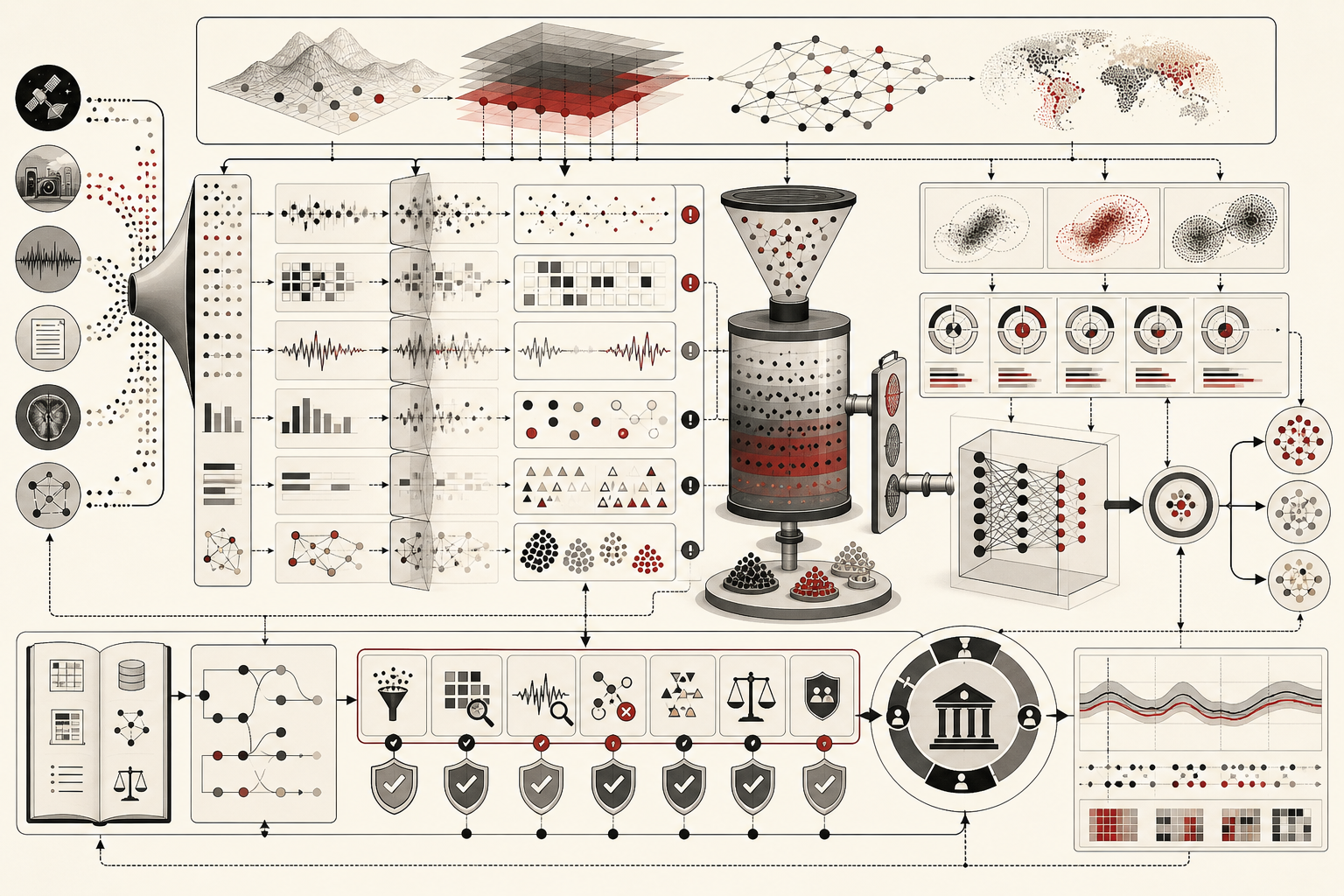
This article develops Data Quality, Bias, and Measurement in Machine Learning as an advanced article within the Artificial Intelligence Systems knowledge series. It explains measurement theory, construct validity, proxy variables, bias-variance tradeoffs, data-quality dimensions, measurement error, label noise, missingness, sources of harm across the machine-learning lifecycle, distribution shift, fairness criteria, impossibility results, evaluation bias, data cascades, documentation practices, governance controls, and institutional accountability. Selected Python and R examples appear here, while the full GitHub repository contains expanded computational scaffolding for data-quality auditing, missingness analysis, label-noise simulation, representation diagnostics, fairness metrics, bias taxonomy documentation, SQL metadata, governance checklists, and advanced Jupyter notebooks.
Why Data Quality Matters in Machine Learning
Data quality matters because machine learning systems are only as valid as the data relationships they learn and the measurement processes that produce those relationships. A model can appear sophisticated while learning from incomplete, biased, stale, noisy, mislabeled, unrepresentative, or institutionally distorted data. In such cases, model performance problems are not merely algorithmic failures. They are measurement failures.
This is especially important because AI systems are often built from data that was not originally collected for the purpose the model later serves. Administrative records, clickstreams, sensor logs, transaction histories, medical codes, human annotations, scraped text, platform behavior, and public records may all be repurposed as machine-learning data. Each of these data sources carries assumptions about what was recorded, what was ignored, who was visible, who was excluded, which categories were available, and which institutional incentives shaped measurement.
Data quality is therefore not only a preprocessing concern. It is a theory of evidence. When data is treated as a transparent window onto reality, AI systems can reinforce the very measurement structures that produced bias in the first place. When data is treated as a constructed, partial, and socially embedded representation, model evaluation becomes more honest, more rigorous, and more accountable.
Low\ Quality\ Data \rightarrow Invalid\ Learning
\]
Interpretation: A machine-learning model can only learn valid relationships when the data represents the intended construct, population, and decision context with sufficient quality.
| Lifecycle Stage | Data-Quality Question | Failure Mode | System Consequence |
|---|---|---|---|
| Collection | Who and what is included in the dataset? | Missing populations, selection bias, institutional invisibility. | Model performs unevenly across groups or contexts. |
| Measurement | Does the variable represent the intended construct? | Weak proxy, biased instrument, inconsistent definition. | Model optimizes the wrong target. |
| Labeling | Are labels accurate, consistent, and meaningful? | Noisy labels, biased annotations, administrative artifacts. | Model learns labeling practices rather than reality. |
| Training | Does the dataset support the model’s intended task? | Representation imbalance, leakage, drift, spurious patterns. | Model appears accurate but generalizes poorly. |
| Evaluation | Does the test set reflect deployment? | Evaluation bias, hidden subgroup failure, metric mismatch. | Performance claims overstate reliability. |
| Deployment | Does data remain valid over time? | Distribution shift, feedback loops, changing behavior. | Model degrades or amplifies prior harms. |
Note: Data quality is not a one-time cleaning step. It is a lifecycle property of the entire AI system.
Measurement Theory and Machine Learning
Machine learning systems rely on data as representations of real-world phenomena. In measurement theory, it is useful to distinguish between latent constructs and observed variables. A latent construct is the underlying phenomenon of interest, such as risk, skill, need, trustworthiness, preference, health status, safety, institutional performance, or ecological condition. An observed variable is a measured proxy, such as a test score, transaction count, diagnosis code, click, rating, complaint, arrest record, inspection note, satellite reading, or sensor measurement.
A measurement relationship can be represented as:
X_{\mathrm{observed}} = X_{\mathrm{latent}} + \epsilon
\]
Interpretation: Observed data \(X_{\mathrm{observed}}\) is an imperfect measurement of an underlying construct \(X_{\mathrm{latent}}\), with measurement error \(\epsilon\).
This distinction is foundational for AI systems. A machine-learning model rarely observes the real construct directly. It observes a proxy. If the proxy is weak, biased, incomplete, or institutionally distorted, the model may learn patterns that are statistically useful but conceptually invalid.
This leads to a central principle:
AI\ Systems\ Learn\ From\ Proxies,\ Not\ Reality\ Itself
\]
Interpretation: Machine learning systems learn from measured representations of phenomena, not from the full reality those measurements only partially capture.
The quality of an AI system therefore depends not only on algorithm choice, but on whether the data represents the right construct in the right way for the intended decision context.
| Measurement Concept | Meaning | Machine-Learning Example | Failure Risk |
|---|---|---|---|
| Latent construct | The underlying concept of interest. | Need, risk, ability, preference, quality, safety, health. | The construct may be contested or poorly defined. |
| Observed variable | The recorded measurement available to the model. | Score, click, code, label, sensor value, transaction count. | The variable may only weakly represent the construct. |
| Proxy | A measurable substitute for something harder to measure. | Healthcare cost used as a proxy for medical need. | Proxy may encode unequal access or institutional bias. |
| Measurement error | Difference between observed value and target construct. | Noisy sensor data, inconsistent diagnosis coding, bad annotations. | Model learns error patterns or unreliable signals. |
| Construct validity | Whether the measurement represents the intended concept. | Engagement used as a proxy for satisfaction. | The model optimizes a measurable but misleading target. |
Note: Data quality begins with the question of what is being measured and whether that measurement is valid for the intended AI use.
Construct Validity, Proxy Variables, and Latent Constructs
Construct validity asks whether a measurement actually represents the concept it claims to measure. This is one of the most important issues in machine learning because many AI systems are trained on proxies for complex social, behavioral, biological, ecological, or institutional concepts.
A model may use prior arrests as a proxy for criminal behavior, clicks as a proxy for user satisfaction, healthcare cost as a proxy for medical need, credentials as a proxy for ability, engagement as a proxy for learning, customer activity as a proxy for loyalty, or infrastructure inspection records as a proxy for physical risk. These proxies may contain useful information, but they are not the constructs themselves.
A proxy relationship can be represented as:
Z \approx C
\]
Interpretation: Proxy variable \(Z\) is used as an approximation for construct \(C\), but the approximation may be incomplete or biased.
The problem is not that proxies are always invalid. Many scientific and operational systems require proxies. The problem is that machine learning can make weak proxies appear objective because they are quantified. If a proxy is treated as ground truth, the model may optimize measurable convenience rather than substantive validity.
This is why data quality must include construct review. Analysts should ask: What construct is the system meant to model? What proxy is being used? Who is visible in the measurement process? Who is missing? What institutional behavior shaped the data? What harms could result if the proxy is mistaken for the underlying reality?
| Construct | Common Proxy | Validity Risk | Review Question |
|---|---|---|---|
| Medical need | Healthcare spending or claims history. | Lower access can make high need appear as low spending. | Does the proxy measure need or access to care? |
| Learning | Engagement, clicks, time-on-platform, completion. | Activity may not represent understanding. | Does the metric capture learning quality or platform behavior? |
| Risk | Past administrative records or enforcement data. | Records may reflect surveillance and policing patterns. | Does the proxy measure behavior or institutional attention? |
| Skill | Credentials, prior titles, test scores, work history. | Opportunity structures shape the proxy. | Does the proxy capture ability or prior access? |
| User satisfaction | Clicks, views, watch time, likes. | Engagement can reflect compulsion, outrage, or manipulation. | Does the proxy represent wellbeing or attention capture? |
| Infrastructure condition | Inspection records, complaint logs, maintenance history. | Underreported areas may appear less risky. | Does absence of evidence reflect safety or invisibility? |
Note: Construct validity asks whether the data represents the concept the AI system is actually supposed to learn.
Weak\ Proxy + Powerful\ Model \rightarrow Confident\ Misrepresentation
\]
Interpretation: More powerful models do not fix weak measurement; they may amplify proxy failures with greater precision.
Statistical Learning Theory: Bias, Variance, and Noise
Statistical learning theory formalizes part of the relationship between data quality and model performance through the bias-variance-noise framework. Prediction error can be decomposed conceptually as:
Error = Bias^2 + Variance + Noise
\]
Interpretation: Prediction error reflects systematic error, sensitivity to the training sample, and irreducible uncertainty in the data-generating process.
Bias is systematic error from incorrect assumptions, misspecified features, invalid proxies, or structural underrepresentation. Variance is sensitivity to fluctuations in the training data. Noise is irreducible uncertainty or measurement instability that no model can fully eliminate.
Low-quality data can increase all three. Biased data increases systematic error. Small or unrepresentative samples increase variance. Noisy labels and unreliable measurements increase irreducible error. This highlights an important lesson: improving model architecture alone cannot compensate for fundamental deficiencies in measurement.
In practical machine learning, data work is often less glamorous than model work, but it is often more important. When the dataset is flawed, the model can optimize the flaw with great precision.
| Error Component | Meaning | Data-Quality Source | AI-System Consequence |
|---|---|---|---|
| Bias | Systematic error. | Invalid proxy, structural underrepresentation, historical inequality. | Model consistently misrepresents certain groups or constructs. |
| Variance | Sensitivity to sample variation. | Small sample, sparse subgroup data, unstable measurement. | Model behavior changes sharply across training samples. |
| Noise | Irreducible or unmodeled uncertainty. | Label noise, sensor instability, inconsistent annotation. | Model cannot reliably distinguish signal from measurement error. |
| Leakage | Information enters the model inappropriately. | Future information, duplicate records, target contamination. | Validation performance is inflated. |
| Drift | Data-generating process changes over time. | Changing populations, incentives, sensors, policies, behavior. | Model degrades after deployment. |
Note: Data quality affects both statistical performance and the validity of what performance metrics appear to prove.
Dimensions of Data Quality
Data quality determines whether machine learning systems can produce reliable results. Several dimensions are especially important: accuracy, completeness, consistency, timeliness, representativeness, granularity, lineage, and fitness for purpose.
A data-quality score can be represented as:
Q_D = f(Accuracy,Completeness,Consistency,Timeliness,Representativeness,Lineage)
\]
Interpretation: Data quality depends on multiple dimensions, not a single property.
Failures in any of these dimensions can propagate through machine-learning systems. Missing data can exclude entire groups. Inconsistent labels can confuse model training. Stale data can degrade deployment performance. Poor lineage can prevent auditing. Unrepresentative samples can create uneven performance across subgroups.
Data quality should therefore be assessed in relation to the intended system role. A dataset may be adequate for exploratory research but inadequate for deployment. It may support aggregate trend analysis but not individual decision-making. It may be appropriate for one institution but not another. Fitness for purpose is the central criterion.
| Dimension | Definition | Machine-Learning Risk | Governance Control |
|---|---|---|---|
| Accuracy | Recorded values are correct relative to intended measurement. | Model learns false signals. | Validation checks, source audits, error sampling. |
| Completeness | Relevant records, fields, and populations are present. | Missing variables or groups distort learning. | Completeness thresholds and missingness review. |
| Consistency | Definitions, formats, labels, and procedures are stable. | Model sees incompatible categories as comparable. | Data dictionaries, schema validation, labeling standards. |
| Timeliness | Data reflects the relevant period for the decision. | Model learns stale relationships. | Freshness checks and temporal validation. |
| Representativeness | Data reflects the target population or environment. | Subgroup and deployment failure. | Sampling review and subgroup coverage analysis. |
| Granularity | Data is detailed enough for the intended analysis. | Important distinctions are collapsed. | Resolution review and aggregation audit. |
| Lineage | Data origin and transformation history are documented. | Model cannot be audited or reproduced. | Provenance systems and version control. |
| Fitness for purpose | Data is appropriate for the model’s intended use. | Dataset is reused outside its valid scope. | Use-case review and inappropriate-use documentation. |
Note: A dataset is not high quality in the abstract. It is high quality for a particular construct, population, model, and decision context.
Measurement Error, Label Noise, and Uncertainty
Observed data can be expressed as:
Observed = True\ Value + Error
\]
Interpretation: Observed measurements include both the intended signal and measurement error.
Measurement error includes random noise and systematic error. Random noise introduces unpredictable variation. Systematic error produces directional distortion, such as consistently undercounting one population, overmeasuring another, or labeling cases differently across institutions.
Label noise is especially important in supervised learning. A model trained on incorrect or inconsistent labels may learn the labeling process rather than the underlying phenomenon. In some settings, labels are produced by expert annotators. In others, they are produced by administrative categories, historical decisions, crowdworkers, sensors, or downstream outcomes that are themselves shaped by prior systems.
Label noise can be represented as:
\tilde{Y}=Y+\eta
\]
Interpretation: Observed label \(\tilde{Y}\) differs from the true target \(Y\) because of label error \(\eta\).
This matters because high label noise can create an illusion of model limitation when the actual limitation is measurement reliability. Conversely, a model can achieve high accuracy against noisy labels while failing to capture the true construct of interest.
| Problem | How It Appears | Example | Mitigation |
|---|---|---|---|
| Random measurement error | Values fluctuate unpredictably. | Noisy sensors, inconsistent self-reports, unstable annotations. | Replication, smoothing, uncertainty estimation. |
| Systematic measurement error | Values are directionally distorted. | Underreporting in communities with lower access to reporting systems. | Bias audit and improved measurement design. |
| Label noise | Training labels differ from target truth. | Incorrect annotations, inconsistent diagnoses, administrative miscoding. | Label review, adjudication, noise-robust training. |
| Differential label quality | Some groups receive less accurate labels. | Diagnosis accuracy differs by population or care access. | Subgroup label-quality assessment. |
| Proxy label failure | Label represents convenience, not construct. | Cost as a label for medical need; clicks as a label for satisfaction. | Construct-validity review and alternative outcomes. |
Note: Label quality is not simply a training-data property. It determines what the model is actually being taught to reproduce.
Missing Data, Selection Effects, and Representation
Missing data is not always random. Some values are missing because of system design, institutional neglect, access barriers, reporting incentives, sensor failure, privacy constraints, historical exclusion, or unequal visibility. In machine learning, missingness can therefore become a signal of power, visibility, and institutional structure.
A common distinction is:
- Missing completely at random: missingness is unrelated to observed or unobserved variables.
- Missing at random: missingness depends on observed variables.
- Missing not at random: missingness depends on unobserved values or unmeasured mechanisms.
A missingness indicator can be represented as:
M_i =
\begin{cases}
1, & \mathrm{if\ value\ is\ missing}\\
0, & \mathrm{if\ value\ is\ observed}
\end{cases}
\]
Interpretation: Missingness itself can be modeled as part of the data-generating process.
Representation bias occurs when some groups, contexts, languages, regions, behaviors, or edge cases are underrepresented in the dataset. This can cause models to perform well for majority populations while failing for smaller or historically marginalized groups. Representation is not only about sample size. It is about whether the dataset covers the variation that matters for the intended use.
| Problem | Mechanism | Machine-Learning Consequence | Governance Response |
|---|---|---|---|
| Missing completely at random | Missingness unrelated to observed or unobserved variables. | Reduces sample size and statistical power. | Imputation, uncertainty reporting, completeness checks. |
| Missing at random | Missingness related to observed variables. | Bias can be reduced if observed predictors are modeled. | Model missingness process and adjust carefully. |
| Missing not at random | Missingness related to unobserved value or hidden mechanism. | Can create serious, hard-to-correct bias. | Sensitivity analysis and improved data collection. |
| Selection effects | Only certain cases enter the dataset. | Training population differs from target population. | Sampling audit and target-population comparison. |
| Representation bias | Groups or contexts underrepresented. | Unequal error rates and hidden subgroup failure. | Coverage analysis and subgroup validation. |
| Visibility bias | Institutions observe some communities more intensely than others. | Model mistakes surveillance for prevalence. | Interpret records in relation to institutional measurement systems. |
Note: Missingness often reflects social, institutional, and technical systems. Treating it as a purely statistical nuisance can hide its causes.
A Taxonomy of Bias in Machine Learning
Bias in machine learning is not a single problem. It can enter at multiple stages of the machine-learning lifecycle. A useful taxonomy includes historical bias, representation bias, measurement bias, aggregation bias, learning bias, evaluation bias, and deployment bias.
A lifecycle view of bias can be represented as:
Collection \rightarrow Measurement \rightarrow Labeling \rightarrow Training \rightarrow Evaluation \rightarrow Deployment
\]
Interpretation: Bias can enter at every stage of the machine-learning lifecycle, not only in the training dataset.
This taxonomy matters because different biases require different remedies. Representation bias may require better sampling. Measurement bias may require improved instruments or labels. Aggregation bias may require subgroup-specific modeling. Evaluation bias may require better test sets. Deployment bias may require workflow redesign.
Calling everything “biased data” is too vague. Responsible machine learning requires diagnosing where the harm enters, how it propagates, and which intervention is appropriate.
| Bias Type | Where It Enters | How It Appears | Possible Response |
|---|---|---|---|
| Historical bias | Before data collection. | Existing inequalities appear in data even when measurement is accurate. | Contextual review, policy analysis, fairness-aware objectives. |
| Representation bias | Sampling and coverage. | Some groups or contexts are underrepresented. | Improved sampling, subgroup coverage, targeted validation. |
| Measurement bias | Instrument, label, proxy, or definition. | Variables are measured differently across groups. | Measurement redesign and construct-validity review. |
| Aggregation bias | Modeling and pooling. | One model is fit across heterogeneous groups. | Subgroup modeling or interaction-aware evaluation. |
| Learning bias | Optimization objective or model assumptions. | Loss function prioritizes majority performance or proxy targets. | Objective review, reweighting, fairness constraints. |
| Evaluation bias | Benchmark or test data. | Test set does not represent deployment population. | External validation and disaggregated evaluation. |
| Deployment bias | Use context and workflow. | Model is used differently than intended or validated. | Use-case controls, workflow redesign, monitoring. |
Note: Bias diagnosis should identify where the problem enters the system, not only that bias exists somewhere in the data.
Distribution Shift and Generalization Failure
Machine learning models often assume that training and deployment data come from the same distribution. In practice, this assumption frequently fails. When the deployment environment differs from the training environment, even a well-trained model can degrade.
Distribution shift can be represented as:
P_{\mathrm{train}}(X,Y)\neq P_{\mathrm{deploy}}(X,Y)
\]
Interpretation: Distribution shift occurs when the training distribution differs from the deployment distribution.
Important types of shift include covariate shift, label shift, concept drift, domain shift, and selection shift. Distribution shift is a major cause of real-world model failure. A model trained on one hospital, region, platform, language community, sensor environment, economic period, or user population may not generalize to another. This connects directly to Model Validation, Benchmarking, and Generalization Theory, because generalization depends on whether evaluation data adequately anticipates deployment conditions.
Distribution shift is not always a random statistical event. It may be created by the AI system itself. A recommender changes user behavior. A risk model changes who receives resources. An eligibility model changes future records. A policing model changes where enforcement occurs. A hiring model changes applicant behavior. In these cases, deployment alters the data-generating process that future models learn from.
| Shift Type | What Changes? | Example | Validation Response |
|---|---|---|---|
| Covariate shift | Input distribution changes. | New users, sensors, language patterns, or regional contexts appear. | Input drift monitoring and external validation. |
| Label shift | Outcome prevalence changes. | Rates of fraud, disease, failure, or demand shift over time. | Prevalence monitoring and recalibration. |
| Concept drift | Relationship between inputs and outcomes changes. | User behavior adapts to model outputs. | Temporal validation and retraining triggers. |
| Domain shift | Deployment environment differs structurally. | Model trained in one institution used in another. | Site-level validation and local calibration. |
| Selection shift | Observed data reflects a non-representative subset. | Only approved applicants or retained users are observed. | Selection-bias analysis and counterfactual reasoning. |
| Feedback shift | Model decisions reshape future data. | Algorithmic decisions determine what gets observed next. | Lifecycle monitoring and causal evaluation. |
Note: Distribution shift links data quality to deployment governance because data can become invalid as environments change.
Fairness, Tradeoffs, and Impossibility Results
Fairness in machine learning concerns how model performance, error, access, burden, and benefit are distributed across groups. Common fairness criteria include statistical parity, equalized odds, predictive parity, calibration within groups, and individual fairness.
A statistical parity difference can be written as:
SPD=P(\hat{Y}=1\mid A=0)-P(\hat{Y}=1\mid A=1)
\]
Interpretation: Statistical parity difference compares positive prediction rates across protected groups.
Equalized odds requires:
P(\hat{Y}=1\mid Y=y,A=0)=P(\hat{Y}=1\mid Y=y,A=1)
\]
Interpretation: Equalized odds requires equal prediction rates across groups conditional on the true outcome.
Fairness criteria can conflict. When base rates differ across groups and predictions are imperfect, it is generally impossible to satisfy all major fairness criteria at the same time. This means fairness cannot be treated as a single metric to maximize. It requires choosing among competing values, documenting the tradeoff, and justifying why a particular criterion fits the decision context.
Fairness is therefore not purely a technical problem. It is a normative, legal, institutional, and policy problem expressed through statistical systems.
| Fairness Criterion | Core Question | Useful When | Limit |
|---|---|---|---|
| Statistical parity | Are positive outcomes distributed similarly across groups? | Access or opportunity rates matter directly. | May ignore relevant differences in true outcome distribution. |
| Equalized odds | Are error rates balanced conditional on true outcomes? | False positives and false negatives have unequal group harms. | May conflict with calibration or predictive parity. |
| Predictive parity | Does a positive prediction mean the same thing across groups? | Risk scores are used for individual decision-making. | Can conflict with equalized odds when base rates differ. |
| Calibration within groups | Do predicted probabilities match outcomes within each group? | Probabilistic scores guide review or triage. | Does not guarantee equal error rates. |
| Individual fairness | Are similar individuals treated similarly? | A meaningful similarity metric exists. | Similarity itself can be contested or biased. |
| Substantive fairness | Does the system reduce or reproduce unjust structures? | High-impact institutional decisions. | Cannot be resolved by metrics alone. |
Note: Fairness metrics are diagnostic tools. They do not replace normative judgment, institutional accountability, or public-interest review.
Fairness\ Metric \neq Justice
\]
Interpretation: Fairness metrics can reveal disparities, but they cannot by themselves decide which social, legal, or institutional tradeoffs are legitimate.
Implications for Model Evaluation
Data quality and bias directly affect evaluation. A model evaluated on a biased test set may appear reliable while failing in the real deployment population. A model evaluated only on aggregate metrics may hide subgroup harms. A model evaluated against noisy labels may optimize measurement error. A model evaluated on a benchmark with poor construct validity may perform well while solving the wrong problem.
Robust evaluation requires diverse and representative test sets, subgroup performance analysis, measurement-error review, label-quality assessment, cross-validation across meaningful distributions, calibration analysis, deployment-context review, and metric selection aligned with real decision costs.
Evaluation can be represented as:
Evaluation = f(Performance,Fairness,Calibration,Robustness,Validity)
\]
Interpretation: Responsible model evaluation combines performance, fairness, calibration, robustness, and validity rather than relying on one score.
This connects directly to Model Validation, Benchmarking, and Generalization Theory. Evaluation is not only a model-level question. It is a measurement-quality question.
| Evaluation Dimension | Question | Weak Pattern | Stronger Pattern |
|---|---|---|---|
| Aggregate performance | How does the model perform overall? | Report one headline score. | Report score with confidence intervals, subgroup results, and context. |
| Subgroup performance | Who is the model failing? | Hide disparities inside averages. | Disaggregate by relevant groups and contexts. |
| Label validity | Are labels reliable and meaningful? | Treat labels as ground truth. | Assess label source, consistency, and construct validity. |
| Calibration | Can model confidence be trusted? | Use scores without confidence review. | Evaluate calibration overall and by subgroup. |
| Robustness | Does performance survive realistic variation? | Test only in-distribution data. | Evaluate shift, missingness, perturbation, and edge cases. |
| Decision alignment | Do metrics match the decision context? | Optimize convenient metrics. | Align evaluation with harms, benefits, thresholds, and use. |
Note: Evaluation is only meaningful when the measurement system, test population, labels, metrics, and deployment context are valid for the decision being made.
Dataset Documentation, Datasheets, and Data Statements
Dataset documentation is one of the most important governance tools for data quality and bias. Datasheets for datasets, data statements, model cards, and related documentation practices help make data assumptions visible. They ask questions that are often hidden during model development: why the dataset was created, who or what is represented, who is missing, how data was collected, how labels were produced, what preprocessing was applied, what uses are appropriate, and what risks or limitations are known.
Documentation can be represented as:
Dataset = Data + Context + Provenance + Limitations
\]
Interpretation: A dataset is not only records and labels; it also requires context, origin, transformation history, and limitations.
Without documentation, downstream users may treat data as more complete, neutral, or reusable than it is. With documentation, data becomes more auditable, more interpretable, and more governable. Documentation does not eliminate bias, but it creates the conditions for accountability.
| Documentation Area | Question It Answers | Why It Matters | Evidence Artifact |
|---|---|---|---|
| Purpose | Why was the dataset created? | Clarifies intended and unintended uses. | Dataset purpose statement. |
| Population | Who or what is represented? | Reveals coverage and exclusion. | Sampling description and population comparison. |
| Collection process | How was data gathered? | Identifies measurement mechanisms and incentives. | Collection protocol and source documentation. |
| Labeling process | Who produced labels and under what rules? | Exposes annotation bias and reliability issues. | Labeling guidelines and inter-rater review. |
| Preprocessing | What transformations were applied? | Supports reproducibility and audit. | Transformation logs and versioned pipelines. |
| Known limitations | Where should the dataset not be used? | Prevents inappropriate reuse. | Limitations and prohibited-use notes. |
| Governance | Who owns stewardship and updates? | Clarifies responsibility after deployment. | Data owner, review cadence, incident process. |
Note: Dataset documentation turns hidden data assumptions into reviewable evidence.
From Data to Decisions: System-Level Effects
Data quality and bias propagate through the entire AI system:
Data \rightarrow Model \rightarrow Decision \rightarrow Institutional\ Outcome
\]
Interpretation: Data errors can propagate into models, decisions, and institutional consequences.
This propagation matters because AI systems rarely stop at prediction. They influence hiring decisions, financial access, healthcare triage, educational support, infrastructure maintenance, content visibility, public benefits, platform governance, and organizational strategy. When data reflects historical inequality or measurement distortion, downstream decisions may reproduce those distortions at scale.
Feedback loops can deepen the problem:
Decision_t \rightarrow Outcome_t \rightarrow Data_{t+1} \rightarrow Model_{t+1}
\]
Interpretation: Model-driven decisions shape future outcomes, which then become future training data.
This connects directly to AI Systems in Organizations and Institutions, AI Governance and Regulatory Systems, Bias, Fairness, and Accountability in Artificial Intelligence, and Systemic Risk, Feedback Loops, and Cascading Failures in AI Systems. The ethical and technical issue is therefore not simply whether data is “clean.” It is whether the system built from that data produces valid, fair, accountable, and institutionally legitimate outcomes.
| Data Problem | Model Effect | Decision Effect | Institutional Consequence |
|---|---|---|---|
| Invalid proxy | Model predicts the proxy instead of the construct. | Decision optimizes the wrong target. | Institution legitimizes misleading evidence. |
| Representation gap | Model performs poorly for underrepresented groups. | Some users receive worse recommendations or decisions. | Unequal burdens and reduced trust. |
| Historical bias | Model learns patterns from unequal systems. | Past inequities influence future allocation. | Automation reproduces injustice at scale. |
| Label noise | Model learns inconsistent or erroneous labels. | Decisions become unreliable or arbitrary. | Accountability becomes difficult because evidence is unstable. |
| Feedback loop | Model changes the data it later trains on. | System reinforces its own prior decisions. | Errors become self-confirming. |
| Poor documentation | Model limitations are hidden. | Users overtrust outputs. | Audit, contestability, and repair are weakened. |
Note: Data quality becomes an institutional issue when model outputs influence rights, resources, opportunities, infrastructure, or public trust.
Integration with Data Governance Systems
Data quality and bias must be governed across the machine-learning lifecycle. This article builds directly on Data Governance, Provenance, and Lineage in AI Systems, where governance mechanisms enable monitoring and control of data origin, transformation, access, quality, and use.
Effective governance requires provenance tracking, dataset documentation, data-quality thresholds, bias-auditing frameworks, labeling protocols, version control for datasets, review of appropriate and inappropriate uses, monitoring for drift and degradation, clear ownership of data stewardship, and incident review when data failures cause harm.
A governance workflow can be represented as:
Collect \rightarrow Document \rightarrow Validate \rightarrow Audit \rightarrow Monitor \rightarrow Review
\]
Interpretation: Data governance is a lifecycle process that tracks quality, bias, documentation, monitoring, and accountability.
In high-impact AI systems, data governance is not an administrative add-on. It is part of the model’s scientific and ethical foundation.
| Governance Control | Purpose | Evidence Produced | Owner |
|---|---|---|---|
| Provenance tracking | Record origin and transformation history. | Lineage graph, source logs, pipeline versions. | Data engineering and governance team. |
| Dataset documentation | Make context, scope, and limits explicit. | Datasheet, data statement, appropriate-use notes. | Data steward and domain experts. |
| Quality thresholds | Define minimum standards for model use. | Completeness, freshness, consistency, and error-rate reports. | Data quality owner. |
| Bias audits | Evaluate representation, measurement, and subgroup performance. | Bias taxonomy, fairness diagnostics, subgroup reports. | Responsible AI, legal, domain, and evaluation teams. |
| Labeling protocol | Standardize how labels are produced and reviewed. | Guidelines, adjudication logs, inter-rater summaries. | Annotation and subject-matter teams. |
| Drift monitoring | Detect changes after deployment. | Distribution-shift metrics and alert thresholds. | ML operations and reliability teams. |
| Incident review | Analyze harm caused by data or measurement failure. | Root-cause analysis and corrective-action log. | Governance, risk, and operations owners. |
Note: Data governance turns data quality from an informal best practice into a documented, auditable, lifecycle responsibility.
Limits of Measurement in AI Systems
All data is an imperfect representation of reality. Measurement constraints limit what AI systems can learn, predict, and justify. Some phenomena are difficult to measure. Some are ethically inappropriate to reduce to a single score. Some are shaped by institutional power. Some change when measured. Some are contested because different communities disagree about what should count.
These limits do not mean AI systems are useless. They mean AI systems should be honest about what their data can and cannot support. The strongest AI systems are not those that pretend data is neutral. They are those that document measurement choices, test data quality, identify bias, monitor drift, and restrict claims to what the evidence can justify.
A mature AI data practice therefore begins with humility: every dataset is partial, every measurement has assumptions, and every model inherits the limits of the data that made it possible.
| Limit | Why It Matters | Risk | Responsible Response |
|---|---|---|---|
| Unobservable constructs | Some concepts cannot be directly measured. | Proxy variables are mistaken for reality. | Construct-validity review and humility about claims. |
| Contested concepts | Communities may disagree about what should count. | One institutional definition becomes automated authority. | Participatory review and transparent definitions. |
| Ethical measurement boundaries | Some data should not be collected or used even if predictive. | Privacy, surveillance, or discriminatory inference. | Use limitations, minimization, and rights review. |
| Power-shaped data | Institutions decide what is visible and recorded. | Records reflect power, not only behavior. | Contextual interpretation and bias analysis. |
| Measurement reactivity | People and systems change when measured. | Metrics become targets and distort behavior. | Guardrails, qualitative review, and feedback monitoring. |
| Irreducible uncertainty | Some outcomes remain noisy or unpredictable. | Model confidence exceeds evidence. | Uncertainty reporting, abstention, and human review. |
Note: Responsible AI does not require perfect data. It requires honest limits, careful measurement, and governance proportional to uncertainty.
Mathematical Lens
Observed measurement can be written as:
X_{\mathrm{observed}} = X_{\mathrm{latent}} + \epsilon
\]
Interpretation: Observed data is an imperfect measurement of a latent construct plus error.
Label noise can be written as:
\tilde{Y}=Y+\eta
\]
Interpretation: Observed labels may differ from the true target because of annotation, administrative, or measurement error.
Prediction error can be decomposed as:
Error = Bias^2 + Variance + Noise
\]
Interpretation: Model error reflects systematic bias, sampling variance, and irreducible noise.
A missingness indicator is:
M_i =
\begin{cases}
1, & \mathrm{if\ value\ is\ missing}\\
0, & \mathrm{if\ value\ is\ observed}
\end{cases}
\]
Interpretation: Missingness can be treated as a measurable process, not merely an inconvenience.
Distribution shift is:
P_{\mathrm{train}}(X,Y)\neq P_{\mathrm{deploy}}(X,Y)
\]
Interpretation: Training and deployment distributions differ, creating risk of generalization failure.
Statistical parity difference is:
SPD=P(\hat{Y}=1\mid A=0)-P(\hat{Y}=1\mid A=1)
\]
Interpretation: Statistical parity difference compares positive prediction rates across protected groups.
Equalized odds requires:
P(\hat{Y}=1\mid Y=y,A=0)=P(\hat{Y}=1\mid Y=y,A=1)
\]
Interpretation: Equalized odds requires parity in prediction rates across groups conditional on the true outcome.
A data-quality score can be represented as:
Q_D = f(Accuracy,Completeness,Consistency,Timeliness,Representativeness,Lineage)
\]
Interpretation: Data quality is multidimensional and must be assessed across measurement, coverage, time, and provenance.
This mathematical lens shows that data quality and bias are not vague ethical concerns. They can be analyzed through measurement error, missingness, distribution shift, subgroup performance, fairness metrics, and governance evidence.
Variables and System Interpretation
| Symbol or Term | Meaning | Typical Type | System Interpretation |
|---|---|---|---|
| \(X_{\mathrm{latent}}\) | Latent construct | Unobserved phenomenon. | The underlying concept the system is trying to represent. |
| \(X_{\mathrm{observed}}\) | Observed measurement | Recorded variable. | The measured proxy available to the model. |
| \(\epsilon\) | Measurement error | Noise or distortion. | Difference between observed data and the underlying construct. |
| \(Y\) | Target variable | Label or outcome. | The outcome the model is trained to predict. |
| \(\tilde{Y}\) | Noisy observed label | Imperfect label. | The label available for training, which may contain error. |
| \(M_i\) | Missingness indicator | Binary variable. | Whether a value is observed or missing for unit \(i\). |
| \(A\) | Protected or group attribute | Group variable. | Used to evaluate subgroup performance and fairness. |
| \(\hat{Y}\) | Model prediction | Predicted label or score. | The output used by downstream decision systems. |
| \(SPD\) | Statistical parity difference | Fairness metric. | Difference in positive prediction rates between groups. |
| \(Q_D\) | Data quality score | Diagnostic construct. | Composite representation of data fitness for purpose. |
| Representation bias | Uneven coverage | Dataset failure mode. | Some groups or conditions are underrepresented. |
| Measurement bias | Uneven measurement validity | Measurement failure mode. | Variables are measured differently or less accurately across groups. |
Note: Data-quality diagnostics should be interpreted in relation to the intended construct, target population, model use, decision context, and potential downstream harms.
Worked Example: Representation Bias and Subgroup Error
Suppose a dataset contains two groups, \(A=0\) and \(A=1\). The target deployment population is balanced:
P_{\mathrm{deploy}}(A=0)=0.50,\quad P_{\mathrm{deploy}}(A=1)=0.50
\]
Interpretation: Both groups are equally represented in the intended deployment population.
But the training data is imbalanced:
P_{\mathrm{train}}(A=0)=0.85,\quad P_{\mathrm{train}}(A=1)=0.15
\]
Interpretation: Group \(A=1\) is underrepresented in the training data.
Suppose the model has error rates:
Error(A=0)=0.08,\quad Error(A=1)=0.22
\]
Interpretation: The model performs substantially worse for the underrepresented group.
The subgroup error gap is:
Gap=0.22-0.08=0.14
\]
Interpretation: The underrepresented group experiences a 14 percentage point higher error rate.
This example shows why aggregate accuracy can be misleading. If the test set mirrors the imbalanced training set, the model may appear strong overall while failing in the population where the system is actually deployed. Data quality therefore requires subgroup evaluation, representativeness review, and deployment-aware validation.
| Quantity | Group \(A=0\) | Group \(A=1\) | Interpretation |
|---|---|---|---|
| Deployment share | 0.50 | 0.50 | Both groups are equally relevant in deployment. |
| Training share | 0.85 | 0.15 | Group \(A=1\) is underrepresented in training. |
| Error rate | 0.08 | 0.22 | The model performs worse for the underrepresented group. |
| Error gap | 0.14 | Aggregate accuracy can hide unequal failure. | |
Note: Representation bias can produce a model that appears accurate in aggregate while failing the population it is meant to serve.
Computational Modeling
Computational modeling can make data quality and bias visible. A data-quality workflow can quantify missingness, completeness, representation, label imbalance, and subgroup error rates. A measurement-error workflow can simulate noisy labels. A distribution-shift workflow can compare training and deployment populations. A fairness workflow can compute statistical parity difference, false positive rate gaps, and false negative rate gaps. A documentation workflow can record dataset purpose, provenance, limitations, and appropriate uses.
The selected examples below use lightweight synthetic workflows so the article remains readable and WordPress-friendly. The GitHub repository extends the same logic into advanced Jupyter notebooks, data-quality scorecards, missingness diagnostics, label-noise simulations, fairness metrics, representation audits, SQL metadata, governance checklists, and reproducible outputs.
A useful computational workflow should treat data quality as evidence. It should not only calculate model scores. It should record missingness, label noise, subgroup coverage, fairness metrics, data provenance, construct assumptions, and deployment limitations.
Data\ Quality\ Audit = Missingness + Representation + Label\ Quality + Fairness + Lineage
\]
Interpretation: A data-quality audit should evaluate whether data is complete, representative, valid, fair, and traceable enough for the intended model use.
Python Workflow: Data Quality, Bias, and Fairness Diagnostics
Python is useful for auditing missingness, subgroup representation, label noise, and fairness metrics. The following workflow creates a synthetic dataset, produces basic diagnostics, and writes governance-ready output artifacts.
"""
Data Quality, Bias, and Measurement in Machine Learning

Python workflow: data quality, bias, and fairness diagnostics.

This educational example demonstrates:
1. missingness diagnostics
2. subgroup representation analysis
3. label-noise simulation
4. subgroup error-rate comparison
5. statistical parity difference
6. governance-ready output files

It uses synthetic data for illustration.
"""

from __future__ import annotations

from pathlib import Path
import numpy as np
import pandas as pd


RANDOM_SEED = 42
rng = np.random.default_rng(RANDOM_SEED)

OUTPUT_DIR = Path("outputs")
OUTPUT_DIR.mkdir(parents=True, exist_ok=True)

N_UNITS = 5000


def create_synthetic_quality_data(n: int = N_UNITS) -> tuple[pd.DataFrame, np.ndarray]:
    """Create synthetic data with representation imbalance and measurement issues."""
    data = pd.DataFrame(
        {
            "unit_id": [f"unit_{i:05d}" for i in range(1, n + 1)],
            "group": rng.choice(["A", "B"], size=n, p=[0.82, 0.18]),
            "feature_signal": rng.normal(0, 1, size=n),
            "measurement_quality": rng.choice(
                ["high", "medium", "low"],
                size=n,
                p=[0.55, 0.30, 0.15],
            ),
        }
    )

    data["measurement_error_sd"] = np.where(
        data["group"] == "B",
        0.45,
        0.20,
    )

    data["measured_feature"] = (
        data["feature_signal"]
        + rng.normal(0, data["measurement_error_sd"], size=n)
    )

    logit = (
        -0.10
        + 1.20 * data["feature_signal"]
        + np.where(data["group"] == "B", -0.15, 0)
    )

    probability = 1 / (1 + np.exp(-logit))

    data["true_label"] = rng.binomial(1, probability)

    label_flip_probability = np.where(
        data["measurement_quality"] == "low",
        0.18,
        np.where(data["measurement_quality"] == "medium", 0.08, 0.03),
    )

    label_flip = rng.binomial(1, label_flip_probability)

    data["observed_label"] = np.where(
        label_flip == 1,
        1 - data["true_label"],
        data["true_label"],
    )

    missing_probability = np.where(data["group"] == "B", 0.20, 0.06)
    data["measured_feature_missing"] = rng.binomial(1, missing_probability)

    data.loc[data["measured_feature_missing"] == 1, "measured_feature"] = np.nan

    return data, label_flip


def add_simple_model_predictions(data: pd.DataFrame) -> pd.DataFrame:
    """Add simple model-like predictions using mean-imputed measured feature."""
    scored = data.copy()

    imputed_feature = scored["measured_feature"].fillna(
        scored["measured_feature"].mean()
    )

    score = 1 / (1 + np.exp(-(-0.05 + 1.05 * imputed_feature)))

    scored["prediction_score"] = score
    scored["predicted_label"] = (score >= 0.50).astype(int)

    scored["prediction_error"] = (
        scored["predicted_label"] != scored["true_label"]
    ).astype(int)

    return scored


def summarize_representation(data: pd.DataFrame) -> pd.DataFrame:
    """Summarize representation, missingness, labels, and error by group."""
    summary = (
        data.groupby("group", as_index=False)
        .agg(
            units=("unit_id", "count"),
            missing_rate=("measured_feature_missing", "mean"),
            observed_label_rate=("observed_label", "mean"),
            true_label_rate=("true_label", "mean"),
            positive_prediction_rate=("predicted_label", "mean"),
            error_rate=("prediction_error", "mean"),
            mean_measurement_error_sd=("measurement_error_sd", "mean"),
        )
    )

    summary["share"] = summary["units"] / len(data)

    return summary[
        [
            "group",
            "units",
            "share",
            "missing_rate",
            "observed_label_rate",
            "true_label_rate",
            "positive_prediction_rate",
            "error_rate",
            "mean_measurement_error_sd",
        ]
    ]


def compute_quality_diagnostics(
    data: pd.DataFrame,
    representation: pd.DataFrame,
    label_flip: np.ndarray,
) -> pd.DataFrame:
    """Compute simple data-quality and fairness diagnostics."""
    rate_a = float(
        representation.loc[
            representation["group"] == "A",
            "positive_prediction_rate",
        ].iloc[0]
    )

    rate_b = float(
        representation.loc[
            representation["group"] == "B",
            "positive_prediction_rate",
        ].iloc[0]
    )

    error_a = float(
        representation.loc[
            representation["group"] == "A",
            "error_rate",
        ].iloc[0]
    )

    error_b = float(
        representation.loc[
            representation["group"] == "B",
            "error_rate",
        ].iloc[0]
    )

    missing_a = float(
        representation.loc[
            representation["group"] == "A",
            "missing_rate",
        ].iloc[0]
    )

    missing_b = float(
        representation.loc[
            representation["group"] == "B",
            "missing_rate",
        ].iloc[0]
    )

    diagnostics = pd.DataFrame(
        [
            {
                "metric": "overall_missing_rate",
                "value": data["measured_feature_missing"].mean(),
            },
            {
                "metric": "label_noise_rate",
                "value": label_flip.mean(),
            },
            {
                "metric": "statistical_parity_difference_A_minus_B",
                "value": rate_a - rate_b,
            },
            {
                "metric": "error_rate_gap_B_minus_A",
                "value": error_b - error_a,
            },
            {
                "metric": "missingness_gap_B_minus_A",
                "value": missing_b - missing_a,
            },
            {
                "metric": "group_B_representation_share",
                "value": float(
                    representation.loc[
                        representation["group"] == "B",
                        "share",
                    ].iloc[0]
                ),
            },
        ]
    )

    return diagnostics


def write_governance_memo(
    representation: pd.DataFrame,
    diagnostics: pd.DataFrame,
) -> None:
    """Write a plain-language data-quality governance memo."""
    memo = "# Data Quality, Bias, and Measurement Governance Memo\n\n"

    memo += "Group-level representation and quality summary:\n"
    for _, row in representation.iterrows():
        memo += (
            f"- Group {row['group']}: share={row['share']:.3f}, "
            f"missing rate={row['missing_rate']:.3f}, "
            f"error rate={row['error_rate']:.3f}, "
            f"positive prediction rate={row['positive_prediction_rate']:.3f}\n"
        )

    memo += "\nDiagnostics:\n"
    for _, row in diagnostics.iterrows():
        memo += f"- {row['metric']}: {row['value']:.3f}\n"

    memo += (
        "\nInterpretation:\n"
        "- Representation, missingness, label noise, and subgroup error should be reviewed before model deployment.\n"
        "- Aggregate performance can hide subgroup failure.\n"
        "- Data-quality diagnostics should be connected to construct validity and intended use.\n"
        "- Fairness metrics should be interpreted alongside measurement quality, data provenance, and institutional context.\n"
    )

    (OUTPUT_DIR / "python_data_quality_governance_memo.md").write_text(memo)


def main() -> None:
    data, label_flip = create_synthetic_quality_data()
    scored = add_simple_model_predictions(data)
    representation = summarize_representation(scored)
    diagnostics = compute_quality_diagnostics(scored, representation, label_flip)

    scored.to_csv(OUTPUT_DIR / "python_data_quality_bias_synthetic_data.csv", index=False)
    representation.to_csv(OUTPUT_DIR / "python_data_quality_group_summary.csv", index=False)
    diagnostics.to_csv(OUTPUT_DIR / "python_data_quality_diagnostics.csv", index=False)

    write_governance_memo(representation, diagnostics)

    print("Representation and data-quality summary")
    print(representation)

    print("\nDiagnostics")
    print(diagnostics)


if __name__ == "__main__":
    main()
This workflow shows how data-quality problems can appear as measurable system diagnostics: missingness, label noise, representation imbalance, subgroup error gaps, and fairness differences.
R Workflow: Missingness, Representation, and Measurement Bias
R is useful for reporting data-quality summaries, missingness patterns, and subgroup-level measurement diagnostics. The following workflow simulates a dataset with unequal representation and measurement quality.
# Data Quality, Bias, and Measurement in Machine Learning
#
# R workflow: missingness, representation, and measurement bias.
#
# This educational workflow simulates:
# - subgroup representation imbalance
# - group-dependent missingness
# - measurement error
# - noisy labels
# - subgroup error diagnostics
# - governance-ready outputs

set.seed(42)

n <- 5000

group <- sample(
  c("A", "B"),
  n,
  replace = TRUE,
  prob = c(0.82, 0.18)
)

feature_signal <- rnorm(n, mean = 0, sd = 1)

measurement_quality <- sample(
  c("high", "medium", "low"),
  n,
  replace = TRUE,
  prob = c(0.55, 0.30, 0.15)
)

measurement_error_sd <- ifelse(group == "B", 0.45, 0.20)

measured_feature <-
  feature_signal +
  rnorm(n, mean = 0, sd = measurement_error_sd)

logit <-
  -0.10 +
  1.20 * feature_signal +
  ifelse(group == "B", -0.15, 0)

probability <- 1 / (1 + exp(-logit))

true_label <- rbinom(
  n,
  size = 1,
  prob = probability
)

label_flip_probability <- ifelse(
  measurement_quality == "low",
  0.18,
  ifelse(
    measurement_quality == "medium",
    0.08,
    0.03
  )
)

label_flip <- rbinom(
  n,
  size = 1,
  prob = label_flip_probability
)

observed_label <- ifelse(
  label_flip == 1,
  1 - true_label,
  true_label
)

missing_probability <- ifelse(group == "B", 0.20, 0.06)

measured_feature_missing <- rbinom(
  n,
  size = 1,
  prob = missing_probability
)

measured_feature_observed <- measured_feature
measured_feature_observed[measured_feature_missing == 1] <- NA

imputed_feature <- measured_feature_observed
imputed_feature[is.na(imputed_feature)] <-
  mean(imputed_feature, na.rm = TRUE)

score <- 1 / (1 + exp(-(-0.05 + 1.05 * imputed_feature)))

predicted_label <- ifelse(
  score >= 0.50,
  1,
  0
)

prediction_error <- ifelse(
  predicted_label != true_label,
  1,
  0
)

quality_data <- data.frame(
  unit_id = paste0("unit_", sprintf("%05d", 1:n)),
  group = group,
  feature_signal = feature_signal,
  measured_feature = measured_feature_observed,
  measurement_quality = measurement_quality,
  true_label = true_label,
  observed_label = observed_label,
  measured_feature_missing = measured_feature_missing,
  predicted_label = predicted_label,
  prediction_error = prediction_error
)

representation_table <- aggregate(
  cbind(
    measured_feature_missing,
    observed_label,
    true_label,
    predicted_label,
    prediction_error
  ) ~ group,
  data = quality_data,
  FUN = mean
)

group_counts <- as.data.frame(
  table(quality_data$group)
)

names(group_counts) <- c("group", "units")
group_counts$share <- group_counts$units / sum(group_counts$units)

summary_table <- merge(
  group_counts,
  representation_table,
  by = "group"
)

statistical_parity_difference <-
  summary_table$predicted_label[summary_table$group == "A"] -
  summary_table$predicted_label[summary_table$group == "B"]

error_gap_B_minus_A <-
  summary_table$prediction_error[summary_table$group == "B"] -
  summary_table$prediction_error[summary_table$group == "A"]

missingness_gap_B_minus_A <-
  summary_table$measured_feature_missing[summary_table$group == "B"] -
  summary_table$measured_feature_missing[summary_table$group == "A"]

diagnostics <- data.frame(
  metric = c(
    "overall_missing_rate",
    "label_noise_rate",
    "statistical_parity_difference_A_minus_B",
    "error_gap_B_minus_A",
    "missingness_gap_B_minus_A"
  ),
  value = c(
    mean(quality_data$measured_feature_missing),
    mean(label_flip),
    statistical_parity_difference,
    error_gap_B_minus_A,
    missingness_gap_B_minus_A
  )
)

dir.create("outputs", recursive = TRUE, showWarnings = FALSE)

write.csv(
  quality_data,
  "outputs/r_data_quality_bias_synthetic_data.csv",
  row.names = FALSE
)

write.csv(
  summary_table,
  "outputs/r_data_quality_bias_group_summary.csv",
  row.names = FALSE
)

write.csv(
  diagnostics,
  "outputs/r_data_quality_bias_diagnostics.csv",
  row.names = FALSE
)

memo <- paste0(
  "# Data Quality, Bias, and Measurement Memo\n\n",
  "Overall missing rate: ",
  round(mean(quality_data$measured_feature_missing), 3), "\n",
  "Label noise rate: ",
  round(mean(label_flip), 3), "\n",
  "Statistical parity difference A minus B: ",
  round(statistical_parity_difference, 3), "\n",
  "Error gap B minus A: ",
  round(error_gap_B_minus_A, 3), "\n",
  "Missingness gap B minus A: ",
  round(missingness_gap_B_minus_A, 3), "\n\n",
  "Interpretation:\n",
  "- Subgroup representation should be reviewed before model training.\n",
  "- Missingness can differ across groups and may indicate measurement bias.\n",
  "- Label noise affects what the model learns as ground truth.\n",
  "- Fairness metrics should be interpreted alongside data quality, measurement validity, and institutional context.\n"
)

writeLines(
  memo,
  "outputs/r_data_quality_bias_governance_memo.md"
)

print("Group-level data-quality summary")
print(summary_table)

print("Diagnostics")
print(diagnostics)

cat(memo)
This workflow treats data quality as measurable evidence. The model’s behavior is linked to missingness, measurement quality, subgroup representation, label noise, and fairness diagnostics.
GitHub Repository
The article body includes selected computational examples so the conceptual and mathematical argument remains readable. The full repository contains expanded computational infrastructure: advanced Jupyter notebooks, missingness diagnostics, label-noise simulations, representation audits, fairness metrics, data-quality scorecards, SQL metadata schemas, governance checklists, dataset documentation templates, and reproducible outputs.
Complete Code Repository
The full code distribution for this article includes Python, R, SQL, Julia, governance documentation, data-quality diagnostics, missingness analysis, label-noise simulation, subgroup representation audits, fairness metrics, reproducible outputs, and audit scaffolding for studying data quality, bias, and measurement in machine learning.
From Data to Accountable Systems
Data quality, bias, and measurement in machine learning show that AI systems are not built from neutral facts. They are built from measurements, proxies, classifications, labels, samples, and records produced by institutions and technical systems. When those measurements are incomplete, biased, noisy, or misaligned with the intended construct, model performance and fairness are compromised before training even begins.
The central lesson is that data quality is not merely a preprocessing issue. It is a foundation for validity, fairness, and accountability. A model can only be trusted if its data is fit for purpose, its measurements are conceptually defensible, its labels are reliable, its populations are represented, its limitations are documented, and its deployment environment is monitored for drift and harm.
The future of responsible machine learning will require stronger data documentation, more rigorous measurement review, richer subgroup auditing, better governance of data provenance, and closer attention to the institutional systems that generate data. In artificial intelligence systems, the question is not only whether the model learns from data. It is whether the data deserves to be learned from in the first place.
Within the Artificial Intelligence Systems knowledge series, this article belongs near Data Governance, Provenance, and Lineage in AI Systems, Model Training, Optimization, and Evaluation, Model Validation, Benchmarking, and Generalization Theory, Bias, Fairness, and Accountability in Artificial Intelligence, AI Governance and Regulatory Systems, and AI Infrastructure: Data Pipelines, Compute, and Deployment Systems. It provides the measurement-quality layer for understanding what AI systems can validly learn, evaluate, and justify.
The final point is institutional. Data quality is how organizations discipline what counts as evidence. If a dataset excludes people, mismeasures need, encodes unequal surveillance, or collapses complex realities into weak proxies, the resulting AI system inherits those limits. Responsible AI begins before modeling: with the humility to ask what the data represents, who it fails to see, and what claims it can honestly support.
Related Articles
- Artificial Intelligence Systems
- Data Governance, Provenance, and Lineage in AI Systems
- Model Training, Optimization, and Evaluation
- Model Validation, Benchmarking, and Generalization Theory
- Bias, Fairness, and Accountability in Artificial Intelligence
- AI Infrastructure: Data Pipelines, Compute, and Deployment Systems
- AI Governance and Regulatory Systems
- Systemic Risk, Feedback Loops, and Cascading Failures in AI Systems
Further Reading
- Barocas, S., Hardt, M. and Narayanan, A. (2023) Fairness and Machine Learning: Limitations and Opportunities. Cambridge, MA: MIT Press. Available at: https://fairmlbook.org/
- Suresh, H. and Guttag, J.V. (2021) ‘A Framework for Understanding Sources of Harm throughout the Machine Learning Life Cycle’, Proceedings of the ACM Conference on Equity and Access in Algorithms, Mechanisms, and Optimization. Available at: https://arxiv.org/abs/1901.10002
- Gebru, T. et al. (2021) ‘Datasheets for Datasets’, Communications of the ACM, 64(12), pp. 86–92. Available at: https://dl.acm.org/doi/10.1145/3458723
- Bender, E.M. and Friedman, B. (2018) ‘Data Statements for Natural Language Processing: Toward Mitigating System Bias and Enabling Better Science’, Transactions of the Association for Computational Linguistics, 6, pp. 587–604. Available at: https://aclanthology.org/Q18-1041/
- Sambasivan, N. et al. (2021) ‘“Everyone wants to do the model work, not the data work”: Data Cascades in High-Stakes AI’, Proceedings of the CHI Conference on Human Factors in Computing Systems. Available at: https://research.google/pubs/everyone-wants-to-do-the-model-work-not-the-data-work-data-cascades-in-high-stakes-ai/
- Kleinberg, J., Mullainathan, S. and Raghavan, M. (2017) ‘Inherent Trade-Offs in the Fair Determination of Risk Scores’, Proceedings of the 8th Innovations in Theoretical Computer Science Conference. Available at: https://arxiv.org/abs/1609.05807
- Buolamwini, J. and Gebru, T. (2018) ‘Gender Shades: Intersectional Accuracy Disparities in Commercial Gender Classification’, Proceedings of Machine Learning Research, 81, pp. 1–15. Available at: https://proceedings.mlr.press/v81/buolamwini18a.html
- Mitchell, T.M. (1997) Machine Learning. New York: McGraw-Hill. Available at: https://www.cs.cmu.edu/~tom/mlbook.html
References
- Barocas, S., Hardt, M. and Narayanan, A. (2023) Fairness and Machine Learning: Limitations and Opportunities. Cambridge, MA: MIT Press. Available at: https://fairmlbook.org/
- Bender, E.M. and Friedman, B. (2018) ‘Data Statements for Natural Language Processing: Toward Mitigating System Bias and Enabling Better Science’, Transactions of the Association for Computational Linguistics, 6, pp. 587–604. Available at: https://aclanthology.org/Q18-1041/
- Buolamwini, J. and Gebru, T. (2018) ‘Gender Shades: Intersectional Accuracy Disparities in Commercial Gender Classification’, Proceedings of Machine Learning Research, 81, pp. 1–15. Available at: https://proceedings.mlr.press/v81/buolamwini18a.html
- Gebru, T. et al. (2021) ‘Datasheets for Datasets’, Communications of the ACM, 64(12), pp. 86–92. Available at: https://dl.acm.org/doi/10.1145/3458723
- Kleinberg, J., Mullainathan, S. and Raghavan, M. (2017) ‘Inherent Trade-Offs in the Fair Determination of Risk Scores’, Proceedings of the 8th Innovations in Theoretical Computer Science Conference. Available at: https://arxiv.org/abs/1609.05807
- Mitchell, T.M. (1997) Machine Learning. New York: McGraw-Hill. Available at: https://www.cs.cmu.edu/~tom/mlbook.html
- Sambasivan, N. et al. (2021) ‘“Everyone wants to do the model work, not the data work”: Data Cascades in High-Stakes AI’, Proceedings of the CHI Conference on Human Factors in Computing Systems. Available at: https://research.google/pubs/everyone-wants-to-do-the-model-work-not-the-data-work-data-cascades-in-high-stakes-ai/
- Suresh, H. and Guttag, J.V. (2021) ‘A Framework for Understanding Sources of Harm throughout the Machine Learning Life Cycle’, Proceedings of the ACM Conference on Equity and Access in Algorithms, Mechanisms, and Optimization. Available at: https://arxiv.org/abs/1901.10002