
Last Updated June 3, 2026
Societal transformation and long-term change refer to deep, structural shifts in social, economic, technological, ecological, cultural, and institutional systems that unfold over extended periods. These transformations reshape how societies organize, govern, produce, communicate, distribute resources, manage risk, imagine the future, and adapt to pressure. They do not arise from one isolated force. They emerge from interacting drivers: technological innovation, demographic change, ecological stress, economic restructuring, political conflict, cultural meaning, institutional evolution, infrastructure change, and shifts in collective expectation.
In complex systems, change rarely occurs in isolation. What begins as a weak signal in one domain can, through feedback, scale, reinforcement, resistance, and interaction, become a driver of broad structural transformation. New technologies alter labor systems and public institutions. Demographic shifts reshape care systems, fiscal capacity, migration patterns, and intergenerational obligations. Ecological stress changes infrastructure, food systems, health risks, insurance markets, migration, and political stability. Economic reorganization alters class structure, everyday insecurity, regional development, state capacity, and the legitimacy of governing institutions.
The key insight is that societal transformation is not merely rapid change. It is system-level reorganization. Understanding it requires more than tracking individual trends. It requires analyzing how multiple changes accumulate, interact, reinforce, conflict, and cross thresholds over time. Futures thinking is essential because it provides the conceptual and strategic tools needed to interpret these dynamics and act within them under uncertainty.
Societal transformation is also never neutral. It is shaped by power, extraction, resistance, collective action, law, finance, technology, memory, violence, care, ecology, and public imagination. One group may experience transformation as opportunity while another experiences the same process as displacement, dispossession, surveillance, austerity, or abandonment. Long-term change must therefore be studied not only as an analytical phenomenon, but as a contested reordering of life chances.
This article examines societal transformation as a futures-thinking problem: how to recognize long-term structural change, interpret signals before they become crises, understand the drivers and feedback loops that reshape societies, and design strategies that remain responsible under uncertainty.
Main Library
Publications
Article Map
Futures Thinking
Related Topic
Systems Modeling
Related Topic
Resilience Thinking
Related Topic
Technology Foresight
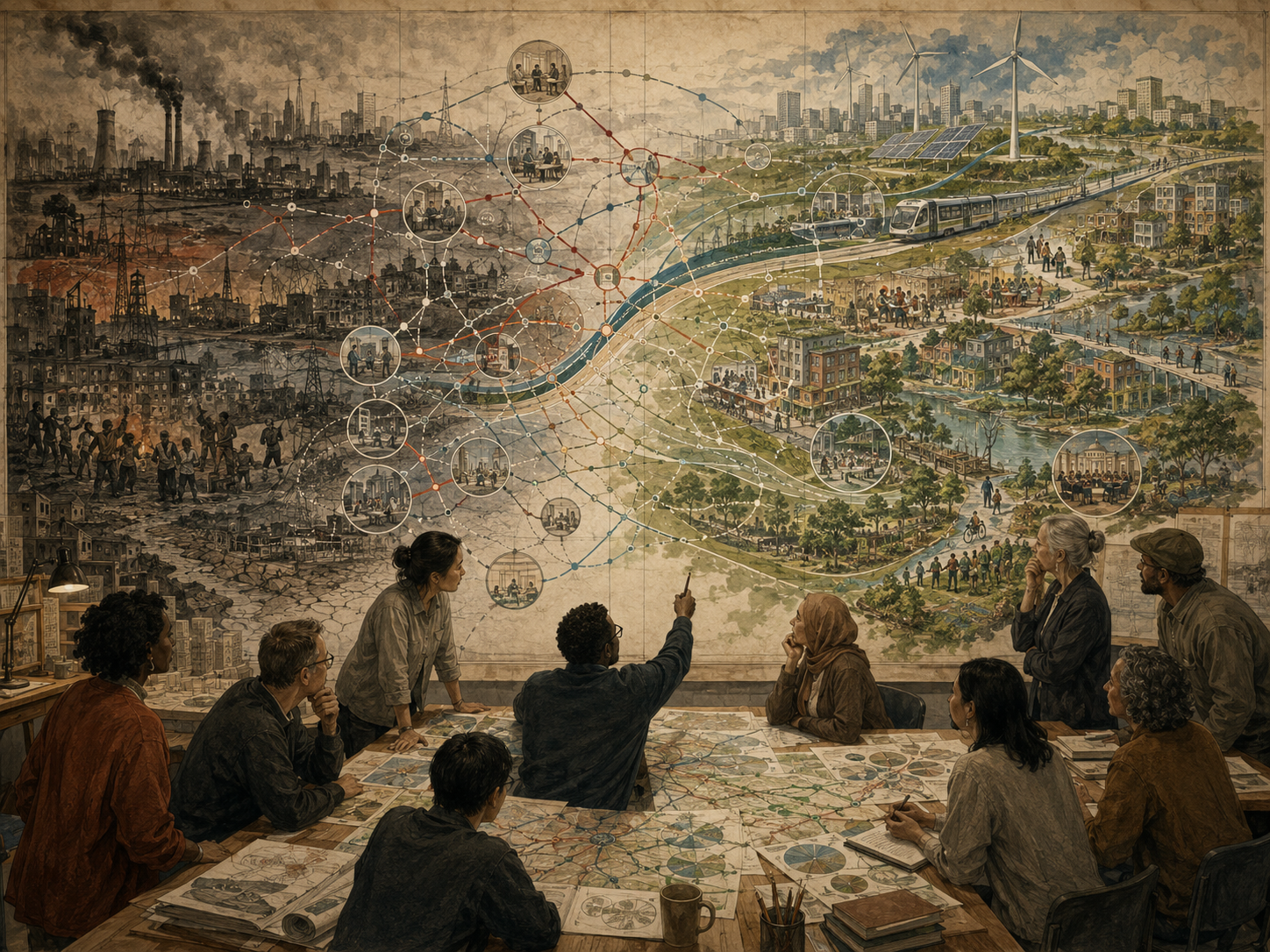
What Is Societal Transformation?
Societal transformation refers to fundamental changes in the structure, function, organization, and meaning of society. These changes go beyond incremental development, ordinary policy reform, market adjustment, or periodic political change. They involve reorganization at the level of systems, institutions, infrastructures, social relations, cultural expectations, and collective behavior.
Historical examples include the transition from agrarian to industrial economies, the rise of fossil-fuel industrial civilization, the expansion of globalized production and communication systems, the formation of mass education and welfare states, the digital transformation of work and communication, and the emerging shift toward climate-constrained and sustainability-oriented systems. In each case, transformation was not reducible to one invention, one reform, one leader, or one crisis. It involved a broader reordering of social relations, economic logic, political power, technological capacity, institutional design, and cultural expectation.
Transformation should therefore be understood as a change in the underlying architecture of collective life. It affects what societies can do, what they value, how they organize authority, how they distribute risk, what infrastructures they depend on, how people work, how communities reproduce themselves, and what futures become imaginable.
| Dimension | Ordinary Change | Societal Transformation |
|---|---|---|
| Scale | Limited to one sector, policy, organization, or practice. | Reorganizes multiple systems and institutions. |
| Depth | Changes surface-level behavior or rules. | Changes underlying structures, incentives, relations, and meanings. |
| Time Horizon | Often short to medium term. | Usually unfolds over years, decades, or generations. |
| System Interaction | May remain localized. | Spreads across technology, economy, ecology, culture, governance, and daily life. |
| Uncertainty | Often manageable with planning and forecasting. | Requires foresight, scenarios, adaptive strategy, and structural interpretation. |
| Power | May adjust existing arrangements. | Can redistribute power, risk, opportunity, voice, and vulnerability. |
Societal transformation is best understood not as isolated progress, but as a reconfiguration of the deep architecture of collective life.
Transformation vs Ordinary Change
Not every change is transformation. A policy revision, product launch, electoral cycle, new regulation, temporary market shift, or local disruption may matter, but it does not necessarily transform society. Transformation occurs when changes become structurally consequential: when they alter the rules, infrastructures, expectations, incentives, relationships, and capacities that organize social life.
The distinction matters because institutions often mistake transformation for a larger version of ordinary change. They respond with familiar tools: incremental reform, crisis management, short-term budgeting, narrow forecasting, technical modernization, or communication strategy. But when underlying conditions are shifting, incremental tools may preserve the very structures that are becoming fragile.
For example, climate adaptation is not simply a matter of improving emergency response. It may require rethinking land use, housing, insurance, infrastructure, food systems, public health, migration, energy systems, and intergenerational responsibility. Digital transformation is not simply the adoption of new platforms. It may reorganize labor, knowledge, public services, privacy, market power, and democratic accountability. Demographic transformation is not merely population change. It reshapes care systems, pensions, labor markets, housing, migration, family structures, and the moral economy of social support.
| Question | Indicates Ordinary Change | Indicates Transformation |
|---|---|---|
| Does the change remain within existing institutions? | Existing rules and structures absorb it. | Institutions must reorganize to remain viable. |
| Does it alter everyday life? | Effects are limited to specialized domains. | Work, care, mobility, communication, risk, and identity change broadly. |
| Does it redistribute power? | Existing power relations mostly persist. | Ownership, authority, voice, and vulnerability shift. |
| Does it change infrastructure dependence? | Existing infrastructure remains sufficient. | New infrastructure, standards, or maintenance systems become necessary. |
| Does it create new political conflicts? | Conflict remains routine or manageable. | Legitimacy, rights, distribution, and governance become contested. |
| Does it change future possibility? | Options remain broadly similar. | Some futures become easier, harder, impossible, or newly imaginable. |
Transformation begins when change stops being an event and becomes a new operating condition.
Major Drivers of Long-Term Change
Societal transformation is driven by multiple interacting forces rather than a single master variable. These drivers do not operate independently. They combine, reinforce, contradict, and reshape one another. A technological innovation may change labor systems, which changes political conflict, which changes regulation, which changes investment, which changes infrastructure, which changes the next technological pathway. Long-term change is relational.
1. Technological Innovation
Technological change alters production, communication, coordination, logistics, knowledge systems, warfare, medicine, education, infrastructure, surveillance, labor, and public administration. It connects directly to Technology Foresight, where emerging technologies shape future pathways. But technology does not transform society by technical capability alone. It becomes transformative when it interacts with capital, governance, standards, public trust, labor systems, and infrastructure.
2. Demographic and Social Change
Population aging, fertility shifts, urbanization, migration, changing household structures, education patterns, cultural change, and intergenerational expectations reshape labor systems, fiscal institutions, housing, care, political identity, public services, and social cohesion. Demographic change often unfolds slowly, but its institutional consequences can become profound.
3. Economic Restructuring
Changes in production systems, global trade, finance, automation, platform economies, labor relations, ownership, debt, inequality, industrial geography, and resource flows reshape opportunity, class structure, regional development, institutional legitimacy, and the everyday experience of security or precarity.
4. Environmental Pressures
Climate change, biodiversity loss, land degradation, water scarcity, pollution, resource stress, food-system instability, and ecological thresholds increasingly drive structural adaptation and transition. Environmental pressure turns ecological systems into active forces shaping infrastructure, migration, health, finance, insurance, security, and governance.
5. Institutional and Political Dynamics
Governance systems, state capacity, regulatory regimes, legitimacy crises, public trust, social movements, conflict, legal change, bureaucratic learning, and institutional reform determine how societies absorb, resist, delay, or redirect transformation. Institutions can stabilize societies, but they can also become barriers when conditions change.
6. Cultural Meaning and Collective Imagination
Societies are shaped not only by material forces, but by stories, identities, values, fears, hopes, metaphors, historical memory, religious traditions, ideological frames, and public imagination. Cultural meaning affects what futures seem desirable, legitimate, threatening, or impossible.
7. Infrastructure Systems
Energy, transport, water, housing, broadband, data systems, logistics, health systems, schools, public buildings, and maintenance regimes shape what societies can do. Infrastructure embeds past choices into the present and can either enable transformation or lock societies into fragile pathways.
8. Geopolitical Change
Power shifts, conflict, trade fragmentation, supply-chain risk, strategic competition, migration, debt, international law, and institutional cooperation influence transformation pathways across countries and regions. Global transformation is uneven because different societies face different constraints, histories, and positions in the world system.
| Driver | Transformation Effect | Foresight Question |
|---|---|---|
| Technology | Changes capability, labor, governance, communication, and power. | Which technologies reorganize systems rather than merely improve tools? |
| Demography | Changes care, labor, migration, housing, taxation, and social contracts. | Which institutions are built for a demographic structure that is disappearing? |
| Economy | Changes work, inequality, ownership, production, finance, and regional development. | Which economic arrangements are becoming unstable or illegitimate? |
| Environment | Changes infrastructure, health, migration, food, water, security, and public finance. | Where are ecological pressures becoming structural constraints? |
| Institutions | Shape capacity to adapt, coordinate, regulate, and remain legitimate. | Which institutions can learn, and which are locked into outdated assumptions? |
| Culture | Shapes public meaning, legitimacy, solidarity, fear, hope, and collective action. | Which futures are imaginable, and which are being suppressed or erased? |
| Infrastructure | Embeds long-term dependence and path constraint. | Which infrastructures enable resilience, and which preserve fragility? |
| Geopolitics | Changes security, supply chains, cooperation, development pathways, and sovereignty. | How do global power shifts alter local transformation options? |
These drivers rarely operate independently. Transformation occurs when they interact, reinforce one another, and alter the balance of stability within a system.
Patterns of Transformation in Complex Systems
Societal transformation often follows recognizable patterns within complex systems, although never in uniform or mechanically predictable ways. Long periods of apparent stability may hide accumulating pressure. Institutions may appear durable until legitimacy, finance, ecology, technology, and social trust weaken together. A sector may seem separate from wider society until cascading effects make interdependence visible.
Several broad patterns are especially important for futures thinking:
| Pattern | Description | Example |
|---|---|---|
| Gradual accumulation | Incremental developments accumulate over time until structural effects become visible. | Slow demographic aging eventually reshapes health systems, pensions, labor, housing, and care. |
| Disruption | A crisis, breakthrough, conflict, or shock accelerates change and destabilizes established arrangements. | A pandemic exposes weaknesses in labor, health, logistics, governance, and public trust. |
| Phase transition | A system crosses a threshold and reorganizes into a different regime or equilibrium. | Energy systems shift from fossil dependence toward renewables after cost, policy, and legitimacy align. |
| Lock-in | Existing infrastructure, incentives, capital, habits, and rules make change difficult even when alternatives exist. | Car-dependent urban form persists because housing, roads, zoning, finance, and behavior reinforce it. |
| Path dependency | Past choices constrain present and future options. | Industrial regions struggle to transition because skills, identity, infrastructure, and capital were built around older sectors. |
| Cascading change | Change in one system triggers change in others. | Climate stress affects insurance, housing, migration, public finance, energy demand, and political conflict. |
| Contested transition | Groups struggle over the direction, benefits, burdens, and legitimacy of transformation. | Energy transition creates conflict over jobs, land, mining, pricing, ownership, and community consent. |
This connects directly to Systems Modeling, where feedback loops, delay, stocks, flows, and nonlinear dynamics shape system behavior. What appears stable for long periods may in fact be building latent instability beneath the surface. When thresholds are crossed, change can appear sudden even though its foundations were accumulating for years.
Transformation is often nonlinear: long periods of slow movement can be followed by rapid systemic reorganization.
From Signals to Transformation
Societal transformation can often be understood as a progression from early signal detection to broad system change. Small developments emerge first at the margins. Over time, they accumulate into wider patterns, and those patterns can eventually reshape institutional and structural conditions.
This progression is central to futures thinking:
- Weak Signals and Early Indicators reveal emerging developments before they become mainstream.
- Horizon Scanning identifies patterns across domains and detects broader movement.
- Trend Analysis and Megatrends captures sustained directions of change.
- Early Warning Systems and Futures Intelligence connects signals to thresholds, assumptions, and response triggers.
- Strategic Robustness Across Futures tests whether strategies survive under multiple plausible conditions.
Not every signal becomes a transformation driver. Many signals remain local, temporary, weak, or misleading. But ignoring signals altogether makes large-scale change appear sudden when it is often long in formation. The discipline is to track signals without overreacting, interpret patterns without forcing certainty, and update assumptions when evidence changes.
| Stage | What It Looks Like | Transformation Question |
|---|---|---|
| Weak signal | A small, ambiguous, marginal, or early sign appears. | Could this indicate a deeper shift? |
| Emerging pattern | Signals repeat across places, sectors, or institutions. | Is this becoming more than noise? |
| Trend | Directionality becomes visible over time. | What is the pattern’s momentum and structural depth? |
| Megatrend | A long-wave force begins shaping multiple systems. | Which institutions, infrastructures, and communities are affected? |
| Threshold condition | Pressure accumulates near a tipping point or system limit. | What would trigger reorganization? |
| Transformation | The system reorganizes around new conditions. | Who benefits, who is harmed, and what strategies remain viable? |
Transformation rarely arrives without warning. More often, the warning signs are distributed, partial, unequal, and easy to dismiss until accumulation becomes undeniable.
Thresholds, Regime Shifts, and Structural Reorganization
Thresholds matter because systems do not always respond smoothly to pressure. A society may absorb stress for a long time, using buffers, institutions, debt, informal care, social trust, ecological reserves, infrastructure redundancy, or political compromise. But when buffers are exhausted, change can accelerate.
Thresholds can be ecological, technological, institutional, fiscal, cultural, or political. A public-health system may cross a threshold when staffing, trust, funding, and demand fall out of balance. A housing system may cross a threshold when cost, climate risk, insurance withdrawal, infrastructure burden, and displacement reinforce each other. A political system may cross a threshold when legitimacy, inequality, misinformation, and institutional failure combine. A technological system may cross a threshold when adoption, network effects, capital, and infrastructure align.
Regime shifts are not always desirable. A system can transform toward justice, resilience, and ecological stability; it can also transform toward authoritarian control, ecological abandonment, extractive adaptation, social fragmentation, or technological dependency. Futures thinking must therefore ask not only whether transformation is occurring, but what kind of transformation is being produced.
| Threshold Type | Example | Possible Regime Shift |
|---|---|---|
| Ecological threshold | Water scarcity, biodiversity loss, heat stress, or climate hazard frequency passes a critical level. | New settlement patterns, agricultural systems, public-health burdens, or migration pressures. |
| Infrastructure threshold | Maintenance backlog, energy demand, grid stress, or transit failure exceeds capacity. | Shift from reliable public systems to unequal service access and emergency management. |
| Technological threshold | Automation, AI, platform systems, or energy technology reaches mass adoption. | New labor relations, governance risks, and institutional dependencies. |
| Institutional threshold | Public trust, state capacity, or legal legitimacy falls below a workable level. | Fragmentation, reform, authoritarian response, or new institutional settlement. |
| Fiscal threshold | Emergency spending, debt, insurance costs, or deferred maintenance crowds out prevention. | Austerity, public investment transformation, or governance breakdown. |
| Cultural threshold | Shared expectations about work, care, authority, or future possibility change. | New social movements, political coalitions, moral frameworks, or identity conflicts. |
The danger is not only collapse. It is transformation without justice, foresight, accountability, or public consent.
Societal Transformation and Uncertainty
Long-term change is inherently uncertain because multiple drivers interact in ways that are difficult to model fully or predict precisely. Technological breakthroughs, policy changes, wars, financial crises, climate shocks, social movements, cultural shifts, pandemics, ecological disruptions, and institutional failures can alter transformation pathways unexpectedly.
This connects directly to Scenario Planning, where alternative futures are explored rather than one linear trajectory being assumed. Scenario thinking is valuable because transformation rarely follows a single expected path. The same drivers can produce very different futures depending on timing, governance, public trust, resource distribution, institutional capacity, conflict, and ecological constraints.
Uncertainty also arises because human systems are reflexive. People, organizations, firms, communities, and states do not merely experience transformation. They interpret it, react to it, resist it, accelerate it, profit from it, organize against it, or redirect it. This makes societal transformation strategically interactive rather than mechanically predictable.
| Uncertainty Type | Description | Futures Thinking Response |
|---|---|---|
| Driver uncertainty | Uncertainty about which forces will become most influential. | Use driver mapping and impact-uncertainty matrices. |
| Interaction uncertainty | Uncertainty about how drivers combine across systems. | Use systems modeling, cross-impact analysis, and scenario modeling. |
| Threshold uncertainty | Uncertainty about when a system crosses a critical point. | Use early warning indicators and adaptive triggers. |
| Governance uncertainty | Uncertainty about institutional response, legitimacy, capacity, and conflict. | Use anticipatory governance, stress testing, and institutional scenario planning. |
| Distributional uncertainty | Uncertainty about who benefits, who loses, and where harm concentrates. | Use equity analysis, participatory foresight, and justice-centered monitoring. |
| Meaning uncertainty | Uncertainty about how people interpret and respond to change. | Use cultural analysis, causal layered analysis, and public participation. |
Futures thinking is essential because it helps interpret transformation as a field of possibilities rather than as a single deterministic path.
Societal Transformation and Resilience
Transformation is closely linked to resilience because societies must adapt to change while maintaining essential functions, legitimacy, care, public trust, ecological viability, and social coherence. This connects directly to Resilience Thinking, which examines how systems absorb shocks, adapt, learn, and transform under pressure.
Resilient societies are not static societies. They evolve in response to changing conditions. In some cases, resilience means preserving core functions through adaptation. In others, it means recognizing that preservation of the old structure is neither possible nor desirable, and that deeper transformation is necessary. The ability to distinguish between adaptation, persistence, transformation, and abandonment is one of the most important tasks of long-term governance.
There is also a political danger. Resilience language can be used to shift responsibility onto vulnerable communities while institutions avoid structural reform. People may be told to adapt to systems that should be changed. Communities may be praised for resilience while being denied resources, rights, infrastructure, or protection. A serious transformation analysis must therefore ask whether resilience is being used to support justice or to normalize harm.
| Resilience Mode | Meaning | Transformation Risk |
|---|---|---|
| Persistence | The system maintains existing functions. | May preserve unjust or unsustainable structures. |
| Adaptation | The system adjusts practices while remaining broadly recognizable. | May be insufficient if underlying conditions change deeply. |
| Transformation | The system reorganizes around new structures, purposes, or relationships. | Can be liberatory or harmful depending on power, design, and distribution. |
| Maladaptation | Short-term adaptation increases long-term vulnerability. | May protect powerful groups while shifting risk to others. |
| Abandonment | Institutions withdraw responsibility while calling it adaptation. | Communities are left to absorb transformation without protection. |
| Just transformation | Structural change is guided by dignity, equity, care, participation, and ecological responsibility. | Requires real governance capacity, not only language. |
Resilience is not the opposite of transformation. In many cases, transformation is the way resilience becomes possible under new conditions.
Power, Politics, and Institutional Friction
Societal transformation is never purely technical. It is shaped by power, conflict, legitimacy, and institutional friction. Different groups benefit differently from existing systems and therefore have different incentives to resist, redirect, accelerate, or capture change. Institutions that were built to stabilize one social order may become obstacles to transition when conditions change.
This means transformation is not only a process of innovation or adaptation. It is also a struggle over whose future will be built, whose interests will be protected, whose costs will be externalized, whose knowledge will count, and whose losses will be called inevitable. Political economy matters because transformation pathways are shaped by ownership, governance, labor structure, finance, law, state capacity, media systems, and the distribution of organized power.
Institutional friction is not always bad. Some friction protects rights, slows dangerous technologies, prevents abuse, preserves democratic deliberation, and resists destructive acceleration. But friction can also defend unjust incumbencies, fossil dependence, racialized inequality, extractive development, land dispossession, monopolistic platform power, or austerity politics. Futures thinking must distinguish protective friction from obstructive inertia.
| Power Question | Why It Matters | Example |
|---|---|---|
| Who benefits from the existing system? | Incumbents may resist transformation that threatens assets or authority. | Fossil-fuel infrastructure, platform monopolies, speculative housing markets. |
| Who pays for transition? | Costs can be shifted to workers, communities, consumers, or future generations. | Energy price shocks, automation displacement, public austerity. |
| Who has authority to decide? | Transformation can be captured by narrow elites or technocratic institutions. | Technology procurement without community participation. | Whose knowledge counts? | Official data may ignore lived experience and local expertise. | Communities detect environmental harm before agencies recognize it. |
| Who is protected from harm? | Some groups receive adaptation, while others receive abandonment. | Unequal climate adaptation, unequal flood protection, unequal healthcare access. |
| Who can contest the future? | Democratic possibility depends on contestability and participation. | Public deliberation over AI, infrastructure, climate, land, and public services. |
A transformation is never just a structural shift. It is also a contested reordering of power.
Equity, Marginalized Voices, and Unequal Futures
Long-term change is experienced unequally. The future does not arrive at the same speed, in the same form, or with the same consequences for everyone. Marginalized communities often experience the pressures of transformation early: environmental exposure, housing insecurity, precarious work, surveillance, extractive development, public-service failure, health vulnerability, disaster risk, displacement, and institutional neglect.
This means marginalized voices are not secondary to transformation analysis. They are often early warning systems. Workers notice labor transformations before executives describe them. Tenants notice housing pressures before official models catch up. Indigenous communities, farmers, fishers, and local ecological stewards notice environmental changes before institutions act. Disabled people, migrants, racialized communities, low-income communities, and care workers often encounter institutional fragility first because they are closest to the burdens of system failure.
A futures-thinking approach that excludes these perspectives will miss both harm and possibility. It will likely reproduce dominant narratives: technology as progress, growth as development, adaptation as resilience, efficiency as improvement, and disruption as innovation. A justice-oriented approach asks who is being asked to absorb the transition and who is being allowed to shape it.
| Equity Lens | Transformation Question | Why It Matters |
|---|---|---|
| Exposure | Who is most exposed to ecological, economic, technological, or institutional risk? | Risk is patterned by geography, class, race, health, infrastructure, and political power. |
| Voice | Who participates in defining the future? | Participation affects legitimacy and reveals knowledge that expert-only processes miss. |
| Burden | Who pays the cost of transition or delay? | Transformation can shift costs downward while benefits move upward. |
| Recognition | Whose histories, harms, and knowledge systems are acknowledged? | Without recognition, foresight can reproduce historical injustice. |
| Repair | What past and present harms must be addressed for transformation to be just? | Future-oriented work cannot ignore accumulated injustice. |
| Agency | Who has real power to alter the pathway? | Consultation without power can become symbolic inclusion. |
Just transformation requires more than imagining better futures. It requires changing who has the power to define, contest, and build them.
Applications in Strategy, Policy, and Governance
Understanding societal transformation is essential across multiple domains of strategy and governance. In each domain, foresight helps decision-makers move beyond short-term crisis response and toward long-horizon structural judgment.
| Domain | Transformation Challenge | Foresight Application |
|---|---|---|
| Public policy | Governments must respond to climate, technology, demography, inequality, and institutional trust under uncertainty. | Use scenario planning, anticipatory governance, public-sector foresight capacity, and adaptive policy cycles. |
| Business strategy | Firms face technological disruption, labor change, market shifts, regulation, supply-chain risk, and social legitimacy pressures. | Use strategic robustness, market scenarios, innovation portfolios, and transition risk analysis. |
| Sustainability | Ecological limits require transformation in energy, food, land, cities, finance, consumption, and development models. | Use backcasting, climate futures, transition pathways, and resilience assessment. |
| Urban planning | Cities face housing, mobility, heat, water, inequality, infrastructure, and migration pressures. | Use urban futures, infrastructure scenarios, climate adaptation pathways, and participatory planning. |
| Public health | Health systems face aging, climate hazards, disease ecology, workforce strain, biotechnology, and inequality. | Use health futures, early warning systems, and preparedness scenarios. |
| Education | Learning systems must prepare people for uncertainty, technological change, civic complexity, and ecological responsibility. | Use futures literacy, workforce scenarios, and institutional adaptation analysis. |
| Global development | Development pathways are shaped by debt, climate, inequality, migration, technology, trade, and governance capacity. | Use plural futures, structural transformation analysis, and justice-centered development scenarios. |
| Civil society | Communities and movements must contest harmful futures and build alternative possibilities. | Use participatory foresight, community futures, power mapping, and narrative change. |
Transformation analysis is useful not only for describing what is changing, but for identifying what kinds of action become necessary when systems are shifting at depth.
Strategic Questions for Long-Term Transformation
Institutions often ask whether change is coming. A deeper futures question is whether the institution is still organized around assumptions that are expiring. Societal transformation forces strategic questions about purpose, capacity, legitimacy, adaptation, and justice.
| Strategic Question | What It Reveals | Example |
|---|---|---|
| What assumptions are we carrying from a disappearing world? | Outdated mental models and legacy planning assumptions. | Assuming stable climate, cheap energy, predictable labor, or continuous growth. |
| Which systems are absorbing pressure invisibly? | Hidden buffers that may fail suddenly. | Informal care, unpaid labor, infrastructure maintenance, ecological reserves. |
| Which signals are we dismissing because they come from the margins? | Institutional blind spots and suppressed knowledge. | Worker reports, tenant experiences, local ecological knowledge, community warnings. |
| Where are we optimizing a system that should be transformed? | Misplaced efficiency within failing structures. | Improving fossil-dependent systems without transition planning. |
| Who gains from delay? | Incumbent power and political economy barriers. | Industries, owners, or institutions benefiting from current arrangements. |
| What would just transformation require? | Structural commitments beyond adaptation language. | Redistribution, public investment, participation, repair, ecological responsibility. |
| What must be preserved, what must adapt, and what must end? | Distinguishes resilience from harmful continuity. | Preserve care; adapt institutions; phase out destructive extraction. |
Strategic foresight becomes serious when it helps institutions confront not only what may change, but what must change.
Limitations and Challenges
Analyzing societal transformation presents real challenges. Complex systems are difficult to model fully. Data may be incomplete, lagged, biased, inaccessible, or politically shaped. Short-term noise can obscure long-range structural change. Analysts may overstate continuity or exaggerate rupture. Institutions may recognize transformation only after it has already altered their operating environment.
There is also the problem of interpretive bias. What counts as transformation depends partly on analytical frame. Some observers may see innovation where others see displacement. Some may see resilience where others see abandonment. Some may see efficiency where others see extraction. Some may see adaptation where others see the powerful protecting themselves while shifting risk elsewhere.
There is also a danger of fatalism. Transformation analysis can become so large-scale that it makes action feel impossible. Futures thinking should avoid both naive control and passive resignation. Societies cannot control every driver, but they can identify leverage points, protect vulnerable people, build adaptive capacity, contest harmful pathways, and preserve future options.
| Challenge | Risk | Corrective Practice |
|---|---|---|
| Complexity | Analysts oversimplify or become overwhelmed. | Use systems maps, scenarios, driver analysis, and layered interpretation. |
| Data limits | Important dynamics remain invisible. | Combine quantitative data, qualitative evidence, community knowledge, and expert judgment. |
| Short-termism | Immediate crises crowd out structural thinking. | Create long-term review cycles, early warning systems, and institutional foresight capacity. |
| Interpretive bias | Dominant narratives define what counts as change. | Use plural perspectives, marginalized voices, and reflexive analysis. |
| Technocratic capture | Transformation is framed as expert management rather than public choice. | Include democratic participation, accountability, and contestability. |
| Fatalism | Scale of change leads to paralysis. | Identify leverage points, pathways, protective measures, and near-term decisions. |
The challenge is not simply to detect change, but to interpret its depth, direction, and systemic meaning with enough seriousness to act before institutions are overtaken by it.
Mathematical Lens: Transformation, Feedback, and Threshold Change
A stylized way to represent long-term transformation is as an interaction among multiple drivers over time:
T_{t+1} = T_t + \alpha X_t + \beta Y_t + \gamma Z_t
\]
Interpretation: \(T_t\) is the state of societal transformation at time \(t\), while \(X_t\), \(Y_t\), and \(Z_t\) represent interacting drivers such as technological change, demographic shift, ecological stress, economic restructuring, or institutional reform. The coefficients indicate the relative influence of each driver. The point is conceptual: transformation grows through interacting forces rather than isolated inputs.
Threshold behavior can be represented more generally as:
\frac{dS}{dt} = f(S, D, F)
\]
Interpretation: \(S\) is system state, \(D\) is destabilizing pressure, and \(F\) is feedback structure. Under some conditions, the system adjusts gradually; under others, feedback and pressure push the system across a threshold and into rapid reorganization.
A resilience-oriented transformation problem can also be written as:
R_t = B_t – P_t + A_t
\]
Interpretation: \(R_t\) is resilience, \(B_t\) is buffering capacity, \(P_t\) is accumulated pressure, and \(A_t\) is adaptive response. This clarifies the link between transformation and resilience: when pressure overwhelms buffering capacity, adaptation must deepen or the system loses viability.
A justice-oriented transformation score can be represented conceptually as:
J_t = V_t + P_t + R_t – H_t
\]
Interpretation: \(J_t\) is a justice-oriented transformation profile, \(V_t\) is voice, \(P_t\) is protection, \(R_t\) is repair, and \(H_t\) is harm concentration. This is not a universal metric; it is a reminder that transformation quality depends on more than aggregate adaptation or growth.
A scenario profile for transformation can be written as:
\Theta_s = \{D_s, I_s, E_s, G_s, Q_s\}
\]
Interpretation: \(\Theta_s\) is the transformation profile of scenario \(s\), including drivers \(D_s\), institutional capacity \(I_s\), ecological pressure \(E_s\), governance legitimacy \(G_s\), and equity conditions \(Q_s\). This supports comparison across multiple futures rather than reliance on one expected pathway.
These equations do not predict societal transformation. They make the relationships easier to inspect: drivers interact, feedback matters, thresholds alter behavior, resilience depends on buffering and adaptation, and justice depends on how harms and voice are distributed.
Computational Modeling for Societal Transformation
Computational modeling can support societal transformation analysis by making assumptions explicit, comparing scenarios, simulating interacting drivers, identifying pressure points, and documenting how changes in one domain affect others. The goal is not to mechanize society or pretend transformation can be predicted precisely. The goal is to make reasoning clearer and more reproducible.
A professional transformation workflow may include:
- Driver register: technology, demography, ecology, economy, institutions, infrastructure, culture, and geopolitics.
- Signal register: weak signals, early indicators, threshold warnings, and institutional stress markers.
- Transformation profiles: scenario records comparing structural depth, social cohesion, ecological stress, institutional adaptability, and economic restructuring.
- Pressure indicators: ecological stress, fiscal strain, infrastructure backlog, trust divergence, care burden, housing stress, and labor precarity.
- Equity indicators: burden concentration, exposure, voice, participation, protection, and repair.
- Scenario simulations: alternative pathways under different levels of coordination, legitimacy, ecological pressure, and technological acceleration.
- Strategy tests: evaluation of policy, investment, governance, and institutional adaptation across multiple futures.
- Learning records: assumptions, revisions, missed signals, false alarms, and lessons from implementation.
Models should be treated as disciplined aids to judgment. They can show how interacting drivers produce different trajectories, but they cannot resolve political questions by themselves. They should be paired with participatory foresight, historical analysis, qualitative interpretation, and public accountability.
Computational transformation analysis is most useful when it exposes assumptions, not when it hides them behind scores.
Advanced R Workflow: Comparing Long-Term Transformation Profiles
The R workflow below compares several stylized transformation futures across technological intensity, institutional adaptability, ecological stress, social cohesion, economic restructuring, equity protection, and public legitimacy. It is designed as an evergreen illustration of how long-term change can be analyzed as a multidimensional transformation profile rather than as one dominant variable.
# ------------------------------------------------------------
# R Workflow: Comparing Long-Term Transformation Profiles
# Purpose:
#   Build stylized profiles across several societal futures
#   using technological, institutional, ecological, social,
#   economic, equity, and legitimacy dimensions.
#
# Optional dependency:
#   install.packages(c("tidyverse"))
# ------------------------------------------------------------

library(tidyverse)

futures <- tibble(
  future_type = c(
    "Fragmented Disruptive Transition",
    "Coordinated Adaptive Transformation",
    "Technologically Accelerated Uneven Future",
    "Ecologically Constrained Social Reordering",
    "Justice-Centered Public Transformation"
  ),
  technological_intensity = c(0.74, 0.62, 0.88, 0.49, 0.58),
  institutional_adaptability = c(0.36, 0.81, 0.44, 0.52, 0.78),
  ecological_stress = c(0.68, 0.39, 0.58, 0.84, 0.44),
  social_cohesion = c(0.31, 0.78, 0.42, 0.47, 0.74),
  economic_restructuring = c(0.72, 0.61, 0.83, 0.56, 0.68),
  equity_protection = c(0.28, 0.70, 0.34, 0.46, 0.86),
  public_legitimacy = c(0.30, 0.76, 0.40, 0.48, 0.82)
)

futures <- futures %>%
  mutate(
    transformation_depth =
      0.18 * technological_intensity +
      0.18 * economic_restructuring +
      0.18 * ecological_stress +
      0.16 * institutional_adaptability +
      0.14 * social_cohesion +
      0.08 * equity_protection +
      0.08 * public_legitimacy,

    just_transition_capacity =
      0.22 * institutional_adaptability +
      0.22 * equity_protection +
      0.20 * public_legitimacy +
      0.18 * social_cohesion +
      0.10 * (1 - ecological_stress) +
      0.08 * economic_restructuring,

    fragility_score =
      0.26 * ecological_stress +
      0.22 * (1 - institutional_adaptability) +
      0.20 * (1 - social_cohesion) +
      0.18 * (1 - public_legitimacy) +
      0.14 * (1 - equity_protection),

    transformation_class = case_when(
      just_transition_capacity >= 0.72 ~ "Strong just-transformation capacity",
      fragility_score >= 0.62 ~ "Fragile or high-risk transformation",
      TRUE ~ "Contested transition pathway"
    )
  ) %>%
  arrange(desc(just_transition_capacity))

print(futures)

futures_long <- futures %>%
  select(
    future_type,
    technological_intensity,
    institutional_adaptability,
    ecological_stress,
    social_cohesion,
    economic_restructuring,
    equity_protection,
    public_legitimacy
  ) %>%
  pivot_longer(
    cols = -future_type,
    names_to = "dimension",
    values_to = "value"
  )

ggplot(futures_long, aes(x = dimension, y = value, fill = future_type)) +
  geom_col(position = "dodge") +
  coord_flip() +
  labs(
    title = "Stylized Societal Transformation Dimensions",
    x = "Dimension",
    y = "Value",
    fill = "Future Type"
  ) +
  theme_minimal(base_size = 12)

ggplot(futures, aes(x = reorder(future_type, just_transition_capacity), y = just_transition_capacity)) +
  geom_col() +
  coord_flip() +
  labs(
    title = "Just Transformation Capacity by Future Type",
    x = "Future Type",
    y = "Just Transformation Capacity"
  ) +
  theme_minimal(base_size = 12)

dir.create("outputs", showWarnings = FALSE)

write_csv(futures, "outputs/societal_transformation_profiles.csv")
This workflow shows how transformation can be profiled across multiple dimensions. A future can be highly transformative and still fragile if legitimacy, equity, cohesion, or institutional capacity are weak.
Advanced Python Workflow: Simulating Structural Change Under Interacting Drivers
The Python workflow below simulates stylized structural change under interacting technological, ecological, institutional, economic, and legitimacy drivers. It is useful for showing why long-term transformation can appear gradual at first and then accelerate once pressures accumulate or adaptive capacity changes.
# ------------------------------------------------------------
# Python Workflow: Simulating Structural Change
# Purpose:
#   Compare stylized societal pathways under interacting
#   technological, ecological, institutional, economic,
#   legitimacy, and equity conditions.
#
# Optional dependencies:
#   pip install pandas numpy matplotlib
# ------------------------------------------------------------

from pathlib import Path

import numpy as np
import pandas as pd
import matplotlib.pyplot as plt

OUTPUT_DIR = Path("outputs")
OUTPUT_DIR.mkdir(exist_ok=True)

time_steps = np.arange(1, 41)

systems = [
    {
        "system": "Adaptive Coordinated Society",
        "technology": 0.66,
        "institution": 0.78,
        "ecology": 0.42,
        "economic_restructuring": 0.58,
        "public_legitimacy": 0.76,
        "equity_protection": 0.72
    },
    {
        "system": "Fragmented High-Stress Society",
        "technology": 0.71,
        "institution": 0.38,
        "ecology": 0.78,
        "economic_restructuring": 0.74,
        "public_legitimacy": 0.34,
        "equity_protection": 0.28
    },
    {
        "system": "Technologically Accelerated Uneven Society",
        "technology": 0.88,
        "institution": 0.44,
        "ecology": 0.58,
        "economic_restructuring": 0.82,
        "public_legitimacy": 0.40,
        "equity_protection": 0.32
    },
    {
        "system": "Justice-Centered Public Transformation",
        "technology": 0.58,
        "institution": 0.80,
        "ecology": 0.44,
        "economic_restructuring": 0.68,
        "public_legitimacy": 0.82,
        "equity_protection": 0.86
    }
]

def simulate_system(
    technology,
    institution,
    ecology,
    economic_restructuring,
    public_legitimacy,
    equity_protection,
    initial_viability=1.0
):
    viability = np.zeros(len(time_steps))
    pressure_index = np.zeros(len(time_steps))
    transformation_depth = np.zeros(len(time_steps))

    viability[0] = initial_viability
    pressure_index[0] = ecology + economic_restructuring
    transformation_depth[0] = 0.30

    for t in range(1, len(time_steps)):
        periodic_shock = 0.10 * ecology if (t + 1) % 9 == 0 else 0.035 * ecology

        structural_pressure = (
            0.26 * ecology +
            0.18 * economic_restructuring +
            0.16 * (1 - public_legitimacy) +
            0.16 * (1 - equity_protection) +
            periodic_shock
        )

        adaptive_capacity = (
            0.24 * institution +
            0.18 * technology +
            0.18 * public_legitimacy +
            0.18 * equity_protection
        )

        threshold_effect = 0.08 if structural_pressure > adaptive_capacity else 0.00

        viability[t] = (
            viability[t - 1]
            - structural_pressure / 5
            + adaptive_capacity / 4
            - threshold_effect
        )

        viability[t] = np.clip(viability[t], 0, 2.0)

        pressure_index[t] = np.clip(structural_pressure + pressure_index[t - 1] * 0.92, 0, 2.5)

        transformation_depth[t] = np.clip(
            transformation_depth[t - 1]
            + 0.04 * technology
            + 0.04 * economic_restructuring
            + 0.03 * ecology
            + 0.02 * institution,
            0,
            2.5
        )

    return viability, pressure_index, transformation_depth

rows = []

for system in systems:
    viability, pressure, depth = simulate_system(
        technology=system["technology"],
        institution=system["institution"],
        ecology=system["ecology"],
        economic_restructuring=system["economic_restructuring"],
        public_legitimacy=system["public_legitimacy"],
        equity_protection=system["equity_protection"]
    )

    for t, v, p, d in zip(time_steps, viability, pressure, depth):
        rows.append({
            "system": system["system"],
            "time": t,
            "transformation_viability": v,
            "pressure_index": p,
            "transformation_depth": d
        })

df = pd.DataFrame(rows)

summary = (
    df.groupby("system")
    .agg(
        final_viability=("transformation_viability", "last"),
        mean_viability=("transformation_viability", "mean"),
        max_pressure=("pressure_index", "max"),
        final_transformation_depth=("transformation_depth", "last")
    )
    .reset_index()
    .sort_values("final_viability", ascending=False)
)

print(summary)

plt.figure(figsize=(10, 6))
for system_name in df["system"].unique():
    subset = df[df["system"] == system_name]
    plt.plot(subset["time"], subset["transformation_viability"], label=system_name)

plt.xlabel("Time Step")
plt.ylabel("Transformation Viability")
plt.title("Structural Change Under Interacting Drivers")
plt.legend()
plt.tight_layout()
plt.savefig(OUTPUT_DIR / "societal_transformation_viability_paths.png", dpi=150)
plt.close()

plt.figure(figsize=(10, 6))
for system_name in df["system"].unique():
    subset = df[df["system"] == system_name]
    plt.plot(subset["time"], subset["pressure_index"], label=system_name)

plt.xlabel("Time Step")
plt.ylabel("Pressure Index")
plt.title("Accumulated Pressure Across Transformation Pathways")
plt.legend()
plt.tight_layout()
plt.savefig(OUTPUT_DIR / "societal_transformation_pressure_paths.png", dpi=150)
plt.close()

df.to_csv(OUTPUT_DIR / "societal_transformation_paths.csv", index=False)
summary.to_csv(OUTPUT_DIR / "societal_transformation_summary.csv", index=False)
This workflow shows why transformation cannot be assessed by speed alone. A pathway may transform rapidly while becoming fragile, unequal, or illegitimate. A slower pathway may build stronger institutional and social capacity if it protects equity, legitimacy, and adaptive learning.
GitHub Repository
The companion repository for this article contains computational examples for societal transformation profiles, interacting drivers, long-term change simulation, system pressure, institutional adaptability, social cohesion, equity protection, transformation viability, scenario comparison, and reproducible futures workflows.
Complete Code Repository
The companion code includes Python, R, Julia, SQL, Rust, Go, C++, Fortran, C, documentation, synthetic datasets, outputs, and notebook placeholders for applied societal transformation and long-term change workflows.
Why This Matters
Societal transformation and long-term change shape the context within which all strategic decisions are made. Understanding these processes helps organizations, governments, communities, and institutions anticipate structural shifts, adapt strategy, protect vulnerable people, and navigate uncertainty with more intelligence.
In a rapidly changing world, the ability to understand transformation is not a theoretical luxury. It is a practical capability that connects futures thinking to real-world action. Climate stress, AI, demographic change, infrastructure fragility, public distrust, economic inequality, migration, labor transformation, and ecological limits are not isolated issues. They are interacting pressures that can reorganize society itself.
The stakes are high because transformation will occur whether or not institutions are prepared. The choice is not between change and no change. The choice is between reactive transformation and anticipatory transformation; between adaptation that protects the powerful and transformation that expands dignity; between futures imposed by crisis and futures shaped through public responsibility.
This is where futures thinking reaches one of its highest purposes: not merely describing change, but helping societies interpret and shape it before the structure of possibility narrows further.
Related Articles
- Futures Thinking
- What Is Futures Thinking?
- Technology Foresight
- AI and the Future of Decision-Making
- Trend Analysis and Megatrends
- Weak Signals and Early Indicators
- Scenario Planning
- Systems Foresight and Structural Change
- Foresight Data Systems and Reproducible Workflows
- Systems Modeling
- Resilience Thinking
- Futures Thinking and Sustainability
Further Reading
- Geels, F.W. (2002) ‘Technological transitions as evolutionary reconfiguration processes: A multi-level perspective and a case-study’, Research Policy, 31(8–9), pp. 1257–1274.
- Geels, F.W. (2011) ‘The multi-level perspective on sustainability transitions: Responses to seven criticisms’, Environmental Innovation and Societal Transitions, 1(1), pp. 24–40.
- Grin, J., Rotmans, J. and Schot, J. (2010) Transitions to Sustainable Development: New Directions in the Study of Long Term Transformative Change. New York: Routledge.
- Meadows, D.H. (2008) Thinking in Systems: A Primer. White River Junction, VT: Chelsea Green.
- Organisation for Economic Co-operation and Development (OECD) (2025) Strategic Foresight Toolkit for Resilient Public Policy. Paris: OECD Publishing. Available at: https://www.oecd.org/en/publications/foresight-toolkit-for-resilient-public-policy_bcdd9304-en.html.
- O’Brien, K. (2012) ‘Global environmental change II: From adaptation to deliberate transformation’, Progress in Human Geography, 36(5), pp. 667–676.
- O’Brien, K. and Sygna, L. (2013) ‘Responding to climate change: The three spheres of transformation’, in Proceedings of Transformation in a Changing Climate. Oslo: University of Oslo.
- Schot, J. and Steinmueller, W.E. (2018) ‘Three frames for innovation policy: R&D, systems of innovation and transformative change’, Research Policy, 47(9), pp. 1554–1567.
- United Nations Development Programme (UNDP) (2018) Foresight Manual: Empowered Futures for the 2030 Agenda. New York: UNDP. Available at: https://www.undp.org/publications/foresight-manual-empowered-futures.
- Westley, F., Olsson, P., Folke, C., Homer-Dixon, T., Vredenburg, H., Loorbach, D., Thompson, J., Nilsson, M., Lambin, E., Sendzimir, J., Banerjee, B., Galaz, V. and van der Leeuw, S. (2011) ‘Tipping toward sustainability: Emerging pathways of transformation’, Ambio, 40(7), pp. 762–780.
References
- European Commission (2023) 2023 Strategic Foresight Report: Sustainability and People’s Wellbeing at the Heart of Europe’s Open Strategic Autonomy. Brussels: European Commission. Available at: https://commission.europa.eu/strategy-and-policy/strategic-foresight/2023-strategic-foresight-report_en.
- Geels, F.W. (2002) ‘Technological transitions as evolutionary reconfiguration processes: A multi-level perspective and a case-study’, Research Policy, 31(8–9), pp. 1257–1274.
- Geels, F.W. (2011) ‘The multi-level perspective on sustainability transitions: Responses to seven criticisms’, Environmental Innovation and Societal Transitions, 1(1), pp. 24–40.
- Grin, J., Rotmans, J. and Schot, J. (2010) Transitions to Sustainable Development: New Directions in the Study of Long Term Transformative Change. New York: Routledge.
- Intergovernmental Panel on Climate Change (IPCC) (2022) Climate Change 2022: Impacts, Adaptation and Vulnerability. Geneva: IPCC. Available at: https://www.ipcc.ch/report/ar6/wg2/.
- Intergovernmental Panel on Climate Change (IPCC) (2022) Chapter 18: Climate Resilient Development Pathways. In: Climate Change 2022: Impacts, Adaptation and Vulnerability. Geneva: IPCC. Available at: https://www.ipcc.ch/report/ar6/wg2/chapter/chapter-18/.
- Meadows, D.H. (2008) Thinking in Systems: A Primer. White River Junction, VT: Chelsea Green.
- Organisation for Economic Co-operation and Development (OECD) (2025) Strategic Foresight Toolkit for Resilient Public Policy. Paris: OECD Publishing. Available at: https://www.oecd.org/en/publications/foresight-toolkit-for-resilient-public-policy_bcdd9304-en.html.
- O’Brien, K. (2012) ‘Global environmental change II: From adaptation to deliberate transformation’, Progress in Human Geography, 36(5), pp. 667–676.
- O’Brien, K. and Sygna, L. (2013) ‘Responding to climate change: The three spheres of transformation’, in Proceedings of Transformation in a Changing Climate. Oslo: University of Oslo.
- Rotmans, J., Kemp, R. and van Asselt, M. (2001) ‘More evolution than revolution: Transition management in public policy’, Foresight, 3(1), pp. 15–31.
- Schot, J. and Steinmueller, W.E. (2018) ‘Three frames for innovation policy: R&D, systems of innovation and transformative change’, Research Policy, 47(9), pp. 1554–1567.
- United Nations Development Programme (UNDP) (2018) Foresight Manual: Empowered Futures for the 2030 Agenda. New York: UNDP. Available at: https://www.undp.org/publications/foresight-manual-empowered-futures.
- Westley, F., Olsson, P., Folke, C., Homer-Dixon, T., Vredenburg, H., Loorbach, D., Thompson, J., Nilsson, M., Lambin, E., Sendzimir, J., Banerjee, B., Galaz, V. and van der Leeuw, S. (2011) ‘Tipping toward sustainability: Emerging pathways of transformation’, Ambio, 40(7), pp. 762–780.