
Last Updated May 21, 2026
Group polarization and collective judgment describe what happens when discussion does not simply aggregate individual views, but changes them. In many groups, deliberation among like-minded people shifts members toward more extreme positions in the direction of their initial inclinations. Instead of producing moderation, balance, or careful correction, discussion can intensify confidence, sharpen identity, narrow acceptable disagreement, and make collective decisions more extreme than the average member’s starting position.
This phenomenon matters because many institutions depend on group judgment. Juries, boards, legislatures, classrooms, executive teams, expert panels, online communities, political movements, advisory bodies, and scientific committees all rely on discussion to improve decisions. Group polarization shows why that hope is conditional. Collective judgment improves when groups pool diverse evidence, protect dissent, test assumptions, and reward accuracy. It deteriorates when groups are homogeneous, identity-driven, norm-enforcing, algorithmically reinforced, or socially structured to punish moderation.
A serious treatment of group polarization must therefore connect social psychology to institutional design. The central question is not only why people become more extreme after discussion. It is how discussion environments shape judgment: which arguments become visible, whose dissent is protected, which positions gain status, how identity and loyalty influence speech, and whether the group is designed to pursue truth, solidarity, victory, or reputation.
Main Library
Publications
Article Map
Social Psychology
Related Topic
Stewardship & Ethics
Related Topic
Behavioral Economics
Related Topic
Institutions & Governance
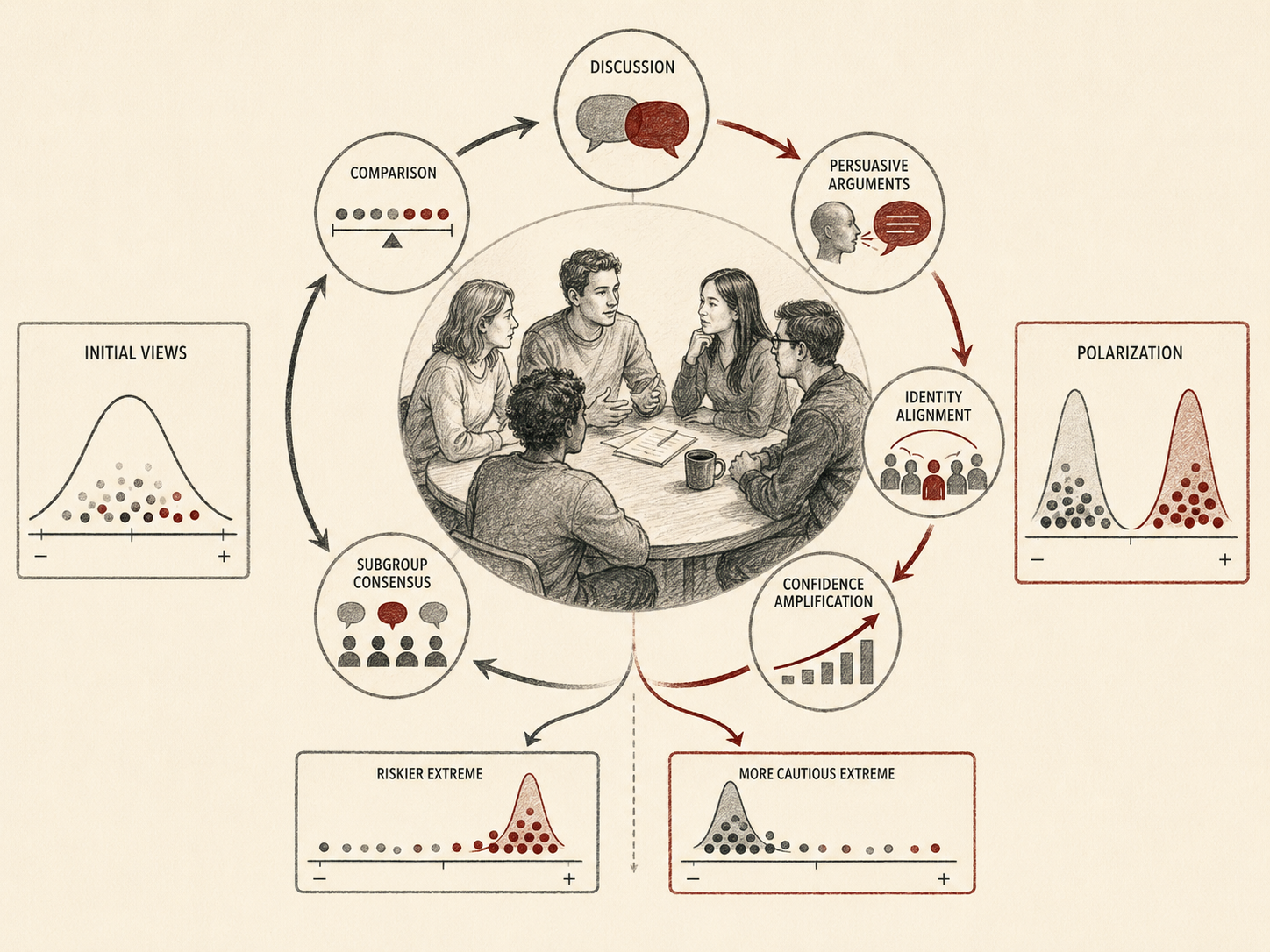
Group polarization connects closely to conformity and social influence, groupthink, social identity theory, social comparison theory, social norms, intergroup conflict, collective action and social change, cognitive biases in decision-making, and decision-making in cognitive psychology. Together these frameworks show how groups transform individual judgments into collective positions, sometimes improving decisions and sometimes amplifying error.
What is group polarization?
Group polarization occurs when discussion among people with similar initial attitudes shifts the group toward a more extreme position in the direction of those initial attitudes. The shift can involve risk preference, political opinion, moral judgment, punishment preference, institutional strategy, legal judgment, organizational policy, or confidence in a disputed claim.
If members begin slightly cautious, discussion may make them more cautious. If they begin somewhat risk-seeking, discussion may make them more willing to take risks. If they begin with a shared political orientation, discussion may intensify that orientation. If they begin convinced that a strategy is promising, discussion may make the strategy feel more obvious, urgent, and legitimate than it did before.
The key feature is directional amplification. Group discussion does not merely produce an average of initial opinions. It can move the group farther along the dominant initial tendency. This is why group polarization is so important for collective judgment. Discussion can strengthen a group’s confidence without improving its accuracy.
Group polarization is not limited to extreme groups. It can occur in ordinary committees, classrooms, work teams, friend groups, professional networks, online forums, activist organizations, partisan communities, and institutional decision bodies. The mechanism is often mundane: people hear more arguments on one side, compare themselves to group norms, signal loyalty, avoid dissent, and update their confidence based on apparent consensus.
The phenomenon challenges an idealized view of deliberation. Discussion can improve judgment, but only under certain conditions. Without viewpoint diversity, protected dissent, evidence discipline, and procedural safeguards, discussion may make groups more certain rather than more correct.
Why collective judgment is the larger problem
Group polarization is often discussed as an attitude phenomenon, but its deeper importance lies in collective judgment. Groups do not merely hold opinions. They make decisions, allocate resources, punish people, approve strategies, interpret evidence, define risks, set policy, and determine which forms of dissent are legitimate.
Collective judgment becomes dangerous when groups confuse intensity with accuracy. A group may emerge from discussion more confident, more unified, and more rhetorically prepared, while also becoming less accurate, less open to correction, and less aware of ignored evidence. Polarization can therefore create a false sense of epistemic strength: the group feels wiser because it feels more certain.
This is especially important in institutions. Boards may become overconfident about a merger. Political factions may become more convinced that opponents are enemies. Juries may shift toward harsher punishment. Online communities may radicalize around a moral narrative. Expert teams may converge prematurely around a flawed model. Social movements may escalate tactics after internal discussion among highly committed members.
Collective judgment requires more than discussion. It requires disciplined disagreement, evidence review, independence before convergence, minority-view protection, and procedures that separate loyalty from accuracy. When those safeguards are absent, group discussion may intensify error.
The practical question is therefore not “Do groups deliberate?” but “What kind of deliberation do they practice?” A group can talk extensively and still fail to think well.
Historical foundations of polarization research
The modern study of group polarization emerged from research on group decision-making in the 1960s. Early studies investigated the “risky shift,” the finding that groups sometimes made riskier decisions than individuals. This challenged the assumption that groups naturally average out individual risk preferences.
Researchers soon discovered that the effect was broader than risk. Groups did not always shift toward risk; they could also shift toward caution. The direction depended on the initial tendency of the members and the values made salient by the discussion. If the group initially leaned toward risk, discussion could intensify risk. If it leaned toward caution, discussion could intensify caution.
This broader pattern led to the concept of group polarization. Moscovici and Zavalloni’s work was central to the shift from risky-shift research to a more general theory of attitude polarization. Later reviews by Myers and Lamm and meta-analytic work by Isenberg clarified the major mechanisms and boundary conditions.
The historical importance of the field lies in its challenge to naïve deliberative optimism. Discussion is not a neutral container for reason. It is a social process structured by information, comparison, identity, norms, status, and power.
That insight remains urgent. Modern institutions often rely on committees, panels, boards, and online publics to produce judgment. Group polarization research shows why those forms can fail unless they are deliberately designed to resist one-sided amplification.
From risky shift to group polarization
The early risky-shift literature found that group decisions could become riskier than the average of members’ individual pre-discussion decisions. At first, researchers asked why groups seemed to increase risk-taking. But subsequent work showed that the phenomenon was not risk itself. It was directional movement.
Groups shifted toward the pole favored by their initial orientation. If the issue was one where risk was socially valued, discussion moved the group toward risk. If the issue was one where caution was socially valued, discussion moved the group toward caution. This meant that discussion amplified dominant value tendencies rather than producing a universal risk effect.
This shift in theory matters because it moves attention from risk preference to social meaning. Risk-taking is not inherently polarizing. What matters is whether a stance becomes associated with courage, prudence, loyalty, moral seriousness, expertise, toughness, compassion, sophistication, or group belonging.
For example, in one group, supporting a harsh policy may signal strength. In another, rejecting that policy may signal moral clarity. In one organization, aggressive expansion may signal leadership. In another, caution may signal responsibility. Polarization follows the direction of the group’s valued identity and argument environment.
The risky-shift literature therefore became a foundation for a broader theory: discussion moves groups when information and social comparison point in a consistent direction.
Psychological mechanisms of polarization
Group polarization is not caused by a single mechanism. Several processes usually interact during discussion.
- Persuasive argument accumulation — members encounter new reasons supporting the group’s dominant initial tendency.
- Informational homogeneity — available evidence points largely in one direction, making the favored position appear stronger than it is.
- Social comparison — members adjust their expressed positions in relation to the perceived group norm.
- Status signaling — stronger positions can signal commitment, courage, intelligence, loyalty, or moral seriousness.
- Identity salience — group membership becomes psychologically active, making attitude alignment feel tied to belonging.
- Norm enforcement — dissent is discouraged directly or indirectly through ridicule, exclusion, silence, or reputation loss.
- Confidence amplification — apparent consensus makes members feel more certain, even when accuracy has not improved.
- Repetition — repeated homogeneous discussion can intensify attitudes across time.
These mechanisms often reinforce one another. Persuasive arguments make the position seem stronger. Social comparison makes stronger expression attractive. Identity salience makes alignment feel meaningful. Norm enforcement makes dissent costly. Consensus increases confidence. The group exits discussion not merely with a decision, but with a stronger sense that the decision is obvious, justified, and socially validated.
This is why group polarization can occur without any explicit order to conform. No one needs to say “be more extreme.” The structure of discussion can make extremity socially and informationally attractive.
Persuasive arguments and informational influence
The persuasive-arguments explanation emphasizes information. During discussion, members hear reasons, examples, anecdotes, evidence, and interpretations that support the dominant position. In like-minded groups, the argument pool is usually asymmetric: more reasons are offered for the shared view than against it.
This can produce polarization even among thoughtful participants. A person may begin with a moderate view because they know only a few reasons for it. After hearing many additional reasons from others, they may rationally feel more confident in that direction. The problem is not that the person ignores information. The problem is that the information environment is one-sided.
Persuasive arguments become especially powerful when they are novel. Repetition can reinforce confidence, but new arguments expand the perceived evidentiary base. Members come away believing that their position is supported by more independent reasons than they previously realized.
In institutional settings, this creates a serious problem. A group may believe it has examined an issue thoroughly because many arguments were discussed. But if all arguments came from the same interpretive direction, the group has not tested its judgment. It has only elaborated it.
Good deliberation therefore requires argument diversity. The presence of multiple voices is not enough if all voices supply reasons for the same conclusion. A serious process must surface strong counterarguments, alternative models, disconfirming evidence, and credible uncertainty.
Social comparison and status signaling
Social comparison provides a second major explanation. People evaluate their own views in relation to others, especially when the issue is socially meaningful. During discussion, members learn where the group stands and may shift their expressed position to occupy a desirable location within the group.
This does not always mean crude conformity. Members may want to be seen as principled, brave, informed, compassionate, tough, loyal, realistic, radical, responsible, or sophisticated. If the group values a particular direction, members may move slightly beyond the perceived average to signal stronger commitment.
This process can create an extremity spiral. One member expresses a stronger version of the group’s view. Others recalibrate the norm and move in the same direction. Moderation begins to look weak, uninformed, or insufficiently loyal. The group’s center of gravity shifts.
Status signaling is especially important in moralized groups. When an attitude becomes a marker of moral identity, members may compete to demonstrate greater purity, courage, outrage, or commitment. The issue is no longer only what one believes; it is what one’s position says about who one is.
Social comparison also helps explain why private views and public expressions can diverge. Members may privately retain doubt while publicly expressing certainty because the social cost of uncertainty is high. Over time, repeated public alignment can become internalized.
Groups therefore polarize not only through arguments, but through status dynamics. Discussion becomes a stage on which members perform belonging.
Social identity, norms, and group distinctiveness
Social identity theory adds another layer. When group membership is salient, attitudes can become signals of group belonging. Discussion clarifies not only what the group believes, but what a good group member is expected to believe.
Group polarization often strengthens when a position differentiates the ingroup from an outgroup. A group may become more extreme because extremity marks distinctiveness. The stronger position is not only more intense; it is more clearly “ours.”
Norms matter because they define acceptable speech and acceptable doubt. In some groups, dissent is treated as useful. In others, dissent is interpreted as betrayal. In some groups, moderation signals wisdom. In others, moderation signals cowardice. These norms determine whether discussion opens judgment or narrows it.
Identity-driven polarization is common in political groups, activist circles, professional cultures, online communities, religious factions, organizational teams, and ideological networks. Members may not consciously decide to polarize. They simply learn what kind of stance earns trust, respect, and belonging.
The danger is that identity can become fused with judgment. Once a belief becomes part of group identity, evidence against that belief may feel like an attack on the group itself. Corrective information then triggers defense rather than learning.
Reducing harmful polarization therefore requires more than presenting facts. It requires creating identities and norms in which accuracy, humility, dissent, and revision are honorable rather than threatening.
Confidence amplification and false certainty
One of the most important effects of group polarization is confidence amplification. After discussion, members may not only hold more extreme views; they may also feel more certain that those views are correct.
Confidence can increase for several reasons. Members hear additional supporting arguments. They observe apparent consensus. They see others expressing certainty. Dissent is absent or weak. The group’s shared language makes the position feel coherent. Social validation converts individual uncertainty into collective confidence.
This is dangerous because confidence and accuracy can diverge. A group may become more confident while becoming less accurate. A board may feel more certain about a risky acquisition because dissenting financial concerns were minimized. A political group may feel more certain about an outgroup threat because everyone in the room repeated the same narrative. An online community may feel certain it has uncovered the truth because internal discussion rewards confirmatory evidence.
False certainty is especially likely when confidence is treated as evidence of competence. Strong expression can be mistaken for knowledge. Consensus can be mistaken for validation. Repetition can be mistaken for independent confirmation.
Good collective judgment requires distinguishing confidence from accuracy. Institutions need procedures that ask: what evidence would change our mind? What are the strongest objections? What assumptions are we making? Who is missing from the discussion? What would we expect to observe if we were wrong?
Formalizing group polarization
Group polarization can be represented as a directional change in attitudes after discussion. Let the initial attitude of member \(i\) be \(x_i^{(0)}\), and let the group mean before discussion be:
\bar{x}^{(0)}=\frac{1}{n}\sum_{i=1}^{n}x_i^{(0)}
\]
Interpretation: The group’s initial position is the mean of members’ pre-discussion attitudes.
After discussion, the group mean becomes:
\bar{x}^{(1)}=\frac{1}{n}\sum_{i=1}^{n}x_i^{(1)}
\]
Interpretation: The group’s post-discussion position is the mean of members’ attitudes after discussion.
Polarization occurs when the post-discussion mean moves farther in the direction of the group’s initial tendency:
|\bar{x}^{(1)}|>|\bar{x}^{(0)}|
\]
Interpretation: The group is more extreme after discussion than before discussion.
A simple individual update model can be written as:
x_i^{(1)}=x_i^{(0)}+\alpha A_i+\beta C_i+\gamma I_i+\delta N_i-\lambda D_i
\]
Interpretation: Individual attitude shift depends on persuasive argument exposure \(A_i\), social comparison pressure \(C_i\), identity salience \(I_i\), norm enforcement \(N_i\), and dissent quality \(D_i\).
At the group level, repeated discussion can produce iterative amplification:
\bar{x}^{(t+1)}=\bar{x}^{(t)}+\phi f(H_t,I_t,E_t)-\psi S_t
\]
Interpretation: Group attitudes intensify over time when informational homogeneity \(H_t\), identity salience \(I_t\), and norm enforcement \(E_t\) are strong, while deliberative safeguards \(S_t\) reduce amplification.
Collective judgment quality can be represented separately:
Q_t=\theta_0+\theta_1V_t+\theta_2D_t+\theta_3M_t+\theta_4L_t-\theta_5H_t-\theta_6E_t
\]
Interpretation: Judgment quality \(Q_t\) improves with viewpoint diversity \(V_t\), dissent quality \(D_t\), moderation or facilitation \(M_t\), and legitimacy \(L_t\), but declines with homogeneity \(H_t\) and norm enforcement \(E_t\) when those forces suppress correction.
These equations are not a full theory of deliberation. They are useful because they separate extremity from accuracy. A group can move toward a stronger position while judgment quality improves, worsens, or stays unchanged. Polarization is not automatically irrational, but it is dangerous when extremity and confidence rise while accuracy falls.
Group polarization and groupthink
Groupthink and group polarization are related but distinct. Groupthink refers to defective decision-making in cohesive groups that suppress dissent, ignore alternatives, and prioritize agreement. Group polarization refers to the tendency for discussion to move attitudes or decisions toward greater extremity in the direction of the group’s initial leaning.
The two can occur together. A cohesive advisory group may suppress dissent and become more extreme after discussion. A political faction may treat disagreement as disloyal and move toward harsher positions. A corporate board may converge around a risky strategy while ignoring warning signs. In these cases, groupthink helps explain the suppression of critical scrutiny, while group polarization explains directional amplification.
But they are not identical. A group can polarize without classic groupthink if members freely share many one-sided arguments and shift through social comparison. A group can also display groupthink without becoming dramatically more extreme if it simply converges prematurely around a flawed consensus.
The distinction matters for intervention. Reducing groupthink requires protecting dissent, avoiding premature closure, and preventing leader dominance. Reducing polarization requires those safeguards plus viewpoint diversity, cross-cutting exposure, and attention to the status rewards attached to extremity.
Both concepts show that group discussion can fail. They do so through different but overlapping pathways.
Institutional decision-making and governance risk
Institutional decisions are often made by groups: boards, councils, committees, panels, agencies, task forces, executive teams, working groups, and expert bodies. These groups are expected to improve judgment by bringing multiple perspectives together. But if the group is homogeneous, hierarchical, identity-aligned, or norm-enforcing, discussion may amplify the initial consensus instead of testing it.
This creates governance risk. A committee may become more confident in an inadequate policy. A board may underestimate downside risk. A leadership team may dismiss warning signals because everyone shares the same strategic narrative. A public agency may treat outside criticism as illegitimate because internal discussion has reinforced institutional defensiveness.
Institutional polarization is especially likely when members are selected from the same professional network, political faction, leadership culture, class background, ideological environment, or organizational incentive system. Even when members are individually competent, their shared assumptions may go unchallenged.
Good governance requires friction. Not destructive conflict, but disciplined friction: structured dissent, evidence review, independent pre-discussion judgment, minority reports, red-team exercises, external review, conflict-of-interest disclosure, and procedures that prevent early consensus from becoming group identity.
The central institutional lesson is that collective judgment must be designed. Good outcomes cannot be assumed simply because smart people were placed in the same room.
Juries, courts, and legal judgment
Legal settings provide an important application of group polarization. Juries deliberate collectively, and their judgments can shift after discussion. Depending on the initial tendencies of members, discussion may move toward harsher punishment, greater leniency, stronger liability judgments, or more confident interpretations of evidence.
The legal significance is serious because deliberation is supposed to improve fairness. A jury should weigh evidence, test interpretations, and correct individual bias. But if the group becomes dominated by a shared initial tendency, discussion can strengthen confidence without improving legal accuracy.
Several factors matter: the strength of initial majority opinion, perceived credibility of early speakers, social comparison pressure, status dynamics, racialized or classed assumptions, complexity of evidence, and whether dissenting jurors are protected or isolated. A lone dissenter may improve judgment if the group takes the dissent seriously. The same dissenter may be pressured into silence if the group treats disagreement as obstruction.
Judges, panels, and legal scholars have also used group polarization to think about courts, regulatory bodies, and institutional interpretation. When judges deliberate or when legal communities cluster ideologically, group discussion can shift interpretive confidence.
The point is not that juries or panels are inherently unreliable. It is that deliberation quality depends on structure. Fair legal judgment requires procedures that protect independent judgment, dissent, evidence standards, and equal voice.
Political polarization and ideological sorting
Political polarization is one of the most visible applications of group polarization. When people discuss politics mainly with like-minded others, they often become more confident, more ideologically consistent, and more negative toward opponents. Internal discussion can transform ordinary disagreement into moralized identity conflict.
Political groups polarize through both information and identity. Members hear arguments that support their side. They learn which positions are admired. They see which views are treated as betrayal. They share stories of outgroup threat. They reward confident denunciation. Over time, the group’s acceptable range narrows.
Ideological sorting intensifies the process. When political identity aligns with media habits, geography, religion, education, race, class, lifestyle, and friendship networks, people encounter fewer cross-cutting pressures. Political identity becomes social identity. A policy disagreement becomes a sign of group membership.
Political polarization is therefore not only a matter of individuals becoming more extreme. It is a transformation of the social environment. People live, communicate, and interpret events through increasingly aligned networks. Discussion within those networks strengthens shared narratives.
Reducing harmful political polarization requires more than telling people to be civil. It requires institutions and media systems that reduce incentives for identity performance, reward accuracy, make cross-cutting contact credible, and protect disagreement without turning politics into theatrical hostility.
Digital environments, algorithms, and networked publics
Digital platforms create powerful conditions for group polarization. Online communities can form around shared interests, grievances, identities, ideologies, or moral narratives. Recommendation systems may then increase exposure to similar content, similar users, and similar emotional cues.
This does not mean algorithms create polarization from nothing. Social identity, grievance, ideology, and group norms predate digital platforms. But platform design can accelerate and scale the process. It can make homogeneous networks easier to find, make high-arousal content more visible, and reward identity-consistent performance.
Digital environments increase polarization risk through several pathways:
- low-cost sorting into like-minded groups;
- recommendation systems that reinforce prior engagement;
- visible metrics that reward outrage, certainty, and group loyalty;
- repeated exposure to group-consistent arguments;
- reduced accountability for extreme expression;
- algorithmic amplification of conflict entrepreneurs;
- public performance of moral identity;
- weakened exposure to credible cross-cutting information.
Online group polarization also changes perceived consensus. A user may believe a view is more common than it is because the platform repeatedly surfaces similar content. This perceived consensus can increase confidence and make dissent appear marginal, corrupt, or hostile.
Design matters. Platform systems can intensify polarization when they reward engagement without regard to epistemic quality. They can reduce polarization risk when they support context, friction, diversity, credible moderation, and exposure to disagreement that does not simply provoke defensive identity threat.
Organizations, boards, and expert groups
Organizations rely heavily on group judgment. Strategic planning, hiring, risk assessment, crisis response, product decisions, ethical review, investment, compliance, and governance often occur through teams or committees. Group polarization can distort these processes when discussion reinforces a dominant internal narrative.
A leadership team may become more committed to a failing strategy after discussing only evidence that supports it. A hiring committee may become more confident in a biased evaluation after members reinforce shared assumptions. A board may underestimate risk because dissent is treated as negativity. A product team may ignore safety concerns because the group norm values speed and optimism.
Organizational polarization is often tied to culture. If the culture rewards alignment, speed, certainty, loyalty, and executive confidence, group judgment may narrow. If the culture rewards evidence, dissent, transparent uncertainty, and responsible challenge, group judgment can improve.
High-status members are especially influential. If senior leaders signal a preferred direction early, discussion may polarize around that direction. Members may generate arguments supporting the leader’s view, interpret silence as agreement, and avoid raising doubts.
Healthy organizations design decision processes that separate idea evaluation from status protection. They use pre-mortems, red teams, anonymous input, independent estimates, structured evidence tables, rotating dissent roles, and decision logs. These practices do not eliminate disagreement. They make disagreement useful.
Science, expertise, and epistemic communities
Scientific and expert communities are not immune to group polarization. Expertise improves judgment when it is organized around evidence, replication, criticism, transparency, and methodological discipline. But expert groups can polarize when fields become homogeneous, incentives reward consensus, dissent is stigmatized, or reputational dynamics make correction costly.
Epistemic communities can develop shared assumptions about what counts as a good question, valid method, credible theory, or acceptable conclusion. These shared assumptions are often necessary for progress. But when they become too closed, they may exclude alternative interpretations or undervalue anomalies.
Polarization in expert groups can occur around paradigms, methods, policy recommendations, disciplinary identities, or institutional incentives. A field may become increasingly confident in a model because discussion occurs mainly among those trained in the same assumptions. A policy advisory body may converge around one interpretation because dissenting expertise is absent or marginalized.
Scientific safeguards are designed to counteract this risk: peer review, replication, open data, adversarial collaboration, preregistration, methodological transparency, competing models, and cross-disciplinary review. These safeguards are not perfect, but they reflect a deep principle: collective knowledge improves when criticism is institutionalized.
The lesson for collective judgment is broader. Expertise needs community, but community needs correction.
Designing safeguards against harmful polarization
Group polarization is not inevitable. It is more likely under certain conditions and less likely under others. The goal is not to suppress strong views or force artificial moderation. The goal is to design discussion environments that distinguish justified confidence from socially amplified certainty.
Useful safeguards include:
- independent pre-discussion judgment, so members record views before social influence begins;
- structured evidence review, so claims are tested against evidence rather than status;
- argument mapping, so reasons for and against a position are visible;
- devil’s advocacy, when used seriously rather than symbolically;
- red-team review, especially for high-stakes decisions;
- minority reports, so dissent is preserved rather than erased;
- anonymous input, especially in hierarchical settings;
- rotating discussion roles, to prevent status capture;
- cross-cutting expertise, to reduce shared blind spots;
- pre-mortem analysis, to identify plausible failure modes;
- decision logs, to track assumptions and later evaluate accuracy;
- deliberation audits, to assess whether dissent was heard and evidence was balanced.
Safeguards work best when they are built into the process before stakes become identity-laden. Once the group has publicly committed to a position, correction becomes harder because revision may feel like defeat.
The best safeguard is a culture in which changing one’s mind is not humiliation. Groups make better judgments when revision is treated as strength, not betrayal.
Power, dissent, and unequal voice
Polarization cannot be understood without power. In many groups, not everyone has the same ability to speak, dissent, interrupt, challenge, or withstand social cost. Formal equality in discussion may hide unequal vulnerability.
Dissent is often easier for high-status members. A senior executive, tenured professor, judge, majority-group member, or socially secure participant may challenge the group with less personal risk. A junior employee, marginalized participant, contingent worker, student, minority juror, or outsider may face greater penalties for dissent.
This matters because groups often claim to welcome disagreement while punishing it selectively. The meeting may be “open,” but only some people can safely speak. The committee may include diverse members, but the norms may still favor dominant voices. The group may invite dissent after the decision is effectively made.
Power also shapes which views are treated as extreme. A dominant group’s assumptions may appear neutral, while marginalized perspectives are treated as disruptive. Calls for moderation can sometimes protect unjust arrangements by labeling criticism as polarizing.
For this reason, polarization analysis must distinguish between harmful extremity and necessary moral clarity. Not every movement away from the center is irrational. Sometimes the “center” reflects unequal power. The question is not whether a group becomes more intense, but whether its judgment is more truthful, just, evidence-based, and accountable.
Protecting dissent means more than allowing speech. It means reducing the cost of disagreement and taking dissent seriously before the group has locked itself into consensus.
Group polarization in the architecture of social influence
Within the broader architecture of social influence, group polarization sits at the intersection of discussion, identity, norms, conformity, persuasion, and institutional design. Conformity explains how individuals align with group expectations. Social norms explain what the group rewards or punishes. Social identity theory explains why group membership becomes self-relevant. Groupthink explains how cohesive groups suppress critical scrutiny. Group polarization explains how discussion moves the group farther in its dominant direction.
The concept is powerful because it links individual judgment to social structure. A person’s attitude after discussion is not merely an individual belief. It is the product of argument exposure, identity pressure, perceived consensus, dissent quality, norms, and institutional design.
Group polarization also links micro-level psychology to macro-level social dynamics. Repeated discussion within like-minded groups can contribute to organizational overconfidence, political extremity, legal severity, online radicalization, institutional defensiveness, and conflict escalation.
This does not mean groups are doomed to polarize. It means collective judgment depends on the architecture of deliberation. The same social processes that intensify error can be redirected toward learning when groups protect dissent, diversify information, and reward accuracy over identity performance.
Group polarization therefore belongs near the center of social psychology because it shows how people do not simply bring attitudes into groups. Groups transform attitudes.
Limits and interpretive cautions
Group polarization is a powerful concept, but it should not be overused. Not every strong group position is an example of irrational polarization. Groups can move toward a more extreme position because evidence genuinely supports that movement. Moderation is not automatically better than intensity.
Several cautions matter:
- Do not equate extremity with error in every case.
- Do not treat the midpoint as inherently rational or just.
- Do not ignore evidence quality.
- Do not confuse polarization with groupthink.
- Do not ignore material interests, power, propaganda, or institutional incentives.
- Do not assume all dissent improves judgment; dissent must be credible and engaged.
- Do not assume all cross-cutting exposure reduces polarization; hostile exposure can intensify defensiveness.
- Do not blame marginalized groups for becoming more forceful in response to injustice.
- Do not treat identity as inherently irrational; identity can also support solidarity and moral courage.
- Do not use polarization language to delegitimize principled disagreement.
The best use of the concept is diagnostic. It helps identify when discussion is making a group more extreme, more confident, and less correct because information, identity, status, and norms are reinforcing one another without adequate correction.
That distinction is crucial. The problem is not strong conviction. The problem is untested conviction that becomes stronger because the group rewards it.
Measurement, data, and research design
Research on group polarization and collective judgment uses laboratory discussion experiments, pre-post attitude designs, jury simulations, organizational case studies, online-community data, network analysis, political communication studies, deliberative-democracy experiments, and computational simulations.
Key variables include:
- participant, group, session, scenario, site, and platform identifiers;
- discussion context;
- experimental condition;
- pre-discussion attitude;
- post-discussion attitude;
- attitude shift;
- extremity shift;
- pre-discussion confidence;
- post-discussion confidence;
- confidence shift;
- persuasive argument exposure;
- argument diversity;
- informational homogeneity;
- social comparison pressure;
- identity salience;
- group identification;
- norm enforcement;
- dissent presence;
- dissent quality;
- minority-view protection;
- deliberation structure;
- moderation quality;
- algorithmic reinforcement;
- cross-cutting exposure;
- perceived consensus;
- perceived legitimacy;
- decision quality;
- collective judgment accuracy;
- response time.
Strong designs should measure both direction and extremity. A simple mean difference is not enough. Researchers should ask whether the group moved farther in the direction of its initial tendency, whether members became more confident, and whether decision accuracy improved or worsened.
Researchers should also separate mechanisms. Persuasive-argument exposure, social comparison pressure, identity salience, and norm enforcement may all produce similar attitude shifts through different pathways. Measuring them separately makes the analysis more useful.
For institutional and digital research, process measures are essential. Did dissent appear? Was dissent protected? Were counterarguments strong? Did the platform feed reinforce prior views? Did discussion increase perceived consensus? Did the final judgment improve relative to an external benchmark?
Finally, ethical measurement matters. Studies of polarization often involve political identity, moral judgment, or controversial issues. Researchers should avoid increasing hostility, exposing participants to harmful material unnecessarily, or using polarizing interventions without debriefing and safeguards.
R code for group-polarization research
The following R workflow models extremity shift, confidence shift, decision quality, collective judgment accuracy, and response time as functions of persuasive argument exposure, argument diversity, informational homogeneity, social comparison pressure, identity salience, group identification, norm enforcement, dissent quality, deliberation structure, algorithmic reinforcement, cross-cutting exposure, and perceived legitimacy.
# Install packages if needed:
# pak::pak(c("tidyverse", "lme4", "lmerTest", "emmeans", "broom.mixed", "performance"))

library(tidyverse)
library(lme4)
library(lmerTest)
library(emmeans)
library(broom.mixed)
library(performance)

# Expected columns:
# participant, session_id, group_id, scenario_id, site_id,
# platform_context, condition, trial, pre_attitude, post_attitude,
# pre_confidence, post_confidence, argument_exposure,
# argument_diversity, informational_homogeneity,
# social_comparison_pressure, identity_salience,
# group_identification, norm_enforcement, dissent_presence,
# dissent_quality, minority_view_protection,
# deliberation_structure, moderation_quality,
# algorithmic_reinforcement, cross_cutting_exposure,
# perceived_consensus, perceived_legitimacy, decision_quality,
# collective_judgment_accuracy, response_time_ms

dat <- read_csv("group_polarization_trials.csv") %>%
  mutate(
    participant = factor(participant),
    session_id = factor(session_id),
    group_id = factor(group_id),
    scenario_id = factor(scenario_id),
    site_id = factor(site_id),
    platform_context = factor(platform_context),
    condition = factor(condition),
    attitude_shift = post_attitude - pre_attitude,
    extremity_shift = abs(post_attitude) - abs(pre_attitude),
    confidence_shift = post_confidence - pre_confidence,
    directional_polarization = as.integer(
      abs(post_attitude) > abs(pre_attitude) &
      sign(post_attitude) == sign(pre_attitude)
    ),
    polarization_risk_index = (
      argument_exposure +
      informational_homogeneity +
      social_comparison_pressure +
      identity_salience +
      group_identification +
      norm_enforcement +
      algorithmic_reinforcement -
      argument_diversity -
      dissent_quality -
      minority_view_protection -
      deliberation_structure -
      cross_cutting_exposure
    ) / 6,
    deliberative_safeguard_index = (
      argument_diversity +
      dissent_quality +
      minority_view_protection +
      deliberation_structure +
      moderation_quality +
      cross_cutting_exposure +
      perceived_legitimacy
    ) / 7,
    log_response_time = log(response_time_ms)
  )

summary_table <- dat %>%
  group_by(condition, platform_context) %>%
  summarise(
    n = n(),
    participants = n_distinct(participant),
    groups = n_distinct(group_id),
    mean_pre_attitude = mean(pre_attitude, na.rm = TRUE),
    mean_post_attitude = mean(post_attitude, na.rm = TRUE),
    mean_shift = mean(attitude_shift, na.rm = TRUE),
    mean_extremity_shift = mean(extremity_shift, na.rm = TRUE),
    directional_polarization_rate = mean(directional_polarization, na.rm = TRUE),
    mean_confidence_shift = mean(confidence_shift, na.rm = TRUE),
    mean_argument_exposure = mean(argument_exposure, na.rm = TRUE),
    mean_argument_diversity = mean(argument_diversity, na.rm = TRUE),
    mean_homogeneity = mean(informational_homogeneity, na.rm = TRUE),
    mean_identity_salience = mean(identity_salience, na.rm = TRUE),
    mean_dissent_quality = mean(dissent_quality, na.rm = TRUE),
    mean_safeguards = mean(deliberative_safeguard_index, na.rm = TRUE),
    mean_decision_quality = mean(decision_quality, na.rm = TRUE),
    mean_accuracy = mean(collective_judgment_accuracy, na.rm = TRUE),
    .groups = "drop"
  )

print(summary_table)

extremity_model <- lmer(
  extremity_shift ~
    argument_exposure +
    argument_diversity +
    informational_homogeneity +
    social_comparison_pressure +
    identity_salience +
    group_identification +
    norm_enforcement +
    dissent_presence +
    dissent_quality +
    minority_view_protection +
    deliberation_structure +
    moderation_quality +
    algorithmic_reinforcement +
    cross_cutting_exposure +
    perceived_legitimacy +
    condition +
    platform_context +
    (1 | participant) +
    (1 | group_id) +
    (1 | scenario_id) +
    (1 | site_id),
  data = dat,
  REML = FALSE
)

summary(extremity_model)
emmeans(extremity_model, ~ condition)

confidence_model <- lmer(
  confidence_shift ~
    argument_exposure +
    informational_homogeneity +
    social_comparison_pressure +
    identity_salience +
    group_identification +
    norm_enforcement +
    argument_diversity +
    dissent_quality +
    deliberation_structure +
    cross_cutting_exposure +
    condition +
    platform_context +
    (1 | participant) +
    (1 | group_id) +
    (1 | scenario_id) +
    (1 | site_id),
  data = dat,
  REML = FALSE
)

summary(confidence_model)

decision_quality_model <- lmer(
  decision_quality ~
    polarization_risk_index +
    deliberative_safeguard_index +
    argument_diversity +
    dissent_quality +
    minority_view_protection +
    deliberation_structure +
    algorithmic_reinforcement +
    cross_cutting_exposure +
    perceived_legitimacy +
    abs(post_attitude) +
    condition +
    platform_context +
    (1 | participant) +
    (1 | group_id) +
    (1 | scenario_id) +
    (1 | site_id),
  data = dat,
  REML = FALSE
)

summary(decision_quality_model)

accuracy_model <- lmer(
  collective_judgment_accuracy ~
    polarization_risk_index +
    deliberative_safeguard_index +
    informational_homogeneity +
    norm_enforcement +
    algorithmic_reinforcement +
    cross_cutting_exposure +
    perceived_legitimacy +
    abs(post_attitude) +
    condition +
    platform_context +
    (1 | participant) +
    (1 | group_id) +
    (1 | scenario_id) +
    (1 | site_id),
  data = dat,
  REML = FALSE
)

summary(accuracy_model)

response_time_model <- lmer(
  log_response_time ~
    abs(post_attitude) +
    identity_salience +
    social_comparison_pressure +
    informational_homogeneity +
    deliberation_structure +
    argument_diversity +
    dissent_quality +
    condition +
    platform_context +
    (1 | participant) +
    (1 | group_id) +
    (1 | scenario_id),
  data = dat %>% filter(response_time_ms >= 150),
  REML = FALSE
)

summary(response_time_model)

condition_summary <- dat %>%
  group_by(condition) %>%
  summarise(
    n = n(),
    mean_extremity_shift = mean(extremity_shift, na.rm = TRUE),
    directional_polarization_rate = mean(directional_polarization, na.rm = TRUE),
    mean_confidence_shift = mean(confidence_shift, na.rm = TRUE),
    mean_decision_quality = mean(decision_quality, na.rm = TRUE),
    mean_accuracy = mean(collective_judgment_accuracy, na.rm = TRUE),
    mean_risk = mean(polarization_risk_index, na.rm = TRUE),
    mean_safeguards = mean(deliberative_safeguard_index, na.rm = TRUE),
    .groups = "drop"
  )

write_csv(summary_table, "group_polarization_summary.csv")
write_csv(condition_summary, "group_polarization_condition_summary.csv")

write_csv(
  tidy(extremity_model, effects = "fixed", conf.int = TRUE),
  "group_polarization_extremity_coefficients.csv"
)

ggplot(
  condition_summary,
  aes(x = reorder(condition, mean_extremity_shift), y = mean_extremity_shift, group = 1)
) +
  geom_line() +
  geom_point() +
  coord_flip() +
  labs(
    title = "Mean extremity shift by discussion condition",
    x = "Condition",
    y = "Mean extremity shift"
  ) +
  theme_minimal()
This workflow supports group-polarization research by separating attitude shift, extremity amplification, confidence amplification, argument exposure, social comparison, identity salience, dissent quality, deliberation structure, algorithmic reinforcement, and collective judgment accuracy.
Python code for group-polarization research
The Python workflow below parallels the R analysis and adds simulation logic for repeated discussion, algorithmic reinforcement, cross-cutting exposure, structured deliberation, and dissent protection.
import numpy as np
import pandas as pd
import statsmodels.formula.api as smf
import matplotlib.pyplot as plt

# Expected columns:
# participant, session_id, group_id, scenario_id, site_id,
# platform_context, condition, trial, pre_attitude, post_attitude,
# pre_confidence, post_confidence, argument_exposure,
# argument_diversity, informational_homogeneity,
# social_comparison_pressure, identity_salience,
# group_identification, norm_enforcement, dissent_presence,
# dissent_quality, minority_view_protection,
# deliberation_structure, moderation_quality,
# algorithmic_reinforcement, cross_cutting_exposure,
# perceived_consensus, perceived_legitimacy, decision_quality,
# collective_judgment_accuracy, response_time_ms

df = pd.read_csv("group_polarization_trials.csv")

for col in [
    "participant",
    "session_id",
    "group_id",
    "scenario_id",
    "site_id",
    "platform_context",
    "condition"
]:
    df[col] = df[col].astype("category")

df["attitude_shift"] = df["post_attitude"] - df["pre_attitude"]
df["extremity_shift"] = df["post_attitude"].abs() - df["pre_attitude"].abs()
df["confidence_shift"] = df["post_confidence"] - df["pre_confidence"]

df["directional_polarization"] = (
    (df["post_attitude"].abs() > df["pre_attitude"].abs())
    & (np.sign(df["post_attitude"]) == np.sign(df["pre_attitude"]))
).astype(int)

df["polarization_risk_index"] = (
    df["argument_exposure"]
    + df["informational_homogeneity"]
    + df["social_comparison_pressure"]
    + df["identity_salience"]
    + df["group_identification"]
    + df["norm_enforcement"]
    + df["algorithmic_reinforcement"]
    - df["argument_diversity"]
    - df["dissent_quality"]
    - df["minority_view_protection"]
    - df["deliberation_structure"]
    - df["cross_cutting_exposure"]
) / 6

df["deliberative_safeguard_index"] = (
    df["argument_diversity"]
    + df["dissent_quality"]
    + df["minority_view_protection"]
    + df["deliberation_structure"]
    + df["moderation_quality"]
    + df["cross_cutting_exposure"]
    + df["perceived_legitimacy"]
) / 7

df["log_response_time"] = np.log(df["response_time_ms"])

summary_table = (
    df.groupby(["condition", "platform_context"], observed=True)
    .agg(
        n=("participant", "size"),
        participants=("participant", "nunique"),
        groups=("group_id", "nunique"),
        mean_pre_attitude=("pre_attitude", "mean"),
        mean_post_attitude=("post_attitude", "mean"),
        mean_shift=("attitude_shift", "mean"),
        mean_extremity_shift=("extremity_shift", "mean"),
        directional_polarization_rate=("directional_polarization", "mean"),
        mean_confidence_shift=("confidence_shift", "mean"),
        mean_argument_exposure=("argument_exposure", "mean"),
        mean_argument_diversity=("argument_diversity", "mean"),
        mean_homogeneity=("informational_homogeneity", "mean"),
        mean_identity_salience=("identity_salience", "mean"),
        mean_dissent_quality=("dissent_quality", "mean"),
        mean_safeguards=("deliberative_safeguard_index", "mean"),
        mean_decision_quality=("decision_quality", "mean"),
        mean_accuracy=("collective_judgment_accuracy", "mean"),
    )
    .reset_index()
)

print(summary_table)

extremity_model = smf.ols(
    "extremity_shift ~ argument_exposure + argument_diversity "
    "+ informational_homogeneity + social_comparison_pressure "
    "+ identity_salience + group_identification + norm_enforcement "
    "+ dissent_presence + dissent_quality + minority_view_protection "
    "+ deliberation_structure + moderation_quality "
    "+ algorithmic_reinforcement + cross_cutting_exposure "
    "+ perceived_legitimacy + condition + platform_context",
    data=df,
)

extremity_result = extremity_model.fit(
    cov_type="cluster",
    cov_kwds={"groups": df["group_id"]}
)

print(extremity_result.summary())

confidence_model = smf.ols(
    "confidence_shift ~ argument_exposure + informational_homogeneity "
    "+ social_comparison_pressure + identity_salience "
    "+ group_identification + norm_enforcement "
    "+ argument_diversity + dissent_quality "
    "+ deliberation_structure + cross_cutting_exposure "
    "+ condition + platform_context",
    data=df,
)

confidence_result = confidence_model.fit(
    cov_type="cluster",
    cov_kwds={"groups": df["group_id"]}
)

print(confidence_result.summary())

quality_model = smf.ols(
    "decision_quality ~ polarization_risk_index "
    "+ deliberative_safeguard_index + argument_diversity "
    "+ dissent_quality + minority_view_protection "
    "+ deliberation_structure + algorithmic_reinforcement "
    "+ cross_cutting_exposure + perceived_legitimacy "
    "+ abs(post_attitude) + condition + platform_context",
    data=df,
)

quality_result = quality_model.fit(
    cov_type="cluster",
    cov_kwds={"groups": df["group_id"]}
)

print(quality_result.summary())

accuracy_model = smf.ols(
    "collective_judgment_accuracy ~ polarization_risk_index "
    "+ deliberative_safeguard_index + informational_homogeneity "
    "+ norm_enforcement + algorithmic_reinforcement "
    "+ cross_cutting_exposure + perceived_legitimacy "
    "+ abs(post_attitude) + condition + platform_context",
    data=df,
)

accuracy_result = accuracy_model.fit(
    cov_type="cluster",
    cov_kwds={"groups": df["group_id"]}
)

print(accuracy_result.summary())

def simulate_repeated_discussion(n_groups=1000, periods=18, seed=42):
    rng = np.random.default_rng(seed)
    rows = []

    scenarios = [
        "homogeneous_discussion",
        "algorithmic_reinforcement",
        "cross_cutting_exposure",
        "structured_deliberation",
        "dissent_protected"
    ]

    for scenario in scenarios:
        for group in range(1, n_groups + 1):
            attitude = rng.choice([-1, 1]) * abs(rng.normal(25, 12))
            confidence = np.clip(rng.normal(60, 10), 0, 100)

            if scenario == "homogeneous_discussion":
                homogeneity, identity, enforcement, safeguards, cross_cutting = 8.0, 6.5, 6.0, 3.0, 2.0
            elif scenario == "algorithmic_reinforcement":
                homogeneity, identity, enforcement, safeguards, cross_cutting = 9.5, 8.0, 7.5, 2.0, 1.0
            elif scenario == "cross_cutting_exposure":
                homogeneity, identity, enforcement, safeguards, cross_cutting = 3.0, 4.5, 3.0, 7.5, 9.0
            elif scenario == "structured_deliberation":
                homogeneity, identity, enforcement, safeguards, cross_cutting = 3.5, 4.0, 2.5, 9.0, 8.0
            else:
                homogeneity, identity, enforcement, safeguards, cross_cutting = 4.5, 5.0, 3.5, 8.2, 6.5

            for period in range(1, periods + 1):
                direction = np.sign(attitude) if attitude != 0 else rng.choice([-1, 1])

                amplification = (
                    0.60 * homogeneity
                    + 0.45 * identity
                    + 0.50 * enforcement
                    - 0.65 * safeguards
                    - 0.55 * cross_cutting
                    + rng.normal(0, 2)
                )

                attitude = np.clip(attitude + direction * amplification, -100, 100)

                confidence = np.clip(
                    confidence
                    + 0.8 * homogeneity
                    + 0.6 * enforcement
                    - 0.7 * safeguards
                    + rng.normal(0, 3),
                    0,
                    100
                )

                quality = np.clip(
                    80
                    + 3.0 * safeguards
                    + 2.0 * cross_cutting
                    - 2.5 * homogeneity
                    - 2.0 * enforcement
                    - 0.20 * abs(attitude)
                    + rng.normal(0, 5),
                    0,
                    100
                )

                rows.append({
                    "scenario": scenario,
                    "group": group,
                    "period": period,
                    "mean_attitude": attitude,
                    "mean_extremity": abs(attitude),
                    "mean_confidence": confidence,
                    "decision_quality": quality,
                    "informational_homogeneity": homogeneity,
                    "identity_salience": identity,
                    "norm_enforcement": enforcement,
                    "deliberative_safeguards": safeguards,
                    "cross_cutting_exposure": cross_cutting,
                })

    simulation = pd.DataFrame(rows)

    simulation_summary = (
        simulation.groupby(["scenario", "period"])
        .agg(
            mean_attitude=("mean_attitude", "mean"),
            mean_extremity=("mean_extremity", "mean"),
            mean_confidence=("mean_confidence", "mean"),
            mean_quality=("decision_quality", "mean"),
        )
        .reset_index()
    )

    return simulation, simulation_summary

simulation, simulation_summary = simulate_repeated_discussion()

print(simulation_summary.tail())

condition_summary = (
    df.groupby("condition", observed=True)
    .agg(
        mean_extremity_shift=("extremity_shift", "mean"),
        directional_polarization_rate=("directional_polarization", "mean"),
        mean_confidence_shift=("confidence_shift", "mean"),
        mean_decision_quality=("decision_quality", "mean"),
        mean_accuracy=("collective_judgment_accuracy", "mean"),
        mean_risk=("polarization_risk_index", "mean"),
        mean_safeguards=("deliberative_safeguard_index", "mean"),
    )
    .reset_index()
)

fig, ax = plt.subplots(figsize=(8, 5))

ordered = condition_summary.sort_values("mean_extremity_shift")
ax.plot(
    ordered["mean_extremity_shift"],
    ordered["condition"].astype(str),
    marker="o"
)

ax.set_xlabel("Mean extremity shift")
ax.set_ylabel("Condition")
ax.set_title("Mean extremity shift by discussion condition")
plt.tight_layout()
plt.show()

summary_table.to_csv("group_polarization_summary.csv", index=False)
condition_summary.to_csv("group_polarization_condition_summary.csv", index=False)
simulation.to_csv("repeated_discussion_simulation.csv", index=False)
simulation_summary.to_csv("repeated_discussion_simulation_summary.csv", index=False)
This Python workflow supports research on group polarization and collective judgment by modeling attitude shift, confidence shift, judgment quality, repeated discussion, algorithmic reinforcement, cross-cutting exposure, dissent protection, and deliberative safeguards.
Research data architecture
Group-polarization and collective-judgment research often depends on relational data: participants, discussion groups, sessions, scenarios, sites, platform contexts, conditions, pre-discussion attitudes, post-discussion attitudes, confidence, argument exposure, argument diversity, informational homogeneity, social comparison pressure, identity salience, group identification, norm enforcement, dissent presence, dissent quality, minority-view protection, deliberation structure, moderation quality, algorithmic reinforcement, cross-cutting exposure, perceived consensus, legitimacy, decision quality, collective judgment accuracy, and response time.
Rather than embedding executable database code directly in the WordPress article body, the companion GitHub repository includes the full SQL schema and example queries for researchers who want to reproduce or extend the data model.
The research data model is designed to support questions such as:
- Does homogeneous discussion increase extremity shift?
- Does persuasive argument exposure predict attitude amplification after controlling for initial attitude?
- Does social comparison pressure increase confidence shift?
- Does identity salience strengthen norm-enforced polarization?
- Does dissent quality reduce extremity amplification?
- Does structured deliberation improve collective judgment accuracy?
- Does algorithmic reinforcement increase perceived consensus?
- Does cross-cutting exposure reduce repeated-discussion amplification?
- Do confidence gains occur even when decision quality falls?
The GitHub repository contains the full database schema, example analytical queries, validation logic, and reproducible data workflow. Keeping executable SQL in GitHub avoids WordPress hosting restrictions while preserving the technical infrastructure for readers who want to inspect or reuse the model.
View the SQL research data architecture in GitHub.
GitHub repository
The companion repository provides reusable code and research scaffolding for studying group polarization and collective judgment, including workflows for pre-post attitude shift, extremity amplification, confidence amplification, persuasive arguments, social comparison, identity salience, norm enforcement, dissent quality, deliberation structure, algorithmic reinforcement, cross-cutting exposure, decision quality, and collective judgment accuracy.
Complete Code Repository
Access the full companion repository for this article, including reproducible analysis materials and multi-language code workflows for group-polarization and collective-judgment research.
Why group polarization matters
Group polarization matters because it reveals a central vulnerability in collective life: discussion can make groups more confident without making them more accurate. People often trust deliberation because it feels more democratic, more social, and more reasoned than individual judgment. But deliberation only improves judgment when the conditions of discussion support evidence, dissent, diversity, humility, and correction.
The phenomenon helps explain why institutions sometimes double down on flawed strategies, why political groups become more extreme, why online communities harden around shared narratives, why boards and committees can become overconfident, and why moral certainty can spread inside homogeneous groups.
At the same time, group polarization should not be used as a lazy label for strong conviction. Some forms of intensity are justified. Some movements away from the center reflect better evidence, stronger ethics, or long-suppressed truth. The real question is whether discussion improves judgment or merely amplifies identity.
Read alongside conformity and social influence, groupthink, social identity theory, social norms, intergroup conflict, Behavioral Economics, and Institutions & Governance, group polarization becomes more than a bias in discussion. It becomes a framework for understanding how groups transform judgment, how institutions can lose contact with correction, and how better deliberation must be designed.
Related articles
- Social Psychology
- Conformity and Social Influence
- Groupthink in Social Psychology
- Social Identity Theory
- Social Comparison Theory
- Social Norms in Social Psychology
- Intergroup Conflict in Social Psychology
- Collective Action and Social Change
- Cognitive Biases in Decision-Making
- Decision-Making in Cognitive Psychology
- Behavioral Economics
- Institutions & Governance
Further reading
- Burnstein, E. and Vinokur, A. (1977) ‘Persuasive argumentation and social comparison as determinants of attitude polarization’, Journal of Experimental Social Psychology, 13(4), pp. 315–332. Available at: https://doi.org/10.1016/0022-1031(77)90002-6.
- Isenberg, D.J. (1986) ‘Group polarization: A critical review and meta-analysis’, Journal of Personality and Social Psychology, 50(6), pp. 1141–1151. Available at: https://doi.org/10.1037/0022-3514.50.6.1141.
- Janis, I.L. (1972) Victims of Groupthink: A Psychological Study of Foreign-Policy Decisions and Fiascoes. Boston: Houghton Mifflin. Available at: https://archive.org/details/victimsofgroupth00jani.
- Kogan, N. and Wallach, M.A. (1967) ‘Risk taking as a function of the situation, the person, and the group’, in New Directions in Psychology III. New York: Holt, Rinehart and Winston.
- Moscovici, S. and Zavalloni, M. (1969) ‘The group as a polarizer of attitudes’, Journal of Personality and Social Psychology, 12(2), pp. 125–135. Available at: https://doi.org/10.1037/h0027568.
- Myers, D.G. and Lamm, H. (1976) ‘The group polarization phenomenon’, Psychological Bulletin, 83(4), pp. 602–627. Available at: https://psycnet.apa.org/doi/10.1037/0033-2909.83.4.602.
- Sunstein, C.R. (1999) ‘The law of group polarization’, John M. Olin Law & Economics Working Paper, No. 91. Available at: https://chicagounbound.uchicago.edu/law_and_economics/542/.
- Sunstein, C.R. (2002) ‘The law of group polarization’, Journal of Political Philosophy, 10(2), pp. 175–195. Available at: https://doi.org/10.1111/1467-9760.00148.
- Turner, J.C., Hogg, M.A., Oakes, P.J., Reicher, S.D. and Wetherell, M.S. (1987) Rediscovering the Social Group: A Self-Categorization Theory. Oxford: Basil Blackwell.
- Vinokur, A. and Burnstein, E. (1978) ‘Novel argumentation and attitude change: The case of polarization following group discussion’, European Journal of Social Psychology, 8(3), pp. 335–348. Available at: https://doi.org/10.1002/ejsp.2420080306.
References
- Burnstein, E. and Vinokur, A. (1977) ‘Persuasive argumentation and social comparison as determinants of attitude polarization’, Journal of Experimental Social Psychology, 13(4), pp. 315–332. Available at: https://doi.org/10.1016/0022-1031(77)90002-6.
- Isenberg, D.J. (1986) ‘Group polarization: A critical review and meta-analysis’, Journal of Personality and Social Psychology, 50(6), pp. 1141–1151. Available at: https://doi.org/10.1037/0022-3514.50.6.1141.
- Janis, I.L. (1972) Victims of Groupthink: A Psychological Study of Foreign-Policy Decisions and Fiascoes. Boston: Houghton Mifflin. Available at: https://archive.org/details/victimsofgroupth00jani.
- Kogan, N. and Wallach, M.A. (1967) ‘Risk taking as a function of the situation, the person, and the group’, in New Directions in Psychology III. New York: Holt, Rinehart and Winston.
- Moscovici, S. and Zavalloni, M. (1969) ‘The group as a polarizer of attitudes’, Journal of Personality and Social Psychology, 12(2), pp. 125–135. Available at: https://doi.org/10.1037/h0027568.
- Myers, D.G. and Lamm, H. (1976) ‘The group polarization phenomenon’, Psychological Bulletin, 83(4), pp. 602–627. Available at: https://psycnet.apa.org/doi/10.1037/0033-2909.83.4.602.
- Sunstein, C.R. (1999) ‘The law of group polarization’, John M. Olin Law & Economics Working Paper, No. 91. Available at: https://chicagounbound.uchicago.edu/law_and_economics/542/.
- Sunstein, C.R. (2002) ‘The law of group polarization’, Journal of Political Philosophy, 10(2), pp. 175–195. Available at: https://doi.org/10.1111/1467-9760.00148.
- Turner, J.C., Hogg, M.A., Oakes, P.J., Reicher, S.D. and Wetherell, M.S. (1987) Rediscovering the Social Group: A Self-Categorization Theory. Oxford: Basil Blackwell.
- Vinokur, A. and Burnstein, E. (1978) ‘Novel argumentation and attitude change: The case of polarization following group discussion’, European Journal of Social Psychology, 8(3), pp. 335–348. Available at: https://doi.org/10.1002/ejsp.2420080306.