
Last Updated May 10, 2026
Multimodal AI systems connect language, vision, audio, video, sensors, structured data, and action into shared computational architectures that can perceive, interpret, reason, generate, retrieve, and operate across different forms of information. Instead of treating text, images, sound, movement, and measurement as separate domains, multimodal systems learn relationships among modalities: an image and caption, a spoken command and transcript, a video and action sequence, a chart and explanatory paragraph, a robot observation and motor command, or a scientific sensor stream and written interpretation. These systems extend artificial intelligence beyond language-only prediction toward richer forms of situated understanding and interaction.
Multimodal AI matters because real-world intelligence is rarely single-modality. People read text, inspect images, listen to sound, watch motion, interpret diagrams, compare symbols, use tools, and act in physical environments. Institutions also operate multimodally: medical imaging and clinical notes, satellite imagery and environmental reports, manufacturing sensors and maintenance logs, legal documents and scanned exhibits, classroom video and student writing, robotics observations and control signals, laboratory instruments and research notebooks. AI systems that can align these evidence streams can support richer forms of analysis, accessibility, search, automation, and decision support.
The central argument is that multimodal AI should be understood as a systems discipline, not merely as an interface feature. A multimodal model is only one part of a larger architecture involving data capture, modality-specific encoders, alignment objectives, fusion layers, temporal modeling, retrieval systems, tool use, action policies, safety constraints, evaluation datasets, accessibility design, privacy controls, monitoring, and governance. When multimodal systems move from captioning images to interpreting evidence, guiding robots, analyzing environments, or assisting high-stakes decisions, their trustworthiness depends on how modalities are represented, fused, evaluated, monitored, and constrained.
Main Library
Publications
Article Map
Artificial Intelligence Systems
Related Topic
Data Systems & Analytics
Related Topic
Embedded & Edge Systems
Related Topic
Intelligent Infrastructure Systems
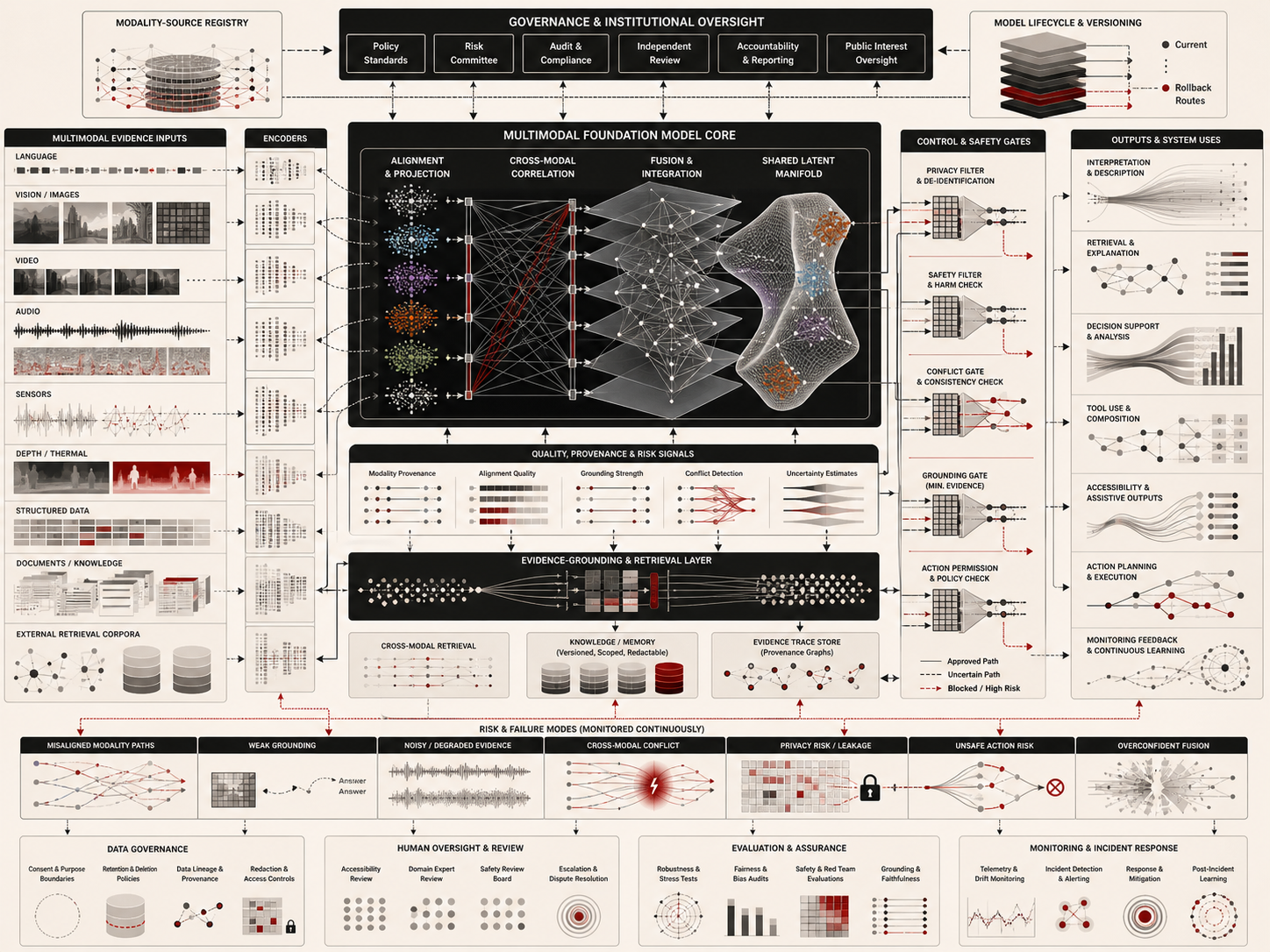
This article develops Multimodal AI: Language, Vision, Audio, and Action as an advanced article within the Artificial Intelligence Systems knowledge series. It explains modality-specific encoders, representation learning, cross-modal alignment, contrastive learning, fusion architectures, vision-language systems, speech and audio systems, video understanding, sensor fusion, embodied AI, multimodal retrieval, action safety, privacy, accessibility, evaluation, monitoring, and institutional accountability. Selected Python and R examples appear here, while the full GitHub repository contains expanded computational scaffolding for modality coverage diagnostics, grounding evaluation, conflict review, privacy scoring, accessibility review, SQL schemas, documentation templates, and reproducible notebooks.
Why Multimodal AI Matters
Multimodal AI matters because many important problems cannot be understood through one data type alone. A clinical diagnosis may require imaging, lab results, notes, patient history, and temporal symptoms. An environmental monitoring system may combine satellite imagery, audio from ecosystems, sensor measurements, maps, field notes, and regulatory thresholds. A factory maintenance system may use vibration data, thermal images, audio signals, equipment manuals, inspection photos, and technician reports. A robot must interpret visual observations, language instructions, spatial context, tactile feedback, and action constraints.
Single-modality systems can be powerful, but they are limited by the evidence they can process. A text-only model cannot inspect an image directly. An image classifier may recognize objects but fail to understand instructions, policy context, or causal explanation. An audio model may detect a sound but not connect it to visual evidence or maintenance records. A sensor model may identify anomalous readings but fail to explain their operational meaning. Multimodal systems allow different evidence streams to complement one another.
However, multimodality also increases complexity. Different modalities have different noise patterns, sampling rates, resolutions, privacy risks, and failure modes. Images can be manipulated. Audio can be ambiguous. Video can be temporally incomplete. Sensors can drift. Text can be misleading. Action systems can cause physical or operational harm. A multimodal system can fail because one modality is wrong, because modalities conflict, because a fusion architecture gives too much weight to the wrong signal, or because the system acts before uncertainty has been resolved.
The importance of multimodal AI is therefore not simply that systems can process more input types. The deeper importance is that AI can move closer to how evidence is actually organized in science, infrastructure, health, education, law, public administration, environmental monitoring, robotics, and daily life. Multimodal systems can inspect, listen, read, compare, retrieve, and act. That makes them more useful, but also more governable only if evidence provenance, uncertainty, privacy, accessibility, and action boundaries are designed into the system.
More\ Modalities \neq Better\ Understanding
\]
Interpretation: Adding images, audio, video, sensors, or action streams increases system capability only when the modalities are aligned, grounded, evaluated, monitored, and interpreted responsibly.
The central design challenge is to build systems that can coordinate evidence without hiding uncertainty. A multimodal system should not simply produce a confident answer because it received many inputs. It should be able to say which modality supports which claim, which evidence is missing, which signals conflict, and when human review or additional measurement is needed.
From Single-Modality Models to Multimodal Systems
Early AI systems often specialized in one modality. Computer vision models classified images. Speech models transcribed audio. Language models processed text. Recommender systems processed user-item records. Robotics systems used sensor data and control policies. These systems were often built separately, with distinct data pipelines, architectures, benchmarks, and evaluation practices.
Modern multimodal AI changes this pattern by building bridges across modalities. A vision-language model can connect images and captions. A speech-language model can connect audio and text. A video-language model can connect temporal scenes with descriptions. A multimodal embedding system can map images, text, audio, and sensor data into a shared representation space. A vision-language-action model can connect perception and language to physical control.
The systems challenge is not only to combine modalities, but to do so responsibly. The system must know when modalities agree, when they conflict, when one modality is missing, when uncertainty is high, and when action should be blocked or escalated. Multimodal AI is therefore an architecture of evidence fusion, not simply a collection of inputs.
| System Type | Primary Capability | Example | Governance Question |
|---|---|---|---|
| Text-only model | Processes language, documents, code, and structured prompts. | Summarizes a policy document. | Are claims grounded in reliable sources? |
| Vision model | Processes images, scans, diagrams, or visual scenes. | Detects visible infrastructure damage. | Does the model miss small but critical visual evidence? |
| Audio model | Processes speech, sound, acoustic events, and temporal signals. | Transcribes speech or detects machine noise. | Does performance vary by accent, noise, device, or environment? |
| Video model | Processes temporal sequences, motion, and events. | Summarizes inspection footage. | Does the model understand sequence, timing, and context? |
| Sensor-fusion model | Combines quantitative measurement streams. | Fuses vibration, thermal, and pressure readings. | Are sensors calibrated, synchronized, and reliable? |
| Multimodal-action system | Connects multimodal perception to tools, robotics, or workflows. | Routes an inspection, controls a robot, or triggers a workflow. | Are action boundaries, permissions, and rollback procedures defined? |
Note: Multimodal AI expands both capability and risk. Each modality introduces distinct evidence, uncertainty, privacy issues, and failure modes.
The transition from single-modality to multimodal systems also changes evaluation. A text model can be evaluated for factuality or language quality. A vision model can be evaluated for object recognition. A multimodal system must be evaluated for cross-modal alignment, grounding, conflict handling, missing-modality behavior, temporal reasoning, source provenance, and safe action under uncertainty.
Core Modalities: Language, Vision, Audio, Video, Sensors, and Action
Language remains central because it provides instruction, explanation, documentation, user interaction, and symbolic framing. Vision provides spatial and visual evidence: objects, scenes, documents, diagrams, medical images, satellite imagery, infrastructure conditions, and physical context. Audio provides speech, environmental sound, machinery signals, acoustic events, emotion-related cues, and temporal patterns. Video adds motion, sequence, causality, interaction, and event structure. Sensors add quantitative streams: temperature, vibration, pressure, location, depth, inertial motion, thermal fields, and environmental measurements. Action connects perception and reasoning to the world through robots, tools, interfaces, software systems, and workflows.
| Modality | Typical Inputs | System Role | Governance Concern |
|---|---|---|---|
| Language | Prompts, documents, transcripts, code, instructions. | Reasoning, explanation, interface, retrieval, planning. | Hallucination, bias, unsupported claims, prompt injection. |
| Vision | Images, scans, diagrams, maps, screenshots, remote sensing. | Scene understanding, evidence inspection, visual grounding. | Misclassification, manipulation, privacy, weak visual grounding. |
| Audio | Speech, environmental sound, machinery noise, acoustic events. | Transcription, sound recognition, temporal signal analysis. | Consent, surveillance, noisy inference, dialect or accent bias. |
| Video | Frames, motion, scene sequences, surveillance or experiment footage. | Temporal reasoning, event recognition, behavior analysis. | Context loss, privacy, misinterpretation, over-surveillance. |
| Sensors | Depth, thermal, IMU, vibration, environmental and industrial data. | Measurement, monitoring, spatial context, system state. | Sensor drift, calibration failure, missing data, false precision. |
| Structured data | Tables, logs, metadata, geospatial records, timestamps. | Context, history, indexing, quantitative comparison. | Schema drift, missingness, lineage, biased records. |
| Action | Robot commands, tool calls, workflows, interface operations. | Operational execution and embodied response. | Physical harm, unsafe automation, permission errors, rollback needs. |
Note: The same event may be represented differently across modalities. A responsible system preserves those differences rather than collapsing them into one undifferentiated signal.
The most important point is that modalities are not interchangeable. Text can describe an object, but the image may reveal its condition. Audio may reveal a machine fault before it appears visually. Video may reveal sequence and cause. Sensors may reveal invisible physical states. Action systems require constraints that generative systems do not. A multimodal AI system must preserve the distinctive evidential value of each modality while learning how to connect them.
Modality = Evidence + Noise + Context + Risk
\]
Interpretation: Each modality contributes useful evidence, but each also brings distinctive uncertainty, failure modes, privacy concerns, and governance requirements.
A mature multimodal system should therefore track modality provenance. It should know whether a claim came from text, image, audio, video, sensor measurement, metadata, tool output, or fusion among several streams. Without provenance, the system may appear integrated while making evidence harder to inspect.
Representation Learning and Cross-Modal Alignment
Multimodal AI begins with representation. Each modality has its own structure: text is sequential and symbolic, images are spatial, audio is temporal and spectral, video is spatiotemporal, sensors are often numeric time series, and actions are constrained by embodiment or system interfaces. Encoders translate these different forms into representations that can be compared, fused, retrieved, or used for prediction.
Cross-modal alignment is the process of learning relationships among these representations. A simple example is image-text alignment: the representation of a picture of a bridge should be close to the representation of a caption describing that bridge. A more complex example is video-language alignment: a sequence of frames should align with a description of the event unfolding over time. In embodied systems, observations and language instructions must align with possible actions.
Alignment is powerful but imperfect. Two modalities may be correlated without being equivalent. A caption may omit important visual details. An image may not reveal the cause of an event. Audio may conflict with video. Sensor signals may detect invisible conditions that language descriptions miss. Multimodal alignment should therefore be treated as evidence coordination, not as proof of meaning.
| Alignment Task | What It Connects | Common Use | Failure Risk |
|---|---|---|---|
| Image-text alignment | Images and captions, labels, or questions. | Visual search, captioning, visual question answering. | Fluent descriptions that miss visual evidence. |
| Audio-text alignment | Speech, sounds, transcripts, and descriptions. | Transcription, sound search, accessibility. | Noise, dialect, accent, or context misinterpretation. |
| Video-language alignment | Frame sequences and event descriptions. | Video summarization, event retrieval, activity recognition. | Misread sequence, causality, or temporal boundaries. |
| Sensor-text alignment | Measurements and human-readable interpretation. | Monitoring reports, anomaly explanation. | False precision or poor calibration awareness. |
| Vision-action alignment | Perception and permitted actions. | Robotics, interface control, embodied agents. | Unsafe action from weak perception or ambiguous instruction. |
Note: Alignment should be evaluated against the task and use context. Similar embeddings are not the same as verified evidence.
Representation learning also affects fairness and accessibility. If training data underrepresents certain languages, environments, body types, accents, devices, lighting conditions, physical abilities, or cultural contexts, the aligned representation space may work unevenly. Multimodal systems should therefore be evaluated across the conditions in which they will actually be used.
Fusion Architectures and Multimodal Reasoning
Fusion is the process by which multimodal systems combine information. Early fusion combines modality features near the input stage. Late fusion combines separate predictions or representations near the output stage. Cross-attention fusion allows one modality to attend to another. Modular fusion routes different inputs through specialized components before combining them. Agentic fusion may decide which modality or tool to inspect next.
Fusion architecture shapes system behavior. If the system overweights language, it may ignore visual evidence. If it overweights images, it may miss textual qualifications. If it treats sensor data as precise when sensors are poorly calibrated, it may produce false confidence. If it cannot represent disagreement among modalities, it may smooth over contradictions that should trigger review.
Responsible multimodal reasoning should preserve modality provenance. The system should be able to indicate whether a claim came from text, image, audio, video, sensor evidence, or a combination. It should identify missing modalities, weak evidence, conflict, and uncertainty. The fusion layer should not become an epistemic black box where incompatible evidence streams are blended into a single confident answer.
| Fusion Approach | Description | Strength | Risk |
|---|---|---|---|
| Early fusion | Combines modality features near input or embedding stage. | Can learn joint representations directly. | May be brittle when modalities are missing or noisy. |
| Late fusion | Combines outputs from modality-specific models. | Modular and easier to inspect. | May miss deep cross-modal interactions. |
| Cross-attention fusion | Allows tokens or features from one modality to attend to another. | Supports fine-grained grounding across modalities. | Attention may not equal faithful explanation. |
| Retrieval-augmented fusion | Uses multimodal retrieval to gather supporting evidence. | Can connect images, documents, video, and records. | Similarity may be mistaken for evidentiary relevance. |
| Agentic fusion | Chooses which modality, tool, or evidence source to inspect next. | Flexible for complex workflows. | Requires tool governance and action boundaries. |
Note: Fusion should be designed to represent uncertainty and conflict, not merely to produce a single confident output.
Fusion \neq Agreement
\]
Interpretation: A fusion layer can combine modalities even when they disagree. Responsible systems should detect and communicate cross-modal conflict rather than hide it.
Fusion design also affects monitoring. If the system changes behavior, teams need to know whether the change came from text inputs, visual inputs, audio quality, sensor drift, retrieval sources, fusion weights, or downstream tools. Observability for multimodal systems must therefore track modality-level signals, not only final outputs.
Vision-Language Systems
Vision-language systems connect images and text. They can caption images, answer visual questions, retrieve images from text, retrieve text from images, describe diagrams, inspect screenshots, compare documents, interpret charts, support accessibility, assist education, and analyze visual evidence. These systems are central to multimodal AI because images and text are among the most common paired modalities on the web and in institutional archives.
Vision-language systems can be used in many domains: medical imaging assistance, infrastructure inspection, manufacturing quality control, cultural heritage analysis, scientific visualization, satellite imagery interpretation, educational tutoring, and document understanding. But each domain requires domain-specific evaluation. A system that captions everyday images well may not reliably interpret radiology images, engineering diagrams, ecological satellite data, or legal exhibits.
Visual grounding is a major challenge. A model may describe an image fluently while misidentifying objects, spatial relations, quantities, symbols, or causality. It may hallucinate objects not present in the image or fail to notice small but important details. In high-stakes settings, visual outputs require evidence review, uncertainty communication, and human expertise.
Document images and charts create additional challenges. A screenshot, scanned contract, engineering drawing, map, or scientific plot contains text, layout, symbols, scale, visual hierarchy, and sometimes domain-specific notation. A vision-language system must not only read the visible text; it must interpret structure. Misreading a chart axis, table header, legend, scale bar, or annotation can change the meaning of the evidence.
| Use Case | Capability | Evaluation Need | Governance Concern |
|---|---|---|---|
| Image captioning | Describe visual content. | Object, relation, and context accuracy. | Hallucinated or omitted details. |
| Visual question answering | Answer questions using image evidence. | Grounding and reasoning tests. | Unsupported answers from weak visual evidence. |
| Document understanding | Interpret scanned documents, screenshots, charts, and forms. | OCR, layout, table, chart, and symbol accuracy. | Misread records or legal/financial documents. |
| Remote sensing | Analyze satellite or aerial imagery with text or geospatial context. | Spatial, temporal, and domain validation. | False environmental or infrastructure claims. |
| Accessibility support | Generate alt text or explain visual interfaces. | User testing and descriptive quality. | Misleading accessibility outputs. |
Note: Vision-language systems should be evaluated for grounding, not only fluency. A fluent visual description can still be wrong.
Responsible use requires clear boundaries. In low-risk settings, visual descriptions may be assistive and exploratory. In medical, legal, infrastructure, safety, or security settings, visual interpretation should support expert review rather than replace it. The system should identify uncertainty and preserve the original image evidence for inspection.
Audio-Language and Speech Systems
Audio-language systems connect sound and language. They can transcribe speech, translate spoken language, identify acoustic events, detect machinery anomalies, describe environmental soundscapes, support accessibility, and connect spoken commands to actions. Audio adds temporal, spectral, and contextual information that text alone cannot capture.
Speech systems raise important governance concerns. Audio can include personal data, biometric cues, background conversations, location signals, emotion-related information, and sensitive context. Speech recognition can also perform unevenly across accents, dialects, languages, noise conditions, and microphone quality. A multimodal system that relies on audio should evaluate performance across user groups and environments.
Non-speech audio is equally important. Environmental monitoring may use bird calls, insect sounds, water flow, industrial noise, alarms, vibration, or acoustic signatures of equipment failure. In these contexts, audio is not merely a transcript source; it is a scientific or operational measurement. The system must respect signal quality, calibration, and uncertainty.
Audio \neq Transcript
\]
Interpretation: Speech transcription is only one use of audio. Audio also contains acoustic events, environmental signals, machine signatures, timing, rhythm, noise, and context.
Audio systems should also distinguish detection from interpretation. A system may detect a sound pattern, but the meaning of that sound may depend on environment, device, distance, background noise, and domain knowledge. A vibration signal may indicate a machine anomaly, but diagnosis may require maintenance records, thermal data, operator reports, and historical baselines.
Privacy governance is especially important for audio. Recording sound can capture people who did not intend to interact with the system. It can reveal identity, health, emotion, location, workplace behavior, or household context. A responsible audio-language system should define collection purpose, consent requirements, retention limits, redaction methods, access rules, and review procedures.
Video, Temporal Modeling, and Event Understanding
Video introduces time. A single image can show a scene, but video shows sequence, movement, interaction, and change. Video-language systems can describe events, answer questions about actions, summarize footage, identify temporal patterns, detect anomalies, support robotics, and analyze experiments or field observations.
Temporal reasoning is difficult. The system must identify what happened, when it happened, what changed, and whether one event caused or merely preceded another. It must handle occlusion, camera motion, missing frames, variable frame rates, and ambiguous context. A model may correctly identify objects but fail to understand the sequence of actions.
Video also raises strong privacy and surveillance concerns. Systems that analyze video can be used for safety, accessibility, scientific observation, and infrastructure monitoring, but they can also support intrusive surveillance or misinterpret human behavior. Governance should define approved uses, retention policies, consent boundaries, access restrictions, and review processes.
| Challenge | Description | Failure Risk | Governance Response |
|---|---|---|---|
| Temporal order | Understanding what happened before, during, and after an event. | Misreading sequence or causality. | Event-order tests and human review for consequential interpretations. |
| Occlusion | Important visual evidence is hidden or partially visible. | Confident inference from incomplete evidence. | Uncertainty flags and multi-camera or sensor corroboration. |
| Sampling | Frames may be sparse, compressed, or irregular. | Missing key moments. | Track frame rate, sampling method, and gaps. |
| Context | Meaning depends on location, situation, policy, or background knowledge. | Misinterpretation of behavior or event significance. | Use domain context and review rather than isolated visual inference. |
| Surveillance risk | Video may expose people, behavior, and movement patterns. | Privacy invasion or unjust monitoring. | Purpose limitation, retention controls, access restrictions. |
Note: Video adds temporal evidence, but it also multiplies privacy, context, and interpretation risks.
Video understanding is especially important for robotics and infrastructure systems because action depends on change over time. A robot must know not only what objects exist, but whether they are moving, reachable, fragile, blocked, or dangerous. An inspection system must know whether a condition is stable, worsening, or caused by temporary environmental conditions. Temporal context often changes the meaning of visual evidence.
Sensor Fusion, Measurement, and Scientific AI
Sensor fusion connects multimodal AI to measurement. Sensors may include temperature, pressure, vibration, humidity, air quality, depth, LiDAR, radar, GPS, inertial measurement units, acoustic arrays, thermal cameras, chemical sensors, biological monitors, industrial telemetry, and environmental instruments. These streams often provide quantitative evidence that images, text, and audio cannot capture directly.
Sensor data can make AI systems more grounded in physical systems, but it also introduces measurement problems. Sensors can drift, fail, saturate, lose calibration, produce missing values, or report at different sampling rates. A system that treats sensor streams as automatically objective may produce false precision. Measurement quality should be monitored alongside model performance.
Scientific and environmental applications often require multimodal sensor fusion. An ecological monitoring system may combine satellite imagery, acoustic biodiversity signals, water-quality sensors, climate data, species observations, and field notes. A medical monitoring system may combine imaging, lab results, wearable signals, notes, and patient-reported symptoms. An industrial system may combine thermal images, vibration spectra, maintenance logs, and operator reports.
Measurement \neq Meaning
\]
Interpretation: Sensor data provide quantitative evidence, but interpretation still depends on calibration, context, uncertainty, domain knowledge, and governance.
Responsible sensor fusion should preserve calibration metadata, timestamps, location, device identity, sampling rate, transformation history, and quality flags. A model output should not merely say that an anomaly exists; it should indicate which sensors contributed, whether their readings were reliable, and whether the signal was corroborated by other modalities.
Sensor fusion also raises operational accountability questions. If an AI system triggers an alert from sensor data, who investigates? If sensors disagree, which signal is trusted? If a sensor fails, does the system abstain, interpolate, escalate, or continue? These decisions should be encoded in monitoring and governance procedures, not left to ad hoc interpretation.
Action, Robotics, and Embodied AI
Action-oriented multimodal AI connects perception and language to behavior. In robotics, a system may observe a scene, interpret a language instruction, plan a sequence, and execute motor actions. In software environments, an AI agent may read a document, call tools, update records, generate code, or navigate an interface. In infrastructure systems, multimodal AI may recommend inspections, trigger alerts, or route maintenance workflows.
Action changes the risk profile. A captioning error may mislead a user. An action error may damage property, expose data, interrupt operations, or injure people. Systems that act require stronger controls than systems that only describe. This includes permission boundaries, simulation testing, physical safety constraints, tool-use approval, user confirmation, rollback procedures, and incident response.
Embodied AI also faces the symbol-grounding problem in concrete form. Language instructions must be grounded in perception, spatial context, affordances, and safe action. A command such as “move the fragile item away from the edge” requires identifying the item, understanding fragility, locating the edge, planning motion, and avoiding harm. This is not simply language understanding. It is multimodal perception-action coordination.
| Control | Purpose | Example | Risk if Missing |
|---|---|---|---|
| Simulation testing | Evaluate perception-action behavior before deployment. | Test robotic motion under varied lighting and object placement. | Unsafe behavior discovered only in the real world. |
| Permission boundaries | Limit what actions the system can take. | Allow inspection recommendation but block autonomous closure order. | Overreach or unauthorized intervention. |
| Human approval | Require accountable review for high-impact action. | Engineer approves maintenance escalation. | Unreviewed automated action. |
| Physical safety constraints | Prevent harmful movement or operation. | Robot stops near humans or uncertain obstacles. | Injury or property damage. |
| Rollback and recovery | Restore safe state after error. | Undo workflow update or stop autonomous operation. | Irreversible operational harm. |
Note: When multimodal AI systems act, evaluation must include safe execution, not only correct perception.
Action systems should also distinguish recommendation from execution. A multimodal infrastructure assistant may recommend inspection. A robot may prepare a plan. A workflow agent may draft an update. These are different from autonomous execution. The boundary should be explicit, logged, and governed.
Multimodal Retrieval and Knowledge Systems
Multimodal retrieval allows users to search across modalities. A text query may retrieve images, videos, audio clips, diagrams, maps, or sensor records. An image may retrieve related documents. An audio clip may retrieve maintenance history. A video segment may retrieve procedural documentation. A chart may retrieve the dataset and report that produced it.
This is especially important for AI knowledge systems. Many institutional records are not plain text: scanned documents, presentation slides, photographs, diagrams, field recordings, videos, logs, charts, tables, maps, and instrument outputs. Multimodal retrieval can make these sources searchable and connect them to language-based reasoning systems.
However, multimodal retrieval must be governed. The system should track modality provenance, source authority, access permissions, timestamps, transformations, and confidence. A retrieved image may be similar but not evidentially relevant. An audio clip may be ambiguous. A video may be out of context. Multimodal search should support source review rather than hide uncertainty behind similarity scores.
Similarity \neq Evidence
\]
Interpretation: Multimodal retrieval can find similar images, text, audio, video, or sensor records, but similarity does not prove relevance, authority, freshness, or factual support.
Multimodal retrieval also expands access-control requirements. A text query should not retrieve restricted images. An image search should not expose private documents. A chart should not reveal sensitive underlying data. Retrieval systems must enforce permissions before generation, not merely filter generated outputs afterward.
Good multimodal knowledge systems preserve evidence trails. If an answer is based on an image, document, chart, or video, the system should make that source available for review where permissions allow. It should also explain which modality supported the claim. This is especially important when outputs are used in research, audit, infrastructure, legal, environmental, or public-sector contexts.
Evaluation: Capability, Grounding, Robustness, and Safety
Multimodal AI evaluation must test more than task accuracy. It must test modality alignment, grounding, robustness, missing-modality behavior, cross-modal conflict handling, privacy, accessibility, and safety. A system may perform well when all modalities are clean and aligned but fail when one modality is noisy, missing, adversarial, or contradictory.
| Evaluation Dimension | Question | Example Evidence | Governance Relevance |
|---|---|---|---|
| Cross-modal alignment | Do related modalities map to compatible representations? | Image-text retrieval, audio-text retrieval, cross-modal ranking. | Tests whether modalities connect meaningfully. |
| Grounding | Are outputs supported by the relevant modality? | Visual grounding review, audio-event verification, source support. | Prevents fluent but unsupported multimodal claims. |
| Temporal reasoning | Does the model understand sequence and change? | Video question answering, event-order tests, anomaly review. | Supports safe interpretation of events. |
| Robustness | Does performance hold under noise, occlusion, missing data, or shift? | Stress tests, perturbation tests, sensor-failure scenarios. | Reveals brittleness beyond clean benchmarks. |
| Conflict handling | Does the system detect disagreement among modalities? | Contradictory evidence tests, uncertainty escalation. | Prevents fusion from hiding uncertainty. |
| Action safety | Are unsafe actions blocked or escalated? | Simulation tests, permission checks, rollback drills. | Protects against physical or operational harm. |
| Privacy | Does the system protect sensitive multimodal data? | Face/audio redaction, access controls, retention audits. | Limits surveillance, exposure, and misuse. |
| Accessibility | Does the system improve access without creating new exclusions? | Alt-text quality, speech recognition equity, assistive-user testing. | Ensures accessibility outputs are accurate and useful. |
| Governance readiness | Are modality sources, transformations, and decisions documented? | System cards, audit logs, evaluation reports, incident reviews. | Makes the system reviewable and accountable. |
Note: Multimodal evaluation should include clean cases, noisy cases, missing modalities, conflicting modalities, and high-impact action scenarios.
Evaluation should also test abstention and escalation. A multimodal system should know when it lacks enough evidence, when a modality is unreliable, when a sensor has failed, when visual evidence is ambiguous, when audio is too noisy, or when action is unsafe. The ability to defer can be as important as the ability to answer.
Evaluation should also be domain-specific. A general-purpose vision-language system may perform well on common images but fail on medical imaging, legal exhibits, engineering diagrams, ecological monitoring, satellite imagery, or accessibility tasks. The system should be evaluated on the evidence forms, user groups, environments, and consequences that define its actual use.
Governance, Privacy, Accessibility, and Institutional Accountability
Multimodal governance requires broader data stewardship than text-only AI. Images can reveal faces, locations, documents, screens, medical conditions, infrastructure vulnerabilities, or private environments. Audio can reveal identity, background conversations, emotional cues, and sensitive context. Video can reveal behavior and movement. Sensor data can reveal operational state, location, environmental exposure, or physical activity. Action logs can reveal decisions, interventions, and consequences.
A responsible multimodal AI system should document:
- approved modalities and data sources;
- collection methods and consent requirements;
- data-retention and redaction policies;
- modality-specific encoders and versions;
- fusion architecture and weighting assumptions;
- cross-modal retrieval and grounding methods;
- evaluation datasets and subgroup tests;
- privacy, surveillance, and accessibility risks;
- human review and escalation thresholds;
- tool-use and action-permission boundaries;
- monitoring signals and incident-response procedures;
- rollback or disablement procedures for unsafe behavior.
Accessibility is a central opportunity and responsibility. Multimodal AI can generate image descriptions, transcribe audio, translate speech, summarize video, explain diagrams, and support assistive workflows. But accessibility systems must be accurate, respectful, user-controllable, and evaluated with affected users. Poor multimodal accessibility can create false confidence, misleading descriptions, or new forms of exclusion.
Multimodal\ Governance = Provenance + Consent + Grounding + Access + Review
\]
Interpretation: Governance must account for where multimodal data came from, whether it was collected appropriately, how it supports claims, who can access it, and when human review is required.
Institutional accountability also requires traceability. When a multimodal system produces a consequential output, reviewers should be able to reconstruct the input modalities, model versions, retrieved sources, fusion logic, uncertainty signals, human review decisions, and any actions taken. Without traceability, multimodal AI can make evidence look integrated while making responsibility harder to locate.
Governance should also define prohibited uses. Some multimodal capabilities may be technically possible but institutionally unacceptable: intrusive surveillance, emotion inference without clear justification, biometric identification without legal and ethical review, unsupported medical interpretation, automated disciplinary decisions from video, or autonomous physical action without safety validation. Responsible systems should include boundaries, not only capabilities.
Common Failure Modes
Multimodal AI systems often fail when the apparent richness of evidence creates false confidence. A system may receive images, text, audio, and sensor readings, yet still misunderstand the situation. More inputs do not guarantee better inference. If one modality is poor, if modalities are misaligned, if fusion hides conflict, or if action proceeds without review, multimodal systems can produce more sophisticated forms of error.
| Failure Mode | Description | Likely Consequence | Governance Response |
|---|---|---|---|
| Alignment mistaken for understanding | Similar embeddings are treated as proof of meaning. | Retrieved or generated outputs appear relevant but lack evidentiary support. | Require grounding tests, source review, and task-specific validation. |
| Visual fluency error | The model describes an image confidently while missing key details. | False claims about diagrams, scans, infrastructure, or documents. | Use visual grounding review and expert validation for high-impact use. |
| Audio fragility | Noise, accent, microphone quality, or context changes output quality. | Unequal transcription or misleading acoustic interpretation. | Evaluate across environments, dialects, devices, and noise levels. |
| Temporal misreading | Video objects are recognized but sequence or causality is wrong. | Incorrect event interpretation. | Use temporal reasoning tests and preserve event uncertainty. |
| Sensor false precision | Numeric streams are treated as authoritative despite drift or calibration failure. | Confident but wrong operational recommendations. | Monitor calibration, missingness, and sensor provenance. |
| Hidden cross-modal conflict | Fusion smooths over disagreement rather than surfacing it. | Conflicting evidence is converted into a single confident output. | Test contradiction handling and escalate unresolved conflicts. |
| Action overreach | Multimodal perception triggers unsafe tool or robotic action. | Operational, physical, privacy, or safety harm. | Use permissions, simulation, human approval, rollback, and incident response. |
| Privacy multiplication | Images, audio, video, metadata, and sensors expose sensitive context. | Surveillance, re-identification, or unintended disclosure. | Apply minimization, redaction, access control, retention limits, and consent rules. |
Note: Multimodal failure often emerges from the interaction among modalities, not only from one weak model.
The core governance lesson is that multimodal systems should surface uncertainty rather than conceal it. If evidence streams disagree, if a modality is missing, if a sensor is unreliable, or if a visual detail is ambiguous, the system should identify the issue and route the case appropriately.
Limits and Open Problems
Multimodal AI systems have important limits. Alignment is not understanding: related embeddings do not prove causal, factual, or contextual understanding. Visual fluency can mislead: a model may describe an image confidently while missing small but critical details. Audio inference can be fragile: noise, accent, microphone quality, and background context can change results. Video reasoning can fail temporally: models may identify objects but misread sequence, timing, or causality.
Sensor fusion can create false precision. Numeric streams can appear authoritative even when sensors drift, fail, or measure only part of the relevant system. Cross-modal conflict can be hidden when fusion blends disagreement into one output. Action systems raise stakes because errors can produce operational, physical, privacy, or safety harms. Privacy risks multiply because images, audio, video, location, and sensor data can expose sensitive information that text alone may not reveal.
Several open problems remain difficult. How should systems quantify uncertainty when modalities disagree? How should multimodal models explain which evidence supported each claim? How should video models evaluate long-horizon event understanding? How should robotic systems prove safe transfer from simulation to real-world action? How should accessibility systems be evaluated with affected users rather than generic benchmarks? How should multimodal systems avoid surveillance expansion while still supporting legitimate public, scientific, medical, or infrastructure uses?
Another open problem is governance capacity. Multimodal systems can produce more evidence than institutions can inspect. A bridge-inspection assistant may process thousands of images, videos, and sensor streams. A hospital system may combine imaging, notes, labs, and devices. A public agency may monitor environmental data across geography and time. The challenge is not only generating outputs, but prioritizing review, preserving accountability, and avoiding overconfidence.
The goal is not to treat multimodal AI as a magical step toward human-like perception. The goal is to build systems that coordinate evidence responsibly. Multimodal AI can make artificial intelligence more useful, accessible, and situated, but only when modality provenance, uncertainty, privacy, action safety, evaluation, and institutional accountability are designed into the architecture from the beginning.
Mathematical Lens
Each modality can be represented by its own encoder.
z_m = E_m(x_m)
\]
Interpretation: Modality-specific encoder \(E_m\) maps input \(x_m\), such as text, image, audio, video, or sensor data, into representation \(z_m\).
Contrastive multimodal learning aligns related representations.
\mathcal{L}_{con}
=
-\log
\frac{\exp(s(z_i,z_j)/\tau)}
{\sum_{k=1}^{N}\exp(s(z_i,z_k)/\tau)}
\]
Interpretation: Related cross-modal pairs, such as an image and caption, are pulled together in representation space relative to unrelated examples. The temperature \(\tau\) controls separation sharpness.
Fusion combines modality representations into a shared state.
h =
\Phi(z_{text},z_{vision},z_{audio},z_{sensor},c)
\]
Interpretation: Fusion function \(\Phi\) combines modality-specific representations and context \(c\) into a shared multimodal state \(h\).
Cross-attention allows one modality to attend to another.
\mathrm{CrossAttention}(Q_m,K_n,V_n)
=
\mathrm{softmax}
\left(
\frac{Q_mK_n^{T}}{\sqrt{d_k}}
\right)V_n
\]
Interpretation: Queries from modality \(m\) attend to keys and values from modality \(n\), allowing language to attend to images, audio to align with video, or sensor states to inform action.
Multimodal prediction conditions output on multiple evidence streams.
\hat{y}
=
F_{\theta}(x_{text},x_{vision},x_{audio},x_{sensor},c)
\]
Interpretation: Model \(F_{\theta}\) generates an answer, label, explanation, or structured output from multiple modalities and contextual constraints.
Conflict risk can be represented as disagreement among modality-specific outputs.
C_{conflict}
=
d\left(
F_text(x_{text}),
F_vision(x_{vision})
\right)
+
d\left(
F_audio(x_{audio}),
F_sensor(x_{sensor})
\right)
\]
Interpretation: Conflict risk increases when modality-specific interpretations diverge. The appropriate response may be uncertainty communication, additional evidence, or human review.
Embodied or action-oriented systems map multimodal state to action.
a_t
\sim
\pi_{\theta}(a_t \mid o_t,q,h_t,G)
\]
Interpretation: An action policy \(\pi_{\theta}\) selects action \(a_t\) based on observation \(o_t\), instruction \(q\), multimodal state \(h_t\), and governance or safety constraints \(G\).
System risk depends on modality quality, fusion reliability, action consequences, and governance controls.
R_{system}
=
\sum_{u \in U}
P(u)\,
L(F_{\theta},\Phi,A,G,u)
\]
Interpretation: Multimodal system risk depends on model \(F_{\theta}\), fusion architecture \(\Phi\), action layer \(A\), governance controls \(G\), and use context \(u\).
A governance rule can route uncertain or conflicting cases to review.
Review =
\begin{cases}
1, & C_{conflict} \geq \tau_C \\
1, & Q_m \leq \tau_Q \\
1, & R_{system} \geq \tau_R \\
1, & ActionImpact \geq \tau_A \\
0, & \mathrm{otherwise}
\end{cases}
\]
Interpretation: Review can be triggered by cross-modal conflict, poor modality quality, high system risk, or high-impact action.
Variables and System Interpretation
| Symbol or Term | Meaning | Multimodal Interpretation | System Relevance |
|---|---|---|---|
| \(x_m\) | Input from modality \(m\) | Text, image, audio, video, depth, thermal, sensor, or action data. | Raw evidence entering the system. |
| \(E_m\) | Modality encoder | Model that maps a specific modality into representation space. | Shapes what the system can perceive from each modality. |
| \(z_m\) | Modality representation | Embedding or latent state for modality \(m\). | Basis for alignment, retrieval, and fusion. |
| \(s(z_i,z_j)\) | Similarity score | Cross-modal relatedness between representations. | Used in retrieval and contrastive learning. |
| \(\Phi\) | Fusion function | Architecture combining modality representations. | Determines how evidence streams influence output. |
| \(h\) | Shared multimodal state | Integrated representation across modalities. | Supports reasoning, generation, retrieval, or action. |
| \(Q_m,K_n,V_n\) | Cross-attention matrices | Attention from one modality to another. | Enables cross-modal grounding and interaction. |
| \(C_{conflict}\) | Conflict score | Measure of disagreement among modality-specific interpretations. | Can trigger uncertainty review or escalation. |
| \(Q_m\) | Modality quality signal | Reliability, calibration, resolution, noise, or completeness of modality \(m\). | Prevents weak evidence from being overtrusted. |
| \(a_t\) | Action at time \(t\) | Robot movement, tool call, interface operation, or workflow step. | Connects multimodal inference to consequences. |
| \(G\) | Governance controls | Policies, permissions, safety rules, human review, and monitoring. | Constrains risk across modalities and actions. |
| \(R_{system}\) | System risk | Composite risk from model, fusion, modality quality, action, and use context. | Guides review, deployment limits, and monitoring. |
Note: Multimodal variables should be interpreted as evidence-system variables, not only model variables. The same model output has different meaning depending on modality quality, provenance, context, and consequence.
Worked Example: A Governed Multimodal Infrastructure Assistant
Consider a city infrastructure department using multimodal AI to support bridge inspection. The system receives inspection photos, drone video, vibration readings, thermal images, maintenance records, weather data, engineering manuals, and inspector notes. The goal is not to replace engineers, but to help triage evidence, surface anomalies, retrieve relevant records, and prioritize human inspection.
A responsible workflow might include:
- Classify source modalities by sensitivity, reliability, and operational purpose.
- Ingest photos, video, sensor streams, and documents with timestamps, location metadata, and provenance.
- Use modality-specific encoders for imagery, video, sensor data, and text.
- Align evidence by asset, time, location, and inspection event.
- Detect cracks, corrosion, vibration anomalies, thermal irregularities, and maintenance-history patterns.
- Retrieve relevant engineering standards, prior inspections, and repair records.
- Generate an evidence-grounded summary with uncertainty and source references.
- Escalate high-risk or conflicting evidence to human engineers.
- Block automated operational actions unless explicitly approved.
- Monitor false positives, false negatives, sensor drift, and inspector feedback over time.
This example shows why multimodal AI is a systems discipline. The system must coordinate modalities, preserve provenance, handle uncertainty, support human expertise, and prevent unsafe automation. Its reliability depends not only on model capability, but on data governance, fusion design, evaluation, monitoring, and institutional review.
Suppose the system identifies possible structural damage from imagery, but vibration sensors remain normal and a recent maintenance record explains the visual pattern as a documented surface repair. A poorly designed system might produce a high-confidence alarm from image evidence alone. A governed system would preserve the conflict, show the supporting modalities, retrieve the maintenance context, and route the case to an engineer with uncertainty clearly stated.
Image\ Signal + Sensor\ Signal + Maintenance\ Record \rightarrow Reviewed\ Evidence
\]
Interpretation: A governed multimodal infrastructure assistant does not collapse all evidence into a single score. It preserves modality provenance and supports expert review.
Computational Modeling
Computational modeling can make multimodal governance more concrete. A multimodal evaluation workflow can track modality coverage, alignment quality, grounding, robustness, missing-modality risk, conflict detection, privacy controls, accessibility, action safety, and review requirements. A monitoring workflow can identify which use cases require human review before deployment and which modalities create the greatest risk.
The examples below are intentionally lightweight and educational. They do not replace production multimodal evaluation tools, sensor-quality systems, model registries, or privacy audits. Their purpose is to show how multimodal systems can be evaluated as evidence systems rather than as generic capability demonstrations.
A mature production system would connect these workflows to real evaluation datasets, modality-specific logs, sensor calibration records, redaction systems, action audits, accessibility testing, human review workflows, incident registers, model cards, and risk registers. The goal is not only to score multimodal capability. The goal is to determine whether the system can coordinate evidence responsibly under uncertainty.
Python Workflow: Multimodal System Evaluation and Risk Review
The following Python workflow simulates a multimodal AI evaluation portfolio. It scores modality coverage, alignment, grounding, robustness, conflict handling, action safety, privacy controls, accessibility, and governance risk. It is dependency-light so it can be adapted for real multimodal evaluation logs.
"""
Multimodal AI: Language, Vision, Audio, and Action

Python workflow:
- Simulate multimodal AI evaluation records.
- Score modality coverage, cross-modal alignment, grounding, robustness,
  conflict handling, action safety, privacy, accessibility, and governance risk.
- Identify missing-modality, conflict, and action-risk review cases.
- Produce governance-ready summaries.

This example is intentionally dependency-light. Production multimodal AI systems
should connect these records to real evaluation datasets, modality-specific logs,
sensor quality records, redaction systems, action audits, accessibility tests,
and human review workflows.
"""

from __future__ import annotations

from pathlib import Path

import numpy as np
import pandas as pd


RANDOM_SEED = 42
rng = np.random.default_rng(RANDOM_SEED)

OUTPUT_DIR = Path("outputs")
OUTPUT_DIR.mkdir(exist_ok=True)


def simulate_multimodal_evaluations(n: int = 220) -> pd.DataFrame:
    """Create synthetic multimodal evaluation records."""
    use_cases = [
        "visual_question_answering",
        "audio_event_understanding",
        "video_event_summary",
        "document_image_analysis",
        "sensor_fusion_monitoring",
        "robotic_action_planning",
        "multimodal_retrieval",
    ]

    rows = []

    for i in range(n):
        use_case = rng.choice(use_cases)

        has_text = int(rng.choice([0, 1], p=[0.10, 0.90]))
        has_vision = int(rng.choice([0, 1], p=[0.25, 0.75]))
        has_audio = int(rng.choice([0, 1], p=[0.55, 0.45]))
        has_video = int(rng.choice([0, 1], p=[0.65, 0.35]))
        has_sensor = int(rng.choice([0, 1], p=[0.60, 0.40]))
        has_action = int(use_case == "robotic_action_planning")

        modality_count = (
            has_text + has_vision + has_audio + has_video + has_sensor + has_action
        )

        cross_modal_alignment = rng.uniform(0.35, 0.98)
        grounding_score = rng.uniform(0.35, 0.98)
        robustness_score = rng.uniform(0.40, 0.98)
        conflict_detection_score = rng.uniform(0.30, 0.95)
        privacy_control_score = rng.uniform(0.50, 1.00)
        accessibility_score = rng.uniform(0.45, 1.00)

        if has_action:
            action_safety_score = rng.uniform(0.50, 1.00)
        else:
            action_safety_score = rng.uniform(0.70, 1.00)

        human_review_score = rng.uniform(0.45, 1.00)

        modality_missing_risk = max(0.0, 0.50 - (modality_count / 6))
        modality_conflict_risk = rng.beta(2.0, 5.5)

        sensor_quality_score = rng.uniform(0.45, 1.00) if has_sensor else 1.0
        temporal_reasoning_score = rng.uniform(0.35, 0.95) if has_video else 0.85

        rows.append(
            {
                "eval_id": f"MM-EVAL-{i:03d}",
                "use_case": use_case,
                "has_text": has_text,
                "has_vision": has_vision,
                "has_audio": has_audio,
                "has_video": has_video,
                "has_sensor": has_sensor,
                "has_action": has_action,
                "modality_count": modality_count,
                "cross_modal_alignment": float(cross_modal_alignment),
                "grounding_score": float(grounding_score),
                "robustness_score": float(robustness_score),
                "conflict_detection_score": float(conflict_detection_score),
                "privacy_control_score": float(privacy_control_score),
                "accessibility_score": float(accessibility_score),
                "action_safety_score": float(action_safety_score),
                "human_review_score": float(human_review_score),
                "sensor_quality_score": float(sensor_quality_score),
                "temporal_reasoning_score": float(temporal_reasoning_score),
                "modality_missing_risk": float(modality_missing_risk),
                "modality_conflict_risk": float(modality_conflict_risk),
                "latency_seconds": float(rng.gamma(shape=2.4, scale=1.2)),
                "compute_cost_index": float(rng.uniform(0.10, 0.95)),
            }
        )

    return pd.DataFrame(rows)


def score_multimodal_system(records: pd.DataFrame) -> pd.DataFrame:
    """Score multimodal records for capability and governance risk."""
    scored = records.copy()

    scored["modality_coverage_score"] = np.minimum(scored["modality_count"] / 4, 1)

    scored["multimodal_capability_score"] = (
        0.16 * scored["modality_coverage_score"]
        + 0.18 * scored["cross_modal_alignment"]
        + 0.18 * scored["grounding_score"]
        + 0.14 * scored["robustness_score"]
        + 0.14 * scored["conflict_detection_score"]
        + 0.10 * scored["temporal_reasoning_score"]
        + 0.10 * scored["accessibility_score"]
    )

    scored["safety_and_governance_score"] = (
        0.20 * scored["privacy_control_score"]
        + 0.20 * scored["action_safety_score"]
        + 0.18 * scored["human_review_score"]
        + 0.14 * scored["conflict_detection_score"]
        + 0.14 * scored["robustness_score"]
        + 0.14 * scored["sensor_quality_score"]
    )

    scored["multimodal_system_risk"] = (
        0.22 * (1 - scored["multimodal_capability_score"])
        + 0.22 * (1 - scored["safety_and_governance_score"])
        + 0.14 * scored["modality_missing_risk"]
        + 0.14 * scored["modality_conflict_risk"]
        + 0.10 * scored["compute_cost_index"]
        + 0.10 * np.minimum(scored["latency_seconds"] / 10, 1)
        + 0.08 * (1 - scored["sensor_quality_score"])
    )

    scored["review_required"] = (
        (scored["multimodal_system_risk"] > 0.42)
        | (scored["cross_modal_alignment"] < 0.60)
        | (scored["grounding_score"] < 0.60)
        | (scored["conflict_detection_score"] < 0.55)
        | (scored["privacy_control_score"] < 0.70)
        | (scored["accessibility_score"] < 0.65)
        | ((scored["has_sensor"] == 1) & (scored["sensor_quality_score"] < 0.65))
        | ((scored["has_video"] == 1) & (scored["temporal_reasoning_score"] < 0.60))
        | ((scored["has_action"] == 1) & (scored["action_safety_score"] < 0.80))
    )

    scored["deployment_recommendation"] = np.select(
        [
            scored["multimodal_system_risk"] > 0.58,
            ((scored["has_action"] == 1) & (scored["action_safety_score"] < 0.80)),
            scored["grounding_score"] < 0.60,
            scored["review_required"],
            scored["multimodal_capability_score"] > 0.82,
        ],
        [
            "pause_for_multimodal_system_review",
            "block_action_deployment_until_safety_review",
            "improve_grounding_before_deployment",
            "approve_only_after_modality_and_safety_review",
            "candidate_for_controlled_deployment",
        ],
        default="continue_evaluation",
    )

    return scored.sort_values("multimodal_system_risk", ascending=False)


def summarize_by_use_case(scored: pd.DataFrame) -> pd.DataFrame:
    """Summarize multimodal quality and risk by use case."""
    return (
        scored.groupby("use_case")
        .agg(
            evaluations=("eval_id", "count"),
            mean_modality_count=("modality_count", "mean"),
            mean_alignment=("cross_modal_alignment", "mean"),
            mean_grounding=("grounding_score", "mean"),
            mean_robustness=("robustness_score", "mean"),
            mean_conflict_detection=("conflict_detection_score", "mean"),
            mean_capability=("multimodal_capability_score", "mean"),
            mean_safety_governance=("safety_and_governance_score", "mean"),
            mean_system_risk=("multimodal_system_risk", "mean"),
            review_rate=("review_required", "mean"),
        )
        .reset_index()
        .sort_values("mean_system_risk", ascending=False)
    )


def main() -> None:
    """Run multimodal AI evaluation and governance review."""
    records = simulate_multimodal_evaluations()
    scored = score_multimodal_system(records)
    use_case_summary = summarize_by_use_case(scored)

    governance_summary = pd.DataFrame(
        [
            {
                "evaluations_reviewed": len(scored),
                "review_required": int(scored["review_required"].sum()),
                "action_cases": int(scored["has_action"].sum()),
                "sensor_cases": int(scored["has_sensor"].sum()),
                "video_cases": int(scored["has_video"].sum()),
                "low_grounding_cases": int((scored["grounding_score"] < 0.60).sum()),
                "low_alignment_cases": int(
                    (scored["cross_modal_alignment"] < 0.60).sum()
                ),
                "low_conflict_detection_cases": int(
                    (scored["conflict_detection_score"] < 0.55).sum()
                ),
                "mean_capability_score": scored["multimodal_capability_score"].mean(),
                "mean_safety_governance_score": scored[
                    "safety_and_governance_score"
                ].mean(),
                "mean_multimodal_system_risk": scored[
                    "multimodal_system_risk"
                ].mean(),
            }
        ]
    )

    records.to_csv(
        OUTPUT_DIR / "python_multimodal_evaluation_records.csv",
        index=False,
    )

    scored.to_csv(
        OUTPUT_DIR / "python_multimodal_system_risk_scores.csv",
        index=False,
    )

    use_case_summary.to_csv(
        OUTPUT_DIR / "python_multimodal_use_case_summary.csv",
        index=False,
    )

    governance_summary.to_csv(
        OUTPUT_DIR / "python_multimodal_governance_summary.csv",
        index=False,
    )

    memo = f"""# Multimodal AI Governance Memo

Evaluations reviewed: {int(governance_summary.loc[0, "evaluations_reviewed"])}
Review required: {int(governance_summary.loc[0, "review_required"])}
Action-oriented cases: {int(governance_summary.loc[0, "action_cases"])}
Sensor cases: {int(governance_summary.loc[0, "sensor_cases"])}
Video cases: {int(governance_summary.loc[0, "video_cases"])}
Low-grounding cases: {int(governance_summary.loc[0, "low_grounding_cases"])}
Low-alignment cases: {int(governance_summary.loc[0, "low_alignment_cases"])}
Low conflict-detection cases: {int(governance_summary.loc[0, "low_conflict_detection_cases"])}
Mean capability score: {governance_summary.loc[0, "mean_capability_score"]:.4f}
Mean safety/governance score: {governance_summary.loc[0, "mean_safety_governance_score"]:.4f}
Mean multimodal system risk: {governance_summary.loc[0, "mean_multimodal_system_risk"]:.4f}

Interpretation:
- Multimodal AI systems should be evaluated by modality, fusion quality, grounding, and action risk.
- Missing or conflicting modalities should trigger uncertainty review.
- Action-oriented systems require stricter safety thresholds and rollback controls.
- Privacy, accessibility, sensor quality, and human review are core multimodal governance requirements.
"""

    (OUTPUT_DIR / "python_multimodal_governance_memo.md").write_text(memo)

    print(governance_summary.T)
    print(use_case_summary)
    print(scored.head(10))
    print(memo)


if __name__ == "__main__":
    main()
This workflow treats multimodal evaluation as an evidence-governance problem. It does not rank systems only by capability. It also examines grounding, cross-modal alignment, conflict detection, sensor quality, action safety, privacy controls, accessibility, cost, latency, and review requirements. That mirrors the core argument of the article: multimodal AI must be evaluated as a system for coordinating evidence under uncertainty.
R Workflow: Multimodal Evaluation Summary
The following R workflow summarizes multimodal evaluation records by use case, modality coverage, alignment, grounding, conflict detection, safety, accessibility, and review status. It provides a lightweight review layer for multimodal AI governance.
# Multimodal AI: Language, Vision, Audio, and Action
# R workflow: multimodal evaluation summary and risk review.

set.seed(42)

n <- 220

use_cases <- c(
  "visual_question_answering",
  "audio_event_understanding",
  "video_event_summary",
  "document_image_analysis",
  "sensor_fusion_monitoring",
  "robotic_action_planning",
  "multimodal_retrieval"
)

records <- data.frame(
  eval_id = paste0("MM-EVAL-", sprintf("%03d", 1:n)),
  use_case = sample(use_cases, size = n, replace = TRUE),
  has_text = rbinom(n, size = 1, prob = 0.90),
  has_vision = rbinom(n, size = 1, prob = 0.75),
  has_audio = rbinom(n, size = 1, prob = 0.45),
  has_video = rbinom(n, size = 1, prob = 0.35),
  has_sensor = rbinom(n, size = 1, prob = 0.40),
  cross_modal_alignment = runif(n, min = 0.35, max = 0.98),
  grounding_score = runif(n, min = 0.35, max = 0.98),
  robustness_score = runif(n, min = 0.40, max = 0.98),
  conflict_detection_score = runif(n, min = 0.30, max = 0.95),
  privacy_control_score = runif(n, min = 0.50, max = 1.00),
  accessibility_score = runif(n, min = 0.45, max = 1.00),
  human_review_score = runif(n, min = 0.45, max = 1.00),
  latency_seconds = rgamma(n, shape = 2.4, scale = 1.2),
  compute_cost_index = runif(n, min = 0.10, max = 0.95)
)

records$has_action <- ifelse(
  records$use_case == "robotic_action_planning",
  1,
  0
)

records$action_safety_score <- ifelse(
  records$has_action == 1,
  runif(n, min = 0.50, max = 1.00),
  runif(n, min = 0.70, max = 1.00)
)

records$sensor_quality_score <- ifelse(
  records$has_sensor == 1,
  runif(n, min = 0.45, max = 1.00),
  1.00
)

records$temporal_reasoning_score <- ifelse(
  records$has_video == 1,
  runif(n, min = 0.35, max = 0.95),
  0.85
)

records$modality_count <- records$has_text +
  records$has_vision +
  records$has_audio +
  records$has_video +
  records$has_sensor +
  records$has_action

records$modality_coverage_score <- pmin(records$modality_count / 4, 1)
records$modality_missing_risk <- pmax(0, 0.50 - (records$modality_count / 6))
records$modality_conflict_risk <- rbeta(n, shape1 = 2.0, shape2 = 5.5)

records$multimodal_capability_score <- 0.16 * records$modality_coverage_score +
  0.18 * records$cross_modal_alignment +
  0.18 * records$grounding_score +
  0.14 * records$robustness_score +
  0.14 * records$conflict_detection_score +
  0.10 * records$temporal_reasoning_score +
  0.10 * records$accessibility_score

records$safety_and_governance_score <- 0.20 * records$privacy_control_score +
  0.20 * records$action_safety_score +
  0.18 * records$human_review_score +
  0.14 * records$conflict_detection_score +
  0.14 * records$robustness_score +
  0.14 * records$sensor_quality_score

records$multimodal_system_risk <- 0.22 * (1 - records$multimodal_capability_score) +
  0.22 * (1 - records$safety_and_governance_score) +
  0.14 * records$modality_missing_risk +
  0.14 * records$modality_conflict_risk +
  0.10 * records$compute_cost_index +
  0.10 * pmin(records$latency_seconds / 10, 1) +
  0.08 * (1 - records$sensor_quality_score)

records$review_required <- records$multimodal_system_risk > 0.42 |
  records$cross_modal_alignment < 0.60 |
  records$grounding_score < 0.60 |
  records$conflict_detection_score < 0.55 |
  records$privacy_control_score < 0.70 |
  records$accessibility_score < 0.65 |
  (records$has_sensor == 1 & records$sensor_quality_score < 0.65) |
  (records$has_video == 1 & records$temporal_reasoning_score < 0.60) |
  (records$has_action == 1 & records$action_safety_score < 0.80)

use_case_summary <- aggregate(
  cbind(
    modality_count,
    cross_modal_alignment,
    grounding_score,
    robustness_score,
    conflict_detection_score,
    multimodal_capability_score,
    safety_and_governance_score,
    multimodal_system_risk,
    review_required
  ) ~ use_case,
  data = records,
  FUN = mean
)

governance_summary <- data.frame(
  evaluations_reviewed = nrow(records),
  review_required = sum(records$review_required),
  action_cases = sum(records$has_action),
  sensor_cases = sum(records$has_sensor),
  video_cases = sum(records$has_video),
  low_grounding_cases = sum(records$grounding_score < 0.60),
  low_alignment_cases = sum(records$cross_modal_alignment < 0.60),
  low_conflict_detection_cases = sum(records$conflict_detection_score < 0.55),
  mean_capability_score = mean(records$multimodal_capability_score),
  mean_safety_governance_score = mean(records$safety_and_governance_score),
  mean_multimodal_system_risk = mean(records$multimodal_system_risk)
)

dir.create("outputs", recursive = TRUE, showWarnings = FALSE)

write.csv(records, "outputs/r_multimodal_evaluation_records.csv", row.names = FALSE)
write.csv(use_case_summary, "outputs/r_multimodal_use_case_summary.csv", row.names = FALSE)
write.csv(governance_summary, "outputs/r_multimodal_governance_summary.csv", row.names = FALSE)

print("Use-case summary")
print(use_case_summary)

print("Governance summary")
print(governance_summary)
This R workflow mirrors the multimodal-governance structure in a compact form. It summarizes use-case-level quality and risk so modality coverage, grounding, alignment, conflict detection, sensor quality, action safety, privacy, accessibility, and review status can be interpreted together.
GitHub Repository
The article body includes selected computational examples so the conceptual and mathematical argument remains readable. The full repository can hold expanded workflows for cross-modal alignment review, modality coverage diagnostics, visual grounding evaluation, audio-event scoring, video-temporal evaluation, sensor-fusion monitoring, robotic-action safety, privacy review, accessibility testing, and multimodal governance.
From Modal Combination to Accountable Evidence
Multimodal AI shows why the next stage of artificial intelligence cannot be understood as language alone. AI systems increasingly read documents, inspect images, listen to audio, summarize video, process sensor streams, retrieve across archives, and act through tools or embodied systems. This can make AI more useful, accessible, and grounded in real-world evidence. It can also make AI more complex, intrusive, and difficult to govern.
The central lesson is that multimodality should be treated as evidence coordination. Each modality contributes something different. Text explains, but may mislead. Images show, but may omit context. Audio carries temporal and acoustic information, but may be noisy or sensitive. Video shows sequence, but can be misread. Sensors measure physical states, but require calibration. Action connects interpretation to consequence, but requires authority and safeguards.
Responsible multimodal AI should therefore preserve provenance, uncertainty, conflict, and reviewability. It should be able to say which modality supports a claim, which evidence is missing, which signals conflict, what privacy rules apply, what action boundaries exist, and when human expertise is required. The fusion of evidence should not erase the accountability of evidence.
This article also shows why multimodal AI belongs with governance, not only model architecture. As systems move from captioning and retrieval toward infrastructure inspection, robotics, accessibility, scientific monitoring, healthcare support, education, and public administration, their legitimacy will depend on how they are evaluated, monitored, constrained, and reviewed. Multimodal systems should not simply see more. They should make evidence more accountable.
Within the Artificial Intelligence Systems knowledge series, this article belongs near Large Language Models and Foundation Model Systems, Self-Supervised Learning and Foundation Models, Representation Learning and Embedding Spaces, Retrieval-Augmented Generation and AI Knowledge Systems, AI Agents, Tool Use, and Workflow Automation, Artificial Intelligence in Environmental Monitoring, AI Systems for Infrastructure and Smart Networks, and Data Governance, Provenance, and Lineage in AI Systems. It provides the multimodal-evidence layer for understanding how AI systems connect perception, representation, retrieval, action, and accountability.
Related Articles
- Artificial Intelligence Systems
- Large Language Models and Foundation Model Systems
- Self-Supervised Learning and Foundation Models
- Representation Learning and Embedding Spaces
- Retrieval-Augmented Generation and AI Knowledge Systems
- AI Agents, Tool Use, and Workflow Automation
- Generative AI and Synthetic Content Systems
- Artificial Intelligence in Environmental Monitoring
- AI Systems for Infrastructure and Smart Networks
- Data Governance, Provenance, and Lineage in AI Systems
Further Reading
- Radford, A. et al. (2021) ‘Learning Transferable Visual Models From Natural Language Supervision’, Proceedings of the 38th International Conference on Machine Learning. Available at: https://arxiv.org/abs/2103.00020
- Girdhar, R. et al. (2023) ‘ImageBind: One Embedding Space To Bind Them All’, Proceedings of the IEEE/CVF Conference on Computer Vision and Pattern Recognition. Available at: https://arxiv.org/abs/2305.05665
- Alayrac, J.B. et al. (2022) ‘Flamingo: a Visual Language Model for Few-Shot Learning’, Advances in Neural Information Processing Systems. Available at: https://arxiv.org/abs/2204.14198
- Zitkovich, B. et al. (2023) ‘RT-2: Vision-Language-Action Models Transfer Web Knowledge to Robotic Control’, Proceedings of The 7th Conference on Robot Learning. Available at: https://proceedings.mlr.press/v229/zitkovich23a.html
- Baltrušaitis, T., Ahuja, C. and Morency, L.P. (2019) ‘Multimodal Machine Learning: A Survey and Taxonomy’, IEEE Transactions on Pattern Analysis and Machine Intelligence. Available at: https://arxiv.org/abs/1705.09406
- Liang, P.P. et al. (2022) ‘Foundations and Trends in Multimodal Machine Learning: Principles, Challenges, and Open Questions’. Available at: https://arxiv.org/abs/2209.03430
- OpenAI (2023) ‘GPT-4V(ision) System Card’. Available at: https://cdn.openai.com/papers/GPTV_System_Card.pdf
- NIST (2023) Artificial Intelligence Risk Management Framework (AI RMF 1.0). Available at: https://www.nist.gov/publications/artificial-intelligence-risk-management-framework-ai-rmf-10
References
- Alayrac, J.B. et al. (2022) ‘Flamingo: a Visual Language Model for Few-Shot Learning’, Advances in Neural Information Processing Systems. Available at: https://arxiv.org/abs/2204.14198
- Baltrušaitis, T., Ahuja, C. and Morency, L.P. (2019) ‘Multimodal Machine Learning: A Survey and Taxonomy’, IEEE Transactions on Pattern Analysis and Machine Intelligence. Available at: https://arxiv.org/abs/1705.09406
- Girdhar, R. et al. (2023) ‘ImageBind: One Embedding Space To Bind Them All’, Proceedings of the IEEE/CVF Conference on Computer Vision and Pattern Recognition. Available at: https://arxiv.org/abs/2305.05665
- Liang, P.P. et al. (2022) ‘Foundations and Trends in Multimodal Machine Learning: Principles, Challenges, and Open Questions’. Available at: https://arxiv.org/abs/2209.03430
- NIST (2023) Artificial Intelligence Risk Management Framework (AI RMF 1.0). Available at: https://www.nist.gov/publications/artificial-intelligence-risk-management-framework-ai-rmf-10
- OpenAI (2023) ‘GPT-4V(ision) System Card’. Available at: https://cdn.openai.com/papers/GPTV_System_Card.pdf
- Radford, A. et al. (2021) ‘Learning Transferable Visual Models From Natural Language Supervision’, Proceedings of the 38th International Conference on Machine Learning. Available at: https://arxiv.org/abs/2103.00020
- Zitkovich, B. et al. (2023) ‘RT-2: Vision-Language-Action Models Transfer Web Knowledge to Robotic Control’, Proceedings of The 7th Conference on Robot Learning. Available at: https://proceedings.mlr.press/v229/zitkovich23a.html