
Last Updated May 11, 2026
Metadata, data catalogs, and lineage form the interpretive and evidentiary infrastructure of modern data systems. They are often described in operational terms—as documentation tools, discovery layers, dependency maps, or governance utilities—but their deeper importance lies in the fact that they make data assets legible as objects of knowledge, stewardship, evidence, and institutional action. In a small environment, analysts may navigate data through memory, direct conversation, or local familiarity with systems. In a scaled environment—where data flows across databases, warehouses, lakes, APIs, pipelines, dashboards, semantic layers, notebooks, models, reporting workflows, and external disclosures—informal coordination breaks down. At that point, organizations require a structured system for knowing what data exists, what it means, where it came from, how it has changed, who is accountable for it, and whether it can be trusted in a given decision context.
That structured system is built from three interlocking capabilities. Metadata provides descriptive, structural, operational, semantic, administrative, and policy-relevant information about data assets. Data catalogs provide the discovery, navigation, interpretation, and governance interface through which those assets become searchable and usable across the organization. Lineage reconstructs the historical, technical, semantic, and analytical pathways by which data moves, is transformed, and is reused across systems and data products. Together, these capabilities help transform a fragmented data estate into a governable knowledge environment. Without them, data systems drift toward opacity, duplication, semantic inconsistency, fragile governance, weak auditability, and declining institutional trust.
Main Library
Publications
Article Map
Data Systems & Analytics
Related Topic
Artificial Intelligence Systems
Related Topic
Intelligent Infrastructure Systems
Related Topic
Economic Systems
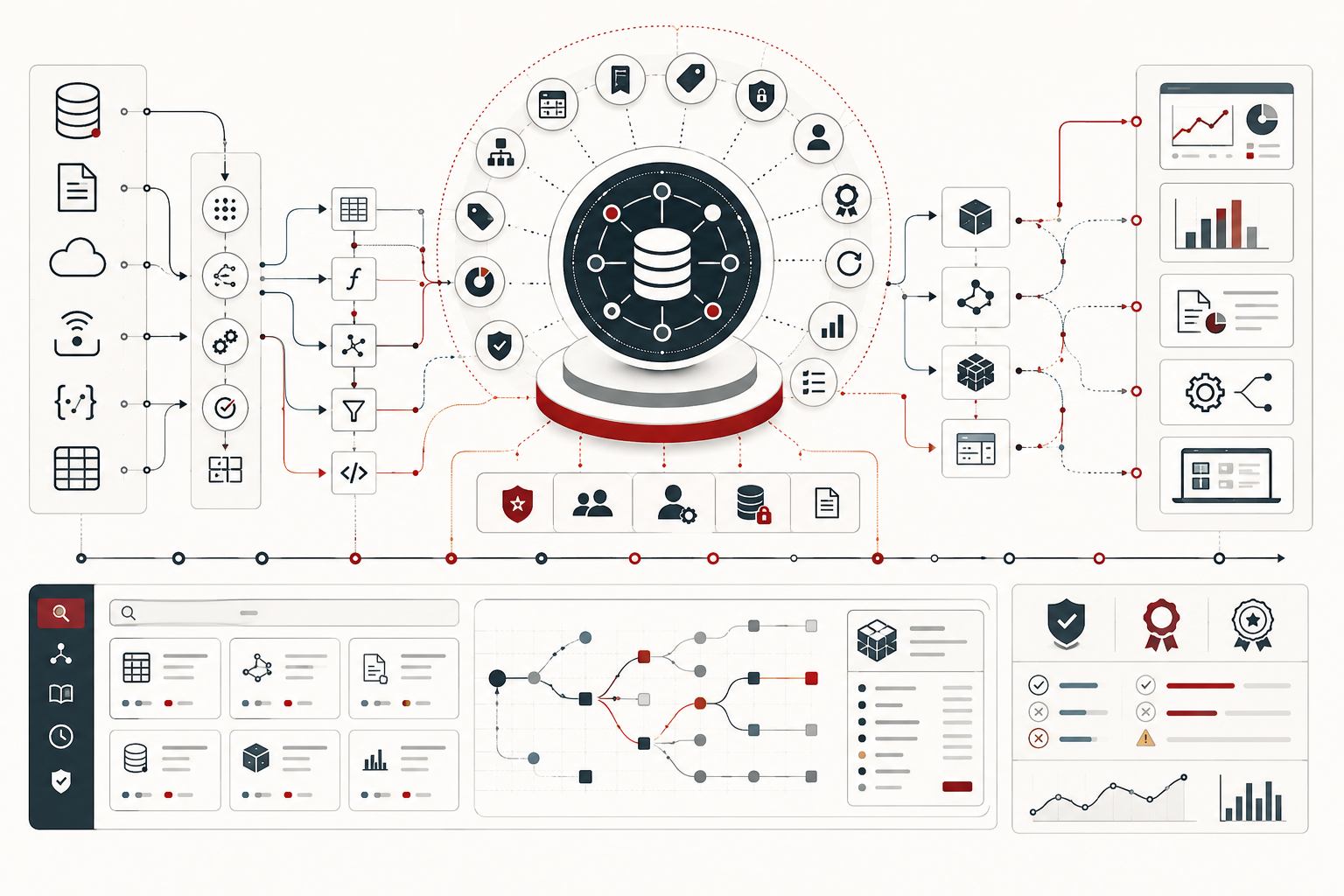
This article builds on the themes developed in Database Systems and Data Architecture, Data Governance and Stewardship, Data Quality Metrics and Observability, Master Data Management and Entity Resolution, Analytics Engineering and Semantic Layers, and Reproducible Analytics and Versioned Data Workflows. If those articles explain how data is structured, governed, tested, modeled, and rerun, this article addresses the interpretive layer that makes those activities intelligible: the metadata, catalog, and lineage infrastructure that allows organizations to understand what their data assets mean, how they were produced, and why particular analytical claims should be believed.
Metadata, catalogs, and lineage as epistemic infrastructure
At a sufficiently mature level of analysis, metadata should not be understood merely as administrative description. It is part of the epistemic infrastructure of data systems: the set of representational, procedural, and evidentiary conditions that allow claims derived from data to be interpreted, evaluated, challenged, reproduced, and trusted. A metric displayed in a dashboard does not speak for itself. Its meaning depends on definitions, inclusion and exclusion rules, source systems, transformations, timing conventions, entity-resolution decisions, quality expectations, lineage history, and domain assumptions. Those conditions are rarely visible in the metric value itself. They are made visible, if at all, through metadata, catalogs, lineage, provenance, and governance records.
This is why metadata matters not only for technical efficiency but for evidentiary discipline. It allows organizations to ask questions that are indispensable in any serious analytical culture: What exactly does this measure represent? Which entities and periods does it cover? Has its definition changed over time? Which transformations shaped it? What assumptions were embedded in its construction? Which source systems are upstream? Which dashboards, reports, APIs, models, notebooks, or decision processes depend on it downstream? Who has certified it, and for what use? Which quality signals support or weaken trust? Which policies restrict access, retention, sharing, or reuse?
These are not peripheral questions. They are central to whether data can function as a basis for accountable action rather than as a source of persuasive but unexamined outputs. In this sense, metadata, data catalogs, and lineage play a role analogous to citation systems, archival description, and provenance records in scholarly and institutional knowledge environments. They do not eliminate disagreement, uncertainty, or interpretation. But they create the conditions under which disagreements can be made explicit, assumptions can be inspected, and claims can be evaluated against a traceable record. That is why these capabilities have become central not only to analytics and engineering, but also to audit, compliance, privacy, model governance, cybersecurity, records management, and organizational risk management.
What metadata actually is
Metadata is often reduced to the phrase “data about data,” but that formula is too imprecise to be genuinely useful. Metadata is better understood as the structured information that describes the identity, structure, behavior, meaning, governance status, and relational context of a data asset. It provides the interpretive frame within which a dataset, table, field, dashboard, metric, model feature, report, lineage edge, policy tag, or analytical output can be understood and used appropriately.
At minimum, metadata answers questions that raw records cannot answer on their own. What is this asset? What system generated it? What business process does it reflect? What do its fields mean? How frequently is it updated? What transformations have been applied? Who owns it? Is it sensitive? Is it certified? What policies govern access, retention, sharing, or reuse? Can it be used for financial reporting, sustainability disclosure, experimentation, machine learning, public reporting, or only exploratory analysis? What other assets depend on it?
The importance of metadata arises from the fact that data systems are never purely material collections of values. They are organized representations. Data becomes analytically useful only when it is embedded in a framework of meaning, control, evidence, and context. Metadata supplies that framework. It is therefore not simply descriptive ornamentation layered onto a finished system. It is one of the mechanisms through which a system becomes interpretable at all.
Major types of metadata
Mature metadata practice distinguishes among several forms of metadata because different kinds of description support different functions in the data environment. Treating all metadata as a single undifferentiated category obscures these differences and often leads to weak system design.
Technical metadata
Technical metadata describes the structural and computational properties of data assets. This includes schemas, data types, table structures, column names, primary and foreign key relationships, file formats, storage locations, partitioning rules, indexes, transformation code references, orchestration metadata, refresh schedules, execution environments, runtime dependencies, and query patterns. Technical metadata is central to data engineering, interoperability, debugging, optimization, and platform operations. It is what allows systems to process, join, validate, and manage assets correctly at scale.
Business metadata
Business metadata explains the organizational meaning of data assets. It includes definitions of entities, metrics, and dimensions; domain context; approved business interpretations; usage constraints; ownership roles; stewardship notes; and explanatory guidance regarding how and when the asset should be used. This is the layer that tells a user what “net revenue,” “household,” “active customer,” “scope 2 emissions,” “incident closure,” “high-risk supplier,” “facility boundary,” or “model feature” actually means within the institution. Many analytical disputes that appear at first to be technical are in fact failures of business metadata, because teams are using the same words to refer to different constructed realities.
Operational metadata
Operational metadata describes how assets behave in time and in production. It includes job runtimes, workflow statuses, update frequency, freshness indicators, row-count trends, data quality alerts, anomaly detection signals, access frequency, incident history, failure logs, remediation records, service-level expectations, and observability events. Operational metadata is essential because an asset may be well defined yet not reliable. A well-documented table that is frequently late, broken, stale, or inconsistent does not support high-trust analytics. Operational metadata closes the gap between documentation and runtime reality.
Administrative and policy metadata
Administrative and policy metadata governs control, classification, and institutional responsibility. It includes permissions, sensitivity labels, legal restrictions, retention schedules, contractual constraints, regulatory tags, approval states, custodianship assignments, access rules, privacy classifications, data-sharing restrictions, and stewardship workflows. In many environments, this layer is the bridge between data infrastructure and the requirements of security, privacy, records management, compliance, and public accountability.
Semantic metadata
Semantic metadata is concerned with meaning across assets, domains, and systems. It includes glossary terms, conceptual models, taxonomies, ontologies, relationship mappings, canonical entity definitions, semantic layer definitions, metric logic, and connections among concepts used in different data contexts. Semantic metadata matters especially in heterogeneous environments where the same real-world phenomenon is represented differently across source systems. Without semantic alignment, organizations may possess large amounts of technically integrated data that remain conceptually incoherent.
Social and usage metadata
Some modern platforms also capture social and usage metadata such as endorsements, usage patterns, frequent query paths, trusted dashboards, commonly joined datasets, certification notes, issue comments, documentation edits, stewardship interactions, and consumer adoption patterns. Although sometimes dismissed as secondary, this layer can provide important trust signals. It reveals which assets are widely relied upon, actively maintained, or recognized as authoritative by a user community. But usage should not be confused with truth: a widely used asset can still be poorly governed. Social and usage metadata are evidence, not automatic certification.
Metadata standards, registries, and the problem of consistency
The value of metadata depends not only on whether it exists, but on whether it is structured consistently enough to support comparison, reuse, interoperability, and governance across systems. This is why standards and registries matter. If each team describes assets using different conventions, labels, and definitions, metadata becomes difficult to aggregate or interpret across the enterprise. A robust metadata environment therefore requires not just collection but normalization.
Metadata standards address this problem by specifying common structures, fields, and controlled interpretive conventions. In broader information management contexts, standards such as ISO/IEC 11179 provide guidance for metadata registries, while W3C provenance standards such as PROV offer formal ways of representing entities, activities, and agents involved in producing data artifacts. W3C’s Data Catalog Vocabulary (DCAT) – Version 3 supports catalog interoperability by providing a vocabulary for describing datasets, catalogs, data services, and related resources. OpenLineage similarly reflects the practical need to capture lineage metadata across jobs, datasets, and runs in modern data processing environments.
Metadata registries occupy an important place in this landscape. A registry is not identical to a catalog. A registry is typically concerned with authoritative control over the definition and identification of metadata elements themselves—for example, canonical definitions of data elements, permissible values, naming conventions, or approved semantic structures. By contrast, a catalog is usually oriented toward the discovery and interpretation of actual data assets in use. The distinction matters because many organizations need both: a mechanism for authoritative metadata governance and a user-facing interface for navigating real assets.
Without standardization, metadata programs often drift into a form of localism. Teams document assets, but they do so in idiosyncratic language. Tags proliferate but do not align. Glossary entries exist but are not tied to implementation. Different platforms maintain overlapping but inconsistent descriptions of similar concepts. The result is not simply untidiness; it is semantic fragmentation, which undermines cross-functional trust and impedes responsible reuse.
Controlled vocabularies, taxonomies, and ontologies
A mature metadata program must eventually confront the problem of semantic discipline. Free-text description alone is rarely sufficient in complex environments. Organizations need controlled vocabularies, taxonomies, and sometimes ontologies to stabilize meaning across time and context.
A controlled vocabulary restricts the terms that can be used to describe assets or fields, reducing ambiguity and synonym drift. A taxonomy organizes concepts hierarchically into broader and narrower categories, allowing assets to be classified within a coherent conceptual structure. An ontology goes further by formally representing entities, relationships, and constraints in a domain, enabling more precise interoperability and reasoning across systems.
These instruments are particularly important when organizations are integrating data across domains, supporting federated analytics, or building cross-system governance. In sustainability, healthcare, finance, public administration, education, infrastructure, scientific research, and AI governance, the same surface term may carry different operational meanings in different systems. Controlled vocabularies and ontological mappings help reduce this ambiguity. They also improve search, classification, policy tagging, and semantic lineage because assets can be related not only by proximity in infrastructure but by shared conceptual structure.
In practice, the challenge is not merely technical. It is political and organizational. Agreeing on a common vocabulary often requires negotiation among functions with different histories, incentives, and interpretive habits. Yet the alternative is continuing semantic drift, in which a seemingly shared data environment conceals deep conceptual fragmentation.
From inventories and glossaries to catalogs and active metadata
Data organizations frequently use overlapping terms—inventory, glossary, registry, catalog, metadata platform—as though they were interchangeable. They are related, but not identical. An inventory is a list of assets. A glossary defines terms. A registry governs metadata elements or standards. A catalog makes assets discoverable and contextualizes them for users. A metadata platform may integrate all of these functions while also supporting automation, orchestration, policy propagation, quality monitoring, lineage capture, impact analysis, and observability.
This distinction becomes especially important when organizations move toward what is often called active metadata. Traditional metadata systems were largely passive: they recorded information about assets, which users could consult when needed. Active metadata systems use metadata not only to describe the environment but to drive behavior within it. Metadata can trigger quality checks, policy enforcement, alerting, orchestration responses, access workflows, impact analysis, documentation prompts, deprecation warnings, and stewardship review.
Active metadata reflects an important shift in philosophy. It treats metadata as live infrastructure rather than static documentation. This shift is especially important in environments where scale, velocity, and complexity make manual coordination insufficient. Yet the move toward active metadata also raises the stakes for metadata quality. If metadata becomes operationally consequential, errors or omissions in that layer can propagate more directly into governance failures, broken workflows, false trust signals, or inappropriate access decisions.
What a data catalog actually does
A data catalog is more than a searchable index of datasets. Properly understood, it is the organizational interface through which the data estate becomes navigable, interpretable, and governable. It creates a user-facing environment in which technical metadata, business context, lineage, stewardship information, trust signals, quality indicators, policy tags, access context, and governance status can be brought into a single frame.
Historically, documentation often existed in dispersed and weakly governed forms: spreadsheets listing tables, wiki pages with outdated definitions, onboarding decks, ad hoc naming conventions, verbal explanations shared through meetings, or domain knowledge locked inside particular analysts and engineers. These arrangements may work temporarily in smaller teams, but they scale poorly. As systems grow, the cost of rediscovery rises. Analysts duplicate work because they cannot find authoritative assets. Teams produce conflicting reports because definitions are not centralized or linked to implementation. Governance bodies struggle to see where sensitive fields live or how transformations propagate.
The data catalog emerged as a response to this legibility problem. Its function is not merely to centralize documentation, but to reduce the cognitive and organizational friction associated with using data responsibly at scale. A good catalog allows a user to answer practical questions quickly: Which asset is the most authoritative representation of this concept? Which dashboard depends on this table? Who owns this metric? Has this asset been certified? What quality issues have been recorded? How recently was it updated? Which policies apply? What downstream systems would be affected by a schema change?
In that sense, the catalog performs for data systems what indexes, finding aids, and classification schemes perform for libraries, archives, and records systems. It converts accumulation into navigability and makes governance actionable by binding documentation, accountability, and discovery to real assets.
Core functions of data catalogs
Discoverability
The most obvious function of a catalog is discoverability. Users must be able to locate relevant datasets, dashboards, tables, models, reports, metrics, and definitions through search, domain browsing, tags, glossary terms, relational navigation, and usage cues. Discoverability is not trivial convenience. It reduces redundant asset creation, shortens analytical cycle time, and increases the likelihood that users will rely on authoritative rather than improvised sources.
Contextual interpretation
A dataset without context is often unusable. The catalog provides that context by combining technical structure with semantic explanation, ownership, intended use, limitations, and sometimes example queries or related assets. This allows both technical and non-technical users to understand not only that an asset exists, but what it represents and how it should be used.
Ownership and stewardship
Catalogs expose ownership and stewardship assignments for assets, metrics, and domains. This matters for accountability, incident escalation, quality remediation, lifecycle management, access review, and governance decisions. In environments where ownership is missing or ambiguous, documentation decay and trust erosion tend to follow quickly.
Trust and quality signals
Mature catalogs surface signals such as certification status, freshness, quality alerts, incident history, documentation completeness, usage patterns, deprecation warnings, and stewardship review. These signals help users distinguish authoritative assets from provisional, stale, or poorly governed ones. Without such signals, search results can flatten crucial differences in asset reliability.
Governance visibility
Catalogs increasingly act as governance surfaces by showing sensitivity tags, policy categories, retention rules, approval status, contractual restrictions, privacy labels, access controls, and permissible-use notes. This makes governance legible at the level of actual data assets rather than abstract policy language alone.
Impact analysis and change management
When connected to lineage, catalogs help teams assess the consequences of changes in schemas, pipelines, definitions, or source systems. This is essential in complex environments where even a small upstream modification can affect many downstream reports, models, dashboards, APIs, semantic metrics, or decisions.
Understanding data lineage more deeply
Data lineage is the representation of how data artifacts are produced, moved, and transformed across systems and over time. At a basic level, lineage answers the question “Where did this come from?” But in advanced environments, lineage also answers several more demanding questions: Which processes transformed this data? Which assumptions entered at each stage? Which downstream assets depend on it? Which agents—human or system—participated in its production? What are the likely consequences if an upstream element changes, fails, or is reclassified?
Lineage matters because modern data environments are not passive repositories. They are transformation systems. Data is extracted, cleaned, standardized, joined, filtered, enriched, aggregated, modeled, anonymized, tokenized, and recontextualized. Every transformation introduces possible gains in usability but also possible losses in interpretability. Fields may be renamed, units converted, duplicates removed, records excluded, categories reclassified, missing values imputed, or business logic embedded in SQL, code, notebooks, transformation frameworks, or semantic layers. By the time a metric appears in a dashboard or model, it may have passed through many layers of transformation that are invisible to the end user. Lineage helps reconstruct that hidden history.
For this reason, lineage is indispensable not only for debugging but also for accountability. If a decision-support system produces a controversial output, or if a metric is challenged by auditors, executives, regulators, researchers, or external stakeholders, the question is no longer simply whether the number exists. The question becomes how it was produced. Lineage is one of the primary mechanisms through which that question can be answered with rigor.
Forms of lineage
Dataset-level lineage
Dataset-level lineage maps the relationships among major assets such as tables, files, views, streams, models, or data products. It shows that one asset depends on another, helping teams understand high-level flow and dependency structure. This is often the minimum viable form of lineage in modern platforms.
Column-level lineage
Column-level lineage traces the derivation of individual fields through transformations. This level of granularity becomes essential when organizations need to understand how specific metrics are calculated, how sensitive attributes propagate, how model features are derived, or how a schema change in one field affects downstream assets. Column-level lineage is substantially more demanding than dataset-level mapping, but its analytical and governance value is often much higher.
Pipeline and process lineage
Pipeline lineage represents the workflows, jobs, and orchestration structures that move and transform data across systems. It captures the process architecture of the data environment, including scheduling, dependency order, execution context, runtime history, and producing agents. This form of lineage is especially useful for reliability engineering, data observability, incident response, and operational maintenance.
Analytical lineage
Analytical lineage connects data assets to dashboards, notebooks, semantic models, reports, machine learning features, APIs, and decision artifacts. This makes it possible to trace the impact of upstream changes on downstream analytical outputs and to evaluate which user-facing products depend on a given source or transformation layer.
Business and semantic lineage
Business lineage concerns the propagation of concepts and metrics across organizational contexts. Semantic lineage tracks how meaning is preserved, translated, or altered as assets move across systems. This is often the most difficult form of lineage because it requires not only technical traceability but interpretive coherence. Yet it is also one of the most important, because organizations often discover that a metric can be traced technically even while its meaning has shifted across domains or layers of transformation.
Lineage and provenance
Lineage is closely related to, but not identical with, provenance. Provenance traditionally emphasizes the origin, custody, and history of an artifact: where it came from, who handled it, and under what conditions it acquired its present form. In data systems, provenance can include information about source systems, agents, transformations, timestamps, execution contexts, versions, quality checks, review actions, and decision-relevant assumptions. Lineage is often the graph-like representation of dependencies and flows; provenance is the broader evidentiary account of production history.
This distinction matters because an organization may possess technically accurate lineage while still lacking a full provenance account. A lineage graph may show that dashboard field A depends on transformed table B, which depends on source table C. But provenance asks further questions: Who defined the business rule embedded in the transformation? Why was a filter introduced? Which version of the model was active at the time? Were manual spreadsheet adjustments inserted outside the formal pipeline? Which agent or workflow produced the final artifact? These questions are crucial in high-stakes settings, and they remind us that traceability is not exhausted by dependency graphs alone.
W3C’s PROV model is useful here because it frames provenance around entities, activities, and agents. That structure maps well onto data systems: a dataset or model output is an entity, a transformation or training run is an activity, and a workflow, human steward, or software system can function as an agent. This does not solve all provenance problems, but it provides a rigorous vocabulary for asking whether production history is sufficiently visible to support trust.
A mathematical lens for metadata, catalogs, and lineage
Metadata, catalogs, and lineage can also be evaluated through a mathematical lens. The purpose is not to reduce institutional trust to a simplistic score, but to make the dimensions of asset legibility explicit. A data asset becomes more trustworthy when its metadata is complete, its definitions are clear, its lineage is visible, its provenance is recorded, its ownership is current, its quality signals are surfaced, and its policy context is enforceable.
T_a = w_M M_a + w_C C_a + w_L L_a + w_P P_a + w_Q Q_a + w_U U_a
\]
Interpretation: Metadata trust \(T_a\) for asset \(a\) can be modeled as a weighted combination of metadata completeness \(M_a\), catalog visibility \(C_a\), lineage depth \(L_a\), provenance completeness \(P_a\), quality-signal coverage \(Q_a\), and usage or stewardship evidence \(U_a\).
The weights should be explicit:
w_M + w_C + w_L + w_P + w_Q + w_U = 1
\]
Interpretation: The scoring model should state how much weight is assigned to each source of trust. A regulatory reporting dataset may weight provenance, lineage, and certification heavily, while an exploratory sandbox asset may weight discoverability and ownership more heavily.
Lineage depth can be represented separately:
L_a = \alpha D_a + \beta K_a + \gamma S_a
\]
Interpretation: Lineage depth \(L_a\) can combine dataset-level visibility \(D_a\), column-level visibility \(K_a\), and semantic lineage \(S_a\). Dataset-level lineage alone may be adequate for some operational uses, but critical metrics and sensitive fields often require column-level and semantic traceability.
Evidence gaps can then be expressed as the inverse of trust:
G_a = 1 – T_a
\]
Interpretation: Evidence gap \(G_a\) shows how much interpretive support is missing for asset \(a\). A high evidence gap does not necessarily mean the asset is wrong; it means the organization lacks sufficient visible evidence to evaluate or govern it confidently.
A final lens addresses metadata decay:
D_m = \frac{S_m + O_m + U_m}{3}
\]
Interpretation: Metadata decay \(D_m\) can be approximated from staleness \(S_m\), orphaned ownership \(O_m\), and unreviewed changes \(U_m\). Catalog coverage can look high while metadata usefulness deteriorates if these decay factors are not monitored.
This mathematical lens helps shift the conversation from “do we have a catalog?” to “which assets are legible enough to support decisions, which evidence is missing, where lineage is shallow, and where metadata has begun to decay?”
Python Workflow: Metadata, Catalog, and Lineage Trust Scorecard
The following Python workflow shows how a data platform can score metadata trust using metadata completeness, catalog visibility, glossary alignment, lineage depth, provenance completeness, policy enforcement, quality signals, and usage context. In production, these inputs might come from a catalog, metadata registry, lineage service, observability system, data quality framework, policy engine, and stewardship workflow.
#!/usr/bin/env python3
"""
Python Workflow: Metadata, Catalog, and Lineage Trust Scorecard

This compact workflow evaluates a data asset as an evidence-bearing
object inside a governed data system.
"""

from __future__ import annotations

from dataclasses import dataclass


@dataclass
class MetadataProfile:
    asset_id: str
    metadata_completeness: float
    metadata_quality: float
    catalog_visibility: float
    glossary_alignment: float
    lineage_depth: float
    provenance_completeness: float
    policy_enforcement: float
    quality_signal_coverage: float
    adoption_signal: float


def metadata_trust_score(profile: MetadataProfile) -> float:
    return round(
        0.15 * profile.metadata_completeness
        + 0.15 * profile.metadata_quality
        + 0.15 * profile.catalog_visibility
        + 0.10 * profile.glossary_alignment
        + 0.15 * profile.lineage_depth
        + 0.10 * profile.provenance_completeness
        + 0.10 * profile.policy_enforcement
        + 0.05 * profile.quality_signal_coverage
        + 0.05 * profile.adoption_signal,
        3,
    )


def evidence_gap(profile: MetadataProfile) -> float:
    return round(1.0 - metadata_trust_score(profile), 3)


def main() -> None:
    profiles = [
        MetadataProfile(
            asset_id="asset_revenue_mart",
            metadata_completeness=1.0,
            metadata_quality=1.0,
            catalog_visibility=1.0,
            glossary_alignment=1.0,
            lineage_depth=1.0,
            provenance_completeness=1.0,
            policy_enforcement=1.0,
            quality_signal_coverage=1.0,
            adoption_signal=1.0,
        ),
        MetadataProfile(
            asset_id="asset_supplier_risk",
            metadata_completeness=0.8,
            metadata_quality=0.7,
            catalog_visibility=0.85,
            glossary_alignment=1.0,
            lineage_depth=0.7,
            provenance_completeness=1.0,
            policy_enforcement=0.7,
            quality_signal_coverage=1.0,
            adoption_signal=0.5,
        ),
        MetadataProfile(
            asset_id="asset_legacy_kpi",
            metadata_completeness=0.4,
            metadata_quality=0.2,
            catalog_visibility=0.45,
            glossary_alignment=0.0,
            lineage_depth=0.2,
            provenance_completeness=0.0,
            policy_enforcement=0.3,
            quality_signal_coverage=0.0,
            adoption_signal=0.2,
        ),
    ]

    for profile in profiles:
        print(
            profile.asset_id,
            "metadata_trust_score=",
            metadata_trust_score(profile),
            "evidence_gap=",
            evidence_gap(profile),
        )


if __name__ == "__main__":
    main()
This workflow separates documentation coverage from evidentiary trust. A catalog entry may exist, but if ownership is stale, lineage is shallow, provenance is incomplete, and quality signals are absent, the asset remains weakly supported. Scoring does not replace judgment, but it makes the review criteria visible.
R Workflow: Metadata, Catalog, Lineage, Policy, and Usage Summary
The following R workflow summarizes asset certification, metadata types, catalog trust labels, glossary alignment, lineage granularity, policy enforcement, quality signals, and catalog usage. It supports a recurring governance review: which assets are well described, which terms are certified, where lineage is shallow, where policy tags are weak, and where usage is high enough to justify deeper stewardship?
#!/usr/bin/env Rscript

# R Workflow: Metadata, Catalog, Lineage, Policy, and Usage Summary
#
# This workflow summarizes metadata coverage, catalog trust,
# glossary alignment, lineage granularity, policy enforcement,
# quality signals, and usage activity.

assets <- data.frame(
  asset_id = c(
    "asset_customer_360",
    "asset_revenue_mart",
    "asset_usage_events",
    "asset_supplier_risk",
    "asset_legacy_kpi"
  ),
  domain = c("customer", "finance", "product", "operations", "legacy"),
  asset_type = c("data_product", "table", "event_stream", "data_product", "extract"),
  certification_status = c("certified", "certified", "certified", "reviewed", "uncertified"),
  stringsAsFactors = FALSE
)

metadata_elements <- data.frame(
  metadata_id = c("meta001", "meta002", "meta003", "meta004", "meta005", "meta006"),
  asset_id = c(
    "asset_customer_360",
    "asset_customer_360",
    "asset_revenue_mart",
    "asset_revenue_mart",
    "asset_supplier_risk",
    "asset_legacy_kpi"
  ),
  metadata_type = c("business", "technical", "business", "operational", "semantic", "business"),
  quality_status = c("approved", "approved", "approved", "approved", "review", "missing"),
  stringsAsFactors = FALSE
)

catalog_entries <- data.frame(
  asset_id = c(
    "asset_customer_360",
    "asset_revenue_mart",
    "asset_usage_events",
    "asset_supplier_risk",
    "asset_legacy_kpi"
  ),
  trust_label = c("trusted", "trusted", "trusted", "reviewed", "legacy"),
  stringsAsFactors = FALSE
)

lineage_edges <- data.frame(
  edge_id = c("lin001", "lin002", "lin003", "lin004", "lin005"),
  relationship_type = c("transformation", "transformation", "consumption", "consumption", "feature_derivation"),
  lineage_granularity = c("dataset", "column", "dataset", "dataset", "column"),
  impact_level = c("high", "high", "high", "medium", "high"),
  stringsAsFactors = FALSE
)

policy_tags <- data.frame(
  policy_tag_id = c("pol001", "pol002", "pol003", "pol004"),
  tag_type = c("sensitivity", "retention", "financial_reporting", "legacy_status"),
  enforcement_status = c("enforced", "enforced", "enforced", "weak"),
  stringsAsFactors = FALSE
)

quality_signals <- data.frame(
  signal_id = c("sig001", "sig002", "sig003", "sig004"),
  signal_type = c("freshness", "completeness", "reconciliation", "documentation"),
  status = c("pass", "warn", "pass", "fail"),
  severity = c("medium", "medium", "high", "medium"),
  stringsAsFactors = FALSE
)

asset_summary <- aggregate(
  asset_id ~ domain + asset_type + certification_status,
  data = assets,
  FUN = length
)

names(asset_summary) <- c(
  "domain",
  "asset_type",
  "certification_status",
  "asset_count"
)

metadata_type_summary <- aggregate(
  metadata_id ~ metadata_type + quality_status,
  data = metadata_elements,
  FUN = length
)

names(metadata_type_summary) <- c(
  "metadata_type",
  "quality_status",
  "element_count"
)

catalog_trust_summary <- aggregate(
  asset_id ~ trust_label,
  data = catalog_entries,
  FUN = length
)

names(catalog_trust_summary) <- c(
  "trust_label",
  "catalog_entry_count"
)

lineage_summary <- aggregate(
  edge_id ~ relationship_type + lineage_granularity + impact_level,
  data = lineage_edges,
  FUN = length
)

names(lineage_summary) <- c(
  "relationship_type",
  "lineage_granularity",
  "impact_level",
  "edge_count"
)

policy_summary <- aggregate(
  policy_tag_id ~ tag_type + enforcement_status,
  data = policy_tags,
  FUN = length
)

names(policy_summary) <- c(
  "tag_type",
  "enforcement_status",
  "policy_tag_count"
)

quality_signal_summary <- aggregate(
  signal_id ~ signal_type + status + severity,
  data = quality_signals,
  FUN = length
)

names(quality_signal_summary) <- c(
  "signal_type",
  "status",
  "severity",
  "signal_count"
)

dir.create("outputs", showWarnings = FALSE, recursive = TRUE)

write.csv(asset_summary, "outputs/asset_summary_r.csv", row.names = FALSE)
write.csv(metadata_type_summary, "outputs/metadata_type_summary_r.csv", row.names = FALSE)
write.csv(catalog_trust_summary, "outputs/catalog_trust_summary_r.csv", row.names = FALSE)
write.csv(lineage_summary, "outputs/lineage_summary_r.csv", row.names = FALSE)
write.csv(policy_summary, "outputs/policy_summary_r.csv", row.names = FALSE)
write.csv(quality_signal_summary, "outputs/quality_signal_summary_r.csv", row.names = FALSE)

cat("Wrote metadata, catalog, lineage, policy, and usage summaries.\n")
This workflow distinguishes catalog coverage from catalog trust. An asset may be discoverable while still lacking certified definitions, current ownership, strong lineage, enforced policy tags, or usable provenance. A mature catalog should surface these differences rather than flatten them into a single search result.
Lineage, observability, and data contracts
As data platforms have matured, lineage has become increasingly linked with observability and data contracts. Observability focuses on the runtime behavior and health of data systems: freshness, volume, schema drift, distribution anomalies, failed jobs, and broken dependencies. Lineage gives those signals context. If a quality alert occurs upstream, lineage reveals what downstream assets may be affected. Without lineage, observability can identify that something is wrong without showing why it matters or where the impact will propagate.
Data contracts formalize expectations between producers and consumers regarding schema, semantics, freshness, availability, quality thresholds, ownership, and change notification. Metadata systems help represent those expectations, catalogs help surface them, and lineage helps determine which downstream consumers are exposed when a contract is violated. Together, these capabilities make it easier to move from reactive firefighting toward more governed and predictable platform behavior.
This is especially important in domain-oriented and data-product environments. A domain team may publish a data product, but consumers need to know not only that it exists. They need to know what it means, what contract it promises, who owns it, what quality signals support it, what downstream use is permitted, and what impact a change might have. Metadata, catalogs, and lineage provide the institutional machinery through which those commitments become visible.
Metadata, catalogs, and lineage as an integrated system
Metadata, catalogs, and lineage should not be treated as isolated features. Metadata provides descriptive substance. Catalogs provide navigational and governance access. Lineage provides temporal and relational traceability. Their combined value lies in the fact that they answer four foundational institutional questions about any data asset: What is it? Where is it? Who is accountable for it? How did it come to exist in its present form?
When these layers are disconnected, organizations experience predictable failure modes. Metadata without catalogs remains inaccessible or fragmented. Catalogs without high-quality metadata become polished shells filled with underdescribed assets. Lineage without semantic context explains technical dependency but not meaning. Governance without lineage and metadata remains abstract, unable to attach policy to actual flows and artifacts. Observability without lineage detects symptoms but struggles to evaluate impact. A glossary without implementation mapping creates semantic aspiration without operational force.
An integrated approach therefore matters not simply for convenience but for the coherence of the data environment as a whole. In Database Systems and Data Architecture, architecture concerns the organization of data storage, movement, modeling, and access. Metadata, catalogs, and lineage make that architecture legible, navigable, and governable. In Data Governance and Stewardship, governance concerns responsibility, policy, and control. Metadata systems operationalize those concerns by attaching definitions, classifications, and accountability structures to real assets and flows.
Institutional failure modes: how metadata programs decay
Metadata initiatives often fail not because the tooling is absent, but because the institutional conditions for maintaining meaning and accountability are weak. One common failure mode is documentation decay. Assets are documented at launch but not updated when schemas change, business rules evolve, systems are deprecated, ownership shifts, or quality conditions deteriorate. Over time, the catalog remains populated but ceases to reflect reality. The result is dangerous not merely because documentation is incomplete, but because it creates false confidence.
A second failure mode is semantic drift. Glossary terms are created, but implementation diverges across teams. Business metadata says one thing while SQL transformations do another. Dashboard labels remain stable even as calculation logic changes underneath them. In such environments, catalog coverage may appear high even though semantic coherence is low.
A third failure mode is orphaned ownership. Assets have nominal owners, but those owners are no longer active, empowered, or accountable. Ownership fields become ceremonial rather than operational. When incidents occur, no one is clearly responsible for remediation or for approving interpretive changes.
A fourth failure mode is automation without curation. Organizations deploy harvesting tools that ingest schemas, parse SQL, and build lineage graphs, but they do not invest in business definition, stewardship workflow, or semantic alignment. The result is a technically impressive but organizationally shallow metadata environment—rich in structure, poor in meaning.
A fifth failure mode is metadata theater. Governance programs impose documentation requirements that are so heavy or disconnected from practical use that teams comply minimally or performatively. Definitions are copied forward, tags are added without discipline, and certification becomes a bureaucratic ritual rather than a meaningful signal of trustworthiness.
A sixth failure mode is lineage overclaiming. Diagrams suggest end-to-end traceability, but manual steps, spreadsheet edits, notebook exports, local extracts, and vendor processes remain outside the observed system. The organization believes it has full traceability when it has only partial instrumentation.
These failure modes reveal that metadata quality is itself a governance problem. It must be monitored, reviewed, incentivized, and embedded in operational workflows. Otherwise, the metadata system reproduces the very opacity it was meant to solve.
Automation, human curation, and the limits of inference
Modern platforms can automate large portions of metadata capture. They can ingest schema changes, infer dependencies, parse query logic, collect usage patterns, update freshness indicators, and construct lineage graphs from orchestration systems or SQL parsers. This automation is indispensable at scale. Without it, metadata coverage quickly collapses under the burden of manual maintenance.
But automation has limits. Machines can detect structural relationships more easily than they can resolve meaning. A parser may infer that a field is propagated through multiple transformations; it cannot reliably determine whether the field’s business meaning changed during those transformations, whether an exclusion rule introduced interpretive bias, whether a field name is being used inconsistently across domains, or whether a metric is appropriate for a particular decision. Similarly, lineage tools may miss manual steps performed in notebooks, spreadsheets, extracts, shared drives, or off-platform vendor systems. These limitations are not incidental. They are reminders that metadata is partly a representational problem and partly an institutional one.
Human curation therefore remains necessary for semantic validation, certification, policy interpretation, stewardship, and contextual explanation. The goal is not to choose between automation and people, but to design a workflow in which automation captures structural reality efficiently while human actors maintain interpretive fidelity and institutional accountability.
Metadata, catalogs, and lineage in governance
Governance depends on visibility. Policies concerning privacy, retention, access, quality, disclosure, interoperability, records management, or responsible model use cannot be operationalized effectively unless the organization can identify which assets exist, what they contain, how they move, and who is responsible for them. Metadata and lineage provide the substrate through which governance becomes specific rather than abstract.
Consider privacy governance. It requires more than a general statement that sensitive data should be handled carefully. It requires knowledge of where sensitive fields reside, how they flow into downstream systems, whether they are transformed or masked, who can access them, and which reports, models, notebooks, or APIs depend on them. Consider retention governance. It requires visibility into lifecycle states, archival boundaries, and duplication across systems. Consider metric governance. It requires alignment between business definitions, technical implementation, certification status, lineage, and usage context. In each case, metadata and lineage convert policy aspirations into operational possibilities.
This is why metadata has become central not only to traditional data management but also to compliance programs, risk management, cybersecurity, auditability, and board-level accountability in data-intensive organizations. It is the connective tissue through which institutional controls are attached to actual assets, flows, and decisions.
Metadata for analytics, machine learning, and AI governance
The importance of metadata increases as analytical systems become more advanced. Dashboards, forecasting systems, experimentation platforms, feature stores, model pipelines, retrieval systems, and decision-support tools all depend on stable definitions and traceable inputs. In Data Visualization and Analytical Communication, one of the core concerns is whether visual representations accurately communicate what a measure means. That question cannot be answered at the point of visualization alone. It depends on upstream metadata and lineage that clarify provenance, definition, and transformation history. The same applies to Information Design and Analytical Reporting, where report credibility depends on the interpretive integrity of the underlying data.
In machine learning and AI contexts, metadata becomes even more consequential. Training datasets require documentation regarding source provenance, collection conditions, labeling methods, sampling frames, representational limits, licensing, consent, version history, and known quality constraints. Features require semantic clarity and freshness tracking. Model outputs require traceability back to governed input pipelines. Evaluation systems require comparable metadata about metrics, benchmark conditions, operational thresholds, and failure modes. Governance frameworks for AI increasingly stress documentation, provenance, risk controls, and transparency precisely because model performance cannot be assessed responsibly without understanding the data conditions under which the model was built and is operating.
Metadata is therefore not peripheral to model governance. It is one of its preconditions. A model may be statistically effective while remaining poorly governed if its inputs, feature derivations, training corpora, or deployment dependencies are underdocumented. The rise of AI has not reduced the need for metadata discipline. It has intensified it.
Knowledge graphs, semantic interoperability, and the future of metadata
As data environments become more distributed, organizations increasingly seek stronger forms of semantic interoperability. One response to this challenge is the use of knowledge-graph approaches, in which entities, relationships, concepts, and contextual assertions are represented in graph structures rather than only as isolated tables or glossary entries. Knowledge graphs can enrich metadata environments by linking datasets, terms, policies, owners, processes, indicators, models, and external reference concepts within a relational semantic fabric.
Such approaches are attractive because they move beyond simple asset listing toward richer representation of meaning. They can support more sophisticated search, inference, concept mapping, stewardship visibility, policy-aware traversal, and cross-domain reasoning. They are particularly useful when organizations must integrate heterogeneous data sources, support cross-domain governance, connect operational data with external standards, or link internal analytical concepts to external taxonomies and reference datasets.
Yet knowledge-graph approaches do not eliminate the underlying governance challenge. They amplify it. The more expressive the semantic system becomes, the more important it is that concepts, relationships, and mappings are maintained with discipline. Otherwise, graph richness becomes another form of unmanaged complexity. The promise of semantic interoperability therefore depends on institutional stewardship as much as on representational sophistication.
Limits and cautions
Metadata, catalogs, and lineage should not be romanticized. They cannot compensate for poor architecture, dysfunctional governance, weak stewardship, or unresolved organizational conflict over definitions and authority. Nor can lineage graphs fully capture every transformation in environments where important work occurs in spreadsheets, manually edited exports, local notebooks, messaging platforms, or external vendor systems. Apparent traceability may therefore exceed actual traceability.
There is also a risk of overformalization. If metadata requirements become excessively burdensome, users may disengage or comply superficially. The result is not disciplined governance but documentation theater. The goal is not maximal descriptive accumulation. It is meaningful, maintained, decision-relevant description that improves interpretability, accountability, and trust.
Finally, metadata systems can create an illusion of epistemic closure. Because they render many aspects of production history visible, users may assume that what is visible is exhaustive. It rarely is. Mature practice therefore pairs metadata discipline with humility about what remains outside the represented system.
Implementation principles for exceptional practice
Treat metadata as core infrastructure
Metadata should be designed into systems rather than appended after implementation. Pipelines, transformation frameworks, reporting layers, semantic layers, catalogs, and model workflows should generate, update, or validate metadata as part of ordinary operation.
Distinguish structural meaning from business meaning
Technical metadata is necessary but insufficient. Organizations must explicitly connect schemas and transformations to business definitions, policy context, ownership, and intended use if they want analytical outputs to be interpretable across functions.
Align catalogs, glossaries, registries, and lineage
These should not evolve as disconnected islands. Glossary terms should map to real assets, registries should inform controlled semantics, lineage should connect definitions to implementation, and catalogs should surface all of these relationships coherently to users.
Embed maintenance into change workflows
Metadata quality declines when updates are voluntary or detached from operational change. Schema modifications, asset creation, metric revisions, deprecation, ownership changes, and policy reclassification should trigger review and update steps wherever possible.
Govern metadata quality explicitly
Metadata quality should itself be measured and governed. Useful indicators include coverage, completeness, staleness, ownership validity, glossary alignment, certification rates, lineage depth, provenance completeness, and adoption levels. Without such measures, metadata programs often drift into symbolism.
Use automation to scale, but not to replace judgment
Automation should harvest and refresh structural information, while human stewards resolve meaning, validate trust signals, and maintain governance integrity. The strongest environments combine these strengths rather than choosing between them.
Design for actual questions users ask
A metadata environment succeeds when it helps people answer real decision-relevant questions quickly: What is the authoritative source? What does this metric mean? Can I trust this dashboard? What breaks if this field changes? Who is responsible? Which policies apply? User-centered design matters here as much as architectural completeness.
| Control | Purpose | Failure it prevents |
|---|---|---|
| Asset registry | Defines what assets exist, who owns them, and how they are classified | Invisible data sprawl and orphaned ownership |
| Business glossary | Stabilizes institutional definitions of entities, metrics, and concepts | Semantic drift and competing metric meanings |
| Data catalog | Makes assets discoverable, contextual, and governable | Rediscovery costs, duplicate work, and reliance on tribal knowledge |
| Technical metadata harvesting | Captures schemas, fields, jobs, dependencies, and runtime context | Manual documentation collapse at scale |
| Policy metadata | Connects sensitivity, retention, access, and compliance rules to actual assets | Abstract governance disconnected from real data flows |
| Lineage capture | Shows upstream sources, transformations, and downstream dependencies | Weak impact analysis and untraceable analytical claims |
| Provenance records | Documents entities, activities, agents, versions, and production history | Outputs that cannot be evaluated, audited, or reproduced |
| Metadata quality monitoring | Tracks completeness, staleness, ownership validity, and trust signals | Catalogs that appear complete while quietly decaying |
GitHub Repository
This article can be paired with a companion code workflow that models metadata, data catalogs, and lineage as epistemic infrastructure for governed data systems. The example includes asset metadata, metadata elements, catalog entries, glossary terms, lineage edges, provenance events, policy tags, quality signals, catalog usage records, SQL schemas, scorecard scripts, typed contracts, governance checklists, and multi-language examples across Python, R, Julia, SQL, Go, Rust, C, C++, TypeScript, and Terraform placeholders.
Conclusion
Metadata, data catalogs, and lineage are foundational to serious data systems because they make data assets describable, discoverable, interpretable, governable, and traceable across time. Metadata provides the descriptive and semantic frame through which assets can be understood. Data catalogs provide the institutional interface through which those assets become navigable and usable. Lineage provides the historical and dependency structure through which outputs can be traced back to sources, transformations, assumptions, and responsible agents.
Together, these capabilities form part of the epistemic infrastructure of modern organizations. They support reproducibility, stewardship, auditability, policy enforcement, semantic coherence, change management, observability, data product reliability, and analytical trust. They help convert data from a collection of distributed technical artifacts into a governed institutional resource. In environments where decisions increasingly depend on complex data and model systems, that conversion is not optional. It is one of the essential conditions of responsible analysis itself.
Related articles
- Data Systems and Analytics knowledge series
- Database Systems and Data Architecture
- Data Governance and Stewardship
- Data Quality Metrics and Observability
- Master Data Management and Entity Resolution
- Analytics Engineering and Semantic Layers
- Reproducible Analytics and Versioned Data Workflows
- Data Visualization and Analytical Communication
- Interactive Dashboards and Data Storytelling
Further reading
- Batini, C. and Scannapieco, M. (2016) Data and Information Quality: Dimensions, Principles and Techniques. Cham: Springer.
- Bowker, G.C. and Star, S.L. (1999) Sorting Things Out: Classification and Its Consequences. Cambridge, MA: MIT Press.
- Kimball, R. and Ross, M. (2013) The Data Warehouse Toolkit: The Definitive Guide to Dimensional Modeling. 3rd edn. Indianapolis: Wiley.
- Kleppmann, M. (2017) Designing Data-Intensive Applications. Sebastopol: O’Reilly Media.
- Redman, T.C. (2008) Data Driven: Profiting from Your Most Important Business Asset. Boston: Harvard Business Press.
- Zeng, M.L. and Qin, J. (2016) Metadata. 2nd edn. Chicago: ALA Neal-Schuman.
References
- Data Management Association International (2017) DAMA-DMBOK: Data Management Body of Knowledge. 2nd edn. Basking Ridge, NJ: Technics Publications.
- ISO/IEC (various parts) ISO/IEC 11179 Information technology — Metadata registries (MDR). Geneva: International Organization for Standardization. Available at: https://www.iso.org/standard/78914.html
- ISO (various parts) ISO 8000 Data quality. Geneva: International Organization for Standardization. Available at: https://www.iso.org/standard/81745.html
- NIST (2023) Artificial Intelligence Risk Management Framework (AI RMF 1.0). Available at: https://www.nist.gov/itl/ai-risk-management-framework
- OpenLineage (n.d.) About OpenLineage. Available at: https://openlineage.io/docs/
- OpenLineage (n.d.) Object Model. Available at: https://openlineage.io/docs/spec/object-model/
- W3C (2013) PROV-DM: The PROV Data Model. Available at: https://www.w3.org/TR/prov-dm/
- W3C (2013) PROV-Overview: An Overview of the PROV Family of Documents. Available at: https://www.w3.org/TR/prov-overview/
- W3C (2024) Data Catalog Vocabulary (DCAT) – Version 3. Available at: https://www.w3.org/TR/vocab-dcat-3/
- Zeng, M.L. and Qin, J. (2016) Metadata. 2nd edn. Chicago: ALA Neal-Schuman.