
Last Updated May 11, 2026
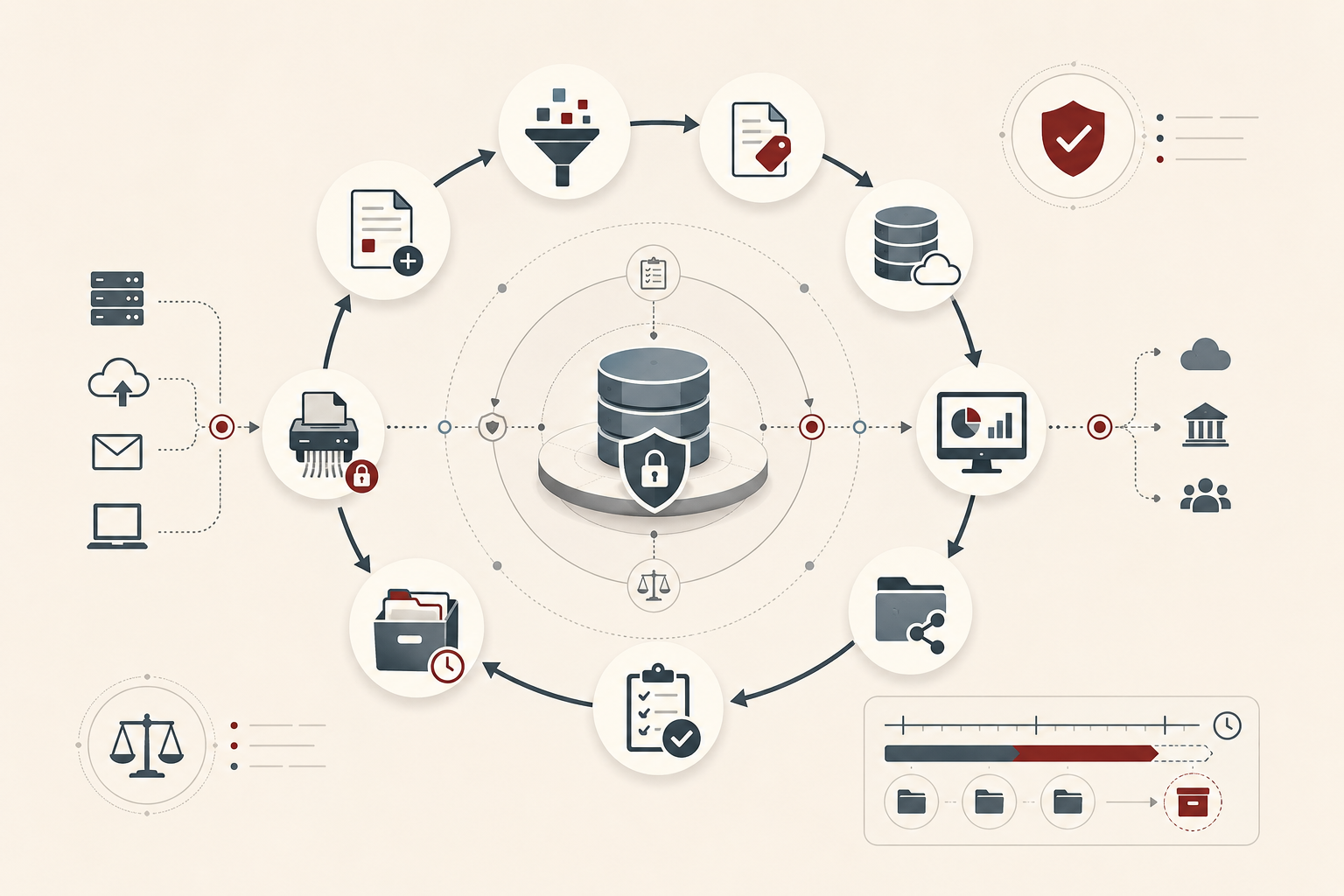
Data lifecycle management and retention sit at the heart of responsible data governance because organizations do not merely collect and analyze data. They create, ingest, classify, transform, store, share, archive, review, and ultimately dispose of it. Every one of those stages carries operational, legal, analytical, security, and ethical consequences. A mature data environment therefore cannot treat retention as an afterthought or as a narrow records-management exercise. It must understand retention as one element within a broader lifecycle discipline that governs how data moves from creation to disposition, how long it remains useful, when it should be reviewed, what must be preserved, what may be deleted, and how disposal should be carried out in a way that is defensible, auditable, and secure.
This matters because unmanaged retention creates several forms of institutional risk at once. Data kept too briefly may undermine accountability, compliance, reproducibility, or historical continuity. Data kept too long increases storage burden, privacy exposure, litigation risk, breach impact, and interpretive confusion, especially when obsolete datasets remain accessible without clear provenance or business purpose. Retention is therefore not a simple question of saving or deleting. It is a governance question about proportionality, purpose, evidentiary value, regulatory obligation, analytical usefulness, and secure end-of-life handling.
Seen from this perspective, data lifecycle management is not just about infrastructure hygiene. It is a way of aligning information practices with institutional memory, legal requirements, privacy obligations, security controls, archival responsibility, and analytical discipline. Retention should preserve what must remain available, restrict what should no longer circulate freely, archive what has enduring value, and dispose of what no longer has a defensible purpose.
Main Library
Publications
Article Map
Data Systems & Analytics
Related Topic
Artificial Intelligence Systems
Related Topic
Institutions & Governance
Related Topic
Risk & Resilience
This article should be read alongside the Data Systems and Analytics knowledge series, especially Data Governance and Stewardship, Metadata, Data Catalogs, and Lineage, Data Security, Privacy, and Access Control, Data Quality Metrics and Observability, and Data Products and Self-Service Analytics.
What data lifecycle management actually covers
Data lifecycle management refers to the structured oversight of data from its point of creation or acquisition through its active use, maintenance, transformation, sharing, retention, archival review, and final disposition. Although lifecycle models vary across domains, the central idea is stable: data should not drift indefinitely through systems without clear rules governing how it is handled at each stage. Mature lifecycle management establishes controls for classification, storage location, quality expectations, access conditions, preservation requirements, review triggers, transfer decisions, and disposal methods.
This broader lifecycle view is important because retention policy cannot be designed intelligently in isolation. The appropriate retention period for any dataset depends on what the data is, how it is used, whether it contains personal or sensitive information, whether it has evidentiary or historical value, whether it supports analytics or operational continuity, and whether a law, contract, or sector-specific obligation requires preservation. Retention, in other words, is downstream from classification and purpose definition. If an organization does not know what the data represents or why it exists, it is unlikely to retain it appropriately.
Lifecycle management also clarifies that not all data follows the same path. Some data remains highly active and business-critical for years. Some becomes reference material. Some is aggregated or anonymized for longer-term analysis. Some must be transferred into archival or preservation environments. Some should be deleted quickly because its continued storage has no legitimate justification. The role of lifecycle governance is to distinguish among these trajectories rather than impose one blunt rule across everything.
Good lifecycle management also distinguishes between data and records. Not every dataset is a formal record, but many datasets provide evidence of actions, obligations, transactions, decisions, or conditions. Records-management practice emphasizes the creation, capture, management, retention, and disposition of authoritative evidence. Data architecture must integrate that logic rather than treating all information as interchangeable storage.
Retention, archival preservation, legal hold, and secure disposition
These four concepts are related, but they are not interchangeable. Retention determines how long information should be kept in order to meet operational, legal, fiscal, scientific, or evidentiary needs. Archival preservation applies when information has enduring value and should be maintained under managed conditions for long-term access, accountability, or historical memory. Legal hold is an exception process that suspends ordinary disposition because litigation, investigation, audit, or regulatory review requires preservation. Secure disposition is the controlled end-of-life execution of policy through deletion, anonymization, destruction, transfer, or media sanitization.
Confusion among these categories weakens governance. When archiving is mistaken for indefinite storage, inactive data is dumped into cold environments without review or preservation metadata. When legal holds are treated as a reason to keep everything forever, schedules lose credibility and retention sprawl accelerates. When deletion is treated as equivalent to secure disposal, organizations may believe information is gone when it remains recoverable in backups, replicas, or physical media. A mature lifecycle program therefore needs clear conceptual boundaries as well as operational procedures.
This distinction is reflected in contemporary standards and guidance. ISO 15489 frames records management across formats, systems, and environments rather than tying it to a single storage state, while NARA scheduling guidance distinguishes retention and disposition logic from transfer of permanent records. NIST SP 800-88 Rev. 2, meanwhile, defines sanitization as a specific process intended to render access to target data infeasible for a given level of effort, which is not the same thing as simply marking a file deleted.
Retention is about purpose, not hoarding
One of the most important principles in retention design is that data should be kept for a reason, not simply because storage is cheap or future use is imaginable. Purpose-bound retention is embedded in modern privacy and governance thinking. The ICO’s guidance on storage limitation states that personal data should not be kept longer than necessary for the purposes for which it is processed, while recognizing that retention depends on purpose and context. This principle does not create one universal retention period. It requires organizations to justify retention rather than assume it.
This does not mean all data should be deleted quickly. Some records must be retained for statutory, contractual, tax, labor, scientific, evidentiary, historical, or safety reasons. Some data has long-term analytical or research value if it is appropriately documented, transformed, de-identified, or preserved under controlled access conditions. The key point is that retention should be justified category by category. A defensible retention program can explain not only why some data is preserved, but also why some data is no longer kept in identifiable or directly accessible form.
Organizations often fail here by conflating possible value with actual value. They retain vast quantities of operational exhaust, duplicated extracts, old reports, stale personal data, deprecated datasets, and undocumented files because “it might be useful one day.” In reality, this frequently produces cost, clutter, and risk without corresponding institutional benefit. Better retention governance asks a harder question: what continuing obligation or legitimate use justifies keeping this information in this form for this length of time?
Purpose-bound retention also matters ethically. Keeping data indefinitely can preserve institutional power over people long after the original relationship, transaction, or consent context has faded. This is especially important where data concerns vulnerable groups, workers, patients, students, migrants, benefit recipients, debtors, tenants, or communities subject to surveillance and administrative judgment. Lifecycle governance should protect memory where memory is needed, but it should also protect people from unnecessary persistence of information that can later be misused.
The logic of retention schedules
A retention schedule is the practical mechanism through which lifecycle principles become operational. It identifies categories of records or data assets, assigns retention periods or review triggers, and specifies disposition actions such as deletion, transfer, archive, anonymization, or secure destruction. Good schedules do not exist merely to satisfy auditors. They create predictable institutional behavior.
Retention schedules are strongest when they are based on functional categories and data classes rather than on individual systems alone. Systems change, migrate, and disappear. Functions endure more reliably. For example, customer transaction records, employee payroll records, environmental monitoring logs, safety incident reports, product quality data, research datasets, legal holds, model training data, and executive communications may all require different retention logic, but that logic should remain intelligible even if the underlying storage platform changes.
Schedules may be age-based, event-based, or hybrid. NARA’s implementation guidance notes that retention periods can begin when records are created or received, or when a specific event occurs. That distinction is important because many categories of information do not become disposable on a simple calendar basis; they become reviewable only after account closure, contract termination, employee departure, case closure, project closeout, publication, audit completion, or supersession by a newer authoritative record.
Retention schedules should also distinguish between minimum retention and maximum retention. A minimum retention rule may say that a record must be kept at least a certain number of years. A maximum retention rule may say that personal or sensitive data should not remain identifiable beyond a defined period unless a justified exception applies. Without both sides of the schedule, organizations can drift into either premature destruction or indefinite accumulation.
Finally, a schedule should specify evidence. It should identify who approved the category, what authority supports the period, what event starts the retention clock, what exceptions apply, what disposition action is expected, and what proof should remain after disposition. Without evidence, retention becomes a statement of intent rather than a defensible operating practice.
Active data, archive, and disposition
Lifecycle management becomes clearer when organizations distinguish among active storage, archival retention, and final disposition. Active data supports current operations, reporting, modeling, and decision-making. It generally needs high availability, current metadata, defined access controls, and integration into live analytical or transactional workflows. Archival data, by contrast, may no longer serve daily operations but still has evidentiary, historical, regulatory, scientific, or long-horizon research value. It may be transferred to lower-cost or specialized preservation environments, with stricter controls over modification and clearer preservation metadata.
Disposition is the point at which the organization executes the end-of-life decision assigned by policy. That may mean deletion, anonymization, secure destruction, transfer to archives, or legal preservation under hold. Disposition should not be treated as a casual technical cleanup task. It is a governed act that changes institutional memory, compliance posture, privacy exposure, and risk. For this reason, disposition actions should be traceable, authorized, and documented.
This distinction also helps correct a common misconception: archiving is not the same as indefinite retention. An archive is a managed state with its own logic, metadata, access constraints, preservation purpose, and review rules. Dumping unused data into cold storage without classification, provenance, or preservation metadata is not archival governance. It is deferred disorder.
Good archival practice also requires humility about future use. Some records have value precisely because future communities, researchers, regulators, courts, or public investigators may need them for purposes the original system did not anticipate. But that does not mean all information deserves permanent preservation. The point of archival review is to identify enduring value deliberately, not to preserve everything by default.
Privacy, security, and minimization
Retention policy has become inseparable from privacy and security governance. The longer personal or sensitive data is kept, the larger the exposure surface becomes. Retained data must still be protected, discoverable, explainable, and managed under access rules. This creates an important asymmetry: the benefit of holding extra data often declines over time, while the burden of protecting it persists. A strong retention program therefore reduces risk not only by preserving what must be kept, but by eliminating what no longer has a defensible purpose.
This is especially important where identifiable personal data is concerned. Privacy guidance emphasizes storage limitation, review periods, and deletion or anonymization once data is no longer necessary for its original purpose, subject to legal obligations or recognized archival, research, or public-interest exceptions. Even outside formal regulatory scope, this logic is institutionally sound. Minimization at the retention stage reduces future breach impact, lessens discovery burden, and improves clarity about which data remains authoritative.
Security considerations also extend to end-of-life handling. Deleting a record from an application interface is not the same as secure disposal across replicated systems, backups, media, and hardware. NIST SP 800-88 Rev. 2 emphasizes that sanitization is a programmatic activity tied to information sensitivity, media type, and disposition context. Lifecycle governance therefore has to connect policy-level retention decisions to real technical disposal practices rather than assume that a front-end delete command completes the job.
Retention minimization is also a form of protection against future misuse. Data may be collected for a legitimate administrative, operational, or analytical purpose and later repurposed for profiling, surveillance, targeting, enforcement, or exclusion. The longer identifiable data persists, the more opportunities exist for uses that were not part of the original justification. A mature lifecycle program should therefore connect retention governance to purpose limitation, access control, privacy review, and downstream-use review.
Backups, snapshots, derived datasets, and downstream copies
Retention governance often breaks not in the primary system of record, but in its copies. Modern data environments produce backups, disaster-recovery replicas, snapshots, exports, analyst extracts, departmental spreadsheets, notebook outputs, semantic caches, feature sets, training datasets, archived reporting packages, and third-party transfers. If lifecycle policy governs only the source system and ignores these derivatives, retention control becomes largely performative.
Backups need defined retention periods, access restrictions, restoration controls, and expiration logic. A backup is not outside governance because it exists for resilience or recovery. It remains part of the lifecycle problem. Backup policies should distinguish operational recovery from archival preservation. Backups are designed primarily for restoration after failure or incident. Archives are designed for long-term preservation, context, and controlled access. Treating backups as archives can create governance problems; treating archives as backups can create recovery problems.
Snapshots created for rollback or audit should be distinguished from archives created for long-term preservation. Derived analytical datasets should carry lifecycle metadata showing whether they are current, superseded, de-identified, restricted, or pending disposal. Downstream copies created by users should be governed by export controls, workspace policies, expiration rules, or managed environments where feasible. In analytics platforms, lineage is crucial because it reveals where data has moved and which dependent artifacts may need review, restriction, refresh, or deletion.
These issues are especially important for personal data and confidential information. Breach risk does not disappear merely because the most visible copy has been removed. If backups and replicas persist indefinitely, so does the exposure. That is why lifecycle governance must extend across infrastructure, applications, analytical consumption surfaces, development environments, and vendor-managed systems rather than stopping at the authoritative source.
Legal holds, defensibility, and auditability
Retention programs fail when they are either rigidly destructive or indefinitely permissive. A mature system needs the capacity to suspend ordinary disposition when litigation, investigation, audit, incident response, public inquiry, or regulatory review requires preservation. Legal holds are therefore an essential exception mechanism within lifecycle management. They ensure that records otherwise eligible for disposal are preserved until the hold is lifted.
But legal holds should remain exceptions, not a permanent excuse for retention sprawl. If every uncertainty results in indefinite preservation, the retention program loses credibility. Defensibility comes from having a clearly documented policy, applying it consistently, suspending it when necessary through formal holds, and recording those decisions. In a well-run environment, an organization can explain why a dataset was kept, why another was deleted, who authorized the action, which schedule applied, and what evidence exists that disposition occurred as intended.
Auditability matters for more than legal defense. It supports stewardship, reduces internal confusion, and helps future teams understand the lifecycle status of records and datasets. A retention regime is credible only when it can be seen, reviewed, and evidenced. That evidence does not need to preserve the original data indefinitely. A disposition log may record the asset, schedule, authority, approval, method, date, and verification result while the underlying data is destroyed or anonymized.
Legal holds also require release discipline. A hold that is never reviewed can quietly become permanent retention. Lifecycle governance should therefore include hold owners, scope, affected assets, start date, review cadence, release criteria, and post-release disposition review. When a hold ends, the ordinary schedule should resume rather than leaving data frozen in indefinite limbo.
Retention in analytics and data platforms
Modern analytics environments create special retention challenges because copies proliferate easily and time horizons differ by use case. Raw ingestion zones may need only short-lived operational retention. Curated analytical tables may need longer persistence for reporting continuity. Historical snapshots may need to survive long enough to support reproducibility, model validation, audit trails, or longitudinal analysis. Some records should be anonymized or aggregated rather than retained in identifiable form. Others may need controlled archival treatment because of historical, scientific, or public-interest value.
This is why lifecycle management must extend across data pipelines and analytical products. Metadata matters because consumers need to know whether a dataset is current, superseded, archived, under hold, or pending disposal. Product thinking matters because a data product should include lifecycle expectations as part of its service definition: freshness, review cadence, archival criteria, deprecation process, and retirement rules. Lineage matters because it shows how source data propagates into derived assets and which downstream products inherit retention obligations.
Retention in analytical systems also raises important questions about reproducibility. Some historical data must remain accessible long enough to support model evaluation, scientific replication, regulatory review, or longitudinal trend analysis. In such cases, the answer may not be to delete everything quickly, but to separate identifiable operational records from appropriately preserved analytical forms such as anonymized aggregates, controlled archives, or documented historical snapshots with restricted access.
Analytical retention should also distinguish between data needed to recreate an output and data needed to understand an output. Sometimes a complete versioned dataset must be preserved. In other cases, a manifest, code version, validation report, aggregate output, schema snapshot, and controlled sample may provide enough evidence without retaining sensitive raw records indefinitely. The best design depends on risk, law, reproducibility needs, scientific value, and human consequences.
Analytics, AI, and lifecycle risk
AI systems make lifecycle governance more complicated because data may become embedded in derived artifacts. Training datasets, feature tables, embeddings, vector indexes, model checkpoints, evaluation sets, prompts, logs, annotations, synthetic data, monitoring records, and feedback loops may all contain traces of source data. A retention program that focuses only on databases may miss the artifacts that power analytical and AI systems.
This matters for model governance. If a dataset is deleted, restricted, corrected, or placed under hold, organizations may need to know whether it was used to train a model, build a feature table, generate embeddings, evaluate performance, support a dashboard, or inform a decision-support workflow. Model cards, data sheets, lineage records, feature-store metadata, experiment-tracking systems, and release manifests can help connect AI artifacts back to lifecycle governance.
AI also creates retention pressure because organizations may want to keep more data for future model training. That pressure should be governed rather than assumed. More data is not always better. Stale, biased, poorly documented, over-retained, or unlawfully reused data can make AI systems less trustworthy. Lifecycle management should therefore include rules for training-data eligibility, retention of evaluation evidence, retirement of obsolete feature sets, deletion of unnecessary logs, and preservation of audit records.
The same principle applies to retrieval-augmented systems and knowledge bases. Documents and records used for retrieval should carry lifecycle metadata. If a document expires, is superseded, is placed under restriction, or loses authorization for a given use, downstream indexes should not continue serving it as if it remained current and valid. Lifecycle status has to travel with data into AI-facing systems, not remain buried in a separate records schedule.
Common failures in lifecycle management
Several failure modes recur in organizations that have weak lifecycle discipline. One is default forever retention, where data persists indefinitely because no one has defined a schedule. Another is system-bound policy, where retention rules are attached to legacy applications rather than to enduring information classes. A third is deletion without traceability, where records disappear but no documented basis exists for the action. A fourth is archive dumping, where inactive data is moved to cold storage without classification, metadata, or review rules. A fifth is privacy blind spots, where derived datasets, exports, replicas, or backups continue to store personal data long after the primary record should have been reviewed or removed.
There is also the problem of lifecycle fragmentation. Legal, compliance, security, records management, analytics, and engineering teams may each govern part of the problem, with no shared model connecting their decisions. The result is usually inconsistent policy, partial enforcement, and confusion over which version of the rules actually applies. Effective lifecycle governance requires coordination across these functions because retention is simultaneously a legal, technical, operational, archival, analytical, and informational issue.
Another recurring failure is semantic decay. Data may still exist, but its meaning may no longer be clear. If definitions, codebooks, schema documentation, lineage, consent context, collection methods, or business rules are lost, retained data may become difficult to interpret responsibly. Long-term retention requires long-term metadata. Otherwise the organization preserves bytes while losing meaning.
Finally, organizations often confuse deletion with disposal. A file may be removed from a user interface while surviving in backups, replicas, caches, indexes, exports, local downloads, or retired media. Secure disposition requires end-to-end knowledge of data location, propagation, recovery paths, and media-handling processes. Without that knowledge, deletion claims can exceed actual control.
What good looks like
A strong data lifecycle and retention program usually has several recognizable features. Data is classified according to purpose, sensitivity, and evidentiary value. Retention schedules are documented, approved, and tied to business functions or data classes rather than to transient tools alone. Age-based and event-based triggers are defined clearly. Legal-hold processes can suspend ordinary deletion when necessary. Metadata, lineage, and cataloging make lifecycle status visible. Archival pathways exist for records and datasets with long-term value. Backup and snapshot policies define retention limits and restoration controls. Secure deletion and media sanitization practices are linked to policy rather than left to ad hoc cleanup. Users understand that retention is not simply about saving less or saving more, but about governing information proportionately across its entire usable life.
Most importantly, good lifecycle management changes institutional behavior. Teams stop assuming that everything should live forever. Data platforms become easier to interpret because stale and redundant assets are reduced. Privacy and breach risk decline because unnecessary identifiable data is not retained indefinitely. Historical continuity improves because true archival assets are preserved intentionally rather than accidentally. Analytical workflows become more trustworthy because outputs can be traced to retained evidence or documented snapshots. In that sense, lifecycle governance supports both minimization and memory. It helps organizations forget responsibly and preserve deliberately.
Good lifecycle governance also makes review normal. It does not wait for a crisis, migration, breach, discovery request, public-records dispute, or storage-cost emergency before asking what data exists. It uses inventories, catalogs, review dates, disposition workflows, access logs, data contracts, lineage maps, and audit evidence to keep lifecycle status visible over time.
Python and R Workflows
Data lifecycle management becomes more practical when retention rules are represented as inspectable logic. The Python workflow below classifies data assets, applies retention schedules, handles legal holds, and generates a disposition review register. The R workflow analyzes data aging, access patterns, retention risk, and lifecycle status across a portfolio of assets. Together, they show how lifecycle governance can move from policy language into reproducible analytical operations.
These workflows are intentionally compact. They are not substitutes for legal review, records-management authority, enterprise catalogs, privacy engineering, or storage-platform automation. Their purpose is to show the structure that lifecycle systems need: asset inventory, ownership, classification, retention category, trigger date, hold status, archival value, risk status, downstream dependencies, and disposition evidence.
Python workflow: Classifying data assets for retention, archival review, and defensible disposal
This Python workflow creates a small data-asset inventory, applies retention rules, calculates review and disposition dates, respects legal holds, and produces a governance-ready disposition register. The same pattern can be extended to metadata catalogs, object storage inventories, warehouse tables, SaaS exports, backup manifests, feature stores, or data product registries.
from datetime import datetime
import pandas as pd

# -----------------------------
# 1. Define a small data asset inventory
# -----------------------------

today = pd.Timestamp("2026-03-31")

assets = pd.DataFrame([
    {
        "asset_id": "crm_contacts_raw",
        "asset_name": "CRM contacts raw export",
        "system": "cloud_object_storage",
        "owner": "sales_ops",
        "classification": "personal_data",
        "retention_category": "customer_contact_data",
        "created_date": "2022-02-01",
        "trigger_date": "2025-12-31",
        "last_accessed_date": "2026-03-01",
        "legal_hold": False,
        "archival_value": "low",
        "downstream_dependencies": 3
    },
    {
        "asset_id": "invoice_records",
        "asset_name": "Invoice records",
        "system": "finance_database",
        "owner": "finance",
        "classification": "financial_record",
        "retention_category": "financial_records",
        "created_date": "2018-01-01",
        "trigger_date": "2019-12-31",
        "last_accessed_date": "2026-02-15",
        "legal_hold": False,
        "archival_value": "medium",
        "downstream_dependencies": 5
    },
    {
        "asset_id": "web_logs_2021",
        "asset_name": "Web logs 2021",
        "system": "log_archive",
        "owner": "platform_engineering",
        "classification": "behavioral_log",
        "retention_category": "system_logs",
        "created_date": "2021-01-01",
        "trigger_date": "2021-12-31",
        "last_accessed_date": "2022-03-01",
        "legal_hold": False,
        "archival_value": "low",
        "downstream_dependencies": 0
    },
    {
        "asset_id": "environmental_sensor_history",
        "asset_name": "Environmental sensor history",
        "system": "data_lakehouse",
        "owner": "research_data_team",
        "classification": "scientific_observation",
        "retention_category": "research_observational_data",
        "created_date": "2016-01-01",
        "trigger_date": "2025-12-31",
        "last_accessed_date": "2026-03-20",
        "legal_hold": False,
        "archival_value": "high",
        "downstream_dependencies": 12
    },
    {
        "asset_id": "terminated_employee_files",
        "asset_name": "Terminated employee files",
        "system": "hr_document_system",
        "owner": "human_resources",
        "classification": "sensitive_personal_data",
        "retention_category": "employee_records",
        "created_date": "2015-05-01",
        "trigger_date": "2016-05-01",
        "last_accessed_date": "2026-01-10",
        "legal_hold": True,
        "archival_value": "low",
        "downstream_dependencies": 1
    },
    {
        "asset_id": "model_training_extract_v1",
        "asset_name": "Model training extract v1",
        "system": "machine_learning_workspace",
        "owner": "machine_learning",
        "classification": "derived_personal_data",
        "retention_category": "ml_training_extract",
        "created_date": "2023-06-01",
        "trigger_date": "2024-06-01",
        "last_accessed_date": "2024-09-01",
        "legal_hold": False,
        "archival_value": "low",
        "downstream_dependencies": 2
    },
    {
        "asset_id": "legacy_dashboard_extract",
        "asset_name": "Legacy dashboard extract",
        "system": "business_intelligence",
        "owner": "",
        "classification": "internal_analytics",
        "retention_category": "dashboard_extract",
        "created_date": "2020-01-01",
        "trigger_date": "2020-12-31",
        "last_accessed_date": "2021-06-01",
        "legal_hold": False,
        "archival_value": "low",
        "downstream_dependencies": 0
    }
])

date_columns = ["created_date", "trigger_date", "last_accessed_date"]

for column in date_columns:
    assets[column] = pd.to_datetime(assets[column])

# -----------------------------
# 2. Define retention rules
# -----------------------------
# Durations here are illustrative. Real retention schedules should be
# developed with legal, privacy, records, security, archival, and business review.

retention_rules = pd.DataFrame([
    {
        "retention_category": "customer_contact_data",
        "retention_years": 2,
        "default_action": "delete_or_anonymize",
        "requires_archival_review": False
    },
    {
        "retention_category": "financial_records",
        "retention_years": 7,
        "default_action": "retain_until_expired_then_dispose",
        "requires_archival_review": False
    },
    {
        "retention_category": "system_logs",
        "retention_years": 1,
        "default_action": "delete",
        "requires_archival_review": False
    },
    {
        "retention_category": "research_observational_data",
        "retention_years": 10,
        "default_action": "archive_review",
        "requires_archival_review": True
    },
    {
        "retention_category": "employee_records",
        "retention_years": 7,
        "default_action": "retain_until_expired_then_dispose",
        "requires_archival_review": False
    },
    {
        "retention_category": "ml_training_extract",
        "retention_years": 2,
        "default_action": "delete_or_regenerate_from_governed_source",
        "requires_archival_review": False
    },
    {
        "retention_category": "dashboard_extract",
        "retention_years": 1,
        "default_action": "delete_or_rebuild_from_certified_source",
        "requires_archival_review": False
    }
])

# -----------------------------
# 3. Apply retention rules
# -----------------------------

inventory = assets.merge(
    retention_rules,
    on="retention_category",
    how="left"
)

inventory["retention_expiration_date"] = inventory.apply(
    lambda row: row["trigger_date"] + pd.DateOffset(years=int(row["retention_years"])),
    axis=1
)

inventory["days_since_last_access"] = (
    today - inventory["last_accessed_date"]
).dt.days

inventory["retention_expired"] = today > inventory["retention_expiration_date"]
inventory["ownership_gap"] = inventory["owner"].isna() | (inventory["owner"] == "")

# -----------------------------
# 4. Determine lifecycle status
# -----------------------------

def determine_lifecycle_status(row):
    if row["legal_hold"]:
        return "retain_legal_hold"

    if row["ownership_gap"]:
        return "assign_owner_before_disposition"

    if row["requires_archival_review"] and row["archival_value"] == "high":
        return "archive_review_required"

    if row["retention_expired"] and row["downstream_dependencies"] > 0:
        return "review_dependencies_before_disposition"

    if row["retention_expired"]:
        return "eligible_for_disposition"

    if row["days_since_last_access"] > 365 and row["archival_value"] == "low":
        return "inactive_monitor_for_future_disposition"

    return "active_retain"

inventory["lifecycle_status"] = inventory.apply(
    determine_lifecycle_status,
    axis=1
)

# -----------------------------
# 5. Create a disposition review register
# -----------------------------

review_statuses = [
    "eligible_for_disposition",
    "review_dependencies_before_disposition",
    "archive_review_required",
    "retain_legal_hold",
    "assign_owner_before_disposition"
]

disposition_register = inventory[
    inventory["lifecycle_status"].isin(review_statuses)
].copy()

disposition_register["recommended_next_step"] = disposition_register["lifecycle_status"].map({
    "eligible_for_disposition": "Approve deletion, anonymization, or secure sanitization and record evidence",
    "review_dependencies_before_disposition": "Review lineage and downstream dependencies before disposal",
    "archive_review_required": "Evaluate long-term preservation, restricted access, or archival transfer",
    "retain_legal_hold": "Suspend normal disposition until hold is released",
    "assign_owner_before_disposition": "Assign accountable owner before lifecycle decision"
})

review_columns = [
    "asset_id",
    "asset_name",
    "owner",
    "classification",
    "retention_category",
    "retention_expiration_date",
    "legal_hold",
    "archival_value",
    "downstream_dependencies",
    "lifecycle_status",
    "recommended_next_step"
]

print("Lifecycle inventory")
print(inventory[[
    "asset_id",
    "retention_category",
    "retention_expiration_date",
    "retention_expired",
    "lifecycle_status"
]])

print("\nDisposition review register")
print(disposition_register[review_columns])

# -----------------------------
# 6. Create a disposition evidence template
# -----------------------------

evidence_template = disposition_register.assign(
    review_date=today,
    reviewer="pending_assignment",
    disposition_authority="pending_policy_reference",
    disposition_method="pending_decision",
    verification_required=True
)

print("\nDisposition evidence template")
print(evidence_template[[
    "asset_id",
    "review_date",
    "reviewer",
    "disposition_authority",
    "disposition_method",
    "verification_required"
]])
This workflow turns retention into a repeatable governance process. It shows which assets are active, which are expired, which require archival review, which are blocked by legal hold, which lack accountable ownership, and which need downstream dependency review before disposal. A production implementation could connect the same logic to catalog metadata, cloud object tags, warehouse table inventories, access logs, backup manifests, approval workflows, and secure-disposal records.
R workflow: Analyzing data aging, access patterns, retention risk, and lifecycle status
This R workflow evaluates lifecycle risk across a portfolio of data assets. It calculates age, inactivity, retention-expiration status, sensitivity, reuse, storage exposure, and ownership gaps, then summarizes risk by system and retention category. This kind of analysis can support governance reviews, platform cleanup, privacy-risk reduction, archival planning, and storage-cost management.
library(tidyverse)
library(lubridate)

# -----------------------------
# 1. Create a data lifecycle inventory
# -----------------------------

today <- as.Date("2026-03-31")

assets <- tribble(
  ~asset_id, ~system, ~owner, ~classification, ~retention_category, ~created_date, ~expiration_date, ~last_accessed_date, ~legal_hold, ~archival_value, ~storage_gb, ~downstream_dependencies,
  "crm_contacts_raw", "cloud_object_storage", "sales_ops", "personal_data", "customer_contact_data", "2022-02-01", "2027-12-31", "2026-03-01", FALSE, "low", 18, 3,
  "invoice_records", "finance_database", "finance", "financial_record", "financial_records", "2018-01-01", "2026-12-31", "2026-02-15", FALSE, "medium", 42, 5,
  "web_logs_2021", "log_archive", "platform_engineering", "behavioral_log", "system_logs", "2021-01-01", "2022-12-31", "2022-03-01", FALSE, "low", 120, 0,
  "environmental_sensor_history", "data_lakehouse", "research_data_team", "scientific_observation", "research_observational_data", "2016-01-01", "2035-12-31", "2026-03-20", FALSE, "high", 380, 12,
  "terminated_employee_files", "hr_document_system", "human_resources", "sensitive_personal_data", "employee_records", "2015-05-01", "2023-05-01", "2026-01-10", TRUE, "low", 9, 1,
  "model_training_extract_v1", "machine_learning_workspace", "machine_learning", "derived_personal_data", "ml_training_extract", "2023-06-01", "2026-06-01", "2024-09-01", FALSE, "low", 64, 2,
  "legacy_dashboard_extract", "business_intelligence", "", "internal_analytics", "dashboard_extract", "2020-01-01", "2022-01-01", "2021-06-01", FALSE, "low", 27, 0
) %>%
  mutate(
    created_date = as.Date(created_date),
    expiration_date = as.Date(expiration_date),
    last_accessed_date = as.Date(last_accessed_date)
  )

# -----------------------------
# 2. Score lifecycle risk
# -----------------------------

asset_risk <- assets %>%
  mutate(
    asset_age_days = as.integer(today - created_date),
    inactive_days = as.integer(today - last_accessed_date),
    retention_expired = today > expiration_date,
    ownership_gap = is.na(owner) | owner == "",
    sensitive = classification %in% c(
      "personal_data",
      "sensitive_personal_data",
      "derived_personal_data",
      "behavioral_log"
    ),
    high_reuse = downstream_dependencies >= 5,
    high_storage = storage_gb > 50,
    lifecycle_risk_score =
      2 * as.integer(retention_expired) +
      2 * as.integer(sensitive) +
      2 * as.integer(ownership_gap) +
      1 * as.integer(inactive_days > 365) +
      1 * as.integer(high_storage) +
      1 * as.integer(high_reuse) +
      3 * as.integer(legal_hold),
    lifecycle_status = case_when(
      legal_hold ~ "retain_legal_hold",
      retention_expired & archival_value == "high" ~ "archive_review_required",
      retention_expired & downstream_dependencies > 0 ~ "dependency_review_required",
      retention_expired ~ "eligible_for_disposition",
      ownership_gap ~ "assign_owner",
      inactive_days > 365 & archival_value == "low" ~ "inactive_review",
      TRUE ~ "active_retain"
    )
  )

asset_risk %>%
  select(
    asset_id,
    system,
    classification,
    expiration_date,
    retention_expired,
    inactive_days,
    storage_gb,
    lifecycle_risk_score,
    lifecycle_status
  )

# -----------------------------
# 3. Summarize risk by system
# -----------------------------

system_summary <- asset_risk %>%
  group_by(system) %>%
  summarise(
    asset_count = n(),
    total_storage_gb = sum(storage_gb),
    expired_assets = sum(retention_expired),
    sensitive_assets = sum(sensitive),
    ownership_gaps = sum(ownership_gap),
    legal_holds = sum(legal_hold),
    average_lifecycle_risk_score = mean(lifecycle_risk_score),
    .groups = "drop"
  ) %>%
  arrange(desc(average_lifecycle_risk_score), desc(total_storage_gb))

system_summary

# -----------------------------
# 4. Summarize lifecycle actions
# -----------------------------

action_register <- asset_risk %>%
  filter(lifecycle_status != "active_retain") %>%
  transmute(
    asset_id,
    system,
    owner,
    classification,
    retention_category,
    lifecycle_status,
    recommended_action = case_when(
      lifecycle_status == "retain_legal_hold" ~ "Preserve until legal hold is released and reviewed",
      lifecycle_status == "archive_review_required" ~ "Review for long-term archival preservation and access restrictions",
      lifecycle_status == "dependency_review_required" ~ "Review lineage and downstream dependencies before disposition",
      lifecycle_status == "eligible_for_disposition" ~ "Approve deletion, anonymization, or secure sanitization",
      lifecycle_status == "assign_owner" ~ "Assign accountable owner before lifecycle decision",
      lifecycle_status == "inactive_review" ~ "Review inactive asset for archive, restriction, or disposal",
      TRUE ~ "Review required"
    )
  )

action_register

# -----------------------------
# 5. Estimate avoidable storage exposure
# -----------------------------

avoidable_storage <- asset_risk %>%
  filter(
    lifecycle_status %in% c(
      "eligible_for_disposition",
      "inactive_review",
      "dependency_review_required"
    )
  ) %>%
  summarise(
    candidate_asset_count = n(),
    candidate_storage_gb = sum(storage_gb),
    sensitive_candidate_assets = sum(sensitive)
  )

avoidable_storage

# -----------------------------
# 6. Build a governance scorecard
# -----------------------------

governance_scorecard <- asset_risk %>%
  summarise(
    total_assets = n(),
    expired_assets = sum(retention_expired),
    assets_under_legal_hold = sum(legal_hold),
    assets_with_ownership_gaps = sum(ownership_gap),
    inactive_assets = sum(inactive_days > 365),
    sensitive_assets = sum(sensitive),
    total_storage_gb = sum(storage_gb),
    storage_gb_in_review = sum(storage_gb[lifecycle_status != "active_retain"])
  )

governance_scorecard
This workflow shows how lifecycle governance can become measurable. It identifies expired assets, sensitive data, ownership gaps, inactive data, high-reuse assets, storage exposure, and legal holds. It also separates simple deletion candidates from assets that require dependency review, archival review, ownership remediation, or legal preservation. In a mature data platform, this kind of workflow can feed governance dashboards, retention reviews, storage optimization, privacy-risk reduction, and records-management reporting.
How these workflows strengthen lifecycle governance
The Python workflow emphasizes policy execution. It shows how retention categories, trigger dates, expiration dates, legal holds, archival value, downstream dependencies, and ownership status can be turned into a disposition review process. The R workflow emphasizes portfolio analysis. It shows how lifecycle risk can be summarized across systems, classifications, storage volume, access patterns, and lifecycle statuses.
Together, the workflows reinforce the central argument of this article: lifecycle management is not a passive storage policy. It is an evidence system. Organizations need to know what data exists, why it exists, where it is stored, who owns it, what rules apply, what dependencies it has, whether it should be retained, and how disposition decisions are documented. Once those questions are represented as metadata and reproducible workflows, lifecycle governance becomes operational rather than aspirational.
GitHub Repository
The companion repository for this article provides reproducible Python and R workflows for classifying data assets, applying retention schedules, identifying legal holds, reviewing archival value, analyzing lifecycle risk, summarizing storage exposure, and producing governance-ready disposition registers.
Complete Code RepositoryThis repository turns data lifecycle management into a practical workflow for retention review, archival decision-making, legal-hold tracking, privacy-risk reduction, defensible disposal, and long-term data governance across modern analytical systems.
Conclusion
Data lifecycle management and retention should be understood as core governance disciplines rather than administrative afterthoughts. They determine how organizations balance utility with restraint, memory with minimization, preservation with disposal, and compliance with operational practicality. A strong lifecycle program does not ask only how long data can be kept. It asks what the data is, why it exists, what obligations attach to it, what value it retains over time, when it should be reviewed, how it should be preserved if necessary, and how it should be disposed of when its legitimate life has ended.
When organizations get this right, they gain more than cleaner storage. They build a more defensible, intelligible, and resilient information environment. Data remains available where it should, protected where it must, archived where it has lasting value, and deleted, anonymized, or sanitized where continued retention no longer serves a legitimate purpose. The result is not simply less data or more data. It is better-governed data.
That is the deeper promise of lifecycle governance: not just control over storage, but disciplined stewardship across the full life of information. A mature organization must be able to remember deliberately, forget responsibly, preserve evidence where accountability requires it, and dispose of information when continued retention becomes unnecessary or harmful.
Related articles
- Data Governance and Stewardship
- Metadata, Data Catalogs, and Lineage
- Data Security, Privacy, and Access Control
- Data Quality Metrics and Observability
- Reproducible Analytics and Versioned Data Workflows
- Data Products and Self-Service Analytics
- Business Intelligence Systems and Decision Support
Further reading
- Borgman, C.L. (2015) Big Data, Little Data, No Data: Scholarship in the Networked World. Cambridge, MA: MIT Press.
- Crockett, M. (2019) The No-Nonsense Guide to Archives and Recordkeeping. 3rd edn. London: Facet Publishing.
- Franks, P.C. (2018) Records and Information Management. 2nd edn. Chicago: ALA Neal-Schuman.
- Kleppmann, M. (2017) Designing Data-Intensive Applications. Sebastopol, CA: O’Reilly Media.
- Smallwood, R.F. (2020) Information Governance: Concepts, Strategies, and Best Practices. 2nd edn. Hoboken, NJ: Wiley.
- Williams, C. (2006) Managing Archives: Foundations, Principles and Practice. Oxford: Chandos Publishing.
- Yakel, E. (ed.) (2021) Digital Curation. 2nd edn. Chicago: ALA Neal-Schuman.
References
- European Commission (2026) For how long can data be kept and is it necessary to update it? Available at: https://commission.europa.eu/law/law-topic/data-protection/rules-business-and-organisations/principles-gdpr/how-long-can-data-be-kept-and-it-necessary-update-it_en
- ICO (2026) Principle (e): Storage limitation. Available at: https://ico.org.uk/for-organisations/uk-gdpr-guidance-and-resources/data-protection-principles/a-guide-to-the-data-protection-principles/storage-limitation/
- ICO (2023) Retention and destruction of information. Available at: https://ico.org.uk/for-organisations/foi/freedom-of-information-and-environmental-information-regulations/retention-and-destruction-of-information/
- ICO (2026) How do we find and retrieve the relevant information? Available at: https://ico.org.uk/for-organisations/uk-gdpr-guidance-and-resources/individual-rights/right-of-access/how-do-we-find-and-retrieve-the-relevant-information/
- ICO (2026) Encryption scenarios. Available at: https://ico.org.uk/for-organisations/uk-gdpr-guidance-and-resources/security/encryption/encryption-scenarios/
- ISO (2016) ISO 15489 Records management. Available at: https://committee.iso.org/sites/tc46sc11/home/projects/published/iso-15489-records-management.html
- NARA (2026) Implementing Schedules. Available at: https://www.archives.gov/records-mgmt/scheduling/implementation
- NARA (2025) Scheduling Records. Available at: https://www.archives.gov/records-mgmt/scheduling/sch-records
- NARA (2021) NARA Records Schedule. Available at: https://www.archives.gov/about/records-schedule
- NIST (2025) SP 800-88 Rev. 2, Guidelines for Media Sanitization. Available at: https://csrc.nist.gov/pubs/sp/800/88/r2/final
- NIST (2024) Research Data Framework (RDaF) Version 2.0. Available at: https://nvlpubs.nist.gov/nistpubs/SpecialPublications/1500-18/NIST.SP.1500-18r2.html
- NIST (2020) Privacy Framework: A Tool for Improving Privacy through Enterprise Risk Management. Available at: https://www.nist.gov/privacy-framework
- NIST (2024) The NIST Cybersecurity Framework (CSF) 2.0. Available at: https://nvlpubs.nist.gov/nistpubs/CSWP/NIST.CSWP.29.pdf
- W3C (2013) PROV-DM: The PROV Data Model. Available at: https://www.w3.org/TR/prov-dm/
- W3C (2013) PROV-O: The PROV Ontology. Available at: https://www.w3.org/TR/prov-o/