
Last Updated May 10, 2026
Synthetic data, simulation, and AI evaluation environments describe the constructed worlds through which artificial intelligence systems are trained, tested, stressed, compared, and governed. Synthetic data can expand limited datasets, protect sensitive records, balance rare cases, generate edge conditions, and support controlled experimentation. Simulation can create environments where agents, robots, decision systems, infrastructure models, and safety controls can be evaluated before deployment. Evaluation environments can turn abstract claims about model quality into repeatable evidence about performance, robustness, fairness, safety, cost, and failure behavior.
These methods are powerful because real-world data are often incomplete, expensive, sensitive, biased, dangerous to collect, or insufficiently diverse. A hospital may not be able to share patient records. A city may not be able to test unsafe infrastructure failures in the real world. A robotics system may need millions of trials before safe deployment. A safety evaluator may need rare harmful scenarios that are absent from ordinary logs. Synthetic data and simulation can help, but they can also mislead. If the synthetic world is wrong, the AI system may learn confidence in a fiction.
The central argument is that synthetic data and simulation should be governed as evaluation infrastructure. They are not neutral substitutes for reality. Their value depends on design assumptions, data provenance, generative mechanisms, coverage of edge cases, utility metrics, privacy analysis, realism, stress-test validity, domain transfer, monitoring, and institutional review. Synthetic environments can improve AI development only when their limits are measured, documented, and connected to real-world validation.
Main Library
Publications
Article Map
Artificial Intelligence Systems
Related Topic
Data Systems & Analytics
Related Topic
Risk & Resilience
Related Topic
Intelligent Infrastructure Systems
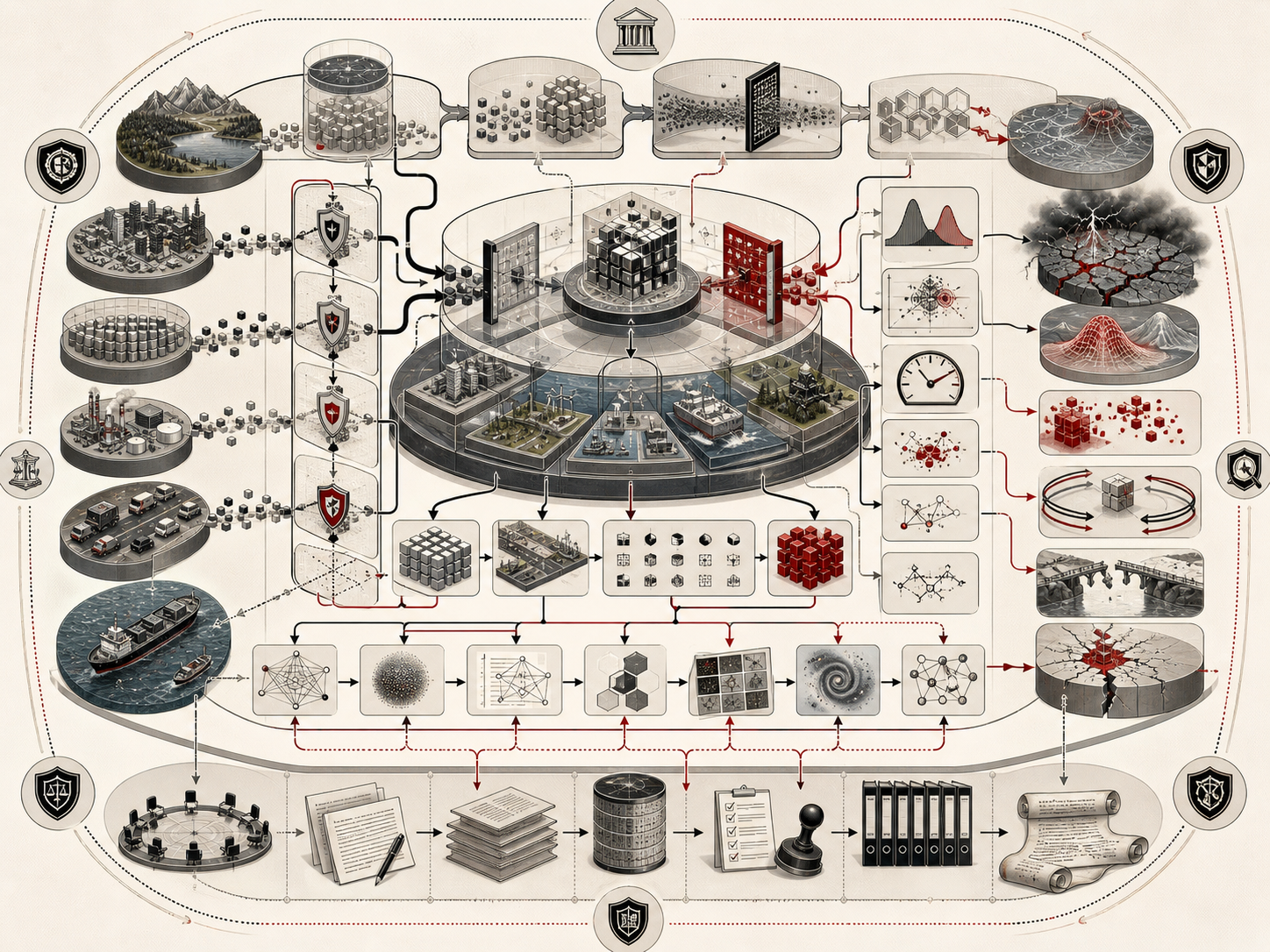
This article develops Synthetic Data, Simulation, and AI Evaluation Environments as an advanced article within the Artificial Intelligence Systems knowledge series. It explains synthetic data generation, simulation environments, digital twins, evaluation benchmarks, fidelity testing, task utility, privacy risk, rare-case coverage, stress testing, sim-to-real transfer, benchmark overfitting, LLM and agent evaluation, documentation, governance, and institutional accountability. Selected Python and R examples appear here, while the full GitHub repository contains expanded computational scaffolding for synthetic-data fidelity, task utility, privacy proximity analysis, simulation validation, benchmark governance, SQL schemas, documentation templates, and reproducible notebooks.
Why Synthetic Data and Simulation Matter
Synthetic data matters because AI systems require evidence, but evidence is often constrained. Real data may be protected by privacy rules, scattered across institutions, too sparse for rare events, expensive to label, dangerous to collect, or historically biased. Synthetic data can help teams explore model behavior when real data are unavailable, insufficient, or too risky to share. It can also help create controlled scenarios for testing, stress evaluation, fairness review, and robustness analysis.
Simulation matters because some AI systems act inside environments. A self-driving system, robot, clinical workflow assistant, reinforcement-learning agent, logistics optimizer, infrastructure controller, climate-risk model, or emergency-response planner cannot be evaluated only through static datasets. These systems interact with changing conditions, feedback loops, constraints, delays, and consequences. Simulation allows repeated experimentation in controlled conditions before real-world deployment.
Evaluation environments matter because AI quality is multi-dimensional. A model is not “good” in the abstract. It may be accurate but unsafe, robust but unfair, fast but poorly calibrated, private but low utility, or strong on benchmark data but weak under deployment shift. A mature evaluation environment tests many dimensions at once and records the conditions under which claims are valid.
Synthetic data and simulation therefore belong to the evidence infrastructure of AI governance. They can help answer questions that ordinary historical validation cannot answer: What happens under rare failures? How does the system behave when data are missing? What if the deployment population shifts? What if an agent receives a malicious tool output? What if a retrieval system contains stale, conflicting, or poisoned sources? What if a benchmark has been contaminated? What if a rare subgroup is nearly absent from the real dataset?
The value of these methods lies not in replacing reality, but in making evaluation more deliberate. A synthetic dataset, simulator, or benchmark should be treated as a controlled experimental world whose assumptions, limits, and transfer claims must be documented. When used well, synthetic environments reveal weaknesses earlier. When used poorly, they create a false sense of safety.
From Data Augmentation to Evaluation Infrastructure
Synthetic data is often introduced as data augmentation: generate more examples to improve training. That use is important, but too narrow. Synthetic data can also be used for privacy-preserving data release, benchmark construction, rare-event simulation, fairness stress testing, counterfactual analysis, adversarial testing, digital twin experimentation, and governance review.
The deeper shift is from “more data” to “better evaluation worlds.” A synthetic dataset is not merely a larger table. It is a constructed representation of what the system designer thinks matters. A simulator is not merely a virtual environment. It is a theory of how an environment behaves. A benchmark is not merely a score. It is a formalized claim about what counts as performance.
This means synthetic data and simulation require the same discipline as model development: assumptions, documentation, versioning, validation, monitoring, and review. The synthetic environment must itself be evaluated. It should be tested for statistical fidelity, task utility, privacy risk, fairness behavior, coverage of rare cases, realism, transfer validity, and sensitivity to design assumptions.
Synthetic\ Data \neq Reality
\]
Interpretation: Synthetic data can support training, testing, privacy protection, and evaluation, but it remains a constructed representation whose relationship to reality must be measured.
This framing is especially important because synthetic data can look convincing. A generated table may have plausible columns. A synthetic image may look realistic. A simulated city may contain roads, traffic, sensors, and weather. A benchmark may produce precise scores. But plausibility is not validation. A synthetic environment is useful only if it preserves the features, relationships, edge cases, constraints, and failure dynamics that matter for the intended task.
Evaluation infrastructure should therefore answer three questions. First, what does this synthetic or simulated world preserve? Second, what does it distort or omit? Third, what decisions will be made based on its results? The higher the consequence of those decisions, the stronger the validation burden should be.
Types of Synthetic Data and Simulation Environments
Synthetic data and simulation take many forms. Their risks depend on how they are generated and used. A rule-based dataset for software testing has different governance needs than a differentially private release, a robotics simulator, a digital twin, a language-model safety benchmark, or a synthetic patient cohort.
| Type | Description | Example Use | Primary Risk |
|---|---|---|---|
| Rule-based synthetic data | Generated from explicit rules, constraints, or statistical assumptions. | Testing data pipelines with known schemas. | May oversimplify reality. |
| Generative synthetic data | Generated by models that learn patterns from real data. | Creating tabular, image, text, or time-series data. | May memorize, distort, or reproduce bias. |
| Differentially private synthetic data | Generated with formal privacy constraints. | Privacy-preserving data sharing. | Utility may degrade; privacy parameters require interpretation. |
| Counterfactual synthetic data | Creates altered versions of cases under changed conditions. | Fairness testing, sensitivity analysis, causal evaluation. | Counterfactual assumptions may be invalid. |
| Scenario-based simulation | Tests systems under designed situations. | Safety evaluation, emergency planning, edge-case testing. | Scenarios may reflect designer blind spots. |
| Physics-based simulation | Uses mechanistic models of physical systems. | Robotics, infrastructure, climate, energy, transportation. | Model parameters may not transfer to reality. |
| Agent-based simulation | Models interacting individuals, entities, or institutions. | Markets, epidemics, public policy, organizational workflows. | Behavioral assumptions may dominate results. |
| Digital twin environment | Operational model linked to a real system or asset. | Infrastructure monitoring, manufacturing, smart cities. | May become stale if not synchronized and validated. |
| Benchmark environment | Standardized tasks, data, and metrics for comparison. | Model evaluation, safety testing, agent evaluation. | Can encourage overfitting to the benchmark. |
Note: The same synthetic artifact can be appropriate for one purpose and misleading for another. Governance should define the approved use before results are interpreted.
The same synthetic artifact can be useful in one role and dangerous in another. A synthetic dataset may be adequate for software testing but inadequate for clinical risk modeling. A simulator may help train a robot but fail under real sensor noise. A benchmark may support comparison but fail to represent deployment context.
Use context determines the validation standard. Synthetic data used for internal load testing may need schema fidelity and range checks. Synthetic data used to train a high-impact decision system needs stronger statistical, causal, subgroup, privacy, and task-utility evaluation. A simulator used for educational demonstration can be simplified. A simulator used to justify deployment in infrastructure, health, transportation, or safety-critical robotics requires much stronger evidence that simulation results transfer.
Utility, Fidelity, and Statistical Similarity
Synthetic data should be evaluated by purpose. A dataset used for software testing may only need valid schemas, plausible ranges, and edge-case coverage. A dataset used for model training needs statistical relationships that improve downstream performance. A dataset used for fairness testing needs subgroup structure, intersectional coverage, and credible counterfactual variation. A dataset used for privacy-preserving release needs both utility and disclosure-risk analysis.
Fidelity can be evaluated at multiple levels:
- Univariate fidelity: individual feature distributions, missingness, ranges, categories, and outliers.
- Bivariate fidelity: correlations, conditional distributions, subgroup relationships, and pairwise dependencies.
- Multivariate fidelity: high-dimensional structure, clusters, latent factors, and rare combinations.
- Temporal fidelity: seasonality, autocorrelation, event sequences, and lagged effects.
- Causal fidelity: whether interventions and counterfactuals preserve plausible relationships.
- Task fidelity: whether synthetic data improves or preserves downstream model performance.
Statistical similarity does not guarantee task usefulness. A synthetic dataset can match marginal distributions while failing to preserve relationships that matter for prediction. It can preserve correlations while distorting rare but important cases. It can improve aggregate accuracy while worsening subgroup performance. Evaluation must therefore include both distributional diagnostics and task-based validation.
Fidelity \neq Utility
\]
Interpretation: A synthetic dataset can resemble real data statistically while failing to support the intended downstream task, subgroup evaluation, or deployment context.
Utility should be measured against the intended use. If synthetic data are used for training, then utility may be measured by performance on a trusted real test set. If synthetic data are used for stress testing, utility may be measured by whether they reveal failure modes that ordinary validation misses. If synthetic data are used for privacy-preserving release, utility may include analytic validity for approved statistical questions rather than full replacement of real data.
The most serious mistake is to treat a single score as proof of quality. Fidelity, utility, privacy, fairness, and coverage can move in different directions. Improving privacy may reduce utility. Increasing rare-case coverage may reduce distributional similarity. Increasing realism may increase disclosure risk. Governance must decide which tradeoffs are acceptable for the specific use case.
Privacy, Disclosure Risk, and Synthetic Data Limits
Synthetic data is often associated with privacy protection, but synthetic data is not automatically private. A generative model trained on sensitive records may memorize rare cases, reproduce outliers, leak membership information, or preserve enough structure for re-identification. Privacy depends on the generation method, the training data, the release context, the attacker’s auxiliary information, and the evaluation method.
Privacy evaluation should include:
- nearest-neighbor analysis between synthetic and real records;
- membership inference testing;
- attribute inference testing;
- outlier memorization review;
- rare subgroup disclosure analysis;
- linkage risk under plausible auxiliary data;
- differential privacy parameters where formal privacy is used;
- utility-privacy tradeoff analysis.
Differentially private synthetic data can provide formal privacy guarantees under defined assumptions, but those guarantees must be interpreted carefully. Stronger privacy can reduce utility. Weaker privacy can leave disclosure risk. The right tradeoff depends on the sensitivity of the data, the purpose of release, the affected population, and the consequences of misuse.
Synthetic \neq Private
\]
Interpretation: Synthetic data can reduce privacy risk, but privacy depends on generation method, memorization behavior, release context, adversary knowledge, and formal or empirical disclosure analysis.
Privacy governance should also account for group harms. A synthetic dataset may not reveal a specific person, yet it may still expose sensitive patterns about a small community, rare disease group, workplace, household type, geographic area, or marginalized population. Disclosure risk is not only individual. In some settings, group-level inference can create stigma, discrimination, or surveillance risk.
Release governance should therefore define who can access synthetic data, what analyses are approved, what claims may be made, what privacy tests were performed, what limitations apply, and whether the synthetic dataset may be combined with other data. Synthetic release should not be treated as automatically safe simply because records are generated.
Simulation Environments, Digital Twins, and Domain Randomization
Simulation environments allow AI systems to be tested across controlled worlds. A robotics system can be evaluated under varied lighting, friction, object placement, camera noise, and failure conditions. An infrastructure model can be tested under flood, heat, load, and outage scenarios. A public-health model can be tested under different behavior and intervention assumptions. A logistics agent can be tested under demand shocks, route disruptions, and resource constraints.
Digital twins extend simulation by linking models to real systems or assets. A digital twin may ingest sensor data, operational records, engineering constraints, and environmental conditions to represent a bridge, building, energy network, industrial process, city system, or ecological asset. For AI evaluation, digital twins can support scenario testing, intervention analysis, anomaly detection, and operational planning.
The central problem is transfer. Simulation is useful only when it preserves the aspects of reality that matter for the task. Domain randomization addresses this by exposing models to many simulated variations so that real-world conditions appear as one more variation. But randomization is not a guarantee. If the simulator omits a critical physical effect, social behavior, sensor artifact, institutional constraint, or failure mode, the AI system may still fail after deployment.
Simulation\ Success \neq Real\ World\ Readiness
\]
Interpretation: Performance in simulation supports evidence, but deployment readiness depends on sim-to-real validation, monitoring, uncertainty, and transfer limits.
Simulation governance should identify what the simulator is allowed to prove. A simplified simulator may be suitable for algorithm comparison but not safety certification. A digital twin may support operational monitoring but become misleading if sensors fail or assets change. A domain-randomized environment may improve robustness but still omit rare social, environmental, or institutional conditions.
Strong simulation programs should therefore maintain versioned environments, parameter assumptions, scenario libraries, validation reports, failure cases, expert reviews, and transfer assessments. The simulator is part of the model ecosystem. It should be governed, not merely used.
AI Evaluation Environments and Benchmark Design
An AI evaluation environment defines tasks, inputs, outputs, scoring rules, metrics, protocols, and comparison conditions. Good evaluation environments test more than top-line accuracy. They examine robustness, calibration, fairness, privacy, safety, efficiency, interpretability, cost, environmental burden, data quality, and failure recovery.
Benchmark design requires care because benchmarks shape behavior. If a benchmark rewards only one metric, model developers optimize for that metric. If benchmark examples become widely known, models may be trained on the test. If a benchmark excludes minority cases, rare cases, low-resource languages, or high-risk contexts, systems may appear better than they are. If a benchmark uses static tasks for dynamic systems, it may miss operational failures.
A responsible evaluation environment should document:
- the intended evaluation purpose;
- the target deployment context;
- data provenance and licensing;
- synthetic generation methods;
- scenario design assumptions;
- metrics and scoring rules;
- known blind spots;
- benchmark contamination risks;
- human annotation or review process;
- version history and update cadence;
- conditions under which evaluation claims are valid.
Benchmarks are also political in a broad institutional sense: they define what counts as competence. A benchmark that measures answer correctness but not uncertainty may reward overconfidence. A benchmark that measures task completion but not tool authority may reward unsafe agents. A benchmark that measures average performance but not subgroup behavior may conceal inequity. A benchmark that measures speed but not cost, energy use, or error recovery may encourage brittle optimization.
Benchmark = Task + Data + Metric + Protocol + Assumptions
\]
Interpretation: A benchmark is not only a dataset. It is a structured evaluation claim shaped by tasks, metrics, protocols, assumptions, and deployment relevance.
Evaluation environments should therefore evolve. Static public benchmarks can be useful, but high-stakes systems also need hidden tests, rotating scenarios, deployment-specific evaluation, adversarial review, subgroup analysis, and incident-informed updates. Evaluation should learn from failure.
Synthetic Data for Edge Cases, Stress Testing, and Safety Evaluation
One of the strongest uses of synthetic data is edge-case construction. Real-world logs often contain common cases, not necessarily critical failures. Synthetic environments can create rare but important conditions: sensor failures, conflicting evidence, extreme weather, unusual medical presentations, multilingual ambiguity, adversarial prompts, corrupted documents, tool errors, distribution shifts, or high-impact decision conflicts.
Stress testing should distinguish between plausible rare cases and unrealistic artifacts. A synthetic test that is too easy creates false confidence. A synthetic test that is impossible or irrelevant creates noise. Good stress tests are grounded in domain knowledge, incident history, expert review, and real-world failure patterns.
Safety evaluation also benefits from controlled synthetic scenarios. For example, evaluators may test whether a model refuses unsafe instructions, whether a retrieval-augmented generation system cites unsupported evidence, whether an agent attempts unauthorized tool calls, whether a multimodal model handles conflicting evidence, or whether a decision-support system escalates uncertain cases. Synthetic evaluation allows repeatable testing, but the results must still be interpreted against real-world use.
Synthetic edge cases are especially important when failure is rare but consequential. A system that performs well on ordinary cases may fail exactly when conditions become unusual. The purpose of stress testing is not to make the system look good. It is to find the boundary where the system becomes unsafe, uncertain, brittle, or inappropriate for autonomous use.
Stress\ Test \rightarrow Boundary\ of\ Safe\ Use
\]
Interpretation: Synthetic stress tests should help identify the conditions under which a system should abstain, escalate, restrict action, or require human review.
Governance should preserve stress-test findings even when they are uncomfortable. Failed synthetic tests are not public-relations problems. They are evidence. They should inform deployment boundaries, monitoring rules, user guidance, retraining priorities, and incident-response planning.
Synthetic Evaluation for LLM, RAG, and Agent Systems
Large language models, retrieval-augmented generation systems, and AI agents require evaluation environments that reflect open-ended behavior. A static benchmark may test factual recall, but deployed systems involve prompts, documents, tools, memory, permissions, workflows, source quality, and user interaction. Synthetic evaluation can create controlled tasks that probe specific failure modes.
| System Type | Synthetic Evaluation Scenario | What It Tests | Key Governance Question |
|---|---|---|---|
| LLM application | Generated prompts with varying ambiguity, risk, and adversarial pressure. | Instruction following, refusal, factuality, safety, calibration. | Does the system behave safely across realistic user intents? |
| RAG system | Synthetic document sets with relevant, irrelevant, stale, conflicting, and poisoned sources. | Retrieval quality, grounding, citation support, source discrimination. | Does the system distinguish evidence from mere similarity? |
| AI agent | Simulated workflows with tool failures, malicious tool outputs, missing permissions, and ambiguous goals. | Planning, tool selection, argument validation, escalation, rollback. | Does the agent act within bounded authority? |
| Multimodal system | Synthetic image, audio, video, and text combinations with controlled conflict. | Cross-modal grounding, alignment, privacy, accessibility, safety. | Does the system handle conflicting or degraded evidence? |
| Decision-support system | Counterfactual cases with varied risk, uncertainty, and subgroup membership. | Threshold behavior, calibration, fairness, human review. | Does the decision policy remain accountable under variation? |
Note: Open-ended AI systems need evaluation environments that test behavior across prompts, documents, tools, permissions, source quality, and workflow consequences—not only answer correctness.
For LLM and agent systems, synthetic evaluation should not only ask whether the model gives a correct answer. It should ask whether the system used sources properly, obeyed tool permissions, handled uncertainty, preserved privacy, resisted prompt injection, escalated high-risk cases, and produced traces that can be audited.
RAG systems require special attention because the retrieval environment becomes part of the effective model context. Synthetic document corpora can test whether the system retrieves relevant evidence, rejects stale information, handles contradictory sources, avoids unsupported claims, and resists malicious instructions embedded in documents. The goal is not simply to retrieve something semantically similar. The goal is to ground outputs in trustworthy evidence.
Agent systems require even stronger evaluation because their outputs may become actions. Synthetic workflows can test whether an agent asks clarifying questions before irreversible steps, validates tool arguments, separates read and write permissions, detects tool failures, logs decisions, and requests human approval where needed. An agent benchmark that only measures task completion may reward unsafe autonomy.
Governance, Documentation, and Institutional Accountability
Synthetic data and simulation governance should begin before generation. Teams should define why synthetic data is being created, what it will be used for, what real data it depends on, which populations or scenarios it represents, what privacy claims are being made, how utility will be measured, and where synthetic results must be validated against reality.
A responsible synthetic-data and simulation program should document:
- generation purpose and approved use cases;
- real-data sources, provenance, and restrictions;
- synthetic generation method and model version;
- privacy method and disclosure-risk evaluation;
- utility metrics and task-based validation;
- fairness and subgroup coverage analysis;
- scenario assumptions and domain-expert review;
- sim-to-real validation plan;
- benchmark contamination and overfitting risks;
- release restrictions and access controls;
- monitoring after use in training or evaluation;
- review cadence and accountable owner.
Institutional accountability means that synthetic results should never be treated as self-validating. If a system performs well in simulation, the organization should ask what the simulation omitted. If a model trained on synthetic data improves accuracy, the organization should ask for whom, under what conditions, and at what privacy cost. If a benchmark score improves, the organization should ask whether the benchmark still represents the deployment problem.
Documentation should be practical, not ceremonial. A synthetic-data card, simulation card, or evaluation-environment record should explain the source data, generation method, intended uses, prohibited uses, quality tests, privacy tests, known blind spots, subgroup coverage, version history, and approval status. Reviewers should be able to decide whether results from the synthetic environment are relevant to the real system under consideration.
Synthetic\ Evidence + Documentation + Real\ Validation \rightarrow Governed\ Use
\]
Interpretation: Synthetic evidence becomes useful for governance when it is documented, validated against reality where possible, and limited to appropriate use cases.
Governance should also define when synthetic data must not be used. Synthetic data may be inappropriate when the generation method is undocumented, privacy risk is unknown, rare groups are distorted, causal assumptions are unvalidated, the deployment context is high-impact, or no real-world validation pathway exists. Responsible use includes refusal where evidence is inadequate.
Common Failure Modes
Synthetic data and simulation often fail when their constructed nature is forgotten. They are useful because they simplify, generate, control, or extrapolate. They become dangerous when those simplifications are mistaken for reality.
| Failure Mode | Description | Likely Consequence | Governance Response |
|---|---|---|---|
| False realism | The synthetic data appear plausible but preserve the wrong relationships. | Models perform well in evaluation but fail in deployment. | Use task validation, domain review, and real holdout comparisons. |
| Privacy leakage | Synthetic records reproduce or reveal sensitive real records. | Disclosure, re-identification, or membership inference risk. | Conduct privacy testing, nearest-neighbor analysis, and release controls. |
| Coverage blind spots | Rare, marginalized, or high-risk cases are missing or poorly generated. | Safety and equity failures remain hidden. | Use rare-case design, subgroup review, and expert scenario validation. |
| Sim-to-real failure | A system succeeds in simulation but fails under real-world conditions. | Unsafe deployment or misleading transfer claims. | Measure transfer gap, validate locally, and monitor after deployment. |
| Benchmark overfitting | Systems optimize to known test sets rather than underlying capabilities. | Scores improve while real-world performance stagnates. | Use hidden sets, rotating scenarios, contamination checks, and deployment tests. |
| Metric narrowing | The evaluation environment rewards a narrow score. | Safety, fairness, privacy, cost, or recovery behavior is ignored. | Use multidimensional evaluation and governance thresholds. |
| Undocumented assumptions | Generation or simulation assumptions are not recorded. | Results cannot be interpreted, audited, or reused responsibly. | Require synthetic-data cards, simulation cards, and versioned evaluation records. |
Note: Synthetic environments fail when plausibility replaces validation. Governance should ask what the constructed world preserves, distorts, omits, and cannot prove.
These failure modes are not arguments against synthetic data. They are arguments for disciplined use. Synthetic data, simulation, and benchmarks can improve evaluation only when their limitations are visible and tied to governance decisions.
Limits and Open Problems
Synthetic data, simulation, and evaluation environments have important limits. Synthetic does not mean true: a synthetic dataset can look realistic while preserving the wrong relationships. Synthetic does not mean private: generated data can still leak information about real records. Simulation does not guarantee transfer: performance in a simulator may fail under real-world conditions. Benchmarks can be overfit: repeated public evaluation can encourage systems to optimize for the benchmark rather than the underlying task.
Rare cases may be invented poorly. Edge-case synthesis requires domain knowledge and validation. Fairness can be distorted: synthetic data may erase, exaggerate, or misrepresent subgroup differences. Privacy and utility often trade off: stronger privacy protections can reduce downstream usefulness. Evaluation environments encode values: task design, metrics, scenarios, and thresholds reflect institutional judgment.
Several open problems remain difficult. How should organizations measure fidelity when the real distribution is itself incomplete or biased? How should synthetic data preserve rare cases without increasing privacy risk? How should simulators represent social, institutional, and behavioral complexity? How should benchmarks stay useful when models are trained on the public internet and benchmark contamination becomes hard to control? How should evaluation environments assess long-horizon agent behavior, tool use, and cascading consequences?
Another open problem is institutional trust. Synthetic evidence can be useful, but it can also be used rhetorically to claim safety before reality has been tested. A polished simulation or benchmark score can make uncertainty look resolved. Governance must resist that temptation. Synthetic environments should clarify uncertainty, not hide it.
The goal is not to reject synthetic data or simulation. The goal is to use them honestly. Synthetic environments can reveal failures, protect sensitive data, expand rare-case coverage, and improve evaluation discipline. But they must be validated, monitored, versioned, documented, and governed. A synthetic world is useful only when its relationship to the real world is measured.
Mathematical Lens
Synthetic data aims to approximate important properties of a real data distribution.
X_{real} \sim P_{real},
\qquad
X_{syn} \sim P_{syn}
\]
Interpretation: Real examples are drawn from \(P_{real}\), while synthetic examples are drawn from \(P_{syn}\). Synthetic data quality depends on which properties of \(P_{real}\) are preserved by \(P_{syn}\).
Distribution fidelity can be expressed as a distance between real and synthetic distributions.
D_{fid}
=
d(P_{real},P_{syn})
\]
Interpretation: \(D_{fid}\) measures the gap between real and synthetic distributions under a chosen distance or divergence. The choice of distance matters because no single metric captures all forms of fidelity.
Task utility asks whether synthetic data supports the intended downstream task.
U_{task}
=
M(f_{syn},D_{test})
–
M(f_{base},D_{test})
\]
Interpretation: Utility can be measured by comparing a model trained or improved with synthetic data, \(f_{syn}\), against a baseline model \(f_{base}\) on a real or trusted test set \(D_{test}\).
Privacy risk asks whether synthetic data reveals information about real records.
R_{priv}
=
P(\mathrm{disclose}\mid X_{syn},A)
\]
Interpretation: Privacy risk depends on the probability that an adversary \(A\) can infer sensitive information from synthetic data. Synthetic does not automatically mean private.
Simulation validity depends on the gap between simulated and real environments.
G_{sim2real}
=
d(P_{sim}(s,a,r),P_{real}(s,a,r))
\]
Interpretation: The sim-to-real gap compares distributions over states \(s\), actions \(a\), and rewards or outcomes \(r\) in simulation and reality.
Evaluation risk combines synthetic-world error with model reliance on that world.
R_{eval}
=
w_1 D_{fid}
+
w_2 G_{sim2real}
+
w_3 R_{priv}
+
w_4 B_{coverage}
+
w_5 H_{overfit}
\]
Interpretation: Evaluation risk can combine fidelity error, sim-to-real gap, privacy risk, coverage blind spots, and benchmark overfitting risk, weighted by governance priorities.
A governance gate can be represented as a threshold rule.
Review =
\begin{cases}
1, & R_{eval} \geq \tau_R \\
1, & R_{priv} \geq \tau_P \\
1, & B_{coverage} \geq \tau_B \\
1, & G_{sim2real} \geq \tau_G \\
0, & \mathrm{otherwise}
\end{cases}
\]
Interpretation: Governance review is triggered when evaluation risk, privacy risk, coverage gaps, or sim-to-real uncertainty exceed acceptable thresholds.
Variables and System Interpretation
| Symbol or Term | Meaning | System Interpretation | Governance Relevance |
|---|---|---|---|
| \(P_{real}\) | Real data distribution | Observed or target operating data. | Reference point for fidelity and validity. |
| \(P_{syn}\) | Synthetic data distribution | Distribution produced by a synthetic generator. | Must be tested for fidelity, utility, bias, and privacy. |
| \(D_{fid}\) | Fidelity gap | Distance between real and synthetic distributions. | Signals whether synthetic data resembles real data for relevant purposes. |
| \(U_{task}\) | Task utility | Downstream performance value from synthetic data. | Connects synthetic quality to real task outcomes. |
| \(R_{priv}\) | Privacy risk | Disclosure or inference risk from synthetic data. | Prevents false assumptions that synthetic data is automatically safe. |
| \(P_{sim}\) | Simulation environment distribution | Distribution of states, actions, outcomes, and observations in simulation. | Defines the world in which the AI system is trained or evaluated. |
| \(G_{sim2real}\) | Sim-to-real gap | Difference between simulated and real operating conditions. | Limits transfer claims from simulation to deployment. |
| \(B_{coverage}\) | Coverage blind spot | Important real-world scenario missing from synthetic evaluation. | Supports edge-case and safety review. |
| \(H_{overfit}\) | Benchmark overfitting risk | Risk that systems optimize to the test rather than the task. | Supports benchmark rotation and hidden evaluation sets. |
| \(R_{eval}\) | Evaluation risk | Composite risk of relying on synthetic or simulated evaluation. | Guides governance, validation, and deployment boundaries. |
Note: Synthetic and simulated evaluation should be interpreted through fidelity, utility, privacy, coverage, transfer, benchmark contamination, and documented use limits.
Worked Example: A Synthetic Evaluation Environment for Decision Support
Consider an institution building an AI decision-support system for triaging operational risk cases. Real historical cases are sensitive, incomplete, and skewed toward common workflows. Rare but high-impact cases are underrepresented. The team creates a synthetic evaluation environment to test model behavior before deployment.
A responsible design would include:
- Define the evaluation purpose: stress testing, threshold validation, human-review routing, and rare-case coverage.
- Use real historical data only under approved governance and access controls.
- Generate synthetic cases that preserve key feature relationships while reducing disclosure risk.
- Create scenario families: routine cases, missing-data cases, conflicting-evidence cases, rare high-impact cases, adversarial cases, and subgroup-specific cases.
- Measure fidelity using distributional diagnostics and domain-expert review.
- Measure utility by testing whether synthetic cases reveal model failures missed by ordinary validation.
- Evaluate privacy risk through nearest-neighbor and membership-inference style tests.
- Test decision thresholds, abstention rules, and human-review triggers.
- Compare synthetic evaluation findings with a protected real holdout set where possible.
- Document assumptions, limitations, and deployment boundaries.
This evaluation environment is not a replacement for real-world validation. It is a controlled laboratory for finding failures earlier, documenting uncertainty, and improving governance before deployment.
The worked example also shows why synthetic evaluation should be tied to decision rules. If synthetic rare cases reveal that the model fails under conflicting evidence, the response should not simply be to record a lower score. The system may need an abstention rule, a human-review trigger, a stronger evidence-retrieval step, a narrower deployment boundary, or a new monitoring signal. Evaluation should change governance.
Synthetic\ Failure \rightarrow Governance\ Response
\]
Interpretation: When synthetic evaluation reveals failure, the institution should translate that evidence into model revision, monitoring, human review, abstention, deployment limits, or incident preparation.
Computational Modeling
Computational modeling can make synthetic-data governance more concrete. A fidelity workflow can compare real and synthetic feature distributions, subgroup representation, outcome rates, and rare-case coverage. A utility workflow can test whether synthetic data improve or distort downstream performance. A privacy workflow can estimate proximity between synthetic and real records. A simulation workflow can track sim-to-real gaps, benchmark overfitting risk, and governance-readiness indicators.
The examples below are intentionally educational and dependency-light. They do not provide a complete privacy audit, a full synthetic-data quality framework, or a production simulation-validity protocol. Their purpose is to show how synthetic artifacts can be evaluated as governed evidence rather than accepted at face value.
A mature synthetic evaluation program would combine statistical diagnostics with domain-expert review, privacy engineering, legal and ethical review, subgroup analysis, simulation validation, benchmark contamination analysis, incident-based stress testing, and real-world holdout comparison where possible. The code here illustrates the structure of the governance problem: synthetic data and simulation must be evaluated before they are trusted.
Python Workflow: Synthetic Data Utility, Privacy, and Evaluation Risk
The following Python workflow simulates real and synthetic datasets, computes basic fidelity and utility metrics, estimates nearest-neighbor privacy risk, evaluates rare-case coverage, and creates a governance risk summary. It is dependency-light so it can be adapted to real synthetic-data evaluation logs.
"""
Synthetic Data, Simulation, and AI Evaluation Environments

Python workflow:
- Simulate real and synthetic datasets.
- Compare distribution fidelity, task utility, privacy proximity, and rare-case coverage.
- Score evaluation risk for synthetic data and simulation environments.
- Produce governance-ready summaries.

This example is dependency-light. Production workflows should connect these
records to real data-governance systems, privacy reviews, benchmark registries,
simulation logs, and model evaluation pipelines.
"""

from __future__ import annotations

from pathlib import Path

import numpy as np
import pandas as pd


RANDOM_SEED = 42
rng = np.random.default_rng(RANDOM_SEED)

OUTPUT_DIR = Path("outputs")
OUTPUT_DIR.mkdir(exist_ok=True)


def sigmoid(values: np.ndarray) -> np.ndarray:
    """Compute logistic sigmoid."""
    return 1 / (1 + np.exp(-values))


def simulate_real_data(n: int = 3000) -> pd.DataFrame:
    """Create synthetic 'real' reference data for evaluation."""
    age_like = rng.normal(45, 12, n)
    exposure = rng.gamma(shape=2.0, scale=1.2, size=n)
    sensor_score = rng.normal(0, 1, n)
    subgroup = rng.choice(["A", "B", "C"], size=n, p=[0.62, 0.28, 0.10])

    subgroup_shift = np.select(
        [subgroup == "A", subgroup == "B", subgroup == "C"],
        [0.0, 0.35, 0.75],
        default=0.0,
    )

    logit = (
        0.035 * (age_like - 45)
        + 0.45 * exposure
        + 0.70 * sensor_score
        + subgroup_shift
        - 1.7
    )

    probability = sigmoid(logit)
    outcome = rng.binomial(1, probability)

    return pd.DataFrame(
        {
            "age_like": age_like,
            "exposure": exposure,
            "sensor_score": sensor_score,
            "subgroup": subgroup,
            "outcome": outcome,
            "true_probability": probability,
        }
    )


def generate_synthetic_data(
    real: pd.DataFrame,
    n: int = 3000,
    mode: str = "moderate_fidelity",
) -> pd.DataFrame:
    """Generate a synthetic dataset with controlled imperfections."""
    if mode == "high_fidelity":
        noise_scale = 0.25
        subgroup_probs = (
            real["subgroup"]
            .value_counts(normalize=True)
            .sort_index()
            .to_numpy()
        )
        exposure_shape = 2.0
        exposure_scale = 1.2

    elif mode == "low_privacy_high_fidelity":
        # Intentionally creates many near copies to demonstrate privacy proximity risk.
        sampled = real.sample(n=n, replace=True, random_state=RANDOM_SEED).reset_index(drop=True)
        numeric_cols = ["age_like", "exposure", "sensor_score"]
        sampled[numeric_cols] = sampled[numeric_cols] + rng.normal(
            0,
            0.03,
            size=(n, len(numeric_cols)),
        )
        sampled["synthetic_mode"] = mode
        return sampled

    else:
        noise_scale = 0.65
        subgroup_probs = np.array([0.68, 0.24, 0.08])
        exposure_shape = 1.8
        exposure_scale = 1.35

    subgroup = rng.choice(["A", "B", "C"], size=n, p=subgroup_probs)

    subgroup_shift = np.select(
        [subgroup == "A", subgroup == "B", subgroup == "C"],
        [0.0, 0.25, 0.55],
        default=0.0,
    )

    age_like = rng.normal(
        real["age_like"].mean(),
        real["age_like"].std() + noise_scale,
        n,
    )

    exposure = rng.gamma(shape=exposure_shape, scale=exposure_scale, size=n)

    sensor_score = rng.normal(
        real["sensor_score"].mean(),
        real["sensor_score"].std() + noise_scale,
        n,
    )

    logit = (
        0.030 * (age_like - 45)
        + 0.40 * exposure
        + 0.60 * sensor_score
        + subgroup_shift
        - 1.6
    )

    probability = sigmoid(logit)
    outcome = rng.binomial(1, probability)

    return pd.DataFrame(
        {
            "age_like": age_like,
            "exposure": exposure,
            "sensor_score": sensor_score,
            "subgroup": subgroup,
            "outcome": outcome,
            "true_probability": probability,
            "synthetic_mode": mode,
        }
    )


def standardized_mean_gap(
    real: pd.DataFrame,
    synthetic: pd.DataFrame,
    column: str,
) -> float:
    """Compute standardized mean gap for one numeric column."""
    denominator = max(real[column].std(), 1e-9)
    return float(abs(real[column].mean() - synthetic[column].mean()) / denominator)


def category_distribution_gap(
    real: pd.DataFrame,
    synthetic: pd.DataFrame,
    column: str,
) -> float:
    """Compute total variation distance between categorical distributions."""
    real_dist = real[column].value_counts(normalize=True)
    syn_dist = synthetic[column].value_counts(normalize=True)
    categories = sorted(set(real_dist.index).union(set(syn_dist.index)))

    gap = 0.0

    for category in categories:
        gap += abs(real_dist.get(category, 0.0) - syn_dist.get(category, 0.0))

    return float(0.5 * gap)


def simple_auc_score(scores: np.ndarray, labels: np.ndarray) -> float:
    """Compute a simple AUC using pairwise ranking."""
    positives = scores[labels == 1]
    negatives = scores[labels == 0]

    if len(positives) == 0 or len(negatives) == 0:
        return float("nan")

    comparisons = 0.0
    total = 0

    for positive_score in positives:
        comparisons += np.sum(positive_score > negatives)
        comparisons += 0.5 * np.sum(positive_score == negatives)
        total += len(negatives)

    return float(comparisons / total)


def nearest_neighbor_privacy_risk(
    real: pd.DataFrame,
    synthetic: pd.DataFrame,
) -> float:
    """Estimate privacy proximity risk using a nearest-neighbor distance heuristic."""
    numeric_cols = ["age_like", "exposure", "sensor_score"]

    real_values = real[numeric_cols].to_numpy()
    syn_values = synthetic[numeric_cols].to_numpy()

    real_standardized = (real_values - real_values.mean(axis=0)) / real_values.std(axis=0)
    syn_standardized = (syn_values - real_values.mean(axis=0)) / real_values.std(axis=0)

    sample_size = min(500, len(syn_standardized))
    sampled_syn = syn_standardized[:sample_size]

    min_distances = []

    for row in sampled_syn:
        distances = np.sqrt(np.sum((real_standardized - row) ** 2, axis=1))
        min_distances.append(np.min(distances))

    min_distances = np.array(min_distances)

    # Lower distance means higher proximity risk.
    risk = float(np.mean(min_distances < 0.10))
    return risk


def evaluate_synthetic_dataset(
    real: pd.DataFrame,
    synthetic: pd.DataFrame,
    mode: str,
) -> dict[str, float | str]:
    """Evaluate synthetic data fidelity, utility, privacy, and coverage."""
    numeric_cols = ["age_like", "exposure", "sensor_score"]

    fidelity_gaps = [
        standardized_mean_gap(real, synthetic, column)
        for column in numeric_cols
    ]

    subgroup_gap = category_distribution_gap(real, synthetic, "subgroup")
    outcome_gap = abs(real["outcome"].mean() - synthetic["outcome"].mean())

    fidelity_risk = float(np.mean(fidelity_gaps) + subgroup_gap + outcome_gap)

    # Task utility proxy: AUC of true probability scores against synthetic labels and real labels.
    real_auc = simple_auc_score(
        real["true_probability"].to_numpy(),
        real["outcome"].to_numpy(),
    )

    synthetic_auc = simple_auc_score(
        synthetic["true_probability"].to_numpy(),
        synthetic["outcome"].to_numpy(),
    )

    utility_gap = float(abs(real_auc - synthetic_auc))

    privacy_risk = nearest_neighbor_privacy_risk(real, synthetic)

    rare_real_rate = float((real["subgroup"] == "C").mean())
    rare_syn_rate = float((synthetic["subgroup"] == "C").mean())
    coverage_gap = abs(rare_real_rate - rare_syn_rate)

    evaluation_risk = float(
        0.30 * fidelity_risk
        + 0.25 * utility_gap
        + 0.25 * privacy_risk
        + 0.20 * coverage_gap
    )

    return {
        "synthetic_mode": mode,
        "fidelity_risk": fidelity_risk,
        "utility_gap": utility_gap,
        "privacy_proximity_risk": privacy_risk,
        "rare_case_coverage_gap": coverage_gap,
        "real_auc": real_auc,
        "synthetic_auc": synthetic_auc,
        "evaluation_risk": evaluation_risk,
    }


def main() -> None:
    """Run synthetic data and evaluation environment review."""
    real = simulate_real_data()

    modes = [
        "high_fidelity",
        "moderate_fidelity",
        "low_privacy_high_fidelity",
    ]

    evaluations = []

    for mode in modes:
        synthetic = generate_synthetic_data(real, mode=mode)
        synthetic.to_csv(
            OUTPUT_DIR / f"python_synthetic_data_{mode}.csv",
            index=False,
        )
        evaluations.append(evaluate_synthetic_dataset(real, synthetic, mode))

    evaluation_summary = pd.DataFrame(evaluations)

    evaluation_summary["review_required"] = (
        (evaluation_summary["evaluation_risk"] > 0.18)
        | (evaluation_summary["privacy_proximity_risk"] > 0.05)
        | (evaluation_summary["rare_case_coverage_gap"] > 0.04)
        | (evaluation_summary["utility_gap"] > 0.05)
    )

    evaluation_summary["recommended_action"] = np.select(
        [
            evaluation_summary["privacy_proximity_risk"] > 0.05,
            evaluation_summary["fidelity_risk"] > 0.20,
            evaluation_summary["rare_case_coverage_gap"] > 0.04,
            evaluation_summary["utility_gap"] > 0.05,
        ],
        [
            "open_privacy_disclosure_review",
            "improve_generator_or_limit_use",
            "expand_rare_case_generation_and_review",
            "validate_task_utility_against_real_holdout",
        ],
        default="approve_for_controlled_evaluation_use",
    )

    governance_summary = pd.DataFrame(
        [
            {
                "synthetic_generators_reviewed": len(evaluation_summary),
                "review_required_count": int(evaluation_summary["review_required"].sum()),
                "max_evaluation_risk": evaluation_summary["evaluation_risk"].max(),
                "max_privacy_proximity_risk": evaluation_summary[
                    "privacy_proximity_risk"
                ].max(),
                "max_rare_case_coverage_gap": evaluation_summary[
                    "rare_case_coverage_gap"
                ].max(),
                "max_utility_gap": evaluation_summary["utility_gap"].max(),
            }
        ]
    )

    real.to_csv(OUTPUT_DIR / "python_real_reference_data.csv", index=False)

    evaluation_summary.to_csv(
        OUTPUT_DIR / "python_synthetic_evaluation_summary.csv",
        index=False,
    )

    governance_summary.to_csv(
        OUTPUT_DIR / "python_synthetic_governance_summary.csv",
        index=False,
    )

    memo = f"""# Synthetic Data and Evaluation Environment Governance Memo

Synthetic generators reviewed: {int(governance_summary.loc[0, "synthetic_generators_reviewed"])}
Generators requiring review: {int(governance_summary.loc[0, "review_required_count"])}
Maximum evaluation risk: {governance_summary.loc[0, "max_evaluation_risk"]:.4f}
Maximum privacy proximity risk: {governance_summary.loc[0, "max_privacy_proximity_risk"]:.4f}
Maximum rare-case coverage gap: {governance_summary.loc[0, "max_rare_case_coverage_gap"]:.4f}
Maximum utility gap: {governance_summary.loc[0, "max_utility_gap"]:.4f}

Interpretation:
- Synthetic data should be evaluated for fidelity, utility, privacy, and coverage.
- High statistical fidelity can still create privacy proximity risk.
- Rare-case coverage should be reviewed separately from aggregate similarity.
- Synthetic evaluation should be validated against real holdout data whenever possible.
"""

    (OUTPUT_DIR / "python_synthetic_governance_memo.md").write_text(memo)

    print(evaluation_summary)
    print(governance_summary.T)
    print(memo)


if __name__ == "__main__":
    main()
This workflow shows why synthetic-data evaluation must examine multiple dimensions at once. The “low privacy, high fidelity” mode may look statistically strong while creating proximity risk. A lower-fidelity generator may reduce privacy risk but fail to preserve rare cases. A governance review should therefore avoid ranking synthetic data by realism alone. It should ask whether the artifact is useful, private enough, sufficiently representative, and appropriate for its intended use.
R Workflow: Synthetic Data and Simulation Evaluation Summary
The following R workflow simulates synthetic evaluation records and summarizes fidelity risk, utility gap, privacy proximity, rare-case coverage, simulation transfer gap, benchmark overfitting risk, and governance review status.
# Synthetic Data, Simulation, and AI Evaluation Environments
# R workflow: synthetic data and simulation evaluation summary.

set.seed(42)

n <- 240

records <- data.frame(
  evaluation_id = paste0("SYN-EVAL-", sprintf("%03d", 1:n)),
  artifact_type = sample(
    c(
      "tabular_synthetic_data",
      "scenario_simulation",
      "digital_twin",
      "benchmark_environment",
      "llm_eval_set"
    ),
    size = n,
    replace = TRUE
  ),
  fidelity_risk = runif(n, min = 0.02, max = 0.35),
  utility_gap = runif(n, min = 0.00, max = 0.12),
  privacy_proximity_risk = runif(n, min = 0.00, max = 0.10),
  rare_case_coverage_gap = runif(n, min = 0.00, max = 0.12),
  sim_to_real_gap = runif(n, min = 0.00, max = 0.30),
  benchmark_overfit_risk = runif(n, min = 0.00, max = 0.25),
  expert_review_score = runif(n, min = 0.45, max = 1.00),
  documentation_score = runif(n, min = 0.40, max = 1.00)
)

records$evaluation_risk <- 0.22 * records$fidelity_risk +
  0.18 * records$utility_gap +
  0.20 * records$privacy_proximity_risk +
  0.16 * records$rare_case_coverage_gap +
  0.16 * records$sim_to_real_gap +
  0.08 * records$benchmark_overfit_risk

records$governance_readiness <- 0.55 * records$expert_review_score +
  0.45 * records$documentation_score

records$review_required <- records$evaluation_risk > 0.12 |
  records$privacy_proximity_risk > 0.05 |
  records$rare_case_coverage_gap > 0.06 |
  records$sim_to_real_gap > 0.18 |
  records$governance_readiness < 0.65

artifact_summary <- aggregate(
  cbind(
    fidelity_risk,
    utility_gap,
    privacy_proximity_risk,
    rare_case_coverage_gap,
    sim_to_real_gap,
    benchmark_overfit_risk,
    evaluation_risk,
    governance_readiness,
    review_required
  ) ~ artifact_type,
  data = records,
  FUN = mean
)

governance_summary <- data.frame(
  evaluations_reviewed = nrow(records),
  review_required = sum(records$review_required),
  mean_evaluation_risk = mean(records$evaluation_risk),
  max_evaluation_risk = max(records$evaluation_risk),
  max_privacy_proximity_risk = max(records$privacy_proximity_risk),
  max_sim_to_real_gap = max(records$sim_to_real_gap),
  mean_governance_readiness = mean(records$governance_readiness)
)

dir.create("outputs", recursive = TRUE, showWarnings = FALSE)

write.csv(
  records,
  "outputs/r_synthetic_simulation_evaluation_records.csv",
  row.names = FALSE
)

write.csv(
  artifact_summary,
  "outputs/r_artifact_type_evaluation_summary.csv",
  row.names = FALSE
)

write.csv(
  governance_summary,
  "outputs/r_synthetic_governance_summary.csv",
  row.names = FALSE
)

print("Artifact summary")
print(artifact_summary)

print("Governance summary")
print(governance_summary)
This R workflow treats synthetic and simulation artifacts as reviewable governance objects. It does not ask only whether an artifact is high-performing. It also asks whether fidelity risk, privacy proximity, rare-case coverage gaps, sim-to-real gaps, benchmark overfitting, expert review, and documentation are acceptable for use.
GitHub Repository
The article body includes selected computational examples so the conceptual and mathematical argument remains readable. The full repository can hold expanded workflows for synthetic-data fidelity, task utility, privacy risk, nearest-neighbor analysis, simulation scenario design, digital twin validation, domain randomization, benchmark contamination, LLM/RAG/agent evaluation environments, stress testing, and governance documentation.
The full code distribution for this article includes Python, R, SQL, Rust, Go, Julia, TypeScript, C++, documentation templates, and advanced notebooks for studying synthetic data, simulation, digital twins, benchmark design, privacy risk, fidelity testing, task utility, sim-to-real transfer, rare-case stress testing, and accountable AI evaluation governance.
From Synthetic Worlds to Accountable Evidence
Synthetic data, simulation, and AI evaluation environments show why responsible AI requires more than training data and benchmark scores. Evaluation is itself an infrastructure problem. The environments used to test AI systems shape what developers notice, what failures remain hidden, what risks are considered legitimate, and what claims institutions make about safety, fairness, utility, privacy, and readiness.
The central lesson is that synthetic worlds are useful only when their relationship to reality is measured. Synthetic data can protect privacy, but it can also leak. Simulation can reveal failure, but it can also omit the failure mode that matters most. Benchmarks can support comparison, but they can also reward narrow optimization. Stress tests can expose risks, but only if they are grounded in plausible scenarios and reviewed by people who understand the domain.
Synthetic evaluation should therefore be treated as accountable evidence, not decorative assurance. It should be documented, versioned, monitored, and interpreted through known limits. Institutions should ask what the synthetic environment preserves, what it distorts, who it excludes, what privacy risk remains, what task utility it supports, and what real-world validation is still required.
The strongest evaluation environments will not claim to replace reality. They will help institutions approach reality more carefully: by testing rare cases, identifying boundary conditions, protecting sensitive data, comparing scenarios, measuring transfer gaps, and creating evidence trails before high-impact systems are deployed.
Within the Artificial Intelligence Systems knowledge series, this article belongs near Model Validation, Benchmarking, and Generalization Theory, Model Monitoring, Drift, and AI Observability, Robustness and Adversarial Resilience in Machine Learning, Calibration, Uncertainty, and Probability in AI Systems, Data Governance, Provenance, and Lineage in AI Systems, Generative AI and Synthetic Content Systems, AI Agents, Tool Use, and Workflow Automation, and AI Governance and Regulatory Systems. It provides the evaluation-infrastructure layer for understanding how AI systems should be tested before their claims are trusted.
Related Articles
- Artificial Intelligence Systems
- Model Validation, Benchmarking, and Generalization Theory
- Model Monitoring, Drift, and AI Observability
- Robustness and Adversarial Resilience in Machine Learning
- Calibration, Uncertainty, and Probability in AI Systems
- Data Governance, Provenance, and Lineage in AI Systems
- Generative AI and Synthetic Content Systems
- AI Agents, Tool Use, and Workflow Automation
- Retrieval-Augmented Generation and AI Knowledge Systems
- AI Governance and Regulatory Systems
Further Reading
- NIST (2022) SDNist: Synthetic Data Report Tool. Available at: https://www.nist.gov/services-resources/software/sdnist-synthetic-data-report-tool
- NIST (2026) AI Test, Evaluation, Validation and Verification. Available at: https://www.nist.gov/ai-test-evaluation-validation-and-verification-tevv
- Jordon, J., Szpruch, L., Houssiau, F. et al. (2022) Synthetic Data — What, Why and How? Royal Society. Available at: https://royalsociety.org/-/media/policy/projects/privacy-enhancing-technologies/Synthetic_Data_Survey-24.pdf
- Patki, N., Wedge, R. and Veeramachaneni, K. (2016) ‘The Synthetic Data Vault’. Available at: https://dai.lids.mit.edu/wp-content/uploads/2018/03/SDV.pdf
- Jordon, J., Yoon, J. and van der Schaar, M. (2018) ‘PATE-GAN: Generating Synthetic Data with Differential Privacy Guarantees’. Available at: https://openreview.net/forum?id=S1zk9iRqF7
- Tobin, J. et al. (2017) ‘Domain Randomization for Transferring Deep Neural Networks from Simulation to the Real World’. Available at: https://arxiv.org/abs/1703.06907
- Liang, P. et al. (2022) ‘Holistic Evaluation of Language Models’. Available at: https://arxiv.org/abs/2211.09110
References
- Farama Foundation (2026) Gymnasium Documentation. Available at: https://gymnasium.farama.org/
- Jordon, J., Szpruch, L., Houssiau, F. et al. (2022) ‘Synthetic Data — What, Why and How?’ Royal Society. Available at: https://royalsociety.org/-/media/policy/projects/privacy-enhancing-technologies/Synthetic_Data_Survey-24.pdf
- Jordon, J., Yoon, J. and van der Schaar, M. (2018) ‘PATE-GAN: Generating Synthetic Data with Differential Privacy Guarantees’. Available at: https://openreview.net/forum?id=S1zk9iRqF7
- Liang, P. et al. (2022) ‘Holistic Evaluation of Language Models’. Available at: https://arxiv.org/abs/2211.09110
- MLCommons (2026) AI Risk & Reliability. Available at: https://mlcommons.org/working-groups/ai-risk-reliability/ai-risk-reliability/
- MLCommons (2026) Benchmarks. Available at: https://mlcommons.org/benchmarks/
- NIST (2022) SDNist: Synthetic Data Report Tool. Available at: https://www.nist.gov/services-resources/software/sdnist-synthetic-data-report-tool
- NIST (2026) AI Test, Evaluation, Validation and Verification. Available at: https://www.nist.gov/ai-test-evaluation-validation-and-verification-tevv
- Patki, N., Wedge, R. and Veeramachaneni, K. (2016) ‘The Synthetic Data Vault’. Available at: https://dai.lids.mit.edu/wp-content/uploads/2018/03/SDV.pdf
- Tobin, J., Fong, R., Ray, A., Schneider, J., Zaremba, W. and Abbeel, P. (2017) ‘Domain Randomization for Transferring Deep Neural Networks from Simulation to the Real World’. Available at: https://arxiv.org/abs/1703.06907