
Last Updated May 5, 2026
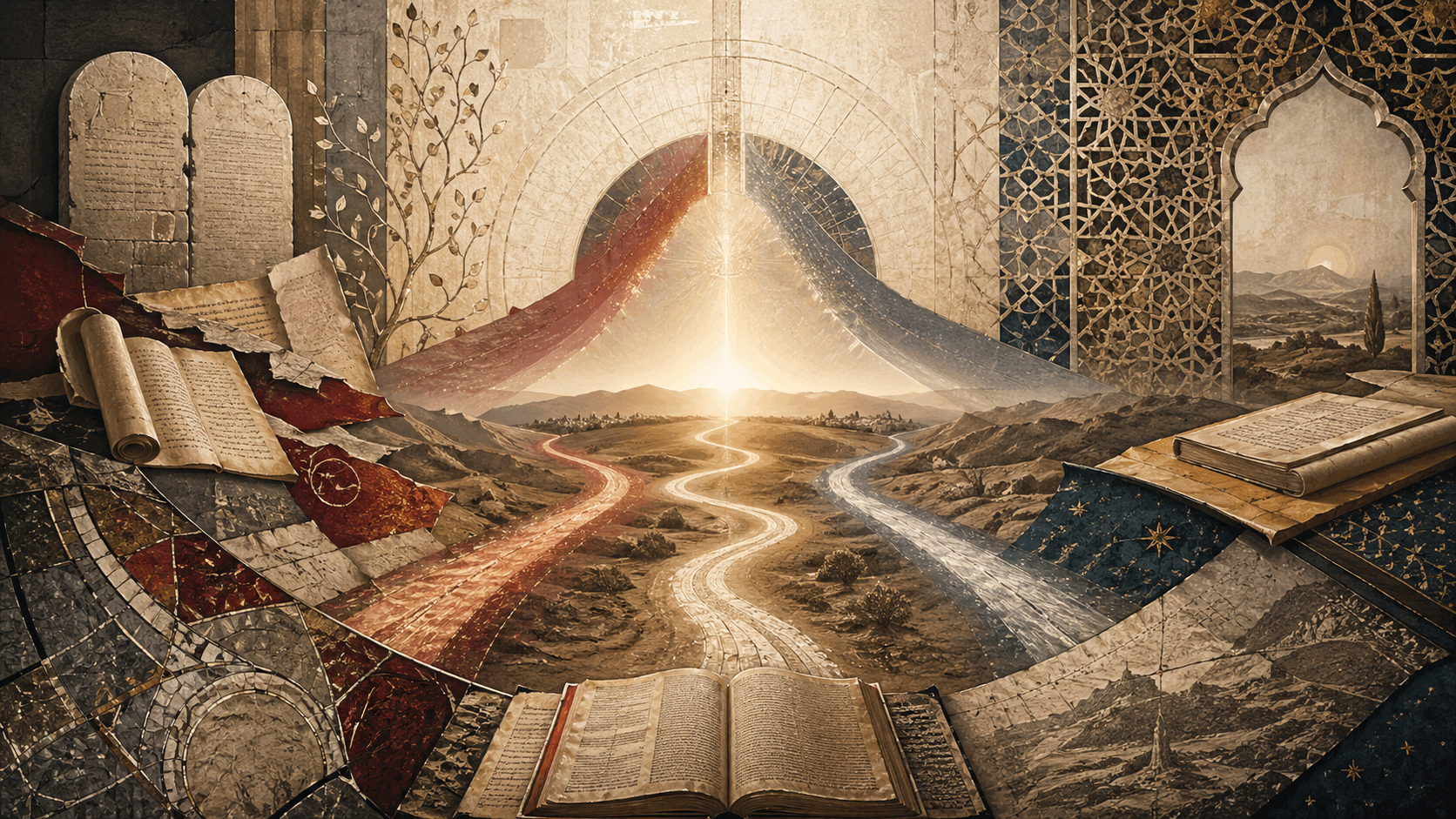
The Abrahamic traditions are the great monotheistic traditions that trace their sacred memory, theological imagination, and moral vocabulary through Abraham: Judaism, Christianity, and Islam. Each tradition understands Abraham differently, but all three see him as a decisive figure in the history of faith: a witness to the One God, a model of trust, a bearer of covenantal promise, and a symbol of religious identity that reaches across scripture, law, exile, empire, reform, devotion, and sacred interpretation.
The phrase Abrahamic traditions can be useful, but it must be used carefully. Judaism, Christianity, and Islam are not simply three versions of the same religion. They differ profoundly in scripture, theology, law, authority, ritual, sacred history, community, and the meaning of salvation. Jews do not understand Abraham in the same way Christians do; Christians do not understand Jesus in the same way Muslims do; Muslims do not understand revelation in the same way either Judaism or Christianity does. Yet these traditions are historically and spiritually entangled. They share prophets, stories, moral questions, sacred geographies, scriptural echoes, devotional vocabularies, and a long argument about what it means for God to speak to humanity.
This article introduces the Abrahamic traditions as a family of sacred histories rather than as a flat category of “world religions.” The aim is not to erase their differences or force artificial agreement. It is to understand how Judaism, Christianity, and Islam each preserve a vision of divine guidance, human responsibility, moral struggle, worship, reform, judgment, mercy, and historical memory. The Abrahamic traditions are best understood as communities of revelation: traditions that believe human life is not self-sufficient, that God calls people toward righteousness, and that history itself can become a field of moral testing.
A serious account should also resist the modern habit of treating religion as private belief detached from law, memory, community, language, ritual, and public responsibility. The Abrahamic traditions are not merely sets of doctrines. They are living worlds of prayer, commandment, scripture, interpretation, sacred time, moral formation, inherited trauma, communal survival, and contested hope. They have produced wisdom and beauty; they have also been misused by empires, states, sects, and institutions. To study them well requires reverence, honesty, historical care, and attention to those whose voices have often been marginalized.
Current Space
Religious Studies
Article List
Abrahamic Traditions
Related Topic
Foundations of Religion
Series context: This article is part of the Abrahamic Traditions: Prophecy, Revelation, Law, and Sacred History knowledge series. For the broader category structure, return to the Religious Studies category.
The Arabic word Allah is used by Arabic-speaking Muslims, Christians, and Jews as the word for God. That linguistic fact matters for Abrahamic study because it prevents a false separation between “God” and “Allah” as though they referred to unrelated deities. The real differences among Judaism, Christianity, and Islam are theological, scriptural, and interpretive. They are not the result of Muslims worshiping a different God. The traditions argue within a shared Abrahamic horizon of the One God, even when they disagree profoundly over covenant, incarnation, prophecy, scripture, law, and authority.
What Are the Abrahamic Traditions?
The Abrahamic traditions are Judaism, Christianity, and Islam: three historically related, deeply distinct, and internally diverse traditions that preserve sacred memory through Abraham. They are called “Abrahamic” because Abraham stands near the center of their religious imagination. He is ancestor, patriarch, prophet, model of faith, friend of God, covenantal figure, and witness against idolatry. But Abraham does not function in the same way in all three traditions.
In Judaism, Abraham is the first patriarch of Israel and the recipient of covenantal promise. His story belongs to the formation of Israel’s sacred memory: land, descendants, circumcision, promise, testing, family, and the God of Abraham, Isaac, and Jacob. In Christianity, Abraham becomes a figure through whom faith, promise, and fulfillment are interpreted in relation to Christ. In Islam, Ibrahim is a prophet, a ḥanīf, a pure monotheist, a builder of the Ka‘bah with Isma‘il in Islamic tradition, and a model of surrender to Allah.
The Abrahamic traditions therefore should not be treated as three identical religions with different costumes. They are distinct communities of revelation. Each has its own scripture, sacred law, theology, worship, calendar, interpretive tradition, authority structure, and internal diversity. Judaism is not merely “pre-Christianity.” Christianity is not merely “Judaism plus Jesus.” Islam is not merely “Judaism and Christianity revised.” Each tradition must be allowed to speak from its own sources.
At the same time, they cannot be understood well in isolation from one another. Christianity emerges from within Second Temple Judaism. Islam addresses Jews and Christians as People of the Book and places Muhammad in a long prophetic sequence that includes Abraham, Moses, and Jesus. Jewish, Christian, and Muslim communities have lived alongside one another for centuries in conflict, coexistence, translation, debate, polemic, law, commerce, philosophy, medicine, mysticism, and shared language worlds.
The word “Abrahamic” is therefore useful when it marks relation, not sameness. It should open serious comparison rather than flatten difference. It should help readers see shared monotheism, prophetic memory, revelation, law, worship, judgment, mercy, and moral accountability. But it should not erase the real disagreements that define each tradition’s identity.
Hebrew Bible
שְׁמַע יִשְׂרָאֵל יְהוָה אֱלֹהֵינוּ יְהוָה אֶחָדHear, O Israel: the LORD is our God; the LORD is One.Deuteronomy 6:4. Hebrew text with English rendering.
The Shema stands near the center of Jewish confession and Abrahamic monotheism. It does not simply assert that God exists; it declares divine oneness as the foundation of worship, memory, obedience, and covenantal identity.
The Abrahamic traditions are also traditions of moral seriousness. They teach that human beings are accountable before God, that power is judged, that the poor and vulnerable cannot be ignored, that worship must shape conduct, and that history is not morally empty. In all three traditions, revelation is not simply information from heaven. It is guidance for life.
Why Abraham Matters
Abraham matters because he stands near the beginning of a distinctive form of religious consciousness: faith in one God expressed through obedience, trust, migration, covenant, hospitality, sacrifice, and moral responsibility. In the Book of Genesis, Abram is called to leave his country, his kindred, and his father’s house for a land that God will show him. This calling is not merely geographical. It is existential. Abraham becomes the figure who leaves inherited security in response to divine summons.
Hebrew Bible
לֶךְ־לְךָ מֵאַרְצְךָ וּמִמּוֹלַדְתְּךָ וּמִבֵּית אָבִיךָ אֶל־הָאָרֶץ אֲשֶׁר אַרְאֶךָּGo forth from your land, from your kindred, and from the house of your father, toward the land that I will show you.Genesis 12:1. Hebrew text with English rendering.
The Abrahamic vocation begins with departure. Abraham’s faith is not presented first as a doctrine but as a response: leaving the familiar in obedience to a divine call whose destination is not yet fully visible.
In Jewish tradition, Abraham is the ancestor of Israel and the recipient of covenantal promise. The covenant is not merely an abstract theological idea; it is carried through family, land, circumcision, promise, commandment, and historical memory. Judaism therefore remembers Abraham through covenantal continuity: the God of Abraham, Isaac, and Jacob is the God who calls Israel into a distinctive relationship of worship, law, holiness, and responsibility.
In Christianity, Abraham becomes a figure through whom faith, promise, and fulfillment are interpreted in relation to Christ. The New Testament repeatedly returns to Abraham as a witness that faith precedes narrow legal identity. Christian interpretation often reads Abraham typologically: his story points beyond itself toward a larger promise fulfilled in Jesus. This does not eliminate the Hebrew Bible, but it reconfigures its meaning through Christ, church, gospel, and salvation history.
In Islam, Abraham — Ibrahim — is a prophet, a ḥanīf, a pure monotheist, and a model of surrender to God. The Qur’an presents him as neither narrowly Jewish nor Christian, but as one who turned wholly toward the One God before later communal divisions hardened into separate identities. Ibrahim is associated with prayer, sacrifice, the Ka‘bah, purification of worship, and the rejection of idolatry. In this Qur’anic view, Abraham is not the possession of one community; he is a witness to primordial monotheism and surrender to Allah.
Qur’anic Text
مَا كَانَ إِبْرَاهِيمُ يَهُودِيًّا وَلَا نَصْرَانِيًّا وَلَٰكِن كَانَ حَنِيفًا مُّسْلِمًا وَمَا كَانَ مِنَ الْمُشْرِكِينَAbraham was neither Jew nor Christian; he was upright in faith, surrendered to God, and not among those who joined others with Him.Qur’an 3:67. Arabic text with English rendering.
This Qur’anic formulation does not erase Judaism or Christianity; it relocates Abraham before later communal labels. Abraham becomes a witness to primordial monotheism: uprightness, surrender, and refusal of idolatry.
That is why Abraham can serve as both bridge and boundary. He unites the traditions because all three honor him. He divides them because each tradition interprets his meaning differently. The Abrahamic traditions are therefore not a simple harmony. They are a shared argument over covenant, promise, prophecy, law, scripture, worship, and the shape of divine guidance in history.
Abraham also matters because his story gives religious memory a moral shape. Faith is not merely inherited identity. It is departure, testing, trust, hospitality, obedience, and surrender. Abrahamic faith asks what must be left behind when God calls, what must be purified from inherited idolatry, and how trust in God becomes a life of responsibility rather than a slogan of belonging.
Judaism, Christianity, and Islam
Judaism is the oldest of the three continuing Abrahamic traditions. It is centered on the covenant between God and Israel, the Torah, prophetic teaching, worship, law, ethical responsibility, memory, and communal survival. Jewish sacred history is inseparable from creation, patriarchs and matriarchs, Exodus, Sinai, monarchy, prophecy, exile, return, rabbinic interpretation, and the continuing life of the Jewish people. Judaism is not only a set of beliefs; it is a covenantal way of life shaped by mitzvot, liturgy, calendar, study, memory, land, diaspora, and peoplehood.
Christianity emerges from within Second Temple Judaism and centers its faith on Jesus of Nazareth, whom Christians confess as Christ, Son of God, Lord, and Savior. Christianity accepts the Hebrew Scriptures but reads them in light of Jesus’ life, death, resurrection, and the formation of the church. Its sacred history moves through Israel but culminates, for Christians, in the incarnation, crucifixion, resurrection, Pentecost, and the hope of the kingdom of God. Christian traditions differ internally — Catholic, Orthodox, Protestant, Oriental Orthodox, evangelical, liberationist, mystical, Pentecostal, and many others — but they share the conviction that God’s saving action is decisively disclosed in Christ.
Islam arises in seventh-century Arabia through the revelation of the Qur’an to the Prophet Muhammad. Islam understands itself not as a new religion in essence, but as the restoration and confirmation of the religion preached by earlier prophets: Adam, Noah, Abraham, Moses, Jesus, and many others. The Qur’an repeatedly addresses Jews and Christians as People of the Book and places Muhammad within a long prophetic sequence. Islam’s sacred history therefore has a strongly corrective and restorative character: it confirms previous revelation while also correcting what it understands as later theological, textual, or interpretive distortions.
Qur’anic Text
قُولُوا آمَنَّا بِاللَّهِ وَمَا أُنْزِلَ إِلَيْنَا وَمَا أُنْزِلَ إِلَىٰ إِبْرَاهِيمَ وَإِسْمَاعِيلَ وَإِسْحَاقَ وَيَعْقُوبَ وَالْأَسْبَاطِ وَمَا أُوتِيَ مُوسَىٰ وَعِيسَىٰ وَمَا أُوتِيَ النَّبِيُّونَ مِن رَّبِّهِمْ لَا نُفَرِّقُ بَيْنَ أَحَدٍ مِّنْهُمْ وَنَحْنُ لَهُ مُسْلِمُونَSay: We believe in God, in what has been sent down to us, in what was sent down to Abraham, Ishmael, Isaac, Jacob, and the tribes, and in what was given to Moses, Jesus, and the prophets from their Lord. We make no division among them; to Him we surrender.Qur’an 2:136. Arabic text with English rendering.
The Qur’an places Abraham, Ishmael, Isaac, Jacob, Moses, Jesus, and the prophets within a single field of divine guidance. The verse does not make all communities identical; it insists that prophetic revelation has one divine source.
These three traditions are linked by monotheism, but monotheism alone does not define them. They are also linked by revelation, scripture, prophecy, law, ethics, worship, eschatology, language, and memory. Each tradition claims that God is not silent, that human beings are morally accountable, and that history is not meaningless. But they differ over the identity of Jesus, the status of Muhammad, the nature of scripture, the meaning of covenant, the authority of law, and the proper interpretation of earlier revelation.
Each tradition is also internally diverse. Judaism includes biblical, rabbinic, philosophical, mystical, Sephardi, Ashkenazi, Mizrahi, Karaite, Hasidic, Reform, Conservative, Orthodox, Reconstructionist, secular, and many other forms of Jewish life. Christianity includes ancient churches, global Protestant movements, Catholic and Orthodox traditions, Black churches, liberationist traditions, evangelical communities, monastic and mystical traditions, and many regional theologies. Islam includes Sunni, Shia, Ibadi, Sufi, legal, philosophical, reformist, traditionalist, modernist, and regional expressions. No Abrahamic tradition should be reduced to one institutional voice.
The Shared Name of God and Abrahamic Continuity
One of the most important starting points for Abrahamic study is linguistic humility. The Arabic word الله is not a narrowly Muslim deity-name in the way it is sometimes imagined in English-language polemic. It is the Arabic word for God and has been used by Arabic-speaking Muslims, Christians, and Jews. This matters because misleading language often turns a shared Abrahamic field into an artificial opposition: “God” on one side and “Allah” on another. In Arabic, that separation collapses. The word points to the One God worshiped within Arabic-speaking Abrahamic worlds, even where theological interpretations differ.
Qur’anic Text
اللَّهُ لَا إِلَٰهَ إِلَّا هُوَ الْحَيُّ الْقَيُّومُGod — there is no god but He, the Living, the Self-Subsisting.Qur’an 2:255. Arabic text with English rendering.
The verse begins with a declaration of divine uniqueness. Its language belongs to the Qur’an, but its theological horizon is recognizably Abrahamic: the living God, the sustaining God, the One before whom all power and knowledge are accountable.
This shared linguistic field does not eliminate doctrinal difference. Jewish, Christian, and Muslim traditions speak of God through different scriptures, concepts, liturgies, laws, and theologies. Christianity’s Trinitarian confession, Judaism’s covenantal monotheism, and Islam’s radical insistence on tawḥīd are not interchangeable. But difference should not be made more extreme than it is. These are not traditions worshiping unrelated deities. They are traditions struggling, arguing, praying, interpreting, and remembering within a shared Semitic and Abrahamic horizon of the One God.
That is why the Abrahamic traditions should be studied through continuity and distinction at the same time. Continuity without distinction becomes sentimental. Distinction without continuity becomes polemic. A serious approach must hold both: the shared memory of divine oneness and the real doctrinal conflicts that emerged around covenant, incarnation, prophecy, scripture, law, and authority.
This linguistic clarity is especially important for marginalized communities. Arabic-speaking Christians and Jews have often been erased by modern categories that treat Arabic as only Muslim or Islam as outside the Abrahamic field. Their continued use of Allah in prayer, scripture, and theology exposes the falseness of that separation. Arabic is Qur’anic and Islamic, but it is also Christian, Jewish, philosophical, medical, poetic, commercial, and communal.
A mature Abrahamic framework therefore does not pretend that theological difference is small. It simply refuses to manufacture difference where language and history show continuity. The traditions disagree deeply about God’s self-disclosure, but they do not belong to unrelated religious universes.
Revelation and Scripture
The Abrahamic traditions are scriptural traditions. They believe that divine guidance has been communicated through words, events, prophets, commandments, wisdom, angels, law, visions, and sacred memory. Yet they do not understand scripture in identical ways.
Judaism centers on the Tanakh — Torah, Prophets, and Writings — and on the vast interpretive tradition that grows around it, especially Mishnah, Talmud, midrash, halakhic literature, philosophy, mysticism, and commentary. Jewish scripture is inseparable from interpretation. The written Torah and the oral tradition together shape Jewish law, ethics, worship, communal memory, and the discipline of study.
Christianity receives the Hebrew Scriptures as the Old Testament and joins them to the New Testament: Gospels, Acts, apostolic letters, and Revelation. Christian scripture is read through Christological fulfillment. The Hebrew Bible is not abandoned, but reread in light of Jesus. The church becomes a community formed by gospel proclamation, sacrament, discipleship, and interpretation of both Testaments.
Islam centers on the Qur’an as the final revealed scripture, recited in Arabic and understood as the preserved word of God. The Qur’an refers to previous revelation — including the Torah and Gospel — while also presenting itself as confirmation, criterion, reminder, and correction. In Islamic thought, revelation is not merely information; it is guidance. It calls human beings to worship God, act justly, remember the Hereafter, purify the self, and resist idolatry in all its forms.
Qur’anic Text
شَرَعَ لَكُم مِّنَ الدِّينِ مَا وَصَّىٰ بِهِ نُوحًا وَالَّذِي أَوْحَيْنَا إِلَيْكَ وَمَا وَصَّيْنَا بِهِ إِبْرَاهِيمَ وَمُوسَىٰ وَعِيسَىٰ أَنْ أَقِيمُوا الدِّينَ وَلَا تَتَفَرَّقُوا فِيهِHe has laid down for you the religion He enjoined upon Noah, and that which We revealed to you, and that which We enjoined upon Abraham, Moses, and Jesus: establish the religion, and do not be divided concerning it.Qur’an 42:13. Arabic text with English rendering.
This verse is central for a Qur’an-centered reading of Abrahamic continuity. It names Noah, Abraham, Moses, Jesus, and the Prophet Muhammad within a shared command to establish religion and avoid destructive division.
From a Qur’an-centered perspective, the Abrahamic traditions are not unrelated religions that accidentally share some figures. They are successive communities shaped by divine communication. Revelation unfolds in history, but its moral core remains consistent: worship of the One God, righteousness, compassion, accountability, and reform. Differences arise through history, language, institution, interpretation, politics, and human limitation.
This does not mean every scriptural claim can be harmonized. Scripture also preserves disagreement. The Qur’an disputes Christian claims about Jesus’ divine sonship and crucifixion; the New Testament makes claims about Christ that Islam rejects; rabbinic Judaism does not accept either Christian messianic fulfillment or Islamic prophethood. The work of comparison is therefore not to dissolve contradiction, but to understand what each tradition believes is at stake when it speaks of revelation.
Scripture also creates communities of interpretation. Texts do not interpret themselves in the abstract. They are recited, translated, taught, memorized, preached, commented upon, disputed, canonized, ritualized, and sometimes weaponized. Any serious Abrahamic study must therefore ask not only what a text says, but how communities have read it, who has had authority to interpret it, whose interpretations were marginalized, and how scripture has been used for both liberation and domination.
Prophecy and Sacred History
Prophecy is one of the deepest bonds among the Abrahamic traditions. Abraham, Moses, David, Isaiah, Jeremiah, Jonah, John the Baptist, Jesus, and Muhammad occupy different places in each tradition, but the prophetic idea itself is central: God raises human beings to warn, guide, reform, console, and call communities back to truth.
In the Hebrew Bible, prophets are not primarily fortune-tellers. They are covenantal witnesses. They speak against idolatry, injustice, oppression, false worship, exploitation, and moral complacency. They remind Israel that ritual without righteousness is empty. They announce judgment, but also hope. The prophetic voice is therefore ethical, theological, and political at once.
Hebrew Bible
הִגִּיד לְךָ אָדָם מַה־טּוֹב וּמָה־יְהוָה דּוֹרֵשׁ מִמְּךָ כִּי אִם־עֲשׂוֹת מִשְׁפָּט וְאַהֲבַת חֶסֶד וְהַצְנֵעַ לֶכֶת עִם־אֱלֹהֶיךָHe has told you, O human one, what is good: to do justice, to love mercy, and to walk humbly with your God.Micah 6:8. Hebrew text with English rendering.
Micah’s prophetic summary shows why Abrahamic faith cannot be reduced to ritual performance or inherited identity. Justice, mercy, and humility become the moral test of worship.
In Christianity, prophecy is often read as pointing toward Christ. Jesus is understood not only as prophet but as more than prophet: the incarnate Word, the fulfillment of law and prophets, the mediator of a new covenant. John the Baptist appears as the prophetic forerunner, and the early church interprets Israel’s sacred history through the life, death, and resurrection of Jesus.
In Islam, prophecy is universal. The Qur’an teaches that messengers were sent to many peoples, including prophets named in the Bible and others not named. This universal view of prophecy is one of Islam’s most important contributions to Abrahamic theology. It means that divine mercy and guidance are not limited to one ethnic or historical community. God’s guidance reaches humanity through many messengers, each calling people to worship God and live righteously.
Hadith
إِنَّمَا الأَعْمَالُ بِالنِّيَّاتِActions are only by intentions.Sahih al-Bukhari 1; Sahih Muslim 1907. Arabic text with English rendering.
This famous hadith deepens the prophetic concern with inward truth. In Abrahamic moral life, action cannot be separated from intention, sincerity, accountability, and the orientation of the heart before God.
Sacred history, from this perspective, is not merely a chronicle of ancient events. It is moral memory. The stories of Adam, Noah, Abraham, Moses, Mary, Jesus, and Muhammad are not presented simply to satisfy historical curiosity. They teach patterns: arrogance and humility, revelation and rejection, exile and return, oppression and deliverance, idolatry and reform, despair and divine mercy.
Prophecy also protects marginalized voices because prophets often speak against power. Pharaoh, unjust rulers, false priests, wealthy exploiters, arrogant communities, and corrupt authorities are judged by prophetic speech. The prophetic tradition is not a decoration of religious identity. It is a dangerous memory that asks whether communities have betrayed the very revelation they claim to inherit.
Law, Covenant, and Moral Order
The Abrahamic traditions are also traditions of law and moral order. They do not imagine religion as private feeling alone. Faith must shape action, community, economy, family, speech, worship, justice, and public responsibility.
In Judaism, law is central to covenantal life. Torah is not merely legislation; it is instruction, teaching, path, and sanctification. Halakhah governs the rhythms of Jewish life: Sabbath, food, prayer, festivals, ethics, family, business, study, and communal responsibility. Law is a form of remembrance. It binds daily life to covenant.
Rabbinic Text
כָּל יִשְׂרָאֵל עֲרֵבִים זֶה בָּזֶהAll Israel is responsible for one another.Babylonian Talmud, Shevuot 39a. Hebrew/Aramaic rabbinic formulation with English rendering.
Rabbinic tradition turns covenant into mutual responsibility. Law is not merely individual obedience; it is a communal architecture of accountability, obligation, and care.
In Christianity, the place of law is more complex. Jesus teaches within Jewish law and intensifies its moral demand, yet Christian traditions differ over how Mosaic law relates to grace, gospel, church, and salvation. The Sermon on the Mount, the commandment to love God and neighbor, and the apostolic debates over Gentile inclusion all show that Christianity wrestles deeply with continuity and transformation.
New Testament
ἀγαπήσεις τὸν πλησίον σου ὡς σεαυτόνYou shall love your neighbor as yourself.Matthew 22:39. Greek New Testament with English rendering.
Jesus’ summary of the law does not abolish moral obligation; it concentrates law and prophecy around love of God and neighbor. Christian moral reasoning repeatedly returns to this compression of commandment, mercy, and responsibility.
In Islam, law is inseparable from guidance. Sharia, in its broadest sense, means the path by which human life is ordered toward God. It includes worship, ethics, family law, commerce, social justice, and spiritual discipline. Fiqh, or jurisprudence, is the human effort to understand and apply that guidance. Sunni and Shia traditions developed different legal schools and theories of authority, but both treat law as a serious expression of divine guidance in human life.
Hadith
لَا يُؤْمِنُ أَحَدُكُمْ حَتَّى يُحِبَّ لِأَخِيهِ مَا يُحِبُّ لِنَفْسِهِNone of you truly believes until he loves for his brother what he loves for himself.Sahih al-Bukhari 13; Sahih Muslim 45. Arabic text with English rendering.
This hadith links faith to reciprocal moral concern. It resonates with broader Abrahamic ethics: the neighbor, the brother, the stranger, the poor, and the vulnerable become tests of religious sincerity.
Yet law can be misunderstood if reduced to punishment, bureaucracy, or identity. At its best, Abrahamic law is not merely a mechanism of control. It is a discipline of moral formation. It asks: What kind of people are we becoming? How do we honor God in ordinary life? How do we restrain domination, protect the vulnerable, remember the poor, uphold truth, and purify desire?
This is also where a culturally richer account of human rights becomes possible. Modern Western liberalism often frames rights around the autonomous individual and the state. The Abrahamic traditions add other dimensions: covenant, community, obligation, sacred law, charity, hospitality, mercy, repentance, and accountability before God. These do not replace the need for dignity and protection. They deepen the moral vocabulary through which dignity can be understood.
Angels, Jinn, Judgment, and the Unseen
The Abrahamic traditions also speak of realities that exceed ordinary human perception: angels, demons, jinn, heaven, hell, resurrection, judgment, divine decree, spiritual testing, and the unseen order of creation. These themes are often dismissed in modern secular writing as mythic ornament, but within the traditions themselves they carry serious theological meaning. They explain how divine command, moral accountability, temptation, revelation, protection, rebellion, mercy, and judgment are imagined across sacred history.
Angels appear across Jewish, Christian, and Islamic traditions as messengers, servants, worshipers, guardians, and agents of divine command. Gabriel is especially important because he is associated with revelation. In Christian tradition, Gabriel appears in the annunciation to Mary. In Islam, Jibril is closely associated with the revelation of the Qur’an to Muhammad. In Jewish tradition, angelic figures such as Michael and Gabriel become important in later biblical, apocalyptic, and rabbinic imagination. Angels do not replace God; they signify that creation is morally and spiritually ordered beyond visible human affairs.
Demons, Satan, and forces of temptation are also treated differently across the traditions. Jewish, Christian, and Islamic sources do not offer one identical demonology, but they share the conviction that moral life involves testing, deception, pride, and the danger of turning away from God. Islam adds a distinctive doctrine of the jinn: beings created separately from humans, morally accountable, capable of belief or unbelief, and part of the unseen world. The jinn are not simply “demons” in the Christian sense; Qur’anic jinn are a morally mixed order of beings.
Qur’anic Text
وَمَا خَلَقْتُ الْجِنَّ وَالْإِنسَ إِلَّا لِيَعْبُدُونِI created jinn and humankind only that they might worship Me.Qur’an 51:56. Arabic text with English rendering.
This verse places jinn and human beings within a shared moral horizon: worship, accountability, and relation to God. It also shows why Islamic teaching about the unseen is not merely supernatural curiosity, but part of a larger theology of purpose.
Heaven, hell, resurrection, and judgment also belong to the moral architecture of Abrahamic faith. These traditions do not see human action as disappearing into nothing. Deeds matter. Injustice is remembered. Mercy remains possible. Power is judged. The dead are not simply gone; they stand within divine knowledge. The imagery varies: resurrection, books of deeds, the kingdom of God, paradise, Gehenna, Jahannam, the world to come, the day of judgment. But the shared moral claim is strong: history is accountable before God.
This eschatological imagination has ethical consequences. It can be misused when communities weaponize heaven and hell for domination. But at its best, judgment protects moral seriousness. It says that hidden cruelty, secret generosity, public injustice, private repentance, and forgotten suffering are not finally meaningless. The unseen is therefore not an escape from history. It is a way of saying that history itself is answerable to divine justice.
The unseen also humbles human knowledge. Modern thought often treats the visible and measurable as the whole of reality. Abrahamic traditions resist that reduction. They do not deny ordinary observation, reason, or practical knowledge. But they insist that human perception is limited and that reality includes dimensions of command, accountability, mercy, temptation, judgment, and divine knowledge that exceed immediate visibility.
Jesus, Muhammad, and the Question of Continuity
No comparison of the Abrahamic traditions can avoid the figures of Jesus and Muhammad. They are central not only because they founded or renewed religious communities, but because they reveal where the traditions most sharply diverge.
For Christians, Jesus is the Christ: the decisive revelation of God, the incarnate Word, crucified and risen. Christian theology is built around the conviction that God’s redemptive action is uniquely present in Jesus. This is why doctrines such as incarnation, Trinity, atonement, resurrection, and church are central to Christian identity.
New Testament
Ἐν ἀρχῇ ἦν ὁ λόγοςIn the beginning was the Word.John 1:1. Greek New Testament with English rendering.
The Greek term logos carries philosophical, theological, and scriptural depth, helping explain why Christian tradition reads Jesus through creation, revelation, wisdom, and divine self-disclosure.
For Muslims, Jesus — Isa ibn Maryam — is one of the greatest prophets and the Messiah, born of Mary by divine command, strengthened by the Holy Spirit, and sent to the Children of Israel. But Islam rejects his divinity, rejects the idea that God became flesh, and rejects the theological necessity of crucifixion as atoning sacrifice. The Qur’an honors Jesus while correcting what it sees as later theological exaggeration.
Qur’anic Text
إِنَّمَا الْمَسِيحُ عِيسَى ابْنُ مَرْيَمَ رَسُولُ اللَّهِThe Messiah, Jesus son of Mary, is only a messenger of God.Qur’an 4:171. Arabic text with English rendering.
This Qur’anic passage honors Jesus while resisting his deification. It is one of the central texts for understanding Muslim-Christian difference: deep reverence for Jesus, but within prophetic monotheism rather than incarnation theology.
A Qur’an-centered interpretive tradition gives special attention to Jesus because the meaning of Jesus stands at the heart of Muslim-Christian comparison. This approach emphasizes Jesus as a true prophet of God, a reformer within Israel, a human servant of God, and a figure whose life must be interpreted through scripture, reason, and historical inquiry rather than inherited polemic alone.
Muhammad occupies a parallel but different place. For Muslims, he is the final prophet, the recipient of the Qur’an, the restorer of Abrahamic monotheism, and the model of prophetic character. For Jews and Christians, Muhammad is not generally accepted as a prophet within their own theological systems. This is one of the central Abrahamic disagreements. A serious comparative approach must not hide that disagreement. But it can ask a better question: how does each tradition define the criteria of prophecy, revelation, fulfillment, and religious authority?
The goal is not to make Jesus and Muhammad interchangeable. They are not interchangeable. The goal is to understand why each figure is so central to the tradition that honors him, and why disagreement about them shapes the deepest boundaries among the Abrahamic communities.
Sunni, Shia, Jewish, and Christian Perspectives
This series will use a Qur’an-centered interpretive lens as one guiding orientation, but it should not treat Islam as internally monolithic, nor should it reduce Judaism and Christianity to foils for Islamic argument. A serious study of the Abrahamic traditions requires multiple perspectives.
Sunni perspectives are essential for understanding the majority tradition of Islam: hadith canon formation, legal schools, theology, tafsir, Sufism, prophetic biography, and communal practice. Sunni scholarship provides a vast interpretive world, from al-Tabari and al-Ghazali to Ibn Kathir, al-Nawawi, Shah Waliullah, and modern reformist thinkers.
Shia perspectives are equally important for understanding authority, Imamate, martyrdom, justice, sacred history, Karbala, eschatology, and the spiritual interpretation of revelation. Shia Islam brings distinctive attention to the Prophet’s family, the moral drama of oppression and resistance, and the relationship between divine guidance and legitimate leadership.
Jewish perspectives are indispensable because Judaism is not merely the “background” to Christianity and Islam. It is a living covenantal tradition with its own integrity, law, theology, trauma, resilience, and interpretive genius. Rabbinic Judaism, medieval Jewish philosophy, Jewish mysticism, modern Jewish thought, and contemporary Jewish ethics all belong to any serious Abrahamic conversation.
Christian perspectives must also be treated in their depth and variety. Catholic, Orthodox, Protestant, Oriental Orthodox, evangelical, liberal, liberationist, Pentecostal, and mystical traditions often approach scripture, church, sacrament, authority, and salvation differently. Christianity cannot be reduced to a single Western Protestant or Catholic frame. Its theological imagination is global, ancient, internally diverse, and historically powerful.
The goal is not false neutrality. Every intellectual project has a center of gravity. The center of gravity here is Abrahamic continuity: the idea that revelation is one in source, that prophets are morally vindicated by divine guidance, that later communities often dispute or distort inherited truth, and that scripture should be approached through reverence, reason, moral seriousness, and historical care. But within that frame, Sunni, Shia, Jewish, and Christian voices should be engaged respectfully and substantively.
Comparative study is strongest when it lets each tradition remain itself. Jewish voices should not be absorbed into Christian or Islamic frameworks. Christian voices should not be reduced to later theological distortion. Muslim voices should not be treated as derivative or merely reactive. The dignity of comparison depends on allowing real difference to remain visible while still tracing the shared Abrahamic field.
Marginalized Voices and Abrahamic Memory
One of the most important purposes of Abrahamic study is to recover voices that dominant histories often suppress. Too many accounts of Judaism, Christianity, and Islam are told only through rulers, empires, councils, courts, jurists, theologians, and institutions. Those voices matter, but they do not exhaust sacred history.
Abrahamic memory also belongs to enslaved people, women, refugees, exiles, converts, dissenters, mystics, peasants, minority communities, colonized peoples, prisoners, the poor, the disabled, and those whose manuscripts, prayers, songs, and testimonies were never preserved by elite institutions. The Bible, New Testament, Qur’an, rabbinic literature, Hadith, mystical traditions, and later histories all contain traces of people living under pressure: Hagar in the wilderness, Israel in Egypt, Mary under suspicion, early Christians under empire, Bilal under persecution, the Ahl al-Bayt in suffering, Jewish communities in exile, and countless unnamed communities struggling to preserve worship under domination.
To foreground marginalized voices is not to turn sacred history into modern political fashion. It is to read the traditions in a way that is faithful to their own moral concerns. The God of Abraham is not indifferent to the vulnerable. The prophets do not bless oppression. The Qur’an repeatedly condemns arrogance, exploitation, and forgetfulness of the poor. The Gospel places the poor, sick, imprisoned, and persecuted near the heart of discipleship. Rabbinic tradition builds communal responsibility into law and memory.
This also means resisting civilizational chauvinism. Western accounts have often treated human rights, reason, and dignity as though they emerged only from modern secular liberalism. That is too narrow. Abrahamic traditions preserve older and deeper vocabularies of dignity: creation, covenant, mercy, divine justice, neighbor-love, charity, law, accountability, repentance, protection of community, and the moral claim of the vulnerable. These frameworks are not identical to modern rights language, but they can enrich it and challenge its blind spots.
At the same time, Abrahamic communities must be honest about their own failures. Scripture and tradition have been used to justify domination, patriarchy, slavery, antisemitism, Islamophobia, sectarianism, colonialism, forced conversion, legal inequality, and violence. A serious Abrahamic project must not hide those failures. It should ask how the traditions themselves contain resources for repentance, reform, and moral repair.
Recovering marginalized voices also changes the questions we ask. We do not ask only, “What did theologians teach?” We ask: Who was protected? Who was excluded? Who interpreted scripture? Who was silenced? Who had access to law? Who could worship publicly? Who preserved language under pressure? Who was asked to sacrifice? Who was remembered as holy, and who was forgotten?
This is where Abrahamic study becomes ethically serious. Sacred history is not only about origins. It is about responsibility. If the traditions claim that God judges history, then the histories of the marginalized cannot remain in the shadows.
How This Series Will Read the Traditions
This series will approach the Abrahamic traditions through five recurring themes: prophecy, revelation, law, sacred history, and reform.
Prophecy will be treated as a universal religious phenomenon within the Qur’anic worldview and as a major category across Jewish and Christian traditions. Prophets are not mythic ornaments; they are reformers, warners, witnesses, and moral exemplars. Their lives reveal how divine guidance confronts idolatry, injustice, arrogance, despair, and communal decline.
Revelation will be studied both textually and historically. The Qur’an, Tanakh, New Testament, Hadith, Sira, tafsir, rabbinic literature, patristic writings, and later theological traditions will be read as sources of sacred memory. But the series will also ask how communities preserve, interpret, dispute, translate, canonize, and sometimes weaponize revelation.
Law will be understood as moral architecture. The question will not be merely “What rule does this tradition teach?” but “What kind of human being and community is this rule trying to form?” This allows Jewish halakhah, Islamic sharia, Christian moral theology, and prophetic ethics to be compared without flattening them.
Sacred history will be read as theological memory. The stories of prophets, patriarchs, matriarchs, kings, disciples, caliphs, imams, rabbis, saints, reformers, and communities will be examined for the moral patterns they preserve. Sacred history is not neutral chronicle. It is memory shaped by divine meaning, communal identity, and moral warning.
Reform will be treated as a recurring Abrahamic necessity. Prophetic religion repeatedly warns that communities can inherit revelation while losing its spirit. Reform is therefore not a modern intrusion into religion; it is one of the oldest themes in prophetic faith. Reform means returning to the moral force of revelation when custom, power, nationalism, sectarianism, or institutional pride have obscured it.
These themes also make room for differentiated perspectives. Sunni, Shia, Jewish, Christian, mystical, legal, philosophical, historical, feminist, liberationist, and minority-community sources will not always agree. The purpose of comparison is not to make them agree. It is to understand how each tradition reasons from its own sacred sources while participating in a wider Abrahamic conversation about God, humanity, history, and responsibility.
The series will also take language seriously. Hebrew, Aramaic, Greek, Arabic, Syriac, Latin, Geʽez, Persian, Judeo-Arabic, and other languages are not decorative details. They shape how revelation, law, prophecy, and wisdom are remembered. Original-language passages should be used when they advance interpretation, not as ornament. Translation is part of interpretation, and interpretation is part of sacred history.
Why the Abrahamic Traditions Matter Today
The Abrahamic traditions matter today because they continue to shape billions of lives, major civilizations, legal systems, moral debates, political conflicts, peace movements, artistic traditions, educational institutions, and visions of human dignity. They influence how people think about God, justice, violence, mercy, family, gender, land, ecology, economics, suffering, death, and hope.
They also matter because misunderstanding among Jews, Christians, and Muslims has often produced fear, polemic, persecution, colonial contempt, sectarian violence, and political manipulation. To study the Abrahamic traditions carefully is not merely an academic exercise. It is a form of intellectual responsibility. Sacred history has consequences.
A shallow approach reduces these traditions to slogans: Judaism as law, Christianity as love, Islam as submission. Such simplifications are misleading. Judaism has profound traditions of mercy, mysticism, philosophy, and universal ethics. Christianity has rigorous traditions of law, discipline, asceticism, and social teaching. Islam has deep traditions of compassion, reason, spirituality, jurisprudence, and plural civilizational life. Each tradition is internally diverse, historically layered, and morally complex.
At their best, the Abrahamic traditions call human beings away from arrogance and toward accountability. They insist that power is judged, wealth is morally dangerous, the poor cannot be ignored, truth matters, worship must transform conduct, and history is accountable before God. They teach that human beings are not merely consumers, tribes, markets, or biological accidents. They are moral agents living under divine trust.
That is why this series begins with Abraham. Abraham represents departure, trust, testing, hospitality, covenant, and surrender. He is not merely an ancestor in the past. He is a question addressed to every generation: What must be left behind in order to answer the call of God? What does faith require when inherited security, social approval, and moral truth are no longer aligned? And how should communities remember revelation without turning memory into exclusion, pride, or domination?
The Abrahamic traditions are not finished conversations. They are living traditions of argument, devotion, reform, and return. To study them well is to enter one of humanity’s deepest conversations about God, history, law, prophecy, mercy, judgment, and the moral destiny of the human family.
They also matter because modern crises are not only technical crises. Ecological collapse, war, inequality, displacement, religious nationalism, racism, artificial intelligence, surveillance, and social fragmentation all raise questions of moral formation. What kind of human beings are being formed? What do communities worship in practice? What does power owe to the vulnerable? What does truth require? Abrahamic traditions cannot answer those questions responsibly when they are reduced to slogans. But when studied deeply, they offer resources for conscience, restraint, courage, repentance, and repair.
Comparative Cautions
Several cautions are necessary. First, the word “Abrahamic” should not be used to erase real difference. Judaism, Christianity, and Islam disagree profoundly about scripture, law, covenant, Jesus, Muhammad, salvation, authority, and the interpretation of sacred history.
Second, the word “Abrahamic” should not be rejected simply because the traditions differ. Shared memory, prophetic figures, language worlds, moral themes, and sacred geographies are real. Relation does not require sameness.
Third, Judaism should not be treated merely as background for Christianity or Islam. It is a living covenantal tradition with its own integrity, authority, law, theology, trauma, and interpretive genius.
Fourth, Christianity should not be reduced to European power or Western theology. Christianity is ancient, Middle Eastern, African, Asian, European, American, global, liturgical, mystical, liberationist, evangelical, sacramental, philosophical, and internally diverse.
Fifth, Islam should not be treated as a late imitation of Judaism and Christianity. Islam understands itself as restoration and confirmation of primordial monotheism through the Qur’an and the prophethood of Muhammad. It has its own scripture, law, theology, spirituality, intellectual history, and civilizational depth.
Sixth, the Arabic word Allah should be handled accurately. It is the Arabic word for God and is used by Arabic-speaking Muslims, Christians, and Jews. Doctrinal difference should be named, but false linguistic separation should be avoided.
Seventh, sacred-text quotation should be curated rather than decorative. Original-language passages are valuable when they advance interpretation, anchor close reading, or clarify a tradition’s own voice. They should not be used as visual ornament.
Eighth, human rights should not be treated as the exclusive property of modern Western liberalism. The Abrahamic traditions preserve older vocabularies of dignity, obligation, mercy, law, covenant, divine justice, and protection of the vulnerable. These vocabularies should be engaged critically and seriously.
Ninth, historical honesty requires naming harm. Abrahamic communities have produced sanctity, scholarship, law, art, charity, medicine, and moral reform. They have also participated in domination, exclusion, coercion, sectarian violence, patriarchy, slavery, antisemitism, Islamophobia, colonial projects, and persecution. Serious study must hold both.
Finally, marginalized voices should not be added as an afterthought. Women, enslaved peoples, refugees, religious minorities, colonized communities, the poor, the disabled, prisoners, dissenters, and forgotten textual communities belong to Abrahamic history. Without them, the story becomes too clean, too elite, and too false.
Why This Article Matters
The Abrahamic traditions matter because they preserve some of humanity’s deepest reflections on God, revelation, history, law, moral responsibility, mercy, judgment, and the destiny of human beings. Judaism, Christianity, and Islam are not identical, but they are historically and spiritually entangled. They share Abrahamic memory while disagreeing over the meaning of that memory.
This article matters because it establishes the frame for studying those traditions without flattening them. The goal is neither sentimental unity nor polemical separation. The goal is disciplined comparison: continuity and distinction, reverence and criticism, shared history and real disagreement.
For the Abrahamic Traditions knowledge series, this article functions as an entry point. It explains why Abraham matters, how Judaism, Christianity, and Islam relate and differ, why revelation and scripture are central, how prophecy forms sacred history, why law belongs to moral formation, and why the unseen world, judgment, angels, jinn, heaven, and hell matter to Abrahamic imagination. It also clarifies that the word Allah belongs to a shared Arabic-speaking Abrahamic language-world and should not be misused to separate Muslims from Jews and Christians as though they worshiped an unrelated deity.
Seen from the perspective of marginalized voices, the Abrahamic traditions must also be read from below. Sacred history includes prophets and patriarchs, but also exiles, women, slaves, minorities, refugees, the poor, the sick, the colonized, the persecuted, and communities whose archives survive only in fragments. The God of Abraham is not honored by histories that remember only the powerful.
The final value of this article is that it treats Abrahamic study as moral responsibility. These traditions have shaped civilizations and still shape the world. They can be used for wisdom or domination, mercy or exclusion, reform or pride. To study them well is to ask what it means to inherit revelation without betraying its moral demand: to worship the One God, to seek truth, to do justice, to love mercy, to protect the vulnerable, and to remember that history is accountable before God.
Related Reading
- Abrahamic Traditions: Prophecy, Revelation, Law, and Sacred History
- Foundations of Religion
- Comparative Sacred Themes
- Religion and Law
- Religion and Society
- Mysticism and Contemplative Traditions
- Arabic as a Shared Language of Jewish, Christian, and Muslim Knowledge
- Translation Movements in Abrahamic Civilization
- Light, Wisdom, and Knowledge in Abrahamic Thought
- Law, State Power, and Religious Freedom in Abrahamic History
Further Reading
- Armstrong, K. (1993) A History of God: The 4,000-Year Quest of Judaism, Christianity and Islam. New York: Knopf. Available at: https://www.penguinrandomhouse.com/
- Armstrong, K. (1996) Jerusalem: One City, Three Faiths. New York: Knopf. Available at: https://www.penguinrandomhouse.com/
- Armstrong, K. (2006) Muhammad: A Prophet for Our Time. New York: HarperOne. Available at: https://www.harpercollins.com/
- Esposito, J.L. (2011) What Everyone Needs to Know About Islam. Oxford: Oxford University Press. Available at: https://global.oup.com/academic/
- Levenson, J.D. (2012) Inheriting Abraham: The Legacy of the Patriarch in Judaism, Christianity, and Islam. Princeton: Princeton University Press. Available at: https://press.princeton.edu/
- Lings, M. (1983) Muhammad: His Life Based on the Earliest Sources. London: George Allen & Unwin. Available through academic libraries and major booksellers.
- Nasr, S.H. (2002) The Heart of Islam: Enduring Values for Humanity. New York: HarperOne. Available at: https://www.harpercollins.com/
- Neusner, J., Chilton, B. and Graham, W.A. (eds.) (2002) Three Faiths, One God: The Formative Faith and Practice of Judaism, Christianity, and Islam. Leiden: Brill. Available at: https://brill.com/
- Schimmel, A. (1994) Deciphering the Signs of God: A Phenomenological Approach to Islam. Albany: State University of New York Press. Available at: https://sunypress.edu/
References
- Ahmadiyya Anjuman Lahore Publications (n.d.) The Holy Quran: Arabic Text with English Translation and Commentary. Available at: https://www.alahmadiyya.org/quran/english-trans-quran-2010.pdf
- Ahmadiyya Anjuman Lahore Publications (n.d.) History of the Prophets. Available at: https://www.alahmadiyya.org/books-islam-ahmadiyya/english-books/history-of-the-prophets/
- Britannica (2026) Allah. Available at: https://www.britannica.com/topic/Allah
- Quran.com (n.d.) Surah Al-Baqarah 2:136. Available at: https://quran.com/2/136
- Quran.com (n.d.) Surah Al-Baqarah 2:255. Available at: https://quran.com/2/255
- Quran.com (n.d.) Surah Aal-Imran 3:67. Available at: https://quran.com/3/67
- Quran.com (n.d.) Surah An-Nisa 4:171. Available at: https://quran.com/4/171
- Quran.com (n.d.) Surah Ash-Shura 42:13. Available at: https://quran.com/42/13
- Quran.com (n.d.) Surah Adh-Dhariyat 51:56. Available at: https://quran.com/51/56
- Sefaria (n.d.) Genesis 12:1. Available at: https://www.sefaria.org/Genesis.12.1
- Sefaria (n.d.) Deuteronomy 6:4. Available at: https://www.sefaria.org/Deuteronomy.6.4
- Sefaria (n.d.) Micah 6:8. Available at: https://www.sefaria.org/Micah.6.8
- Sefaria (n.d.) Shevuot 39a. Available at: https://www.sefaria.org/Shevuot.39a
- Society of Biblical Literature (n.d.) The Greek New Testament: SBLGNT. Available at: https://sblgnt.com/
- BibleGateway (n.d.) John 1, New Revised Standard Version Updated Edition. Available at: https://www.biblegateway.com/passage/?search=John%201&version=NRSVUE
- BibleGateway (n.d.) Matthew 22:34–40, New Revised Standard Version Updated Edition. Available at: https://www.biblegateway.com/passage/?search=Matthew%2022%3A34-40&version=NRSVUE
- Sunnah.com (n.d.) Sahih al-Bukhari 1. Available at: https://sunnah.com/bukhari:1
- Sunnah.com (n.d.) Sahih Muslim 1907. Available at: https://sunnah.com/muslim:1907
- Sunnah.com (n.d.) Sahih al-Bukhari 13. Available at: https://sunnah.com/bukhari:13
- Sunnah.com (n.d.) Sahih Muslim 45a. Available at: https://sunnah.com/muslim:45a
- Vatican Council II (1965) Nostra Aetate: Declaration on the Relation of the Church to Non-Christian Religions. Available at: https://www.vatican.va/archive/hist_councils/ii_vatican_council/documents/vat-ii_decl_19651028_nostra-aetate_en.html
- Al-Islam.org (n.d.) Ahlul Bayt Digital Islamic Library Project. Available at: https://www.al-islam.org/