
Last Updated May 28, 2026
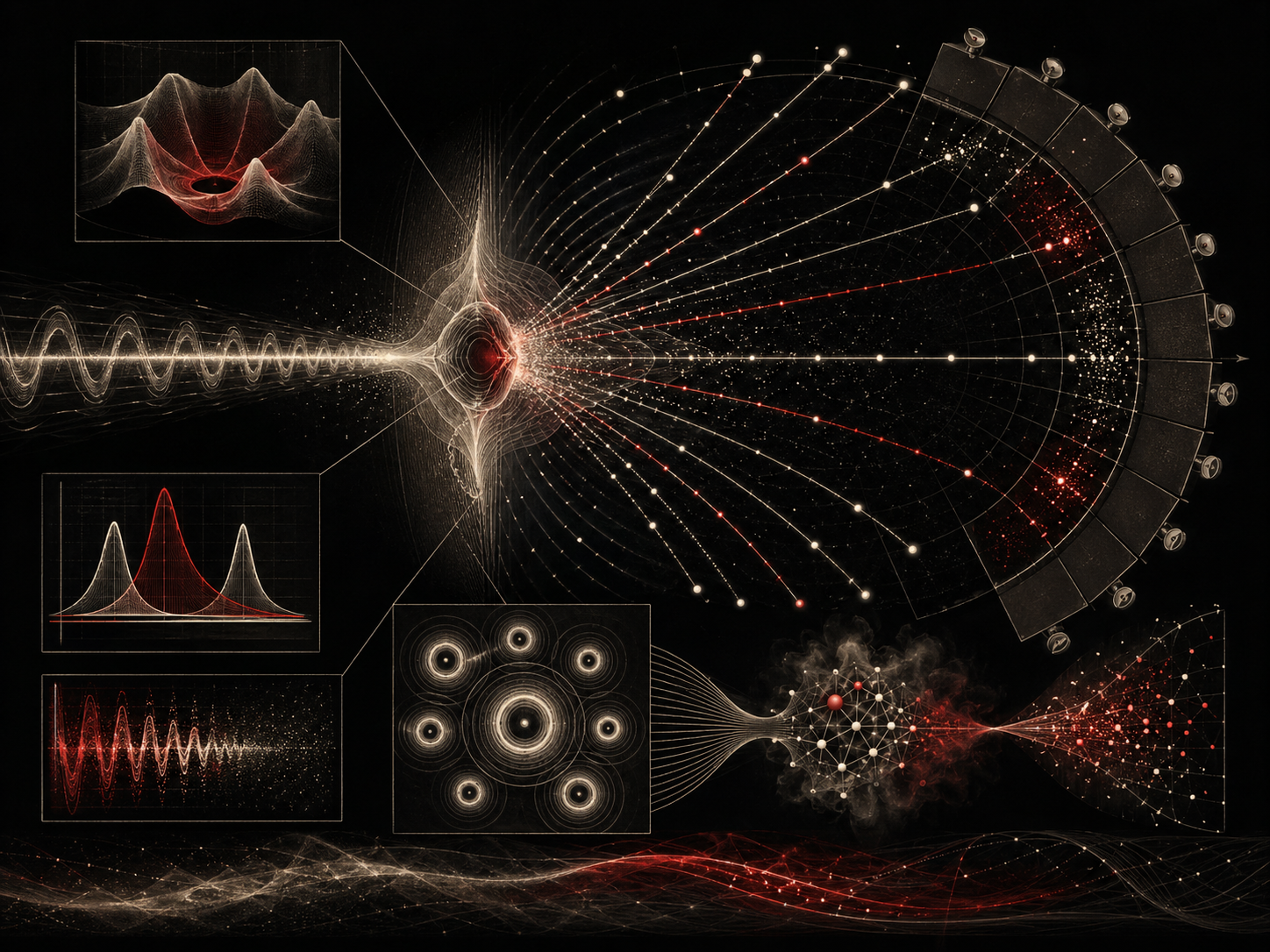
Scattering theory is one of the central inference engines of physics: it translates invisible interactions into measurable angular distributions, energy spectra, event counts, cross sections, resonances, and outgoing states. In a scattering experiment, a prepared incoming beam or wavepacket interacts with a target, potential, field, particle, nucleus, material, molecule, or many-body system. The observable result is not usually the interaction itself, but the pattern of outgoing particles, waves, radiation, or excitations. Scattering theory supplies the mathematical bridge between cause and signature.
This bridge is foundational across physics. Rutherford scattering revealed the nuclear atom. Neutron scattering maps condensed-matter structure and dynamics. X-ray and electron scattering resolve crystals, molecules, and materials. Nuclear scattering probes interaction potentials and resonances. Particle scattering tests quantum field theory and the Standard Model. Optical scattering explains diffraction, atmospheric effects, and microscopy. Plasma, atomic, molecular, and condensed-matter scattering all use related ideas: flux, amplitude, probability current, differential cross section, total cross section, phase shift, response function, luminosity, detector acceptance, uncertainty, and inverse inference.
This article develops Scattering Theory, Cross Sections, and Physical Inference as a research-grade introduction within the Physics knowledge series. It explains incoming and outgoing states, scattering amplitudes, differential cross sections, total cross sections, probability current, flux, the S-matrix, T-matrix, Born approximation, partial-wave expansion, phase shifts, optical theorem, resonances, Breit–Wigner forms, inelastic scattering, coupled channels, Rutherford scattering, wave scattering, quantum field theory scattering, Feynman amplitudes, luminosity, event rates, detector efficiency, acceptance, response matrices, unfolding, likelihood inference, uncertainty, inverse scattering, and computational modeling. Selected R and Python examples appear in the article body, while the companion GitHub repository contains expanded computational resources for angular distributions, differential and total cross-section integration, partial-wave phase shifts, Born approximation examples, resonance fitting, event-rate inference, detector smearing, likelihood estimation, SQL provenance tables, C/C++/Fortran/Rust examples, and reproducible scattering workflows.
Main Library
Publications
Article Map
Physics
Related Topic
Chemistry
Related Topic
Data Systems & Analytics
Related Topic
Astronomy
Why Scattering Matters
Scattering matters because much of physics is learned by disturbing a system and observing what comes out. A beam of particles strikes a target. Light interacts with a material. Neutrons enter a crystal. Electrons scatter from nuclei. Protons collide at high energy. Photons emerge from a molecule. Waves reflect from a potential. In each case, the outgoing distribution contains encoded information about the interaction.
The word “scattering” can sound narrow, but the concept is broad. It includes elastic scattering, where internal states remain unchanged; inelastic scattering, where energy is transferred; diffraction, where wave interference reveals structure; resonance scattering, where temporary intermediate states form; and high-energy collision scattering, where new particles may be produced. Scattering is therefore both a theoretical framework and an experimental strategy.
The central observable is the cross section. Although it has units of area, a cross section is not always a literal geometric area. It is an effective measure of interaction probability under specified conditions. A larger cross section means the process occurs more often for a given incoming flux or collider luminosity. A differential cross section describes how that probability is distributed across angle, energy, momentum transfer, invariant mass, rapidity, transverse momentum, or other final-state variables.
Scattering also matters because it preserves structure that simple bulk measurements often hide. A total cross section compresses interaction probability into one number. A differential distribution can reveal angular momentum, spin, parity, interference, form factors, internal structure, threshold behavior, resonance widths, detector bias, and new-physics signatures. The pattern is often the evidence.
For the Physics knowledge series, this article belongs near Quantum Mechanics and the Limits of Classical Intuition, Quantum Field Theory I: Fields, Particles, and Second Quantization, Path Integrals and the Functional Formulation of Physics, Atomic, Molecular, and Optical Physics, Nuclear Physics and the Structure of Matter, Many-Body Physics and Emergent Collective Behavior, and Experimental Physics: Measurement, Noise, Calibration, and Inference. Scattering is where theory, measurement, and inference meet.
Scattering as Physical Inference
A scattering experiment is an inverse problem. The experimenter controls or characterizes an incoming state and measures an outgoing distribution. The goal is to infer something about the interaction, target, internal structure, potential, field, coupling, resonance, symmetry, or dynamics.
The direct problem asks: given the interaction, what scattering pattern should occur? The inverse problem asks: given the scattering pattern, what interaction or structure produced it? Real experiments require both. Theory predicts amplitudes and cross sections. Measurement produces counts, spectra, angular distributions, and uncertainties. Statistical inference compares the two.
This inference structure appears at many scales. Rutherford scattering inferred a compact atomic nucleus. X-ray diffraction infers crystal structure from reciprocal-space peaks. Neutron scattering infers phonon spectra, magnetic order, and correlation functions. Particle scattering infers coupling constants, masses, widths, branching fractions, and possible new particles. In each case, scattering turns indirect evidence into physical knowledge.
This is why scattering theory should not be treated as only a formal quantum mechanics chapter. It is a general architecture for learning from interactions. A scattering calculation is only the theoretical part of the chain. A complete scattering workflow also includes source characterization, beam energy, flux or luminosity, target properties, detector response, background modeling, selection efficiency, acceptance, unfolding, uncertainty, and inference.
Scattering therefore connects ontology and measurement. The hidden entity may be a potential, nucleus, excitation, intermediate state, coupling, symmetry, or many-body correlation. The observable is a distribution of outcomes. The intellectual work is the inference that connects one to the other.
Incoming and Outgoing States
In simple nonrelativistic scattering, an incoming plane wave interacts with a localized potential. Far from the scatterer, the wavefunction has an incident part and an outgoing scattered part:
\psi(\mathbf{r})
\sim
e^{ikz}
+
f(\theta,\phi)\frac{e^{ikr}}{r}
\]
Interpretation: Far from a scatterer, the wavefunction separates into an incoming plane wave and an outgoing spherical scattered wave.
The first term is the incident wave moving in the \(z\)-direction. The second term is an outgoing spherical wave. The function \(f(\theta,\phi)\) is the scattering amplitude. It encodes how strongly the wave is scattered into each direction.
This asymptotic form is a boundary-condition statement. It says that far away from the interaction region, the wave looks like a known incoming state plus outgoing radiation. The interaction itself is hidden inside the amplitude.
The wave number \(k\) is related to momentum by:
p=\hbar k
\]
Interpretation: Wave number is momentum divided by the reduced Planck constant.
and, for a nonrelativistic particle of mass \(m\), energy is:
E=\frac{\hbar^2 k^2}{2m}
\]
Interpretation: A nonrelativistic free particle’s kinetic energy is determined by its wave number.
For relativistic and quantum field theoretic scattering, the state description becomes more complex, but the basic logic remains: define asymptotic incoming states, define asymptotic outgoing states, and compute the probability amplitude connecting them.
The word “asymptotic” matters. Scattering theory assumes that far before and far after the interaction, the system can be described in terms of identifiable free or effectively free states. This is why long-range interactions, unstable particles, confinement, many-body media, and open channels require special care. The notion of a simple incoming and outgoing state can become subtle when the interaction never fully turns off or when the final state is not directly observed.
Scattering Amplitude
The scattering amplitude is the central theoretical object in many scattering problems. In simple elastic scattering, the differential cross section is:
\frac{d\sigma}{d\Omega}
=
|f(\theta,\phi)|^2
\]
Interpretation: The angular differential cross section is the squared magnitude of the scattering amplitude.
This formula shows how probability is distributed across solid angle. The amplitude is complex, so its phase matters. Interference between different scattering paths, angular momentum channels, internal states, or diagrams depends on relative phases.
In quantum mechanics, amplitudes add before probabilities are computed. If several indistinguishable processes contribute to the same final state, the total amplitude is:
\mathcal{A}_{\mathrm{total}}
=
\mathcal{A}_1+\mathcal{A}_2+\cdots
\]
Interpretation: Indistinguishable scattering pathways contribute coherently through amplitude addition.
and the probability involves:
|\mathcal{A}_{\mathrm{total}}|^2
\]
Interpretation: Observable probabilities depend on the squared magnitude of the total amplitude.
This is why scattering patterns can show interference, diffraction, resonant enhancement, and suppression. Cross sections are not merely counts; they are squared amplitudes shaped by phase.
The phase information is often difficult to measure directly, but it controls the physics. Partial-wave phase shifts, interference between resonant and nonresonant backgrounds, and coherent sums of diagrams all show that scattering is not just a probability problem. It is an amplitude problem whose observed distributions emerge only after coherent quantum contributions are combined.
Differential and Total Cross Sections
The differential cross section with respect to solid angle describes scattering into a small angular region:
d\sigma
=
\frac{d\sigma}{d\Omega}d\Omega
\]
Interpretation: A small cross-section element is the angular differential cross section multiplied by solid angle.
The total cross section is obtained by integrating over all solid angles:
\sigma_{\mathrm{tot}}
=
\int
\frac{d\sigma}{d\Omega}
\,d\Omega
\]
Interpretation: The total cross section sums the differential cross section over all outgoing directions.
For azimuthally symmetric scattering, \(d\Omega = 2\pi\sin\theta\,d\theta\), so:
\sigma_{\mathrm{tot}}
=
2\pi
\int_0^\pi
\frac{d\sigma}{d\Omega}(\theta)
\sin\theta\,d\theta
\]
Interpretation: Azimuthal symmetry reduces the solid-angle integral to a one-dimensional polar-angle integral.
More generally, scattering can be differential in energy, momentum transfer, invariant mass, rapidity, transverse momentum, or many-body phase-space variables:
\frac{d\sigma}{dE},\quad
\frac{d\sigma}{dq^2},\quad
\frac{d^2\sigma}{d\Omega\,dE},\quad
\frac{d\sigma}{d\Phi_n}
\]
Interpretation: Differential cross sections can resolve energy, momentum transfer, angle, or many-body final-state phase space.
Differential cross sections are often more informative than total cross sections because they preserve structure. A total cross section compresses the process into one number. A differential distribution can reveal angular dependence, spin effects, resonance peaks, interference, form factors, threshold behavior, and new physics signatures.
The choice of differential variable is itself an inference decision. An angular distribution may expose spin or parity. A momentum-transfer distribution may expose spatial structure. An invariant-mass distribution may expose resonances. A transverse-momentum spectrum may expose radiation, parton dynamics, or detector thresholds. A good scattering analysis chooses observables that preserve the physical information most relevant to the question being asked.
Probability Current and Flux
Cross sections are ratios of outgoing rate to incoming flux. In nonrelativistic quantum mechanics, the probability current is:
\mathbf{j}
=
\frac{\hbar}{2mi}
\left(
\psi^*\nabla\psi-\psi\nabla\psi^*
\right)
\]
Interpretation: Probability current measures the flow of quantum probability density.
For an incident plane wave \(e^{ikz}\), the incident flux is proportional to:
j_{\mathrm{inc}}
=
\frac{\hbar k}{m}
\]
Interpretation: Incident flux is proportional to particle velocity for a plane wave.
up to normalization. The scattered spherical wave produces outgoing radial flux. The differential cross section is defined so that the scattered rate into solid angle \(d\Omega\) equals incident flux times \(d\sigma\):
dR
=
j_{\mathrm{inc}}
\,d\sigma
\]
Interpretation: The differential cross section converts incident flux into an outgoing scattering rate.
This flux-based definition explains why cross section has units of area. It is the effective area that converts incoming flux into a scattering rate.
In beam experiments and colliders, the same concept appears through luminosity. The number of events is proportional to cross section times integrated luminosity, modified by efficiency and acceptance. At every scale, the cross section links interaction probability to measurable rate.
Flux also clarifies why normalization conventions matter. A wavefunction, beam current, or collider luminosity must be defined consistently before a cross section can be inferred. The cross section is not a raw outcome; it is a rate normalized by exposure.
S-Matrix and T-Matrix
The scattering matrix, or S-matrix, maps incoming asymptotic states to outgoing asymptotic states:
| \mathrm{out} \rangle
=
S
|
\mathrm{in}
\rangle
\]
Interpretation: The S-matrix maps prepared incoming states to outgoing scattering states.
It is often written as:
S=I+iT
\]
Interpretation: The identity part represents no interaction, while \(T\) contains transition amplitudes.
where \(I\) represents no interaction and \(T\) contains the transition amplitude. In quantum field theory, S-matrix elements are connected to invariant amplitudes computed from Feynman diagrams.
Unitarity is central:
S^\dagger S=I
\]
Interpretation: S-matrix unitarity expresses conservation of total probability.
Unitarity expresses probability conservation. It constrains scattering amplitudes, connects imaginary parts of forward amplitudes to total cross sections, and underlies the optical theorem.
The S-matrix perspective is powerful because it focuses on observable transitions between asymptotic states. It avoids requiring direct access to the interaction region. In high-energy physics, where interactions occur at extremely small distances and short times, the S-matrix is one of the main bridges between theory and experiment.
The T-matrix perspective is especially useful for separating the trivial identity process from the interaction-driven transition. Poles of scattering amplitudes can signal bound states, virtual states, or resonances. Analytic structure, branch cuts, thresholds, and unitarity constraints all become part of the physical interpretation.
Born Approximation
The Born approximation estimates scattering from a weak potential. For a potential \(V(\mathbf{r})\), the first Born approximation gives a scattering amplitude proportional to the Fourier transform of the potential:
f(\mathbf{q})
=
-\frac{m}{2\pi\hbar^2}
\int
e^{-i\mathbf{q}\cdot\mathbf{r}}
V(\mathbf{r})
\,d^3r
\]
Interpretation: The first Born approximation connects scattering amplitude to the Fourier transform of the interaction potential.
where \(\mathbf{q}=\mathbf{k}’-\mathbf{k}\) is the momentum transfer. This formula reveals an important principle: scattering measures spatial structure through momentum-space response.
If the potential is weak, the incoming wave is only slightly distorted, and a first-order approximation can be useful. If the potential is strong, supports bound states, produces resonances, or causes large phase shifts, the Born approximation may fail.
The Born approximation links scattering to Fourier analysis. Short-range features in real space affect large momentum transfer. Long-range structure affects small momentum transfer. This is why scattering experiments are often interpreted as probes of structure at length scales roughly related to inverse momentum transfer:
\ell \sim \frac{1}{q}
\]
Interpretation: Momentum transfer roughly probes spatial scales inversely proportional to \(q\).
This relationship is one reason scattering is so powerful in materials science, nuclear physics, and particle physics. The experiment does not directly “take a picture” of the object. It samples momentum-space information from which spatial structure is inferred through a model.
Partial-Wave Expansion
For central potentials, angular momentum is conserved, and scattering can be decomposed into partial waves. The scattering amplitude for elastic scattering from a spherically symmetric potential is:
f(\theta)
=
\frac{1}{k}
\sum_{\ell=0}^{\infty}
(2\ell+1)
e^{i\delta_\ell}
\sin\delta_\ell
P_\ell(\cos\theta)
\]
Interpretation: Partial-wave expansion decomposes scattering into angular momentum channels.
where \(\ell\) is angular momentum quantum number, \(P_\ell\) is a Legendre polynomial, and \(\delta_\ell\) is the phase shift for the \(\ell\)-th partial wave.
The total elastic cross section becomes:
\sigma_{\mathrm{el}}
=
\frac{4\pi}{k^2}
\sum_{\ell=0}^{\infty}
(2\ell+1)\sin^2\delta_\ell
\]
Interpretation: Elastic scattering strength can be summed over phase-shifted angular momentum channels.
At low energy, only small \(\ell\) values often contribute significantly. The \(s\)-wave term \(\ell=0\) may dominate. At higher energies, many partial waves can contribute.
Partial-wave analysis is important because it translates angular distributions into angular momentum channels. In nuclear and particle physics, resonances are often identified by their angular momentum, parity, spin, and phase-shift behavior.
Partial waves also show how scattering organizes complexity. Instead of treating an angular distribution as an unstructured curve, one decomposes it into symmetry-guided channels. The physics then appears through the phase shifts and their energy dependence.
Phase Shifts
A phase shift measures how a scattered partial wave differs from a free wave. The potential modifies the outgoing phase of each angular momentum channel. Even if the cross section depends on \(\sin^2\delta_\ell\), the phase shift itself contains deeper information about the interaction.
For low-energy \(s\)-wave scattering, the phase shift is related to the scattering length \(a\):
k\cot\delta_0
=
-\frac{1}{a}
+
\frac{1}{2}r_e k^2
+
\cdots
\]
Interpretation: The effective-range expansion summarizes low-energy scattering through scattering length and effective range.
This is the effective-range expansion. The parameter \(a\) is the scattering length, and \(r_e\) is the effective range. These quantities summarize low-energy interaction behavior without requiring full knowledge of the microscopic potential.
Scattering length appears across atomic, nuclear, and condensed-matter physics. It controls ultracold collisions, low-energy neutron scattering, effective interactions in dilute gases, and near-threshold phenomena.
Phase shifts also provide evidence for resonances. As the energy passes through a resonance, a phase shift may change rapidly. This energy dependence can be more revealing than a cross-section peak alone, because peaks may be distorted by background, thresholds, or interference.
Optical Theorem
The optical theorem relates the total cross section to the imaginary part of the forward scattering amplitude:
\sigma_{\mathrm{tot}} = \frac{4\pi}{k}\,\mathrm{Im}\, f(0)
\]
Interpretation: The total cross section is tied to the imaginary part of the forward scattering amplitude by unitarity.
Here, \(\sigma_{\mathrm{tot}}\) is the total cross section, \(k\) is the incident wave number, and \(f(0)\) is the scattering amplitude in the forward direction. The theorem is a consequence of probability conservation and unitarity.
The optical theorem is conceptually important because it connects all scattering, including processes that remove flux from the incident beam, to the forward amplitude. Forward scattering carries information about total interaction probability.
This relationship appears in quantum mechanics, optics, nuclear physics, and high-energy physics. It shows that even unobserved channels affect the elastic forward amplitude through unitarity.
The theorem is also a useful warning. One cannot interpret an observed channel in isolation when other channels are open. Elastic scattering, inelastic scattering, absorption, breakup, and particle production are coupled through probability conservation. Total interaction strength leaves a trace in the forward amplitude, even when some final states are not directly reconstructed.
Resonances and Breit–Wigner Forms
A resonance occurs when scattering proceeds through a temporary intermediate state. In cross-section data, resonances often appear as peaks in energy or invariant mass distributions. A simple resonance form is the Breit–Wigner distribution:
\sigma(E)
\propto
\frac{\Gamma^2/4}
{(E-E_R)^2+\Gamma^2/4}
\]
Interpretation: A Breit–Wigner form models a resonance peak centered at \(E_R\) with width \(\Gamma\).
where \(E_R\) is the resonance energy and \(\Gamma\) is the width. The width is related to the lifetime \(\tau\) of the unstable state:
\tau \sim \frac{\hbar}{\Gamma}
\]
Interpretation: Resonance width is inversely related to the lifetime of the unstable intermediate state.
Resonances are central in nuclear physics, atomic physics, molecular scattering, condensed-matter spectroscopy, and particle physics. They reveal temporary states that are not stable bound states but still shape scattering strongly.
In real experiments, resonance fitting requires backgrounds, detector resolution, interference, threshold effects, branching fractions, acceptance corrections, and uncertainty propagation. A resonance peak is not automatically a new particle or state; it must be inferred through a model and tested against alternatives.
The line shape also matters. A simple Breit–Wigner model is a starting point, not a universal truth. Near thresholds, in strongly coupled channels, or in the presence of interference, a resonance may not appear as a symmetric peak. A serious analysis asks whether the apparent structure is a pole, a threshold cusp, a background fluctuation, a detector artifact, or an interference pattern.
Inelastic Scattering and Coupled Channels
Elastic scattering leaves the internal states of the target and projectile unchanged. Inelastic scattering transfers energy into internal excitation, particle production, radiation, breakup, phonons, magnons, nuclear levels, or other channels.
Inelastic cross sections are often differential in both angle and energy transfer:
\frac{d^2\sigma}{d\Omega\,dE’}
\]
Interpretation: Inelastic scattering can resolve both outgoing angle and outgoing energy.
The energy transfer is:
\hbar\omega = E_i-E_f
\]
Interpretation: Energy transfer is the difference between initial and final energies.
and the momentum transfer is:
\mathbf{q}=\mathbf{k}_i-\mathbf{k}_f
\]
Interpretation: Momentum transfer is the difference between incoming and outgoing wave vectors.
In neutron scattering and condensed-matter physics, inelastic scattering is often expressed through a dynamic structure factor:
S(\mathbf{q},\omega)
\]
Interpretation: The dynamic structure factor encodes space-time correlations probed by inelastic scattering.
This function encodes correlations in space and time. It allows scattering experiments to measure collective excitations such as phonons, magnons, density waves, and quantum fluctuations.
Coupled-channel scattering accounts for multiple possible final states and transitions among them. It is essential when channels interact strongly, thresholds are nearby, or resonances couple to several decay modes.
Coupled channels are not a technical complication to be ignored. They are often the physics. A resonance that appears in one channel may decay primarily into another. A threshold in one channel may distort the observed distribution in a different channel. Inelasticity, absorption, and open final states are part of the interaction structure inferred from scattering.
Rutherford Scattering
Rutherford scattering describes Coulomb scattering of charged particles. In its classic form, the differential cross section varies strongly with scattering angle:
\frac{d\sigma}{d\Omega}
=
\left(
\frac{Z_1Z_2e^2}{16\pi\epsilon_0 E}
\right)^2
\frac{1}{\sin^4(\theta/2)}
\]
Interpretation: Rutherford scattering has a strong forward angular dependence caused by the long-range Coulomb interaction.
where \(Z_1e\) and \(Z_2e\) are charges, \(E\) is kinetic energy, and \(\theta\) is scattering angle. The strong forward divergence reflects the long range of the Coulomb interaction.
Rutherford scattering is historically important because large-angle alpha scattering showed that positive atomic charge is concentrated in a small nucleus rather than spread diffusely through the atom. The experiment transformed atomic structure from a diffuse model into a nuclear model.
Conceptually, Rutherford scattering demonstrates the inferential power of angular distributions. A small number of rare large-angle events can overturn an entire model of matter.
It also illustrates how deviations matter. At sufficiently high momentum transfer or small distance scale, deviations from a simple Coulomb form can reveal finite nuclear size, screening, recoil, relativistic corrections, quantum effects, or additional interactions. A scattering law is often most informative where it fails.
Form Factors and Structure Functions
Scattering often measures structure indirectly through form factors and structure functions. A form factor describes how an extended object responds to momentum transfer. In many settings, it is related to the Fourier transform of a spatial distribution:
F(\mathbf{q})
=
\int \rho(\mathbf{r})e^{-i\mathbf{q}\cdot\mathbf{r}}\,d^3r
\]
Interpretation: A form factor relates momentum-transfer response to spatial structure.
Here \(\rho(\mathbf{r})\) may represent a charge density, mass density, scattering-length density, or other source distribution depending on the experiment. The measured cross section may include factors such as \(|F(\mathbf{q})|^2\), meaning the observed intensity is connected to the squared magnitude of the momentum-space structure.
Structure functions generalize this idea when the target has internal dynamics, many-body correlations, or partonic substructure. In condensed matter, dynamic structure factors encode correlations in space and time. In high-energy scattering, structure functions encode how constituents share momentum inside composite particles.
These quantities show why scattering is not merely about collisions. It is about correlation. A scattering experiment can reveal where matter is, how it moves, how it fluctuates, how it responds, and how its internal degrees of freedom are organized. The outgoing distribution is a map of hidden structure projected into measurable variables.
Quantum Field Theory Scattering
In quantum field theory, scattering amplitudes are computed from interactions among fields. A process such as:
a+b\rightarrow c+d
\]
Interpretation: QFT scattering relates specified incoming particle states to specified outgoing particle states.
has an invariant amplitude \(\mathcal{M}\). For a two-body final state, the cross section is schematically:
d\sigma
=
\frac{1}{\mathrm{flux}}
|\mathcal{M}|^2
d\Phi
\]
Interpretation: QFT cross sections combine invariant amplitudes, incoming flux, and final-state phase space.
where \(d\Phi\) is Lorentz-invariant phase space. The details depend on normalization, spin averages, identical particles, color factors, kinematics, and final-state multiplicity.
Feynman diagrams organize perturbative contributions to \(\mathcal{M}\). Each diagram represents a term in an expansion, not a literal particle trajectory. Interference between diagrams can be constructive or destructive.
High-energy scattering uses Mandelstam variables:
s=(p_1+p_2)^2
\]
Interpretation: The Mandelstam variable \(s\) represents total center-of-mass energy squared.
t=(p_1-p_3)^2
\]
Interpretation: The Mandelstam variable \(t\) represents momentum transfer squared between selected incoming and outgoing particles.
u=(p_1-p_4)^2
\]
Interpretation: The Mandelstam variable \(u\) is a complementary invariant momentum-transfer channel.
These Lorentz-invariant quantities describe energy and momentum transfer. Differential cross sections in \(t\), invariant mass, transverse momentum, rapidity, or angular variables form the basis of particle-physics inference.
QFT scattering also makes the inferential chain explicit. A Lagrangian defines fields and interactions. Perturbation theory or nonperturbative methods produce amplitudes. Amplitudes produce cross sections and decay rates. Experiments measure detector-level event counts and distributions. Statistical inference then tests whether the theory, with uncertainties, accounts for the observed data.
Luminosity, Event Rates, and Counting Experiments
In a collider or beam experiment, the expected event rate is:
R
=
\mathcal{L}\sigma
\]
Interpretation: Event rate equals instantaneous luminosity times cross section.
where \(\mathcal{L}\) is instantaneous luminosity and \(\sigma\) is the cross section. Over time, the expected number of events is:
N
=
\mathcal{L}_{\mathrm{int}}\sigma
\]
Interpretation: Integrated luminosity times cross section gives expected event count before detector corrections.
where \(\mathcal{L}_{\mathrm{int}}\) is integrated luminosity.
Real measurements include efficiency and acceptance:
N_{\mathrm{obs}}
=
\mathcal{L}_{\mathrm{int}}
\sigma
\epsilon
A
+
N_{\mathrm{background}}
\]
Interpretation: Observed counts combine signal yield, efficiency, acceptance, and background.
where \(\epsilon\) is detection efficiency, \(A\) is acceptance, and \(N_{\mathrm{background}}\) is the expected background count.
This formula shows that measuring a cross section is not just counting events. One must know luminosity, selection efficiency, geometric and kinematic acceptance, detector response, background contamination, trigger efficiency, reconstruction bias, and systematic uncertainty.
The counting equation also shows why rare processes require large exposure. A small cross section can still be measured if the integrated luminosity is large enough and the background is controlled. Conversely, a large cross section can be hard to interpret if the detector response is poorly understood or if backgrounds dominate the selected sample.
Detectors, Acceptance, and Efficiency
A detector observes only part of the physical final state. Some particles escape. Some energies are mismeasured. Some tracks are lost. Some angles are outside coverage. Some events fail trigger or reconstruction. This means measured distributions are detector-level approximations to particle-level or theory-level quantities.
A simple detector response model can be written as:
\mathbf{n}_{\mathrm{obs}}
=
R\mathbf{n}_{\mathrm{true}}
+
\mathbf{b}
\]
Interpretation: A detector response matrix maps true distributions into observed distributions with background added.
where \(R\) is a response matrix, \(\mathbf{n}_{\mathrm{true}}\) is the true distribution, \(\mathbf{n}_{\mathrm{obs}}\) is the observed distribution, and \(\mathbf{b}\) is background.
Unfolding attempts to infer the true distribution from observed data and detector response. This is an ill-conditioned inverse problem, so regularization, priors, likelihood methods, covariance matrices, and validation are essential.
Scattering inference is therefore experimental and statistical, not only theoretical. A beautiful amplitude formula becomes a measured cross section only after detector effects are controlled.
Efficiency and acceptance also depend on the model. If simulated events do not represent the true distribution well, the correction from observed counts to inferred cross sections can be biased. This is why scattering analyses often include control regions, calibration samples, closure tests, alternative models, and nuisance parameters. Detector correction is part of the physics measurement, not an afterthought.
Unfolding, Response Matrices, and Detector-Level Data
Unfolding is the process of estimating an underlying distribution from a distorted measured distribution. If the true distribution is binned into \(\mathbf{n}_{\mathrm{true}}\), the observed distribution may be approximated by:
\mathbf{n}_{\mathrm{obs}}
=
R\mathbf{n}_{\mathrm{true}}
+
\mathbf{b}
\]
Interpretation: Detector response, migration, inefficiency, and background connect true and observed binned distributions.
The response matrix \(R\) may include efficiency losses, bin migration, resolution smearing, reconstruction thresholds, and acceptance cuts. If \(R\) were perfectly known and well-conditioned, one might attempt a direct inversion. In practice, this is often unstable:
\mathbf{n}_{\mathrm{true}}
\approx
R^{-1}(\mathbf{n}_{\mathrm{obs}}-\mathbf{b})
\]
Interpretation: Direct inversion is conceptually simple but often unstable for realistic detector response.
Small statistical fluctuations in observed bins can become large oscillations in the inferred distribution. Regularized unfolding, Bayesian iterative methods, forward-folded likelihoods, and response-aware comparisons are therefore used to stabilize inference.
In many modern analyses, forward modeling is preferred: instead of unfolding data all the way back to an ideal truth distribution, theory predictions are passed through detector simulation and compared at detector level. This approach can avoid some instabilities, but it depends strongly on the quality of the detector model. Either way, scattering inference must account for the measurement apparatus.
Uncertainty and Statistical Inference
Scattering experiments are statistical. Counts fluctuate. Backgrounds are uncertain. Luminosity has calibration error. Detector response is imperfect. Theory predictions have parameter, scale, model, and numerical uncertainties.
For a simple counting experiment with expected signal \(s\) and background \(b\), the observed count \(n\) is often modeled as Poisson:
P(n|s,b)
=
\frac{(s+b)^n e^{-(s+b)}}{n!}
\]
Interpretation: Poisson counting models the probability of observing \(n\) events given signal and background expectations.
If the signal expectation is:
s=
\mathcal{L}_{\mathrm{int}}\sigma\epsilon A
\]
Interpretation: Expected signal count depends on luminosity, cross section, efficiency, and acceptance.
then inference on \(\sigma\) follows from the likelihood:
\mathcal{L}(\sigma)
=
P(n|\mathcal{L}_{\mathrm{int}}\sigma\epsilon A,b)
\]
Interpretation: A likelihood links observed counts to the cross section being inferred.
More realistic analyses use binned likelihoods, unbinned likelihoods, nuisance parameters, covariance matrices, profile likelihoods, Bayesian posteriors, unfolding, simulations, and control regions.
The key idea is that a cross section is an inferred quantity. It is not simply the raw number of events divided by luminosity. It is a model-dependent estimate with uncertainty.
Uncertainty should also be decomposed. Statistical uncertainty comes from finite counts. Systematic uncertainty may come from luminosity calibration, detector efficiency, energy scale, resolution, background normalization, modeling assumptions, acceptance corrections, theory scale variation, parton distributions, branching fractions, or unfolding regularization. A credible scattering result states not only the central value, but also how uncertainty enters the inference chain.
Inverse Scattering
Inverse scattering asks how much can be learned about an interaction from scattering data. In some cases, phase shifts over all energies can constrain or reconstruct a potential. In other cases, different microscopic models can produce similar scattering observables, making the inverse problem nonunique.
Inverse scattering appears in quantum mechanics, acoustics, optics, geophysics, medical imaging, materials science, nuclear physics, and particle physics. The common structure is the same: infer hidden structure from wave response.
Important inverse-scattering questions include: Which observables are sufficient? What energy range is needed? Are phases measured or only intensities? Are there missing channels? Is the model identifiable? How sensitive is the inference to noise? What assumptions constrain the solution?
This is why scattering theory must be paired with epistemology of measurement. It teaches not only what can be inferred, but what remains underdetermined.
Inverse scattering is also where physical judgment becomes unavoidable. A fitted potential, form factor, resonance, or coupling is not merely extracted from data. It is inferred under assumptions about dynamics, symmetries, detector effects, background, resolution, and model class. Good scattering science makes those assumptions visible and tests whether alternatives could explain the same evidence.
Measurement, Units, and SI Interpretation
Cross section has units of area. In SI units:
[\sigma]=\mathrm{m^2}
\]
Interpretation: Cross section has dimensions of area.
In nuclear and particle physics, cross sections are commonly expressed in barns:
1\,\mathrm{barn}
=
10^{-28}\,\mathrm{m^2}
\]
Interpretation: The barn is a standard nuclear and particle physics area unit for cross section.
Common derived units include millibarn, microbarn, nanobarn, picobarn, and femtobarn. High-energy collider luminosity is often expressed in inverse femtobarns for integrated luminosity:
\mathcal{L}_{\mathrm{int}}
\sim
\mathrm{fb}^{-1}
\]
Interpretation: Integrated luminosity is commonly reported in inverse cross-section units.
The product \(\mathcal{L}_{\mathrm{int}}\sigma\) is dimensionless and gives an expected event count before efficiency, acceptance, and background effects.
Momentum transfer may be measured in SI units, inverse length, electronvolts over \(c\), or natural units. High-energy physics often uses natural units:
\hbar=c=1
\]
Interpretation: Natural units relate energy, momentum, mass, inverse length, and inverse time through \(\hbar\) and \(c\).
In that convention, cross sections may be expressed in powers of energy inverse and converted to area units. Computational workflows should document whether they use SI, natural units, lattice units, or experiment-specific conventions.
Unit discipline matters because scattering spans fields with different conventions. A neutron scattering table, a nuclear cross-section library, a collider luminosity report, a molecular scattering calculation, and a quantum mechanics derivation may use different unit systems. Reproducible scattering workflows must record those conventions explicitly.
Mathematical Lens
A mathematics-first view begins with the asymptotic scattering wavefunction:
\psi(\mathbf{r})
\sim
e^{ikz}
+
f(\theta,\phi)\frac{e^{ikr}}{r}
\]
Interpretation: The asymptotic wavefunction separates incident and scattered components.
The differential cross section is:
\frac{d\sigma}{d\Omega}
=
|f(\theta,\phi)|^2
\]
Interpretation: Angular scattering probability is determined by the squared amplitude.
The total cross section is:
\sigma_{\mathrm{tot}}
=
\int
\frac{d\sigma}{d\Omega}
d\Omega
\]
Interpretation: Total interaction probability is obtained by integrating over outgoing directions.
For azimuthal symmetry:
\sigma_{\mathrm{tot}}
=
2\pi
\int_0^\pi
\frac{d\sigma}{d\Omega}(\theta)
\sin\theta\,d\theta
\]
Interpretation: Azimuthal symmetry reduces total cross-section integration to a polar-angle integral.
The Born approximation is:
f(\mathbf{q})
=
-\frac{m}{2\pi\hbar^2}
\int
e^{-i\mathbf{q}\cdot\mathbf{r}}
V(\mathbf{r})
d^3r
\]
Interpretation: Weak-potential scattering is related to the Fourier transform of the potential.
The partial-wave expansion is:
f(\theta)
=
\frac{1}{k}
\sum_{\ell=0}^{\infty}
(2\ell+1)
e^{i\delta_\ell}
\sin\delta_\ell
P_\ell(\cos\theta)
\]
Interpretation: Scattering from a central potential can be decomposed into angular momentum channels.
The elastic total cross section in terms of phase shifts is:
\sigma_{\mathrm{el}}
=
\frac{4\pi}{k^2}
\sum_{\ell=0}^{\infty}
(2\ell+1)\sin^2\delta_\ell
\]
Interpretation: Elastic total cross section is determined by the phase shifts of each partial wave.
The optical theorem is:
\sigma_{\mathrm{tot}} = \frac{4\pi}{k}\,\mathrm{Im}\, f(0)
\]
Interpretation: Total cross section is constrained by the forward scattering amplitude.
A simple Breit–Wigner resonance form is:
\sigma(E)
=
\sigma_0
\frac{\Gamma^2/4}
{(E-E_R)^2+\Gamma^2/4}
\]
Interpretation: A resonance cross section peaks near \(E_R\) with characteristic width \(\Gamma\).
Event-rate inference uses:
N_{\mathrm{obs}}
=
\mathcal{L}_{\mathrm{int}}\sigma\epsilon A
+
N_{\mathrm{background}}
\]
Interpretation: Observed counts connect cross section to luminosity, detector effects, and backgrounds.
This mathematical lens shows how scattering connects amplitudes, flux, probability, angular distributions, cross sections, resonances, detector response, and experimental inference.
Variables, Units, and Physical Interpretation
Scattering theory uses variables that connect amplitudes, flux, cross sections, phase shifts, resonances, detector response, and inference. The table below summarizes several central quantities.
| Symbol or Term | Meaning | Typical Unit or Dimension | Physical Interpretation |
|---|---|---|---|
| \(f(\theta,\phi)\) | Scattering amplitude | length | Complex amplitude for scattering into a direction |
| \(d\sigma/d\Omega\) | Differential cross section | area per steradian | Angular distribution of scattering probability |
| \(\sigma_{\mathrm{tot}}\) | Total cross section | area | Integrated effective interaction probability |
| \(k\) | Wave number | m\(^{-1}\) | Momentum divided by \(\hbar\) |
| \(\mathbf{q}\) | Momentum transfer | kg m s\(^{-1}\) or inverse length in natural units | Difference between incoming and outgoing momentum |
| \(\delta_\ell\) | Partial-wave phase shift | radians | Interaction-induced phase change in angular momentum channel \(\ell\) |
| \(\mathcal{M}\) | Invariant amplitude | convention-dependent | QFT scattering amplitude entering cross sections |
| \(E_R\) | Resonance energy | J or eV | Energy at which resonant scattering peaks |
| \(\Gamma\) | Resonance width | J or eV | Inverse lifetime scale of unstable intermediate state |
| \(\mathcal{L}\) | Instantaneous luminosity | m\(^{-2}\)s\(^{-1}\) | Beam overlap and intensity factor converting cross section to rate |
| \(\mathcal{L}_{\mathrm{int}}\) | Integrated luminosity | m\(^{-2}\) or inverse barn units | Time-integrated exposure of a scattering experiment |
| \(\epsilon A\) | Efficiency times acceptance | dimensionless | Fraction of true events detected and selected |
| \(R\) | Detector response matrix | dimensionless or bin-dependent | Maps true event distributions into observed distributions |
| \(b\) | Background expectation | counts | Non-signal events expected in a selected sample |
Note: Units vary by convention, especially when using natural units where momentum transfer, wave number, energy, and inverse length may be expressed in related forms.
Worked Example: From Angular Distribution to Total Cross Section
Suppose an elastic scattering experiment has an azimuthally symmetric differential cross section:
\frac{d\sigma}{d\Omega}(\theta)
=
\sigma_0(1+\alpha\cos^2\theta)
\]
Interpretation: This model cross section includes an isotropic term plus an angular anisotropy proportional to \(\cos^2\theta\).
The total cross section is:
\sigma_{\mathrm{tot}}
=
2\pi
\int_0^\pi
\sigma_0(1+\alpha\cos^2\theta)
\sin\theta\,d\theta
\]
Interpretation: Azimuthal symmetry reduces total cross section to a polar-angle integral.
Let:
u=\cos\theta
\]
Interpretation: A substitution converts angular integration into a polynomial integral.
Then:
du=-\sin\theta\,d\theta
\]
Interpretation: The sine factor in the solid-angle measure is absorbed into \(du\).
As \(\theta\) goes from \(0\) to \(\pi\), \(u\) goes from \(1\) to \(-1\). Therefore:
\sigma_{\mathrm{tot}}
=
2\pi\sigma_0
\int_{-1}^{1}
(1+\alpha u^2)\,du
\]
Interpretation: The total cross section becomes an integral over \(u=\cos\theta\).
Compute the integral:
\int_{-1}^{1}1\,du=2
\]
Interpretation: The isotropic part contributes 2 in the transformed variable.
\int_{-1}^{1}u^2\,du=\frac{2}{3}
\]
Interpretation: The angular anisotropy contributes \(2/3\) after integration.
Thus:
\sigma_{\mathrm{tot}}
=
2\pi\sigma_0
\left(
2+\frac{2\alpha}{3}
\right)
\]
Interpretation: The total cross section combines isotropic and anisotropic angular contributions.
or:
\sigma_{\mathrm{tot}}
=
4\pi\sigma_0
\left(
1+\frac{\alpha}{3}
\right)
\]
Interpretation: The anisotropy changes the total cross section by the factor \(1+\alpha/3\).
This example shows how angular information becomes an integrated interaction probability. It also shows why losing angular information can obscure physics: different angular distributions may produce the same total cross section.
The example is simple, but the principle generalizes. A measured distribution is often more informative before integration than after integration. Total cross sections are useful summaries, but differential cross sections preserve the patterns from which physical mechanisms are inferred.
Computational Modeling
Computational modeling makes scattering theory operational. An angular-distribution workflow can integrate differential cross sections. A partial-wave workflow can compute phase-shift contributions. A Born-approximation workflow can Fourier transform model potentials. A resonance workflow can fit energy-dependent cross sections. An event-rate workflow can translate cross section, luminosity, efficiency, and background into expected counts. A detector workflow can smear true distributions into observed ones. A likelihood workflow can infer model parameters from binned counts. A metadata workflow can preserve units, assumptions, sources, detector corrections, numerical settings, and uncertainty models.
The selected examples below focus on total cross-section integration and resonance fitting because they are foundational, readable, and directly reusable. The GitHub repository extends the same logic into richer computational resources: R angular integrations, Python resonance fitting, Born approximation examples, partial-wave tables, optical-theorem checks, event-rate inference, detector smearing, unfolding examples, likelihood calculations, Julia scattering utilities, C++ parameter sweeps, Fortran cross-section tables, SQL scattering provenance, Rust command-line utilities, C examples, documentation, and reproducible sample data.
These examples are intentionally modest. Their purpose is to show the habits of scattering computation: integrate distributions carefully, validate numerical results against analytic checks, fit models with uncertainty, preserve assumptions, and connect theoretical quantities to measurable observables. Production scattering analyses extend the same logic with detector simulation, covariance matrices, nuisance parameters, background models, and independent validation samples.
R Workflow: Integrating a Differential Cross Section
R is useful for transparent numerical integration, reproducible tables, and uncertainty summaries. The following workflow computes total cross sections from a model angular distribution:
\frac{d\sigma}{d\Omega}
=
\sigma_0(1+\alpha\cos^2\theta)
\]
Interpretation: The model angular distribution is integrated numerically and compared with an analytic result.
# Integrating a Differential Cross Section
#
# This workflow computes:
#
#   sigma_total = 2 pi integral_0^pi (d sigma / d Omega)(theta) sin(theta) d theta
#
# for:
#
#   d sigma / d Omega = sigma_0 * (1 + alpha cos^2(theta))
#
# The numerical integral is compared with the analytic result:
#
#   sigma_total = 4 pi sigma_0 (1 + alpha / 3)

library(tibble)
library(dplyr)
library(purrr)

compute_total_cross_section <- function(sigma_0, alpha, n_grid = 20000) {
  theta <- seq(0, pi, length.out = n_grid)

  differential_cross_section <- sigma_0 * (1 + alpha * cos(theta)^2)

  integrand <- differential_cross_section * sin(theta)

  delta_theta <- theta[2] - theta[1]

  numerical_integral <- delta_theta * (
    0.5 * first(integrand) +
      sum(integrand[2:(length(integrand) - 1)]) +
      0.5 * last(integrand)
  )

  sigma_total_numeric <- 2 * pi * numerical_integral

  sigma_total_analytic <- 4 * pi * sigma_0 * (1 + alpha / 3)

  tibble(
    sigma_0 = sigma_0,
    alpha = alpha,
    sigma_total_numeric = sigma_total_numeric,
    sigma_total_analytic = sigma_total_analytic,
    absolute_error = abs(sigma_total_numeric - sigma_total_analytic),
    relative_error = absolute_error / sigma_total_analytic
  )
}

parameter_table <- tribble(
  ~sigma_0, ~alpha,
  1.0, 0.0,
  1.0, 0.5,
  1.0, 1.0,
  2.0, 1.0,
  0.5, 2.0
)

cross_section_summary <- parameter_table %>%
  mutate(result = map2(sigma_0, alpha, compute_total_cross_section)) %>%
  select(result) %>%
  unnest(result)

print(cross_section_summary)
This workflow demonstrates the basic numerical structure of cross-section integration. It also validates the numerical integration against an analytic result, which is a useful reproducibility habit for more complex scattering workflows.
In more realistic applications, the same pattern can be extended to measured angular bins, detector acceptance, covariance matrices, Monte Carlo integration over phase space, or multidimensional final-state variables. The essential habit is the same: preserve the differential structure until the scientific question requires integration.
Python Workflow: Resonance Fitting with a Breit–Wigner Model
Python is useful for numerical fitting, simulation, and inference. The following workflow generates synthetic resonance cross-section data, adds noise, and fits a Breit–Wigner model.
"""
Resonance Fitting with a Breit-Wigner Model

This workflow models an energy-dependent cross section:

    sigma(E) = background + amplitude * (Gamma^2 / 4) /
               ((E - E_R)^2 + Gamma^2 / 4)

It generates synthetic data and estimates resonance parameters using
least-squares fitting.

This is a transparent teaching example. Real resonance analyses require backgrounds,
resolution models, interference terms, covariance matrices, systematic
uncertainties, and experiment-specific detector corrections.
"""

from __future__ import annotations

import numpy as np
import pandas as pd
from scipy.optimize import curve_fit


RANDOM_SEED = 42


def breit_wigner(
    energy: np.ndarray,
    resonance_energy: float,
    width: float,
    amplitude: float,
    background: float,
) -> np.ndarray:
    """
    Compute a simple Breit-Wigner resonance cross section.
    """
    numerator = width**2 / 4.0
    denominator = (energy - resonance_energy) ** 2 + width**2 / 4.0

    return background + amplitude * numerator / denominator


def generate_synthetic_data() -> pd.DataFrame:
    """
    Generate synthetic resonance data with Gaussian measurement noise.
    """
    rng = np.random.default_rng(RANDOM_SEED)

    energy = np.linspace(0.5, 1.5, 80)

    true_cross_section = breit_wigner(
        energy=energy,
        resonance_energy=1.0,
        width=0.12,
        amplitude=8.0,
        background=0.5,
    )

    measurement_uncertainty = 0.25 + 0.05 * true_cross_section

    observed_cross_section = rng.normal(
        loc=true_cross_section,
        scale=measurement_uncertainty,
    )

    return pd.DataFrame(
        {
            "energy": energy,
            "observed_cross_section": observed_cross_section,
            "measurement_uncertainty": measurement_uncertainty,
            "true_cross_section": true_cross_section,
        }
    )


def fit_resonance(data: pd.DataFrame) -> tuple[np.ndarray, np.ndarray]:
    """
    Fit Breit-Wigner parameters using weighted least squares.
    """
    initial_guess = [1.0, 0.1, 7.0, 0.3]

    bounds = (
        [0.7, 0.01, 0.0, 0.0],
        [1.3, 0.5, 20.0, 5.0],
    )

    parameters, covariance = curve_fit(
        f=breit_wigner,
        xdata=data["energy"].to_numpy(),
        ydata=data["observed_cross_section"].to_numpy(),
        sigma=data["measurement_uncertainty"].to_numpy(),
        p0=initial_guess,
        bounds=bounds,
        absolute_sigma=True,
    )

    return parameters, covariance


def main() -> None:
    """
    Generate data, fit resonance parameters, and print results.
    """
    data = generate_synthetic_data()
    parameters, covariance = fit_resonance(data)

    parameter_names = [
        "resonance_energy",
        "width",
        "amplitude",
        "background",
    ]

    standard_errors = np.sqrt(np.diag(covariance))

    summary = pd.DataFrame(
        {
            "parameter": parameter_names,
            "estimate": parameters,
            "standard_error": standard_errors,
        }
    )

    data_with_fit = data.copy()
    data_with_fit["fitted_cross_section"] = breit_wigner(
        data_with_fit["energy"].to_numpy(),
        *parameters,
    )

    print("Breit-Wigner fit summary:")
    print(summary.round(6).to_string(index=False))

    print("\nSynthetic data sample:")
    print(data_with_fit.head(10).round(6).to_string(index=False))


if __name__ == "__main__":
    main()
This workflow shows how scattering inference works in miniature. A model predicts an energy-dependent cross section. Data provide noisy measurements. A fitting procedure estimates resonance energy, width, amplitude, and background. Real analyses extend this structure with likelihoods, detector models, nuisance parameters, systematic uncertainties, and competing hypotheses.
GitHub Repository
The article body includes only selected computational examples so the conceptual and mathematical argument remains readable. The full repository contains the expanded computational resources: R angular integrations, Python resonance fitting, Born approximation examples, partial-wave tables, optical-theorem checks, event-rate inference, detector smearing, unfolding examples, likelihood calculations, Julia scattering utilities, C++ parameter sweeps, Fortran cross-section tables, SQL scattering provenance, Rust command-line utilities, C examples, documentation, and reproducible sample data.
Complete Code RepositoryThe full code distribution for this article, including examples, computational workflows, metadata, reproducibility documentation, and extended scientific computing resources for scattering theory, cross-section integration, Born approximation, partial waves, phase shifts, resonance fitting, event-rate inference, detector response, and uncertainty modeling, is available on GitHub.
From Amplitudes to Evidence
Scattering theory turns interaction into evidence. A potential becomes a phase shift. A field interaction becomes an amplitude. An amplitude becomes a cross section. A cross section becomes an event rate. An event rate becomes a measured count after luminosity, efficiency, acceptance, background, and detector response. Inference then works backward from data to physical structure.
Within the Physics knowledge series, this article belongs near Quantum Mechanics and the Limits of Classical Intuition, Quantum Field Theory I: Fields, Particles, and Second Quantization, Path Integrals and the Functional Formulation of Physics, Atomic, Molecular, and Optical Physics, Nuclear Physics and the Structure of Matter, Many-Body Physics and Emergent Collective Behavior, and Experimental Physics: Measurement, Noise, Calibration, and Inference. It provides one of the most important practical bridges between formal theory and measured reality.
The next conceptual steps are natural. Particle Physics and the Standard Model develops high-energy scattering. Nuclear Reactions and Resonance Phenomena develops nuclear scattering channels. Neutron, X-Ray, and Electron Scattering in Materials develops structural and dynamical probes. Statistical Inference in Physical Measurement develops likelihood, uncertainty, and inverse-problem methods.
The deeper lesson is methodological. Scattering is not only a way to observe particles or waves. It is a way to infer hidden structure from controlled disturbance. The discipline is strongest when amplitudes, cross sections, detectors, uncertainty, and inverse inference are treated as one connected chain.
Related Articles
- What Is Physics?
- Measurement, Mathematics, and the Structure of Physical Inquiry
- Experimental Physics: Measurement, Noise, Calibration, and Inference
- Quantum Mechanics and the Limits of Classical Intuition
- Quantum Field Theory I: Fields, Particles, and Second Quantization
- Path Integrals and the Functional Formulation of Physics
- Atomic, Molecular, and Optical Physics
- Nuclear Physics and the Structure of Matter
- Many-Body Physics and Emergent Collective Behavior
- Computational Physics and Scientific Simulation
- Particle Physics and the Standard Model
- Nuclear Reactions and Resonance Phenomena
- Neutron, X-Ray, and Electron Scattering in Materials
- Statistical Inference in Physical Measurement
Further Reading
- CERN Accelerator School (2008) Luminosity Diagnostics. Available at: https://cas.web.cern.ch/sites/default/files/lectures/dourdan-2008/wenninger-luninosity.pdf (Accessed: 25 April 2026).
- CERN (2026) Taking a Closer Look at LHC: Cross Section. Available at: https://www.lhc-closer.es/taking_a_closer_look_at_lhc/0.cross_section (Accessed: 25 April 2026).
- Goldberger, M.L. and Watson, K.M. (1964) Collision Theory. New York: Wiley. Publisher information available at: https://search.worldcat.org/title/Collision-theory/oclc/535521 (Accessed: 25 April 2026).
- Joachain, C.J. (1983) Quantum Collision Theory. Amsterdam: North-Holland. Publisher information available at: https://search.worldcat.org/title/Quantum-collision-theory/oclc/8724173 (Accessed: 25 April 2026).
- MIT OpenCourseWare (2018) Quantum Physics III: Scattering and Identical Particles. Available at: https://ocw.mit.edu/courses/8-06-quantum-physics-iii-spring-2018/pages/video-lectures/scattering-and-identical-particles/ (Accessed: 25 April 2026).
- MIT OpenCourseWare (2018) Quantum Physics III, Chapter 7: Scattering. Available at: https://ocw.mit.edu/courses/8-06-quantum-physics-iii-spring-2018/45dbd7038c3e969491eceeae86c44d42_MIT8_06S18ch7.pdf (Accessed: 25 April 2026).
- NIST (2011) Basic Metrology: Neutron Cross Section Standards. Available at: https://www.nist.gov/programs-projects/basic-metrology-neutron-cross-section-standards (Accessed: 25 April 2026).
- NIST Center for Neutron Research (2017) Neutron Scattering Lengths and Cross Sections. Available at: https://www.nist.gov/ncnr/planning-your-experiment/scattering-length-periodic-table (Accessed: 25 April 2026).
- Particle Data Group (2023) Cross-Section Formulae for Specific Processes. Available at: https://pdg.lbl.gov/2023/reviews/rpp2023-rev-cross-section-formulae.pdf (Accessed: 25 April 2026).
- Taylor, J.R. (1972) Scattering Theory: The Quantum Theory of Nonrelativistic Collisions. New York: Wiley. Publisher information available at: https://search.worldcat.org/title/Scattering-theory-the-quantum-theory-of-nonrelativistic-collisions/oclc/421254 (Accessed: 25 April 2026).
References
- CERN Accelerator School (2008) Luminosity Diagnostics. Available at: https://cas.web.cern.ch/sites/default/files/lectures/dourdan-2008/wenninger-luninosity.pdf (Accessed: 25 April 2026).
- CERN (2026) Taking a Closer Look at LHC: Cross Section. Available at: https://www.lhc-closer.es/taking_a_closer_look_at_lhc/0.cross_section (Accessed: 25 April 2026).
- Goldberger, M.L. and Watson, K.M. (1964) Collision Theory. New York: Wiley. Publisher information available at: https://search.worldcat.org/title/Collision-theory/oclc/535521 (Accessed: 25 April 2026).
- Joachain, C.J. (1983) Quantum Collision Theory. Amsterdam: North-Holland. Publisher information available at: https://search.worldcat.org/title/Quantum-collision-theory/oclc/8724173 (Accessed: 25 April 2026).
- MIT OpenCourseWare (2018) Quantum Physics III: Scattering and Identical Particles. Available at: https://ocw.mit.edu/courses/8-06-quantum-physics-iii-spring-2018/pages/video-lectures/scattering-and-identical-particles/ (Accessed: 25 April 2026).
- MIT OpenCourseWare (2018) Quantum Physics III, Chapter 7: Scattering. Available at: https://ocw.mit.edu/courses/8-06-quantum-physics-iii-spring-2018/45dbd7038c3e969491eceeae86c44d42_MIT8_06S18ch7.pdf (Accessed: 25 April 2026).
- NIST (2011) Basic Metrology: Neutron Cross Section Standards. Available at: https://www.nist.gov/programs-projects/basic-metrology-neutron-cross-section-standards (Accessed: 25 April 2026).
- NIST Center for Neutron Research (2017) Neutron Scattering Lengths and Cross Sections. Available at: https://www.nist.gov/ncnr/planning-your-experiment/scattering-length-periodic-table (Accessed: 25 April 2026).
- Particle Data Group (2023) Cross-Section Formulae for Specific Processes. Available at: https://pdg.lbl.gov/2023/reviews/rpp2023-rev-cross-section-formulae.pdf (Accessed: 25 April 2026).
- Taylor, J.R. (1972) Scattering Theory: The Quantum Theory of Nonrelativistic Collisions. New York: Wiley. Publisher information available at: https://search.worldcat.org/title/Scattering-theory-the-quantum-theory-of-nonrelativistic-collisions/oclc/421254 (Accessed: 25 April 2026).