
Last Updated May 28, 2026
Gravitation, orbits, and celestial mechanics show how classical physics extends from falling bodies on Earth to planets, moons, satellites, comets, stars, and spacecraft moving through space. The same gravitational interaction that pulls a dropped object toward the ground also bends the Moon around Earth, shapes planetary motion around the Sun, governs binary stars, constrains satellite trajectories, and supplies the classical foundation for spaceflight. Celestial mechanics is therefore not a distant subfield separate from mechanics. It is one of the great demonstrations that local motion and cosmic motion can be understood through a common mathematical framework.
This article develops Gravitation, Orbits, and Celestial Mechanics as a foundational topic within the Physics knowledge series. It explains Newtonian gravitation, Kepler’s laws, central-force motion, the two-body problem, orbital energy, angular momentum, circular orbits, escape speed, elliptical trajectories, the vis-viva equation, perturbations, tides, resonances, the many-body problem, and basic spaceflight-transfer reasoning. It also follows the mathematics-first and computation-aware structure used throughout the series while keeping the article body readable. Selected R and Python workflows appear here, while the full GitHub repository contains advanced research-style computational workflows for Keplerian orbits, orbital elements, two-body integration, escape velocity, Hohmann transfers, perturbation metadata, SQL schemas, C/C++/Fortran/Rust examples, and reproducible celestial-mechanics workflows.
Main Library
Publications
Article Map
Physics
Related Topic
Mathematics
Related Topic
Data Systems & Analytics
Related Topic
Astronomy
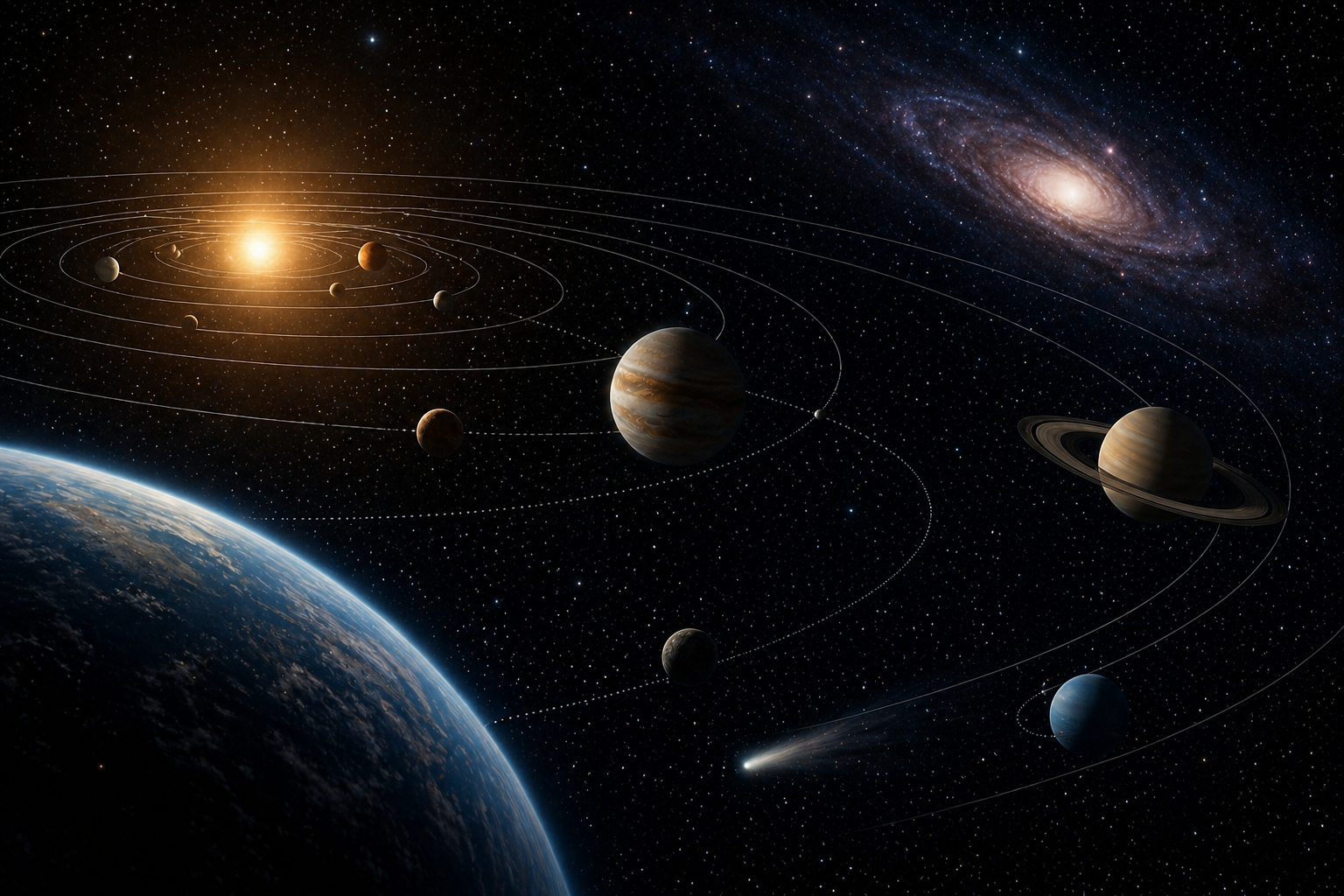
Why Celestial Mechanics Matters
Celestial mechanics matters because it demonstrates the explanatory reach of classical physics at astronomical scale. The motion of planets, moons, satellites, comets, asteroids, and spacecraft is not random wandering across the sky. It is governed by gravitational interaction, initial conditions, conservation laws, and the geometry of conic sections. A theory that begins with force, mass, acceleration, energy, and angular momentum becomes powerful enough to describe the architecture of the solar system.
This is one of the decisive achievements of the scientific revolution. Before modern celestial mechanics, the heavens and Earth were often treated as distinct domains. Terrestrial objects fell, rolled, and collided, while celestial bodies were assigned a different kind of motion. Newtonian gravitation dissolved that division. The fall of an apple and the orbit of the Moon became different expressions of the same gravitational law.
Celestial mechanics also matters because it links theory to prediction. Eclipses, planetary positions, comet returns, satellite trajectories, spacecraft transfers, tidal effects, orbital resonances, and long-term stability questions all require mathematical models of gravitational motion. The field therefore combines observation, theory, computation, and measurement in an especially clear form.
For modern science and engineering, celestial mechanics remains indispensable. It supports navigation, astronomy, planetary science, satellite communications, Earth observation, space exploration, geodesy, climate monitoring, asteroid defense, and the design of orbital infrastructure. It also prepares the conceptual bridge to general relativity, where gravitation is no longer treated as a force in flat space but as curvature in spacetime.
Kepler, Newton, and the Unification of Heaven and Earth
Any serious account of celestial mechanics should begin with Kepler and Newton. Johannes Kepler transformed planetary astronomy by showing that planets move in ellipses, sweep out equal areas in equal times, and obey a period–semimajor-axis relation. Kepler’s laws were empirical and mathematical, based on careful astronomical data, especially the observations associated with Tycho Brahe. They described the order of planetary motion with remarkable precision, but they did not yet provide the deeper dynamical reason for that order.
Newton supplied that dynamical foundation. In the Principia, he connected the laws of motion with universal gravitation, showing that an inverse-square gravitational attraction could account for Keplerian motion. The achievement was not merely a new formula. It was a unification of terrestrial and celestial mechanics. Bodies on Earth and bodies in the heavens became parts of one lawful physical order.
This unification remains one of the most important moments in the history of science because it showed that mathematical mechanics could move beyond local laboratory phenomena and explain cosmic structure. The orbit of a planet was not a special heavenly circle. It was a dynamical trajectory governed by force, inertia, geometry, energy, and angular momentum.
Later celestial mechanics, including the work of Laplace and others, extended Newtonian gravitation into perturbation theory, many-body dynamics, tidal theory, lunar theory, planetary stability, and increasingly sophisticated astronomical prediction. In that sense, celestial mechanics became one of the earliest large-scale mathematical sciences of complex systems.
Newtonian Gravitation
Newtonian gravitation states that two masses attract one another with a force proportional to the product of their masses and inversely proportional to the square of the distance between them:
F = G\frac{m_1m_2}{r^2}
\]
Interpretation: Newton’s law of gravitation says that gravitational force grows with mass and decreases with the square of separation distance.
In vector form, the force on a body can be written as:
\mathbf{F} = -G\frac{Mm}{r^2}\hat{\mathbf{r}}
\]
Interpretation: The negative sign indicates that gravitational force points inward toward the attracting mass.
where \(G\) is the Newtonian constant of gravitation, \(M\) and \(m\) are the interacting masses, \(r\) is the separation distance, and \(\hat{\mathbf{r}}\) is a radial unit vector. The negative sign indicates attraction toward the central mass.
Gravitation is a central force in the simplest two-body case because it acts along the line connecting the bodies. This matters profoundly. A central force produces no torque about the center of force, so angular momentum is conserved. It also means that motion lies in a plane for an ideal two-body orbit. Thus, the inverse-square law is not merely a formula for force magnitude. It imposes strong geometric structure on motion.
The gravitational potential energy for two masses separated by distance \(r\) is:
U(r) = -G\frac{Mm}{r}
\]
Interpretation: Gravitational potential energy is negative for bound systems when zero is defined at infinite separation.
The negative sign reflects the conventional choice that gravitational potential energy approaches zero as separation approaches infinity. Bound orbits have negative total mechanical energy, while unbound escape trajectories have zero or positive total energy.
Central Forces and the Two-Body Problem
The two-body problem asks how two masses move under their mutual gravitational attraction. Rather than solving two separate motions in full, classical mechanics transforms the problem using center-of-mass and relative coordinates. The center of mass moves uniformly if no external force acts, while the relative separation behaves like a single effective body with reduced mass:
\mu_{\mathrm{red}} = \frac{m_1m_2}{m_1+m_2}
\]
Interpretation: Reduced mass transforms the two-body problem into an equivalent one-body relative-motion problem.
This reduction is one of the great mathematical simplifications of mechanics. It shows that the ideal two-body gravitational problem is exactly solvable in terms of conic sections. The relative orbit can be an ellipse, parabola, or hyperbola depending on the system’s total energy.
In many planetary and satellite problems, one mass is much larger than the other. For example, a satellite orbiting Earth or a planet orbiting the Sun can often be approximated as a small body moving in the gravitational field of a much larger central body. In that case, the gravitational parameter is commonly used:
\mu = GM
\]
Interpretation: The standard gravitational parameter combines the gravitational constant and central mass.
Orbital formulas often depend on \(\mu\) rather than \(G\) and \(M\) separately.
The central-force structure also means angular momentum is conserved. Because the gravitational force is radial, it produces no torque about the central body:
\boldsymbol{\tau} = \mathbf{r}\times\mathbf{F} = 0
\]
Interpretation: A radial central force produces no torque about the center of force.
and therefore:
\frac{d\mathbf{L}}{dt} = 0
\]
Interpretation: Zero torque implies conservation of angular momentum.
This conservation principle underlies Kepler’s second law and much of orbital mechanics.
Kepler’s Laws
Kepler’s laws summarize the idealized motion of planets around the Sun and, more generally, the motion of bodies in inverse-square gravitational orbits under appropriate two-body assumptions.
Kepler’s first law states that planets move in ellipses with the Sun at one focus. In modern language, bound two-body gravitational orbits are elliptical, with the central mass at one focus of the ellipse.
Kepler’s second law states that a line joining the planet and the Sun sweeps out equal areas in equal times. This is the areal-velocity form of angular momentum conservation. When the planet is closer to the Sun, it moves faster; when farther away, it moves more slowly. The area swept per unit time remains constant.
Kepler’s third law states that the square of the orbital period is proportional to the cube of the semimajor axis:
T^2 \propto a^3
\]
Interpretation: Kepler’s third law relates orbital period to orbital size.
For a small body orbiting a much larger mass \(M\), the more precise Newtonian form is:
T^2 = \frac{4\pi^2}{GM}a^3
\]
Interpretation: Newtonian gravity explains the proportionality constant in Kepler’s third law.
These laws are historically important because they transformed astronomy from geometric description into mathematical regularity. They are physically important because Newtonian mechanics explains them from deeper dynamical principles. In a modern physics sequence, Kepler’s laws therefore act as a bridge between observed celestial order and gravitational dynamics.
Orbital Energy and Conic Sections
Orbital motion can be classified by total mechanical energy. For a small body of mass \(m\) moving under a central mass \(M\), the total mechanical energy is:
E = \frac{1}{2}mv^2 – G\frac{Mm}{r}
\]
Interpretation: Total orbital energy combines kinetic energy with gravitational potential energy.
Dividing by \(m\) gives the specific orbital energy:
\epsilon = \frac{v^2}{2} – \frac{\mu}{r}
\]
Interpretation: Specific orbital energy is energy per unit mass and is especially useful in orbital mechanics.
where \(\mu = GM\). The sign of \(\epsilon\) classifies the orbit:
- \(\epsilon < 0\): bound elliptical orbit
- \(\epsilon = 0\): parabolic escape trajectory
- \(\epsilon > 0\): hyperbolic unbound trajectory
For an elliptical orbit, the specific orbital energy is related to the semimajor axis \(a\):
\epsilon = -\frac{\mu}{2a}
\]
Interpretation: Bound orbit size is directly tied to specific orbital energy.
This equation is conceptually powerful because it shows that the size of a bound orbit is tied directly to energy. A more tightly bound orbit has a smaller semimajor axis and more negative specific energy. A larger bound orbit has energy closer to zero.
Orbital geometry is commonly described through conic sections. The eccentricity \(e\) distinguishes circular, elliptical, parabolic, and hyperbolic trajectories:
- \(e = 0\): circle
- \(0 < e < 1\): ellipse
- \(e = 1\): parabola
- \(e > 1\): hyperbola
Thus, celestial mechanics connects geometry and dynamics. Conic sections are not merely shapes drawn in a plane. They are the natural trajectories of inverse-square gravitational motion under different energy conditions.
Circular Orbits, Escape Speed, and the Vis-Viva Equation
Circular orbits provide the simplest entry point into orbital mechanics. For a circular orbit of radius \(r\), gravity supplies the centripetal acceleration:
\frac{v^2}{r} = \frac{GM}{r^2}
\]
Interpretation: In a circular orbit, gravitational acceleration supplies the required centripetal acceleration.
Solving for circular orbital speed gives:
v_{\mathrm{circ}} = \sqrt{\frac{GM}{r}} = \sqrt{\frac{\mu}{r}}
\]
Interpretation: Circular orbital speed decreases with orbital radius and increases with central gravitational parameter.
The orbital period for a circular orbit is:
T = 2\pi\sqrt{\frac{r^3}{\mu}}
\]
Interpretation: Circular orbital period increases with radius according to Kepler-style scaling.
Escape speed is found by setting total specific energy to zero:
\frac{v_{\mathrm{esc}}^2}{2} – \frac{\mu}{r} = 0
\]
Interpretation: Escape speed corresponds to zero total specific orbital energy.
which gives:
v_{\mathrm{esc}} = \sqrt{\frac{2\mu}{r}}
\]
Interpretation: Escape speed is the minimum speed needed to escape to infinity in the ideal two-body model.
Thus, escape speed is \(\sqrt{2}\) times circular orbital speed at the same radius:
v_{\mathrm{esc}} = \sqrt{2}\,v_{\mathrm{circ}}
\]
Interpretation: Escape speed is about 41 percent greater than circular orbital speed at the same radius.
The vis-viva equation generalizes orbital speed for an object in a Keplerian orbit:
v^2 = \mu\left(\frac{2}{r} – \frac{1}{a}\right)
\]
Interpretation: The vis-viva equation relates orbital speed to current radius and semimajor axis.
where \(r\) is current orbital radius and \(a\) is semimajor axis. This equation is central in astrodynamics because it connects local speed to position and orbital size. It is one of the key formulas for understanding elliptical orbits, transfer orbits, and spacecraft maneuvers.
Angular Momentum and Areal Velocity
Angular momentum is central to orbital motion. For a small body moving around a central mass, angular momentum is:
\mathbf{L} = \mathbf{r}\times m\mathbf{v}
\]
Interpretation: Orbital angular momentum depends on position relative to the central body and linear momentum.
The specific angular momentum is:
\mathbf{h} = \mathbf{r}\times \mathbf{v}
\]
Interpretation: Specific angular momentum is angular momentum per unit mass.
For a central gravitational force, torque about the central body is zero:
\boldsymbol{\tau} = \mathbf{r}\times\mathbf{F} = 0
\]
Interpretation: A central force produces no torque about the central body.
so angular momentum remains constant. This conservation law explains Kepler’s second law. The areal velocity is:
\frac{dA}{dt} = \frac{h}{2}
\]
Interpretation: Constant specific angular momentum implies constant areal velocity.
Because \(h\) is constant in the ideal two-body problem, equal areas are swept out in equal times.
This relation also explains why orbital speed varies along an ellipse. Near periapsis, where the body is closest to the central mass, it moves faster. Near apoapsis, where it is farthest away, it moves more slowly. The changing speed is not arbitrary; it is required by angular momentum conservation and the geometry of the orbit.
Angular momentum also connects celestial mechanics to rotational dynamics. Orbits are not rotations of rigid bodies, but they share deep angular structure. The conservation of angular momentum appears in spinning bodies, rolling objects, planetary motion, accretion disks, galaxies, and quantum systems. In this way, orbital mechanics extends a conservation principle already central to rotational dynamics into the architecture of astronomical motion.
Orbital Elements and Initial Conditions
An orbit is not specified merely by saying that gravity acts. Initial conditions matter. Position and velocity determine the size, shape, orientation, and timing of the orbit. Celestial mechanics therefore uses orbital elements to describe Keplerian orbits compactly.
Common orbital elements include:
- Semimajor axis \(a\): sets the size of the orbit.
- Eccentricity \(e\): sets the shape of the orbit.
- Inclination \(i\): sets the tilt of the orbital plane.
- Longitude of ascending node \(\Omega\): orients the orbital plane.
- Argument of periapsis \(\omega\): orients the ellipse within its plane.
- True anomaly \(\nu\): locates the body along the orbit at a given time.
These elements show why orbital mechanics is both geometric and dynamical. The orbit has a shape, a plane, an orientation, and a temporal phase. A satellite in low Earth orbit, a comet on an eccentric trajectory, a spacecraft transfer ellipse, and a planet’s path around the Sun can all be described through related orbital-element frameworks, though real systems often require corrections beyond the ideal Keplerian model.
This is also why computation is now essential. Translating position and velocity into orbital elements, propagating orbits over time, incorporating perturbations, and comparing predictions with observations often requires numerical methods and careful data handling.
Perturbations, Tides, Resonances, and the Many-Body Problem
The ideal two-body problem is exactly solvable, but the real solar system is not made of isolated two-body pairs. Planets pull on one another. Moons raise tides. Oblate planets produce non-spherical gravitational fields. Atmospheres drag low satellites. Solar radiation pressure affects small bodies. Relativistic corrections become measurable in some contexts. These effects are perturbations: deviations from ideal Keplerian motion caused by additional influences.
Perturbation theory is one of the major achievements of celestial mechanics. It allows an orbit to be treated as approximately Keplerian while tracking how its elements slowly change under additional forces. This is essential for lunar theory, planetary ephemerides, satellite orbit prediction, mission planning, and long-term stability analysis.
Tides are another important gravitational phenomenon. Because gravitational force varies with distance, an extended body experiences differential gravitational attraction across its diameter. This produces tidal deformation, tidal torques, orbital evolution, and in some cases tidal locking. The Earth–Moon system, ocean tides, planetary moons, and exoplanet systems all involve tidal physics.
Resonances occur when orbital periods or frequencies form simple ratios. Resonances can stabilize or destabilize systems, shape asteroid belts, organize moon systems, and produce complex long-term behavior. They show that celestial mechanics is not only about individual orbits but also about interactions among multiple cycles.
The many-body problem is therefore one of the great gateways from classical mechanics into complexity. The two-body problem is elegant and exactly solvable. The three-body and many-body problems are much richer, often requiring approximation, numerical integration, perturbation theory, and stability analysis. This makes celestial mechanics one of the earliest and most important domains of computational physics.
Spaceflight and Orbital Transfer
Celestial mechanics is not only descriptive astronomy. It is also the foundation of spaceflight. A spacecraft does not simply “go upward” into space. It must acquire appropriate horizontal velocity, orbital energy, and angular momentum. Reaching orbit requires entering a trajectory that continually falls around the central body rather than falling back to the surface.
One of the simplest transfer concepts is the Hohmann transfer between two circular coplanar orbits. It uses an elliptical transfer orbit tangent to the initial and final circular orbits. The semimajor axis of the transfer ellipse is:
a_t = \frac{r_1 + r_2}{2}
\]
Interpretation: A Hohmann transfer ellipse has a semimajor axis equal to the average of the initial and final orbital radii.
where \(r_1\) and \(r_2\) are the initial and final orbital radii. The vis-viva equation gives the speeds required at each point of the transfer, allowing the required velocity changes to be estimated.
The first burn places the spacecraft onto the transfer ellipse. The second burn circularizes the orbit at the destination radius. The total required velocity change, or delta-v, is a central quantity in mission design:
\Delta v_{\mathrm{total}} = |\Delta v_1| + |\Delta v_2|
\]
Interpretation: Total transfer delta-v is the sum of the velocity changes required for the maneuver.
Real mission design can be far more complex, involving inclination changes, launch windows, gravity assists, low-thrust propulsion, atmospheric drag, perturbations, and multi-body dynamics. But the basic idea remains rooted in Newtonian celestial mechanics: change the velocity vector, and the orbit changes.
Measurement, Units, and the Gravitational Constant
Gravitation depends on careful measurement. The Newtonian constant of gravitation \(G\) has SI units:
\mathrm{m^3\,kg^{-1}\,s^{-2}}
\]
Interpretation: The units of \(G\) make Newton’s gravitational force law dimensionally coherent.
NIST’s CODATA listing gives the Newtonian constant of gravitation as:
G = 6.67430 \times 10^{-11}\ \mathrm{m^3\,kg^{-1}\,s^{-2}}
\]
Interpretation: \(G\) sets the strength of gravitational attraction in Newtonian theory.
with a standard uncertainty:
0.00015 \times 10^{-11}\ \mathrm{m^3\,kg^{-1}\,s^{-2}}
\]
Interpretation: The uncertainty reflects the experimental difficulty of measuring gravitational attraction between laboratory-scale masses.
The gravitational constant is much less precisely known than many other fundamental constants. This is not because the law of gravitation is weakly important, but because measuring the extremely weak gravitational attraction between laboratory-scale masses is experimentally difficult.
In orbital mechanics, one often uses the standard gravitational parameter \(\mu = GM\), because \(\mu\) for astronomical bodies can often be determined more precisely from orbital motion than \(G\) and \(M\) separately. This is a useful reminder that measurement practice shapes the quantities used in applied physics.
Units also matter in orbital modeling. Distances may be expressed in meters, kilometers, astronomical units, or Earth radii; time in seconds, days, or years; mass in kilograms or solar masses. Computation requires consistent units, especially when combining observational data, physical constants, and numerical integrators. Many orbital mistakes are unit mistakes before they are physics mistakes.
Mathematical Lens
A mathematics-first treatment of gravitation begins with Newton’s second law and the inverse-square force law. For a small body moving around a central mass \(M\), the equation of motion is:
\frac{d^2\mathbf{r}}{dt^2} = -\mu\frac{\mathbf{r}}{r^3}
\]
Interpretation: The two-body acceleration vector points toward the central mass and decreases with the square of distance.
where \(\mu = GM\). This vector differential equation is the core of the two-body orbital problem. It states that acceleration always points toward the central mass and decreases with the square of distance.
The specific mechanical energy is:
\epsilon = \frac{v^2}{2} – \frac{\mu}{r}
\]
Interpretation: Specific orbital energy combines kinetic and gravitational potential terms per unit mass.
For an ellipse:
\epsilon = -\frac{\mu}{2a}
\]
Interpretation: Elliptical orbit energy is determined by the semimajor axis.
The specific angular momentum is:
\mathbf{h} = \mathbf{r}\times\mathbf{v}
\]
Interpretation: Specific angular momentum captures orbital geometry and is conserved in ideal central-force motion.
and the areal velocity is:
\frac{dA}{dt} = \frac{h}{2}
\]
Interpretation: Constant specific angular momentum gives Kepler’s equal-areas law.
The orbit equation for a conic section can be written as:
r(\nu) = \frac{p}{1 + e\cos\nu}
\]
Interpretation: The conic-section orbit equation gives orbital radius as a function of true anomaly.
where \(p\) is the semi-latus rectum, \(e\) is eccentricity, and \(\nu\) is true anomaly. For Keplerian motion:
p = \frac{h^2}{\mu}
\]
Interpretation: The semi-latus rectum is determined by specific angular momentum and gravitational parameter.
These equations reveal the deep structure of celestial mechanics. Position, velocity, energy, angular momentum, and geometry are not separate descriptions. They are interconnected ways of representing the same gravitational motion.
For numerical work, the differential equation is often rewritten as a first-order system:
\frac{d\mathbf{r}}{dt} = \mathbf{v}
\]
\[
\frac{d\mathbf{v}}{dt} = -\mu\frac{\mathbf{r}}{r^3}
\]
Interpretation: The first-order system form is directly suited to numerical integration.
This form is directly suited to computational integration. It makes celestial mechanics an ideal bridge between classical mechanics and scientific computing.
Variables, Units, and Physical Interpretation
Gravitation and orbital mechanics depend on variables that connect force, geometry, energy, angular momentum, and time. The table below summarizes several central quantities.
| Symbol or Term | Meaning | Typical Unit | Physical Interpretation |
|---|---|---|---|
| \(G\) | Newtonian constant of gravitation | m³ kg⁻¹ s⁻² | Sets the strength of gravitational attraction in Newtonian theory |
| \(\mu\) | Standard gravitational parameter | m³/s² | Product \(GM\), commonly used in orbital mechanics |
| \(M\) | Central mass | kg | Mass of the dominant gravitating body |
| \(r\) | Radial distance | m | Distance from central body or focus to orbiting body |
| \(v\) | Orbital speed | m/s | Magnitude of velocity along an orbit |
| \(a\) | Semimajor axis | m | Size parameter for an elliptical orbit |
| \(e\) | Eccentricity | dimensionless | Shape parameter distinguishing circular, elliptical, parabolic, and hyperbolic trajectories |
| \(\epsilon\) | Specific orbital energy | J/kg or m²/s² | Energy per unit mass, classifying bound and unbound orbits |
| \(\mathbf{h}\) | Specific angular momentum | m²/s | Angular momentum per unit mass, conserved in ideal central-force motion |
| \(T\) | Orbital period | s | Time required to complete one orbit |
The table shows why celestial mechanics is mathematically compact but physically rich. A small set of variables can describe orbital shape, size, timing, energy, and stability when the assumptions of the model are clear.
Worked Example: Circular Orbit and Escape Speed
Consider a satellite in a circular orbit around Earth. Let Earth’s standard gravitational parameter be \(\mu\), and let the orbital radius from Earth’s center be \(r\). For a circular orbit, gravitational acceleration supplies centripetal acceleration:
\frac{v^2}{r} = \frac{\mu}{r^2}
\]
Interpretation: Circular motion requires gravitational acceleration to equal centripetal acceleration.
Solving for orbital speed gives:
v_{\mathrm{circ}} = \sqrt{\frac{\mu}{r}}
\]
Interpretation: Circular orbital speed depends on gravitational parameter and orbital radius.
The orbital period is the circumference divided by speed:
T = \frac{2\pi r}{v_{\mathrm{circ}}}
\]
Interpretation: Orbital period is circumference divided by orbital speed for a circular orbit.
Substituting the circular-speed expression gives:
T = 2\pi\sqrt{\frac{r^3}{\mu}}
\]
Interpretation: Circular-orbit period follows Kepler-style radius scaling.
Escape speed follows from the condition that total specific energy is zero:
\frac{v_{\mathrm{esc}}^2}{2} – \frac{\mu}{r} = 0
\]
Interpretation: Escape speed corresponds to the threshold between bound and unbound motion.
so:
v_{\mathrm{esc}} = \sqrt{\frac{2\mu}{r}}
\]
Interpretation: Escape speed exceeds circular speed at the same radius by a factor of \(\sqrt{2}\).
The comparison is revealing:
v_{\mathrm{esc}} = \sqrt{2}\,v_{\mathrm{circ}}
\]
Interpretation: At a fixed radius, escape speed is approximately 41 percent greater than circular orbital speed.
This means that at a given orbital radius, escape speed is about 41 percent greater than circular orbital speed. The difference is not arbitrary. Circular orbit has negative total energy and remains bound. Escape trajectory has just enough kinetic energy to reach infinite separation with zero residual speed in the ideal model.
This worked example shows how force, acceleration, energy, and orbit geometry converge. A satellite is not held up by the absence of gravity. It remains in orbit because it is continually falling around the central body with sufficient tangential speed.
Computational Modeling
Computational modeling helps make celestial mechanics concrete. Circular orbit speeds can be calculated from gravitational parameters. Kepler’s third law can be checked across orbital radii. Two-body equations can be integrated numerically. Specific energy and angular momentum can be tracked to test numerical accuracy. Escape speed and transfer velocity can be computed from the same energy framework. Hohmann transfer estimates can be generated from the vis-viva equation. Repository metadata can preserve units, assumptions, central-body parameters, orbital regimes, source references, and model limitations.
The selected examples below focus on circular orbits and two-body integration because they are foundational and readable. The GitHub repository extends the same logic into richer computational workflows: R orbital scaling and period workflows, Python two-body integration, orbital energy diagnostics, Hohmann transfer estimates, Julia orbital parameter sweeps, C++ orbit tables, Fortran period calculations, SQL celestial-mechanics metadata, Rust command-line utilities, C examples, documentation, and reproducible sample data.
R Workflow: Circular Orbits, Escape Speed, and Period Scaling
R is especially useful for tabular orbital comparisons, scaling relations, residual summaries, and reproducible data outputs. The following workflow computes circular speed, escape speed, and orbital period for a set of orbital radii around Earth.
# Circular Orbits, Escape Speed, and Period Scaling
#
# This workflow computes:
#
#   v_circ = sqrt(mu / r)
#   v_esc  = sqrt(2 * mu / r)
#   T      = 2*pi*sqrt(r^3 / mu)
#
# where:
#   mu = standard gravitational parameter of Earth
#   r  = distance from Earth's center

library(tibble)
library(dplyr)

earth_mu_m3_per_s2 <- 3.986004418e14
earth_radius_m <- 6.371e6

orbit_table <- tibble(
  orbit_label = c(
    "low_earth_400_km",
    "medium_earth_20200_km",
    "geostationary",
    "high_earth_60000_km"
  ),
  altitude_m = c(
    400e3,
    20200e3,
    35786e3,
    60000e3
  )
) %>%
  mutate(
    orbital_radius_m = earth_radius_m + altitude_m,
    circular_speed_m_per_s =
      sqrt(earth_mu_m3_per_s2 / orbital_radius_m),
    escape_speed_m_per_s =
      sqrt(2 * earth_mu_m3_per_s2 / orbital_radius_m),
    orbital_period_s =
      2 * pi * sqrt(orbital_radius_m^3 / earth_mu_m3_per_s2),
    orbital_period_hours =
      orbital_period_s / 3600,
    escape_to_circular_speed_ratio =
      escape_speed_m_per_s / circular_speed_m_per_s
  )

print(orbit_table)
This workflow makes the scaling structure visible. As orbital radius increases, circular speed decreases while orbital period increases. Escape speed remains \(\sqrt{2}\) times circular speed at the same radius in the ideal two-body model.
Python Workflow: Two-Body Orbit Integration
Python is especially useful for integrating the differential equations of orbital motion and checking conservation of energy and angular momentum. The following workflow integrates a two-dimensional orbit around Earth using Newtonian gravity and reports diagnostic quantities.
"""
Two-Body Orbit Integration

This workflow integrates the Newtonian two-body equation for a small body
moving around a central mass:

    d r / dt = v
    d v / dt = -mu r / |r|^3

It tracks:
    - position
    - velocity
    - orbital radius
    - speed
    - specific orbital energy
    - specific angular momentum

The conservation diagnostics help test whether the numerical integration
is respecting the structure of ideal Keplerian motion.
"""

import numpy as np
import pandas as pd
from scipy.integrate import solve_ivp

EARTH_MU_M3_PER_S2 = 3.986_004_418e14
EARTH_RADIUS_M = 6.371e6
ALTITUDE_M = 700e3

ORBITAL_RADIUS_M = EARTH_RADIUS_M + ALTITUDE_M
CIRCULAR_SPEED_M_PER_S = np.sqrt(EARTH_MU_M3_PER_S2 / ORBITAL_RADIUS_M)

def two_body_equations(time_s: float, state: np.ndarray) -> list[float]:
    """
    Return derivatives for planar two-body motion.

    State vector:
        state[0] = x position in meters
        state[1] = y position in meters
        state[2] = x velocity in meters per second
        state[3] = y velocity in meters per second
    """
    x_m, y_m, vx_m_per_s, vy_m_per_s = state
    radius_m = np.sqrt(x_m**2 + y_m**2)

    ax_m_per_s2 = -EARTH_MU_M3_PER_S2 * x_m / radius_m**3
    ay_m_per_s2 = -EARTH_MU_M3_PER_S2 * y_m / radius_m**3

    return [
        vx_m_per_s,
        vy_m_per_s,
        ax_m_per_s2,
        ay_m_per_s2,
    ]

def compute_orbit_diagnostics(solution) -> pd.DataFrame:
    """
    Convert integration output into an orbital diagnostics table.
    """
    x_m = solution.y[0]
    y_m = solution.y[1]
    vx_m_per_s = solution.y[2]
    vy_m_per_s = solution.y[3]

    radius_m = np.sqrt(x_m**2 + y_m**2)
    speed_m_per_s = np.sqrt(vx_m_per_s**2 + vy_m_per_s**2)

    specific_energy_j_per_kg = (
        0.5 * speed_m_per_s**2 - EARTH_MU_M3_PER_S2 / radius_m
    )

    specific_angular_momentum_m2_per_s = (
        x_m * vy_m_per_s - y_m * vx_m_per_s
    )

    return pd.DataFrame(
        {
            "time_s": solution.t,
            "x_m": x_m,
            "y_m": y_m,
            "vx_m_per_s": vx_m_per_s,
            "vy_m_per_s": vy_m_per_s,
            "radius_m": radius_m,
            "speed_m_per_s": speed_m_per_s,
            "specific_energy_j_per_kg": specific_energy_j_per_kg,
            "specific_angular_momentum_m2_per_s":
                specific_angular_momentum_m2_per_s,
        }
    )

def main() -> None:
    """
    Integrate a near-circular low Earth orbit and summarize conservation.
    """
    orbital_period_s = (
        2.0 * np.pi * np.sqrt(ORBITAL_RADIUS_M**3 / EARTH_MU_M3_PER_S2)
    )

    initial_state = [
        ORBITAL_RADIUS_M,
        0.0,
        0.0,
        CIRCULAR_SPEED_M_PER_S,
    ]

    solution = solve_ivp(
        two_body_equations,
        (0.0, orbital_period_s),
        initial_state,
        t_eval=np.linspace(0.0, orbital_period_s, 1000),
        rtol=1e-10,
        atol=1e-3,
    )

    orbit_table = compute_orbit_diagnostics(solution)

    summary = pd.DataFrame(
        [
            {
                "orbital_radius_m": ORBITAL_RADIUS_M,
                "circular_speed_m_per_s": CIRCULAR_SPEED_M_PER_S,
                "orbital_period_s": orbital_period_s,
                "min_radius_m": orbit_table["radius_m"].min(),
                "max_radius_m": orbit_table["radius_m"].max(),
                "energy_relative_range": (
                    orbit_table["specific_energy_j_per_kg"].max()
                    - orbit_table["specific_energy_j_per_kg"].min()
                ) / abs(orbit_table["specific_energy_j_per_kg"].mean()),
                "angular_momentum_relative_range": (
                    orbit_table[
                        "specific_angular_momentum_m2_per_s"
                    ].max()
                    - orbit_table[
                        "specific_angular_momentum_m2_per_s"
                    ].min()
                ) / abs(
                    orbit_table[
                        "specific_angular_momentum_m2_per_s"
                    ].mean()
                ),
            }
        ]
    )

    print("Orbit diagnostics sample:")
    print(orbit_table.head(12).round(6).to_string(index=False))

    print("\nConservation summary:")
    print(summary.round(10).to_string(index=False))

if __name__ == "__main__":
    main()
This workflow shows the computational heart of celestial mechanics. A compact gravitational acceleration law becomes a trajectory through numerical integration. Energy and angular momentum diagnostics then help evaluate whether the integration preserves the structure expected from the ideal two-body problem.
GitHub Repository
The article body includes only selected computational examples so the conceptual and mathematical argument remains readable. The full repository contains the expanded computational infrastructure: R orbital scaling workflows, Python two-body orbit integration, orbital-energy diagnostics, Hohmann transfer examples, Julia orbit parameter sweeps, C++ circular orbit tables, Fortran Kepler-period calculations, SQL celestial-mechanics metadata, Rust command-line utilities, C examples, documentation, and reproducible sample data.
Complete Code Repository
The full code distribution for this article, including selected article examples and advanced research-style computational workflows for Newtonian gravitation, Keplerian orbits, circular orbit speed, escape velocity, orbital period scaling, two-body integration, Hohmann transfers, conservation diagnostics, celestial-mechanics metadata, reproducibility documentation, and performance-oriented scientific computing, is available on GitHub.
From Newtonian Gravitation to Relativity and Cosmology
Newtonian celestial mechanics remains extraordinarily powerful, but it is not the final theory of gravitation. General relativity replaces gravitational force in flat space with the curvature of spacetime. This becomes essential for strong gravitational fields, precision tests, black holes, gravitational waves, and cosmology. The perihelion precession of Mercury, gravitational time dilation, and light bending cannot be fully explained within Newtonian gravity alone.
Even so, Newtonian gravitation remains indispensable. It is the first major theory through which celestial motion becomes mathematically intelligible, and it remains accurate enough for many practical orbital calculations when relativistic and perturbative corrections are small. It also supplies the conceptual foundation for understanding what relativity modifies.
Within the Physics knowledge series, this article belongs after Rotational Dynamics, Torque, and Angular Momentum and before deeper treatments of relativity, spacetime curvature, cosmology, and black holes. It shows how classical mechanics becomes cosmic: force becomes orbit, angular momentum becomes areal velocity, energy becomes orbital classification, and initial conditions become celestial architecture.
Related Articles
- Physics
- What Is Physics?
- Measurement, Mathematics, and the Structure of Physical Inquiry
- Motion, Force, and the Foundations of Classical Mechanics
- Energy, Work, and Conservation in Physical Systems
- Rotational Dynamics, Torque, and Angular Momentum
- Relativity and the Reconstruction of Space and Time
- Gravity, Curvature, and the Structure of Spacetime
- Cosmology and the History of the Universe
- Galaxies, Black Holes, and the Large-Scale Universe
- Systems Modeling
- Calculus for Systems Modeling
Further Reading
- Bureau International des Poids et Mesures (2025) The International System of Units: SI Brochure, 9th edition, version 3.02. Available at: https://www.bipm.org/en/si-brochure-9 (Accessed: 25 April 2026).
- Kepler, J. (1609) Astronomia Nova. Available at: https://archive.org/details/Astronomianovaa00Kepl (Accessed: 25 April 2026).
- Kepler, J. (1621–1622) Epitome Astronomiae Copernicanae. Available at: https://archive.org/details/epitomeastronomi02kepl (Accessed: 25 April 2026).
- Laplace, P.S. (1829–1839) Mécanique Céleste. English translation by Nathaniel Bowditch. Available at: https://archive.org/details/mecaniqueceleste11829lapl (Accessed: 25 April 2026).
- MIT OpenCourseWare (2016) Classical Mechanics. Available at: https://ocw.mit.edu/courses/8-01sc-classical-mechanics-fall-2016/ (Accessed: 25 April 2026).
- MIT OpenCourseWare (2022) Chapter 25: Celestial Mechanics. Available at: https://ocw.mit.edu/courses/8-01sc-classical-mechanics-fall-2016/mit8_01scs22_chapter25new.pdf (Accessed: 25 April 2026).
- MIT OpenCourseWare (2008) Central Force Motion: Kepler’s Laws. Available at: https://ocw.mit.edu/courses/16-07-dynamics-fall-2009/d931dd84ca3025a3676ed2244f48ab85_MIT16_07F09_Lec15.pdf (Accessed: 25 April 2026).
- MIT OpenCourseWare (2017) Lecture 8: Kepler’s Laws. Available at: https://ocw.mit.edu/courses/8-223-classical-mechanics-ii-january-iap-2017/9875b46d4a49c3e6bd50f00aac768fef_MIT8_223IAP17_Lec8.pdf (Accessed: 25 April 2026).
- NASA Goddard Space Flight Center (n.d.) From Stargazers to Starships. Available at: https://pwg.gsfc.nasa.gov/stargaze/Smap.htm (Accessed: 25 April 2026).
- National Institute of Standards and Technology (n.d.) CODATA Value: Newtonian Constant of Gravitation. Available at: https://physics.nist.gov/cgi-bin/cuu/Value?bg= (Accessed: 25 April 2026).
- Newton, I. (1687/1729) The Mathematical Principles of Natural Philosophy. English translation by Andrew Motte. Available at: https://archive.org/download/NewtonPrincipia_201701/The%20Principia%20Mathematical%20Principles%20of%20Natural%20Philosophy%20Isaac%20Newton.pdf (Accessed: 25 April 2026).
References
- Bureau International des Poids et Mesures (2025) The International System of Units: SI Brochure, 9th edition, version 3.02. Available at: https://www.bipm.org/en/si-brochure-9 (Accessed: 25 April 2026).
- Kepler, J. (1609) Astronomia Nova. Available at: https://archive.org/details/Astronomianovaa00Kepl (Accessed: 25 April 2026).
- Kepler, J. (1621–1622) Epitome Astronomiae Copernicanae. Available at: https://archive.org/details/epitomeastronomi02kepl (Accessed: 25 April 2026).
- Laplace, P.S. (1829–1839) Mécanique Céleste. English translation by Nathaniel Bowditch. Available at: https://archive.org/details/mecaniqueceleste11829lapl (Accessed: 25 April 2026).
- MIT OpenCourseWare (2022) Chapter 25: Celestial Mechanics. Available at: https://ocw.mit.edu/courses/8-01sc-classical-mechanics-fall-2016/mit8_01scs22_chapter25new.pdf (Accessed: 25 April 2026).
- MIT OpenCourseWare (2008) Central Force Motion: Kepler’s Laws. Available at: https://ocw.mit.edu/courses/16-07-dynamics-fall-2009/d931dd84ca3025a3676ed2244f48ab85_MIT16_07F09_Lec15.pdf (Accessed: 25 April 2026).
- NASA Goddard Space Flight Center (n.d.) From Stargazers to Starships. Available at: https://pwg.gsfc.nasa.gov/stargaze/Smap.htm (Accessed: 25 April 2026).
- National Institute of Standards and Technology (n.d.) CODATA Value: Newtonian Constant of Gravitation. Available at: https://physics.nist.gov/cgi-bin/cuu/Value?bg= (Accessed: 25 April 2026).
- Newton, I. (1687/1729) The Mathematical Principles of Natural Philosophy. English translation by Andrew Motte. Available at: https://archive.org/download/NewtonPrincipia_201701/The%20Principia%20Mathematical%20Principles%20of%20Natural%20Philosophy%20Isaac%20Newton.pdf (Accessed: 25 April 2026).