
Last Updated May 29, 2026
Archetypal psychology after Jung represents one of the most radical and influential revisions of analytical psychology because it shifts the center of gravity from ego development, clinical integration, and symbolic interpretation toward image, plurality, imagination, soul-making, and the irreducible autonomy of psychic life. Although it emerges directly from Jungian thought—especially Jung’s understanding of archetypes, myth, fantasy, dream, symbolic depth, and the collective life of the psyche—it does not merely continue classical analytical psychology in a slightly altered form. It reorients the whole project. Where much Jungian psychology asks how the ego comes into relation with the Self, how unconscious contents may be integrated, and how psychic life may move toward wholeness, archetypal psychology asks what happens if psyche is approached first as image, style, mood, metaphor, fantasy, personification, and imaginal multiplicity rather than as a system seeking ordered completion.
This turn is associated most strongly with James Hillman, whose work reshaped the post-Jungian field by arguing that depth psychology had become too developmental, too moralized, too medicalized, too literal, and too focused on adaptation, cure, ego strength, or final integration. Hillman wanted to return psychology to imagination. He treated psyche not as an object to be corrected into health, nor merely as a developmental structure to be interpreted into coherence, but as a living field of images that speak through metaphor, symptom, fantasy, reverie, dream, aesthetic form, mythic personification, and psychic style. In this framework, the task of psychology is less to dominate psyche, synthesize it, or move it toward one governing ideal than to stay with its images, deepen into them, and learn the modes of perception they make possible.
Archetypal psychology is therefore both continuous with Jung and sharply revisionary. It keeps Jung’s sense that psyche is symbolic, mythic, and more than conscious reason. It keeps his fascination with gods, dreams, complexes, fantasy, ritual, art, religion, and cultural imagination. It preserves his refusal to reduce psychic life to surface rationality or behavioral adaptation. But it resists the tendency in classical, developmental, and clinical Jungian traditions to treat symbolic forms as steps in a larger process of integration, individuation, or ego-Self relation. Archetypal psychology is suspicious of unity when unity becomes a psychological ideal imposed upon the soul’s plurality. It prefers multiplicity to system, style to diagnosis, imagination to reduction, and depth of seeing to moral pressure toward wholeness.
Main Library
Publications
Article Map
Analytical Psychology
Related Topic
Personality Psychology
Related Topic
Foundations of Religion
Related Topic
Comparative Sacred Themes
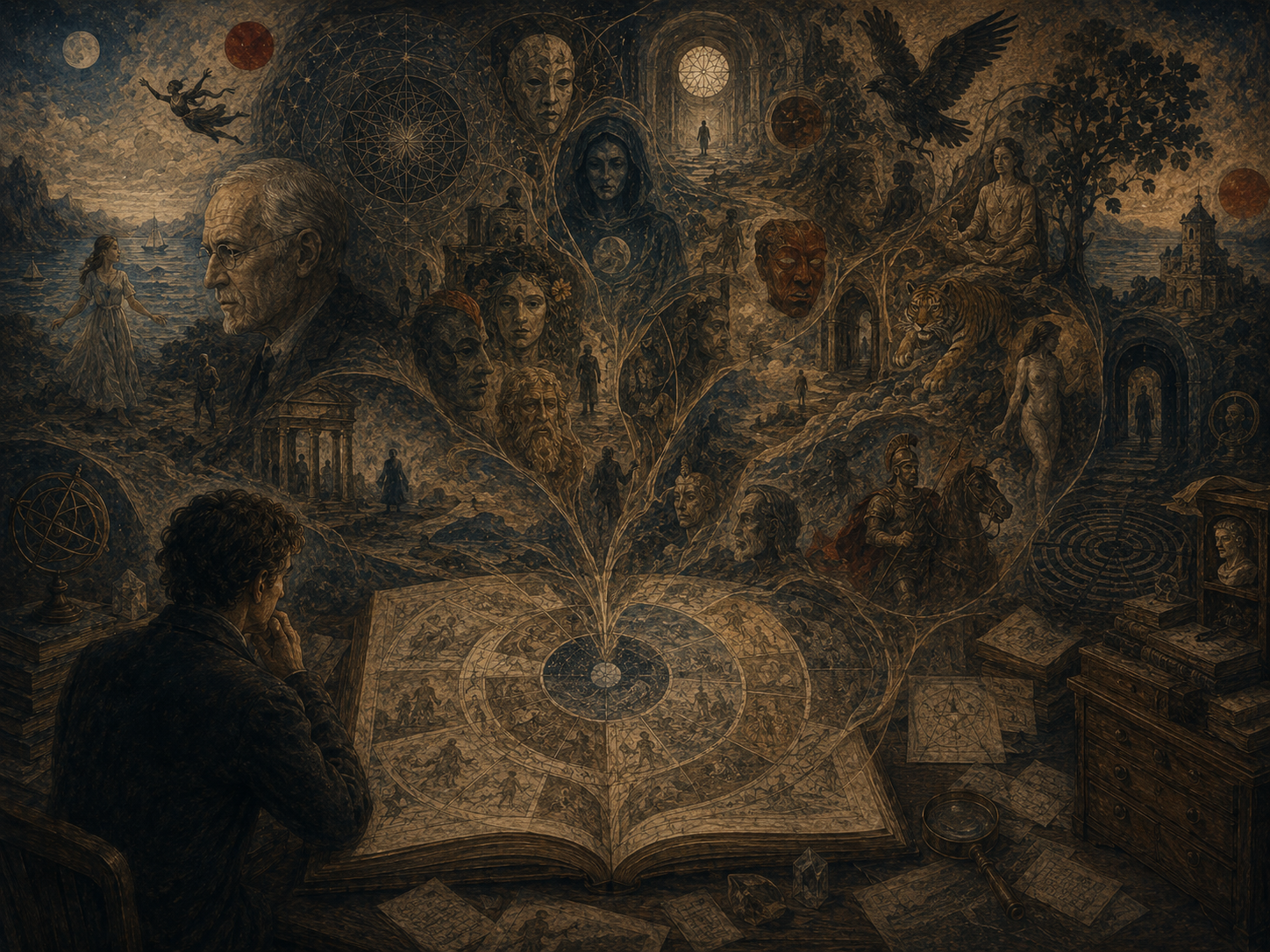
This preference has major consequences for method. Archetypal psychology reads symptoms aesthetically as well as clinically. It sees fantasy as psychologically real without rushing to decode it into a more literal explanation. It treats gods and goddesses, mythic figures, moods, dream images, and psychic styles as distinct modes of being rather than simply symbolic masks for one underlying process. Psyche, in this vision, is inherently polytheistic. It is not one voice speaking through many disguises. It is many voices, many powers, many imaginal presences that constitute the soul’s life.
This does not mean archetypal psychology rejects all clinical responsibility, all development, or all suffering as mere poetry. Its most serious versions do not deny pain, trauma, depression, compulsion, despair, or psychic danger. Rather, it asks whether modern psychology has too often impoverished suffering by naming it only as disorder, adjustment failure, maladaptation, cognitive distortion, or developmental deficit. Archetypal psychology insists that suffering also has image, atmosphere, style, metaphor, and soul. It asks what the symptom imagines, what world it opens, what god it serves, what mood it inhabits, what language it requires, and what form of seeing it demands before psychology tries to remove it.
This article examines archetypal psychology after Jung as a distinct post-Jungian movement. It explores its relation to Jung, its critique of development and integration, its emphasis on image and imagination, its revaluation of myth and polytheism, its style of literary and cultural interpretation, its clinical and philosophical consequences, and the debates surrounding its limits. It treats archetypal psychology not as a secondary footnote to Jungian thought, but as one of the most ambitious attempts to remake psychology as a poetics of the soul.
Why Archetypal Psychology Matters After Jung
Archetypal psychology matters after Jung because it asks whether depth psychology loses something essential when it becomes too focused on cure, maturity, adjustment, integration, or unity. Much post-Freudian and post-Jungian thought, despite deep differences between those traditions, still tends to imagine psychological growth as a movement toward greater coherence: stronger ego function, integration of opposites, clearer identity, stable relational capacity, stronger adaptation, or a more ordered self. Archetypal psychology interrupts that aspiration. It argues that psyche may be inherently multiple, imaginal, unruly, stylistically diverse, and symbolically excessive in ways that should not always be domesticated into wholeness.
This challenge is significant because many psychic realities do not present themselves first as developmental tasks. They appear as moods, images, obsessions, gods, nightmares, aesthetic fascinations, wounds, fantasies, repetitions, bodily atmospheres, styles of seeing, and irreducible psychic characters. A person may not experience depression first as a treatable disorder or a developmental blockage, but as a gray world, a descent, a slowing, a Saturnine heaviness, a deadened landscape, or an underworld atmosphere. A person may not experience jealousy merely as insecurity, but as a mythic possession by rivalry, envy, erotic threat, humiliation, and wounded imagination. A person may not experience a recurring dream figure as a symbol to be integrated, but as a presence with its own face, voice, demand, and mood.
Archetypal psychology remains important because it insists that psychology should learn to behold these forms before explaining them away. It does not reject explanation entirely, but it questions the speed with which modern psychology often moves from image to category, from suffering to diagnosis, from metaphor to mechanism, from dream to interpretation, and from psychic multiplicity to developmental agenda. Hillman’s central provocation is that psychology may have become too literal in its search for health. It may have forgotten that the soul speaks indirectly, aesthetically, metaphorically, and polyphonically.
This matters for Jungian thought specifically because Jung opened the door to myth, archetype, image, symbol, dream, alchemy, religion, and psychic multiplicity, yet much Jungian practice still retained an organizing teleology of individuation. Archetypal psychology asks whether even that teleology may become too unified. Does every image need to be interpreted in relation to the Self? Does every psychic conflict need integration? Does every dream sequence need to be read as movement toward wholeness? Does every plurality secretly seek one center? Hillman’s answer is often no. Psyche may deepen by differentiating images rather than integrating them.
The movement also matters because it changes the ethics of interpretation. If the psyche is polycentric, then the analyst, critic, or reader should not rush to adjudicate which image is the “true” one or which psychic voice should govern the rest. Instead, interpretation becomes a practice of hospitality toward images. It asks what each figure sees, what each mood wants, what each fantasy reveals, what each symptom imagines, and how the soul is complicated by the presence of many interior powers. This is an ethics of attention before management.
Archetypal psychology therefore matters because it preserves a radical question inside depth psychology: what if the psyche is not primarily a problem to be solved, a structure to be integrated, or a patient to be cured, but a field of images asking to be seen more deeply? That question does not answer every clinical need. But it prevents psychology from becoming too thin, too literal, too managerial, and too certain that health means order.
From Jungian Analysis to Archetypal Revision
Archetypal psychology grows out of Jungian analysis but takes a decisive turn away from some of its dominant assumptions. Jung had already opened psychology to myth, religion, dream, symbolic life, and archetypal imagination. He had challenged reductive rationalism and insisted that the psyche thinks in images. He had argued that the unconscious was not merely a repository of repressed material, but a symbolic and creative dimension of psychic life. Yet classical and developmental Jungian traditions still often organized these insights around individuation, integration, ego-Self relation, and the search for psychic wholeness. Archetypal psychology asks what happens if that teleology is suspended.
What emerges is a psychology less interested in final organization and more interested in psychic style. The question is no longer primarily how the person becomes whole, but how images speak, how moods reveal worlds, how symptoms imagine, and how soul becomes visible in its multiplicity. This shift is subtle in origin but radical in consequence. It does not simply add another technique to Jungian analysis. It changes the basic orientation of psychological attention.
Classical Jungian psychology often interprets psychic material within a developmental arc. The ego becomes differentiated, encounters shadow, engages anima or animus, enters relation to the Self, and participates in the individuation process. This model has great explanatory power. It offers a way of thinking about inner conflict, symbolic development, dream sequences, midlife crisis, spiritual transformation, and the gradual formation of a more capacious personality. Yet Hillman worries that this developmental arc can become too orderly. It can turn psyche into a system with a preferred end-state.
Archetypal psychology does not deny that people change over time. It does not deny that growth, differentiation, or integration can occur. Its concern is that developmental language can subtly moralize psychic life. Some images are treated as immature, regressive, fragmented, unintegrated, or pathological because they do not serve a preferred model of wholeness. Hillman reverses the priority: rather than asking how the image contributes to the person’s development, he asks how the person might serve the image, understand its style, and enter more deeply into its imaginal world.
This revision also alters the status of archetypes. In some Jungian formulations, archetypes are understood as deep structural patterns that shape symbolic experience. Archetypal psychology tends to move away from structural definition toward imaginal manifestation. The archetype is not mainly an invisible form behind the image; it is encountered through the image’s specific presentation. The point is not to classify the image under an archetypal name, but to deepen perception of the image itself. A dream serpent should not be rushed into “the serpent archetype.” Its color, movement, danger, texture, setting, and mood matter. The image must be allowed its own specificity.
The revision is therefore methodological and philosophical. Jungian analysis often seeks meaning behind or through the image. Archetypal psychology seeks meaning within the image’s own mode of appearing. Jungian analysis may ask where an image belongs in the individuation process. Archetypal psychology may ask how the image sees, what rhetoric it uses, what god or mood it carries, and what kind of world it opens. The psyche is not first a developmental sequence. It is an imaginal ecology.
| Dimension | Classical / developmental Jungian emphasis | Archetypal psychology emphasis |
|---|---|---|
| Primary aim | Individuation, integration, relation to the Self | Soul-making, image-depth, imaginal plurality |
| Method | Interpretation, amplification, symbolic development | Sticking with the image, poetic elaboration, imaginal attention |
| View of psyche | Structured, developmental, oriented toward wholeness | Polycentric, metaphorical, aesthetic, plural |
| View of symptom | Expression of complex, conflict, imbalance, or developmental need | Image-bearing event, fantasy form, psychic style, soul statement |
| Risk | Teleology may become moralized or overly unified | Plurality may become diffuse or clinically underbounded |
Archetypal psychology is therefore not anti-Jungian in any simple sense. It is a radicalization of one side of Jung: the side that insists on image, myth, fantasy, gods, and the autonomy of the psyche. But it radicalizes this side against Jung’s own integrative tendencies. It remains within Jung’s symbolic universe while questioning whether Jungian psychology has too often made the soul serve the Self.
James Hillman and the Reimagining of Psychology
James Hillman is the central figure in archetypal psychology after Jung. His project was not simply to create another school of psychotherapy, but to reimagine what psychology itself could be. Hillman argued that modern psychology had become trapped in literalism, medicalism, moralism, developmental teleology, and a narrow obsession with adjustment. He wanted to return psychology to soul, metaphor, polytheism, rhetoric, image, and imagination. The ambition was not technical but civilizational: psychology had to recover its poetic and imaginal vocation.
Hillman’s style itself reflects this shift. He wrote associatively, allusively, mythically, aesthetically, and often polemically, resisting the dry procedural language of clinical technique. For him, psychology should not only theorize imagination; it should itself be imaginal in method. This is why archetypal psychology often feels more like a reorientation of sensibility than a codified doctrine. It is less a manual than a way of seeing.
In Re-Visioning Psychology, Hillman frames psychology as a return to soul rather than a science of behavior or adaptation. The word soul does not mean a theological substance in a narrow doctrinal sense. It names the depth, inwardness, pathos, imagination, and metaphorical richness through which life becomes psychologically meaningful. Soul is not a thing one possesses. It is a way experience deepens. It appears in image, suffering, memory, mood, fantasy, beauty, anxiety, grief, eroticism, and the strange personified life of dreams.
Hillman’s critique of literalism is central. Literalism occurs when an image is reduced to a concept, a symptom to a diagnosis, a fantasy to a cause, a god to an abstract principle, or a dream to a message. Literalism kills the image by making it mean something else too quickly. Archetypal psychology therefore asks interpretation to slow down. It does not ask, “What does this really mean?” as though the image were only a disguise. It asks, “What is this image doing? What world does it create? What language does it speak? What mode of seeing does it demand?”
Hillman’s revision also draws on ancient polytheism, Renaissance imagination, Neoplatonic and hermeneutic traditions, literary criticism, phenomenology, and the history of myth. He was not trying to restore Greek religion in any simple literal sense. The gods function as imaginal names for distinct psychic styles. Aphrodite, Ares, Hermes, Hades, Apollo, Dionysus, Artemis, Athena, and Saturn are not treated merely as symbolic contents to be integrated into one personality. They are different ways psyche perceives, desires, suffers, judges, seduces, wounds, conceals, descends, and transforms.
This makes Hillman difficult to classify. He is Jungian, but not classical. Clinical, but often anti-clinical in style. Psychological, but deeply literary. Philosophical, but suspicious of abstraction. Religious in sensibility, but not doctrinal. Post-Jungian, but also critical of Jungian orthodoxy. His importance lies precisely in this refusal of stable category. He forced depth psychology to ask whether its own concepts had become too literal to hear the soul they claimed to study.
Hillman’s contribution can be summarized as a change in psychological posture. Instead of interpreting images into concepts, he teaches psychology to remain answerable to images. Instead of organizing psyche around one center, he teaches psychology to notice many centers. Instead of treating pathology only as breakdown, he asks what soul is saying through pathologizing. Instead of seeking cure too quickly, he asks how experience might be deepened, complicated, and imagined. This is the reimagining of psychology at the heart of archetypal thought.
Psyche as Image
One of the defining claims of archetypal psychology is that psyche is imaginal through and through. This does not mean the psyche merely has images, as though images were optional decorations placed on top of a more fundamental mechanism. It means that psychic reality presents itself in image: dream figures, metaphors, fantasies, personifications, moods, scenes, voices, visual forms, bodily atmospheres, symbolic landscapes, and aesthetic styles. To understand psyche, one must therefore attend to image in its own terms.
This is the basis of Hillman’s resistance to reductive interpretation. An image should not be rushed past to a supposedly more real explanation behind it. The image is already a mode of psychic truth. Archetypal psychology therefore encourages a style of attention that lingers with image, elaborates it, compares it, enters its texture, and allows it to disclose its own world. The question is not simply what the image means, but how it means.
This claim marks an important shift from symbol to image. In many forms of depth psychology, a symbol is something that points beyond itself. It mediates an unknown content, a deeper psychic structure, or a larger process. Archetypal psychology does not reject symbolism, but it worries that symbolic interpretation may still move too quickly beyond the image. The image becomes a signpost toward something else: the Self, the mother complex, the shadow, the developmental task, the trauma, the archetype. Hillman wants to recover the image’s own autonomy before it is translated.
To say psyche is image is also to say that psychic life is inherently aesthetic. This does not mean beautiful. It means that psyche appears with form, tone, style, rhythm, intensity, color, texture, and atmosphere. A depression may have a gray palette, a slow tempo, a downward direction, a heavy spatiality, a Saturnine mood. Rage may have heat, sharpness, velocity, fire, metal, storm, or animal form. Desire may appear as shimmer, hunger, pursuit, fragrance, danger, garden, water, or wound. Fear may organize a world of thresholds, pursuers, darkness, locked rooms, exposed spaces, and watching eyes. These are not decorative details. They are the psyche’s way of appearing.
Image also resists abstraction because every image is particular. “The mother archetype” is abstract. A dream of a silent woman in a blue coat standing beside a flooded staircase is not abstract. It has place, mood, color, posture, relation, and mystery. Archetypal psychology asks the interpreter not to erase this specificity by moving too quickly to a category. The image’s details are not accidental. They are its psychology.
This does not mean interpretation stops. It means interpretation becomes more imaginal. Instead of explaining the image away, interpretation elaborates the image’s world. What kind of staircase is flooded? What does blue do? What is the silence like? What is the woman’s relation to the dreamer? Does the water threaten, cleanse, conceal, remember, or invite? What myths, poems, paintings, moods, or symptoms echo the image without replacing it? Such questions are not evasions of meaning. They are a more faithful path into meaning.
The doctrine of psyche as image is therefore not a decorative thesis. It is a discipline. It asks psychology to become more precise in its attention to the forms through which psychic reality appears. It resists the violence of premature explanation. It allows the soul to speak in its own language before theory claims ownership.
Soul-Making Rather Than Adaptation
Hillman often preferred the language of soul-making to the more clinical language of adaptation, cure, adjustment, or maturity. Soul-making names a deepening of experience through imagination, reflection, suffering, style, memory, metaphor, and symbolic attention. It does not necessarily look like efficient functioning. Indeed, archetypal psychology is wary of identifying mental health too quickly with normativity, productivity, relational smoothness, positive emotion, or socially recognizable adjustment.
This does not mean archetypal psychology glamorizes pathology or dismisses practical suffering. Rather, it questions the assumption that the purpose of psychology is to normalize the person. Soul may deepen precisely where life becomes more complex, more wounded, more aesthetically alive, more aware of contradiction, more capable of inhabiting grief, or more receptive to images that do not fit a conventional picture of success. Archetypal psychology therefore measures value differently than many therapeutic traditions do.
Adaptation has its place. People need work, shelter, relationships, safety, regulation, and functioning. A psychology that ignores these needs can become irresponsible. Yet adaptation can also become a tyranny when it is treated as the highest psychological good. A person may be adapted to a deadening institution, an unjust society, a false persona, a compulsive productivity culture, or a life emptied of imagination. Archetypal psychology asks whether adjustment to such conditions should be called health.
Soul-making shifts the question from “How can this person function better?” to “How can this experience deepen?” That shift is not always appropriate in acute crisis, but it is profoundly important where life has become flattened by literal categories. A grief may need to be mourned, not optimized. A fantasy may need to be imagined, not corrected. A symptom may need to be heard, not immediately eliminated. A mood may need language, not only treatment. A repeated failure may need mythic context before it can become intelligible.
Hillman’s soul-making also challenges moralized psychology. Psychological discourse often smuggles moral ideals into clinical language: mature, integrated, healthy, adaptive, functional, resilient, regulated. These terms can be useful, but they can also narrow psychic life. Archetypal psychology asks whether the soul’s value may appear in ambivalence, descent, melancholy, erotic confusion, slowness, contradiction, and imaginal excess. It invites psychology to become less moralistic and more hospitable to the full range of psychic atmospheres.
The term soul-making therefore names a different psychological economy. Value is not located only in symptom reduction or developmental progress. It may also be found in the ability to see more deeply, imagine more richly, suffer with more form, speak with more metaphor, and recognize the gods or archetypal styles moving through ordinary life. Psychology becomes less a technology of correction and more a craft of deepening.
The risk, of course, is that soul-making can become too vague or too aesthetically detached from real suffering. This is why archetypal psychology needs clinical and ethical limits. But its corrective remains essential. A society that values efficiency, productivity, diagnosis, and measurable outcomes needs a psychology capable of defending the soul’s slower, darker, more imaginal forms of meaning.
Polytheistic Psychology and the Many Gods of the Soul
One of the boldest features of archetypal psychology is its polytheistic model of psyche. Hillman argued that soul is better imagined through many gods than through one sovereign principle. Different gods symbolize different styles of consciousness, desire, conflict, beauty, aggression, wisdom, eros, fate, and perception. Psyche is therefore inherently plural. It contains competing claims, differing values, irreducible moods, and distinct imaginal presences.
This polytheistic vision is both metaphorical and methodological. It resists what Hillman regarded as monotheistic psychology: any psychology in which all psychic life is subordinated to one highest principle, one developmental norm, one central Self, one ego ideal, one model of health, or one final integration. In archetypal psychology, psyche becomes a parliament of images. The task is not always to synthesize them, but to recognize their differences and the worlds they open.
Polytheism here does not require literal belief in ancient gods. It names a way of honoring psychic multiplicity. Aphrodite, Ares, Hermes, Apollo, Dionysus, Hades, Artemis, Athena, Hera, Demeter, Persephone, Saturn, and other figures become names for psychic styles. Aphrodite may name eros, beauty, attraction, pleasure, seduction, and relational magnetism. Ares may name conflict, heat, aggression, battle, and blood. Hermes may name trickery, mediation, communication, crossing, ambiguity, and theft. Hades may name depth, invisibility, death, underworld, memory, and hidden wealth. These figures do not collapse into one message. They carry different values.
This matters because psychic conflict is not always a problem waiting for resolution. Sometimes the conflict is between gods: eros and order, rage and beauty, withdrawal and speech, discipline and intoxication, mourning and action, trickery and law. A person may suffer not because one part is pathological and another healthy, but because several legitimate psychic powers make competing claims. Polytheistic psychology asks interpretation to preserve these differences rather than prematurely organizing them under a single principle.
A polytheistic model also alters moral judgment. What looks pathological under one god may be meaningful under another. Melancholy may be failure under a productivity ideal but a descent under Saturn or Hades. Erotic confusion may be immaturity under a moralizing psychology but Aphroditic disturbance under a polytheistic imagination. Rage may be dysregulation in one frame and Ares-like assertion in another. This does not mean every impulse should be acted out. It means psychology should understand the style of the force before judging it.
| Imaginal figure or style | Psychic atmosphere | Possible psychological question | Risk if literalized |
|---|---|---|---|
| Aphrodite / erotic style | Beauty, attraction, pleasure, seduction, relational magnetism | Where is desire asking for beauty, relation, or aesthetic life? | Reducing all value to charm, desirability, or erotic possession |
| Ares / martial style | Heat, conflict, aggression, courage, battle | Where has anger become necessary speech or destructive compulsion? | Romanticizing violence, domination, or impulsive acting out |
| Hermes / trickster style | Ambiguity, crossing, language, theft, movement, mediation | Where is psyche refusing fixed identity or literal certainty? | Excusing deception, evasion, or perpetual instability |
| Hades / underworld style | Depth, invisibility, death, memory, shadowed wealth | What hidden world is asking to be entered rather than cured? | Overvaluing descent, isolation, or depressive enclosure |
| Apollo / ordering style | Clarity, distance, form, measure, light, proportion | Where is form needed to make experience intelligible? | Flattening ambiguity through control and abstraction |
| Dionysus / ecstatic style | Dissolution, intoxication, ecstasy, embodiment, rupture | Where does psyche resist rigid identity through excess or release? | Confusing liberation with collapse or destructive loss of boundary |
The phrase “many gods of the soul” therefore names a disciplined refusal of premature unity. It allows depth psychology to recognize that psychic life is not always moving toward a single center. It may be composed of many centers, each with its own truth, danger, beauty, and demand. The task is not to abolish plurality, but to become more perceptive within it.
Critique of Individuation and Integration
Archetypal psychology’s critique of individuation and integration is one of its defining controversies. Hillman did not simply deny Jung’s concept of individuation, but he worried that it had become moralized into a final ideal of unity, centeredness, self-realization, or wholeness. He suspected that too much emphasis on integration imposes an egoic or culturally preferred order onto the soul’s inherent multiplicity.
This critique is not trivial. It asks whether wholeness itself can become oppressive as an image, especially when used to judge messy, contradictory, imaginal, unresolved, or polyphonic psychic life. Archetypal psychology would rather deepen into conflict than resolve it too quickly, rather multiply meanings than close them into unity, and rather hear the gods than silence them in the name of health.
In classical Jungian thought, individuation is not supposed to mean simple ego perfection. It involves confrontation with shadow, differentiation from collective norms, relation to unconscious figures, and orientation toward the Self as a more comprehensive psychic center. At its best, individuation is not conformity but deep differentiation. Yet Hillman’s critique concerns the way the concept can function in practice. Even subtle models of wholeness can become prescriptive. They may imply that multiplicity is unfinished, fragmentation is inferior, and psychic life should eventually form a coherent pattern around a higher center.
Archetypal psychology asks whether this preference for integration reflects a monotheistic imagination: the desire for one order, one center, one governing principle. Hillman’s polytheistic alternative suggests that psyche may be healthier when it remains plural, not when it is forced into a single hierarchy. A dream image may not exist to serve the Self. A symptom may not exist to advance individuation. A fantasy may not be a disguised step toward integration. It may be a world in itself.
The critique also has clinical consequences. If integration becomes the goal too quickly, the analyst may interpret away the autonomy of images. The grieving figure becomes part of a process. The monster becomes shadow to be integrated. The child becomes future potential. The underworld becomes a stage of transformation. These readings may be useful, but they may also domesticate the image. Archetypal psychology asks whether the monster, child, underworld, or mourner can first be allowed to remain itself.
This does not mean integration is always wrong. People can be dangerously fragmented. Some forms of dissociation, trauma, psychosis, or severe instability require grounding, containment, relational support, and integration. Archetypal psychology can become irresponsible if it romanticizes fragmentation or treats clinical disorganization as soulful plurality. The critique of integration must therefore be clinically bounded. The question is not whether integration is ever necessary. The question is whether integration should be the master ideal governing all psychic life.
A balanced view might say that integration is one psychological value among others. Differentiation, imagination, multiplicity, symbolic richness, aesthetic depth, clinical safety, ethical responsibility, and relational capacity also matter. Archetypal psychology’s contribution is to prevent integration from becoming a covert moral law. It reminds Jungian psychology that wholeness can be a beautiful image, but it is still an image—and not the only god in the psyche.
Symptom, Fantasy, and the Poetics of Psychopathology
Archetypal psychology rethinks psychopathology by approaching symptoms aesthetically as well as clinically. A symptom is not only a malfunction to be removed. It is also an expression of psychic style, an image-bearing event, a mode of fantasy, or a dramatic statement by the soul. Depression, obsession, jealousy, panic, erotic fixation, shame, envy, paralysis, and compulsive repetition all have imaginal dimensions that may be flattened by purely diagnostic language.
This does not mean symptoms should be romanticized or left untreated. It means that symptom can be read for its metaphoric and imaginal qualities. What world does this suffering evoke? What figures populate it? What style of soul is speaking through it? What kind of landscape does the symptom create? What tempo, color, myth, rhetoric, or god does it carry? Archetypal psychology seeks to restore depth to psychopathology without denying pain.
Hillman’s term pathologizing is important here. He did not use it simply to mean labeling someone as sick. He treated pathologizing as one of the soul’s basic activities: the psyche breaks, distorts, dramatizes, repeats, darkens, and complicates experience in order to make soul. This is a difficult and controversial idea. It risks sounding as though suffering is desirable. But Hillman’s point is subtler: psychic disturbance is not merely error. It is one of the ways psyche becomes visible.
Modern diagnostic systems are often necessary for treatment, insurance, research, communication, and crisis care. But they can also become literalizing. A diagnosis may name a pattern of symptoms while saying little about the imaginal world in which the person lives. Two people may share a diagnostic category but inhabit entirely different psychic landscapes. Archetypal psychology asks what is lost when psychology knows the category but not the image.
For example, depression may be named clinically through mood, energy, sleep, appetite, concentration, guilt, and suicidality. These markers matter. But archetypal psychology also asks about depression’s underworld: its darkness, slowness, heaviness, silence, deadness, invisibility, and relation to loss. Anxiety may be measured through arousal and avoidance, but it may also have images: pursuit, exposure, trembling thresholds, invisible judges, fragile bridges, collapsing rooms, or devouring time. Obsession may be understood through intrusive thought and compulsion, but also as ritual, possession, repetition, and the desperate aesthetics of control.
Reading symptoms poetically does not replace clinical intervention. It adds depth where clinical language becomes too thin. The danger is that poetic reading may become evasive if it avoids risk, safety, social conditions, medication needs, trauma history, or practical care. The power is that it can restore meaning where diagnostic language alone feels humiliating or empty.
Archetypal psychology’s poetics of psychopathology is therefore best understood as a supplement and correction, not a total replacement. It reminds clinicians, writers, and patients that suffering has form. It has imagery. It has atmosphere. It has a rhetoric. When psychology listens to this form, it may discover that the symptom is not only a problem to be solved but also an image demanding a more faithful language.
Dreams, Metaphor, and the “Sticking with the Image” Method
Dream work in archetypal psychology is guided by Hillman’s famous insistence on “sticking with the image.” Rather than translating dream content immediately into abstract meanings, biographical explanations, developmental lessons, or diagnostic clues, the interpreter stays with the dream image itself. One notices color, mood, movement, rhetoric, texture, atmosphere, and the relations among figures. The dream is approached as a world, not as a puzzle to solve.
This method changes the whole tone of interpretation. Metaphor becomes central. The dream is not stripped of its language in order to recover a supposedly literal truth. Its imaginal language is itself the truth. Archetypal psychology thus resists the impatience that turns every dream into a message about adaptation, progress, childhood, trauma, or hidden content waiting to be paraphrased.
In classical dream interpretation, the dream may be read as compensation, wish fulfillment, symbolic expression, developmental message, or manifestation of a complex. Archetypal psychology is wary of all interpretive methods that leave the image too quickly. Even a Jungian amplification can become problematic if it uses mythology to classify rather than deepen. The point is not to attach a mythic label to the image, but to let mythic imagination enrich perception of the image’s own form.
Sticking with the image means that a black dog in a dream is not immediately reduced to instinct, depression, shadow, loyalty, animal nature, or a familiar archetypal category. It is first this black dog: its size, fur, eyes, gait, breath, silence, threat, friendliness, setting, and relation to the dreamer. Does it follow, block, lead, bite, sleep, guard, decay, or speak? What kind of black is it? What is the landscape? What is the dream’s weather? Such details are not secondary. They are the image’s reality.
This method also changes the role of the interpreter. The analyst or reader is not a decoder standing above the dream. The interpreter becomes a participant in the image’s unfolding. Interpretation is less translation and more cultivation. The goal is not to extract a message but to intensify the image until its psychic world becomes more visible. This requires patience, aesthetic sensitivity, and restraint.
The dream is also treated as metaphor without being reduced to “mere metaphor.” Metaphor in archetypal psychology is a primary mode of psychic truth. A dream figure is not necessarily a literal person, nor simply an internal part, nor only a symbol of something else. It is imaginal. It exists in the psychic middle realm where image, feeling, perception, memory, myth, and mood interpenetrate. To understand it, one must speak metaphorically enough to meet it.
The limitation of this approach is that it may underplay biographical, traumatic, relational, or clinical contexts when those contexts are urgent. Some dreams need grounding. Some dream images are tied to trauma memories, dissociation, psychosis, or immediate risk. Sticking with the image should not become avoidance of clinical responsibility. But as a corrective to overly reductive dream interpretation, it remains one of archetypal psychology’s most important contributions.
Archetypal Psychology and Literary-Cultural Reading
Archetypal psychology has had major influence on literary and cultural interpretation because its method naturally extends beyond the clinic. Films, poems, novels, paintings, cities, political movements, advertisements, rituals, architecture, public rhetoric, and everyday objects can all be read as expressions of soul. Culture itself becomes psychic text. Hillman and related thinkers often read culture through gods, images, pathologized styles, and aesthetic atmospheres rather than through sociology, ideology, economics, or clinical categories alone.
This makes archetypal psychology especially fertile for criticism, but also vulnerable to excess. Its brilliance lies in revealing imaginal depth in places other methods overlook. Its weakness begins when historical, political, material, racial, gendered, or economic specificity is dissolved into free-floating symbolism. The method is strongest when it deepens cultural reading without erasing material reality.
In literary interpretation, archetypal psychology shifts attention from plot summary, authorial intention, or psychological diagnosis toward imaginal style. A novel may be read through its gods: the mercurial, the saturnine, the aphroditic, the martial, the apollonian, the dionysian, the underworld. A poem may be approached as a soul-event rather than a message. A character may be treated not merely as a representation of a person, but as a psychic figure with its own mythic atmosphere. This can make criticism more alive, more attentive to image, and less reductive.
In film and media, archetypal psychology can illuminate why certain images recur with force: deserted cities, masked heroes, haunted houses, artificial humans, cosmic children, underworld descents, wounded warriors, trickster criminals, technological gods, seductive machines, apocalyptic landscapes. These images may not be reducible to ideology or entertainment. They carry collective fantasies, fears, desires, and mythic patterns. Archetypal reading can reveal the soul of a cultural moment.
But cultural reading requires discipline. A political movement is not only an archetypal drama. It is also organized by institutions, money, law, media, race, class, gender, violence, and historical grievance. A city is not only an image of underworld or labyrinth. It is also infrastructure, housing policy, policing, migration, memory, and ecological design. A cultural symptom should not be mythologized so completely that material power disappears. Archetypal psychology must be careful not to make the world beautiful at the expense of justice.
The method is most valuable when it adds imaginal depth to other forms of analysis rather than replacing them. A political myth can be studied ideologically and archetypally. A film can be read historically and imaginally. A religious image can be interpreted theologically, culturally, and psychologically. A symptom of public life can be analyzed materially and symbolically. Archetypal psychology gives culture another dimension of reading: the dimension of image, mood, and soul.
This is especially important in a culture saturated with literalism. Public discourse often treats images as branding, propaganda, entertainment, data, or content. Archetypal psychology asks what images are doing to the soul. What moods do they cultivate? What gods do they serve? What fantasies do they normalize? What psychic worlds do they build? These questions remain powerful for cultural criticism, provided they are held together with historical and political accountability.
The Aesthetic Turn in Depth Psychology
Archetypal psychology is often described as an aesthetic turn in depth psychology because it privileges style, image, rhetoric, imagination, poiesis, and form. Psyche is not approached primarily as disease or even as structure, but as something that reveals itself through aesthetic presentation. Beauty, ugliness, irony, glamour, excess, fragmentation, ornament, pathos, rhythm, and atmosphere all become psychologically meaningful categories.
This aesthetic orientation changes what counts as insight. Insight is no longer only correct interpretation, successful integration, symptom reduction, or conscious explanation. It may also be a more vivid seeing, a more faithful relation to image, a richer language for mood, or a more differentiated sense of psychic style. Psychology becomes closer to criticism, poetics, phenomenology, and artful attention than to medical correction alone.
The aesthetic turn does not mean psychology becomes superficial or decorative. Aesthetic attention is not the same as prettiness. It is attention to how experience appears. A panic attack has form. A city has mood. A family system has style. A depression has color and tempo. A political fantasy has imagery. A dream has composition. An obsession has ritual design. Archetypal psychology insists that these forms are psychologically meaningful.
This shift also challenges the modern tendency to value explanation over perception. Many psychological systems move quickly toward causality: Why did this happen? What caused this symptom? What mechanism sustains it? What intervention will reduce it? These are important questions. But archetypal psychology asks another: What is the thing like? This question is deceptively simple. It requires the interpreter to stay with the phenomenon’s qualities rather than using it merely as evidence for a theory.
The aesthetic turn also brings psychology closer to art. Art does not typically heal by explaining. It transforms perception by intensifying form. A poem, painting, film, or piece of music may not solve suffering, but it may give suffering image, rhythm, dignity, and language. Archetypal psychology sees something similar in soul-making. The task is not always to remove pain but to give it form, to allow its images to speak, and to discover the psychic style within it.
There is a risk here. Aesthetic psychology can become detached from ethics if it treats suffering only as style. Not every wound should be aestheticized. Violence, oppression, trauma, and illness require more than imaginal appreciation. The aesthetic turn becomes dangerous when beauty substitutes for responsibility. But it becomes indispensable when psychology has become so managerial that it can no longer see the soul’s forms.
At its best, the aesthetic turn is a demand for precision. It asks psychology to stop speaking only in categories and begin seeing again. What is the shape of this grief? What is the rhetoric of this anger? What is the color of this longing? What does this symptom imagine? What is the style of this relationship? What god moves through this mood? Such questions do not abandon psychology. They deepen it.
Clinical Implications and Limits
Clinically, archetypal psychology offers a powerful corrective to flattening psychologies of adjustment. It can help patients feel that their symptoms and fantasies are not meaningless noise but imaginal events worthy of attention. It can deepen dream work, reduce moralizing, loosen rigid diagnostic identity, and open space for symbolic complexity. It is especially valuable where people have been over-pathologized, over-managed, or reduced to symptom categories that leave no room for the soul’s language.
Archetypal psychology can also help clinicians resist the pressure to interpret too quickly. It encourages reverence for the image, patience with mood, sensitivity to metaphor, and respect for the autonomy of fantasy. It may be particularly useful in work involving creative blockage, dream exploration, spiritual crisis, grief, midlife transition, existential dislocation, artistic identity, and symbolic impoverishment. In such contexts, the patient may need not only relief but a richer language for what is happening.
Yet the limits are real. Patients in acute crisis, severe dissociation, psychosis, suicidality, major trauma, or dangerous instability may need grounding, structure, safety, stabilization, medication, crisis intervention, relational containment, and practical support before imaginal deepening becomes viable. Archetypal psychology can become clinically irresponsible if it treats all psychic disturbance as imaginal material to be elaborated. Some states require immediate care, not poetic amplification.
The danger is especially serious where symbolic intensification may worsen instability. A psychotic patient may not benefit from archetypal amplification of delusional material. A traumatized patient may be overwhelmed by imaginal descent before sufficient safety exists. A suicidal patient may need direct risk assessment and protection rather than underworld interpretation. A dissociative patient may require careful pacing and grounding rather than fascination with inner figures. Archetypal psychology must therefore be integrated with clinical judgment.
There is also a relational limit. Hillman’s emphasis on image can sometimes underplay attachment, intersubjectivity, transference, and the therapeutic relationship. Many patients do not only need a better relation to images; they need a reliable human relationship in which affect can be held, trust can develop, shame can be metabolized, and relational patterns can become conscious. Archetypal work becomes stronger when it does not neglect these relational dimensions.
Another limit is social. Symptoms are not only imaginal. They may be shaped by poverty, racism, gender violence, disability, war, labor exploitation, ecological crisis, institutional abandonment, and political fear. A poetics of symptom that ignores social reality can become a privileged aestheticization of suffering. Archetypal psychology must therefore be careful to distinguish the imaginal dimension of suffering from the material conditions that produce or intensify it.
The strongest clinical use of archetypal psychology is therefore not as a total method, but as a depth corrective. It reminds clinicians that the patient is not a diagnostic object; the symptom is not only a malfunction; the dream is not a code; fantasy is not mere escape; and healing is not only adaptation. But it must remain accountable to safety, trauma, embodiment, relationship, ethics, and social context. The soul needs imagination, but it also needs care.
Criticisms and Debates
Archetypal psychology has been criticized for obscurity, aestheticism, insufficient clinical accountability, political looseness, and rejection of developmental seriousness. Some critics argue that it dissolves suffering into poetics, making pain beautiful rather than adequately treating it. Others believe it rescues psychology from precisely the flattening, moralizing, and managerial tendencies those critics underestimate. The debate is not simply between clinical seriousness and poetic indulgence. It concerns what kind of seriousness the psyche requires.
One major criticism is that Hillman’s writing can be elusive, rhetorical, and difficult to operationalize. Archetypal psychology often resists procedural clarity. It does not easily become a technique, manual, protocol, or measurable intervention. This is part of its identity, but also a limitation. A psychology that resists all procedural language may struggle to train clinicians, demonstrate outcomes, or establish clinical accountability.
A second criticism is that archetypal psychology may be too suspicious of development. Developmental psychology, attachment theory, trauma studies, relational psychoanalysis, and clinical practice all show that structure matters. People do need capacities: regulation, symbolic function, relational trust, affect tolerance, narrative continuity, and embodied safety. If archetypal psychology dismisses development too quickly, it may fail to distinguish soulful multiplicity from disorganization, fragmentation, or uncontained trauma.
A third criticism concerns politics. Hillman often wrote powerfully about culture, war, city life, ecology, and public imagination, but archetypal psychology can sometimes turn political reality into mythic pattern too quickly. Mythic reading may reveal the imaginal forces in public life, but it can also obscure institutions, economics, law, race, gender, class, and historical violence. A politics of image must not replace material analysis.
A fourth criticism concerns polytheism itself. The polytheistic model allows psyche to remain plural, but critics may ask what ethical anchor prevents plurality from becoming relativism. If many gods speak, how are destructive gods answered? What prevents archetypal psychology from aestheticizing cruelty, domination, addiction, or despair? Hillman’s answer is often to deepen the image rather than moralize it, but some critics find this insufficient. Ethical judgment remains necessary.
A fifth criticism concerns clinical risk. Archetypal psychology’s suspicion of cure can be liberating where cure means normalization, but dangerous where cure means relief from intolerable suffering. Some people want and need symptoms to lessen. Some conditions require direct treatment. Some forms of suffering are not deepened by being made more imaginal; they are relieved by safety, medicine, social support, trauma care, or practical change. A psychology of soul must not become indifferent to relief.
These criticisms should be taken seriously. Archetypal psychology is strongest when read as a radical corrective, not as a total replacement for all other forms of psychological thought. Its enduring contribution lies in forcing psychology to remember image, mood, multiplicity, and soul precisely where modern discourse prefers classification and control. Its weakness appears when it forgets that psyche also needs structure, relation, safety, ethics, and history.
The debate therefore should not be whether archetypal psychology is wholly right or wrong. Its importance lies in the pressure it applies. It asks every psychology: Have you become too literal? Have you forgotten metaphor? Have you mistaken health for adaptation? Have you silenced psychic plurality in the name of integration? Have you diagnosed the symptom before hearing its image? Even where archetypal psychology goes too far, these questions remain necessary.
Mathematical Lens
Archetypal psychology can be modeled as a shift from integrative optimization toward plural imaginal activation. Let \(A_t\) represent archetypal depth at time \(t\), \(P_t\) psychic plurality, \(I_t\) imaginal density, \(M_t\) metaphorical richness, \(S_t\) symptom-image intensity, and \(G_t\) integrative pressure.
A_t = \alpha + \beta_1 P_t + \beta_2 I_t + \beta_3 M_t + \beta_4 S_t – \beta_5 G_t + \varepsilon_t
\]
Interpretation: Archetypal depth increases when multiple imaginal centers remain active, images become dense, metaphorical richness increases, and symptoms are treated as image-bearing events. It decreases when integration is imposed prematurely as a governing norm.
This captures the Hillman-style intuition that psyche becomes more archetypally alive when multiplicity is allowed rather than over-synthesized. The model does not claim that integration is bad in every case. It formalizes a specific archetypal concern: when integrative pressure becomes too dominant, the soul’s plurality may be reduced before its images have spoken.
A polytheistic network model can also be proposed. Let \(N\) represent the imaginal field of psyche, with each \(g_i\) representing a distinct archetypal configuration, mood, figure, god, or style of soul.
N = \{g_1, g_2, \dots, g_n\}
\]
Interpretation: Psyche is modeled not as a single equilibrium point but as a field of imaginal centers. Psychological understanding depends less on collapsing these nodes into one center than on mapping relations, tensions, intensities, and transformations among them.
A third relation can represent the risk of premature synthesis. Let \(R_t\) represent reduction or flattening risk, \(G_t\) integrative pressure, \(L_t\) literalizing force, \(D_t\) diagnostic dominance, and \(I_t\) imaginal density.
R_t = \gamma_1 G_t + \gamma_2 L_t + \gamma_3 D_t – \gamma_4 I_t + \eta_t
\]
Interpretation: Flattening risk rises when integration, literalism, and diagnosis dominate the field. It declines when imaginal density is preserved and the image is allowed to complicate interpretation.
In network terms, archetypal psychology is polycentric. Its units are not only variables but figures, moods, images, gods, and styles. A classical integrative model may seek one central attractor. An archetypal model allows several attractors to remain active. The point is not disorder for its own sake, but differentiated plurality: a psyche in which many images can speak without being forced into one final system.
R Workflow: Simulating Image Plurality and Integrative Pressure
The following R workflow models archetypal depth as a function of imaginal density, psychic plurality, metaphorical richness, symptom-image intensity, and integrative pressure. The data are synthetic and illustrative. They do not measure real patients, dreams, symptoms, or therapeutic outcomes. The workflow formalizes the archetypal intuition that psyche becomes more imaginally alive when multiplicity is allowed rather than over-synthesized.
# ============================================================
# Archetypal Psychology After Jung
# R Workflow: Simulating Image Plurality and Integrative Pressure
# ============================================================

# This workflow uses synthetic data for conceptual demonstration.
# It is not a clinical tool, diagnostic instrument, or empirical validation
# of archetypal psychology.

library(dplyr)
library(ggplot2)
library(lme4)
library(broom.mixed)
library(tidyr)

set.seed(2026)

# ------------------------------------------------------------
# 1. Create synthetic panel data
# ------------------------------------------------------------

n_cases <- 240
n_periods <- 18

panel <- expand.grid(
  case_id = 1:n_cases,
  time = 1:n_periods
) |>
  arrange(case_id, time) |>
  mutate(
    presentation_type = sample(
      c("dream_sequence",
        "creative_block",
        "depressive_descent",
        "erotic_conflict",
        "symbolic_crisis",
        "cultural_image",
        "obsessional_ritual",
        "grief_image"),
      size = n(),
      replace = TRUE
    ),
    psychic_plurality = rnorm(n(), 0, 1),
    imaginal_density = rnorm(n(), 0, 1),
    metaphorical_richness = rnorm(n(), 0, 1),
    symptom_image_intensity = rnorm(n(), 0, 1),
    integrative_pressure = rnorm(n(), 0, 1),
    literalizing_force = rnorm(n(), 0, 1),
    diagnostic_dominance = rnorm(n(), 0, 1),
    clinical_containment = rnorm(n(), 0, 1)
  )

# ------------------------------------------------------------
# 2. Simulate archetypal depth
# ------------------------------------------------------------

panel <- panel |>
  mutate(
    archetypal_depth =
      0.65 * psychic_plurality +
      0.70 * imaginal_density +
      0.58 * metaphorical_richness +
      0.46 * symptom_image_intensity -
      0.55 * integrative_pressure +
      rnorm(n(), 0, 0.50)
  )

# ------------------------------------------------------------
# 3. Simulate aesthetic richness
# ------------------------------------------------------------

panel <- panel |>
  mutate(
    aesthetic_richness =
      0.62 * imaginal_density +
      0.54 * psychic_plurality +
      0.60 * metaphorical_richness -
      0.38 * literalizing_force +
      rnorm(n(), 0, 0.50)
  )

# ------------------------------------------------------------
# 4. Simulate flattening risk
# ------------------------------------------------------------

panel <- panel |>
  mutate(
    flattening_risk =
      0.58 * integrative_pressure +
      0.62 * literalizing_force +
      0.56 * diagnostic_dominance -
      0.48 * imaginal_density -
      0.34 * clinical_containment +
      rnorm(n(), 0, 0.50)
  )

# ------------------------------------------------------------
# 5. Estimate mixed-effects model
# ------------------------------------------------------------

model_depth <- lmer(
  archetypal_depth ~ psychic_plurality +
    imaginal_density +
    metaphorical_richness +
    symptom_image_intensity +
    integrative_pressure +
    time +
    (1 | case_id),
  data = panel
)

summary(model_depth)

fixed_effects <- broom.mixed::tidy(model_depth, effects = "fixed")
print(fixed_effects)

# ------------------------------------------------------------
# 6. Summarize by presentation type
# ------------------------------------------------------------

presentation_summary <- panel |>
  group_by(presentation_type) |>
  summarize(
    mean_archetypal_depth = mean(archetypal_depth),
    mean_aesthetic_richness = mean(aesthetic_richness),
    mean_flattening_risk = mean(flattening_risk),
    mean_imaginal_density = mean(imaginal_density),
    mean_integrative_pressure = mean(integrative_pressure),
    .groups = "drop"
  ) |>
  arrange(desc(mean_archetypal_depth))

print(presentation_summary)

# ------------------------------------------------------------
# 7. Visualize archetypal depth by presentation type
# ------------------------------------------------------------

ggplot(
  presentation_summary,
  aes(x = reorder(presentation_type, mean_archetypal_depth),
      y = mean_archetypal_depth)
) +
  geom_col() +
  coord_flip() +
  labs(
    title = "Synthetic Archetypal Depth by Presentation Type",
    subtitle = "Depth rises when plurality, image density, metaphor, and symptom imagery remain active",
    x = "Presentation type",
    y = "Mean archetypal depth"
  ) +
  theme_minimal()

# ------------------------------------------------------------
# 8. Visualize flattening risk
# ------------------------------------------------------------

ggplot(
  presentation_summary,
  aes(x = reorder(presentation_type, mean_flattening_risk),
      y = mean_flattening_risk)
) +
  geom_col() +
  coord_flip() +
  labs(
    title = "Synthetic Flattening Risk Under Literalizing and Integrative Pressure",
    subtitle = "Risk rises when diagnosis, literalism, and premature synthesis dominate imaginal attention",
    x = "Presentation type",
    y = "Mean flattening risk"
  ) +
  theme_minimal()

# ------------------------------------------------------------
# 9. Compare high and low integrative pressure
# ------------------------------------------------------------

pressure_comparison <- panel |>
  mutate(
    pressure_group = if_else(
      integrative_pressure > median(integrative_pressure),
      "Higher integrative pressure",
      "Lower integrative pressure"
    )
  ) |>
  group_by(pressure_group, time) |>
  summarize(
    mean_archetypal_depth = mean(archetypal_depth),
    mean_aesthetic_richness = mean(aesthetic_richness),
    mean_flattening_risk = mean(flattening_risk),
    .groups = "drop"
  ) |>
  pivot_longer(
    cols = c(mean_archetypal_depth, mean_aesthetic_richness, mean_flattening_risk),
    names_to = "measure",
    values_to = "value"
  )

ggplot(pressure_comparison, aes(x = time, y = value, linetype = pressure_group)) +
  geom_line(linewidth = 1) +
  facet_wrap(~ measure, scales = "free_y") +
  labs(
    title = "Integrative Pressure and Imaginal Measures Over Time",
    x = "Time period",
    y = "Synthetic measure"
  ) +
  theme_minimal()

# ------------------------------------------------------------
# Possible extensions
# ------------------------------------------------------------

# 1. Simulate multiple archetypal centers rather than one plurality score.
# 2. Compare clinical, dream, literary, and cultural corpora.
# 3. Add mood clusters as separate imaginal nodes.
# 4. Model what happens when integrative pressure spikes.
# 5. Estimate symbolic depletion under over-medicalized frameworks.
# 6. Add clinical risk and containment variables.
# 7. Compare archetypal and developmental Jungian interpretations.
This workflow turns the article’s argument into a transparent conceptual simulation. Archetypal depth increases when plurality, image density, metaphorical richness, and symptom imagery are allowed to remain active. Flattening risk increases when integrative pressure, diagnostic dominance, and literalizing force become too strong. The workflow also leaves room for clinical containment, because imaginal deepening is not a substitute for safety, structure, and care.
Python Workflow: Modeling Archetypal Psychology as a Polycentric Symbol Network
The following Python workflow models archetypal psychology as a network of multiple imaginal centers rather than a single integrative core. The goal is to represent psyche as a field of competing and collaborating symbolic styles. The model is conceptual and synthetic. It is not a clinical tool, diagnostic system, or empirical validation of archetypal psychology.
# ============================================================
# Archetypal Psychology After Jung
# Python Workflow: Polycentric Symbol Network
# ============================================================

# This workflow is a conceptual network demonstration.
# It is not a clinical, diagnostic, or empirical validation tool.

import networkx as nx
import pandas as pd
import numpy as np

np.random.seed(2026)

# ------------------------------------------------------------
# 1. Build a simplified archetypal network
# ------------------------------------------------------------

G = nx.DiGraph()

nodes = {
    "lover": {"activation": 0.60, "node_type": "archetypal_style"},
    "warrior": {"activation": 0.50, "node_type": "archetypal_style"},
    "trickster": {"activation": 0.52, "node_type": "archetypal_style"},
    "mourner": {"activation": 0.44, "node_type": "archetypal_style"},
    "sage": {"activation": 0.50, "node_type": "archetypal_style"},
    "underworld": {"activation": 0.48, "node_type": "archetypal_style"},
    "dream_image": {"activation": 0.72, "node_type": "image"},
    "symptom_image": {"activation": 0.58, "node_type": "image"},
    "metaphor": {"activation": 0.64, "node_type": "method"},
    "integrative_pressure": {"activation": 0.50, "node_type": "pressure"},
    "literalizing_force": {"activation": 0.44, "node_type": "pressure"},
    "archetypal_depth": {"activation": 0.40, "node_type": "outcome"},
    "flattening_risk": {"activation": 0.32, "node_type": "outcome"},
}

for node, attrs in nodes.items():
    G.add_node(node, **attrs)

edges = [
    ("lover", "archetypal_depth", 0.30),
    ("warrior", "archetypal_depth", 0.30),
    ("trickster", "archetypal_depth", 0.34),
    ("mourner", "archetypal_depth", 0.36),
    ("sage", "archetypal_depth", 0.28),
    ("underworld", "archetypal_depth", 0.38),
    ("dream_image", "archetypal_depth", 0.50),
    ("symptom_image", "archetypal_depth", 0.42),
    ("metaphor", "archetypal_depth", 0.36),
    ("integrative_pressure", "archetypal_depth", -0.40),
    ("literalizing_force", "archetypal_depth", -0.34),
    ("integrative_pressure", "flattening_risk", 0.44),
    ("literalizing_force", "flattening_risk", 0.50),
    ("dream_image", "lover", 0.18),
    ("dream_image", "trickster", 0.22),
    ("dream_image", "mourner", 0.24),
    ("dream_image", "sage", 0.18),
    ("dream_image", "underworld", 0.26),
    ("symptom_image", "mourner", 0.24),
    ("symptom_image", "warrior", 0.18),
    ("symptom_image", "underworld", 0.30),
    ("metaphor", "dream_image", 0.20),
    ("metaphor", "symptom_image", 0.20),
]

for source, target, weight in edges:
    G.add_edge(source, target, weight=weight)

# ------------------------------------------------------------
# 2. Simulate activation over time
# ------------------------------------------------------------

history = []

for step in range(18):
    imaginal_pressure = np.random.normal(0.65, 0.20)
    literal_pressure = np.random.normal(0.35, 0.12)
    new_activations = {}

    for node in G.nodes():
        incoming = 0.0

        for predecessor in G.predecessors(node):
            incoming += (
                G.nodes[predecessor]["activation"] *
                G[predecessor][node]["weight"]
            )

        base = G.nodes[node]["activation"]
        node_type = G.nodes[node]["node_type"]

        if node_type in {"archetypal_style", "image", "method"}:
            updated = base + 0.10 * imaginal_pressure + 0.10 * incoming
        elif node_type == "pressure":
            updated = base + 0.04 * literal_pressure + 0.06 * incoming
        else:
            updated = base + 0.08 * incoming

        new_activations[node] = max(0.0, min(updated, 3.0))

    # Slight increase in ordinary integrative pressure over time
    new_activations["integrative_pressure"] = min(
        new_activations["integrative_pressure"] + 0.02,
        3.0
    )

    for node in G.nodes():
        G.nodes[node]["activation"] = new_activations[node]

    history.append({"step": step, **new_activations})

results_df = pd.DataFrame(history)
print("Activation history")
print(results_df)

# ------------------------------------------------------------
# 3. Compute centrality
# ------------------------------------------------------------

centrality_df = pd.DataFrame({
    "node": list(G.nodes()),
    "node_type": [G.nodes[n]["node_type"] for n in G.nodes()],
    "betweenness": list(nx.betweenness_centrality(G, weight="weight").values()),
    "degree_centrality": list(nx.degree_centrality(G).values()),
    "out_degree": [G.out_degree(n) for n in G.nodes()],
    "in_degree": [G.in_degree(n) for n in G.nodes()],
    "final_activation": [G.nodes[n]["activation"] for n in G.nodes()]
}).sort_values(
    ["betweenness", "degree_centrality"],
    ascending=False
)

print("\nNetwork centrality")
print(centrality_df)

# ------------------------------------------------------------
# 4. Inspect incoming sources for archetypal depth
# ------------------------------------------------------------

depth_inputs = []

for predecessor in G.predecessors("archetypal_depth"):
    depth_inputs.append({
        "source": predecessor,
        "source_type": G.nodes[predecessor]["node_type"],
        "weight": G[predecessor]["archetypal_depth"]["weight"],
        "final_activation": G.nodes[predecessor]["activation"],
        "weighted_contribution": (
            G.nodes[predecessor]["activation"] *
            G[predecessor]["archetypal_depth"]["weight"]
        )
    })

depth_input_df = pd.DataFrame(depth_inputs).sort_values(
    "weighted_contribution",
    ascending=False
)

print("\nInputs to archetypal depth")
print(depth_input_df)

# ------------------------------------------------------------
# 5. Compare polycentric and integrative dominance
# ------------------------------------------------------------

polycentric_nodes = [
    "lover",
    "warrior",
    "trickster",
    "mourner",
    "sage",
    "underworld"
]

results_df["polycentric_activation"] = results_df[polycentric_nodes].mean(axis=1)
results_df["pressure_activation"] = results_df[
    ["integrative_pressure", "literalizing_force"]
].mean(axis=1)

results_df["polycentric_minus_pressure"] = (
    results_df["polycentric_activation"] -
    results_df["pressure_activation"]
)

print("\nPolycentric vs pressure summary")
print(
    results_df[
        ["step", "polycentric_activation", "pressure_activation",
         "polycentric_minus_pressure", "archetypal_depth", "flattening_risk"]
    ]
)

# ------------------------------------------------------------
# Possible extensions
# ------------------------------------------------------------

# 1. Add more archetypal figures and mood clusters.
# 2. Model symptom images as separate polycentric nodes.
# 3. Compare polycentric and integrative networks.
# 4. Estimate which archetypal styles dominate under stress.
# 5. Connect literary or dream corpora to the network.
# 6. Add clinical containment and acute-risk variables.
# 7. Compare archetypal psychology with classical Jungian individuation models.
This model reflects a key archetypal claim: psyche is not best understood as one center integrating many parts, but as a polycentric field in which multiple imaginal styles coexist, contend, and disclose the soul’s depth through their very plurality. The network also includes integrative pressure and literalizing force, because archetypal psychology is defined partly by its resistance to premature synthesis and reduction. The strongest future version of this model would include clinical containment, because plurality is psychologically valuable only when it does not become unsafe fragmentation.
GitHub Repository
The companion repository extends this article’s archetypal argument into reproducible, multi-language research scaffolding. It supports synthetic-data simulation, polycentric symbol-network modeling, structured documentation, SQL schemas, and reusable workflows for examining how psychic plurality, imaginal density, metaphorical richness, symptom-image intensity, integrative pressure, literalizing force, and flattening risk interact in archetypal psychology.
| Repository area | Purpose | Use in this article context |
|---|---|---|
python |
Network modeling and tabular analysis | Models archetypal psychology as a polycentric symbol network of imaginal styles, images, pressures, and outcomes |
r |
Simulation, statistical modeling, and visualization | Simulates archetypal depth, aesthetic richness, and flattening risk under varying image and integration conditions |
sql |
Structured data design and query examples | Stores synthetic presentation types, imaginal variables, archetypal-depth scores, and flattening-risk measures |
julia |
Numerical simulation and scenario analysis | Can extend imaginal plurality and integrative-pressure models into dynamic simulations |
c, cpp, fortran, go, rust |
Compiled-language examples and computational scaffolds | Provide simple scoring, reproducibility, and systems-modeling examples for archetypal-depth comparison |
data, notebooks, outputs, docs |
Inputs, notebooks, generated figures/tables, and documentation | Keep synthetic data, exploratory notebooks, results, method notes, validation plans, and responsible-use documentation organized |
These materials are for synthetic-data research, methods demonstration, conceptual modeling, institutional learning, and reproducible workflows. They are not intended for diagnosis, therapy, psychological assessment, clinical decision-making, employment screening, workplace surveillance, individual performance management, or individual evaluation.
Complete Code Repository
Access the full companion repository for this article, including reproducible analysis materials, synthetic archetypal-psychology data, polycentric symbol-network workflows, simulation scripts, and multi-language code scaffolding for analytical psychology research.
Conclusion
Archetypal psychology after Jung remains one of the most original post-Jungian developments because it redefined the task of psychology itself. Instead of asking first how psyche can be normalized, integrated, cured, or made to conform to developmental ideals, it asked how soul speaks in image, mood, fantasy, metaphor, symptom, style, and multiplicity. It shifted attention from synthesis to seeing, from cure to imagination, from monotheistic order to polytheistic plurality, from the search for one center to the difficult hospitality of many psychic presences.
This does not make archetypal psychology the final word in depth psychology. Its limits are real, especially where clinical responsibility requires more structure than pure imaginal deepening can offer. People in acute crisis need safety. Trauma requires containment. Psychosis requires careful boundaries. Social suffering requires political and material recognition. Diagnosis, development, integration, attachment, and evidence all have their place. Archetypal psychology becomes weak when it refuses these realities or turns suffering into aesthetic fascination.
But its enduring contribution is profound. It teaches psychology to see again: to notice the gods in symptoms, the soul in mood, the dignity of image, the aesthetics of suffering, the rhetoric of fantasy, and the irreducible plurality of psychic life. It asks whether psychology has become too literal, too moral, too medical, too developmental, too managerial, and too certain that health means unity. It reopens the question of whether the soul may need imagination as much as cure.
In that sense, archetypal psychology did not simply continue Jung. It returned to one of Jung’s deepest intuitions—the autonomy of image—and pushed it against the integrative tendencies of Jungian tradition itself. It made the archetype less a structural category and more an imaginal event. It made the symptom less a defect and more a figure. It made multiplicity not a failure of unity but a condition of soul. And it made psychology answerable not only to science, clinic, or development, but to poetics.
The future value of archetypal psychology may depend on holding its radical imagination together with ethical and clinical restraint. It should not replace developmental, relational, trauma-informed, social, or empirical approaches. But without it, depth psychology risks losing its imaginal center. Archetypal psychology remains necessary because it keeps asking the inconvenient question: before we heal, integrate, correct, explain, or manage the psyche, have we truly seen its images?
Related articles
- What Is an Archetype? Pattern, Image, and Psychic Structure
- Myth, Symbol, and the Archetypal Imagination
- Analytical Psychology and Literary Interpretation
- Jung, Alchemy, and Symbolic Transformation
- Analytical Psychology, Religion, and Spiritual Experience
- Numinous Experience, Spiritual Emergency, and Symbolic Crisis
- Post-Jungian Developments in Clinical Analytical Psychology
- Analytical Psychology, Symbolism & the Depth Mind
Further reading
- Hillman, J. (1975) Re-Visioning Psychology. New York: Harper & Row.
- Hillman, J. (1979) The Dream and the Underworld. New York: Harper & Row.
- Hillman, J. (1983) Healing Fiction. Woodstock, CT: Spring Publications.
- Hillman, J. (1996) The Soul’s Code: In Search of Character and Calling. New York: Random House.
- Jung, C.G. (1968) The Archetypes and the Collective Unconscious, trans. R.F.C. Hull. 2nd edn. Princeton, NJ: Princeton University Press. Available via Princeton University Press.
- Samuels, A. (1985) Jung and the Post-Jungians. London: Routledge. Available via Routledge.
- Shamdasani, S. (2003) Jung and the Making of Modern Psychology: The Dream of a Science. Cambridge: Cambridge University Press. Available via Cambridge University Press.
References
- Casey, E.S. (1974) Toward a Hermeneutics of Imagination. Bloomington: Indiana University Press.
- Hillman, J. (1975) Re-Visioning Psychology. New York: Harper & Row.
- Hillman, J. (1979) The Dream and the Underworld. New York: Harper & Row.
- Hillman, J. (1983) Healing Fiction. Woodstock, CT: Spring Publications.
- Hillman, J. (1996) The Soul’s Code: In Search of Character and Calling. New York: Random House.
- Jung, C.G. (1968) The Archetypes and the Collective Unconscious, trans. R.F.C. Hull. 2nd edn. Princeton, NJ: Princeton University Press. Available via Princeton University Press.
- Moore, T. (1989) The Re-Enchantment of Everyday Life. New York: HarperCollins.
- Samuels, A. (1985) Jung and the Post-Jungians. London: Routledge. Available via Routledge.
- Segal, N. (1986) ‘Archetypal psychology: A brief account’, Journal of Analytical Psychology, 31(4), pp. 285–297.
- Shamdasani, S. (2003) Jung and the Making of Modern Psychology: The Dream of a Science. Cambridge: Cambridge University Press. Available via Cambridge University Press.
- Stein, M. (1998) Jung’s Map of the Soul: An Introduction. Chicago, IL: Open Court. Available via Open Court.