
Last Updated May 29, 2026
Analytical psychology has had enduring influence on literary interpretation because it offers a way of reading texts not only as aesthetic constructions, historical artifacts, or formal systems, but also as symbolic dramas in which psyche imagines conflict, desire, fear, division, transformation, failure, and the search for meaning. Jungian literary interpretation begins from the conviction that literature does more than tell stories. It gives form to psychic realities through character, image, setting, symbol, repetition, mythic pattern, dream logic, shadow projection, narrative reversal, and the staging of oppositions that exceed ordinary conscious explanation. A poem, novel, play, epic, myth, fairy tale, or experimental narrative may therefore be read not only for theme, genre, rhetoric, and historical context, but also for the way it constellates deeper structures of imagination.
This does not mean literature should be reduced to psychology. A serious Jungian approach does not treat a literary work as a disguised case study, a symptom report, or a simple illustration of theoretical concepts. Literature has its own formal intelligence, historical location, political conditions, linguistic texture, genre conventions, and rhetorical particularity. A novel is not merely a dream; a poem is not merely a symptom; a play is not merely a complex acted out in dramatic form. Yet Jungian interpretation remains compelling because literary works often generate symbolic forms that resonate with dream life, mythic recurrence, psychic conflict, archetypal figures, shadow projection, divided identity, moral crisis, and the movement toward or away from integration.
Literature becomes one of the major cultural spaces in which psyche imagines itself. It allows inner conflict to become plot, disowned desire to become antagonist, loss to become landscape, transformation to become journey, and psychic division to become dialogue among characters, voices, or worlds. The literary work may stage what ordinary consciousness cannot fully say: the terror of the double, the seduction of the forbidden, the wound beneath heroic identity, the shadow of collective innocence, the descent into the underworld, the impossible return home, the dangerous guide, the haunted house, the devouring parent, the sacrificed child, the broken kingdom, or the voice that speaks from beyond the social self.
Main Library
Publications
Article Map
Analytical Psychology
Related Topic
Personality Psychology
Related Topic
Foundations of Religion
Related Topic
Comparative Sacred Themes
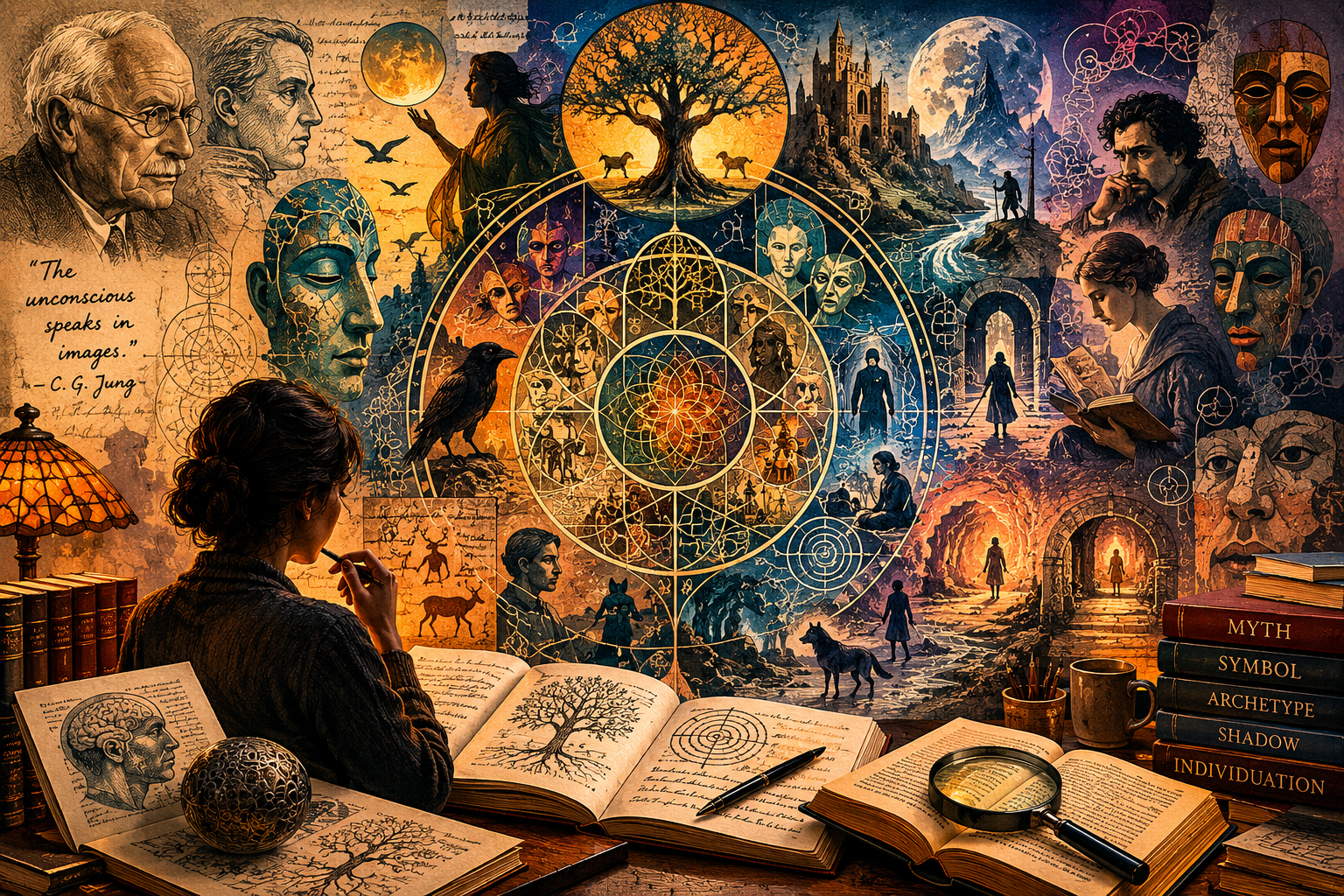
Jung’s own writings on literature were uneven but influential. He was especially interested in visionary art, mythic imagination, symbolic recurrence, and works that seemed to exceed the conscious intentions of their authors. He distinguished between psychological literature, which remains relatively close to familiar human motives and observable conflict, and visionary literature, which opens onto stranger, deeper, more archaic, more numinous, or more archetypal layers of experience. This distinction was never perfect, and it should not be treated as a rigid taxonomy. But it helped define a central Jungian intuition: some works do not merely represent life; they break open into psychic depths larger than the individual author or character alone.
At the same time, Jungian literary criticism has often been misused. Weak versions of the method turn every story into the same hero’s journey, every female figure into anima, every dark figure into shadow, every older guide into wise old man, every descent into individuation, and every recurring symbol into proof of timeless archetypal sameness. Such reading becomes reductive, historically careless, formally insensitive, and theoretically repetitive. The strongest Jungian literary interpretation does something more demanding. It tracks how symbolic patterns emerge within particular literary forms, how a text stages psychic conflict without exhausting itself in theory, and how mythic or archetypal resonance interacts with history, language, genre, culture, race, gender, religion, power, and literary technique.
This article examines analytical psychology and literary interpretation as a method of symbolic reading. It explores Jung’s interest in visionary literature, the roles of archetype, shadow, anima and animus, symbol, myth, dream logic, narrative transformation, authorial intention, reader response, and cultural specificity in literary analysis. It treats literature not as raw material for theoretical imposition, but as one of the richest sites where the psyche becomes narratively, poetically, and imaginatively visible.
Why Analytical Psychology Matters for Literary Interpretation
Analytical psychology matters for literary interpretation because literature is one of the major places where psychic life becomes form. Human beings do not only analyze themselves in concepts; they imagine themselves in stories, symbols, figures, landscapes, voices, and dramatic conflicts. Literature preserves these forms at high intensity. It stages longing, guilt, fear, beauty, violence, alienation, temptation, loss, transformation, and the search for wholeness in ways that often exceed direct psychological statement. Jungian reading is useful because it attends to this symbolic dimension with unusual seriousness.
This matters particularly when texts seem larger than realistic explanation alone. A work may organize itself around doubles, descents, sacred children, haunted houses, impossible transformations, dark forests, blinding revelations, fractured kingdoms, wandering strangers, wise guides, thresholds, wounds, masks, underworld journeys, or uncanny repetitions that suggest symbolic logic beyond mere plot utility. Analytical psychology offers a vocabulary for asking why such patterns recur and what psychic work they may be doing within literature.
Literature can be psychologically powerful because it allows psychic conflict to become externally visible without becoming simplistic. A protagonist may be divided between persona and shadow. A community may project its violence onto a scapegoat. A kingdom may fall apart because its ruler cannot recognize the disorder inside himself. A ghost may represent memory that has not been mourned. A monster may carry collective fear, disowned appetite, racialized projection, or forbidden desire. A symbolic object may hold the entire pressure of a text’s moral and emotional conflict. These are not merely decorative devices. They are forms through which literature makes psychic life legible.
Analytical psychology is especially helpful where texts move between conscious and unconscious levels. Some works speak in realistic dialogue while being organized by dreamlike structures. Others present ordinary social conflict while repeatedly returning to images of darkness, water, fire, mirrors, caves, birds, blood, houses, children, wounds, doubles, or thresholds. A Jungian critic asks how these images function inside the text’s psychic economy. Do they reveal what characters cannot say? Do they compensate the declared meaning of the narrative? Do they expose the shadow of the moral order? Do they carry the possibility of transformation? Do they reveal that transformation has failed?
This does not make Jungian criticism superior to formalism, historicism, psychoanalysis, feminism, Marxist criticism, postcolonial criticism, deconstruction, narratology, or reader-response theory. It is strongest when placed in dialogue with those methods. Literary works are simultaneously formal, historical, political, linguistic, psychological, and symbolic. A strong Jungian interpretation should deepen that complexity, not replace it. The method becomes weak when it ignores the sentence, the line, the archive, the genre, the author’s historical world, or the political field in which the text speaks.
At its best, analytical psychology gives literary interpretation a language for symbolic depth without reducing the work to pathology. Literature is not simply the author’s neurosis in disguised form. It is a cultural and artistic form through which images become shareable. Jungian criticism matters because it asks how those images carry psychic force across individual lives, literary traditions, and historical moments. It asks why some stories continue to grip readers long after their immediate social context has changed. It asks what kinds of psychic reality literature makes visible when ordinary conceptual language fails.
Jung on Literature: Psychological and Visionary Works
Jung distinguished between what he called psychological and visionary literature. Psychological literature remains relatively close to recognizably human motives, conflicts, emotions, relationships, and social life. It may be profound, but its material remains largely within the horizon of ordinary experience. Visionary literature, by contrast, breaks into strange, mythic, uncanny, or symbolic domains that cannot be fully explained by ordinary psychology alone. It gives the impression that deeper layers of the collective imagination have become active.
This distinction should not be treated as rigid taxonomy, but it helps clarify a Jungian orientation to literature. Jung was especially drawn to works that seemed to exceed the conscious intentions of their creators and open onto larger psychic structures. Visionary literature, in his sense, places the reader before something both compelling and difficult to domesticate. It resembles dream, ritual, myth, and revelation as much as ordinary narration. It does not simply represent psychic contents; it confronts readers with symbolic forces that feel older, stranger, or larger than personal psychology.
Psychological literature, in Jung’s terms, remains closer to personal experience. It may depict jealousy, ambition, love, guilt, rivalry, social conflict, sexual tension, family drama, ethical collapse, or the problem of identity in recognizable forms. The critic can often analyze such works through character motivation, personal history, social setting, and emotional conflict. Visionary literature is different because it disrupts ordinary explanatory frames. It may present apocalyptic landscapes, cosmic visions, gods, monsters, impossible transformations, underworld journeys, terrifying doubles, or symbolic scenes that feel closer to dream than to realism.
Jung’s distinction has value because it prevents all literature from being treated in one way. A realist novel of social manners may require a different Jungian approach than a visionary epic, Gothic nightmare, mystical poem, fairy tale, or surrealist narrative. The first may be read through persona, complex, projection, family system, and social adaptation. The second may require stronger attention to archetype, collective fantasy, mythic pattern, numinous imagery, and symbolic excess. Both can be psychologically rich, but their modes of depth differ.
Yet the distinction also has limits. Many literary works contain both psychological and visionary elements. Shakespearean tragedy, Dostoevskian fiction, modernist narrative, Gothic literature, speculative fiction, magical realism, epic poetry, and sacred narrative often move between personal motive and visionary symbolic force. A character may be socially and psychologically plausible while also carrying archetypal weight. A setting may be historically specific while also functioning as psychic landscape. A plot may be formally constructed while also reenacting mythic structures. A careful Jungian reading therefore treats Jung’s distinction as a continuum rather than a binary.
Jung’s approach to literature also raises an important question: who or what creates visionary material? Is it the author’s unconscious, the collective unconscious, the culture’s symbolic inheritance, the literary tradition, the reader’s response, or the formal structure of the work itself? A modern Jungian criticism should avoid answering too quickly. Visionary literature may arise at the intersection of individual imagination, inherited forms, historical crisis, religious memory, genre convention, and readerly activation. Its power lies precisely in the way these layers converge.
The enduring value of Jung’s distinction is that it preserves wonder before literary works that feel larger than authorial intention. It allows criticism to ask why some texts seem to dream beyond themselves. But its responsible use requires humility. Visionary intensity should not become an excuse to ignore craft, history, politics, or textual specificity. A visionary work is still made of words, forms, conventions, and choices. Its symbolic force does not float outside literature; it becomes visible through literature.
Literature as Symbolic Drama
From an analytical-psychological perspective, literature often functions as symbolic drama. Characters may act as more than social individuals; they may also embody divided tendencies, disowned potentials, moral conflicts, archetypal functions, developmental crises, or psychic positions within a larger inner drama. Settings may become psychic landscapes. Events may carry symbolic charge beyond their literal sequence. Plot may stage descent, initiation, fragmentation, confrontation, sacrifice, failed integration, or the dangerous possibility of transformation.
This does not reduce literature to allegory. Rather, it acknowledges that literary form can hold multiple layers at once. A character can be historically situated, psychologically complex, formally constructed, and symbolically resonant simultaneously. A Jungian reading becomes strongest when it keeps these layers in tension instead of collapsing the text into one-to-one equivalences. The antagonist is not simply “the shadow.” The beloved is not simply “the anima.” The journey is not automatically “individuation.” The question is how the text itself gives these figures psychic and symbolic force.
Symbolic drama is especially visible when a text externalizes inner conflict. A divided protagonist may encounter a double who embodies disowned appetite, violence, desire, or freedom. A respectable society may create an outsider who carries its denied cruelty. A house may hold buried memory. A forest may become the place where social persona dissolves. A river may mark transition, death, purification, or irreversibility. A child may represent vulnerability, future possibility, sacrifice, or the return of what a culture has abandoned. The literary work stages psychic conflict in a dramatic field.
This staging often depends on oppositions. Light and darkness, house and wilderness, city and sea, surface and depth, father and child, ruler and exile, mask and face, voice and silence, ascent and descent, law and desire, memory and forgetting, purity and contamination: these oppositions organize many literary works. Jungian interpretation asks how such oppositions operate psychologically. Are they held creatively, split defensively, projected onto others, reconciled symbolically, or left unresolved? Does the text move toward a conjunction of opposites, or does it show the destruction caused by refusing such conjunction?
Symbolic drama also includes failure. Jungian criticism should not assume that literary narratives naturally move toward wholeness. Many works are powerful because they stage failed development: the protagonist cannot integrate the shadow, the community cannot acknowledge guilt, the hero cannot relinquish inflation, the narrator cannot face truth, the family cannot mourn, the culture cannot stop projecting evil outward, or the symbolic order collapses without renewal. Tragedy is especially important here because it shows psychic structure under conditions where transformation does not arrive in redemptive form.
The method becomes richer when symbolic drama is joined to close reading. The critic should ask how imagery, syntax, rhythm, point of view, repetition, metaphor, irony, silence, and narrative structure create psychic meaning. A Jungian reading cannot rely only on thematic labels. The symbolic drama must be shown in the actual literary fabric: recurring images, charged scenes, tonal shifts, formal breaks, narrative reversals, and the pressure of language itself.
| Literary element | Possible Jungian function | Critical caution |
|---|---|---|
| Character | May carry a complex, shadow function, persona role, guiding image, or divided psychic position | Do not reduce character to a single concept; preserve narrative agency and social context |
| Setting | May function as psychic landscape: house, forest, sea, city, underworld, desert, mountain, threshold | Do not ignore historical geography, class, race, ecology, or material conditions |
| Plot | May stage descent, initiation, repetition, rupture, sacrifice, transformation, or failed individuation | Do not force every plot into the hero’s journey or individuation sequence |
| Image | May concentrate symbolic tension and carry emotional charge beyond explicit theme | Attend to the image’s textual details before naming it archetypal |
| Voice | May reveal persona, dissociation, possession by complex, irony, or divided consciousness | Preserve rhetoric, genre, and narrative technique |
Literature as symbolic drama therefore offers one of the richest uses of Jungian interpretation. It lets the critic read psyche not as hidden content behind the text, but as dramatic structure within the text’s form. The literary work becomes a field where psyche appears through image, conflict, voice, scene, and narrative movement.
Archetypes and Recurring Literary Forms
Archetypes are among the most famous and most easily abused tools of Jungian literary criticism. At their best, they help explain why certain figures and situations recur across literary traditions: the orphan, the wanderer, the wise elder, the trickster, the shadow-double, the sacred child, the devouring parent, the dangerous bridegroom, the hero at the threshold, the descent into darkness, the impossible return, the wounded king, the forbidden room, the lost bride, the enchanted animal, the underworld guide, the sacrificial victim, the broken vessel, and the hidden treasure. These recurrences suggest that literature often draws upon durable structures of imagination.
But archetypes should not be treated as fixed templates mechanically imposed on every work. Jungian interpretation becomes crude when it treats literary uniqueness as irrelevant or assumes that all recurrence means sameness. Archetypes are better understood as recurring organizing potentials that take historically specific form in different genres, traditions, languages, religions, and symbolic systems. A child figure in a Christian Nativity poem, a modernist novel, a postcolonial novel, a fairy tale, a dystopian narrative, and a war poem may all resonate with vulnerability or futurity, but the meanings are not identical.
The archetypal question is therefore not “Which archetype is this?” but “How does this literary figure or pattern become archetypally charged in this text?” A trickster figure may unsettle law, language, property, gender, race, class, or sacred authority depending on the work. A descent may be psychological, political, spiritual, erotic, colonial, ecological, or linguistic. A mother figure may be nurturing, devouring, absent, historical, institutional, ecological, or theological. The archetypal dimension emerges through the text’s particular construction of symbolic force.
Archetypes also change through literary history. A heroic pattern in epic does not function the same way in modernist irony, postwar disillusionment, feminist revision, anti-colonial literature, or contemporary speculative fiction. The hero may be exposed as inflated, the quest as imperial, the monster as victim, the wilderness as colonized land, the wise guide as manipulator, or the sacred child as politically abandoned. A serious Jungian criticism must therefore read archetype historically. Recurrence is not repetition without change. It is transformation under new conditions.
This is where archetypal criticism can learn from Northrop Frye, Maud Bodkin, myth criticism, comparative literature, folklore studies, religious studies, and cultural history. Recurring literary forms are real, but their meanings emerge through genre and tradition. Comedy, tragedy, romance, satire, epic, lyric, fairy tale, Gothic, realism, modernism, fantasy, and speculative fiction each handle archetypal patterns differently. A threshold in a fairy tale differs from a threshold in a migration novel. A double in Gothic fiction differs from a double in postcolonial literature. A sacrifice in tragedy differs from a sacrifice in political allegory.
Archetypal reading is strongest when it identifies both pattern and difference. It shows that a figure belongs to a recurring symbolic family while also asking what the specific text does with that inheritance. Does the text repeat the pattern, invert it, parody it, racialize it, gender it, secularize it, desacralize it, politicize it, or make it fail? The critical task is not archetypal labeling but archetypal interpretation under conditions of literary specificity.
Used this way, archetypes remain valuable. They help explain why certain literary forms feel charged beyond local plot. But they must be handled as dynamic symbolic potentials, not universal labels. The archetype appears through the work’s language, images, structure, and historical world. It is not a shortcut around them.
Shadow, Projection, and the Dark Double
Few Jungian concepts are more useful in literary analysis than the shadow. Literature is full of dark doubles, antagonists, monsters, exiles, scapegoats, criminals, racialized others, forbidden desires, secret sins, hidden rooms, and buried histories that carry what protagonists or communities cannot acknowledge in themselves. The shadow helps explain why so many narratives organize themselves around projection: evil is cast outward, innocence is self-proclaimed, and what is disowned returns in threatening form.
This is especially productive in reading Gothic fiction, tragedy, modernist alienation, political myth, colonial literature, dystopia, horror, and narratives of moral purity. A Jungian reading asks how the text distributes disowned aggression, shame, desire, fear, vulnerability, dependency, and contradiction. The villain may reveal more about the psychic structure of the protagonist or culture than the overt moral code of the story initially admits. The monster may not be merely external threat; it may be the returning form of what the social order has expelled.
The double is one of the shadow’s most powerful literary forms. Doubles dramatize psychic division by giving disowned aspects of the self a separate body, voice, or destiny. A double may embody forbidden freedom, criminal desire, moral corruption, unacknowledged violence, racial fantasy, queer possibility, madness, spiritual emptiness, or the truth behind a respectable persona. The double is frightening because it is both other and intimate. It shows the self what the self refuses to know.
Shadow projection also operates collectively. A community may define itself as pure by locating evil in outsiders. A nation may project violence onto enemies while denying its own brutality. A family may assign shame to one member. A religious community may demonize desire. A colonial system may imagine colonized peoples as primitive, dangerous, irrational, or seductive in order to preserve its own innocence. Literature often exposes these projections by dramatizing the instability of the boundary between self and other.
Jungian shadow reading must therefore be ethically careful. The shadow is not merely an inner psychological category. In literature, shadow projection often intersects with racism, misogyny, antisemitism, Islamophobia, colonial fantasy, class fear, disability stigma, sexuality, and social exclusion. A critic should not aestheticize these projections as timeless psychic patterns while ignoring their historical violence. The shadow is psychological and political. Projection can become policy, law, war, scapegoating, or social death.
Shadow interpretation is also valuable because it can identify failed transformation. A text may present the possibility of shadow recognition but refuse it. The protagonist destroys the double rather than learning from it. The community sacrifices the scapegoat rather than confronting its guilt. The ruler punishes dissent rather than acknowledging corruption. The narrator denies complicity until the narrative itself breaks. Such failures are psychologically meaningful. They show what happens when disowned material cannot be integrated, mourned, or symbolically held.
A strong Jungian reading of shadow therefore asks not only “Who is the shadow?” but also: who casts the projection, what is being disowned, what social order benefits from the projection, how does the text complicate moral certainty, and what happens when the projected figure returns? The shadow is not a label for darkness. It is a structure of disavowal, return, and possible recognition.
Anima, Animus, and Figures of Interiority
The concepts of anima and animus have often been used in Jungian literary criticism to interpret figures who mediate inwardness, alterity, eros, insight, judgment, fantasy, soulfulness, or psychic transition. Such figures may appear as beloved presences, dangerous seducers, guides, accusing voices, muses, ghosts, inaccessible interior counterparts, prophetic figures, or voices that draw the protagonist away from ordinary identity. In some literary traditions, they help stage the protagonist’s relation to desire, imagination, moral conflict, or a deeper dimension of selfhood.
Yet these concepts require caution today. Used uncritically, they can reproduce rigid gender binaries or flatten literary characters into projections of the male or female psyche. Weak Jungian criticism has often treated women in literature as anima figures for male protagonists rather than as characters with their own agency, social location, narrative function, and symbolic complexity. Similarly, animus readings can reduce male figures in women’s narratives to abstract functions of logos, judgment, or masculine spirit. Such readings risk reinscribing the gender assumptions they claim to analyze.
A stronger contemporary Jungian reading treats anima and animus less as fixed gender essences and more as symbolic figures of interior relation, alterity, and psychic mediation within specific historical literary forms. The question is not whether a character “is” anima or animus. The question is how the text constructs figures of otherness, desire, mediation, interiority, voice, judgment, image, or transformation, and how those figures are gendered by the work’s cultural world.
This distinction matters because gendered symbolism in literature is historically unstable. A beloved woman in medieval romance, a prophetic woman in tragedy, a femme fatale in noir, a muse in Romantic poetry, a ghostly mother in Gothic fiction, a silenced wife in modernist narrative, and a revolutionary female figure in anti-colonial literature cannot be responsibly collapsed into one anima function. Each belongs to a literary, historical, and political field. A Jungian reading may notice archetypal resonance, but it must preserve those differences.
The same applies to animus. Figures of law, speech, judgment, abstraction, violence, prophecy, doctrine, command, or rationality may be gendered masculine in certain texts, but such gendering should be analyzed rather than accepted as timeless. The critic should ask how the work constructs authority, speech, intellectual force, and moral demand; how those constructions intersect with gender; and whether the text reinforces, ironizes, destabilizes, or reimagines inherited symbolic polarities.
Queer, trans, and feminist criticism have made this revision even more necessary. Psychic otherness cannot be reduced to a binary gender structure. Literature frequently stages desire, identification, embodiment, and interiority in ways that exceed masculine-feminine opposition. A contemporary Jungian approach should be able to read gendered symbolic figures as fluid, contested, performative, culturally produced, and imaginally complex.
The value of anima and animus criticism lies not in preserving Jung’s gender language unchanged, but in retaining the insight that literary works often dramatize the psyche’s encounter with an interior other. This other may be beloved, terrifying, accusatory, seductive, guiding, silent, divine, animal, ghostly, or textual. It may be gendered or ungendered. It may open transformation or lead to possession. The critical task is to read the figure’s symbolic and literary function without erasing the character’s historical, formal, and ethical specificity.
Myth, Symbol, and Literary Imagination
Jungian literary interpretation is deeply tied to myth and symbol. Literature often reworks mythic structures without merely repeating inherited myths. A modern novel may secularize descent to the underworld; a poem may invoke sacred marriage without doctrinal framework; a play may stage sacrifice, exile, or revelation in psychologically modern terms; a speculative narrative may reframe creation, apocalypse, or transformation through technology, ecology, or empire. Jungian reading tracks how literary imagination reanimates, revises, contests, or fractures durable symbolic forms.
Symbols matter because literature does not usually state its deepest concerns propositionally. It condenses them in image. A labyrinth, wound, house, child, mirror, ocean, fire, tower, mask, forest, threshold, stone, road, river, bird, scar, book, garden, or locked room may become the symbolic center of an entire work. The question is not what the symbol “really means” once and for all, but what psychic tension it mediates within this text. A mirror may reveal vanity, self-knowledge, doubling, fragmentation, surveillance, gendered self-consciousness, or the impossibility of stable identity depending on its literary use.
Mythic interpretation is strongest when it attends to revision. Literature rarely transmits myth unchanged. It rewrites. It secularizes gods into psychological forces. It turns sacred journeys into social exile. It feminizes heroic quests, ironizes epic grandeur, politicizes sacrifice, exposes the violence behind myths of order, or gives voice to figures previously silenced. A Jungian reading should therefore ask not only which mythic pattern appears, but how the text changes the pattern and why that change matters.
This is especially important in modern and contemporary literature. Modernity often inherits myth in broken form. Myth may appear as fragment, allusion, parody, trauma, longing, ruin, or failed pattern. A character may live inside a myth without knowing it. A culture may repeat sacrificial structures while claiming to be rational. A modern city may become labyrinth, underworld, tower, wasteland, or machine. A narrative may invoke myth precisely to show that inherited symbolic structures no longer hold. Jungian criticism must be able to read mythic absence as well as presence.
Symbols also carry cultural specificity. A river in one literary tradition may signify purification; in another, border, exile, commerce, colonial route, death, memory, migration, or environmental devastation. A forest may be wilderness, sacred grove, colonial frontier, refuge, danger, ecological system, unconscious depth, or political commons. A wound may signify trauma, sacrifice, shame, initiation, bodily vulnerability, racial violence, divine encounter, or unhealed history. Symbolic reading becomes serious only when it asks how meaning is produced by the text’s world.
Myth and symbol are therefore not decorative. They are organizing structures of literary imagination. But they must be read dynamically. A symbol is not a code. A myth is not a template. They are fields of tension. Literature works on them, alters them, resists them, and gives them new life. Jungian interpretation becomes valuable when it can show this movement: how a text receives inherited symbolic material and transforms it into a new psychic and literary event.
Dream Logic, Fantasy, and the Unconscious Text
Many literary works operate with dream logic: displacement, condensation, repetition, metamorphosis, temporal distortion, uncanny setting, emotionally charged imagery, symbolic disproportion, circular movement, sudden transformation, and scenes that resist realist explanation. Jungian criticism finds such features especially revealing because they resemble the formal operations of unconscious life. Fantasy and surreal narrative may then become readable not as irrational excess, but as structured symbolic expression.
This is particularly useful in reading visionary poetry, surrealism, magical realism, fairy tale, speculative fiction, mythic realism, Gothic fiction, modernist fragmentation, and texts whose symbolic intensity exceeds realist causality. A house may expand impossibly. A dead figure may speak. Time may fold. A city may become labyrinth. A character may split into doubles. Animals may become messengers. A landscape may mirror psychic collapse. These features are not simply violations of realism. They may be the text’s way of giving form to unconscious or imaginal reality.
Yet one must avoid the temptation to say that everything strange is simply “the unconscious.” Literary technique remains technique. Dream logic in literature is crafted as well as symbolically resonant. The critic must attend to narrative voice, genre, intertextuality, pacing, structure, and aesthetic effect. A surreal image may derive from dream logic, but it may also be a political strategy, a formal experiment, a religious inheritance, a linguistic joke, or a critique of rational order. Jungian interpretation should not steal complexity from the literary work.
Dream logic often reveals itself through repetition. Repeated images may function like recurring dream motifs. A text may return again and again to water, mirrors, thresholds, wounds, birds, fire, or night. Such repetition may indicate symbolic pressure. Something in the work cannot be stated directly and therefore returns as image. The critic should ask where repetition occurs, whether it intensifies, transforms, or collapses, and how it relates to narrative development.
Fantasy also matters because it opens a middle realm between literal reality and abstract idea. In fantasy, psychic conflict can become world-building. A divided psyche may appear as divided kingdoms. A wounded relation to nature may appear as ecological curse. A hidden fear may become monster. A moral test may become quest. A broken symbolic order may become apocalypse. Jungian criticism is well suited to reading these forms because it treats fantasy as psychologically serious rather than escapist by default.
Dream logic can also expose the unconscious of a text. This does not mean the text has a mind exactly like a person. It means that literary form can produce tensions, contradictions, images, and symbolic recurrences that exceed explicit theme. A novel may declare one moral position while its imagery reveals another. A poem may repress a political history that returns in metaphor. A play may claim order while repeatedly staging disorder. A Jungian reading can ask what the text cannot fully know about itself.
The best use of dream logic in literary interpretation is therefore double: it honors the unconscious-like structure of certain literary forms while preserving the literary work as crafted art. The text dreams, but it dreams through form.
Character, Plot, and the Psychology of Transformation
Jungian criticism can illuminate how plots stage transformation. A narrative may present the disintegration of persona, confrontation with shadow, emergence of guiding figures, relation to the feminine or masculine other, symbolic death, descent into crisis, encounter with the uncanny, or impossible return to former identity. In this sense, plot becomes not only sequence but process. The story organizes psychic development or its failure.
Character development can be read similarly. A protagonist may not simply mature socially; they may become more divided, more inflated, more shadow-ridden, more integrated, or more tragically incapable of transformation. Jungian reading pays attention to what kinds of psychic movement plot enables, delays, distorts, or forecloses. A character may move toward deeper self-knowledge, but may also become possessed by a complex, trapped in persona, consumed by shadow, seduced by inflation, or destroyed by the inability to symbolize conflict.
Transformation in literature often begins with rupture. The old identity fails. The social role no longer holds. The home becomes uncanny. The beloved is lost. The kingdom is diseased. The hero is exiled. The narrator encounters a double. A forbidden room opens. A dream disturbs ordinary life. Such ruptures may function psychologically as cracks in the persona or openings into unconscious material. The plot then explores whether the character can survive and respond to what emerges.
Many literary plots also stage descent. The descent may be literal, as in journeys underground, into darkness, into wilderness, into sea, into prison, or into exile. It may be psychological, as in depression, memory, shame, madness, grief, or moral crisis. It may be social, as in downward mobility, loss of status, banishment, or exposure. Jungian interpretation asks what kind of descent occurs and whether the text imagines descent as initiation, punishment, trauma, revelation, or collapse. Not all descents transform. Some destroy.
Guiding figures are equally important. Literature often places protagonists in relation to mentors, strangers, animals, spirits, servants, fools, witches, elders, children, ghosts, or marginal figures who know what the protagonist does not. These figures may carry wisdom, deception, temptation, memory, or the possibility of altered perception. Jungian criticism can read them as mediators between conscious identity and deeper psychic material, but must also preserve their literary and social specificity.
Transformation may also fail because the protagonist cannot bear contradiction. A tragic figure may cling to persona, pride, purity, revenge, ideology, or heroic self-image. A community may refuse to recognize its shadow. A narrator may remain trapped in self-deception. A lover may confuse possession with relation. A ruler may identify with power and lose soul. A modern protagonist may be so alienated that no symbolic renewal is possible. Jungian criticism is valuable precisely because it can read failed transformation as a structured psychic outcome rather than as a mere absence of growth.
Plot, then, can be read as the temporal form of psychic possibility. It shows whether a work imagines transformation, repetition, possession, fragmentation, reconciliation, or irreparable loss. The critic should ask not only what happens, but what psychic movement the happening makes possible or impossible.
Individuation, Narrative, and Failed Development
Some literary works can be read as narratives of individuation, though this should never be assumed too quickly. Such works stage confrontation with one-sidedness, symbolic crisis, relation to shadow, encounter with inner otherness, descent into inward conflict, and gradual emergence of a more complex self-relation. But literature is equally full of failed individuation: characters who cannot bear contradiction, cultures trapped in projection, narrators undone by inflation, heroes destroyed by one-sidedness, and worlds where symbolic integration never arrives.
This is one reason Jungian literary criticism can be especially strong with tragedy and dark modernity. It does not require that transformation succeed. It can read breakdown, repetition, fragmentation, and moral collapse as psychologically structured failures of relation, not simply bad outcomes. In tragedy, the protagonist often cannot enter a living relation with the unconscious material that threatens conscious identity. The result is not wholeness but catastrophe.
Individuation narratives should also be read critically because the concept can become too individualistic if applied without historical awareness. Some literary works show personal transformation, but others show that transformation is blocked by social violence, gendered constraint, colonial domination, poverty, racial exclusion, religious persecution, disability, war, or ecological collapse. A character may not fail because of inner resistance alone. They may inhabit a world that denies the conditions for becoming. A responsible Jungian criticism must distinguish psychic failure from structural injury.
In some works, individuation appears as differentiation from collective identity. The protagonist must separate from family expectation, social conformity, inherited myth, ideological possession, or false persona. But in other works, the problem is not too much collectivity but too little relation. The isolated modern subject may need reconnection, community, ancestral memory, ecological belonging, or symbolic tradition. Individuation should not always be equated with separation. It may require deeper relation.
Failed individuation can take many literary forms. A character may identify with persona and become hollow. Another may identify with shadow and become destructive. Another may become possessed by an archetypal role: martyr, savior, victim, tyrant, lover, prophet, hero. Another may refuse mourning and live inside repetition. Another may encounter the unconscious but inflate rather than integrate. Another may enter symbolic crisis but lack a cultural container strong enough to hold it. Literature allows these failures to be explored with great subtlety.
Jungian reading should also recognize anti-individuation narratives: works that question whether wholeness is possible, desirable, or politically innocent. Some modern and postmodern texts resist coherent selfhood altogether. Fragmented narration, unstable voice, unresolved plot, irony, and formal rupture may challenge the very idea of a unified developmental arc. Such works should not be forced into an individuation model. They may be critiquing the desire for wholeness or exposing the historical conditions under which wholeness becomes unavailable.
Individuation remains a useful literary lens when used as a question rather than a template. Does the text imagine a deeper relation to unconscious life? Does the protagonist become more capable of holding contradiction? Does the narrative move toward integration, fragmentation, repetition, inflation, or collapse? Does the work itself question the possibility of such movement? These questions preserve the concept’s value without making it a formula.
Author, Reader, and the Problem of Psychological Intention
Jung was often interested in the relation between literary work and the author’s psyche, but modern criticism has complicated that question. A text may contain symbolic patterns the author did not consciously intend. Readers may also constellate meanings not reducible to author psychology. A careful Jungian criticism therefore avoids simplistic biographical reduction. The author matters, but the work often exceeds the author.
This matters because older psychological criticism often treated literature as a symptom of the writer’s inner life. Such criticism can be useful when grounded in evidence and literary sensitivity, but it becomes reductive when it treats the text primarily as a diagnostic record. The author’s biography may illuminate certain images, obsessions, conflicts, and forms, but the literary work is not simply the author’s unconscious printed on the page. Once made, the work enters language, genre, tradition, publication, interpretation, and cultural memory.
Jungian criticism has a useful way of thinking about this excess. A work may constellate collective images beyond conscious intention. An author may serve as a vehicle for symbolic material larger than personal biography. This idea should be handled carefully; it can become vague or mystical if overstated. But it recognizes a real literary phenomenon: authors often create images whose meanings exceed their own explanations. Readers, critics, and later historical moments may perceive dimensions of the work that the author did not fully formulate.
The reader matters too. Literary interpretation is partly a psychological event in the present. Certain symbols seize readers because they resonate with collective or personal patterns that remain active. A reader may be gripped by the shadow figure, the abandoned child, the haunted house, the forbidden room, the sea, the double, the wound, or the failed return because these images activate psychic material within the reader. Jungian criticism attentive to reception can therefore ask not only what the text contains, but why certain images continue to grip readers across time.
This does not mean reader response is arbitrary. The text constrains interpretation through form, language, structure, genre, and historical context. But reading is not passive decoding. It is an encounter between text and psyche. A literary work may function almost like a dream shared across culture: not because it has one fixed unconscious meaning, but because it activates symbolic participation in readers who bring different histories, wounds, hopes, fears, and cultural memories to the work.
The problem of intention is therefore best handled through layers. At one layer, the author’s life, letters, notebooks, historical context, and stated aims may matter. At another, the formal work of the text matters independently. At another, inherited mythic and symbolic structures shape the work. At another, readers activate the text across time. A serious Jungian literary criticism should not reduce all these layers to author psychology, nor should it deny the psychological force of authorship and reception entirely.
The literary work lives between intention and reception. It is made by a person, shaped by culture, structured by form, and reanimated by readers. Jungian interpretation becomes strongest when it respects this complex life rather than locating meaning in only one psychic source.
History, Culture, and the Limits of Archetypal Reading
The strongest contemporary Jungian literary interpretation must remain historical and cultural in method. Archetypal recurrence does not erase colonial violence, racial ordering, gendered power, class structure, theological specificity, linguistic difference, formal literary history, or political conflict. A sacred child in one tradition is not identical in meaning to a child figure in another simply because both are “archetypal.” Cultural and linguistic mediation matters.
This is where Jungian criticism has often been weakest when used lazily. It becomes strongest when it lets archetypal resonance deepen historical reading rather than replace it. Symbolic life occurs in culture, not outside it. Literature is therefore both psychic and historical at once. A symbol does not float freely above language, religion, race, class, gender, land, empire, or law. It is shaped by them.
For example, a dark figure in a Gothic text may carry shadow material, but it may also be entangled with racial fantasy, colonial anxiety, class fear, sexuality, disability stigma, or religious demonology. A Jungian critic who names the figure “shadow” without analyzing those conditions risks turning historical violence into timeless psychology. Similarly, a wilderness setting may function as unconscious landscape, but it may also be Indigenous land, colonial frontier, ecological system, or site of extraction. Symbolic interpretation must not erase material history.
Gendered symbolism requires similar care. A female figure in a male-authored text may function as anima, but she may also reveal the text’s gender politics, sexual economy, social constraints, and literary tradition of objectifying women. A mother image may resonate archetypally, but motherhood is also shaped by law, labor, inheritance, race, religion, sexuality, and social expectation. A contemporary Jungian reading should ask how archetypal symbolism and historical gender formation interact.
Religious symbols demand particular discipline. A cross, veil, mandala, Qur’anic allusion, Torah image, Buddhist motif, Hindu deity, Indigenous ritual reference, or alchemical figure cannot be treated only as evidence of archetypal pattern. It belongs to traditions with their own languages, communities, practices, authorities, and histories. Psychological interpretation may reveal one layer of meaning, but it should not claim to possess the symbol’s deepest truth over and against the tradition itself.
The same is true of postcolonial and diasporic literature. Myths, ghosts, ancestors, doubles, wounds, broken languages, and haunted landscapes may carry archetypal force, but they also carry histories of displacement, enslavement, partition, migration, cultural loss, and resistance. A Jungian reading becomes more powerful when it can speak about collective trauma and inherited symbolic memory without reducing them to universal psychic patterns.
Historical and cultural discipline does not abolish Jungian criticism. It makes it more credible. Archetypal resonance and cultural specificity are not enemies. A symbol may be psychologically deep precisely because it is historically dense. The task is to read both: the recurring psychic form and the particular world through which it speaks.
Literary Form, Language, and the Danger of Psychological Reduction
One of the most important corrections to weak Jungian criticism is attention to literary form. A symbolic reading that ignores syntax, rhythm, genre, narrative voice, metaphor, irony, point of view, sound, lineation, pacing, structure, and intertextuality is not yet literary criticism. It may be psychological commentary on a plot summary, but it has not shown how the literary work produces meaning. Jungian criticism must demonstrate symbolic force in the actual language and form of the text.
This is especially important because literature often works through ambiguity. A symbol may not have one meaning. A narrator may be unreliable. An image may be ironic. A character may function differently at different points in the narrative. A poem may resist paraphrase. A play may make meaning through staging, silence, repetition, or contradiction. Psychological interpretation becomes reductive if it forces such complexity into fixed concepts.
Form can itself be psychological. Fragmented narration may dramatize dissociation, cultural rupture, unreliable memory, or a refusal of unified selfhood. Repetition may enact compulsion or ritual. Unstable point of view may stage divided consciousness. Lyric compression may condense affect into image. Epic structure may place individual conflict inside collective destiny. Gothic atmosphere may make repression spatial. Modernist stream of consciousness may dramatize the fluidity of psychic life. Postmodern fragmentation may challenge the very idea of coherent identity.
A Jungian critic should therefore ask how form carries psyche. Does the narrative structure enact descent? Does the syntax produce claustrophobia, breathlessness, paralysis, or release? Does imagery intensify around certain conflicts? Does the voice reveal persona, irony, or splitting? Does genre itself carry archetypal expectations that the text fulfills, subverts, or breaks? Does the text’s form create a symbolic field before any explicit interpretation is possible?
The danger of psychological reduction is that the critic treats literary language as transparent evidence for hidden content. A poem’s images become symptoms. A novel’s characters become parts of the author. A mythic structure becomes the “real” meaning beneath the work. This approach weakens both psychology and literary criticism. It ignores the way literary meaning emerges from form, not from content alone.
A disciplined Jungian criticism should therefore move slowly from textual observation to psychological claim. It should cite specific images, structures, repetitions, scenes, voices, and formal choices. It should test whether the Jungian interpretation explains the text’s actual patterning or merely overlays familiar concepts. It should allow literature to resist theory. A work may trouble Jungian categories, not merely confirm them.
Literary form is not a secondary concern. It is the medium through which symbolic life becomes readable. The psyche in literature does not appear apart from language. It appears as language.
Reader Response, Symbolic Reception, and Collective Imagination
Jungian literary interpretation can also be extended through reader response. Some texts become culturally powerful because they activate symbolic patterns in readers beyond their first publication moment. They are reread, adapted, translated, staged, filmed, contested, and reimagined because their images continue to constellate psychic and cultural meaning. A Jungian approach can help ask why certain works keep returning.
Reception matters because symbols are not static. A work’s meaning changes as readers change. A nineteenth-century Gothic image may be read differently after psychoanalysis, feminism, decolonization, disability studies, queer theory, ecological crisis, or digital culture. A mythic figure may be reclaimed by marginalized readers who were once excluded from the tradition. A villain may become sympathetic in a later political context. A monster may become a figure of oppressed identity. A quest may be reread as imperial conquest. Symbolic reception is historical.
This does not mean the text means anything at all. It means that literary symbols remain alive through renewed psychic and cultural encounter. A Jungian reading of reception asks which images retain force, which become obsolete, which are transformed, and which return under new conditions. It also asks what collective needs, fears, or fantasies are being activated when a work becomes newly popular or newly contested.
Adaptation is especially revealing. When a literary work is adapted into film, theater, television, graphic narrative, or digital form, certain images are emphasized, suppressed, revised, or politicized. A Jungian critic can read adaptation as symbolic selection. What does a culture choose to keep? What does it cut? Which shadow figures are softened? Which wounds are made visible? Which endings are changed? Which archetypal patterns are intensified? Adaptation shows collective imagination at work.
Reader response also complicates the author-centered model. A work may become a vessel for meanings its author did not anticipate. This is not a failure of interpretation. It is part of literature’s cultural life. Texts survive because they can be reanimated. Their symbols become available for new psychic tasks: mourning, identity, resistance, critique, consolation, transformation, or collective self-recognition.
Jungian reception criticism should be especially careful with marginalized readers and traditions. A canonical work may have functioned historically as a vehicle of exclusion, but later readers may reinterpret it against itself. Conversely, a work may be celebrated for archetypal power while carrying harmful stereotypes that some readers experience as psychic violence rather than symbolic universality. Reception is not neutral. It reveals how symbols affect different communities differently.
The collective imagination is not one harmonious field. It is contested. Different readers constellate different meanings because they inhabit different histories. A responsible Jungian literary criticism should therefore treat symbolic reception as plural, historical, and ethically charged. The psyche that reads literature is never outside culture.
Criticisms and Qualifications
Jungian literary criticism has been criticized for universalism, essentialism, vague symbolism, insufficient attention to form, and insufficient attention to politics. These critiques are often justified when the method becomes repetitive or doctrinaire. A reading that simply labels figures as hero, anima, shadow, trickster, or Self without attending to language, structure, genre, and history adds little to literary criticism. It may even diminish the literary work by making it seem less strange, less specific, and less intelligently formed than it is.
Universalism is the most persistent criticism. Jungian criticism often claims that certain symbolic patterns recur across cultures. That may be true at a general level, but recurrence does not prove identical meaning. A mother figure, trickster, underworld, child, serpent, sacred marriage, flood, or tree may appear across traditions while functioning very differently in each. A serious Jungian criticism must distinguish resemblance from equivalence.
Essentialism is another danger. Concepts such as anima, animus, masculine, feminine, mother, father, hero, and shadow can become rigid when applied without historical critique. Literature often reproduces gendered, racial, colonial, religious, and class-based symbolism. Jungian criticism should analyze those formations, not turn them into timeless psychic truths. A symbol may reveal an archetypal structure, but it may also reveal an oppressive cultural structure.
Vague symbolism is a related problem. A critic may say that water means unconscious, fire means transformation, forest means instinct, house means psyche, and night means shadow. Such statements may sometimes be useful, but they are too general to count as interpretation. What kind of water? Where does it appear? Who sees it? How does the language describe it? Does it cleanse, drown, separate, carry, conceal, reflect, or destroy? Symbols become meaningful in context.
Political critique also matters. Jungian literary criticism can become escapist if it treats social conflict as only psychic drama. Class struggle, racial violence, colonial domination, gender oppression, ecological destruction, religious persecution, and state violence cannot be responsibly translated into archetypal patterns alone. They are historical realities. Psychological and symbolic readings may deepen their interpretation, but they must not replace material analysis.
Still, the method remains valuable when used rigorously. Its strength lies in taking symbolic form seriously, attending to mythic recurrence without flattening difference, and recognizing that literature often stages psychic realities not fully capturable by historicism or formalism alone. A disciplined Jungian criticism is not a replacement for other methods. It is a deepening lens.
The strongest qualification is therefore methodological humility. Jungian criticism should ask: Does this interpretation arise from the text, or am I imposing a familiar pattern? Have I attended to form? Have I preserved history and culture? Have I considered gender, race, religion, class, and power? Have I allowed the literary work to resist Jungian theory? Have I distinguished symbolic resonance from proof? These questions keep the method alive rather than formulaic.
Mathematical Lens
Literary interpretation in a Jungian frame can be modeled as the interaction of symbolic density, archetypal recurrence, formal centrality, affective charge, and historical-contextual specificity. Let \(L_t\) represent interpretive depth for a text or corpus at time \(t\), \(S_t\) symbolic density, \(A_t\) archetypal clustering, \(F_t\) formal centrality, \(E_t\) affective charge, \(H_t\) historical-contextual specificity, and \(R_t\) reductive overgeneralization.
L_t = \alpha + \beta_1 S_t + \beta_2 A_t + \beta_3 F_t + \beta_4 E_t + \beta_5 H_t – \beta_6 R_t + \varepsilon_t
\]
Interpretation: Jungian literary interpretation becomes stronger when symbolic density, archetypal clustering, formal centrality, emotional charge, and historical specificity reinforce one another. It becomes weaker when archetypal labels overgeneralize and flatten the text.
This reflects a central principle: strong Jungian interpretation depends not only on symbolic richness and recurring psychic forms, but also on fidelity to the text’s specific historical, linguistic, and formal conditions. A symbol is more interpretively important when it is structurally central, repeated, emotionally charged, and formally integrated into the work, rather than merely present as a word or image.
A second expression can model reductive risk. Let \(R_t\) represent the risk of interpretive reduction, \(U_t\) universalizing pressure, \(T_t\) template imposition, \(C_t\) cultural specificity, and \(Q_t\) close-reading quality.
R_t = \gamma_1 U_t + \gamma_2 T_t – \gamma_3 C_t – \gamma_4 Q_t + \eta_t
\]
Interpretation: Reductive risk rises when the critic universalizes too quickly or imposes ready-made archetypal templates. It falls when the reading is culturally specific and grounded in close attention to the text.
A network view may treat characters, motifs, settings, objects, narrative events, and recurring images as nodes in a graph. Recurrent clusters such as double, descent, child, mask, wound, house, forest, guide, threshold, mirror, and sacrificial figure can then be mapped across the text. Jungian interpretation becomes most persuasive where these clusters are both structurally central and emotionally charged rather than merely superficially present.
G = (V, E)
\]
Interpretation: A literary-symbolic network can be modeled as a graph in which \(V\) represents motifs, images, characters, settings, or symbolic objects, and \(E\) represents their co-occurrence, narrative relation, or interpretive association.
In this model, symbolic interpretation is not automated by the graph. The graph helps identify clusters and central motifs; close reading determines whether those clusters are meaningful, ironic, incidental, culturally specific, or structurally decisive.
R Workflow: Simulating Symbolic Density and Archetypal Clustering in Literary Corpora
The following R workflow sketches how symbolic and archetypal patterns might be modeled across literary corpora. The aim is not to automate interpretation, diagnose authors, or prove archetypes. The aim is to identify recurrent symbolic clusters that may warrant closer Jungian reading. Quantitative patterning can support interpretation, but it cannot replace close reading, historical analysis, or literary judgment.
# ============================================================
# Analytical Psychology and Literary Interpretation
# R Workflow: Symbolic Density and Archetypal Clustering
# ============================================================
#
# Purpose:
# This workflow demonstrates how a critic or researcher might
# map recurring symbolic motifs in a literary corpus.
#
# Responsible-use note:
# This is not an automated interpretation system, author diagnosis,
# psychological assessment tool, or proof of archetypes. It is a
# reproducible aid for identifying patterns that require close reading.

library(tidyverse)
library(quanteda)
library(tidytext)
library(tidygraph)
library(ggraph)

# ------------------------------------------------------------
# 1. Load a literary corpus
# ------------------------------------------------------------
# Expected columns:
#   doc_id: unique document identifier
#   genre: literary genre or category
#   period: historical period
#   author: author name
#   title: text title
#   text: full text or excerpt

texts <- read_csv("data/raw/literary_symbol_corpus.csv")

# If no corpus is available, create a small synthetic example.
# Replace this block with a real curated corpus for actual research.

if (nrow(texts) == 0) {
  texts <- tibble(
    doc_id = c("text_1", "text_2", "text_3"),
    genre = c("gothic", "romance", "visionary_poetry"),
    period = c("nineteenth_century", "medieval", "modern"),
    author = c("synthetic_author_a", "synthetic_author_b", "synthetic_author_c"),
    title = c("Synthetic House", "Synthetic Quest", "Synthetic Descent"),
    text = c(
      "The shadow crossed the house and waited beside the mirror at night.",
      "The child crossed the river and entered the forest beyond the threshold.",
      "Fire, stone, dream, wound, and mask appeared in the underworld vision."
    )
  )
}

# ------------------------------------------------------------
# 2. Create a quanteda corpus and tokenize
# ------------------------------------------------------------

corp <- corpus(texts, text_field = "text")

tokens_clean <- corp |>
  tokens(
    remove_punct = TRUE,
    remove_symbols = TRUE,
    remove_numbers = TRUE
  ) |>
  tokens_tolower() |>
  tokens_remove(stopwords("en"))

# ------------------------------------------------------------
# 3. Build a document-feature matrix
# ------------------------------------------------------------

dfm_mat <- dfm(tokens_clean)

tidy_terms <- tidy(dfm_mat)

# ------------------------------------------------------------
# 4. Define a curated motif dictionary
# ------------------------------------------------------------
# Motifs should be revised for each corpus. A real project should document
# why these motifs were selected and how ambiguous terms were handled.

motif_terms <- c(
  "shadow", "child", "mirror", "house", "forest", "fire",
  "dream", "double", "mask", "wound", "road", "river",
  "mother", "king", "queen", "stone", "night", "threshold",
  "sea", "tower", "blood", "bird", "garden", "door",
  "ghost", "serpent", "cave", "star", "bone", "voice"
)

motif_counts <- tidy_terms |>
  filter(term %in% motif_terms) |>
  group_by(document, term) |>
  summarize(count = sum(count), .groups = "drop") |>
  left_join(texts, by = c("document" = "doc_id"))

# ------------------------------------------------------------
# 5. Summarize motif density by genre and period
# ------------------------------------------------------------

motif_summary <- motif_counts |>
  group_by(period, genre, term) |>
  summarize(total = sum(count), .groups = "drop") |>
  arrange(desc(total))

print(motif_summary)

# ------------------------------------------------------------
# 6. Compute symbolic density by document
# ------------------------------------------------------------
# Symbolic density here is a simple ratio:
# total motif terms divided by total token count.
# This is only a crude proxy and must be interpreted cautiously.

doc_lengths <- tibble(
  document = docnames(dfm_mat),
  total_terms = ntoken(dfm_mat)
)

symbolic_density <- motif_counts |>
  group_by(document, title, author, genre, period) |>
  summarize(total_motifs = sum(count), .groups = "drop") |>
  left_join(doc_lengths, by = "document") |>
  mutate(symbolic_density = total_motifs / total_terms) |>
  arrange(desc(symbolic_density))

print(symbolic_density)

# ------------------------------------------------------------
# 7. Build motif co-occurrence matrix
# ------------------------------------------------------------
# Window size should be adjusted depending on corpus type.
# A smaller window captures local image clusters.
# A larger window captures broader thematic proximity.

fcm_mat <- fcm(tokens_clean, context = "window", window = 8)

cooc_df <- tidy(fcm_mat) |>
  filter(feature %in% motif_terms, target %in% motif_terms, count >= 1) |>
  filter(feature != target)

print(cooc_df)

# ------------------------------------------------------------
# 8. Convert co-occurrence table into graph
# ------------------------------------------------------------

nodes <- tibble(
  name = unique(c(cooc_df$feature, cooc_df$target))
)

edges <- cooc_df |>
  rename(from = feature, to = target, weight = count)

motif_graph <- tbl_graph(
  nodes = nodes,
  edges = edges,
  directed = FALSE
)

# ------------------------------------------------------------
# 9. Plot symbolic motif network
# ------------------------------------------------------------

ggraph(motif_graph, layout = "fr") +
  geom_edge_link(aes(width = weight), alpha = 0.20) +
  geom_node_point() +
  geom_node_text(aes(label = name), repel = TRUE) +
  theme_void() +
  labs(
    title = "Symbolic Motif Co-occurrence Network",
    subtitle = "Motif proximity suggests symbolic neighborhoods for close reading"
  )

# ------------------------------------------------------------
# 10. Save outputs
# ------------------------------------------------------------

dir.create("outputs/tables", recursive = TRUE, showWarnings = FALSE)
dir.create("outputs/figures", recursive = TRUE, showWarnings = FALSE)

write_csv(motif_summary, "outputs/tables/motif_summary_by_period_genre.csv")
write_csv(symbolic_density, "outputs/tables/symbolic_density_by_document.csv")
write_csv(cooc_df, "outputs/tables/motif_cooccurrence_edges.csv")

# ------------------------------------------------------------
# Interpretive cautions
# ------------------------------------------------------------
# 1. A term such as "shadow" may be literal, metaphorical, ironic,
#    theological, racialized, or structurally central depending on context.
# 2. Frequency does not equal importance.
# 3. Co-occurrence does not equal archetypal proof.
# 4. Historical and formal context remain necessary.
# 5. Close reading determines whether a motif cluster is interpretively meaningful.

# ------------------------------------------------------------
# Possible extensions
# ------------------------------------------------------------
# 1. Compare visionary and realist genres.
# 2. Track motif clusters across historical periods.
# 3. Model symbolic density by author, genre, or movement.
# 4. Compare literary and mythic corpora.
# 5. Integrate sentiment or affect coding with motifs.
# 6. Use topic modeling or embeddings to detect symbolic fields.
# 7. Add manually annotated close-reading passages.
This workflow can help identify symbolic neighborhoods, but interpretation still requires close reading. A word such as “shadow” may be literal, metaphorical, ironic, racialized, theological, or structurally central depending on context. The quantitative map is useful only when paired with textual judgment, historical awareness, and literary analysis.
Python Workflow: Modeling Literary Interpretation as a Symbolic Network
The following Python workflow models literary motifs as a co-occurrence network across texts. It can be used to identify which symbols function as bridge motifs and how strongly certain archetypal clusters organize a corpus. The workflow is conceptual and methodological. It does not automate literary interpretation, diagnose authors, or prove that motifs are archetypes.
# ============================================================
# Analytical Psychology and Literary Interpretation
# Python Workflow: Literary Motifs as a Symbolic Network
# ============================================================
#
# Purpose:
# This workflow demonstrates how symbolic motifs in a literary corpus
# can be represented as a network of co-occurring images.
#
# Responsible-use note:
# This is not an automated interpretation system, author diagnosis,
# psychological assessment tool, or empirical proof of archetypes.
# It is a research scaffold for identifying patterns that require
# close reading and historical interpretation.

from pathlib import Path
from collections import Counter
from itertools import combinations

import pandas as pd
import networkx as nx

# ------------------------------------------------------------
# 1. Load corpus
# ------------------------------------------------------------
# Expected columns:
#   doc_id, genre, period, author, title, text

data_path = Path("data/raw/literary_symbol_corpus.csv")

if data_path.exists():
    df = pd.read_csv(data_path)
else:
    # Synthetic fallback dataset for demonstration.
    df = pd.DataFrame(
        [
            {
                "doc_id": "text_1",
                "genre": "gothic",
                "period": "nineteenth_century",
                "author": "synthetic_author_a",
                "title": "Synthetic House",
                "text": "The shadow crossed the house and waited beside the mirror at night."
            },
            {
                "doc_id": "text_2",
                "genre": "romance",
                "period": "medieval",
                "author": "synthetic_author_b",
                "title": "Synthetic Quest",
                "text": "The child crossed the river and entered the forest beyond the threshold."
            },
            {
                "doc_id": "text_3",
                "genre": "visionary_poetry",
                "period": "modern",
                "author": "synthetic_author_c",
                "title": "Synthetic Descent",
                "text": "Fire, stone, dream, wound, and mask appeared in the underworld vision."
            },
        ]
    )

# ------------------------------------------------------------
# 2. Define curated motif dictionary
# ------------------------------------------------------------
# This dictionary should be revised for each project.
# Motif selection should be documented in research notes.

motif_terms = {
    "shadow", "child", "mirror", "house", "forest", "fire",
    "dream", "double", "mask", "wound", "road", "river",
    "mother", "king", "queen", "stone", "night", "threshold",
    "sea", "tower", "blood", "bird", "garden", "door",
    "ghost", "serpent", "cave", "star", "bone", "voice"
}

# ------------------------------------------------------------
# 3. Tokenize text in a simple, transparent way
# ------------------------------------------------------------
# For larger projects, replace this with a stronger tokenizer
# and document preprocessing choices.

def tokenize(text: str) -> list[str]:
    cleaned = (
        str(text)
        .lower()
        .replace(",", " ")
        .replace(".", " ")
        .replace(";", " ")
        .replace(":", " ")
        .replace("!", " ")
        .replace("?", " ")
        .replace("—", " ")
        .replace("-", " ")
    )
    return [token.strip() for token in cleaned.split() if token.strip()]

df["tokens"] = df["text"].apply(tokenize)

# ------------------------------------------------------------
# 4. Count motif frequencies
# ------------------------------------------------------------

all_tokens = [token for tokens in df["tokens"] for token in tokens]

freq_df = (
    pd.DataFrame(
        Counter(token for token in all_tokens if token in motif_terms).items(),
        columns=["motif", "frequency"]
    )
    .sort_values("frequency", ascending=False)
)

print("Motif frequencies")
print(freq_df)

# ------------------------------------------------------------
# 5. Build document-level motif table
# ------------------------------------------------------------

doc_motif_rows = []

for _, row in df.iterrows():
    counts = Counter(token for token in row["tokens"] if token in motif_terms)

    for motif, count in counts.items():
        doc_motif_rows.append(
            {
                "doc_id": row["doc_id"],
                "title": row["title"],
                "author": row["author"],
                "genre": row["genre"],
                "period": row["period"],
                "motif": motif,
                "count": count,
                "total_tokens": len(row["tokens"]),
            }
        )

doc_motif_df = pd.DataFrame(doc_motif_rows)

if not doc_motif_df.empty:
    doc_density_df = (
        doc_motif_df
        .groupby(["doc_id", "title", "author", "genre", "period"], as_index=False)
        .agg(total_motifs=("count", "sum"), total_tokens=("total_tokens", "first"))
    )
    doc_density_df["symbolic_density"] = (
        doc_density_df["total_motifs"] / doc_density_df["total_tokens"]
    )
else:
    doc_density_df = pd.DataFrame()

print("\nDocument symbolic density")
print(doc_density_df)

# ------------------------------------------------------------
# 6. Build co-occurrence graph
# ------------------------------------------------------------
# Here, co-occurrence means motifs appearing in the same document.
# For finer analysis, use sentence or window-level co-occurrence.

G = nx.Graph()

for _, row in df.iterrows():
    present_terms = sorted(set(token for token in row["tokens"] if token in motif_terms))

    for motif in present_terms:
        if not G.has_node(motif):
            G.add_node(motif, frequency=0)

    for token in row["tokens"]:
        if token in motif_terms:
            G.nodes[token]["frequency"] += 1

    for source, target in combinations(present_terms, 2):
        if G.has_edge(source, target):
            G[source][target]["weight"] += 1
        else:
            G.add_edge(source, target, weight=1)

# ------------------------------------------------------------
# 7. Graph metrics
# ------------------------------------------------------------

if len(G.nodes) > 0:
    degree_centrality = nx.degree_centrality(G)
    betweenness_centrality = nx.betweenness_centrality(G, weight="weight")
    clustering = nx.clustering(G, weight="weight")

    metrics_df = pd.DataFrame(
        {
            "motif": list(G.nodes()),
            "frequency": [G.nodes[m].get("frequency", 0) for m in G.nodes()],
            "degree_centrality": [degree_centrality[m] for m in G.nodes()],
            "betweenness_centrality": [betweenness_centrality[m] for m in G.nodes()],
            "clustering": [clustering[m] for m in G.nodes()],
        }
    ).sort_values(
        ["betweenness_centrality", "degree_centrality", "frequency"],
        ascending=False
    )
else:
    metrics_df = pd.DataFrame()

print("\nNetwork metrics")
print(metrics_df)

# ------------------------------------------------------------
# 8. Edge table
# ------------------------------------------------------------

edge_rows = []

for source, target, attrs in G.edges(data=True):
    edge_rows.append(
        {
            "source": source,
            "target": target,
            "weight": attrs.get("weight", 1),
        }
    )

edges_df = pd.DataFrame(edge_rows).sort_values("weight", ascending=False)

print("\nSymbolic network edges")
print(edges_df)

# ------------------------------------------------------------
# 9. Identify possible interpretive bridge motifs
# ------------------------------------------------------------
# Bridge motifs may connect several symbolic clusters.
# They are not automatically "more meaningful"; they invite close reading.

bridge_motifs = metrics_df.head(10) if not metrics_df.empty else pd.DataFrame()

print("\nPossible bridge motifs for close reading")
print(bridge_motifs)

# ------------------------------------------------------------
# 10. Save outputs
# ------------------------------------------------------------

output_tables = Path("outputs/tables")
output_tables.mkdir(parents=True, exist_ok=True)

freq_df.to_csv(output_tables / "motif_frequencies.csv", index=False)
doc_density_df.to_csv(output_tables / "document_symbolic_density.csv", index=False)
metrics_df.to_csv(output_tables / "motif_network_metrics.csv", index=False)
edges_df.to_csv(output_tables / "motif_network_edges.csv", index=False)

# ------------------------------------------------------------
# Interpretive cautions
# ------------------------------------------------------------
# 1. Frequency does not equal symbolic importance.
# 2. Motif co-occurrence does not prove archetypal structure.
# 3. A bridge motif requires close reading in context.
# 4. Historical, cultural, and formal specificity remain essential.
# 5. Symbolic networks are aids to interpretation, not replacements for it.

# ------------------------------------------------------------
# Possible extensions
# ------------------------------------------------------------
# 1. Compare genres or authors separately.
# 2. Distinguish realist and visionary texts.
# 3. Use embeddings to detect symbolic similarity beyond exact words.
# 4. Identify motifs most associated with transformation plots.
# 5. Integrate reader-response annotations.
# 6. Add sentiment, affect, or narrative-position metadata.
# 7. Build separate networks for each historical period.
This network approach reflects a Jungian insight: literary symbols rarely operate in isolation. They gather into structured constellations. Mapping those constellations can help identify where a work’s symbolic life may be psychologically richest, though the decisive work of interpretation still belongs to close reading, literary form, and historical judgment.
GitHub Repository
The companion repository extends this article’s interpretive argument into reproducible, multi-language research scaffolding. It supports synthetic literary-corpus data, symbolic motif analysis, archetypal clustering, co-occurrence networks, structured documentation, SQL schemas, and reusable workflows for examining how symbolic density, archetypal recurrence, formal centrality, affective charge, historical specificity, and reductive risk interact in Jungian literary interpretation.
| Repository area | Purpose | Use in this article context |
|---|---|---|
python |
Symbolic network modeling and tabular analysis | Models literary motifs as co-occurring symbolic networks and identifies bridge motifs for close reading |
r |
Corpus analysis, motif density, co-occurrence modeling, and visualization | Simulates symbolic density and archetypal clustering across literary corpora |
sql |
Structured data design and query examples | Stores literary texts, motif dictionaries, motif counts, co-occurrence edges, and interpretive metadata |
julia |
Numerical and network scenario analysis | Can extend motif-density models into larger symbolic-corpus comparisons |
c, cpp, fortran, go, rust |
Compiled-language examples and computational scaffolds | Provide simple scoring, reproducibility, and systems-modeling examples for symbolic-density analysis |
data, notebooks, outputs, docs |
Inputs, notebooks, generated figures/tables, and documentation | Keep synthetic corpus data, exploratory notebooks, results, method notes, validation plans, and responsible-use documentation organized |
These materials are for synthetic-data research, methods demonstration, literary methods exploration, conceptual modeling, institutional learning, and reproducible workflows. They are not intended for author diagnosis, psychological assessment, automated interpretation, cultural ranking, literary canon ranking, student evaluation, employment screening, workplace surveillance, individual performance management, or individual evaluation.
Complete Code Repository
Access the full companion repository for this article, including reproducible analysis materials, synthetic literary-symbol data, symbolic network workflows, corpus-analysis scripts, and multi-language code scaffolding for analytical psychology and literary interpretation.
Conclusion
Analytical psychology remains a powerful approach to literary interpretation because it takes seriously the symbolic, imaginal, and transformative dimensions of literature. It recognizes that texts often stage psychic conflict through figures, images, settings, narrative movements, and symbolic structures that exceed conscious explanation and resonate with deeper patterns of experience. At its best, Jungian criticism helps readers see how literature becomes one of the great cultural theaters of the psyche.
Its value, however, depends on restraint and rigor. Literature must not be reduced to an inventory of archetypes, a disguised clinical report, or a predictable sequence of Jungian labels. A strong Jungian reading honors form, history, language, genre, cultural specificity, and political context while also attending to the symbolic energies that make literary works unforgettable. Used this way, analytical psychology does not diminish literature. It helps reveal why literature remains one of the most profound places where human beings imagine, fear, divide, desire, mourn, and transform themselves.
The strongest version of Jungian literary interpretation is therefore neither purely psychological nor purely archetypal. It is literary, historical, symbolic, and critical at once. It asks how images work in the text, how myths are revised, how shadows are projected, how figures of interiority appear, how symbols carry affect, how plots stage transformation or failure, and how readers across time are drawn into the work’s symbolic field. It also asks where the method itself must be restrained: where archetypal recurrence risks flattening cultural difference, where gendered symbolism reproduces essentialism, where psychological reading erases politics, or where symbolic interpretation ignores form.
Literature does not need Jungian theory in order to be profound. But Jungian theory, handled carefully, can help articulate why literature so often feels dreamlike, mythic, haunted, divided, transformative, and larger than the conscious intentions of its makers. It gives criticism a language for the depth of image. It helps us see that a text may not merely describe the psyche; it may enact the psyche’s own symbolic life.
The task is to read without conquest. The critic should not force the work into theory, but allow the work to test, complicate, and revise the theory. When Jungian criticism does that, it becomes not a mechanical application of archetypes, but a disciplined encounter with literary imagination as one of the deepest forms through which psychic life becomes visible.
Related articles
- Myth, Symbol, and the Archetypal Imagination
- What Is an Archetype? Pattern, Image, and Psychic Structure
- The Shadow and the Psychology of Disowned Selfhood
- Anima, Animus, and the Problem of Gendered Symbolism
- Dream Interpretation in Analytical Psychology
- Jung, Alchemy, and Symbolic Transformation
- Individuation and the Development of the Depth Self
- Archetypal Psychology After Jung
- Analytical Psychology, Symbolism & the Depth Mind
Further reading
- Bodkin, M. (1968) Archetypal Patterns in Poetry: Psychological Studies of Imagination. London: Oxford University Press.
- Frye, N. (1957) Anatomy of Criticism. Princeton, NJ: Princeton University Press. Available via Princeton University Press.
- Jung, C.G. (1966) The Spirit in Man, Art, and Literature, trans. R.F.C. Hull. Princeton, NJ: Princeton University Press. Available via Princeton University Press.
- Jung, C.G. (1968) The Archetypes and the Collective Unconscious, trans. R.F.C. Hull. 2nd edn. Princeton, NJ: Princeton University Press. Available via Princeton University Press.
- Segal, N. (1998) Jung on Literature. London: Routledge.
- Samuels, A. (1985) Jung and the Post-Jungians. London: Routledge. Available via Routledge.
- von Franz, M.-L. (1970) The Interpretation of Fairy Tales. Dallas, TX: Spring Publications.
References
- Bodkin, M. (1968) Archetypal Patterns in Poetry: Psychological Studies of Imagination. London: Oxford University Press.
- Frye, N. (1957) Anatomy of Criticism. Princeton, NJ: Princeton University Press. Available via Princeton University Press.
- Jung, C.G. (1966) The Spirit in Man, Art, and Literature, trans. R.F.C. Hull. Princeton, NJ: Princeton University Press. Available via Princeton University Press.
- Jung, C.G. (1968) The Archetypes and the Collective Unconscious, trans. R.F.C. Hull. 2nd edn. Princeton, NJ: Princeton University Press. Available via Princeton University Press.
- Jung, C.G. (1971) Psychological Types, trans. R.F.C. Hull. Princeton, NJ: Princeton University Press. Available via Princeton University Press.
- Samuels, A. (1985) Jung and the Post-Jungians. London: Routledge. Available via Routledge.
- Segal, N. (1998) Jung on Literature. London: Routledge.
- Shamdasani, S. (2003) Jung and the Making of Modern Psychology: The Dream of a Science. Cambridge: Cambridge University Press. Available via Cambridge University Press.
- Stein, M. (1998) Jung’s Map of the Soul: An Introduction. Chicago, IL: Open Court. Available via Open Court.
- von Franz, M.-L. (1970) The Interpretation of Fairy Tales. Dallas, TX: Spring Publications.