
Last Updated May 29, 2026
In analytical psychology, individuation is the long and difficult process by which a person becomes more inwardly differentiated, less one-sided, and more deeply related to the total psyche beyond the narrow limits of conscious identity. It does not mean becoming merely individualistic, eccentric, expressive, or privately self-defined. Nor does it mean polishing the ego into a stronger, more confident, or more impressive self-image. Jung used the term to name a developmental movement in which the person gradually comes into relation with what consciousness has excluded, projected, feared, idealized, or failed to understand in itself. Individuation is therefore not self-assertion in the ordinary sense. It is the formation of a more truthful relation between ego, unconscious life, symbolic experience, shadow, and the deeper psychic order Jung associated with the Self.
This is why individuation stands at the center of analytical psychology. Many psychological theories describe adjustment, coping, symptom relief, role performance, behavioral adaptation, social learning, cognitive restructuring, or trait regularity. Jung did not dismiss these matters, but he believed that human development could not be understood fully at that level alone. People do not suffer only because they lack adaptation. They also suffer because they are inwardly divided, excessively identified with persona, estranged from symbol, possessed by complexes, cut off from feeling, trapped in one-sided consciousness, or unable to bear the tension between what they are and what they are becoming. Individuation names the developmental task that emerges from this deeper condition of division.
Main Library
Publications
Article Map
Analytical Psychology
Related Topic
Developmental Psychology
Related Topic
Personality Psychology
Related Topic
Cognitive Psychology
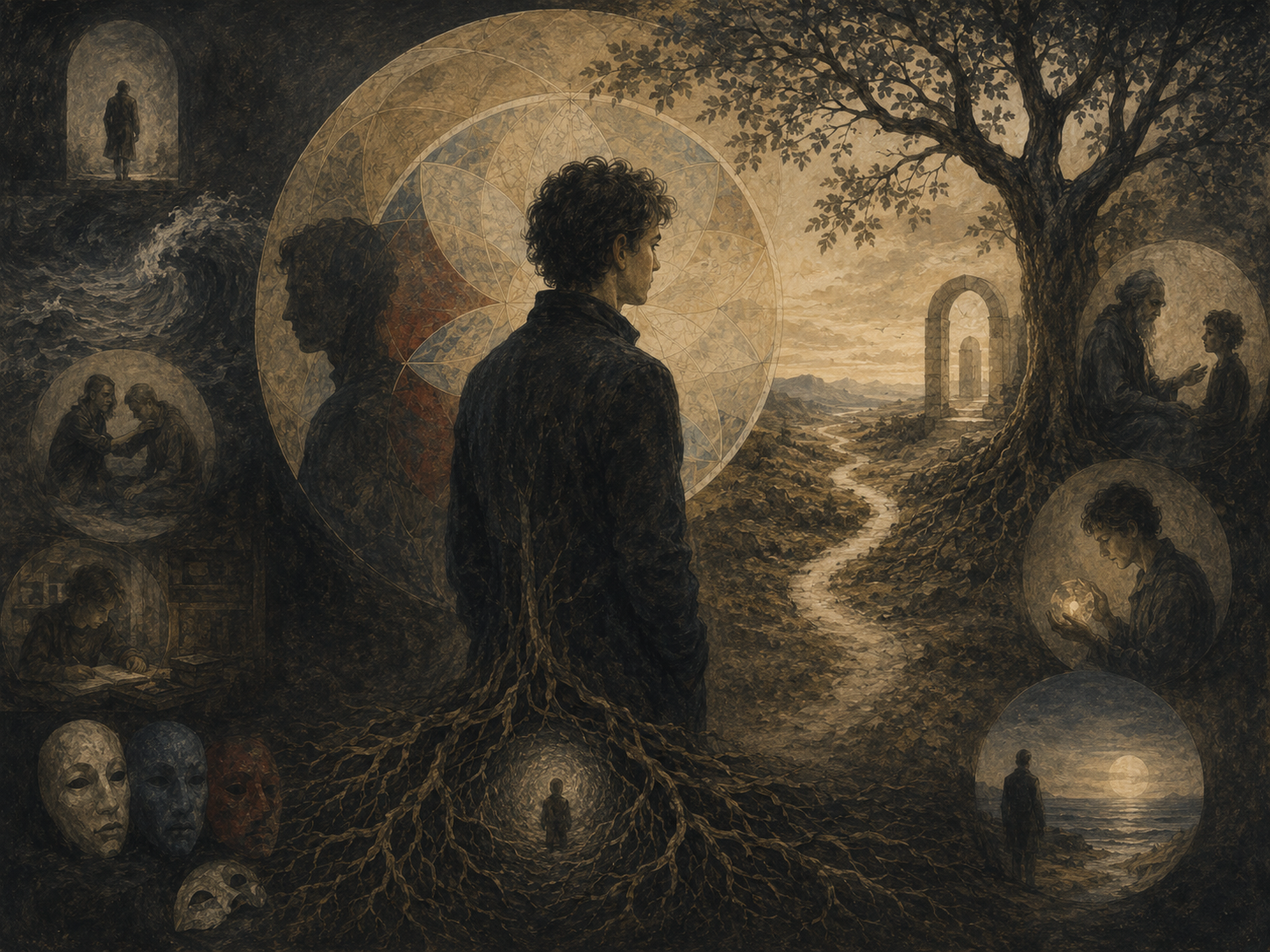
The phrase depth self is useful here because it helps distinguish Jung’s idea from superficial notions of identity. The depth self is not a hidden “real me” waiting intact behind social life, nor a pure essence buried beneath repression. It is not the ego’s preferred story about itself. In a Jungian sense, the depth self develops through relation to the unconscious, through confrontation with shadow, through symbolic encounter, through compensation, through ethical struggle, and through the gradual reorganization of conscious life around something larger than ego preference alone. It is not discovered all at once. It is formed through conflict, humility, symbolization, differentiation, and increasing capacity to bear psychic complexity.
Individuation therefore includes paradox. The person becomes more distinctly themselves not by narrowing into private self-certainty, but by becoming less governed by false innocence and less identified with surface identity. One becomes more singular by becoming more capable of relation to what is not immediately manageable. Development requires not purity but breadth, not self-flattery but integration, not domination of the psyche but more honest participation in it. The depth self is not given prior to this work. It takes shape through it.
This article examines individuation as Jung understood it, with special emphasis on the development of the depth self. It explores how individuation differs from ego development, why it requires confrontation with shadow and symbol, how it relates to the Self, why it is not individualism, how dreams and active imagination participate in the process, and why individuation remains one of the most demanding and generative ideas in analytical psychology. It treats individuation not as a spiritual slogan, therapeutic cliché, or lifestyle language of authenticity, but as a serious theory of psychic development under conditions of inner division, ethical responsibility, and symbolic becoming.
Why Individuation Matters
Individuation matters because human beings are not made whole by adaptation alone. A person may function well, perform competently, and still feel inwardly unreal, divided, or directionless. They may be socially recognized yet psychically estranged from themselves. They may live through roles that are effective but too narrow, cling to beliefs that protect consciousness from contradiction, or repeat conflicts whose deeper meaning they cannot grasp. Jung’s idea of individuation matters because it addresses this deeper problem: how a person becomes more inwardly real under conditions of division, projection, compensation, and symbolic necessity.
Modern life often rewards adaptation more than depth. A person may be trained to produce, persuade, manage, compete, comply, optimize, and perform, while remaining largely unconscious of the psychic costs of that adaptation. They may become highly successful in the language of the collective while remaining alienated from the deeper structures of their own life. The persona becomes functional; the soul becomes neglected. Individuation matters because it challenges the assumption that social effectiveness is the same as psychological truth.
This does not mean adaptation is unimportant. Jung did not imagine that psychological development meant withdrawal from reality into private fantasy. The ego must learn to function. The person must develop responsibility, discipline, relational capacity, work, judgment, and a place in the world. But adaptation becomes dangerous when it is mistaken for totality. A life can become organized around being useful, admirable, productive, moral, attractive, clever, strong, or successful while excluding the parts of the psyche that do not serve that image. Individuation begins when the excluded returns.
Individuation also matters because suffering often has developmental meaning without being reducible to growth. Anxiety, depression, dream disturbance, relational conflict, spiritual crisis, creative pressure, bodily symptoms, and midlife disorientation may all indicate that the conscious personality has become too narrow for the psychic life it contains. Not every suffering is individuation; not every crisis is meaningful; not every breakdown is transformation. Yet some suffering becomes intelligible only when understood as the psyche’s protest against one-sidedness. Individuation gives language to that protest.
This also makes individuation more than a therapeutic technique. It is a theory of development. It proposes that psychic life tends not only toward survival and adaptation but toward greater relation among its own parts. That tendency is not smooth, guaranteed, or benign. It often appears through crisis, breakdown of persona, activation of shadow, dream intensity, symbolic upheaval, or moral discomfort. But the developmental question remains: can a divided person become less divided without collapsing into fantasy, dogma, narcissism, or self-enclosure? Individuation is Jung’s answer to that question.
Individuation matters, finally, because it places psychological development inside an ethical horizon. To know oneself more deeply is not merely to feel authentic. It is to become accountable for projection, shadow, illusion, envy, resentment, aggression, dependence, fear, and unlived possibility. The person who individuates becomes less able to hide behind collective slogans or private innocence. Depth brings responsibility. The more one knows about the psyche’s capacity to divide and deceive, the less innocent self-certainty becomes.
Individuation therefore names a demanding form of becoming. It asks whether the person can develop beyond the adaptive surface without abandoning reality, whether they can encounter unconscious life without inflation, whether they can integrate shadow without moral collapse, and whether they can live from a deeper center without making that center into self-importance. It remains one of Jung’s most important concepts because it recognizes that human development is not only about becoming functional. It is about becoming more whole under the pressure of truth.
What Jung Meant by Individuation
Jung used the term individuation to describe the process by which a person becomes an indivisible psychological whole, not in the sense of perfect harmony, but in the sense of greater relation among differentiated psychic parts. It is the movement toward becoming who one is in the deepest psychological sense, which is very different from simply doing whatever one wants, amplifying one’s conscious preferences, or asserting uniqueness against the collective. Individuation requires differentiation and integration together. The psyche becomes more itself by becoming less naively identified with only one of its partial standpoints.
This distinction matters because individuation is often misunderstood as self-expression. Jung’s view is more severe. Individuation is not the ego declaring independence from convention. It is the ego entering a more truthful relation to the unconscious. That relation may indeed make the person less governed by collective imitation, but it may also make them less governed by private fantasy. The individuating person does not become free by indulging impulse. They become freer by recognizing what had been unconscious, projected, defended, or falsely identified as the whole self.
Jung was careful to distinguish individuation from perfection. The process does not eliminate conflict, contradiction, finitude, moral ambiguity, or suffering. It does not yield a purified self free of tension. Rather, it allows the person to live more consciously within psychic tension and to relate more truthfully to what had previously been disowned or unconscious. Individuation is therefore not the end of struggle. It is a more adequate participation in it.
Individuation involves several linked movements. The person differentiates from collective identity, but not into isolated narcissism. They confront the persona, but do not become socially formless. They encounter shadow, but do not glorify darkness. They relate to contrasexual, relational, or other inner figures without reducing them to stereotypes. They become aware of complexes without imagining they can simply abolish them. They develop symbolic relation to the Self without identifying with it. The process is relational, layered, and incomplete.
Jung’s term also implies that wholeness is not sameness. To become more whole does not mean flattening psychic difference into a single coherent personality brand. It means allowing differentiated parts of the psyche to enter relation. Thinking, feeling, sensation, intuition, body, fantasy, social role, shadow, memory, desire, grief, and spiritual orientation do not become identical. They become more mutually accountable. Individuation preserves difference while reducing unconscious possession by any one part.
The process also requires time. Individuation is not achieved through a sudden insight, a powerful dream, a spiritual experience, or a decisive act of self-definition. Such events may open the process, but they do not complete it. Individuation unfolds through repeated encounters with conflict, symbol, limitation, projection, failure, love, mortality, and the demands of real life. It is not an escape from ordinary existence. It is a deeper way of inhabiting it.
At its strongest, Jung’s concept of individuation gives psychological language to a form of development that is both personal and transpersonal. The person becomes more distinctly themselves, but not because the ego becomes sovereign. They become more themselves because consciousness gradually enters relation with a wider psychic order. That is the paradox at the heart of the concept: individuation is the development of singularity through relation to what exceeds the ego.
| Common misunderstanding | Jungian correction | Developmental implication |
|---|---|---|
| Individuation means doing whatever one wants. | Individuation requires relation to unconscious life, shadow, symbol, and ethical reality. | Desire must be interpreted, not merely obeyed. |
| Individuation means becoming more unique or eccentric. | Individuation means becoming more inwardly differentiated and less unconsciously possessed. | Distinctness emerges through depth, not performance of difference. |
| Individuation means ego perfection. | Individuation relativizes the ego in relation to the Self. | Ego strength matters, but ego sovereignty is not the goal. |
| Individuation means harmony. | Individuation increases conscious relation among tensions and opposites. | Wholeness includes conflict rather than erasing it. |
| Individuation means withdrawal from society. | Individuation changes the person’s relation to the collective without abolishing responsibility. | Inner differentiation should deepen, not destroy, ethical relation. |
Jung’s concept remains powerful because it refuses simplification. It does not reduce development to adjustment, self-esteem, authenticity, productivity, spirituality, or symptom reduction. It asks how a person becomes less divided while remaining fully human: conflicted, finite, embodied, social, symbolic, and accountable.
The Depth Self Is Not the Ego
The depth self, in Jungian terms, cannot be identified with the ego. The ego is the center of consciousness, the “I” that remembers, intends, chooses, narrates, and orients to ordinary reality. It is necessary for daily life. Without ego function, a person cannot sustain continuity, take responsibility, test reality, make commitments, or withstand the pressure of unconscious material. But the ego is partial. It is the center of consciousness, not the center of the whole psyche.
The depth self refers instead to a deeper organization of personhood that includes conscious and unconscious dimensions, symbolic life, shadow, undeveloped possibilities, complexes, bodily knowing, relational patterns, spiritual orientation, and relation to the Self as a wider psychic totality. It is not identical with what the person currently believes about themselves. It includes what consciousness excludes, what dreams reveal, what relationships constellate, what the body carries, and what the psyche seeks to become.
This distinction is one of the reasons individuation cannot be reduced to ego strengthening, though ego strength is often necessary for it. Without a sufficiently formed ego, the person may not be able to bear confrontation with the unconscious. Dreams, active imagination, shadow work, and symbolic intensity can destabilize a weak or fragmented ego. But if the ego becomes the whole horizon of identity, individuation stalls. The depth self emerges not when the ego triumphs, but when it becomes more reflective, less inflated, and more capable of relation to what exceeds it.
The ego tends to narrate identity in familiar terms: “This is who I am,” “This is what I value,” “This is what I want,” “This is what I would never do.” Some of these statements may be true enough for social life, but they are rarely the whole truth psychologically. The unconscious complicates them. Shadow reveals what the ego rejects. Complexes reveal where the ego is not free. Dreams reveal what the ego does not know. The body reveals what conscious language may deny. Relationship reveals projection. The depth self emerges through these complications.
To say that the depth self is not the ego is also to reject a simplistic “true self” model. Jungian depth does not imagine that beneath social adaptation lies a pure, intact, original self waiting to be liberated. The deeper self is not merely hidden; it is developmental. It becomes more real as the person does the work of differentiation and integration. It is formed through symbolic relation, moral encounter, suffering, limitation, and the gradual capacity to hold what had previously been split apart.
This is why individuation can feel like loss before it feels like growth. The ego may lose certainty, innocence, moral simplicity, or identification with role. It may discover dependency where it imagined independence, aggression where it imagined goodness, vulnerability where it imagined strength, or spiritual hunger where it imagined self-sufficiency. These discoveries threaten ego identity, but they may deepen the depth self. The person becomes more whole by becoming less defended against complexity.
The depth self therefore develops through the ego’s transformation, not the ego’s disappearance. A healthy Jungian account does not ask the ego to dissolve into the unconscious or identify with the Self. It asks the ego to become a responsible participant in a larger psychic life. The ego must remain capable of judgment, ethics, and reality-testing, but it must relinquish the fantasy that it is the whole personality. The depth self begins where that fantasy breaks.
Ego Development and Individuation
Ego development and individuation are related, but they are not identical. Ego development concerns the formation of conscious identity, adaptive capacity, self-regulation, responsibility, reality testing, social participation, and narrative continuity. It allows the person to function as an “I” in the world. Individuation, by contrast, concerns the reorganization of that “I” in relation to unconscious life and the wider psychic totality. Ego development asks whether the person can stand in the world. Individuation asks whether the person can stand in truthful relation to the whole psyche.
This distinction matters because the two processes can be confused in both directions. A person with a weak ego may interpret fragmentation, fantasy, or instability as individuation when what is needed first is stabilization, containment, and basic ego support. Conversely, a person with a strong adaptive ego may mistake competence for depth and never enter the deeper work of shadow, symbol, and Self-relation. Jungian development requires both: an ego strong enough to relate to the unconscious and humble enough not to identify with the whole psyche.
Ego development often belongs to the first half of life: building identity, developing skills, forming relationships, entering work, learning boundaries, and becoming capable of responsibility. These are not inferior tasks. A person who cannot adapt may be overwhelmed by fantasy or dependency. A person who cannot commit may mistake evasion for freedom. A person who cannot work, love, or choose may need ego development before individuation can proceed in any sustained way.
Individuation becomes more urgent when ego structures harden into one-sidedness. The ego that once helped the person adapt may become a prison. A professional identity becomes a persona. A moral identity becomes a defense against shadow. A rational identity excludes feeling. A spiritual identity excludes aggression or body. A caregiving identity excludes need. A successful identity excludes grief. Individuation does not reject ego development; it relativizes it. The structures that allowed the person to survive and function must now be brought into relation with what they excluded.
Clinical and reflective work must therefore ask what kind of development is needed. Is the person lacking ego coherence, or are they overly identified with ego control? Is symbolic material overwhelming because the ego is too weak, or is it pressing because the ego is too rigid? Is the person withdrawing from responsibility in the name of depth, or avoiding depth in the name of responsibility? These distinctions shape whether the work should emphasize stabilization, interpretation, confrontation, symbolic elaboration, relational repair, or ethical responsibility.
| Dimension | Ego development | Individuation |
|---|---|---|
| Primary question | Can the person function as a coherent “I”? | Can the ego relate to the wider psyche? |
| Developmental task | Adaptation, identity, responsibility, boundaries, continuity | Shadow encounter, symbolic relation, Self-orientation, integration of opposites |
| Danger of weakness | Fragmentation, poor reality testing, instability, dependence | Inflation, overwhelm, dissociation, fantasy mistaken for depth |
| Danger of excess | Rigid control, persona identification, defensive certainty | Spiritual grandiosity, isolation, over-symbolization, contempt for ordinary life |
| Healthy relation | A stable ego able to bear experience | A humble ego able to participate in a larger psychic order |
Ego development gives the person a center of consciousness. Individuation teaches that this center is not the whole. The depth self develops when the ego is neither dissolved nor idolized, but brought into living relation with shadow, symbol, body, history, relationship, and the Self.
Individuation and the Problem of One-Sidedness
One-sidedness is one of the central problems individuation addresses. Consciousness becomes organized through preference, development, adaptation, and defense. One function becomes dominant, one role becomes central, one moral image becomes necessary, one style of relating appears natural, one life story becomes familiar. This one-sided organization is not accidental; it is part of how consciousness becomes coherent. But it also excludes. The person becomes effective by narrowing.
Jung believed that the psyche compensates for this narrowing. What is excluded remains active. The neglected function becomes inferior. The disowned trait becomes shadow. The ignored conflict returns through dreams, affective disturbance, body symptoms, relational repetition, or compulsive attraction. Individuation begins when the person can no longer sustain the illusion that their one-sided conscious identity is adequate to the whole of their life.
One-sidedness can appear in many forms. A rational person may exclude feeling and then be overwhelmed by moods they cannot interpret. A moral person may exclude aggression and then project evil onto others. A successful person may exclude vulnerability and then collapse under failure or aging. A spiritual person may exclude body and power. A helper may exclude need. A rebel may exclude dependence. A responsible person may exclude play. A tolerant person may exclude judgment. Every developed position casts a shadow.
One-sidedness is not simply a mistake. It is often necessary for survival and development. Children, adolescents, and young adults must often become one-sided in order to become anything at all. A person develops a dominant function, a social identity, a vocation, a moral orientation, and a way of managing anxiety. The problem arises when the one-sided structure becomes absolute. The person begins to mistake partial adaptation for wholeness. The psyche then compensates.
Compensation may initially feel like disruption. Dreams bring unfamiliar figures. Relationships constellate conflict. The body refuses endless control. Depression withdraws energy from an exhausted persona. Envy reveals unlived desire. Anger reveals violated boundaries. Attraction reveals projection. Fear reveals vulnerability. These disturbances are not automatically wise, but they may carry information from the excluded side of the personality. The task is to interpret them without either repressing or blindly obeying them.
Individuation transforms one-sidedness not by erasing differentiation but by widening relation. The thinker does not cease thinking; they develop feeling. The helper does not cease caring; they recover need and boundary. The moral person does not abandon ethics; they confront shadow. The successful person does not necessarily abandon work; they recover soul. The spiritual person does not reject transcendence; they return to body. Integration means the dominant standpoint becomes less tyrannical, not that all standpoints become equal in a flat way.
This is why individuation is difficult. One-sidedness often feels like identity. To loosen it can feel like betrayal of oneself, family, morality, religion, profession, or community. A person may defend the very structure that imprisons them because it once protected them. Individuation asks the person to honor the developmental necessity of the old structure while recognizing that it is no longer sufficient. The psyche does not demand that consciousness become shapeless. It demands that consciousness become less false.
Persona, Shadow, and the First Break in Self-Illusion
For many people, individuation begins with the failure of the persona. The socially adapted self no longer feels sufficient. Success feels empty, competence brittle, moral certainty suspect, or role identity exhausted. This first break is often painful because the person must begin to distinguish between what has functioned publicly and what is psychically true. The persona may have helped the person survive, work, belong, and be recognized, but now it reveals its cost.
The persona is not inherently false. It is the necessary interface between the individual and the social world. A person needs roles, manners, professional identity, family responsibilities, and ways of participating in collective life. Jung’s critique is not of persona itself, but of identification with persona. When the person becomes the role, the role begins to govern psychic life. The adaptive face becomes a mask that forgets it is a mask.
Individuation often begins when the mask cracks. A person may discover that they have spent years being useful but not truthful, admirable but inwardly dead, strong but cut off from grief, responsible but resentful, spiritual but dissociated from body, successful but estranged from desire. This discovery can bring shame, anger, depression, relief, or panic. The persona’s failure reveals that the person’s public identity cannot contain the whole psyche.
Closely linked to this is confrontation with the shadow. What consciousness excluded now appears as a living problem. Aggression, envy, dependency, grief, desire, fear, laziness, ambition, tenderness, hatred, truthfulness, or creative vitality return in forms the ego cannot easily assimilate. Individuation deepens precisely when false innocence weakens. The person begins to discover that they are larger, darker, more vulnerable, and more divided than their persona allowed them to know.
Shadow confrontation is not the same as indulging the shadow. To recognize anger does not mean acting cruelly. To recognize desire does not mean betraying commitments. To recognize envy does not mean becoming resentful. To recognize aggression does not mean abandoning ethics. Shadow integration requires consciousness, not acting out. The person must learn what the disowned material means, what it protects, what it distorts, and what legitimate life it may contain.
The first break in self-illusion is often humiliating because the person loses the comfort of self-image. They may discover that they are not as generous, rational, tolerant, loving, brave, free, spiritual, or victimless as they imagined. But this humiliation can become liberating if it reduces projection. A person who recognizes their own shadow becomes less eager to locate all darkness outside themselves. They may still judge, resist, and act ethically, but they do so with less false purity.
Persona and shadow therefore mark one of the first major thresholds of individuation. The person must learn to participate in society without being consumed by role, and to confront disowned psychic life without being possessed by it. The depth self begins to develop when the public self and the rejected self can enter conscious relation.
Complexes, Symbols, and Developmental Pressure
Individuation is not driven by will alone. The psyche exerts developmental pressure through complexes, dreams, imaginal material, bodily states, affective repetitions, and symbolic formations. A complex may repeatedly constellate because the underlying psychic organization has not yet been integrated. A symbol may appear because consciousness lacks language for what is trying to emerge. Development, in Jung’s view, is often pressured from below and beyond the ego.
A complex is an affectively charged cluster of memory, image, expectation, bodily response, and reaction. Complexes behave semi-autonomously because they can seize the personality before the ego understands what has happened. A person may react with disproportionate shame, rage, fear, dependence, withdrawal, or certainty because a complex has been activated. In such moments, the person does not merely have a feeling; they are possessed by an organized psychic field.
Complexes are central to individuation because they show where the personality is not free. The ego may believe it chooses, but the complex reveals compulsion. The ego may believe the present is clear, but the complex imports the past. The ego may believe its judgments are objective, but the complex colors perception. To become more individuated is not to eliminate complexes altogether, but to become less unconsciously governed by them. The person learns to say, “A complex is active,” rather than simply becoming the complex.
Symbols enter the process because complexes cannot always be resolved through explanation alone. A person may understand a pattern intellectually and still remain possessed by it. The psyche often requires symbolic mediation: a dream image, active imagination figure, ritual form, artwork, mythic parallel, bodily gesture, or narrative that allows the complex to be related to differently. Symbol does not merely decorate insight. It creates a form in which psychic energy can move.
A symbol differs from a sign because it exceeds simple translation. A dream house, animal, child, wound, stranger, mandala, river, or dark figure cannot be reduced to one fixed meaning. It gathers psychic complexity into an image that consciousness can approach. Symbols allow the psyche to hold opposites, compress history, express affect, and point toward future development. They are crucial to individuation because the depth self develops through symbolic relation, not only through rational self-description.
Developmental pressure often appears when the ego’s current organization cannot contain what the psyche is becoming. The person may dream repeatedly, become fascinated by certain images, feel pulled toward creative work, experience bodily symptoms, encounter relational repetition, or feel a strange urgency around themes they do not yet understand. Such pressure may be destabilizing. It must be assessed carefully, especially where trauma, psychosis, mania, or severe depression are present. But where ego capacity is sufficient, symbolic pressure may indicate that the psyche is reorganizing.
| Individuation pressure | How it may appear | Developmental meaning | Clinical or ethical caution |
|---|---|---|---|
| Complex activation | Disproportionate affect, repetition, projection, bodily intensity | A charged psychic pattern seeks recognition and differentiation | Do not treat possession by a complex as simple choice or character flaw |
| Dream intensification | Recurring symbols, unfamiliar figures, compensatory images | The unconscious presents material beyond the ego’s current standpoint | Interpret through context and association, not formula |
| Creative compulsion | Urgency to write, draw, build, sing, study, or make symbolic form | Unconscious material seeks expression and mediation | Distinguish disciplined creativity from flight from responsibility |
| Relational repetition | Repeated conflicts, attractions, betrayals, or dependency patterns | Projection and complex structure are being constellated through relationship | Do not spiritualize harm or bypass accountability |
| Symbolic crisis | Loss of old meaning, spiritual uncertainty, fascination with myth or ritual | Old symbolic order no longer organizes life sufficiently | Guard against inflation, cultic dependence, or grandiose certainty |
Complexes and symbols therefore drive individuation by revealing where consciousness is incomplete. They disturb the ego, but they also provide material for development. The depth self takes shape as the person becomes capable of bearing, interpreting, and integrating these pressures without either repressing them or being consumed by them.
The Self as Orienting Center
Individuation is oriented not toward ego mastery but toward the Self. Jung’s concept of the Self gives individuation its horizon. The Self is not the ego perfected. It is the wider totality and symbolic center of the psyche, the ordering wholeness that exceeds conscious identity while orienting it. Individuation is the gradual re-situation of the ego in relation to this larger center.
This makes the Self one of Jung’s most difficult concepts. It cannot be understood simply as a personal ideal, a spiritual essence, a higher self, or an inner voice telling the ego what it wants to hear. The Self is a symbol of psychic totality, not a convenient source of permission. It includes light and dark, conscious and unconscious, personal and transpersonal, order and disruption. The ego may experience the Self as guidance, but also as crisis, correction, humiliation, or demand.
Symbols of the Self often appear as images of order, center, containment, sacred geometry, wise figures, children, paths, houses, mandalas, trees, stones, vessels, or circular movement. Such images suggest that the psyche is attempting to organize itself around a deeper pattern. But the appearance of Self-symbols does not mean individuation is achieved. It means the ego is being invited into relation with a symbolic center that it does not control.
The relation between ego and Self is delicate. If the ego refuses the Self, life may remain organized around persona, adaptation, and defensive one-sidedness. If the ego identifies with the Self, inflation may result. The person may imagine themselves chosen, enlightened, uniquely authorized, or beyond ordinary limits. Healthy individuation requires a middle path: the ego must become responsive to the Self without claiming to be the Self. This is one of the central ethical disciplines of Jungian psychology.
The Self also reorders values. Under its influence, the person may become less governed by social approval, achievement, image, or inherited identity. But this does not necessarily produce dramatic external change. Sometimes the change is inward: a different relation to work, love, suffering, time, body, or responsibility. Sometimes external structures must change because they no longer correspond to inner truth. But even then, individuation requires ethical discernment rather than impulsive obedience to intensity.
Self-orientation also deepens the meaning of the depth self. The depth self is not merely the sum of recovered shadow material or personal authenticity. It develops in relation to a wider psychic order. The ego discovers that it belongs to something larger, and that psychological truth is not simply self-expression. The person becomes more whole by learning to live in relation to the center that exceeds the ego’s plans.
Jung’s concept of the Self remains controversial, especially when interpreted metaphysically or spiritually. But psychologically, it captures a real experience: the sense that the psyche has organizing tendencies that are not reducible to conscious will. Dreams, symbols, crises, and transformative encounters often seem to orient the person toward a pattern they did not invent. Individuation is the long work of responding to that pattern without surrendering critical judgment.
Individuation Is Not Individualism
Jung’s term is often misunderstood because it sounds like a celebration of self-enclosed uniqueness. But individuation is not individualism. It does not mean the person becomes sovereign, self-invented, and answerable only to private preference. In fact, the process often undermines narcissistic self-certainty. It requires humility before the psyche, greater ethical seriousness, and a more honest relation to dependence, shadow, history, and symbolic reality.
Individualism often imagines the self as independent, autonomous, and self-authorizing. Individuation reveals that the self is relational, historical, embodied, symbolic, and partially unconscious. The person is shaped by family, culture, language, body, history, dream, trauma, desire, and collective patterns. Becoming more individuated does not mean denying these conditions. It means becoming more conscious of how they live within the psyche and how one may respond to them more truthfully.
The individuating person may indeed become more distinct, less governed by collective imitation, and less trapped in role conformity. But that distinctness comes through depth, not through self-display. Individuation makes a person more real, not simply more idiosyncratic. The person becomes less dependent on borrowed identity, but also less able to pretend that private impulse equals truth. They become more capable of standing apart where necessary and more capable of relation where needed.
This distinction is especially important in cultures that market authenticity as personal branding. A person may be encouraged to express themselves, optimize themselves, curate themselves, and differentiate themselves from others while remaining deeply unconscious of shadow, projection, and symbolic life. Such self-expression can become another persona. Individuation asks for something more difficult: not “How do I display my uniqueness?” but “What truth am I avoiding because my identity depends on not knowing it?”
Individuation also does not mean contempt for the collective. Jung was critical of mass conformity, but he did not imagine that development required antisocial detachment. Human beings need community, law, tradition, language, care, and shared symbolic forms. The problem is not collective life itself, but unconscious identification with it. Individuation changes the person’s relation to the collective so that they can participate without being swallowed by it.
Nor does individuation mean isolation from responsibility. A person cannot claim individuation while using depth language to excuse cruelty, abandonment, exploitation, or indifference. The individuating person becomes more accountable, not less. They may have to disappoint others when collective expectations violate psychic truth, but they also have to confront the shadow motives that can hide inside “truth.” Independence without self-knowledge is often only another form of possession.
Individuation is therefore a relational form of singularity. The person becomes more distinctly themselves through deeper relation to unconscious life, symbolic reality, other people, history, and the Self. It is not the ego standing alone. It is the ego becoming more honestly situated within the whole field of psyche and world.
The Middle Passage and Psychic Reorganization
Although individuation can begin at many points in life, Jung and many post-Jungian writers associated it strongly with the middle passage of life, when earlier identity structures may begin to fail. Goals once pursued lose force. Persona no longer satisfies. Deferred conflicts intensify. Symbolic material becomes more urgent. What had been left unconscious presses for recognition. Midlife often dramatizes the difference between adaptation and individuation because the structures that supported the first half of life may no longer carry the second.
This does not mean individuation belongs only to midlife. Childhood, adolescence, early adulthood, old age, trauma, illness, grief, migration, love, failure, or spiritual crisis may all activate individuation pressure. But midlife is often a privileged threshold because the person has usually built enough ego structure and social identity for the limitations of those structures to become visible. The question is no longer only “Can I enter the world?” but “Can I live truthfully in the world I have entered?”
The middle passage often begins with loss of meaning. Work may continue, but feel hollow. Relationship may remain stable, but reveal buried distance. Success may be present, but no longer convincing. The body may bring mortality into awareness. Dreams may become more vivid. Old memories may return. Attractions, resentments, creative longings, or spiritual questions may intensify. The psyche begins withdrawing energy from the old organization.
Such withdrawal can feel like depression, disorientation, or failure. Sometimes it is clinical depression and requires direct care. Sometimes it is also symbolic: the old life no longer mediates psychic meaning. Jungian thought must hold both possibilities. Midlife suffering should never be romanticized, but it should also not be reduced too quickly to dysfunction. A life may be breaking down because it needs care; it may also be breaking open because it needs truth.
The middle passage is dangerous because the unlived life returns with force. The person may project renewal onto a lover, vocation, place, spiritual path, or idealized future. Some external change may be necessary, but projection can distort discernment. What appears as destiny may be shadow. What appears as liberation may be avoidance. What appears as love may carry the hunger of the unlived self. Individuation requires that midlife intensity be interpreted before it is obeyed.
The second half of life may require a different orientation: less driven by conquest, recognition, and expansion; more oriented toward meaning, relation, finitude, service, symbolic depth, and inward truth. This shift does not mean withdrawal from action. Many people become more creative and publicly engaged after the middle passage. But the source of action changes. The person acts less to prove existence and more to serve what has become inwardly necessary.
The middle passage therefore reveals individuation as psychic reorganization. The old center weakens; a new center has not yet formed. This liminal period can be painful, but it may also be fertile. The depth self becomes more audible when the old arrangements no longer hold. The question is whether the person can endure the threshold long enough for a deeper pattern to emerge.
Dreams, Active Imagination, and the Work of Becoming
Dreams and active imagination are central to individuation because they make symbolic development more accessible. Dreams compensate for conscious one-sidedness and may show what is emerging before the ego understands it. Active imagination extends that symbolic relation into waking life through disciplined dialogue with imaginal figures, moods, scenes, and affects. Together, these practices allow the psyche’s hidden movements to become more thinkable.
Dreams matter because they do not merely repeat conscious opinion. They often present the ego with images that challenge its standpoint. A person identified with competence may dream of failure, exposure, or helplessness. A person identified with purity may dream of dirt, animals, criminals, or sexuality. A person identified with rationality may dream of mythic figures or impossible landscapes. A person identified with spiritual light may dream of darkness. Such dreams are not random. They may show the compensatory activity of the psyche, balancing what consciousness has excluded.
Dreams also have a prospective function. They may not only reveal what has been neglected, but hint at what is trying to develop. Images of paths, children, houses, unknown rooms, guides, animals, water, vessels, mandalas, trees, or thresholds may point toward emerging psychic organization. The dream does not provide a simple instruction. It presents a symbolic field in which consciousness can begin to participate. Individuation often advances when the person learns to take such images seriously without literalizing them.
Active imagination deepens this participation. Rather than analyzing the image from a distance only, the person enters relation with it. They may write dialogue, draw, move, sculpt, speak, or imaginatively engage a figure or scene. The aim is not fantasy indulgence. It is disciplined symbolic encounter. The ego remains present enough to respond, question, resist, and listen. Active imagination becomes dangerous when the ego abdicates judgment or treats every image as sacred command. It becomes transformative when ego and unconscious enter a responsible dialogue.
The development of the depth self depends on such symbolic encounters because the psyche cannot be integrated by conceptual explanation alone. A person may know their shadow intellectually and still remain unchanged. But a dream figure may confront them with living force. An imaginal dialogue may reveal grief, rage, longing, or wisdom that abstract analysis could not reach. A repeated symbol may become a vessel for psychic transformation. Symbolic work gives form to the unfinished psyche.
Dreams and active imagination also require context. Not every dream is profound. Not every image should be amplified. Trauma, psychosis, dissociation, mania, and severe destabilization require clinical caution. Symbolic work depends on ego capacity. A person who cannot maintain reality testing may be overwhelmed by imaginal material. Responsible Jungian work therefore distinguishes between symbolic engagement and psychic flooding.
At their best, dreams and active imagination allow individuation to become lived rather than merely discussed. They bring the ego into relation with shadow, complexes, symbolic center, and future possibility. The depth self develops through this participation: not by forcing unconscious material into conscious categories, but by allowing symbolic life to reorganize consciousness from within.
Symbolic Life and the Depth Self
The depth self develops through symbolic life because the psyche cannot always speak in direct conceptual language. It speaks through dream, fantasy, image, ritual, bodily metaphor, mythic pattern, affective atmosphere, creative form, and relational enactment. Symbolic life mediates between what is unconscious and what can become conscious. Without symbol, the person may remain trapped between raw affect and rigid explanation. With symbol, experience can take form, become visible, and enter relation.
This is why Jung placed so much importance on symbols. A symbol is not merely an ornament, analogy, or decorative image. It is a living formation that holds more meaning than consciousness can immediately exhaust. It gathers conflict and possibility into a form that can be approached. A dream of a house may hold body, family, psyche, memory, and future development at once. A child image may carry vulnerability, wound, new life, and destiny. A shadow figure may carry rejected aggression and needed strength. A mandala may express a movement toward order that the ego has not yet achieved.
Symbolic life is essential to individuation because it protects complexity. When the ego reduces experience too quickly, development narrows. A symbol allows the psyche to hold opposing meanings without premature closure. Water may be danger and renewal. Darkness may be fear and depth. Death may be loss and transformation. A stranger may be threat and guide. The symbol refuses the ego’s demand for immediate simplification.
At the same time, symbolic life must remain connected to reality. Jungian interpretation becomes weak when it floats away from body, history, relationship, ethics, and material conditions. A symbol must be approached through the person’s actual life. A dream of a father is not only archetypal authority; it may also involve the person’s real father, institutions, religion, class, race, trauma, gender, and body. Symbolic depth does not erase concreteness. It deepens it.
The depth self emerges when symbolic life reorganizes identity. The person begins to see that their life is not only a sequence of events, roles, and choices, but a field of meaning shaped by unconscious patterns. They begin to recognize motifs: abandonment, rescue, exile, return, sacrifice, inflation, descent, renewal, betrayal, initiation, reconciliation. These motifs are not scripts to obey, but patterns to understand. Symbolic awareness makes life more psychologically legible.
Creative work often plays a role here. Writing, painting, music, movement, craft, coding, scholarship, design, prayer, and ritual can become forms in which unconscious material finds shape. The person does not simply express themselves; they discover themselves through form. The work becomes a container for psychic development. The depth self grows where symbolic form allows hidden experience to become consciously related.
Symbolic life also has communal and cultural dimensions. Myths, religious traditions, stories, art, and collective rituals provide shared containers for psychic experience. Individuation does not require inventing meaning from nothing. It often involves re-entering inherited symbolic forms more consciously, revising them, wrestling with them, or finding new forms when old ones no longer hold. The depth self is personal, but it develops within symbolic worlds larger than the individual.
Individuation therefore depends on the capacity to live symbolically without becoming unreal. The symbol must neither be dismissed as fantasy nor inflated into absolute command. It must be related to. The depth self develops through that relation: attentive, disciplined, imaginative, embodied, and ethically grounded.
Ethical Depth and the Cost of Self-Knowledge
Individuation is ethically demanding because it requires relinquishing flattering illusions. The person must become less invested in innocence, less governed by projection, less dependent on persona, and more capable of admitting contradiction within themselves. This is not merely intrapsychic technique. It changes moral life. One judges differently when one knows more about one’s own shadow. One inhabits conflict differently when one recognizes how easily the psyche divides and distorts.
The cost of self-knowledge is therefore real. Individuation may bring less certainty, less vanity, less dramatic purity, and more burden. But that burden is also depth. The person becomes more able to live truthfully because they have ceased demanding that truth flatter them. This is why individuation can feel painful even when it is developmental. It strips away the consolations of simple self-image.
Ethical depth begins with projection. The psyche often locates disowned material outside itself. The arrogant person sees arrogance everywhere else. The dependent person despises dependency in others. The angry person condemns aggression. The morally rigid person finds impurity around them. The wounded person may interpret every conflict as injury done by others. Individuation requires withdrawing projection—not by denying external reality, but by recognizing the psychic contribution one brings to perception.
This does not mean all judgment becomes projection. Jungian psychology should not be used to neutralize moral clarity. Abuse, injustice, domination, cruelty, and exploitation are real. The point is not that evil exists only inside the observer. The point is that the observer must know their own participation in shadow if their moral response is to remain grounded. Ethical action becomes stronger when it is less possessed by unconscious projection.
Self-knowledge also carries relational cost. As the person becomes less identified with persona, relationships organized around that persona may strain. Family systems may resist change. Institutions may prefer compliance. Partners may feel threatened by new honesty. The person may discover that some bonds were based on adaptation rather than truth. Individuation does not guarantee relational harmony. It often reveals where relationship must deepen, change, or end.
Ethical depth also requires responsibility for symbolic inflation. A person who has powerful dreams, spiritual experiences, creative breakthroughs, or intense encounters with the unconscious may become inflated. They may believe themselves chosen, exceptional, beyond ordinary morality, or uniquely insightful. Jung warned repeatedly against this danger. Individuation requires humility precisely because unconscious material can feel numinous. The more powerful the symbol, the greater the need for grounding.
The cost of self-knowledge includes grief. One must grieve the idealized self, the unlived life, the harm one has done, the harm one has suffered, the limits of repair, and the fantasies that cannot be lived literally. Grief prevents individuation from becoming grandiose. It keeps development connected to finitude. The person becomes deeper not by transcending loss, but by allowing loss to become part of truth.
Individuation is ethical, then, because it changes the person’s relation to responsibility. It asks for less projection, more humility, more courage, more symbolic discipline, and more willingness to know what is difficult. The depth self is not morally perfect. It is more accountable to psychic reality than the persona was able to be.
Individuation Across the Life Course
Individuation should not be imagined as a single decisive event. It unfolds unevenly across the life course. Some phases are marked by strong differentiation and ego formation, others by shadow encounter, others by symbolic consolidation, others by crisis and reorganization. The process is not linear. There may be regressions, renewals, compensations, and new symbolic tasks at different stages. The depth self is not “found” once and for all. It continues to develop as consciousness enters new relations with suffering, loss, love, mortality, meaning, and finitude.
In childhood, individuation is not yet the adult process Jung often described, but its foundations are forming. Ego differentiation, symbolic play, relational trust, body awareness, and early complex organization shape the later capacity for individuation. A child who can play, imagine, feel, and relate develops conditions that later allow symbolic work. A child whose development is marked by trauma, shame, or rigid family projection may later need to repair these foundations before deeper work can proceed safely.
In adolescence, individuation appears through separation, identity formation, peer relation, conflict with authority, emerging sexuality, moral questioning, and the search for symbolic belonging. Adolescence can be intensely one-sided because the young person needs identity. But it also opens the question of differentiation from family and collective expectation. The adolescent’s challenge is not full individuation, but the beginning of conscious separation.
In early adulthood, the task often involves adaptation: work, love, commitment, responsibility, and entry into collective life. Jungian thought sometimes risks undervaluing this phase when it emphasizes later depth. But the first half of life is essential. The person must develop enough ego strength and world relation to have something that can later be relativized. A person cannot meaningfully move beyond adaptation if they have never developed it.
Midlife often brings individuation into sharper focus because first-half structures begin to show their limits. Persona, achievement, family role, and social identity may no longer suffice. Shadow and unlived life return with intensity. Dreams may become more powerful. Mortality becomes real. This is why many Jungians associate midlife with the middle passage. It is a moment when the ego’s old organization may break open under pressure from the Self.
Later life brings different individuation tasks. The person may confront bodily decline, dependency, loss, legacy, regret, simplification, spiritual reckoning, and death. The question becomes less “What can I become?” and more “What can be reconciled, transmitted, released, or carried with dignity?” Individuation in later life may involve accepting limitation without surrendering meaning. The depth self deepens through relation to finitude.
| Life phase | Developmental emphasis | Individuation task |
|---|---|---|
| Childhood | Ego emergence, attachment, symbolic play, complex formation | Formation of conditions for later symbolic and relational depth |
| Adolescence | Separation, identity, peer relation, authority conflict | Initial differentiation from family and collective identity |
| Early adulthood | Adaptation, vocation, relationship, responsibility, persona formation | Building ego strength and world participation |
| Midlife | Collapse or revision of old meanings, shadow return, unlived life | Reorganization around symbolic center and deeper self-relation |
| Later life | Finitude, loss, legacy, reconciliation, simplification | Integration of mortality, memory, gratitude, grief, and meaning |
Individuation across the life course is therefore not a straight ascent toward wholeness. It is a recurring confrontation with the psyche’s unfinished truth. Each life phase brings new material, new limits, and new symbolic tasks. The depth self develops through these changing demands, never as a completed object, but as a deepening relation to life as it actually unfolds.
Individuation, Relationship, and Community
Individuation is sometimes imagined as a solitary inward journey, and there is truth in that image. The person must confront what no one else can confront for them. They must withdraw projections, face shadow, listen to dreams, bear loneliness, and develop a more truthful relation to the unconscious. Yet individuation is not anti-relational. It unfolds through relationship as well as solitude. Other people reveal the psyche. Love, conflict, friendship, family, community, and institutional life all constellate unconscious material.
Relationships are among the primary sites of projection. A partner, friend, teacher, enemy, child, parent, leader, or stranger may carry psychic material that belongs partly to the individual’s own unconscious. Attraction, irritation, idealization, contempt, dependency, fear, and envy often reveal what the ego does not yet know about itself. Individuation requires learning from these projections without reducing the other person to a psychological mirror. The other is real, and the projection is real. Both must be held.
Love can deepen individuation because it confronts the person with dependence, vulnerability, desire, fear, and the limits of control. A person may discover that their self-image collapses in intimacy. They may meet jealousy, need, shame, tenderness, aggression, or abandonment terror. Relationship can become a powerful field of individuation when it supports truth, repair, mutual recognition, and differentiation. It becomes destructive when unconscious complexes dominate the field without reflection.
Community also matters because individuation requires a relation to the collective. The person must differentiate from collective identity, but they also need shared language, moral accountability, symbolic forms, and practical support. A person who individuates without community may become isolated or inflated. A community that allows no individuation becomes oppressive. The tension between belonging and differentiation is one of the central social dimensions of Jungian development.
Institutions can either support or obstruct individuation. Schools, workplaces, religious communities, professional cultures, families, and political systems often reward persona and punish complexity. They may demand compliance, productivity, innocence, loyalty, or ideological certainty. Yet institutions can also provide symbolic containers, mentorship, discipline, public responsibility, and shared forms of service. The individuating person must discern when collective structures support development and when they enforce unconscious conformity.
Individuation also changes the person’s participation in community. They may become less eager to belong at any cost, less dependent on approval, and less willing to participate in collective shadow. But they may also become more capable of genuine contribution because they are less governed by projection and persona. Their distinctness can become service rather than self-display.
The depth self therefore develops in a rhythm of solitude and relation. Some truths can only be faced inwardly. Others only become visible in the presence of another. Individuation is not the escape from relationship into selfhood. It is the development of a self capable of more truthful relationship.
Cultural and Collective Dimensions
Individuation is personal, but it is never merely private. The psyche forms within culture, language, history, religion, race, gender, class, nation, institution, and collective memory. A person does not individuate outside these conditions. They individuate through and against them. Jung’s attention to the collective unconscious helps explain why individual development often draws on images, myths, symbols, and patterns larger than personal biography. But a contemporary account must also attend to concrete histories of power, exclusion, and inherited trauma.
Collective identity can support development by giving symbolic language, belonging, ritual, moral orientation, and continuity. It can also obstruct individuation when it demands unconscious conformity. Family myths, national myths, religious certainties, professional identities, political ideologies, racial hierarchies, gender scripts, and class expectations may all become psychic structures. The person may mistake inherited identity for inner truth. Individuation requires distinguishing what one has received from what one has consciously chosen, transformed, or refused.
Collective shadow is especially important. Groups often disown their own violence, dependency, envy, fear, aggression, or shame and project it onto outsiders. Nations project evil onto enemies. Institutions project failure onto scapegoats. Families project pathology onto the identified patient. Religious communities project impurity onto dissenters. Political movements project corruption entirely onto opponents. Individuation at the personal level includes becoming less available to such projections, but it also requires recognizing how collective shadow lives inside the individual.
Cultural and historical trauma complicate individuation. A person may carry inherited fear, silence, displacement, humiliation, religious injury, racialized vigilance, caste memory, family exile, or institutional betrayal. Such material is not merely personal complex. It belongs to social and historical fields. Jungian interpretation becomes inadequate if it reduces collective injury to individual shadow. The depth self develops in relation to history as well as dream.
Marginalized communities also face a special problem: what looks like individuation from one angle may look like survival from another. A person whose identity has been denied may first need collective belonging before differentiation is possible. A person under social threat may not have the same freedom to disregard collective expectations. A serious account of individuation must avoid universalizing the developmental path of those with greater privilege. The work of becoming oneself is shaped by real conditions of power, safety, recognition, and possibility.
At the same time, individuation can support resistance to dehumanizing collective patterns. A person who becomes more conscious of projection, shadow, and inherited myth may be less easily absorbed by propaganda, scapegoating, or moral panic. They may become more capable of ethical independence. They may also contribute more responsibly to communities because they are less possessed by unconscious collective identities.
The cultural and collective dimensions of individuation therefore deepen the concept. Individuation is not withdrawal into private interiority. It is the development of a person capable of standing in more conscious relation to the symbolic, historical, and institutional worlds that shape them. The depth self is inward, but it is not isolated from history.
Criticisms and Qualifications
Individuation has often been criticized for vagueness, spiritual inflation, cultural overgeneralization, and possible elitism. These criticisms are serious. The concept can become a flattering myth of self-realization if it is detached from ethical struggle, historical reality, clinical caution, and psychological restraint. It can also be romanticized as though every crisis were secretly growth or every symbolic experience profound.
A disciplined reading resists this. Not all suffering is individuation. Not all symbolic material is deep. Not every turn inward is developmental. Not every dream requires amplification. Not every desire represents the Self. Not every rejection of social norms is psychologically mature. Jung’s concept remains useful only when it retains its difficulty: individuation as confrontation with one-sidedness, relation to the unconscious, and development under tension rather than a decorative language of authenticity.
One criticism is that individuation can sound too individual-centered. Jungian language may focus on the person’s inner development while insufficiently addressing poverty, racism, colonialism, gendered violence, disability, war, labor exploitation, or institutional harm. A person’s suffering may not arise primarily from inner division; it may arise from social conditions. A serious account of individuation must not interpret structural injury as merely intrapsychic symbolism.
Another criticism concerns spiritual inflation. Because individuation involves the Self, symbols, dreams, and numinous experience, it can be misused by people who want to feel special. They may treat symbolic experiences as proof of destiny, superiority, or exemption from ordinary responsibility. This is a distortion of Jung’s concept. Individuation should humble the ego, not glorify it. The deeper the symbol, the greater the ethical burden.
A third criticism concerns gender and cultural assumptions in classical Jungian theory. Some traditional formulations of anima, animus, masculine, feminine, and life stages reflect historical categories that require revision. Individuation remains useful when freed from rigid gender essentialism and brought into conversation with contemporary psychology, feminist thought, queer theory, postcolonial critique, disability studies, and social history. The core idea of integrating excluded psychic life does not require preserving outdated cultural assumptions.
A fourth criticism is that individuation can be clinically risky if used too broadly. Severe trauma, dissociation, psychosis, mania, suicidal depression, and acute instability require careful clinical support. Powerful symbolic material may destabilize rather than integrate when ego capacity is insufficient. Jungian depth work must therefore be paced and ethically grounded. The unconscious is not always healing when approached directly. Sometimes stabilization, safety, medical care, or relational repair must come first.
| Criticism | Risk | Responsible Jungian response |
|---|---|---|
| Vagueness | Individuation becomes a vague word for self-improvement | Define it through ego, shadow, complexes, symbol, Self, and ethical integration |
| Spiritual inflation | The ego identifies with symbolic or numinous experience | Emphasize humility, grounding, and distinction between ego and Self |
| Individualism | Social responsibility is replaced by private authenticity | Distinguish individuation from self-enclosed autonomy |
| Social blindness | Structural harm is reduced to inner symbolism | Hold psyche, history, institution, and power together |
| Clinical overreach | Unconscious material is explored before safety or ego capacity is sufficient | Use pacing, stabilization, referral, and clinical caution where needed |
These qualifications do not weaken individuation. They make it more serious. The concept remains valuable when it is held as a demanding developmental process rather than a flattering identity story. Individuation is not a shortcut to meaning. It is the long work of becoming less false in relation to oneself, others, history, and the unconscious.
Mathematical Lens
Individuation can be modeled as a process of increasing integration among differentiated psychic domains under conditions of tension, compensation, and symbolic mediation. Let \(E_t\) represent ego coherence, \(S_t\) shadow acknowledgment, \(C_t\) complex activation, \(R_t\) relation to symbolic center, and \(I_t\) individuation potential at time \(t\). A stylized individuation function may be written as:
I_t = \alpha + \beta_1 E_t + \beta_2 S_t + \beta_3 R_t – \beta_4 |C_t| + \varepsilon_t
\]
Interpretation: Individuation potential increases with sufficient ego coherence, shadow acknowledgment, and relation to symbolic center. Strong unresolved complex activation can destabilize the process when it possesses the personality rather than becoming consciously related.
This model does not claim that individuation is literally measurable as a single score. It clarifies a systems logic: development depends on both structure and depth. Ego coherence is needed, but it is not enough. Shadow acknowledgment is needed, but it can destabilize without ego capacity. Symbolic relation is needed, but it can inflate the ego if not grounded. Complex activation may supply developmental pressure, but it may also overwhelm the system.
One-sidedness can be represented as destructive discrepancy among psychic domains. Let \(x_i\) represent differentiated domains such as persona, feeling, shadow recognition, symbolic relation, body awareness, and ego flexibility. A stylized one-sidedness estimate may be written as:
W_t = \sum_{i=1}^{n}(x_i – \bar{x})^2
\]
Interpretation: One-sidedness rises when psychic domains become highly uneven or isolated. Individuation does not erase difference; it reduces destructive dissociation among domains by increasing ordered relation.
A third expression can model the development of the depth self as increasing connectivity among previously separated psychic clusters. Let \(G_t = (V,E)\) be a psychic network at time \(t\), where nodes represent domains such as ego, persona, shadow, complexes, symbolic center, body, and reflective capacity. Let \(K_t\) represent integration connectivity.
K_t = \frac{2|E_t|}{|V_t|(|V_t|-1)}
\]
Interpretation: As more meaningful links form among differentiated psychic domains, integration connectivity rises. Wholeness is not fusion into sameness, but more ordered relation among parts that had been split, projected, or isolated.
The mathematical lens helps distinguish integration from simplification. A highly individuated psyche is not one without difference or tension. It is one in which tension becomes more consciously held. The depth self emerges not by eliminating shadow, persona, complexes, or symbolic conflict, but by creating stronger relations among them under the orienting pressure of the Self.
In this sense, individuation can be understood as a nonlinear developmental system. Complex activation may initially reduce stability while increasing developmental pressure. Shadow acknowledgment may temporarily increase conflict before increasing integration. Symbolic relation may produce disorientation before new meaning emerges. The process is not a smooth upward curve. It is a dynamic reorganization of the personality network.
R Workflow: Simulating Individuation as Integration Under Tension
The following R workflow simulates individuation as a dynamic interaction among ego coherence, shadow acknowledgment, complex activation, symbolic relation, persona identification, reflective capacity, and depth-self integration. It models development as structured integration under tension rather than as simple stabilization. The data are synthetic and illustrative. They do not represent real people, therapy outcomes, diagnosis, personality assessment, or clinical recommendations.
# ============================================================
# Individuation and the Development of the Depth Self
# R Workflow: Individuation as integration under tension
# ============================================================

# This workflow uses synthetic data for conceptual demonstration.
# It is not a clinical tool, diagnostic instrument, personality
# assessment, treatment recommendation system, or empirical
# validation of Jungian individuation theory.

library(dplyr)
library(ggplot2)
library(lme4)
library(broom.mixed)
library(tidyr)

set.seed(2026)

# ------------------------------------------------------------
# 1. Create synthetic person-period data
# ------------------------------------------------------------

n_people <- 260
n_periods <- 24

person_level <- tibble(
  person_id = 1:n_people,
  baseline_ego_coherence = rnorm(n_people, 0, 1),
  baseline_persona_identification = rnorm(n_people, 0, 1),
  baseline_symbolic_relation = rnorm(n_people, 0, 1),
  baseline_reflective_capacity = rnorm(n_people, 0, 1),
  individuation_pathway = sample(
    c(
      "persona_crisis",
      "shadow_encounter",
      "symbolic_awakening",
      "complex_repetition",
      "midlife_reorganization",
      "ethical_reckoning"
    ),
    size = n_people,
    replace = TRUE
  )
)

panel <- expand.grid(
  person_id = 1:n_people,
  time = 1:n_periods
) |>
  arrange(person_id, time) |>
  left_join(person_level, by = "person_id") |>
  mutate(
    developmental_time = time / max(time),

    persona_identification =
      baseline_persona_identification +
      0.02 * time -
      0.05 * pmax(time - 10, 0) +
      ifelse(individuation_pathway == "persona_crisis", -0.24, 0) +
      rnorm(n(), 0, 0.42),

    ego_coherence =
      baseline_ego_coherence +
      0.04 * time -
      0.20 * abs(persona_identification) +
      0.28 * baseline_reflective_capacity +
      rnorm(n(), 0, 0.44),

    symbolic_relation =
      baseline_symbolic_relation +
      0.06 * time +
      ifelse(individuation_pathway == "symbolic_awakening", 0.44, 0) +
      ifelse(individuation_pathway == "midlife_reorganization", 0.28, 0) +
      rnorm(n(), 0, 0.48),

    shadow_acknowledgment =
      0.34 * symbolic_relation -
      0.26 * persona_identification +
      0.32 * baseline_reflective_capacity +
      ifelse(individuation_pathway == "shadow_encounter", 0.50, 0) +
      rnorm(n(), 0, 0.52),

    complex_activation =
      0.40 * persona_identification -
      0.22 * ego_coherence -
      0.18 * shadow_acknowledgment +
      ifelse(individuation_pathway == "complex_repetition", 0.62, 0) +
      ifelse(individuation_pathway == "ethical_reckoning", 0.32, 0) +
      rnorm(n(), 0, 0.56),

    reflective_capacity =
      baseline_reflective_capacity +
      0.30 * ego_coherence +
      0.28 * symbolic_relation +
      0.24 * shadow_acknowledgment -
      0.20 * abs(complex_activation) +
      rnorm(n(), 0, 0.42)
  )

# ------------------------------------------------------------
# 2. Estimate one-sidedness and compensation pressure
# ------------------------------------------------------------

panel <- panel |>
  mutate(
    onesidedness =
      (ego_coherence - shadow_acknowledgment)^2 +
      (symbolic_relation - complex_activation)^2 +
      (persona_identification - reflective_capacity)^2,

    compensation_pressure =
      0.44 * onesidedness +
      0.36 * abs(complex_activation) -
      0.28 * reflective_capacity +
      rnorm(n(), 0, 0.38)
  )

# ------------------------------------------------------------
# 3. Simulate depth-self integration
# ------------------------------------------------------------

panel <- panel |>
  mutate(
    depth_self_integration =
      0.54 * ego_coherence +
      0.62 * shadow_acknowledgment +
      0.66 * symbolic_relation +
      0.52 * reflective_capacity -
      0.42 * abs(complex_activation) -
      0.28 * onesidedness +
      0.20 * compensation_pressure +
      rnorm(n(), 0, 0.56),

    individuation_score =
      0.58 * depth_self_integration +
      0.42 * symbolic_relation +
      0.38 * shadow_acknowledgment +
      0.34 * reflective_capacity -
      0.32 * persona_identification -
      0.30 * abs(complex_activation) +
      rnorm(n(), 0, 0.46)
  )

# ------------------------------------------------------------
# 4. Estimate mixed-effects model
# ------------------------------------------------------------

model <- lmer(
  individuation_score ~ ego_coherence +
    shadow_acknowledgment +
    symbolic_relation +
    reflective_capacity +
    complex_activation +
    onesidedness +
    persona_identification +
    compensation_pressure +
    time +
    (1 | person_id),
  data = panel
)

summary(model)

fixed_effects <- broom.mixed::tidy(model, effects = "fixed")
print(fixed_effects)

# ------------------------------------------------------------
# 5. Summarize by individuation pathway
# ------------------------------------------------------------

pathway_summary <- panel |>
  group_by(individuation_pathway) |>
  summarize(
    mean_ego_coherence = mean(ego_coherence),
    mean_persona_identification = mean(persona_identification),
    mean_shadow_acknowledgment = mean(shadow_acknowledgment),
    mean_symbolic_relation = mean(symbolic_relation),
    mean_complex_activation = mean(complex_activation),
    mean_reflective_capacity = mean(reflective_capacity),
    mean_onesidedness = mean(onesidedness),
    mean_depth_self_integration = mean(depth_self_integration),
    mean_individuation_score = mean(individuation_score),
    .groups = "drop"
  ) |>
  arrange(desc(mean_individuation_score))

print(pathway_summary)

# ------------------------------------------------------------
# 6. Developmental trajectory
# ------------------------------------------------------------

trajectory <- panel |>
  group_by(time) |>
  summarize(
    mean_ego_coherence = mean(ego_coherence),
    mean_persona_identification = mean(persona_identification),
    mean_shadow_acknowledgment = mean(shadow_acknowledgment),
    mean_symbolic_relation = mean(symbolic_relation),
    mean_complex_activation = mean(complex_activation),
    mean_depth_self_integration = mean(depth_self_integration),
    mean_individuation_score = mean(individuation_score),
    .groups = "drop"
  ) |>
  pivot_longer(
    cols = c(
      mean_ego_coherence,
      mean_persona_identification,
      mean_shadow_acknowledgment,
      mean_symbolic_relation,
      mean_complex_activation,
      mean_depth_self_integration,
      mean_individuation_score
    ),
    names_to = "measure",
    values_to = "value"
  )

ggplot(trajectory, aes(x = time, y = value, linetype = measure)) +
  geom_line(linewidth = 1) +
  labs(
    title = "Simulated Individuation Under Psychic Tension",
    subtitle = "Depth-self integration rises as symbolic relation, shadow acknowledgment, and reflective capacity strengthen",
    x = "Developmental time",
    y = "Mean synthetic score"
  ) +
  theme_minimal()

# ------------------------------------------------------------
# 7. Pathway comparison
# ------------------------------------------------------------

pathway_long <- pathway_summary |>
  pivot_longer(
    cols = c(
      mean_persona_identification,
      mean_shadow_acknowledgment,
      mean_symbolic_relation,
      mean_complex_activation,
      mean_onesidedness,
      mean_depth_self_integration,
      mean_individuation_score
    ),
    names_to = "measure",
    values_to = "value"
  )

ggplot(
  pathway_long,
  aes(x = reorder(individuation_pathway, value), y = value, fill = measure)
) +
  geom_col(position = "dodge") +
  coord_flip() +
  labs(
    title = "Synthetic Individuation Pathways",
    subtitle = "Different pathways show different balances of persona, shadow, symbol, complexes, one-sidedness, and depth-self integration",
    x = "Individuation pathway",
    y = "Mean synthetic score"
  ) +
  theme_minimal()

# ------------------------------------------------------------
# Possible extensions
# ------------------------------------------------------------

# 1. Add dream intensity as a mediator of symbolic relation.
# 2. Model midlife crises as spikes in complex activation.
# 3. Compare rigid and flexible ego structures.
# 4. Simulate active imagination as growth in shadow acknowledgment.
# 5. Estimate nonlinear development across life stages.
# 6. Add relational repair and community accountability.
# 7. Model Self-symbol emergence as a latent organizing factor.
A richer version could add separate domains for typological imbalance, body awareness, dream intensity, ethical accountability, or Self-symbol emergence. That would make it possible to simulate not just overall integration, but the specific developmental routes through which individuation may proceed or stall. The purpose is not to reduce individuation to numbers, but to clarify the systems logic of integration under tension.
Python Workflow: Modeling the Development of the Depth Self as a Dynamic Network
The following Python workflow treats the depth self as an emergent property of a network in which ego, persona, shadow, complexes, symbolic center, reflective capacity, body awareness, ethical accountability, and relational life become more connected over time. The aim is to model individuation as changing relation among psychic clusters rather than as a fixed trait. The workflow is conceptual and synthetic, not clinical, diagnostic, or predictive.
# ============================================================
# Individuation and the Development of the Depth Self
# Python Workflow: Dynamic depth-self integration network
# ============================================================
#
# This workflow is a conceptual network demonstration.
# It is not a clinical, diagnostic, treatment recommendation,
# personality assessment, or prediction tool.

from pathlib import Path
import networkx as nx
import pandas as pd
import numpy as np

np.random.seed(2026)

# ------------------------------------------------------------
# 1. Build a simplified individuation network
# ------------------------------------------------------------

G = nx.DiGraph()

nodes = {
    "ego": {"activation": 0.82, "node_type": "ego_capacity"},
    "persona": {"activation": 0.88, "node_type": "adaptive_structure"},
    "shadow": {"activation": 0.38, "node_type": "unconscious_content"},
    "complexes": {"activation": 0.52, "node_type": "developmental_pressure"},
    "symbolic_center": {"activation": 0.42, "node_type": "self_symbol"},
    "reflective_capacity": {"activation": 0.62, "node_type": "integration_capacity"},
    "body_awareness": {"activation": 0.40, "node_type": "embodied_capacity"},
    "ethical_accountability": {"activation": 0.44, "node_type": "ethical_capacity"},
    "relational_life": {"activation": 0.50, "node_type": "relational_field"},
    "dream_function": {"activation": 0.46, "node_type": "symbolic_capacity"},
    "depth_self": {"activation": 0.32, "node_type": "outcome"},
}

for node, attrs in nodes.items():
    G.add_node(node, **attrs)

edges = [
    ("ego", "persona", 0.36),
    ("ego", "reflective_capacity", 0.48),
    ("ego", "ethical_accountability", 0.30),

    ("persona", "shadow", 0.28),
    ("persona", "complexes", 0.22),

    ("complexes", "shadow", 0.42),
    ("complexes", "dream_function", 0.30),
    ("complexes", "depth_self", -0.24),

    ("shadow", "reflective_capacity", 0.34),
    ("shadow", "ethical_accountability", 0.30),
    ("shadow", "depth_self", 0.42),

    ("symbolic_center", "depth_self", 0.62),
    ("symbolic_center", "reflective_capacity", 0.38),
    ("symbolic_center", "ethical_accountability", 0.28),

    ("dream_function", "symbolic_center", 0.34),
    ("dream_function", "shadow", 0.26),

    ("reflective_capacity", "depth_self", 0.50),
    ("reflective_capacity", "complexes", -0.22),

    ("body_awareness", "depth_self", 0.32),
    ("body_awareness", "reflective_capacity", 0.24),

    ("ethical_accountability", "depth_self", 0.36),
    ("relational_life", "shadow", 0.22),
    ("relational_life", "ethical_accountability", 0.32),
    ("relational_life", "depth_self", 0.28),

    ("depth_self", "ego", 0.28),
    ("depth_self", "persona", -0.18),
]

for source, target, weight in edges:
    G.add_edge(source, target, weight=weight)

# ------------------------------------------------------------
# 2. Simulate activation over time
# ------------------------------------------------------------

history = []

for step in range(20):
    compensation_pressure = np.random.normal(0.68, 0.20)
    integration_support = np.random.normal(0.46, 0.14)
    new_activations = {}

    for node in G.nodes():
        incoming = 0.0

        for predecessor in G.predecessors(node):
            incoming += (
                G.nodes[predecessor]["activation"]
                * G[predecessor][node]["weight"]
            )

        base = G.nodes[node]["activation"]
        node_type = G.nodes[node]["node_type"]

        if node_type in {
            "unconscious_content",
            "developmental_pressure",
            "self_symbol",
            "symbolic_capacity",
        }:
            updated = base + 0.10 * compensation_pressure + 0.10 * incoming
        elif node_type in {
            "ego_capacity",
            "integration_capacity",
            "embodied_capacity",
            "ethical_capacity",
            "relational_field",
            "outcome",
        }:
            updated = base + 0.08 * integration_support + 0.10 * incoming
        else:
            updated = base + 0.08 * incoming

        new_activations[node] = max(0.0, min(updated, 3.0))

    # Individuation gradually relativizes persona dominance.
    new_activations["persona"] *= 0.975

    # Reflective capacity and ethical accountability strengthen through repeated integration.
    new_activations["reflective_capacity"] = min(
        new_activations["reflective_capacity"] + 0.018,
        3.0,
    )
    new_activations["ethical_accountability"] = min(
        new_activations["ethical_accountability"] + 0.014,
        3.0,
    )

    for node in G.nodes():
        G.nodes[node]["activation"] = new_activations[node]

    history.append({"step": step, **new_activations})

results_df = pd.DataFrame(history)

print("Activation history")
print(results_df)

# ------------------------------------------------------------
# 3. Centrality metrics
# ------------------------------------------------------------

centrality_df = pd.DataFrame(
    {
        "node": list(G.nodes()),
        "node_type": [G.nodes[n]["node_type"] for n in G.nodes()],
        "betweenness": list(nx.betweenness_centrality(G, weight="weight").values()),
        "degree_centrality": list(nx.degree_centrality(G).values()),
        "out_degree": [G.out_degree(n) for n in G.nodes()],
        "in_degree": [G.in_degree(n) for n in G.nodes()],
        "final_activation": [G.nodes[n]["activation"] for n in G.nodes()],
    }
).sort_values(["betweenness", "degree_centrality"], ascending=False)

print("\nNetwork centrality")
print(centrality_df)

# ------------------------------------------------------------
# 4. Inspect inputs to depth self
# ------------------------------------------------------------

depth_self_inputs = []

for predecessor in G.predecessors("depth_self"):
    depth_self_inputs.append(
        {
            "source": predecessor,
            "source_type": G.nodes[predecessor]["node_type"],
            "weight": G[predecessor]["depth_self"]["weight"],
            "final_activation": G.nodes[predecessor]["activation"],
            "weighted_contribution": (
                G.nodes[predecessor]["activation"]
                * G[predecessor]["depth_self"]["weight"]
            ),
        }
    )

depth_self_input_df = pd.DataFrame(depth_self_inputs).sort_values(
    "weighted_contribution",
    ascending=False,
)

print("\nInputs to depth self")
print(depth_self_input_df)

# ------------------------------------------------------------
# 5. Track individuation balance
# ------------------------------------------------------------

results_df["adaptive_surface_index"] = results_df[
    ["ego", "persona"]
].mean(axis=1)

results_df["depth_integration_index"] = results_df[
    [
        "shadow",
        "symbolic_center",
        "reflective_capacity",
        "body_awareness",
        "ethical_accountability",
        "relational_life",
        "dream_function",
        "depth_self",
    ]
].mean(axis=1)

results_df["complex_pressure_index"] = results_df[
    ["complexes"]
].mean(axis=1)

results_df["depth_minus_surface"] = (
    results_df["depth_integration_index"] -
    results_df["adaptive_surface_index"]
)

balance_df = results_df[
    [
        "step",
        "adaptive_surface_index",
        "depth_integration_index",
        "complex_pressure_index",
        "depth_minus_surface",
        "ego",
        "persona",
        "shadow",
        "complexes",
        "symbolic_center",
        "reflective_capacity",
        "ethical_accountability",
        "depth_self",
    ]
]

print("\nIndividuation balance")
print(balance_df)

# ------------------------------------------------------------
# Possible extensions
# ------------------------------------------------------------

# 1. Simulate persona collapse as a shock event.
# 2. Add dream symbols as separate developmental nodes.
# 3. Model strong shadow resistance via weaker reflective edges.
# 4. Compare early-life and midlife network states.
# 5. Estimate how active imagination changes depth_self integration.
# 6. Add cultural, institutional, or collective-shadow nodes.
# 7. Model trauma as weakening symbolic and reflective connectivity.
This model reflects a core Jungian idea: the depth self does not appear as a preformed hidden essence but as an emergent integration of previously divided domains. Individuation strengthens relation among these domains without abolishing their tension. The person becomes more whole not by simplifying the psyche, but by entering more conscious relation with its complexity.
GitHub Repository
The companion repository extends this article’s argument into reproducible, multi-language research scaffolding. It supports synthetic individuation data, depth-self integration simulation, one-sidedness modeling, persona-and-shadow workflows, dynamic individuation network scripts, structured documentation, SQL schemas, and reusable methods for examining how ego coherence, persona identification, shadow acknowledgment, complex activation, symbolic relation, reflective capacity, ethical accountability, body awareness, and relation to the Self interact in Jungian developmental theory.
| Repository area | Purpose | Use in this article context |
|---|---|---|
python |
Dynamic network modeling and tabular analysis | Models the depth self as an emergent network linking ego, persona, shadow, complexes, symbolic center, dreams, body awareness, ethics, and relational life |
r |
Simulation, statistical modeling, and visualization | Simulates individuation score, one-sidedness, compensation pressure, persona identification, shadow acknowledgment, and depth-self integration across time |
sql |
Structured data design and query examples | Stores synthetic individuation variables, depth-self integration measures, symbolic-relation indicators, and one-sidedness estimates |
julia |
Numerical simulation and scenario analysis | Can extend individuation models into nonlinear crisis, symbolic-center emergence, and shadow-integration scenarios |
c, cpp, fortran, go, rust |
Compiled-language examples and computational scaffolds | Provide simple scoring, reproducibility, and systems-modeling examples for individuation potential and depth-self integration |
data, notebooks, outputs, docs |
Inputs, notebooks, generated figures/tables, and documentation | Keep synthetic data, exploratory notebooks, results, method notes, validation plans, and responsible-use documentation organized |
These materials are for synthetic-data research, methods demonstration, conceptual modeling, symbolic-process analysis, institutional learning, and reproducible workflows. They are not intended for diagnosis, therapy, psychological assessment, clinical decision-making, life prediction, employment screening, workplace surveillance, individual performance management, or individual evaluation.
Complete Code Repository
Access the full companion repository for this article, including reproducible analysis materials, synthetic individuation data, depth-self integration workflows, persona-and-shadow models, dynamic individuation network scripts, and multi-language code scaffolding for analytical psychology research.
Conclusion
Individuation and the development of the depth self belong at the heart of analytical psychology because they name the psyche’s demand for a more truthful life than adaptation, persona, and conscious preference alone can provide. The process is not self-celebration, not private authenticity rhetoric, and not a guarantee of peace. It is the difficult formation of a less divided person through relation to shadow, symbol, conflict, body, relationship, and the Self as a wider psychic center.
The depth self, in this view, is not merely found. It is developed through the erosion of one-sidedness and through increasing capacity to live in relation to what consciousness does not control. That is why individuation remains such a demanding concept. It asks whether a person can become more genuinely themselves only by becoming less defended against what is most difficult to know. Jung’s answer was yes, and that answer still marks one of the boldest theories of psychological development in modern thought.
But the answer must be held carefully. Individuation is not individualism, inflation, self-invention, or symbolic grandiosity. It does not excuse harm, abandon responsibility, or transform every crisis into proof of destiny. Its seriousness lies in the opposite direction. It asks for humility before the unconscious, moral responsibility before shadow, discernment before symbol, and relation before certainty. The more deeply the person enters the psyche, the more accountable they become for how they live.
The development of the depth self is therefore not an escape from ordinary life. It transforms ordinary life from within. Work, love, body, grief, aging, community, history, dreams, and failure become part of the individuation field. The person becomes more whole not by leaving the world behind, but by meeting the world with a less divided psyche. The mask becomes more transparent. The shadow becomes less projected. The dream becomes more audible. The ego becomes more humble. The Self becomes less an idea than an orienting reality.
In this sense, individuation remains a necessary language for psychological development in any age marked by performance, fragmentation, collective projection, and shallow identity. It reminds us that becoming oneself is not a matter of branding, preference, or self-display. It is a lifelong task of integration under tension. The depth self emerges where the person can bear complexity without fleeing into false simplicity—and where consciousness becomes brave enough to enter relation with the whole psyche it belongs to.
Related articles
- The Self in Jungian Thought: Totality, Center, and Symbol
- Ego, Consciousness, and Psychic Differentiation
- The Shadow and the Psychology of Disowned Selfhood
- Persona and Social Adaptation in Analytical Psychology
- The Personal Unconscious and the Theory of Complexes
- Dreams, Compensation, and the Prospective Function
- Dream Interpretation in Analytical Psychology
- Active Imagination and the Practice of Symbolic Dialogue
- Midlife, Meaning, and Individuation
- Analytical Psychology, Symbolism & the Depth Mind
Further reading
- Edinger, E.F. (1972) Ego and Archetype: Individuation and the Religious Function of the Psyche. Boston, MA: Shambhala. Available via Shambhala.
- Jung, C.G. (1966) Two Essays on Analytical Psychology, trans. R.F.C. Hull. 2nd edn. Princeton, NJ: Princeton University Press. Available via Princeton University Press.
- Jung, C.G. (1976) Aion: Researches into the Phenomenology of the Self, trans. R.F.C. Hull. Princeton, NJ: Princeton University Press. Available via Princeton University Press.
- Jung, C.G. (1981) The Development of Personality, trans. R.F.C. Hull. Princeton, NJ: Princeton University Press. Available via Princeton University Press.
- Jung, C.G. (1989) The Symbolic Life: Miscellaneous Writings, trans. R.F.C. Hull. Princeton, NJ: Princeton University Press. Available via Princeton University Press.
- Jung, C.G. (2009) The Red Book: Liber Novus, ed. S. Shamdasani. New York: W.W. Norton. Available via W.W. Norton.
- Samuels, A., Shorter, B. and Plaut, F. (1986) A Critical Dictionary of Jungian Analysis. London: Routledge. Available via Routledge.
- Stein, M. (1998) Jung’s Map of the Soul: An Introduction. Chicago, IL: Open Court. Available via Open Court.
- Stein, M. (2006) Individuation: Inner Work. Boston, MA: Shambhala. Available via Shambhala.
- Young-Eisendrath, P. and Dawson, T. (eds.) (2008) The Cambridge Companion to Jung. 2nd edn. Cambridge: Cambridge University Press. Available via Cambridge University Press.
References
- Edinger, E.F. (1972) Ego and Archetype: Individuation and the Religious Function of the Psyche. Boston, MA: Shambhala. Available via Shambhala.
- Jacobi, J. (1965) The Way of Individuation. New York: Harcourt, Brace & World.
- Jung, C.G. (1966) Two Essays on Analytical Psychology, trans. R.F.C. Hull. 2nd edn. Princeton, NJ: Princeton University Press. Available via Princeton University Press.
- Jung, C.G. (1968) The Archetypes and the Collective Unconscious, trans. R.F.C. Hull. 2nd edn. Princeton, NJ: Princeton University Press. Available via Princeton University Press.
- Jung, C.G. (1976) Aion: Researches into the Phenomenology of the Self, trans. R.F.C. Hull. Princeton, NJ: Princeton University Press. Available via Princeton University Press.
- Jung, C.G. (1981) The Development of Personality, trans. R.F.C. Hull. Princeton, NJ: Princeton University Press. Available via Princeton University Press.
- Jung, C.G. (1989) The Symbolic Life: Miscellaneous Writings, trans. R.F.C. Hull. Princeton, NJ: Princeton University Press. Available via Princeton University Press.
- Jung, C.G. (2009) The Red Book: Liber Novus, ed. S. Shamdasani. New York: W.W. Norton. Available via W.W. Norton.
- Knox, J. (2003) Archetype, Attachment, Analysis: Jungian Psychology and the Emergent Mind. Hove: Brunner-Routledge. Available via Routledge.
- Samuels, A., Shorter, B. and Plaut, F. (1986) A Critical Dictionary of Jungian Analysis. London: Routledge. Available via Routledge.
- Stein, M. (1998) Jung’s Map of the Soul: An Introduction. Chicago, IL: Open Court. Available via Open Court.
- Stein, M. (2006) Individuation: Inner Work. Boston, MA: Shambhala. Available via Shambhala.
- Young-Eisendrath, P. and Hall, J.A. (eds.) (1991) Jung’s Self Psychology: A Constructivist Perspective. New York: Guilford Press. Available via Guilford Press.
- Young-Eisendrath, P. and Dawson, T. (eds.) (2008) The Cambridge Companion to Jung. 2nd edn. Cambridge: Cambridge University Press. Available via Cambridge University Press.