
Last Updated May 21, 2026
Aging is not the opposite of development. It is development under changing conditions of body, time, social role, memory, health, vulnerability, adaptation, care, and meaning. Later life is often misrepresented in one of two reductive ways: either as simple decline or as an unrealistically triumphant ideal of “successful aging” detached from illness, loss, dependency, and mortality. Developmental psychology offers a stronger account. Later life is a phase in which change continues through adaptation, compensation, reflection, shifting social roles, altered embodiment, and a different relationship to time itself.
The question is not whether development continues in later life. It does. The deeper question is what kind of development later life makes possible under conditions of bodily aging, accumulated history, changing social position, and unequal support. Older adulthood can include loss, illness, bereavement, disability, role transition, and dependency. It can also include selective investment, emotional depth, wisdom, care, practical adaptation, relational repair, community contribution, spiritual seriousness, and new forms of dignity. Later life is developmental because the person continues to reorganize life under changing conditions.
Main Library
Publications
Article Map
Developmental Psychology
Related Topic
Cognitive Psychology
Related Topic
Positive Psychology
Related Topic
Risk & Resilience
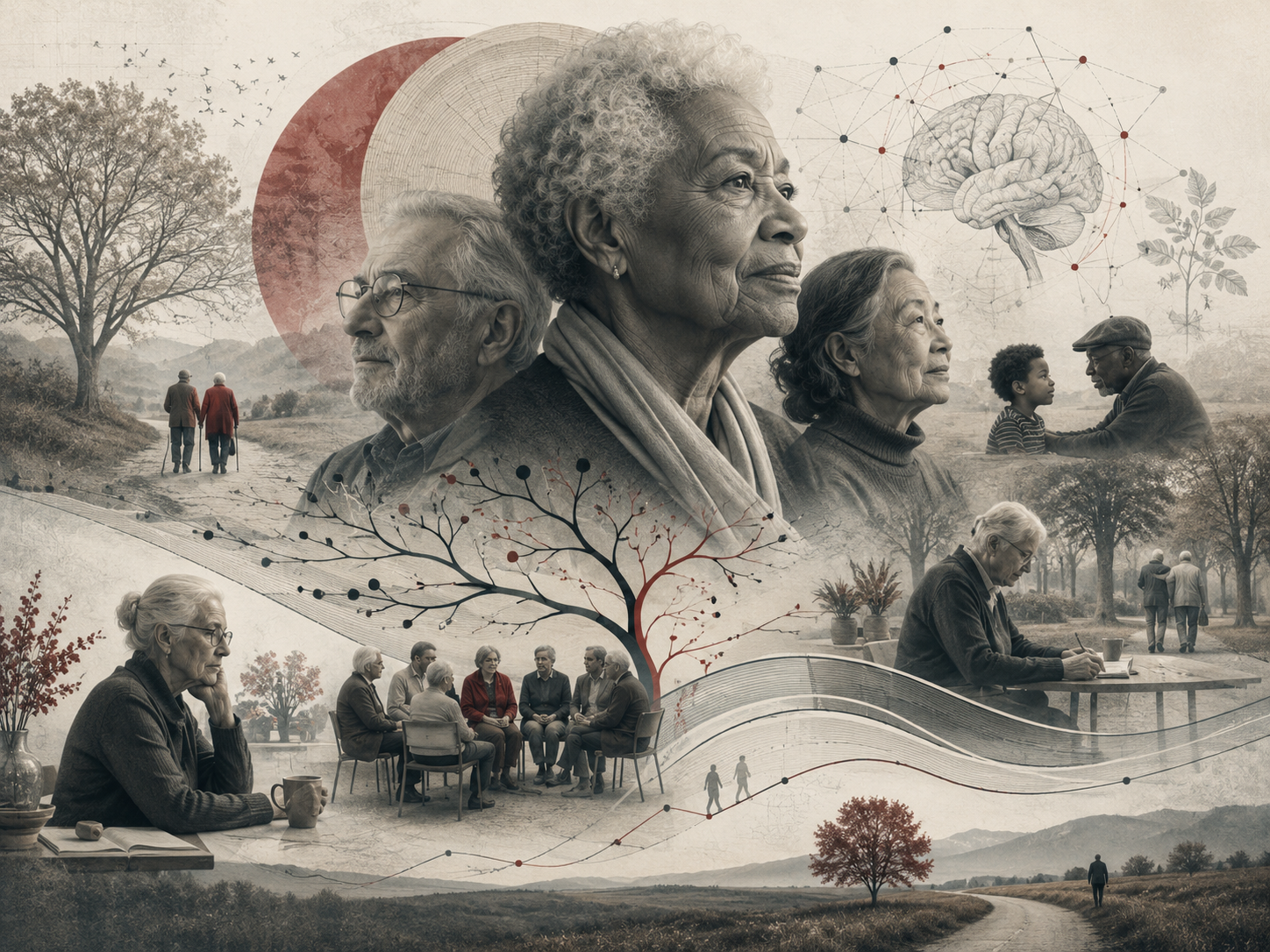
Current official sources support a developmental rather than decline-only view of later life. WHO’s healthy-ageing framework defines healthy ageing around the development and maintenance of functional ability that enables well-being in older age. NIA frames healthy aging as preserving health, functioning, independence where possible, and quality of life rather than merely extending years of life. CDC’s healthy-aging materials similarly foreground physical, mental, emotional, and social health as people grow older. APA’s aging resources treat later life as part of continuous psychological change across the lifespan. Together, these sources point toward a more serious developmental account: aging is a changing relation between organism, environment, institution, history, care, and meaning.
Aging is therefore not merely biological deterioration. It is biological change lived through social worlds. Hearing loss, pain, reduced mobility, chronic disease, cognitive change, or increased care needs have different developmental consequences depending on housing, transportation, health care, family support, assistive technology, neighborhood safety, social connection, income, stigma, and institutional design. Later-life development is not located in the body alone. It emerges through the relation between changing bodies and the environments that either support or constrain them.
Why Later Life Matters
Later life matters because it is one of the clearest phases in which development becomes inseparable from adaptation. Earlier development often emphasizes acquisition: new capacities, new roles, independence, language, identity, work, family formation, and social participation. Later life more often makes visible the developmental work of adjustment, compensation, revision, acceptance, care, loss, and reorganization. This does not make later development less real. It makes it psychologically complex.
Older adults often confront bereavement, changing health, altered mobility, retirement, caregiving reversal, time compression, institutional dependency, and social loss. Yet they may also continue to learn, revise priorities, deepen relationships, develop wisdom, sustain community memory, mentor others, reorganize daily life, and reinterpret the past. Later life is therefore not developmental silence. It is a phase in which development often shifts from expansion toward adaptation, selection, meaning, and dignity.
This matters because simplistic narratives fail most clearly in old age. A decline-only account cannot explain adaptation, resilience, expertise, emotional regulation, selective social investment, intergenerational contribution, or meaning-making in older adulthood. A celebratory “successful aging” script, if used too rigidly, can ignore pain, frailty, disability, dependence, and unequal conditions. Later life requires a developmental language broad enough to hold vulnerability and continued growth together.
Developmental psychology becomes more humane when it treats older adults not as incomplete versions of youth, but as persons living through a distinctive developmental condition. Later life asks different questions: How does the self adapt when roles change? How does meaning survive bodily limitation? How do care systems preserve or damage dignity? How do relationships change when time becomes finite? How do environments support or restrict functional ability? These are developmental questions, not merely medical or demographic ones.
What Aging Is
Aging is a universal biological and developmental process, but it is not experienced in a purely biological register. Biological aging includes changes in cellular function, organ systems, sensory capacity, mobility, sleep, immune function, cognition, and vulnerability to chronic disease. Yet those changes are lived through social environments. The same physical limitation may have very different consequences depending on housing design, income, transportation, health care, family support, technology, and social inclusion.
Psychologically, aging includes changing attention to time, altered future horizons, revised goals, shifting emotional priorities, and new relations to dependence and interdependence. Later life is not just another chronological bracket. It is a developmental condition in which the person must increasingly negotiate change that cannot be mastered only through effort, ambition, or willpower.
This is why adaptation becomes central. An older adult may not be able to restore youth-like functioning, but may reorganize life around available capacities, valued relationships, compensatory supports, and meaningful routines. Aging therefore requires a shift in developmental criteria. The question is not whether older adults can remain young. The question is whether environments, relationships, institutions, and practices allow older adults to sustain agency, dignity, meaning, and participation under changing conditions.
Aging is also diverse. Some older adults remain physically robust, cognitively active, socially engaged, and economically secure. Others experience chronic illness, disability, poverty, bereavement, isolation, or institutional dependency. The diversity of older age reflects biology, but also life-course advantage and disadvantage. Aging is chronological, biological, psychological, social, and historical at once.
Healthy Aging and Functional Ability
Healthy aging is often misunderstood as the absence of disease or the preservation of youthful performance. A stronger framework focuses on functional ability: what older adults are able to be and do in the environments where they actually live. This includes mobility, cognition, emotional well-being, social connection, meaningful activity, self-care, participation, safety, and the ability to make choices that matter.
Functional ability is not produced by the body alone. It emerges from the relation between intrinsic capacity and environment. An older adult with reduced mobility may remain highly engaged if housing is accessible, transportation exists, sidewalks are safe, assistive devices are available, and social roles remain open. Another person with similar physical capacity may become isolated if the environment is inaccessible. The developmental outcome depends on fit.
This point is crucial because it shifts aging away from a purely individual model. Health matters, but so do housing, care systems, public space, income, family structure, digital access, health literacy, social protection, and institutional respect. Healthy aging is not simply something individuals achieve through discipline. It is something societies either support or undermine.
Functional ability also includes meaning. A person may live longer but be cut off from valued activity, social recognition, and dignity. A developmental view therefore asks whether later life remains livable in a full sense: whether the person can sustain relationships, participate in community, exercise agency, receive care without humiliation, and continue to inhabit life as meaningful.
Adaptation and Development in Later Life
Development in later life often proceeds through adaptation rather than expansion alone. This can involve changing routines, modifying environments, relying more on supports, compensating for sensory or physical loss, narrowing some goals while deepening others, and reorganizing identity around what remains possible rather than what once was. Adaptation is not merely surrender. It is often an active developmental achievement.
Older adults may preserve agency by changing the terms on which agency is exercised. A person who can no longer drive may preserve participation through transit, ride services, family support, walkable neighborhoods, or relocated housing. A person with memory difficulty may preserve autonomy through routines, reminders, notes, shared calendars, medication systems, and trusted relationships. A person with reduced stamina may preserve meaning by selecting fewer but more valued commitments.
Adaptation also includes psychological revision. Later life may require accepting help without interpreting help as failure. It may require releasing roles that once anchored identity. It may require grieving capacity while discovering new forms of presence. It may require living with dependence while still claiming agency. These are developmental tasks, not merely practical adjustments.
This is why later life cannot be treated as a developmental void. People in later life may become more selective, more deliberate, and more oriented toward emotionally meaningful relationships or pursuits. They may revise identity around wisdom, care, memory, craft, spirituality, service, or legacy. None of this erases illness, loss, or structural constraint. It shows instead that development in later life often takes the form of reorganization under limitation.
Body, Health, and Functional Ability
Later life makes embodiment more explicit. Chronic disease, hearing loss, vision change, pain, reduced mobility, arthritis, cardiovascular conditions, frailty, falls, depression, dementia, and multimorbidity can become increasingly salient. These are not peripheral to later-life development. They shape what can be done, how the person moves through space, how relationships are maintained, how identity is interpreted, and how much energy remains for valued activity.
Yet bodily change does not have a single psychological meaning. Functional decline in one domain may coexist with preserved capacity in another. Mobility may narrow while social or reflective depth grows. Pain may intensify while relationships deepen. Slower processing may coexist with stronger judgment. Reduced work output may coexist with greater moral clarity or family significance. The developmental question is not whether the body changes, but how persons and environments respond to that change.
This is why functional ability is a stronger framework than youth-like performance. Older adults do not need to remain young to remain developing persons. They need environments that help translate remaining capacities into meaningful life. Assistive devices, home modifications, accessible design, respectful care, transportation, rehabilitation, hearing support, fall prevention, medication management, and social participation can all shape whether bodily change becomes isolation or adaptation.
Developmental psychology should therefore study the body without reducing the person to the body. Health burden is real, but its meaning depends on support, dignity, and fit. A changed body still belongs to a developing person.
Cognition, Memory, and Compensation
Later-life cognition is often discussed in terms of decline, but the developmental picture is more differentiated. Some cognitive functions, such as processing speed, divided attention, or certain forms of working memory, may become more vulnerable with age. Other capacities, such as knowledge, vocabulary, expertise, practical judgment, emotional understanding, and strategic reasoning, may remain stable or even deepen across long experience.
Cognitive aging is therefore not uniform, and it is not reducible to dementia. Dementia is a serious condition, but it is not the same as normal cognitive aging. Developmental psychology must distinguish among normal variation, mild impairment, disease processes, compensatory strategy, educational history, health conditions, social support, and environmental demands. A person’s cognitive functioning is shaped not only by neural change but by sleep, medication, hearing, depression, social engagement, stress, nutrition, and task design.
Compensation is central. Older adults may rely more on routines, written reminders, calendars, environmental organization, assistive technologies, social collaboration, simplified task demands, and strategic prioritization. Such strategies are not evidence that development has stopped. They are evidence that development has changed form. A person may adapt by changing the environment rather than restoring the prior capacity.
This is a more respectful and accurate view of later-life cognition. It asks not only what is lost, but how people preserve function, dignity, and meaning under altered cognitive conditions. It also asks whether environments are designed to support cognitive accessibility rather than punish cognitive change.
Relationships, Care, and Social Connection
Later life is deeply relational because aging often changes who gives care, who receives care, and how dependency is distributed. Some older adults remain highly independent. Others increasingly rely on spouses, adult children, neighbors, friends, clinicians, community programs, or formal care systems. These changes are not merely logistical. They reorganize autonomy, reciprocity, identity, emotional life, and dignity.
Social connection matters because later life can bring both deepened intimacy and increased risk of isolation. Retirement, widowhood, bereavement, migration of family members, disability, hearing loss, reduced mobility, or relocation may narrow everyday connection. At the same time, emotionally significant relationships may become more valued and more deliberately maintained. Later-life development is therefore partly a psychology of selective social worlds: not always broader, but often more concentrated in meaning.
Care relationships can be both protective and complicated. Receiving care may preserve life, health, and participation, but it may also challenge identity in cultures that equate adulthood with independence. Giving care may express love and obligation, but it may also produce burden, exhaustion, financial strain, and grief. Later-life development unfolds in these reciprocal care systems.
Social connection is also institutional. Transportation, community centers, libraries, religious communities, digital access, accessible housing, age-friendly public space, and health systems all shape whether older adults remain socially visible. Isolation is not only a personal condition. It can be built into environments.
Retirement, Role Loss, and Role Revision
Retirement is often imagined as a simple exit from productive life, but psychologically it is better understood as a role transition whose meaning depends on prior work identity, finances, health, family structure, care obligations, and institutional context. For some, retirement brings relief, flexibility, time, and new purpose. For others, it brings disorientation, status loss, isolation, economic anxiety, or a weakened sense of usefulness.
Work can provide far more than income. It can provide routine, social contact, recognition, problem-solving, identity, contribution, and future structure. Leaving work may therefore affect the organization of the self. Some older adults revise identity toward volunteering, caregiving, mentoring, craft, community life, study, religious practice, or family involvement. Others struggle when former roles no longer organize time and social value.
Later life often includes role revision rather than simple cessation. Adults may shift from worker to mentor, from parent to grandparent, from spouse to widow or widower, from independent actor to assisted resident, from caregiver to care recipient, or from public productivity to quieter forms of meaning. These are developmental reorganizations. They require not only practical adaptation but also narrative revision: who one is when long-held roles no longer organize everyday life.
Role change is shaped by inequality. Retirement is very different for someone with pension security, health care, housing stability, and strong relationships than for someone forced out of work by illness, age discrimination, caregiving burden, or economic precarity. The psychology of retirement cannot be separated from the institutions that structure later-life security.
Time, Meaning, and Mortality Awareness
Later life changes the psychology of time. The future is still present, but it is more concretely finite. This can sharpen grief, anxiety, or urgency, but it can also deepen selectivity, gratitude, acceptance, and concern for what remains meaningful. Aging is therefore not only a medical or social condition. It is an altered temporal condition.
Older adults may become more attentive to legacy, unfinished tasks, relational repair, spiritual or existential reflection, and the difference between what once felt optional and what now feels limited by time itself. This shift can change values. Status competition may matter less. Close relationships may matter more. Old grievances may feel either more urgent to repair or less worth carrying. The meaning of time changes when time is no longer assumed to be open-ended.
Mortality awareness is part of this shift. Later life often intensifies encounters with death, both one’s own future death and the deaths of partners, friends, siblings, peers, or members of one’s community. Developmental psychology should not treat this only as a threat. It is also a condition under which meaning, reconciliation, valuation, and perspective can change.
Later-life development may therefore include a different relation to urgency: less oriented toward endless accumulation, more oriented toward what is still worth doing, saying, repairing, transmitting, or sustaining. Time becomes not only a measure of age but a developmental force.
Caregiving, Dependence, and Reciprocity
Dependence is often treated as the opposite of adulthood, but later life reveals how misleading that assumption is. Human beings are interdependent across the entire lifespan. Infancy, illness, disability, aging, grief, and crisis all make that interdependence visible. Later life does not introduce dependence from nowhere. It changes its form, intensity, and social meaning.
Caregiving relationships can preserve dignity when they are organized around respect, voice, continuity, and recognition. They can damage dignity when they reduce older adults to tasks, risks, bodies, or burdens. The same practical assistance—bathing, transportation, medication help, mobility support, meal preparation—can feel humane or humiliating depending on how it is given, whether the person has voice, and whether the relationship preserves personhood.
Caregiving also affects caregivers developmentally. Adult children, spouses, friends, and formal caregivers may experience role strain, grief, intimacy, exhaustion, responsibility, resentment, love, and moral growth. Care is not simply a service delivered to an older adult. It is a relational system that reorganizes multiple lives.
A developmental psychology of later life must therefore include care as a central context. The question is not whether older adults need care. Many do, at different levels and times. The question is whether care systems allow people to remain persons in relation, with agency, dignity, memory, preference, and meaning.
Ageism, Dignity, and Institutional Life
Ageism shapes later-life development by narrowing how older adults are seen. If older people are treated mainly as costs, risks, burdens, or fragile objects of management, their opportunities for participation and dignity shrink. If they are romanticized as universally wise or serene, their pain, anger, complexity, and support needs may be ignored. Both forms of ageism flatten older adulthood.
Dignity requires a more serious view. Older adults are not merely patients, clients, residents, grandparents, retirees, or care recipients. They are persons with histories, preferences, relationships, unfinished concerns, and future-oriented desires. Institutional life should preserve that personhood. Health systems, long-term care facilities, social-service agencies, transportation systems, housing programs, and community organizations all shape whether later life is lived as participation or management.
Institutional dignity includes being heard, being addressed respectfully, having privacy, retaining meaningful choice, receiving culturally appropriate care, having pain taken seriously, maintaining social contact, and being protected from neglect or abuse. Dignity is not a sentimental addition to care. It is part of the developmental environment of aging.
Age-friendly institutions therefore matter developmentally. They can support adaptation, preserve identity, reduce isolation, and make functional ability possible. Poorly designed institutions can accelerate dependency, loneliness, humiliation, and decline. Later-life development is shaped not only by what happens inside the person, but by how institutions recognize or diminish the person.
Inequality, Disability, and Unequal Aging
Later life is not lived under equal conditions. Old age is shaped by cumulative advantage and disadvantage across the life course. Education, income, work conditions, housing, nutrition, environmental exposure, disability access, racism, gender inequality, labor precarity, health care access, neighborhood safety, and social protection all influence how people age. Chronological age alone does not explain later-life outcomes.
Two people of the same age may have radically different developmental conditions. One may age with stable housing, savings, good medical care, accessible transportation, family support, and valued community roles. Another may age with untreated pain, food insecurity, disability barriers, social isolation, medical debt, unsafe housing, and weak institutional support. These differences are developmental differences, not merely lifestyle differences.
Disability is central to later-life development. Some people age into disability. Some age with long-standing disability. Others experience fluctuating function that blurs the line between independence and dependence. A serious developmental psychology must therefore avoid idealizing autonomy as the only meaningful form of adulthood. Later-life adaptation often depends on accessibility, care infrastructure, assistive technology, and social recognition rather than self-sufficiency alone.
Inequality also affects who is seen as aging “successfully.” A model that celebrates independence, productivity, and wellness without attending to poverty, disability, race, gender, caregiving, and institutional access can become morally thin. Developmental psychology should ask not only how individuals adapt, but whether societies distribute the conditions for adaptation fairly.
Resilience, Compensation, and Environmental Fit
Resilience in later life should not be understood as heroic self-sufficiency. It is often relational and environmental. Older adults may adapt through internal strengths such as flexibility, emotional regulation, humor, faith, persistence, and perspective. But resilience is also supported by family, friends, neighbors, caregivers, health systems, accessible environments, financial stability, assistive technology, and social programs.
Compensation is a key mechanism. A person may compensate for mobility loss through a walker, accessible housing, transportation support, or relocation. A person may compensate for memory change through notes, routines, reminders, and shared planning. A person may compensate for social loss through community programs, faith groups, digital contact, intergenerational relationships, or new forms of participation. Compensation is not lesser development. It is development under constraint.
Environmental fit is equally important. A limitation becomes more or less disabling depending on the environment. Stairs, poor lighting, inaccessible transit, confusing medical systems, digital-only services, and social stigma can turn manageable change into exclusion. Conversely, accessible design, respectful care, clear communication, and social support can preserve agency.
Later-life resilience should therefore be framed as person-environment adaptation. It is not only the older adult’s capacity to endure. It is the ability of the whole developmental ecology to support continued life, dignity, and meaning.
Methods for Studying Later-Life Development
Studying later-life development requires methods that can capture change, heterogeneity, context, and adaptation. Cross-sectional age comparisons can be useful, but they often confuse age differences with cohort differences. Longitudinal designs are essential for understanding how people change over time, how health burden accumulates, how support modifies trajectories, and how transitions such as retirement, bereavement, illness, relocation, or entry into care settings reshape development.
Multilevel models are useful because later-life outcomes are nested within households, families, care settings, neighborhoods, health systems, and cohorts. Growth-curve models can estimate trajectories. Event-history approaches can examine transitions. Mixed-methods designs can combine measurable change with narrative accounts of meaning, dignity, and adaptation. Qualitative methods are especially important because later-life experience cannot be reduced to functioning scores alone.
Measurement must also be careful. Functional ability, health burden, social support, loneliness, cognitive change, meaning, dignity, adaptation, and quality of life are related but distinct constructs. Treating them as interchangeable weakens analysis. A serious developmental approach should specify what kind of change is being studied and at what level: body, cognition, emotion, relationship, role, institution, or meaning.
Later-life research also requires ethical care. Older adults should not be treated only as vulnerable subjects or data points. Research should preserve dignity, consent, privacy, accessibility, cultural relevance, and attention to disability and cognitive variation. A field that studies aging should model respect for the people whose aging it studies.
Beyond Decline and Beyond Romance
There are two common mistakes in talking about later life. One is decline reductionism: treating older age as nothing but deterioration, dependency, and loss. The other is romantic compensation: pretending that later life is mainly wisdom, serenity, reinvention, and “golden years” flourishing. Both distort reality.
A stronger developmental account holds vulnerability and possibility together. Later life may include grief, frailty, pain, cognitive change, dependency, fear, and institutional mistreatment. It may also include adaptation, dignity, care, humor, companionship, perspective, wisdom, and reorganization of value. Development in later life is real precisely because limitation does not end psychological change. It changes its terrain.
Decline-only models are harmful because they erase agency and contribution. Romance-only models are harmful because they erase suffering and inequality. Older adults need neither pity nor forced inspiration. They need recognition as developing persons whose lives remain complex, relational, embodied, and meaningful.
The best developmental psychology of later life is therefore sober and humane. It does not deny illness, loss, or mortality. It also does not reduce older adulthood to them. It asks how people adapt, what supports make adaptation possible, how meaning changes, and how societies can sustain dignity across the final decades of life.
An Analytical Framework for Aging and Adaptation
A stylized later-life developmental outcome \(L_{it}\) for individual \(i\) at time \(t\) can be modeled as a function of functional ability, support, health burden, and residual variation:
L_{it} = \alpha_i + \beta_i t + \gamma F_{it} + \delta S_{it} – \lambda H_{it} + \varepsilon_{it}
\]
Interpretation: \( \alpha_i \) is initial later-life psychological organization, \( \beta_i \) is change across time, \(F_{it}\) represents functional ability, \(S_{it}\) represents social support or environmental scaffolding, and \(H_{it}\) represents health burden.
To capture continuity in adaptation, prior adjustment can be added:
L_{it} = \rho L_{i,t-1} + \beta_i t + \gamma F_{it} + \delta S_{it} – \lambda H_{it} + \varepsilon_{it}
\]
Interpretation: A larger value of \( \rho \) indicates that prior adaptation strongly shapes later adaptation. Earlier coping, reserve, support, health burden, and self-organization often condition how new changes are managed.
To represent compensation more explicitly, let adaptive strategy \(C_{it}\) capture supports, routines, accommodations, and assistive practices:
L_{it} = \alpha_i + \beta_i t + \gamma F_{it} + \delta S_{it} + \theta C_{it} – \lambda H_{it} + \varepsilon_{it}
\]
Interpretation: Later-life development often proceeds not through unchanged capacity but through revised strategy. Compensation can preserve participation and meaning even when capacity changes.
Because aging unfolds within households, neighborhoods, care systems, and institutions, a multilevel model is often more realistic:
L_{ijt} = \alpha + u_j + \beta t + \gamma F_{ijt} + \delta S_{ijt} + \theta C_{ijt} – \lambda H_{ijt} + \varepsilon_{ijt}
\]
Interpretation: The term \(u_j\) captures contextual effects at the level of family system, care environment, community, housing, health infrastructure, or social policy.
To represent person-environment fit, functional ability can be modeled as the interaction of intrinsic capacity and environmental support:
F_{it} = \phi_1 I_{it} + \phi_2 E_{it} + \phi_3(I_{it} \times E_{it}) + \eta_{it}
\]
Interpretation: \(I_{it}\) represents intrinsic capacity and \(E_{it}\) represents environmental support. The interaction term reflects the idea that capacity becomes functional ability through environmental fit.
The point of this framework is not to reduce later life to equations. It is to clarify that aging, adaptation, and development are relational, embodied, and context-sensitive processes.
R: Simulating Functional Ability, Support, and Later-Life Adaptation
The following R example simulates older adults observed across repeated waves. It includes functional ability, social support, health burden, adaptive strategy, environmental accessibility, dignity support, and care context as predictors of later-life adjustment. The data are synthetic and intended for demonstration only.
# Simulating aging, adaptation, and development in later life
# ---------------------------------------------------------
# This synthetic example models later-life adjustment as a function of
# functional ability, social support, adaptive strategy, health burden,
# environmental accessibility, dignity support, and care context.

suppressPackageStartupMessages({
  library(dplyr)
  library(lme4)
  library(ggplot2)
})

set.seed(2026)

n_older_adults <- 850
n_waves <- 10
n_contexts <- 30

older_adults <- data.frame(
  id = 1:n_older_adults,
  care_context_id = sample(1:n_contexts, n_older_adults, replace = TRUE),
  baseline_adjustment = rnorm(n_older_adults, mean = 50, sd = 8),
  functional_ability = rnorm(n_older_adults, mean = 0, sd = 1),
  social_support = rnorm(n_older_adults, mean = 0, sd = 1),
  health_burden = rnorm(n_older_adults, mean = 0, sd = 1),
  adaptive_strategy = rnorm(n_older_adults, mean = 0, sd = 1),
  meaning_orientation = rnorm(n_older_adults, mean = 0, sd = 0.8)
)

care_contexts <- data.frame(
  care_context_id = 1:n_contexts,
  environmental_accessibility = rnorm(n_contexts, mean = 0, sd = 0.6),
  dignity_support = rnorm(n_contexts, mean = 0, sd = 0.6),
  service_access = rnorm(n_contexts, mean = 0, sd = 0.5)
)

panel_data <- older_adults |>
  slice(rep(1:n(), each = n_waves)) |>
  group_by(id) |>
  mutate(
    wave = 0:(n_waves - 1),
    current_function = rnorm(n_waves, mean = functional_ability - 0.04 * wave, sd = 0.6),
    current_support = rnorm(n_waves, mean = social_support, sd = 0.6),
    current_health = rnorm(n_waves, mean = health_burden + 0.05 * wave, sd = 0.6),
    current_adaptation = rnorm(n_waves, mean = adaptive_strategy + 0.03 * wave, sd = 0.6),
    current_meaning = rnorm(n_waves, mean = meaning_orientation, sd = 0.5)
  ) |>
  ungroup() |>
  left_join(care_contexts, by = "care_context_id") |>
  arrange(id, wave)

panel_data <- panel_data |>
  mutate(
    functional_fit =
      current_function +
      environmental_accessibility +
      0.35 * current_function * environmental_accessibility,
    adjustment_score =
      baseline_adjustment +
      0.35 * wave +
      1.15 * functional_fit +
      1.05 * current_support +
      0.95 * current_adaptation +
      0.80 * current_meaning +
      0.75 * dignity_support +
      0.60 * service_access -
      1.30 * current_health +
      rnorm(n(), mean = 0, sd = 2.6)
  )

model <- lmer(
  adjustment_score ~ wave + functional_fit + current_support +
    current_adaptation + current_meaning + current_health +
    dignity_support + service_access +
    (1 + wave | care_context_id/id),
  data = panel_data
)

summary(model)

panel_data <- panel_data |>
  mutate(health_group = ntile(current_health, 3))

trajectory_summary <- panel_data |>
  group_by(wave, health_group) |>
  summarize(
    mean_adjustment = mean(adjustment_score),
    mean_fit = mean(functional_fit),
    standard_error = sd(adjustment_score) / sqrt(n()),
    .groups = "drop"
  ) |>
  mutate(
    lower = mean_adjustment - 1.96 * standard_error,
    upper = mean_adjustment + 1.96 * standard_error,
    group = case_when(
      health_group == 1 ~ "Lower health burden",
      health_group == 2 ~ "Moderate health burden",
      TRUE ~ "Higher health burden"
    )
  )

ggplot(trajectory_summary, aes(x = wave, y = mean_adjustment, linetype = group)) +
  geom_line(linewidth = 1) +
  geom_ribbon(aes(ymin = lower, ymax = upper, group = group), alpha = 0.12) +
  labs(
    title = "Simulated Aging, Adaptation, and Development in Later Life",
    x = "Wave",
    y = "Adjustment score",
    linetype = "Health group"
  ) +
  theme_minimal()

context_summary <- panel_data |>
  group_by(care_context_id) |>
  summarize(
    environmental_accessibility = mean(environmental_accessibility),
    dignity_support = mean(dignity_support),
    service_access = mean(service_access),
    average_adjustment = mean(adjustment_score),
    average_functional_fit = mean(functional_fit),
    .groups = "drop"
  )

ggplot(context_summary, aes(x = dignity_support, y = average_adjustment)) +
  geom_point() +
  geom_smooth(method = "lm", se = TRUE) +
  labs(
    title = "Synthetic Care Context, Dignity, and Later-Life Adjustment",
    x = "Dignity support",
    y = "Average adjustment score"
  ) +
  theme_minimal()

# Analysts can extend this model by:
# 1. separating cognition, mobility, emotional well-being, and meaning outcomes;
# 2. modeling bereavement or caregiving transitions;
# 3. adding neighborhood or care-setting random effects;
# 4. simulating assistive technology or environmental supports;
# 5. comparing trajectories under different social-support conditions;
# 6. modeling loneliness, functional ability, and dignity separately.
This simulation highlights a central later-life point: adjustment depends not only on health burden, but also on support, function, compensatory strategy, meaning, accessibility, dignity, and care context.
Python: Modeling Aging, Health Burden, and Development in Later Life
The following Python example simulates later-life development over repeated periods using functional ability, social support, adaptive strategy, health burden, environmental accessibility, dignity support, service access, and meaning orientation. The outcome can be read as a broad later-life adjustment score.
# Modeling aging, health burden, and development in later life
# -----------------------------------------------------------
# This synthetic example models later-life adjustment as a dynamic relation
# among functional ability, social support, adaptive strategy, health burden,
# environmental accessibility, dignity support, service access, meaning,
# and prior adjustment.

from __future__ import annotations

import numpy as np
import pandas as pd
import statsmodels.formula.api as smf
import matplotlib.pyplot as plt

np.random.seed(2026)

n_older_adults = 900
n_periods = 10
n_contexts = 32

older_adults = pd.DataFrame({
    "id": np.arange(1, n_older_adults + 1),
    "care_context_id": np.random.choice(np.arange(1, n_contexts + 1), size=n_older_adults),
    "baseline_adjustment": np.random.normal(50, 8, n_older_adults),
    "functional_ability": np.random.normal(0, 1, n_older_adults),
    "social_support": np.random.normal(0, 1, n_older_adults),
    "health_burden": np.random.normal(0, 1, n_older_adults),
    "adaptive_strategy": np.random.normal(0, 1, n_older_adults),
    "meaning_orientation": np.random.normal(0, 0.8, n_older_adults),
})

care_contexts = pd.DataFrame({
    "care_context_id": np.arange(1, n_contexts + 1),
    "environmental_accessibility": np.random.normal(0, 0.6, n_contexts),
    "dignity_support": np.random.normal(0, 0.6, n_contexts),
    "service_access": np.random.normal(0, 0.5, n_contexts),
})

panel = older_adults.loc[older_adults.index.repeat(n_periods)].copy()
panel["time"] = np.tile(np.arange(n_periods), n_older_adults)
panel = panel.merge(care_contexts, on="care_context_id", how="left")

panel["current_function"] = np.random.normal(
    panel["functional_ability"] - 0.04 * panel["time"],
    0.70,
    len(panel),
)
panel["current_support"] = np.random.normal(panel["social_support"], 0.70, len(panel))
panel["current_health"] = np.random.normal(
    panel["health_burden"] + 0.05 * panel["time"],
    0.70,
    len(panel),
)
panel["current_adaptation"] = np.random.normal(
    panel["adaptive_strategy"] + 0.03 * panel["time"],
    0.70,
    len(panel),
)
panel["current_meaning"] = np.random.normal(panel["meaning_orientation"], 0.55, len(panel))

panel["functional_fit"] = (
    panel["current_function"]
    + panel["environmental_accessibility"]
    + 0.35 * panel["current_function"] * panel["environmental_accessibility"]
)

panel = panel.sort_values(["id", "time"]).reset_index(drop=True)
panel["adjustment_score"] = np.nan

for person_id in panel["id"].unique():
    person_data = panel.loc[panel["id"] == person_id].copy()
    previous_score = person_data["baseline_adjustment"].iloc[0] + np.random.normal(0, 2)

    for idx in person_data.index:
        time = panel.at[idx, "time"]
        functional_fit = panel.at[idx, "functional_fit"]
        support = panel.at[idx, "current_support"]
        health = panel.at[idx, "current_health"]
        adaptation = panel.at[idx, "current_adaptation"]
        meaning = panel.at[idx, "current_meaning"]
        dignity = panel.at[idx, "dignity_support"]
        services = panel.at[idx, "service_access"]

        current_score = (
            0.70 * previous_score
            + 0.35 * time
            + 1.15 * functional_fit
            + 1.05 * support
            + 0.95 * adaptation
            + 0.80 * meaning
            + 0.75 * dignity
            + 0.60 * services
            - 1.30 * health
            + np.random.normal(0, 2.5)
        )

        panel.at[idx, "adjustment_score"] = current_score
        previous_score = current_score

panel["lag_score"] = panel.groupby("id")["adjustment_score"].shift(1)
regression_data = panel.dropna(subset=["lag_score"]).copy()

model = smf.ols(
    formula="""
    adjustment_score ~ lag_score + time + functional_fit +
    current_support + current_adaptation + current_meaning +
    current_health + dignity_support + service_access
    """,
    data=regression_data,
).fit(cov_type="HC3")

print(model.summary())

panel["health_group"] = pd.qcut(
    panel["current_health"],
    3,
    labels=["Lower burden", "Moderate burden", "Higher burden"],
)

trajectory = panel.groupby(["time", "health_group"], as_index=False).agg(
    average_adjustment=("adjustment_score", "mean"),
    average_functional_fit=("functional_fit", "mean"),
    standard_error=("adjustment_score", lambda x: x.std() / np.sqrt(len(x))),
)

trajectory["lower"] = trajectory["average_adjustment"] - 1.96 * trajectory["standard_error"]
trajectory["upper"] = trajectory["average_adjustment"] + 1.96 * trajectory["standard_error"]

plt.figure(figsize=(8, 5))
for group_name, subset in trajectory.groupby("health_group"):
    plt.plot(subset["time"], subset["average_adjustment"], marker="o", label=group_name)

plt.xlabel("Time")
plt.ylabel("Average adjustment score")
plt.title("Simulated Aging, Adaptation, and Development in Later Life")
plt.legend()
plt.tight_layout()
plt.show()

context_summary = panel.groupby("care_context_id", as_index=False).agg(
    environmental_accessibility=("environmental_accessibility", "mean"),
    dignity_support=("dignity_support", "mean"),
    service_access=("service_access", "mean"),
    average_adjustment=("adjustment_score", "mean"),
    average_functional_fit=("functional_fit", "mean"),
)

print(context_summary.sort_values("average_adjustment", ascending=False).head())

# Analysts can extend this framework by:
# 1. modeling cognition and physical function separately;
# 2. adding household or care-setting clustering;
# 3. simulating bereavement, retirement, or caregiving shocks;
# 4. including environmental accessibility and assistive supports;
# 5. comparing alternative healthy-aging trajectories;
# 6. modeling dignity, loneliness, and meaning as separate outcomes.
The analytical value of a model like this is that it makes visible a core developmental truth: later life remains developmental because adaptation, support, environment, dignity, and meaning continue to reorganize the self under changing bodily conditions.
GitHub Repository
Complete Code Repository
Access the full companion repository for this article, including reproducible analysis materials and multi-language code workflows for aging, adaptation, functional ability, health burden, social support, adaptive strategy, environmental accessibility, dignity support, care context, and later-life developmental adjustment.
Conclusion
Aging, adaptation, and development in later life belong together because later life is neither developmental silence nor developmental failure. It is a phase in which body, memory, social role, care, loss, meaning, and time are reorganized under conditions that make adaptation central. A serious developmental psychology does not ask whether older adults are still developing. It asks how development proceeds when energy, health, social role, and temporal horizons change.
Later life reveals one of the deepest truths of the field: development continues not despite limitation, but through the ways human beings adapt to limitation. Adaptation may involve support, compensation, environmental change, relational dependence, technological aid, role revision, spiritual reflection, or meaning-making. These are not lesser forms of development. They are development under different conditions.
The strongest developmental account of aging therefore moves beyond decline and beyond romance. It recognizes frailty, pain, disability, and mortality without reducing older adults to them. It recognizes resilience, wisdom, care, and meaning without pretending that aging is easy or equally supported. Later life is a developmental period because older adults continue to change, choose, grieve, repair, compensate, connect, remember, and make meaning within the final chapters of embodied life.
Related Articles
- What Is Developmental Psychology?
- Why Developmental Psychology Matters Today
- Adult Development and the Psychology of Life Stages
- Lifespan Developmental Psychology and the Baltes Tradition
- Wisdom, Meaning, and Development in Later Life
- Lifespan Development from Childhood to Aging
- Development, Inequality, and the Life Course
- Disability, Neurodivergence, and Development
- Self-Regulation and Executive Function Across Development
- Developmental Psychology knowledge series
Further Reading
- American Psychological Association (n.d.) Aging and Older Adults. Available at: https://www.apa.org/topics/aging-older-adults.
- American Psychological Association (n.d.) Adult Development and Aging, Division 20. Available at: https://www.apa.org/about/division/div20.
- Baltes, P.B. (1987) ‘Theoretical propositions of life-span developmental psychology: On the dynamics between growth and decline’, Developmental Psychology, 23(5), pp. 611–626. Available at: https://www.imprs-life.mpg.de/25277/022_baltes_1987.pdf.
- Baltes, P.B. and Baltes, M.M. (1990) Successful Aging: Perspectives from the Behavioral Sciences. Cambridge: Cambridge University Press. Available at: https://doi.org/10.1017/CBO9780511665684.
- Centers for Disease Control and Prevention (2024) Healthy Aging at Any Age. Available at: https://www.cdc.gov/healthy-aging/about/index.html.
- Centers for Disease Control and Prevention (2024) About Social Connectedness. Available at: https://www.cdc.gov/social-connectedness/about/index.html.
- National Institute on Aging (2022) What Do We Know About Healthy Aging? Available at: https://www.nia.nih.gov/health/healthy-aging/what-do-we-know-about-healthy-aging.
- National Institute on Aging (2023) How the Aging Brain Affects Thinking. Available at: https://www.nia.nih.gov/health/brain-health/how-aging-brain-affects-thinking.
- World Health Organization (2020) Healthy Ageing and Functional Ability. Available at: https://www.who.int/news-room/questions-and-answers/item/healthy-ageing-and-functional-ability.
- World Health Organization (2023) UN Decade of Healthy Ageing (2021–2030). Available at: https://www.who.int/initiatives/decade-of-healthy-ageing.
- World Health Organization (2024) Extending Healthy Ageing Across the Life Course. Available at: https://www.who.int/publications/b/79383.
References
- American Psychological Association (n.d.) Aging and Older Adults. Available at: https://www.apa.org/topics/aging-older-adults.
- American Psychological Association (n.d.) Adult Development and Aging, Division 20. Available at: https://www.apa.org/about/division/div20.
- American Psychological Association (n.d.) Psychology and Aging. Available at: https://www.apa.org/pubs/journals/pag.
- Baltes, P.B. (1987) ‘Theoretical propositions of life-span developmental psychology: On the dynamics between growth and decline’, Developmental Psychology, 23(5), pp. 611–626. Available at: https://www.imprs-life.mpg.de/25277/022_baltes_1987.pdf.
- Baltes, P.B. and Baltes, M.M. (1990) Successful Aging: Perspectives from the Behavioral Sciences. Cambridge: Cambridge University Press. Available at: https://doi.org/10.1017/CBO9780511665684.
- Centers for Disease Control and Prevention (2024) Healthy Aging. Available at: https://www.cdc.gov/healthy-aging/index.html.
- Centers for Disease Control and Prevention (2024) Healthy Aging at Any Age. Available at: https://www.cdc.gov/healthy-aging/about/index.html.
- Centers for Disease Control and Prevention (2024) About Social Connectedness. Available at: https://www.cdc.gov/social-connectedness/about/index.html.
- Centers for Disease Control and Prevention (2026) About Older Adult Fall Prevention. Available at: https://www.cdc.gov/falls/about/index.html.
- Centers for Disease Control and Prevention (2026) Aging and Work. Available at: https://www.cdc.gov/niosh/aging/about/index.html.
- National Institute on Aging (n.d.) National Institute on Aging. Available at: https://www.nia.nih.gov/.
- National Institute on Aging (2022) What Do We Know About Healthy Aging? Available at: https://www.nia.nih.gov/health/healthy-aging/what-do-we-know-about-healthy-aging.
- National Institute on Aging (2023) How the Aging Brain Affects Thinking. Available at: https://www.nia.nih.gov/health/brain-health/how-aging-brain-affects-thinking.
- National Institute on Aging (2026) 2026 Dementia Care and Caregiving Research Summit. Available at: https://www.nia.nih.gov/2026-dementia-care-summit.
- World Health Organization (2020) Healthy Ageing and Functional Ability. Available at: https://www.who.int/news-room/questions-and-answers/item/healthy-ageing-and-functional-ability.
- World Health Organization (2023) UN Decade of Healthy Ageing (2021–2030). Available at: https://www.who.int/initiatives/decade-of-healthy-ageing.
- World Health Organization (2024) Ageing. Available at: https://www.who.int/health-topics/ageing.
- World Health Organization (2024) Extending Healthy Ageing Across the Life Course. Available at: https://www.who.int/publications/b/79383.
- World Health Organization (2025) Ageing and Health. Available at: https://www.who.int/news-room/fact-sheets/detail/ageing-and-health.