
Last Updated May 21, 2026
Temperament names one of the earliest and most consequential facts of human development: children do not enter the world behaviorally identical. From the beginning, infants and young children differ in reactivity, sensitivity, activity level, attentional style, emotional intensity, approach or withdrawal, adaptability, rhythmicity, persistence, and capacity for self-regulation. These early differences are not yet full personality in the mature adult sense, nor are they fixed destinies. They are early-organized patterns of response through which development begins to take on an individual form.
Temperament therefore occupies a crucial place in developmental psychology because it links biology, caregiving, environment, social expectation, classroom design, culture, inequality, neurodevelopment, and later developmental pathway. It is one of the earliest sites where individuality becomes visible. It is also one of the earliest places where developmental science must resist crude determinism. Temperament is neither a life sentence nor a negligible background trait. It is an early style of being in the world that unfolds through relationship, context, timing, interpretation, institutional design, and unequal developmental conditions.
Main Library
Publications
Article Map
Developmental Psychology
Related Topic
Cognitive Psychology
Related Topic
Personality Psychology
Related Topic
Risk & Resilience
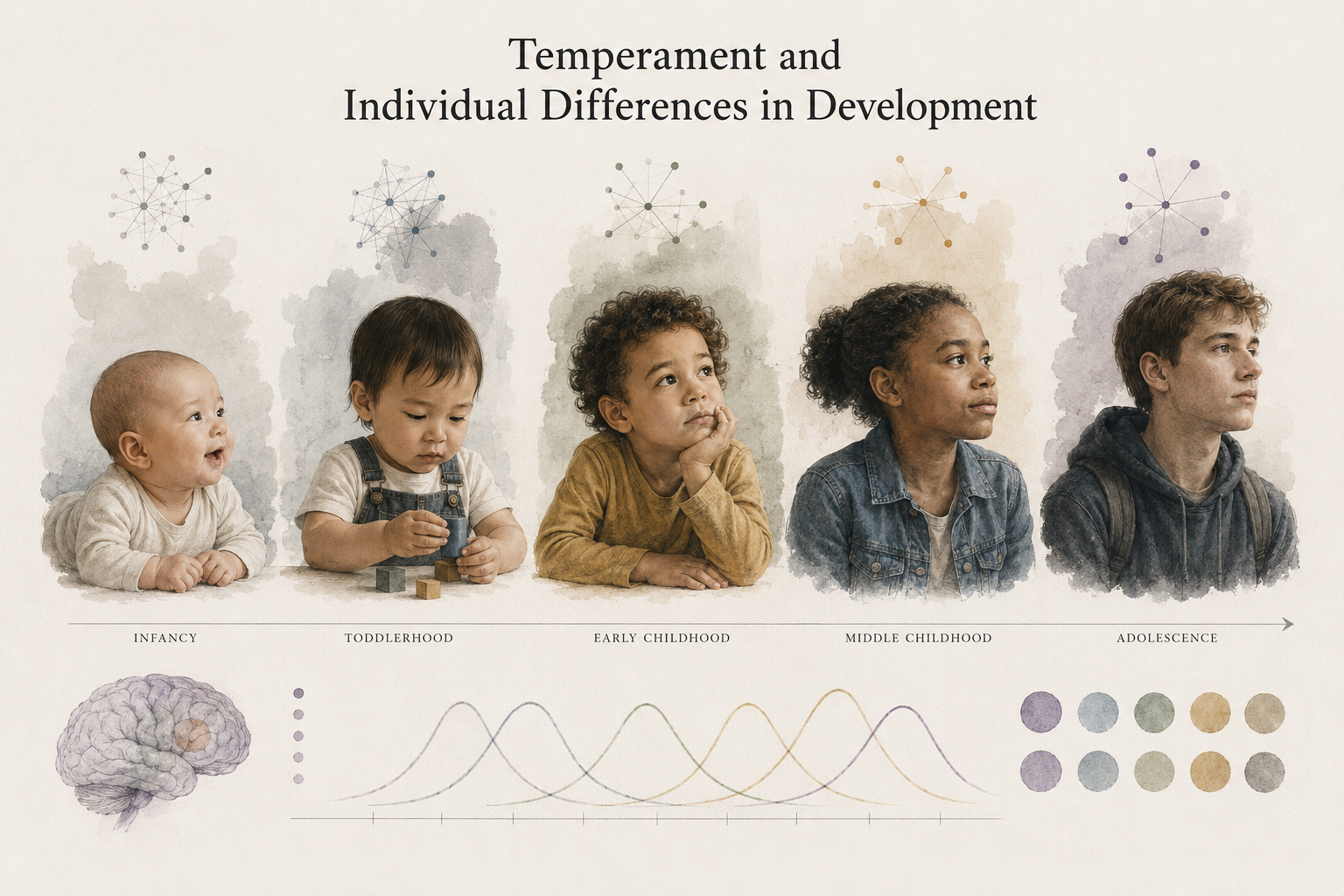
Modern developmental psychology treats temperament as an early-appearing pattern of emotional and behavioral response that both shapes and is shaped by the environments in which children develop. NIMH notes that infant temperament can serve as a foundation for later personality, while developmental and pediatric sources emphasize that children’s reactions and self-regulatory styles emerge early and influence later adjustment. Yet the strongest developmental account goes beyond saying that some children are “easy” and others “difficult.” That language is too blunt, too adult-centered, and too moralized. Temperament matters because it affects caregiver fit, peer relations, classroom experience, vulnerability to stress, adaptation to novelty, self-concept, disciplinary exposure, and the cumulative experience of being recognized, soothed, encouraged, misunderstood, punished, accommodated, or pathologized.
Temperament is therefore not only an individual characteristic. It is a relational and institutional question. A child’s early style matters, but so does the world that receives that style. A highly reactive child in a responsive home may develop strong emotional awareness and flexible regulation. The same child in a chaotic or punitive environment may become more vulnerable to anxiety, conflict, withdrawal, or dysregulation. A cautious child may be protected by patient scaffolding or harmed by shaming pressure. A highly active child may thrive in a movement-rich environment or be mislabeled in a rigid one. Temperament begins inside the child, but its developmental meaning emerges between child and world.
Why Temperament Matters
Temperament matters because developmental psychology is not only the study of universal sequence. It is also the study of patterned difference. Even when children share broad developmental processes, they do not experience those processes in the same way. Some infants are highly reactive to noise, novelty, hunger, discomfort, separation, or transition. Some are comparatively calm and adaptable. Some toddlers rush toward unfamiliar people and settings, while others hesitate, observe, or withdraw. Some children are emotionally intense and easily frustrated, while others appear more even-tempered or slow to arousal. These early patterns matter because they influence how the child encounters the world and how the world responds in return.
This makes temperament a foundational developmental concept rather than a side topic. The field of developmental psychology includes physical, cognitive, social, perceptual, personality, emotional, and lifespan change. Temperament sits at the intersection of several of these because it concerns emotional style, regulation, social interaction, attentional response, early biological sensitivity, and the foundations of later personality. The importance of temperament is heightened by the fact that early childhood is a period of rapid brain, social, emotional, and regulatory development. Early differences in reactivity and regulation are part of that story.
Temperament also matters because it shapes feedback loops. A child who startles easily may receive more protective caregiving, which can either soothe and scaffold the child or restrict opportunities for exploration. A child who is high in activity may elicit more correction, more conflict, or more movement-rich support depending on the environment. A child who is slow to warm up may be gently included or socially overlooked. A child who is emotionally intense may be taught regulation or punished for distress. Over time, these responses can become developmental pathways.
Temperament is therefore consequential because it affects both experience and interpretation. It shapes what the child feels, how the child acts, what adults notice, how peers respond, what teachers reward, what institutions tolerate, and what labels become attached. A child’s temperament does not determine the future, but it helps organize the child’s earliest developmental exchanges with the world.
What Temperament Is and Is Not
Temperament refers to early-appearing, partly biologically rooted patterns of emotional and behavioral response. It is often discussed in relation to reactivity and self-regulation: how strongly a child responds, how quickly arousal occurs, how long it lasts, how easily attention shifts, how the child approaches novelty, and how effectively the child can be soothed, redirected, or organized. Temperament concerns the style of responding rather than the full content of personality, morality, identity, belief, or mature character.
Temperament is not identical to adult personality, though it can contribute to later personality development. It is also not identical to diagnosis. A highly active child is not automatically disordered. A cautious child is not automatically anxious. An emotionally intense child is not automatically dysregulated in every context. A sensory-sensitive child is not simply “difficult.” Temperament names early patterns that become developmentally meaningful through relationship, expectation, support, and context.
Just as important is what temperament is not. It is not a moral category. Terms like “easy,” “difficult,” “fussy,” “stubborn,” “dramatic,” “clingy,” “lazy,” or “well-behaved” often reveal adult convenience more than developmental truth. A child who is easy for one caregiver, classroom, or culture may be mismatched in another. A child described as difficult may be overwhelmed, under-supported, highly sensitive, neurodivergent, tired, hungry, frightened, overstimulated, or simply poorly matched to the demands being imposed.
A serious developmental view therefore replaces moralized labels with descriptive precision. Instead of calling a child “bad,” it asks whether the child is high in negative emotionality, sensitive to novelty, low in inhibitory control, easily overstimulated, slow to adapt, high in approach, high in activity, or in need of stronger co-regulation. Instead of asking whether a temperament is good or bad in the abstract, it asks what kind of environment helps the child regulate, learn, relate, and participate with dignity.
Early Reactivity, Regulation, and the Origins of Individual Difference
One of the strongest ways to understand temperament is through the paired ideas of reactivity and regulation. Reactivity refers to how readily and intensely an infant or child responds to stimulation, frustration, novelty, transition, hunger, fatigue, social demand, or sensory input. Regulation refers to how that arousal is modulated, soothed, redirected, organized, sustained, or recovered from. Some children are highly reactive but develop strong regulation when caregiving is warm, predictable, and scaffolded. Others appear low in overt reactivity but may be slow to engage, internally distressed, or less expressive of discomfort.
These differences emerge early and can often be observed within the first year of life. Infants differ in how they cry, orient, startle, sleep, feed, settle, attend, and respond to novelty. Toddlers differ in persistence, frustration tolerance, social approach, activity, attention, and adaptability. These patterns are not yet adult personality, but they are developmentally meaningful because they help shape how the child’s daily world is organized.
Regulation is especially important because children do not begin life as self-regulating organisms in the mature sense. Regulation is first co-regulation. Infants are regulated through bodies, voices, touch, routines, feeding, sleep, warmth, eye contact, pacing, and the predictability of caregiver response. Temperament is therefore not sealed inside the child. It becomes visible and organized through the relational environment.
This is why high reactivity should not be interpreted only as risk. A highly reactive child may be more vulnerable under chaos, harshness, inconsistency, or sensory overload. But under responsive support, high reactivity may be associated with strong awareness, empathic sensitivity, creativity, vigilance, or intense engagement. The developmental meaning of reactivity depends on whether regulation is supported or undermined.
Temperament, Personality, and Developmental Continuity
Temperament is often described as a foundation of later personality, but the relationship must be handled carefully. Early temperament can predict aspects of later personality and adjustment, especially in longitudinal work on behavioral inhibition, emotional reactivity, effortful control, and approach or withdrawal. Yet stability is never perfect. A cautious infant does not automatically become an anxious adult. A highly active toddler does not automatically become a disruptive adolescent. A socially outgoing child does not automatically become a confident adult. Developmental pathways remain open, though not unconstrained.
The best formulation is one of constrained continuity. Early temperament can bias the child toward certain experiences, responses, and feedback loops. Those loops may reinforce, redirect, soften, or intensify the original pattern. A behaviorally inhibited child may avoid novelty, receive overprotective responses, and have fewer chances to practice approach, thereby stabilizing caution. In another context, the same child may be gently scaffolded into confidence, trusted routines, and secure participation. A highly active child may be punished repeatedly and learn oppositional patterns, or may be guided into sport, movement, exploration, and constructive agency.
Temperament contributes to developmental direction because it affects what the child does and what others do in response. But direction still depends on pathway, timing, support, and interpretation. This distinction matters because developmental science can easily slide into determinism. It is tempting to imagine that early temperament reveals the person’s future. A more careful account says that temperament shapes probabilities, not destinies.
Personality develops as temperament becomes organized through language, identity, habit, relationship, values, self-understanding, culture, and social role. What begins as emotional reactivity may later become anxiety, sensitivity, artistic intensity, moral concern, or disciplined self-regulation depending on the child’s ecology. What begins as high approach may later become sociability, risk-taking, leadership, impulsivity, or resilient engagement depending on guidance and context. Temperament gives development an early contour. It does not write the whole life.
Goodness of Fit: Caregiving, Schooling, and Social Response
The concept of goodness of fit is one of the most important ways developmental psychology moves beyond simplistic trait thinking. A temperament is not evaluated in a vacuum. It is evaluated in relation to environmental demand and support. A highly active child in a rigid, punitive setting may be treated as chronically difficult. The same child in a responsive setting with movement, structure, and patient guidance may thrive. A cautious child in an overstimulating classroom may appear withdrawn, while that same child in a slower, emotionally safe environment may reveal impressive depth and attentiveness.
Goodness of fit means that developmental outcomes arise through the match or mismatch between child characteristics and environment. A child’s temperament matters, but so do adult expectations, classroom rules, family routines, cultural norms, neighborhood stress, sensory conditions, sleep, nutrition, language, and institutional patience. The question is not “What is wrong with this child?” but “What does this child need to regulate, participate, and develop well?”
This has major implications for parents, educators, clinicians, and institutions. Schools often reward certain temperamental styles more than others: quiet compliance, moderate sociability, emotional containment, sustained seated attention, quick transitions, and low disruption. Yet these are not neutral developmental endpoints. They are institutional preferences. When children diverge from them, adults may confuse mismatch with pathology. Developmental psychology is most useful when it helps adults distinguish genuine developmental concern from misfit between child style and environmental design.
Goodness of fit does not mean that every demand should disappear. Children also need support in developing flexibility, regulation, persistence, and social responsibility. But the developmental question is how that support is provided. Does the environment scaffold growth, or does it shame difference? Does it teach regulation, or merely punish dysregulation? Does it expand participation, or enforce a narrow behavioral norm? The difference is developmentally profound.
Caregiving, Co-Regulation, and the Developing Nervous System
Temperament becomes developmentally organized through caregiving. A caregiver does not create the child’s temperament from nothing, but caregiving profoundly affects how temperament is expressed, regulated, interpreted, and integrated. A highly reactive infant may need more predictable routines, slower transitions, sensory moderation, and calm co-regulation. A low-reactive or slow-to-engage child may need gentle stimulation, patient invitation, and adults who do not mistake quietness for absence of need. A high-approach child may need boundaries that preserve curiosity without allowing danger or intrusion.
Co-regulation is not indulgence. It is the developmental bridge toward self-regulation. Young children borrow adult regulation before they can reliably regulate themselves. They learn through repeated experience that distress can be held, named, reduced, and survived. They learn that adults can help organize overwhelming feeling without humiliating them. Over time, these patterns become internal resources: language for emotion, confidence in repair, tolerance for frustration, and trust in routines.
Caregiving quality also shapes whether temperament becomes a source of strength or vulnerability. A sensitive child who is consistently dismissed may learn that distress is shameful. A highly active child who is constantly punished may learn that adults expect conflict. A cautious child who is forced too quickly may become more fearful. A persistent child whose determination is recognized may develop resilience; the same persistence in another context may be labeled defiance.
This does not mean parents are solely responsible for temperament outcomes. Caregivers themselves live under conditions of stress, work, poverty, trauma, isolation, discrimination, disability, and inadequate support. Goodness of fit is not only a private family achievement. It is a social and institutional matter. Caregivers need time, security, health care, childcare support, safe housing, rest, and community in order to provide the co-regulation that children require.
Schooling, Classroom Design, and Institutional Fit
Temperament becomes especially visible in schools because schools are behavioral institutions. They organize bodies, attention, speech, time, movement, noise, peer interaction, evaluation, and compliance. A child’s temperament may fit school expectations easily or collide with them repeatedly. High activity, emotional intensity, sensory sensitivity, slow adaptability, low persistence, high inhibition, or strong novelty seeking can each become more or less problematic depending on classroom design.
Classrooms are often built around assumptions about the “ideal student”: attentive but not intense, sociable but not disruptive, curious but compliant, expressive but not emotionally overwhelming, independent but not resistant, energetic but able to sit still. Children who do not match this pattern may be corrected before they are understood. Temperament can then become an institutional label rather than a developmental clue.
A developmental approach asks how classrooms can create better fit. This may include predictable transitions, movement breaks, visual schedules, calm corners, sensory-aware environments, relational check-ins, differentiated participation, flexible seating, explicit emotion language, routines for repair, and discipline practices that teach rather than merely exclude. These supports do not lower developmental expectations. They make development more possible.
School fit also matters because children internalize how institutions respond to them. A child repeatedly treated as disruptive may develop a self-concept organized around trouble. A child repeatedly overlooked because they are quiet may learn that withdrawal is safer than participation. A child whose intensity is interpreted with patience may learn to regulate without losing vitality. Schools do not merely manage temperament. They help shape what temperament becomes.
Culture, Inequality, Neurodivergence, and Developmental Difference
Temperament cannot be interpreted adequately outside culture. Cultural norms shape which temperamental expressions are encouraged, tolerated, admired, corrected, or stigmatized. A reserved child may be interpreted as respectful in one setting and socially deficient in another. High expressiveness may be read as vitality in one community and dysregulation in another. Independence, emotional display, deference, persistence, peer engagement, eye contact, and adult-directed speech do not carry the same developmental meaning across all cultures.
This matters because developmental science has often been tempted to treat dominant cultural preferences as neutral developmental standards. They are not. Temperament research becomes stronger when it distinguishes between universal developmental processes and culturally specific judgments about ideal behavior. Children develop in communities, and communities differ in what they expect children to become.
Inequality also matters. A child’s temperament is not received by the same world in all bodies and all social positions. Race, class, disability status, language background, gender, school resourcing, family stress, exposure to violence, and institutional bias affect whether a child’s early style is read as spirited, resilient, oppositional, shy, disordered, gifted, threatening, sensitive, or immature. Highly active or emotionally intense children in under-resourced or punitive systems may be disciplined earlier and more harshly. Quiet or inhibited children may be overlooked when schools lack time for careful relationship-building.
Neurodivergence adds another important layer. Some patterns that first appear as temperament may also be related to sensory processing differences, autism, ADHD, developmental disability, anxiety, communication differences, or other neurodevelopmental variation. Temperament should not be used to erase disability, but neither should all difference be pathologized automatically. A careful developmental perspective asks how temperament, neurodevelopment, sensory experience, environmental response, and institutional design interact rather than assuming one explanatory layer is sufficient.
The ethical point is clear: temperament is never interpreted in a social vacuum. Some children receive patience. Others receive punishment. Some receive accommodation. Others receive suspicion. Some are protected by cultural fit. Others are harmed by cultural mismatch. Developmental psychology must study those differences as part of temperament’s real-world meaning.
Temperament, Risk, Resilience, and Developmental Psychopathology
Temperament matters greatly in developmental psychopathology because it can shape both vulnerability and protection. Behavioral inhibition, high negative emotionality, low effortful control, high impulsivity, extreme sensory sensitivity, and difficulty regulating frustration can each be associated with later adjustment challenges under some conditions. But the phrase “under some conditions” is essential. Temperament is probabilistic, not deterministic. It alters pathways; it does not prewrite them.
Risk emerges through interaction. A highly reactive child may be especially vulnerable in chaotic, harsh, unpredictable, or unsupportive environments. The same child may flourish in warm, structured, responsive environments. A behaviorally inhibited child may be at greater risk for anxiety if avoidance is reinforced, but may develop confidence when novelty is scaffolded gently. A high-activity child may struggle in rigid environments, but may develop persistence, courage, and constructive energy when guided well.
Resilience should not be interpreted as the opposite of vulnerable temperament. Some children are more sensitive to context in both directions. They may suffer more under adversity and benefit more from support. This is developmentally important because it shifts the focus away from labeling children as fragile or strong. A child’s developmental pathway depends on how temperament meets context.
Protective factors include stable caregiving, predictable routines, sufficient sleep, safety, responsive schooling, reduced exposure to chronic stress, peer belonging, emotion coaching, movement opportunities, sensory supports, mental-health care when needed, and institutions that interpret difference carefully. Temperament participates in risk, but it also participates in the possibility of adaptive fit. The same early sensitivity that increases vulnerability may become a source of empathy, vigilance, creativity, or insight under supportive conditions.
Temperament Across Developmental Time
Although temperament is most visible in infancy and early childhood, its developmental importance extends across time. Early styles can influence friendship patterns, school adjustment, self-concept, stress reactivity, academic engagement, family conflict, peer reputation, emotional regulation, and emerging personality organization. Yet the meaning of temperament changes across development. High activity in toddlerhood, social inhibition in early school years, emotional intensity in adolescence, and stress sensitivity in adulthood are not identical phenomena, even when some continuity is present.
Development changes the environment, the demands, and the interpretation of the same underlying style. A toddler’s high activity may be managed through movement and supervision. In elementary school, that same activity may become a classroom issue. In adolescence, it may be expressed through sport, risk-taking, social dominance, restlessness, or creative energy. In adulthood, it may appear as drive, impatience, entrepreneurial action, or chronic overextension depending on context and self-regulation.
This is why temperament should never be treated as a frozen essence. Children are not simply born with a fixed profile that later life reveals. They develop strategies, language, self-understanding, habits of regulation, expectations about adults, and memories of how the world responded to them. A child who once needed extensive co-regulation may later develop strong self-control. A child once seen as fearless may later become cautious under social stress. A child once intensely reactive may later become unusually empathic or creatively expressive.
Temperament provides an early developmental contour, but the life course fills that contour differently under different conditions. Developmental continuity is real, but so is transformation. The strongest account of temperament must hold both.
Methods for Studying Temperament
Studying temperament requires methodological care because temperament is observable, relational, culturally interpreted, and developmentally changing. Researchers may use parent reports, teacher reports, laboratory observations, structured novelty tasks, physiological measures, behavioral coding, longitudinal designs, and mixed-methods interviews. Each method captures something important, but none is sufficient alone.
Parent reports are valuable because caregivers observe children across daily life, but they are also shaped by stress, culture, expectations, and comparison with siblings or peers. Teacher reports reveal how children function in institutional settings, but they may reflect classroom fit as much as child temperament. Laboratory observations can standardize conditions, but they may not capture home, neighborhood, or cultural context. Physiological measures may illuminate arousal and regulation, but they do not explain meaning or relationship by themselves.
Longitudinal designs are especially important because temperament is developmental. A single snapshot may confuse temporary state with stable style. A toddler’s distress during transition may reflect temperament, sleep loss, illness, family disruption, sensory overload, or unfamiliarity. Repeated observation across settings and time is necessary to distinguish pattern from episode.
Multilevel methods are also important because children are nested in families, classrooms, schools, neighborhoods, cultures, and care systems. What appears to be a child-level pattern may partly reflect classroom stress, family routines, neighborhood safety, institutional bias, or cultural mismatch. Good temperament research therefore studies child characteristics and context together.
Avoiding Moralized Labels and Deficit Narratives
Temperament language can easily become a disguised moral judgment. Words such as “difficult,” “easy,” “compliant,” “stubborn,” “dramatic,” “sensitive,” “spirited,” “shy,” or “wild” often carry adult preference, cultural norm, and institutional convenience. Some of these terms may be used affectionately, but they can still shape how children are seen. Once a label sticks, adults may interpret future behavior through it.
A child described as “difficult” may receive less patience even when they are overwhelmed. A child described as “shy” may be denied opportunities to develop leadership. A child described as “too much” may learn to experience their own vitality as a problem. A child described as “easy” may have their quieter needs overlooked. Temperament labels can therefore become developmental interventions in themselves: they shape response, identity, expectation, and opportunity.
A better approach is descriptive, contextual, and humane. Instead of “difficult,” say “highly reactive to transition and needs predictable routines.” Instead of “clingy,” say “slow to warm in unfamiliar settings and benefits from secure adult proximity.” Instead of “defiant,” say “high persistence and low flexibility under demand; needs choice, structure, and co-regulation.” Instead of “hyper,” say “high activity level and benefits from movement and clear pacing.” These descriptions do not excuse harmful behavior, but they make development possible by identifying what kind of support is needed.
Developmental psychology should help adults see children more precisely and less judgmentally. Temperament is not a verdict. It is information about how a child meets the world and what kind of world may help that child grow.
An Analytical Framework for Temperament and Development
A simple developmental outcome for child \( i \) at time \( t \) can be modeled as a function of temperament, context, and their interaction:
Y_{it} = \alpha + \beta_T T_i + \beta_C C_{it} + \beta_{TC}(T_i \times C_{it}) + \varepsilon_{it}
\]
Interpretation: \(T_i\) represents a temperamental characteristic such as reactivity, inhibition, activity level, sensory sensitivity, or attentional control. \(C_{it}\) represents contextual conditions such as caregiving support, classroom fit, stress burden, or institutional accommodation. The interaction term matters because temperament rarely has one invariant effect. Its developmental consequences depend on fit.
To represent continuity across time, state dependence can be added:
Y_{it} = \rho Y_{i,t-1} + \beta_T T_i + \beta_C C_{it} + \beta_{TC}(T_i \times C_{it}) + \varepsilon_{it}
\]
Interpretation: Prior developmental status influences current status. Early regulation, school adjustment, peer confidence, or self-concept can become self-reinforcing over time, especially when adults and institutions respond consistently to the child in the same way.
If some temperamental profiles are especially sensitive to stress or support, that can be expressed directly:
Y_{it} = \alpha + \beta_T T_i + \beta_S S_{it} + \beta_P P_{it} + \gamma_1(T_i \times S_{it}) + \gamma_2(T_i \times P_{it}) + \varepsilon_{it}
\]
Interpretation: \(S_{it}\) represents stress exposure and \(P_{it}\) represents protective support. Under this formulation, the same temperamental trait can predict very different outcomes under different developmental ecologies.
Because temperament unfolds within families, classrooms, schools, neighborhoods, and cultures, a multilevel model is often more realistic:
Y_{ijt} = \alpha + u_j + \beta_T T_i + \beta_C C_{ijt} + \beta_{TC}(T_i \times C_{ijt}) + \varepsilon_{ijt}
\]
Interpretation: \(u_j\) captures contextual effects at the level of classroom, school, neighborhood, family system, care setting, or community. What appears to be an “individual difference” is often co-authored by institution and environment.
To represent goodness of fit more explicitly, fit can be modeled as the match between child temperament and environmental demand:
F_{it} = – \lvert T_i – D_{it} \rvert + A_{it}
\]
Interpretation: \(D_{it}\) represents environmental demand and \(A_{it}\) represents accommodation or support. Fit is lower when the distance between child temperament and environmental demand is large, but accommodation can improve fit even when the child and setting initially differ.
The point of this analytical frame is not to reduce temperament to numbers alone. It is to clarify that individual difference, developmental continuity, context, support, stress, and fit are central to any serious account of temperament.
R: Simulating Temperament, Context, and Developmental Trajectories
The following R example simulates children observed across eight waves. It includes temperamental reactivity, caregiver support, classroom fit, stress exposure, accommodation, and a developmental outcome that can be read as socioemotional adjustment or self-regulation. The data are synthetic and intended for demonstration only.
# Simulating temperament, context, and developmental trajectories
# --------------------------------------------------------------
# This synthetic example models socioemotional adjustment as a function
# of temperament, caregiver support, classroom fit, accommodation,
# stress exposure, and goodness of fit.

suppressPackageStartupMessages({
  library(dplyr)
  library(lme4)
  library(ggplot2)
})

set.seed(2026)

n_children <- 760
n_waves <- 8
n_classrooms <- 32

children <- data.frame(
  child_id = 1:n_children,
  classroom_id = sample(1:n_classrooms, n_children, replace = TRUE),
  temperament_reactivity = rnorm(n_children, mean = 0, sd = 1),
  inhibition = rnorm(n_children, mean = 0, sd = 1),
  activity_level = rnorm(n_children, mean = 0, sd = 1),
  baseline_adjustment = rnorm(n_children, mean = 50, sd = 8),
  chronic_stress = rbinom(n_children, size = 1, prob = 0.30),
  family_support = rnorm(n_children, mean = 0, sd = 1),
  school_fit = rnorm(n_children, mean = 0, sd = 1)
)

classrooms <- data.frame(
  classroom_id = 1:n_classrooms,
  classroom_structure = rnorm(n_classrooms, mean = 0, sd = 0.6),
  teacher_responsiveness = rnorm(n_classrooms, mean = 0, sd = 0.6),
  movement_flexibility = rnorm(n_classrooms, mean = 0, sd = 0.5)
)

panel_data <- children |>
  slice(rep(1:n(), each = n_waves)) |>
  group_by(child_id) |>
  mutate(
    wave = 0:(n_waves - 1),
    current_support = rnorm(n_waves, mean = family_support, sd = 0.6),
    current_school_fit = rnorm(n_waves, mean = school_fit, sd = 0.6),
    acute_stress = rnorm(n_waves, mean = 0.3 * chronic_stress, sd = 0.8),
    current_accommodation = rnorm(n_waves, mean = 0.4, sd = 0.5)
  ) |>
  ungroup() |>
  left_join(classrooms, by = "classroom_id") |>
  mutate(
    goodness_of_fit =
      current_school_fit +
      teacher_responsiveness +
      movement_flexibility -
      abs(temperament_reactivity - classroom_structure) +
      current_accommodation,
    adjustment_score =
      baseline_adjustment +
      1.05 * wave +
      1.35 * current_support +
      1.20 * goodness_of_fit -
      1.65 * acute_stress -
      1.05 * chronic_stress -
      0.75 * temperament_reactivity * acute_stress +
      0.90 * temperament_reactivity * current_support +
      0.85 * temperament_reactivity * goodness_of_fit +
      0.70 * teacher_responsiveness +
      rnorm(n(), mean = 0, sd = 2.7)
  )

model <- lmer(
  adjustment_score ~ wave + temperament_reactivity + inhibition +
    activity_level + current_support + goodness_of_fit +
    acute_stress + chronic_stress + teacher_responsiveness +
    temperament_reactivity:current_support +
    temperament_reactivity:goodness_of_fit +
    temperament_reactivity:acute_stress +
    (1 + wave | classroom_id/child_id),
  data = panel_data
)

summary(model)

trajectory_summary <- panel_data |>
  mutate(
    reactivity_group = ifelse(
      temperament_reactivity > median(temperament_reactivity),
      "Higher reactivity",
      "Lower reactivity"
    )
  ) |>
  group_by(wave, reactivity_group) |>
  summarize(
    mean_adjustment = mean(adjustment_score),
    standard_error = sd(adjustment_score) / sqrt(n()),
    .groups = "drop"
  ) |>
  mutate(
    lower = mean_adjustment - 1.96 * standard_error,
    upper = mean_adjustment + 1.96 * standard_error
  )

ggplot(trajectory_summary, aes(x = wave, y = mean_adjustment, linetype = reactivity_group)) +
  geom_line(linewidth = 1) +
  geom_ribbon(aes(ymin = lower, ymax = upper, group = reactivity_group), alpha = 0.12) +
  labs(
    title = "Simulated Temperament and Developmental Adjustment Over Time",
    x = "Wave",
    y = "Adjustment score",
    linetype = "Temperament group"
  ) +
  theme_minimal()

fit_summary <- panel_data |>
  group_by(wave) |>
  summarize(
    average_fit = mean(goodness_of_fit),
    average_support = mean(current_support),
    average_stress = mean(acute_stress),
    average_adjustment = mean(adjustment_score),
    .groups = "drop"
  )

ggplot(fit_summary, aes(x = average_fit, y = average_adjustment)) +
  geom_point() +
  geom_smooth(method = "lm", se = TRUE) +
  labs(
    title = "Synthetic Goodness of Fit and Adjustment",
    x = "Goodness of fit",
    y = "Average adjustment"
  ) +
  theme_minimal()

# Analysts can extend this model by:
# 1. separating inhibition, activity, sensory sensitivity, and attention;
# 2. modeling classroom, school, or neighborhood random effects;
# 3. including intervention or therapy exposure;
# 4. simulating peer relations or academic outcomes;
# 5. comparing differential sensitivity under low- and high-support contexts;
# 6. modeling disciplinary exposure as an institutional outcome.
This simulation illustrates a key developmental point: temperament influences outcome most powerfully in interaction with support, stress, classroom fit, and accommodation, not as an isolated variable.
Python: Modeling Temperament, Stress, and Goodness of Fit
The following Python example simulates a panel of children with different temperamental profiles observed over ten periods. It models caregiver support, classroom fit, accommodation, acute stress, chronic stress, and state dependence in socioemotional adjustment.
# Modeling temperament, stress, and goodness of fit
# ------------------------------------------------
# This synthetic example models socioemotional adjustment as a dynamic
# relation among temperament, support, classroom fit, stress, accommodation,
# and prior adjustment.

from __future__ import annotations

import numpy as np
import pandas as pd
import statsmodels.formula.api as smf
import matplotlib.pyplot as plt

np.random.seed(2026)

n_children = 900
n_periods = 10
n_classrooms = 36

children = pd.DataFrame({
    "child_id": np.arange(1, n_children + 1),
    "classroom_id": np.random.choice(np.arange(1, n_classrooms + 1), size=n_children),
    "temperament_reactivity": np.random.normal(0, 1, n_children),
    "inhibition": np.random.normal(0, 1, n_children),
    "activity_level": np.random.normal(0, 1, n_children),
    "baseline_adjustment": np.random.normal(50, 8, n_children),
    "chronic_stress": np.random.binomial(1, 0.30, n_children),
    "family_support": np.random.normal(0, 1, n_children),
    "school_fit": np.random.normal(0, 1, n_children),
})

classrooms = pd.DataFrame({
    "classroom_id": np.arange(1, n_classrooms + 1),
    "classroom_structure": np.random.normal(0, 0.6, n_classrooms),
    "teacher_responsiveness": np.random.normal(0, 0.6, n_classrooms),
    "movement_flexibility": np.random.normal(0, 0.5, n_classrooms),
})

panel = children.loc[children.index.repeat(n_periods)].copy()
panel["time"] = np.tile(np.arange(n_periods), n_children)
panel = panel.merge(classrooms, on="classroom_id", how="left")

panel["current_support"] = np.random.normal(
    loc=panel["family_support"],
    scale=0.7,
    size=len(panel),
)

panel["current_school_fit"] = np.random.normal(
    loc=panel["school_fit"],
    scale=0.7,
    size=len(panel),
)

panel["acute_stress"] = np.random.normal(
    loc=0.3 * panel["chronic_stress"],
    scale=0.8,
    size=len(panel),
)

panel["current_accommodation"] = np.random.normal(
    loc=0.4,
    scale=0.5,
    size=len(panel),
)

panel["goodness_of_fit"] = (
    panel["current_school_fit"]
    + panel["teacher_responsiveness"]
    + panel["movement_flexibility"]
    - np.abs(panel["temperament_reactivity"] - panel["classroom_structure"])
    + panel["current_accommodation"]
)

panel = panel.sort_values(["child_id", "time"]).reset_index(drop=True)
panel["adjustment_score"] = np.nan

for child_id in panel["child_id"].unique():
    child_data = panel.loc[panel["child_id"] == child_id].copy()
    previous_score = child_data["baseline_adjustment"].iloc[0] + np.random.normal(0, 2)

    for idx in child_data.index:
        temp = panel.at[idx, "temperament_reactivity"]
        inhibition = panel.at[idx, "inhibition"]
        activity = panel.at[idx, "activity_level"]
        support = panel.at[idx, "current_support"]
        fit = panel.at[idx, "goodness_of_fit"]
        stress = panel.at[idx, "acute_stress"]
        chronic = panel.at[idx, "chronic_stress"]
        teacher = panel.at[idx, "teacher_responsiveness"]
        time = panel.at[idx, "time"]

        current_score = (
            0.70 * previous_score
            + 0.90 * time
            + 1.30 * support
            + 1.20 * fit
            + 0.50 * teacher
            - 1.50 * stress
            - 1.10 * chronic
            - 0.25 * inhibition
            - 0.20 * activity
            + 0.95 * temp * support
            + 0.85 * temp * fit
            - 0.90 * temp * stress
            + np.random.normal(0, 2.5)
        )

        panel.at[idx, "adjustment_score"] = current_score
        previous_score = current_score

panel["lag_score"] = panel.groupby("child_id")["adjustment_score"].shift(1)
regression_data = panel.dropna(subset=["lag_score"]).copy()

model = smf.ols(
    formula="""
    adjustment_score ~ lag_score + time + temperament_reactivity +
    inhibition + activity_level + current_support + goodness_of_fit +
    acute_stress + chronic_stress + teacher_responsiveness +
    temperament_reactivity:current_support +
    temperament_reactivity:goodness_of_fit +
    temperament_reactivity:acute_stress
    """,
    data=regression_data,
).fit(cov_type="HC3")

print(model.summary())

panel["temperament_group"] = np.where(
    panel["temperament_reactivity"] > panel["temperament_reactivity"].median(),
    "Higher reactivity",
    "Lower reactivity",
)

trajectory = panel.groupby(["time", "temperament_group"], as_index=False).agg(
    average_adjustment=("adjustment_score", "mean"),
    average_fit=("goodness_of_fit", "mean"),
    standard_error=("adjustment_score", lambda x: x.std() / np.sqrt(len(x))),
)

trajectory["lower"] = trajectory["average_adjustment"] - 1.96 * trajectory["standard_error"]
trajectory["upper"] = trajectory["average_adjustment"] + 1.96 * trajectory["standard_error"]

plt.figure(figsize=(8, 5))
for group_name, subset in trajectory.groupby("temperament_group"):
    plt.plot(subset["time"], subset["average_adjustment"], marker="o", label=group_name)

plt.xlabel("Time")
plt.ylabel("Average adjustment score")
plt.title("Simulated Temperament and Developmental Adjustment Across Time")
plt.legend()
plt.tight_layout()
plt.show()

fit_summary = panel.groupby("classroom_id", as_index=False).agg(
    teacher_responsiveness=("teacher_responsiveness", "mean"),
    movement_flexibility=("movement_flexibility", "mean"),
    average_fit=("goodness_of_fit", "mean"),
    average_adjustment=("adjustment_score", "mean"),
)

print(fit_summary.sort_values("average_adjustment", ascending=False).head())

# Analysts can extend this framework by:
# 1. modeling inhibition and activity as separate dimensions;
# 2. adding peer-context, school, or neighborhood clustering;
# 3. simulating intervention targeting for high-reactivity children;
# 4. linking temperament to academic and socioemotional outcomes;
# 5. testing whether supportive settings disproportionately help certain profiles;
# 6. modeling discipline exposure, exclusion, or referral patterns.
The analytical value of a model like this is that it turns temperament from a label into a developmental process: an early difference whose consequences depend on context, support, stress, accommodation, and time.
GitHub Repository
Complete Code Repository
Access the full companion repository for this article, including reproducible analysis materials and multi-language code workflows for temperament, individual differences, reactivity, inhibition, activity level, caregiving support, classroom fit, stress exposure, goodness of fit, accommodation, and developmental trajectories.
Conclusion
Temperament is one of the earliest ways developmental individuality becomes visible. It matters because it shapes how children experience novelty, frustration, stimulation, transition, routine, social approach, sensory demand, and regulation. It also matters because it shapes how adults and institutions respond in return. Yet temperament should never be mistaken for destiny or for a moral verdict on the child. Its developmental meaning depends on goodness of fit, cultural interpretation, caregiving, classroom design, chronic stress, neurodevelopment, institutional patience, and the broader ecology in which childhood unfolds.
The strongest developmental psychology therefore treats temperament as a starting pattern, not a finished explanation. It is an early contour of human difference that can harden under adversity, flourish under support, or be radically reinterpreted by changing context across time. A child’s temperament may shape the pathway, but the pathway is co-authored by family, school, culture, community, history, and opportunity.
In that sense, temperament is not merely about what kind of child one is. It is about how a life begins to take individual shape under conditions that are biological, relational, cultural, institutional, and unequal all at once.
Related Articles
- What Is Developmental Psychology?
- Why Developmental Psychology Matters Today
- Nature, Nurture, and the Developmental Question
- Continuity, Discontinuity, and the Logic of Developmental Change
- Critical Periods, Sensitive Periods, and the Timing of Development
- Attachment, Caregiving, and Early Emotional Development
- Self-Regulation and Executive Function Across Development
- Developmental Psychopathology: Risk, Resilience, and Adaptation
- Disability, Neurodivergence, and Development
- Development, Inequality, and the Life Course
- Developmental Psychology knowledge series
Further Reading
- Goldsmith, H.H. et al. (1987) ‘What is temperament? Four approaches’, Child Development, 58(2), pp. 505–529. Available at: https://doi.org/10.2307/1130527.
- Kagan, J. and Snidman, N. (2004) The Long Shadow of Temperament. Cambridge, MA: Harvard University Press. Available at: https://www.hup.harvard.edu/books/9780674015517.
- Rettew, D.C. and McKee, L. (2005) ‘Temperament and its role in developmental psychopathology’, Harvard Review of Psychiatry, 13(1), pp. 14–27. Available at: https://pmc.ncbi.nlm.nih.gov/articles/PMC3319036/.
- Rothbart, M.K. (2011) Becoming Who We Are: Temperament and Personality in Development. New York: Guilford Press. Available at: https://www.guilford.com/books/Becoming-Who-We-Are/Mary-Rothbart/9781609180690.
- Shiner, R.L. et al. (2012) ‘The structure of temperament and personality traits: A developmental perspective’, in Zentner, M. and Shiner, R. (eds.) Handbook of Temperament. New York: Guilford Press. Available at: https://www.guilford.com/books/Handbook-of-Temperament/Zentner-Shiner/9781462506484.
- Thomas, A. and Chess, S. (1977) Temperament and Development. New York: Brunner/Mazel. Available at: https://psycnet.apa.org/record/1978-20032-000.
- Zentner, M. and Shiner, R.L. (eds.) (2012) Handbook of Temperament. New York: Guilford Press. Available at: https://www.guilford.com/books/Handbook-of-Temperament/Zentner-Shiner/9781462506484.
References
- American Psychological Association (n.d.) Developmental Psychology. Available at: https://www.apa.org/education-career/guide/subfields/developmental.
- American Psychological Association (n.d.) Psychology Topics: Children. Available at: https://www.apa.org/topics/children.
- Centers for Disease Control and Prevention (2026) Child Development. Available at: https://www.cdc.gov/child-development/index.html.
- Centers for Disease Control and Prevention (2026) Developmental Disabilities. Available at: https://www.cdc.gov/developmental-disabilities/index.html.
- Goldsmith, H.H. et al. (1987) ‘What is temperament? Four approaches’, Child Development, 58(2), pp. 505–529. Available at: https://doi.org/10.2307/1130527.
- Kagan, J. and Snidman, N. (2004) The Long Shadow of Temperament. Cambridge, MA: Harvard University Press. Available at: https://www.hup.harvard.edu/books/9780674015517.
- National Institute of Mental Health (2020) Infant Temperament Predicts Personality More Than 20 Years Later. Available at: https://www.nimh.nih.gov/news/science-updates/2020/infant-temperament-predicts-personality-more-than-20-years-later.
- Rettew, D.C. and McKee, L. (2005) ‘Temperament and its role in developmental psychopathology’, Harvard Review of Psychiatry, 13(1), pp. 14–27. Available at: https://pmc.ncbi.nlm.nih.gov/articles/PMC3319036/.
- Rothbart, M.K. (2011) Becoming Who We Are: Temperament and Personality in Development. New York: Guilford Press. Available at: https://www.guilford.com/books/Becoming-Who-We-Are/Mary-Rothbart/9781609180690.
- StatPearls (2024) Child Development. Available at: https://www.ncbi.nlm.nih.gov/books/NBK564386/.
- Thomas, A. and Chess, S. (1977) Temperament and Development. New York: Brunner/Mazel. Available at: https://psycnet.apa.org/record/1978-20032-000.
- World Health Organization (n.d.) Promoting Healthy Growth and Development. Available at: https://www.who.int/activities/promoting-healthy-growth-and-development.
- World Health Organization (n.d.) Improving the Mental and Brain Health of Children and Adolescents. Available at: https://www.who.int/activities/improving-the-mental-and-brain-health-of-children-and-adolescents.
- Zentner, M. and Shiner, R.L. (eds.) (2012) Handbook of Temperament. New York: Guilford Press. Available at: https://www.guilford.com/books/Handbook-of-Temperament/Zentner-Shiner/9781462506484.