
Last Updated May 21, 2026
The question of nature and nurture has long served as developmental psychology’s most famous debate, but serious developmental science no longer treats it as a simple either-or. Human development does not arise from genes alone, from environment alone, or from any neat arithmetic between the two. It unfolds through reciprocal processes in which biological inheritance, caregiving, nutrition, stress, learning, schooling, social policy, culture, disability, neurodivergence, environmental exposure, and historical conditions continually interact across time. The enduring importance of the nature-nurture question lies not in preserving an old opposition, but in clarifying why development must be understood as structured, probabilistic, plastic, embodied, relational, and unequally conditioned.
To ask whether nature or nurture matters more is already to ask the wrong question. The deeper question is how biological potentials, environmental inputs, developmental timing, social structure, and historical inequality combine to produce divergent pathways of cognition, emotion, health, identity, vulnerability, resilience, and adaptation. A child’s temperament may shape how caregivers respond. A caregiver’s response may shape how that temperament develops. A genetic sensitivity may make a child more vulnerable in harsh conditions and more responsive in supportive ones. A school may buffer risk for one child while amplifying exclusion for another. A neighborhood may provide safety, nutrition, language, play, and care, or it may expose children to chronic stress, toxins, violence, displacement, and underfunded institutions. Development is therefore neither biological destiny nor environmental blank-slate formation. It is the life of an organism inside a world.
Main Library
Publications
Article Map
Developmental Psychology
Related Topic
Cognitive Psychology
Related Topic
Risk & Resilience
Related Topic
Social Psychology
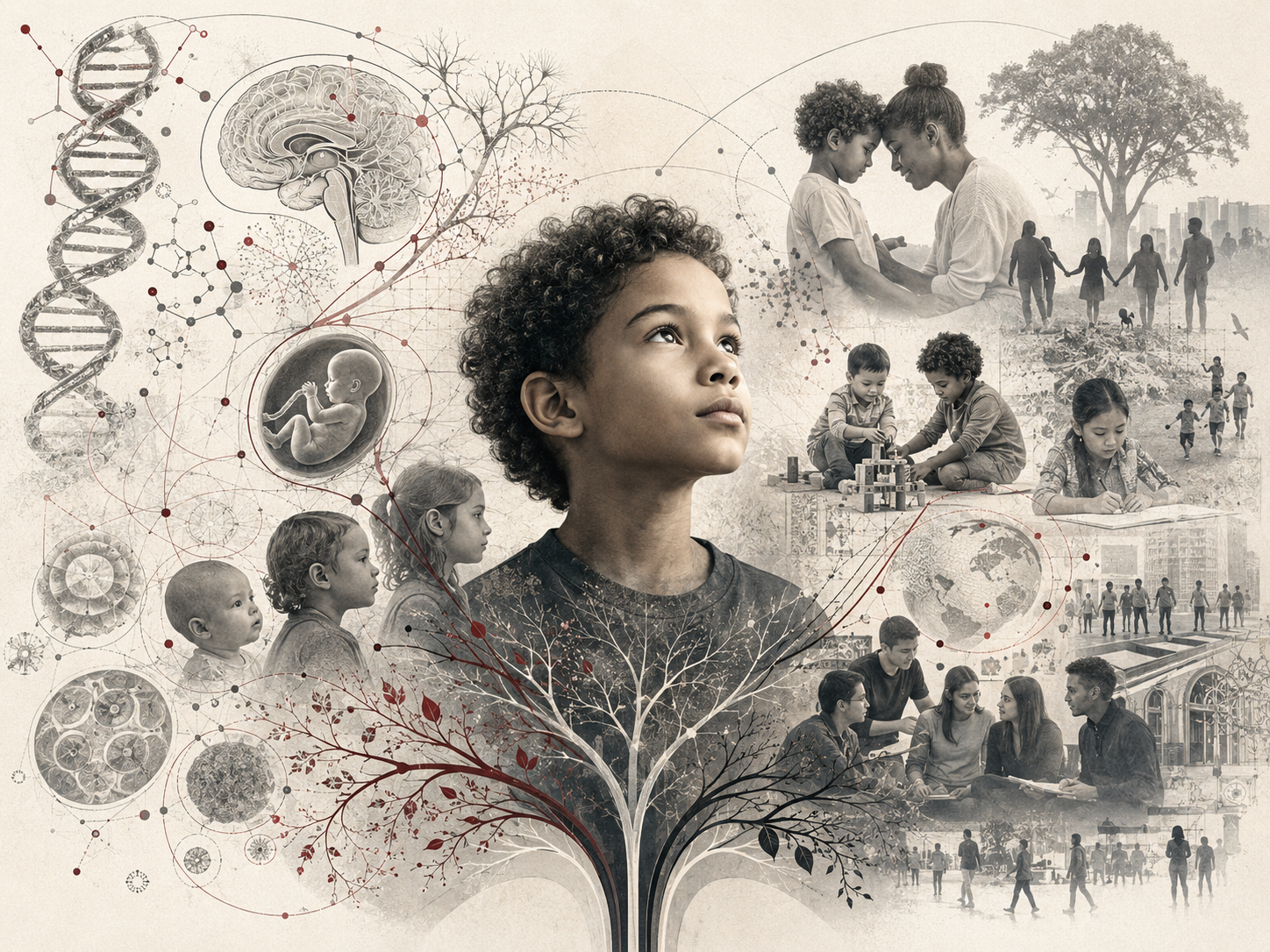
Few developmental questions have traveled more widely beyond the discipline than the dispute between nature and nurture. It appears in education, parenting, neuroscience, genetics, psychiatry, economics, criminal justice, public health, social policy, and debates about inequality. Yet public debate often treats the question in a simplified way, as though heredity and environment were separable forces pulling in opposite directions. Developmental psychology has gradually moved beyond that frame. Contemporary developmental science emphasizes gene-environment interaction, gene-environment correlation, epigenetic regulation, biological embedding, developmental timing, differential susceptibility, risk and resilience, social inequality, and the fact that environmental conditions can become embodied while biological sensitivities shape how environments are experienced.
The result is a more rigorous and more humane picture of development: one in which difference is produced through layered systems rather than single causes. Heredity matters, but it does not speak in isolation. Environment matters, but it does not act on an empty organism. Timing matters because the same experience may have different consequences depending on when it occurs. Context matters because “nurture” is not distributed equally. Inequality matters because families, schools, neighborhoods, healthcare systems, labor markets, immigration systems, environmental conditions, and public policy help determine which developmental possibilities are available in the first place.
The Classic Debate and Why It Persists
The nature-nurture debate has endured because it gives a deceptively simple form to a difficult problem. On one side stands inheritance: genes, biological predispositions, temperament, neural development, sensory thresholds, physiological regulation, and the fact that children do not enter the world as blank slates. On the other side stands environment: caregiving, language exposure, education, nutrition, sleep, safety, social class, discrimination, trauma, peer culture, medical care, neighborhood conditions, and the institutions that shape everyday life. The debate persists because both sides capture something real. Human development is impossible without biology, and it is unintelligible without environment.
Yet the persistence of the debate has often come at the cost of conceptual clarity. Public conversations regularly translate developmental complexity into crude causal competition. Is intelligence inherited or taught? Is aggression biological or environmental? Is mental illness genetic or social? Are developmental delays “in the child” or “in the environment”? Are language, attention, self-control, attachment, disability, risk-taking, personality, or resilience products of nature or nurture? Such formulations invite false choices and encourage ideological overreach. Biological explanations can be used to naturalize inequality or excuse institutions from responsibility. Environmental explanations, if flattened, can imply unlimited malleability, blame parents, ignore disability, or understate temperament and neurobiological constraint.
The debate persists also because people often want developmental explanation to provide moral reassurance. If an outcome is “natural,” then perhaps no one is responsible. If it is “environmental,” then perhaps it could have been prevented. If it is “genetic,” perhaps it is fixed. If it is “social,” perhaps it is entirely changeable. Developmental psychology disrupts these simple moral categories. It shows that causes can be real without being deterministic, that plasticity can be real without being unlimited, and that social responsibility remains even when biology matters.
Developmental psychology became more serious precisely by refusing the forced choice. The field’s major advance has not been to crown one side the winner. It has been to show that development happens through transaction, timing, feedback, and mutual shaping. The question is no longer whether nature or nurture matters. The question is how biological and environmental systems become developmentally organized across time.
Why the Nature-Nurture Binary Breaks Down
The first reason the binary breaks down is that genes never operate outside environments. Genetic influence does not mean destiny. Genes require expression, regulation, activation, suppression, and developmental context. A child may have a biological susceptibility toward certain outcomes, but whether that susceptibility becomes visible, harmful, adaptive, or muted depends on relational, nutritional, educational, medical, cultural, and institutional conditions. Biology is not a sealed script. It is developmental.
The second reason is that environments do not act on an empty organism. Children differ in reactivity, sensory thresholds, attention, learning pace, motor patterning, social orientation, affective intensity, sleep, appetite, and regulatory capacity from very early in life. Some are more easily soothed, some more vigilant, some more impulsive, some more inhibited, some more exploratory, some more sensitive to praise or threat. Environment therefore affects different children differently. The same classroom, parenting style, curriculum, peer group, or stressor may not have uniform effects.
The third reason is developmental timing. An environment can matter differently at different points in life. Prenatal exposure, infancy, early childhood, middle childhood, adolescence, young adulthood, and later adulthood are not equivalent developmental windows. Some experiences are especially powerful at particular periods because of neurobiological readiness, bodily maturation, social transition, identity formation, institutional placement, or cumulative prior history. Development is not merely exposure. It is exposure at a certain time, in relation to a trajectory already underway.
The fourth reason is that social conditions themselves are stratified. “Nurture” is not a neutral pool of experiences delivered equally to everyone. It is distributed through class, race, caste, disability inclusion, family stress, housing, safety, school quality, environmental exposure, labor precarity, political neglect, language access, immigration status, and public investment. The developmental environment is not just the home. It is the whole ecology in which the child lives.
The fifth reason is feedback. Developmental outcomes become developmental inputs. A child who learns to read early may receive more encouragement, more books, more advanced instruction, and a stronger academic identity. A child who struggles may receive remediation, but may also receive stigma, frustration, discipline, or lowered expectations. A child who is anxious may evoke protection, impatience, or avoidance. A child who is socially skilled may be given more opportunities to practice those skills. Development becomes self-organizing because earlier states alter later environments.
For all these reasons, nature and nurture cannot be treated as separate containers. They are mutually organized across time. The old binary breaks down because development is not a contest between heredity and experience. It is an unfolding process through which heredity becomes meaningful in experience and experience becomes embodied in development.
Genes, Environment, and Developmental Process
Modern developmental psychology tends to replace the old opposition with more precise concepts: gene-environment interaction, gene-environment correlation, differential susceptibility, biological embedding, epigenetic regulation, developmental timing, and transactional development. These concepts are not interchangeable, but together they help move the field beyond slogans.
Gene-environment interaction refers to the fact that the effect of an environment may depend on biological characteristics, and the effect of a biological characteristic may depend on environment. A child with high stress reactivity may fare poorly in a chaotic setting and exceptionally well in a supportive one. A child with a vulnerability to reading difficulty may improve substantially under high-quality instruction but struggle under low-quality instruction. A child with heightened sensory sensitivity may become overwhelmed in a noisy classroom but thrive in a structured and responsive setting. Development is often not additive but interactive.
Gene-environment correlation adds another layer. Children do not simply receive environments passively. Temperament, family history, inherited traits, and developing capacities can influence the environments children encounter, evoke, and select. Parents provide both genes and environments. More active children may evoke different responses from teachers. Verbally precocious children may receive richer language opportunities. Adolescents select peers, media, activities, and institutions that then shape them further. Development is recursive.
Biological embedding refers to the process by which environmental conditions become incorporated into physiological and developmental functioning. Chronic stress, undernutrition, instability, violence, neglect, discrimination, or environmental toxicity can affect regulation, attention, immune response, sleep, learning, and mental health. Enriched support, responsive caregiving, safety, language, education, and belonging can also become embodied as developmental protection. The environment does not remain outside the organism. It can become part of the developmental system.
These concepts are more rigorous than the old debate because they make clear that development is neither fixed by heredity nor infinitely programmable by intervention. It is structured by interaction. Biological differences matter, but their meaning depends on context. Environmental differences matter, but their effects depend on organism, timing, prior history, and institutional structure.
Gene-Environment Interaction and Differential Susceptibility
Gene-environment interaction is one of the most important reasons the nature-nurture question must be reformulated. It means that the same environment may have different effects depending on biological sensitivity, and the same biological tendency may have different outcomes depending on environment. This is a developmental idea, not a simple genetic one. It rejects both genetic determinism and environmental uniformity.
Consider two children exposed to the same level of classroom noise, family conflict, or social threat. One may become dysregulated, withdrawn, or hypervigilant; another may be relatively unaffected. Conversely, the same child who is highly vulnerable under stress may be highly responsive to support. This is the logic behind differential susceptibility: some individuals are more environmentally sensitive for worse and for better. Sensitivity is not simply weakness. It can become vulnerability under harsh conditions and advantage under supportive ones.
This idea has major ethical implications. It means that support cannot be evaluated only by average effects. An intervention may have modest average impact but strong effects for children with particular sensitivities, histories, or contexts. A school climate may be “good enough” for many children but harmful for those with sensory sensitivity, trauma histories, language barriers, or social exclusion. A family routine may support one child and overwhelm another. Developmental science must therefore ask: for whom does this environment work, under what conditions, and why?
Gene-environment interaction also helps avoid crude blame. If a child struggles in a particular context, that does not mean the child is defective or the environment alone is guilty. It may mean the fit between organism and environment is poor. Good developmental practice asks how the environment can be adapted, supported, structured, or repaired so that the child’s capacities can develop more fully.
In this sense, differential susceptibility is one of the most important bridges between developmental biology and human care. It shows that sensitivity is not destiny, and that supportive environments matter precisely because children are not all the same.
Gene-Environment Correlation and Developmental Feedback
Gene-environment correlation describes how inherited characteristics and environments become associated across development. This does not mean that genes mechanically choose environments. It means that biological tendencies, family systems, social responses, and personal choices can become linked in recursive ways.
Developmental researchers often distinguish passive, evocative, and active forms of gene-environment correlation. Passive correlation occurs because parents provide both genes and environments. A child may inherit language-related tendencies from parents who also provide a language-rich home. Evocative correlation occurs when a child’s traits evoke particular responses from others. A highly active child may receive more discipline, redirection, or encouragement toward sports. A socially responsive child may receive more conversational engagement. Active correlation becomes more visible as children grow older and select environments that fit their interests, temperament, talents, or identities.
The significance of gene-environment correlation is that development is not a one-way process. Children help shape the environments that shape them. This does not mean children are responsible for the conditions they encounter. It means that developmental systems are interactive. The child’s behavior may evoke adult response; adult response may reinforce or redirect behavior; the emerging pattern may alter future opportunities; those opportunities may shape the next phase of development.
Feedback can create advantage or disadvantage. Early reading success may lead to more reading, more praise, more confidence, and more advanced instruction. Early difficulty may lead to avoidance, frustration, reduced practice, and lowered expectations unless supportive intervention disrupts the pattern. Early social confidence may open peer opportunities. Early rejection may restrict them. Early stress may alter behavior in ways that invite harsher discipline, which then increases stress further. Developmental pathways can become self-reinforcing, not because destiny has spoken, but because systems reproduce themselves unless interrupted.
Gene-environment correlation therefore reveals why developmental inequality can become cumulative. Small differences in fit, response, recognition, and opportunity can compound over time. It also reveals why intervention can matter: changing the feedback loop can change the trajectory.
Epigenetics, Stress, and Biological Embedding
Epigenetics is often misunderstood in public discourse. It does not mean that environment magically rewrites heredity in a simple or unlimited way. More carefully, it refers to regulatory processes through which gene expression can be influenced without changing the underlying DNA sequence. Developmentally, the broader point is that biological systems are responsive to conditions. Nutrition, stress, toxins, caregiving, sleep, inflammation, and safety can affect physiological regulation and developmental functioning.
Biological embedding is the developmental idea that experience can become incorporated into the body. Chronic stress can shape stress-response systems. Food insecurity can affect growth, attention, energy, and health. Environmental toxins can alter neurodevelopmental risk. Exposure to violence can affect vigilance, sleep, emotion regulation, and trust. Neglect can alter social expectation and regulatory development. Conversely, stable caregiving, safe routines, strong relationships, high-quality education, medical care, and social belonging can become protective conditions that support regulation and adaptation.
This does not mean that environment determines biology in a simplistic way. Nor does it mean early adversity dooms development. It means that developmental science must take embodied context seriously. Social conditions are not merely “external” to biological development. Poverty, racism, pollution, housing instability, family stress, educational exclusion, and violence can become biological through stress, inflammation, sleep, nutrition, exposure, and access to care. Likewise, public support, safety, caregiving, healthcare, disability accommodation, and education can become biological through protection.
Biological embedding also helps explain why prevention matters. Once adversity has become embodied, later repair may still be possible, but it may require more sustained support. The most humane developmental policy is not one that waits for injury and then blames individuals for failing to recover. It is one that reduces preventable harm, protects early development, and provides durable supports when adversity has already occurred.
Epigenetics and biological embedding therefore deepen the nature-nurture question. They show that the social world can enter biological development while biology remains active, responsive, and historically conditioned.
Timing, Sensitive Periods, and Developmental Plasticity
One of the most important corrections to simplistic nature-nurture thinking comes from the study of timing. Development is path-dependent. Earlier experiences can alter later sensitivity, competence, trust, stress regulation, language, attachment, self-regulation, health, and opportunity. At the same time, the field has become more careful about overstating irreversible damage or imagining that all important developmental work occurs in a tiny early window.
Sensitive periods matter because some forms of input are especially consequential at certain times. Prenatal nutrition, toxic exposure, stress, and healthcare can shape early developmental conditions before birth. Stable caregiving, language exposure, motor practice, nutrition, sleep, and sensory experience can have disproportionate effects in infancy and early childhood. Middle childhood brings school routines, peer comparison, academic identity, and social competence. Adolescence contains major reorganizations in puberty, selfhood, peer orientation, risk processing, autonomy, sexuality, identity, and moral reasoning. Later adulthood brings its own timing questions around caregiving, illness, work, loss, adaptation, and aging.
Yet “sensitive” does not mean absolutely closed afterward. Developmental pathways often remain modifiable, though not always at equal cost or with equal ease. A child deprived of early language input may face later challenges, but learning remains possible. A young person exposed to trauma may struggle, but therapy, stable relationships, school support, and safe environments can help repair developmental pathways. An adult may change through new relationships, education, treatment, work, faith, illness, loss, or political awakening. Plasticity is not unlimited, but neither is development fixed.
This is one of the field’s most humane insights. Developmental psychology rejects both fatalism and fantasy. It insists that earlier conditions matter, but it also insists that later repair, support, and redirection remain possible. It recognizes that intervention may be easier and more powerful when timed well, while also refusing the cruel conclusion that missed early opportunities make later life hopeless.
Timing therefore transforms the nature-nurture question. The issue is not only what influences development, but when, for whom, after what history, and in relation to which supports or constraints. Developmental time is cumulative, but it is also open.
Family, Culture, Inequality, and the Unequal Distribution of Nurture
The word nurture can sound warm, intimate, and apolitical. In reality, nurture is always socially organized. It includes caregiving, but also food security, clean water, sleep, healthcare, neighborhood safety, pollution exposure, school quality, disability accommodations, language access, transportation, public investment, and family time under labor conditions that may be stable or crushing. Developmental nurture is never only a matter of private love.
This is why developmental psychology must be alert to structural inequality. Children do not arrive at developmental tasks under equal conditions. Some grow up with stable housing, low violence, strong schools, access to books, responsive medical care, protected time for play and learning, low exposure to environmental toxins, and adults with enough time and support to respond with patience. Others grow up amid stress, crowding, underfunded institutions, discriminatory discipline, exposure to pollutants, food instability, unsafe housing, family exhaustion, chronic uncertainty, or systems that interpret their behavior through suspicion rather than care.
To speak of nurture without speaking of inequality is to obscure the actual conditions of development. Families matter deeply, but families do not operate outside political economy. A caregiver working multiple jobs has less time, less rest, and more stress than a caregiver with paid leave, stable housing, healthcare, and community support. A child in an underfunded school encounters a different developmental environment than a child in a well-resourced one. A child with a disability develops differently depending on whether support, access, communication tools, sensory accommodations, and dignity are available.
Culture matters as well. Developmental pathways are shaped by different conceptions of autonomy, obedience, family obligation, emotional expression, interdependence, schooling, gender, religion, respect, adulthood, elderhood, and maturity. What counts as healthy dependence, appropriate assertiveness, moral responsibility, or ideal socialization differs across cultural contexts. Developmental psychology is strongest when it recognizes this rather than universalizing one historically specific pathway as the norm.
A serious account of nature and nurture must therefore ask not just whether environment matters, but which environments, for whom, under what power relations, and with what historical burdens. Nurture is not simply what parents do. It is what societies make possible.
Risk, Resilience, Developmental Psychopathology, and Neurodivergence
The nature-nurture question becomes especially important in discussions of developmental difficulty, mental health, disability, and neurodivergence. Disorders and differences are often misframed through causal absolutism: either the child is “born that way,” or the environment “caused it.” Developmental psychopathology has been valuable because it resists this flattening. It treats maladaptation and adaptation as unfolding processes shaped by vulnerability, stress, support, regulation, timing, cumulative experience, and social response.
Risk factors such as chronic stress, trauma, family instability, toxic exposure, social exclusion, inherited liability, undernutrition, sleep disruption, and school failure often co-occur. Their effects can amplify one another. But outcomes remain probabilistic, not predetermined. Some children exposed to severe adversity develop serious difficulties. Others show substantial resilience, usually because protective factors intervene: caring adults, predictable routines, material support, therapeutic help, educational fit, cultural belonging, disability accommodation, spiritual community, peer connection, or social recognition.
Resilience should not be romanticized as individual toughness. A resilient child is often a supported child. The language of resilience becomes ethically dangerous when it praises adaptation while leaving harmful systems unchanged. A child who survives adversity should not become evidence that adversity is acceptable. Developmental science should ask what protective systems made adaptation possible and why those systems are not available to everyone.
Neurodivergence also requires a more careful framework than the old debate allows. Biological difference is real. So are the environmental contexts that render difference disabling, manageable, stigmatized, supported, or generative. A neurodivergent child’s development is shaped not only by neurology, but by whether communication supports exist, whether sensory needs are respected, whether schools accommodate variation, whether clinicians listen, whether peers are educated, and whether the child is interpreted through deficit alone or through a more complex understanding of development.
Developmental psychology therefore does not ask whether outcomes are biological or environmental. It asks how liabilities, strengths, supports, stressors, institutions, identities, and histories combine across time. The goal is not to deny impairment, minimize suffering, or romanticize difference. It is to understand development in a way that protects dignity and improves support.
Education, Policy, and Developmental Institutions
Nature-nurture thinking becomes much more concrete when applied to schools, clinics, childcare systems, juvenile justice systems, disability services, and public policy. These institutions often decide whether developmental difference is supported, punished, ignored, diagnosed, accommodated, or stigmatized. They also decide whether biological and environmental knowledge is used to expand opportunity or to sort people into hierarchies.
In education, a serious nature-nurture framework would reject both “ability is fixed” and “every child learns the same way if taught properly.” Children differ in language exposure, attention, memory, temperament, disability, sensory processing, executive function, prior instruction, family stress, and cultural context. High-quality education does not erase difference. It responds to difference. It recognizes that instruction, environment, and support can change developmental trajectories, but it does not assume that all learners need identical inputs or will move at identical rates.
In public policy, the same framework points toward prevention and support. If chronic stress, toxic exposure, undernutrition, housing instability, and school exclusion become biologically embedded, then developmental responsibility cannot be placed only on families. Paid leave, prenatal care, early childhood programs, disability services, mental-health care, clean environments, housing stability, food security, and safe schools are developmental policies. They are not separate from psychology. They are part of the ecology through which children become capable of learning, regulating, trusting, and participating.
Institutions also shape interpretation. A child’s restlessness may be read as curiosity, disorder, defiance, trauma, giftedness, disability, or bad parenting depending on context, race, class, teacher expectation, school resources, and available expertise. A developmental explanation can either open support or intensify surveillance. This is why developmental science must be used carefully. Nature-nurture explanation is never only descriptive once it enters institutions. It can change a child’s life.
Developmental institutions should therefore use biological and environmental knowledge to expand care, not to narrow futures. The goal is not to classify children more efficiently. It is to build environments in which more developmental possibilities can become real.
The Ethics of Nature-Nurture Explanation
Nature-nurture explanation is ethically charged because causal stories influence responsibility. If a difference is described as genetic, institutions may treat it as fixed. If it is described as environmental, parents may be blamed. If a difficulty is described as biological, social conditions may disappear from view. If it is described as social, embodied suffering may be minimized. Developmental psychology has to resist all of these distortions.
Biological explanation can be humane when it reduces moral blame, validates embodied difference, and helps identify appropriate support. It can be harmful when it naturalizes hierarchy, treats inequality as destiny, or implies that social intervention is pointless. Environmental explanation can be humane when it identifies preventable harm, supports public responsibility, and shows that change is possible. It can be harmful when it blames caregivers without recognizing poverty, racism, disability exclusion, violence, housing instability, or policy failure.
The ethics of explanation also require humility about prediction. Developmental science can identify probabilities, risks, protective factors, and patterns. It cannot reduce a child to a forecast. Probabilistic explanation should never become deterministic labeling. A risk factor is not a verdict. A genetic association is not fate. A childhood adversity score is not a destiny. A diagnosis is not a person. A developmental pathway is not a moral ranking.
The nature-nurture question also raises issues of privacy, surveillance, and social control. Genetic information, developmental screening, school records, behavioral data, health data, and family-risk indicators can be used to provide support, but they can also be used to sort, stigmatize, police, exclude, or deny opportunity. A humane developmental psychology must insist that knowledge be used to expand care, consent, accommodation, and justice rather than intensify monitoring or blame.
The ethical standard is simple: developmental explanation should make support more precise and responsibility more honest. It should not make inequality look natural or make suffering look private when it has social causes.
Beyond Determinism: What Developmental Psychology Now Argues
The modern developmental view is not anti-biological and not anti-environmental. It is anti-deterministic in both directions. Against naïve environmentalism, it argues that children are not infinitely moldable raw material and that inherited variation, temperament, disability, physiology, and neurobiological sensitivity matter. Against naïve biologism, it argues that predispositions are context-sensitive, that environments shape expression and functioning, and that social arrangements affect developmental outcomes at scale.
This more mature position has several implications. First, developmental outcomes are best understood probabilistically. Traits, risks, supports, and capacities shift likelihoods, not certainties. Second, development is transactional. Children shape and are shaped by their environments. Third, development is timed. The same exposure can matter differently depending on whether it occurs prenatally, in infancy, in early childhood, in adolescence, or later in life. Fourth, development is nested. Families matter, but so do schools, neighborhoods, policies, economies, healthcare systems, and histories.
Fifth, developmental plasticity is real but bounded. The fact that development can change does not mean change is effortless, costless, or equally available to everyone. Sixth, inequality is developmental. It is not background noise. It shapes exposure, support, interpretation, stress, opportunity, and embodiment. Seventh, developmental science must be interpreted ethically. Biological findings can be misused to naturalize hierarchy. Environmental findings can be misused to individualize blame onto parents while leaving institutions untouched. A serious developmental psychology must resist both distortions.
Finally, the nature-nurture question remains valuable only when it is reformulated. The right question is no longer which force wins, but how developmental systems produce human lives under unequal conditions of care, exposure, opportunity, constraint, and recognition. That question is more difficult than the old debate. It is also more truthful.
An Analytical Framework for Nature, Nurture, and Development
A simple developmental outcome \(Y_{it}\) for individual \(i\) at time \(t\) can be represented as a function of biological sensitivity, environmental input, and their interaction:
Y_{it} = \alpha + \beta_G G_i + \beta_E E_{it} + \beta_{GE}(G_i \times E_{it}) + \varepsilon_{it}
\]
Interpretation: \(G_i\) represents a biological characteristic or latent sensitivity, \(E_{it}\) represents a time-varying environmental exposure such as caregiving quality, chronic stress, school support, or educational opportunity, and \(G_i \times E_{it}\) captures interaction. If \(\beta_{GE} \neq 0\), the effect of environment depends on biological sensitivity.
To represent developmental accumulation, we can add lagged dependence:
Y_{it} = \rho Y_{i,t-1} + \beta_G G_i + \beta_E E_{it} + \beta_{GE}(G_i \times E_{it}) + \varepsilon_{it}
\]
Interpretation: A large value of \(\rho\) indicates that prior developmental status strongly conditions current status. This reflects a common developmental pattern: early advantage and early disadvantage can become self-reinforcing through feedback unless a later support, intervention, or institutional change disrupts the pathway.
To model bounded plasticity over time, environmental responsiveness can vary by age or developmental stage:
Y_{it} = \alpha + \beta_G G_i + \left(\beta_E + \lambda e^{-kt}\right)E_{it} + \beta_{GE}(G_i \times E_{it}) + \varepsilon_{it}
\]
Interpretation: \(\lambda e^{-kt}\) represents the declining marginal effect of certain inputs across time, a stylized way of representing sensitive-period dynamics. At earlier stages, environmental effects may be larger; later they may persist but with reduced leverage.
A multilevel form makes clear that nurture is not only interpersonal but institutional:
Y_{ijt} = \alpha + u_j + \beta_G G_i + \beta_E E_{ijt} + \beta_{GE}(G_i \times E_{ijt}) + \varepsilon_{ijt}
\]
Interpretation: \(u_j\) is a contextual effect at the level of school, neighborhood, clinic, community, or institution. This is crucial because many developmental outcomes are shaped not only by home conditions but by the ecology of collective life.
To represent biological embedding, current physiological or regulatory state \(R_{it}\) can be modeled as a function of prior exposure:
R_{it} = \phi R_{i,t-1} + \theta_S S_{it} – \theta_P P_{it} + \eta_{it}
\]
Interpretation: \(S_{it}\) represents stress or adversity, while \(P_{it}\) represents protection such as caregiving stability, safety, treatment, accommodation, or social support. This captures the developmental idea that environments can become embodied over time.
The point of this framework is not to imply that development can be perfectly captured by one equation. It is to show that serious developmental analysis must include interaction, timing, feedback, biological embedding, and nested context rather than treating nature and nurture as separable blocks.
R: Simulating Gene-Environment Interaction and Developmental Trajectories
The following R example simulates developmental trajectories for children observed across eight waves. It includes biological sensitivity, caregiving support, chronic adversity, school quality, acute stress, later intervention exposure, and gene-environment interaction. The data are synthetic and intended for conceptual demonstration only.
# Simulating gene-environment interaction and developmental trajectories
# ---------------------------------------------------------------------
# This synthetic example models development as a transactional process:
# biological sensitivity affects response to support and stress, while
# caregiving support, acute stress, structural risk, school quality, and
# intervention shape developmental trajectories over time.

suppressPackageStartupMessages({
  library(dplyr)
  library(tidyr)
  library(lme4)
  library(ggplot2)
})

set.seed(2026)

n_children <- 760
n_waves <- 8
n_schools <- 30

children <- data.frame(
  child_id = 1:n_children,
  school_id = sample(1:n_schools, n_children, replace = TRUE),
  biological_sensitivity = rnorm(n_children, mean = 0, sd = 1),
  baseline_score = rnorm(n_children, mean = 50, sd = 8),
  structural_risk = rbinom(n_children, size = 1, prob = 0.35),
  chronic_adversity = rbinom(n_children, size = 1, prob = 0.32),
  family_support_context = rnorm(n_children, mean = 0, sd = 1)
)

schools <- data.frame(
  school_id = 1:n_schools,
  school_quality = rnorm(n_schools, mean = 0, sd = 0.7),
  disability_support = rnorm(n_schools, mean = 0, sd = 0.6),
  resource_stability = rnorm(n_schools, mean = 0, sd = 0.5)
)

panel_data <- children |>
  slice(rep(1:n(), each = n_waves)) |>
  group_by(child_id) |>
  mutate(
    wave = 0:(n_waves - 1),
    caregiving_support = rnorm(
      n_waves,
      mean = 0.5 + family_support_context - 0.6 * structural_risk,
      sd = 0.8
    ),
    acute_stress = rnorm(
      n_waves,
      mean = 0.4 * structural_risk + 0.3 * chronic_adversity,
      sd = 0.9
    ),
    intervention = ifelse(wave >= 4 & runif(n_waves) < 0.30, 1, 0)
  ) |>
  ungroup() |>
  left_join(schools, by = "school_id") |>
  mutate(
    protective_context =
      caregiving_support +
      school_quality +
      disability_support +
      resource_stability +
      intervention,
    development_score =
      baseline_score +
      1.8 * wave +
      1.6 * caregiving_support -
      2.4 * acute_stress -
      2.8 * chronic_adversity -
      2.2 * structural_risk +
      1.3 * school_quality +
      1.1 * disability_support +
      0.9 * resource_stability +
      1.4 * intervention +
      1.2 * biological_sensitivity * caregiving_support -
      1.0 * biological_sensitivity * acute_stress +
      0.7 * biological_sensitivity * protective_context +
      rnorm(n(), mean = 0, sd = 3)
  )

model <- lmer(
  development_score ~ wave + biological_sensitivity + caregiving_support +
    acute_stress + structural_risk + chronic_adversity +
    school_quality + disability_support + resource_stability + intervention +
    biological_sensitivity:caregiving_support +
    biological_sensitivity:acute_stress +
    biological_sensitivity:protective_context +
    (1 + wave | school_id/child_id),
  data = panel_data
)

summary(model)

trajectory_summary <- panel_data |>
  group_by(wave, structural_risk) |>
  summarize(
    mean_score = mean(development_score),
    standard_error = sd(development_score) / sqrt(n()),
    .groups = "drop"
  ) |>
  mutate(
    lower = mean_score - 1.96 * standard_error,
    upper = mean_score + 1.96 * standard_error,
    risk_group = ifelse(structural_risk == 1, "Higher structural risk", "Lower structural risk")
  )

ggplot(trajectory_summary, aes(x = wave, y = mean_score, linetype = risk_group)) +
  geom_line(linewidth = 1) +
  geom_ribbon(aes(ymin = lower, ymax = upper, group = risk_group), alpha = 0.12) +
  labs(
    title = "Simulated Developmental Trajectories Under Different Risk Conditions",
    x = "Wave",
    y = "Development score",
    linetype = "Group"
  ) +
  theme_minimal()

support_summary <- panel_data |>
  group_by(wave) |>
  summarize(
    average_support = mean(caregiving_support),
    average_stress = mean(acute_stress),
    average_protective_context = mean(protective_context),
    average_development = mean(development_score),
    .groups = "drop"
  )

ggplot(support_summary, aes(x = average_protective_context, y = average_development)) +
  geom_point(size = 2) +
  geom_smooth(method = "lm", se = TRUE) +
  labs(
    title = "Synthetic Protective Context and Developmental Outcome",
    x = "Average protective context",
    y = "Average development score"
  ) +
  theme_minimal()

# Analysts can extend this framework by:
# 1. adding nonlinear growth terms such as wave^2;
# 2. including neighborhood-level or clinic-level random effects;
# 3. modeling different forms of intervention targeting;
# 4. distinguishing language, regulation, cognition, and socioemotional outcomes;
# 5. testing differential susceptibility more explicitly;
# 6. comparing environments that amplify or buffer biological sensitivity.
This simulation shows why the developmental question cannot be answered with a single causal label. Biological sensitivity shapes response to experience, while experience alters the course along which biological sensitivity becomes visible.
Python: Modeling Development Under Risk, Support, and Differential Sensitivity
The Python example below simulates development over ten periods under conditions of structural risk, caregiver support, institutional support, acute stress, biological sensitivity, school resources, disability support, and later intervention exposure. It then estimates a longitudinal model with state dependence.
# Modeling development under risk, support, and differential sensitivity
# ---------------------------------------------------------------------
# This synthetic example models development as a dynamic process in which
# biological sensitivity amplifies response to support and stress, while
# structural risk, institutional support, disability support, and intervention
# shape developmental trajectories over time.

from __future__ import annotations

import numpy as np
import pandas as pd
import statsmodels.formula.api as smf
import matplotlib.pyplot as plt

np.random.seed(2026)

n_children = 900
n_periods = 10
n_schools = 36

children = pd.DataFrame({
    "child_id": np.arange(1, n_children + 1),
    "school_id": np.random.choice(np.arange(1, n_schools + 1), size=n_children),
    "biological_sensitivity": np.random.normal(0, 1, n_children),
    "baseline_functioning": np.random.normal(50, 7, n_children),
    "structural_risk": np.random.binomial(1, 0.35, n_children),
    "chronic_adversity": np.random.binomial(1, 0.32, n_children),
    "family_support_context": np.random.normal(0, 1, n_children),
})

schools = pd.DataFrame({
    "school_id": np.arange(1, n_schools + 1),
    "institutional_support": np.random.normal(0, 0.7, n_schools),
    "disability_support": np.random.normal(0, 0.6, n_schools),
    "resource_stability": np.random.normal(0, 0.5, n_schools),
})

panel = children.loc[children.index.repeat(n_periods)].copy()
panel["time"] = np.tile(np.arange(n_periods), n_children)
panel = panel.merge(schools, on="school_id", how="left")

panel["caregiver_support"] = np.random.normal(
    loc=0.4 + panel["family_support_context"] - 0.5 * panel["structural_risk"],
    scale=0.9,
    size=len(panel),
)

panel["acute_stress"] = np.random.normal(
    loc=0.3 * panel["structural_risk"] + 0.35 * panel["chronic_adversity"],
    scale=0.8,
    size=len(panel),
)

panel["intervention"] = (
    (panel["time"] >= 5) &
    (np.random.uniform(size=len(panel)) < 0.28)
).astype(int)

panel["protective_context"] = (
    panel["caregiver_support"]
    + panel["institutional_support"]
    + panel["disability_support"]
    + panel["resource_stability"]
    + panel["intervention"]
)

panel = panel.sort_values(["child_id", "time"]).reset_index(drop=True)
panel["development_score"] = np.nan

for child_id in panel["child_id"].unique():
    child_rows = panel["child_id"] == child_id
    child_data = panel.loc[child_rows].copy()

    previous_score = child_data["baseline_functioning"].iloc[0]

    for idx in child_data.index:
        bio = panel.at[idx, "biological_sensitivity"]
        support = panel.at[idx, "caregiver_support"]
        stress = panel.at[idx, "acute_stress"]
        risk = panel.at[idx, "structural_risk"]
        adversity = panel.at[idx, "chronic_adversity"]
        institution = panel.at[idx, "institutional_support"]
        disability_support = panel.at[idx, "disability_support"]
        resource_stability = panel.at[idx, "resource_stability"]
        intervention = panel.at[idx, "intervention"]
        protective_context = panel.at[idx, "protective_context"]
        time = panel.at[idx, "time"]

        current_score = (
            0.70 * previous_score
            + 0.90 * time
            + 1.20 * support
            - 1.40 * stress
            - 2.20 * risk
            - 1.80 * adversity
            + 0.95 * institution
            + 0.85 * disability_support
            + 0.70 * resource_stability
            + 1.60 * intervention
            + 1.00 * bio * support
            - 0.90 * bio * stress
            + 0.65 * bio * protective_context
            + np.random.normal(0, 2.6)
        )

        panel.at[idx, "development_score"] = current_score
        previous_score = current_score

panel["lag_score"] = panel.groupby("child_id")["development_score"].shift(1)
regression_data = panel.dropna(subset=["lag_score"]).copy()

model = smf.ols(
    formula="""
    development_score ~ lag_score + time + biological_sensitivity +
    caregiver_support + acute_stress + structural_risk + chronic_adversity +
    institutional_support + disability_support + resource_stability +
    intervention + protective_context +
    biological_sensitivity:caregiver_support +
    biological_sensitivity:acute_stress +
    biological_sensitivity:protective_context
    """,
    data=regression_data
).fit(cov_type="HC3")

print(model.summary())

trajectory = panel.groupby(["time", "structural_risk"], as_index=False).agg(
    average_development=("development_score", "mean"),
    average_support=("caregiver_support", "mean"),
    average_stress=("acute_stress", "mean"),
    average_protective_context=("protective_context", "mean"),
    standard_error=("development_score", lambda x: x.std() / np.sqrt(len(x))),
)

trajectory["risk_group"] = trajectory["structural_risk"].map({
    0: "Lower structural risk",
    1: "Higher structural risk",
})

trajectory["lower"] = trajectory["average_development"] - 1.96 * trajectory["standard_error"]
trajectory["upper"] = trajectory["average_development"] + 1.96 * trajectory["standard_error"]

plt.figure(figsize=(8, 5))
for group_name, subset in trajectory.groupby("risk_group"):
    plt.plot(subset["time"], subset["average_development"], marker="o", label=group_name)

plt.xlabel("Time")
plt.ylabel("Average development score")
plt.title("Simulated Developmental Trajectories by Structural Risk")
plt.legend()
plt.tight_layout()
plt.show()

school_summary = panel.groupby("school_id", as_index=False).agg(
    institutional_support=("institutional_support", "mean"),
    disability_support=("disability_support", "mean"),
    resource_stability=("resource_stability", "mean"),
    average_development=("development_score", "mean"),
    average_stress=("acute_stress", "mean"),
    average_protective_context=("protective_context", "mean"),
)

print(school_summary.sort_values("average_development", ascending=False).head())

# Analysts can extend this model by:
# 1. separating cognitive, language, socioemotional, and health outcomes;
# 2. modeling nonlinear developmental turning points;
# 3. adding school-, neighborhood-, clinic-, or family-level clustering;
# 4. testing policy interventions under varying stress conditions;
# 5. introducing cohort effects or cultural-context variables;
# 6. comparing differential susceptibility, diathesis-stress, and vantage-sensitivity models.
The analytical benefit of a model like this is that it forces developmental explanation to become explicit. Instead of asking whether biology or environment matters, it asks how support, risk, timing, feedback, institutional resources, disability support, and biological sensitivity jointly produce developmental pathways.
GitHub Repository
Complete Code Repository
Access the full companion repository for this article, including reproducible analysis materials and multi-language code workflows for nature, nurture, gene-environment interaction, differential susceptibility, structural risk, caregiving support, institutional support, biological sensitivity, developmental timing, and nested developmental context.
Conclusion
The developmental question of nature and nurture remains powerful, but only after its terms are transformed. Developmental psychology no longer treats heredity and environment as rival sovereign forces. It treats them as interacting processes unfolding through time within bodies, families, cultures, schools, institutions, and unequal material worlds. Genes matter, but always in relation to context. Environments matter, but never as though the child arrives without predisposition, sensitivity, disability, temperament, or embodied history. Timing matters. Feedback matters. Plasticity matters. Inequality matters.
The most serious answer to the nature-nurture question is therefore not a ratio, not a winner, and not a slogan. It is a developmental account of how human beings become what they become under conditions that are biological, relational, cultural, institutional, historical, and political all at once. That is why the old debate survives only by being outgrown.
The enduring lesson is that development is neither fate nor fantasy. It is not fixed in the genes, and it is not infinitely malleable by will. It is a living process of organism and world, vulnerability and support, timing and history, sensitivity and care. A humane developmental psychology asks not which side wins, but what conditions make flourishing more possible—and why those conditions are still denied to so many.
Related Articles
- What Is Developmental Psychology?
- The History of Developmental Psychology: From Child Study to Lifespan Science
- Stage Theories of Development: Promise, Power, and Critique
- Continuity, Discontinuity, and the Logic of Developmental Change
- Critical Periods, Sensitive Periods, and the Timing of Development
- Developmental Systems Theory and the Ecology of Human Growth
- Genes, Environment, and Developmental Plasticity
- Developmental Psychopathology: Risk, Resilience, and Adaptation
- Culture, Socialization, and Developmental Variation
- Disability, Neurodivergence, and Development
- Lifespan Development from Childhood to Aging
- Developmental Psychology knowledge series
Further Reading
- Boyce, W.T. and Ellis, B.J. (2005) ‘Biological sensitivity to context: I. An evolutionary-developmental theory of the origins and functions of stress reactivity’, Development and Psychopathology, 17(2), pp. 271–301. Available at: https://pubmed.ncbi.nlm.nih.gov/16761546/.
- Bronfenbrenner, U. and Morris, P.A. (2006) ‘The bioecological model of human development’, in Damon, W. and Lerner, R.M. (eds.) Handbook of Child Psychology. 6th edn. Hoboken, NJ: Wiley.
- Ellis, B.J., Boyce, W.T., Belsky, J., Bakermans-Kranenburg, M.J. and van IJzendoorn, M.H. (2011) ‘Differential susceptibility to the environment: An evolutionary-neurodevelopmental theory’, Development and Psychopathology, 23(1), pp. 7–28. Available at: https://pubmed.ncbi.nlm.nih.gov/21262036/.
- Meaney, M.J. (2010) ‘Epigenetics and the biological definition of gene × environment interactions’, Child Development, 81(1), pp. 41–79. Available at: https://pubmed.ncbi.nlm.nih.gov/20331654/.
- Sameroff, A. (2010) ‘A unified theory of development: A dialectic integration of nature and nurture’, Child Development, 81(1), pp. 6–22. Available at: https://pubmed.ncbi.nlm.nih.gov/20331651/.
- Shonkoff, J.P. and Phillips, D.A. (eds.) (2000) From Neurons to Neighborhoods: The Science of Early Childhood Development. Washington, DC: National Academies Press. Available at: https://nap.nationalacademies.org/catalog/9824/from-neurons-to-neighborhoods-the-science-of-early-childhood-development.
- Wright, R.O. (2010) ‘Gene-environment interaction and children’s health and development’, Current Opinion in Pediatrics, 22(2), pp. 208–213. Available at: https://pubmed.ncbi.nlm.nih.gov/20090521/.
- World Health Organization (2018) Nurturing Care for Early Childhood Development: A Framework for Helping Children Survive and Thrive. Geneva: World Health Organization. Available at: https://www.who.int/publications/i/item/9789241514064.
References
- American Psychological Association (n.d.) Life Span Development. Available at: https://www.apa.org/ed/precollege/topss/lessons/life-development.pdf.
- Boyce, W.T. and Ellis, B.J. (2005) ‘Biological sensitivity to context: I. An evolutionary-developmental theory of the origins and functions of stress reactivity’, Development and Psychopathology, 17(2), pp. 271–301. Available at: https://pubmed.ncbi.nlm.nih.gov/16761546/.
- Centers for Disease Control and Prevention (2026) Key Points About CDC’s Developmental Milestone Checklists. Available at: https://www.cdc.gov/act-early/milestones/key-points.html.
- Ellis, B.J., Boyce, W.T., Belsky, J., Bakermans-Kranenburg, M.J. and van IJzendoorn, M.H. (2011) ‘Differential susceptibility to the environment: An evolutionary-neurodevelopmental theory’, Development and Psychopathology, 23(1), pp. 7–28. Available at: https://pubmed.ncbi.nlm.nih.gov/21262036/.
- Eunice Kennedy Shriver National Institute of Child Health and Human Development (2026) Child Development and Behavior Branch. Available at: https://www.nichd.nih.gov/about/org/der/branches/cdbb.
- Eunice Kennedy Shriver National Institute of Child Health and Human Development (2019) Study of Early Child Care and Youth Development (SECCYD) Overview. Available at: https://www.nichd.nih.gov/research/supported/seccyd/overview.
- Meaney, M.J. (2010) ‘Epigenetics and the biological definition of gene × environment interactions’, Child Development, 81(1), pp. 41–79. Available at: https://pubmed.ncbi.nlm.nih.gov/20331654/.
- National Institute of Environmental Health Sciences (n.d.) Gene and Environment Interaction. Available at: https://www.niehs.nih.gov/health/topics/science/gene-env.
- National Institute of Mental Health (n.d.) Developmental and Environmental Aspects. Available at: https://www.nimh.nih.gov/research/research-funded-by-nimh/rdoc/developmental-and-environmental-aspects.
- National Institute of Mental Health (n.d.) Children and Mental Health: Is This Just a Stage?. Available at: https://www.nimh.nih.gov/health/publications/children-and-mental-health.
- Sameroff, A. (2010) ‘A unified theory of development: A dialectic integration of nature and nurture’, Child Development, 81(1), pp. 6–22. Available at: https://pubmed.ncbi.nlm.nih.gov/20331651/.
- Shonkoff, J.P. and Phillips, D.A. (eds.) (2000) From Neurons to Neighborhoods: The Science of Early Childhood Development. Washington, DC: National Academies Press. Available at: https://nap.nationalacademies.org/catalog/9824/from-neurons-to-neighborhoods-the-science-of-early-childhood-development.
- World Health Organization (2018) Nurturing Care for Early Childhood Development: A Framework for Helping Children Survive and Thrive. Geneva: World Health Organization. Available at: https://www.who.int/publications/i/item/9789241514064.
- World Health Organization (n.d.) Promoting Healthy Growth and Development. Available at: https://www.who.int/activities/promoting-healthy-growth-and-development.
- Wright, R.O. (2010) ‘Gene-environment interaction and children’s health and development’, Current Opinion in Pediatrics, 22(2), pp. 208–213. Available at: https://pubmed.ncbi.nlm.nih.gov/20090521/.