
Last Updated May 3, 2026
Persian poetry preserves one of the world’s great civilizational archives of epic memory, lyric longing, mystical symbolism, ethical reflection, and cultural continuity. Across epic, panegyric, romance, ghazal, mystical verse, wisdom literature, elegy, reflective lyric, manuscript culture, and transregional literary exchange, Persian poetic culture carried forward memories of kingship, justice, love, loss, spiritual longing, exile, beauty, ethical formation, and historical endurance across centuries of upheaval and renewal. In the Persianate world, poetry was never merely refined ornament. It was a medium of education, self-cultivation, courtly prestige, metaphysical speculation, political imagination, manuscript transmission, and civilizational memory.
This content pillar approaches Persian Poetry and Cultural Memory not as an isolated body of admired poems, but as a cultural memory system of exceptional depth and reach. Its canonical spine runs through the poets who most powerfully shaped the Persian literary imagination: Ferdowsi, Nezami, Attar, Rumi, Saadi, Hafez, Jami, and Omar Khayyam. Around that spine extends a wider archive that includes pre-Islamic Iranian memory, court poetry, ethical and didactic writing, Sufi symbolism, prose traditions that shaped poetic culture, tazkiras, commentary, recitation, manuscript arts, and the transregional Persianate ecumene stretching across Iran, Central Asia, Afghanistan, South Asia, Anatolia, and beyond.
Current Space
Literature & Cultural Memory
Related Topic
Arabic Literature & Adab
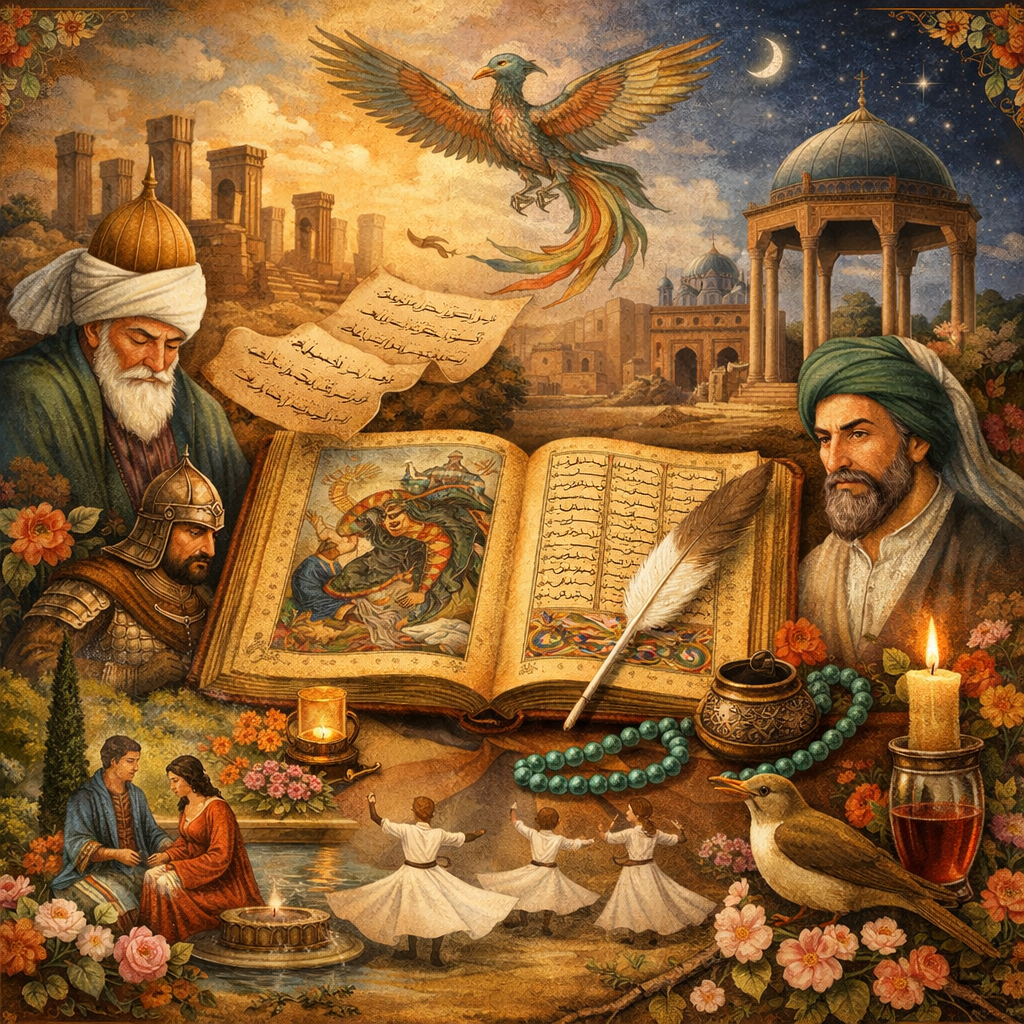
Read in this way, Persian poetry becomes more than literary history. It becomes a record of how a civilization understood sovereignty and impermanence, earthly beauty and spiritual ascent, longing and restraint, the garden and the wilderness, the beloved and the divine, justice and tyranny, homeland and exile, fracture and continuity. It reveals how literary form can preserve a world not only through factual remembrance, but through rhythm, symbol, archetype, allusion, and recurring modes of voice. Persian poetry endured because it gave durable shape to the moral and emotional imagination of a vast transregional world. It survived conquest, sectarian change, dynastic transformation, and linguistic diffusion because it became one of the principal ways memory itself was refined, beautified, and transmitted.
Persian Poetry and Cultural Memory therefore stands at the intersection of literary history, intellectual history, religious history, court culture, manuscript culture, translation history, and the history of civilizational transmission. It asks how poetry becomes inheritance; how epic preserves Iran in mythic, heroic, and historical time; how lyric and ghazal turn longing into a collective symbolic language; how Sufi poetry transforms desire into spiritual grammar; how wisdom poetry shapes the self; how prose, commentary, and anthologies stabilize canon; and how Persian literary memory radiates outward across languages, courts, and centuries while remaining recognizably itself.
Persian Poetry as Civilizational Memory
Persian poetry is one of the great memory systems of world literature because it transformed language into a durable archive of kingship, longing, justice, beauty, mystical ascent, ethical counsel, exile, transience, and cultural continuity. It preserved Iran in epic time, refined love into lyric form, turned spiritual longing into symbolic grammar, shaped ethical formation through didactic verse, and gave courts, households, Sufi communities, manuscript ateliers, and multilingual empires a shared language of cultivation.
The tradition is unusually powerful because poetry stood close to the center of Persianate civilization. Persian verse was recited, memorized, quoted, copied, illuminated, taught, glossed, adapted, translated, and carried across regions. It lived in courts and Sufi lodges, in manuscripts and oral performance, in moral instruction and aesthetic pleasure, in imperial settings and intimate memory. A line from Ferdowsi, Saadi, Rumi, Hafez, or Khayyam could function as wisdom, consolation, argument, spiritual provocation, political memory, or ethical shorthand.
To study Persian Poetry and Cultural Memory is therefore to study how poetry becomes civilizational infrastructure. It is not simply a matter of beautiful language. It is the study of how a literary tradition preserves worlds, forms selves, transmits symbols, sustains language, and gives historical communities a way to remember continuity across rupture.
Why This Pillar Matters
Persian poetry matters because it became one of the principal means by which a civilization narrated itself across rupture. Dynasties rose and fell, courts shifted, languages intermingled, empires expanded and fractured, and religious worlds changed; yet Persian poetry continued to provide a stable repertoire of memory, beauty, authority, longing, and ethical reflection. It carried ancient Iran into Islamic literary culture, preserved heroic and royal memory within new intellectual and political worlds, linked sovereignty to justice and impermanence, transformed love into moral and metaphysical journey, and gave transregional societies a shared symbolic vocabulary through which to think about truth, beauty, grief, exile, spiritual aspiration, and historical endurance.
It also matters because of its unusual cultural centrality. In many literary traditions, poetry is one eminent form among others. In Persian civilization, poetry often stood much nearer the center. It was recited in courts, quoted in ethical instruction, memorized in households, interpreted in Sufi circles, copied into anthologies, illuminated in manuscripts, set to music, and carried across empires as a mark of cultivation and prestige. Persian poetry became not only literature, but pedagogy, metaphysics, civility, self-formation, and public memory.
This pillar also matters because the Persianate world cannot be reduced to modern national borders. Persian literary culture moved through Iran, Central Asia, Afghanistan, South Asia, Ottoman and Timurid worlds, and many multilingual courts and scholarly communities. Persian poetry became a transregional language of prestige and refinement. Its memory is therefore civilizational, not narrowly territorial.
Scope and Method
This pillar is expansive by design, but ordered by a clear center. It includes the deep Iranian background from which Persian literary memory emerged; the classical canon of epic, romance, lyric, mystical verse, panegyric, rubaiyat, wisdom literature, and elegy; the prose and para-literary traditions that shaped poetic culture; and the wider Persianate world in which Persian functioned as a language of court, spirituality, education, literary prestige, and transregional refinement.
The pillar is centered on poetry, but it does not isolate poetry from the institutions and adjacent forms that sustained it. Mirror-for-princes literature, ethical prose, tazkiras, Sufi prose narratives, anthologies, literary biography, commentary, recitation, translation, and manuscript culture are included wherever they clarify how Persian poetry became a durable system of cultural memory.
The method throughout is to read Persian poetry as both art and civilizational structure. That means attending to genre, meter, imagery, symbolism, rhetorical texture, and literary convention, while also asking what these works did within the societies that preserved them. How did epic narrate Iran across catastrophe and continuity? How did panegyric articulate ideals of sovereignty? How did romance make love into ordeal, refinement, and revelation? How did the ghazal become at once erotic, social, mystical, and philosophical? How did Sufi poetry convert the language of love into the grammar of transformation? How did didactic verse educate the self? How did commentary shape interpretation? How did recitation, copying, illumination, and transregional patronage make Persian poetry durable across time and geography?
Reading Architecture for a Humanities Pillar
This literature pillar does not require a GitHub repository. Its research infrastructure is textual, bibliographic, philological, and interpretive rather than code-based. The proper scholarly architecture consists of primary texts, reliable translations, critical editions, manuscript records, commentary traditions, university press scholarship, museum and library collections, and carefully ordered reading pathways.
The central research practices for this pillar are close reading, historical contextualization, genre analysis, symbolic interpretation, reception history, translation comparison, manuscript study, canon formation, and critical engagement with the Persianate world as a transregional literary formation. The most important materials are poems, editions, translations, commentaries, tazkiras, manuscripts, illustrated codices, scholarly monographs, and literary histories.
A strong Persian Poetry and Cultural Memory pillar should therefore foreground:
- primary Persian texts in reliable translation, scholarly edition, or digitized manuscript form;
- major poets and works including Ferdowsi’s Shahnameh, Nezami’s romances, Attar’s mystical narratives, Rumi’s Masnavi, Saadi’s Gulistan and Bustan, Hafez’s Divan, Jami’s later classical synthesis, and Omar Khayyam’s quatrain tradition;
- major genre pathways such as epic, qasida, masnavi, ghazal, rubai, elegy, mystical verse, didactic poetry, and tazkira;
- recurring symbolic structures such as garden, rose, nightingale, wine, tavern, beloved, candle, moth, king, exile, spring, ruin, mirror, and spiritual journey;
- transmission history through recitation, memorization, manuscript copying, illumination, commentary, anthology, translation, and courtly patronage;
- critical attention to empire, court hierarchy, religious plurality, Sufi institutions, gendered voice, slavery, patronage, exile, and translation.
The Canonical Spine of the Tradition
A strongest-sense account of Persian Poetry and Cultural Memory should be unmistakably anchored in the poets who form the high canonical spine of the tradition. Ferdowsi preserves Iran in epic memory. Nezami perfects the architecture of narrative romance. Attar turns spiritual journey into allegorical world-literature. Rumi transforms longing into an immense metaphysical and poetic cosmos. Saadi gives Persian literature one of its greatest ethical and humanistic voices. Hafez carries lyric ambiguity, irony, beauty, and longing to unmatched density. Jami gathers and refines the later classical inheritance with extraordinary elegance and synthesis. Omar Khayyam, whether read through philosophical skepticism, quatrain form, or modern reception, remains indispensable to the Persian imagination of time, pleasure, mortality, and brevity.
These figures do not exhaust Persian poetry, but they provide its most visible axis of permanence. Around them gather the broader constellations of court poets, panegyrists, mystics, anthologists, commentators, scribes, illuminators, and translators through whom the tradition expanded. An elite ordering of the pillar does not diminish that broader richness. It clarifies the hierarchy through which the tradition is most powerfully recognized and most durably transmitted.
Foundational Questions
- How did Persian poetry become one of the principal media of civilizational memory across Iran and the wider Persianate world?
- What distinguishes epic, qasida, masnavi, ghazal, rubai, elegy, mystical verse, and didactic poetry as different memory forms?
- How did Persian literature preserve pre-Islamic Iranian memory while flourishing in Islamic intellectual and courtly worlds?
- How do Ferdowsi, Nezami, Attar, Rumi, Saadi, Hafez, Jami, and Omar Khayyam shape different political, romantic, ethical, philosophical, and spiritual archives?
- How do prose traditions such as tazkiras, Sufi prose, ethical prose, and commentary support and interpret poetic memory?
- How did Persian poetry travel across Central Asia, South Asia, Afghanistan, Anatolia, and beyond as a language of prestige and refinement?
- Why do recurring Persian symbols—garden, wine, rose, nightingale, tavern, candle, moth, beloved, ruin, desert, mirror, king, exile, spring—carry such enduring force?
- How should Persian poetry be read in relation to courtly hierarchy, religious plurality, imperial power, mysticism, gender, exile, and historical fracture?
- How did manuscript culture, recitation, commentary, and translation shape what survived as the Persian canon?
I. Iranian Backgrounds and the Deep Memory Before Classical Persian
A deepest-sense treatment of Persian poetry begins before the classical canon proper. Persian literary memory draws from older Iranian, royal, heroic, and sacred inheritances that predate the mature New Persian tradition. Pre-Islamic Iranian cosmology, kingship, mythic conflict, and Zoroastrian moral imagination form part of the deep memory later poets repeatedly reworked. Even when the textual pathways are indirect or historically layered, the memory of ancient Iran—of sacred order, contested sovereignty, heroic struggle, justice, and the vulnerability of civilization—remains fundamental to Persian literary self-understanding.
This deep background matters because Persian poetry repeatedly stages continuity through transformation. The Islamic centuries did not simply erase earlier Iranian memory. Rather, Persian literary culture re-inscribed, translated, elevated, and renewed that inheritance within new linguistic, theological, and political worlds. The result is one of world literature’s most remarkable acts of continuity across rupture.
- Ancient Iran and the Deep Memory Behind Persian Poetry (planned) — A foundational article on pre-Islamic Iranian memory, myth, kingship, sacred order, and literary inheritance.
- Zoroastrian Backgrounds and the Moral Imagination of Persian Literature (planned) — A study of moral dualism, cosmic order, justice, and the deeper symbolic inheritance behind Persian literary thought.
- Heroic Iran Before the Shahnameh (planned) — An article on pre-Ferdowsian heroic traditions, oral memory, royal narrative, and mythic continuity.
- Royal Memory, Sacred Order, and the Prehistory of Persian Poetics (planned) — A study of kingship, legitimacy, divine order, and the older memory-worlds behind classical Persian poetry.
- How Persian Literature Preserved Iran Across Rupture (planned) — A synthetic article on language, conquest, continuity, adaptation, and cultural survival.
II. Epic, Kingship, and the Memory of Iran
Ferdowsi and the Shahnameh as Civilizational Archive
The epic center of the tradition belongs above all to Ferdowsi. The Shahnameh is not merely a national epic in any narrow modern sense; it is one of the greatest civilizational archives in world literature. It preserves kings, heroes, dynasties, betrayals, battles, political catastrophes, generational rise and decline, and the tragic passing of worlds. It gathers mythic, heroic, and historical time into a single poetic body through which Iran remembers itself across conquest, linguistic change, and political transformation.
The Shahnameh matters not only because of scale, but because of function. It preserves pre-Islamic Iranian memory within classical Persian literary culture, dignifies Persian as a language of epic magnificence, offers exemplary and cautionary figures to later generations, and binds heroism to mortality, sovereignty to justice, and glory to impermanence. Rustam, Sohrab, Siyavash, Kay Khosrow, Zahhak, Jamshid, and the succession of kings endure not merely as characters but as permanent structures of reflection. Through them, Persian civilization contemplates loyalty, tyranny, innocence, fatherhood, betrayal, fate, restoration, and the fragility of order.
Epic Beyond Ferdowsi
Epic memory also extends beyond Ferdowsi’s singular achievement into illustrated manuscripts, public recitation, later retellings, regional adaptations, and the broader heroic imagination of Persianate culture. The epic archive is thus not one text alone, however monumental, but a continuing world of visual, pedagogical, and political remembrance.
- Ferdowsi’s Shahnameh and the Memory of Iran (planned) — A major article on epic memory, kingship, heroic time, language, and cultural continuity.
- Rustam, Heroism, and the Tragic Burden of Strength (planned) — A study of heroic greatness, violence, loyalty, and the limits of force.
- Rustam and Sohrab: Recognition, Blood, and Catastrophe (planned) — A close reading of fatherhood, misrecognition, fate, grief, and tragic identity.
- Siyavash, Innocence, and the Politics of Betrayal (planned) — An article on innocence, exile, accusation, sacrifice, and dynastic injustice.
- Kingship, Justice, and Dynastic Rise and Fall in the Shahnameh (planned) — A study of royal legitimacy, just rule, tyranny, succession, and decline.
- Tyranny, Disorder, and Demonic Kingship in Persian Epic (planned) — An article on Zahhak, corruption, monstrous rule, and political disorder.
- Illustrated Shahnamehs and the Visual Afterlife of Epic Memory (planned) — A study of manuscript illumination, court patronage, visual storytelling, and epic afterlife.
- Epic Language and Civilizational Continuity in Persian Literature (planned) — An article on Persian as epic language, cultural survival, and literary permanence.
III. Courtly Poetics, Panegyric, and the Ethics of Rule
Persian poetry flourished in courts as well as in mystical and scholarly milieus. Panegyric, especially in the qasida tradition, occupies a major place in the archive because it joined literary refinement to political culture. Court poets praised rulers, commemorated patronage, articulated ideals of kingship, and situated sovereigns within cosmic, ethical, and historical frameworks. Yet panegyric was not merely decorative praise. At its strongest, it encoded expectations of justice, made rule visible through image and rhetoric, and preserved the relationship between power and literary judgment.
The courtly archive includes poets such as Unsuri, Farrukhi, Manuchehri, Anvari, and Khaqani, whose works reveal the sophistication, density, and symbolic ambition of Persian praise poetry. Court literature also intersects with mirror-for-princes writing, advice literature, and ethical thought, showing how poetics and governance were repeatedly intertwined.
- Qasida and the Architecture of Courtly Praise (planned) — A foundational article on the qasida as political, aesthetic, and social form.
- Poetry, Patronage, and Political Imagination in Persian Courts (planned) — A study of poets, patrons, reputation, literary competition, and courtly hierarchy.
- Anvari and the Height of Learned Panegyric (planned) — An article on technical brilliance, praise, difficulty, and the learned courtly tradition.
- Khaqani, Majesty, Difficulty, and the Poetics of Power (planned) — A study of dense imagery, sovereign address, learned style, and poetic difficulty.
- Poetry and Kingship in the Persian Courtly World (planned) — An article on literary sovereignty, royal image, praise, counsel, and memory.
- Mirror-for-Princes Traditions and the Ethics of Sovereignty (planned) — A study of advice literature, justice, political ethics, and Persianate rulership.
IV. Romance, Narrative Poetry, and the Poetics of Love and Quest
If Ferdowsi secures the epic memory of Iran, Nezami gives Persian literature one of its highest narrative refinements. Romance in the Persian tradition, especially in the masnavi form, became a major vehicle for imagining beauty, ordeal, longing, fidelity, kingship, separation, transformation, and revelation. Nezami stands at the summit of this mode. In works such as Khosrow and Shirin, Leyli and Majnun, and Haft Paykar, he turns love into ethical testing, narrative architecture, and metaphysical resonance.
Persian romance often exceeds modern distinctions between secular and sacred, personal and civilizational. It moves simultaneously through courtly, symbolic, psychological, and spiritual registers. These narratives shaped emotional education across the Persianate world and became enduring sources for translation, imitation, illustration, and adaptation.
- Nezami and the Architecture of Persian Narrative Poetry (planned) — A major article on Nezami’s narrative design, symbolic architecture, romance, and poetic refinement.
- Khosrow and Shirin: Love, Sovereignty, and Refinement (planned) — A study of royal desire, feminine agency, beauty, discipline, and courtly imagination.
- Leyli and Majnun: Madness, Separation, and Absolute Desire (planned) — An article on longing, separation, madness, desert, and spiritualized love.
- Haft Paykar and the Cosmology of Narrative Design (planned) — A study of color, planetary symbolism, story architecture, and kingly transformation.
- Romance, Quest, and Ethical Formation in Persian Poetry (planned) — An article on love as ordeal, refinement, testing, and self-education.
- Beauty, Ordeal, and the Transforming Power of Love in Persian Narrative (planned) — A thematic article on beauty, desire, suffering, and transformation across Persian romance.
V. Sufi and Mystical Poetry
One of the defining achievements of Persian literary culture is the transformation of mystical experience into a vast symbolic poetry. Sanai, Attar, Rumi, and Jami each stand centrally within that achievement, though in different registers. Attar turns spiritual journey into allegorical and visionary literature of enduring power. Rumi transforms longing into an immense poetic cosmos in which love, bewilderment, discipline, annihilation, and return become inseparable. Jami gathers and refines the later inheritance with intellectual grace and lyrical control. In this tradition, wine becomes more than wine, the beloved more than beloved, journey more than travel, and ruin more than ruin. Outer language becomes inward grammar.
This mystical archive does not abolish emotional or literal meaning; it multiplies it. Persian Sufi poetry is powerful precisely because it accommodates ethical instruction, metaphysical speculation, parable, ecstasy, irony, symbolic indirection, and psychological exactness at once. It preserves memory not only of institutions or dynasties, but of inward states, disciplines of the self, and the soul’s difficult education.
- Sanai and the Early Formation of Persian Mystical Poetry (planned) — A study of didactic mysticism, symbolic language, and the early formation of Persian Sufi poetics.
- Attar and the Poetics of Spiritual Journey (planned) — A major article on allegory, quest, annihilation, and spiritual transformation.
- The Conference of the Birds and the Collective Search for the Real (planned) — A close reading of the birds’ journey, leadership, surrender, and the Simurgh.
- Rumi and the Metaphysics of Love (planned) — A study of longing, divine love, self-annihilation, and poetic metaphysics.
- The Masnavi as Spiritual Literature and Poetic Cosmos (planned) — An article on parable, story, theology, psychology, and expansive mystical teaching.
- Jami and the Late Flowering of Persian Mystical Humanism (planned) — A study of later classical synthesis, refinement, Sufi thought, and literary elegance.
- Sufi Symbolism in Persian Poetry: Wine, Tavern, Beloved, and Ruin (planned) — A thematic article on recurring symbols and their layered meanings.
- Ecstasy, Discipline, and the Inner Education of the Self in Persian Verse (planned) — A study of mystical pedagogy, longing, discipline, and transformation.
VI. Ghazal, Lyric Intimacy, and the Language of Desire
The ghazal stands among the most refined lyric forms in world literature, and Hafez stands at its most luminous center. In Persian lyric, longing is concentrated, stylized, recursive, and allusive. The beloved may be human, divine, absent, cruel, redemptive, or intentionally indeterminate. The speaker may be lover, seeker, skeptic, penitent, ironic observer, ecstatic, or some unstable combination of them all. Hafez carries this ambiguity to extraordinary density, creating poems in which beauty, longing, irony, piety, social critique, and metaphysical suggestion remain permanently entwined.
What makes the ghazal such a powerful form of cultural memory is its density of recurrence. It does not narrate at epic scale; it preserves states, symbols, tonal registers, and recurring relations between desire and knowledge. Through the ghazal, Persian civilization made inward life collectively legible without reducing its mystery.
Omar Khayyam also belongs near this lyric center, though by way of quatrain rather than ghazal. The rubai condenses reflection on time, mortality, contingency, wine, and fleeting delight into one of the sharpest small forms of the Persian tradition. Khayyam’s afterlife—philological, philosophical, and modern—makes him central to the way Persian lyric thought has been received across cultures.
- The Ghazal as a Form of Cultural Memory (planned) — A foundational article on lyric compression, recurrence, desire, ambiguity, and symbolic tradition.
- Hafez and the Sovereignty of Ambiguous Desire (planned) — A major article on Hafez’s lyric density, irony, beauty, longing, and interpretive openness.
- Wine, Garden, and the Beloved in Persian Lyric (planned) — A study of the symbolic landscape of the ghazal.
- Irony, Piety, and Spiritual Indirection in Hafez (planned) — An article on devotional ambiguity, critique of hypocrisy, and lyric indirection.
- The Social and Mystical Lives of the Ghazal (planned) — A study of how ghazal language moves across erotic, social, courtly, and mystical registers.
- Omar Khayyam and the Philosophical Brevity of the Rubai (planned) — An article on quatrain form, mortality, skepticism, time, and pleasure.
- Mortality, Time, and the Lyric of Fleeting Presence in Khayyam (planned) — A study of finitude, impermanence, wine, and the compressed philosophy of presence.
VII. Ethical, Didactic, and Wisdom Traditions
Saadi gives Persian literature one of its greatest ethical voices. In the Gulistan and Bustan, anecdote, maxim, travel, reflection, wit, compassion, and discipline combine into a literature of character and conduct that has shaped Persianate moral imagination for centuries. Here Persian literary culture is not only exalted or ecstatic; it is lucid, humane, practical, and pedagogical. Saadi’s world is one in which poetry and prose help form judgment, humility, generosity, restraint, social intelligence, and awareness of human frailty.
This tradition is indispensable because cultural memory is not only heroic or mystical. It is also ethical and educative. Persian literature repeatedly sought to form the self, not simply delight the ear or overwhelm the heart. It created a moral style as well as a poetic one.
- Saadi and the Ethics of Persian Humanism (planned) — A major article on ethical prose, poetic wisdom, human frailty, and moral clarity.
- The Gulistan and the Art of Moral Prose (planned) — A study of anecdote, wit, travel, ethical instruction, and social observation.
- The Bustan and the Poetics of Ethical Formation (planned) — An article on didactic poetry, virtue, justice, generosity, humility, and self-cultivation.
- Wisdom, Conduct, and Self-Knowledge in Persian Literature (planned) — A broader article on ethical formation through poetry and prose.
- Adab, Civility, and Moral Intelligence in the Persianate World (planned) — A study of refined conduct, literary cultivation, social judgment, and ethical eloquence.
VIII. Elegy, Lament, and the Memory of Loss
Persian poetry preserves grief with extraordinary subtlety and force. Lament for fallen rulers, ruined cities, lost beloveds, vanished youth, moral decline, spiritual distance, and historical catastrophe forms an important layer of the archive. Elegiac consciousness moves across epic, lyric, mystical poetry, and historical reflection. Even poems not formally classified as elegy often remain marked by impermanence, absence, and the passing of beauty or power.
This makes Persian poetry one of the great literatures of civilizational vulnerability. Gardens bloom and fade. Spring returns but not the lost moment. Dynasties rise and vanish. Love survives fulfillment. Beauty remains inseparable from transience. Loss is not incidental to the tradition; it is one of its governing truths.
- Elegy and the Memory of Loss in Persian Poetry (planned) — A thematic article on lament, grief, mortality, and cultural memory.
- Impermanence, Ruin, and Historical Fragility in Persian Verse (planned) — A study of transience, political decline, broken worlds, and poetic memory.
- Mourning, Separation, and the Aesthetics of Absence (planned) — An article on longing, distance, absence, and the emotional structure of Persian verse.
- Poetry After Catastrophe in the Persianate Imagination (planned) — A study of literary response to conquest, exile, dynastic rupture, and historical loss.
IX. Prose, Commentary, and the Literary World Around Poetry
Although poetry is the spine of the category, prose cannot be excluded from a strongest-sense treatment. Persian cultural memory was shaped by prose works that framed, transmitted, interpreted, and complemented poetry. This includes ethical prose, mirrors-for-princes literature, Sufi prose narratives, biographies of saints, anthologies, tazkiras, literary criticism, letters, memoir, and historiographical writing where literary texture and poetic reference are central. These works help explain how Persian poetry was read, taught, authorized, and socially embedded.
Tazkiras and biographical anthologies are especially important because they preserve reputations, anecdotes, literary genealogies, evaluative judgment, and memory of poets themselves. They are part of the machinery through which the canon becomes durable. Commentary traditions, meanwhile, reveal the layered interpretive life of Persian verse, especially for allusive and mystical poets whose meaning was never exhausted by first reading.
- Tazkiras and the Making of Persian Literary Memory (planned) — A study of literary biography, reputation, anecdote, canon formation, and poet memory.
- Sufi Prose and the Narrative World Around Mystical Poetry (planned) — An article on saintly biography, teaching stories, spiritual prose, and poetic interpretation.
- Mirror-for-Princes Literature and the Ethics of Rule (planned) — A study of advice literature, sovereignty, justice, and political ethics.
- Commentary, Gloss, and the Interpretive Life of Persian Poetry (planned) — An article on layered reading, ambiguity, mystical interpretation, and scholarly mediation.
- Anthology, Biography, and Canon Formation in Persian Literature (planned) — A study of selection, preservation, literary ranking, and cultural memory.
X. The Persianate World and the Transregional Life of Persian Poetry
Persian poetry cannot be contained within the territorial idea of Iran alone. It belongs to the wider Persianate world: Central Asia, Afghanistan, South Asia, parts of Anatolia, and the many courts and intellectual networks in which Persian functioned as a language of prestige, administration, spirituality, aesthetics, and elite formation. Persian poetry moved through courts, Sufi lodges, scholarly communities, manuscript ateliers, and multilingual literary ecologies. It shaped and was reshaped by Turkic, Indic, and Arabic literary cultures while retaining a distinct authority and identity.
This transregional life is essential because cultural memory here is civilizational rather than narrowly national. Persian poetry became a medium through which multiple societies entered a shared world of refinement, longing, ethical form, and literary inheritance. Its afterlife includes Timurid, Mughal, Central Asian, Afghan, and Ottoman settings, as well as multilingual environments in which Persian forms were translated, adapted, imitated, and contested.
- The Persianate World and the Geography of Literary Memory (planned) — A foundational article on Persian as a transregional literary language and cultural system.
- Persian Poetry in Central Asia and the Timurid Imagination (planned) — A study of Timurid patronage, manuscript culture, courtly refinement, and literary continuity.
- Indo-Persian Literature and the Expansion of Persian Cultural Memory (planned) — An article on South Asian Persianate literary life, multilingual courts, and cultural synthesis.
- Persian Poetry at Mughal Courts (planned) — A study of Mughal patronage, Persian literary prestige, aesthetics, translation, and imperial memory.
- Ottoman Encounters with Persian Poetic Prestige (planned) — An article on imitation, rivalry, multilingual literary culture, and Persian influence.
- Translation, Adaptation, and Multilingual Literary Worlds in the Persianate Ecumene (planned) — A study of cross-linguistic circulation, adaptation, and literary prestige.
XI. Modern Afterlives, Translation, and Cultural Renewal
Persian poetry survives through translation, nationalist recovery, scholarly editing, spiritual universalization, performance, pedagogy, and global literary circulation. Some poets, especially Rumi and Hafez, have entered modern world literature through translation in ways that are sometimes illuminating and sometimes reductive. Ferdowsi and the Shahnameh continue to shape modern discussions of language, identity, memory, and civilizational inheritance. Khayyam’s modern afterlife reveals how radically Persian poetry can be reframed under translation and modern taste.
A strongest-sense pillar therefore includes not only the classical archive itself, but the modern conditions under which that archive is edited, translated, simplified, contested, repoliticized, and renewed. Persian poetry remains active not as a museum tradition alone, but as a living resource through which readers continue to negotiate beauty, memory, ethics, longing, and cultural belonging.
- Modern Readings of Rumi and the Global Afterlife of Persian Mystical Poetry (planned) — A study of translation, spirituality, popular reception, and the risks of decontextualization.
- Ferdowsi in Modern Cultural Memory (planned) — An article on language, identity, epic memory, and modern cultural inheritance.
- Hafez in Translation and the Problem of Lyric Ambiguity (planned) — A study of translation, interpretive openness, metaphor, and the difficulty of preserving ambiguity.
- Khayyam and the Reinvention of Persian Poetic Skepticism (planned) — An article on the Rubaiyat, translation, philosophical brevity, and modern reception.
- Translation and the Gains and Losses of Persian Poetic Reception (planned) — A broader article on what translation reveals, alters, simplifies, and preserves.
- Persian Poetry, Modernity, and the Renewal of Cultural Inheritance (planned) — A study of modern literary memory, nationalism, diaspora, pedagogy, and renewal.
XII. Major Genres Across the Persian Poetic Archive
A comprehensive pillar should also organize the archive by genre, since genre is one of the principal ways Persian literary memory differentiates function and scale. Epic monumentalizes dynastic and heroic memory. Qasida formalizes praise, hierarchy, sovereignty, and literary virtuosity. Ghazal preserves longing, ambiguity, beauty, and inward intensity. Masnavi expands narrative, spiritual, and romantic possibility. Rubai condenses philosophical or existential reflection into the pressure of brevity. Didactic poetry forms the self through moral instruction. Elegy preserves absence and impermanence. Sufi poetry transforms the symbolic world into inward map. Tazkira and anthology transform literary culture into remembered lineage.
- Epic as Civilizational Memory in Persian Literature (planned) — A genre article on heroic time, kingship, dynasty, catastrophe, and cultural continuity.
- Qasida and the Poetics of Courtly Authority (planned) — A study of praise, hierarchy, patronage, rhetorical display, and political imagination.
- Ghazal and the Language of Desire (planned) — An article on longing, lyric compression, ambiguity, and symbolic recurrence.
- Masnavi and the Architecture of Narrative and Spiritual Quest (planned) — A study of narrative expansiveness, romance, mystical teaching, and poetic structure.
- Rubai and Philosophical Compression (planned) — An article on quatrain form, mortality, brevity, skepticism, and reflective intensity.
- Didactic Poetry and Ethical Formation (planned) — A study of poetry as moral instruction, self-cultivation, and practical wisdom.
- Elegy and the Poetics of Absence (planned) — An article on mourning, separation, impermanence, and memory.
- Tazkira, Anthology, and Literary Canon (planned) — A study of literary biography, selection, reputation, and transmission.
XIII. Recurring Themes and Symbolic Structures
Across these genres, certain symbols and themes recur with extraordinary persistence and give Persian poetry its unique interpretive density: kingship and justice; heroic loyalty and betrayal; beauty and danger; wine and intoxication; tavern and anti-hypocrisy; garden as cultivated order, paradise, and remembered harmony; desert as ordeal and searching; rose and nightingale as desire and lament; candle and moth as annihilating attraction; beloved as earthly or divine axis; exile and wandering; ruin and impermanence; spring and renewal; sincerity and hypocrisy; sovereignty and mortality. These recurring structures are among the chief reasons Persian poetry became so durable. They allow each generation to inherit a world of meaning without exhausting its depth.
- Garden, Rose, and Nightingale in Persian Poetic Imagination (planned) — A thematic article on beauty, longing, song, nature, and cultivated symbolic order.
- Wine, Tavern, and the Politics of Spiritual Indirection (planned) — A study of wine imagery, anti-hypocrisy, spiritual ambiguity, and poetic subversion.
- Beloved, Distance, and the Grammar of Longing (planned) — An article on desire, absence, lyric relation, and spiritualized intimacy.
- King, Hero, and the Burden of Justice (planned) — A study of sovereignty, heroism, legitimacy, and moral responsibility.
- Exile, Wandering, and Homeland in Persian Literature (planned) — An article on displacement, longing, belonging, and poetic geography.
- Ruin, Impermanence, and the Fragility of Worldly Order (planned) — A study of decline, time, transience, and historical vulnerability.
- Spring, Renewal, and the Temporal Imagination of Persian Poetry (planned) — An article on seasonal return, beauty, mortality, and cyclical time.
- Hypocrisy, Sincerity, and the Moral Critique of Religious Pretension (planned) — A study of social critique, piety, irony, tavern imagery, and poetic moral intelligence.
XIV. Manuscripts, Recitation, Commentary, and Canon Formation
Persian poetry became canonical through institutions of transmission. Manuscripts, calligraphy, illumination, oral recitation, memorization, court patronage, Sufi instruction, anthologies, tazkiras, scholarly commentary, and later print culture all helped determine what survived and how it was read. The Persian canon is not simply the result of poetic genius; it is also the result of repeated acts of copying, selecting, glossing, teaching, and reverence.
The manuscript tradition matters especially because Persian literary culture so often fused text with visual beauty. Calligraphy, illumination, miniature painting, and codex production belong to the memory system itself. Recitation and quotation made poetry socially alive beyond the page. A line of Ferdowsi, Saadi, Rumi, or Hafez could circulate as wisdom, consolation, argument, devotion, ethical shorthand, or spiritual provocation. Canon formation in Persian literature is therefore inseparable from embodied practice, aesthetic transmission, and interpretive community.
- Manuscript Culture and the Material Life of Persian Poetry (planned) — A study of codices, scribes, libraries, copying, patronage, and textual survival.
- Calligraphy, Illumination, and the Visual Form of Literary Memory (planned) — An article on manuscript beauty, miniature painting, visual storytelling, and poetic authority.
- Recitation, Memorization, and the Social Life of Persian Verse (planned) — A study of oral transmission, quotation, pedagogy, and social memory.
- Tazkiras, Anthologies, and the Construction of the Persian Canon (planned) — An article on literary biography, selection, ranking, and canon formation.
- Commentary and the Layered Reading of Mystical Poetry (planned) — A study of gloss, exegesis, ambiguity, and interpretive tradition.
- Why Persian Poetry Endured Across Empires (planned) — A synthetic article on portability, prestige, language, pedagogy, and cultural continuity.
Expanded Article Architecture
The following long-range architecture preserves the full breadth of the category while clarifying its canonical center. It is designed to support gradual expansion without losing hierarchy. All entries below should be treated as planned unless already completed elsewhere on the site.
Deep Backgrounds and Foundations
- Ancient Iran and the Deep Memory Behind Persian Poetry (planned)
- Zoroastrian Backgrounds and the Moral Imagination of Persian Literature (planned)
- Royal Memory, Heroic Time, and the Prehistory of Persian Epic (planned)
- How Persian Literature Preserved Iran Across Rupture (planned)
Ferdowsi and Epic Memory
- Ferdowsi’s Shahnameh and the Memory of Iran (planned)
- Rustam and the Tragic Burden of Heroism (planned)
- Rustam and Sohrab: Recognition and Catastrophe (planned)
- Siyavash and the Poetry of Innocence Betrayed (planned)
- Kingship, Justice, and Decline in the Shahnameh (planned)
- Epic Language and Civilizational Continuity in Persian Poetry (planned)
- Illustrated Shahnamehs and the Visual Afterlife of Epic (planned)
Nezami and Narrative Romance
- Nezami and the Architecture of Persian Narrative (planned)
- Khosrow and Shirin: Love and Sovereignty (planned)
- Leyli and Majnun: Desire, Madness, and Separation (planned)
- Haft Paykar and the Cosmology of Story (planned)
- Romance, Beauty, and Ordeal in Persian Poetry (planned)
Attar, Rumi, and the Mystical Archive
- Sanai and the Early Formation of Persian Mystical Poetry (planned)
- Attar and the Poetics of Spiritual Search (planned)
- The Conference of the Birds and Collective Quest (planned)
- Rumi and the Metaphysics of Love (planned)
- The Masnavi as Spiritual Cosmos (planned)
- Sufi Symbolism in Persian Poetry: Wine, Tavern, Beloved, and Ruin (planned)
- Ecstasy, Discipline, and the Inner Education of the Self (planned)
Saadi and Ethical Humanism
- Saadi and the Ethics of Persian Humanism (planned)
- The Gulistan and the Art of Moral Prose (planned)
- The Bustan and the Poetics of Conduct (planned)
- Wisdom, Self-Knowledge, and Ethical Formation in Persian Literature (planned)
- Adab, Civility, and Moral Intelligence in the Persianate World (planned)
Hafez and the Ghazal Tradition
- The Ghazal as Cultural Memory (planned)
- Hafez and the Sovereignty of Ambiguous Desire (planned)
- Garden, Rose, and Nightingale in Persian Lyric (planned)
- Irony, Piety, and Hypocrisy in Hafez (planned)
- Lyric Compression and Allusive Depth in Persian Poetry (planned)
Jami and the Later Classical Synthesis
- Jami and the Late Flowering of Persian Mystical Humanism (planned)
- Jami and the Classical Inheritance of Persian Poetry (planned)
- Yusuf and Zulaykha and the Aesthetics of Spiritualized Narrative (planned)
Omar Khayyam and the Rubai Tradition
- Omar Khayyam and the Philosophical Brevity of the Rubai (planned)
- Mortality, Time, and Fleeting Presence in Khayyam (planned)
- The Rubaiyat and the Problem of Modern Reception (planned)
Courtly Poetry and Sovereignty
- Qasida and the Architecture of Praise (planned)
- Poetry, Patronage, and the Persian Court (planned)
- Anvari and the Height of Learned Panegyric (planned)
- Khaqani and the Difficult Sublime of Court Poetry (planned)
- Mirror-for-Princes Literature and the Ethics of Rule (planned)
Loss, Ruin, and Historical Fragility
- Elegy and the Memory of Loss in Persian Poetry (planned)
- Impermanence, Ruin, and Historical Fragility (planned)
- Separation, Absence, and the Aesthetics of Longing (planned)
- Poetry After Catastrophe in the Persianate Imagination (planned)
Prose and Literary Surrounds
- Tazkiras and the Making of Persian Literary Memory (planned)
- Sufi Prose and the Narrative World Around Mystical Poetry (planned)
- Anthology, Biography, and Canon Formation in Persian Literature (planned)
- Commentary and the Interpretive Life of Persian Verse (planned)
The Persianate World
- The Persianate World and the Geography of Literary Memory (planned)
- Persian Poetry in Central Asia (planned)
- Indo-Persian Literature and Mughal Cultural Memory (planned)
- Persian Poetic Prestige in Ottoman Literary Culture (planned)
- Translation, Adaptation, and Multilingual Persianate Worlds (planned)
Transmission and Afterlives
- Manuscript Culture and the Material Life of Persian Poetry (planned)
- Calligraphy, Illumination, and Literary Memory (planned)
- Recitation, Memorization, and the Social Life of Persian Verse (planned)
- Modern Readings of Rumi and the Global Afterlife of Persian Mystical Poetry (planned)
- Ferdowsi in Modern Cultural Memory (planned)
- Hafez in Translation and the Problem of Lyric Ambiguity (planned)
- Khayyam and the Reinvention of Persian Poetic Skepticism (planned)
- Translation and the Gains and Losses of Persian Literary Reception (planned)
Closing Perspective
Persian Poetry and Cultural Memory should be understood as a major archive of sovereignty, beauty, longing, discipline, remembrance, and civilizational endurance rather than as a narrow shelf of lyric refinement alone. Its range extends from deep Iranian memory and epic kingship to courtly qasida, narrative romance, mystical masnavi, ghazal lyric, ethical wisdom, elegiac fragility, prose commentary, and the vast Persianate world that carried Persian verse across regions and centuries. Read in the strongest sense, the category shows how poetry can preserve not only feeling or style, but an entire symbolic civilization.
It is therefore central to any serious understanding of how literary cultures carry memory across rupture. Persian poetry reveals how a civilization narrates justice and tyranny, beauty and peril, exile and belonging, earthly love and spiritual longing, historical fracture and cultural continuity. It also shows how poetry, when placed at the center of a civilizational order, can become one of the most enduring media through which a people remembers its past, refines its inward life, and transmits its most durable forms of imagination to the future.
Related Reading
- Literature & Cultural Memory
- Arabic Literature and Adab
- Classical Literature and Civilizational Memory
- Indus Region Myth, Folklore & Sacred Narrative
- Egyptian Mythology
- South Asian Traditions
- Persian Traditions
Further Reading
- Attar, F. al-D. (1984). The Conference of the Birds. Translated by A. Darbandi and D. Davis. London: Penguin.
- Brookshaw, D. P. (2019). Hafiz and His Contemporaries: Poetry, Performance and Patronage in Fourteenth-Century Iran. London: I.B. Tauris / Bloomsbury.
- Davis, D. (1992). Epic and Sedition: The Case of Ferdowsi’s Shahnameh. Fayetteville: University of Arkansas Press.
- de Bruijn, J. T. P. (1997). Persian Sufi Poetry: An Introduction to the Mystical Use of Classical Persian Poems. Richmond: Curzon.
- Ferdowsi (2006). Shahnameh: The Persian Book of Kings. Translated by D. Davis. New York: Penguin Classics / Washington, DC: Mage Publishers.
- Jabbari, A. (2023). The Making of Persianate Modernity: Language and Literary History between Iran and India. Cambridge: Cambridge University Press. https://www.cambridge.org/core/books/making-of-persianate-modernity/A796FA74ABF9B0B6FAE1C81F60D75891
- Lewis, F. D. (2000). Rumi: Past and Present, East and West. Oxford: Oneworld.
- Meisami, J. S. (1987). Medieval Persian Court Poetry. Princeton: Princeton University Press.
- Mojaddedi, J. (trans.) (2008). The Masnavi, Book One. Oxford: Oxford University Press. https://global.oup.com/academic/product/the-masnavi-book-one-9780199552313
- Nezami Ganjavi (1997). Layli and Majnun. Translated by R. Gelpke. New Lebanon, NY: Omega Publications.
- Saadi (2004). The Gulistan. Translated by W. M. Thackston. Bethesda, MD: Ibex.
- Thackston, W. M. (trans.) (1999). A Millennium of Classical Persian Poetry: A Guide to the Reading and Understanding of Persian Poetry from the Tenth to the Twentieth Century. Bethesda, MD: Ibex.
References
- Attar, F. al-D. (1984). The Conference of the Birds. Translated by A. Darbandi and D. Davis. London: Penguin.
- Cambridge University Press (n.d.). Persian and Persianate Literature. Cambridge: Cambridge University Press. https://www.cambridge.org/core/browse-subjects/literature/asian-literature/persian-and-persianate-literature
- Davis, D. (1992). Epic and Sedition: The Case of Ferdowsi’s Shahnameh. Fayetteville: University of Arkansas Press.
- de Bruijn, J. T. P. (1997). Persian Sufi Poetry: An Introduction to the Mystical Use of Classical Persian Poems. Richmond: Curzon.
- Ferdowsi (n.d.). Shahnameh. Persian text resources. https://persian.packhum.org/persian/main?url=pf?file=6010101
- Ferdowsi (n.d.). Shahnameh. Manuscript and object resources. Metropolitan Museum of Art. https://www.metmuseum.org/art/collection/search?q=Shahnama
- Ferdowsi (2006). Shahnameh: The Persian Book of Kings. Translated by D. Davis. New York: Penguin Classics / Washington, DC: Mage Publishers.
- Hafez (2012). The Green Sea of Heaven: Eighty Ghazals from the Diwan of Hafiz. Translated by E. Banani and D. Davis. Washington, DC: Mage Publishers.
- Jabbari, A. (2023). The Making of Persianate Modernity: Language and Literary History between Iran and India. Cambridge: Cambridge University Press. https://www.cambridge.org/core/books/making-of-persianate-modernity/A796FA74ABF9B0B6FAE1C81F60D75891
- Jami (2013). Jami. By H. Algar. New Delhi: Oxford University Press. https://global.oup.com/academic/product/jami-9780198090441
- Khayyam, O. (2009). The Rubáiyát of Omar Khayyám. Oxford: Oxford University Press.
- Lewis, F. D. (2000). Rumi: Past and Present, East and West. Oxford: Oneworld.
- Meisami, J. S. (1987). Medieval Persian Court Poetry. Princeton: Princeton University Press.
- Mojaddedi, J. (trans.) (2008). The Masnavi, Book One. Oxford: Oxford University Press. https://global.oup.com/academic/product/the-masnavi-book-one-9780199552313
- Nezami Ganjavi (1997). Layli and Majnun. Translated by R. Gelpke. New Lebanon, NY: Omega Publications.
- Rumi, J. al-D. (n.d.). Masnavi-ye Ma’navi. Persian text. https://archive.org/details/masnavimaulanarumipersian
- Saadi (2004). The Gulistan. Translated by W. M. Thackston. Bethesda, MD: Ibex.
- Thackston, W. M. (trans.) (1999). A Millennium of Classical Persian Poetry: A Guide to the Reading and Understanding of Persian Poetry from the Tenth to the Twentieth Century. Bethesda, MD: Ibex.