
Last Updated May 6, 2026
Chinese myth becomes clearer when placed beside other mythic traditions, but comparison has to be done with methodological care. Comparison can illuminate recurring human concerns such as origins, flood, divine power, sacred geography, heroic action, political legitimacy, ritual continuity, monsters, death, ancestry, and the relation between heaven and humanity. At its best, comparative mythology shows that myths are not merely local stories but symbolic systems for organizing fundamental questions about order, danger, landscape, kinship, sacrifice, sovereignty, and the unseen world. At its worst, however, comparison misleads by assuming that all mythic traditions ought to take the same formal shape, preserve themselves through the same kinds of texts, or possess the same kind of pantheon, epic, or divine genealogy.
This is precisely where Chinese myth becomes theoretically important. It does not survive in exactly the same form as Greek mythology, Hindu mythic traditions, Mesopotamian cosmology, Egyptian sacred kingship, biblical flood narrative, or the Norse corpus. Early Chinese literature does not present a single large mythological epic comparable to the Iliad, the Mahābhārata, the Epic of Gilgamesh, or the Edda. Attempts to reconstruct a fully organic mythology from antiquity remain difficult because the archive is dispersed across classics, philosophical writing, poetry, ritual texts, folklore, local cult, geographical imagination, history, anomaly literature, regional performance, and later literary reinvention.
Article Map
Chinese Myth, Folklore & Legend
Related Topic
Problem of Sources
Series context: This article is part of the Chinese Myth, Folklore & Legend knowledge series. For the broader category structure, return to the Mythology category.
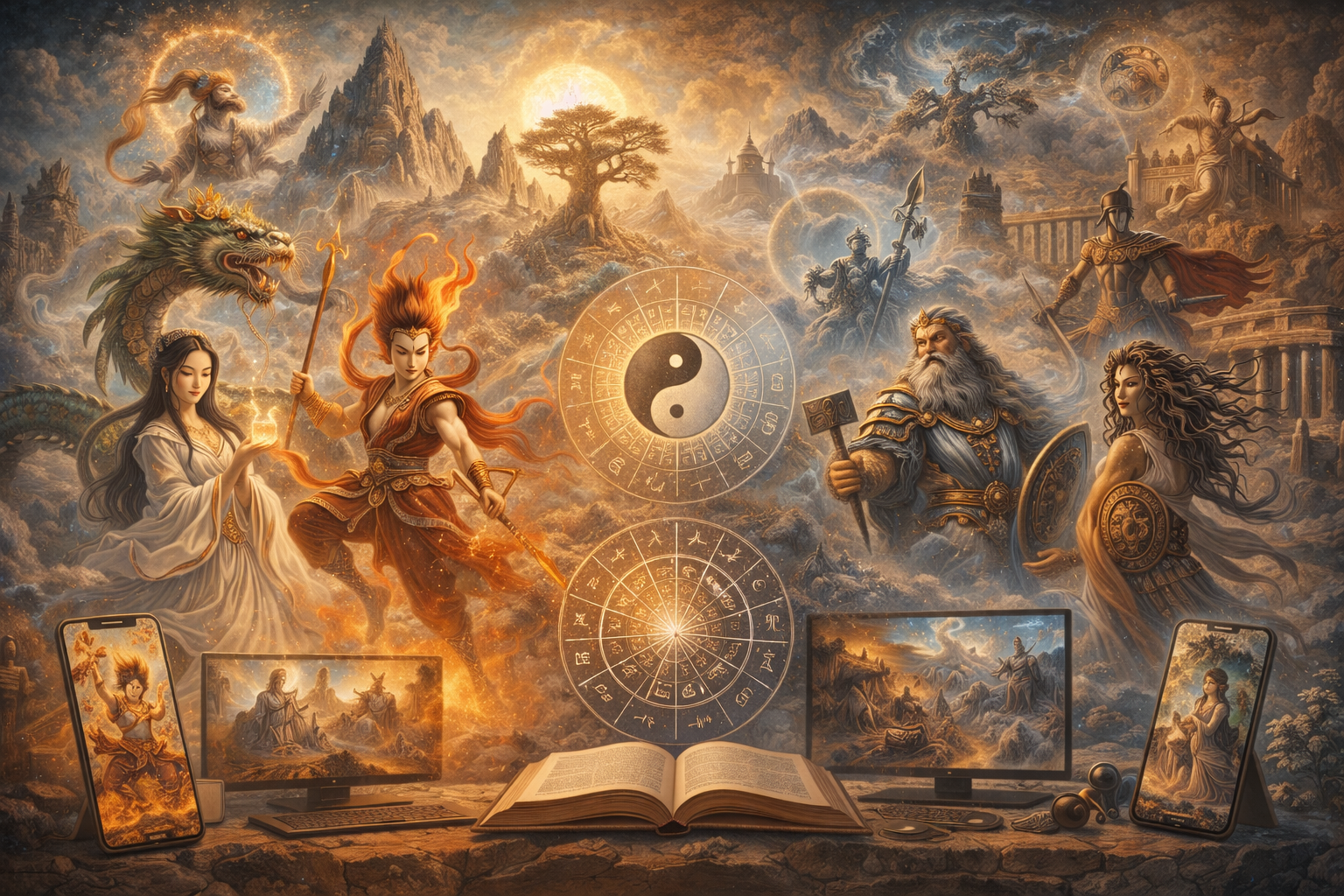
For that reason, comparison is most valuable when it asks not whether Chinese myth has “the same gods,” “the same epic structure,” or “the same creation narrative” as somewhere else, but how different civilizations organized cosmos, authority, sacred landscape, heroic labor, ritual continuity, and cultural memory. From that perspective, Chinese myth is neither an incomplete version of some other model nor a closed exception to comparison. It is a distinct mythic formation whose differences are themselves theoretically important.
Chinese myth also changes how comparison should be practiced. It asks the reader to compare not only plots, gods, and motifs, but media of preservation. Some traditions preserve myth through monumental epic. Others through scripture, temple ritual, oral performance, festival, visual art, local cult, sacred geography, or philosophical cosmology. Chinese myth is especially valuable because it makes this problem visible. Its archive is not weak because it is dispersed. It is strong in a different way: accretive, relational, ritualized, spatial, adaptive, and repeatedly remade.
Why Comparison Matters
Comparative mythology is useful because myths are not only local narratives; they are also ways of organizing fundamental human questions. Why is the world ordered as it is? How do heaven, earth, and humanity relate? Why do flood, death, kingship, monsters, sacred mountains, liminal beings, divine punishments, and culture heroes recur across cultures? Why do societies imagine origins, catastrophe, justice, lineage, sacrifice, and sacred authority through stories that exceed ordinary history? Comparison helps identify both recurrent patterns and distinctive civilizational choices.
Chinese myth shares with many traditions an interest in beginnings, heroic action, sacred places, catastrophe, divine or semi-divine mediation, cosmic ordering, monstrous beings, and the relation between visible and invisible worlds. There are creator or world-ordering figures, flood traditions, sacred mountains, culture heroes, divine animals, underworld officials, heaven-earth relations, and mythic geographies. These parallels matter because they show that Chinese myth participates in the wider human effort to make cosmos meaningful through symbolic form.
At the same time, comparison also reveals how differently civilizations choose to preserve and structure those concerns. Chinese myth often frames them through correlative cosmology, moral-political order, ritual continuity, sacred geography, and distributed textual survival rather than through a single genealogy of gods or one master epic. That difference matters. It means comparison is most illuminating when it identifies distinct ways of making order meaningful rather than forcing all traditions into the same narrative mold.
Used carefully, comparison sharpens both likeness and difference. It can show that Chinese myth belongs to the larger human history of symbolic thought while also demonstrating that its formal organization, modes of transmission, and relationship to ritual and political order are distinctive in ways that expand the very meaning of mythology itself.
Comparison Without Flattening
The central danger in comparative mythology is flattening. It is easy to compare Pangu to other cosmic giants, Nüwa to creator or mother goddesses, Yu the Great to flood heroes, Xiwangmu to goddess queens, dragons to serpents, and heavenly order to divine kingship elsewhere. Such comparisons can be useful, but only if they do not erase the specific structure of Chinese materials. A figure can resemble another figure without doing the same cultural work.
Chinese myth especially resists shallow equivalence because its categories do not always align with those of better-known Western comparative models. “God,” “hero,” “ancestor,” “immortal,” “sage-king,” “spirit,” “demon,” “dragon,” and “deity” do not map neatly onto Greek, Norse, biblical, or Mesopotamian categories. A Chinese culture hero may be a moral ruler, hydraulic engineer, ritual founder, cosmic repairer, or ancestral figure rather than a warrior defined primarily by glory. A dragon may be a rain and water power rather than a treasure-hoarding monster. A goddess may be a cosmic repairer, sea-protector, or sovereign of immortality rather than a member of a closed divine family.
Comparison must therefore ask what a figure or motif does within its own system. Does it organize ritual? Legitimate rule? Map geography? Explain catastrophe? Carry ancestral authority? Make the unseen bureaucratically legible? Preserve ecological relation? Anchor a local cult? If comparison begins with function rather than surface resemblance, it becomes more useful and less distorting.
This article therefore treats comparison as a method of clarification rather than ranking. Chinese myth is not being measured against Greece, India, Mesopotamia, or the Norse world as a standard. It is being placed beside them so that its own structure becomes sharper: dispersed rather than centralized, correlative rather than exclusively anthropomorphic, ritualized rather than merely literary, spatial rather than only genealogical, and continuously reinvented rather than fixed in one form.
The Problem of Form: Epic, Canon, and Fragment
The first major comparative difference is formal. Many readers come to mythology with expectations shaped by Greece, Mesopotamia, India, or the Norse world. They expect an identifiable pantheon, a relatively stable cycle of divine stories, and major narrative containers such as the Iliad, the Odyssey, the Epic of Gilgamesh, the Mahābhārata, the Rāmāyaṇa, or the Edda. Chinese myth does not survive in quite this way. What remains is often fragmentary, layered, scattered across genres, and difficult to reconstruct as one unified mythological library.
This does not mean Chinese myth is thin or deficient. It means its archive is distributed differently. Myths appear in the Shanhaijing, the Chu Ci, the Huainanzi, transmitted classics, ritual texts, dynastic histories, anomaly literature, temple traditions, vernacular novels, opera, popular religion, visual culture, and regional performance systems. In comparative terms, Chinese myth resembles a layered field more than a single codified mythological corpus.
That makes it especially valuable for comparative theory because it complicates any model that assumes mythology must be preserved in one dominant literary form. A mythic system may be foundational without being unified as epic. It may be culturally powerful because it is dispersed across many institutions rather than concentrated in one book. It may survive not through canonical closure, but through repeated recombination.
This formal difference is one of the strongest reasons Chinese myth matters beyond China. It challenges the assumption that a civilization must preserve a stable divine genealogy or monumental epic canon in order to possess a foundational mythic archive. Chinese myth instead demonstrates how continuity can be achieved through dispersion, accretion, ritual repetition, spatial memory, vernacular reinvention, and performance.
Origins, Cosmos, and Creation
Chinese myth certainly includes origin materials, but comparison shows that they are often organized differently from more anthropomorphic or creator-centered traditions. Pangu, Nüwa, chaos-cosmos differentiation, and other origin motifs address beginnings, repair, separation, emergence, and restoration. Yet Chinese cosmological thinking often places special weight on process, relation, transformation, balance, and patterned order rather than on the will of a single creator deity.
That is a major comparative distinction. In some traditions, the world is shaped by divine persons whose intentions resemble human politics at a cosmic scale. In much Chinese thought, by contrast, cosmos is often imagined through dynamic ordering relations: yin and yang, seasonal transformation, correspondence among heaven, earth, and human order, and the moral-political consequences of attunement or imbalance. The difference is not absolute, but it is real. Chinese myth frequently pushes comparison away from “who created the world?” toward “how does the world become ordered, repaired, and kept in balance?”
This does not make Chinese myth less mythic. It makes its cosmology structurally different. Creation becomes less a singular act of authorial power and more a problem of emergence, differentiation, repair, and continuing relation. The world may not require one divine maker standing outside it; it may require processes of separation, stabilization, harmonization, and restoration.
In comparative perspective, this is one of the most distinctive contributions Chinese myth makes to the global study of origins. It broadens the category of creation beyond making from nothing or divine command. It shows creation as repair, patterning, ordering, and the restoration of conditions under which human and nonhuman life can continue.
Pangu, Nüwa, and the Question of World-Making
Pangu and Nüwa illustrate two different modes of world-making. Pangu belongs to a tradition in which cosmos emerges through separation and bodily transformation. Heaven and earth are differentiated, and the cosmic body becomes part of the material world. This invites comparison with other traditions in which a primordial being’s body becomes cosmos, but the Chinese material should not be reduced to a universal “world giant” motif. Its importance lies in the way the body becomes a system of cosmic correspondences.
Nüwa offers a different model. Her role is not only origin but repair. She intervenes when the world has been damaged. Heaven has broken; waters overflow; fire and beasts threaten human life; cosmic support has failed. Her work is technical, salvific, and world-restoring. In comparative perspective, this makes her especially important because she is not merely a mother goddess or creator figure. She is a cosmic engineer of survival.
Primary Source
於是女媧煉五色石以補蒼天,斷鼇足以立四極。殺黑龍以濟冀州,積蘆灰以止淫水。Then Nüwa smelted stones of five colors to mend the blue sky, cut off the legs of the great turtle to set up the four pillars, killed the black dragon to save Jizhou, and piled reed ash to stop the overflowing waters.Huainanzi 淮南子, “Lan Ming Xun” 覽冥訓. Available at: https://ctext.org/huainanzi/lan-ming-xun
This passage is central for comparative mythology because it frames creation not as a single beginning, but as cosmic repair after collapse, flood, fire, and predation.
Comparison helps show how unusual this emphasis can be. Nüwa does not simply found humanity and withdraw. She restores the world when its structure fails. This gives Chinese origin myth a strong reparative dimension. The cosmos is meaningful not only because it began, but because it can be repaired when broken.
That idea has broader significance. It connects origin myth to governance, ritual, ecology, and ethics. A damaged world requires action, skill, sacrifice, and ordering intelligence. Nüwa’s story therefore belongs not only to creation mythology, but to the wider Chinese concern with maintaining balance between heaven, earth, and human life.
Flood, Heroism, and the Ordering of the World
Flood stories appear across many civilizations, making them one of the classic comparative zones. China shares with other traditions an interest in overwhelming waters, danger, catastrophe, and the problem of restoring order. But Yu the Great is especially revealing because the Chinese flood hero is less often framed as a passive survivor chosen for rescue than as an active laboring organizer of the world. The emphasis falls on channeling waters, establishing order, mastering environmental danger, and linking hydraulic success to political legitimacy.
Compared with Mesopotamian or biblical-style flood narratives centered on destruction, divine punishment, survival, and covenantal aftermath, the Yu cycle foregrounds governance, labor, coordination, geography, and the birth of political order. Comparison here does not erase similarity; it sharpens difference. Flood in China becomes not only a memory of catastrophe but a founding problem of rulership.
That affinity matters because it shows how closely Chinese myth often overlaps with legendary history and sage-kingship. The flood hero is not only a rescued remnant of a destroyed world. He is a world-ordering figure whose mastery over water inaugurates legitimate rule. Environmental management becomes political legitimacy. Hydraulics becomes mythic statecraft.
In comparative perspective, Yu reveals a distinctive Chinese pattern: catastrophe is answered by labor and governance rather than only by divine rescue. The hero’s greatness lies in organizing the world so that life can continue. The flood story therefore belongs not only to mythic memory, but to a deeper imagination of political ecology.
Gods, Ancestors, and Sacred Authority
Another major comparative difference lies in how sacred authority is organized. Greek or Norse comparisons often begin with a highly personalized pantheon of gods whose genealogies and rivalries structure the mythic world. Chinese traditions certainly include divine beings, immortals, culture heroes, goddesses, underworld judges, dragons, celestial officials, and local deities. Yet authority is often distributed among ancestors, sage-kings, Heaven, local cults, ritual specialists, imperial legitimacy, and moral-political principles rather than concentrated in one stable Olympian-type family system.
This is one reason comparison with Chinese myth can be so productive. It shows that a civilization may possess a rich mythic archive without centering a single divine family tree. Sacred legitimacy in China is often inseparable from ritual continuity, ancestral reverence, mandate, imperial symbolism, and local deity networks. The result is a mythic order in which religion, politics, cosmology, and lineage are tightly intertwined.
Ancestors are especially important in this comparative frame. In many traditions, gods dominate mythic comparison. In Chinese contexts, ancestors, exemplary rulers, and sage-kings often occupy a powerful zone between memory, ritual, political authority, and sacred legitimacy. They are not simply dead humans remembered sentimentally. They participate in a ritual order that binds lineage, state, morality, and cosmic continuity.
In comparative perspective, this makes Chinese myth feel less like a closed “pantheon mythology” and more like a web of sacred authorities operating at different scales. Heaven, ancestor, ruler, local deity, ritual specialist, immortal, and cosmic principle may all share in a distributed sacred order. That structure is not less coherent than an Olympian model. It is coherent in a different way.
Pantheon or Bureaucracy? The Organization of Divine Power
Chinese mythic and religious imagination often organizes divine power through offices, ranks, titles, courts, mandates, registers, and jurisdictions. This is one of the most important comparative differences from traditions where divine order is primarily imagined through family genealogy or heroic rivalry among gods. Chinese divine worlds may certainly be personal, dramatic, and narrative, but they are also administrative. Heaven can resemble a court; the underworld can resemble a judicial bureaucracy; local gods can hold territorial responsibility; titles can elevate deities into wider ritual hierarchies.
This bureaucratic sacred does not make Chinese myth dry or impersonal. On the contrary, it gives the unseen world a distinctive form of intelligibility. Gods, ghosts, ancestors, demons, and local powers can be understood through offices, ranks, documents, petitions, registers, punishments, promotions, and ritual procedures. The invisible world becomes governed, not merely inhabited.
Comparison makes this feature sharper. In Greek myth, divine authority often appears through genealogy, personality, and conflict among gods. In Norse traditions, divine fate, heroic violence, and cosmic doom are central. In Chinese traditions, divine authority often intersects with administrative order, ritual propriety, and moral-political legitimacy. The sacred world is not outside governance; it often mirrors, judges, or authorizes governance.
This pattern also helps explain why local deity cults and temple festivals matter so much. A god may not be important because of a place in a universal pantheon, but because of a jurisdiction: a village, city, mountain, river, harbor, profession, disease, boundary, or family need. Chinese mythic order is therefore both cosmic and local. It is mapped through responsibility as much as through genealogy.
Sacred Geography and the Mythic Landscape
Chinese myth also stands out in comparative perspective for the centrality of landscape. Mountains, rivers, paradisal zones, caves, western realms, sacred peaks, seas, islands, and extraordinary borderlands are not just settings for myth; they are among its main organizing principles. The Shanhaijing is one of the clearest expressions of this because it preserves mythic beings and sacred knowledge through geographic enumeration and spatial imagination rather than through a single continuous narrative.
Comparison with other traditions can make this feature more visible. Many mythic cultures have sacred mountains or holy rivers, but Chinese myth often gives geography a particularly systematic narrative function. Myth is mapped. Strange beings, wonders, medicinal substances, gods, animals, mountains, rivers, and powers are distributed across terrain. This strengthens the link between cosmology and environment and helps explain why sacred geography remains so important later in Daoist imagination, pilgrimage traditions, regional cults, visual art, and local religion.
In this respect, Chinese myth treats landscape not merely as backdrop but as archive. Geography itself becomes a way of storing and ordering the sacred. A mountain can preserve a deity, an herb, a beast, a danger, a ritual association, or a gateway to other realms. A river can organize flood memory, sacrifice, transport, and political order. A western realm can hold immortality. A sacred peak can become a ritual center.
This is one of the strongest comparative differences in the tradition, and one of the reasons Chinese myth remains especially rich for spatial and environmental approaches to mythology. It suggests that myth can be preserved not only through stories about places, but through places as story-bearing structures.
Mountains, Maps, and the Spatial Archive
The Shanhaijing is essential to comparative mythology because it does not behave like a conventional narrative epic. It proceeds through mountains, regions, routes, beings, substances, waters, and extraordinary presences. This structure is easy to underestimate if one expects mythology to appear primarily as plot. But in comparative perspective, the text is theoretically important precisely because it shows a different way of preserving mythic knowledge: spatially.
Primary Source
又東三百里,曰青丘之山,其陽多玉,其陰多青雘。有獸焉,其狀如狐而九尾,其音如嬰兒。Again three hundred li to the east is the mountain called Qingqiu. On its sunny side there is much jade; on its shaded side there is much green pigment. There is a beast there shaped like a fox with nine tails, and its cry is like that of an infant.Shanhaijing 山海經 / Classic of Mountains and Seas, “Nan Shan Jing” 南山經. Available at: https://ctext.org/shan-hai-jing/nan-shan-jing
The passage shows the spatial logic of early Chinese mythic knowledge: place, mineral, animal, wonder, and danger are preserved through geographic sequence rather than continuous epic narrative.
This kind of passage demonstrates why the Shanhaijing should not be treated merely as a strange miscellany. It stores mythic meaning through spatial cataloguing. The nine-tailed fox is not introduced through a long story of origin or divine genealogy. It appears as part of a mapped world in which geography, resource, creature, and omen belong together.
Comparatively, this differs from mythic systems organized primarily around divine households, heroic cycles, or creation sequences. The Shanhaijing presents a world of distributed wonders. Its structure resembles a mythic geography, a sacred gazetteer, an environmental imagination, and a catalogue of strange life at once. It invites a comparative method attentive to place, not only plot.
This spatial archive also helps explain later Chinese mythic culture. Sacred mountains, Daoist paradises, pilgrimage routes, local cults, and regional legends all continue the idea that myth can attach itself to place in durable ways. The land is not merely where myth happens. The land is one of the ways myth is remembered.
Monsters, Boundaries, and Strange Beings
Comparative mythology often attends to monsters because monsters mark boundaries. They appear where human order encounters danger, wilderness, divine punishment, social anxiety, or cosmic disorder. Chinese myth is rich in strange beings: nine-tailed foxes, dragons, hybrid creatures, mountain spirits, demons, river powers, ghostly figures, animal transformations, and beings associated with distant regions. But these figures often function differently from monsters in heroic traditions centered on slaying and glory.
Some Chinese strange beings are threats; others are omens, medicines, transformations, guardians, spirits, or beings whose meaning depends on context. A dragon may be a water power rather than an enemy. A fox may be a seducer, teacher, lover, or sign of transformation. A strange animal in the Shanhaijing may be dangerous, edible, medicinal, prophetic, or simply part of the world’s extraordinary geography. The category of “monster” is therefore too narrow.
Comparison clarifies this point. In many Indo-European heroic traditions, monsters often exist to be defeated by heroes who thereby gain glory, establish order, or protect a community. Chinese traditions certainly include combat against demons and dangerous beings, but they also preserve a broader taxonomy of strangeness. Strange beings are not always enemies; they are signs that the world contains more forms of life and power than ordinary social categories can manage.
This makes Chinese myth especially valuable for thinking about boundary beings. The strange creature is not merely the negative mirror of humanity. It may be part of an ecological, cosmological, medicinal, erotic, ritual, or moral field. The unusual being becomes a way of thinking about the permeability of the world itself.
Heroes, Sage-Kings, and Culture Founders
Chinese heroic figures are often best understood through the category of culture founder rather than warrior alone. Yu the Great controls floodwaters and establishes political order. Shennong teaches agriculture and medicinal knowledge. Fuxi is associated with ordering signs, culture, and human institutions. Nüwa repairs the world. The Yellow Emperor becomes a civilizational ancestor and legendary ruler. These figures do not fit easily into a model of heroism centered on individual glory, martial conquest, or tragic heroic destiny.
This is a major comparative difference. Greek heroes such as Achilles, Heracles, or Perseus often dramatize glory, mortality, divine ancestry, violence, and fame. Mesopotamian heroic tradition explores kingship, mortality, friendship, and the limits of human aspiration. Indian epic heroes are embedded in dharma, cosmic order, kinship conflict, and divine incarnation. Chinese heroic figures frequently emphasize world-ordering labor, civilizational invention, sage-rule, ritual authority, and the alignment of human institutions with cosmic pattern.
This does not mean Chinese myth lacks conflict or violence. Nezha, Sun Wukong, Erlang Shen, Yu, and many vernacular or regional figures engage in intense combat. But the oldest and most central culture heroes often gain significance through making the world habitable, governable, cultivable, measurable, or ritually ordered. Heroism is practical and civilizational.
That pattern matters because it links myth to institutions. Agriculture, writing, medicine, marriage, flood control, rulership, divination, ritual, and music can all become mythic achievements. Chinese mythology often asks not only who defeated the monster, but who made life possible, who ordered the land, who transmitted technique, and who aligned human society with Heaven and Earth.
Ritual, Performance, and Living Transmission
In comparative terms, Chinese myth is also remarkable for how strongly it survives through ritual, festival, performance, visual culture, and regional arts. This is not unique to China, but it is especially important there because of the relative fragmentation of early textual myth. Temple festivals, shadow puppetry, opera, sacred arts in regional traditions, local deity cults, popular prints, New Year images, and living-heritage practices all help preserve mythic worlds outside a single canonical script.
This means comparison should not be limited to texts. If one compares only literary canons, Chinese myth may appear unusually scattered. But if one compares full mythic ecologies, including ritual and performance, a different picture emerges: Chinese myth appears as an exceptionally durable system of distributed cultural memory. Its continuity lies not in one book but in repetition across calendar, landscape, cult, image, and performance.
That distributed continuity is one of the tradition’s most distinctive civilizational forms. It reveals that mythology can persist as a lived environment of recurrence and enactment rather than as a stable corpus alone. In comparative perspective, this makes Chinese myth especially important for rethinking the relationship between archive and practice.
This also helps explain why modern media adaptation is not a break with tradition. A mythic figure that once moved from oral tale to opera, from print to temple festival, or from vernacular fiction to puppet theater can also move into television, animation, and gaming. Chinese myth has long survived by changing media. Modern reinvention intensifies an old pattern rather than replacing it.
Regional Plurality and the Comparative Field
Chinese myth also contributes to comparative mythology by exposing the problem of internal plurality. A civilization-scale mythic field is not a single voice. It contains regional traditions, ethnic traditions, local cults, oral epics, ritual arts, religious transformations, and living performance systems. The Gesar epic, Qiang New Year, Tibetan opera, Regong arts, Mongolian Khoomei, Manas, Uyghur Muqam, Dong Grand Song, and other regional traditions all complicate the idea that Chinese mythology can be represented by Han classical materials alone.
This plurality matters comparatively because many traditions called “Greek,” “Indian,” “Norse,” “Mesopotamian,” or “Chinese” are themselves aggregations formed by language, region, transmission, scholarship, political boundaries, and later canon-making. Comparison can become misleading when it treats these large names as internally uniform. Chinese myth makes that danger visible because the archive is so obviously layered across multiple languages, religions, regions, and media.
Regional traditions also expand the kinds of mythic media that comparison must include. Gesar is oral epic and living heritage. Qiang New Year is seasonal ritual and ecological relation. Regong arts are sacred image-making. Tibetan opera is prayer, mask, song, dance, and narrative performance. Such traditions make it impossible to limit myth to ancient written texts without losing much of the field.
In this respect, Chinese myth is not only one tradition to compare with others. It is also a reminder that every comparative term is internally complex. “Chinese myth” names a field, not a single essence. That field must be approached with attention to power, preservation, marginality, and the uneven survival of voices.
Modern Reinvention and Comparative Afterlives
Modern media make Chinese myth comparable in new ways. Film, television, animation, streaming, and video games now place Chinese mythic figures into global media ecologies alongside Greek gods in superhero franchises, Norse figures in fantasy cinema, Hindu mythic imagery in television and comics, Japanese yokai in animation, and global fantasy worlds built from many traditions. Comparison now happens not only in scholarship, but in entertainment markets, streaming interfaces, fan cultures, and game platforms.
This changes the question. It is no longer enough to ask how ancient Chinese myth compares with ancient Greek or Indian myth. One must also ask how modern adaptations compare across media industries. Why does Nezha become a rebellious outsider hero? Why does Sun Wukong become especially playable? Why does White Snake lend itself to romantic fantasy world-building? Why do some figures become global media icons while others remain locally or ritually specific?
Modern reinvention also reveals the continuing power of mythic flexibility. Figures that can absorb new emotional structures—alienation, selfhood, trauma, rebellion, destiny, romance, moral ambiguity, playable combat—travel more easily through modern media. This is true across cultures, not only in China. But Chinese myth offers especially rich examples because many of its major figures were already remediated through vernacular fiction, opera, print, temple festival, and visual culture before entering modern screen culture.
In comparative perspective, the modern afterlife of Chinese myth therefore confirms one of the article’s main claims: myth survives not because it remains unchanged, but because cultures continue to find forms through which old symbolic materials can become meaningful again. The modern screen is only the latest stage in a much longer history of mythic transmission.
What Chinese Myth Adds to Comparative Mythology
Chinese myth contributes something especially valuable to comparative mythology because it challenges the discipline’s inherited expectations. It shows that mythology need not be preserved as a single coherent epic corpus to be culturally foundational. It shows that cosmology can be correlative and processual rather than primarily anthropomorphic. It shows that myth may be carried through political theology, sacred geography, ritual calendars, popular religion, vernacular reinvention, local cult, visual art, and regional plurality as much as through divine genealogy.
It also complicates the idea of a single civilizational voice. As the later parts of the pillar make clear, the archive includes Han classical materials, Daoist and Buddhist recastings, sea-goddess traditions, temple culture, the Gesar epic, Qiang and Tibetan ritual worlds, women and spirit traditions, regional performance, and modern media afterlives. In comparative perspective, that plurality matters as much as any individual myth. Chinese mythology is not only comparable to other traditions; it also forces comparison itself to become more subtle.
For that reason, Chinese myth in comparative perspective should not end in the simplistic claim that “all cultures tell the same stories.” Some motifs recur, but the forms they take are historically specific. What comparison finally reveals is not sameness, but different ways human societies make cosmos meaningful. Chinese myth is one of the richest examples because it shows how a vast civilization can organize myth through fragment, relation, ritual, landscape, and reinvention rather than through a single master canon.
That is what Chinese myth adds to comparative mythology: not merely another set of stories to place alongside Greece, India, Mesopotamia, Egypt, the Bible, or the Norse world, but a challenge to the assumptions by which comparison itself is often carried out. It expands the discipline by changing the kinds of mythic form we learn to recognize.
Source History and Interpretive Caution
A careful comparative reading must distinguish among different kinds of sources. Early Chinese mythic materials survive in the Shanhaijing, Huainanzi, Chu Ci, transmitted classics, historical texts, philosophical works, ritual traditions, anomaly collections, vernacular fiction, religious hagiography, temple culture, local cult, visual art, oral epic, and modern media. These layers do not all speak in the same voice, and they should not be treated as if they were one unified mythology book.
Comparison also requires caution with other traditions. Greek mythology is not simply Homer. Hindu mythic traditions are not reducible to the Mahābhārata or Rāmāyaṇa. Mesopotamian mythology is not only the Epic of Gilgamesh. Norse myth is mediated through late textual preservation and Christian-era manuscript contexts. Biblical flood narrative is not the same genre as the Yu cycle. Every comparative term contains its own internal problems of source history, canon formation, translation, and later interpretation.
This means the goal should not be to identify exact equivalents. Nüwa is not simply “the Chinese version” of another creator goddess. Yu is not simply “the Chinese Noah.” Xiwangmu is not simply “the Chinese Hera” or “the Chinese Demeter.” Dragons are not simply “Chinese serpents.” Such equivalences flatten what comparison should clarify. Better comparison asks how each figure organizes relation: creation, repair, water, sovereignty, immortality, danger, protection, or cosmic order.
Finally, comparative mythology should remain attentive to power. Canons privilege some traditions over others. Written texts often overshadow oral performance. Dominant cultures often absorb local traditions. Museum and heritage systems classify living practices from the outside. Modern media commercialize some figures while ignoring others. Chinese myth is valuable for comparison partly because it makes these issues unavoidable. Its archive is vast, plural, and unevenly preserved, and that unevenness is itself part of what must be studied.
Related Reading
- Chinese Myth, Folklore & Legend
- The Problem of Sources in Chinese Mythology
- Chaos, Cosmos, and the Origins of the World in Chinese Myth
- Yu the Great, Flood Control, and the Birth of Political Order
- The Gesar Epic and the Plural Narrative Worlds of China
- Modern China and the Reinvention of Myth in Film, Television, and Digital Media
- From Classical Text to Folkloric Archive: How Chinese Myth Survived
Primary Sources
- Shanhaijing 山海經 / Classic of Mountains and Seas. Useful as a primary Chinese source for sacred geography, strange beings, mountains, rivers, mythic mapping, and the spatial organization of early mythic knowledge. Chinese Text Project edition available at: https://ctext.org/shan-hai-jing
- Huainanzi 淮南子, “Lan Ming Xun” 覽冥訓. Useful as a primary source for Nüwa’s cosmic repair, flood control, dragon-slaying, and the Chinese mythic emphasis on world-restoration rather than simple creation. Chinese Text Project edition available at: https://ctext.org/huainanzi/lan-ming-xun
- Chu Ci 楚辭 / Songs of Chu, especially “Tian Wen” 天問 / “Questions of Heaven.” Useful as a primary poetic source for early Chinese mythic questioning, fragmentary divine references, cosmology, ancestry, and the difficulty of reconstructing a single coherent mythological system. Chinese Text Project edition available at: https://ctext.org/chu-ci
- Shujing 書經 / Book of Documents. Useful as a primary source for sage-kingship, political legitimacy, flood-ordering traditions, and the fusion of mythic memory with early political theology. Chinese Text Project edition available at: https://ctext.org/shang-shu
- Mengzi 孟子 / Mencius. Useful for later reflections on sage-kings, Yu, moral-political order, and the relationship between exemplary rule and cosmic/social harmony. Chinese Text Project edition available at: https://ctext.org/mengzi
- Wu Cheng’en 吳承恩, attributed (n.d.) Xiyouji 西遊記 / Journey to the West. Useful as a primary vernacular-fiction source showing how Chinese mythic material survives through later narrative consolidation, episodic travel, Buddhist-Daoist cosmology, demons, and performance-ready characters. Chinese Text Project edition available at: https://ctext.org/xiyouji
- Xu Zhonglin 許仲琳, attributed (n.d.) Fengshen yanyi 封神演義 / Investiture of the Gods. Useful as a primary vernacular-fiction source for gods-and-demons fiction, dynastic mythologization, divine warfare, Nezha, Jiang Ziya, Daji, and the literary organization of a pantheon-like divine order. Chinese Text Project edition available at: https://ctext.org/fengshen-yanyi/ens
- Epic of Gilgamesh. Useful as a comparative Mesopotamian source for heroic kingship, mortality, divine-human relation, flood tradition, and the role of epic form in preserving mythic memory. Electronic Text Corpus of Sumerian Literature entry point available at: https://etcsl.orinst.ox.ac.uk/
- Homeric tradition, Iliad and Odyssey. Useful as comparative Greek epic sources for divine-human conflict, heroic glory, fate, warfare, return, and the epic organization of mythic memory. Perseus Digital Library entry point available at: https://www.perseus.tufts.edu/
- Mahābhārata and Rāmāyaṇa. Useful as comparative South Asian epic sources for dharma, kingship, divine incarnation, kinship conflict, cosmic order, and the relationship between narrative vastness and sacred authority. Internet Sacred Text Archive entry point available at: https://sacred-texts.com/hin/
- Poetic Edda and Prose Edda. Useful as comparative Norse sources for cosmology, gods, fate, heroic narrative, and the source-history problems created by later textual preservation. Internet Sacred Text Archive entry point available at: https://sacred-texts.com/neu/ice/
Further Reading
- Encyclopaedia Britannica (n.d.) “Chinese literature: Literary use of myths.” Available at: https://www.britannica.com/art/Chinese-literature/Literary-use-of-myths
- Encyclopaedia Britannica (n.d.) “Chinese mythology.” Available at: https://www.britannica.com/topic/Chinese-mythology
- Encyclopaedia Britannica (n.d.) “Myth.” Available at: https://www.britannica.com/topic/myth
- Encyclopaedia Britannica (n.d.) “Myth: Relation of myths to other narrative forms.” Available at: https://www.britannica.com/topic/myth/Relation-of-myths-to-other-narrative-forms
- Stanford Encyclopedia of Philosophy (2015) “Metaphysics in Chinese Philosophy.” Available at: https://plato.stanford.edu/entries/chinese-metaphysics/
- Oxford University Press (n.d.) Handbook of Chinese Mythology. Available at: https://global.oup.com/academic/product/handbook-of-chinese-mythology-9780195332636
- Birrell, A. (1993) Chinese Mythology: An Introduction. Baltimore: Johns Hopkins University Press.
- Birrell, A. (1999) The Classic of Mountains and Seas. London: Penguin Classics.
- Campany, R.F. (1996) Strange Writing: Anomaly Accounts in Early Medieval China. Albany: State University of New York Press.
- Csapo, E. (2005) Theories of Mythology. Malden, MA: Blackwell.
- Doty, W.G. (2000) Mythography: The Study of Myths and Rituals. Tuscaloosa: University of Alabama Press.
- Lincoln, B. (1999) Theorizing Myth: Narrative, Ideology, and Scholarship. Chicago: University of Chicago Press.
- Major, J.S., Queen, S.A., Meyer, A.S. and Roth, H.D. (2010) The Huainanzi: A Guide to the Theory and Practice of Government in Early Han China. New York: Columbia University Press.
- Poo, M.-C. (1998) In Search of Personal Welfare: A View of Ancient Chinese Religion. Albany: State University of New York Press.
- Yang, L., An, D. and Turner, J.A. (2005) Handbook of Chinese Mythology. Oxford: Oxford University Press.
References
- Birrell, A. (1993) Chinese Mythology: An Introduction. Baltimore: Johns Hopkins University Press.
- Birrell, A. (1999) The Classic of Mountains and Seas. London: Penguin Classics.
- Campany, R.F. (1996) Strange Writing: Anomaly Accounts in Early Medieval China. Albany: State University of New York Press.
- Chinese Text Project (n.d.) Chu Ci 楚辭. Available at: https://ctext.org/chu-ci
- Chinese Text Project (n.d.) Fengshen yanyi 封神演義. Available at: https://ctext.org/fengshen-yanyi/ens
- Chinese Text Project (n.d.) Huainanzi 淮南子, “Lan Ming Xun” 覽冥訓. Available at: https://ctext.org/huainanzi/lan-ming-xun
- Chinese Text Project (n.d.) Mengzi 孟子. Available at: https://ctext.org/mengzi
- Chinese Text Project (n.d.) Shanhaijing 山海經. Available at: https://ctext.org/shan-hai-jing
- Chinese Text Project (n.d.) Shangshu 尚書 / Book of Documents. Available at: https://ctext.org/shang-shu
- Chinese Text Project (n.d.) Xiyouji 西遊記. Available at: https://ctext.org/xiyouji
- Csapo, E. (2005) Theories of Mythology. Malden, MA: Blackwell.
- Doty, W.G. (2000) Mythography: The Study of Myths and Rituals. Tuscaloosa: University of Alabama Press.
- Encyclopaedia Britannica (n.d.) “Chinese literature: Literary use of myths.” Available at: https://www.britannica.com/art/Chinese-literature/Literary-use-of-myths
- Encyclopaedia Britannica (n.d.) “Chinese mythology.” Available at: https://www.britannica.com/topic/Chinese-mythology
- Encyclopaedia Britannica (n.d.) “Myth.” Available at: https://www.britannica.com/topic/myth
- Encyclopaedia Britannica (n.d.) “Myth: Relation of myths to other narrative forms.” Available at: https://www.britannica.com/topic/myth/Relation-of-myths-to-other-narrative-forms
- Internet Sacred Text Archive (n.d.) “Hinduism.” Available at: https://sacred-texts.com/hin/
- Internet Sacred Text Archive (n.d.) “Icelandic / Norse.” Available at: https://sacred-texts.com/neu/ice/
- Lincoln, B. (1999) Theorizing Myth: Narrative, Ideology, and Scholarship. Chicago: University of Chicago Press.
- Major, J.S., Queen, S.A., Meyer, A.S. and Roth, H.D. (2010) The Huainanzi: A Guide to the Theory and Practice of Government in Early Han China. New York: Columbia University Press.
- Oxford University Press (n.d.) Handbook of Chinese Mythology. Available at: https://global.oup.com/academic/product/handbook-of-chinese-mythology-9780195332636
- Perseus Digital Library (n.d.) “Greek and Roman Materials.” Available at: https://www.perseus.tufts.edu/
- Poo, M.-C. (1998) In Search of Personal Welfare: A View of Ancient Chinese Religion. Albany: State University of New York Press.
- Stanford Encyclopedia of Philosophy (2015) “Metaphysics in Chinese Philosophy.” Available at: https://plato.stanford.edu/entries/chinese-metaphysics/
- Yang, L., An, D. and Turner, J.A. (2005) Handbook of Chinese Mythology. Oxford: Oxford University Press.