
Last Updated May 10, 2026
Post-growth, degrowth, and the critique of endless expansion belong together because they challenge one of the deepest assumptions of modern political economy: that a good society must be organized around the permanent expansion of gross domestic product. These perspectives do not all say exactly the same thing, but they converge in questioning whether endless economic growth can remain ecologically viable, socially desirable, or politically stabilizing under conditions of planetary stress, deep inequality, financial fragility, care pressure, and institutional mistrust.
Post-growth is often used as a broad term for approaches that seek to organize economic life around wellbeing, sufficiency, resilience, public goods, social security, and ecological stability rather than around GDP expansion as the overriding objective. Degrowth is a more specific and more explicitly political current that argues that high-income economies, in particular, need planned reductions in resource and energy throughput while expanding justice, care, public services, democratic capacity, and ecological repair. The critique of endless expansion addresses the wider growth-centered model itself: the assumption that rising output is the master solution to social problems regardless of ecological pressure, distributional inequality, debt dependence, or diminishing gains in lived wellbeing.
These themes matter because growth has historically been associated with major advances in material welfare, public health, infrastructure, industrial capacity, and mass consumption. Yet growth has also been tied to escalating resource use, ecological overshoot, commodification, inequality, colonial and global extraction, household stress, and the normalization of social systems built around speed, debt, competition, waste, and perpetual acceleration. The central question is no longer simply whether growth can continue. It is whether the growth-centered model remains an adequate framework for organizing flourishing, fairness, and long-run viability at all.
Main Library
Publications
Article Map
Economic Systems
Related Topic
Sustainable Development
Related Topic
Environmental Systems
Related Topic
Risk & Resilience
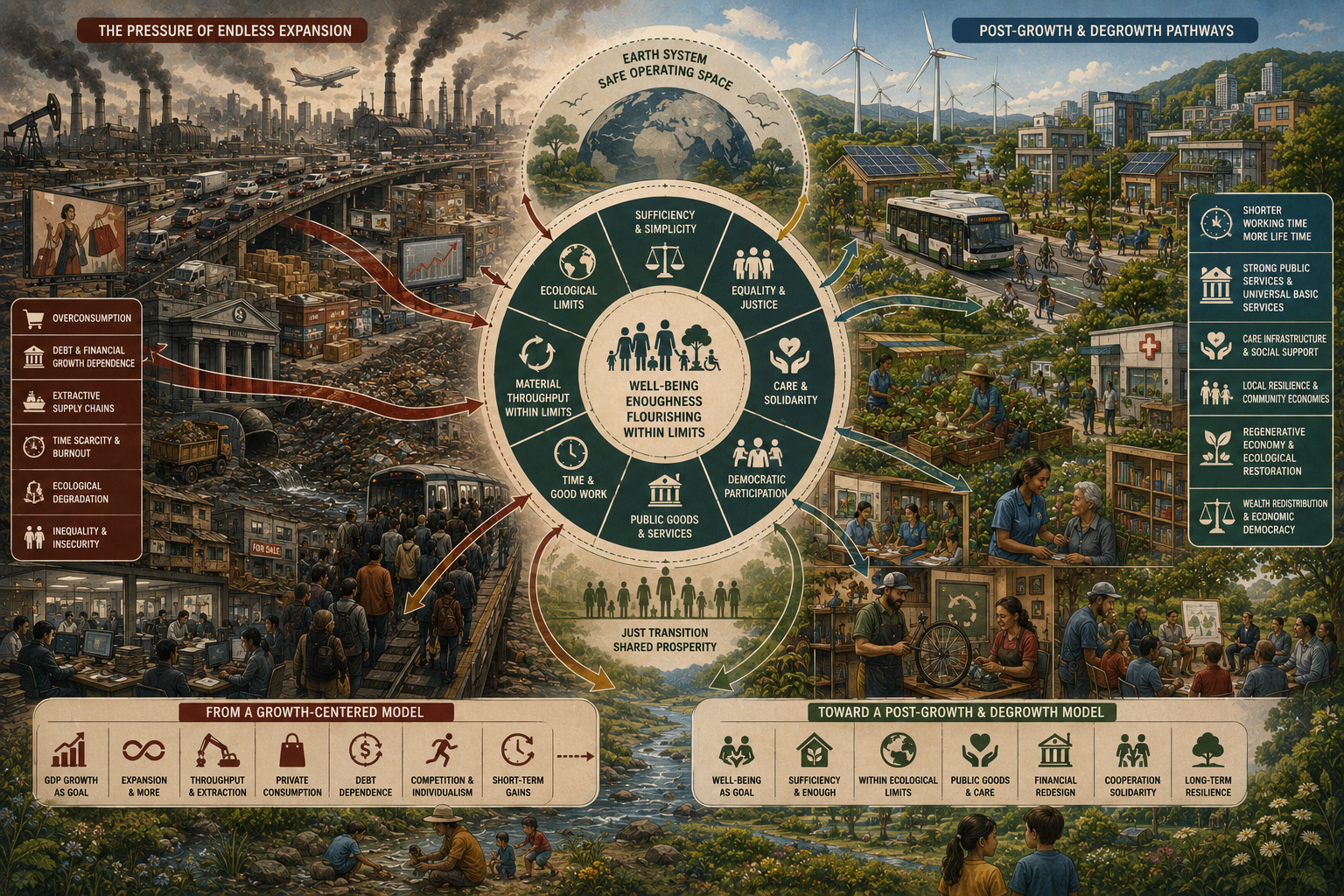
Within a sustainable systems framework, post-growth and degrowth should be examined not as slogans, but as competing proposals about scale, distribution, institutions, public purpose, and the meaning of prosperity. The deeper issue is whether societies can move from an economy organized around expansion for its own sake toward one organized around enoughness, ecological stability, and broadly shared capability without collapsing into austerity, abandonment, or political breakdown.
Why This Topic Matters
For much of the modern era, economic growth has been treated as the primary sign of success. Governments seek it, firms depend on it, labor markets are stabilized through it, and public legitimacy is often narrated through it. Rising GDP has been expected to fund welfare states, absorb conflict, support employment, sustain pensions, service debt, and make distributional tensions more manageable by enlarging the total pie.
That historical role cannot simply be dismissed. Growth has often accompanied major improvements in living standards, survival, mobility, education, infrastructure, and public capability. Yet growth has also become a governing habit that can hide structural problems. A society may expand output while deepening ecological damage, intensifying inequality, exhausting workers, weakening social trust, and making everyday life more fragile even as macroeconomic indicators appear healthy.
This tension is why post-growth and degrowth matter now. They ask whether a society should continue treating output expansion as the default answer to every social problem, or whether a different model of prosperity is needed—one centered more on distribution, care, ecological stability, time, public goods, and democratic capacity than on aggregate expansion alone.
The issue is not whether production matters. It is whether the growth imperative has become too dominant, too ecologically costly, and too conceptually narrow to remain the master frame of political economy.
Post-growth and degrowth also matter because they bring hidden dependencies into view. Modern economies are not merely growing; many of their institutions are built to require growth. Employment, debt, asset prices, fiscal revenue, pensions, and political legitimacy are often stabilized through future expansion. This makes slowing growth appear dangerous even when ecological conditions make continued expansion difficult.
The deeper question is therefore institutional: can societies become less dependent on growth without abandoning security, fairness, public capacity, and hope?
What Post-Growth Means
Post-growth refers to approaches that seek to move beyond GDP growth as the overriding objective of economic governance. It does not always require immediate contraction of output, nor does it always imply a single fixed policy program. Rather, it asks what an economy would look like if the central goal were wellbeing within ecological limits rather than output expansion as an end in itself.
This perspective matters because it creates conceptual room for societies to ask better questions. Instead of treating growth as synonymous with progress, post-growth asks whether institutions are delivering health, security, inclusion, ecological resilience, meaningful lives, public trust, and durable social foundations. It shifts attention from aggregate expansion toward the quality, distribution, and sustainability of economic life.
Post-growth is often broader and more institutionally plural than degrowth. It may include wellbeing economy approaches, steady-state thinking, boundary-aware development, beyond-GDP governance, ecological economics, circular economy, care-centered public policy, and economic frameworks that regard growth as contingent rather than sacred.
A serious account therefore treats post-growth as a family of growth-critical approaches rather than a single doctrine.
Its central claim is that economies should be judged by what they enable people and societies to become, not by whether GDP rises indefinitely.
This makes post-growth especially relevant for mature, high-income economies where further GDP expansion may deliver thinner wellbeing gains while ecological and social costs continue to accumulate. It does not mean that every society should stop developing materially. It means that growth should no longer be treated as the unquestioned proxy for development itself.
In post-growth thinking, the question becomes: what should grow, what should stabilize, what should contract, and what should be protected outside the logic of expansion altogether?
What Degrowth Means
Degrowth is a more specific and more explicitly political approach. It argues that high-income economies need planned reductions in resource and energy throughput, combined with stronger equality, public goods, democratic participation, care systems, shorter working time, repair economies, and ecological restoration. Degrowth is not simply recession by another name. Its advocates frame it as an intentional socio-ecological transition rather than a chaotic economic collapse.
This matters because the word often provokes confusion. Degrowth does not primarily mean indiscriminate shrinkage of everything. It generally distinguishes between ecologically destructive expansion, which should decline, and socially necessary systems such as care, health, education, public transport, repair, housing retrofits, and ecosystem restoration, which may need to grow in social importance even if total throughput falls.
Degrowth therefore combines ecological critique with a distributive and democratic argument. It asks whether rich societies can reduce excess consumption and material pressure while improving the social basis of life. That makes it fundamentally different from austerity, which often reduces public security while preserving wealth concentration and social vulnerability.
A serious account treats degrowth as a proposal for structural transformation, not as a call for generalized deprivation.
Its challenge is to show how planned downscaling of throughput can be made socially credible, institutionally durable, and politically just.
The strongest degrowth arguments are selective rather than blanket claims. They ask why luxury emissions, wasteful consumption, planned obsolescence, speculative construction, fossil expansion, and ecologically destructive industries should continue to grow when societies still underfund care, public health, housing, education, adaptation, and ecological repair.
The test of degrowth is therefore not whether it can make contraction sound virtuous in the abstract. The test is whether it can define a credible path toward better lives with less destructive material scale.
The Critique of Endless Expansion
The critique of endless expansion is broader than either post-growth or degrowth. It targets the assumption that economies must expand continually in order to remain normal, legitimate, and governable. Under this model, stagnation is treated as pathology, while growth is treated as the condition that makes debt service, employment, fiscal stability, asset valuations, pensions, and distributional peace possible.
This matters because endless expansion is not simply a descriptive pattern. It is an institutional dependency. Pension systems, housing markets, financial expectations, labor markets, public budgets, and corporate valuations are often built around the expectation of continuing growth. The critique therefore asks whether societies have locked themselves into a system that requires ever-larger throughput just to remain politically stable.
That critique becomes sharper under ecological stress. If endless expansion depends on material extraction, fossil energy, waste generation, land transformation, and planetary overshoot, then the growth imperative itself becomes part of the sustainability problem. The issue is not only dirty technologies. It is an institutional order that needs expansion to avoid conflict.
A serious framework therefore examines not only growth outcomes, but growth dependence.
The key question is whether economic systems can remain socially coherent if GDP ceases to be the master stabilizer of modern life.
This critique also reveals why growth politics can become evasive. Instead of confronting inequality, housing speculation, financial fragility, weak public goods, or ecological limits directly, governments often promise that future growth will make these problems easier to solve later. The promise of future expansion postpones structural reform.
Post-growth and degrowth ask whether that postponement has become a political trap.
Growth as a Historical Achievement and a Historical Problem
Growth-centered development was historically powerful for understandable reasons. Industrial expansion supported mass employment, welfare-state building, public infrastructure, urbanization, higher life expectancy, mass education, electrification, transport systems, and major reductions in extreme poverty in many contexts. Growth helped governments fund schools, hospitals, housing, transport networks, administrative systems, and social insurance.
Yet the same historical process also intensified extraction, fossil-fuel dependence, colonial transfer, mass commodification, gendered care burdens, and ecological destabilization. What looked like universal progress at the level of output often depended on unequal distributions of labor, land, waste, and vulnerability across classes, regions, countries, and generations.
The historical lesson is not that growth achieved nothing. It is that growth was never neutral. It solved some problems while amplifying others, and its legitimacy often depended on treating ecological systems and unpaid care work as background supports rather than as finite foundations.
A serious account therefore approaches growth historically rather than devotionally.
It asks what growth made possible, what it concealed, and whether its twentieth-century role can still serve as the organizing principle of the twenty-first century.
Historical perspective also prevents caricature. Growth criticism is strongest when it acknowledges the real gains that growth helped produce while asking whether those gains now require a different institutional foundation. Public health, education, housing, and dignity remain essential. The question is whether they must remain tied to endless aggregate expansion.
Post-growth thought does not require rejecting the material achievements of development. It requires asking how to preserve and extend human capability without reproducing the ecological and social costs of expansionary dependence.
Well-Being Beyond Output
One of the strongest growth-critical arguments is that output is an incomplete measure of human flourishing. Health, security, time balance, social trust, meaningful work, housing stability, ecological quality, public services, freedom from chronic stress, and political inclusion all shape whether life goes well. Rising output may support some of these conditions, but it does not guarantee them.
This matters because societies can become richer while many people experience worsening stress, weak belonging, time scarcity, high housing costs, health insecurity, and chronic precarity. In such cases, growth continues statistically while life becomes thinner experientially.
Post-growth and degrowth therefore push beyond the old assumption that more production necessarily translates into better lives. They ask whether public institutions and social organization are converting economic means into human ends effectively at all.
A serious framework treats wellbeing as multidimensional rather than as a shadow cast automatically by GDP.
The question is not only whether the economy is bigger, but whether lives are becoming more livable, more secure, and more dignified.
Wellbeing also has a threshold logic. Additional income can be transformative where basic needs are unmet. But once needs are met, public goods, time, trust, equality, health, ecological quality, and freedom from competitive insecurity may matter more than further private consumption.
This is why growth critique is not anti-human. At its strongest, it is a demand that economies be judged by how well they support life rather than by how quickly they enlarge measured output.
Resource Use, Ecological Limits, and Material Throughput
Growth-critical perspectives become especially forceful when they turn to material throughput. Economies do not grow in a vacuum. They draw on energy, land, water, minerals, biomass, and ecosystems, and they return waste to atmospheric, terrestrial, and aquatic sinks. Efficiency matters, but total scale matters too.
This matters because a society can become more efficient per unit of output while still increasing total resource use if the overall scale of activity continues to expand. That is one reason why growth critics remain skeptical that efficiency alone can reconcile indefinite GDP expansion with ecological stability.
Degrowth arguments typically make this point more sharply, emphasizing the need to reduce absolute throughput in affluent economies. Post-growth perspectives may be more open to mixed pathways, but they share the concern that resource pressure cannot be treated as an afterthought.
A serious account therefore places material scale near the center of the debate.
Whatever else prosperity means, it cannot remain plausible if it depends on continuously rising ecological pressure in a finite and destabilized world.
Throughput also changes how we interpret productivity. A system that produces more goods per worker may appear more productive, but if those goods require escalating extraction, pollution, energy use, and disposal, the system may be less productive in ecological terms than its market indicators suggest.
Post-growth and degrowth therefore ask whether the economy’s material metabolism can be reduced while the social foundations of life are strengthened.
Distribution, Work, and the Social Shape of Prosperity
Growth has often been defended because it makes distributional conflict easier to manage. When output rises, wages, profits, and public spending can sometimes all increase at once. But when growth slows, deeper conflicts over work, taxation, ownership, wealth, rent, and social claims become more visible.
This matters because post-growth and degrowth both imply that distribution must move to the center of economic design. If societies cannot rely on endless expansion to soften conflict, then inequality, working time, wage share, public goods, wealth concentration, rent extraction, and access to essentials become harder to postpone politically.
These perspectives also reopen the question of work itself. Must productivity gains always be converted into more output, or could some of them be converted into shorter working hours, less precarity, more care time, more leisure, and more civic life?
A serious framework therefore links prosperity to distribution and time, not only to aggregate expansion.
Once growth is decentered, the social architecture of everyday life becomes much harder to ignore.
Distribution also determines whether lower throughput is experienced as security or deprivation. If material reduction falls on those already insecure, it becomes austerity. If excess consumption falls among the affluent while public services, housing, care, and income security improve, lower throughput can coexist with greater social freedom.
The political economy of post-growth is therefore inseparable from redistribution.
Public Goods, Care, and the Hidden Foundations of Life
Growth-centered systems often treat public goods and care systems as dependent variables. First the economy grows, then better services and more security may follow. Growth-critical approaches invert that logic by asking whether public goods, care, and social infrastructure should be treated as primary conditions of a good society rather than as secondary beneficiaries of expansion.
This matters because care, health, education, housing support, transit, parks, libraries, local institutions, and public health systems often contribute more directly to lived wellbeing than further marginal increases in private consumption for already affluent groups. A society organized around stronger public goods may reduce its dependence on high-volume private throughput as the main route to perceived prosperity.
Care is especially important because it exposes the limits of growth-based valuation. Some of the most essential work in society is labor-intensive, relational, and not easily accelerated without degrading its quality. Caring for children, elders, disabled people, communities, and ecosystems cannot simply be optimized like a factory process without moral and social loss.
A serious account therefore treats care and public goods as part of prosperity itself.
Post-growth and degrowth matter partly because they force the question of whether economies should be organized to protect the systems that sustain life rather than only those that accelerate output.
This also changes the meaning of abundance. A society can feel abundant through clean water, safe housing, universal healthcare, public transit, education, time, belonging, and ecological quality. It does not need to rely only on rising volumes of private goods to produce security.
Care-centered prosperity may be less spectacular than consumer expansion, but it is often more directly connected to human flourishing.
Productivity, Automation, and the Problem of Growth Dependence
Modern economies often celebrate productivity because it allows more output to be produced with less labor input. In growth-centered systems, this typically creates pressure to expand markets continuously so that displaced labor can be reabsorbed somewhere else. The result is a structural link between productivity and expansion.
This matters because technological gains do not necessarily have to be translated into more throughput. They could, in principle, be translated into shorter working hours, lower stress, more care time, and stronger public time. But growth-dependent systems often turn efficiency into acceleration rather than relief.
Growth-critical perspectives therefore ask whether automation and productivity should be governed differently. Instead of using innovation primarily to enlarge output, could societies use it to enlarge freedom from unnecessary work, provided distribution and public systems are redesigned accordingly?
A serious framework treats productivity as politically organized rather than inherently growth-seeking.
The issue is not what technology can do in the abstract, but what kind of society it is being used to build.
Automation can produce insecurity if its gains are captured by capital and workers are left exposed. It can produce freedom if gains are distributed through shorter workweeks, public services, income security, and democratic control over technological change.
The post-growth question is therefore not anti-technology. It is whether technology can be governed for time, care, sufficiency, and ecological stability rather than for expansion alone.
Debt, Finance, and the Institutions of Expansion
One reason growth remains politically entrenched is that modern financial systems are deeply expansion-oriented. Debt is issued on expectations of future income, asset values often rely on rising returns, and firms are judged through growth narratives as much as through stability or stewardship. Finance therefore embeds expansion into the institutional core of the economy.
This matters because post-growth or degrowth transition would likely require financial redesign. If pension systems, housing markets, public budgets, and private investment all assume continuous GDP expansion, then slowing growth or reducing throughput becomes destabilizing even before any ecological question is considered.
Growth critics therefore do not only challenge consumption culture. They also challenge the financial architecture that makes expansion seem necessary for ordinary solvency and legitimacy.
A serious account therefore treats finance as a structural obstacle and a structural lever.
Any economy that seeks to move beyond endless expansion will have to confront the institutions that have made expansion normal in the first place.
Financial redesign might include public banking, lower dependence on speculative asset inflation, stronger social housing, debt restructuring, pension systems less tied to high-return financial expansion, and investment criteria based on social and ecological value rather than growth alone.
Without such reforms, post-growth politics risks colliding with financial systems designed to punish any deviation from expansion.
Decoupling, Efficiency, and Why the Debate Persists
One of the central disputes between growth critics and growth reformers concerns decoupling. Can GDP continue to rise while environmental pressure falls fast enough and broadly enough to remain within ecological limits? Some argue that technological innovation, cleaner energy, better design, service-sector change, circular materials, and digital systems can allow this. Others argue that relative decoupling is not enough and that absolute decoupling at the required scale and speed remains too uncertain, too uneven, too rebound-prone, or too weak to justify endless expansion as a policy norm.
This matters because the entire growth debate hinges partly on this question. If deep, durable, and globally relevant decoupling were easy and sufficient, the case for degrowth would weaken. If it remains partial, uneven, rebound-prone, or too slow, the critique of endless expansion becomes harder to dismiss.
Post-growth often remains open to empirical variation here, while degrowth tends to place less faith in decoupling as the primary route to sustainability. Both perspectives insist that total pressure matters more than intensity alone.
A serious framework therefore treats decoupling not as a slogan but as an empirical and institutional question.
The debate persists because the answer matters enormously for what kind of future economic system remains plausible.
Efficiency gains are real, but they can be offset when lower costs, convenience, or productivity gains stimulate additional demand. This rebound problem is not merely technical. It reflects how economies convert efficiency into more activity instead of lower pressure.
The key test is whether ecological pressure falls absolutely, rapidly, and across the full range of material systems, not merely whether production becomes cleaner per unit.
Sufficiency, Time, and the Politics of Enough
Growth-critical thought often shifts the language of policy from efficiency toward sufficiency. Efficiency asks how to do more with less. Sufficiency asks how much is enough, for whom, and at what ecological and social cost. It raises the possibility that some forms of consumption or production may be excessive even if they become somewhat cleaner.
This matters because sufficiency is politically difficult in consumer societies built around aspiration, marketing, status, debt, and competitive insecurity. Yet it also opens space for a different account of abundance—one based less on quantity of goods and more on security, time, health, public space, mobility, belonging, ecological quality, and freedom from precarious competition.
Time is central here. Shorter working time, slower throughput, and less forced consumption may feel like loss under one model of prosperity and like recovery under another. If people have secure housing, healthcare, transit, education, social protection, and meaningful work, they may need less private consumption to feel secure.
A serious framework therefore treats enoughness as a real political category rather than as private moralism.
What counts as prosperity changes when societies stop assuming that more must always be better.
Sufficiency also requires justice. Calls for less are unjust when directed at people whose needs remain unmet. They are more compelling when directed at systems of excess: luxury emissions, wasteful design, speculative consumption, planned obsolescence, and status competition.
The politics of enough must therefore distinguish dignity from excess, and sufficiency from deprivation.
Post-Growth Policy Debates
Post-growth policy debates often focus on beyond-GDP governance, stronger public goods, wellbeing budgeting, wealth redistribution, ecological accounting, reduced dependence on speculative finance, shorter working time, industrial transition, and institutions capable of stabilizing societies without requiring rapid GDP expansion. The emphasis is often on redesigning the goals of governance before assuming a single pathway of contraction or stasis.
This matters because post-growth is often more strategically broad than degrowth. It can include mixed economies, welfare-state renewal, green public investment, stronger care systems, sufficiency-oriented regulation, and measures of progress centered on life quality rather than output alone.
The central policy question is whether states can organize economic security, fiscal legitimacy, and public purpose in ways that do not collapse whenever growth slows. That means post-growth policy must take macroeconomic stabilization seriously rather than assuming that better values alone can replace growth-dependent institutions.
A serious account therefore treats post-growth policy as a project of institutional reframing.
Its ambition is to make growth less necessary politically even before growth disappears economically.
Post-growth policies might include universal basic services, public housing, social care systems, public transit, local resilience planning, ecological taxation, wealth taxes, debt reform, labor-market security, and wellbeing indicators linked to budgeting.
The common thread is not hostility to production, but a shift in priority: economic activity should be judged by whether it supports secure and sustainable lives.
Degrowth Policy Debates
Degrowth policy debates are usually more explicit about planned reductions in throughput. Common proposals include shorter working hours, wealth caps or stronger wealth taxation, universal basic services, rent controls, stronger public transit, repair economies, advertising limits, resource caps, public banking, democratic planning, and public investment in low-throughput sectors such as care, education, health, maintenance, and ecosystem restoration.
This matters because degrowth seeks to align social policy with ecological downscaling rather than assuming that lower throughput must mean harsher life. Its practical challenge is to show how material reduction can be paired with greater equality and stronger public life.
Degrowth policy is therefore not merely anti-production. It is selective, arguing that some sectors should contract and others should expand in social importance even if they do not expand in throughput-heavy ways. Fossil extraction, arms production, luxury overconsumption, disposable goods, planned obsolescence, and speculative real estate may be targeted for contraction, while care, housing security, repair, transit, health, education, and restoration may be strengthened.
A serious framework therefore evaluates degrowth by its institutional coherence, not by caricatures of generalized austerity.
The real question is whether it can produce a convincing political economy of better lives with less destructive material scale.
Degrowth is most credible when it specifies how employment, public revenue, debt, pensions, local economies, democratic consent, and transition conflicts will be governed. Without that institutional detail, it risks remaining ethically powerful but operationally incomplete.
The best version of the debate therefore asks not whether “growth” or “degrowth” wins as a slogan, but which systems should expand, which should contract, and how society can remain secure through that transformation.
Common Criticisms and Hard Questions
Growth-critical perspectives face serious criticisms. Skeptics ask how post-growth or degrowth societies would maintain employment, service debt, fund pensions, support innovation, preserve fiscal capacity, and avoid political backlash. They question whether reduced throughput can be governed democratically without coercion or whether growth criticism becomes politically viable only in affluent niches.
These questions matter because they are not trivial objections. Any serious growth-critical project has to show how macroeconomic stabilization, distributional justice, and institutional legitimacy can be maintained if GDP ceases to be the main social stabilizer. That requires more than critique. It requires credible transitional design.
Post-growth and degrowth are strongest when they face these issues directly rather than treating them as symptoms of bad faith. Their future depends partly on whether they can move from moral and ecological diagnosis toward operational political economy.
A serious account therefore takes both the critique and the implementation problem seriously.
The debate is not settled by showing that growth has limits; it also turns on whether alternatives can organize security under those limits.
The hardest questions are practical: How should public budgets work with lower growth? How should debt be managed? How can jobs be secured without throughput expansion? How can lower material consumption avoid becoming austerity? How can democratic legitimacy be maintained when transition requires real constraints?
A credible post-growth politics must answer these questions with institutions, not only aspirations.
Global Justice, Development, and Asymmetric Responsibility
Growth criticism cannot be universalized mechanically across all contexts. High-income economies with high historical emissions, high material footprints, and saturated consumption patterns are not situated the same way as lower-income societies still seeking housing, infrastructure, public health, sanitation, food security, education, and basic material security.
This matters because post-growth and degrowth have to grapple with asymmetric responsibility. What may be excess consumption in one context may still be unmet need in another. A just global transition therefore cannot mean imposing identical limits on radically unequal societies.
Many growth-critical arguments are strongest when directed at affluent economies whose ecological pressure is disproportionately high and whose gains from further expansion may be socially thin relative to their costs. Developmental justice remains essential for poorer societies. The task is to reduce excess while expanding capability where deprivation remains real.
A serious framework therefore distinguishes clearly between reducing excess and denying necessity.
The politics of enough must be compatible with the politics of dignity, especially in a world of unequal starting points.
Global justice also requires technology transfer, climate finance, debt relief, fair trade rules, adaptation support, and protection of development space. Without those, post-growth or degrowth language can become a cover for denying poorer countries the material foundations of decent life.
In global terms, the critique of endless expansion should fall most heavily on systems of high consumption, extraction, waste, and accumulated responsibility—not on populations still seeking basic security.
Historical Lessons from Growth-Centered Governance
The twentieth century made growth central to modern governance because it helped manage mass politics, industrial labor conflict, consumer aspiration, welfare-state finance, and Cold War developmental competition. But it also normalized a world in which more production was expected to cure problems rooted in ownership, distribution, ecological neglect, colonial extraction, or institutional weakness.
This matters because growth became not just an outcome, but a governing reflex. When faced with insecurity, the answer was more expansion. When faced with unemployment, more growth. When faced with debt, more growth. When faced with political conflict, more future pie. The result was a political economy that often postponed structural reform by promising future enlargement.
Today that reflex faces sharper limits. Ecological stress, aging infrastructure, social fragmentation, unequal gains, care burdens, and declining trust make the old formula less reliable.
A serious historical perspective therefore treats post-growth and degrowth not as anomalies, but as responses to a model whose stabilizing capacities are becoming less convincing.
The critique of endless expansion gains force precisely because the old expansionary bargain no longer resolves its own contradictions as easily as it once did.
History also shows that transitions are not purely technical. They involve institutions, narratives, coalitions, interests, and moral imagination. Growth became dominant because it answered real political problems. Any post-growth settlement must answer them too.
The lesson is that a new model of prosperity must be institutionally stabilizing, not merely ethically appealing.
Post-Growth, Degrowth, and Sustainable Systems
Within sustainable systems, post-growth and degrowth matter because they force economic thought to confront a difficult possibility: a good society may need to become less dependent on expansion and more skilled at distribution, care, public provision, ecological stewardship, maintenance, repair, and institutional sufficiency. Sustainability is not only about cleaner production. It is also about whether societies can govern well without treating growth as their universal solvent.
This changes the policy imagination. The question becomes whether prosperity can be built around durability, public goods, shorter working time, lower waste, better health, stronger housing security, ecological repair, and democratic capacity rather than around ever-rising throughput and competitive consumption.
Sustainable systems therefore do not require one rigid post-growth doctrine, but they do require taking growth critique seriously. Once ecological limits, inequality, care strain, financial dependence, and diminishing welfare returns are visible, endless expansion can no longer function as an unquestioned horizon.
In this sense, post-growth and degrowth are systems questions.
They ask whether modern societies can redesign their institutions so that enough can be stabilizing, not terrifying.
This also means that the real debate is no longer simply about growth rates. It is about what kind of civilization growth was serving, what kinds of insecurity it was masking, and what kind of civilization might come after it.
A sustainable post-growth future would not romanticize scarcity. It would build security through shared provision, reduced excess, ecological repair, democratic legitimacy, and a clearer distinction between human need and destructive expansion.
How Post-Growth and Degrowth Systems Should Be Judged
Post-growth and degrowth systems should not be judged only by whether GDP rises or falls. A broader economic systems framework asks whether institutions can reduce destructive throughput while improving wellbeing, security, equality, public goods, care, ecological quality, democratic legitimacy, and macroeconomic stability.
| Dimension | Narrow Question | Systems Question |
|---|---|---|
| Growth Dependence | Is GDP growing? | How dependent are employment, debt, public budgets, pensions, housing, and legitimacy on continued expansion? |
| Throughput | Is output cleaner per unit? | Is total energy and material throughput falling where ecological pressure is excessive? |
| Wellbeing | Are people consuming more? | Are health, time, security, equality, public goods, ecological quality, care, and trust improving? |
| Sufficiency | Are systems efficient? | How well are needs met per unit of throughput required? |
| Work | Are jobs preserved? | Can productivity gains support shorter hours, care, security, and democratic time rather than more output alone? |
| Care | Is paid activity expanding? | Are unpaid care, public care systems, household security, and social reproduction supported? |
| Finance | Is investment rising? | Does finance depend on speculative expansion, or is it aligned with stability, public goods, and ecological repair? |
| Decoupling | Is resource intensity falling? | Are absolute pressure reductions fast, broad, and durable enough after rebound effects? |
| Justice | Is consumption reduced? | Are excess claims reduced while unmet needs, development rights, and vulnerable communities are protected? |
| Transition Legitimacy | Is contraction planned? | Are redistribution, public services, macro-stabilization, democratic participation, and employment security credible? |
This framework prevents a common mistake: confusing degrowth with recession or post-growth with vague anti-GDP rhetoric. The issue is institutional design. A recession reduces output through crisis and insecurity. A post-growth or degrowth transition would have to reduce destructive dependence on expansion while increasing the security of ordinary life.
The central issue is therefore not whether “growth” is good or bad in all contexts. The deeper question is whether economic systems can stop treating endless expansion as the condition of social survival.
Mathematical Lens
Mathematics can clarify post-growth and degrowth debates by making growth dependence, throughput, wellbeing, sufficiency, transition legitimacy, and rebound explicit. These equations do not settle political questions, but they help show what must be examined.
1. Growth Dependence Relation
GD = f(Employment,\ Debt\ Service,\ Fiscal\ Stability,\ Asset\ Valuation)
\]
Interpretation: Growth dependence \(GD\) captures the idea that many modern institutions rely on continued expansion to remain stable. Post-growth politics must reduce this dependence, not merely criticize GDP.
2. Throughput Relation
T = Population \times Affluence \times Intensity
\]
Interpretation: Total throughput \(T\) depends on scale as well as efficiency. This helps explain why efficiency alone may not guarantee falling material pressure.
3. Wellbeing Relation
WB = f(Health,\ Time,\ Security,\ Equality,\ Public\ Goods,\ Ecological\ Quality)
\]
Interpretation: Wellbeing \(WB\) is multidimensional rather than reducible to output. A larger economy does not automatically produce more secure, meaningful, or dignified lives.
4. Sufficiency Intuition
S = \frac{Needs\ Met}{Throughput\ Required}
\]
Interpretation: Sufficiency \(S\) highlights the possibility that better systems can meet needs with lower total material pressure. The goal is not deprivation, but higher social performance per unit of throughput.
5. Degrowth Transition Relation
DT = f(Throughput\ Reduction,\ Redistribution,\ Public\ Services,\ Democratic\ Legitimacy)
\]
Interpretation: Degrowth transition \(DT\) shows why social justice and public goods are central to any intentional downscaling project. Throughput reduction without redistribution becomes austerity.
6. Rebound Intuition
R = Efficiency\ Gain – Additional\ Demand\ Induced
\]
Interpretation: Rebound \(R\) explains why technical improvements do not always translate into absolute reductions in pressure. Efficiency can become lower pressure or more consumption depending on institutions.
7. Practical Interpretation
The mathematical lens clarifies several structural points. Modern systems may depend institutionally on continued growth. Total throughput depends on scale, not only efficiency. Wellbeing is multidimensional rather than reducible to GDP. Sufficiency asks how needs can be met with lower pressure. Degrowth requires redistribution and legitimacy, not only contraction.
Formalization helps clarify mechanism, but it does not determine what level of consumption is enough, how much reduction is fair, or how quickly societies can redesign growth-dependent institutions without disruption. Those remain institutional, ecological, ethical, and political questions.
Python Workflow: Post-Growth, Degrowth, and Endless Expansion
Python is useful for turning post-growth and degrowth concepts into reproducible indicators. The following compact workflow models growth dependence, throughput, wellbeing, sufficiency, degrowth transition credibility, and rebound.
# Post-Growth, Degrowth, and the Critique of Endless Expansion
# Simple Python workflow

import pandas as pd

# Growth dependence
employment_dependency = 0.68
debt_service_dependency = 0.72
fiscal_dependency = 0.63
asset_dependency = 0.75
pension_dependency = 0.66
housing_market_dependency = 0.70

growth_dependence = sum([
    employment_dependency,
    debt_service_dependency,
    fiscal_dependency,
    asset_dependency,
    pension_dependency,
    housing_market_dependency
]) / 6

print("Growth dependence score:", round(growth_dependence, 3))

# Throughput index
population = 100
affluence = 1.25
intensity = 0.64

throughput_index = population * affluence * intensity

print("Throughput index:", round(throughput_index, 2))

# Wellbeing score
health = 0.73
time_balance = 0.57
security = 0.62
equality = 0.51
public_goods = 0.69
ecological_quality = 0.54
care_support = 0.60
social_trust = 0.56

wellbeing_score = sum([
    health,
    time_balance,
    security,
    equality,
    public_goods,
    ecological_quality,
    care_support,
    social_trust
]) / 8

print("Wellbeing score:", round(wellbeing_score, 3))

# Sufficiency score
needs_met = 0.74
throughput_required = 0.52

sufficiency_score = needs_met / throughput_required

print("Sufficiency score:", round(sufficiency_score, 3))

# Degrowth transition score
throughput_reduction = 0.58
redistribution = 0.61
public_services = 0.70
democratic_legitimacy = 0.55
macro_stabilization = 0.52
employment_security = 0.57

degrowth_transition = (
    0.18 * throughput_reduction
    + 0.20 * redistribution
    + 0.20 * public_services
    + 0.16 * democratic_legitimacy
    + 0.14 * macro_stabilization
    + 0.12 * employment_security
)

print("Degrowth transition score:", round(degrowth_transition, 3))

# Rebound intuition
efficiency_gain = 0.24
additional_demand_induced = 0.10

net_pressure_reduction = efficiency_gain - additional_demand_induced

print("Net pressure reduction after rebound:", round(net_pressure_reduction, 3))

df = pd.DataFrame({
    "Metric": [
        "Growth Dependence Score",
        "Throughput Index",
        "Wellbeing Score",
        "Sufficiency Score",
        "Degrowth Transition Score",
        "Net Pressure Reduction After Rebound"
    ],
    "Value": [
        growth_dependence,
        throughput_index,
        wellbeing_score,
        sufficiency_score,
        degrowth_transition,
        net_pressure_reduction
    ]
})

print(df)
This workflow is useful because it shows that the post-growth debate is not only about whether GDP rises or falls. It is also about institutional dependence, material throughput, wellbeing, sufficiency, transition legitimacy, and rebound. A society can reduce growth dependence only if it builds alternative stabilizers: public goods, redistribution, shorter working time, care systems, secure housing, financial reform, and ecological planning.
The full GitHub repository expands this example into growth-dependence scoring, throughput identities, wellbeing dashboards, sufficiency ratios, work-time and care scenarios, finance-dependence analysis, decoupling and rebound models, degrowth transition credibility, global justice indicators, SQL queries, R and Stata replication workflows, Julia simulations, and article-ready figures.
R Workflow: Post-Growth, Degrowth, and Endless Expansion
R is useful for post-growth dashboards, throughput comparisons, wellbeing summaries, sufficiency analysis, and article-ready graphics. The following compact workflow performs the same growth-dependence, throughput, wellbeing, sufficiency, degrowth-transition, and rebound calculations in R.
# Post-Growth, Degrowth, and the Critique of Endless Expansion
# Simple R workflow

# Growth dependence
employment_dependency <- 0.68
debt_service_dependency <- 0.72
fiscal_dependency <- 0.63
asset_dependency <- 0.75
pension_dependency <- 0.66
housing_market_dependency <- 0.70

growth_dependence <- mean(c(
  employment_dependency,
  debt_service_dependency,
  fiscal_dependency,
  asset_dependency,
  pension_dependency,
  housing_market_dependency
))

cat("Growth dependence score:", round(growth_dependence, 3), "\n")

# Throughput index
population <- 100
affluence <- 1.25
intensity <- 0.64

throughput_index <- population * affluence * intensity

cat("Throughput index:", round(throughput_index, 2), "\n")

# Wellbeing score
health <- 0.73
time_balance <- 0.57
security <- 0.62
equality <- 0.51
public_goods <- 0.69
ecological_quality <- 0.54
care_support <- 0.60
social_trust <- 0.56

wellbeing_score <- mean(c(
  health,
  time_balance,
  security,
  equality,
  public_goods,
  ecological_quality,
  care_support,
  social_trust
))

cat("Wellbeing score:", round(wellbeing_score, 3), "\n")

# Sufficiency score
needs_met <- 0.74
throughput_required <- 0.52

sufficiency_score <- needs_met / throughput_required

cat("Sufficiency score:", round(sufficiency_score, 3), "\n")

# Degrowth transition score
throughput_reduction <- 0.58
redistribution <- 0.61
public_services <- 0.70
democratic_legitimacy <- 0.55
macro_stabilization <- 0.52
employment_security <- 0.57

degrowth_transition <- (
  0.18 * throughput_reduction +
  0.20 * redistribution +
  0.20 * public_services +
  0.16 * democratic_legitimacy +
  0.14 * macro_stabilization +
  0.12 * employment_security
)

cat("Degrowth transition score:", round(degrowth_transition, 3), "\n")

# Rebound intuition
efficiency_gain <- 0.24
additional_demand_induced <- 0.10

net_pressure_reduction <- efficiency_gain - additional_demand_induced

cat("Net pressure reduction after rebound:", round(net_pressure_reduction, 3), "\n")

summary_df <- data.frame(
  Metric = c(
    "Growth Dependence Score",
    "Throughput Index",
    "Wellbeing Score",
    "Sufficiency Score",
    "Degrowth Transition Score",
    "Net Pressure Reduction After Rebound"
  ),
  Value = c(
    growth_dependence,
    throughput_index,
    wellbeing_score,
    sufficiency_score,
    degrowth_transition,
    net_pressure_reduction
  )
)

print(summary_df)
This R workflow is deliberately compact for article readability. In the full repository, R reads structured growth-dependence, throughput, wellbeing, sufficiency, work-time, finance, decoupling, degrowth-transition, and global-justice scenarios; calculates growth dependence scores, throughput indices, wellbeing scores, sufficiency ratios, transition credibility scores, and article-ready graphics.
Future Economic Systems articles can extend this foundation with national accounts, material-flow accounts, energy-use data, household-expenditure data, time-use surveys, wellbeing indicators, debt and financial-stability data, fiscal data, labor-market data, public-goods indicators, inequality datasets, emissions inventories, and country-level development indicators.
GitHub Repository
The article body includes selected computational examples so the conceptual, ecological, institutional, and mathematical argument remains readable. The full repository contains the expanded research infrastructure: Python post-growth analysis, R throughput and wellbeing dashboards, Stata applied indicator replication workflows, SQL post-growth scenario tables, Julia throughput and transition simulations, growth dependence, throughput identities, wellbeing dashboards, sufficiency ratios, shorter working time, care and public goods, finance dependence, decoupling, rebound, degrowth transition credibility, global justice indicators, documentation, reproducible sample data, and article-ready figures and tables.
Complete Code Repository
The full code distribution for this article, including selected article examples and advanced research-style computational scaffolding for growth dependence, material throughput, wellbeing beyond output, sufficiency, work-time reduction, care systems, public goods, finance and debt dependence, decoupling, rebound effects, degrowth transition credibility, global justice, asymmetric responsibility, reproducibility documentation, and cross-language economic analysis, is available on GitHub.
Conclusion
Post-growth, degrowth, and the critique of endless expansion matter because they challenge the assumption that more output is always the surest route to a better society. They ask instead whether prosperity can be organized around sufficiency, public goods, equality, care, time, ecological stability, and democratic legitimacy rather than around continuous enlargement of material throughput.
To understand these debates seriously, one must therefore ask not only whether growth can continue, but what growth is doing, whom it benefits, what systems it is exhausting, and whether societies have built institutions capable of delivering security without permanent expansion. These questions reveal whether the future of political economy lies in defending the old growth bargain at all costs or in building forms of prosperity that no longer depend on endless expansion to remain thinkable.
The serious study of post-growth and degrowth also requires caution. Critique is easier than transition. Any credible alternative must explain how employment, fiscal capacity, debt, pensions, innovation, public services, and democratic consent can be maintained while destructive throughput falls. Without that, growth criticism can remain ethically powerful but institutionally incomplete.
In a sustainable economic system, the goal is not recession, deprivation, or collapse. It is a society that no longer needs ecological overshoot to feel secure. The challenge is to build institutions where enough can be stable, where care and public goods carry more of the work of prosperity, and where human flourishing is no longer held hostage to endless expansion.
Related Reading
- Economic Systems
- Beyond GDP: Measuring Well-Being, Inclusion, and Sustainability
- Economic Systems Within Planetary Boundaries
- Ecological Economics and the Embedded Economy
- Natural Capital, Resource Use, and Environmental Constraint
- Circular Economy and Regenerative Production
- Climate Economics, Transition Policy, and Decarbonization
- Public Finance, State Capacity, and Collective Goods
- Environmental Systems
- Risk & Resilience
Further Reading
- European Environment Agency (EEA) (2021). Growth without economic growth. Available at: https://www.eea.europa.eu/en/analysis/publications/growth-without-economic-growth
- Engler, J.O., Kretschmer, M.-F., Rathgens, J., Ament, J.A., Huth, T. and von Wehrden, H. (2024). ‘15 years of degrowth research: A systematic review’, Ecological Economics, 218, 108101. Available at: https://www.sciencedirect.com/science/article/pii/S0921800923003646
- Intergovernmental Panel on Climate Change (IPCC) (2022). Climate Change 2022: Mitigation of Climate Change. Available at: https://www.ipcc.ch/report/ar6/wg3/
- Intergovernmental Panel on Climate Change (IPCC) (2022). Chapter 5: Demand, services and social aspects of mitigation. Available at: https://www.ipcc.ch/report/ar6/wg3/chapter/chapter-5/
- Islar, M. (2024). ‘Degrowth: a path to transformative solutions for socio-ecological sustainability’, Global Sustainability, 7, e20. Available at: https://www.cambridge.org/core/journals/global-sustainability/article/degrowth-a-path-to-transformative-solutions-for-socioecological-sustainability/F885F1CCD7156341E7DB7EF65F595A31
- Organisation for Economic Co-operation and Development (OECD) (n.d.). Beyond Growth. Available at: https://www.oecd.org/en/publications/beyond-growth_33a25ba3-en.html
- Organisation for Economic Co-operation and Development (OECD) (n.d.). Well-being and beyond GDP. Available at: https://www.oecd.org/en/topics/well-being-and-beyond-gdp.html
- United Nations Environment Programme (UNEP) (2024). Global Resources Outlook 2024. Available at: https://www.unep.org/resources/Global-Resource-Outlook-2024
References
- European Environment Agency (EEA) (2021). Growth without economic growth. Available at: https://www.eea.europa.eu/en/analysis/publications/growth-without-economic-growth
- Engler, J.O., Kretschmer, M.-F., Rathgens, J., Ament, J.A., Huth, T. and von Wehrden, H. (2024). ‘15 years of degrowth research: A systematic review’, Ecological Economics, 218, 108101. Available at: https://www.sciencedirect.com/science/article/pii/S0921800923003646
- Intergovernmental Panel on Climate Change (IPCC) (2022). Climate Change 2022: Mitigation of Climate Change. Available at: https://www.ipcc.ch/report/ar6/wg3/
- Intergovernmental Panel on Climate Change (IPCC) (2022). Chapter 5: Demand, services and social aspects of mitigation. Available at: https://www.ipcc.ch/report/ar6/wg3/chapter/chapter-5/
- Islar, M. (2024). ‘Degrowth: a path to transformative solutions for socio-ecological sustainability’, Global Sustainability, 7, e20. Available at: https://www.cambridge.org/core/journals/global-sustainability/article/degrowth-a-path-to-transformative-solutions-for-socioecological-sustainability/F885F1CCD7156341E7DB7EF65F595A31
- Organisation for Economic Co-operation and Development (OECD) (n.d.). Beyond Growth. Available at: https://www.oecd.org/en/publications/beyond-growth_33a25ba3-en.html
- Organisation for Economic Co-operation and Development (OECD) (n.d.). Well-being and beyond GDP. Available at: https://www.oecd.org/en/topics/well-being-and-beyond-gdp.html
- United Nations Environment Programme (UNEP) (2024). Global Resources Outlook 2024. Available at: https://www.unep.org/resources/Global-Resource-Outlook-2024