
Last Updated May 9, 2026
Political economy, power, and distributional conflict belong together because economies do not allocate resources, risks, and rewards through neutral mechanisms alone. They are structured through institutions, ownership, law, bargaining power, public authority, and organized struggles over who gets what, who decides, and who bears adjustment. Political economy studies economic life as a field of institutions and power rather than as a self-contained sphere of exchange. Power concerns the capacity of individuals, firms, classes, states, and organizations to shape rules, outcomes, and expectations. Distributional conflict concerns the ongoing contest over income, wealth, public goods, labor conditions, taxation, property, debt, prices, and the social terms of security and exposure.
These themes sit close to the center of serious economic analysis because growth, inflation, wages, welfare provision, taxation, regulation, industrial policy, housing, monetary policy, and financial governance all involve conflicts of interest. Firms seek profits, workers seek wages and stability, creditors seek repayment, households seek affordable essentials, landlords seek rents, and states seek legitimacy, revenue, and governability. These interests sometimes align, but they often do not. Economic institutions help stabilize such tensions, but they do not eliminate them. Every tax code, labor regime, welfare system, monetary order, property settlement, and crisis response reflects not only technical reasoning, but also the relative strength of competing social groups.
Power is especially important because it determines how conflicts are resolved, or whose conflicts count as visible in the first place. Some groups can shape policy through lobbying, ownership, financial leverage, media influence, administrative access, legal advantage, or organized coordination. Others depend more on unions, parties, protest, voting blocs, local collective action, or civic advocacy. Still others remain weakly represented even when policy outcomes affect them deeply. The study of distribution therefore cannot stop at who ends up with more or less. It must also ask how those outcomes were politically produced, institutionalized, defended, and narrated as normal.
Main Library
Publications
Article Map
Economic Systems
Related Topic
Sustainable Development
Related Topic
Institutions & Governance
Related Topic
Risk & Resilience
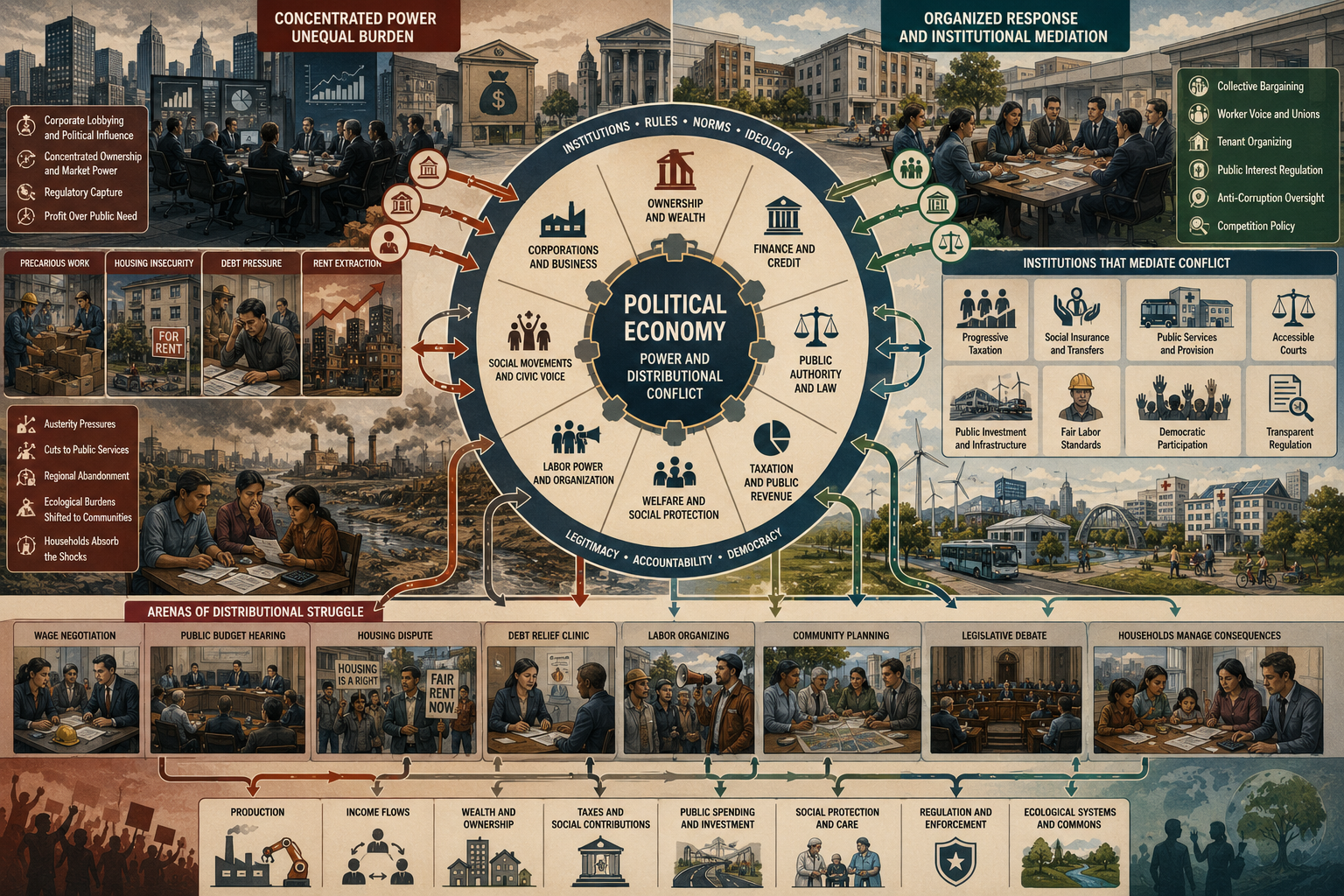
Within a sustainable systems framework, political economy, power, and distributional conflict should be examined not only in relation to efficiency or growth, but in relation to legitimacy, resilience, democratic voice, and the long-run governability of social order. A society may appear prosperous while underlying conflicts over housing, wages, debt, care, taxation, ecological burden, prices, public services, or regional inequality intensify beneath the surface. The deeper question is whether institutions are broad and credible enough to mediate distributional conflict without chronic exclusion, coercive instability, or the steady capture of public purpose by concentrated power.
Why This Topic Matters
Economic life is always political in the sense that it involves contested rules, unequal capacities, and decisions about how burdens and benefits are to be shared. Wages, profits, rents, taxes, transfers, prices, public services, credit conditions, housing access, labor protections, and investment priorities do not emerge from technical logic alone. They are shaped by law, institutions, organized interests, public authority, and struggles over who has voice, leverage, and protection.
Distributional conflict matters because societies rarely agree on what counts as a fair share, a tolerable burden, or a legitimate claim. Workers may resist wage compression, firms may resist taxation or regulation, creditors may resist inflation or debt relief, landlords may resist tenant protections, and households may resist price increases in essentials such as food, housing, energy, transport, and care. These conflicts do not always appear dramatic, but they are built into the ordinary operation of political economy.
Power matters because it determines whose preferences are translated into policy and whose losses are treated as acceptable. Some groups can delay reform, shape narratives, influence legislation, or move capital across borders. Others depend on electoral pressure, organized labor, public protest, community action, or administrative advocacy. Unequal power means that similar shocks do not produce similar outcomes for all groups.
For that reason, political economy is not an optional supplement to economics. It is one of the main ways of understanding why economic orders take the shape they do and why their outcomes remain so unevenly distributed.
It also clarifies that distributional struggle is not a temporary disturbance in an otherwise harmonious system. It is part of how economic order is continually made, defended, and revised.
The point is not that every economic disagreement is reducible to conflict alone. The point is that institutions decide how conflict is organized: whether through bargaining, democratic decision-making, law, markets, repression, privatized suffering, or public compromise.
Political economy therefore gives economic analysis a wider moral and institutional vocabulary. It asks not only whether a system works, but who it works for, who pays when it fails, and whose power makes that arrangement durable.
What Political Economy Is
Political economy is the study of how economic life is structured by institutions, law, power, social conflict, and public authority. Rather than treating the economy as a self-contained system governed only by prices and incentives, political economy asks how states, classes, firms, households, creditors, landlords, workers, and organized interests shape production, distribution, and exchange.
This matters because many of the most important economic questions are institutional before they are technical. Labor markets depend on labor law and bargaining structures. Finance depends on central banking, regulation, and creditor protections. Property depends on legal recognition and enforcement. Welfare depends on taxation, administration, and political coalitions. Housing depends on land rules, finance, zoning, public investment, and tenant protections. Economic life is therefore always mediated through political and institutional arrangements.
Political economy also broadens the meaning of rationality. Actors do not pursue goals on a blank surface. They pursue them inside systems already shaped by unequal ownership, public rules, inherited institutions, administrative capacity, and available forms of organization.
A serious account therefore treats economics and politics as intertwined rather than separate domains.
Political economy is, in effect, the study of how material life is organized through power-backed rules and contested social settlements.
It also asks why certain economic arrangements become common sense. A policy may be described as efficient, responsible, modern, or inevitable, but political economy asks whose interests are embedded in that description and what alternatives are being excluded by it.
For economic systems analysis, this is essential. No economy is only a technical machine. It is also a social order built around property, authority, legitimacy, and conflict.
What Power Means in Economic Life
Power in economic life refers to the capacity to shape outcomes, rules, expectations, and distributions even when interests conflict. It can take many forms: ownership power, bargaining power, agenda-setting power, administrative power, financial leverage, legal authority, coercive force, exit power, and ideological influence.
This matters because not all power is visible in open confrontation. Firms may shape labor outcomes through hiring discretion, capital mobility, supply-chain control, or the threat of relocation. Creditors may shape fiscal policy through refinancing conditions. Governments may shape labor markets through regulation, public employment, policing, or welfare design. Landlords may shape household security through control over access to shelter. Power often works through structured dependence rather than overt command.
Power also operates through institutions. A union contract, a shareholder vote, a central-bank mandate, a zoning rule, a tax code, a bankruptcy statute, or an eligibility rule can stabilize certain interests while weakening others. Institutional power is especially important because it makes some outcomes appear normal or neutral even when they reflect historically specific distributions of influence.
A serious framework therefore treats power as built into economic order rather than external to it.
The relevant question is not only who wins visible conflicts, but who begins with advantages strong enough to shape the terrain on which conflict occurs.
Power also includes the ability to avoid conflict. A highly mobile investor can leave; a tenant often cannot. A corporation can hire lawyers and lobbyists; a low-wage worker may lack time even to attend a public meeting. These differences shape outcomes before formal decision-making begins.
Political economy therefore studies power not only as domination, but as structured capacity: the unequal ability to make claims, resist losses, demand compensation, influence law, and define what counts as economically reasonable.
What Distributional Conflict Is
Distributional conflict refers to struggles over how income, wealth, opportunities, public goods, security, and losses are allocated across groups. It includes conflicts over wages versus profits, taxes versus retained earnings, rents versus affordability, debt repayment versus relief, inflation control versus employment, public investment versus austerity, and social spending versus fiscal restraint.
This matters because distribution is never merely a postscript to production. How output is divided influences investment, consumption, labor relations, household stability, public legitimacy, and future political capacity. Conflicts over distribution can therefore reshape the whole structure of the economy.
Distributional conflict may be explicit, as in strikes, tax revolts, debt negotiations, protests, welfare retrenchment battles, or tenant movements. It may also be embedded in ordinary policy debates over interest rates, pension reform, zoning, benefits eligibility, procurement rules, collective bargaining law, trade policy, or corporate regulation. Much of political economy consists of these quieter struggles.
A serious account therefore treats distributional conflict as continuous rather than episodic.
It is one of the main ways societies negotiate the terms on which prosperity, scarcity, and adjustment are shared.
Distributional conflict is also about time. Some groups are asked to bear current sacrifice for promised future gains. Others claim immediate returns while shifting costs into the future through debt, ecological damage, infrastructure neglect, or social insecurity.
The deeper question is not simply how much each group receives today, but which institutions decide the distribution of future risk, future wealth, and future vulnerability.
Markets Are Institutional, Not Neutral
Markets are often described as neutral arenas of exchange, but they are better understood as institutionally constructed systems of rule-bound interaction. Property law, contract enforcement, labor standards, corporate law, financial regulation, monetary systems, zoning, public infrastructure, and competition policy all shape what markets can do and for whom.
This matters because market outcomes depend on prior political choices. A labor market with weak unions and low minimum wages produces different outcomes from one with sectoral bargaining and strong protections. A housing market with permissive speculation and weak tenant rights produces different outcomes from one with stronger public planning and social housing. A financial system that privileges creditor claims produces different outcomes from one designed around broader public stability.
Calling markets neutral can therefore hide the distributive choices already built into them. Wage flexibility may sound technical but can mean weaker worker bargaining power. Investor confidence may sound neutral but can mean stronger protection for creditor claims over social spending. Efficiency language often conceals structured priorities.
A serious framework treats markets as politically constituted orders.
Once that is recognized, distributional conflict no longer looks like an intrusion into the economy. It becomes part of the economy’s institutional design.
This does not mean markets are useless or merely ideological. It means they are never institution-free. They require rules, enforcement, boundaries, currency, property, public authority, and political legitimacy.
The real question is therefore not whether markets should exist, but how they are constructed, whom they empower, what they leave unpriced, and what institutions are needed to prevent market outcomes from becoming social domination.
Class, Interest, Coalition, and Social Organization
Political economy has long emphasized that societies are organized through groups with different material interests: owners and workers, creditors and debtors, landlords and tenants, exporters and domestic producers, professionals and precarious labor, asset owners and wage earners, urban centers and peripheral territories. These divisions do not determine everything, but they remain important for understanding recurring policy conflicts.
This matters because economic interests are often organized collectively rather than expressed as isolated preferences. Business associations, labor unions, professional groups, parties, civic organizations, tenant unions, advocacy groups, and regional blocs all help transform scattered interests into political force. Coalition-building often determines whether conflicts produce reform, stalemate, retrenchment, or rupture.
Class and interest also interact with institutions. Electoral systems, labor law, campaign finance, media ownership, welfare arrangements, federal structures, and administrative access all shape how easily different groups can organize and how effectively they can convert demands into outcomes.
A serious account therefore treats interests as socially organized rather than merely individually held.
The distribution of power depends not only on what groups want, but on whether they can coordinate, represent themselves, and sustain political pressure over time.
Coalitions also shift. A policy may unite workers and small firms against monopolies, or homeowners and financial institutions against tenants, or export sectors against domestic producers. Political economy examines these alignments because policy outcomes often depend less on abstract national interest than on coalitions capable of defining their interests as national.
This is why political economy cannot treat society as one representative agent. Different groups experience the same economy differently, and institutions decide whose experience becomes politically decisive.
Capital, Labor, and the Division of Income
One of the oldest and most persistent distributional conflicts concerns the division of income between capital and labor. Firms seek profitability, flexibility, and cost control. Workers seek wages, stability, benefits, safe conditions, and voice. The balance between these aims helps determine wage shares, employment quality, and the broader social character of an economy.
This matters because the division of income is not fixed by technology alone. It is shaped by labor law, union strength, monopsony conditions, macroeconomic policy, corporate governance, public procurement, supply-chain structure, immigration rules, and the broader institutional setting in which bargaining occurs.
Conflict between capital and labor can be direct, as in strikes and lockouts, or indirect, as in debates over minimum wages, employment protections, scheduling rules, collective bargaining rights, workplace safety, and industrial restructuring. Even inflation can reflect distributional struggle when firms try to preserve margins and workers try to preserve real wages.
A serious framework therefore treats wage and profit shares as politically mediated outcomes.
The labor-capital relation is one of the main arenas in which economic growth is translated into either shared improvement or more concentrated gain.
The division of income also shapes social time. When wages rise with productivity, households may experience growth as security. When profits rise while wages stagnate, growth may appear abstract, benefiting asset owners more than the people whose labor sustains production.
Political economy therefore asks how institutions translate production into income claims: who has bargaining power, who can wait, who can exit, who can organize, and who is treated as replaceable.
The State as Arbiter, Participant, and Terrain of Struggle
The state is often described as an external referee standing above social conflict, but political economy shows that it is more complicated. States set taxes, enforce property, regulate labor, issue money, manage debt, provide welfare, subsidize industry, police borders, define eligibility, build infrastructure, and arbitrate disputes. They are therefore deeply embedded in economic life.
This matters because the state is simultaneously an arbiter, an economic actor, and a terrain of struggle. Different groups compete to shape legislation, regulation, appointments, budgets, procurement, monetary authority, administrative practice, and legal enforcement. Public institutions can sometimes moderate conflict, but they can also entrench existing hierarchies if access is highly unequal.
State capacity also shapes outcomes. A government may want reform but lack the administrative ability to enforce it. Conversely, a highly capable state may implement policies that strongly favor already dominant actors. Capacity and orientation are distinct issues.
A serious account therefore avoids imagining the state as either a neutral umpire or a single unified actor.
It is better understood as a structured site where economic conflicts are translated into law, policy, and enforceable order.
The state also produces the appearance of neutrality. Once a conflict is translated into a rule, the rule may appear technical, legal, or administrative rather than political. But behind many rules are settled conflicts over property, risk, obligation, access, and authority.
Political economy therefore asks how public power is used: to mediate conflict, suppress it, socialize risk, protect ownership, expand rights, discipline labor, support capital, or build shared capacity.
Taxation, Spending, and the Politics of Fiscal Order
Fiscal policy is one of the clearest arenas of distributional conflict. Tax systems allocate burdens across income groups, firms, property owners, consumers, asset holders, regions, and generations. Public spending allocates benefits across households, sectors, territories, and social priorities. Together they help determine how much inequality is moderated or reproduced.
This matters because budgets are never only accounting devices. They express political choices about who should pay, who should receive, and what the state exists to support. Progressive taxation, universal services, targeted transfers, corporate incentives, defense spending, infrastructure investment, debt service, and austerity all reflect distributive priorities.
Conflicts over fiscal order often reveal deeper disagreements about social membership. Should healthcare, housing, education, and care be treated as rights or as private responsibilities? Should capital gains be taxed like wages? Should debt reduction take priority over public investment? Should public subsidies create public returns? These are distributional questions before they are technical ones.
A serious framework therefore treats budgets as political-economic settlements.
They show how societies rank competing claims and how power influences what is presented as fiscally necessary or politically impossible.
Fiscal debates also shape legitimacy. People are more likely to accept taxation when they believe public systems are fair, visible, competent, and broadly shared. They are less likely to accept burdens when public resources appear captured, wasteful, punitive, or unevenly distributed.
Taxation and spending therefore mediate not only money, but trust. Fiscal order is one of the main ways a society defines common obligation.
Inflation, Prices, and Conflict Over Adjustment
Inflation is often discussed as a monetary or macroeconomic phenomenon, but it can also be understood as a site of distributional struggle. When prices rise, the real value of wages, savings, debt, profits, rents, and public spending commitments all come under pressure. Different groups then try to protect their position.
This matters because inflation is not socially neutral. Workers seek wage adjustments, firms seek to defend margins, creditors seek preservation of real asset values, landlords may raise rents, governments seek stability, and households try to preserve access to essentials. The burden of adjustment becomes contested.
Anti-inflation policy is therefore also political. High interest rates may protect creditors and curb price growth, but they can also increase unemployment, weaken labor, raise debt-service costs, and slow public investment. Price controls, subsidies, tax changes, public provisioning, profit-margin scrutiny, or targeted support may shift burdens differently. Each strategy reflects a judgment about whose claims should be prioritized.
A serious framework therefore treats inflation not only as a technical imbalance, but as a conflict over real income distribution.
How societies respond to rising prices reveals which groups are expected to absorb loss and which are protected from it.
Inflation also has narrative power. If price increases are described only as excessive demand, policy may focus on cooling wages and employment. If they are also understood through supply shocks, market power, energy dependence, rent extraction, or profit margins, a wider set of policy tools becomes thinkable.
Political economy therefore asks not only what causes inflation, but how explanations of inflation distribute blame and justify adjustment.
Debt, Creditors, and the Politics of Obligation
Debt creates structured relationships between debtors and creditors, and those relationships carry political weight. Households, firms, municipalities, and states that owe money face obligations shaped by contract, interest rates, legal enforcement, credit ratings, refinancing conditions, and the broader power of financial institutions.
This matters because debt repayment is rarely just a technical matter of honoring contracts. It can reshape budgets, wages, investment, household security, public services, and political priorities. Creditors often seek predictability and repayment discipline. Debtors may seek relief, restructuring, lower rates, or more time. These interests can collide sharply.
The politics of debt appears in household foreclosure crises, student debt debates, sovereign restructuring, municipal austerity, corporate bankruptcy, and international development finance. In each case, the question is not only who borrowed unwisely or lent imprudently, but how losses will be distributed and which claims will be treated as most legitimate.
A serious account therefore treats debt as a political-economic relation rather than a private moral obligation alone.
It organizes power by giving some actors enforceable claims on the future resources of others.
Debt also compresses political possibility. A government with heavy debt-service burdens may cut public spending; a household with high debt may accept poor work; a firm under creditor pressure may reduce investment or wages. Debt can therefore govern behavior before any overt coercion appears.
The political question is when debt discipline supports responsibility and when it becomes a mechanism for transferring risk downward while protecting creditor claims from democratic contestation.
Property, Rents, and the Power of Ownership
Ownership shapes distribution not only through productive profits, but through rents: income derived from controlling scarce assets, strategic positions, or legally protected privileges. Landlords, monopolists, patent holders, platform owners, resource owners, and financial asset holders can all exercise forms of power rooted in ownership.
This matters because rent-based income often allows some groups to command resources without equivalent contribution to production. More importantly, it gives them leverage over access to essentials such as housing, infrastructure, digital systems, land, medicine, data, energy, and intellectual property.
Property therefore matters politically as well as economically. Strong ownership rights may support investment and stability, but they may also consolidate advantages that are hard to contest democratically once they become institutionalized. A society’s property regime determines not only who owns assets, but whose claims are backed by law and whose needs remain negotiable.
A serious framework therefore treats rent and ownership as central to political economy rather than as peripheral distortions.
The structure of property helps determine who can live from wages, who can live from assets, and who can shape public choices through the leverage ownership confers.
Rent extraction is especially important in housing and infrastructure. When access to shelter, mobility, energy, or digital systems is mediated through ownership power, households may experience basic participation as a series of payments to asset holders.
Political economy therefore asks whether property institutions support productive use, shared security, and public purpose, or whether they allow control over scarcity to become a durable source of social power.
Welfare States, Social Rights, and Contested Solidarity
Welfare institutions are among the main ways societies manage distributional conflict. Social insurance, healthcare, education, pensions, unemployment benefits, childcare, disability support, housing assistance, and public services all redistribute resources and risk across classes, generations, territories, and life-course positions.
This matters because solidarity is never politically automatic. Welfare states depend on coalitions willing to finance shared protection and on institutions broad enough to command legitimacy beyond narrowly targeted groups. Every extension or retrenchment of social rights reopens questions about deservingness, reciprocity, contribution, and common obligation.
Conflicts over welfare are therefore also conflicts over social membership. Who is entitled to care, security, and public support? On what terms? Paid by whom? Administered with what level of trust, burden, or surveillance? These debates reveal how societies define belonging and how much market dependence they consider acceptable.
A serious account treats welfare states as core sites of distributional politics.
They show how public institutions can either buffer conflict through shared guarantees or intensify it when support becomes thin, stigmatized, punitive, or unevenly accessible.
Welfare states also affect bargaining power. Workers with healthcare, unemployment protection, childcare, pensions, and housing support are less vulnerable to immediate discipline by employers or creditors. Social rights can therefore change market power by changing what people must endure to survive.
For sustainable systems, welfare institutions are not only redistribution. They are conflict-mediating infrastructure: they help keep ordinary life risks from becoming social fragmentation.
Industrial Policy, Development, and Struggles Over Strategy
Industrial policy is often presented as a technical development tool, but it is also a site of distributional conflict. Subsidies, procurement, infrastructure spending, trade protection, research funding, tax incentives, public finance, and development banks all allocate advantage across firms, sectors, workers, and regions.
This matters because strategic coordination creates winners and losers. Export-oriented strategies may favor some regions over others. Green industrial policy may reward firms positioned for transition while exposing incumbent sectors. Public investment may create new capabilities, but it also raises the question of who controls the resulting gains.
Development is therefore never only about increasing output. It is also about whose industries are built, whose jobs are protected, whose communities are invested in, whose losses are treated as collateral adjustment, and whether public support produces public return.
A serious framework therefore treats industrial strategy as a contested political project rather than a neutral optimization exercise.
The struggle over development is always also a struggle over the distribution of future capacity and present sacrifice.
This is especially clear in climate transition. The shift toward cleaner energy, transport, buildings, and industry is not only technical. It reallocates jobs, capital, land use, public finance, and regional futures.
Industrial policy becomes legitimate when it is disciplined by public purpose: labor standards, regional inclusion, environmental goals, learning, transparency, and mechanisms that prevent public risk from becoming private windfall.
Globalization, Trade, and Cross-Border Distributional Conflict
Globalization broadens distributional conflict across borders. Trade, financial integration, capital mobility, migration regimes, supply chains, reserve-currency hierarchy, intellectual property rules, and multinational corporate structures create new patterns of advantage and vulnerability across countries, regions, sectors, and classes.
This matters because international integration rarely benefits all groups equally. Export sectors may gain while import-competing workers lose. Financial openness may benefit asset holders while increasing instability for indebted states and households. Strong currencies may protect consumers while weakening some domestic industries. External adjustment pressures often fall unevenly within countries.
Globalization also changes the terrain of power. Firms may threaten relocation, states may compete for investment, and international institutions may constrain domestic policy space. Distributional conflict becomes harder to contain within national democratic institutions when key decisions are shaped by transnational structures.
A serious framework therefore treats globalization as a transformation of political economy rather than merely an expansion of exchange.
It redistributes bargaining power across borders and changes who can credibly shape the terms of adjustment.
Globalization also creates invisibility. Consumers may see lower prices without seeing labor exploitation, ecological damage, or debt pressure elsewhere in the chain. Domestic policy may appear constrained by markets when the constraint is partly produced by legal, financial, and institutional arrangements that could be governed differently.
Political economy therefore asks how global integration is structured: who writes the rules, who captures value, who bears adjustment, and whether democratic institutions can govern systems that operate beyond national boundaries.
Ideology, Legitimacy, and the Politics of Economic Common Sense
Power operates not only through law and ownership, but through ideology and legitimacy. Economic arrangements endure partly because they are presented as natural, efficient, deserved, inevitable, modern, or beyond politics. Ideas such as market neutrality, fiscal responsibility, meritocracy, competitiveness, investor confidence, or household responsibility can shape what policies seem reasonable before debate even begins.
This matters because distributional conflict is easier to stabilize when unequal outcomes can be narrated as common sense rather than as contingent choices. Austerity may be presented as prudence, labor flexibility as modernization, asset inflation as prosperity, or welfare retrenchment as responsibility. Language helps organize consent.
Legitimacy also matters because institutions cannot govern by coercion alone. They require enough acceptance that ordinary compliance remains possible. When economic narratives stop matching lived experience, legitimacy weakens and conflict becomes harder to contain through established channels.
A serious account therefore treats ideology as part of economic order rather than as a secondary layer of rhetoric.
Ideas help determine which conflicts become visible, which claims appear legitimate, and which distributions are treated as normal.
Ideology also shapes expertise. Technical language can clarify, but it can also narrow the field of legitimate disagreement. When a distributional choice is framed as purely technical, the public may be denied language for contesting who benefits and who pays.
Political economy therefore studies common sense as a political achievement. What a society treats as obvious often reflects a prior victory by particular interests, institutions, and narratives.
Crisis Moments and the Reordering of Power
Crisis often makes political economy visible. Financial crashes, inflation spirals, housing collapses, pandemics, energy shocks, food crises, debt crises, climate disasters, and fiscal breakdowns force decisions about rescue, burden-sharing, and adjustment that ordinary times can postpone.
This matters because crises reorder power. Some groups obtain bailouts, guarantees, subsidies, liquidity, or legal relief. Others absorb wage loss, debt stress, eviction risk, public-service cuts, or unemployment. Emergency measures can strengthen public institutions, but they can also entrench concentrated interests if rescue is selective and accountability weak.
Crisis also opens ideological space. Policies once treated as impossible can suddenly become necessary. Public spending, controls, planning, relief, debt moratoria, industrial coordination, emergency procurement, and social protection may expand rapidly when breakdown becomes too visible to ignore.
A serious framework therefore treats crisis not as an interruption to political economy, but as one of the moments in which its underlying structure becomes hardest to conceal.
Who is saved, who waits, and who pays usually tells more about an economic order than its official principles do.
Crisis response also sets future precedent. A bailout can create moral hazard, but so can the failure to protect households. Austerity can restore fiscal ratios while destroying public trust. Relief can stabilize life, but it can also be designed in ways that exclude those with the least administrative capacity.
Political economy therefore asks whether crisis becomes a moment of repair, renewal, and broader protection, or a mechanism for consolidating power while shifting losses downward.
Historical Lessons from Political-Economic Conflict
Historical development has repeatedly been shaped by distributional conflict. Labor movements, suffrage struggles, land reform, anti-colonial mobilization, welfare-state building, monetary stabilization, civil-rights movements, neoliberal restructuring, debt crises, and climate justice movements all involved competing groups seeking to institutionalize different distributions of power and protection.
This matters because economic orders are not self-generating. They are historically produced through coalition, coercion, reform, crisis, and resistance. Property rights, labor law, welfare systems, development strategies, monetary institutions, and public services all bear the imprint of earlier struggles.
History also shows that settlements are reversible. Periods of stronger labor power and social protection can be followed by financialization and deregulation. Oligarchic concentration can be moderated through reform and then reconstituted through new asset structures, privatization, legal design, or political capture.
A serious historical perspective therefore treats economic institutions as contested achievements rather than natural equilibria.
Political economy is historical because every stable distribution rests on prior conflict and remains vulnerable to future challenge.
History also cautions against reading present arrangements as inevitable. What appears technically necessary in one period may later be recognized as a political settlement that protected particular interests.
The historical lesson is not that conflict can be eliminated. It is that conflict can be institutionalized more or less democratically, more or less visibly, and more or less justly.
Political Economy, Power, and Sustainable Systems
Within sustainable systems, distributional conflict should be understood as a central design problem rather than an afterthought. A society is not durable if its institutions systematically shield concentrated wealth while exposing large populations to precarious housing, care deficits, debt dependency, ecological burden, unstable work, and weak public services.
This changes the meaning of sustainability. Sustainability is not only about environmental thresholds or fiscal balances. It is also about whether institutions can mediate conflict in ways that preserve legitimacy, capability, public trust, and shared security across time.
Sustainable systems therefore require more than technical optimization. They require tax systems, welfare institutions, labor arrangements, property regimes, financial rules, public capacities, and democratic channels broad enough to keep conflict from hardening into chronic exclusion or political breakdown. They also require visibility: a willingness to recognize whose interests are being served by existing rules and whose are being treated as residual.
In this sense, political economy becomes a systems question. It asks whether power is organized through institutions capable of generating credible social settlement or through arrangements that privatize gains, socialize losses selectively, and gradually erode public trust.
This also means that sustainability cannot be treated as politically neutral. Every transition, reform, and policy package raises the question of who will bear costs, who will control resources, and whether the resulting order can command consent beyond those already strongest within it.
A just transition, for example, is not only a climate-policy phrase. It is a political-economic requirement. Energy transition reallocates jobs, land, infrastructure, prices, public funds, and industrial strategy. Without credible burden-sharing, ecological policy can become another arena of unequal adjustment.
Sustainable systems therefore require institutions that can name conflict honestly, distribute burdens fairly, restrain concentrated power, and create forms of shared security strong enough to support long-run transformation.
How Political-Economic Systems Should Be Judged
Political-economic systems should not be judged only by output growth, price stability, investment levels, or formal institutional design. A broader economic systems framework asks whether power is accountable, distribution is legitimate, conflict is mediated democratically, and ordinary people can live with security and voice rather than merely absorb adjustment.
| Dimension | Narrow Question | Systems Question |
|---|---|---|
| Income Distribution | Who receives wages, profits, and rents? | How do institutions shape the division of income across labor, capital, property, and public claims? |
| Power | Who has resources? | Who can shape rules, delay reform, define narratives, exit obligations, and influence enforcement? |
| Labor | Are wages rising? | Do workers have bargaining power, security, voice, and protection against arbitrary adjustment? |
| Finance | Is credit available? | Do creditor claims discipline useful investment or subordinate households and states to debt-service pressure? |
| Property | Are ownership rights protected? | Do property regimes support productive use and security, or concentrate rent extraction and social leverage? |
| Fiscal Order | Are budgets balanced? | Who pays, who receives, what is protected, and what burdens are described as unavoidable? |
| Inflation | Are prices stable? | Whose real income is protected, whose claims are disciplined, and how is adjustment distributed? |
| Welfare | Are safety nets present? | Do social rights reduce market dependence, build solidarity, and mediate conflict with dignity? |
| Globalization | Is the economy integrated? | How does integration redistribute bargaining power across workers, firms, regions, creditors, and states? |
| Legitimacy | Do institutions function? | Are outcomes perceived as fair, secure, voice-responsive, and worthy of public trust? |
This framework prevents a common mistake: treating economic conflict as noise around an otherwise technical system. Conflict is part of the system. The question is whether institutions mediate it openly and fairly or conceal it until crisis makes it impossible to ignore.
The central issue is therefore not simply whether an economy grows. The deeper question is whether its rules, institutions, and power relations can sustain a credible social settlement under pressure.
Mathematical Lens
Mathematics can clarify political economy, power, and distributional conflict by making income shares, fiscal incidence, power asymmetry, conflict intensity, and legitimacy explicit. These equations do not determine what distribution is just, but they help show what must be examined.
1. Income Distribution Relation
Y = W + \Pi + R
\]
Interpretation: Total income \(Y\) can be divided into wage income \(W\), profit income \(\Pi\), and rent income \(R\). Distributional conflict often concerns how total output is divided across these social claims.
2. Wage Share
WS = \frac{W}{Y}
\]
Interpretation: Wage share \(WS\) compares wage income with total income. It is shaped by productivity, labor law, bargaining power, macroeconomic policy, union strength, and corporate governance.
3. Profit Share
PS = \frac{\Pi}{Y}
\]
Interpretation: Profit share \(PS\) compares profit income with total income. Rising profit shares may reflect productivity gains, market power, weakened labor, financial pressure, or shifts in institutional bargaining power.
4. Rent Share
RS = \frac{R}{Y}
\]
Interpretation: Rent share \(RS\) compares rent income with total income. It captures the importance of property, monopoly, land, intellectual property, platform control, and other asset-based claims.
5. Net Fiscal Position
NFP = Benefits\ Received + Public\ Services – Taxes\ Paid
\]
Interpretation: Net fiscal position \(NFP\) shows how tax and spending systems redistribute resources and services across groups. It helps connect public finance to distributional conflict.
6. Power Asymmetry
PA = f(Ownership, Organization, Access, Mobility, Voice)
\]
Interpretation: Power asymmetry \(PA\) depends on ownership, organization, access to institutions, mobility or exit options, and voice. These factors shape which groups can influence outcomes before formal policy debates begin.
7. Conflict Intensity
CI = f(Inequality, Inflation, Unemployment, Representation\ Gaps, Shock\ Exposure)
\]
Interpretation: Conflict intensity \(CI\) often rises when material stress combines with weak representation. Inequality, inflation, unemployment, shocks, and exclusion can reinforce one another.
8. Legitimacy
L = f(Fairness, Security, Voice, Institutional\ Trust)
\]
Interpretation: Legitimacy \(L\) depends on whether people experience institutions as fair, protective, voice-responsive, and trustworthy. Distributional arrangements affect the stability of the wider order.
9. Practical Interpretation
The mathematical lens clarifies several structural points. Distribution concerns the division of output among wages, profits, and rents. Wage share is institutionally shaped, not purely technical. Fiscal systems reallocate burdens and protections across groups. Power depends on ownership, organization, political access, mobility, and voice. Conflict intensifies when material stress combines with weak representation. Legitimacy depends on whether institutions mediate conflict credibly and visibly.
Formalization helps clarify mechanism, but it does not determine what distribution is just, which interests deserve priority, or how much conflict a system can absorb before legitimacy breaks down. Those remain institutional, historical, ethical, and political questions.
Python Workflow: Political Economy, Power, and Distributional Conflict
Python is useful for turning political-economy concepts into reproducible calculations. The following compact workflow models income division, wage share, profit share, rent share, fiscal position, power asymmetry, conflict intensity, and legitimacy.
# Political Economy, Power, and Distributional Conflict
# Simple Python workflow

import pandas as pd

# Income distribution
wages = 320
profits = 140
rents = 60
total_income = wages + profits + rents

wage_share = wages / total_income
profit_share = profits / total_income
rent_share = rents / total_income

print("Total income:", total_income)
print("Wage share:", round(wage_share, 3))
print("Profit share:", round(profit_share, 3))
print("Rent share:", round(rent_share, 3))

# Fiscal incidence
taxes_paid = 22
benefits_received = 10
public_services_received = 14

net_fiscal_position = benefits_received + public_services_received - taxes_paid

print("Net fiscal position:", net_fiscal_position)

# Stylized power asymmetry
ownership = 0.78
organization = 0.62
access = 0.74
mobility = 0.69
voice = 0.58

power_asymmetry = (
    0.24 * ownership
    + 0.20 * organization
    + 0.20 * access
    + 0.18 * mobility
    + 0.18 * voice
)

print("Power asymmetry score:", round(power_asymmetry, 3))

# Conflict intensity
inequality = 0.68
inflation = 0.55
unemployment = 0.44
representation_gap = 0.62
shock_exposure = 0.58

conflict_intensity = (
    0.22 * inequality
    + 0.18 * inflation
    + 0.18 * unemployment
    + 0.20 * representation_gap
    + 0.22 * shock_exposure
)

print("Conflict intensity score:", round(conflict_intensity, 3))

# Legitimacy
fairness = 0.42
security = 0.48
voice_score = 0.44
institutional_trust = 0.40

legitimacy = (
    0.26 * fairness
    + 0.24 * security
    + 0.24 * voice_score
    + 0.26 * institutional_trust
)

print("Legitimacy score:", round(legitimacy, 3))

df = pd.DataFrame({
    "Metric": [
        "Total Income",
        "Wage Share",
        "Profit Share",
        "Rent Share",
        "Net Fiscal Position",
        "Power Asymmetry Score",
        "Conflict Intensity Score",
        "Legitimacy Score"
    ],
    "Value": [
        total_income,
        wage_share,
        profit_share,
        rent_share,
        net_fiscal_position,
        power_asymmetry,
        conflict_intensity,
        legitimacy
    ]
})

print(df)
This workflow is useful because it links distribution, fiscal burden, organized power, conflict intensity, and legitimacy within one simplified analytical frame. It helps show why distributional conflict cannot be reduced to personal preference or isolated market outcomes. Institutions decide how wages, profits, rents, taxes, benefits, and risks are organized.
The full GitHub repository expands this example into income-share analysis, fiscal-incidence scenarios, bargaining-power indicators, inflation-conflict modeling, debt-service pressure, rent extraction, welfare-state buffering, globalization constraints, crisis burden-sharing, legitimacy scoring, SQL queries, R and Stata replication workflows, Julia simulations, and article-ready figures.
R Workflow: Political Economy, Power, and Distributional Conflict
R is useful for distributional-conflict summaries, income-share tables, fiscal-burden comparisons, power-asymmetry scores, and publication-ready graphics. The following compact workflow performs the same income-division, fiscal-position, power-asymmetry, conflict-intensity, and legitimacy calculations in R.
# Political Economy, Power, and Distributional Conflict
# Simple R workflow

# Income distribution
wages <- 320
profits <- 140
rents <- 60
total_income <- wages + profits + rents

wage_share <- wages / total_income
profit_share <- profits / total_income
rent_share <- rents / total_income

cat("Total income:", total_income, "\n")
cat("Wage share:", round(wage_share, 3), "\n")
cat("Profit share:", round(profit_share, 3), "\n")
cat("Rent share:", round(rent_share, 3), "\n")

# Fiscal incidence
taxes_paid <- 22
benefits_received <- 10
public_services_received <- 14

net_fiscal_position <- benefits_received + public_services_received - taxes_paid

cat("Net fiscal position:", net_fiscal_position, "\n")

# Stylized power asymmetry
ownership <- 0.78
organization <- 0.62
access <- 0.74
mobility <- 0.69
voice <- 0.58

power_asymmetry <- (
  0.24 * ownership +
  0.20 * organization +
  0.20 * access +
  0.18 * mobility +
  0.18 * voice
)

cat("Power asymmetry score:", round(power_asymmetry, 3), "\n")

# Conflict intensity
inequality <- 0.68
inflation <- 0.55
unemployment <- 0.44
representation_gap <- 0.62
shock_exposure <- 0.58

conflict_intensity <- (
  0.22 * inequality +
  0.18 * inflation +
  0.18 * unemployment +
  0.20 * representation_gap +
  0.22 * shock_exposure
)

cat("Conflict intensity score:", round(conflict_intensity, 3), "\n")

# Legitimacy
fairness <- 0.42
security <- 0.48
voice_score <- 0.44
institutional_trust <- 0.40

legitimacy <- (
  0.26 * fairness +
  0.24 * security +
  0.24 * voice_score +
  0.26 * institutional_trust
)

cat("Legitimacy score:", round(legitimacy, 3), "\n")

summary_df <- data.frame(
  Metric = c(
    "Total Income",
    "Wage Share",
    "Profit Share",
    "Rent Share",
    "Net Fiscal Position",
    "Power Asymmetry Score",
    "Conflict Intensity Score",
    "Legitimacy Score"
  ),
  Value = c(
    total_income,
    wage_share,
    profit_share,
    rent_share,
    net_fiscal_position,
    power_asymmetry,
    conflict_intensity,
    legitimacy
  )
)

print(summary_df)
This R workflow is deliberately compact for article readability. In the full repository, R reads structured income-distribution, power-group, fiscal-incidence, inflation-conflict, debt-rent, welfare-globalization-crisis, and legitimacy scenarios; calculates wage shares, profit shares, rent shares, net fiscal positions, power-asymmetry scores, disposable income, post-burden income, conflict intensity, and legitimacy; and visualizes how distributional conflict changes across institutional settings.
Future Economic Systems articles can extend this foundation with national accounts, distributional national accounts, labor-force surveys, tax-benefit microdata, union-density data, collective-bargaining coverage, household debt, housing costs, wealth data, firm markups, lobbying data, campaign-finance records, inflation data, wage data, and political-representation indicators.
GitHub Repository
The article body includes selected computational examples so the conceptual, institutional, and mathematical argument remains readable. The full repository contains the expanded research infrastructure: Python political-economy and distributional-conflict analysis, R income-share summaries, Stata applied political-economy replication workflows, SQL distributional scenario tables, Julia legitimacy and conflict simulations, wage shares, profit shares, rent shares, fiscal incidence, bargaining power, power asymmetry, inflation conflict, debt-service pressure, rent extraction, welfare-state buffering, globalization constraints, crisis burden-sharing, legitimacy scoring, documentation, reproducible sample data, and article-ready figures and tables.
Complete Code Repository
The full code distribution for this article, including selected article examples and advanced research-style computational scaffolding for income distribution, wage shares, profit shares, rent shares, fiscal incidence, bargaining power, ownership power, representation gaps, inflation adjustment, debt and creditor pressure, housing rents, welfare-state solidarity, globalization constraints, crisis burden-sharing, conflict intensity, legitimacy, reproducibility documentation, and cross-language economic analysis, is available on GitHub.
Conclusion
Political economy, power, and distributional conflict are central to economic analysis because they show that economic order is never only about production and exchange. It is also about how societies divide gains, allocate losses, organize authority, and decide whose claims are protected through institutions.
To understand an economic system seriously, one must therefore ask not only how much wealth it generates, but who owns assets, who bears adjustment, how rules are enforced, how organized interests shape policy, and whether public institutions can mediate conflict without normalizing exclusion or capture. These questions reveal whether an economy has built a credible social settlement or whether apparent stability rests on distributions of power and burden that are becoming harder to sustain over time.
The serious study of distribution also requires moving beyond the idea that inequality is merely an outcome after markets operate. Markets themselves are structured by law, property, finance, bargaining power, public infrastructure, and institutional voice. Distribution is built into the rules before income is counted.
In a sustainable economic system, power must be made visible and accountable. Institutions must be capable of mediating conflict, distributing burdens fairly, protecting those exposed to shocks, and preventing private advantage from capturing public purpose. The central question is whether economic order can remain legitimate when people see not only what it produces, but whom it protects, whom it disciplines, and whose future it makes possible.
Related Reading
- Economic Systems
- Capitalism and Its Varieties
- Institutions, Property Rights, and Economic Order
- Inequality, Redistribution, and Social Mobility
- The Welfare State and Social Protection
- Debt, Dependency, and Global Financial Order
- Finance, Leverage, and Systemic Risk
- Labor, Wages, Productivity, and the Social Organization of Work
- Fiscal Policy, Taxation, and Public Investment
- Sustainable Development
- Institutions & Governance
- Risk & Resilience
Further Reading
- Acemoglu, D. and Robinson, J.A. (2012). Why Nations Fail: The Origins of Power, Prosperity, and Poverty. New York: Crown. Available at: https://whynationsfail.com/
- Bowles, S. (2004). Microeconomics: Behavior, Institutions, and Evolution. Princeton: Princeton University Press. Available at: https://press.princeton.edu/books/paperback/9780691126388/microeconomics
- Esping-Andersen, G. (1990). The Three Worlds of Welfare Capitalism. Princeton: Princeton University Press. Available at: https://press.princeton.edu/books/paperback/9780691028576/the-three-worlds-of-welfare-capitalism
- Hacker, J.S. and Pierson, P. (2010). Winner-Take-All Politics: How Washington Made the Rich Richer—and Turned Its Back on the Middle Class. New York: Simon & Schuster. Available at: https://www.simonandschuster.com/books/Winner-Take-All-Politics/Jacob-S-Hacker/9781416588702
- International Labour Organization (ILO) (n.d.). Social dialogue and tripartism. Available at: https://www.ilo.org/
- Marx, K. (1867). Capital: A Critique of Political Economy, Volume I. Available at: https://www.marxists.org/archive/marx/works/1867-c1/
- Piketty, T. (2014). Capital in the Twenty-First Century. Cambridge, MA: Harvard University Press. Available at: https://www.hup.harvard.edu/books/9780674979857
- Polanyi, K. (1944). The Great Transformation: The Political and Economic Origins of Our Time. Boston: Beacon Press. Available at: https://www.beacon.org/The-Great-Transformation-P156.aspx
- Streeck, W. (2014). Buying Time: The Delayed Crisis of Democratic Capitalism. London: Verso. Available at: https://www.versobooks.com/products/2124-buying-time
- United Nations Research Institute for Social Development (UNRISD) (n.d.). Social policy, inequality, and political economy. Available at: https://www.unrisd.org/
References
- Acemoglu, D. and Robinson, J.A. (2012). Why Nations Fail: The Origins of Power, Prosperity, and Poverty. New York: Crown. Available at: https://whynationsfail.com/
- Bowles, S. (2004). Microeconomics: Behavior, Institutions, and Evolution. Princeton: Princeton University Press. Available at: https://press.princeton.edu/books/paperback/9780691126388/microeconomics
- Esping-Andersen, G. (1990). The Three Worlds of Welfare Capitalism. Princeton: Princeton University Press. Available at: https://press.princeton.edu/books/paperback/9780691028576/the-three-worlds-of-welfare-capitalism
- Hacker, J.S. and Pierson, P. (2010). Winner-Take-All Politics: How Washington Made the Rich Richer—and Turned Its Back on the Middle Class. New York: Simon & Schuster. Available at: https://www.simonandschuster.com/books/Winner-Take-All-Politics/Jacob-S-Hacker/9781416588702
- International Labour Organization (ILO) (n.d.). Social dialogue and tripartism. Available at: https://www.ilo.org/
- Marx, K. (1867). Capital: A Critique of Political Economy, Volume I. Available at: https://www.marxists.org/archive/marx/works/1867-c1/
- Piketty, T. (2014). Capital in the Twenty-First Century. Cambridge, MA: Harvard University Press. Available at: https://www.hup.harvard.edu/books/9780674979857
- Polanyi, K. (1944). The Great Transformation: The Political and Economic Origins of Our Time. Boston: Beacon Press. Available at: https://www.beacon.org/The-Great-Transformation-P156.aspx
- Streeck, W. (2014). Buying Time: The Delayed Crisis of Democratic Capitalism. London: Verso. Available at: https://www.versobooks.com/products/2124-buying-time
- United Nations Research Institute for Social Development (UNRISD) (n.d.). Social policy, inequality, and political economy. Available at: https://www.unrisd.org/