
Last Updated May 9, 2026
Capitalism is not a single institutional template repeated uniformly across the world. It is a family of economic orders organized around private ownership, wage labor, capital accumulation, markets, and the production of profit, but these elements are combined in different ways across different societies. Some capitalist systems rely heavily on liberalized markets, arm’s-length finance, flexible labor, and shareholder value. Others depend on coordinated bargaining, patient capital, vocational training, stronger welfare institutions, developmental states, or closer ties among firms, banks, labor, and public authority. The phrase varieties of capitalism draws attention to this diversity and to the fact that capitalism has always developed through historically specific institutional settlements rather than through one pure model.
This makes the subject central to political economy. Capitalism shapes how societies organize production, innovation, competition, labor, finance, risk, social reproduction, property, technology, and public purpose. Yet the outcomes associated with capitalist development—growth, crisis, inequality, technological change, welfare provision, ecological pressure, and political legitimacy—vary significantly depending on institutional design. A liberal market economy, a coordinated market economy, a developmental state, a finance-led regime, a welfare-capitalist settlement, and a resource-dependent capitalist system may all be capitalist, but they do not govern firms, workers, households, investment, and public authority in the same way.
Variety matters because institutional differences affect more than efficiency. They influence who bears risk, how firms compete, whether labor is treated as a disposable input or a long-term partner, whether finance supports productive investment or speculative extraction, whether housing becomes a social foundation or an asset market, and whether the gains of growth are broadly shared or narrowly captured. The question is therefore not whether capitalism exists, but which capitalism is being discussed, whose interests it organizes most effectively, and what forms of social order it tends to reproduce.
Main Library
Publications
Article Map
Economic Systems
Related Topic
Sustainable Development
Related Topic
Institutions & Governance
Related Topic
Risk & Resilience
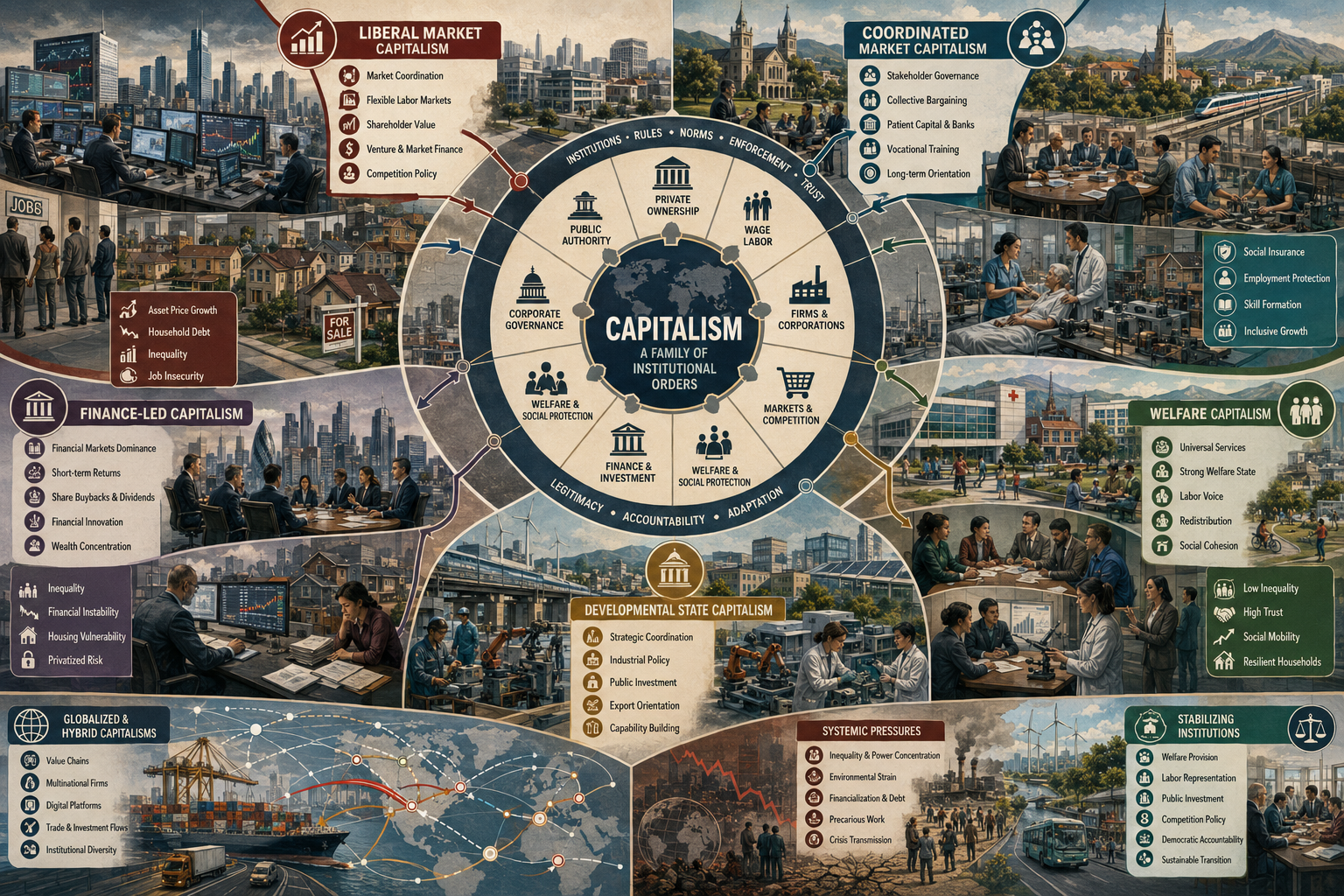
Within a sustainable systems framework, capitalism should be analyzed not only as a growth-generating system, but as a set of institutional arrangements that shape resilience, legitimacy, inequality, ecological pressure, household security, public capacity, and long-run social capability. Some capitalist systems embed markets within stronger public institutions, coordinated investment systems, and risk-sharing mechanisms. Others leave insecurity more privatized, adjustment more unequal, and accumulation more tightly governed by short-term financial returns. The deeper question is whether a given capitalist order can sustain prosperity, social membership, ecological responsibility, and institutional trust over time, or whether its internal dynamics produce recurring instability and widening fracture.
Why This Topic Matters
Capitalism matters because it remains the dominant way much of the world organizes production, investment, labor, ownership, innovation, and accumulation. Yet debates about capitalism are often flattened into false oppositions between “the market” and “the state,” as though all capitalist economies were institutional copies of one another. In practice, capitalist systems differ widely in how they structure finance, welfare, labor law, training, corporate governance, industrial policy, housing, taxation, public investment, and social responsibility.
Those differences shape lived outcomes. In one society, job loss may mean rapid downward mobility, expensive healthcare, housing insecurity, and debt dependence. In another, stronger public systems may absorb part of the shock and preserve continuity. In one setting, firms may maximize short-term shareholder returns. In another, they may coordinate more closely with banks, training systems, suppliers, workers, and public authorities over longer horizons. The same broad label therefore covers very different social settlements.
The study of capitalist variety also helps explain why performance cannot be judged by GDP alone. Growth may coexist with weak labor protections, fragile households, concentrated ownership, and ecological strain. Slower but more coordinated systems may produce stronger wage compression, industrial depth, public legitimacy, and risk-sharing. Institutional comparison reveals that economic order is always socially organized and never simply dictated by abstract market logic.
For that reason, capitalism is best understood not as one fixed model, but as a set of historically evolving arrangements through which property, labor, finance, firms, households, and public authority are combined.
The question is not whether markets exist, but how they are embedded, disciplined, protected, and made compatible—or incompatible—with broader social goals.
Capitalist variety also matters because it changes what reform means. A policy that works in a coordinated system with patient finance and strong training institutions may fail in a liberalized system with weak bargaining power and volatile capital markets. Institutions operate in clusters.
Comparative capitalism therefore turns a general debate into a more precise one: what institutional mix produces productive investment, broad security, ecological responsibility, democratic legitimacy, and durable public trust?
What Capitalism Is
Capitalism is an economic order centered on private ownership of productive assets, wage labor, generalized commodity exchange, competitive or quasi-competitive markets, and the accumulation of capital through investment for profit. Firms organize production, workers sell labor power for income, investors seek returns, and prices help coordinate the allocation of goods, services, labor, capital, and resources.
This definition, however, should not be mistaken for a complete description. Capitalism also depends on institutions that make private ownership, contract, money, credit, competition, labor markets, and corporate organization durable in practice. States define property rights, enforce contracts, issue currencies, regulate firms, support infrastructure, educate labor, subsidize innovation, create legal persons in the form of corporations, and often absorb systemic risk during crisis. Capitalism is therefore never simply private exchange left to itself.
Capitalism also contains tensions within its own structure. It depends on competition, yet often produces concentration. It relies on wage labor, yet firms seek to lower labor costs. It depends on long-term investment, yet finance may reward short-term extraction. It promises dynamism, yet recurrently generates instability and uneven development. It generates wealth, yet often concentrates the ownership of the assets that produce future wealth.
A serious account therefore treats capitalism as an institutional and historical order rather than as a pure market ideal.
It is a system of organized accumulation whose forms vary depending on how ownership, labor, finance, welfare, and public authority are put together.
This also means capitalism is never separable from power. Property rights, corporate governance, labor contracts, credit access, land ownership, and financial claims all determine whose decisions shape production and whose lives are shaped by those decisions.
Capitalism is therefore both an economic system and a social order. It organizes not only prices and firms, but time, risk, discipline, hierarchy, aspiration, dependency, and the practical terms of participation in material life.
Why There Are Varieties of Capitalism
There are varieties of capitalism because no economy coordinates production, labor, finance, investment, and innovation through markets alone. Firms need credit, skilled workers, enforceable contracts, stable infrastructure, legal predictability, social peace, and often some degree of public support or coordination. Different societies solve these coordination problems in different ways.
Some rely more on fluid labor markets, arm’s-length finance, flexible wages, shareholder discipline, and intense competition. Others rely more on long-term banking relations, employer associations, vocational training, collective bargaining, public services, and negotiated adjustment. Still others rely on strong state direction, industrial policy, public banks, strategic sectors, or export discipline. These are not peripheral differences. They shape the basic operating logic of the system.
Capitalist variety also reflects history. Class compromise, war, industrialization, colonial inheritance, constitutional design, unionization, land regimes, welfare development, banking systems, state capacity, and patterns of social conflict all leave institutional traces. Once established, these arrangements often reinforce themselves through path dependence, political coalitions, and complementary institutions.
A serious framework therefore approaches capitalism comparatively. It asks how different institutional combinations generate different strengths, weaknesses, social outcomes, and crisis tendencies.
Variety is not a deviation from capitalism. It is one of capitalism’s defining historical characteristics.
There is no institution-free capitalism beneath these varieties. Every capitalist order is built through law, finance, infrastructure, labor discipline, public authority, and cultural legitimacy. The real question is not whether institutions shape capitalism, but which institutions do so and for whose benefit.
Comparative analysis is therefore essential because it prevents one country’s version of capitalism from being mistaken for capitalism itself.
Core Institutions of Capitalist Order
Capitalist systems differ, but most are organized through a recognizable set of core institutions: property rights, labor markets, financial systems, firms, corporate governance, competition rules, welfare arrangements, tax systems, housing regimes, education and training systems, and public infrastructure. The specific configuration of these institutions helps determine what kind of capitalism a society has built.
Labor markets influence whether firms rely on disposable labor or long-term skill formation. Financial systems influence whether capital is patient or speculative. Welfare systems influence how much risk households absorb privately. Corporate governance influences whether firms prioritize short-term returns, stakeholder coordination, or developmental goals. Housing systems influence whether households experience property as shelter, debt, asset accumulation, or exclusion. Public institutions influence whether markets operate in a context of high trust and broad capability or under more fragmented and unequal conditions.
These institutions often work in clusters. Flexible labor markets tend to align with portable general skills and weaker employment protection. Coordinated bargaining tends to align with stronger vocational systems and more patient finance. Developmental states tend to align with targeted industrial strategy, export discipline, public investment, and strong bureaucratic coordination.
A serious account therefore looks for institutional complementarities rather than isolated policy choices.
Capitalist order is shaped not by one institution at a time, but by how multiple institutions reinforce one another across the wider system.
This matters because reforms can fail when they import one policy without the institutions that make it work elsewhere. Apprenticeship systems require employer coordination. Patient industrial finance requires credible discipline. Strong welfare states require fiscal capacity and administrative competence. Labor flexibility requires social protection if it is not to become insecurity.
Capitalist systems are therefore institutional ecologies. Their strengths and weaknesses emerge from patterned relationships among ownership, work, finance, state capacity, social protection, and public legitimacy.
Liberal Market Economies
Liberal market economies rely relatively more on competitive markets and arm’s-length coordination. Firms obtain finance more readily through capital markets, labor markets are often more flexible, collective bargaining tends to be weaker or more decentralized, and corporate governance frequently emphasizes shareholder value, short-term performance, and market valuation.
This institutional form can generate strengths in adaptability, entrepreneurial dynamism, venture-capital formation, rapid labor reallocation, and radical innovation. It can support innovation in sectors where generalized skills, flexible hiring, start-up ecosystems, and deep capital markets matter. At the same time, it often produces greater wage dispersion, weaker household security, greater exposure to debt, and stronger pressure toward individualized risk-bearing.
In liberal systems, the burden of adjustment tends to fall more quickly on workers, households, and localities. Firms can exit, restructure, or downsize relatively easily. Housing, healthcare, retirement, and education may also be more heavily commodified, increasing the role of private wealth in shaping life chances.
A serious account sees liberal capitalism not as capitalism in its pure form, but as one specific institutional arrangement with its own advantages, tradeoffs, and political tensions.
Its dynamism is real, but so is its tendency to privatize insecurity and widen dispersion across households, regions, and social groups.
Liberal capitalism therefore raises a recurring systems question: can high flexibility and innovation be combined with enough social protection, labor voice, public investment, and household security to prevent dynamism from becoming insecurity?
When those buffering institutions are weak, the same market fluidity that supports entrepreneurship may also produce brittle communities, unstable families, precarious work, and concentrated wealth.
Coordinated Market Economies
Coordinated market economies rely more heavily on non-market coordination among firms, banks, labor unions, employer associations, training systems, suppliers, and public institutions. Wage-setting may be more centralized, finance more relationship-based, and corporate strategy more oriented toward long-term capability than quarter-to-quarter shareholder metrics.
These arrangements can support strong vocational training, incremental innovation, high-quality manufacturing, export specialization, and more compressed wage structures. Workers may benefit from stronger employment protections, broader social partnership, and more institutional voice within the economy.
Such systems are not frictionless. They can be slower to adapt in some sectors, more dependent on institutional cooperation, and harder to reform when established coalitions resist change. They may also exclude outsiders if protections are concentrated among core workers while peripheral workers remain less secure. Yet they often provide stronger mechanisms for negotiated adjustment and risk-sharing than more liberal systems.
A serious comparative approach therefore treats coordinated capitalism as a distinct solution to the problem of capitalist organization.
Its central logic is that markets can be made more stable and productive when embedded in thicker institutions of cooperation and negotiated coordination.
The productivity of these systems comes partly from trust. Firms invest in worker skills because workers are less disposable; workers cooperate with technological change because protections exist; banks and firms coordinate because relationships extend beyond immediate returns.
Coordinated capitalism therefore demonstrates that market competition and institutional cooperation are not opposites. Under certain arrangements, cooperation can be part of how firms compete successfully.
State-Led and Developmental Capitalisms
State-led and developmental forms of capitalism rely more heavily on public coordination of investment, industrial upgrading, infrastructure, finance, and strategic sectors. Here the state is not merely a referee or residual welfare provider. It acts more directly to shape the direction of accumulation, the structure of industry, and the trajectory of national development.
These systems often emerge where late industrialization, geopolitical pressure, technological catch-up, or strategic developmental ambition make market-led upgrading appear insufficient. Public banks, targeted subsidies, trade policy, state-owned enterprises, export discipline, procurement, technical agencies, and close coordination with selected industries may all play significant roles.
Developmental capitalisms can generate rapid structural transformation, industrial learning, and technological catch-up when administrative capacity is strong and support is tied to performance. They can also fail badly when bureaucracy is weak, rents become entrenched, industrial policy becomes captured, or state-business ties harden into political favoritism rather than disciplined coordination.
A serious framework therefore distinguishes developmental state capacity from mere state size.
The decisive issue is not whether the state intervenes, but whether intervention builds productive capability, credible discipline, and long-term institutional learning.
Developmental capitalism also raises questions about democracy, labor rights, regional inequality, ecological cost, and whose sacrifices are justified in the name of growth. State coordination can build capacity, but it can also concentrate authority and suppress dissent if not institutionally accountable.
The sustainable version of developmental capitalism requires public direction without public impunity: industrial transformation, labor inclusion, ecological constraint, transparent discipline, and democratic accountability together.
Finance-Led Capitalism and Shareholder Primacy
In finance-led capitalism, financial markets, asset valuation, debt expansion, and shareholder claims exert especially strong influence over firms and households. Corporate governance often prioritizes shareholder returns, and economic activity becomes increasingly shaped by leverage, asset-price movements, portfolio allocation, and the extraction of value through financial channels.
This can support liquidity, portfolio diversification, and rapid capital mobilization. It can also redirect firms away from long-horizon productive investment toward buybacks, cost-cutting, mergers, asset restructuring, and balance-sheet strategies designed primarily to satisfy capital markets. Households may be drawn more deeply into credit systems tied to housing, education, healthcare, pensions, and consumption.
Finance-led regimes often intensify inequality because asset ownership is highly concentrated and rising asset prices benefit those already positioned within financial markets. They may also increase fragility through leverage, maturity mismatch, speculative feedback loops, and crisis dynamics in which private gains are retained while public institutions absorb systemic losses.
A serious account therefore treats financialization as a transformation of capitalist order, not merely as a neutral deepening of financial sophistication.
It changes who governs the time horizon of the economy and whose claims take priority when adjustment becomes necessary.
Shareholder primacy also changes firm behavior. When the firm is treated mainly as a vehicle for shareholder value, workers, suppliers, communities, and long-term investment may become residual claimants on decisions organized around financial return.
The central question is therefore whether finance supports productive transformation or whether production becomes subordinated to financial extraction.
Welfare Capitalism and Social Risk Sharing
Capitalist systems differ sharply in how they distribute social risk. Welfare capitalism refers to arrangements in which market production coexists with relatively strong systems of social insurance, healthcare, education, pensions, family support, housing assistance, labor protections, and public services. These institutions do not eliminate capitalism, but they change how its risks are lived.
Where welfare institutions are strong, illness, unemployment, caregiving, disability, and old age are less likely to become immediate private disasters. Households can plan over longer horizons, workers can exercise more bargaining power, and mobility can become less dependent on inherited wealth alone.
Welfare capitalism also affects the legitimacy of the system. When market outcomes are moderated by robust public institutions, capitalist order can appear more socially reciprocal and less punitive. When welfare systems are weak, the same growth dynamics may coexist with deeper insecurity and more brittle legitimacy.
A serious comparison of capitalist systems must therefore include welfare institutions as constitutive rather than peripheral.
They help determine whether capitalism operates as a system of generalized precarity or as a more socially buffered order.
Welfare institutions also affect productivity. Health, education, childcare, unemployment protection, and pensions are not simply redistributive expenditures. They shape labor-force participation, human capability, risk-taking, retraining, and macroeconomic stability.
In this sense, welfare capitalism shows that social protection can be part of the infrastructure of capitalist development rather than only a moral correction after growth occurs.
Labor Regimes, Skill Formation, and Firm Coordination
Labor regimes are among the main ways capitalist systems diverge. Some economies rely on flexible labor markets and generalized skills that can move across firms and sectors. Others depend more on occupational training, long-term employment relations, apprenticeships, sectoral bargaining, and coordinated employer-worker institutions that support industry-specific capabilities.
These institutional choices affect what firms can do well. Economies built on portable general skills may adapt quickly in sectors requiring rapid turnover and experimentation. Economies built on dense training systems may excel in precision manufacturing, incremental innovation, quality production, and long-term capability accumulation.
Labor regimes also influence social outcomes. Strong worker protections, co-determination, or sectoral bargaining can compress wages and strengthen social partnership. Weak labor institutions can widen dispersion and strengthen managerial discretion at the cost of security and voice.
A serious account therefore treats labor systems as productive institutions, not merely as distributional afterthoughts.
They shape both the technical capacities of firms and the everyday terms on which people participate in capitalist order.
Skill formation is especially important because it is not created by workers alone. Firms, schools, unions, public agencies, industry associations, and labor-market rules shape whether skill becomes a broad social capacity or a private burden placed on individuals.
The quality of capitalism therefore depends partly on whether workers are treated as cost items to minimize, human capital to extract, or partners in long-term productive development.
Corporate Governance and the Organization of Firms
Corporate governance influences how firms define purpose, allocate profit, organize time horizons, and relate to workers, creditors, suppliers, communities, and the public. In some capitalist systems, firms are governed primarily through shareholder claims and market valuation. In others, governance includes stronger roles for banks, labor representatives, family ownership structures, public-development priorities, or stakeholder coordination.
This matters because firms are not simple market actors. They are legally structured organizations with internal hierarchies and external obligations. Governance rules influence whether firms emphasize short-term profitability, long-term capability, employment stability, reinvestment, regional commitment, or wider stakeholder coordination.
Different governance forms also interact with different financial and labor institutions. A system built around hostile takeovers and equity-market discipline behaves differently from one built around relationship banking, worker representation, long-term supplier contracts, and negotiated adjustment.
A serious account therefore sees firms as institutional centers of organized power rather than as black boxes responding automatically to price signals.
The way they are governed affects the wider social character of capitalist order.
Corporate governance also determines who has standing inside economic decision-making. Shareholders may vote; workers may or may not have formal voice; communities may bear consequences without representation; creditors may discipline strategy; states may intervene only during crisis.
Capitalist variety therefore depends not only on markets outside the firm, but on authority inside the firm.
Innovation, Competition, and Comparative Institutional Advantage
Different capitalist systems often develop different strengths in innovation. Liberal systems may excel in radical innovation where venture capital, rapid firm turnover, and flexible labor matter. Coordinated systems may excel in incremental innovation, quality production, and cumulative industrial learning where stable employer-worker relations and long-term supplier coordination are important. Developmental systems may accelerate technological catch-up where public coordination and industrial discipline are strong.
This suggests a broader point: there is no single institutional arrangement that maximizes all forms of economic performance simultaneously. Institutional systems generate comparative advantages of their own. The question is not only whether a system is efficient in general, but efficient at what, for whom, over what time horizon, and with what social cost.
Competition itself is institutionally shaped. Antitrust regimes, industrial standards, sectoral bargaining, education systems, patent law, public procurement, research funding, and financial structures all influence how firms compete and what kinds of innovation they pursue.
A serious framework therefore rejects the idea that capitalist performance can be measured by one universal benchmark.
Different forms of capitalism solve different coordination problems well while creating other vulnerabilities elsewhere.
Comparative institutional advantage also changes across historical periods. A system well suited to mass manufacturing may be less well suited to digital platforms; a system strong in finance may be weak in industrial resilience; a system strong in export coordination may struggle with domestic service inequality.
The key is therefore adaptive institutional learning: whether a capitalist order can renew its strengths without destroying the social foundations that made those strengths possible.
Housing, Finance, and Household Vulnerability
Housing is one of the clearest ways capitalist variety becomes visible in everyday life. In some systems, housing is treated more as a social good, buffered by tenant protection, public provision, cooperative ownership, and tighter regulation. In others, it is more fully integrated into asset markets, household leverage, speculative wealth accumulation, and financialized urban development.
This difference matters because housing sits at the intersection of welfare, finance, inequality, and household security. A household in a highly financialized housing regime may experience rising home prices as either asset appreciation or exclusion, depending on whether it already owns property. Rent burdens, mortgage debt, displacement, spatial inequality, and intergenerational wealth transfer all become sharper where housing is treated mainly as an investment vehicle.
Housing regimes therefore show how capitalist order reaches beyond firms and factories into the reproduction of everyday security. They affect mobility, family formation, access to schools, neighborhood inequality, public health, household debt, and the distribution of wealth across generations.
A serious account of capitalist diversity must therefore include households and property markets, not only firms and states.
Housing often reveals whether a capitalist system is widening security or converting a basic condition of life into a central site of speculative pressure.
This is also why financialization cannot be understood only through banks and corporations. When household survival depends on mortgage access, rent extraction, asset inflation, and debt service, finance reaches directly into daily life.
Capitalist systems differ in whether they protect households from that pressure or use households as balance sheets for broader financial accumulation.
Globalization, Value Chains, and Hybrid Capitalisms
Globalization has not erased capitalist variety, but it has complicated it. Production now moves through global value chains, multinational firms operate across institutional settings, and many economies combine domestic institutions with external disciplines imposed by trade, finance, logistics, intellectual property, currency hierarchy, and technology platforms.
This has encouraged hybrid forms. Export-oriented manufacturing may coexist with liberalized finance. Strong welfare institutions may coexist with global shareholder pressure. Developmental ambitions may coexist with foreign-currency dependence and uneven technological sovereignty. Resource-dependent capitalism may operate through private ownership, state rents, external creditors, and commodity markets simultaneously.
Hybridization matters because it means capitalist systems cannot always be understood as closed national models. Domestic institutions increasingly interact with global rules, regional blocs, digital infrastructure, supply-chain governance, transnational corporate power, and external financial conditions.
A serious framework therefore treats capitalist variety as dynamic and internationally entangled.
The question is not only what kind of capitalism exists within a country, but how that system is positioned within wider structures of global accumulation and dependence.
Global value chains can support industrial upgrading when domestic firms, workers, and public institutions build capability. They can also lock economies into low-margin assembly, weak labor standards, technological dependence, and external vulnerability.
Capitalist variety therefore includes position in the world economy. A system’s internal institutions matter, but so do the external rules and hierarchies through which capital, technology, debt, trade, and production are organized globally.
Inequality, Power, and the Politics of Capitalist Order
All capitalist systems generate inequality, but they do so to different degrees and through different mechanisms. The distribution of property, the strength of labor institutions, the structure of taxation, the scale of welfare provision, the role of housing, and the power of finance all affect how far market inequality hardens into social hierarchy.
This matters because capitalist order is never only about growth. It is also about who owns productive assets, who bears adjustment, who can influence policy, who has voice inside firms, and how far the political system is insulated from concentrated wealth. Some forms of capitalism compress inequality more effectively through coordinated bargaining and social protection. Others allow more extreme concentration in income, wealth, ownership, and political voice.
Power therefore has to be placed inside the analysis. Capitalism is not simply a decentralized mechanism of exchange. It is also a structured field of ownership and authority in which firms, creditors, landlords, asset holders, managers, and workers enter economic life from very different positions.
A serious account of capitalist variety therefore includes class power, institutional voice, ownership concentration, and the distribution of risk.
The kind of capitalism a society builds is inseparable from the kind of hierarchy it normalizes or restrains.
Inequality also affects the durability of capitalism itself. If growth is experienced as insecurity for many and asset appreciation for a few, legitimacy weakens. If public institutions appear to rescue capital while disciplining labor, trust erodes.
Capitalist systems therefore depend not only on profitability, but on the social and political conditions that make accumulation appear legitimate, reciprocal, and governable.
Crisis, Instability, and Institutional Adaptation
Capitalism is dynamic partly because it is unstable. Credit booms, financial crises, labor-market dislocation, ecological strain, geopolitical shocks, inflation, technological disruption, and supply-chain breakdown repeatedly force institutional adaptation. Different capitalist systems absorb and respond to crisis in different ways.
Some rely more on rapid market adjustment, allowing households and firms to bear losses directly. Others rely more on automatic stabilizers, public banks, negotiated restructuring, industrial policy, employment protection, or social insurance. Some crisis responses strengthen collective institutions; others deepen financial concentration, household precarity, or public austerity.
Crisis therefore reveals institutional character. It shows who is protected, who is sacrificed, and what forms of order are treated as worth preserving. It also reveals whether a capitalist system has enough public capacity to adapt without simply offloading disruption downward.
A serious framework treats crisis not as an exception to capitalist order, but as one of the ways its deeper structure becomes visible.
How a system responds under stress often tells more about its priorities than how it performs in calmer periods.
Crisis response also shapes the future path of capitalism. Bailouts, austerity, industrial policy, welfare expansion, deregulation, and green investment do not merely repair damage. They reconfigure power, expectations, and institutional direction.
The central question is therefore whether crisis becomes an opportunity for social renewal and productive transformation, or a mechanism through which losses are socialized while power becomes even more concentrated.
Historical Lessons from Capitalist Diversity
Historical experience shows that capitalism has never developed as a single universal institutional form. Early industrial capitalism, colonial and postcolonial capitalisms, social-democratic capitalism, developmental capitalism, welfare capitalism, resource-dependent capitalism, liberalized capitalism, and finance-led capitalism all emerged through distinct political settlements and historical pressures.
No variety has been static. Liberal systems have built welfare layers under pressure. Coordinated systems have liberalized under globalization and financialization. Developmental systems have moved through phases of state discipline, privatization, public investment, export strategy, and hybridization. Each period reshapes what capitalism looks like in practice.
History also shows that capitalism is often transformed through conflict rather than smooth adjustment. Labor movements, banking crises, inflation shocks, war, decolonization, environmental breakdown, technological revolutions, democratic realignments, and social movements have all altered the institutional balance among capital, labor, and the state.
A serious historical perspective therefore rejects the myth of one natural capitalism toward which all societies converge.
Capitalist order is historically assembled, revised, and contested, and its varieties reflect those struggles.
History also shows that the institutions restraining capitalism’s most destructive tendencies are rarely automatic. Labor rights, welfare states, public health, financial regulation, environmental standards, and democratic accountability have usually required political conflict and public organization.
The lesson is not that capitalism must take one final form. It is that capitalism is institutionally malleable, politically contested, and judged by the social order it produces—not by its abstract label.
Capitalism and Sustainable Systems
Within sustainable systems, capitalism has to be judged not only by its capacity to generate innovation and growth, but by how it organizes risk, inequality, public purpose, democratic legitimacy, and ecological strain over time. Some capitalist systems are better able to embed markets within strong institutions of coordination, welfare, public investment, labor voice, and long-term planning. Others intensify privatized insecurity, short-term extraction, financial fragility, and socially brittle forms of adjustment.
This changes the question from whether capitalism works in the abstract to what kind of capitalist order can sustain legitimacy, resilience, ecological responsibility, and broad-based capability under modern conditions. A system that generates wealth while eroding housing security, labor stability, ecological viability, public trust, or democratic voice may remain profitable while becoming less durable as a social order.
Sustainable systems therefore require more than market dynamism. They require institutional forms that keep investment compatible with social protection, innovation compatible with inclusion, competition compatible with public purpose, finance compatible with productive transformation, and adaptation compatible with political legitimacy.
In this sense, capitalism becomes a systems question. It asks whether private accumulation is being governed through institutions capable of supporting a shared future, or whether the system’s own internal incentives are undermining the conditions that make social order sustainable.
This also means that sustainability should not be framed only as an environmental correction added onto otherwise unchanged economic arrangements. It involves the broader institutional question of whether capitalist variety can be reshaped toward longer horizons, wider security, ecological limits, and more credible forms of collective life.
A sustainable capitalist order would need to discipline finance, protect labor, invest publicly, reduce insecurity, govern ecological limits, and treat public capacity as central rather than residual. Without those institutions, capitalism’s dynamism can become socially and ecologically destabilizing.
The key question is therefore not whether capitalism is one thing to be accepted or rejected in the abstract. The key question is what institutional settlement can govern accumulation so that prosperity does not consume the foundations on which it depends.
How Capitalist Systems Should Be Judged
Capitalist systems should not be judged only by growth, profits, stock-market performance, or investment volume. A broader economic systems framework asks whether a capitalist order generates productive investment, broad capability, labor security, democratic legitimacy, ecological responsibility, and resilience under crisis.
| Dimension | Narrow Question | Systems Question |
|---|---|---|
| Growth | Does output increase? | Does growth build broad capability, productive depth, public capacity, and long-term resilience? |
| Profit | Are firms profitable? | Do profits come from productive investment, innovation, and efficiency, or from extraction, rent, leverage, and cost shifting? |
| Labor | Are people employed? | Do labor institutions provide wages, security, voice, skill formation, and dignity? |
| Finance | Is capital available? | Does finance support long-term productive investment or short-term shareholder extraction and asset inflation? |
| Corporate Governance | Who owns the firm? | Whose interests shape firm strategy, investment, employment, and social responsibility? |
| Welfare | Are safety nets present? | How strongly are households protected from illness, unemployment, care burdens, disability, and old age insecurity? |
| Housing | Do property markets function? | Does housing provide security and place-based opportunity or become a vehicle for speculative pressure and exclusion? |
| Global Position | Is the economy integrated? | Does integration support upgrading and sovereignty, or deepen dependence within global value chains and finance? |
| Crisis Response | Can the system recover? | Who bears losses, who is protected, and whether crisis response strengthens or weakens social resilience? |
| Sustainability | Can capitalism continue? | Can accumulation be governed within ecological limits, democratic legitimacy, and broad social membership? |
This framework prevents a common mistake: treating capitalism as either a single system or a purely technical mechanism for allocating resources. Capitalism is always institutionally organized. Its consequences depend on how ownership, labor, finance, firms, households, welfare, public authority, and ecological constraint are arranged.
The central question is therefore not simply whether capitalism produces wealth. The deeper question is whether a particular variety of capitalism organizes wealth creation in ways that sustain social trust, distribute risk fairly, widen capability, protect ecological foundations, and remain legitimate across time.
Mathematical Lens
Mathematics can clarify capitalism and its varieties by making profit, distribution, financialization, social buffering, institutional advantage, and sustainability explicit. These equations do not determine which capitalist variety is most just or most durable, but they help show what must be compared.
1. Profit Relation
\pi = R – C
\]
Interpretation: Profit \(\pi\) equals revenue \(R\) minus cost \(C\). This simple relation helps show why capitalist systems differ depending on how they shape revenue opportunities, labor costs, finance costs, technology, regulation, and competitive pressure.
2. Investment Relation
I = f(Profit\ Expectations, Finance, Demand, Institutional\ Stability)
\]
Interpretation: Investment \(I\) depends not only on profit, but on expectations, credit, demand, and institutional stability. This is why finance systems, public policy, and trust matter for capitalist growth.
3. Wage Share
WS = \frac{W}{Y}
\]
Interpretation: The wage share \(WS\) compares total wage income \(W\) with total output or income \(Y\). Different capitalist systems often produce different wage shares depending on bargaining institutions, ownership structures, and labor-market power.
4. Profit Share
PS = \frac{\pi}{Y}
\]
Interpretation: The profit share \(PS\) compares profit \(\pi\) with output \(Y\). Shifts between wage share and profit share help reveal how gains from production are distributed.
5. Financialization
F = f(Asset\ Prices, Debt, Shareholder\ Claims, Leverage)
\]
Interpretation: Financialization \(F\) reflects the extent to which asset prices, debt, shareholder claims, and leverage organize accumulation. Some capitalist systems are more strongly governed through financial channels than others.
6. Social Protection Buffer
SP = f(Transfers, Services, Coverage, Replacement\ Rates)
\]
Interpretation: Social protection \(SP\) shows how welfare institutions shape how households experience capitalist risk. Stronger buffers reduce the likelihood that market shocks become permanent hardship.
7. Comparative Institutional Advantage
CA = f(Finance\ Type, Labor\ Regime, Training\ System, Firm\ Coordination)
\]
Interpretation: Comparative institutional advantage \(CA\) reflects the idea that different institutional combinations support different productive strengths. No single capitalist form maximizes all outcomes at once.
8. Sustainable Capitalist Order
SCO = f(Productive\ Investment, Labor\ Security, Welfare\ Buffering, Ecological\ Constraint, Democratic\ Legitimacy)
\]
Interpretation: A sustainable capitalist order \(SCO\) depends on productive investment, labor security, welfare buffering, ecological constraint, and democratic legitimacy. Profitability alone is not enough to make a system durable.
9. Practical Interpretation
The mathematical lens clarifies several structural points. Capitalism is organized around profit, but profit depends on wider institutional conditions. Distribution between wages and profits varies across institutional regimes. Financialization changes how accumulation is organized and governed. Social protection alters how households experience market risk. Different institutional combinations generate different comparative strengths. Sustainability requires evaluating capitalism by resilience, legitimacy, ecological constraint, and public purpose, not by growth alone.
Formalization helps clarify mechanism, but it does not determine which capitalist variety is most just, most stable, or most sustainable. Those remain institutional, historical, ethical, and political questions.
Python Workflow: Capitalism and Its Varieties
Python is useful for turning comparative-capitalism concepts into reproducible calculations. The following compact workflow models profit, wage share, profit share, financialization, social protection, institutional advantage, and sustainable-capitalism scoring.
# Capitalism and Its Varieties
# Simple Python workflow

import pandas as pd

# Profit relation
revenue = 520
cost = 410
profit = revenue - cost
print("Profit:", profit)

# Wage and profit shares
wages = 290
output = 520
wage_share = wages / output
profit_share = profit / output

print("Wage share:", round(wage_share, 3))
print("Profit share:", round(profit_share, 3))

# Stylized financialization score
asset_price_intensity = 0.72
household_debt = 0.64
shareholder_claims = 0.78
leverage = 0.66
speculative_pressure = 0.70

financialization_score = (
    0.22 * asset_price_intensity
    + 0.20 * household_debt
    + 0.22 * shareholder_claims
    + 0.18 * leverage
    + 0.18 * speculative_pressure
)

print("Financialization score:", round(financialization_score, 3))

# Stylized social protection buffer
transfers = 0.62
services = 0.68
coverage = 0.71
replacement_rate = 0.57

social_protection_score = (
    0.25 * transfers
    + 0.25 * services
    + 0.25 * coverage
    + 0.25 * replacement_rate
)

print("Social protection score:", round(social_protection_score, 3))

# Stylized comparative institutional advantage
finance_type = 0.66
labor_regime = 0.72
training_system = 0.75
firm_coordination = 0.70

institutional_advantage = (
    0.25 * finance_type
    + 0.25 * labor_regime
    + 0.25 * training_system
    + 0.25 * firm_coordination
)

print("Institutional advantage score:", round(institutional_advantage, 3))

# Sustainable capitalist order
productive_investment = 0.68
labor_security = 0.60
welfare_buffering = 0.64
ecological_constraint = 0.52
democratic_legitimacy = 0.58

sustainable_capitalism_score = (
    0.22 * productive_investment
    + 0.20 * labor_security
    + 0.20 * welfare_buffering
    + 0.20 * ecological_constraint
    + 0.18 * democratic_legitimacy
)

print("Sustainable capitalism score:", round(sustainable_capitalism_score, 3))

df = pd.DataFrame({
    "Metric": [
        "Profit",
        "Wage Share",
        "Profit Share",
        "Financialization Score",
        "Social Protection Score",
        "Institutional Advantage Score",
        "Sustainable Capitalism Score"
    ],
    "Value": [
        profit,
        wage_share,
        profit_share,
        financialization_score,
        social_protection_score,
        institutional_advantage,
        sustainable_capitalism_score
    ]
})

print(df)
This workflow is useful because it links accumulation, distribution, finance, welfare buffering, institutional variety, and sustainability within one simplified analytical frame. It helps show why capitalism cannot be evaluated by profit or growth alone. A regime’s structure matters: how wages are distributed, how finance governs firms and households, how welfare systems buffer risk, and how institutions shape long-run resilience.
The full GitHub repository expands this example into regime comparisons, wage-share and profit-share analysis, financialization scoring, labor-regime and skill-formation models, corporate-governance comparisons, housing vulnerability analysis, global value-chain hybridization, crisis-response scoring, sustainable-capitalism indicators, SQL queries, R and Stata replication workflows, Julia simulations, and article-ready figures.
R Workflow: Capitalism and Its Varieties
R is useful for comparative-capitalism summaries, regime tables, institutional-complementarity graphics, and publication-ready figures. The following compact workflow performs the same profit, wage-share, profit-share, financialization, social-protection, institutional-advantage, and sustainability calculations in R.
# Capitalism and Its Varieties
# Simple R workflow

# Profit relation
revenue <- 520
cost <- 410
profit <- revenue - cost
cat("Profit:", profit, "\n")

# Wage and profit shares
wages <- 290
output <- 520
wage_share <- wages / output
profit_share <- profit / output

cat("Wage share:", round(wage_share, 3), "\n")
cat("Profit share:", round(profit_share, 3), "\n")

# Stylized financialization score
asset_price_intensity <- 0.72
household_debt <- 0.64
shareholder_claims <- 0.78
leverage <- 0.66
speculative_pressure <- 0.70

financialization_score <- (
  0.22 * asset_price_intensity +
  0.20 * household_debt +
  0.22 * shareholder_claims +
  0.18 * leverage +
  0.18 * speculative_pressure
)

cat("Financialization score:", round(financialization_score, 3), "\n")

# Stylized social protection buffer
transfers <- 0.62
services <- 0.68
coverage <- 0.71
replacement_rate <- 0.57

social_protection_score <- (
  0.25 * transfers +
  0.25 * services +
  0.25 * coverage +
  0.25 * replacement_rate
)

cat("Social protection score:", round(social_protection_score, 3), "\n")

# Stylized comparative institutional advantage
finance_type <- 0.66
labor_regime <- 0.72
training_system <- 0.75
firm_coordination <- 0.70

institutional_advantage <- (
  0.25 * finance_type +
  0.25 * labor_regime +
  0.25 * training_system +
  0.25 * firm_coordination
)

cat("Institutional advantage score:", round(institutional_advantage, 3), "\n")

# Sustainable capitalist order
productive_investment <- 0.68
labor_security <- 0.60
welfare_buffering <- 0.64
ecological_constraint <- 0.52
democratic_legitimacy <- 0.58

sustainable_capitalism_score <- (
  0.22 * productive_investment +
  0.20 * labor_security +
  0.20 * welfare_buffering +
  0.20 * ecological_constraint +
  0.18 * democratic_legitimacy
)

cat("Sustainable capitalism score:", round(sustainable_capitalism_score, 3), "\n")

summary_df <- data.frame(
  Metric = c(
    "Profit",
    "Wage Share",
    "Profit Share",
    "Financialization Score",
    "Social Protection Score",
    "Institutional Advantage Score",
    "Sustainable Capitalism Score"
  ),
  Value = c(
    profit,
    wage_share,
    profit_share,
    financialization_score,
    social_protection_score,
    institutional_advantage,
    sustainable_capitalism_score
  )
)

print(summary_df)
This R workflow is deliberately compact for article readability. In the full repository, R reads structured regime, financialization, labor-skill, corporate-governance, housing, globalization, crisis, and sustainability scenarios; calculates profit, wage share, profit share, institutional advantage, financialization, productive finance, labor coordination, housing vulnerability, dependent hybridization, crisis response, and sustainable-capitalism scores; and visualizes how capitalist varieties differ across institutional dimensions.
Future Economic Systems articles can extend this foundation with national accounts, wage-share data, firm-level datasets, union density and collective bargaining coverage, social spending data, household debt, financial accounts, housing-cost measures, corporate-governance indicators, global value-chain data, emissions indicators, and institutional-quality datasets.
GitHub Repository
The article body includes selected computational examples so the conceptual, institutional, and mathematical argument remains readable. The full repository contains the expanded research infrastructure: Python comparative-capitalism analysis, R regime summaries, Stata applied comparative political economy workflows, SQL capitalism-scenario tables, Julia institutional-complementarity simulations, regime typologies, profit and wage-share analysis, financialization scoring, labor-regime analysis, corporate-governance comparison, welfare buffering, housing vulnerability, globalization and value-chain hybridization, crisis response, sustainable-capitalism scoring, documentation, reproducible sample data, and article-ready figures and tables.
Complete Code Repository
The full code distribution for this article, including selected article examples and advanced research-style computational scaffolding for capitalist-regime comparison, wage shares, profit shares, financialization, shareholder primacy, social protection buffering, labor coordination, skill formation, corporate governance, housing vulnerability, global value chains, hybrid capitalisms, crisis response, institutional complementarities, sustainable-capitalism indicators, reproducibility documentation, and cross-language economic analysis, is available on GitHub.
Conclusion
Capitalism and its varieties are central to political economy because they show that private ownership, wage labor, market exchange, and capital accumulation can be organized through very different institutional settlements. The key question is not whether capitalism exists, but how finance, labor, welfare, firms, housing, innovation, and public authority are arranged, and what those arrangements mean for security, inequality, ecological pressure, crisis response, and legitimacy.
To understand a capitalist system seriously, one must therefore ask not only how much it grows, but how it governs adjustment, who bears risk, how firms are financed and disciplined, how labor is organized, how households are protected, how housing is structured, and whether its institutions make prosperity durable beyond narrow groups of winners. These questions reveal whether a given variety of capitalism is socially buffered and institutionally resilient, or whether it relies on forms of coordination that remain profitable while generating deeper instability and fracture over time.
The serious study of capitalism also requires moving beyond the idea that markets and states are separate spheres. Every capitalist system depends on law, public authority, infrastructure, monetary systems, education, regulation, welfare institutions, and political legitimacy. The differences among capitalist systems are differences in how these foundations are organized.
In a sustainable economic system, capitalism cannot be judged by dynamism alone. It must be judged by whether accumulation is governed in ways that support human capability, labor security, ecological responsibility, public trust, productive investment, and democratic membership. The central question is whether private accumulation can be institutionally embedded within a shared future rather than allowed to undermine the conditions on which that future depends.
Related Reading
- Economic Systems
- Institutions, Property Rights, and Economic Order
- The Welfare State and Social Protection
- Industrial Policy and the Developmental State
- Trade, Globalization, and Uneven Development
- Inequality, Redistribution, and Social Mobility
- Finance, Leverage, and Systemic Risk
- Labor, Wages, Productivity, and the Social Organization of Work
- Sustainable Development
- Institutions & Governance
- Risk & Resilience
Further Reading
- Amable, B. (2003). The Diversity of Modern Capitalism. Oxford: Oxford University Press. Available at: https://global.oup.com/academic/product/the-diversity-of-modern-capitalism-9780199261136
- Boyer, R. (2005). How and Why Capitalisms Differ. Economy and Society, 34(4), pp. 509–557. Available at: https://www.tandfonline.com/doi/abs/10.1080/03085140500277070
- Hall, P.A. and Soskice, D. (eds.) (2001). Varieties of Capitalism: The Institutional Foundations of Comparative Advantage. Oxford: Oxford University Press. Available at: https://global.oup.com/academic/product/varieties-of-capitalism-9780199247752
- International Labour Organization (ILO) (n.d.). Labour institutions and social dialogue. Available at: https://www.ilo.org/
- Mazzucato, M. (2013). The Entrepreneurial State: Debunking Public vs. Private Sector Myths. London: Anthem Press. Available at: https://marianamazzucato.com/books/the-entrepreneurial-state
- Organisation for Economic Co-operation and Development (OECD) (n.d.). Economic policy, productivity, and institutions. Available at: https://www.oecd.org/
- Streeck, W. (2016). How Will Capitalism End? London: Verso. Available at: https://www.versobooks.com/products/104-how-will-capitalism-end
- United Nations Conference on Trade and Development (UNCTAD) (n.d.). Development, industrial policy, and global economic structures. Available at: https://unctad.org/
References
- Amable, B. (2003). The Diversity of Modern Capitalism. Oxford: Oxford University Press. Available at: https://global.oup.com/academic/product/the-diversity-of-modern-capitalism-9780199261136
- Boyer, R. (2005). How and Why Capitalisms Differ. Economy and Society, 34(4), pp. 509–557. Available at: https://www.tandfonline.com/doi/abs/10.1080/03085140500277070
- Hall, P.A. and Soskice, D. (eds.) (2001). Varieties of Capitalism: The Institutional Foundations of Comparative Advantage. Oxford: Oxford University Press. Available at: https://global.oup.com/academic/product/varieties-of-capitalism-9780199247752
- International Labour Organization (ILO) (n.d.). Labour institutions and social dialogue. Available at: https://www.ilo.org/
- Mazzucato, M. (2013). The Entrepreneurial State: Debunking Public vs. Private Sector Myths. London: Anthem Press. Available at: https://marianamazzucato.com/books/the-entrepreneurial-state
- Organisation for Economic Co-operation and Development (OECD) (n.d.). Economic policy, productivity, and institutions. Available at: https://www.oecd.org/
- Streeck, W. (2016). How Will Capitalism End? London: Verso. Available at: https://www.versobooks.com/products/104-how-will-capitalism-end
- United Nations Conference on Trade and Development (UNCTAD) (n.d.). Development, industrial policy, and global economic structures. Available at: https://unctad.org/