
Last Updated May 26, 2026
Poverty, capability, and economic inclusion belong together because material deprivation is never only a matter of low income. Poverty concerns the absence of resources, but also the absence of security, access, institutional support, public recognition, and practical freedom. Capability concerns what people are actually able to do and to be: to learn, remain healthy, move safely through public space, participate in economic life, plan for the future, care for others, and act with dignity rather than under constant constraint. Economic inclusion concerns whether an economy allows broad participation in work, services, finance, infrastructure, technology, and opportunity, or whether large portions of the population remain structurally excluded from the systems that organize modern life.
These concepts belong at the center of economic analysis because a society can raise aggregate output while leaving many people unable to secure housing, healthcare, education, mobility, stable work, digital access, or social protection. It can create jobs that do not provide durable security, expand credit without reducing precarity, or improve headline poverty rates while preserving deep territorial and institutional disadvantage. Poverty therefore cannot be understood only as a threshold problem. It is better understood as a structured condition in which deprivation, vulnerability, and limited capability reinforce one another across time.
Capability is especially useful because it shifts attention from resources alone to the real conversion of resources into lived possibility. Two households with similar incomes may face very different realities if one has access to safe housing, reliable transport, quality schools, preventive healthcare, digital connectivity, and social support, while the other faces chronic illness, dangerous work, weak infrastructure, debt pressure, discrimination, and institutional exclusion. The relevant question is not only what people possess, but what social and material conditions allow them to do with what they possess.
Main Library
Publications
Article Map
Economic Systems
Related Topic
Sustainable Development
Related Topic
Institutions & Governance
Related Topic
Risk & Resilience
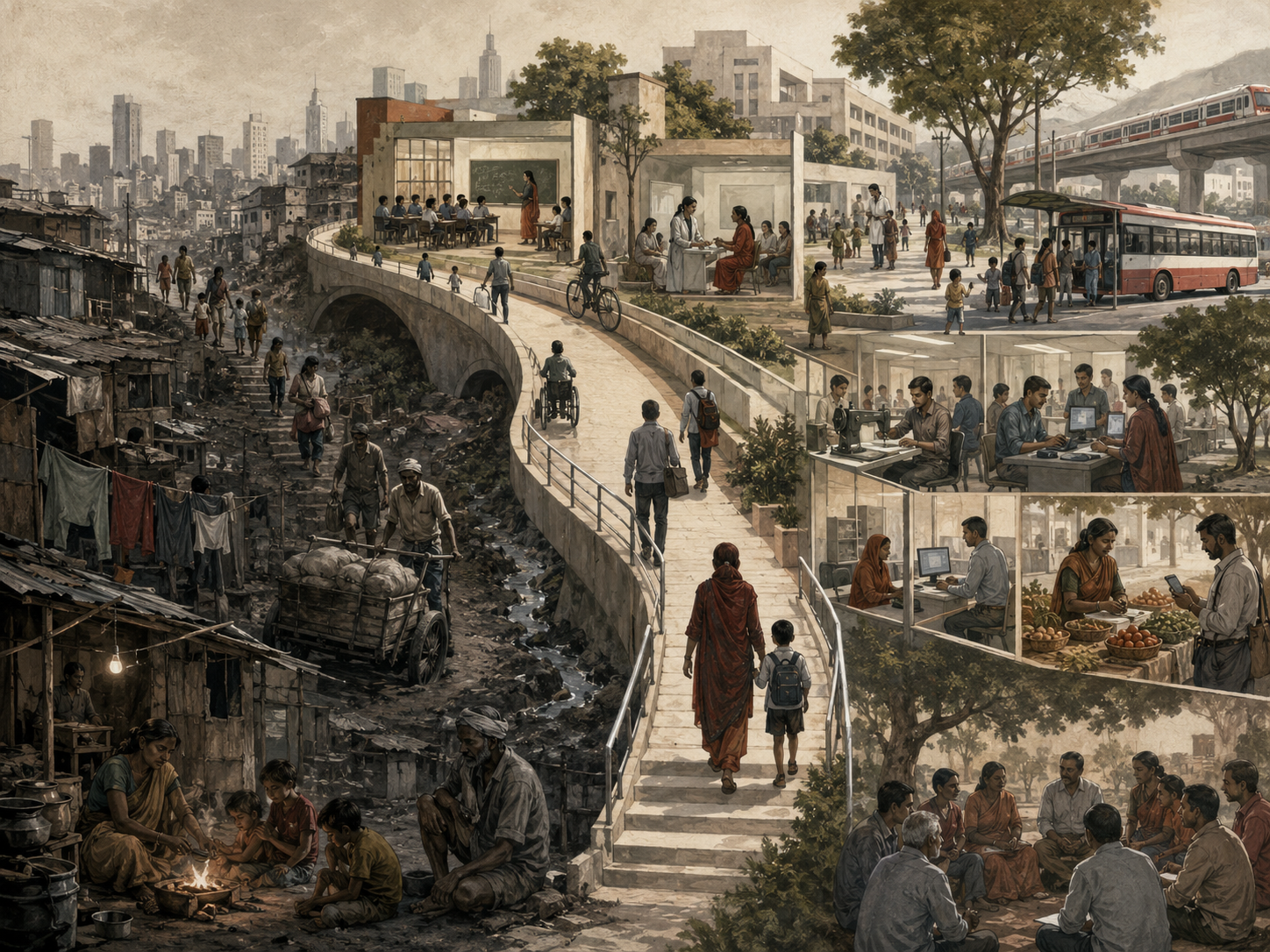
Within a sustainable systems framework, poverty, capability, and economic inclusion should be examined not only in relation to income growth, but in relation to whether societies create resilient conditions for participation, security, dignity, and human development. A society may reduce extreme income deprivation while still reproducing exclusion through inadequate housing, poor health access, insecure labor, weak transport, territorial abandonment, digital inequality, administrative burden, or social stigma. The deeper question is whether economic systems widen the real foundations of agency and belonging or leave substantial populations navigating modern life under conditions of chronic constraint.
Why This Topic Matters
Poverty, capability, and economic inclusion matter because deprivation rarely appears in only one form. Low income often arrives with weak housing, insecure work, poor transport, limited healthcare, educational disadvantage, digital exclusion, debt pressure, and greater exposure to risk. These conditions compound. A missed paycheck becomes a rent crisis; a health problem becomes labor-market exit; lack of childcare becomes lost earnings; poor transit becomes exclusion from jobs and services. Poverty is therefore less a single shortage than a cluster of mutually reinforcing limits.
Economic inclusion is equally important because modern societies are organized through access to institutions. Employment, banking, schooling, identification systems, digital tools, transport networks, utilities, legal recognition, public services, and social protection all help determine whether people can participate on workable terms. Exclusion from these systems can make even modest setbacks hard to recover from.
Capability provides a clearer lens because it asks what people can actually do with the resources available to them. The issue is not only whether an individual receives income or support, but whether those resources translate into nutrition, mobility, education, safety, dignity, care, and meaningful participation.
For that reason, poverty analysis belongs at the center of political economy rather than at its margins. It concerns how a society organizes access to the minimum conditions of agency, and whether growth expands those conditions broadly or leaves them unevenly distributed and chronically fragile.
It also asks how exclusion becomes normalized. When entire groups live without secure access to housing, healthcare, credit, transport, civic recognition, or digital systems, deprivation stops appearing exceptional and begins to look built into the ordinary functioning of the system.
Poverty also matters because it compresses time. Households under chronic constraint must often prioritize immediate survival over education, health, savings, political participation, or long-term planning. That compression narrows freedom even when formal rights remain intact.
Within sustainable systems, this makes poverty a resilience problem. A society cannot adapt well to climate shocks, technological change, public-health stress, or economic volatility if large portions of its population already live close to collapse.
What Poverty Is
Poverty refers to a condition of insufficient resources to secure a minimally adequate standard of living. In conventional economic measurement, this often begins with income or consumption thresholds. Yet poverty is wider than low income alone. It includes weak access to food, shelter, healthcare, sanitation, education, transport, safety, digital systems, legal recognition, and other conditions necessary for stable participation in social and economic life.
This broader understanding is important because households can sit above an income poverty line while remaining highly vulnerable to eviction, illness, debt shocks, unsafe work, food insecurity, or infrastructure failure. Conversely, strong public provision can reduce lived deprivation even where money income remains modest. Poverty is therefore not simply a number beneath a threshold. It is a condition shaped by institutions, prices, public goods, and exposure to risk.
Poverty also has temporal depth. It can be acute and immediate, as in sudden income loss or food insecurity, or chronic, as in long-term exclusion from quality schooling, stable work, reliable housing, or basic infrastructure. Chronic poverty is often more structurally important because it shapes capability across years and generations.
A serious account therefore treats poverty not merely as low command over money, but as restricted command over the material and institutional means of living a minimally secure life.
In that sense, poverty is not only about scarcity. It is also about instability, dependence, and a constant narrowing of the options through which people can respond to hardship.
Poverty also involves exposure to cascading harm. A household with no savings, unstable work, high rent burden, and limited service access may experience a small shock as a life-altering crisis. Poverty is therefore inseparable from vulnerability.
This is why poverty analysis must include both incidence and depth. Counting how many people fall below a line is useful, but it does not reveal how far below the line they are, how many deficits they face, or how fragile their position remains even if measured income improves.
What Capability Means
Capability refers to the real freedoms people possess to achieve valued ways of living. It focuses not only on resources, but on what those resources make possible in practice. The relevant issue is not simply whether a person receives income, education, healthcare, or legal access in some formal sense, but whether they can actually convert those resources into health, movement, security, learning, participation, care, and self-direction.
Resources do not translate automatically into equal outcomes. Disability, illness, unsafe neighborhoods, discrimination, caregiving burdens, weak infrastructure, digital exclusion, administrative complexity, and unequal institutional access can all reduce the capability a person derives from similar formal resources. What appears equal on paper may be unequal in lived effect.
Capability also broadens the meaning of development. It asks whether social systems expand practical agency or merely circulate goods and incomes without changing the deeper conditions under which people live and act.
A serious framework therefore treats capability as a bridge between economics and lived human experience. It connects resources to institutions, bodies, environments, and social arrangements that determine whether possibility is real or merely nominal.
Capability is thus a better measure of inclusion than income alone. It asks whether people can participate with dignity and continuity rather than merely survive under constant compromise.
This approach also clarifies why public services matter. Health systems, schools, transport, safe housing, childcare, disability access, legal recognition, and digital infrastructure are not secondary supports. They are conversion systems: they determine whether resources become real freedom.
Capability analysis therefore asks a demanding question of economic systems: not merely whether they produce more, but whether they expand what more people can actually do and become.
What Economic Inclusion Is
Economic inclusion refers to the degree to which people can participate in the institutions and systems through which modern economic life is organized. This includes access to work, finance, education, infrastructure, digital tools, transport, legal identity, public services, markets, and social protection. Inclusion is not only about formal admission. It is about whether participation occurs on workable, secure, and dignity-preserving terms.
Many people are formally included yet materially excluded. They may hold jobs that do not pay enough to support stable life, possess bank accounts with no real access to affordable credit, live in cities where essential services remain geographically or financially out of reach, or interact with digital benefit systems they cannot use effectively. Inclusion can therefore be shallow, fragile, or conditional.
Economic inclusion also has a systemic dimension. An economy may rely on labor from groups it does not fully serve through infrastructure, legal protection, social insurance, or public investment. In such cases, participation occurs, but under unequal terms that reproduce insecurity rather than reducing it.
A strong account therefore treats inclusion as a question of depth and durability. The issue is not only whether people are present inside economic systems, but whether those systems allow them to build stability, capability, and future possibility.
Inclusion becomes meaningful only when people can use institutions without being continually pushed toward exhaustion, debt dependence, informal workaround, administrative humiliation, or forced exit.
This means inclusion is not equivalent to market participation. A person can be fully exposed to markets and still excluded from capability if wages are too low, risk is unmanaged, services are inaccessible, and institutions treat them as disposable.
The deeper test is whether inclusion widens agency. If participation merely absorbs people into precarious work, predatory finance, inadequate services, or opaque digital systems, it may be inclusion in form but exclusion in substance.
Income Poverty and Multidimensional Deprivation
Income poverty remains important because money affects access to food, housing, transport, care, communication, and basic resilience. Without sufficient income, many other forms of deprivation quickly intensify. Yet income by itself cannot fully describe deprivation because households live within broader systems of prices, services, infrastructure, and institutional support.
Multidimensional deprivation captures this wider reality. A household may face overlapping deficits in schooling, sanitation, electricity, healthcare, digital access, safe housing, nutrition, transport, environmental quality, and personal security. These disadvantages do not simply add to one another. They interact and compound.
This is why multidimensional approaches are often more revealing than narrow income thresholds alone. They show how deprivation persists through interlocking weaknesses in the environment of everyday life.
A careful framework therefore uses income as one necessary measure among others. The broader question is how many constraints a household must navigate simultaneously, and how those constraints reduce its ability to convert effort into improved conditions.
Deprivation becomes especially durable when several deficits are present at once, since each one weakens the household’s ability to compensate for the others through its own resources.
For example, an income transfer may matter deeply, but it cannot fully compensate for unsafe housing, unusable transit, poor schools, untreated illness, and digital exclusion at the same time. Those conditions require institutional repair, not only income support.
Multidimensional deprivation therefore shifts poverty analysis from a single line to a map of constraints. It asks where scarcity, insecurity, infrastructure failure, and institutional exclusion converge.
The Conversion Problem: From Resources to Real Freedom
One of the most important insights in capability analysis is that people differ in their ability to convert resources into practical freedom. The same income may support very different standards of living depending on health status, disability, household composition, neighborhood conditions, transport access, social stigma, public services, administrative burden, and the price or availability of basic goods.
This means that policy can appear equitable while remaining unequal in effect. A cash benefit of equal size may do far less for someone facing chronic illness, unsafe housing, high care burdens, discrimination, or digital exclusion than for someone living in a more supportive environment. Uniform resources do not guarantee uniform capability.
The conversion problem also shows how much institutional design matters. Public transport, accessible healthcare, safe schools, disability accommodations, digital access, legal aid, childcare, and affordable housing all affect how far resources go in real life.
A serious account of poverty therefore cannot stop at the distribution of means. It must ask how environments, bodies, and institutions shape the transformation of means into actual opportunity.
Real freedom depends not only on what is handed out, but on the surrounding architecture that determines whether that support can be used effectively and without constant loss.
This is also why austerity can be especially damaging. Cutting public services may leave nominal incomes unchanged while weakening the conversion conditions that make those incomes useful.
Capability therefore requires seeing the economy as a set of conversion systems. Income, services, infrastructure, law, safety, health, and time all determine whether resources become lived possibility.
Health, Education, and the Foundations of Human Capability
Health and education are among the deepest foundations of capability. They influence survival, cognition, earnings, confidence, social participation, and the ability to adapt over time. Because they shape life chances before and during entry into labor markets, they play a central role in both poverty reduction and long-run inclusion.
Deprivation in these areas often accumulates quietly. Malnutrition, untreated illness, stress exposure, poor school quality, weak literacy support, lack of mental-health care, unsafe environments, and limited early-childhood development can generate effects that remain visible decades later in earnings, health, and participation.
Education and health also interact. Poor health can weaken learning; weak education can reduce access to better work, stable housing, preventative care, and public systems. These domains are therefore best understood as mutually reinforcing parts of capability formation rather than separate policy boxes.
A serious framework treats them as core institutions of economic life. They shape not just human welfare in the abstract, but the actual capacity of societies to widen participation and reduce inherited disadvantage.
Where health and education systems are thin, opportunity becomes fragile even for the talented and hardworking. Where they are strong, they widen the base from which mobility and inclusion can become real.
This is why early investment matters so much. Deprivation in childhood often becomes adult disadvantage through mechanisms that are difficult and expensive to reverse later.
Health and education are therefore not merely outcomes of development. They are productive foundations of an inclusive economy because they determine who can participate, learn, adapt, and contribute over time.
Work, Informality, and Precarious Inclusion
Employment is often treated as the primary route out of poverty, yet work does not always provide durable inclusion. Informal labor, unstable hours, low wages, unsafe conditions, weak protections, unpaid waiting time, algorithmic control, and lack of social insurance can leave workers economically active while still living under chronic insecurity.
This matters because inclusion through labor can be shallow. A person may be “in” the economy in the sense of working constantly, while remaining excluded from benefits, legal protection, skill development, bargaining power, and any reasonable path to savings or stability. Employment in such cases mitigates immediate deprivation without overcoming structural vulnerability.
Informality matters especially because it often sits at the boundary between participation and exclusion. Informal workers keep cities, supply chains, care systems, and service systems functioning, yet they may remain invisible to labor law, social insurance, and official statistics in ways that weaken their bargaining power and public standing.
A serious account therefore distinguishes between mere labor-market absorption and genuine economic inclusion. The relevant question is whether work allows people to build capability, security, and future options rather than simply endure the present.
Work becomes developmentally meaningful when it provides more than income. It must also provide continuity, recognition, learning, and some protection against routine shocks.
This does not mean every job must look the same. It means that work should not be organized in ways that make workers permanently disposable, uninsured, underpaid, or unable to plan a life.
An inclusive economy therefore requires labor institutions, social insurance, training pathways, fair scheduling, workplace safety, and recognition of informal workers as part of the economy rather than as exceptions to it.
Housing, Infrastructure, and Everyday Security
Housing and infrastructure strongly shape whether people can live with stability and dignity. Safe shelter, reliable electricity, clean water, sanitation, transport, and digital connectivity are not luxuries added after development; they are part of the practical basis of participation in modern society.
Without these conditions, households must devote enormous time and energy to securing what others take for granted. Long commutes, unsafe buildings, water insecurity, unreliable power, weak broadband, and inaccessible public services all reduce capability even when income is technically present.
Housing also organizes opportunity spatially. Families pushed into overcrowded, unsafe, unaffordable, or distant areas often face worse schools, weaker services, longer commutes, higher stress, and narrower labor-market access. In that way, poverty becomes embedded in daily geography.
A serious framework therefore treats infrastructure and housing as distributive institutions. They determine whose time is consumed by survival, whose movement is constrained, and whose lives remain exposed to avoidable disruption.
Everyday security is built materially. Without stable housing and functioning infrastructure, other supports often fail to convert into lasting capability.
Housing burden also creates a hidden form of poverty. A household may appear above an income line but remain effectively deprived once rent, utilities, transportation, debt, and health costs are accounted for.
Inclusion therefore requires more than labor income. It requires the material systems that allow income to become secure life: housing, water, power, transport, communication, sanitation, and public space.
Finance, Credit, and the Boundaries of Economic Participation
Access to finance can widen inclusion by allowing households and firms to smooth shocks, invest in education or tools, build businesses, and manage time more flexibly. Yet financial inclusion is not always emancipatory. Credit can just as easily deepen dependence if borrowing occurs under predatory terms, unstable incomes, weak consumer protection, or conditions where debt replaces adequate wages and public provision.
The boundary between inclusion and extraction is often thin. A bank account, digital wallet, microloan, or credit product may signal formal entry into financial systems, but the deeper issue is whether those systems provide fair access to useful instruments or merely widen exposure to fees, surveillance, and debt stress.
Finance also matters because exclusion from affordable credit can reinforce poverty by preventing households from smoothing ordinary volatility or making productive investments. At the same time, inclusion without protection can turn vulnerability into a revenue stream for lenders.
A serious account therefore treats finance as a contested terrain. The relevant question is whether financial systems widen capability and resilience or reorganize insecurity into new forms of obligation.
Economic participation becomes deeper when finance supports planning and stability rather than monetizing desperation.
This is especially important in digital finance. Automated scoring, platform access, data profiling, and identity systems can widen access, but they can also create new forms of exclusion if they are opaque, discriminatory, unaffordable, or inaccessible.
Financial inclusion should therefore be judged by quality, not only by coverage. The question is not simply who has an account, but whether financial access reduces risk, supports agency, and protects households from exploitative dependency.
Gender, Care Work, and Hidden Forms of Exclusion
Poverty and exclusion are often shaped by gendered divisions of labor, especially through unpaid or underpaid care work. Household care, childrearing, elder care, disability support, and domestic labor are essential to economic reproduction, yet they are frequently undervalued or omitted from conventional measures of economic contribution.
This matters because unpaid care constrains time, labor-force participation, earnings growth, mobility, rest, education, and access to social insurance. A person may appear outside formal employment not because of lack of effort or skill, but because care systems and labor markets are structured in ways that assign private burdens unevenly.
Gendered exclusion also appears through pay gaps, occupational segregation, unsafe workplaces, transport insecurity, unequal property rights, weaker access to finance, and weaker legal protection in some settings. These mechanisms can combine, making inclusion shallower even when formal participation rises.
A serious framework therefore includes care as part of economic analysis rather than treating it as a private residual. It asks how societies distribute the labor of sustaining life, and how that distribution affects capability, poverty, and participation.
Without attention to care systems, inclusion metrics can flatter economies that depend on invisible labor while leaving its burdens largely unshared.
Care also shapes children’s capability. Underfunded childcare, unsupported caregivers, and insecure family time can transmit disadvantage even where income assistance exists.
An inclusive economy must therefore treat care as infrastructure. Paid leave, childcare, elder care, disability support, safe transport, and care-worker protections are not optional social add-ons; they are part of the economic system that makes participation possible.
Children, Youth, and the Reproduction of Disadvantage
Poverty is especially consequential in childhood because deprivation early in life can shape nutrition, cognitive development, health, schooling, confidence, social trust, and long-run earnings. When disadvantage begins early, later interventions often face steeper obstacles.
Exclusion is frequently reproduced through childhood environments. Family stress, insecure housing, poor schools, unsafe neighborhoods, underfunded care, weak public health, and digital inequality can limit capability long before labor-market entry. By adulthood, what appears as individual shortfall may already reflect years of accumulated institutional deficit.
Youth transitions matter as well. The move from school to work, training, or higher education often determines whether inequality deepens or begins to loosen. Weak apprenticeships, costly education, poor transport, unstable entry-level jobs, and limited mentoring can all trap young people in shallow inclusion.
A serious account therefore treats children and youth as central rather than peripheral to poverty analysis. The issue is not only current deprivation, but whether a society prevents disadvantage from becoming intergenerational structure.
Where childhood capability is neglected, later mobility becomes harder, more expensive, and less likely to be broadly shared.
Child poverty is therefore not only a humanitarian concern. It is a structural warning about the future capacity of the whole society.
An economy that tolerates childhood deprivation is effectively choosing lower future capability, weaker resilience, and narrower participation before the next generation has had any meaningful chance to act.
Place, Territory, and Spatially Organized Poverty
Poverty is often spatially organized. Deprivation can cluster in underinvested neighborhoods, peripheral regions, informal settlements, isolated rural areas, climate-exposed zones, or post-industrial territories left behind by structural change. In such contexts, exclusion is reinforced by place itself.
Geography shapes access to schools, clinics, jobs, transport, digital networks, food systems, environmental safety, and political attention. Living in a poorly served place can transform modest disadvantage into chronic exclusion through simple distance, disrepair, or institutional neglect.
Territorial inequality also affects how poverty is perceived. Affluent centers may treat deprivation as marginal when it is simply concentrated elsewhere. Meanwhile, people living in excluded territories experience the economy as something organized around their absence.
A serious framework therefore includes place directly in the analysis of capability. Opportunity is not evenly spread across space, and poverty cannot be understood apart from the territorial patterns through which institutions and infrastructure are distributed.
Spatially organized poverty is one of the clearest signs that exclusion is structural rather than merely individual. It shows that deprivation often follows maps of investment, abandonment, environmental exposure, and unequal public attention.
Place also affects political voice. Poorly served regions may be described as lacking initiative when they actually lack infrastructure, institutional presence, transport, capital, public services, or environmental safety.
An inclusive economy must therefore be territorial. It must ask where capability is being built, where it is being withheld, and how investment, infrastructure, and public systems can repair the geography of exclusion.
Public Services, Social Protection, and Capability-Building
Public services and social protection can reduce poverty not only by transferring resources, but by changing the institutional environment in which people live. Healthcare, education, transport, childcare, housing support, unemployment protection, food assistance, disability support, pensions, legal aid, and disaster relief all affect how secure and capable households can become over time.
These systems matter because private income alone rarely provides an adequate picture of lived wellbeing. A household with modest earnings but reliable services and protections may enjoy far greater stability than one with somewhat higher wages but full exposure to private costs and unmanaged risk.
Social protection also enables planning. People are more able to retrain, care for family, search for better work, move safely, or recover from setbacks when ordinary life shocks do not immediately threaten collapse.
A serious account therefore treats public services and protection not as secondary correctives, but as part of the productive architecture of an inclusive economy. They build the conditions under which people can participate more fully and with less fear.
Capability-building is thus institutional. It depends not only on private effort, but on whether public systems reduce avoidable vulnerability and widen the practical use of talent and time.
Social protection also has macroeconomic value. By stabilizing households during downturns, shocks, and transitions, it prevents individual hardship from cascading into broader economic and social fragility.
Inclusion therefore requires institutions that treat security as a foundation for participation, not as a reward available only after people have already achieved stability.
Digital Inclusion, Data Systems, and New Boundaries of Participation
Economic participation increasingly depends on digital access. Employment applications, benefit systems, education platforms, banking, healthcare portals, identification systems, transport services, and everyday commerce now often rely on connectivity, devices, digital literacy, platform compatibility, and usable interfaces.
Digital exclusion can now function as economic exclusion. Limited broadband, weak device access, poor platform design, low digital literacy, inaccessible identity systems, language barriers, or automated decision systems can prevent people from claiming rights, seeking jobs, accessing services, or participating in markets on equal terms.
Digital systems also redistribute power. Platforms, algorithms, and data infrastructures can widen access, but they can also intensify surveillance, automate gatekeeping, or make participation conditional on opaque technical systems beyond users’ control.
A serious framework therefore treats digital inclusion as part of contemporary capability. The issue is not merely whether people are online, but whether digital systems are affordable, intelligible, accessible, and governed in ways compatible with real economic participation.
As more institutions become digitally mediated, exclusion can become quieter but no less consequential. A denied form, unreadable interface, missing device, unstable connection, or algorithmic flag can now function as a barrier as real as distance or illiteracy once did.
Digital inclusion also requires institutional accountability. If public benefits, work opportunities, healthcare, education, and finance depend on digital systems, those systems must be designed around the people most likely to be excluded by them.
Technology therefore belongs inside poverty analysis. It can expand capability, but only if digital infrastructure, literacy, design, privacy, and governance are treated as public inclusion problems rather than private user burdens.
Poverty, Stigma, and the Politics of Recognition
Poverty is not only material. It is also social and symbolic. Stigma can shape how people are treated by employers, landlords, schools, bureaucracies, police, healthcare systems, financial institutions, and even by the design of public benefits themselves. Recognition matters because humiliation, suspicion, and administrative burden can become part of deprivation.
This matters because institutions do not merely distribute resources; they also distribute respect and credibility. If poor households must constantly prove deservingness, navigate degrading procedures, or accept surveillance as the price of support, then formal assistance may coexist with civic diminishment.
Stigma also affects political interpretation. Poverty can be framed as moral failure, cultural deficiency, dependency, or individual irresponsibility in ways that obscure structural exclusion and weaken support for collective solutions.
A serious account therefore includes recognition alongside material provision. Economic inclusion is incomplete if participation is offered only under conditions of suspicion, shame, or reduced civic standing.
The politics of poverty thus concern not only what support exists, but what kind of social meaning attaches to needing it and to receiving it.
Administrative burden is especially important. A benefit system may exist formally, but if accessing it requires time, paperwork, documentation, digital access, repeated verification, or humiliating scrutiny, then part of the support is consumed by the process of obtaining it.
Inclusion therefore requires institutional respect. A society’s poverty policy should not solve material deprivation while reproducing social degradation.
Historical Lessons from Development, Welfare, and Inclusion
Historical experience shows that poverty reduction has followed different paths. Some societies relied heavily on growth and labor absorption, others on land reform, welfare-state expansion, public health, mass education, housing provision, social insurance, or combinations of these. No single route has been universal.
What recurs, however, is the importance of institutional depth. Durable reductions in poverty have usually involved more than income growth alone. They have depended on public health systems, schooling, infrastructure, labor institutions, social protection, housing systems, and in some cases structural changes that widened access to land, stable employment, or public services.
History also shows that inclusion can be reversed. Fiscal crises, privatization waves, austerity, conflict, environmental breakdown, housing shocks, pandemics, or labor-market deregulation can erode earlier gains and push households back toward vulnerability.
A serious historical perspective therefore treats inclusion as something built and maintained rather than simply achieved once. Poverty reduction is often most durable where societies create institutions capable of preserving capability across shocks.
History also cautions against narrow triumphalism. A decline in one deprivation measure may hide the growth of others if housing, care, health, debt, digital access, or territorial exclusion are worsening beneath the surface.
This is why poverty reduction must be evaluated across time. Temporary income improvement is not the same as durable capability if households remain exposed to shocks that can rapidly reverse gains.
The historical lesson is that poverty is not solved only by raising income in the short run. It is reduced durably when societies build institutions that protect capability, share risk, widen participation, and prevent deprivation from reproducing across generations.
Poverty, Capability, and Sustainable Systems
Within sustainable systems, poverty should be understood as a failure to provide broad access to the material and institutional foundations of agency. An economy is not socially sustainable if large numbers of people remain unable to secure shelter, health, learning, mobility, recognition, and participation without constant exposure to collapse.
This changes the meaning of inclusion. Inclusion is not only about connecting people to markets; it is about building systems in which participation does not require permanent precarity. Public services, infrastructure, care systems, labor protections, fair finance, digital access, and social protection are all part of that foundation.
Sustainable systems therefore require more than anti-poverty transfers in isolation. They require institutions strong enough to convert economic activity into durable capability across territories and generations. They also require a willingness to see deprivation not merely as individual shortfall, but as evidence of systemic design problems.
In this sense, poverty becomes a systems question. It asks whether an economy reproduces life in ways that widen practical freedom and belonging, or whether it leaves substantial populations surviving inside institutions that do not fully include them.
This also means that sustainability should not be framed only in environmental or fiscal terms. A society may protect budgets or improve aggregate growth while remaining unsustainable if everyday capability is too thinly distributed to support a shared future.
Poverty reduction is therefore part of resilience. Households with secure housing, healthcare, education, transport, savings, digital access, and public support are better able to adapt to shocks. Households without these foundations experience shocks as cascading crises.
A sustainable economy must therefore build capability before crisis, not only provide relief afterward. The goal is not merely to help people survive deprivation, but to redesign systems so fewer lives are organized around deprivation in the first place.
How Poverty, Capability, and Inclusion Systems Should Be Judged
Poverty, capability, and economic inclusion should not be judged only by poverty headcounts, employment rates, or service coverage. A broader economic systems framework asks whether institutions create durable capability, reduce vulnerability, widen participation, and allow people to live with dignity, security, and real agency.
| Dimension | Narrow Question | Systems Question |
|---|---|---|
| Income Poverty | Who falls below a poverty line? | How deep is deprivation, how volatile is income, and what essential costs reduce effective living standards? |
| Multidimensional Deprivation | Which needs are unmet? | How do deficits in housing, health, education, transport, food, sanitation, safety, and digital access compound? |
| Capability | What resources are available? | Can people convert resources into health, mobility, learning, security, care, and self-direction? |
| Economic Inclusion | Are people participating? | Is participation secure, dignified, protected, and capable of building future possibility? |
| Work | Are people employed? | Does work provide adequate wages, stability, safety, benefits, recognition, and pathways for advancement? |
| Housing & Infrastructure | Do households have shelter and services? | Do housing, water, energy, transport, sanitation, and digital systems support everyday security? |
| Finance | Do people have financial access? | Does finance support resilience and planning, or does it monetize vulnerability through fees and debt? |
| Care | Are people available for work? | How are care burdens distributed, supported, valued, and protected? |
| Digital Access | Are people online? | Can they actually use digital systems to access work, education, services, rights, and finance? |
| Recognition | Is support available? | Do institutions provide support with dignity, low burden, and respect for civic standing? |
This framework prevents a common mistake: treating poverty as a single lack of money. Income matters, but poverty is also a condition of weak conversion, fragile inclusion, high vulnerability, institutional exclusion, and limited future possibility. A household can cross an income threshold while remaining exposed to housing crisis, illness, debt, digital exclusion, or precarious work.
The central question is therefore not simply whether poverty rates fall. The deeper question is whether societies are building the institutional conditions that allow people to live securely, participate meaningfully, and convert resources into capability across time.
Mathematical Lens
Mathematics can clarify poverty, capability, and economic inclusion by making poverty incidence, poverty depth, capability formation, inclusion systems, conversion conditions, vulnerability, and social-protection effects explicit. These equations do not determine what level of deprivation is morally tolerable, but they help show why poverty analysis must go beyond income thresholds alone.
1. Poverty Rate
PR = \frac{P}{N}
\]
Interpretation: The poverty rate \(PR\) compares the number of people below a poverty threshold \(P\) with the total population \(N\). It is useful for basic comparison, but it does not capture depth, vulnerability, or multidimensional deprivation.
2. Poverty Gap
PG = \frac{\sum_{i=1}^{q}(z – y_i)}{N}
\]
Interpretation: The poverty gap \(PG\) measures how far people below the poverty line fall beneath the threshold \(z\), where \(y_i\) is income of poor household \(i\), \(q\) is the number of poor households, and \(N\) is total population.
3. Multidimensional Deprivation
MD = f(Health, Education, Housing, Food, Sanitation, Transport, Digital\ Access, Safety)
\]
Interpretation: Multidimensional deprivation \(MD\) reflects overlapping deficits in the conditions of daily life. This helps show why income alone does not capture the full structure of poverty.
4. Capability Relation
C = f(Income, Health, Education, Mobility, Safety, Time, Institutional\ Access)
\]
Interpretation: Capability \(C\) depends on income, health, education, mobility, safety, time, and institutional access. This expresses the idea that practical freedom depends on more than money alone.
5. Inclusion Relation
I = f(Work, Finance, Services, Infrastructure, Digital\ Access, Legal\ Recognition)
\]
Interpretation: Economic inclusion \(I\) is multi-institutional. It depends on whether people can participate in work, finance, services, infrastructure, digital systems, and legal systems on workable terms.
6. Conversion Function
Real\ Freedom = Resources \times Conversion\ Conditions
\]
Interpretation: Resources do not automatically become freedom. Conversion conditions include health, disability status, public services, social norms, safety, physical environment, digital access, and administrative design.
7. Vulnerability
V = f(Low\ Savings, High\ Debt, Insecure\ Work, Weak\ Services, Shock\ Exposure)
\]
Interpretation: Vulnerability \(V\) shows why households above an income threshold may still face serious risk. Low savings, high debt, insecure work, weak services, and shock exposure can push households into crisis quickly.
8. Social Protection Effect
SPE = V_{before} – V_{after}
\]
Interpretation: The social protection effect \(SPE\) measures the reduction in vulnerability after public services, transfers, insurance, or social protection are taken into account.
9. Practical Interpretation
The mathematical lens clarifies several structural points. Income poverty is only one part of deprivation. Poverty depth matters as well as poverty incidence. Capability depends on health, infrastructure, time, safety, and institutions. Inclusion requires access to multiple systems at once. Vulnerability can remain high even where measured income improves. Public services and social protection can reduce vulnerability by improving conversion conditions, not only by raising income.
Formalization helps clarify mechanism, but it does not determine what level of deprivation is morally tolerable, what package of inclusion is socially adequate, or how public priorities should be ordered under scarcity. Those remain institutional, historical, ethical, and political questions.
Python Workflow: Poverty, Capability, and Economic Inclusion
Python is useful for turning poverty, capability, and inclusion concepts into reproducible calculations. The following compact workflow models a poverty rate, poverty gap, capability score, inclusion score, conversion conditions, and vulnerability.
# Poverty, Capability, and Economic Inclusion
# Simple Python workflow

import pandas as pd

# Poverty rate
people_below_line = 180
population = 1200
poverty_rate = people_below_line / population
print("Poverty rate:", round(poverty_rate, 3))

# Simple poverty gap
poverty_line = 30
incomes_below = [18, 22, 25, 27, 29]
poverty_gap = sum(poverty_line - y for y in incomes_below) / population
print("Poverty gap:", round(poverty_gap, 3))

# Capability score
income_score = 0.55
health_score = 0.60
education_score = 0.58
mobility_score = 0.52
safety_score = 0.57
time_score = 0.48
institutional_access = 0.50

capability_score = (
    0.18 * income_score
    + 0.17 * health_score
    + 0.17 * education_score
    + 0.14 * mobility_score
    + 0.12 * safety_score
    + 0.10 * time_score
    + 0.12 * institutional_access
)

print("Capability score:", round(capability_score, 3))

# Conversion conditions and real freedom proxy
conversion_condition_score = sum([
    health_score,
    education_score,
    mobility_score,
    safety_score,
    time_score,
    institutional_access
]) / 6

real_freedom_proxy = income_score * conversion_condition_score

print("Conversion condition score:", round(conversion_condition_score, 3))
print("Real freedom proxy:", round(real_freedom_proxy, 3))

# Economic inclusion score
work_access = 0.62
finance_access = 0.46
service_access = 0.54
infrastructure_access = 0.50
digital_access = 0.44
legal_recognition = 0.68
participation_security = 0.38

inclusion_score = (
    0.16 * work_access
    + 0.14 * finance_access
    + 0.18 * service_access
    + 0.16 * infrastructure_access
    + 0.12 * digital_access
    + 0.10 * legal_recognition
    + 0.14 * participation_security
)

print("Inclusion score:", round(inclusion_score, 3))

# Vulnerability score
low_savings = 0.80
high_debt = 0.65
insecure_work = 0.75
weak_services = 0.70
shock_exposure = 0.78

vulnerability_score = (
    0.24 * low_savings
    + 0.20 * high_debt
    + 0.22 * insecure_work
    + 0.16 * weak_services
    + 0.18 * shock_exposure
)

print("Vulnerability score:", round(vulnerability_score, 3))

df = pd.DataFrame({
    "Metric": [
        "Poverty Rate",
        "Poverty Gap",
        "Capability Score",
        "Conversion Condition Score",
        "Real Freedom Proxy",
        "Inclusion Score",
        "Vulnerability Score"
    ],
    "Value": [
        poverty_rate,
        poverty_gap,
        capability_score,
        conversion_condition_score,
        real_freedom_proxy,
        inclusion_score,
        vulnerability_score
    ]
})

print(df)
This workflow is useful because it separates low income from deeper questions of capability, conversion, inclusion, and vulnerability. It shows why a household can move above a poverty threshold while remaining insecure if housing costs, debt, weak services, poor transport, and shock exposure remain severe.
The full GitHub repository expands this example into poverty-rate and poverty-gap analysis, multidimensional deprivation scoring, capability and conversion-condition models, economic inclusion depth, work and informality comparisons, housing and infrastructure security, financial and digital inclusion quality, public-service vulnerability reduction, SQL queries, R and Stata replication workflows, Julia simulations, and article-ready figures.
R Workflow: Poverty, Capability, and Economic Inclusion
R is useful for poverty summaries, capability tables, vulnerability comparisons, and publication-ready graphics. The following compact workflow performs the same poverty-rate, poverty-gap, capability, conversion, inclusion, and vulnerability calculations in R.
# Poverty, Capability, and Economic Inclusion
# Simple R workflow

# Poverty rate
people_below_line <- 180
population <- 1200
poverty_rate <- people_below_line / population
cat("Poverty rate:", round(poverty_rate, 3), "\n")

# Simple poverty gap
poverty_line <- 30
incomes_below <- c(18, 22, 25, 27, 29)
poverty_gap <- sum(poverty_line - incomes_below) / population
cat("Poverty gap:", round(poverty_gap, 3), "\n")

# Capability score
income_score <- 0.55
health_score <- 0.60
education_score <- 0.58
mobility_score <- 0.52
safety_score <- 0.57
time_score <- 0.48
institutional_access <- 0.50

capability_score <- (
  0.18 * income_score +
  0.17 * health_score +
  0.17 * education_score +
  0.14 * mobility_score +
  0.12 * safety_score +
  0.10 * time_score +
  0.12 * institutional_access
)

cat("Capability score:", round(capability_score, 3), "\n")

# Conversion conditions and real freedom proxy
conversion_condition_score <- mean(c(
  health_score,
  education_score,
  mobility_score,
  safety_score,
  time_score,
  institutional_access
))

real_freedom_proxy <- income_score * conversion_condition_score

cat("Conversion condition score:", round(conversion_condition_score, 3), "\n")
cat("Real freedom proxy:", round(real_freedom_proxy, 3), "\n")

# Economic inclusion score
work_access <- 0.62
finance_access <- 0.46
service_access <- 0.54
infrastructure_access <- 0.50
digital_access <- 0.44
legal_recognition <- 0.68
participation_security <- 0.38

inclusion_score <- (
  0.16 * work_access +
  0.14 * finance_access +
  0.18 * service_access +
  0.16 * infrastructure_access +
  0.12 * digital_access +
  0.10 * legal_recognition +
  0.14 * participation_security
)

cat("Inclusion score:", round(inclusion_score, 3), "\n")

# Vulnerability score
low_savings <- 0.80
high_debt <- 0.65
insecure_work <- 0.75
weak_services <- 0.70
shock_exposure <- 0.78

vulnerability_score <- (
  0.24 * low_savings +
  0.20 * high_debt +
  0.22 * insecure_work +
  0.16 * weak_services +
  0.18 * shock_exposure
)

cat("Vulnerability score:", round(vulnerability_score, 3), "\n")

summary_df <- data.frame(
  Metric = c(
    "Poverty Rate",
    "Poverty Gap",
    "Capability Score",
    "Conversion Condition Score",
    "Real Freedom Proxy",
    "Inclusion Score",
    "Vulnerability Score"
  ),
  Value = c(
    poverty_rate,
    poverty_gap,
    capability_score,
    conversion_condition_score,
    real_freedom_proxy,
    inclusion_score,
    vulnerability_score
  )
)

print(summary_df)
This R workflow is deliberately compact for article readability. In the full repository, R reads structured household-poverty, multidimensional-deprivation, capability, inclusion, work-informality, housing-infrastructure, finance-digital, and public-service vulnerability scenarios; calculates poverty rates, poverty gaps, capability scores, conversion-condition scores, inclusion depth, work inclusion, public-service effects, and service-adjusted vulnerability; and visualizes how poverty differs once capability and institutions are included.
Future Economic Systems articles can extend this foundation with household surveys, multidimensional poverty indicators, benefit records, labor-force surveys, housing-cost data, health and education datasets, spatial opportunity measures, digital-access data, and social-protection administrative data.
GitHub Repository
The article body includes selected computational examples so the conceptual, institutional, and mathematical argument remains readable. The full repository contains the expanded research infrastructure: Python poverty and capability analysis, R inclusion summaries, Stata applied poverty replication workflows, SQL poverty scenario tables, Julia vulnerability simulations, poverty rates, poverty gaps, multidimensional deprivation, capability conversion, economic inclusion depth, work informality, housing and infrastructure security, financial inclusion quality, digital access, public services, social protection, vulnerability scoring, documentation, reproducible sample data, and article-ready figures and tables.
Complete Code Repository
The full code distribution for this article, including selected article examples and advanced research-style computational scaffolding for income poverty, poverty gaps, multidimensional deprivation, capability formation, conversion conditions, economic inclusion, work and informality, housing and infrastructure security, financial and digital inclusion, care burdens, child and youth disadvantage, spatial exclusion, public services, social protection, vulnerability reduction, reproducibility documentation, and cross-language economic analysis, is available on GitHub.
Conclusion
Poverty, capability, and economic inclusion are central to economic analysis because they show whether a society provides more than nominal participation in markets and institutions. The issue is not only whether people receive income, but whether they can convert available resources into safety, movement, learning, health, care, recognition, and future possibility.
To understand an economic system seriously, one must therefore ask not only who falls below a poverty line, but who lacks secure housing, who is excluded from services, who cannot absorb shocks, who remains trapped in precarious work, who is burdened by care without support, who cannot access digital systems, and who is unable to turn effort into durable capability. These questions reveal whether an economy is widening practical freedom and belonging or leaving substantial populations included only in the thinnest and most unstable sense.
The serious study of poverty also requires moving beyond the idea that deprivation is merely an individual shortage of money. Income matters deeply, but poverty is shaped by housing systems, health systems, schools, labor markets, finance, transport, digital infrastructure, care arrangements, public services, and recognition. When these systems fail together, deprivation becomes structural.
In a sustainable economic system, inclusion must mean more than survival inside fragile institutions. It must mean access to the foundations of agency: secure shelter, health, education, mobility, work with dignity, fair finance, public services, social protection, digital access, and enough stability to plan for the future. The central question is whether economic systems build capability broadly enough for freedom, dignity, and social membership to become real.
Related Reading
- Economic Systems
- Inequality, Redistribution, and Social Mobility
- Growth, Development, and Structural Transformation
- Labor, Wages, Productivity, and the Social Organization of Work
- Fiscal Policy, Taxation, and Public Investment
- Debt, Dependency, and Global Financial Order
- Trade, Globalization, and Uneven Development
- Externalities, Public Goods, and Collective Provision
- Sustainable Development
- Institutions & Governance
- Risk & Resilience
Further Reading
- International Labour Organization (ILO) (n.d.). Inclusive labour markets and social protection. Available at: https://www.ilo.org/
- Oxford Poverty and Human Development Initiative (OPHI) (n.d.). Multidimensional poverty and capability approaches. Available at: https://ophi.org.uk/
- United Nations Children’s Fund (UNICEF) (n.d.). Child poverty and social inclusion. Available at: https://www.unicef.org/
- United Nations Development Programme (UNDP) (n.d.). Human development and multidimensional poverty. Available at: https://hdr.undp.org/
- World Bank (n.d.). Poverty. Available at: https://www.worldbank.org/en/topic/poverty
- World Bank (n.d.). Poverty and Equity Data Portal. Available at: https://povertydata.worldbank.org/
- World Bank (n.d.). Social protection. Available at: https://www.worldbank.org/en/topic/socialprotection
References
- International Labour Organization (ILO) (n.d.). Inclusive labour markets and social protection. Available at: https://www.ilo.org/
- Oxford Poverty and Human Development Initiative (OPHI) (n.d.). Multidimensional poverty and capability approaches. Available at: https://ophi.org.uk/
- United Nations Children’s Fund (UNICEF) (n.d.). Child poverty and social inclusion. Available at: https://www.unicef.org/
- United Nations Development Programme (UNDP) (n.d.). Human development and multidimensional poverty. Available at: https://hdr.undp.org/
- World Bank (n.d.). Poverty. Available at: https://www.worldbank.org/en/topic/poverty
- World Bank (n.d.). Poverty and Equity Data Portal. Available at: https://povertydata.worldbank.org/
- World Bank (n.d.). Social protection. Available at: https://www.worldbank.org/en/topic/socialprotection