
Last Updated May 9, 2026
Fiscal policy, taxation, and public investment are central to economic analysis because they shape how societies mobilize resources, distribute burdens, stabilize demand, build infrastructure, and sustain the institutional conditions of collective life. Taxes are not simply revenue instruments. Public budgets are not merely accounting exercises. Public investment is not just optional spending after “the real economy” has done its work. Together, these fiscal institutions help determine whether an economy can maintain public goods, respond to crisis, support long-horizon development, and organize shared prosperity across time.
Fiscal policy matters because markets alone do not reliably provide everything an advanced society requires. Transport systems, education, public health, courts, environmental protection, scientific research, energy grids, water systems, emergency response, and social insurance all depend heavily on public authority, public finance, or public coordination. Even where private firms operate within these domains, they often do so on top of public legal, physical, and institutional foundations that taxation and budgeting make possible.
These questions also matter because taxation and spending are inseparable from political economy. Tax systems shape incentives, but they also shape legitimacy, fairness, and the distribution of power. Public expenditure can stabilize downturns, reduce insecurity, and expand productive capability, or it can be weakened by austerity, captured by narrow interests, or misdirected toward short-term optics rather than durable public value. Fiscal systems therefore do not simply move money. They define how a society converts collective claims into collective capacity.
Main Library
Publications
Article Map
Economic Systems
Related Topic
Sustainable Development
Related Topic
Institutions & Governance
Related Topic
Risk & Resilience
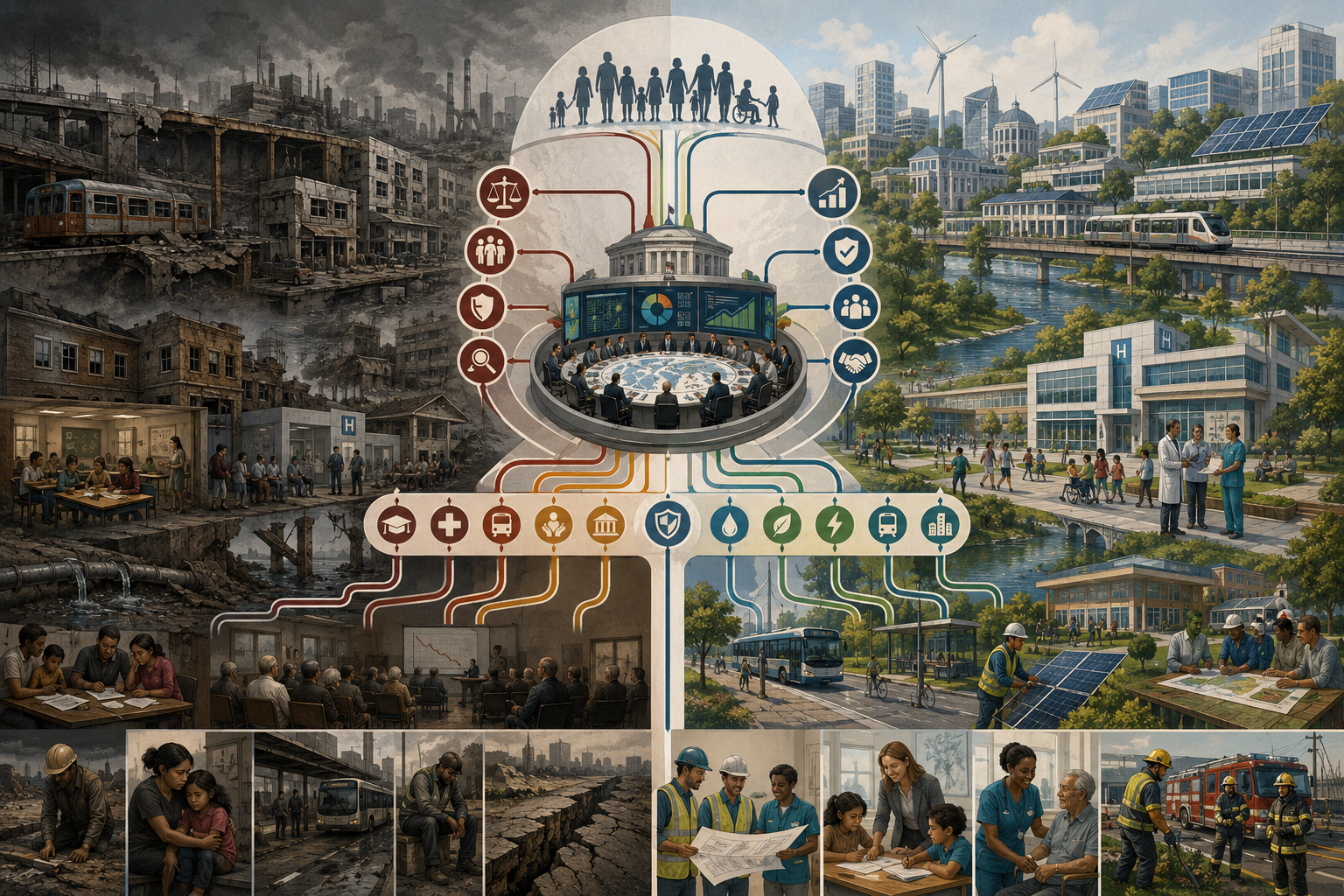
Within a sustainable systems framework, fiscal policy must be understood not only as a tool of macroeconomic stabilization, but also as a means of building resilience, maintaining infrastructure, funding adaptation, reducing fragility, and supporting the long-run reproduction of social and ecological systems. A society may keep deficits temporarily low while allowing bridges, grids, schools, water systems, public health capacity, and household security to deteriorate. The serious study of fiscal policy therefore asks not only how much government spends or taxes, but what fiscal systems are for, what they make possible, and whether they are strong enough to sustain collective life under conditions of uncertainty and structural change.
Why This Topic Matters
Fiscal policy, taxation, and public investment matter because no modern economy reproduces itself through private exchange alone. Roads must be built and repaired. Schools must function. Water systems must be maintained. Public health systems must absorb shocks. Courts must adjudicate disputes. Safety nets must support households when labor markets weaken. Scientific capacity, environmental regulation, emergency response, and basic administrative competence all require fiscal institutions able to mobilize resources on behalf of collective goals.
This matters analytically because the state is not external to the economy. It is part of the economy’s enabling structure. Fiscal systems shape aggregate demand, influence the distribution of disposable income, affect incentives, determine the quality of public goods, and alter the long-run path of productivity and resilience. Taxation and public expenditure are therefore not secondary to market life. They are among the principal ways market societies govern themselves.
These issues also matter politically. Taxation raises questions of fairness, reciprocity, and authority. Public spending raises questions of priority, competence, and legitimacy. If people perceive that taxes are extracted without visible public value, fiscal legitimacy weakens. If public investment is absent where need is obvious, institutions lose credibility. The fiscal state therefore helps determine whether collective life is experienced as organized and capable or fragmented and abandoned.
It also matters because fiscal weakness magnifies crisis. When downturn, disaster, pandemic, climate shock, war, or structural transition arrives, societies with strong tax capacity and credible public finance can respond more effectively than societies that have hollowed out administrative capacity, underfunded maintenance, or treated public investment as permanently expendable.
In this sense, fiscal policy is one of the main ways a society makes its priorities durable. It gives institutional form to questions that cannot be settled privately or episodically: who contributes, what is maintained, which risks are shared, and what kinds of future are built deliberately rather than left to drift.
Fiscal policy also reveals whether a society understands interdependence. Private prosperity depends on public systems that make transportation, education, law, health, communication, settlement, and security possible. A fiscal order that refuses to maintain these foundations does not reduce dependence. It merely hides dependence until breakdown makes it visible.
What Fiscal Policy Is
Fiscal policy refers to the use of government taxation, spending, borrowing, and transfer systems to influence economic conditions and organize collective capacity. In the narrow macroeconomic sense, fiscal policy is often discussed as a tool for stabilizing demand during recession or restraining overheating during expansion. In the broader and more serious sense, it is one of the main ways societies decide what they will fund together, what risks they will share, and what infrastructures they will maintain across time.
This broader meaning matters because fiscal policy is often misunderstood as only a short-run lever. In reality, it also determines the long-run quality of schools, transit, health systems, environmental protection, public administration, research ecosystems, energy systems, digital infrastructure, and social insurance. Fiscal choices today shape the capabilities available tomorrow.
Fiscal policy is therefore both cyclical and structural. It affects immediate demand conditions, but it also accumulates or depletes institutional strength over years and decades. A budget is not merely a statement of current spending. It is a statement about what kinds of future a polity is willing to support materially.
For that reason, the study of fiscal policy belongs simultaneously to macroeconomics, political economy, public administration, public law, and systems design. It concerns not only how governments balance accounts, but how they convert public authority into durable social capacity.
Fiscal policy also reveals a society’s theory of dependence. Where people recognize that markets rely on public foundations, taxation and expenditure can appear as normal instruments of collective self-organization. Where those foundations are denied rhetorically, fiscal systems are more likely to be treated as distortions even when the whole economy continues depending on them in practice.
At its deepest level, fiscal policy is a way of organizing time. It turns present resources into future capacity, present claims into public obligations, and present political choices into infrastructures that may support or constrain generations to come. That is why fiscal choices cannot be evaluated only by annual balance sheets.
Taxation as Revenue, Power, and Social Design
Taxation is often introduced as the means by which governments raise revenue. That is true, but incomplete. Taxes also shape incentives, define legal reporting systems, structure property and market relations, and express judgments about what a society believes should be supported, restrained, or redistributed. Tax systems therefore do more than collect money. They help organize the social order.
This matters because every tax has distributive and institutional consequences. A payroll tax affects labor income differently from a capital-gains tax. A consumption tax burdens households differently from a progressive income tax. A land-value tax changes the treatment of location rents differently from a corporate income tax. Taxation therefore operates not only as collection, but as design.
Tax systems also reveal power. What is easy to tax, what is politically protected, what is hidden, and what is internationally mobile all affect actual outcomes. A nominally progressive system may become less progressive in practice if enforcement is weak, loopholes are deep, or highly resourced actors can shift profits and assets across jurisdictions.
A serious account of taxation must therefore move beyond the narrow question of how much revenue is collected and ask who pays, how easily they can avoid payment, what behaviors are encouraged or discouraged, and how the tax system shapes legitimacy and state capacity over time.
Taxation also produces legibility. To tax income, property, profits, trade, and transactions, the state must know something about them. This makes tax systems part of the broader architecture through which economic life becomes visible, recorded, and governable.
This legibility can serve democratic accountability when taxation is transparent, fair, and connected to public value. It can also become coercive or illegitimate when tax burdens are arbitrary, corrupt, regressive, or disconnected from visible public benefit. Taxation therefore always has a legitimacy dimension as well as a technical one.
Why Governments Tax
Governments tax in order to fund public goods, support administration, provide transfers, stabilize the economy, and create the fiscal base for public authority. But taxation also performs broader functions. It helps validate legal reporting systems, creates accountability records, and establishes the state’s practical claim over part of social surplus. In that sense, taxation is part of how public authority becomes real in daily economic life.
This matters because some public goods cannot be funded reliably through voluntary payment or private pricing alone. National defense, courts, epidemic preparedness, flood control, basic scientific research, environmental regulation, and social insurance all depend on forms of collective financing that markets alone are poorly structured to provide at adequate scale or continuity.
Taxation also matters because it can reduce destabilizing inequality and excess concentration of economic power. Progressive systems can moderate post-tax disparities and strengthen social cohesion. Corrective taxes can discourage harmful activities or partly internalize external costs. Administrative taxes can bring economic activity into legible form for governance.
The deeper lesson is that taxation is not simply a burden on a pre-political market order. It is one of the ways the institutional order that makes markets possible is financed, maintained, and made governable.
Governments also tax because borrowing without credible taxation is unstable over time. Public debt markets, currency credibility, and administrative continuity all depend in part on the expectation that the state can ultimately mobilize resources through revenue if required. Taxation is therefore tied to sovereignty as well as budgeting.
Taxation also creates a durable relationship between citizens, firms, and the state. That relationship can be experienced as extractive, reciprocal, developmental, or legitimate depending on how taxes are collected and what they make possible. The fiscal state therefore lives or dies not only through collection, but through the public meaning of collection.
Types of Taxes and Their Economic Meaning
Tax systems usually combine several types of taxes: income taxes, payroll taxes, corporate taxes, property taxes, sales or value-added taxes, excise taxes, customs duties, capital-gains taxes, inheritance taxes, carbon taxes, resource royalties, and sometimes land-value taxes. Each has distinct economic and political properties.
This matters because different taxes fall on different bases and therefore shape behavior and distribution differently. Income taxes can be designed progressively and can capture part of earnings growth at the top. Consumption taxes are often easier to administer and more stable, but can be regressive relative to income. Property taxes can support local services and partially connect tax burden to immovable wealth. Corporate taxes attempt to capture part of firm profits, though enforcement becomes harder where capital is globally mobile. Excise taxes can target harmful or socially costly goods, but may burden lower-income households if poorly designed.
The economic meaning of a tax therefore cannot be understood from the label alone. One must ask about incidence, enforceability, mobility of the tax base, administrative cost, political legitimacy, avoidance possibilities, and the broader institutional setting. A tax that appears efficient in theory may fail in practice if avoidance is easy or enforcement capacity is weak.
Research-grade fiscal analysis therefore treats tax composition as a structural question. The mix of taxes influences not just revenue yield, but fairness, resilience, political acceptability, and the long-run capacity of the state to govern effectively.
It also influences time horizons. Taxes on land, inheritance, rents, carbon, or resource extraction may discipline longer-run patterns of accumulation differently from taxes levied mainly on current labor income or everyday consumption. The composition of the tax state therefore shapes not only revenue, but development itself.
Tax design also shapes what societies treat as normal economic activity. If labor is taxed heavily while land rents, capital gains, pollution, inheritance, or monopoly profits are lightly taxed, the fiscal system may unintentionally encourage extraction, speculation, or intergenerational concentration. The structure of taxation therefore expresses a political economy of what is protected and what is disciplined.
Progressivity, Regressivity, and Fiscal Fairness
Tax systems are often judged partly by whether they are progressive, proportional, or regressive. A progressive system takes a larger share of income from higher-income groups than from lower-income groups. A regressive system does the opposite in practical effect, often because essential consumption taxes, flat charges, fees, or payroll burdens weigh more heavily on households with lower incomes.
This matters because tax systems do not simply finance public activity. They also shape after-tax distribution and therefore influence social cohesion, political legitimacy, and the durability of mass demand. Highly regressive fiscal systems may raise revenue while worsening insecurity and reducing trust. More progressive systems may better align ability to pay with tax burden and may reduce inequality after market distribution has already produced severe disparities.
Fairness, however, is not exhausted by statutory rates. It also depends on exemptions, deductions, enforcement, wealth concentration, local tax structures, consumption burdens, and the quality of public goods provided in return. A formally progressive system with deep loopholes for capital income may be less progressive in effect than it appears on paper.
Fiscal fairness therefore requires looking at the whole system: who contributes, who benefits, what is avoided, what is hidden, and whether the combined pattern of taxation and spending supports a credible sense of reciprocity in public life.
Fairness also includes visibility. Highly visible taxes imposed on ordinary households can feel more burdensome than opaque tax expenditures or avoidance channels benefiting wealthier actors. The politics of taxation is therefore shaped not only by incidence, but by who can see the burden and who can obscure it.
A just fiscal system must therefore be evaluated after transfers and public services as well as before them. The relevant question is not simply who pays at the tax counter, but how the full fiscal system reorganizes material security, public access, risk protection, and opportunity across the population.
Public Spending and the Architecture of Collective Life
Public spending is the mechanism through which fiscal systems become materially visible. Budgets fund infrastructure, schools, public health, emergency management, environmental monitoring, courts, social insurance, administration, housing support, research institutions, and countless other functions without which everyday life would be more precarious and less productive.
This matters because public expenditure is often discussed as if it were simply a subtraction from private activity. In reality, much public spending is enabling expenditure. It supports the conditions under which private households and firms can function at all. Well-maintained roads reduce cost. Effective schools raise capability. Reliable courts support contract enforcement. Public health systems reduce vulnerability to epidemic disruption. Basic administration lowers coordination costs across the economy.
Public spending also has distributive importance. It can reduce out-of-pocket burdens for essentials such as education, transportation, healthcare, social care, housing, and emergency protection. In doing so, it changes the real standard of living associated with a given level of private income. Public goods and services are therefore part of the effective social wage.
A serious analysis of public expenditure must therefore ask not only how large budgets are, but what they build, what they maintain, and whether they support durable capability rather than short-lived political visibility.
Public spending also creates temporal continuity. It keeps systems functioning between crises, between elections, and between market cycles. Many of the most important fiscal achievements are not spectacular new projects, but the quiet reproduction of institutional reliability that households and firms come to rely on precisely because it usually goes unnoticed until it fails.
Public budgets therefore reveal the real architecture of collective life. They show whether a society treats care, education, maintenance, infrastructure, ecological protection, public health, and institutional competence as enduring obligations or as discretionary residues after narrower priorities are satisfied.
Automatic Stabilizers and Countercyclical Policy
Automatic stabilizers are fiscal institutions that cushion downturns without requiring entirely new legislation each time conditions worsen. Progressive income taxes, unemployment insurance, income support, and certain transfer programs all help sustain household income when private demand contracts. Fiscal policy becomes more explicitly countercyclical when governments deliberately expand spending or reduce taxes during downturns, and withdraw stimulus or rebuild buffers during stronger phases of the cycle.
This matters because decentralized private recovery is often too weak or too slow after severe contraction. Households reduce spending when incomes fall. Firms reduce investment when demand weakens. If the public sector retrenches at the same time, recession deepens. Automatic stabilizers and discretionary fiscal expansion therefore help prevent a private downturn from becoming a cumulative system-wide collapse.
Countercyclical policy also matters because the quality of stabilization matters as much as the size. Transfers that prevent eviction, hunger, or debt spirals can stabilize both welfare and demand. Public investment during downturns can support employment now while building productive capacity for later. Fiscal timing and composition both shape recovery.
For this reason, strong fiscal systems do not wait passively for markets to heal themselves. They possess institutions capable of leaning against collapse before deterioration becomes socially irreversible.
Countercyclical strength also depends on fiscal memory and political discipline in good times. States that systematically hollow out administration, weaken benefits, and defer maintenance during expansion often discover during crisis that the institutional instruments of stabilization no longer function at the scale required.
Automatic stabilizers are therefore not merely budget items. They are institutional shock absorbers. Their value is often greatest precisely when private actors are least able to sustain spending, credit, and confidence on their own.
Public Investment and Long-Horizon Capacity
Public investment refers to fiscal expenditure that builds or significantly upgrades long-lived public assets and capabilities: transport networks, water systems, schools, hospitals, research facilities, grids, flood defenses, digital infrastructure, ecological restoration, public housing, and other forms of collective capital. It is one of the main ways societies shape the future productivity and resilience of the economy.
This matters because some of the most important investments in any society have diffuse returns, long horizons, or public-good characteristics that private finance alone often undersupplies. Basic research, sanitation, climate adaptation, grid modernization, and preventive infrastructure may not yield short-run profits attractive to private investors, yet may generate enormous long-run value socially.
Public investment also matters because it can crowd in rather than crowd out productive private activity when it reduces bottlenecks, raises capability, improves logistics, and lowers uncertainty. Firms invest more readily in places with functioning infrastructure, stable institutions, and skilled populations. Public capital and private capital are often complements rather than simple substitutes.
A research-grade treatment of fiscal policy therefore places public investment near the center. The question is not merely whether governments spend, but whether they build durable assets that widen future possibility rather than simply consuming current political attention.
Public investment also has a civilizational dimension. It is one of the main ways a polity signals that it expects to endure, coordinate, and care for future populations. A society unwilling to invest publicly in its own continuity often reveals deeper crises of confidence than budget tables alone can show.
Public investment should therefore be evaluated through multiple lenses: economic productivity, avoided loss, equity, resilience, ecological adaptation, territorial inclusion, institutional trust, and long-run maintenance obligations. A bridge, grid, school, or water system is never only a capital item. It is a commitment to a shared future.
Infrastructure Maintenance and the Hidden Side of Fiscal Capacity
One of the most overlooked aspects of fiscal policy is maintenance. Roads, bridges, pipes, schools, hospitals, grids, parks, data systems, and public buildings degrade over time. Maintenance spending is often less politically visible than new construction, yet it may yield exceptionally high social return by preserving reliability, safety, and continuity.
This matters because undermaintenance is a hidden fiscal failure. An economy may appear prudent by restraining expenditure while quietly accumulating infrastructure decay, service deterioration, and future replacement cost. What looks like savings in one budget cycle may become much larger liabilities later.
Maintenance also matters because neglect is rarely evenly distributed. Poorer regions, weaker municipalities, and politically marginalized communities often experience infrastructure decline first and hardest. The politics of maintenance is therefore also a politics of territorial equality and institutional care.
A serious fiscal framework must therefore include the stewardship of inherited assets, not only the announcement of new ones. Public capacity is reproduced not just through expansion, but through patient upkeep of what already sustains collective life.
This hidden side of fiscal capacity is especially important in resilience analysis. Systems fail under stress not only because they were never built, but because they were built and then allowed to degrade. Maintenance is therefore part of public memory made material.
Maintenance also disciplines political rhetoric. It forces the fiscal state to acknowledge that public goods are not one-time achievements. They require repeated, often unglamorous, and locally specific acts of care. A society that refuses maintenance is not saving money in a deep sense; it is converting public assets into future crisis.
Deficits, Debt, and the Politics of Fiscal Constraint
Fiscal deficits arise when public spending exceeds revenue in a given period. Public debt accumulates when deficits are financed through borrowing over time. These concepts are politically charged, often treated as straightforward signs of irresponsibility or prudence. But their meaning depends heavily on context.
This matters because deficits are not inherently good or bad in the abstract. A deficit that supports stabilization during recession, preserves employment, or funds high-value public investment may strengthen the economy’s long-run position. By contrast, attempts to eliminate deficits during deep downturns can worsen contraction, weaken revenues further, and increase social damage. The same nominal fiscal balance can therefore carry very different economic meaning under different macroeconomic conditions.
Debt also must be interpreted relative to growth, interest costs, monetary conditions, currency denomination, institutional credibility, and what the borrowing financed. Borrowing to support speculative subsidies or narrow patronage differs from borrowing to modernize infrastructure, prevent depression, or expand productive capability.
A research-grade perspective therefore treats debt and deficits as instruments embedded in political economy, not as isolated moral categories. The central question is whether fiscal choices support long-run resilience, legitimacy, and capacity or merely defer deeper weakness.
The politics of fiscal constraint often obscures this distinction by treating all borrowing as equivalent. In practice, however, borrowing to offset collapse, maintain systems, or invest in future resilience is different from borrowing that sustains extraction, delay, or performative budgeting without long-run public value.
Fiscal responsibility should therefore be understood as stewardship under constraint, not as mechanical deficit minimization. A budget can be numerically conservative and socially reckless if it defers maintenance, weakens public health, underfunds schools, ignores climate risk, and pushes costs onto households and local governments least able to absorb them.
Fiscal Multipliers and the Quality of Expenditure
Fiscal multipliers refer to the extent to which a change in public spending or taxation affects total output. Under some conditions, an increase in public expenditure can produce a larger increase in income than the initial outlay, because one actor’s spending becomes another actor’s income and then supports further rounds of demand. But multipliers are not mechanical constants. They vary with economic slack, monetary conditions, openness, household balance sheets, institutional capacity, and the kind of spending undertaken.
This matters because not all fiscal expenditure has the same macroeconomic and structural effect. Cash transfers to liquidity-constrained households may support demand quickly. Infrastructure investment may act more slowly but leave durable public assets behind. Tax cuts for very high-income groups may produce weaker immediate demand effects if much of the gain is saved. The quality, timing, and distribution of expenditure shape its actual impact.
Multiplier analysis is therefore useful only when paired with institutional judgment. The key fiscal question is not merely how much is spent, but where it goes, how quickly it moves, who receives it, what bottlenecks it reduces, and what long-run capacities it builds or neglects.
A serious fiscal state does not choose between stabilization and development as if they were separate. The best-designed expenditure can support demand now while improving capability later.
It can also prevent false economies. Spending that appears costly today may be the cheaper option once avoided unemployment, reduced deterioration, lower future repair costs, and stronger future productivity are considered. The fiscal question is often not whether public spending has a cost, but whether non-spending carries a larger one that remains politically easier to ignore.
Fiscal multiplier analysis therefore becomes more powerful when joined to systems analysis. A dollar spent on public transit, grid resilience, school retrofits, or water-system repair may have immediate demand effects, long-run productivity effects, ecological effects, equity effects, and avoided-loss effects. Narrow accounting often misses this layered value.
Tax Capacity, State Capacity, and Legitimacy
Tax capacity refers to the practical ability of a state to assess, collect, and enforce taxes reliably across its economy. State capacity more broadly includes administrative competence, legal enforcement, budgeting ability, information systems, procurement capacity, and the organizational strength to implement policy effectively. These capacities are deeply connected.
This matters because a state that cannot raise revenue effectively will struggle to maintain public goods, respond to crisis, or make credible long-horizon commitments. Weak tax capacity can produce dependence on volatile revenues, external borrowing, extractive rents, or underprovision of essential services. Fiscal weakness is therefore not only a budget problem. It is a structural limitation on governance itself.
Legitimacy matters because taxation is easier to sustain where citizens believe public institutions are reasonably competent, reciprocal, and not wholly captured by narrow interests. A fiscally strong state is not merely one that can coerce payment. It is one that can make taxation appear sufficiently fair, intelligible, and productive that compliance becomes politically durable.
A research-grade approach therefore treats tax capacity as a civilizational variable. It helps determine whether a society can act collectively over time or remains trapped in short-horizon fragmentation and underinvestment.
Legitimacy also has a feedback structure. Effective taxation funds visible competence; visible competence supports willingness to comply; compliance strengthens fiscal reach. When that loop breaks, mistrust, evasion, underprovision, and political fragmentation can reinforce one another just as powerfully in the opposite direction.
State capacity also depends on information. Tax administration, budget execution, procurement, auditing, and public investment planning all require credible data systems. A fiscal state that cannot see its own revenue base, asset condition, service gaps, or future liabilities cannot govern them responsibly.
Distribution, Inequality, and the Fiscal State
The fiscal state shapes inequality through both sides of the budget. Taxes affect how income and wealth are collected. Spending affects how services, transfers, and public goods are distributed. Taken together, fiscal systems can either reduce market-generated inequality or reinforce it.
This matters because inequality is not only a question of wages and markets. It is also a question of what happens after private income is earned and before basic life conditions are secured. Public education, healthcare, transport, pensions, social insurance, housing support, childcare, and disability services can significantly alter effective living standards and opportunity structures even without eliminating market inequality outright.
Fiscal systems also shape power. Highly unequal societies often have stronger incentives for affluent groups to resist progressive taxation while favoring privatized access to essential goods. This can create a self-reinforcing cycle in which weaker public provision justifies further tax resistance. By contrast, broadly shared public goods can help sustain legitimacy for broader-based taxation.
The deeper issue is that the fiscal state is one of the main mechanisms through which societies decide whether market outcomes will stand largely unmodified or be reorganized through collective institutions in the name of security, reciprocity, and equal citizenship.
Distribution is therefore not a side effect of fiscal design. It is one of fiscal design’s central outcomes. Whether deliberately or not, tax and spending systems write a practical constitution of social membership by determining who is cushioned, who is exposed, and what counts as a collectively guaranteed minimum.
Fiscal inequality also affects macroeconomic stability. If large parts of the population lack income security, public services, savings buffers, or access to affordable infrastructure, then shocks transmit more rapidly into reduced demand, debt stress, and political instability. Distribution is therefore not only a justice question. It is a resilience question.
Fiscal Federalism, Local Government, and Territorial Inequality
In many countries, fiscal systems are divided across national, regional, and local governments. This creates a complex architecture of revenue authority, spending responsibility, and transfer dependence often described as fiscal federalism. Local governments may fund schools, transport, policing, sanitation, land-use systems, and emergency response while relying heavily on transfers or narrower tax bases than central governments possess.
This matters because territorial inequality is often partly fiscal in origin. Wealthier regions can sometimes raise more revenue from property, income, or commercial activity, while poorer regions face greater need with weaker tax capacity. Without equalizing transfers, infrastructure gaps and service inequality can widen across places even inside the same national economy.
Local fiscal weakness also matters for resilience. Municipalities responsible for roads, water systems, emergency response, public health, drainage, schools, or transit may be unable to maintain them adequately if revenue systems are too narrow or volatile. National fiscal strength does not automatically translate into local functionality unless intergovernmental systems are designed well.
A serious treatment of fiscal policy must therefore include spatial structure. The fiscal state is not only national. It is territorial, layered, and deeply consequential for whether public capacity is evenly or unevenly distributed across space.
This territorial dimension also means that public failure is often experienced locally long before it is acknowledged nationally. Fiscal federalism can therefore either buffer regional disparity through solidarity or harden it through uneven tax bases and fragmented responsibility.
Territorial fiscal inequality is especially important under climate risk. Flood control, heat adaptation, emergency response, grid resilience, and public health capacity are place-based needs. If the places most exposed to risk also have the weakest tax bases, then fiscal design can either reduce or intensify climate injustice.
Public Investment, Risk, and the Governance of the Future
Public investment is always partly a wager on the future. It commits present resources to infrastructures and capacities whose benefits may unfold across decades. This makes public finance inseparable from risk governance. The question is not only whether a project yields return in narrow monetary terms, but whether it reduces vulnerability, supports adaptation, and makes future coordination more feasible under uncertainty.
This matters because many of the most important investments in the twenty-first century involve long-horizon uncertainty: grid resilience, climate adaptation, flood control, water systems, public health readiness, digital security, ecological restoration, and urban redesign. These investments may appear costly in the short term while preventing enormous future damage that markets alone often discount too heavily.
Public investment therefore governs future possibility. It can lock in resilient or fragile systems, inclusive or exclusionary urban form, adaptive or brittle infrastructure, and low-carbon or high-carbon development paths. Fiscal policy is thus one of the main ways a society decides what kind of future will be easier or harder to inhabit.
A research-grade framework therefore treats public investment not as a residual category after current spending, but as one of the principal means through which a polity exercises stewardship over historical time.
Public investment also reveals how a society values uncertainty. A polity willing to invest before catastrophe, before collapse, and before visible emergency demonstrates a stronger theory of stewardship than one that finances only reaction after deterioration has already become undeniable.
The governance of future risk requires institutions capable of comparing visible present costs with avoided future losses. That is politically difficult because avoided disasters rarely receive the credit that visible new projects do. Yet in a resilience-oriented fiscal state, preventing breakdown is one of the highest forms of public value.
Historical Lessons from Fiscal Orders and Public Buildout
Historically, strong fiscal orders have often preceded or accompanied periods of major institutional and infrastructural development. The ability to tax, borrow credibly, and maintain administrative continuity has frequently determined whether states could build transport systems, expand schooling, finance public health, and respond to war, crisis, industrial transformation, or social reform.
This matters because history shows that fiscal weakness is rarely just a bookkeeping issue. It tends to coincide with undermaintenance, fragmented authority, narrow public horizons, and weakened capacity to coordinate responses to large-scale risk. Conversely, durable public buildout has often depended on revenue systems and administrative legitimacy strong enough to sustain investment over many years, not just in short bursts of political enthusiasm.
Historical comparison also helps clarify that debates over deficits and taxation are often really debates over what counts as a public future worth financing. Periods of major public construction and institutional expansion were not usually achieved by waiting for needs to disappear. They were achieved by deciding that certain forms of shared capacity had to be built and then creating fiscal systems capable of carrying that decision.
A research-grade fiscal perspective therefore treats history not as nostalgia, but as evidence that state capacity, tax legitimacy, and public investment have repeatedly shaped the difference between institutional durability and long-term decline.
Historical analysis also warns against treating fiscal austerity as automatically responsible. There are times when restraint is necessary, but there are also times when premature restraint hollows out the very capacities required for recovery, resilience, and legitimacy. History often distinguishes not between states that spent and states that did not, but between states that built capacity and states that allowed capacity to decay.
The long-run lesson is that fiscal orders are judged not only by accounting outcomes but by what they make possible: settlement, education, mobility, resilience, health, production, trust, and the ability to act collectively under pressure.
Fiscal Policy, Taxation, and Sustainable Systems
Within sustainable systems, fiscal policy must be judged by whether it supports resilience, maintenance, adaptation, and broad-based capability rather than only short-run budget optics. A society that underfunds infrastructure repair, ecological transition, public health, and social protection may appear disciplined on paper while quietly becoming more fragile in material reality.
This changes the meaning of fiscal responsibility. Responsibility is not merely the minimization of public borrowing or the compression of expenditure categories. It is also the capacity to preserve systems that households, firms, and ecosystems depend on. A budget that cuts maintenance, weakens prevention, and delays adaptation may reduce near-term outlays while increasing long-run liability dramatically.
Sustainable systems therefore require fiscal institutions capable of funding public goods across time, taxing in ways that retain legitimacy, and investing in the infrastructures of collective survival. This includes energy transition, water security, transit, education, care systems, public data capacity, and ecological restoration. These are not luxuries outside real economics. They are part of the capital structure of a resilient society.
In this sense, fiscal policy becomes a systems question. It asks whether the public sector is organized to buffer volatility, reduce fragility, and widen future possibility, or whether it is being narrowed to the point that inevitable shocks must be absorbed privately by already strained households and deteriorating infrastructures.
This also means that sustainability depends partly on the quality of the fiscal state. A society cannot reliably maintain resilient systems with a hollow tax base, weak administrative legitimacy, deferred maintenance, and chronic inability to invest ahead of visible crisis. Fiscal design is therefore foundational to any serious theory of long-run resilience.
A sustainable fiscal system must join stabilization and transformation. It must protect households during downturns, maintain the systems already built, and invest in the infrastructures required for ecological and social transition. If fiscal policy does only one of these tasks while neglecting the others, it leaves the economy vulnerable to the next shock.
How Fiscal Systems Should Be Judged
Fiscal systems should not be judged only by tax rates, spending totals, deficits, or debt ratios. A broader economic systems framework asks whether taxation is legitimate and enforceable, whether public spending builds durable capability, whether fiscal policy stabilizes downturns, and whether public investment reduces future vulnerability.
| Dimension | Narrow Question | Systems Question |
|---|---|---|
| Taxation | How much revenue is collected? | Is the tax system fair, enforceable, legitimate, and capable of sustaining public goods over time? |
| Progressivity | Do higher incomes pay higher statutory rates? | Who actually pays after loopholes, consumption taxes, wealth treatment, avoidance, and transfers are included? |
| Spending | How large is the budget? | What does spending maintain, protect, stabilize, and build? |
| Public Investment | How much capital spending occurs? | Does investment expand future capability, resilience, inclusion, productivity, and ecological adaptation? |
| Maintenance | Are current costs being controlled? | Are hidden maintenance gaps accumulating into future infrastructure failure and public liability? |
| Deficits and Debt | Is the budget in deficit? | What caused the deficit, what did borrowing finance, and how does debt relate to growth, rates, capacity, and public value? |
| Local Capacity | Do local governments balance budgets? | Do places with high need and weak tax bases receive enough support to provide basic public capacity? |
| Sustainability | Are public finances restrained? | Does fiscal policy preserve the infrastructure, services, ecological systems, and household security needed for durable collective life? |
This framework prevents a common mistake: confusing fiscal minimalism with fiscal responsibility. A society can reduce current spending while increasing future risk. It can hold deficits down while allowing infrastructure to decay. It can lower tax burdens for some while weakening public goods for many. It can appear disciplined while becoming less capable.
The central question is therefore not simply whether the state taxes or spends more or less. The deeper question is whether fiscal institutions convert shared resources into durable public capacity, legitimate governance, and a more resilient future.
Mathematical Lens
Mathematics can clarify fiscal policy, taxation, and public investment by making budget balances, debt dynamics, tax ratios, investment shares, multipliers, effective tax rates, and maintenance gaps explicit. These equations do not determine what a society should tax or build, but they help reveal the structure of fiscal capacity and fiscal risk.
1. Budget Balance Identity
BB = T – G
\]
Interpretation: The budget balance \(BB\) equals tax revenue \(T\) minus public spending \(G\). A positive value indicates a surplus; a negative value indicates a deficit.
2. Debt Dynamics
D_{t+1} = D_t + (G_t – T_t) + iD_t
\]
Interpretation: Next-period debt \(D_{t+1}\) equals existing debt \(D_t\), plus the current deficit, plus interest costs \(iD_t\). This clarifies that debt changes through both fiscal balance and financing conditions.
3. Tax-to-Output Ratio
\tau = \frac{T}{Y}
\]
Interpretation: The tax ratio \(\tau\) compares tax revenue \(T\) with national output or income \(Y\). It gives a rough indicator of the fiscal resources mobilized relative to the size of the economy.
4. Public Investment Share
s_{pi} = \frac{I_p}{G}
\]
Interpretation: The public investment share \(s_{pi}\) compares public investment \(I_p\) with total public spending \(G\). It helps distinguish current expenditure from long-lived capacity-building expenditure.
5. Fiscal Multiplier Logic
\Delta Y = k \times \Delta G
\]
Interpretation: A change in public spending \(\Delta G\) affects output \(\Delta Y\) through a fiscal multiplier \(k\). This captures the idea that public spending can produce broader income effects when resources are underused and households or firms spend the resulting income.
6. Effective Tax Rate
ETR = \frac{Tax\ Paid}{Income}
\]
Interpretation: The effective tax rate \(ETR\) compares taxes actually paid with income. If the effective tax rate rises with income, the structure is progressive in effect; if it falls, the structure is regressive in effect.
7. Maintenance Gap
MG = M_{needed} – M_{actual}
\]
Interpretation: The maintenance gap \(MG\) equals required upkeep \(M_{needed}\) minus actual upkeep \(M_{actual}\). This formalizes the idea that nominal fiscal restraint may conceal deterioration of public assets.
8. Avoided-Loss Return on Public Investment
ALR = \frac{Avoided\ Future\ Losses}{Public\ Investment}
\]
Interpretation: The avoided-loss return \(ALR\) compares future losses prevented with the public investment required. This helps evaluate resilience investments whose benefits may appear as disasters avoided rather than revenues earned.
9. Practical Interpretation
The mathematical lens clarifies several structural points. Budget balance is only one part of fiscal evaluation. Debt dynamics depend on both balances and interest costs. Tax capacity can be measured relative to the size of the economy. Public spending differs in quality depending on whether it stabilizes, transfers, maintains, or builds long-lived assets. Maintenance shortfalls can quietly weaken public capacity even when budgets look restrained. Public investment may generate returns by preventing future losses, not only by producing immediate revenue.
Formalization helps clarify structure, but it does not decide what should be taxed, what deserves investment priority, or what level of redistribution and borrowing is politically and socially justified. Those remain institutional, ethical, and democratic questions.
Python Workflow: Fiscal Policy, Taxation, and Public Investment
Python is useful for turning fiscal-policy concepts into reproducible calculations. The following compact workflow models a budget balance, tax ratio, debt dynamics, public-investment share, fiscal multiplier, effective tax rate, maintenance gap, and avoided-loss return.
# Fiscal Policy, Taxation, and Public Investment
# Simple Python workflow

import pandas as pd

# Budget balance
tax_revenue = 420
public_spending = 470
budget_balance = tax_revenue - public_spending
print("Budget balance:", budget_balance)

# Tax ratio
output = 1200
tax_ratio = tax_revenue / output
print("Tax ratio:", round(tax_ratio, 3))

# Debt dynamics
debt_t = 800
interest_rate = 0.04
debt_next = debt_t + (public_spending - tax_revenue) + interest_rate * debt_t
print("Next-period debt:", round(debt_next, 2))

# Public investment share
public_investment = 110
investment_share = public_investment / public_spending
print("Public investment share:", round(investment_share, 3))

# Fiscal multiplier
delta_g = 40
multiplier = 1.35
delta_y = multiplier * delta_g
print("Estimated output effect:", round(delta_y, 2))

# Effective tax rate
income = 68000
tax_paid = 11200
effective_tax_rate = tax_paid / income
print("Effective tax rate:", round(effective_tax_rate, 3))

# Maintenance gap
maintenance_needed = 95
maintenance_actual = 68
maintenance_gap = maintenance_needed - maintenance_actual
print("Maintenance gap:", maintenance_gap)

# Avoided-loss return on public investment
avoided_future_losses = 420
resilience_investment = 120
avoided_loss_return = avoided_future_losses / resilience_investment
print("Avoided-loss return:", round(avoided_loss_return, 2))

df = pd.DataFrame({
    "Metric": [
        "Budget Balance",
        "Tax Ratio",
        "Next-Period Debt",
        "Public Investment Share",
        "Fiscal Output Effect",
        "Effective Tax Rate",
        "Maintenance Gap",
        "Avoided-Loss Return"
    ],
    "Value": [
        budget_balance,
        tax_ratio,
        debt_next,
        investment_share,
        delta_y,
        effective_tax_rate,
        maintenance_gap,
        avoided_loss_return
    ]
})

print(df)
This workflow is useful because it connects revenue, spending, debt, investment quality, stabilization, tax distribution, hidden infrastructure strain, and resilience return within one simple fiscal frame. It shows why fiscal analysis should not stop at whether a budget is in deficit or surplus. The quality, timing, distribution, and long-run capacity effects of fiscal choices matter just as much.
The full GitHub repository expands this example into fiscal-position scenarios, tax-distribution analysis, public-spending composition, fiscal multipliers, maintenance gaps, local fiscal capacity, public-investment resilience scores, SQL queries, R and Stata replication workflows, Julia simulations, and article-ready figures.
R Workflow: Fiscal Policy, Taxation, and Public Investment
R is useful for fiscal summaries, tax progressivity analysis, spending-composition tables, and publication-ready graphics. The following compact workflow performs the same budget, tax, debt, investment, multiplier, maintenance, and avoided-loss calculations in R.
# Fiscal Policy, Taxation, and Public Investment
# Simple R workflow

# Budget balance
tax_revenue <- 420
public_spending <- 470
budget_balance <- tax_revenue - public_spending
cat("Budget balance:", budget_balance, "\n")

# Tax ratio
output <- 1200
tax_ratio <- tax_revenue / output
cat("Tax ratio:", round(tax_ratio, 3), "\n")

# Debt dynamics
debt_t <- 800
interest_rate <- 0.04
debt_next <- debt_t + (public_spending - tax_revenue) + interest_rate * debt_t
cat("Next-period debt:", round(debt_next, 2), "\n")

# Public investment share
public_investment <- 110
investment_share <- public_investment / public_spending
cat("Public investment share:", round(investment_share, 3), "\n")

# Fiscal multiplier
delta_g <- 40
multiplier <- 1.35
delta_y <- multiplier * delta_g
cat("Estimated output effect:", round(delta_y, 2), "\n")

# Effective tax rate
income <- 68000
tax_paid <- 11200
effective_tax_rate <- tax_paid / income
cat("Effective tax rate:", round(effective_tax_rate, 3), "\n")

# Maintenance gap
maintenance_needed <- 95
maintenance_actual <- 68
maintenance_gap <- maintenance_needed - maintenance_actual
cat("Maintenance gap:", maintenance_gap, "\n")

# Avoided-loss return on public investment
avoided_future_losses <- 420
resilience_investment <- 120
avoided_loss_return <- avoided_future_losses / resilience_investment
cat("Avoided-loss return:", round(avoided_loss_return, 2), "\n")

summary_df <- data.frame(
  Metric = c(
    "Budget Balance",
    "Tax Ratio",
    "Next-Period Debt",
    "Public Investment Share",
    "Fiscal Output Effect",
    "Effective Tax Rate",
    "Maintenance Gap",
    "Avoided-Loss Return"
  ),
  Value = c(
    budget_balance,
    tax_ratio,
    debt_next,
    investment_share,
    delta_y,
    effective_tax_rate,
    maintenance_gap,
    avoided_loss_return
  )
)

print(summary_df)
This R workflow is deliberately compact for article readability. In the full repository, R reads structured fiscal-position, tax-distribution, spending-composition, multiplier, maintenance, local-capacity, and resilience-investment scenarios; calculates budget balances, debt ratios, effective tax rates, public investment shares, maintenance gaps, and resilience returns; and visualizes how fiscal systems differ across policy designs.
Future Economic Systems articles can extend this foundation with national accounts, public budget data, tax-distribution records, public investment datasets, municipal finance data, infrastructure condition assessments, climate-adaptation cost estimates, procurement data, and debt service schedules.
GitHub Repository
The article body includes selected computational examples so the conceptual, institutional, and mathematical argument remains readable. The full repository contains the expanded research infrastructure: Python fiscal-position analysis, R tax and spending summaries, Stata applied public-finance replication workflows, SQL fiscal scenario tables, Julia debt and public-investment simulations, budget balance calculations, debt dynamics, tax progressivity, public investment shares, fiscal multiplier scenarios, infrastructure maintenance gaps, local fiscal capacity analysis, resilience investment scoring, documentation, reproducible sample data, and article-ready figures and tables.
Complete Code Repository
The full code distribution for this article, including selected article examples and advanced research-style computational scaffolding for budget balances, debt dynamics, tax ratios, effective tax rates, tax progressivity, public spending composition, fiscal multipliers, automatic stabilizers, infrastructure maintenance gaps, local fiscal inequality, public investment, avoided-loss returns, resilience scoring, reproducibility documentation, and cross-language economic analysis, is available on GitHub.
Conclusion
Fiscal policy, taxation, and public investment are central to economic analysis because they show how societies convert collective claims into collective capacity. Taxes fund administration, public goods, transfers, and long-horizon investment. Budgets shape stabilization, legitimacy, and distribution. Public investment builds the infrastructures and institutions that make future productivity, resilience, and social coordination possible.
To understand an economic system seriously, one must therefore ask not only how much the state taxes or spends, but what tax bases it relies on, how fair and enforceable those taxes are, what forms of expenditure dominate the budget, whether public assets are being maintained, and whether fiscal institutions are strong enough to support adaptation, stability, and durable collective life. These questions reveal whether the fiscal state is widening future possibility or quietly allowing the conditions of shared prosperity to erode.
The serious study of fiscal systems also shows why budget morality alone is inadequate. A deficit may be irresponsible if it finances waste, extraction, or delay. It may be responsible if it prevents collapse or builds essential public capacity. A surplus may be prudent if it rebuilds buffers under strong conditions. It may be reckless if it is achieved by deferring maintenance, weakening public health, or abandoning vulnerable communities. Fiscal responsibility must therefore be judged by context, purpose, and long-run consequence.
In a sustainable economic system, fiscal policy is one of the core institutions of stewardship. It determines whether societies can maintain what they have inherited, repair what has been neglected, protect people during shocks, and invest in the infrastructures required for a livable future. Taxation and public investment are therefore not peripheral to economic life. They are among the principal means through which collective life becomes durable.
Related Reading
- Economic Systems
- Macroeconomic Stability, Business Cycles, and Crisis
- Inflation, Energy Shocks, and Supply Constraints
- Money, Banking, Credit, and Financial Intermediation
- Finance, Leverage, and Systemic Risk
- Capital, Investment, and the Dynamics of Accumulation
- Public Finance, State Capacity, and Collective Goods
- Institutions & Governance
- Sustainable Development
- Risk & Resilience
Further Reading
- International Monetary Fund (IMF) (n.d.). Fiscal Policy. Available at: https://www.imf.org/en/Topics/fiscal-policy
- International Monetary Fund (IMF) (n.d.). Fiscal Monitor. Available at: https://www.imf.org/en/Publications/FM
- Organisation for Economic Co-operation and Development (OECD) (n.d.). Tax Policy. Available at: https://www.oecd.org/en/topics/tax-policy.html
- Organisation for Economic Co-operation and Development (OECD) (n.d.). Public Finance and Fiscal Policy. Available at: https://www.oecd.org/en/topics/public-finance.html
- World Bank (n.d.). Macroeconomics, Trade, and Investment. Available at: https://www.worldbank.org/en/topic/macroeconomics
- World Bank (n.d.). Public-Private Partnerships. Available at: https://www.worldbank.org/en/topic/publicprivatepartnerships
- International Institute for Sustainable Development (IISD) (n.d.). Sustainable Public Finance. Available at: https://www.iisd.org/
References
- International Monetary Fund (IMF) (n.d.). Fiscal Policy. Available at: https://www.imf.org/en/Topics/fiscal-policy
- International Monetary Fund (IMF) (n.d.). Fiscal Monitor. Available at: https://www.imf.org/en/Publications/FM
- Organisation for Economic Co-operation and Development (OECD) (n.d.). Tax Policy. Available at: https://www.oecd.org/en/topics/tax-policy.html
- Organisation for Economic Co-operation and Development (OECD) (n.d.). Public Finance. Available at: https://www.oecd.org/en/topics/public-finance.html
- World Bank (n.d.). Macroeconomics, Trade, and Investment. Available at: https://www.worldbank.org/en/topic/macroeconomics
- International Institute for Sustainable Development (IISD) (n.d.). Sustainable Public Finance. Available at: https://www.iisd.org/