
Last Updated May 5, 2026
Arabian and Levantine myth, folklore, and sacred narrative constitute a rich and layered field of cultural inquiry in which unseen worlds, sacred geography, moral testing, hospitality, prophecy, wonder, love, tribal memory, exile, sanctity, domestic storytelling, and the endurance of narrative tradition converge. This archive cannot be reduced to a single canonical mythology of the kind associated with some classical traditions. Rather, it survives across pre-Islamic poetry, Qurʾanic and post-Qurʾanic sacred narrative, folklore, marvel literature, oral storytelling, saintly legend, pilgrimage memory, jinn lore, apocalyptic imagination, heroic romance, popular epic, Christian and Jewish sacred memory, shrine traditions, women’s domestic storytelling, and the long afterlives of tale-worlds that circulated through Arabic literary and popular cultures.
This field is especially important because it preserves one of the great narrative zones of the premodern world: a zone in which deserts, ruins, caravans, oases, shrines, villages, monasteries, ports, cities, caves, mountains, seas, and invisible beings are woven into symbolic geographies of danger, fate, protection, revelation, longing, divine warning, spiritual testing, and return. Arabian and Levantine storytelling repeatedly returns to thresholds between the human and the unseen, the settled and the wandering, the sacred and the ordinary, the remembered and the ruined, the ancestral and the revealed. It is therefore a field in which narrative imagination, environmental imagination, and sacred imagination are closely joined.
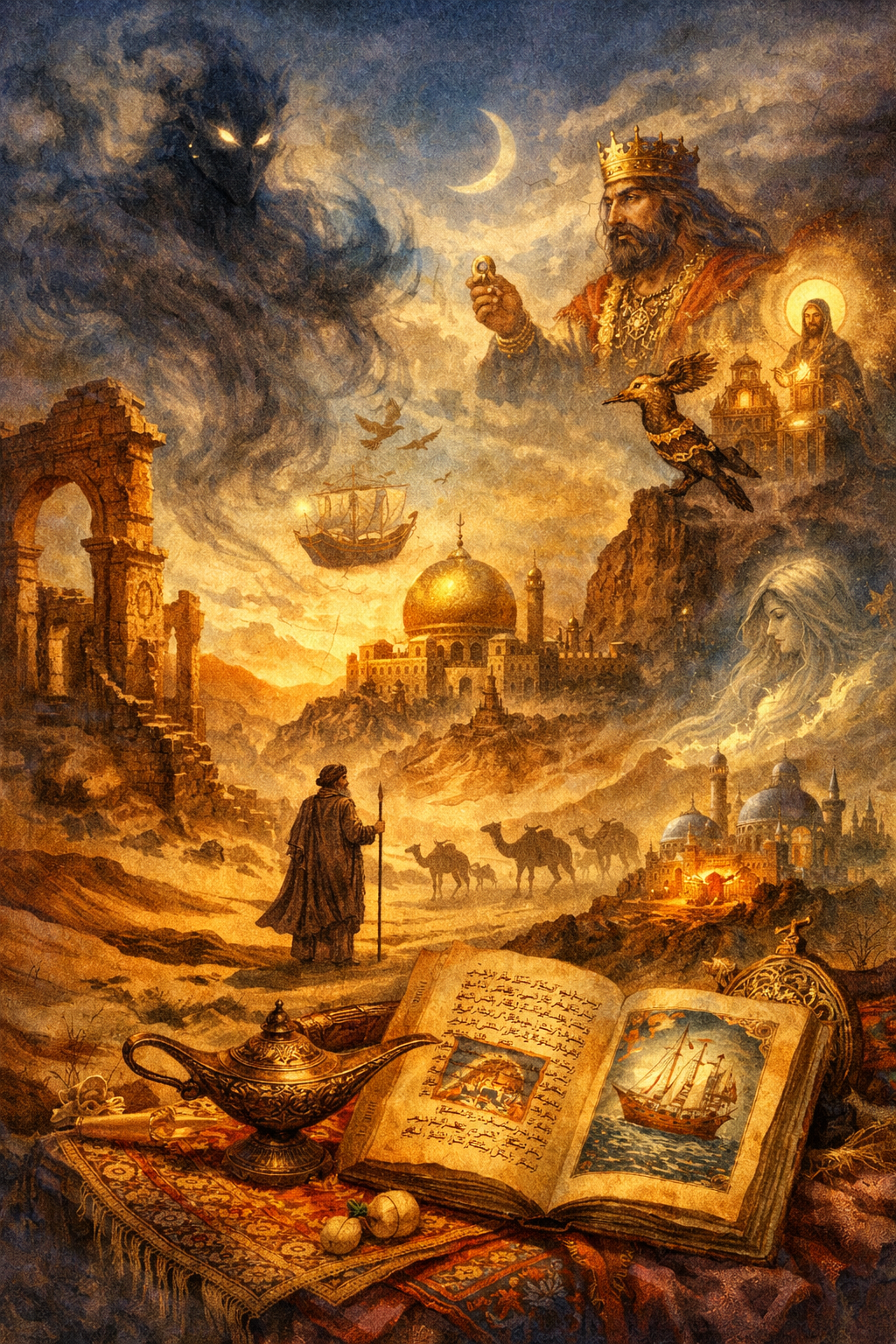
This category must be handled with conceptual care. “Arabian” and “Levantine” are not identical, and neither should be collapsed into “Islamic” as though religious tradition exhausted the narrative worlds of the region. Pre-Islamic Arabian poetic and legendary materials, Qurʾanic and post-Qurʾanic sacred narratives, Levantine folklore, Syriac and Christian Arabic traditions, Jewish narrative memory, saintly legends, shrine traditions, heroic tales, wonder voyages, and the story-worlds associated with One Thousand and One Nights all belong to overlapping but distinct historical layers. A serious treatment therefore requires attention to region, genre, transmission, language, and religious change without dissolving the continuity of narrative imagination.
At the same time, this archive should not be romanticized into timeless desert mystique or flattened into a generalized “Middle Eastern mythology.” It is shaped by oral transmission, manuscript circulation, shrine practice, pilgrimage, domestic ritual, imperial literary cultures, translation, trade, sectarian plurality, and shifting political worlds. Arabian and Levantine sacred narrative and folklore are historically dynamic, not static survivals. What makes them so important is precisely that they reveal how story can preserve memory, moral order, sacred presence, and cultural continuity across long periods of conquest, displacement, devastation, exchange, and transformation.
This pillar therefore approaches Arabian and Levantine myth, folklore, and sacred narrative as a layered cultural system rather than as a simple catalogue of tales, spirits, prophets, saints, and marvels. It asks how desert ruins become archives of memory, how jinn and unseen beings organize fear and protection, how prophetic stories transmit moral history, how Christian and Jewish sacred worlds remain part of Arabic-speaking narrative life, how women’s domestic traditions preserve spiritual knowledge, how saints and shrines make blessing local, how wonder tales move between entertainment and moral testing, and how oral, manuscript, ritual, and popular traditions keep narrative worlds alive across generations.
Why This Field Matters
Arabian and Levantine myth, folklore, and sacred narrative matter because they preserve one of the world’s richest archives of the relation between human life and the unseen. Across poetry, scripture, hagiography, wonder tale, oral tradition, shrine story, and domestic folklore, the region’s narrative worlds ask how human beings live under conditions of risk, blessing, temptation, exile, hospitality, divine warning, ancestral memory, and moral testing. The field is not a single mythology but a layered archive of sacred and popular imagination.
The field also matters because it joins story to place with unusual intensity. Desert ruins, abandoned campsites, sacred cities, prophetic landscapes, monasteries, shrines, caves, wells, mountains, ports, villages, and pilgrimage routes are not neutral settings. They are charged environments in which memory, revelation, danger, sanctity, hospitality, and loss become narratable. The region’s storytelling often begins where landscape and moral imagination meet.
Arabian and Levantine narrative traditions are also essential for understanding religious plurality. Arabic-speaking Muslims, Christians, and Jews have all participated in overlapping sacred and narrative worlds, even while preserving distinct theological commitments, communal memories, liturgical traditions, and ritual practices. The Arabic word Allah belongs to Arabic-speaking Abrahamic language more broadly and has been used by Arabic-speaking Christians and Jews as well as Muslims. This linguistic reality matters because the field should not be organized around misleading oppositions between “Islamic” and “Judeo-Christian” worlds. Its history is more entangled, more Semitic, more regional, and more shared than those categories often allow.
Finally, this field matters because it preserves memory under conditions of rupture. The peoples of Arabia and the Levant have lived through empire, pilgrimage, trade, conquest, migration, sectarian plurality, local devotion, displacement, war, and cultural exchange. Story becomes one way communities preserve sacred presence, moral warning, local belonging, and communal endurance when cities fall, villages disappear, routes change, and political orders shift. Myth, folklore, and sacred narrative are therefore not escapist traditions. They are memory systems.
The Problem of the Archive
A research-grade account must begin with the archive itself. Arabian and Levantine sacred narrative and folklore do not survive in one canonical mythological corpus. They are dispersed across pre-Islamic poetry, Qurʾanic narrative, hadith-adjacent storytelling, qiṣaṣ al-anbiyāʾ literature, tafsīr, adab, travel writing, hagiography, Christian Arabic and Syriac texts, Jewish narrative traditions, oral folktale collections, saint stories, shrine legends, domestic rituals, women’s songs, local histories, manuscript anthologies, and modern ethnographic records.
This archive is not only textual. It is also performative, material, and geographical. A tale may be preserved in a manuscript, recited by a storyteller, attached to a shrine, remembered in a village, encoded in a protective saying, enacted in a ritual visit, or transmitted by women through lullaby, lament, warning, or domestic instruction. The same motif may move between sacred commentary, folk belief, children’s tale, healing practice, and local legend.
The problem of the archive is therefore a problem of genre and setting. A jinn story told as household warning does not function in the same way as a theological discussion of the unseen. A saint’s miracle in hagiography does not function in the same way as a local shrine story told by pilgrims. A Qurʾanic prophetic episode does not function in the same way as later expansion in qiṣaṣ al-anbiyāʾ. Interpretation must ask where a narrative appears, who tells it, what authority it claims, and what community practice sustains it.
This complexity is one of the field’s strengths. Arabian and Levantine narrative worlds survived precisely because they were not confined to one medium. They moved among recitation, writing, travel, devotion, performance, domestic memory, and place.
Myth Without a Single Canon
This field is best approached as a plural and historically adaptive archive rather than as a closed canon. It includes sacred narratives and folkloric materials, but it is not reducible to either. It includes Islamic traditions, but it is not reducible to Islam. It includes Arabian materials, but it is not reducible to Arabia. It includes Levantine sacred worlds, but it is not reducible to one religious community or one national geography.
The absence of a single canon does not mean the absence of structure. Several themes recur across the archive: the unseen, the danger of the wilderness, the moral force of hospitality, the memory of ruins, the authority of prophets, the blessing attached to saints and holy places, the danger of oath-breaking, the power of women’s domestic transmission, the moral ambiguity of marvels, and the fragility of human order under divine judgment.
These recurring structures allow the field to be studied coherently without forcing it into false unity. A jinn tale, a pre-Islamic elegiac image, a Qurʾanic warning narrative, a Christian saint legend, a Jewish miracle story, a Palestinian village folktale, an Arabian heroic romance, and an episode from One Thousand and One Nights may belong to different genres and communities, yet all participate in a broader regional imagination of danger, memory, sacred presence, and moral testing.
This pillar therefore treats “myth” carefully. It does not use the term to deny the sacred authority of religious traditions. Rather, it uses myth in the scholarly sense: a field of powerful stories, symbols, beings, places, and narrative structures through which communities imagine ultimate meaning, moral order, origin, danger, destiny, and the relation between human life and unseen powers.
Arabian and Levantine: Distinction Without Separation
“Arabian” and “Levantine” are related but not identical. Arabian traditions are deeply shaped by desert ecology, tribal memory, pre-Islamic poetry, pilgrimage routes, oasis life, sacred precincts, oral honor codes, and the transformation of Arabian religious and narrative life through Islam. Levantine traditions are shaped by sacred cities, villages, monasteries, shrines, coastal trade, agricultural landscapes, prophetic memory, pilgrimage, Christian and Jewish sacred geographies, Islamic devotional worlds, and the long history of multilingual and multi-confessional coexistence.
Comparison becomes useful only when it preserves difference. The Arabian qaṣīdah’s world of abandoned campsites, desert travel, tribal valor, and remembered beloveds is not the same as a Levantine saint legend attached to a village shrine, monastery, or sacred spring. A tale of jinn haunting a desert ruin does not function in precisely the same way as a story of a saint’s tomb protecting a community. Yet all belong to a wider cultural zone in which place, memory, danger, and unseen agency are narratively charged.
The Levant is especially important because it is an Abrahamic crossroads. Jerusalem, Damascus, Aleppo, Bethlehem, Nazareth, Hebron, Mount Lebanon, the Jordan Valley, the Syrian desert, Palestine’s villages and shrines, coastal ports, monasteries, caves, and pilgrimage routes all carry layered sacred associations. These places cannot be interpreted through a single confessional frame without losing their depth.
Arabia, likewise, cannot be reduced to pre-Islamic poetry or to Islamic sacred geography alone. It includes tribal legend, oasis settlement, pilgrimage memory, jinn lore, heroic romance, maritime and desert trade, sacred precincts, and narrative worlds shaped by movement across harsh environments. The field requires both distinction and relation.
Religious Plurality and Shared Sacred Language
A fullest treatment must acknowledge that the narrative worlds of Arabia and the Levant are religiously plural. Muslim traditions are central, but they coexist historically with Christian, Jewish, Druze, Alawi, Samaritan, and other local sacred imaginations. These communities are not interchangeable, but they have shared landscapes, languages, motifs, shrines, markets, stories, and forms of neighborly or contested memory across long periods.
Arabic-speaking Christian traditions include saint legends, relic stories, Marian devotion, martyr narratives, monastic memory, healing miracles, pilgrimage routes, and sacred landscapes shaped by liturgy and local devotion. Jewish traditions of the region include biblical afterlives, tales of sages and holy men, prophetic memory, local miracle lore, shrine traditions, and storytelling shaped by Arabic-speaking environments. Muslim traditions include Qurʾanic narrative, prophetic storytelling, saints, jinn, baraka, pilgrimage memory, and shrine worlds.
The shared use of Arabic also matters. The word Allah is not a narrowly Muslim deity-name but the Arabic word for God used by Arabic-speaking Muslims and also by Arabic-speaking Christians and Jews. This does not erase theological differences, but it helps resist misleading frames that treat the region’s religious worlds as completely separate symbolic universes. They are distinct traditions within a shared Abrahamic and Semitic linguistic field.
This pillar therefore foregrounds continuity and difference at the same time. It recognizes doctrinal distinctions while avoiding polemical separations that obscure shared prophetic memory, sacred geography, monotheistic language, moral accountability, mercy, justice, revelation, blessing, and worship.
Pre-Islamic Poetic Memory and the Desert Archive
Pre-Islamic Arabic poetry preserves one of the oldest and most powerful narrative imaginations of Arabia. The qaṣīdah tradition gives literary form to memory, desert travel, longing, tribal honor, beloveds, abandoned campsites, animals, danger, endurance, praise, satire, and social obligation. It is not mythology in the narrow sense of gods and monsters, but it is foundational for understanding Arabian symbolic life.
The abandoned campsite, or aṭlāl, is especially important. The poet stands before ruins or traces of a vanished dwelling and remembers love, tribe, loss, and time. The landscape becomes an archive of absence. Memory is not stored in a building or book; it is read from traces in sand, stone, camp remains, and the emotional force of place.
Desert travel also shapes moral imagination. The desert is a place of vulnerability, danger, testing, generosity, raiding, endurance, and poetic self-fashioning. Camels, horses, night journeys, storms, thirst, predators, and distant water all become part of a narrative ecology in which survival depends on skill, loyalty, hospitality, and courage.
Pre-Islamic poetic memory therefore belongs at the foundation of this field. It shows how Arabian narrative imagination tied language, landscape, honor, longing, danger, and memory together long before later manuscript and sacred narrative traditions expanded the archive.
Ruins, Loss, and the Poetics of Remembrance
Ruins are one of the deep symbolic forms of Arabian and Levantine narrative. In pre-Islamic poetry, the deserted campsite evokes lost love, time’s passage, and the fragility of human dwelling. In Qurʾanic sacred narrative, ruined peoples often become warnings of divine judgment and moral failure. In Levantine memory, destroyed villages, abandoned houses, ancient stones, sacred sites, and vanished communities carry the weight of historical rupture.
This means that ruins do different kinds of narrative work. They can be poetic, moral, sacred, historical, political, or domestic. They remind the listener that human settlements are temporary, that power can vanish, that love can be lost, that divine warning can be ignored, and that memory often begins where presence has disappeared.
The poetics of ruin is also a poetics of humility. The abandoned place speaks against arrogance. It tells the living that flourishing does not guarantee permanence. Cities, tribes, empires, camps, and households can all become traces. Story protects those traces from complete erasure.
For this reason, ruins are not merely background imagery. They are memory devices. Arabian and Levantine narrative traditions repeatedly return to them because they concentrate time, loss, judgment, longing, and historical consciousness in visible form.
Sacred Geography and Place-Worlds
Arabian and Levantine narrative traditions are deeply geographical. Mecca, Medina, Jerusalem, Hebron, Bethlehem, Nazareth, Damascus, Aleppo, the Syrian desert, Mount Sinai, Mount Lebanon, the Jordan Valley, the Hijaz, oases, wells, caves, shrines, monasteries, and village tombs all belong to charged landscapes of memory. Sacred geography makes story local and embodied.
Place-worlds matter because narrative authority is often attached to specific sites. A cave may preserve prophetic memory. A shrine may carry baraka. A spring may be associated with healing. A ruin may warn of divine punishment. A mountain may become a site of revelation, retreat, or trial. A city may gather prophets, saints, scholars, markets, pilgrims, and storytellers into one symbolic center.
The Levant is especially dense in sacred geography because multiple Abrahamic traditions share, contest, and remember overlapping places. Jerusalem is not one story but many: prophetic memory, pilgrimage, temple memory, Christian passion geography, Islamic sacred journey, Jewish longing, local urban holiness, and political history. The field must preserve this layered complexity.
Sacred geography also includes ordinary places: village thresholds, wells, cemeteries, rooftops, courtyards, olive groves, caves, and crossroads. Folklore often attaches unseen beings, saints, blessings, and dangers to such sites. The sacred is not only monumental. It may also be local, domestic, and intimate.
Jinn, Demons, and Unseen Worlds
One of the central features of Arabian and Levantine narrative is the vivid life of unseen beings. Jinn, demons, devils, angels, saints, baraka, relic powers, haunted ruins, dream visitors, spirits, and talismanic forces populate the region’s sacred and folkloric imagination. These beings do not belong to folklore alone. They also inhabit theology, legal reflection, healing practice, domestic fear, sacred commentary, and everyday explanation.
Jinn are especially important because they stand near the boundary between human and unseen life. They may be dangerous, seductive, protective, deceptive, territorial, pious, rebellious, or ambiguous. They inhabit deserts, ruins, bathrooms, thresholds, abandoned places, wells, caves, and liminal zones. Their presence makes the world morally and spiritually crowded.
In folklore, jinn stories often help communities explain danger, illness, desire, possession, misfortune, strange sounds, dreams, and vulnerable places. In sacred and theological contexts, they belong to a broader cosmology of created beings accountable to God. The same category therefore moves across registers without becoming identical in every setting.
The unseen world gives Arabian and Levantine narrative its charged atmosphere. Human beings are never alone in space. Places may be occupied, words may attract danger, vows may bind, blessings may protect, and moral action may be witnessed by powers beyond ordinary sight.
Qurʾanic Sacred Narrative and Prophetic Moral History
The Qurʾān is foundational for Islamic sacred narrative and for the moral imagination of later Arabic storytelling. Its narratives of prophets, warnings, ruined peoples, migration, miracle, kingship, revelation, judgment, and divine mercy shaped later preaching, pedagogy, commentary, folktale, art, and memory. These stories are not presented as entertainment. They are moral history.
Qurʾanic narrative often works through warning and remembrance. Communities receive guidance, reject it, and face consequence. Prophets speak truth under pressure. Ruined peoples become signs. Sacred history is therefore not merely past event; it is instruction addressed to the living. Story becomes moral accountability.
Post-Qurʾanic qiṣaṣ al-anbiyāʾ traditions expand prophetic narrative worlds through elaboration, exemplum, wonder, and imaginative detail. These traditions often connect scripture to popular pedagogy, oral retelling, and devotional memory. Figures such as Adam, Noah, Abraham, Joseph, Moses, Solomon, Mary, Jesus, and others become part of shared storytelling environments across Islamic and broader Abrahamic memory.
A scholarly treatment must distinguish Qurʾanic authority from later narrative expansion. The Qurʾān, tafsīr, qiṣaṣ, sermons, folktales, and local legends are related but not identical. Their differences matter because each setting produces a different kind of narrative authority.
Solomon, Jinn, and Mythic Kingship
Solomon occupies a central place in Arabian, Levantine, Jewish, Christian, and Islamic narrative imagination. He is prophet, king, judge, builder, master of wisdom, commander of animals and unseen beings, and ruler associated with extraordinary knowledge. Solomonic tradition became one of the great meeting points of sacred narrative, jinn lore, magical authority, temple memory, and mythic sovereignty.
In Islamic tradition, Solomon’s command over jinn gives kingship a cosmic dimension. Rule extends beyond human political order into the unseen. Yet this power is not simply domination. It is tied to divine gift, wisdom, accountability, and the limits of sovereignty before God.
Jewish and Christian traditions also preserve Solomonic worlds of wisdom, temple, judgment, wealth, and later magical or legendary elaboration. Across traditions, Solomon becomes a figure through whom communities imagine the relation between sacred rule, hidden knowledge, building, speech, and spiritual authority.
Solomon matters because he concentrates several themes of the field: kingship, unseen beings, language, divine favor, construction, judgment, and the danger of power. He stands at the boundary between sacred history and mythic imagination.
Christian Levantine Sacred Storytelling
Christian Levantine storytelling is essential to the region’s narrative archive. It includes saint legends, martyr stories, Marian devotion, relic traditions, miracle accounts, monastic memory, pilgrimage routes, healing narratives, sacred caves, churches, icons, and landscapes tied to biblical memory. These traditions belong to Arabic-speaking, Syriac, Greek, Armenian, and other Christian worlds that have shaped the Levant for centuries.
Saints and monasteries often anchor sacred geography. A monastery is not only a building; it may be a place of miracle, refuge, relic power, healing, local memory, and communal continuity. A saint’s life may become a map of sanctity, linking discipline, suffering, divine intervention, and protection.
Marian devotion is especially important in many Christian Levantine settings. Stories of Mary, icons, healing, apparition, protection, and pilgrimage connect household piety to sacred place. Such traditions often travel across confessional lines, with local reverence sometimes exceeding formal boundaries.
Christian Levantine narrative must therefore be included not as a side topic but as a central component of regional sacred memory. Without it, the field loses much of its historical and religious plurality.
Jewish Narrative Memory in Arabic-Speaking Lands
Jewish narrative memory in Arabic-speaking lands also belongs centrally to this field. It includes biblical afterlives, tales of prophets and sages, shrine traditions, miracle stories, holy tombs, local legends, liturgical memory, moral tales, and narrative worlds shaped by Arabic language, regional coexistence, migration, and communal continuity.
Jewish storytelling in the region often intersects with shared Abrahamic figures: Abraham, Joseph, Moses, David, Solomon, Elijah, and others. These figures are not simply “shared” in a flat sense; each tradition interprets them differently. But their presence across communities creates a layered narrative environment in which sacred memory circulates, overlaps, and diverges.
Local Jewish traditions also preserve place-based holiness. Tombs of sages, prophetic sites, synagogues, pilgrimage routes, and miracle stories attach memory to geography. These traditions form part of the broader Levantine and Arabic-speaking sacred landscape.
Including Jewish narrative memory is essential for resisting an overly narrow view of the field. Arabian and Levantine sacred narrative is not the possession of one community alone. It is a regionally entangled archive shaped by distinction, proximity, translation, and shared sacred geography.
Saintly Legend, Shrines, and Baraka
Saintly legend and shrine worlds are major components of Arabian and Levantine sacred narrative. Stories of holy persons, tombs, relics, healing, dreams, protection, vows, pilgrimage, local guardianship, and miraculous intervention tie sacred power to place. Baraka, or blessing, becomes narratively and ritually localized.
Shrines matter because they make sanctity spatial. A village shrine, saint’s tomb, monastery, mosque, church, cave, or spring can become a point of contact between human vulnerability and sacred protection. People visit, vow, pray, leave offerings, seek healing, remember ancestors, and tell stories that explain why the place matters.
Saintly narratives also preserve local identity. A community may understand itself through the protection of a saint, the memory of a miracle, the healing power of a shrine, or the annual return of a festival. Such stories are not merely decorative. They organize belonging.
This field must therefore treat saintly legend as lived narrative. It exists in books and hagiographies, but also in paths walked, candles lit, names invoked, dreams remembered, and bodies seeking protection from illness, danger, infertility, grief, or fear.
Hospitality, Honor, Oath, and Moral Testing
Hospitality, honor, oath, promise, protection, betrayal, vengeance, kinship, generosity, and guest-right are central to Arabian and Levantine narrative. Stories repeatedly test virtue through relation: the stranger at the door, the traveler in danger, the guest under protection, the oath sworn, the family honor threatened, the weak person seeking refuge, the rival who must be treated justly.
Hospitality is more than social courtesy. In harsh environments and unstable political worlds, hosting can become a moral and survival system. To feed, shelter, protect, or betray a guest may carry sacred, social, and reputational consequences. Narrative turns these consequences into memorable form.
Honor narratives can be ethically complex. They may preserve courage, loyalty, and protection, but they may also expose violence, pride, vengeance, and the vulnerability of women, strangers, and the poor. A serious treatment should neither romanticize nor dismiss honor codes. It should ask how stories used them to think social order and moral danger.
Oaths and promises also matter because speech binds. A vow may protect or endanger; a broken promise may invite catastrophe; a curse may carry force; a blessing may secure life. The spoken word is part of the moral architecture of the narrative world.
Women, Domestic Transmission, and Household Cosmology
Women’s storytelling and domestic transmission are foundational to this archive. Folklore is not sustained only by poets, scholars, public reciters, or written anthologies. It also survives in lullabies, laments, wedding songs, household tales, protective sayings, stories of spirits and thresholds, fertility narratives, birth practices, mourning rituals, and women’s knowledge around illness, children, marriage, danger, and blessing.
The domestic sphere is one of the major historical environments in which fear, protection, kinship, local cosmology, and intergenerational memory are transmitted. A grandmother’s warning about jinn, a mother’s lullaby, a bride’s ritual song, a mourner’s lament, or a household practice around thresholds may preserve narrative knowledge that formal literary history overlooks.
Women’s traditions also complicate the boundary between folklore and ritual. A story may be told to protect a child, explain danger, warn against improper behavior, mark fertility, or give emotional form to grief. Narrative becomes practical knowledge.
A research-grade pillar must therefore treat women not as occasional characters in stories but as tellers, preservers, ritual actors, healers, mourners, and interpreters of unseen worlds. Without domestic transmission, much of the archive becomes invisible.
Amulets, Talismans, Healing, and Protective Practice
Material and ritual culture belong to the lived life of Arabian and Levantine sacred narrative. Amulets, inscriptions, bowls, talismans, knots, lamps, relics, protective recitations, blue beads, written prayers, threshold markings, pilgrimage tokens, saintly objects, and healing rites reveal how narrative, material culture, and practical spirituality intersect in everyday life.
Protective practice often emerges where vulnerability is greatest: childbirth, infancy, illness, travel, envy, possession, nightmares, infertility, storms, war, and uncertain thresholds. Communities create rituals and objects that make danger manageable. Stories explain why those objects matter and how protection works.
Healing traditions also connect sacred narrative to the body. A saint may heal; a shrine may protect; a recitation may calm; a relic may bless; a talisman may guard; a dream may diagnose. The boundary between medicine, ritual, and narrative is often porous in lived practice.
This material dimension is crucial because stories do not survive only in books. They survive in gestures, routes, thresholds, objects, ceremonies, and repeated acts of remembrance. The narrative world is inseparable from the practical ways communities negotiate vulnerability, hope, danger, and divine nearness.
Wonder Tales and the Narrative Life of Marvel
Wonder tales are central to Arabic and regional storytelling. The story-worlds associated with One Thousand and One Nights and related tale traditions preserve voyages, enchantment, trickery, erotic intrigue, commerce, courtly danger, magical objects, jinn, hidden identities, social reversal, and narrative survival. These tales are not a single fixed book but a layered tradition of transmission, translation, expansion, and adaptation.
Marvel matters because it expands the moral and social imagination. A voyage can test greed, loyalty, courage, curiosity, and luck. A magical object can expose desire. A disguised figure can reverse hierarchy. A jinn can become judge, threat, lover, rescuer, or punisher. Wonder makes ordinary social reality unstable and therefore narratively revealing.
The Nights tradition is also important because of its frame: storytelling itself becomes survival. Shahrazad’s narration postpones death, transforms power, and creates an ethical space through narrative intelligence. Story is not mere entertainment; it becomes a form of life-preserving strategy.
Wonder literature therefore belongs at the heart of this field. It shows how marvel, danger, pleasure, knowledge, and moral testing circulate through popular and literary forms alike.
Heroic Romance, Sīra, and Popular Epic
The region’s narrative worlds also include warrior-hero cycles, tribal memory, frontier struggle, popular recitation, and heroic models of courage, loyalty, cunning, and endurance. Sīra traditions and popular epics preserve heroic worlds that move between history, legend, romance, oral performance, and communal identity.
Figures such as ʿAntar ibn Shaddād and heroic cycles associated with tribal and frontier struggle reveal how courage, honor, love, lineage, racialized exclusion, poetic gift, and martial prowess can be woven into long narrative memory. Such stories often preserve social tensions as much as heroic ideals.
Popular epic matters because it brings narrative into public performance. Reciters, storytellers, coffeehouse settings, markets, gatherings, and oral transmission keep heroic material socially alive. Like Persian naqqāli or other epic performance traditions, Arabic popular epic transforms text into voice, gesture, timing, and communal response.
This domain also connects literature to social imagination. Heroic romance stages what a community admires, fears, argues over, and remembers: loyalty, betrayal, beauty, rank, freedom, courage, justice, and the fragile honor of families and tribes.
Exile, Wandering, and the Poetics of Displacement
Arabian and Levantine narrative traditions repeatedly return to exile, wandering, forced movement, migration, longing, and loss of home. The desert traveler, the refugee, the pilgrim, the lover separated from the beloved, the exiled prophet, the displaced village, the lost city, and the wandering hero all belong to the archive’s emotional and moral structure.
Wandering may be trial, punishment, pilgrimage, escape, initiation, or destiny. It can expose a person to danger while also opening the possibility of revelation, hospitality, encounter, and transformation. Movement through space becomes movement through moral experience.
In the Levant especially, narratives of displacement carry historical weight. Sacred places, villages, shrines, cemeteries, houses, and ruined landscapes become sites where memory resists erasure. Story protects belonging when political history breaks continuity.
Exile and wandering therefore belong not only to romance or sacred biography. They are structural forms through which the archive thinks fragility, endurance, longing, and the effort to remain human under conditions of loss.
Apocalypse, Judgment, and End-Time Imagination
A comprehensive account must include eschatology and apocalyptic imagination. Arabian and Levantine narratives do not concern only origins, marvels, and holy persons. They also imagine the end: signs of corruption, ruined cities as warnings, trials before judgment, messianic expectation, the Dajjāl, cosmic upheaval, resurrection, divine reckoning, and final justice.
Islamic, Christian, and Jewish traditions all contribute to the region’s end-time imagination. Their theologies differ, but they share a concern with judgment, accountability, historical crisis, moral corruption, and the exposure of earthly power’s fragility. Apocalyptic narrative gives history a horizon of ultimate meaning.
The Levant has been especially important in apocalyptic geography. Sacred cities, battlefields, deserts, mountains, and holy places are often drawn into narratives of final trial and restoration. Place becomes charged not only by memory of the past but by expectation of the future.
Eschatological imagination intensifies the moral force of the field. It insists that history is not morally empty, that oppression will be judged, that hidden truth will be disclosed, and that the apparent permanence of worldly power is illusory.
Oral Transmission, Manuscript Culture, and Afterlives
Arabian and Levantine narratives move across oral tradition, manuscript culture, recitation, shrine circulation, adab literature, travel narrative, hagiography, domestic storytelling, print, theater, radio, film, television, children’s literature, and digital media. Transmission is not a single line from oral to written or written to oral. It is a continuing exchange among media.
Manuscripts preserve anthologies, tales, poetry, prophetic stories, devotional texts, travel accounts, and local histories. Oral performance gives stories flexibility, immediacy, voice, gesture, and audience relation. Print and modern media standardize some narratives while also spreading them far beyond earlier settings.
Modern afterlives are especially complex. The region’s stories have been translated, exoticized, commercialized, politicized, reclaimed, and adapted. One Thousand and One Nights became a global object of fascination, often through Orientalist distortion. Local folklore collections have preserved precious materials while also transforming living performance into textual archive.
A responsible pillar must therefore study afterlife as well as origin. These traditions remain powerful because they continue to be retold, adapted, contested, and reinterpreted in new historical conditions.
Major Questions of Interpretation
This pillar is organized around several major questions. How should Arabian and Levantine myth, folklore, and sacred narrative be studied when the archive includes poetry, scripture, commentary, saint legend, Jewish and Christian sacred memory, jinn lore, shrine traditions, women’s domestic storytelling, travel writing, wonder tales, popular epic, and modern folklore collections? What does it mean to study “mythology” respectfully in traditions where many stories remain sacred to living communities?
The pillar also asks how landscape becomes narrative. Why do ruins, deserts, caves, wells, cities, shrines, monasteries, ports, and villages carry such symbolic power? How do jinn and unseen beings organize fear, protection, and moral ambiguity? How do prophetic stories become moral history? How do women’s oral traditions preserve household cosmology? How do saints and shrines localize blessing? How do wonder tales turn marvel into social and ethical testing?
These questions keep the category from becoming a generalized inventory of tales. They open Arabian and Levantine myth, folklore, and sacred narrative as a field of religious, literary, oral, domestic, material, geographical, performative, and comparative inquiry. The tradition is not only a collection of stories. It is one of the great symbolic systems through which communities have imagined the unseen, preserved place-memory, and narrated moral life under the pressure of history.
Expanded Article Architecture
The following structure gathers the pillar into a long-range architecture suitable for a major mythology knowledge series. It is designed to support pre-Islamic poetic memory, Qurʾanic and post-Qurʾanic sacred narrative, Christian and Jewish Levantine traditions, jinn lore, sacred geography, saintly legend, women’s oral tradition, wonder literature, popular epic, protective practice, apocalyptic imagination, oral transmission, manuscript culture, and modern afterlives. All entries below should be treated as planned unless already completed elsewhere on the site.
Foundations and Source Problems
- What Is Arabian & Levantine Myth, Folklore & Sacred Narrative? (planned)
- The Problem of Sources in Arabian and Levantine Narrative Traditions (planned)
- Arabian and Levantine Narrative Without a Single Canon (planned)
- Myth, Folklore, and Sacred Narrative Between Region and Religion (planned)
- How to Read Arabian and Levantine Story Worlds Across Genres (planned)
- Oral, Written, Sacred, and Popular Transmission in Regional Narrative (planned)
Pre-Islamic Arabia and Poetic Memory
- Pre-Islamic Arabia and the Narrative World of al-Jāhiliyya (planned)
- Ruins, Desert, and Memory in Early Arabic Poetry (planned)
- The Abandoned Campsite and the Poetics of Loss (planned)
- Tribal Honor, Praise, Satire, and Social Memory in the Qaṣīdah (planned)
- Desert Travel, Animal Imagery, and the Ethics of Survival (planned)
- Poetry as Archive Before the Book (planned)
Sacred Geography and Place-Worlds
- Sacred Geography in Arabian and Levantine Narrative (planned)
- Jerusalem, Damascus, Aleppo, and the Sacred Life of Cities (planned)
- Mecca, Medina, and the Narrative Geography of Pilgrimage (planned)
- Villages, Shrines, Wells, and Local Sacred Memory (planned)
- Deserts, Caves, Mountains, and the Geography of Testing (planned)
- Ports, Seas, Caravans, and the Narrative Worlds of Travel (planned)
- Ruined Cities and Divine Warning in Sacred Narrative (planned)
Jinn, Spirits, and the Unseen
- Jinn in Arabian and Levantine Imagination (planned)
- Demons, Spirits, and the Unseen in Regional Folklore (planned)
- Possession, Protection, and the Moral Ambiguity of Unseen Beings (planned)
- Haunted Ruins, Thresholds, and the Liminal Geography of Jinn (planned)
- Jinn Between Folklore, Theology, and Everyday Practice (planned)
- Angels, Devils, and the Structure of the Invisible World (planned)
Qurʾanic and Post-Qurʾanic Sacred Narrative
- The Qurʾān, Sacred Narrative, and Mythic Pattern (planned)
- Prophets, Punishment, and the Moral Worlds of Sacred Story (planned)
- Qiṣaṣ al-Anbiyāʾ and the Expansion of Prophetic Narrative (planned)
- Joseph, Moses, Mary, and Jesus in Qurʾanic Narrative Memory (planned)
- Ruined Peoples, Divine Warning, and Moral History (planned)
- Revelation, Migration, Miracle, and Sacred Time (planned)
Solomon, Kingship, and Command Over the Unseen
- Solomon, Jinn, and Mythic Kingship in Arab-Islamic Tradition (planned)
- Solomon Across Jewish, Christian, and Islamic Narrative Worlds (planned)
- Wisdom, Temple Memory, and Sacred Rule in Solomonic Tradition (planned)
- Jinn, Magical Authority, and the Limits of Sovereignty (planned)
- Speech, Animals, Hidden Knowledge, and the Solomonic Imagination (planned)
Christian Levantine Sacred Storytelling
- Christian Sacred Narrative and Saint Worlds in the Levant (planned)
- Mary, Marian Devotion, and Local Sacred Memory (planned)
- Monasteries, Relics, and the Geography of Miracle (planned)
- Martyrs, Healing, and the Narrative Life of Saints (planned)
- Syriac and Christian Arabic Story Worlds in the Levant (planned)
- Pilgrimage, Liturgy, and the Memory of Holy Places (planned)
Jewish Narrative Memory in Arabic-Speaking Lands
- Jewish Folklore and Sacred Memory in Arabic-Speaking Lands (planned)
- Biblical Afterlives and Local Miracle Traditions (planned)
- Sages, Holy Tombs, and Place-Based Jewish Memory (planned)
- Shared Prophetic Figures Across Arabic-Speaking Abrahamic Worlds (planned)
- Arabic, Hebrew, Aramaic, and the Multilingual Life of Sacred Story (planned)
- Jewish Narrative Worlds and the Sacred Geography of the Levant (planned)
Saintly Legend, Shrines, and Baraka
- Saintly Legend, Shrines, and Baraka in the Levant (planned)
- Pilgrimage, Visitation, and the Narrative Life of Holy Places (planned)
- Miracle, Healing, and Local Protection in Shrine Worlds (planned)
- Tombs, Relics, Springs, and the Material Geography of Blessing (planned)
- Village Saints and Communal Identity in Levantine Folklore (planned)
- Dreams, Vows, and the Social Life of Sacred Presence (planned)
Hospitality, Honor, Oath, and Moral Testing
- Hospitality, Honor, and Moral Testing in Arabian Narrative (planned)
- Guest-Right, Protection, and the Ethics of the Stranger (planned)
- Oath, Promise, Curse, and the Binding Power of Speech (planned)
- Generosity, Betrayal, and the Social Imagination of Virtue (planned)
- Kinship, Vengeance, and the Burden of Honor (planned)
- Moral Testing in Desert, Village, and Courtly Story Worlds (planned)
Women, Domestic Ritual, and Oral Transmission
- Women’s Oral Traditions, Lament, and Domestic Story Worlds (planned)
- Lullabies, Wedding Songs, and the Transmission of Household Memory (planned)
- Birth, Fertility, Illness, and Women’s Protective Knowledge (planned)
- Thresholds, Children, and Spirit Warnings in Domestic Folklore (planned)
- Mourning, Lament, and the Poetics of Communal Grief (planned)
- Women as Tellers, Healers, and Interpreters of the Unseen (planned)
Ritual Objects, Healing, and Protective Practice
- Amulets, Talismans, Healing, and Protective Practice (planned)
- Written Prayers, Inscriptions, and the Material Life of Sacred Words (planned)
- Protection Against Envy, Illness, Possession, and Harm (planned)
- Relics, Lamps, Vows, and Ritual Objects in Local Devotion (planned)
- Healing Narratives Between Shrine, Household, and Sacred Text (planned)
- Material Culture and the Practical Life of the Unseen (planned)
Wonder Tales, Fables, and the Narrative Life of Marvel
- Arabian Nights and the Narrative Culture of Marvel (planned)
- Voyage, Magic, and Wonder in Arabic Tale Traditions (planned)
- Shahrazad, Storytelling, and Narrative Survival (planned)
- The Arabic Fable and the Afterlives of Animal Narrative (planned)
- Commerce, Trickery, and Social Reversal in Wonder Tales (planned)
- Jinn, Hidden Wealth, and the Moral Ambiguity of Marvel (planned)
Heroic Romance, Sīra, and Popular Epic
- Heroic Romance, Sīra, and Popular Epic Performance (planned)
- ʿAntar ibn Shaddād and the Heroic Imagination of Poetry, Love, and Valor (planned)
- Sīrat Banī Hilāl and the Epic Memory of Migration and Conflict (planned)
- Warrior-Heroes, Tribal Memory, and Public Recitation (planned)
- Love, Fate, and Legendary Attachment in Regional Storytelling (planned)
- Popular Epic Between History, Romance, and Performance (planned)
Exile, Wandering, and Displacement
- Exile, Wandering, and the Poetics of Loss (planned)
- Desert Imagination and the Ethics of Survival (planned)
- Migration, Pilgrimage, and the Narrative Meaning of Movement (planned)
- Lost Villages, Sacred Places, and the Memory of Belonging (planned)
- Longing, Homeland, and the Emotional Geography of Story (planned)
- Ruins, Forced Movement, and Cultural Endurance in Levantine Memory (planned)
Apocalyptic and Eschatological Imagination
- Apocalypse, Judgment, and End-Time Imagination (planned)
- The Dajjāl, Trials, and the Moral Drama of the End (planned)
- Christian and Jewish Apocalyptic Traditions in the Levant (planned)
- Ruined Peoples, Final Judgment, and Sacred Warning (planned)
- Messianic Expectation, Restoration, and the Future of Sacred History (planned)
- End-Time Geography and the Moral Meaning of Place (planned)
Transmission, Manuscripts, and Literary Afterlives
- Oral Tradition, Recitation, and Story Transmission (planned)
- Manuscript Culture and the Written Afterlife of Story (planned)
- Adab, Travel Writing, and Legendary Historiography (planned)
- Folklore Collections and the Modern Preservation of Oral Tradition (planned)
- Translation, Orientalism, and the Global Afterlife of One Thousand and One Nights (planned)
- Arabian & Levantine Narrative in Comparative Perspective (planned)
- Arabian & Levantine Story Worlds and the Persistence of the Unseen (planned)
- Why Arabian & Levantine Myth, Folklore & Sacred Narrative Still Matter (planned)
Closing Perspective
Arabian and Levantine myth, folklore, and sacred narrative reveal one of the great long-duration narrative archives of world culture. They preserve desert memory, sacred cities, ruins, jinn, prophets, saints, holy places, domestic rituals, women’s storytelling, wonder tales, heroic romance, apocalyptic expectation, pilgrimage memory, and the moral force of the unseen. Their power lies not in a single fixed canon, but in a layered continuity of oral transmission, sacred text, local place, ritual practice, manuscript culture, and popular imagination.
This is what makes the category so important within Mythology. Arabian and Levantine narrative culture shows how mythology can be sacred and folkloric, oral and written, domestic and public, Islamic and also Christian and Jewish, Arabian and Levantine, local and transregional, ancient and continually reinterpreted. It also shows why mythology must be studied through place, language, ritual, gender, material culture, and lived community, not only through story summary.
The strongest reason to study this field is that it clarifies how human beings narrate life at the boundary between the visible and the unseen. These traditions ask how people endure danger, honor guests, remember ruins, seek blessing, fear spirits, interpret dreams, tell stories to survive, and preserve sacred presence across historical loss. They do not belong only to the past. They continue to shape how communities imagine memory, place, divine nearness, moral accountability, and the long life of story.
Related Reading
- Mythology
- Abrahamic Traditions
- Arabian and Levantine Thought
- Comparative Sacred Themes
- Foundations of Religion
- Religion and Society
- Religion and Law
- Maghrebi and Andalusi Legend, Folklore, and Sacred Imagination
- Persian Myth, Folklore, and Epic Tradition
- Turkic and Ottoman Myth, Epic, and Folklore
Primary Sources
Pre-Islamic and Early Arabic Narrative Worlds
- Pre-Islamic Arabic poetry, especially the qaṣīdah tradition and later anthologies preserving desert memory, tribal honor, ruin motifs, exile, sacred landscape, and emotional recollection. Public-domain English translations of selected early Arabic poems are available through Internet Archive collections: https://archive.org/
- The Muʿallaqāt. A central anthology for early Arabic poetic memory, including the poetics of ruins, beloveds, desert movement, honor, and tribal voice. Scholarly editions and translations vary; use critical editions where possible.
- Early Arabic akhbār and adab materials. Important for legendary, historical, genealogical, and moralized memories of Arabia before and after Islam.
Sacred Narrative and Prophetic Tradition
- The Qurʾān. Foundational for prophetic storytelling, divine warning, ruined peoples, miracle, judgment, sacred kingship, revelation, and the symbolic organization of moral history. Arabic text and multiple translations are accessible through Quran.com: https://quran.com/
- The Quranic Arabic Corpus. Useful for linguistic study of Qurʾanic Arabic, morphology, grammar, and translation comparison: https://corpus.quran.com/
- Qiṣaṣ al-anbiyāʾ traditions. Important post-Qurʾanic narrative literature expanding prophetic story worlds through commentary, exemplum, wonder, and moral imagination.
- Exegetical, devotional, and narrative materials concerning Solomon, Moses, Joseph, Mary, Jesus, and other major sacred figures whose stories shaped regional folklore and mythic imagination.
Christian and Jewish Narrative Traditions
- Syriac, Christian Arabic, hagiographical, monastic, and pilgrimage traditions. Essential for saint legends, relic stories, Marian devotion, martyrdom, healing, and sacred topographies of the Levant.
- Christian Arabic and Syriac manuscript traditions. Major witnesses to the multilingual sacred narrative worlds of the region. The Hill Museum & Manuscript Library provides digital access to many manuscript traditions: https://hmml.org/
- Jewish narrative traditions of the region, including biblical afterlives, tales of sages, holy places, pilgrimage memory, miracle accounts, and local folklore transmitted within Arabic-speaking and multilingual environments.
- The Hebrew Bible and related interpretive traditions. Important for prophetic memory, sacred geography, and later Jewish, Christian, and Islamic narrative intersections. Public texts and translations are available through Sefaria: https://www.sefaria.org/
Folklore, Wonder, and Popular Narrative
- One Thousand and One Nights. Central to Arabic and global tale traditions involving marvel, urban imagination, erotic intrigue, magical risk, travel, social inversion, and narrative survival. Public-domain translations are available through Project Gutenberg: https://www.gutenberg.org/
- Kalīla wa-Dimna. A major Arabic fable tradition with deep transregional afterlives, important for animal narrative, political counsel, moral teaching, and translation history.
- Arabic fables, animal tales, popular romances, and heroic cycles. Important for moral teaching, entertainment, adaptation, and layered transmission across oral and literary forms.
- Regional folklore collections documenting jinn lore, local legends, women’s tales, spirit belief, shrine narrative, healing practice, and village storytelling.
Travel, Place, and Legendary Geography
- Arabic travel writing, pilgrimage narratives, geographical literature, and local chronicles. Important for sacred sites, marvels, relics, ruins, holy persons, and the narrative charge of place.
- Texts tied to Jerusalem, Damascus, Aleppo, Mecca, Medina, Hebron, and other sacred or storied locations that illuminate the relationship between geography, devotion, legend, and historical memory.
- Ibn Jubayr, Ibn Baṭṭūṭa, al-Muqaddasī, Yāqūt al-Ḥamawī, and related geographical and travel traditions. Important for place-memory, marvel, sacred geography, and the literary mapping of the region.
Further Reading
- Ahmed, S. (2020) Cry of the Owl: Muslim Reconstructions of the Pre-Islamic Arabian Past. Princeton: Princeton University Press.
- Allen, R. (2000) An Introduction to Arabic Literature. Cambridge: Cambridge University Press.
- Bray, J. (1999) Poetry and Culture in the Early Arab World. Aldershot: Variorum.
- Irwin, R. (2004) The Arabian Nights: A Companion. London: Tauris Parke.
- Reynolds, G.S. (ed.) (2008) The Qurʾān in Its Historical Context. London: Routledge.
- Shoshan, B. (2004) Popular Culture in Medieval Cairo. Cambridge: Cambridge University Press.
- Stetkevych, S.P. (1993) The Mute Immortals Speak: Pre-Islamic Poetry and the Poetics of Ritual. Ithaca, NY: Cornell University Press.
- Stetkevych, S.P. (2017) ‘Solomon and Mythic Kingship in the Arab-Islamic Tradition: Qaṣīdah, Qurʾān and Qiṣaṣ al-anbiyāʾ’, Journal of Arabic Literature, 48(1–2), pp. 1–30.
- Toorawa, S.M. (2015) Arabic Literature: A Very Short Introduction. Oxford: Oxford University Press.
- Webb, P. (2016) Imagining the Arabs: Arab Identity and the Rise of Islam. Edinburgh: Edinburgh University Press.
- Zipes, J. (ed.) (2014) The Arabian Nights: Tales of 1001 Nights. New York: Routledge.
- Muhawi, I. and Kanaana, S. (1989) Speak, Bird, Speak Again: Palestinian Arab Folktales. Berkeley: University of California Press.
- El-Shamy, H.M. (2004) Types of the Folktale in the Arab World: A Demographically Oriented Tale-Type Index. Bloomington: Indiana University Press.
- Heath, P. (1996) The Thirsty Sword: Sīrat ʿAntar and the Arabic Popular Epic. Salt Lake City: University of Utah Press.
- Lyons, M.C. (1995) The Arabian Epic: Heroic and Oral Story-Telling. Cambridge: Cambridge University Press.
- Tottoli, R. (2002) Biblical Prophets in the Qurʾān and Muslim Literature. Richmond: Curzon.
- Sells, M.A. (1989) Desert Tracings: Six Classic Arabian Odes. Middletown, CT: Wesleyan University Press.
References
- Ahmed, S. (2020) Cry of the Owl: Muslim Reconstructions of the Pre-Islamic Arabian Past. Princeton: Princeton University Press.
- Allen, R. (2000) An Introduction to Arabic Literature. Cambridge: Cambridge University Press.
- Bray, J. (1999) Poetry and Culture in the Early Arab World. Aldershot: Variorum.
- El-Shamy, H.M. (2004) Types of the Folktale in the Arab World: A Demographically Oriented Tale-Type Index. Bloomington: Indiana University Press.
- Heath, P. (1996) The Thirsty Sword: Sīrat ʿAntar and the Arabic Popular Epic. Salt Lake City: University of Utah Press.
- Hill Museum & Manuscript Library (n.d.) ‘HMML’. Available at: https://hmml.org/
- Irwin, R. (2004) The Arabian Nights: A Companion. London: Tauris Parke.
- Lyons, M.C. (1995) The Arabian Epic: Heroic and Oral Story-Telling. Cambridge: Cambridge University Press.
- Muhawi, I. and Kanaana, S. (1989) Speak, Bird, Speak Again: Palestinian Arab Folktales. Berkeley: University of California Press.
- Project Gutenberg (n.d.) ‘Project Gutenberg’. Available at: https://www.gutenberg.org/
- Quran.com (n.d.) ‘The Qurʾān’. Available at: https://quran.com/
- Quranic Arabic Corpus (n.d.) ‘The Quranic Arabic Corpus’. Available at: https://corpus.quran.com/
- Reynolds, G.S. (ed.) (2008) The Qurʾān in Its Historical Context. London: Routledge.
- Sefaria (n.d.) ‘Sefaria: A Living Library of Jewish Texts’. Available at: https://www.sefaria.org/
- Sells, M.A. (1989) Desert Tracings: Six Classic Arabian Odes. Middletown, CT: Wesleyan University Press.
- Shoshan, B. (2004) Popular Culture in Medieval Cairo. Cambridge: Cambridge University Press.
- Stetkevych, S.P. (1993) The Mute Immortals Speak: Pre-Islamic Poetry and the Poetics of Ritual. Ithaca, NY: Cornell University Press.
- Stetkevych, S.P. (2017) ‘Solomon and Mythic Kingship in the Arab-Islamic Tradition: Qaṣīdah, Qurʾān and Qiṣaṣ al-anbiyāʾ’, Journal of Arabic Literature, 48(1–2), pp. 1–30.
- Toorawa, S.M. (2015) Arabic Literature: A Very Short Introduction. Oxford: Oxford University Press.
- Tottoli, R. (2002) Biblical Prophets in the Qurʾān and Muslim Literature. Richmond: Curzon.
- Webb, P. (2016) Imagining the Arabs: Arab Identity and the Rise of Islam. Edinburgh: Edinburgh University Press.
- Zipes, J. (ed.) (2014) The Arabian Nights: Tales of 1001 Nights. New York: Routledge.