
Last Updated May 4, 2026
Japanese myth, folklore, and legend constitute a major field of cultural and historical inquiry in which cosmogony, ritual narrative, court chronicle, sacred geography, oral tradition, visual storytelling, performance, and supernatural imagination converge. The earliest written sources, especially the Kojiki (712) and Nihon shoki (720), preserve creation narratives, divine genealogies, foundational accounts of rulership, and mythic memories of sacred order. Yet the Japanese mythic archive extends far beyond those court texts into shrine traditions, local legends, seasonal observances, folktales, spirit lore, regional ritual worlds, Buddhist tale literature, illustrated emaki, theater, painting, print, and modern media.
Serious study of this field requires attention to religion, because Japanese mythic traditions developed in close relation to Shinto ritual worlds, shrine practice, sacred place, purification, and the concept of kami. Shinto took shape gradually rather than through a single founder or formal creed, and its emphasis on ritual purity, divine presence, ancestral memory, and the sacredness of particular landscapes deeply influenced the symbolic logic of myth. Japanese folklore must also be read alongside Buddhist narrative traditions, medieval tale literature, illustrated emaki, Ainu oral literature, Ryukyuan traditions, living folk performance, and the long afterlives of myth in Noh, Kabuki, woodblock print, manga, anime, film, museum culture, tourism, and contemporary popular media.
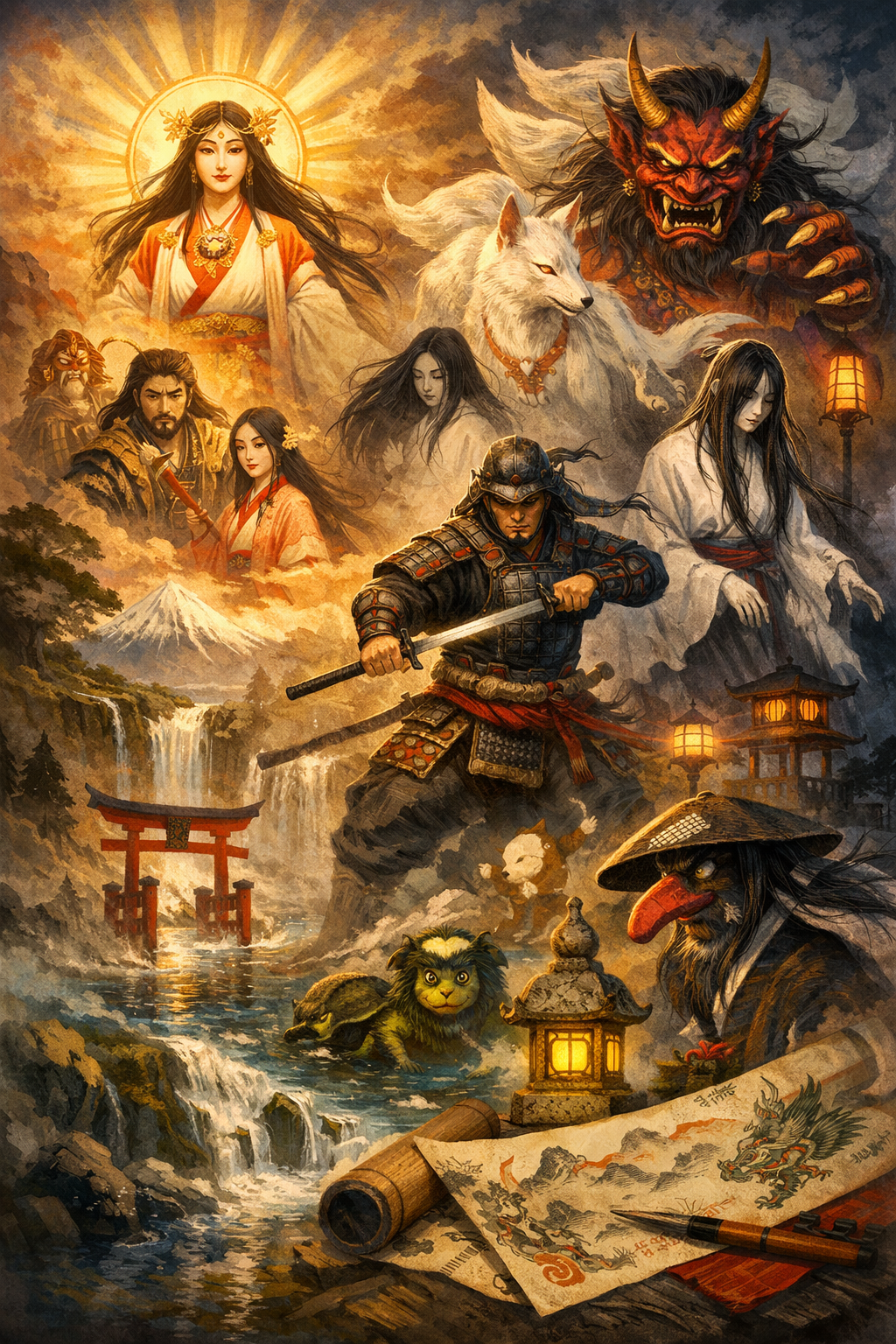
Japanese myth, folklore, and legend belong not only to literary history, but also to the study of ritual order, symbolism, cultural memory, visual culture, environmental imagination, political legitimacy, performance, and the social life of the supernatural. Official preservation frameworks in Japan distinguish folk cultural properties as an important category of cultural inheritance, while UNESCO listings show that many ritual and performance traditions remain active forms of living heritage rather than merely historical survivals. Myth in this context is not simply ancient story. It is transmitted through shrine practice, purification rites, seasonal festivals, regional customs, theatrical repetition, visual representation, oral performance, and public acts of cultural preservation.
This pillar approaches Japanese mythic culture as a layered archive rather than a single unified canon. Court chronicles preserve the symbolic foundations of divine descent and rulership, but local shrine traditions preserve place-based sacred memory; Buddhist tale worlds reshape moral narrative and afterlife imagination; yōkai and ghost traditions give form to fear, impurity, vengeance, humor, ambiguity, and social anxiety; Ainu and Ryukyuan traditions complicate any narrowly centralized account of the archipelago’s narrative heritage; and modern media continually rework inherited figures for new audiences. The field therefore requires movement across texts, rituals, landscapes, images, performances, and living traditions.
Japanese Myth, Folklore, and Legend is therefore a study of how stories, beings, places, rituals, and images carry cultural memory across time. It asks how creation myths ground sacred order, how kami inhabit landscapes and shrines, how purification organizes relations between life and death, how ghosts and yōkai preserve anxieties about unresolved attachment and social boundary-crossing, how local traditions resist reduction to a single national mythology, and how modern media keep mythic forms alive through reinvention.
Why This Field Matters
Japanese myth, folklore, and legend matter because they preserve one of the world’s most distinctive symbolic archives of sacred place, ritual renewal, divine presence, supernatural ambiguity, and narrative reinvention. They carry accounts of island creation, divine descent, shrine origin, purification, solar authority, storm violence, underworld descent, sacred mountains, visiting deities, heroic figures, ghosts, yōkai, animal transformation, and the relation between visible and invisible worlds. These materials are not merely entertaining stories. They are cultural memory organized through myth, ritual, place, performance, and image.
The field also matters because Japanese mythology challenges overly narrow definitions of myth. It cannot be reduced to a single sacred book, one unified pantheon, or one continuous epic. Its archive is layered across court chronicle, shrine tradition, liturgy, local geography, oral transmission, Buddhist tale collections, theater, visual art, folk performance, modern media, and living heritage systems. Japanese mythic culture survives because it is not confined to one medium.
Japanese folklore is equally important because it preserves forms of memory that elite court texts cannot fully contain. Local deities, mountain beings, household customs, visiting gods, ghost tales, regional legends, folk performance, Ainu oral literature, Ryukyuan traditions, and yōkai culture all reveal narrative worlds that move outside the central court archive. These traditions complicate the notion of a single Japanese mythic system and show how myth lives differently in different places.
The field also matters for understanding modern culture. Japanese mythology and folklore have continued to shape literature, museum exhibitions, shrine tourism, manga, anime, horror cinema, fantasy games, visual design, and global popular culture. These modern afterlives are not trivial add-ons. They show how mythic beings and symbolic forms remain available for new acts of meaning, memory, and imagination.
The Problem of the Archive
A research-grade treatment must begin with the archive itself. Japanese mythic materials survive across unequal, layered, and historically situated sources. The Kojiki and Nihon shoki are foundational, but they are not neutral repositories of timeless myth. They are early eighth-century court compilations shaped by concerns of genealogy, authority, sacred descent, political legitimacy, and cultural memory. They preserve myth, but they also organize myth.
This means that Japanese mythology must be read both through and beyond the court archive. The Fudoki preserve regional place traditions and local sacred geographies. Norito preserve ritual language and the sacred speech of invocation and purification. Buddhist setsuwa collections preserve moral tale worlds, karmic logic, miracle narrative, and supernatural encounters. Ainu and Ryukyuan materials preserve narrative worlds that cannot be reduced to courtly Yamato mythology. Yōkai and ghost traditions circulate through oral tale, visual art, print culture, theater, and modern media.
The archive is therefore plural rather than closed. It includes textual witnesses, ritual practices, shrine traditions, visual forms, performance genres, local memories, oral traditions, and modern reinterpretations. A mythic figure may appear in a chronicle, be invoked in ritual, represented in art, localized at a shrine, adapted in theater, and reinvented in contemporary animation. The study of Japanese myth therefore requires attention to transmission as much as origin.
This archival complexity is not a weakness. It is one of the field’s great strengths. It reveals how myth survives when carried by institutions, places, bodies, images, performances, festivals, and media systems across many centuries.
Myth, Court Chronicle, and Sacred Order
Japanese mythic tradition is inseparable from questions of order. The early chronicles preserve narratives in which cosmic generation, divine genealogy, ritual purity, and political authority are linked. The creation of the islands, the descent into the underworld, the birth of deities, the withdrawal and return of the sun goddess, the descent of Ninigi, and the legendary beginnings of rulership all present myth as a structure of sacred relation.
Court myth does not merely explain origins. It organizes memory around descent, legitimacy, and continuity. The divine world, the imperial line, sacred objects, rituals, and lands are placed into relation with one another. Myth becomes a way of making political order appear rooted in cosmic ancestry and sacred narrative.
Primary Text
天地初發之時、於高天原成神名、天之御中主神。When Heaven and Earth first became active, a deity came into being in the High Plain of Heaven: Amenominakanushi no Kami.
Kojiki, opening cosmogonic passage; classical written text with English rendering.
This opening places Japanese mythic order in a sacred beginning: heaven, earth, divine emergence, and the High Plain of Heaven. It is a compact example of how court myth organizes cosmos, genealogy, and sacred authority from the start.
Yet this court-centered material must be read with care. It is powerful but not exhaustive. It elevates some traditions while subordinating or excluding others. It preserves origin stories while shaping them toward particular institutional needs. A serious account therefore studies court myth as both mythic memory and political-cultural construction.
This dual character makes Japanese myth especially important for the study of mythology and authority. It shows how sacred narrative can ground rulership, but also how later readers must distinguish the symbolic power of myth from the historical processes that codified it.
The Kojiki, Nihon shoki, and the Making of Canonical Myth
The Kojiki and Nihon shoki are indispensable for the study of early Japanese mythology, but they should not be treated as interchangeable. Both preserve narratives of divine creation, genealogy, rulership, and mythic antiquity, yet they differ in style, structure, audience, and historiographic purpose. Their overlaps are important, but their differences are equally revealing.
The Kojiki often foregrounds mythic narration, genealogical sequence, and sacred story in a compact literary form. The Nihon shoki, written in a more explicitly historiographical and Sinicized mode, frequently offers variant accounts and places myth within a broader chronicle structure. Together they show myth being transformed into court memory.
These texts are central because they create a mythic frame for sacred kingship, divine descent, cosmic order, and political continuity. But they also reveal the work of compilation. Mythic materials are selected, arranged, standardized, and placed within an official textual world. Canonical myth is not merely inherited; it is made.
To read these sources responsibly is therefore to read them as both primary mythic witnesses and acts of state-centered memory. They remain foundational, but they do not exhaust Japanese mythic culture.
Kami, Shinto, and Ritual Presence
The concept of kami is central to Japanese mythic thought, but it resists simple translation. Kami may refer to deities, sacred presences, ancestral powers, extraordinary beings, forces associated with natural phenomena, or presences localized in shrines, mountains, groves, waterfalls, rocks, and other charged sites. The category is relational and contextual rather than a fixed equivalent to “gods” in a narrow sense.
Shinto traditions developed gradually through ritual, shrine practice, local devotion, court ceremony, purification, and sacred place rather than through a single founder or dogmatic creed. Myth therefore appears within a ritual world. Stories of deities matter not only as narratives, but because they are connected to offerings, festivals, sacred objects, shrine genealogies, purification rites, and the renewal of relations between human communities and sacred presences.
Ritual Text
高天原に神留り坐す……八百万神等を神集へに集へ賜ひIn the High Plain of Heaven, where the kami dwell, the countless kami are gathered in sacred assembly.
Ōharae no Kotoba, Great Purification liturgy; Japanese excerpt with English rendering.
This ritual language shows that Japanese mythic thought is not only narrative. It is also liturgical: kami are invoked, gathered, addressed, and ritually placed in relation to human order.
This ritual grounding distinguishes Japanese mythic culture from accounts that treat mythology only as literature. A kami may be narrated, invoked, worshipped, localized, embodied in shrine practice, represented visually, and remembered through festival. Myth and ritual are mutually sustaining.
The study of kami also highlights the environmental and place-based character of Japanese sacred imagination. Mountains, forests, waterfalls, coasts, fields, and thresholds can become sites of presence. Mythic memory is therefore inseparable from landscape.
Purity, Pollution, and the Logic of Renewal
Purity and pollution are major symbolic structures in Japanese myth and ritual. The descent of Izanagi into the land of death and his subsequent purification are among the clearest mythic expressions of this logic. Death, decay, blood, disorder, transgression, and contact with dangerous thresholds require ritual response. Purification is not merely physical cleansing. It is the restoration of proper relation.
This logic connects mythology to practice. Ritual purification, shrine observance, seasonal renewal, and rites of separation and return all show that mythic order must be maintained through action. The world is not purified once and for all. It requires repeated renewal.
Purity and pollution also shape the relation between life and death. The underworld is not only a place in a narrative; it marks a dangerous boundary. Returning from that boundary requires transformation. The myth of Izanagi and Izanami therefore establishes a symbolic vocabulary for thinking mortality, separation, danger, and restoration.
Ritual Text
罪と云ふ罪は在らじと、祓へ給ひ清め給ふLet there be no remaining thing called defilement; may it be purified and cleansed away.
Ōharae no Kotoba, Great Purification liturgy; Japanese excerpt with English rendering.
The language of purification is central to the ritual logic of renewal. It frames disorder not as a permanent stain, but as something ritually addressed, moved, cleansed, and restored to right relation.
This makes purification one of the central themes of Japanese mythic imagination. It links body, ritual, death, landscape, deity, and community into a system of recurring renewal.
Cosmogony, Divine Genealogy, and Island Creation
Japanese creation myths often focus on generation, differentiation, descent, and the formation of land. The birth of the Japanese islands through Izanagi and Izanami places geography inside sacred genealogy. The archipelago is not simply territory. It is remembered as mythically generated land, connected to divine action and ritualized origin.
Cosmogony in this tradition is also genealogical. Deities emerge through sequences of birth, purification, conflict, and descent. Divine relations organize the cosmos into families, lineages, tensions, and inheritances. Mythic order is therefore not abstract alone; it is relational.
The creation of the islands also gives Japanese myth a powerful spatial imagination. Land, sea, heaven, underworld, and sacred place are connected through narrative. The archipelago becomes a mythic landscape in which origin, rulership, shrine memory, and ritual belonging can be anchored.
These creation narratives have had long afterlives because they make geography meaningful. They turn place into inherited sacred memory and place-based identity.
Amaterasu, Susanoo, and Cosmic Tension
Amaterasu, Susanoo, and Tsukuyomi stand among the most important divine figures in early Japanese mythology. Their relationships organize tensions among light, storm, order, disruption, ritual violation, restoration, and cosmic balance. Amaterasu’s solar presence, Susanoo’s violent excess, and the symbolic force of the Heavenly Rock Cave episode remain central to the mythic imagination of crisis and renewal.
The Heavenly Rock Cave story is especially important because it dramatizes the withdrawal and restoration of light. When Amaterasu withdraws, the world is darkened; when she returns, order is restored. The episode links divine conflict, ritual performance, laughter, mirror symbolism, collective action, and cosmic renewal.
Primary Text
高天原皆暗。葦原中國悉闇。All the High Plain of Heaven became dark, and the Central Land of Reed Plains was entirely in darkness.
Kojiki, Heavenly Rock Cave episode; classical written text with English rendering.
The withdrawal of Amaterasu turns divine conflict into cosmic crisis. Light is not merely natural illumination; it is the condition of order, visibility, ritual restoration, and communal life.
Susanoo’s role is not merely negative. He is disruptive, dangerous, and transgressive, but also complex. He appears in narratives of exile, monster-slaying, and boundary-crossing. His figure reveals how myth can preserve powers that threaten order while also participating in renewed order.
These divine tensions show that Japanese mythic order is not static. It is produced through conflict, withdrawal, performance, negotiation, and return.
Divine Descent, Rulership, and Political Myth
The descent of Ninigi and the legendary beginnings associated with Emperor Jimmu are central to the political uses of Japanese mythic origins. These narratives link divine ancestry, sacred objects, land, descent, and rulership into a symbolic structure of legitimacy. They helped shape the mythic foundations through which political authority could be imagined as continuous with sacred order.
Political myth in this context does not simply invent authority. It organizes memory. It binds genealogy to territory, ritual to sovereignty, and heaven to earthly rule. The imperial regalia, descent narratives, and court chronicles all participate in this symbolic construction.
Yet the political dimension of myth requires critical reading. Mythic origin narratives can legitimate institutions, but they also reveal the processes by which institutions construct sacred memory. To study them is not to accept political claims uncritically, but to understand how mythic language, ritual order, and historical authority became intertwined.
This makes Japanese mythology an important field for studying the relation between sacred narrative and state formation. It shows how myth can become political memory and how political memory can become mythic inheritance.
Sacred Geography, Shrines, and Place-Memory
Japanese mythic culture is deeply geographical. Mountains, forests, islands, coasts, caves, rivers, waterfalls, fields, crossroads, and shrines are not passive settings. They are sites of presence, memory, danger, purification, and encounter. Sacred geography gives myth a local body.
Shrines are especially important because they anchor mythic memory in place. A shrine may preserve a deity’s presence, a local origin story, a ritual calendar, a community identity, and a landscape relation. Myth is not only told at such sites; it is maintained through offering, festival, pilgrimage, architecture, and repeated practice.
Mountain traditions reveal another major dimension of sacred geography. Mountains can be places of divine presence, ascetic practice, pilgrimage, danger, transformation, and encounter with more-than-human powers. Forests and groves likewise preserve a sense of sacred enclosure and presence.
Classical Poetic Text
春過ぎて夏来るらし白妙の衣干したり天の香具山Spring has passed, and summer seems to have come: white robes are drying on heavenly Mount Kagu.
Man’yōshū 1.28, attributed to Empress Jitō; Japanese text with English rendering.
Mount Kagu is not only scenery. Classical poetry helps show how place becomes memory: seasonal, visual, courtly, sacred, and mythic at once.
Place-memory also ensures that Japanese mythology remains regional and plural. Local traditions may preserve stories absent from central chronicles. Sacred geography therefore resists the reduction of myth to court text alone.
The Fudoki, Regional Memory, and Local Sacred History
The Fudoki are crucial for understanding regional and place-based dimensions of Japanese mythic culture. These provincial records preserve local etymologies, land stories, deity traditions, customs, sacred sites, and memories of place. They reveal a mythic landscape more varied than the court-centered narratives alone suggest.
Through the Fudoki, myth appears as local explanation and sacred geography. Why a place has its name, why a deity is associated with a site, how a landscape came to matter, what customs are linked to a region—these questions show mythology functioning as place-memory.
The Fudoki also complicate the idea of a unified mythic canon. Local tradition does not simply repeat central narrative. It may supplement, modify, resist, or preserve alternative memories. Regional mythic memory is therefore essential to the field.
By including the Fudoki, the study of Japanese mythology becomes more grounded, plural, and attentive to the relation between narrative and land.
Buddhist Tale Worlds and Moral Narrative
Japanese folklore and legend cannot be understood without Buddhist narrative traditions. Buddhism brought new frameworks for karma, rebirth, salvation, hell, merit, compassion, ghosts, miracle tales, and moral causality. These frameworks interacted with shrine traditions, local beliefs, court culture, monastic networks, visual art, and popular storytelling.
Medieval setsuwa literature is especially important because it preserved short narrative forms in which moral causation, supernatural encounter, religious practice, and social behavior could be made memorable. These tales often link ordinary conduct to invisible consequence. They make the moral structure of the world narratable.
Buddhist tale worlds also contributed to the development of ghosts, hell imagery, miracle stories, sacred objects, and karmic justice. They expanded the supernatural imagination while giving it ethical structure. The dead, the monk, the sinner, the healer, the spirit, the bodhisattva, and the miraculous sign all became part of a wider narrative ecology.
This interaction between Buddhist and shrine-centered worlds is not simply syncretic in a vague sense. It is historically specific, institutionally complex, and central to the development of Japanese mythic and folkloric imagination.
Yōkai, Ghosts, and the Supernatural Imagination
Yōkai and ghosts occupy a central place in Japanese cultural history. Yōkai traditions include monsters, spirits, animated objects, strange phenomena, animal beings, tricksters, boundary figures, and unsettling presences that move between fear, humor, warning, spectacle, and classification. Ghost traditions, especially yūrei, reveal enduring concerns with vengeance, attachment, improper death, betrayal, memory, and unresolved obligation.
Yōkai are important because they expose the instability of ordinary categories. They may be frightening, comic, grotesque, protective, disruptive, or ambiguous. They often appear at thresholds: night, road, water, mountain, abandoned space, household object, festival, or social boundary. They give narrative form to what exceeds normal classification.
Ghosts preserve a different logic. They often return because something remains unresolved: a violent death, broken promise, betrayal, improper ritual care, jealousy, grief, or injustice. The ghost story therefore links haunting to memory. The dead continue to speak because the living world has failed to settle what must be remembered.
The supernatural imagination in Japan is also strongly visual. Yōkai and ghosts were repeatedly represented in painting, prints, illustrated books, theater, exhibitions, cinema, manga, and anime. Their cultural durability depends on image as much as story.
Animals, Transformation, and Liminal Beings
Japanese folklore is rich in animal transformation and liminal beings. Foxes, tanuki, serpents, birds, wolves, cats, monkeys, and mountain beings often stand at the threshold between natural presence and supernatural agency. They may deceive, protect, marry, possess, test, punish, or reveal hidden relations between humans and the more-than-human world.
Kitsune and tanuki traditions are especially important because they show transformation as morally and socially ambiguous. Shape-shifting can be deception, play, seduction, survival, revenge, or spiritual power. Such tales explore the instability of appearance and the vulnerability of human certainty.
Serpent and dragon-like beings often connect water, fertility, danger, feminine power, and sacred place. Tengu belong to mountain and martial imagination, often occupying a boundary between ascetic power, danger, and supernatural skill. Kappa reveal the uncanny force of rivers and waters, especially where human life meets environmental risk.
Animal transformation tales therefore preserve ecological and moral imagination together. They remind the reader that the natural world is not inert backdrop. It is inhabited by agencies that human society must respect, fear, interpret, or negotiate.
Festival, Folk Performance, and Living Heritage
Japanese folklore remains deeply embedded in seasonal observance, festival culture, folk performance, and living ritual. Visiting deities, protective rites, harvest observances, New Year practices, masked performances, shrine festivals, village customs, and ritual warnings show mythic memory as recurrent social practice. Folklore here is not simply preserved in books. It returns with the calendar.
Namahage is a powerful example of this living ritual logic. It combines visitation, warning, renewal, fear, blessing, performance, and household moral instruction. Such traditions show how mythic figures can function socially: disciplining, protecting, renewing, frightening, entertaining, and binding a community across generations.
Living heritage frameworks are important because they recognize that cultural inheritance is practiced by communities, not merely stored in archives. Ritual and performance traditions continue to change, but their continuity lies in repeated participation, transmission, and local meaning.
This makes Japanese folklore essential for understanding mythology as living culture. The mythic is not only ancient. It may arrive at the door in mask, sound, gesture, and seasonal return.
Ainu, Ryukyuan, and Regional Narrative Worlds
A research-grade treatment must distinguish court mythology from regional, Indigenous, and local traditions. Accounts centered only on the major deities of the early chronicles are incomplete. Ainu oral literature, including yukar, demonstrates that the narrative heritage of the Japanese archipelago cannot be reduced to Yamato court tradition. Ryukyuan and Okinawan mythic traditions likewise preserve sacred geographies, ritual systems, priestess traditions, ancestor relations, and cosmologies that require their own interpretive frameworks.
Ainu oral traditions are especially important because they preserve Indigenous narrative worlds with distinct cosmologies, beings, performance forms, and relations between humans, animals, land, and spirits. To include these traditions responsibly is not to absorb them into a single national mythology, but to recognize their distinctiveness and the historical pressures under which they have been marginalized.
Ryukyuan traditions also complicate centralized accounts. They preserve island-based sacred geographies, royal ritual systems, priestess authority, ancestral relations, and local cosmologies shaped by the history of the Ryukyu Kingdom and its later incorporation into Japan. These traditions make clear that the archipelago contains multiple sacred histories.
Regional legends, shrine traditions, mountain cults, coastal stories, and village practices further show that Japanese mythic culture is not one uniform system. It is a field of intersecting narrative worlds.
Visual Storytelling, Theater, and Transmission
Japanese myth and legend have survived through extraordinary visual and performative media. Narrative handscrolls, or emaki, made stories visible in sequential form, combining text, image, movement, and viewing practice. Religious painting, illustrated tales, woodblock prints, theatrical staging, masks, costumes, and museum exhibitions all shaped the reception of mythic and folkloric materials.
Theater is equally important. Noh preserves ghosts, gods, warriors, women, spirits, memory, longing, and attachment through highly formalized performance. Kabuki transforms legends, vendettas, ghost stories, and supernatural spectacle into popular theatrical experience. Folk performance preserves local ritual and seasonal narrative. Theater gives myth an embodied afterlife.
Edo-period print culture played a decisive role in expanding the public life of yōkai, ghosts, heroes, and legends. Illustrated books, prints, and popular encyclopedic or playful classifications of supernatural beings helped turn folklore into visual culture. Many modern images of Japanese monsters and spirits descend from this early modern visual explosion.
Transmission in this field is therefore not only textual. It is visual, theatrical, tactile, ritual, and popular. Myth survives because it can be seen, staged, worn, printed, displayed, and reimagined.
Modern Afterlives: Manga, Anime, Film, and Digital Culture
Japanese myth did not remain ancient. It was reworked in Edo-period print culture, modern literary nationalism, museum display, manga, anime, film, video games, tourism, horror media, fantasy, and digital culture. These afterlives are central to the field because they show how inherited mythic and folkloric materials continue to acquire new meanings.
Modern media often transform older beings into new symbolic forms. Amaterasu may be invoked as solar or national memory; yōkai may become comic, nostalgic, ecological, monstrous, or child-friendly; ghosts may move into horror cinema and urban legend; foxes and tanuki may become figures of transformation, mischief, or environmental loss; shrine landscapes may become settings for fantasy, pilgrimage, tourism, or identity-making.
Manga and anime are especially important because they have globalized Japanese mythic and folkloric imagery. They do not simply transmit old stories unchanged. They remix mythic figures, visual conventions, religious motifs, supernatural taxonomies, and regional folklore within new narrative worlds. This modern reinvention can popularize tradition while also reshaping it.
The modern afterlife of Japanese myth therefore raises important questions about heritage, commercialization, secularization, nationalism, environmental imagination, and global reception. Myth remains alive because it is continually adapted, but adaptation always changes what is remembered.
Major Questions of Interpretation
This pillar is organized around several major questions. How should Japanese mythology be studied when its archive includes court chronicles, shrine traditions, ritual prayers, provincial records, local legends, Buddhist tale worlds, Ainu oral literature, Ryukyuan traditions, yōkai culture, visual storytelling, theater, and modern media? What is the relation between the Kojiki, Nihon shoki, and broader mythic culture? How does the concept of kami reshape ordinary categories of deity, spirit, nature, ancestor, and sacred presence?
The pillar also asks how myth grounds political authority, how purification structures relations between life and death, how sacred geography organizes memory, how ghosts and yōkai preserve social and emotional anxieties, how animals and shape-shifters mark the instability of human boundaries, and how festival practice keeps myth socially alive. It also asks how Indigenous, regional, and local traditions challenge centralized accounts of Japanese mythology.
These questions keep the category from becoming a simple inventory of gods and monsters. They open Japanese myth, folklore, and legend as a field of textual, ritual, religious, regional, visual, performative, and comparative inquiry. The tradition is not only a collection of stories. It is a living symbolic archive through which Japanese cultural worlds have imagined origin, purity, danger, place, memory, transformation, and the unseen.
Expanded Article Architecture
The following structure gathers the pillar into a long-range architecture suitable for a major mythology knowledge series. It is designed to support foundational source studies, court myth, shrine-centered ritual worlds, sacred geography, Buddhist tale traditions, supernatural beings, festival culture, Indigenous and regional narrative worlds, visual transmission, theater, and modern afterlives. All entries below should be treated as planned unless already completed elsewhere on the site.
Foundations and Source Problems
- What Is Japanese Myth, Folklore & Legend? (planned)
- The Problem of Sources in Japanese Mythology (planned)
- Japanese Mythology Without a Single Canon (planned)
- Text, Shrine, Ritual, and Story in Japanese Mythic Memory (planned)
- How to Read Japanese Myth Across Genres and Periods (planned)
- Myth, Folklore, Legend, and Living Heritage in Japan (planned)
Court Texts and Mythographic Chronicles
- The Kojiki, Nihon shoki, and the Making of Japan’s Mythic Archive (planned)
- Reading the Kojiki: Genealogy, Divine Origin, and Sacred Memory (planned)
- Reading the Nihon shoki: Chronicle, Variant, and Political Myth (planned)
- Canonical Myth and the Courtly Ordering of Origins (planned)
- Divine Genealogy and the Literary Making of Sacred Authority (planned)
- Mythic Variants and the Problem of Early Japanese Sources (planned)
Ritual Language and Shinto Practice
- Myth, Ritual, and Sacred Speech: The World of the Norito (planned)
- Shinto, Kami, and Sacred Order in Japanese Mythic Thought (planned)
- Purity, Pollution, and the Ritual Logic of Japanese Myth (planned)
- Shrine Practice and the Living Presence of Myth (planned)
- Offering, Invocation, and the Ritual Maintenance of Sacred Relation (planned)
- Kami, Place, and the Non-Dogmatic Structure of Japanese Sacred Life (planned)
Cosmogony, Creation, and Divine Siblings
- Creation Myths and the Birth of the Japanese Islands (planned)
- Izanagi and Izanami: Purification, Death, and Cosmic Generation (planned)
- Amaterasu, Susanoo, and Tsukuyomi: Divine Siblings and Cosmic Tension (planned)
- The Heavenly Rock Cave and the Restoration of Light (planned)
- Underworld Descent and the Mythic Logic of Separation (planned)
- Light, Storm, Death, and Renewal in Early Japanese Myth (planned)
Divine Descent, Rule, and Political Myth
- The Descent of Ninigi and the Mythic Foundations of Rule (planned)
- Emperor Jimmu and the Political Uses of Mythic Origins (planned)
- Imperial Regalia and the Symbolic Memory of Sacred Authority (planned)
- Heavenly Descent, Land, and the Mythic Imagination of Sovereignty (planned)
- Genealogy, Legitimacy, and the Courtly Politics of Sacred Memory (planned)
- Myth, Nation, and the Critical Study of Political Origin Narratives (planned)
Sacred Geography, Shrines, and Regional Memory
- Reading the Fudoki: Place, Region, and Sacred Geography (planned)
- Sacred Mountains, Forests, and Shrines in Japanese Mythic Geography (planned)
- Pilgrimage, Place-Memory, and the Mythic Landscape of Japan (planned)
- Waterfalls, Groves, Coasts, and Thresholds in Japanese Sacred Space (planned)
- Local Shrines and the Preservation of Regional Myth (planned)
- Landscape as Mythic Archive in Japanese Tradition (planned)
Heroes, Gender, and Legendary Memory
- Heroic and Legendary Imagination: Yamato Takeru and Beyond (planned)
- Women, Spirits, and Gendered Power in Japanese Legend (planned)
- Divine Women, Shrine Power, and the Sacred Feminine in Japanese Myth (planned)
- Warriors, Exiles, and the Memory of Heroic Violence (planned)
- Gender, Vengeance, and Transformation in Japanese Legend (planned)
- Legendary Figures Between Court Memory and Popular Tradition (planned)
Buddhist Tale Worlds and Moral Narrative
- Buddhist Tale Worlds, Setsuwa, and Moral Narrative (planned)
- Karma, Ghosts, and Moral Causation in Japanese Tale Literature (planned)
- Hell, Salvation, and the Visual Imagination of Buddhist Narrative (planned)
- Miracle Tales and the Supernatural Logic of Devotion (planned)
- Bodhisattvas, Monks, and Sacred Objects in Japanese Legend (planned)
- Shinto-Buddhist Interactions and the Recasting of Mythic Worlds (planned)
Folktales, Oral Tradition, and Transmission
- Japanese Folktales, Oral Tradition, and the Work of Transmission (planned)
- How Folktales Preserve Local Memory in Japan (planned)
- Old Women, Children, Animals, and Village Worlds in Japanese Folklore (planned)
- Storytelling, Repetition, and the Social Life of Folktales (planned)
- Moral Instruction and Wonder in Japanese Folk Narrative (planned)
- From Oral Tale to Picture Book, Theater, and Screen (planned)
Yōkai, Ghosts, and Supernatural Beings
- Yōkai and the Japanese Supernatural Imagination (planned)
- Oni, Kappa, Tengu, and the Taxonomy of Monstrous Beings (planned)
- Yūrei, Vengeance, and the Japanese Ghost Tradition (planned)
- Kitsune, Tanuki, and Shape-Shifting in Folklore (planned)
- Animals, Portents, and Supernatural Ecology in Japanese Folk Belief (planned)
- Haunting, Attachment, and the Memory of the Unresolved Dead (planned)
- Yōkai as Fear, Humor, Classification, and Visual Culture (planned)
- Animated Objects and the Folklore of Material Life (planned)
Festival, Folk Performance, and Living Heritage
- Visiting Deities, Seasonal Ritual, and Folk Performance (planned)
- Namahage and the Ritual Logic of Warning, Renewal, and Blessing (planned)
- Festival Worlds, Folk Performance, and Living Heritage in Japan (planned)
- Masked Performance and the Return of Sacred Visitors (planned)
- Seasonal Time and the Ritual Calendar of Japanese Folklore (planned)
- Folk Cultural Properties and the Preservation of Living Tradition (planned)
Indigenous, Ryukyuan, and Regional Narrative Worlds
- Ainu Myth and Indigenous Narrative Worlds in Northern Japan (planned)
- Yukar and the Oral Transmission of Ainu Cosmology (planned)
- Ryukyuan and Okinawan Mythic Traditions (planned)
- Regional Legends, Local Shrines, and Vernacular Sacred History (planned)
- Indigenous Narrative Worlds and the Limits of Court-Centered Mythology (planned)
- Island Cosmologies, Priestess Traditions, and Sacred Geography in the Ryukyus (planned)
- Regional Plurality and the Mythic Diversity of the Archipelago (planned)
Visual Storytelling, Theater, and Performance Transmission
- Narrative Handscrolls, Emaki, and the Visual Transmission of Story (planned)
- Noh, Kabuki, and the Theatrical Afterlives of Myth and Legend (planned)
- Edo-Period Monster Culture and the Print Worlds of Yōkai (planned)
- Ghosts, Monsters, and Spectacle in Early Modern Visual Culture (planned)
- Storytelling in Japanese Art: Image, Sequence, and Memory (planned)
- Masks, Costumes, Gesture, and the Embodiment of Myth (planned)
- Woodblock Prints and the Popular Circulation of the Supernatural (planned)
Modern Reinvention and Comparative Afterlives
- Modern Japan and the Reinvention of Myth in Manga, Anime, and Film (planned)
- Japanese Myth in Comparative Perspective (planned)
- Why Japanese Myth, Folklore & Legend Still Matter (planned)
- Yōkai in Global Popular Culture (planned)
- Shrines, Tourism, and the Modern Heritage Life of Myth (planned)
- Anime, Ecology, and the Reimagining of Sacred Landscape (planned)
- Horror Cinema, Ghost Memory, and the Modern Yūrei (planned)
- Myth, National Memory, and Critical Interpretation in Modern Japan (planned)
Closing Perspective
Japanese myth, folklore, and legend reveal one of the great symbolic archives of world mythology: a field in which island creation, divine genealogy, shrine practice, purification, sacred geography, ghosts, yōkai, animal transformation, regional tradition, visual storytelling, folk performance, and modern media are all bound together through memory and reinvention. The tradition’s power lies not in a single canon but in a layered continuity of transmission.
This is what makes the category so important within Mythology. Japanese mythic culture shows how mythology can be at once courtly and local, textual and ritual, visual and oral, ancient and modern, official and popular, sacred and playful, terrifying and beautiful. It also shows why mythology must be studied through place, practice, media, and community, not only through story summary.
The strongest reason to study this field is that Japanese myth, folklore, and legend clarify mythology as living cultural memory. These traditions do not belong only to the ancient past. They continue to shape how landscapes are sacralized, how communities perform renewal, how spirits and monsters make social anxieties visible, how local memory resists centralization, and how modern media keep inherited forms alive by changing them.
Related Reading
- Mythology
- Chinese Myth, Folklore, and Legend
- East Asian Traditions
- Comparative Sacred Themes
- Religion and Society
- Religion and Ecology
- Culture, Meaning, and Symbolism
- Environment, Place, and Ecological Knowledge
Primary Sources
Court Texts and Mythographic Chronicles
- Kojiki (Records of Ancient Matters). The foundational court compilation for early Japanese cosmogony, divine genealogy, sacred kingship, and mythic narrative. English translation and research gateway available at Kokugakuin University: https://kojiki.kokugakuin.ac.jp/en/kojiki-en/
- Nihon shoki / Nihongi (Chronicles of Japan). Essential for court-centered myth, legendary history, divine descent, and the political uses of origins. Digitized English translation available via Internet Archive, vol. 1: https://archive.org/details/nihongi1asto; vol. 2: https://archive.org/details/nihongi2asto
Ritual Texts and Sacred Language
- Norito ancient ritual prayers, preserved in the Engishiki tradition. Important for understanding invocation, purification, sacred speech, and the ritual dimensions of Shinto practice. Digitized translation available via Internet Archive: https://archive.org/details/noritotranslatio0000unse
- Ōharae no Kotoba / Great Purification liturgy. Important for the language of purification, kami assembly, ritual cleansing, and the symbolic movement of impurity away from human community. Japanese text available through Wikisource: https://ja.wikisource.org/wiki/大祓詞_(神社本庁例文)
Regional and Local Sources
- Fudoki. Provincial gazetteers crucial for sacred geography, local cults, land myths, place-memory, and regional traditions beyond the imperial center. Digitized translation available via Internet Archive: https://archive.org/details/recordsofwindear0000unse
Classical Poetry and Place-Memory
- Man’yōshū. Japan’s earliest major waka anthology and an essential witness to classical place-memory, landscape perception, seasonal imagination, and the poetic afterlife of sacred geography. Nara Prefecture’s Man’yō Hyakka database includes poem 1.28 on Mount Kagu: https://manyo-hyakka.pref.nara.jp/db/detailLink?cls=db_manyo&pkey=28
Research Tools for Primary Texts
- Kokugakuin University, Kojiki research databases. Useful for deity names, lineages, toponyms, shrines, and related materials tied directly to the Kojiki textual tradition: https://kojiki.kokugakuin.ac.jp/en/
- National Diet Library, “Japanese Literature | Research Navi.” An institutional gateway to major Japanese literary and historical resources, including databases relevant to early mythic texts and classical literature: https://ndlsearch.ndl.go.jp/en/rnavi/humanities/link_japaneseliterature
Indigenous and Oral Traditions
- Ainu oral literature, including yukar. These traditions are indispensable primary materials for understanding Indigenous narrative worlds in northern Japan and for resisting reduction of Japanese mythic culture to courtly textual tradition alone. Upopoy provides institutional documentation of Ainu cultural experience programs and oral-literary continuity: https://ainu-upopoy.jp/en/program/
Further Reading
- Columbia University, Asia for Educators (n.d.) ‘The Legendary Past: The Age of the Gods’. A clear academic introduction to the early written sources of Japanese myth. http://afe.easia.columbia.edu/special/japan_1000ce_myths.htm
- The Metropolitan Museum of Art (2002) ‘Shinto’. A strong institutional introduction to shrine traditions, ritual purity, and sacred place. https://www.metmuseum.org/toah/hd/shin/hd_shin.htm
- The Metropolitan Museum of Art (2012) ‘Japanese Illustrated Handscrolls’. Valuable for understanding narrative transmission through emaki. https://www.metmuseum.org/toah/hd/jiem/hd_jiem.htm
- The Metropolitan Museum of Art (2011) ‘Storytelling in Japanese Art’. Useful for the relationship between tale transmission and Japanese visual culture. https://www.metmuseum.org/exhibitions/listings/2011/storytelling-in-japanese-art
- Agency for Cultural Affairs (n.d.) ‘Folk Cultural Properties’. Important for official Japanese definitions of folk cultural heritage. https://www.bunka.go.jp/english/policy/cultural_properties/introduction/folk/
- UNESCO (n.d.) ‘Japan – Intangible Cultural Heritage’. Helpful for connecting mythic and folkloric traditions to living ritual and performance. https://ich.unesco.org/en/state/japan-JP?info=elements-on-the-lists
- Japan House (n.d.) ‘Yōkai and Amabie’. A helpful institutional introduction to yōkai as creatures and phenomena of Japanese folklore. https://jpnhouse.illinois.edu/education/yokai-and-amabie
- The Art Institute of Chicago (n.d.) ‘Yūrei-zu: The Appearance of a Ghost’. Useful for ghost imagery and the visual culture of the supernatural. https://www.artic.edu/artworks/195729/yurei-zu-the-appearance-of-a-ghost
- Philippi, D.L. (trans.) (1968) Kojiki. Princeton, NJ: Princeton University Press.
- Aston, W.G. (trans.) (1896) Nihongi: Chronicles of Japan from the Earliest Times to A.D. 697. London: Kegan Paul, Trench, Trübner & Co.
- Antoni, K. (2016) Kojiki: The Oldest Extant Chronicle of Japan. London: Routledge.
- Foster, M.D. (2015) The Book of Yokai: Mysterious Creatures of Japanese Folklore. Berkeley: University of California Press.
- Reider, N.T. (2010) Japanese Demon Lore: Oni from Ancient Times to the Present. Logan: Utah State University Press.
- Blacker, C. (1975) The Catalpa Bow: A Study of Shamanistic Practices in Japan. London: George Allen & Unwin.
- Hardacre, H. (2017) Shinto: A History. Oxford: Oxford University Press.
References
- Agency for Cultural Affairs (n.d.) ‘Folk Cultural Properties’. Government of Japan. Available at: https://www.bunka.go.jp/english/policy/cultural_properties/introduction/folk/
- Agency for Cultural Affairs (n.d.) ‘Overview’. Government of Japan. Available at: https://www.bunka.go.jp/english/policy/cultural_properties/introduction/overview/
- Antoni, K. (2016) Kojiki: The Oldest Extant Chronicle of Japan. London: Routledge.
- Art Institute of Chicago (n.d.) ‘Yūrei-zu (The Appearance of a Ghost)’. Available at: https://www.artic.edu/artworks/195729/yurei-zu-the-appearance-of-a-ghost
- Aston, W.G. (trans.) (1896) Nihongi: Chronicles of Japan from the Earliest Times to A.D. 697. London: Kegan Paul, Trench, Trübner & Co.
- Blacker, C. (1975) The Catalpa Bow: A Study of Shamanistic Practices in Japan. London: George Allen & Unwin.
- Columbia University, Asia for Educators (n.d.) ‘The Legendary Past: The Age of the Gods’. Available at: http://afe.easia.columbia.edu/special/japan_1000ce_myths.htm
- Foster, M.D. (2015) The Book of Yokai: Mysterious Creatures of Japanese Folklore. Berkeley: University of California Press.
- Hardacre, H. (2017) Shinto: A History. Oxford: Oxford University Press.
- Internet Archive (n.d.) Nihongi: Chronicles of Japan from the Earliest Times to A.D. 697, vol. 1. Available at: https://archive.org/details/nihongi1asto
- Internet Archive (n.d.) Nihongi: Chronicles of Japan from the Earliest Times to A.D. 697, vol. 2. Available at: https://archive.org/details/nihongi2asto
- Internet Archive (n.d.) Records of Wind and Earth: A Translation of Fudoki, with Introduction and Commentaries. Available at: https://archive.org/details/recordsofwindear0000unse
- Internet Archive (n.d.) Norito: A Translation of the Ancient Japanese Ritual Prayers. Available at: https://archive.org/details/noritotranslatio0000unse
- Japan House (n.d.) ‘Yōkai and Amabie’. Available at: https://jpnhouse.illinois.edu/education/yokai-and-amabie
- Kokugakuin University (n.d.) ‘Kojiki English Translation’. Available at: https://kojiki.kokugakuin.ac.jp/en/kojiki-en/
- Kokugakuin University (2025) ‘Our new English Kojiki translation now has its own dedicated page’. Available at: https://kojiki.kokugakuin.ac.jp/en/our-new-english-kojiki-translation-now-has-its-own-dedicated-page/
- Kokugakuin University (n.d.) ‘Studies on the Kojiki’. Available at: https://kojiki.kokugakuin.ac.jp/en/
- Man’yō Hyakka / Nara Prefecture (n.d.) ‘Man’yōshū 1.28’. Available at: https://manyo-hyakka.pref.nara.jp/db/detailLink?cls=db_manyo&pkey=28
- Metropolitan Museum of Art (2002) ‘Shinto’. In: Heilbrunn Timeline of Art History. New York: The Metropolitan Museum of Art. Available at: https://www.metmuseum.org/toah/hd/shin/hd_shin.htm
- Metropolitan Museum of Art (2012) ‘Japanese Illustrated Handscrolls’. In: Heilbrunn Timeline of Art History. New York: The Metropolitan Museum of Art. Available at: https://www.metmuseum.org/toah/hd/jiem/hd_jiem.htm
- Metropolitan Museum of Art (2011) ‘Storytelling in Japanese Art’. Available at: https://www.metmuseum.org/exhibitions/listings/2011/storytelling-in-japanese-art
- National Diet Library (2025) ‘Japanese Literature | Research Navi’. Available at: https://ndlsearch.ndl.go.jp/en/rnavi/humanities/link_japaneseliterature
- Philippi, D.L. (trans.) (1968) Kojiki. Princeton, NJ: Princeton University Press.
- Reider, N.T. (2010) Japanese Demon Lore: Oni from Ancient Times to the Present. Logan: Utah State University Press.
- Upopoy (n.d.) ‘Cultural Experience Programs’. Available at: https://ainu-upopoy.jp/en/program/
- UNESCO (n.d.) ‘Japan – Intangible Cultural Heritage’. Available at: https://ich.unesco.org/en/state/japan-JP?info=elements-on-the-lists
- Wikisource Japan (n.d.) ‘大祓詞(神社本庁例文)’. Available at: https://ja.wikisource.org/wiki/大祓詞_(神社本庁例文)