
Last Updated May 3, 2026
Astronomy examines celestial bodies, cosmic systems, and the large-scale structure and history of the universe. It seeks to explain the origins, motions, composition, luminosity, distances, interactions, and evolution of planets, moons, stars, galaxies, black holes, nebulae, cosmic structures, and other phenomena beyond Earth, as well as the broader physical laws that govern matter, radiation, gravity, space, and time. As a foundational natural science, astronomy provides one of the principal frameworks through which human beings understand the universe beyond the planet and situate Earth within a much wider cosmic order.
This content pillar brings together the major domains through which astronomy interprets the universe. It treats astronomy not merely as the observation of visible objects in the night sky, but as a disciplined framework for understanding celestial motion, light, radiation, stellar life cycles, planetary systems, galaxies, cosmology, instrumentation, astronomical data, and the methods through which distant phenomena become scientifically knowable. Across physics, planetary science, cosmology, astrobiology, space exploration, scientific instrumentation, data science, and the history of science, astronomy provides an indispensable language for explaining scale, origin, structure, motion, matter, time, and change in the universe.
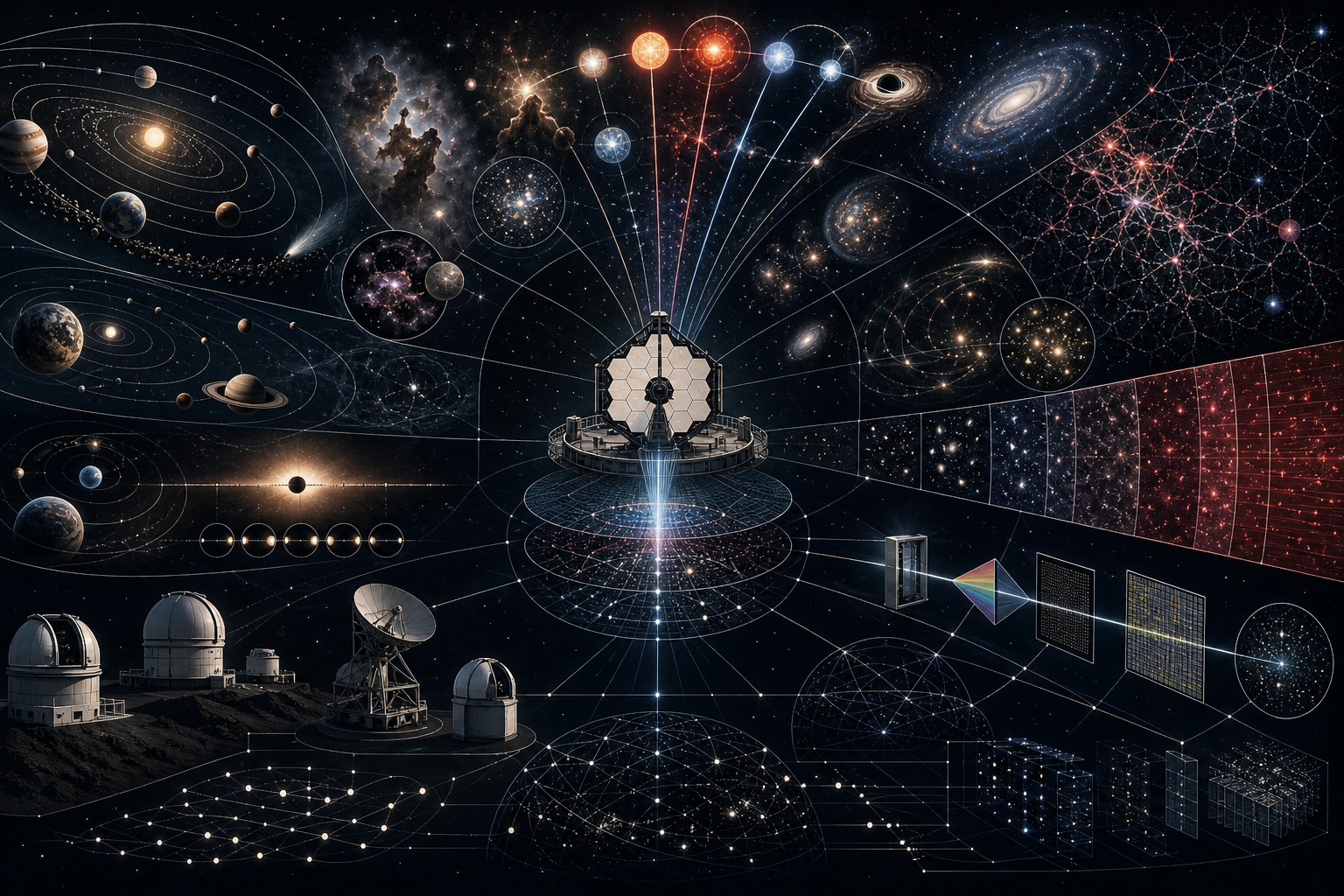
This series also approaches astronomy as a field that increasingly depends on quantitative reasoning, observational measurement, statistical inference, computational modeling, astronomical imaging, signal processing, reproducible data analysis, and open scientific workflows. Many of the most important astronomical questions cannot be answered by direct manipulation of objects, but by interpreting light, spectra, time-series observations, orbital motion, survey catalogs, detector outputs, simulations, and weak signals collected across immense distances. For that reason, this pillar integrates astronomy with mathematics, physics, statistics, Python, R, Julia, SQL, scientific notebooks, astronomical data formats, reproducible research practices, and open scientific code. Mathematics clarifies motion, gravity, luminosity, distance, uncertainty, radiation, orbital dynamics, redshift, expansion, and scaling laws. Python supports astronomical data analysis, image processing, FITS workflows, orbital simulation, machine learning, automation, visualization, and scientific computing. R supports statistical astronomy, time-series analysis, uncertainty, survey data, regression, photometry summaries, and reproducible reporting. Julia supports high-performance numerical simulation, differential equations, gravitational dynamics, and cosmological modeling. C++, Fortran, and C support performance-critical numerical kernels, legacy astrophysical codes, simulation infrastructure, and instrument-adjacent computation. Rust and Go support safe command-line tools, catalog validation, lightweight data services, and reproducible workflow utilities. SQL supports observation catalogs, metadata, survey records, object tables, instrument logs, provenance, and reproducible astronomical data infrastructure. Together, these tools make it possible not only to describe the universe, but to measure, model, simulate, test, reproduce, and interrogate astronomical evidence with greater rigor.
Astronomy therefore appears here not only as an observational science, but also as a historical, theoretical, mathematical, computational, instrumental, philosophical, and civilizational one. The aim of the series is to preserve the conceptual richness of astronomical thought while also showing how contemporary astronomy increasingly relies on mathematical structure, statistical reasoning, data analysis, simulation, computational imaging, and reproducible workflows in order to understand cosmic systems under real conditions of distance, uncertainty, faintness, noise, incompleteness, and scale. In that sense, this series treats astronomy not simply as the study of celestial objects, but as one of the deepest and most demanding ways human beings have developed for thinking about origin, motion, matter, time, observation, and the universe as a whole.
Astronomy Code Repository
The Astronomy knowledge series is supported by an open computational repository with article-level folders, reproducible examples, synthetic datasets, documentation, astronomical data-analysis workflows, orbital simulations, photometry and time-series examples, SQL catalog structures, and scientific-computing scaffolding across Python, R, Julia, SQL, C++, Fortran, Rust, Go, C, and notebooks where appropriate.
Astronomy as a Foundational Science
Astronomy occupies a distinctive place within the natural sciences because it extends scientific inquiry beyond Earth and reveals the universe across immense scales of space and time. Physics provides many of the general laws that govern gravitation, radiation, motion, thermodynamics, quantum behavior, relativity, and matter. Earth Science helps interpret planetary formation, impact history, comparative worlds, and the physical conditions of habitability. Chemistry helps explain stellar composition, molecular clouds, planetary atmospheres, interstellar molecules, and the material conditions through which stars, planets, and life become possible. Astronomy is distinctive because it brings these dimensions together in order to understand celestial bodies, cosmic structures, observational evidence, and the evolution of the universe itself.
This foundational role does not mean that astronomy is simply applied physics at large scales. Rather, it is a field uniquely concerned with observation across distance, the interpretation of faint and indirect signals, and the reconstruction of systems and events that cannot be manipulated experimentally in ordinary ways. Astronomers often study objects by analyzing light that has traveled for years, centuries, millions of years, or billions of years before reaching an instrument. They infer composition through spectra, distance through parallax and standard candles, mass through motion and gravitational effects, temperature through radiation, and cosmic history through signals preserved across time.
Astronomy is therefore both empirical and inferential. It depends on telescopes, detectors, observatories, satellites, spectroscopy, astrometry, photometry, radio signals, gravitational waves, computational models, statistical inference, and theoretical physics. Across these methods, astronomy seeks not merely to catalogue the sky, but to explain the motions, structures, origins, and transformations of cosmic systems. It serves as one of the most important bridges between physical law, planetary science, cosmic history, observational method, and humanity’s wider understanding of time, origin, and place in the universe.
Astronomy as a Science of Cosmic Systems
Astronomy may be understood as one of the great sciences of cosmic systems. Planets are not isolated objects, but members of dynamical systems shaped by gravity, formation histories, radiation, impacts, atmospheres, and orbital interactions. Stars are not fixed lights, but evolving physical systems whose lives are governed by mass, fusion, pressure, temperature, radiation, and gravity. Galaxies are not static collections of stars, but structured systems of gas, dust, dark matter, star formation, black holes, chemical enrichment, motion, collision, and evolution. The universe itself is not a timeless container, but an expanding, structured, historically evolving system whose past remains partially visible through radiation, distance, and large-scale structure.
For that reason, astronomy has always demanded forms of thinking capable of moving between scales. It must explain how local measurements reveal distant systems, how light becomes evidence, how gravitational interaction produces orbital structure, how stellar interiors shape cosmic chemistry, how galaxies form and evolve, how black holes influence their surroundings, how planetary systems emerge from disks, and how cosmic expansion links observation to the history of the universe. In the contemporary world, these problems increasingly require quantitative and computational tools, but they remain astronomical in the deepest sense because they concern the universe as organized physical process across scale and time.
This makes astronomy especially important within a broader intellectual project concerned with systems, scientific interpretation, and long-horizon understanding. The universe is not a decorative background to human life. It is the larger physical order within which Earth, life, matter, and time itself must be understood. To study astronomy seriously is therefore to study the conditions under which worlds form, stars shine, elements are made, galaxies evolve, cosmic structures emerge, and human knowledge reaches beyond immediate experience.
Astronomy as a Quantitative and Computational Science
Modern astronomy is deeply quantitative. Celestial bodies are not only observed and described; they are measured, mapped, modeled, compared, simulated, and interpreted using formal methods. Orbital motion can be represented mathematically. Stellar luminosity can be related to distance and flux. Spectra can reveal composition, temperature, velocity, redshift, and physical conditions. Galaxy distributions can be analyzed statistically. Light curves can reveal transiting exoplanets, variable stars, eclipsing binaries, supernovae, and active galactic nuclei. Astronomical knowledge therefore increasingly emerges through the combination of observation, mathematics, physics, statistics, computation, and reproducible workflows.
This does not mean that astronomy ceases to be observational, historical, or interpretive. Rather, it means that modern astronomical understanding often depends on moving across modes of inquiry. A researcher may collect telescope observations, calibrate detector data, reduce images in Python, model light curves, store object metadata in SQL, analyze survey statistics in R, run an orbital simulation, compare results with theoretical predictions, and interpret the evidence in relation to stellar physics, planetary science, galactic dynamics, or cosmology. Astronomy has become one of the clearest examples of a science in which observation, instrumentation, mathematics, theory, and computation are inseparable.
For that reason, this series treats mathematics, statistics, Python, R, Julia, SQL, scientific computing, astronomical imaging, catalog analysis, numerical simulation, and reproducible notebooks as increasingly important parts of astronomical literacy. Some articles in the series remain primarily conceptual, historical, observational, or philosophical. Others lend themselves naturally to orbital mechanics, photometry, spectroscopy, time-series analysis, astronomical imaging, catalog queries, statistical inference, gravitational dynamics, stellar modeling, cosmological distances, or simulation. The aim is not to force code into every article, but to build an Astronomy pillar that reflects how astronomical knowledge is actually produced.
What Astronomy Studies
Astronomy studies celestial bodies and cosmic systems across multiple levels of organization. At the local level, it examines the Moon, planets, dwarf planets, asteroids, comets, meteoroids, planetary rings, moons, atmospheres, surfaces, impacts, and the formation and evolution of planetary systems. At the stellar level, it studies stars, stellar birth, fusion, radiation, main-sequence evolution, red giants, supernovae, white dwarfs, neutron stars, black holes, stellar populations, and the production of elements. At the galactic level, it investigates the Milky Way, galaxies, clusters, interstellar gas, dust, star formation, dark matter, galactic structure, and cosmic environments.
At broader scales, astronomy studies the universe as a whole. It asks how the universe began, how it expanded, how structure formed, how galaxies assembled, how dark matter and dark energy shape cosmic evolution, and how the observable universe carries information from its earliest accessible states. It also studies the instruments, methods, and theoretical frameworks through which distant objects become knowable: telescopes, observatories, detectors, spectra, imaging, astrometry, photometry, survey catalogs, simulations, and statistical inference.
Astronomy further studies the universe as a historical phenomenon. Every observation of distant objects is also an observation of the past, because light takes time to travel. The night sky is therefore not a single moment, but a layered archive of cosmic time. Astronomy is not only concerned with how celestial systems function now, but with how they came to be, how they have changed, and how they may evolve in the future.
What This Pillar Covers
This pillar brings together the major domains through which astronomy interprets the universe. It begins with the scope of astronomy and the historical emergence of astronomical thought, then moves through observation, light, telescopes, celestial motion, timekeeping, the solar system, planetary science, stars, stellar evolution, compact objects, galaxies, black holes, the interstellar medium, exoplanets, astrobiology, cosmology, dark matter, dark energy, large-scale structure, space-based astronomy, astronomical data, and the wider scientific and civilizational significance of understanding the cosmos.
The pillar also incorporates quantitative and computational astronomical reasoning where appropriate. Some topics naturally involve mathematical structure, including orbits, gravity, radiation, luminosity, redshift, parallax, spectral lines, signal-to-noise, telescope resolution, stellar equilibrium, and cosmic expansion. Others lend themselves especially well to statistical inference, visualization, reproducible notebooks, data pipelines, astronomical imaging, time-series analysis, simulation, machine learning, or catalog workflows. In those cases, articles may incorporate mathematical interpretation, Python-based modeling, R-based statistical analysis, Julia-based simulation, SQL metadata, GitHub-based code examples, or full-stack computational scaffolding. This allows the series to remain conceptually rich while also becoming methodologically stronger.
Taken together, these domains form a coherent intellectual architecture. Astronomy is not simply the study of distant objects in isolation. It is a far-reaching mode of explanation that connects Earth’s sky to celestial mechanics, planets to stars, stars to galaxies, galaxies to cosmic structure, and present-day observations to events that occurred billions of years ago. It shows that the universe is dynamic, structured, historically evolving, physically intelligible, and accessible to scientific understanding even when its most important processes unfold far beyond direct human reach.
The series also treats astronomy as a field that links fundamental science and practical systems. Astronomical knowledge informs physics, space exploration, timekeeping, navigation, instrumentation, imaging, detector technology, data science, planetary defense, astrobiology, and human self-understanding. For that reason, the pillar is designed not only to introduce astronomical concepts, but to clarify why astronomical thinking remains indispensable for understanding scale, evidence, origin, and the larger physical setting of life.
Mathematics, Computation, and Simulation in Astronomy
Mathematics provides part of the formal language through which astronomy understands motion, radiation, distance, mass, energy, time, uncertainty, and cosmic structure. Orbital mechanics, gravitational attraction, luminosity, inverse-square relationships, spectral shifts, expansion rates, stellar equilibrium, statistical distributions, and signal detection can all be clarified through mathematical reasoning. Astronomy depends deeply on geometry, trigonometry, calculus, differential equations, linear algebra, probability, statistics, numerical methods, Fourier analysis, and physical modeling.
Computation is especially valuable where astronomical systems are too distant, faint, dynamic, high-dimensional, or data-rich for direct intuition alone. Python supports image calibration, source detection, photometry, spectroscopy, orbital modeling, catalog analysis, simulation, visualization, machine learning, and automation. R supports statistical modeling, time-series analysis, survey-data exploration, uncertainty, regression, and reproducible reports. Julia supports high-performance numerical simulation, differential equations, n-body dynamics, radiative models, and cosmological computation. SQL supports object catalogs, observation metadata, survey tables, instrument records, provenance, and reproducible data infrastructure. C++, Fortran, C, Rust, and Go support performance-critical numerical methods, legacy astrophysical modeling, instrument-adjacent tooling, command-line utilities, validation workflows, and lightweight scientific services.
Used together, mathematics, computation, numerical methods, notebooks, SQL metadata, and open code repositories help make astronomy more explicit, testable, reproducible, and scalable. They allow distant signals to be measured rather than merely described, uncertainty to be quantified rather than assumed away, and cosmic systems to be explored through models as well as through observation. In this series, those tools are integrated where they deepen explanation rather than distract from it. The result is an Astronomy pillar that remains faithful to observational and theoretical astronomy while also acknowledging that modern astronomical literacy increasingly includes quantitative and computational competence.
Major Domains of Astronomy
Astronomy includes a wide range of major domains, each of which illuminates a different dimension of cosmic organization. Observational astronomy studies the universe through light, radiation, detectors, telescopes, images, spectra, and time-series data. Celestial mechanics examines the motions of bodies under gravity, including orbits, resonances, perturbations, tides, and dynamical stability. Planetary astronomy studies planets, moons, asteroids, comets, rings, atmospheres, surfaces, impacts, and the formation of planetary systems.
Stellar astronomy examines stars as physical systems, including stellar birth, fusion, luminosity, spectra, internal structure, evolution, and death. High-energy astronomy studies black holes, neutron stars, supernovae, accretion disks, active galactic nuclei, gamma-ray bursts, X-rays, and other extreme cosmic phenomena. Galactic astronomy studies the Milky Way, stellar populations, star formation, gas, dust, spiral structure, dark matter, and the dynamics of galaxies. Extragalactic astronomy studies galaxies beyond the Milky Way, galaxy clusters, interactions, mergers, and the large-scale distribution of matter. Cosmology studies the universe as a whole, including expansion, cosmic microwave background radiation, dark matter, dark energy, structure formation, and cosmic history.
Other major astronomical domains extend and deepen this framework. Astrometry measures positions, distances, and motions with high precision. Photometry measures brightness and variation. Spectroscopy studies composition, temperature, velocity, pressure, magnetic fields, and physical conditions through the structure of light. Radio astronomy, infrared astronomy, optical astronomy, ultraviolet astronomy, X-ray astronomy, and gamma-ray astronomy each reveal different physical processes. Gravitational-wave astronomy opens a non-light-based window into compact-object mergers and spacetime dynamics. Astrobiology connects astronomy to planetary habitability and the scientific question of life beyond Earth. Astronomical instrumentation studies the tools through which the universe becomes observable.
Many of these domains are now inseparable from quantitative and computational methods. Survey astronomy depends on catalogs, databases, automated pipelines, source classification, statistical inference, and machine learning. Cosmology depends on numerical models, statistical constraints, simulations, and large observational datasets. Exoplanet research depends on light curves, radial velocities, transit modeling, atmospheric spectra, and uncertainty analysis. High-energy astrophysics depends on signal processing, detector calibration, and time-domain analysis. Astronomy therefore continues to broaden not only in subject matter but also in formal and technical depth.
Why Astronomy Matters
Astronomy matters because it expands the scale of human understanding. It clarifies how planets form, how stars are born and die, how elements are produced, how galaxies organize matter across vast distances, how black holes reshape spacetime and surrounding matter, and how the universe itself has evolved over cosmic time. In doing so, astronomy shapes physics, planetary science, cosmology, navigation, timekeeping, space exploration, instrumentation, data science, and many of the deepest questions in scientific thought.
Astronomy also matters because the contemporary world depends on technologies and modes of reasoning that astronomy helped develop or accelerate. Precision timing, optical systems, imaging methods, detectors, spectroscopy, data pipelines, statistical inference, satellite systems, and computational modeling all intersect with astronomical practice. Astronomy has repeatedly expanded the reach of measurement by forcing science to extract meaning from faint signals, distant sources, noisy data, and indirect evidence.
At the same time, astronomy matters because it changes how human beings understand themselves. It reveals that Earth is one world among many, that the stars have histories, that the elements in living systems were forged through cosmic processes, that galaxies evolve, and that the observable universe carries traces of events from the deep past. It is therefore not only a scientific field but also one of the principal ways human beings have learned to think about origin, finitude, scale, evidence, and the wider setting of life.
Astronomy also matters because modern decisions increasingly depend on space systems, planetary awareness, and scientific literacy. Planetary defense, space weather, satellite infrastructure, lunar and planetary exploration, orbital debris, exoplanet research, and the search for life all require astronomical understanding. An astronomically literate society must therefore be able to move between the sky as experienced, the universe as measured, and the universe as modeled.
Astronomy and Human Self-Understanding
Astronomy changes how human beings understand themselves. It places human life within a larger cosmic history, reveals the deep time beneath the formation of Earth, and shows that humanity is neither separate from nor outside the physical history of the universe. It illuminates origin, matter, finitude, scale, fragility, curiosity, and the layered conditions that make planetary life possible.
Yet astronomy also complicates self-understanding. It shows that ordinary perception captures only a narrow range of reality, that visible light is only one part of the electromagnetic spectrum, that the night sky is an archive of different times, and that most cosmic processes unfold on scales beyond direct human experience. It asks human beings to understand themselves at once as observers, physical beings, planetary inhabitants, and participants in a universe whose history long predates human culture.
For that reason, astronomy has philosophical as well as scientific significance. It raises enduring questions about origin, time, evidence, knowledge, exploration, planetary responsibility, and the meaning of human life in a vast universe. As astronomy becomes increasingly data-rich, computational, and technologically powerful, those questions become even more pressing. A serious Astronomy pillar should therefore not end with facts alone. It should also clarify the wider implications of astronomical knowledge for humility, wonder, scientific responsibility, and civilization.
Astronomy Pillar Map
The map below organizes the Astronomy knowledge series into conceptual domains, moving from foundations and first principles toward observation, celestial motion, the solar system, stars, galaxies, compact objects, exoplanets, cosmology, instrumentation, computation, exploration, and the wider human significance of astronomical knowledge.
The Astronomy pillar is organized to move from foundations and first principles into observation, light, celestial motion, planetary systems, stellar structure, stellar evolution, galaxies, compact objects, exoplanets, astrobiology, cosmology, astronomical instruments, computational astronomy, survey data, space-based observation, and the wider intellectual significance of cosmic knowledge. Mathematics, Python, R, Julia, SQL, C++, Fortran, Rust, Go, C, and computational notebooks are integrated within the series where they deepen astronomical understanding, especially in areas such as orbital mechanics, astronomical imaging, photometry, spectroscopy, time-series analysis, catalog data, gravitational simulation, cosmological modeling, uncertainty analysis, reproducibility, and observational data pipelines. The goal is a pillar that remains clearly and fully astronomical while also reflecting the quantitative and computational depth of contemporary astronomy.
Foundations of Astronomy
- What Is Astronomy? (planned) — An opening article defining astronomy as the scientific study of celestial bodies, cosmic systems, and the universe beyond Earth. This piece clarifies the identity of the field, its scope within the natural sciences, and its importance for understanding motion, light, matter, scale, origin, and cosmic history.
- The Rise of Modern Astronomical Thought (planned) — An account of how astronomy emerged through naked-eye observation, mathematical astronomy, heliocentrism, telescopes, celestial mechanics, spectroscopy, astrophysics, relativity, cosmology, radio astronomy, space telescopes, and modern survey science.
- Observation, Light, and the Methods of Astronomical Inquiry (planned) — A methodological article on how astronomical knowledge is produced through light, radiation, telescopes, detectors, spectra, images, time-series observations, models, statistical inference, and reproducible scientific practice.
- Astronomy as a Science of Distance, Time, and Evidence (planned) — A conceptual article on how astronomy reconstructs distant systems through indirect evidence, finite light speed, cosmic time, observational limits, uncertainty, and inference from weak signals.
- The Electromagnetic Spectrum and the Invisible Universe (planned) — An article on radio, microwave, infrared, visible, ultraviolet, X-ray, and gamma-ray astronomy, explaining why different wavelengths reveal different cosmic processes.
- Mathematics, Measurement, and Scale in Astronomy (planned) — A quantitative foundation for astronomical units, light-years, parsecs, magnitudes, luminosity, angular measurement, parallax, redshift, and the scaling relationships that make cosmic measurement possible.
The Night Sky, Celestial Motion, and Time
- The Night Sky and the Human Discovery of Celestial Order (planned) — A historical and observational article on how human beings recognized patterns of motion in the sky, including daily rotation, seasonal change, planetary wandering, lunar phases, eclipses, and celestial regularity.
- Celestial Motion, Orbits, and Gravitational Structure (planned) — A core article on orbital motion, gravity, Kepler’s laws, Newtonian mechanics, elliptical orbits, perturbations, resonance, and the gravitational organization of celestial systems.
- Timekeeping, Calendars, and the Astronomical Measurement of Time (planned) — An article on solar days, lunar months, seasons, calendars, sidereal time, time standards, navigation, and the role of astronomy in organizing human time.
- Constellations, Mapping, and the Cultural History of the Sky (planned) — A careful article on constellations, sky maps, cultural astronomy, scientific naming, celestial coordinates, and the difference between cultural sky traditions and modern astronomical classification.
- Eclipses, Transits, and Alignments (planned) — A focused article on solar eclipses, lunar eclipses, planetary transits, occultations, alignments, geometry, prediction, and the scientific value of rare celestial configurations.
- Celestial Coordinates, Reference Frames, and Sky Mapping (planned) — A technical article on right ascension, declination, ecliptic coordinates, galactic coordinates, proper motion, reference frames, and the mathematical organization of the sky.
The Solar System and Planetary Worlds
- The Solar System and the Structure of Our Local Cosmic Neighborhood (planned) — A foundational article on the Sun, planets, moons, dwarf planets, asteroids, comets, Kuiper Belt objects, planetary rings, and the architecture of the local solar system.
- Planets, Dwarf Planets, Moons, Asteroids, and Comets (planned) — A survey of the major classes of solar-system objects, explaining their physical properties, compositions, orbital families, formation histories, and scientific importance.
- Planetary Formation and the Origins of Worlds (planned) — An article on protoplanetary disks, accretion, planetesimals, differentiation, migration, impacts, gas giants, rocky planets, icy worlds, and the processes through which planetary systems form.
- Comparative Planetology and the Diversity of Planetary Environments (planned) — A comparative article on terrestrial planets, giant planets, icy moons, atmospheres, surfaces, interiors, magnetic fields, volcanism, climate, and planetary evolution.
- The Sun as a Star and the Center of the Solar System (planned) — A bridge article on solar structure, fusion, radiation, magnetic activity, sunspots, solar wind, space weather, and the Sun’s influence on planetary environments.
- Planetary Atmospheres, Climate, and Surface Conditions (planned) — An article on atmospheric composition, pressure, greenhouse effects, clouds, weather, climate, escape, surface temperature, and the diversity of planetary environments.
- Impacts, Craters, and Planetary Surface Histories (planned) — A study of impact cratering, surface dating, planetary geology, bombardment history, extinction risk, and the role of impacts in shaping planetary surfaces.
- Small Bodies, Comets, and the Archives of Solar-System History (planned) — An article on asteroids, comets, meteoroids, trans-Neptunian objects, primitive materials, volatiles, and the scientific value of small bodies as records of early solar-system conditions.
Stars, Stellar Physics, and Stellar Evolution
- Stars and the Basic Units of Stellar Astronomy (planned) — A foundational article on stars as self-gravitating luminous objects, including mass, luminosity, temperature, spectra, radius, distance, and the physical properties used to classify them.
- Stellar Birth, Fusion, and the Main Sequence (planned) — An article on molecular clouds, gravitational collapse, protostars, hydrostatic equilibrium, nuclear fusion, the main sequence, and the relationship between mass and stellar lifetime.
- The Hertzsprung-Russell Diagram and the Architecture of Stellar Life (planned) — A quantitative article on luminosity, temperature, spectral class, main sequence, giants, white dwarfs, stellar populations, and the diagram that organizes stellar evolution.
- Red Giants, Supernovae, and the Death of Stars (planned) — A major article on late-stage stellar evolution, red giants, planetary nebulae, core collapse, Type Ia supernovae, nucleosynthesis, and the transformation of stars at the end of life.
- White Dwarfs, Neutron Stars, and Stellar Remnants (planned) — A focused article on compact remnants, degeneracy pressure, neutron stars, pulsars, white dwarfs, mass limits, and the physical extremes produced by stellar death.
- Stellar Nucleosynthesis and the Cosmic Origin of Elements (planned) — An article on how stars, supernovae, neutron-star mergers, and cosmic processes produce and distribute the elements that make planets, chemistry, and life possible.
- Variable Stars, Light Curves, and Stellar Measurement (planned) — A methodological article on variable stars, pulsation, eclipsing binaries, Cepheids, RR Lyrae stars, light curves, distance measurement, and time-domain astronomy.
Compact Objects and High-Energy Astronomy
- Black Holes, Extreme Objects, and High-Energy Astronomy (planned) — A major article on black holes, neutron stars, accretion disks, X-ray binaries, active galactic nuclei, gamma-ray bursts, jets, and the universe’s most energetic phenomena.
- Accretion, Jets, and Cosmic Energy Release (planned) — An article on matter falling into compact objects, disk physics, relativistic jets, radiation, magnetic fields, and high-energy feedback into surrounding environments.
- Neutron Stars, Pulsars, and Dense Matter (planned) — A focused article on neutron stars, pulsars, magnetars, dense matter, rotation, magnetic fields, gravitational effects, and compact-object physics.
- Gravitational Waves and Multi-Messenger Astronomy (planned) — An article on gravitational-wave detection, compact-object mergers, electromagnetic counterparts, neutrinos, and the emergence of multi-messenger astronomy.
- Supernova Remnants and the Recycling of Stellar Matter (planned) — A study of expanding remnants, shock waves, cosmic rays, enriched gas, compact remnants, and the role of supernovae in galactic evolution.
Galaxies, Interstellar Matter, and Cosmic Structure
- The Milky Way and Galactic Structure (planned) — A core article on the structure of our galaxy, including disk, bulge, halo, spiral arms, stellar populations, gas, dust, dark matter, and the central black hole.
- Galaxies, Clusters, and the Architecture of the Universe (planned) — An article on galaxy types, clusters, groups, filaments, voids, dark matter halos, large-scale structure, and the organization of matter across cosmic distances.
- The Interstellar Medium and the Material Ecology of Space (planned) — A bridge article on gas, dust, molecular clouds, ionized regions, star formation, shock waves, chemical enrichment, and the cycling of matter between stars and space.
- Star Formation and Molecular Clouds (planned) — A focused article on cold gas, dust, gravitational collapse, turbulence, magnetic fields, protostars, clusters, and the conditions under which new stars form.
- Galaxy Formation, Evolution, and Interaction (planned) — A major article on how galaxies assemble, merge, form stars, exhaust gas, interact with environments, and change over cosmic time.
- Dark Matter and the Gravitational Structure of Galaxies (planned) — An article on rotation curves, gravitational lensing, galaxy clusters, structure formation, and the evidence for unseen matter in cosmic systems.
- Active Galactic Nuclei and Supermassive Black Holes (planned) — A study of quasars, active nuclei, accretion, jets, galaxy feedback, and the relationship between supermassive black holes and galaxy evolution.
Exoplanets, Habitability, and Astrobiology
- Exoplanets and the Discovery of Other Worlds (planned) — A major article on exoplanet detection, transits, radial velocities, direct imaging, microlensing, planetary diversity, and the transformation of planetary science by worlds beyond the solar system.
- Transit Photometry and the Measurement of Exoplanets (planned) — A quantitative article on light curves, transit depth, orbital period, planet radius, detection limits, false positives, and the statistical interpretation of exoplanet observations.
- Radial Velocity, Planet Mass, and Gravitational Detection (planned) — A focused article on stellar wobble, Doppler shifts, orbital inference, minimum mass, detection sensitivity, and the gravitational evidence for exoplanets.
- Habitability, Planetary Conditions, and the Search for Life (planned) — An article on habitable zones, atmospheres, water, climate stability, stellar radiation, planetary geology, biosignatures, and the conditions that may support life.
- Astrobiology and the Scientific Question of Life Beyond Earth (planned) — A bridge article connecting astronomy, biology, chemistry, planetary science, habitability, biosignatures, extremophiles, and the search for life beyond Earth.
- Exoplanet Atmospheres and Spectroscopic Biosignatures (planned) — A technical article on transmission spectroscopy, emission spectra, atmospheric composition, clouds, methane, oxygen, carbon dioxide, water vapor, and the difficulty of interpreting biosignatures.
- Planetary Systems, Migration, and Orbital Architectures (planned) — A systems article on multiplanet systems, resonance, migration, stability, hot Jupiters, compact systems, and the diverse architectures of planetary systems.
Cosmology and Cosmic History
- Cosmology and the History of the Universe (planned) — A flagship article on the universe as an evolving system, including expansion, early conditions, cosmic microwave background radiation, structure formation, matter, radiation, dark matter, and dark energy.
- The Big Bang, Expansion, and Cosmic Background Radiation (planned) — A foundational article on cosmic expansion, early-universe conditions, the cosmic microwave background, nucleosynthesis, recombination, and the observational evidence for cosmic history.
- Redshift, Distance, and the Expanding Universe (planned) — A quantitative article on redshift, recessional velocity, distance measures, Hubble’s law, cosmological expansion, and the measurement challenges of deep cosmic space.
- Dark Matter, Dark Energy, and the Limits of Current Understanding (planned) — An article on the evidence for dark matter and dark energy, their role in cosmic structure and expansion, and the unresolved questions at the edge of current cosmology.
- Cosmic Structure, Deep Time, and the Evolution of the Universe (planned) — A synthesis of large-scale structure, cosmic web formation, galaxy evolution, dark matter halos, voids, clusters, and the history of structure across billions of years.
- Inflation, Early-Universe Physics, and Cosmological Evidence (planned) — A theoretical and observational article on inflation, horizon problems, flatness, primordial fluctuations, and the relationship between theory and measurable cosmic structure.
- The Fate of the Universe and Long-Term Cosmic Futures (planned) — A speculative but scientifically grounded article on cosmic acceleration, heat death, stellar aging, black holes, structure dissolution, and the possible long-term futures of the universe.
Observation, Instruments, and Astronomical Practice
- Telescopes, Observatories, and the Expansion of Vision (planned) — A major article on optical telescopes, radio telescopes, adaptive optics, mirrors, lenses, detectors, observatories, resolution, sensitivity, and the technological expansion of astronomical vision.
- Astrometry, Measurement, and the Mapping of the Sky (planned) — A methodological article on position, parallax, proper motion, distance, reference frames, stellar catalogs, and precision sky mapping.
- Space Telescopes, Satellites, and Astronomy Beyond the Atmosphere (planned) — An article on space-based observation, atmospheric limits, infrared astronomy, ultraviolet astronomy, X-ray astronomy, cosmic microwave background missions, and orbital observatories.
- Data, Imaging, and the Interpretation of Distant Signals (planned) — A computational article on image calibration, detector noise, source extraction, photometry, spectroscopy, signal-to-noise, uncertainty, and scientific interpretation of astronomical data.
- Spectroscopy and the Physical Interpretation of Light (planned) — A core article on spectral lines, absorption, emission, redshift, Doppler shifts, chemical composition, temperature, velocity, and the role of spectra in astronomical inference.
- Photometry, Magnitudes, and the Measurement of Brightness (planned) — A quantitative article on flux, apparent magnitude, absolute magnitude, filters, calibration, luminosity, light curves, and brightness as astronomical evidence.
- Survey Astronomy, Catalogs, and the Data-Rich Universe (planned) — An article on large surveys, object catalogs, sky databases, automated pipelines, classification, statistical astronomy, and the transformation of astronomy by large-scale data.
Quantitative and Computational Astronomy
- Mathematical Astronomy and the Logic of Celestial Motion (planned) — A spine article on the use of mathematics to represent orbits, gravity, distance, angular motion, luminosity, redshift, and the formal structure of astronomical reasoning.
- Probability, Uncertainty, and Statistical Inference in Astronomy (planned) — An article on measurement error, noise, detection thresholds, confidence intervals, Bayesian inference, survey bias, selection effects, and uncertainty in astronomical evidence.
- Python for Astronomical Data Analysis and Imaging (planned) — A practical article on Python for FITS data, image calibration, source detection, photometry, catalog handling, visualization, automation, and reproducible astronomical workflows.
- R for Photometry, Time-Series Analysis, and Survey Statistics (planned) — A practical article on R for light curves, variability, statistical modeling, regression, survey summaries, uncertainty visualization, and reproducible astronomical reports.
- SQL for Astronomical Catalogs and Observation Metadata (planned) — A data-infrastructure article on object catalogs, observation logs, instrument metadata, survey tables, provenance, quality flags, and reproducible astronomical databases.
- Julia for Orbital Dynamics and Astrophysical Simulation (planned) — An applied article on high-performance simulation, differential equations, n-body systems, orbital integration, stellar models, and computational astrophysics.
- N-Body Simulation and Gravitational Systems (planned) — A computational article on multi-body gravitational interaction, numerical integration, stability, chaos, star clusters, planetary systems, and galactic dynamics.
- Machine Learning in Astronomy and Survey Science (planned) — A modern article on classification, anomaly detection, photometric redshifts, transient detection, image analysis, catalog matching, uncertainty, interpretability, and responsible use of machine learning in astronomy.
- Computational Notebooks and Reproducible Astronomical Research (planned) — A methodological article on notebooks, literate programming, executable documentation, data provenance, version control, visual outputs, and transparent workflows in astronomical science.
Astronomy in Human Knowledge and Practice
- Astronomy, Scale, and the Human Understanding of the Universe (planned) — A reflective article on how astronomy changes human understanding of scale, origin, matter, time, finitude, evidence, and the place of Earth within a wider cosmic order.
- Astronomy, Exploration, and the Future of Cosmic Inquiry (planned) — An article on space exploration, telescopes, planetary missions, observatories, scientific collaboration, long-term inquiry, and the future of astronomy as a human project.
- Astronomy, Navigation, Timekeeping, and Civilization (planned) — A historical article on the role of astronomy in navigation, calendars, agriculture, ritual time, mapping, maritime travel, and the organization of human societies.
- Astronomy, Ethics, and the Governance of Space (planned) — A contemporary article on orbital congestion, satellite constellations, light pollution, planetary protection, space resources, scientific access, and the ethical governance of the near-Earth and planetary environment.
- Planetary Defense, Asteroids, and Cosmic Risk (planned) — A practical article on near-Earth objects, impact monitoring, orbital prediction, deflection concepts, risk communication, and the scientific basis of planetary defense.
- Astronomy, Wonder, and the Public Meaning of Science (planned) — A capstone-style article on astronomy’s cultural power, public science, humility, curiosity, awe, scientific literacy, and the relationship between cosmic knowledge and human imagination.
Python Workflow: Orbital Motion and Astronomical Image Analysis
A useful Python workflow for this pillar is an orbital motion and astronomical image analysis pipeline. The workflow can begin with two educational modules: a simple two-body orbital simulation and a synthetic astronomical image-processing example. The orbital module can calculate position, velocity, gravitational acceleration, orbital period, and energy for a planet-like body around a star-like mass. The image-analysis module can generate a synthetic star field, estimate background noise, detect bright sources, measure approximate brightness, and export a small source catalog. In a more advanced version, the workflow can incorporate FITS files, WCS coordinates, real survey data, astropy-style workflows, photometric calibration, source extraction, and cross-matching against object catalogs.
This workflow belongs naturally with articles on celestial motion, orbits, telescopes, astronomical imaging, photometry, exoplanet detection, survey astronomy, and computational astronomy. It demonstrates how astronomy moves from observation to measurement: light becomes pixels, pixels become sources, sources become catalogs, and catalogs become evidence for physical interpretation. The point is not to replace professional astronomical pipelines, but to show how reproducible computational workflows clarify assumptions, make uncertainty visible, and help readers understand the connection between physical models and observational data.
R Workflow: Photometry, Time Series, and Survey Statistics
A useful R workflow for this pillar is a photometry, time-series, and survey-statistics pipeline. The workflow can begin with a synthetic light-curve dataset containing object identifiers, observation dates, measured brightness, magnitude uncertainty, filter bands, and quality flags. R can be used to clean the data, summarize uncertainty, plot light curves, estimate periodicity, flag variable objects, compare object classes, and generate reproducible reports. In a more advanced version, the workflow can incorporate transit-like dips, variable-star patterns, survey completeness, detection thresholds, regression models, and statistical summaries of astronomical catalogs.
This workflow belongs naturally with articles on photometry, variable stars, exoplanet transits, survey astronomy, statistical inference, astronomical catalogs, and reproducible astronomical research. It demonstrates how astronomical evidence is built from repeated observations, uncertainty estimates, time variation, and transparent statistical interpretation. It also reinforces the difference between a single observation and a scientifically interpretable pattern. Used carefully, R helps readers see astronomical data not as static images of the sky, but as structured evidence that can reveal motion, variability, periodicity, physical change, and hidden systems.
Measurement, Observation, and Astronomical Practice
One of astronomy’s enduring contributions is its ability to make distant systems observable, measurable, and historically intelligible without direct physical access. Astronomical knowledge depends not only on theory, but on reliable observation, calibrated instruments, shared coordinate systems, repeatable measurement, detector characterization, telescope design, observational logs, data reduction, statistical inference, and disciplined forms of comparison. The history of astronomy is therefore also a history of skywatching, geometry, observatories, lenses, mirrors, clocks, photographic plates, spectrographs, radio receivers, CCD detectors, space telescopes, catalogs, survey pipelines, and the effort to render distant light scientifically meaningful.
This matters far beyond observational technique. Astronomical measurement supports timekeeping, navigation, planetary science, space exploration, detector technology, image processing, satellite systems, and the broader culture of scientific evidence. A stellar distance estimate, exoplanet transit detection, galaxy redshift, supernova light curve, black-hole image, or cosmological parameter all depends on the transformation of weak and distant signals into careful evidence. Astronomy therefore requires humility about uncertainty: signals are faint, instruments have limits, noise is unavoidable, selection effects matter, and many cosmic systems cannot be observed from every angle or at every moment.
Modern astronomical practice increasingly depends on combining observation, instrumentation, mathematics, physics, statistics, computation, and reproducible documentation. A serious astronomical claim may draw on telescope observations, calibration frames, spectra, catalogs, simulation, statistical models, computational notebooks, and open data. This makes astronomy one of the clearest examples of a science in which knowledge is produced through layered evidence rather than through one method alone.
Astronomy, Technology, and the Modern World
Astronomy has become one of the central sciences shaping modern understanding and technological capability. Its influence extends through optics, detectors, spectroscopy, radio systems, image processing, data pipelines, high-performance computing, satellite operations, timekeeping, navigation, planetary missions, space telescopes, gravitational-wave observatories, and public scientific imagination. Many of the most important questions in modern science are astronomical questions: how planets form, how stars produce elements, how galaxies evolve, how black holes behave, how the universe expands, how life may arise elsewhere, and how scientific instruments can extend human perception beyond ordinary experience.
Astronomy also underlies many powerful tools of the present century. Space telescopes make invisible wavelengths observable. Radio arrays reveal cold gas, pulsars, and cosmic background signals. Spectrographs translate light into physical evidence. Survey telescopes generate vast catalogs of celestial objects. Precision astrometry maps stellar motion and distance. Computational pipelines process images, spectra, and time-series observations at scale. Machine learning increasingly assists classification, transient detection, anomaly discovery, and catalog interpretation. These technologies support not only astronomy, but broader scientific and technical cultures of measurement, imaging, computation, and inference.
Yet astronomical power also creates responsibility. Satellite constellations affect the night sky. Space exploration raises questions of planetary protection. Space debris threatens orbital environments. Resource ambitions raise governance concerns. Planetary defense requires public trust and careful risk communication. Astronomy therefore belongs not only to observatories and missions, but to public life, ethics, international coordination, environmental responsibility, and long-term questions about humanity’s relation to space.
Astronomy, Computation, and Scientific Simulation
Computation has become central to contemporary astronomy because the universe generates complex, high-dimensional, multi-wavelength, time-dependent, and often indirect data. Telescope images, spectra, light curves, astrometric catalogs, sky surveys, detector streams, simulation outputs, gravitational-wave signals, and cosmological datasets all require computational methods for storage, calibration, interpretation, visualization, and reproducibility. Astronomical computation is not merely a convenience. It is increasingly part of how astronomical knowledge is produced.
Simulation is especially important when cosmic systems cannot be understood through direct observation alone. Orbital simulations can explore planetary motion, resonance, stability, and collision risk. N-body simulations can examine star clusters, galaxy dynamics, dark matter structure, and cosmic web formation. Stellar models can explore interior structure, fusion, evolution, and stellar remnants. Cosmological simulations can test structure formation, expansion histories, and the behavior of dark matter. Exoplanet models can examine transits, atmospheres, and orbital architectures. Machine learning can help identify patterns in images, spectra, light curves, and catalogs, while also raising questions about interpretability, bias, uncertainty, and physical meaning.
For that reason, this Astronomy pillar treats computational practice as a major component of modern astronomy. It includes Python for astronomical data analysis, imaging, simulation, automation, and scientific computing; R for time-series statistics, survey analysis, uncertainty, and reproducible reporting; Julia for high-performance orbital and astrophysical simulation; SQL for catalogs, metadata, and provenance; C++ and Fortran for numerical kernels and legacy astrophysical modeling; Rust for safe command-line validation tools; Go for lightweight data services; C for instrument-adjacent and low-level examples; and computational notebooks for transparent explanation. The goal is not to replace astronomical judgment with code, but to strengthen astronomical reasoning through reproducible, inspectable, and methodologically explicit workflows.
Astronomy in a Wider Intellectual Context
Astronomy occupies a distinctive place in human knowledge because it studies the cosmic conditions within which Earth and life themselves exist. It places humanity within deep time, stellar evolution, planetary formation, cosmic expansion, elemental history, and the wider physical order of the universe. It reveals continuity between matter on Earth and matter in stars, between planetary history and stellar history, and between local experience and cosmic structure.
This wider intellectual significance makes astronomy especially important for an age shaped by science, technology, planetary risk, and questions of long-term futures. Astronomy expands human imagination while also disciplining it through evidence. It teaches that reality exceeds ordinary perception, that knowledge often depends on indirect signals, that scale matters, and that humility is a scientific virtue. It connects observation to theory, mathematics to wonder, and cosmic distance to human self-understanding.
A serious Astronomy pillar therefore belongs within a larger architecture of natural science, physics, Earth Science, chemistry, biology, technology, data science, ethics, and public reason. It gives readers a way to understand the universe not only as a collection of celestial objects, but as the larger physical history within which Earth, life, matter, and human knowledge have emerged.
Related Reading
- Physics
- Earth Science
- Chemistry
- Biology
- Environmental Science
- Planetary Boundaries
- Artificial Intelligence Systems
Further Reading
- American Astronomical Society (n.d.) About AAS. Available at: https://aas.org/about-aas.
- European Space Agency (n.d.) About Space Science. Available at: https://www.esa.int/Science_Exploration/Space_Science/About_Space_Science.
- International Astronomical Union (n.d.) About the IAU. Available at: https://www.iau.org/IAU/About/About.aspx.
- National Aeronautics and Space Administration (n.d.) Astrophysics. Available at: https://science.nasa.gov/astrophysics/.
- National Aeronautics and Space Administration (n.d.) Universe. Available at: https://science.nasa.gov/universe/.
- National Aeronautics and Space Administration (n.d.) Solar System Exploration. Available at: https://science.nasa.gov/solar-system/.
References
- American Astronomical Society (n.d.) About AAS. Available at: https://aas.org/about-aas.
- American Astronomical Society (n.d.) Mission and Vision Statement. Available at: https://aas.org/about/mission-and-vision-statement.
- European Space Agency (n.d.) About Space Science. Available at: https://www.esa.int/Science_Exploration/Space_Science/About_Space_Science.
- European Space Agency (n.d.) Space Science. Available at: https://www.esa.int/Science_Exploration/Space_Science.
- European Space Agency (n.d.) Gaia overview. Available at: https://www.esa.int/Science_Exploration/Space_Science/Gaia_overview.
- International Astronomical Union (n.d.) International Astronomical Union. Available at: https://www.iau.org/.
- International Astronomical Union (n.d.) About the IAU. Available at: https://www.iau.org/IAU/About/About.aspx.
- International Astronomical Union (n.d.) What we do: The Constellations. Available at: https://www.iau.org/IAU/Iau/Science/What-we-do/The-Constellations.aspx.
- National Aeronautics and Space Administration (n.d.) Astronomy. Available at: https://www.nasa.gov/solar-system/skywatching/astronomy/.
- National Aeronautics and Space Administration (n.d.) Astrophysics. Available at: https://science.nasa.gov/astrophysics/.
- National Aeronautics and Space Administration (n.d.) Physics of the Cosmos. Available at: https://science.nasa.gov/astrophysics/programs/physics-of-the-cosmos/.
- National Aeronautics and Space Administration (n.d.) Solar System Exploration. Available at: https://science.nasa.gov/solar-system/.
- National Aeronautics and Space Administration (n.d.) About the Planets. Available at: https://science.nasa.gov/solar-system/planets/.
- National Aeronautics and Space Administration (n.d.) Universe. Available at: https://science.nasa.gov/universe/.
- National Aeronautics and Space Administration (n.d.) Cosmic History. Available at: https://science.nasa.gov/universe/overview/.
- National Aeronautics and Space Administration (n.d.) Star Basics. Available at: https://science.nasa.gov/universe/stars/.