
Last Updated May 4, 2026
Russian thought examines the literary, moral, psychological, religious, political, economic, and civilizational traditions through which Russian writers and thinkers explored freedom, conscience, suffering, history, social order, spiritual crisis, property, labor, ideology, memory, and the meaning of human existence. As a major category within the Philosophy knowledge series, this pillar studies Russian thought not as a narrow branch of national literature, but as one of the most intense and searching intellectual worlds of modernity, where literature repeatedly becomes philosophy by other means and where philosophy itself is often inseparable from theology, politics, historical catastrophe, and the burden of moral self-knowledge.
This field follows a remarkable arc in which Russian literature becomes a form of thought in its own right. From Pushkin’s revolution in language and form, to Lermontov’s early psychology of alienation, to Gogol’s grotesque satire, Goncharov’s critique of inertia, Turgenev’s generational conflicts, Dostoevsky’s investigations of conscience, crime, and spiritual fracture, Tolstoy’s meditations on history, morality, property, and social order, and Chekhov’s quiet exposure of inward life, Russian writing repeatedly turns literary form into a medium of philosophical seriousness. But the tradition is broader than the novel alone. It also includes Orthodox theology, criticism, social philosophy, revolutionary thought, religious metaphysics, symbolism, dialogic theory, dissident witness, exile literature, and reflections on power, ideology, memory, and civilizational destiny.
Russian thought refuses easy separations between literature and philosophy, psychology and ethics, private feeling and public order, history and conscience, religion and metaphysics, economics and moral life, or suffering and truth. It asks what becomes of the soul under modernity, what freedom does to a person when severed from responsibility, what forces move history, whether beauty can redeem or deceive, how property, labor, and communal life should be understood, and how guilt, love, humiliation, faith, violence, longing, and spiritual hunger shape human lives. The result is a tradition of unusual depth in which literary, philosophical, political, theological, and moral form become inseparable from the search for truth.
The goal of this pillar is not to romanticize “the Russian soul” or reduce Russian thought to melancholy, suffering, or metaphysical excess. It is to show why Russian thought remains philosophically indispensable precisely because it turns literature, philosophy, theology, economics, political theory, and social criticism toward the deepest questions of human life under pressure. It is also to show that Russian thought is not a single worldview. It is a field of argument and imaginative struggle shaped by Orthodoxy, empire, serfdom, reform, Westernization, property relations, revolution, religious philosophy, symbolism, censorship, exile, and the repeated crises of modern history.
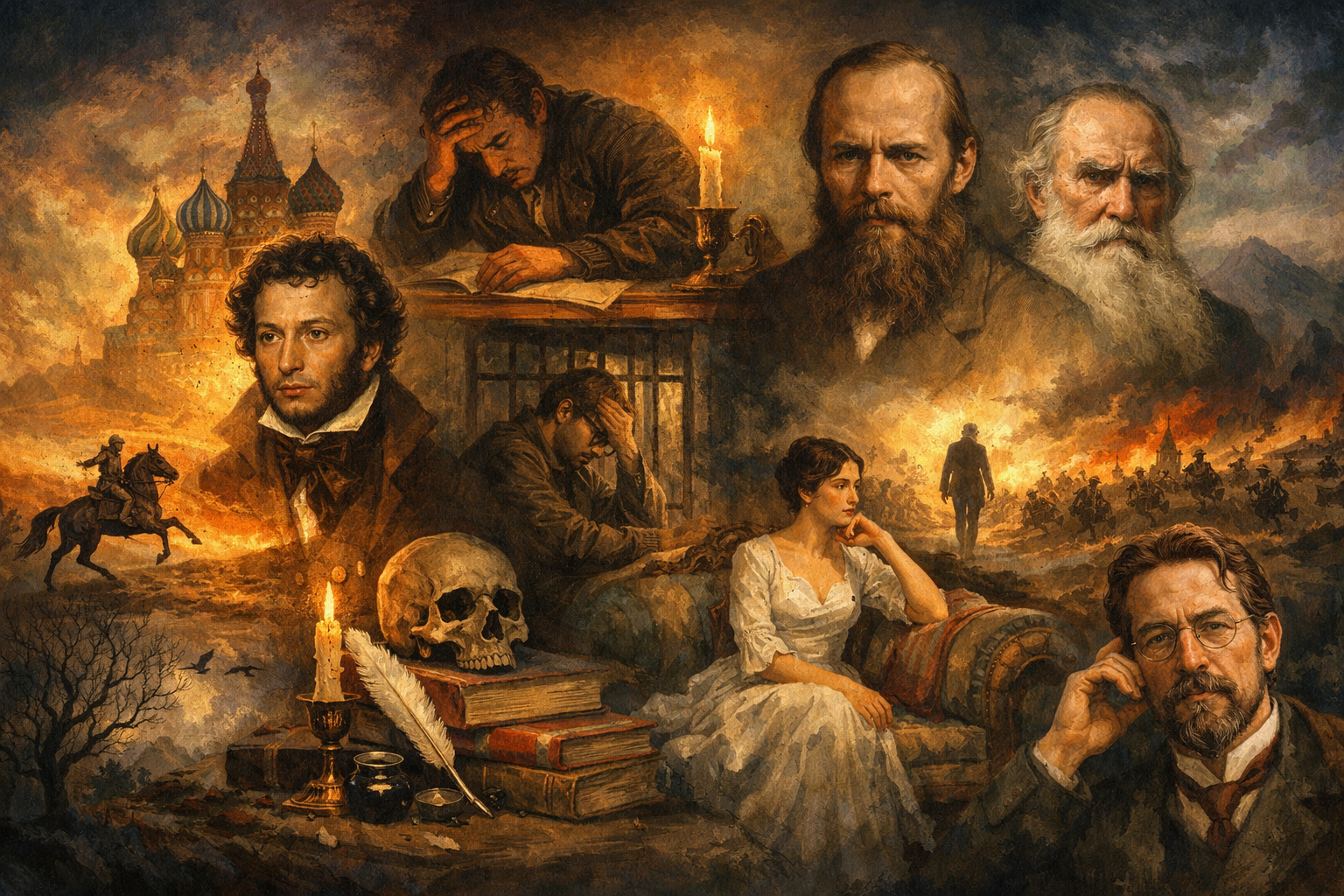
Russian thought is especially important to a broader philosophy architecture because it provides one of the richest philosophical-literary traditions for understanding moral conflict, inwardness, suffering, historical upheaval, spiritual longing, economic justice, ideology, exile, and the difficult relation between freedom and responsibility. In this respect, the category links not only to Existential Thought and Ethics and Moral Philosophy, but also to Political Philosophy and Justice, Metaphysics, Greek and Roman Thought, Persian Thought, and Islamic and Mystical Thought. Questions of conscience, redemption, nihilism, history, spiritual crisis, property, labor, social obligation, exile, witness, and the meaning of personhood become sharper when Russian thought is treated not merely as a literary tradition, but as a major philosophical world in its own right.
A full treatment of Russian thought must therefore move across genres. It must read novels as philosophy, criticism as moral argument, theology as metaphysics, revolutionary theory as a philosophy of history, poetry as witness, and exile writing as a struggle over memory and language. Russian thought is not strongest when it is reduced to doctrine. It is strongest when its forms are allowed to speak in their full range: the novel, the poem, the letter, the memoir, the religious essay, the political tract, the philosophical fragment, the theoretical study of language, and the testimony of survival.
Source Material and Intellectual Framing
This series begins from the literary arc already central to the Russian tradition: Pushkin, Lermontov, Gogol, Goncharov, Turgenev, Dostoevsky, Tolstoy, and Chekhov. That sequence remains indispensable because it follows the emergence of modern Russian literature from its linguistic and formal founding into its greatest psychological, social, and moral achievements. But a comprehensive treatment of Russian thought has to widen beyond the nineteenth-century novel into criticism, theology, social philosophy, revolutionary thought, economics, symbolism, philosophy of language, and moral witness.
That widening matters because Russian thought has never been only “literature” in a narrow sense. Criticism, essays, letters, memoir, theology, political reflection, and the philosophy of language all belong to the tradition’s inner architecture. The disputes over Russia’s historical path, the relation between Orthodoxy and modernity, the meaning of the peasant commune, the legitimacy of revolution, the possibility of spiritual renewal, the role of mathematics and symbol in metaphysical thought, and the moral burden of memory and exile all extend the literary tradition rather than standing outside it.
A serious series in Russian thought therefore has to treat primary literary works as core materials while also making room for Russian philosophy, criticism, political economy, and intellectual history. It must follow not only the great novelists, but the wider debates through which Russian culture thought about history, personhood, faith, justice, economy, suffering, ideology, and civilization itself.
This means reading Russian thought as a field of pressure. Fiction often carries philosophical argument because abstract discourse alone is insufficient to contain the tradition’s moral intensity. Theology often carries social criticism. Political thought often carries spiritual anxiety. Literature often carries metaphysics. Russian thought is therefore best approached as an interwoven archive of conscience, language, history, and moral imagination.
Why Russian Thought Matters
Russian thought matters because it offers one of the world’s deepest traditions for thinking about conscience, freedom, suffering, moral responsibility, history, social order, and the instability of the self. It is a tradition that repeatedly asks what becomes of human beings when they are pressed by humiliation, ideology, faith, violence, longing, and the demand to justify their lives. In this respect, Russian thought is not merely nationally important. It is philosophically universal in the seriousness of its questions.
This matters because Russian literature and philosophy repeatedly treat human beings as morally and spiritually answerable, even where certainty collapses. Conscience is not an ornament of respectable life. It is a site of torment, confession, contradiction, and revelation. Russian thought is often at its strongest precisely when it refuses psychological simplification and insists that selfhood is unstable, divided, wounded, and yet still answerable.
Russian thought also matters because it stages the relation between private life and historical catastrophe with unusual force. The tradition is saturated by serfdom, reform, imperial expansion, social inequality, revolutionary ideology, religious crisis, censorship, exile, and civilizational self-questioning. This makes it one of the strongest literary-intellectual traditions for understanding how large historical forces enter consciousness, distort moral life, and transform the possibilities of thought itself.
It also matters because Russian thought has a distinctive way of refusing moral neutrality. Its great works rarely allow the reader to remain merely observant. They ask whether one is guilty, compromised, evasive, passive, proud, cowardly, faithful, loving, self-deceived, or spiritually hungry. The tradition’s intensity comes from its refusal to treat human beings as simple products of circumstance or transparent agents of choice. Russian thought holds together determinism and responsibility, suffering and freedom, history and conscience, ideology and personhood.
Historical and Civilizational Context
Any serious account of Russian thought must begin with the historical conditions under which it developed. Russian intellectual life was shaped by Orthodoxy, empire, autocracy, uneven modernization, serfdom, reform, Western influence, agrarian structure, class inequality, censorship, and the repeated pressure of political crisis. These conditions did not merely provide background. They formed the atmosphere within which literature, philosophy, and social thought took on their characteristic intensity.
This matters because Russian thought repeatedly emerges under pressure. The question is rarely only what is true in the abstract. It is also what can be believed, endured, justified, redeemed, or changed in a world marked by hierarchy, humiliation, spiritual hunger, and political strain. Russian literature becomes so philosophically powerful in part because it is forced to carry moral, religious, and political argument in a culture where direct theoretical expression was often constrained or morally insufficient.
Russian thought is therefore best understood not simply as a sequence of authors, but as a civilizational field of argument. It includes the novel, the poem, the story, the essay, the theological treatise, the political tract, the memoir, and the theory of language. Its deepest questions concern not only art, but how a people and a person are to live under conditions of spiritual and historical difficulty.
The tradition also develops through the tension between Russia and Europe. Westernization, imitation, resistance, reform, and the search for a distinct historical path repeatedly shape Russian self-understanding. This tension is not merely diplomatic or cultural. It becomes philosophical: what is progress, what is civilization, what is freedom, and what is lost when a society modernizes through coercion, imitation, or rupture?
Orthodoxy, Empire, and the Spiritual Foundations of Russian Culture
No comprehensive account of Russian thought can begin only with the modern novel. Russian intellectual life is rooted in older religious and imperial formations, especially Eastern Orthodoxy and the long development of sacred and political order from medieval Rus’ into imperial Russia. Orthodoxy shaped conceptions of community, personhood, suffering, redemption, symbolism, liturgy, and the relation between visible and invisible reality. These inheritances remained active even in later secular, literary, or revolutionary forms.
This matters because many of the most distinctive features of Russian thought—its seriousness about suffering, its tendency to moral absolutes, its attention to spirit and redemption, its suspicion of purely procedural modernity, and its vision of culture as carrying metaphysical weight—cannot be fully understood apart from Orthodox background. Even Russian thinkers who rejected theology often wrote against a moral and spiritual horizon that Orthodoxy had helped shape.
A research-grade pillar should therefore include the spiritual foundations of Russian culture not as remote background, but as one of the tradition’s active sources. Russian thought is literary and philosophical, but it is also deeply sacramental, symbolic, and theologically haunted.
Empire also belongs in this foundation. Russian thought develops not only inside spiritual tradition but inside imperial structure, autocratic power, censorship, conquest, and cultural hierarchy. To study Russian thought seriously is to study how metaphysical seriousness, literary brilliance, spiritual longing, and political domination coexist in the same historical field.
Peter the Great, Westernization, and the Violence of Modernization
The age of Peter the Great is crucial because it intensifies one of Russian thought’s deepest recurring problems: whether modernization is emancipation, imitation, violence, or civilizational rupture. Peter’s reforms are often narrated as necessary modernization, yet they also brought coercion, elite restructuring, new forms of state power, and a sharpened sense that Russia had been forcibly inserted into European modernity.
This matters because later Russian thought repeatedly returns to the question of whether Westernization can be embraced without self-loss, whether reform is liberation or domination, and whether modernity arrives as development or wound. The problem of Russia’s relation to Europe is not simply geopolitical. It is existential, civilizational, and moral.
To include Peter and the violence of modernization is therefore to clarify why later debates between Slavophiles, Westernizers, radicals, conservatives, and revolutionaries took the forms they did. The question of Russia’s path does not begin late. It begins with coercive transformation itself.
This problem never disappears. Russian thought continues to ask whether state-led modernization can create freedom, whether European forms can become Russian forms, whether reform without spiritual renewal produces alienation, and whether resistance to modernity becomes moral depth or reactionary evasion. The Peterine rupture becomes one of the recurring wounds through which Russian intellectual life interprets itself.
The Russian Enlightenment and the Problem of Cultural Imitation
The Russian Enlightenment belongs in a comprehensive pillar because it established many of the terms through which later Russian thought would define itself: rational critique, reform, progress, education, moral seriousness, and the problem of borrowed forms. In the Russian case, Enlightenment did not arrive as a simple internal development. It arrived through uneven translation, appropriation, court culture, and state project.
This matters because imitation, adaptation, and cultural asymmetry are central to the Russian intellectual condition. Russian thought repeatedly asks whether imported categories can become native, whether borrowed institutions can produce real freedom, and whether civilization can be received without self-distortion. These concerns prefigure later disputes about Europe, revolution, Orthodoxy, socialism, and national destiny.
A fuller pillar should therefore treat the Russian Enlightenment not as a detached preface, but as part of the long drama through which Russian thinkers confronted modernity as both aspiration and threat.
Its philosophical importance lies in the problem of translation. Ideas do not enter a society as pure abstractions. They arrive through institutions, elites, language, state power, education, and social hierarchy. The Russian Enlightenment therefore becomes an early instance of a recurring question: can borrowed intellectual forms produce liberation if they are carried by coercive or unequal historical structures?
Pushkin and the Birth of Modern Russian Literature
Alexander Pushkin stands at the beginning because he does more than inaugurate a canon. He transforms Russian literary language itself. In him, style, wit, irony, narrative intelligence, and poetic precision come together in a way that makes later Russian literature possible. The tradition does not simply begin after Pushkin; it begins through him.
Eugene Onegin is central here because it joins formal brilliance to psychological and cultural insight. Its hero becomes one of the original superfluous men of Russian literature: intelligent, detached, emotionally stunted, and incapable of the kind of decisive moral action that life eventually demands. With Pushkin, Russian thought already acquires one of its enduring concerns: the distance between sensibility and action, intelligence and responsibility, style and life.
Pushkin also matters because he establishes a tonal and linguistic flexibility that later Russian thought will use for very different ends: irony, satire, confession, tragedy, and historical seriousness. Without Pushkin, the later moral and philosophical intensity of the Russian novel would be almost unthinkable.
He also creates a uniquely Russian literary modernity: European in form, Russian in language and sensibility, classical in poise, yet already haunted by alienation, social performance, and missed possibility. Russian thought inherits from Pushkin not only a language, but a problem: how can form become morally serious without becoming heavy-handed, and how can irony reveal the drama of a life not fully lived?
Lermontov and the Early Psychology of Modernity
Mikhail Lermontov deepens this early formation by giving Russian literature one of its first psychologically probing protagonists in Pechorin. A Hero of Our Time is not simply a novel of adventure or social observation. It is an inquiry into boredom, vanity, self-consciousness, estrangement, and the moral damage done by a life that can neither fully believe nor fully commit.
Lermontov sharpens the problem of modern inwardness. Pechorin is not just destructive to others; he is internally damaged by the very lucidity he prizes. Through him, Russian literature takes a decisive step toward the psychological and existential seriousness later associated with Dostoevsky.
His importance lies in making alienation feel native to literary consciousness rather than merely imported from philosophical vocabulary. Lermontov shows that the drama of the self may be driven as much by exhaustion, vanity, and emotional incapacity as by grand ideology.
In this sense, Lermontov extends Pushkin’s superfluous man into a darker psychological field. The problem is not only wasted talent. It is self-division. The modern self becomes aware of its own emptiness and yet unable to move beyond it. Russian thought will return again and again to this figure: brilliant, wounded, detached, morally dangerous, and incapable of innocent belonging.
Gogol, Goncharov, and the Satire of Russian Life
Nikolai Gogol and Ivan Goncharov enlarge Russian thought through satire, absurdity, and social diagnosis. Gogol’s world is comic, grotesque, morally charged, and often on the edge of the unreal. In Dead Souls, bureaucracy, fraud, vanity, and the hollow machinery of status become inseparable from a deeper sense of spiritual vacancy. The laughter his work produces is rarely innocent. It almost always opens into unease.
Goncharov’s Oblomov offers a different but equally revealing critique. Its hero embodies not flamboyant corruption but paralysis. What makes the novel enduring is the way it shows that failure can take the form of passivity rather than transgression. A life may collapse not because it commits some grand crime, but because it never quite enters life at all.
Together, Gogol and Goncharov reveal two enduring strands in Russian thought: the grotesque exposure of false social reality and the quieter tragedy of inertia, drift, and unfulfilled possibility.
These writers matter because Russian thought is not only concerned with heroic moral crisis. It is also concerned with absurd systems, hollow institutions, petty vanity, bureaucratic unreality, social drift, and the wasted life. Gogol exposes a world in which social forms become grotesque masks. Goncharov exposes a life that dissolves through comfort, indecision, and incapacity. Both show that spiritual emptiness can be comic before it becomes tragic.
Turgenev and the Aesthetics of Generational Conflict
Ivan Turgenev brings unusual elegance and composure to Russian thought. He is often the most artistically balanced of the great novelists, yet his work remains deeply entangled with social and ideological conflict. Fathers and Sons becomes central because it gives literary form to a generational struggle over nihilism, inheritance, culture, and historical change.
Turgenev’s gift lies in his restraint. He neither caricatures the old nor romanticizes the new. Instead, he renders transition itself: the way ideas enter feeling, the way public conflict enters family life, and the way historical change is lived through temperament, love, style, and disappointment rather than through doctrine alone.
He matters because he turns ideological dispute into lived human relation. In doing so, he prepares the ground for later Russian thought about nihilism, reform, historical rupture, and the emotional texture of social transformation.
Turgenev also shows that ideas wound differently when they enter households, friendships, and love. Nihilism is not only a doctrine. It becomes a way of speaking, judging, desiring, refusing, and separating. Russian thought learns from him that historical conflict is never merely abstract. It enters tone of voice, family tension, failed intimacy, and the fragile dignity of those who stand on different sides of time.
Belinsky, Herzen, and the Moral Intelligentsia
A comprehensive Russian thought pillar must also include criticism and political-moral prose. Vissarion Belinsky and Alexander Herzen belong here because they help define the Russian intelligentsia as a morally serious cultural force. Belinsky turns criticism into ethical judgment and social diagnosis; Herzen transforms memoir, essay, and political reflection into one of the great languages of moral and historical witness.
This matters because Russian thought is not carried by fiction alone. It is also carried by those who interpreted literature as a site of truth and treated public speech as a moral vocation. Belinsky’s criticism and Herzen’s political writing reveal that the Russian literary world was also a world of ethical accusation, historical argument, and intellectual responsibility.
Herzen is especially important for the way he connects moral life to politics, exile, and the historical disappointments of revolution. He deepens Russian thought into a reflective tradition of freedom, memory, and anti-dogmatic moral seriousness.
The intelligentsia becomes one of the defining institutions of Russian modernity: not a formal class in the ordinary sense, but a moral role. To be an intellectual in this tradition is not simply to produce ideas. It is to answer for society, literature, history, and truth. That vocation could become noble, self-sacrificial, arrogant, doctrinaire, or tragic. Russian thought repeatedly tests all of these possibilities.
Slavophiles, Westernizers, and the Problem of Russian Modernity
No serious account of Russian thought can avoid the great nineteenth-century dispute over Russia’s historical path. The conflict between Slavophiles and Westernizers is not merely an antiquarian debate. It is one of the tradition’s central forms of civilizational self-questioning: whether Russia’s future lies in organic continuity with Orthodox and communal traditions, or in a fuller engagement with Western rationality, institutions, and development.
This dispute matters because it organizes Russian thought around a persistent question: is modernity a universal path, a civilizational distortion, or something that must be critically transformed? The question echoes far beyond the explicit debate itself. It informs later literature, political thought, religious philosophy, and even revolutionary ideology.
The problem of Russian modernity therefore belongs near the center of the pillar. It shows that Russian thought is not only psychological and moral, but civilizationally reflective, repeatedly asking what kind of society Russia is, should become, or must resist becoming.
The debate also reveals a central danger: both sides could become abstractions. The Westernizer could mistake Europe for universal reason; the Slavophile could mistake idealized communal memory for living reality. Russian thought is strongest when it refuses both simplifications and asks how historical identity, reform, freedom, faith, and social justice can be thought without myth or imitation.
Chernyshevsky, Narodism, and the Radical Imagination
A truly comprehensive pillar must also include the radical and socialist traditions internal to Russian thought. Nikolai Chernyshevsky and the broader populist or Narodnik world matter because they transform the moral and literary debate into a more explicit politics of social transformation. Rational egoism, utility, labor, and revolutionary purpose enter Russian thought not merely as abstract theory, but as claims about how life itself should be reorganized.
This matters because Russian thought is one of the great sites where literature, ethics, and revolutionary imagination collide. The radical tradition cannot be reduced to caricature or to Dostoevsky’s critique of nihilism. It has its own seriousness about suffering, injustice, labor, and the need to transform social life rather than merely interpret it.
Narodism also belongs here because it connects Russian thought to the peasantry, the commune, agrarian life, and the question of whether Russia might follow a non-capitalist path. It turns economics into moral and civilizational argument.
This radical imagination is philosophically important because it treats life as something that can be redesigned. That makes it powerful and dangerous. It gives Russian thought a language of social hope, but also raises the recurring Russian question of whether abstract theories of liberation can become coercive when they are imposed on living persons in the name of history.
Bakunin, Kropotkin, and the Russian Critique of Power
Russian thought also includes one of the modern world’s strongest traditions of anarchist critique. Mikhail Bakunin and Peter Kropotkin matter because they treat authority, domination, mutual aid, and social order as problems requiring more than state-centered solutions. In very different ways, they ask whether human cooperation and freedom can be conceived beyond coercive hierarchy.
This matters because Russian thought is not only a tradition of conscience under authority. It is also a tradition of critique against political authority itself. Bakunin radicalizes destruction, revolt, and anti-statism; Kropotkin offers a more constructive vision of cooperation, mutual aid, and social interdependence that intersects not only with politics but with ethics, social theory, and even natural science.
Their inclusion helps complete the political and economic range of the pillar. Russian thought is not only spiritual and literary. It is also revolutionary, anarchic, communal, and anti-authoritarian.
Bakunin and Kropotkin also show that Russian political thought contains more than state socialism and religious conservatism. It contains a deep suspicion of domination as such. This makes the Russian critique of power especially important for political philosophy: it asks whether hierarchy corrupts moral life, whether freedom can be social rather than merely individual, and whether cooperation can emerge without centralized coercion.
Property, Labor, and the Peasant Commune
Economics enters Russian thought less as technical economics than as moral economy, agrarian order, and the question of social justice. Property, land, labor, peasant life, and the commune are all central because Russia’s social reality made them unavoidable. Herzen, populists, Tolstoy, radicals, and anarchists all return to the problem of whether property and labor can be justified under conditions of hierarchy, poverty, and historical asymmetry.
This matters because the peasant commune becomes more than an institution. It becomes a philosophical image of alternative order: communal obligation, collective life, pre-capitalist relation, and the possibility of another path through modernity. Whether idealized, critiqued, or mourned, it remains central to Russian debates about justice, economy, and destiny.
A comprehensive treatment of Russian thought should therefore include economics in this broader moral and civilizational sense. The problem is not only production or exchange. It is what kinds of life, obligation, and freedom property relations make possible.
This is one of the reasons Tolstoy, Herzen, Chernyshevsky, the Narodniks, and Kropotkin belong in the same broad pillar despite their differences. They all confront the moral meaning of economic life. Russian thought repeatedly asks whether ownership can be innocent, whether labor can be dignified, whether simplicity can be truthful, and whether communal life can resist the isolating force of modern property relations.
Dostoevsky, Crime, Consciousness, and the Underground Soul
With Dostoevsky, Russian thought enters a new level of psychological and philosophical intensity. His fiction does not simply portray characters; it stages competing moral visions, wounded forms of consciousness, ecstatic delusion, guilt, rebellion, confession, and the desperate need to justify oneself before or against the world. He turns the novel into a theater of the soul.
Notes from Underground matters because it makes consciousness itself unstable, resentful, self-dividing, and hostile to rational simplification. Crime and Punishment places murder, pride, guilt, and moral rationalization at the center of human psychology. The Idiot tests innocence and goodness in a damaged world. Demons explores ideology, possession, and destructive abstraction. The Brothers Karamazov brings together faith, doubt, patricide, moral freedom, and the burden of human responsibility.
Dostoevsky’s force lies in the way he joins crime, psychology, religion, and philosophy without reducing any of them to thesis. Thought in his novels is never disembodied. It lives in nerves, speech, humiliation, longing, contradiction, and spiritual hunger. For that reason, Dostoevsky remains indispensable not only to Russian thought, but to existential, religious, and moral philosophy more broadly.
Dostoevsky also makes ideology psychological. Ideas do not remain ideas; they enter pride, resentment, guilt, erotic humiliation, spiritual rebellion, and the hunger to be justified. His characters show that freedom can become unbearable when severed from love, humility, and responsibility. In this sense, Dostoevsky is one of the great philosophers of freedom’s danger.
Tolstoy, History, Civilization, and the Moral Life
Leo Tolstoy widens Russian thought from the abyss of interior crisis to the scale of society, history, and civilization. He remains profoundly attentive to consciousness, but his larger genius lies in showing how personal life is shaped by institutions, war, class, family, property, labor, and the immense currents of historical movement.
War and Peace asks what forces move history and whether human beings misunderstand both agency and necessity. Anna Karenina turns toward society, love, marriage, judgment, and the uneasy relation between inward longing and public form. Tolstoy’s greatness lies in the fact that he is never merely sociological or merely moralistic. He renders the texture of lived social existence while continually asking what truthfulness in life would actually require.
Tolstoy also expands Russian thought into a sustained ethical critique of violence, institutions, property, and social falsity. Through him, the tradition becomes more explicitly concerned with moral life as practice, conscience as reform, and history as something lived rather than merely narrated.
Tolstoy’s later moral and religious writings intensify these concerns. He asks whether civilization itself is organized around lies: violence disguised as order, property disguised as merit, social convention disguised as morality, and literary prestige disguised as truth. Whether one accepts or rejects his conclusions, Tolstoy remains one of the most searching critics of modern life because he insists that moral truth must change how one lives.
Chekhov and the Quiet Drama of Inward Life
Anton Chekhov brings Russian thought into a quieter but no less radical register. With him, the grand philosophical and historical scale often yields to understatement, mood, delay, anticlimax, and the half-spoken sorrow of ordinary life. He becomes central not by arguing more loudly, but by revealing how much human existence is lived in hesitation, fatigue, compromise, longing, and self-misrecognition.
Chekhov’s precision lies in what he withholds. He probes beneath the surface of life without forcing his characters into melodrama or grand resolution. In that sense, he extends Russian thought into a modern key: one in which the drama of the soul is often quiet, unfinished, and almost unbearably ordinary.
He matters because he shows that conscience is not always explosive and that inward collapse is often atmospheric rather than theatrical. The Russian tradition of moral seriousness becomes, in Chekhov, more subtle and perhaps more devastating.
Chekhov also moves Russian thought toward modern ambiguity. His characters are not always guilty in the grand Dostoevskian sense, nor morally heroic in the Tolstoyan sense. They are tired, trapped, evasive, kind, foolish, tender, and incomplete. In this incompletion, Chekhov reveals a different kind of philosophical truth: that many lives are not destroyed by dramatic evil but by the slow erosion of attention, courage, and possibility.
Solovyov and the Search for Integral Knowledge
A comprehensive pillar must also include the explicitly philosophical and religious side of Russian thought, and Vladimir Solovyov stands near the center of that expansion. Solovyov matters because he sought a philosophical synthesis joining rational inquiry, ethics, mysticism, history, and spiritual wholeness. He represents a major attempt to think beyond the fragmentation of modern knowledge without surrendering philosophy altogether.
This strand of Russian thought is important because it shows that the tradition’s concern with conscience and spirit does not belong only to fiction. Religious philosophy in Russia sought to reconcile knowledge, morality, beauty, divine reality, and cultural crisis into larger visions of truth. Even where such systems remain contested, they enlarge the philosophical range of the tradition.
Solovyov therefore belongs in the pillar not as an appendix, but as one of the major figures through whom Russian thought tried to build a philosophical alternative to both positivism and spiritual disintegration.
His importance also lies in his attempt to think unity without flattening difference. Russian religious philosophy often asks whether knowledge, ethics, beauty, and spirituality can be integrated without becoming ideology. Solovyov’s project is one of the major expressions of that ambition: a search for wholeness in a world increasingly divided by specialization, secularization, and social crisis.
Khomyakov, Sobornost, and the Spiritual Idea of Community
Aleksey Khomyakov is indispensable for the specifically Orthodox-social concept of sobornost, often associated with spiritual community, conciliarity, and organic unity. This concept matters because it offers a distinctive Russian response to the problems of atomized modernity, bureaucratic order, and purely legal or contractual models of social life.
This matters because Russian thought often seeks forms of community that are not reducible either to state coercion or to isolated individualism. Sobornost becomes one of the tradition’s most important ideas for thinking about relation, personhood, truth, and shared spiritual life.
Whether one ultimately accepts or critiques it, the concept belongs centrally to Russian religious philosophy and to the broader question of how freedom, community, and transcendence might be held together.
The danger, however, is that organic community can become mythic or exclusionary when treated too romantically. A serious treatment must therefore read sobornost both sympathetically and critically. It asks a powerful question—how can persons belong together without coercion?—but it can also obscure hierarchy, conflict, and the actual historical conditions under which communities form.
Berdyaev, Freedom, Personality, and the Crisis of Modernity
Nikolai Berdyaev deepens Russian thought by centering freedom, personality, creativity, and the spiritual crisis of modern civilization. He is crucial because he refuses both collectivist reduction and bourgeois complacency, arguing that the person is not adequately understood through social function or rational system alone.
This matters because Berdyaev gives Russian thought one of its strongest philosophies of personality. Freedom becomes creative, tragic, and spiritual rather than merely legal or procedural. His work stands at the crossing of existential seriousness, religious philosophy, and civilizational criticism.
Berdyaev therefore helps connect Russian thought to wider debates about modernity, personhood, alienation, and the fate of freedom in mass society.
His importance also lies in his critique of objectification. Modern systems can reduce persons to functions, classes, mechanisms, or ideological categories. Berdyaev resists that reduction with a philosophy of creative spirit and personal dignity. This makes him especially relevant to any broader philosophy of freedom, individuality, and social order.
Florensky, Bulgakov, Shestov, and Russian Religious Philosophy
Pavel Florensky, Sergei Bulgakov, and Lev Shestov each expand Russian thought in distinctive ways. Florensky joins theology, symbolism, mathematics, metaphysics, and culture into a dense vision of truth and spiritual form. Bulgakov brings religious philosophy into dialogue with economy, culture, and social life. Shestov, by contrast, stages a more radical revolt against rational necessity, pressing the claims of faith, tragedy, and irreducible existential extremity.
This matters because Russian religious philosophy is not monolithic. It ranges from synthesis to rebellion, from symbolic metaphysics to anti-rational protest. Together, these thinkers show that Russian thought includes some of modernity’s boldest attempts to think beyond the limits of positivism, secular reduction, and closed rational system.
A truly comprehensive pillar cannot leave them out, because they extend the Russian tradition into metaphysics, religious anthropology, philosophy of culture, and the critique of rational necessity itself.
They also show that Russian thought’s religious dimension is not merely conservative or nostalgic. It can be speculative, experimental, mathematical, apocalyptic, economic, and existential. Russian religious philosophy becomes one of the great attempts to ask whether reason can remain open to mystery without collapsing into irrationality, and whether faith can confront modernity without becoming retreat.
Mathematics, Symbol, and Russian Metaphysical Imagination
Mathematics is not the center of Russian thought in the way it is in Greek philosophy, yet there is still a distinctive Russian intersection of mathematics, metaphysics, theology, and symbol. Florensky is especially important here, because he brings number, form, symbol, infinity, and spiritual reality into philosophical relation rather than treating mathematics as a merely technical domain.
This matters because it reveals another side of Russian thought: its tendency to treat formal order, symbolic depth, and metaphysical imagination as related rather than strictly separate. Mathematics becomes philosophically meaningful where it intersects with truth, structure, transcendence, and the limits of rational abstraction.
This strand should remain secondary to the literary and moral core of the pillar, but it helps complete the intellectual range of Russian thought and prevents the tradition from being reduced to psychological fiction alone.
The broader point is that Russian thought often refuses the modern division between scientific form and spiritual meaning. This refusal can be fruitful or dangerous depending on how it is handled. At its best, it asks how symbol, number, image, and metaphysics can illuminate the structure of reality without replacing disciplined thought with mystical vagueness.
Silver Age Symbolism and Apocalyptic Consciousness
The Silver Age must be part of any comprehensive account. This period deepens Russian thought through symbolism, religious renewal, decadence, aesthetic experiment, and apocalyptic expectation. It extends the great nineteenth-century inheritance into a more self-consciously philosophical and metaphysical modernity.
This matters because Russian thought did not move from the classic novel straight into revolution. There was also a rich world of poetic and symbolic experimentation in which consciousness, beauty, doom, and transcendence took on new forms. Thinkers and writers of this world turn culture itself into a site of eschatological and philosophical struggle.
Its inclusion prevents the pillar from becoming too narrowly realist or novel-centered. Russian thought also includes lyric intensity, symbolism, spiritual modernism, and the poetics of historical rupture.
The Silver Age is especially important because it feels the coming catastrophe before it fully arrives. Symbolism, apocalyptic consciousness, religious seeking, and aesthetic extremity become ways of registering a civilization under pressure. Russian thought in this period is not merely decorative or decadent. It is a heightened attempt to read history, beauty, and spirit at the edge of collapse.
Women, Voice, and Historical Suffering in Russian Thought
A comprehensive pillar must also make visible the women whose writing and thought carry some of the deepest moral force in Russian culture. Anna Akhmatova, Marina Tsvetaeva, Nadezhda Mandelstam, Teffi, and Alexandra Kollontai belong here in different ways because they bring memory, intimacy, witness, gender, exile, revolutionary transformation, and the poetics of survival into the tradition.
This matters because Russian thought cannot remain almost exclusively male if it is to be complete. Some of the most searching reflections on memory, loss, love, voice, terror, history, and endurance come through women’s writing. Their inclusion widens the tradition’s range from moral-philosophical inwardness to embodied and gendered historical experience.
This section should therefore mark both literary importance and conceptual necessity. Russian thought includes not only the drama of the male conscience, but the voices through which history, intimacy, and suffering are differently remembered and judged.
Akhmatova makes memory itself a form of resistance. Tsvetaeva gives lyric extremity to love, exile, and inner intensity. Nadezhda Mandelstam turns remembrance into moral preservation. Teffi brings wit, displacement, and exile into the tradition’s emotional range. Kollontai forces Russian thought to confront revolution, gender, labor, and the reorganization of intimacy. Together, these writers make the pillar more honest, more complete, and more historically grounded.
Revolution, Utopia, and the Ethics of History
No comprehensive treatment of Russian thought can ignore revolution. Russian intellectual life repeatedly wrestled with the moral legitimacy of radical transformation, the seductions of abstraction, the ethics of violence, and the question of whether history can be redeemed through force. These concerns appear already in literature and criticism before they become explicit political realities.
This matters because Russian thought often tests the relation between moral seriousness and ideological extremity. It asks when ideals become destructive, when historical necessity becomes an excuse for cruelty, and when visions of justice deform the very persons who claim to serve them. Dostoevsky, Herzen, religious philosophers, radicals, and witness writers all remain indispensable here.
A serious pillar should therefore include revolution not merely as background event, but as an intellectual and ethical problem internal to Russian thought itself.
Revolution concentrates many Russian questions into one crisis: freedom and coercion, justice and terror, utopia and violence, history and personhood, ideology and conscience. It is not enough to ask whether revolution was historically inevitable or morally justified. Russian thought asks what revolution does to the soul, to language, to memory, to truth, and to the possibility of human dignity.
Lenin and the Problem of Historical Necessity
A complete treatment of Russian thought should also include Lenin, not simply as a political actor, but as a thinker of organization, strategy, historical necessity, and revolutionary transformation. Lenin matters because he gives one of the most consequential formulations of political will, disciplined organization, and the relation between theory and historical force in the modern world.
This matters because Russian thought is one of the great sites where philosophy and political practice collide under revolutionary conditions. Lenin represents a decisive form of that collision. Whether admired, criticized, or resisted, his place in Russian thought is unavoidable because he reshaped the relation between history, ideology, and power on a world scale.
His inclusion also clarifies the transition from literary and philosophical critique into state ideology, historical violence, and the problem of revolutionary necessity as lived political reality.
Lenin’s importance for this pillar lies not in treating him as a literary figure, but in recognizing that Russian thought becomes world-historical through revolution. The question becomes severe: when theory claims to know the direction of history, what happens to dissent, ambiguity, conscience, and the singular person? Lenin forces the pillar to confront the institutional and political consequences of ideas.
Bakhtin, Dialogue, Language, and the Philosophy of the Novel
The twentieth century widens Russian thought in another direction through Mikhail Bakhtin and the Bakhtin Circle. Their work is crucial because it treats language, dialogue, culture, and the novel itself as philosophically charged forms of social life. Dialogue is not only a literary feature. It becomes a model for understanding subjectivity, value, voice, and the conflict of perspectives in history and culture.
This matters because Bakhtin allows Russian thought to speak in a new theoretical register. Questions of polyphony, voice, carnival, ideological struggle, and the novel as a site of competing consciousnesses all deepen the tradition’s concern with moral and social plurality. The Russian literary tradition becomes, in Bakhtin, a philosophy of culture and language as well as of conscience.
His inclusion is essential to a comprehensive pillar because it shows that Russian thought does not end with the nineteenth-century canon. It continues into theories of discourse, culture, ideology, and dialogic human life that remain highly influential across literary theory and philosophy.
Bakhtin is especially important because he gives philosophical language to what Dostoevsky had already dramatized: the plurality of voices, the resistance of persons to finalizing judgment, and the moral significance of dialogue. In this sense, Bakhtin turns Russian literary practice into a theory of human life.
Conscience, Memory, and Moral Witness in Twentieth-Century Russian Thought
The twentieth century must be treated not as a polemical appendix but as a profound extension of Russian thought into questions of memory, witness, language, repression, endurance, and moral truth under extreme historical pressure. In this period, conscience does not disappear. It becomes more fragile, more dangerous, and in some cases more necessary. Russian thought in the twentieth century is carried not only by formal philosophy, but by poetry, testimony, novels, memoir, underground writing, and the effort to preserve moral speech when public truth becomes precarious.
This matters because the drama of the soul in Russian thought does not remain confined to fictional inwardness. It enters collective historical experience in new and terrible ways: through censorship, fear, displacement, silence, erasure, and the burden of remembering what power would prefer forgotten. Yet the category should not be reduced to accusation. What makes this tradition important is not merely suffering itself, but the forms of language, witness, and moral endurance that arise in response to historical crisis.
Akhmatova, Mandelstam, Pasternak, Solzhenitsyn, Brodsky, and others matter here because they help make memory into a moral act. Their work preserves the Russian tradition of seriousness about truth, but in a register shaped by survival, testimony, exile, compression, silence, and the ethical burden of naming what has happened without surrendering literature to propaganda or abstraction.
Moral witness is one of Russian thought’s decisive twentieth-century forms. It asks whether truth can survive when public language is corrupted, whether memory can resist forced forgetting, and whether literature can bear witness without becoming merely documentary. Russian thought becomes, here, an ethics of remembrance.
Exile, Language, and Post-Soviet Memory
Russian thought also continues through exile and memory. For many writers and thinkers, language becomes the last domain of freedom when territory, institution, and public truth have been compromised. Exile therefore matters not only biographically, but philosophically. It transforms the relation between self, homeland, history, and speech.
This matters because post-Soviet memory is not merely retrospective. It remains bound up with truth-telling, historical judgment, nostalgia, selective forgetting, and the unresolved relation between power and witness. Russian thought survives partly through those who carried it outside the official structures that sought to contain it.
A complete pillar should therefore make room for exile, displacement, and the afterlives of moral witness in the long twentieth century and beyond.
Exile also changes language. A writer in exile writes from distance, but distance can clarify and wound at the same time. The mother tongue becomes home, burden, inheritance, and battlefield. Russian thought in exile therefore asks what remains of identity when place is lost, what literature can preserve when institutions fail, and how memory can resist both nostalgia and erasure.
Core Themes in Russian Thought
One major theme in this field is conscience. Russian literature and philosophy repeatedly ask what happens when a person must live with guilt, self-knowledge, moral failure, humiliation, or the inability to justify a life to oneself.
A second theme is psychological depth. This tradition returns again and again to contradiction, irrationality, self-division, resentment, longing, vanity, passivity, spiritual hunger, and the instability of inward life.
A third theme is social and historical order. Russian thought is deeply concerned with the forces that move societies, generations, institutions, revolutions, and civilizations, and with the role of the individual inside those larger currents.
A fourth theme is freedom and responsibility. Characters and thinkers are repeatedly tested by what they do with inward freedom, and by whether freedom liberates them, destroys them, or reveals their incapacity for action.
A fifth theme is literature as thought. In this tradition, poetry, the novel, the story, criticism, and the play are not mere containers for ideas. They are themselves modes of inquiry, giving shape to problems that cannot be exhausted by philosophy alone.
A sixth theme is religion and spiritual crisis. Russian thought repeatedly confronts faith, doubt, redemption, transcendence, sin, grace, and the possibility that moral life may require a reckoning beyond secular reason alone.
A seventh theme is revolution, ideology, and historical catastrophe. Russian writers and thinkers continually ask what happens when abstraction promises salvation yet produces coercion, simplification, or spiritual emptiness.
An eighth theme is moral economy and communal life. Property, labor, peasant life, the commune, mutual aid, and social obligation all enter Russian thought as ethically charged problems rather than merely administrative questions.
A ninth theme is language and witness. Russian thought asks how truth can be spoken under censorship, exile, fear, ideology, and historical trauma.
Finally, this field returns constantly to suffering, beauty, love, witness, memory, and redemption. Russian thought endures because it treats human life as spiritually, morally, historically, politically, economically, and psychologically serious without ever making it simple.
Expanded Article Architecture
The following structure gathers the Russian Thought pillar into a long-range article architecture. It preserves the planned article sequence from the source draft while adding short descriptions for every planned article.
Foundations of Russian Thought
- Introduction to Russian Thought (planned)
Introduces Russian thought as a literary, philosophical, religious, political, and moral tradition centered on conscience, history, suffering, freedom, and the drama of the soul. - Russian Thought: Literature, Conscience, and the Drama of the Soul (planned)
Frames the pillar around Russian literature as a mode of philosophical inquiry into inward life, guilt, freedom, history, faith, and moral responsibility.
Sacred Order, Empire, and Modernization
- From Kievan Rus’ to Empire: Sacred Order and Political Formation (planned)
Studies the religious, political, and cultural formation of Russian civilization from medieval sacred order into imperial structure. - Orthodoxy, Empire, and the Spiritual Foundations of Russian Culture (planned)
Examines Orthodoxy, liturgy, symbolism, suffering, redemption, and empire as foundational forces in Russian moral and cultural imagination. - Peter the Great, Westernization, and the Violence of Modernization (planned)
Explores Peter’s reforms as a decisive rupture that intensified Russian debates over Europe, modernity, coercion, imitation, and civilizational self-loss. - The Russian Enlightenment and the Problem of Cultural Imitation (planned)
Studies Enlightenment reform, rational critique, education, and the challenge of translating European intellectual forms into Russian historical conditions.
Pushkin, Lermontov, and the Birth of Modern Russian Literature
- Pushkin and the Birth of Modern Russian Literature (planned)
Introduces Pushkin as the creator of modern Russian literary language and a foundational figure for later philosophical-literary inquiry. - Eugene Onegin and the Invention of the Superfluous Man (planned)
Examines Onegin as an early figure of detachment, missed possibility, emotional incapacity, social performance, and wasted modern consciousness. - Lermontov and the Psychology of A Hero of Our Time (planned)
Studies Lermontov’s psychological portrait of Pechorin as a figure of vanity, alienation, self-consciousness, and destructive lucidity. - Pechorin, Alienation, and the Early Modern Self in Russian Literature (planned)
Explores Pechorin as a precursor to later Russian figures of inward fracture, boredom, moral danger, and existential estrangement.
Satire, Inertia, and Social Diagnosis
- Gogol, Satire, and the Moral Grotesque (planned)
Studies Gogol’s grotesque comic world as a moral exposure of bureaucratic unreality, vanity, fraud, and spiritual emptiness. - Dead Souls and the Bureaucratic Absurd (planned)
Examines Dead Souls as a satire of status, property, bureaucracy, falsity, and the hollow machinery of social life. - Goncharov’s Oblomov and the Tragedy of Inertia (planned)
Studies Oblomov as a figure of passivity, comfort, paralysis, and the quiet tragedy of a life never fully entered. - Oblomovism and the Critique of Russian Social Passivity (planned)
Explores Oblomovism as a cultural and philosophical diagnosis of inertia, social drift, unfulfilled possibility, and failed action.
Turgenev, Criticism, and the Intelligentsia
- Turgenev and the Art of Generational Conflict (planned)
Examines Turgenev’s restrained literary treatment of social transition, ideological conflict, inheritance, and generational change. - Fathers and Sons and the Problem of Nihilism (planned)
Studies nihilism, inheritance, family conflict, and historical rupture through Turgenev’s most influential novel. - Belinsky and the Moral Vocation of Criticism (planned)
Introduces Belinsky as a figure who transformed literary criticism into ethical judgment, social diagnosis, and public responsibility. - Herzen, Exile, and the Ethics of Historical Witness (planned)
Studies Herzen’s memoir, exile, anti-dogmatism, and political reflection as one of Russian thought’s great languages of witness. - Herzen, Property, and the Moral Critique of Bourgeois Society (planned)
Examines Herzen’s critique of property, bourgeois life, historical progress, revolution, and the moral failures of modern society.
Russia, Europe, Community, and the Social Question
- Slavophiles, Westernizers, and the Question of Russia’s Historical Path (planned)
Studies the great nineteenth-century debate over whether Russia should follow Western modernity or recover distinct Orthodox and communal forms. - Khomyakov, Sobornost, and the Spiritual Idea of Community (planned)
Examines sobornost as a Russian Orthodox-social concept of spiritual community, conciliarity, shared truth, and organic relation. - Chernyshevsky, Rational Egoism, Labor, and the Social Question (planned)
Studies Chernyshevsky’s radical imagination through rational egoism, social utility, labor, equality, and the reorganization of life. - Narodism, Peasant Economy, and the Russian Road to Social Justice (planned)
Examines Narodism, agrarian populism, the peasantry, and the hope for a non-capitalist path rooted in communal life. - Russian Thought and the Peasant Commune: Economy, Obligation, and Collective Life (planned)
Studies the peasant commune as an economic, moral, and civilizational image of obligation, collective life, and alternative modernity. - Bakunin, Anarchism, and the Destruction of Political Authority (planned)
Explores Bakunin’s anarchist critique of state power, domination, hierarchy, revolutionary destruction, and political authority. - Kropotkin, Mutual Aid, Cooperation, and the Critique of Competition (planned)
Studies Kropotkin’s vision of mutual aid, cooperation, social interdependence, and alternatives to competitive political economy.
Dostoevsky and the Underground Soul
- Dostoevsky and the Underground Psychology of Freedom (planned)
Introduces Dostoevsky as a philosopher of wounded consciousness, pride, resentment, moral freedom, guilt, and spiritual hunger. - Crime and Punishment: Guilt, Pride, and Conscience (planned)
Studies murder, rationalization, guilt, confession, pride, suffering, and the awakening of conscience in Dostoevsky’s novel. - The Idiot and the Failure of Innocence (planned)
Examines innocence, goodness, beauty, social corruption, vulnerability, and spiritual failure through Prince Myshkin’s tragic presence. - Demons and the Violence of Abstract Ideas (planned)
Studies ideology, possession, nihilism, revolutionary extremity, and the destructive force of ideas detached from conscience. - The Brothers Karamazov and the Trial of Freedom (planned)
Examines faith, doubt, patricide, moral responsibility, freedom, suffering, and spiritual judgment in Dostoevsky’s final great novel.
Tolstoy, History, and Moral Life
- Tolstoy, History, and the Problem of Human Agency (planned)
Introduces Tolstoy’s philosophy of history, agency, necessity, moral life, and the limits of great-man explanations. - War and Peace and the Forces That Move Civilization (planned)
Studies Tolstoy’s epic account of war, history, family, contingency, collective life, and the forces that shape civilization. - Anna Karenina and the Moral Texture of Society (planned)
Examines love, marriage, social judgment, hypocrisy, family, desire, and the moral density of social life in Tolstoy’s novel. - Tolstoy, Property, Labor, and the Moral Economy of Simple Life (planned)
Studies Tolstoy’s critique of property, violence, social falsity, labor, simplicity, and the ethical demands of truthful living.
Chekhov and the Quiet Modern Self
- Chekhov and the Quiet Drama of Human Motive (planned)
Examines Chekhov’s understated treatment of longing, fatigue, failure, compromise, and the moral ambiguity of ordinary life.
Russian Religious Philosophy
- Solovyov and the Search for Integral Knowledge (planned)
Studies Solovyov’s attempt to synthesize philosophy, theology, ethics, mysticism, beauty, and spiritual wholeness. - Russian Religious Philosophy and the Metaphysics of Unity (planned)
Introduces Russian religious philosophy as a field concerned with unity, spirit, culture, divine reality, knowledge, and modern crisis. - Berdyaev, Freedom, Personality, and the Crisis of Modernity (planned)
Examines Berdyaev’s philosophy of creative freedom, personality, objectification, alienation, and the spiritual crisis of mass society. - Florensky, Mathematics, Symbol, and the Structure of Reality (planned)
Studies Florensky’s integration of theology, mathematics, symbolism, metaphysics, infinity, and the spiritual meaning of form. - Bulgakov, Theology, Economy, and the Religious Philosophy of Culture (planned)
Examines Bulgakov’s engagement with theology, economy, culture, social life, and the religious meaning of human labor. - Shestov, Faith, Tragedy, and the Revolt Against Rational Necessity (planned)
Studies Shestov’s anti-rational existential philosophy of faith, tragedy, freedom, and revolt against necessity.
Silver Age, Symbolism, and Apocalyptic Culture
- Russian Symbolism and the Search for Spiritual Culture (planned)
Introduces Russian symbolism as a movement of spiritual modernism, aesthetic experiment, metaphysical longing, and cultural renewal. - Blok, History, Apocalypse, and the Poetics of Revolution (planned)
Studies Blok’s poetic treatment of history, revolution, apocalypse, beauty, violence, and symbolic consciousness. - Bely, Symbolism, Consciousness, and the Crisis of Form (planned)
Examines Bely’s modernist experimentation with consciousness, symbolism, urban modernity, form, and historical crisis.
Women, Voice, and Historical Suffering
- Akhmatova, Memory, and Historical Suffering (planned)
Studies Akhmatova’s poetry of memory, grief, repression, silence, moral witness, and historical suffering. - Tsvetaeva, Love, Exile, and the Poetics of Inner Extremity (planned)
Examines Tsvetaeva’s lyric intensity through love, exile, voice, extremity, and the inward drama of poetic selfhood. - Women, Voice, and Historical Suffering in Russian Thought (planned)
Synthesizes women’s writing in Russian thought through memory, gender, intimacy, exile, witness, revolution, and survival. - Kollontai, Revolution, Gender, and the Transformation of Intimacy (planned)
Studies Kollontai’s revolutionary thought on gender, labor, sexuality, family, intimacy, and the social reorganization of personal life.
Revolution, Ideology, and Historical Necessity
- Revolution, Utopia, and the Ethics of History in Russian Thought (planned)
Examines revolution as an ethical and philosophical problem involving violence, justice, utopia, ideology, and historical redemption. - Lenin, Revolutionary Organization, and the Problem of Historical Necessity (planned)
Studies Lenin as a thinker of revolutionary organization, political will, historical necessity, ideology, and the transformation of theory into power.
Bakhtin, Language, and the Philosophy of the Novel
- Bakhtin, Polyphony, and the Philosophy of the Novel (planned)
Introduces Bakhtin’s account of polyphony, voice, dialogue, Dostoevsky, and the novel as a philosophical form. - Dialogue, Language, and Moral Plurality in the Bakhtin Circle (planned)
Studies dialogue, language, carnival, ideology, social voice, and moral plurality in Bakhtin and related thinkers.
Twentieth-Century Memory, Witness, and Exile
- Mandelstam, Poetry, Memory, and the Violence of History (planned)
Examines Mandelstam’s poetry as a form of memory, linguistic precision, cultural inheritance, and witness under historical violence. - Pasternak, History, Love, and Moral Survival (planned)
Studies Pasternak’s treatment of love, artistic conscience, history, suffering, and the fragile survival of moral life. - Conscience, Memory, and Moral Witness in Twentieth-Century Russian Thought (planned)
Synthesizes twentieth-century Russian witness writing through repression, censorship, poetry, testimony, memory, and moral speech. - Solzhenitsyn, Conscience, Camp, and the Truth of Witness (planned)
Studies Solzhenitsyn’s witness to the camp system, moral responsibility, truth-telling, suffering, and historical memory. - Brodsky, Exile, Language, and Freedom (planned)
Examines Brodsky’s poetry and essays through exile, language, freedom, memory, and the autonomy of literary speech. - Russian Thought in Exile and Cultural Memory (planned)
Studies exile as a philosophical condition involving language, homeland, displacement, cultural memory, and the preservation of truth outside official structures.
Civilization, Europe, and Historical Calling
- Russia and Europe: Civilization, Exception, and Historical Destiny (planned)
Examines Russia’s contested relation to Europe through imitation, resistance, exception, modernization, empire, and civilizational self-understanding. - Messianism, Empire, and the Burden of Historical Calling (planned)
Studies Russian ideas of historical mission, messianism, empire, spiritual destiny, and the dangers of sacred national self-interpretation. - Why Russian Thought Still Matters (planned)
Concludes the series by explaining why Russian thought remains vital for philosophy, literature, ethics, politics, religion, memory, and the study of modernity.
Closing Perspective
Russian thought remains indispensable because it gives philosophy one of its deepest literary and moral laboratories. It does not allow freedom to remain simple, conscience to remain comfortable, history to remain abstract, or suffering to remain mute. It asks how human beings justify themselves, what they do with guilt, how ideology captures moral energy, how history enters the soul, and whether truth can survive under pressure.
This does not mean Russian thought should be romanticized. Its power lies not in mystical national exceptionalism, but in its refusal to make human life easy. The tradition is filled with contradictions: spiritual longing and political violence, communal ideal and imperial domination, freedom and coercion, witness and ideology, literature and propaganda, beauty and catastrophe. To study Russian thought seriously is to study those contradictions without smoothing them away.
The strongest reason to study Russian thought is that its questions remain alive. What does freedom become without responsibility? What does social justice become when captured by abstraction? What does conscience require under history? How does literature bear witness when public truth fails? What is the relation between suffering and redemption, memory and identity, power and the person? These are not only Russian questions. They are enduring human questions, and Russian thought is one of the great traditions through which they can be studied with depth.
Related Reading
- Existential Thought — for freedom, anxiety, selfhood, responsibility, absurdity, embodiment, and moral seriousness under conditions of uncertainty.
- Ethics and Moral Philosophy — for conscience, responsibility, virtue, duty, dignity, moral conflict, and the good life.
- Political Philosophy and Justice — for authority, revolution, domination, equality, legitimacy, coercion, law, and collective life.
- Metaphysics — for being, personhood, freedom, identity, causation, history, and the structure of reality.
- Greek and Roman Thought — for comparative traditions of virtue, tragedy, civic order, mortality, and philosophical discipline.
- Persian Thought — for poetry, memory, kingship, spiritual longing, beauty, and civilizational reflection.
- Islamic and Mystical Thought — for inward transformation, spiritual discipline, revelation, metaphysics, remembrance, and the education of the soul.
Further Reading
- Buckler, J.A. and Weir, J. (eds.) (2025) The Oxford Handbook of the Russian Novel. Oxford: Oxford University Press.
- Frank, J. (2010) Dostoevsky: A Writer in His Time. Princeton, NJ: Princeton University Press.
- Kelly, C. (2001) Russian Literature: A Very Short Introduction. Oxford: Oxford University Press.
- Leatherbarrow, W. and Offord, D. (eds.) (2007) A History of Russian Thought. Cambridge: Cambridge University Press.
- Morson, G.S. (ed.) (1998) The Cambridge Companion to the Classic Russian Novel. Cambridge: Cambridge University Press.
- Terras, V. (1985) A History of Russian Literature. New Haven, CT: Yale University Press.
- Walicki, A. (1979) A History of Russian Thought from the Enlightenment to Marxism. Stanford, CA: Stanford University Press.
- Wachtel, A.B. (1998) An Obsession with History: Russian Writers Confront the Past. Stanford, CA: Stanford University Press.
References
- Pushkin, A. (2008) Eugene Onegin. Translated by J.E. Falen. Oxford: Oxford University Press.
- Lermontov, M. (2006) A Hero of Our Time. Translated by P. Foote. London: Penguin Classics.
- Gogol, N. (1997) Dead Souls. Translated by R. Pevear and L. Volokhonsky. New York: Vintage Classics.
- Goncharov, I. (2005) Oblomov. Translated by M. Schwartz. New York: New York Review Books.
- Turgenev, I. (2008) Fathers and Sons. Translated by R. Freeborn. Oxford: Oxford University Press.
- Dostoevsky, F. (2001) Notes from Underground. In: The Best Short Works of Fyodor Dostoevsky. Translated by R. Pevear and L. Volokhonsky. New York: Modern Library.
- Dostoevsky, F. (1993) Crime and Punishment. Translated by R. Pevear and L. Volokhonsky. New York: Vintage Classics.
- Dostoevsky, F. (2003) The Idiot. Translated by R. Pevear and L. Volokhonsky. New York: Vintage Classics.
- Dostoevsky, F. (1995) Demons. Translated by R. Pevear and L. Volokhonsky. New York: Vintage Classics.
- Dostoevsky, F. (2002) The Brothers Karamazov. Translated by R. Pevear and L. Volokhonsky. New York: Farrar, Straus and Giroux.
- Tolstoy, L. (2007) War and Peace. Translated by R. Pevear and L. Volokhonsky. New York: Vintage Classics.
- Tolstoy, L. (2001) Anna Karenina. Translated by R. Pevear and L. Volokhonsky. New York: Penguin Classics.
- Chekhov, A. (2000) Selected Stories of Anton Chekhov. Translated by R. Pevear and L. Volokhonsky. New York: Modern Library.
- Leatherbarrow, W. and Offord, D. (eds.) (2007) A History of Russian Thought. Cambridge: Cambridge University Press.
- Morson, G.S. (ed.) (1998) The Cambridge Companion to the Classic Russian Novel. Cambridge: Cambridge University Press.
- Kelly, C. (2001) Russian Literature: A Very Short Introduction. Oxford: Oxford University Press.
- Frank, J. (2010) Dostoevsky: A Writer in His Time. Princeton, NJ: Princeton University Press.
- Walicki, A. (1979) A History of Russian Thought from the Enlightenment to Marxism. Stanford, CA: Stanford University Press.
- Internet Encyclopedia of Philosophy. (n.d.) Russian Philosophy.
- Internet Encyclopedia of Philosophy. (n.d.) Vladimir Solovyov.
- Internet Encyclopedia of Philosophy. (n.d.) The Bakhtin Circle.