
Last Updated May 4, 2026
Chinese thought examines the major philosophical traditions that shaped conceptions of self-cultivation, harmony, governance, ritual order, moral formation, language, law, strategy, cosmology, and the relationship between human life and the larger order of things. As a major category within the Philosophy knowledge series, this pillar studies Chinese philosophy not as an exotic counterpart to Greek or modern European traditions, but as one of the world’s great civilizational traditions of reflective inquiry, with its own vocabulary, methods, canonical texts, interpretive lineages, and enduring debates about ethics, political order, practical wisdom, metaphysical pattern, and the disciplined art of living well.
This field explores traditions such as Confucianism, Daoism, Mohism, Legalism, military statecraft, Chinese Buddhism, Neo-Confucianism, and later moral-metaphysical syntheses, together with the historical conditions that made their disputes possible. It asks how human beings should be formed through learning, relation, and discipline; how order should arise in family, society, and government; how one should live in accordance with ritual, the Dao, humane concern, impartial care, administrative law, or strategic intelligence; and how wisdom should respond to conflict, disorder, historical change, and the burdens of political life.
Chinese philosophy offers a different arrangement of philosophical priorities than many readers first encounter through Greek or modern European traditions. Character, relationship, ritual, governance, self-cultivation, education, practical judgment, and the alignment of human conduct with broader patterns of change stand close to the center. Questions of ethics and politics are not easily separated, and self-cultivation is rarely treated as a merely private affair. What emerges is a tradition that is moral, social, political, linguistic, cosmological, metaphysical, and civilizational in scope.
The goal of this pillar is not to flatten Chinese philosophy into a few familiar labels or reduce it to slogans about harmony, balance, or “Eastern wisdom.” It is to show why Chinese thought remains philosophically indispensable precisely because it preserves a rich argument about ethical formation, political order, ritual life, naturalness, law, strategic judgment, mind, language, cosmology, and the disciplined shaping of human conduct. It is also to show that Chinese philosophy is not a single worldview, but a field of often sharp disagreement over how order should be made, how authority should be justified, whether human beings are naturally good or require shaping, and what kind of life is most fitting under heaven.
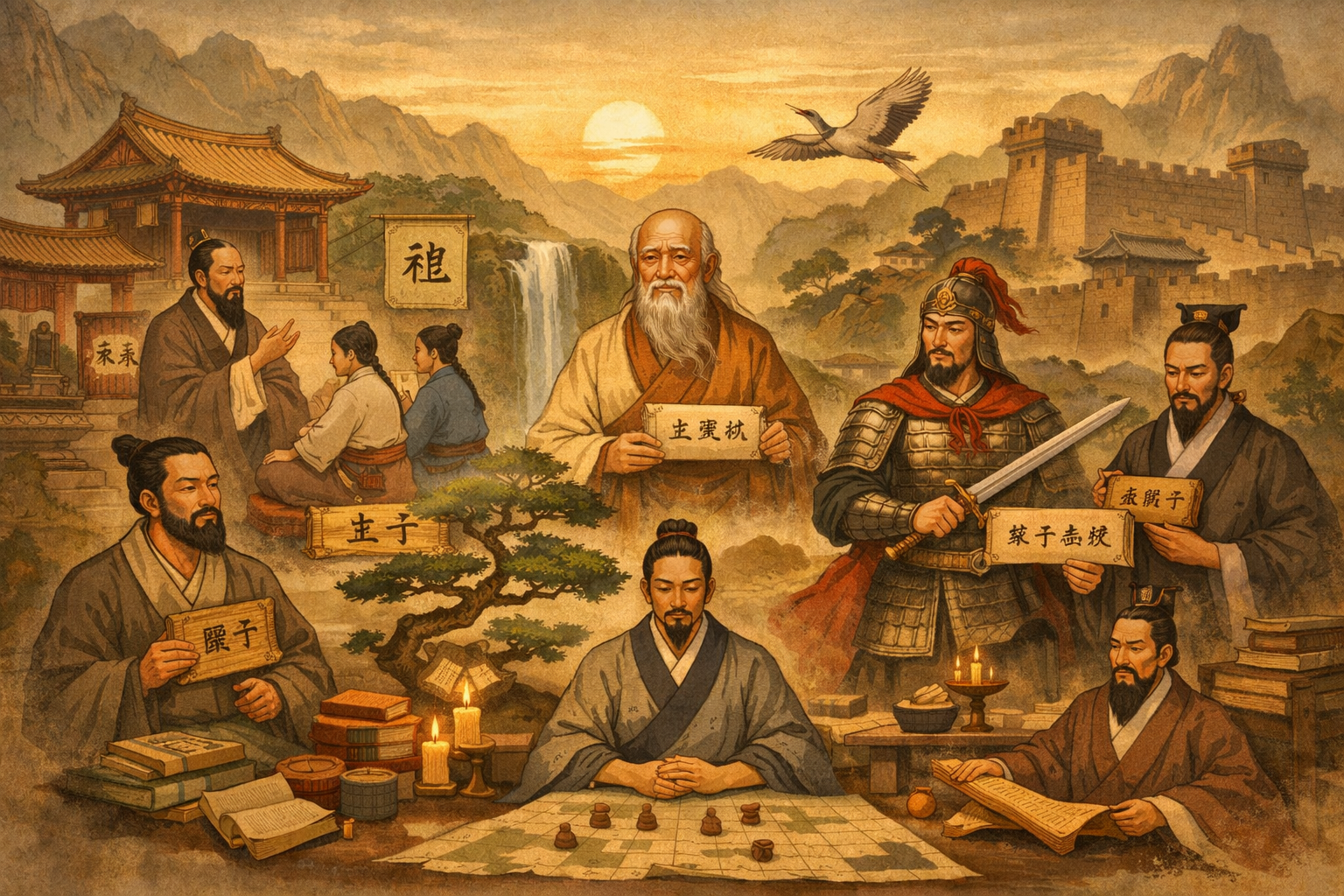
Chinese thought is especially important to a broader philosophy architecture because it provides one of the most sophisticated non-Western philosophical frameworks for understanding moral life, social relation, political authority, cultivated personhood, language, ritual, statecraft, and the fit between human order and larger cosmic processes. In this respect, the category connects not only to Ethics and Moral Philosophy and Political Philosophy and Justice, but also to Metaphysics, Greek and Roman Thought, Existential Thought, Persian Thought, and Islamic and Mystical Thought. Questions of ritual, governance, moral psychology, embodiment, language, nature, cultivated life, and patterned order all become clearer when Chinese thought is treated not as supplementary wisdom but as a major philosophical world in its own right.
A more fully comprehensive treatment of Chinese thought must also include the philosophical worlds that developed after the classical schools, especially Chinese Buddhism, Neo-Confucianism, and the broader cosmological and metaphysical traditions that shaped conceptions of change, pattern, resonance, and human alignment with the world. Chinese philosophy is not exhausted by early debates over ritual, law, and governance. It also includes profound reflection on qi, li, yin-yang, the Five Phases, the Yijing, Buddhist emptiness and mind, and the reconstruction of Confucian order under later civilizational conditions. These traditions reveal that Chinese thought is not only ethical and political, but also deeply metaphysical, cosmological, linguistic, and transformative in scope.
Source Material and Intellectual Framing
This series is grounded in both modern scholarship and classical Chinese source material. Benjamin I. Schwartz’s The World of Thought in Ancient China provides a particularly strong intellectual frame because it captures the diversity, tension, and conceptual richness of the formative period without flattening the schools into a single worldview. A research-grade treatment should also engage major modern interpreters such as A.C. Graham, Bryan W. Van Norden, Philip J. Ivanhoe, Roger T. Ames, David S. Nivison, Chad Hansen, Yuri Pines, Brook Ziporyn, and others who have helped clarify the philosophical stakes of classical Chinese argument.
At the same time, Chinese thought needs to be read through its own texts. A serious series in this area should draw directly on the Analects, the Mengzi, the Xunzi, the Mozi, the Daodejing, the Zhuangzi, the Han Feizi, the Yijing, and The Art of War. These works are not simply evidence for later summaries. They are where the arguments, concepts, sensibilities, literary strategies, moral claims, and contestations of Chinese thought take shape.
That combination matters because it lets the series move between close engagement with primary texts and larger civilizational synthesis. Modern scholarship helps illuminate the world of thought; the Chinese classics themselves give that world its voice. A strong pillar should therefore move repeatedly between canonical passages, conceptual analysis, historical setting, and comparative reflection without allowing any one of these levels to dominate the others.
It is especially important to avoid treating Chinese thought as a storehouse of aphorisms or simplified civilizational wisdom. Many of its central texts are argumentative, polemical, interpretive, dialogical, poetic, strategic, and institutionally aware. They speak not only about harmony, but about disorder; not only about virtue, but about power; not only about ritual, but about law; not only about naturalness, but about the difficulty of governing under conditions of fear, ambition, violence, and historical rupture.
Why Chinese Thought Matters
Chinese thought matters because it offers one of the world’s richest philosophical traditions for thinking about how human beings should be formed, how order should be maintained, how rulers should govern, how moral life becomes embodied in practice, and how social harmony can be pursued without reducing human existence to coercion or private individualism alone. It asks not only what is true, but what kind of cultivated person, household, institution, and public order should arise from that truth.
This matters because Chinese philosophy repeatedly refuses the modern tendency to isolate ethics from politics, selfhood from relationship, or personal discipline from public order. The human being is not treated as an abstract individual standing outside family, ritual, language, and historical formation. Rather, the person is understood through relation, role, cultivation, memory, speech, conduct, and participation in inherited and contested forms of life. That gives Chinese thought unusual force wherever philosophy must address social formation rather than only isolated choice.
Chinese thought also matters because it preserves a highly developed civilizational argument about order under conditions of breakdown. The classical schools emerged during periods of fragmentation, violence, administrative transformation, interstate competition, and moral uncertainty. Their disputes are therefore not scholastic games. They are responses to a world in crisis. Whether through ritual renewal, impartial concern, non-forcing, legal-administrative clarity, military strategy, Buddhist liberation, or Neo-Confucian moral-metaphysical synthesis, Chinese thinkers repeatedly asked how durable order and humane life might still be possible.
Within a broader philosophy architecture, Chinese thought offers one of the strongest non-European resources for comparative philosophy, political ethics, moral psychology, social ontology, metaphysics of relation, philosophy of language, civilizational reflection, and practical wisdom. It provides categories such as ren, li, yi, dao, de, wuwei, qi, li as principle, rectification of names, correlative order, and patterned transformation that cannot simply be translated into Western terms without loss. To study Chinese thought seriously is therefore to widen philosophy itself.
Historical and Cultural Context
Any serious account of Chinese thought begins with historical and cultural context. The classical schools did not arise in a vacuum. Their formative period belongs to an age of political fragmentation, warfare, administrative change, interstate competition, and moral uncertainty. Rival thinkers were not engaging in detached speculation so much as trying to answer how order, legitimacy, humane life, and effective rule might still be possible in a fractured world.
Seen this way, Chinese philosophy emerges from civilizational strain as much as from intellectual curiosity. Questions about ritual, hierarchy, law, humaneness, impartiality, spontaneity, military strategy, language, punishment, and state control all belong to the same broad effort to think through disorder and to identify more durable ways of life. A great deal of what makes classical Chinese thought philosophically vivid is precisely the fact that it is written under pressure.
This historical setting also helps explain why many Chinese texts move so fluidly between ethics and governance. A good society, in these debates, cannot be secured simply through metaphysical correctness or institutional design taken in isolation. It depends on character, ritual, law, persuasion, education, discipline, speech, and the cultivated quality of rulers and subjects alike.
The wider historical context also cautions against reading Chinese thought as only contemplative or quietist. Even Daoist and Buddhist traditions, which often critique overactive intervention or conceptual attachment, belong to worlds shaped by political power, social hierarchy, administrative order, and the demands of communal life. Chinese philosophy repeatedly asks how persons, families, rulers, states, and worlds become ordered, distorted, transformed, or released from harmful fixation.
The Zhou World and the Age of Argument
The Zhou dynasty provides the long political and cultural horizon out of which the classical schools emerged. Later generations repeatedly looked back to the Zhou as a formative civilizational matrix, and the Eastern Zhou period in particular became the setting in which many of the great philosophical traditions took shape. To invoke the Zhou was often to invoke a memory of order, legitimacy, ritual-political inheritance, and cultivated hierarchy, whether to restore it, criticize it, or transform it.
This makes the Zhou world more than background. It is the setting in which inherited ritual-political order began to weaken and new visions of governance, social life, moral formation, and administrative control had to be worked out. Chinese thought becomes easier to understand once it is seen as reflection under historical pressure rather than as timeless wisdom detached from circumstance.
The so-called Hundred Schools context should likewise be treated as a condition of real philosophical contest rather than a tidy taxonomy. Confucians, Mohists, Daoists, Legalists, military theorists, and other thinkers did not simply occupy adjacent boxes. They argued over the nature of the person, the legitimacy of rule, the function of ritual, the value of impartiality, the use of punishment, the meaning of order, the authority of language, and the proper relation between human life and the larger cosmos.
The age of argument is therefore one of the great achievements of world philosophy. It shows Chinese thought as a field of disagreement, not merely continuity. Its thinkers were not simply repeating inherited maxims. They were struggling over the terms of civilization itself: whether order should be ritual, legal, spontaneous, impartial, strategic, moral, administrative, cosmological, or some unstable combination of these.
Major Intellectual Lineages
The study of Chinese thought draws on several major intellectual lineages. One foundational lineage is Confucian, centered on self-cultivation, role ethics, exemplary personhood, humane relation, ritual order, education, and morally serious governance. In this tradition, learning, character, family relation, and public order belong to the same larger project of making human life more fitting and more humane.
A second lineage is Daoist, especially in the texts associated with Laozi and Zhuangzi. Here the emphasis falls on the Dao, naturalness, non-forcing, perspective, spontaneity, transformation, and the limits of rigid conceptualization or overmanaged social order. Daoist thought often serves as both a metaphysical and political counterpoint to more formalist, moralizing, or disciplinarian traditions.
A third lineage is Mohist. Mohist thinkers challenged inherited norms by asking whether institutions and customs could be justified in terms of practical benefit, order, and impartial concern. They brought argumentative rigor, reformist criticism, and proto-utilitarian reasoning into the center of classical Chinese debate.
A fourth lineage is Legalist, in which the central concerns become law, administration, incentive, surveillance, discipline, and the reliable production of political order. Legalism is indispensable because it shows that Chinese thought cannot be reduced to virtue and harmony alone. It contains a powerful current of political realism and institutional severity.
A fifth lineage includes military and strategic reflection, especially the world associated with The Art of War. Strategy, indirect action, the reading of conditions, and the calibrated use of force all belong to the broader Chinese reflection on order, intelligence, governance, and conflict.
A sixth lineage concerns cosmology, language, and correlative thinking, including reflection on Heaven, naming, qi, yin-yang, the Five Phases, pattern, resonance, and the Yijing. These traditions show that Chinese thought is not merely practical ethics. It also includes a deep philosophical imagination of change, relation, timing, transformation, and world-order.
A seventh lineage concerns later synthesis and transmission, including Han appropriations, Chinese Buddhist developments, Neo-Confucian reconstruction, and the long afterlife of classical categories in East Asian intellectual life. Chinese thought is therefore not only a classical archive but a dynamic tradition of commentary, reconstruction, state formation, spiritual discipline, and civilizational continuity.
Confucianism: The Founding Phase
Confucianism stands near the center of Chinese thought because it became one of the most enduring visions of ethical and political life in world philosophy. In its founding phase, associated above all with Confucius, it presents human beings as educable, relational, and capable of refinement through study, discipline, exemplary conduct, reverent speech, and ritual practice.
What makes this vision so powerful is the way it links self-cultivation to social and political order. Ethics is not reduced to isolated acts of conscience. It unfolds through family, education, ceremony, memory, role, and public life. Learning and moral formation become part of a broader project of civilizational renewal. To become a better person is already to participate in the remaking of a more ordered world.
Confucius is therefore important not merely as a founder, but as a philosophical model of seriousness about how everyday conduct, speech, reverence, relation, and education shape the larger moral quality of a society. The person and the polity are never fully separate in this tradition. The cultivated person becomes a living site where moral formation and public order meet.
Confucianism also provides one of the most important alternatives to theories that imagine social life primarily through contract, coercion, or isolated individual preference. It begins instead from relation, memory, role, learning, and moral refinement. That does not eliminate the need for criticism, especially where hierarchy hardens into domination, but it gives the tradition its distinctive philosophical depth.
Confucianism: The Philosophy of Ren
The concept of ren is one of the deepest moral ideas in the Confucian tradition. It is often translated as humaneness, benevolence, or humane excellence, but none of these captures it perfectly. Ren names a cultivated quality of relation and character, a way of being with others that is morally deep rather than merely polite, compliant, sentimental, or rule-following.
It also keeps Confucianism from hardening into empty formalism. Ritual, hierarchy, and propriety are not ends in themselves. They are meant to cultivate deeper humanity. The real question is not simply whether order is maintained, but whether persons are becoming more fully humane within that order. Without ren, ritual can become hollow and governance can become merely performative.
A research-grade treatment of Chinese thought should therefore linger over ren not as a vocabulary term but as a philosophical center of gravity. It is one of the places where Chinese thought most clearly joins ethics, anthropology, relation, and public life. It asks what kind of moral quality must animate conduct if social order is to become more than discipline or appearance.
Ren also helps reveal why Confucian ethics is not simply obedience to inherited forms. The tradition’s strongest versions insist that moral life requires inward seriousness, relational depth, affective cultivation, and practical judgment. The humane person is not merely correct in form. The humane person becomes capable of fitting relation.
Ritual, Propriety, and the Formation of Moral Life
The concept of li is equally indispensable. Often rendered as ritual, propriety, or patterned conduct, li shows how Chinese thought ties moral life to embodied practice. Human beings are not formed by abstract principles alone. They are shaped through gesture, ceremony, speech, role, repetition, reverence, and social discipline.
This matters because Confucian thought does not imagine morality as a purely inward sincerity detached from action. Moral life must take form. Ritual becomes one of the means by which emotion, hierarchy, memory, and relation are ordered without being reduced to brute coercion. Proper conduct is not decorative. It is formative.
At the same time, the Confucian tradition repeatedly warns that ritual without humanity becomes empty. The tension between form and sincerity is therefore internal to the tradition. This makes li philosophically rich rather than merely conservative. It asks how external practice and inward moral seriousness can become mutually sustaining.
Ritual also connects the individual person to a wider civilizational memory. It teaches how to inhabit roles, honor ancestors, express grief, regulate desire, acknowledge rank, and participate in a shared moral world. A serious account must therefore treat ritual neither as mechanical conformity nor as mere symbolism, but as a practical technology of moral formation.
Mohism
Mohism is one of the clearest signs that classical Chinese thought is genuinely argumentative. Mohist thinkers challenged inherited norms by asking whether institutions and customs could be justified in terms of practical benefit, order, and impartial concern. Their work gives Chinese philosophy a sharper reformist, critical, and analytic edge than stereotyped presentations often allow.
Mohism presses against the tendency to treat loyalty to one’s own circle as morally sufficient. It asks whether concern can be widened, whether social life can be judged by broader standards, and whether inherited practice deserves respect simply because it is old. In that sense, Mohism brings philosophical criticism directly into the center of classical Chinese debate.
Its importance also lies in its rationalizing impulse. Mohist thought asks what kinds of social practices actually reduce harm, improve order, and serve human beings more impartially. This gives Chinese philosophy one of its strongest internal critiques of hierarchy, extravagance, partiality, fatalism, ritual excess, and unexamined tradition.
Mohism also forces comparison with Confucianism. If Confucian ethics emphasizes graded relation, ritual, family, and cultivated role, Mohism asks whether such partiality fails to meet the demands of broader social concern. The result is not a simple opposition between love and order, but a deep dispute over what moral universality should mean in a relational world.
Daoism: Laozi
Daoism offers a distinct and powerful counterpoint to Confucian and Mohist lines of thought. In Laozi, the emphasis falls on the Dao, the way, and on forms of wisdom rooted in simplicity, restraint, naturalness, receptivity, and non-forcing. Where some traditions emphasize cultivation through social form, Daoism often asks what happens when life becomes overmanaged, overmoralized, overadministered, or too aggressively shaped by human intention.
Laozi gives one of the great classical philosophies of wise restraint. His thought turns attention toward attunement, fit, softness, humility, and a less coercive relation to the world. In doing so, Daoism broadens Chinese philosophy beyond duty and ritual into a deeper reflection on being, action, power, language, and the limits of forceful order.
This does not make Laozi apolitical in any simple sense. Rather, it offers a critique of domination and excess by asking how rule, conduct, and language become distorted when human beings try to impose themselves too aggressively upon the world. Non-forcing is not mere passivity. It is a disciplined refusal to confuse control with wisdom.
Laozi also gives Chinese thought one of its most powerful vocabularies for thinking about power indirectly. The strongest form of rule may not always announce itself as force. The most effective action may not always appear as intervention. The deepest order may not be the order most visibly imposed.
Zhuangzi
Zhuangzi deepens Daoist reflection by exploring freedom of perspective, the instability of rigid distinctions, and the limits of conceptual certainty. If Laozi gives a philosophy of non-forcing and alignment, Zhuangzi expands the tradition into questions of spontaneity, irony, language, transformation, and the strangeness of consciousness itself.
What makes Zhuangzi so enduring is the way he unsettles confidence in fixed categories without dissolving thought into nonsense. He reveals how quickly certainty can become philosophical blindness. In that respect, Zhuangzi does not merely complement Laozi; he enlarges Daoism into one of the most subtle meditations on freedom, perspective, and transformation in world philosophy.
A research-grade series should give Zhuangzi serious independent treatment because he is not simply a commentator on a prior Daoist core. He is one of the great philosophers of perspective, linguistic instability, transformation, and freedom from conceptual captivity.
Zhuangzi is also important because his writing performs the philosophical freedom it explores. Parable, humor, reversal, dream, animal image, exaggeration, and paradox are not decorative techniques. They are part of the philosophical method. Zhuangzi teaches by loosening the reader’s grip on rigid distinction and by making ordinary confidence appear strange.
Confucianism Developed: Mencius
Mencius is crucial because he develops Confucianism rather than merely repeating Confucius. He gives the tradition greater psychological and moral depth, especially by drawing questions of human nature and moral cultivation into sharper focus. Through Mencius, Confucianism becomes more explicit about how goodness can grow within the person and how moral life can be nurtured rather than merely imposed.
Mencius gives classical Confucianism one of its strongest developmental visions. The person is not only disciplined from outside but capable of moral growth through the cultivation of capacities already present in human life. That makes him central to the more hopeful and internally generative side of the Confucian tradition.
His philosophy matters not only as moral psychology but also as a defense of humane governance. If persons possess the capacity for cultivated goodness, then political order should not be organized solely around suspicion, punishment, or manipulation. Moral growth requires nourishment, example, education, and institutional conditions that do not crush the beginnings of humanity.
The Mencian tradition therefore matters because it links human nature, moral psychology, and political legitimacy. It suggests that a society’s task is not merely to restrain disorder, but to cultivate what is best in human beings.
Mencius’ Social and Political Philosophy
Mencius also extends Confucian thought more fully into social and political philosophy. Humane governance, in his vision, is inseparable from the moral quality of rule. Politics is not merely administration or control. It reflects the ethical substance of a society and the seriousness with which rulers respond to the people under their care.
This gives Mencius lasting importance for any philosophy of governance. He strengthens the idea that legitimacy is bound up with moral quality, and that political order without humane seriousness is unstable at its root. A ruler who neglects the people cannot sustain true order merely through force, ritual display, or institutional control.
Mencius thus becomes one of the most important classical resources for thinking about legitimacy, moral authority, and the ethical burden of political office in Chinese thought. He preserves a vision in which government is judged by its ability to nourish life, protect the vulnerable, and embody humane concern.
His political philosophy also sharpens the contrast between Confucian moral governance and Legalist administrative power. Both seek order, but they disagree profoundly about what kind of order is worthy of human beings.
Xunzi
Xunzi is equally indispensable because he advances a more austere and disciplinarian line within Confucian thought. Where Mencius often emphasizes moral growth from within, Xunzi stresses the necessity of culture, education, ritual, and deliberate shaping. Order, in his vision, is not something that naturally appears. It must be made.
That harder edge makes Xunzi one of the most important figures in the tradition. He clarifies that education and culture are not decorative achievements but formative necessities. Under his influence, Confucian thought becomes more sharply attentive to discipline, structure, institution, and the labor required to produce moral and social order.
Xunzi matters because he makes visible one of the deepest tensions in Chinese thought: whether human beings become good primarily by unfolding what is already there, or by being deliberately reshaped through culture, study, and patterned life. This dispute with Mencius is not a minor psychological disagreement. It changes the meaning of ethics, education, politics, and ritual.
Xunzi’s severity also prevents Confucianism from becoming sentimental. He insists that desire, conflict, and disorder must be taken seriously. A humane order requires artifice, training, law, hierarchy, and institutional form. The challenge is whether such form can cultivate humanity without becoming mere coercion.
Xunzi Continued
Xunzi’s continued importance lies in the way he ties ritual, education, language, and order together. Ritual is not decorative. It becomes a means of shaping desire, training conduct, and stabilizing society. In his hands, culture itself becomes a serious philosophical response to disorder.
He also helps explain how later Chinese thought could move toward more institutional and political visions of order without abandoning ethical seriousness. Xunzi sits at a crucial threshold between moral cultivation and political realism. In that sense, he is one of the indispensable figures for understanding the tension between Confucian ethics and later statecraft traditions.
Xunzi’s philosophy of language is also important. Naming, distinction, and correct use of terms are not merely semantic issues. They are tied to order, governance, education, and social coherence. If names become confused, conduct and authority become confused as well. This concern anticipates later debates over the rectification of names and the ethical power of language.
Xunzi therefore belongs at the center of Chinese philosophy because he links moral formation, institutional design, linguistic order, ritual practice, and political stability into a single demanding vision.
Legalism
Legalism shows with unusual clarity that Chinese thought cannot be reduced to harmony, virtue, or inward cultivation alone. Legalist thinkers direct attention toward law, incentive, administration, punishment, surveillance, discipline, and the machinery of state power. Their concern is not primarily the moral refinement of persons, but the reliable production of political order.
That makes Legalism indispensable. It brings political realism into the center of classical Chinese philosophy and forces the broader tradition to confront harder questions about enforcement, institutional design, and the uses of power in unstable conditions. A society cannot be governed by moral aspiration alone if its structures do not reliably hold.
Legalism therefore belongs inside the tradition not as an embarrassment but as one of its central argumentative poles. It reveals how deeply Chinese philosophy grappled with the problem of political order under real historical pressure. It also warns that governance can become a technology of control when moral formation is displaced by administrative calculation.
The Legalist challenge remains philosophically important because it asks whether virtue is politically dependable, whether law can substitute for moral cultivation, and whether order secured through fear and incentive deserves to be called good order. These questions remain alive wherever institutions seek stability without humane legitimacy.
Sunzi and The Art of War
The Art of War deserves serious treatment within Chinese thought because it belongs to the same broader classical world of conflict, statecraft, and political order. Sunzi should not be reduced to modern management clichés. In its proper setting, this text is concerned with judgment under uncertainty, the use of knowledge, the management of force, the reading of conditions, and the strategic logic of conflict.
Read in that way, The Art of War belongs naturally beside discussions of governance and order. It is not just a manual of tactics. It is also a reflection on prudence, adaptation, indirect action, discipline, and the relation between intelligence and power in a world where conflict is an enduring feature of political life.
Its inclusion in the pillar helps widen Chinese thought beyond moral cultivation narrowly conceived, showing that classical Chinese reflection also developed sophisticated theories of action under pressure, strategic fit, and the economy of force.
Sunzi’s philosophical importance lies especially in his attention to conditions. Good action is not simply the imposition of will. It depends on timing, terrain, morale, information, deception, discipline, and the shape of the whole situation. Strategy becomes a philosophy of situated judgment.
Classical Chinese Thought in Debate
The deepest strength of classical Chinese thought is that it is internally argumentative. Confucius, Mozi, Laozi, Zhuangzi, Mencius, Xunzi, Han Feizi, Sunzi, and other thinkers do not merely present minor variations of one civilizational worldview. They debate the nature of moral life, the place of ritual, the structure of governance, the meaning of impartiality, the significance of nature, the use of law, the legitimacy of force, the role of language, and the conditions of durable order.
That is why Chinese thought is such a rich philosophical field. It is not merely a tradition of harmony, but a tradition of serious disagreement about how human beings should live and how order should be made. Some stress ritual and cultivation, some impartial concern, some natural alignment, some strategic intelligence, some state power and legal structure, some Buddhist liberation, and some later moral-metaphysical synthesis. Taken together, they form one of the most sophisticated civilizational debates in world philosophy.
A research-grade treatment must therefore avoid presenting Chinese thought as a static wisdom tradition. Its power lies in argument, not only continuity. The schools are best understood through their collisions as much as through their shared civilizational setting.
This also means that comparison should not be simplistic. Confucianism is not simply social order. Daoism is not simply freedom. Legalism is not simply authoritarian harshness. Mohism is not simply utility. Each tradition contains internal nuance, later reception, and philosophical pressure points. The value of the field lies in sustained reading of the arguments themselves.
Cosmos, Language, and the Order of Things
Chinese thought is often introduced through ethics and governance, but it also contains deep reflection on cosmology, language, naming, pattern, and the relation between human order and larger processes under heaven. Concepts of Heaven, the Dao, patterned order, transformation, and fit all reveal that Chinese philosophy is not simply moral instruction. It is also a way of thinking about how reality itself is structured and how human beings ought to align with that structure.
This matters because many debates about governance, ritual, and conduct presuppose broader claims about the world. Is order something imposed by human artifice, or discovered through attunement? Does naming clarify reality or imprison it? Is the cosmos best understood as patterned hierarchy, spontaneous transformation, or contested field? These questions show that Chinese philosophy includes metaphysical and linguistic depth even when it presents itself in practical terms.
Language is especially important. The rectification of names is not merely a technical theory of reference. It asks whether social life depends on names, roles, titles, obligations, and distinctions being properly ordered. If a ruler does not act as a ruler, or a minister as a minister, or a parent as a parent, then language itself reveals moral and political disorder. Naming becomes part of the structure of ethical life.
A fuller pillar should therefore make visible the way moral, political, linguistic, and cosmological inquiry remain intertwined in Chinese thought. The order of human life is rarely separable from the order of things.
Family, State, and Civilizational Order
Chinese thought repeatedly treats family, education, and governance as linked rather than isolated domains. The household is not merely private; it is one of the training grounds of moral life. Filiality, role, continuity, reverence, care, and patterned relation all become part of a larger account of how persons are formed and how authority can become either humane or corrupt.
This matters because Chinese philosophy often imagines civilizational order as beginning from cultivated forms of relation rather than from contract among isolated individuals. The state is not only a coercive apparatus. It is also an extension, distortion, or refinement of the moral quality present in smaller forms of life. This makes Chinese thought especially important for comparative political philosophy, because it offers a powerful alternative to modern atomistic models of the political person.
At the same time, this structure invites criticism. The same traditions that emphasize ethical relation can also naturalize hierarchy. Family, gender, age, rank, and obedience can be treated as sources of moral formation, but they can also become instruments of domination or exclusion. A serious treatment should therefore show both the depth and the tension of this family-state-civilization continuum.
The philosophical question is not whether relation matters. Chinese thought makes clear that it does. The harder question is what forms of relation cultivate humaneness, and what forms merely preserve inherited power.
Chinese Buddhism and the Transformation of Philosophical Life
No comprehensive treatment of Chinese thought can end with the classical schools alone. Chinese Buddhism transformed the intellectual landscape by introducing new ways of thinking about mind, suffering, emptiness, perception, discipline, liberation, and the relation between appearance and reality. Once Buddhism entered China and developed through translation, commentary, debate, and adaptation, it became one of the indispensable components of Chinese philosophical life rather than a merely foreign addition.
This matters because Chinese Buddhism did not simply import Indian doctrines unchanged. It generated distinctively Chinese forms of thought, practice, and metaphysical reflection. Tiantai, Huayan, and Chan each developed powerful accounts of reality, mind, practice, interdependence, and awakening that reshaped the meaning of cultivation and transformed the larger philosophical conversation. Questions of self-cultivation, moral life, and political order could no longer remain untouched by Buddhist views of impermanence, emptiness, and liberation.
Chinese Buddhism also widened the range of philosophical possibility. It deepened reflection on consciousness, illusion, suffering, attachment, language, and the limits of conceptual fixation. In that sense, it belongs not only to religious history but to Chinese metaphysics, moral psychology, and philosophical anthropology. A research-grade treatment of Chinese thought therefore requires major attention to the Buddhist transformation of the tradition and to the new syntheses and tensions that followed from it.
Buddhism also changed Confucianism and Daoism by forcing both to respond to new metaphysical and spiritual challenges. Later Chinese thought cannot be understood without this encounter.
Neo-Confucianism and the Reconstruction of Moral Order
Neo-Confucianism is equally indispensable to a comprehensive account of Chinese thought. It represents not merely a revival of early Confucian themes, but a major reconstruction of moral, metaphysical, and educational philosophy under conditions shaped by Buddhism, Daoism, imperial statecraft, and long civilizational development. In Neo-Confucianism, Chinese philosophy becomes more explicitly systematic about the relation between cosmology, human nature, moral cultivation, knowledge, action, and public order.
This matters because Neo-Confucian thinkers did not simply preserve the classics. They reinterpreted them in light of deep questions about pattern, material force, mind, principle, sincerity, investigation, and the structure of reality itself. The result was one of the most sophisticated moral-metaphysical syntheses in world philosophy, especially in thinkers such as Zhu Xi and Wang Yangming. Through them, Chinese thought developed richer accounts of moral psychology, self-cultivation, and the unity or tension between inward knowledge and outward practice.
Neo-Confucianism also matters because it shaped education, orthodoxy, governance, and the long moral vocabulary of Chinese civilization. A pillar that ends before Neo-Confucianism remains incomplete, because it misses one of the major moments in which Chinese thought became at once more reflective, more systematic, and more enduringly institutional.
Its importance also lies in its struggle with Buddhism and Daoism. Neo-Confucianism sought to recover Confucian moral seriousness while absorbing, resisting, and transforming metaphysical questions sharpened by those traditions. It is therefore a reconstruction, not a simple return.
Cosmology, Pattern, and the Metaphysics of Order
Chinese thought is often introduced through ethics and governance, but a deeper treatment must also foreground cosmology and metaphysics. The Chinese philosophical world includes sustained reflection on Heaven, the Dao, qi, pattern, transformation, yin-yang, the Five Phases, correlative order, and the relation between human conduct and the larger processes of the cosmos. These are not decorative background ideas. They shape how moral life, political order, health, ritual, and cultivated judgment are understood.
This matters because Chinese philosophy often treats the order of human life as continuous with a broader order of things. The person, the family, the state, nature, and heaven are not always sharply divided domains. Rather, they may be understood through patterned relation, resonance, transformation, and fit. This gives Chinese thought a different metaphysical texture than many traditions organized around substance, individual autonomy, or strong dualisms between nature and culture.
A comprehensive pillar should therefore show that Chinese thought contains not only ethical and political teaching, but also a serious account of world-order. Questions of change, pattern, force, naming, relation, and alignment belong to the heart of the tradition. Without them, harmony can sound merely moralistic rather than cosmological, and cultivation can sound merely personal rather than civilizational.
The metaphysics of order in Chinese thought is not always expressed as abstract ontology. Often it appears through practices of timing, ritual, diagnosis, government, music, medicine, divination, and moral formation. This makes it philosophically demanding because it asks readers to recognize metaphysical thought in forms that do not always resemble later European treatises.
The Yijing and the Philosophy of Change
No final expansion pass on Chinese cosmology would be complete without the Yijing. The Book of Changes is one of the most influential texts in the Chinese intellectual world, not only as a divinatory classic but as a source for reflection on change, pattern, transformation, contingency, correlation, and the intelligibility of unfolding situations. It helped shape the larger Chinese sense that reality is dynamic, patterned, and responsive rather than static and inert.
This matters because the Yijing offers one of the deepest frameworks through which change itself becomes philosophically meaningful. Rather than treating order as the denial of change, it often treats order as something disclosed through transformation, timing, relation, and the reading of conditions. That gives Chinese thought a powerful alternative to philosophies that privilege fixed essence over process.
The Yijing should therefore be treated not merely as a classic of divination, but as a major source for Chinese metaphysical imagination, correlative cosmology, strategic judgment, and the philosophy of becoming.
Its importance also lies in its influence. Confucian, Daoist, cosmological, political, and medical traditions drew from its language of transformation and pattern. The text becomes a meeting point where practical judgment, metaphysical order, and historical contingency converge.
Later Developments and the Afterlife of Classical Thought
Chinese thought did not end with the classical period. Han statecraft, later Confucian orthodoxy, Buddhist interaction, Neo-Confucian synthesis, evidential scholarship, modern reform movements, and contemporary comparative philosophy all transformed the older traditions. The afterlife of classical thought is therefore not a mere appendix. It is part of what makes Chinese philosophy a living civilizational tradition rather than a frozen archive.
This matters because later developments reveal how canonical texts are continually re-read under new institutional, religious, and political conditions. Chinese philosophy survives by commentary, education, canon formation, reinterpretation, and historical reuse. That process is itself philosophically significant.
A comprehensive pillar should therefore point beyond the formative classical debates toward later traditions, comparative influence in East Asia, and the continuing role of Chinese thought in contemporary philosophy, political culture, environmental reflection, moral psychology, and civilizational self-understanding.
The afterlife of Chinese thought also shows how traditions remain alive by being reinterpreted. Confucius, Laozi, Zhuangzi, Mencius, Xunzi, Mozi, Han Feizi, Zhu Xi, Wang Yangming, and Buddhist thinkers continue to speak not because their worlds are identical to ours, but because the problems they confronted—order, desire, language, power, cultivation, suffering, and change—remain philosophically alive.
Core Themes in Chinese Thought
One major theme in this field is self-cultivation. Chinese thought repeatedly asks how human beings should form their character, judgment, and conduct through learning, discipline, relation, and reflective practice.
A second theme is harmony and order. Chinese philosophy asks how personal, familial, social, and political life may be brought into fitting relation without reducing all order to coercion or all freedom to arbitrariness.
A third theme is ritual and propriety. The Confucian concern with ritual shows how embodied practice, role, ceremony, and propriety help form moral and social life.
A fourth theme is governance. Chinese thought contains sustained reflection on rulership, administration, law, virtue, strategy, and the conditions under which political order is maintained or distorted.
A fifth theme is naturalness and the Dao. Daoist traditions especially ask how life should align with the way, simplicity, spontaneity, and a less coercive relation to the world.
A sixth theme is argument within a civilizational tradition. Confucianism, Daoism, Mohism, Legalism, military-statecraft texts such as The Art of War, Buddhist schools, and Neo-Confucian reconstructions do not produce one answer to human life but a complex field of rival possibilities.
A seventh theme is language and naming. Chinese philosophy repeatedly asks how names, roles, distinctions, and speech shape moral conduct, political order, and the intelligibility of social life.
An eighth theme is cosmological and metaphysical order. Chinese thought asks how Heaven, Dao, pattern, change, resonance, qi, principle, and human conduct relate to one another within a larger intelligible world.
A ninth theme is family, hierarchy, and relation. The tradition treats kinship, filiality, household order, and role as morally formative, while also raising serious questions about hierarchy, gender, authority, and constraint.
Finally, this field raises persistent questions of wisdom, relation, and the good society. Chinese thought endures because it treats philosophical life as inseparable from education, conduct, public order, and the search for fitting ways of inhabiting the world.
Expanded Article Architecture
The following structure gathers the Chinese Thought pillar into a long-range article architecture. It preserves the planned article sequence from the source draft while adding short descriptions for each article and expanding the overall map to reflect classical debates, cosmology, Buddhism, Neo-Confucianism, gender, statecraft, and comparative philosophy.
Foundations of Chinese Thought
- Introduction to Chinese Thought (planned)
Introduces Chinese philosophy as a major civilizational tradition concerned with cultivation, ritual, governance, language, order, nature, and the art of living well. - Historic and Cultural Context of Classical Chinese Philosophy (planned)
Explains the historical pressures, political fragmentation, and social transformations that gave rise to the major classical schools. - The Zhou World and the Conditions of Philosophical Debate (planned)
Studies the Zhou political and ritual horizon as the setting for later disputes over order, legitimacy, cultivation, and authority. - Chinese Thought: Harmony, Cultivation, and the Order of Human Life (planned)
Frames Chinese philosophy around the relation between cultivated persons, ordered families, stable governance, and cosmic pattern.
Confucian Beginnings and Moral Formation
- Confucianism: The Founding Phase (planned)
Introduces early Confucianism through learning, ritual, role, humane relation, moral seriousness, and the renewal of civilizational order. - Confucius and the Ethics of Moral Formation (planned)
Studies Confucius as a thinker of education, character, reverence, speech, conduct, and the disciplined formation of the exemplary person. - Confucianism: The Philosophy of Ren (planned)
Examines ren as humaneness, relational excellence, cultivated moral depth, and one of the central concepts of Confucian ethics. - Confucianism: Ritual, Propriety, and the Formation of Moral Life (planned)
Studies li as ritual, propriety, embodied practice, and a formative structure of moral, familial, and social life. - Family, Filiality, and Ethical Relation in Confucian Thought (planned)
Explores filiality, kinship, role, reverence, and family as moral foundations in Confucian ethics and social philosophy.
Mohism and Reformist Critique
- Mohism and the Critique of Partiality (planned)
Introduces Mohism as a reformist tradition challenging partiality, ritual excess, hierarchy, and inherited practice. - Mozi and the Ethics of Impartial Concern (planned)
Studies Mozi’s argument for broader moral concern and the critique of narrow loyalty to one’s own circle. - Mohist Argument, Utility, and the Reform of Society (planned)
Examines Mohist reasoning about benefit, harm reduction, social order, practical justification, and institutional reform.
Daoism, Naturalness, and the Limits of Control
- Daoism: Laozi (planned)
Introduces Laozi’s philosophy of Dao, simplicity, receptivity, non-forcing, humility, and critique of coercive order. - Laozi on the Dao, Simplicity, and Non-Forcing (planned)
Studies wuwei, restraint, softness, indirect power, and the philosophical critique of excess intervention. - Zhuangzi and the Freedom of Perspective (planned)
Examines Zhuangzi’s philosophy of perspective, transformation, spontaneity, humor, and freedom from rigid distinctions. - Zhuangzi on Language, Distinction, and Spontaneity (planned)
Studies Zhuangzi’s treatment of language, naming, conceptual fixation, and the freedom made possible by loosening rigid categories.
Mencius and the Development of Confucian Moral Psychology
- Confucianism Developed: Mencius (planned)
Introduces Mencius as a major developer of Confucian moral psychology, human nature, cultivation, and humane governance. - Mencius on Human Nature and Moral Cultivation (planned)
Studies Mencius’ account of moral sprouts, cultivated goodness, emotional responsiveness, and the development of virtue. - Mencius’ Social and Political Philosophy (planned)
Examines humane rule, moral legitimacy, care for the people, and the ethical conditions of stable political order.
Xunzi, Ritual Discipline, and Cultural Formation
- Xunzi and the Discipline of Culture (planned)
Introduces Xunzi’s more austere Confucian vision of education, ritual, discipline, and deliberate moral formation. - Xunzi Continued: Ritual, Education, and Order (planned)
Studies how ritual, learning, hierarchy, and cultural practice produce moral and social order in Xunzi’s thought. - Xunzi on Language, Desire, and Human Formation (planned)
Examines Xunzi’s account of naming, desire, distinction, education, and the disciplined formation of persons.
Legalism, Law, and Political Control
- Legalism and the Problem of Political Control (planned)
Introduces Legalism as a tradition centered on law, punishment, administration, incentive, authority, and state order. - Han Feizi and the Logic of State Power (planned)
Studies Han Feizi’s political philosophy of law, technique, authority, surveillance, bureaucracy, and ruler-centered control. - Law, Punishment, and Administrative Order in Chinese Thought (planned)
Examines how legal and administrative systems shape behavior, stabilize rule, and raise ethical questions about coercive order.
Strategy, Conflict, and Statecraft
- Sunzi and The Art of War (planned)
Introduces Sunzi as a thinker of conflict, intelligence, timing, discipline, indirect action, and strategic judgment. - The Art of War: Strategy, Statecraft, and the Logic of Conflict (planned)
Studies strategy as the reading of conditions, calibrated force, deception, adaptation, and the economy of conflict.
Classical Debate, Governance, and Moral Order
- Classical Chinese Thought in Debate (planned)
Synthesizes the major disagreements among Confucian, Daoist, Mohist, Legalist, and strategic traditions. - Chinese Thought and the Moral Foundations of Governance (planned)
Examines the relation between virtue, law, ritual, legitimacy, public order, and the moral responsibilities of rulers.
Cosmos, Language, Naming, and Natural Order
- Cosmos, Heaven, and the Patterning of Human Life (planned)
Studies Heaven, cosmic order, moral legitimacy, and the relation between human life and larger patterns of reality. - Language, Naming, and the Order of Things in Chinese Philosophy (planned)
Examines naming, distinction, speech, classification, and the philosophical power of language in ordering social life. - Rectification of Names and the Ethics of Language (planned)
Studies the rectification of names as a doctrine linking language, role, authority, obligation, and moral-political order. - Nature, Spontaneity, and the Critique of Force (planned)
Examines Daoist and related critiques of excessive intervention, coercion, artificiality, and overmanaged life. - The Yijing and the Philosophy of Change (planned)
Studies the Book of Changes as a major source for Chinese reflection on transformation, timing, pattern, and contingency. - Correlative Cosmology and the Patterning of the World (planned)
Examines correlative thinking as a way of linking heaven, earth, body, state, ritual, season, and patterned transformation. - Yin-Yang, the Five Phases, and the Structure of Transformation (planned)
Studies yin-yang and Five Phases thinking as frameworks for change, balance, process, and patterned relation. - Qi, Pattern, and the Metaphysics of Chinese Thought (planned)
Examines qi, pattern, material force, resonance, and the metaphysical vocabulary of Chinese cosmology. - Cosmology, Resonance, and the Order of Human Life (planned)
Studies how cosmological resonance connects conduct, ritual, body, governance, and world-order.
Family, Education, Rulership, and Empire
- Family, State, and Civilizational Order (planned)
Examines the Chinese linkage between household relation, moral formation, public order, and civilizational continuity. - Chinese Thought and the Ethics of Education (planned)
Studies education as moral cultivation, social formation, classical learning, and preparation for responsible conduct. - Rulership, Legitimacy, and Humane Authority (planned)
Examines what makes rule legitimate in Chinese thought, including virtue, mandate, care for the people, ritual order, and administrative capacity. - The Qin-Han Transition and the Philosophical Problem of Empire (planned)
Studies the transition from classical debate to imperial order and the philosophical problems raised by centralized rule. - Confucianism and Imperial Statecraft (planned)
Examines how Confucian thought became linked to bureaucracy, education, state ideology, and imperial governance. - Law, Bureaucracy, and the Moral Limits of Rule (planned)
Studies the tension between legal-administrative order and moral governance in the Chinese political tradition.
Chinese Buddhism and the Transformation of Mind, Self, and Practice
- Chinese Buddhism and the Transformation of Philosophical Life (planned)
Introduces Chinese Buddhism as a major transformation of Chinese philosophy through mind, suffering, emptiness, practice, and liberation. - Buddhism and the Reconfiguration of Self, Mind, and Liberation in China (planned)
Studies how Buddhist thought reshaped Chinese understandings of selfhood, consciousness, suffering, attachment, and awakening. - Tiantai and the Philosophy of Buddhist Order (planned)
Examines Tiantai thought through classification, totality, practice, reality, and the ordering of Buddhist teaching. - Huayan, Interdependence, and the Metaphysics of Totality (planned)
Studies Huayan philosophy as a profound account of interpenetration, relational totality, dependence, and the structure of reality. - Chan Buddhism, Practice, and the Critique of Conceptual Attachment (planned)
Examines Chan’s emphasis on practice, awakening, nonattachment to concepts, direct insight, and the limits of discursive thought. - Buddhism and the Transformation of Chinese Moral Psychology (planned)
Studies how Buddhist accounts of desire, suffering, illusion, compassion, and mind transformed Chinese moral psychology.
Han Synthesis, Later Traditions, and Neo-Confucian Reconstruction
- Chinese Thought Beyond the Classical Schools (planned)
Explores the continuation of Chinese philosophy beyond early schools through synthesis, commentary, Buddhism, statecraft, and later reconstruction. - Han Synthesis and the Institutionalization of Philosophy (planned)
Studies how Han thought integrated classical traditions into statecraft, cosmology, education, and imperial order. - Neo-Confucianism and the Reconstruction of Moral Order (planned)
Introduces Neo-Confucianism as a major synthesis of moral cultivation, cosmology, principle, mind, and education. - Zhu Xi and the Metaphysics of Principle (planned)
Examines Zhu Xi’s account of principle, investigation, moral learning, and the systematic reconstruction of Confucian thought. - Li, Qi, and the Reconstruction of Cosmic-Moral Order (planned)
Studies the Neo-Confucian relation between principle and material force as a framework for reality, morality, and cultivation. - Neo-Confucian Self-Cultivation and Moral Psychology (planned)
Examines how Neo-Confucian thinkers understood learning, desire, sincerity, mind, discipline, and moral transformation. - Wang Yangming and the Unity of Knowledge and Action (planned)
Studies Wang Yangming’s philosophy of innate knowing, moral action, mind, sincerity, and the unity of knowledge and practice. - Mind, Principle, and Moral Knowing in Late Imperial Thought (planned)
Examines later debates over mind, principle, moral knowledge, practice, and the internal structure of cultivated life.
Gender, Family, and Social Hierarchy
- Women, Family, and Gendered Order in Chinese Thought (planned)
Studies how family, gender roles, kinship, hierarchy, and moral formation shaped Chinese ethical and social thought. - Gender, Hierarchy, and Moral Formation in the Confucian World (planned)
Examines the philosophical tension between Confucian moral cultivation and gendered structures of authority and exclusion.
Comparative Philosophy and Contemporary Significance
- Buddhism and the Transformation of Chinese Philosophy (planned)
Synthesizes the long Buddhist transformation of Chinese metaphysics, practice, moral psychology, and philosophical anthropology. - Chinese Thought in Comparative Philosophy (planned)
Places Chinese thought in dialogue with Greek, Indian, Islamic, European, and modern philosophical traditions without reducing it to external categories. - Why Chinese Thought Still Matters (planned)
Concludes the series by explaining why Chinese thought remains vital for ethics, governance, cultivation, language, cosmology, and comparative philosophy.
Additional Expansion Articles for a Fuller Pillar
- The Hundred Schools and the Problem of Order (planned)
Expands the series by examining the Hundred Schools as a historically pressured field of competing answers to disorder, violence, and political instability. - Confucian Role Ethics and the Relational Self (planned)
Studies the person as formed through relation, role, obligation, care, ritual, and participation in shared moral life. - The Mandate of Heaven and Political Legitimacy (planned)
Examines Heaven, legitimacy, dynastic change, moral failure, and the philosophical meaning of political authority. - Daoist Political Thought and the Critique of Overgovernment (planned)
Studies Daoist critiques of excessive law, moralism, force, and administrative intrusion. - Confucianism, Daoism, and the Question of Human Artifice (planned)
Compares traditions that emphasize ritual shaping with traditions that warn against artificial distortion of natural life. - Mohist Logic and the Structure of Argument (planned)
Examines Mohist contributions to logic, classification, disputation, standards, and analytic reasoning in early Chinese philosophy. - Chinese Philosophy of Music, Ritual, and Harmony (planned)
Studies music and ritual as forms of patterned order shaping emotion, social relation, moral education, and political life. - Chinese Medical Thought, Body, and Cosmology (planned)
Examines the relation between body, qi, balance, seasonal order, medicine, and cosmological pattern. - Chinese Thought and Environmental Philosophy (planned)
Studies Dao, Heaven, relational order, non-forcing, cultivation, and ecological interpretation in relation to environmental thought. - Chinese Thought and the Philosophy of Technology (planned)
Explores how Chinese concepts of order, control, technique, artifice, and non-forcing can illuminate modern technological systems. - Chinese Thought and Global Governance (planned)
Examines Chinese philosophical resources for legitimacy, order, responsibility, bureaucracy, moral authority, and international political thought. - Chinese Thought, Modernity, and Reform (planned)
Studies the reinterpretation of Chinese philosophy under modern conditions of reform, revolution, empire, nationalism, and global comparison.
Closing Perspective
Chinese thought remains indispensable because it gives philosophy one of its richest vocabularies for thinking about formation, relation, order, power, language, change, and cultivated life. It asks how persons become humane, how families shape moral life, how rulers gain or lose legitimacy, how ritual forms character, how law can stabilize or distort order, how strategy reads conditions, how language organizes social reality, and how human life fits within larger patterns of transformation.
This does not mean Chinese philosophy offers one simple answer. Its power lies in disagreement. Confucianism emphasizes cultivated relation, ritual, and humane governance. Daoism questions coercive order, conceptual rigidity, and overmanaged life. Mohism challenges partiality and demands broader practical justification. Legalism confronts the machinery of state power. Sunzi develops a philosophy of strategic intelligence under conflict. Chinese Buddhism transforms questions of mind, suffering, and liberation. Neo-Confucianism reconstructs moral order through cosmology, principle, and self-cultivation.
The strongest reason to study Chinese thought is that its questions remain alive. How should human beings be formed? What makes authority legitimate? When does order become coercion? How should language guide conduct? What is the relation between family, state, and moral life? How should one act without forcing? How does change become intelligible? What kind of wisdom is possible in a world of conflict, hierarchy, transformation, and uncertainty? These are not only Chinese questions. They are enduring philosophical questions, and Chinese thought is one of the great traditions through which they can be studied with depth.
Related Reading
- Ethics and Moral Philosophy — for virtue, moral formation, duty, humane conduct, practical wisdom, and the good life.
- Political Philosophy and Justice — for rulership, legitimacy, law, governance, authority, civic order, and public responsibility.
- Metaphysics — for being, order, change, pattern, relation, cosmology, and the structure of reality.
- Greek and Roman Thought — for comparative classical traditions of virtue, reason, civic life, law, and philosophical discipline.
- Existential Thought — for mortality, freedom, selfhood, meaning, suffering, and the problem of how to live.
- Persian Thought — for comparative reflection on wisdom, kingship, ethics, metaphysics, poetry, and civilizational memory.
- Islamic and Mystical Thought — for metaphysics, spiritual discipline, divine reality, philosophical theology, and contemplative transformation.
Further Reading
- Ames, R.T. and Rosemont, H. Jr. (1998) The Analects of Confucius: A Philosophical Translation. New York: Ballantine Books. Available at: https://www.penguinrandomhouse.com/books/2919/the-analects-of-confucius-by-roger-t-ames-and-henry-rosemont-jr/.
- Graham, A.C. (1989) Disputers of the Tao: Philosophical Argument in Ancient China. La Salle, IL: Open Court. Available at: https://www.opencourtbooks.com/books_n/disputers.htm.
- Ivanhoe, P.J. and Van Norden, B.W. (eds.) (2005) Readings in Classical Chinese Philosophy. 2nd edn. Indianapolis: Hackett. Available at: https://hackettpublishing.com/readings-in-classical-chinese-philosophy-second-edition.
- Pines, Y. (2012) The Everlasting Empire: The Political Culture of Ancient China and Its Imperial Legacy. Princeton, NJ: Princeton University Press. Available at: https://press.princeton.edu/books/paperback/9780691153572/the-everlasting-empire.
- Schwartz, B.I. (1985) The World of Thought in Ancient China. Cambridge, MA: Harvard University Press. Available at: https://www.hup.harvard.edu/books/9780674961913.
- Van Norden, B.W. (2007) Virtue Ethics and Consequentialism in Early Chinese Philosophy. Cambridge: Cambridge University Press. Available at: https://www.cambridge.org/core/books/virtue-ethics-and-consequentialism-in-early-chinese-philosophy/8AB3919677B59B7C39B7E7F326A60544.
- Wong, D.B. (2011) Natural Moralities: A Defense of Pluralistic Relativism. New York: Oxford University Press. Available at: https://global.oup.com/academic/product/natural-moralities-9780195383292.
- Ziporyn, B. (2009) Zhuangzi: The Essential Writings with Selections from Traditional Commentaries. Indianapolis: Hackett. Available at: https://hackettpublishing.com/zhuangzi-the-essential-writings.
References
- The Analects. Available at: https://ctext.org/analects.
- Mencius. Available at: https://ctext.org/mengzi.
- Xunzi. Available at: https://ctext.org/xunzi.
- Mozi. Available at: https://ctext.org/mozi.
- Daodejing. Available at: https://ctext.org/dao-de-jing.
- Zhuangzi. Available at: https://ctext.org/zhuangzi.
- Han Feizi. Available at: https://ctext.org/hanfeizi.
- Yijing. Available at: https://ctext.org/book-of-changes.
- The Art of War. Available at: https://ctext.org/art-of-war.
- Britannica (n.d.) Chinese philosophy. Available at: https://www.britannica.com/topic/Chinese-philosophy.
- Britannica (n.d.) Confucianism. Available at: https://www.britannica.com/topic/Confucianism.
- Britannica (n.d.) Zhou dynasty. Available at: https://www.britannica.com/topic/Zhou-dynasty.
- Britannica (n.d.) Sunzi. Available at: https://www.britannica.com/biography/Sunzi.
- Fraser, C. (2023) ‘Mohism’, in Zalta, E.N. and Nodelman, U. (eds.) The Stanford Encyclopedia of Philosophy. Available at: https://plato.stanford.edu/entries/mohism/.
- Hansen, C. (2025) ‘Daoism’, in Zalta, E.N. and Nodelman, U. (eds.) The Stanford Encyclopedia of Philosophy. Available at: https://plato.stanford.edu/entries/daoism/.
- Internet Encyclopedia of Philosophy (n.d.) Chinese Philosophy: Overview of History. Available at: https://iep.utm.edu/chinese-philosophy-overview-of-history/.
- Pines, Y. (2014) ‘Legalism in Chinese Philosophy’, in Zalta, E.N. and Nodelman, U. (eds.) The Stanford Encyclopedia of Philosophy. Available at: https://plato.stanford.edu/entries/chinese-legalism/.
- Schwartz, B.I. (1985) The World of Thought in Ancient China. Cambridge, MA: Harvard University Press. Available at: https://www.hup.harvard.edu/books/9780674961913.
- Van Norden, B.W. (2008) ‘Chinese Ethics’, in Zalta, E.N. and Nodelman, U. (eds.) The Stanford Encyclopedia of Philosophy. Available at: https://plato.stanford.edu/entries/ethics-chinese/.