
Last Updated May 3, 2026
Kinship, reciprocity, and social organization examine the relational structures through which human communities organize belonging, obligation, exchange, care, inheritance, alliance, and social reproduction. In cultural anthropology, these patterns are not confined to family life in a narrow sense. They extend to the broader ways societies structure descent, marriage, households, lineages, mutual aid, exchange, migration, remittances, inheritance, care, dependency, authority, and communal responsibility across generations. Kinship is therefore not simply a biological or legal fact. It is one of the principal relational architectures through which social life becomes durable, intelligible, and morally binding.
This content pillar brings together the major domains through which cultural anthropology studies relatedness, reciprocity, exchange, and social organization. It examines kinship systems, descent, alliance, marriage, household formation, lineage, inheritance, residence, gift exchange, reciprocity, care, dependency, social support, migration, gender, reproduction, informality, remittance networks, community resilience, and the moral foundations of obligation. It treats kinship not as a private domain isolated from public life, but as a social infrastructure that links intimacy to economy, household to community, care to power, inheritance to continuity, and everyday obligation to wider systems of authority, memory, and social order.
Current Space
Cultural Anthropology
Related Topic
Culture, Meaning & Symbolism
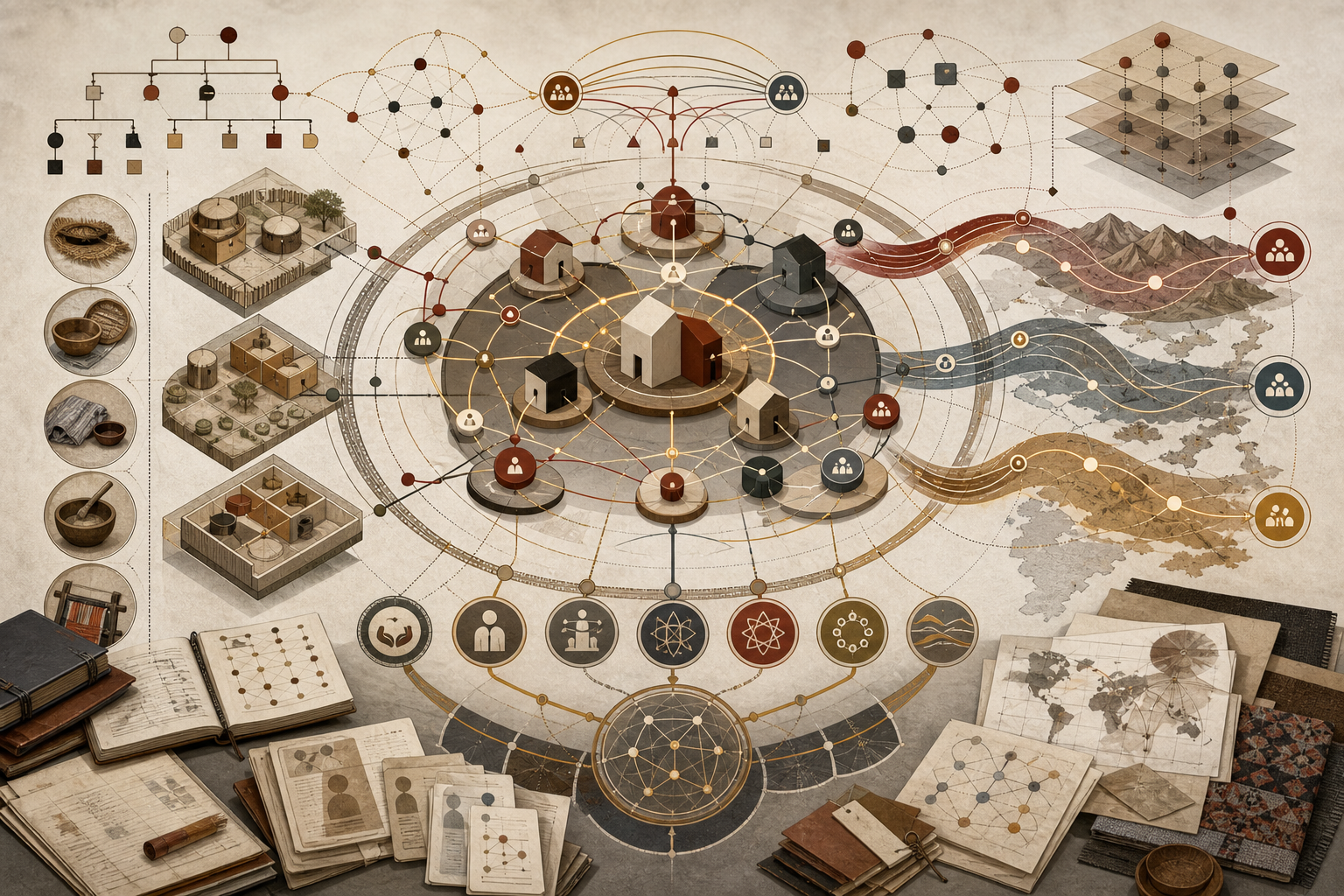
This series also approaches kinship and reciprocity as fields that benefit from careful research infrastructure: kinship diagrams, household profiles, exchange records, interview guides, fieldnote templates, qualitative codebooks, migration and remittance case notes, ethical memos, anonymized relational maps, bibliographic records, and reproducible research documentation. Cultural anthropology cannot reduce kinship to network diagrams, family trees, or exchange tables. Kinship is lived through emotion, obligation, care, authority, memory, conflict, gender, class, migration, law, ritual, and everyday practice. Yet research repositories can strengthen this work by making sources, fieldnote structures, interpretive categories, ethical decisions, and methodological assumptions more transparent.
For that reason, this pillar integrates cultural anthropology with open research workflows where appropriate. Python may support synthetic kinship-network examples, relationship metadata, anonymized graph structures, source organization, and research utilities. R may support qualitative-code summaries, exchange-pattern tables, care-work summaries, household comparison, and reproducible research reports. SQL may support structured catalogs for sources, households, relationships, exchange events, obligations, migration records, interview excerpts, and interpretive memos. Markdown and notebooks may support research logs, literature reviews, concept maps, reflexive memos, methods documentation, and article-level research packages. These tools do not replace anthropological interpretation. They help make relational evidence more organized, auditable, and reusable while preserving context, ethics, reflexivity, and the central anthropological responsibility of interpretation.
Kinship, reciprocity, and social organization therefore appear here not only as classic anthropological concerns, but also as a research architecture for studying how social life is reproduced through relation. The aim of the series is to preserve the interpretive and comparative richness of kinship anthropology while building a more transparent scholarly workflow around concepts, cases, sources, obligations, care, and exchange. In that sense, this pillar treats kinship not simply as family structure, but as one of the deepest infrastructures of everyday social life.
Kinship, Reciprocity, and Social Organization Research Repository
The Kinship, Reciprocity, and Social Organization knowledge series is supported by an open research repository with article-level folders, annotated bibliographies, research notes, kinship-diagram templates, household-profile templates, ethical fieldwork guidance, qualitative codebooks, synthetic teaching datasets, source metadata, SQL research schemas, Python and R workflow examples, notebooks, and reproducible research scaffolding where appropriate.
View the Kinship, Reciprocity, and Social Organization Research Repository
Kinship, Reciprocity, and Social Organization as a Foundational Anthropological Field
Kinship, reciprocity, and social organization occupy a central place in cultural anthropology because human communities do not persist through formal institutions alone. They also endure through everyday structures of care, obligation, dependency, exchange, inheritance, alliance, residence, household labor, memory, and mutual expectation. These structures connect persons to households, households to wider networks, and networks to larger systems of authority, continuity, and moral order. To study kinship in this sense is to study one of the principal relational architectures through which social life becomes durable.
Anthropology has long treated kinship as something more than family in the ordinary sense. In its stronger analytical form, kinship refers to systems of relationship through which societies organize descent, marriage, inheritance, residence, alliance, authority, reproduction, support, and belonging. These systems help determine who counts as kin, how persons are situated within a wider moral order, how obligations are distributed, and how communities reproduce continuity across time. Kinship is therefore not simply a private sphere. It is one of the principal structures through which social life is organized, reproduced, and transmitted.
This perspective matters because social order is not sustained by law, administration, or markets alone. It is also sustained through informal structures of care, obligation, dependency, reciprocity, and exchange that bind persons to one another in morally consequential ways. Households distribute labor, resources, responsibility, inheritance, and emotional support. Kin groups shape alliance, care, identity, authority, marriage, memory, and social protection. Reciprocal exchange creates expectations of return and thereby stabilizes relations that extend beyond immediate family life into wider networks of trust, obligation, and interdependence.
A serious anthropology of kinship therefore asks not only who is related to whom, but how relatedness is made, recognized, disputed, inherited, transformed, and lived. It asks how kinship terms organize expectation, how households reproduce social life, how gift exchange creates obligation, how marriage and alliance connect groups, how care work is distributed, how migration reshapes family networks, and how social organization is reproduced through everyday relational practice.
Kinship as Relational Infrastructure
Kinship may be understood as relational infrastructure. It is not infrastructure in the technical sense of roads, pipes, wires, or platforms, but it often performs similarly consequential work. It carries support, memory, care, inheritance, labor, authority, obligation, legitimacy, and belonging across time. It helps determine who is responsible for whom, who can call on whom, who inherits, who marries whom, who belongs where, who is remembered, and who is socially protected.
This relational infrastructure is not always visible from the outside. A society may appear to be organized by formal institutions, markets, state services, or legal rules, while everyday life remains deeply dependent on households, extended families, kin networks, reciprocal obligations, remittances, patronage, ritual ties, and informal support systems. Economic life often depends on trust embedded in kin and communal ties. Political life may draw on family-based loyalties, inherited patronage, marriage alliances, and durable structures of belonging. Social protection may depend less on bureaucratic provision than on households, relatives, neighbors, migrant networks, and reciprocal obligations.
Kinship as relational infrastructure also helps explain why social change is rarely only economic, legal, or administrative. Policies that alter inheritance, land tenure, welfare, migration, reproduction, marriage, gender, labor, housing, or elder care enter existing relational worlds. Technologies such as assisted reproduction, DNA testing, social media, mobile money, and migration platforms do not simply add new tools to old families. They can transform what relatedness means, how obligation travels, how care is organized, and how people imagine belonging.
To study kinship seriously is therefore to study one of the deepest organizational layers of society. Kinship links intimacy to structure. It connects bodies, names, houses, land, memory, exchange, gender, labor, law, ritual, and moral expectation. It reveals that social organization is not only institutional. It is relational.
Kinship Studies as Interpretive Research Practice
Kinship studies require interpretive care because relatedness is never merely a diagram. Genealogical charts, household rosters, marriage rules, exchange tables, and descent categories can be useful, but they cannot by themselves capture the lived meaning of kinship. A person may be considered kin through birth, marriage, adoption, co-residence, feeding, ritual incorporation, shared labor, naming, sponsorship, migration, care, or long-term obligation. What appears to be “family” from one analytical perspective may be understood very differently by the people whose relationships are being studied.
This requires close attention to emic categories. Kinship terms often encode age, gender, generation, authority, affection, avoidance, obligation, joking relations, respect, seniority, and moral expectation. A term translated as “uncle,” “cousin,” “mother,” “brother,” or “child” may not map neatly onto Euro-American assumptions about biology or household structure. Relatedness may be made through substance, land, ritual, naming, feeding, milk, adoption, debt, apprenticeship, political alliance, or shared suffering. Anthropological interpretation must therefore avoid translating kinship systems too quickly into familiar categories.
Kinship research also requires reflexivity. Earlier anthropological work sometimes projected outside assumptions about blood, descent, marriage, family, gender, and biological relatedness onto societies with different understandings of social relation. Later scholarship challenged those assumptions by asking how relatedness is actually made in particular settings. A research repository for this pillar can support that work by organizing kinship terms, household notes, exchange records, interview guides, source metadata, ethical restrictions, and interpretive memos. But the central scholarly task remains contextual interpretation.
The goal is not to turn kinship into data detached from persons. It is to make the research process more careful: to distinguish participant categories from researcher categories, to document uncertainty, to protect sensitive relationships, to avoid exposing private family information, and to interpret relational life in context.
What This Pillar Studies
This pillar studies kinship as the organization of relatedness, obligation, exchange, and social reproduction. It examines how societies define persons, classify relatives, form households, arrange marriage, transmit inheritance, recognize descent, create alliance, distribute care, organize dependency, and sustain social continuity. It asks how relatedness is made through biology, law, ritual, feeding, residence, labor, naming, memory, reproduction, technology, and shared life.
At the level of everyday practice, the pillar examines households, domestic labor, childrearing, elder care, hospitality, mutual aid, remittances, gift exchange, inheritance, marriage negotiations, caregiving, and social support. At the level of wider social organization, it examines lineages, clans, descent groups, alliance systems, patronage, community networks, migration circuits, ritual kinship, and forms of belonging that extend beyond the immediate household. At the level of political and economic life, it examines how kinship shapes authority, property, land, labor, social protection, welfare, migration, development, and community resilience.
The pillar also studies reciprocity as a moral and relational form of exchange. Reciprocity is not simply exchange in the narrow economic sense. It is a social logic of giving, receiving, and returning through which relationships are formed, sustained, ranked, remembered, and sometimes burdened. Gifts, favors, remittances, care, hospitality, labor, ritual support, and mutual aid create obligations that may produce solidarity, dependency, prestige, debt, gratitude, or tension.
Finally, this pillar studies power. Kinship can provide identity, belonging, care, and protection, but it can also structure hierarchy, gendered labor, inheritance inequality, family pressure, social surveillance, exclusion, patronage, and unequal dependence. Reciprocity can sustain community, but it can also generate moral coercion. Social organization can create resilience, but it can also reproduce inequality. The anthropology of kinship therefore studies relation and power together.
Major Intellectual Lineages
The anthropology of kinship and social organization draws on several major intellectual traditions. One important lineage comes from classical kinship studies centered on descent, marriage rules, lineage systems, residence patterns, inheritance, and the comparative classification of family forms. In this tradition, kinship was treated as one of the foundational structures of society, shaping authority, succession, group membership, alliance, property, and the reproduction of social life. Anthropologists sought to understand how societies organized persons into relational categories that extended far beyond immediate biological ties into wider systems of descent and obligation.
A second major lineage focuses on alliance and exchange. Here, kinship is understood not only through descent but through marriage, reciprocity, and the circulation of persons, goods, and obligations across groups. This approach emphasized that social order is often sustained through exchange rather than isolated self-interest. The study of gift exchange became especially important because it revealed how giving, receiving, and returning are never merely economic transactions. They are moral acts that create enduring social ties, mutual expectations, prestige, debt, and wider structures of social cohesion.
A third lineage emerged through later critiques of classical kinship theory. Anthropologists increasingly argued that earlier work too often projected Euro-American assumptions about blood, biology, marriage, and family onto societies with very different understandings of relatedness. Subsequent scholarship broadened the field by asking how kinship is actually made in specific cultural settings: through feeding, co-residence, ritual incorporation, shared substance, reproduction, labor, memory, and care. In this view, relatedness is not simply a natural given. It is actively produced, interpreted, and lived through culturally organized practice.
A fourth lineage examines households, gender, domestic labor, reproduction, and care. This line of work asks how kinship is sustained through everyday work: cooking, cleaning, raising children, tending elders, managing money, arranging marriages, maintaining ritual obligations, hosting relatives, and coordinating support across distance. It also shows that kinship systems often assign care and obligation unequally, especially along lines of gender, generation, class, caste, migration status, and marital position.
A fifth lineage examines migration, transnational families, remittances, informality, and social support. This work shows how kinship extends across borders through money, communication, visits, rituals, obligations, and emotional labor. It also shows how migration can intensify obligations even as it separates households geographically. Relatedness persists through distance, but it is often reworked through technology, remittance economies, legal status, and uneven mobility.
Taken together, these lineages show that kinship anthropology is not merely the study of family forms. It is one of the discipline’s central pathways for understanding how societies organize belonging, continuity, exchange, obligation, care, authority, and the reproduction of everyday life. Kinship links intimacy to economy, household to polity, care to inheritance, and moral obligation to the wider organization of social structure.
Core Themes in the Study of Relational Life
One major theme in this field is kinship itself: the ways societies define relatedness, classify persons, and assign social roles through descent, marriage, alliance, co-residence, shared substance, ritual incorporation, adoption, care, or practice. Anthropologists ask how kin terms organize expectation, how lineages and households function, how residence patterns shape obligation, and how systems of relatedness distribute authority, care, property, identity, and social continuity.
A second major theme is reciprocity. Reciprocity is not simply exchange in the narrow economic sense, but a social logic of giving, receiving, and returning through which relationships are formed and sustained. Anthropological work on exchange has shown that gifts are never just objects moving between isolated individuals. They carry obligation, establish ties, generate expectations of response, and help stabilize wider moral worlds. Exchange, in this sense, is one of the means through which societies make social life durable.
A third theme is the household as a site of labor, care, reproduction, and distribution. Households often serve as the immediate arena in which kinship becomes practical: children are raised, labor is divided, resources are allocated, obligations are negotiated, elders are supported, and continuity is reproduced. Yet households are rarely self-contained. They are linked to wider circuits of kinship, inheritance, migration, remittance, ritual obligation, and social support, making them both intimate and structurally consequential units of social organization.
A fourth theme is alliance and cohesion. Marriage, exchange, co-residence, ritual ties, fictive kinship, compadrazgo, mutual aid, and forms of social support often connect households and groups into larger structures of solidarity or dependence. Anthropology therefore examines how kinship and reciprocity bind communities together, manage conflict, distribute support, and create wider forms of belonging that exceed the individual household.
A fifth theme is change. Kinship systems are not static remnants of tradition. They are reshaped by migration, markets, state policy, urbanization, reproductive technologies, gender transformation, labor mobility, inheritance law, digital communication, welfare systems, and shifting forms of care. Anthropological analysis pays close attention to the ways kinship is reworked under modern conditions, revealing that relatedness remains fundamental even as its forms evolve.
Finally, this field raises persistent questions of power and inequality. Kinship can provide identity, solidarity, and support, but it can also structure hierarchy, exclusion, inheritance inequality, gendered labor, obligation, and asymmetrical dependence. Reciprocity can bind communities together, yet it can also encode pressure, moral surveillance, and unequal relations masked as mutuality. For this reason, the anthropology of kinship and reciprocity is also a study of how power is distributed through intimate and everyday forms of social organization.
Kinship, Reciprocity, and Social Organization Pillar Map
The map below organizes the Kinship, Reciprocity, and Social Organization series into conceptual domains, moving from foundational theories of kinship into descent, alliance, households, exchange, inheritance, care, gender, migration, reproduction, informality, social support, community resilience, power, and research practice.
This pillar is organized to move from foundations and first principles into kinship classification, descent, alliance, marriage, households, reciprocity, gift exchange, inheritance, care, dependency, gender, migration, reproductive technologies, informality, support systems, resilience, and moral obligation. Research infrastructure is integrated where it strengthens scholarly practice, especially through annotated bibliographies, kinship-diagram templates, household-profile templates, exchange-event metadata, qualitative codebooks, fieldnote templates, synthetic teaching datasets, Python utilities, R summaries, SQL research catalogs, and reproducible notebooks. The goal is a pillar that remains fully anthropological while also making its research practices more transparent, organized, and ethically responsible.
Foundations of Kinship and Relatedness
- What Is Kinship in Anthropological Thought? (planned) — A foundational article defining kinship as a system of culturally organized relatedness rather than a narrow biological or legal category. This article explains why kinship remains central to anthropology’s understanding of social organization, belonging, obligation, and continuity.
- Kinship as Relational Infrastructure (planned) — An article on kinship as a deep social infrastructure that carries care, inheritance, memory, authority, obligation, and support across households, communities, and generations.
- Relatedness Beyond Biology (planned) — A major article on how relatedness may be produced through feeding, co-residence, adoption, ritual ties, shared labor, naming, care, migration, memory, and social recognition.
- Kinship, Personhood, and Social Identity (planned) — An article on how kinship systems define persons, names, statuses, roles, obligations, gendered expectations, and social belonging.
- Kinship Terminologies and Social Classification (planned) — A focused article on kin terms, classificatory systems, generational distinctions, joking relations, avoidance relations, seniority, and the social logic embedded in naming relatives.
- Emic and Etic Categories in Kinship Research (planned) — A methodological article on participant categories, researcher categories, translation problems, kinship diagrams, and the risk of imposing outside assumptions on relational worlds.
Descent, Lineage, Alliance, and Social Continuity
- Descent, Alliance, and the Classical Study of Kinship (planned) — A core article on descent groups, lineages, clans, alliance systems, marriage rules, inheritance, residence, and the classical foundations of kinship anthropology.
- Lineage, Clan, and the Transmission of Social Continuity (planned) — An article on descent-based social organization, ancestry, membership, inheritance, authority, ritual obligation, and the reproduction of group continuity.
- Inheritance, Lineage, and the Transmission of Social Continuity (planned) — A focused article on property, land, names, status, memory, ritual responsibility, and the intergenerational transfer of social position.
- Ancestorhood, Memory, and Kinship Across Generations (planned) — An article on ancestors, lineage memory, graves, ritual continuity, genealogical imagination, and the ways kinship extends beyond the living.
- Residence Patterns and the Organization of Social Life (planned) — An article on patrilocal, matrilocal, neolocal, avunculocal, and other residence patterns as arrangements that organize labor, authority, marriage, and household life.
- Names, Descent, and the Social Memory of Belonging (planned) — A study of names, titles, genealogies, family histories, documents, and oral traditions as forms through which kinship is remembered and authorized.
Marriage, Alliance, and the Organization of Social Ties
- Marriage, Alliance, and the Organization of Social Ties (planned) — A major article on marriage as a social institution linking persons, households, descent groups, property, gender, reproduction, alliance, and legitimacy.
- Claude Lévi-Strauss and Alliance Theory (planned) — A focused article on alliance theory, exchange, marriage rules, reciprocity, and the structural study of kinship relations.
- Marriage Rules, Exogamy, and Endogamy (planned) — An article on rules and expectations governing who may marry whom, how marriage creates boundaries, and how alliance systems shape social organization.
- Bridewealth, Dowry, and the Material Life of Marriage (planned) — A careful article on marriage payments, property transfers, gendered obligations, alliance, status, and the dangers of reducing marriage exchange to economics alone.
- Divorce, Remarriage, and the Reworking of Kinship Ties (planned) — An article on how kinship systems manage rupture, remarriage, step-relations, custody, inheritance, alliance, and household reconfiguration.
- Marriage, Law, and Social Recognition (planned) — An article on the relationship between cultural marriage practices, state law, religious authority, kin recognition, legitimacy, and changing family forms.
Households, Domestic Life, and Social Reproduction
- Households, Domestic Life, and Social Reproduction (planned) — A foundational article on households as sites where labor, care, resources, reproduction, memory, obligation, and social continuity are organized.
- Domestic Labor, Care Work, and Everyday Obligation (planned) — An article on cooking, cleaning, childcare, elder care, emotional labor, household management, and the often invisible work through which kinship is maintained.
- Household Economies and Moral Distribution (planned) — A study of how households allocate food, money, land, labor, education, care, and inheritance according to moral and relational expectations.
- Children, Elders, and Intergenerational Responsibility (planned) — An article on age, dependency, care, authority, socialization, elderhood, childhood, and the intergenerational organization of responsibility.
- Households, Risk, and Community Resilience (planned) — A systems article on how households absorb shocks through mutual aid, remittances, savings, labor sharing, migration, and extended kin support.
- Domestic Space, Kinship, and the Organization of Belonging (planned) — A spatial article on houses, rooms, courtyards, compounds, kitchens, sleeping arrangements, and the material organization of kinship life.
Reciprocity, Exchange, and Mutual Obligation
- Reciprocity, Exchange, and the Moral Life of Obligation (planned) — A core article on reciprocity as a social logic of giving, receiving, returning, remembering, and sustaining relational life.
- Gift Exchange and the Social Logic of Giving (planned) — A major article on gifts as social acts that create relation, prestige, debt, gratitude, obligation, and moral expectation.
- Marcel Mauss and the Anthropology of Reciprocity (planned) — A focused article on Mauss, the gift, obligation, total social facts, exchange, personhood, and the social force of giving, receiving, and returning.
- Balanced, Generalized, and Negative Reciprocity (planned) — An article on classic forms of reciprocity and how they structure trust, distance, exchange, exploitation, generosity, and social expectation.
- Mutual Aid, Solidarity, and Informal Support Systems (planned) — A contemporary article on mutual aid, neighbor support, kin networks, rotating credit, informal welfare, and collective survival outside formal institutions.
- Debt, Obligation, and the Burden of Reciprocity (planned) — A critical article on how reciprocity may create pressure, hierarchy, dependency, moral surveillance, or obligations that are difficult to refuse.
- Hospitality, Hosting, and the Ethics of Receiving Others (planned) — An article on hospitality as relational practice, including welcome, obligation, status, risk, generosity, strangerhood, and household honor.
Care, Dependency, Gender, and Power
- Care, Dependency, and the Everyday Work of Kinship (planned) — A major article on care as one of the central practices through which kinship is made, maintained, expected, and contested.
- Gender, Power, and the Politics of Family Organization (planned) — A critical article on how kinship systems organize gendered labor, authority, marriage expectations, inheritance, care, reproduction, and dependency.
- Motherhood, Fatherhood, and Cultural Models of Parenthood (planned) — An article on the cultural organization of parenthood, caregiving, authority, responsibility, legitimacy, and emotional expectation.
- Siblings, Cousins, and Horizontal Kinship Ties (planned) — A focused article on siblinghood, cousinhood, age hierarchy, cooperation, rivalry, inheritance, alliance, and lateral support.
- Kinship, Obligation, and Family Conflict (planned) — An article on conflict, avoidance, estrangement, inheritance disputes, gendered pressure, generational tension, and the ambivalence of kinship ties.
- Care Chains, Labor Migration, and Transnational Families (planned) — A contemporary article on gendered migration, paid care work, remittances, children left behind, elder care, and the global redistribution of reproductive labor.
Migration, Remittances, and Translocal Kin Networks
- Migration, Remittances, and Translocal Kin Networks (planned) — A major article on how migration stretches kinship across distance through money, communication, visits, ritual obligations, documents, and emotional labor.
- Remittances and the Moral Economy of Obligation (planned) — An article on remittances as financial, emotional, moral, and symbolic acts that sustain households while reshaping power and dependency.
- Diaspora, Kinship, and Long-Distance Belonging (planned) — A study of how diasporic communities maintain kinship through memory, marriage, language, ritual, food, digital communication, and transnational visits.
- Migration Documents, Legal Status, and Family Separation (planned) — An article on how borders, visas, documents, detention, deportation, and legal categories reorganize kinship and household life.
- Digital Communication and the Maintenance of Kinship Across Distance (planned) — A contemporary article on phones, messaging, video calls, social media, mobile money, and the technological mediation of care and obligation.
- Return Migration, Homecoming, and Kinship Expectations (planned) — An article on return, obligation, status, disappointment, reintegration, ritual welcome, and the complicated moral life of homecoming.
Reproduction, Technology, and Changing Relatedness
- Reproductive Technologies and the Changing Meaning of Kinship (planned) — A major article on assisted reproduction, surrogacy, sperm and egg donation, IVF, genetic testing, and the transformation of kinship categories.
- Adoption, Fostering, and the Making of Relatedness (planned) — An article on adoption, fostering, child circulation, caregiving, legal recognition, social parenthood, and kinship beyond birth.
- DNA, Genealogy, and the Politics of Biological Knowledge (planned) — A critical article on genetic ancestry, DNA testing, biological claims, identity, inheritance, secrecy, and the re-biologization of relatedness.
- Surrogacy, Labor, and the Ethics of Reproductive Exchange (planned) — An article on surrogacy as reproductive labor, kinship transformation, legal complexity, inequality, gender, and global reproductive markets.
- Queer Kinship and Chosen Family (planned) — An article on chosen family, care networks, recognition, exclusion, intimacy, and the reworking of kinship outside dominant family norms.
- Reproductive Loss, Memory, and Kinship Recognition (planned) — A sensitive article on miscarriage, stillbirth, infertility, grief, ritual, recognition, silence, and the social meaning of reproductive loss.
Kinship, Informality, Institutions, and Social Support
- Kinship, Informality, and Social Support Systems (planned) — A major article on informal welfare, household support, kin-based loans, childcare, elder care, job access, housing support, and the social life of dependency.
- Kinship, Patronage, and Political Authority (planned) — An article on kinship in political life, including loyalty, patronage, faction, inheritance of office, dynastic authority, and the moral language of political belonging.
- Kinship and Economic Life (planned) — A study of how kinship shapes labor, trust, credit, entrepreneurship, business networks, property, hiring, and informal economic systems.
- Social Protection Beyond the State (planned) — An article on households, kin networks, religious communities, mutual aid, remittances, and community forms of social protection outside formal welfare systems.
- Kinship, Welfare, and the Limits of Formal Policy (planned) — A policy-facing article on how formal programs interact with existing household obligations, caregiving expectations, kin responsibilities, and informal support.
- Kinship, Community Resilience, and Crisis Response (planned) — A systems article on how kinship and reciprocal networks respond to disaster, unemployment, illness, migration shocks, environmental stress, and political instability.
Power, Inequality, and the Ambivalence of Kinship
- Kinship, Reciprocity, and the Moral Foundations of Social Organization (planned) — A capstone article on how kinship and reciprocity create moral order, obligation, belonging, and social durability while also producing hierarchy and conflict.
- Kinship, Hierarchy, and Unequal Obligation (planned) — A critical article on seniority, gender, birth order, lineage rank, class, caste, inheritance, and unequal demands within relational systems.
- Inheritance, Exclusion, and the Reproduction of Inequality (planned) — An article on how property, land, wealth, names, status, and opportunity are transmitted unequally through kinship systems.
- Family Honor, Shame, and Moral Surveillance (planned) — A sensitive article on how kinship systems regulate reputation, gender, sexuality, marriage, obedience, and public standing through honor and shame.
- Violence, Dependency, and the Limits of Kinship Solidarity (planned) — A critical article on domestic violence, coercion, elder abuse, forced obligation, abandonment, and the vulnerability produced by dependency.
- Refusing Kinship, Estrangement, and Relational Exit (planned) — An article on estrangement, refusal, boundary-setting, chosen relations, leaving households, and the moral difficulty of exiting kinship obligations.
Research Methods, Ethics, and Relational Data
- Fieldnotes, Genealogies, and the Documentation of Kinship (planned) — A methodological article on fieldnotes, genealogical methods, kinship diagrams, household histories, source metadata, and the limits of relational documentation.
- Interviewing About Family, Care, Obligation, and Exchange (planned) — A research-practice article on conducting ethical interviews about sensitive relational topics, including marriage, inheritance, migration, care, conflict, and dependency.
- Kinship Diagrams, Household Profiles, and Ethical Representation (planned) — An article on diagramming relatedness without exposing private relationships or flattening cultural categories into abstract charts.
- Codebooks for Kinship, Reciprocity, and Social Organization (planned) — A practical article on qualitative coding for kin terms, obligations, exchange events, household labor, care roles, migration ties, and interpretive memos.
- Relational Data, Privacy, and Anthropological Ethics (planned) — A critical article on why kinship data is ethically sensitive, how relational information can expose people, and why anonymization must consider networks as well as individuals.
- Digital Research Repositories for Kinship Anthropology (planned) — A practical article on organizing sources, notes, synthetic examples, codebooks, kinship diagrams, exchange records, ethics notes, and reproducible workflows without reducing kinship to data.
Python Workflow: Synthetic Kinship Network and Obligation Metadata
A useful Python workflow for this pillar is a synthetic kinship-network and obligation-metadata workflow. The workflow can begin with a small synthetic teaching dataset containing anonymized persons, household identifiers, relationship types, exchange events, care obligations, migration status, and notes about ethical sensitivity. Python can be used to validate relationship records, generate a simple adjacency list, identify relationship categories, summarize exchange or care ties, and export structured tables for research review. In a more advanced version, the workflow can incorporate household timelines, migration events, remittance records, ritual obligations, inheritance disputes, and links between fieldnote excerpts and interpretive memos.
This workflow belongs naturally with articles on kinship terminology, households, reciprocity, remittances, care, social support, migration, and relational data ethics. It demonstrates how research infrastructure can support interpretation without replacing it. The purpose is not to map real people casually, expose private relationships, or treat kinship as a network detached from meaning. The purpose is to show how synthetic examples and transparent metadata can help researchers think carefully about relatedness, obligation, and social organization while foregrounding privacy, consent, and context.
R Workflow: Reciprocity, Care, and Household Code Summaries
A useful R workflow for this pillar is a reciprocity, care, and household-code summary workflow. The workflow can begin with a synthetic coding table containing excerpt identifiers, household roles, relationship types, exchange categories, care-work codes, obligation forms, migration contexts, and researcher memos. R can be used to summarize code frequencies, compare care obligations across relationship types, visualize exchange categories, and create reproducible tables for article drafting. In a more advanced version, the workflow can incorporate qualitative coding for generalized, balanced, and negative reciprocity; gendered labor; remittance obligations; elder care; inheritance; and household risk response.
This workflow belongs naturally with articles on reciprocity, gift exchange, domestic labor, care, migration, social support, gender, and household resilience. It demonstrates that computational summaries can support kinship research only when they remain subordinate to ethnographic interpretation. A table showing that “care,” “remittance,” and “obligation” co-occur in a synthetic corpus does not explain a kinship system by itself. It simply identifies a pattern that requires close reading, participant context, historical interpretation, and ethical care.
Fieldwork Ethics and the Sensitivity of Relational Data
Kinship research requires particular ethical care because relational information is rarely private to one person alone. A genealogy, household roster, inheritance dispute, marriage history, care arrangement, or migration record can reveal sensitive information about multiple people at once. Even when names are removed, relational patterns may make individuals identifiable within a community. Kinship data can expose conflict, illegitimacy, adoption, reproductive history, estrangement, debt, abuse, migration status, inheritance claims, or social obligations that participants may not want public.
For that reason, research infrastructure for this pillar must treat relational data as ethically sensitive by default. Real kinship records should not be stored in public repositories unless there is explicit permission, careful anonymization, and a clear ethical basis. Synthetic teaching datasets are preferable for public code examples. Fieldnotes should separate public observations from sensitive private information. Genealogical diagrams should be simplified, anonymized, or replaced with conceptual templates when publication could expose people or relationships.
Ethical kinship research also requires attention to power. Researchers may be invited into households, rituals, disputes, or intimate conversations where trust is essential. The researcher’s responsibility is not merely to collect relational information, but to protect participants from harm, misrepresentation, and unwanted exposure. A repository can support this responsibility by including consent notes, restricted-data warnings, anonymization guidance, ethical checklists, and clear distinctions between synthetic examples and real research material.
Kinship, Reciprocity, and Power
Kinship is often imagined as a domain of care, belonging, and solidarity. It can be all of those things. But kinship is also a domain of power. It can organize hierarchy, inheritance, gendered labor, age authority, marital control, family reputation, dependency, social pressure, and unequal obligation. A person may receive support through kinship while also being constrained by it. A household may provide protection while also enforcing conformity. A gift may express generosity while creating debt. A remittance may sustain family life while placing heavy pressure on migrants. A lineage may preserve memory while excluding some descendants from recognition.
Reciprocity is similarly ambivalent. Giving, receiving, and returning can create solidarity, mutual aid, and trust. But reciprocal systems can also produce moral pressure, surveillance, obligation, and asymmetrical dependency. Some people may be expected to give more than they receive. Some may be unable to refuse requests without losing belonging. Some may be judged harshly for failing to meet obligations under conditions of poverty, migration, illness, or crisis.
A serious anthropology of kinship therefore avoids romanticizing relational life. It studies care and coercion together, solidarity and hierarchy together, obligation and burden together. Kinship is one of the ways societies make life possible, but it is also one of the ways social inequality becomes intimate.
Kinship and Modern Institutions
Modern institutions do not replace kinship. They often depend on it, regulate it, reshape it, or compete with it. States define legal marriage, citizenship, inheritance, adoption, custody, welfare eligibility, reproductive rights, and family responsibility. Markets depend on kin-based labor, family businesses, informal credit, care work, and remittances. Schools interact with household expectations, parental authority, and intergenerational aspiration. Healthcare systems depend on family caregivers, consent practices, elder support, and kin decision-making. Migration regimes separate families while also producing new forms of transnational kinship.
Development programs, welfare systems, public-health interventions, environmental projects, and technological systems may fail if they assume individuals exist apart from kin networks. A policy directed at an individual may affect a household. A cash transfer may redistribute obligation. A water project may change gendered labor. A migration rule may reorganize childcare. A reproductive technology may transform legal and cultural categories of parenthood. A platform may alter how remittances, care, and emotional presence travel across distance.
Kinship therefore remains central to modernity. It is not a leftover from a premodern world. It is continually reworked through law, migration, technology, capitalism, religion, welfare, medicine, housing, education, and global inequality. To understand modern institutions without kinship is to miss one of the main ways institutions enter everyday life.
Kinship, Reciprocity, and Social Organization in a Wider Intellectual Context
Kinship, reciprocity, and social organization occupy a distinctive place in human knowledge because they explain how social life is held together at the level of relation. They show that society is not only made of institutions, laws, markets, technologies, or symbols. It is also made of obligations, dependencies, exchanges, households, care arrangements, inheritance claims, marriage ties, migration circuits, and moral expectations that connect people across time.
This wider intellectual significance makes kinship anthropology indispensable for understanding contemporary life. Welfare, migration, housing, healthcare, development, elder care, childcare, inheritance, gender politics, social resilience, and informal economies all depend on relational structures. Public systems often work only because households and kin networks absorb burdens that formal institutions do not fully carry. At the same time, kinship can reproduce inequality, hide unpaid labor, and make social dependency appear natural or private.
A serious Kinship, Reciprocity, and Social Organization pillar therefore belongs within a larger architecture of cultural anthropology, sociology, political economy, gender studies, development studies, migration studies, public health, law, ethics, and sustainability. It gives readers a way to understand kinship not as a narrow family topic, but as one of the deep infrastructures of human social life.
Related Reading
- Cultural Anthropology
- Culture, Meaning, and Symbolism
- Power, Norms, and Institutions
- Development, Modernity, and Global Change
- Environment, Place, and Ecological Knowledge
- Technology, Infrastructure, and Everyday Systems
Further Reading
- Carsten, J. (2004). After Kinship. Cambridge: Cambridge University Press. https://www.cambridge.org/core/books/after-kinship/BF660970EC79E6A4847E76A38CBE1DB9
- Carsten, J. (ed.) (2000). Cultures of Relatedness: New Approaches to the Study of Kinship. Cambridge: Cambridge University Press.
- Lévi-Strauss, C. (1969). The Elementary Structures of Kinship. Revised edn. Boston: Beacon Press.
- Mauss, M. ([1925] 1990). The Gift: The Form and Reason for Exchange in Archaic Societies. Translated by W. D. Halls. London: Routledge.
- Sahlins, M. (1972). Stone Age Economics. Chicago: Aldine-Atherton.
- Schneider, D. M. (1984). A Critique of the Study of Kinship. Ann Arbor: University of Michigan Press.
- Strathern, M. (1988). The Gender of the Gift: Problems with Women and Problems with Society in Melanesia. Berkeley: University of California Press. https://www.ucpress.edu/books/the-gender-of-the-gift/paper
- Yan, Y. (2020). Gifts. Open Encyclopedia of Anthropology. https://www.anthroencyclopedia.com/entry/gifts
- Brown, N., McIlwraith, T., and González, L. A. T. de (eds.) (2020). Perspectives: An Open Introduction to Cultural Anthropology, 2nd edn. American Anthropological Association. https://perspectives.americananthro.org/
- Society for Anthropology in Community Colleges. (2020). Economics. In Perspectives: An Open Introduction to Cultural Anthropology. https://americananthro.pressbooks.pub/perspectivesculanth2/chapter/economics/
References
- Carsten, J. (2004). After Kinship. Cambridge: Cambridge University Press. https://www.cambridge.org/core/books/after-kinship/BF660970EC79E6A4847E76A38CBE1DB9
- Carsten, J. (ed.) (2000). Cultures of Relatedness: New Approaches to the Study of Kinship. Cambridge: Cambridge University Press.
- Goody, J. (1976). Production and Reproduction: A Comparative Study of the Domestic Domain. Cambridge: Cambridge University Press.
- Lévi-Strauss, C. (1969). The Elementary Structures of Kinship. Revised edn. Boston: Beacon Press.
- Malinowski, B. (1922). Argonauts of the Western Pacific. London: Routledge & Kegan Paul.
- Mauss, M. ([1925] 1990). The Gift: The Form and Reason for Exchange in Archaic Societies. Translated by W. D. Halls. London: Routledge.
- Sahlins, M. (1972). Stone Age Economics. Chicago: Aldine-Atherton.
- Schneider, D. M. (1984). A Critique of the Study of Kinship. Ann Arbor: University of Michigan Press.
- Strathern, M. (1988). The Gender of the Gift: Problems with Women and Problems with Society in Melanesia. Berkeley: University of California Press. https://www.ucpress.edu/books/the-gender-of-the-gift/paper
- Weiner, A. B. (1992). Inalienable Possessions: The Paradox of Keeping-While-Giving. Berkeley: University of California Press.
- Yan, Y. (2020). Gifts. Open Encyclopedia of Anthropology. https://www.anthroencyclopedia.com/entry/gifts
- Brown, N., McIlwraith, T., and González, L. A. T. de (eds.) (2020). Perspectives: An Open Introduction to Cultural Anthropology, 2nd edn. American Anthropological Association. https://perspectives.americananthro.org/
- Society for Anthropology in Community Colleges. (2020). Economics. In Perspectives: An Open Introduction to Cultural Anthropology. https://americananthro.pressbooks.pub/perspectivesculanth2/chapter/economics/